


Product Monograph - Haloette
RECENT MAJOR LABEL CHANGES
| 1 INDICATIONS, 1.2 Geriatrics | 03/2025 |
|---|---|
| 2 CONTRAINDICATIONS | 03/2025 |
| 4 DOSAGE AND ADMINSITRATION, 4.1 Dosing Considerations | 03/2025 |
| 7 WARNINGS AND PRECAUTIONS, Hepatic/Biliary/Pancreatic, Immune | 03/2025 |
TABLE OF CONTENTS
Sections or subsections that are not applicable at the time of authorization are not listed.
RECENT MAJOR LABEL CHANGES .......................................................................................................... 2
TABLE OF CONTENTS ............................................................................................................................ 2
PART I: HEALTH PROFESSIONAL INFORMATION ................................................................................... 4
1 INDICATIONS ........................................................................................................................... 4
1.1 Pediatrics ............................................................................................................................... 4
1.2 Geriatrics ............................................................................................................................... 4
2 CONTRAINDICATIONS .............................................................................................................. 4
3 SERIOUS WARNINGS AND PRECAUTIONS BOX ......................................................................... 5
4 DOSAGE AND ADMINISTRATION .............................................................................................. 5
4.1 Dosing Considerations .......................................................................................................... 5
4.2 Recommended Dose and Dosage Adjustment ..................................................................... 5
4.4 Administration ...................................................................................................................... 6
4.5 Missed Dose .......................................................................................................................... 8
5 OVERDOSAGE .......................................................................................................................... 9
6 DOSAGE FORMS, STRENGTHS, COMPOSITION AND PACKAGING .............................................. 9
7 WARNINGS AND PRECAUTIONS ............................................................................................... 9
7.1 Special Populations ............................................................................................................. 16
7.1.1 Pregnant Women ......................................................................................................... 16
7.1.2 Breast-feeding .............................................................................................................. 16
7.1.3 Pediatrics ...................................................................................................................... 16
7.1.4 Geriatrics ...................................................................................................................... 16
8 ADVERSE REACTIONS ............................................................................................................. 17
8.1 Adverse Reaction Overview ................................................................................................ 17
8.2 Clinical Trial Adverse Reactions .......................................................................................... 18
8.3 Less Common Clinical Trial Adverse Reactions ................................................................... 20
8.4 Abnormal Laboratory Findings: Hematologic, Clinical Chemistry and Other Quantitative Data ............................................................................................................................................. 21
8.5 Post-Market Adverse Reactions .......................................................................................... 21
9 DRUG INTERACTIONS ............................................................................................................. 23
9.2 Drug Interactions Overview ................................................................................................ 23
9.3 Drug-Behavioural Interactions ............................................................................................ 23
9.4 Drug-Drug Interactions ....................................................................................................... 24
9.5 Drug-Food Interactions ....................................................................................................... 30
9.6 Drug-Herb Interactions ....................................................................................................... 30
9.7 Drug-Laboratory Test Interactions ...................................................................................... 30
10 CLINICAL PHARMACOLOGY .................................................................................................... 31
10.1 Mechanism of Action .................................................................................................... 31
10.2 Pharmacodynamics ...................................................................................................... 31
10.3 Pharmacokinetics ......................................................................................................... 32
11 STORAGE, STABILITY AND DISPOSAL ...................................................................................... 34
12 SPECIAL HANDLING INSTRUCTIONS ........................................................................................ 34
PART II: SCIENTIFIC INFORMATION .................................................................................................... 35
13 PHARMACEUTICAL INFORMATION ......................................................................................... 35
14 CLINICAL TRIALS..................................................................................................................... 36
14.1 Clinical Trials by Indication ........................................................................................... 36
14.2 Comparative Bioavailability Studies ............................................................................. 44
15 MICROBIOLOGY ..................................................................................................................... 45
16 NON-CLINICAL TOXICOLOGY .................................................................................................. 45
17 SUPPORTING PRODUCT MONOGRAPHS ................................................................................. 47
PATIENT MEDICATION INFORMATION ............................................................................................... 48
PART I: HEALTH PROFESSIONAL INFORMATION
1 INDICATIONS
HALOETTE (etonogestrel/ethinyl estradiol slow release vaginal ring) is indicated for:
- Conception control
1.1 Pediatrics
Pediatrics (˂18 years of age): The safety and efficacy of etonogestrel / ethinyl estradiol slow release vaginal rings in adolescents under the age of 18 have not been studied. Use of this product before menarche is not indicated.
1.2 Geriatrics
Geriatrics: etonogestrel / ethinyl estradiol slow release vaginal rings have not been studied in postmenopausal women and is not indicated in this population.
2 CONTRAINDICATIONS
HALOETTE should not be used in the presence of any of the conditions listed below. Should any of the conditions appear for the first time during the use of HALOETTE, it should be removed immediately.
- Presence or history of venous thrombosis, with or without pulmonary embolism.
- Presence or history of arterial thrombosis (e.g., cerebrovascular accident, myocardial infarction) or prodromi of a thrombosis (e.g., angina pectoris or transient ischemic attack).
- Valvular heart disease with complications.
Presence of a severe or multiple risk factor(s) for arterial or venous thrombosis (see 7 WARNINGS AND PRECAUTIONS, Cardiovascular AND PRECAUTIONS, Cardiovascular and Hematologic):
- Severe hypertension (persistent values of ≥160/110 mmHg).
- Known predisposition for venous or arterial thrombosis, with or without hereditary involvement such as Activated Protein C (APC-) resistance (including Factor V Leiden), antithrombin-III deficiency, protein C deficiency, protein S deficiency, hyperhomocysteinemia and antiphospholipid antibodies (anticardiolipin antibodies, lupus anticoagulant).
- Severe dyslipoproteinemia.
- Smoking, if over age 35.
- Diabetes mellitus with vascular involvement (see 7 WARNINGS AND PRECAUTIONS, Endocrine and Metabolism, Diabetes).
- Major surgery with prolonged immobilization (see 7 WARNINGS AND PRECAUTIONS, General).
- History of migraine with focal neurological symptoms (see 7 WARNINGS AND PRECAUTIONS, Neurologic, Migraine and Headache).
- Any ocular lesion arising from ophthalmic vascular disease, such as partial or complete loss of vision or defect in visual fields.
- Pancreatitis or a history thereof if associated with severe hypertriglyceridemia.
- Presence or history of severe hepatic disease as long as liver function values have not returned to normal.
- Use with the Hepatitis C virus (HCV) combination drug regimen ombitasvir/ paritaprevir/ ritonavir with or without dasabuvir or medicinal products containing glecaprevir/pibrentasvir (see 7 WARNINGS AND PRECAUTIONS, Hepatic/Biliary/Pancreatic, Hepatitis C and 9.4 Drug-Drug Interactions).
- Presence or history of liver tumors (benign or malignant).
- Known or suspected malignant conditions of the genital organs or the breasts, if sex steroid- influenced.
- Undiagnosed vaginal bleeding.
- Known or suspected pregnancy.
- Hypersensitivity to HALOETTE or to any ingredient in the formulation or component of the container. For a complete listing, see 6 DOSAGE FORMS, STRENGTHS, COMPOSITION AND PACKAGING.
3 SERIOUS WARNINGS AND PRECAUTIONS BOX
Serious Warnings and Precautions
|
|---|
4 DOSAGE AND ADMINISTRATION
4.1 Dosing Considerations
|
|---|
4.2 Recommended Dose and Dosage Adjustment
To achieve maximum contraceptive effectiveness, HALOETTE must be used as directed (see When to Start HALOETTE below). One HALOETTE is inserted in the vagina by the woman herself. As HALOETTE is designed to be a once-a-month contraceptive regimen the ring is to remain in place continuously for three weeks. It is removed for a one-week break, during which a withdrawal bleed usually occurs. A new ring is inserted no more than one week after removal of the last ring.
Advise women to regularly check for the presence of HALOETTE in the vagina (for example, before and after intercourse). If HALOETTE is accidentally expelled, the woman should follow the instructions given below (4.5 Missed Dose, Inadvertent removal, expulsion, or prolonged ring-free interval) (for more information, see also 9 DRUG INTERACTIONS, 9.3 Drug-Behavioural Interactions, Expulsion).
Health Canada has not authorized an indication for pediatric and geriatric use.
4.4 Administration
The user can choose the insertion position that is most comfortable to her, for example, standing with one leg up, squatting, or lying down. The ring is to be compressed and inserted into the vagina until it feels comfortable. The exact position of HALOETTE inside the vagina is not critical for the contraceptive effect of the ring. The vaginal ring must be inserted on the appropriate day and left in place for three consecutive weeks. This means that the ring is removed three weeks later on the same day of the week as it was inserted and at about the same time. HALOETTE can be removed by hooking the index finger under the forward rim or by grasping the rim between the index and middle finger and pulling it out. The used ring should be placed in the sachet (foil pouch) and discarded in a waste receptacle out of the reach of children and pets (do not flush in toilet). The withdrawal bleeding usually starts 2-3 days after removal of the ring and may not have finished before the next ring is inserted. In order to maintain contraceptive effectiveness, the new ring must be inserted one week after the previous one was removed even if menstrual bleeding has not finished. For example, if HALOETTE is inserted on Wednesday at 22:00 h the ring should be removed again on the Wednesday 3 weeks later at about 22:00 h. The following Wednesday a new ring should be inserted.
When to Start HALOETTE
IMPORTANT: The possibility of ovulation and conception prior to the first use of HALOETTE should be considered.
No hormonal contraceptive use in the preceding cycle
The woman may start using HALOETTE within the first five days of her natural cycle (i.e., Day 1-5 of her menstrual bleeding). During the first seven days of HALOETTE use in the first cycle, an additional barrier method, such as male condoms or spermicide, is recommended.
Switching from another CHC
The woman may switch from her previous combined hormonal contraceptive on any day of the cycle, if she has been using this method consistently and correctly, and if it is reasonably certain that she is not pregnant. Otherwise, the woman should insert HALOETTE at the latest on the day following the usual tablet-free, patch-free or placebo tablet interval of her previous combined hormonal contraceptive. The hormone-free interval of the previous method should never be extended beyond its recommended length.
Switching from a progestin-only method
There are several types of progestin-only methods. Women should insert the first HALOETTE as follows:
- Any day of the month when switching from a progestin-only pill; do not skip any days between the last pill and the first day of HALOETTE use
- On the same day as contraceptive implant removal
- On the same day as removal of a progestin-containing IUD, or
- On the day when the next contraceptive injection would be due
In all of these cases, the patient should be advised to use an additional method of contraception, such as a male condom and/or spermicide, for the first seven days after insertion of the ring.
Following complete first-trimester abortion
The woman may start using HALOETTE within the first five days following a complete first trimester abortion and does not need to use an additional method of contraception. If use of HALOETTE is not started within five days following a first trimester abortion, the woman should follow the instructions for “No preceding hormonal contraceptive use in the preceding cycle.” In the meantime she should be advised to use a non-hormonal contraceptive method.
Following delivery or second-trimester abortion
The use of HALOETTE for contraception may be initiated four weeks after a second trimester abortion or four weeks postpartum in women who elect not to breastfeed. When HALOETTE is used postpartum or postabortion, the increased risk of thromboembolic disease must be considered. (See 2 CONTRAINDICATIONS and 7 WARNINGS AND PRECAUTIONS, Hematologic. Also see 7 WARNINGS AND PRECAUTIONS, Special Populations, Breast-feeding). If a woman begins using HALOETTE postpartum, she should be instructed to use an additional method of contraception, such as male condoms or spermicide for the first seven days. If she has not yet had a period, the possibility of ovulation and conception occurring prior to initiation of HALOETTE should be considered.
The increased risk of venous thromboembolism (VTE) during postpartum period should be considered when restarting HALOETTE (see 7 WARNING AND PRECAUTIONS, Hematologic)
Deviations from the Recommended Regimen
To prevent loss of contraceptive efficacy patients should not deviate from the recommended regimen.
Prolonged Use of HALOETTE
If HALOETTE has been left in place for up to one extra week (i.e., up to four weeks total), the woman will remain protected. HALOETTE should be removed and the woman should insert a new ring after a one- week ring-free interval. The mean serum etonogestrel concentration during the fourth week of continuous use of an etonogestrel / ethinyl estradiol slow release vaginal ring was 1,272 ± 311 pg/mL compared to a mean concentration range of 1,578 ± 408 to 1,374 ± 328 pg/mL during Weeks 1 to 3. The mean serum ethinyl estradiol concentration during the fourth week of continuous use of an etonogestrel / ethinyl estradiol slow release vaginal ring was 16.8 ± 4.6 pg/mL compared to a mean concentration range of 19.1 ± 4.5 to 17.6 ± 4.3 pg/mL during Weeks 1 to 3. If HALOETTE has been left in place for longer than four weeks, contraceptive efficacy may be reduced. Pregnancy should be ruled out before inserting a new HALOETTE, and an additional method of contraception, such as a male condom and/or spermicide, MUST be used until the new HALOETTE has been used continuously for seven days.
In the Event of a Missed Menstrual Period
- 1. If the patient has not adhered to the prescribed regimen (HALOETTE has been out of the vagina for more than three hours or the preceding ring-free interval was extended beyond one week) the possibility of pregnancy should be considered at the time of the first missed period and HALOETTE use should be discontinued if pregnancy is confirmed.
- 2. If the patient has adhered to the prescribed regimen and misses two consecutive periods, pregnancy should be ruled out.
- 3. If the patient has retained one HALOETTE for longer than four weeks, pregnancy should be ruled out.
How to Change the HALOETTE Start Day to another Day of the Week
If the woman wishes to change the day on which she starts a new HALOETTE cycle, she should complete the current cycle, removing HALOETTE on the same day of the week as the one on which she started. During the ring-free period, a new start day may be selected by inserting the new HALOETTE on the first occurrence of the desired day. In no case should there be more than 7 consecutive ring-free days. The shorter the ring-free interval, the higher the risk that she does not have a withdrawal bleed and may experience breakthrough bleeding and spotting during the use of the next ring. This practice is for a one- time only change and should not to be used as a standard dosing regimen, as there are no long-term safety data available on the continuous use of HALOETTE.
4.5 Missed Dose
Inadvertent removal, expulsion, or prolonged ring-free interval
HALOETTE should be left in the vagina for a continuous period of 3 weeks. If the ring is accidentally expelled and is left outside of the vagina for less than 3 hours contraceptive efficacy is not reduced i.e., the woman should still be protected from pregnancy. HALOETTE should be rinsed with cool to lukewarm (not hot) water and re-inserted as soon as possible, but at the latest within 3 hours. If HALOETTE is lost, a new vaginal ring should be inserted and the regimen should be continued without alteration.
If HALOETTE is out of the vagina for more than 3 continuous hours:
During Weeks 1 and 2: If HALOETTE has been out of the vagina for more than 3 continuous hours during the 1st or 2nd week of use, contraceptive efficacy may be reduced. The woman should reinsert the ring as soon as she remembers. A barrier method, such as a male condom and/or spermicide, must be used in addition until HALOETTE has been in the vagina continuously for 7 days. The longer the time HALOETTE has been out of the vagina and the closer this is to the ring-free interval, the higher the risk of pregnancy.
During Week 3: If HALOETTE has been out of the vagina for more than 3 continuous hours during the 3rd week of the three-week use period, contraceptive efficacy may be reduced. The woman should discard that ring, and one of the following two options should be chosen:
- 1. Insert a new ring immediately. Inserting a new ring will start the next three-week use period. The woman may not experience a withdrawal bleed from her previous cycle. However, breakthrough spotting or bleeding may occur.
- 2. Have a withdrawal bleeding and insert a new ring no later than 7 days (7x24 hours) from the time the previous ring was removed or expelled. This option should only be chosen if the ring was used continuously for the preceding 7 days.
A barrier method such as male condoms and/or spermicides must be used until the new ring has been used continuously for seven days.
If the ring-free interval has been extended beyond one week, the possibility of pregnancy should be considered, and an additional method of contraception, such as a male condom and/or spermicide, MUST be used until HALOETTE has been used continuously for seven days. The longer the ring-free interval, the higher the risk of pregnancy.
If HALOETTE was out of the vagina for an unknown amount of time, the possibility of pregnancy should be considered. A pregnancy test should be performed prior to inserting a new ring.
5 OVERDOSAGE
Overdosage of CHCs may cause nausea, vomiting, vaginal bleeding, or other menstrual irregularities.
Given the nature and design of HALOETTE it is unlikely that overdosage will occur. If a HALOETTE is broken, it does not release a higher dose of hormones. Serious ill effects have not been reported following acute ingestion of large doses of oral contraceptives by young children. There are no antidotes and further treatment should be symptomatic.
| For the most recent information in the management of a suspected drug overdose, contact your regional poison control centre or Health Canada’s toll-free number, 1-844 POISON-X (1-844-764-7669). |
|---|
6 DOSAGE FORMS, STRENGTHS, COMPOSITION AND PACKAGING
Table 1 – Dosage Forms, Strengths, Composition and Packaging
Each HALOETTE vaginal ring is individually packaged in a reclosable aluminum laminate sachet pouch consisting of three layers, from outside to inside: Polyethylene terephthalate (PET), aluminum foil, and low-density polyethylene.
HALOETTE has an outer diameter of 54 mm and a cross-sectional diameter of 4 mm.
Each ring contains 11.7 mg etonogestrel and 2.7 mg ethinyl estradiol Ph.Eur. and delivers 120 mcg etonogestrel and 15 mcg ethinyl estradiol per day.
HALOETTE is not made with natural rubber latex.
HALOETTE is available in: Boxes of 3 sachets and boxes of 1 sachet.
7 WARNINGS AND PRECAUTIONS
Please see 3 SERIOUS WARNINGS AND PRECAUTIONS BOX.
General
Discontinue medication at the earliest manifestation of:
- A. Thromboembolic and Cardiovascular Disorders such as: Thrombophlebitis, pulmonary embolism, cerebrovascular disorders, myocardial ischemia, mesenteric thrombosis, and retinal thrombosis.
- B. Conditions which Predispose to Venous Stasis and to Vascular Thrombosis, e.g., immobilization after accidents or confinement to bed during long-term illness. Other non-hormonal methods of contraception should be used until regular activities are resumed. For use of combination hormonal contraceptives when surgery is contemplated, see Peri-Operative Considerations.
| Route of Administration | Dosage Form / Strength/Composition | Non-medicinal Ingredients |
| Vaginal | Slow release vaginal ring / 11.7 mg etonogestrel / 2.7 mg ethinyl estradiol (120 mcg etonogestrel/15 mcg ethinyl estradiol per day) | Ethylene vinylacetate copolymers (28% and 9% vinylacetate) and magnesium stearate. |
C. Visual Defects, Partial or Complete.
- D. Papilledema, or Ophthalmic Vascular Lesions.
- E. Severe Headache of Unknown Etiology or Worsening of Pre-existing Migraine Headache.
- F. Increase in Epileptic Seizures, see 9 DRUG INTERACTIONS, Table 5, Anticonvulsants.
HALOETTE and other contraceptives that contain both an estrogen and a progestin are called CHCs. Most of the warnings below are based on data obtained from the oral route of administration.
The use of CHCs is associated with increased risks of several serious conditions including myocardial infarction, thromboembolism, stroke, although the risk of serious morbidity or mortality is small in healthy women without underlying risk factors. The risk of morbidity and mortality increases significantly if associated with the presence of other risk factors such as hypertension, hyperlipidemias, obesity and diabetes. The excess risk of VTE is highest during the first year a woman ever uses a combined hormonal contraceptive. Other medical conditions which have been associated with adverse circulatory events include systemic lupus erythematosus, hemolytic uremic syndrome, chronic inflammatory bowel disease, (Crohn’s disease or ulcerative colitis), sickle cell disease, valvular heart disease, and atrial fibrillation.
The following conditions have been reported to occur or deteriorate with both pregnancy and CHC use, although a direct association with CHCs has not been firmly established: porphyria, systemic lupus erythematosus, hemolytic uremic syndrome, Sydenham’s chorea, herpes gestationis, and otosclerosis- related hearing loss.
If any of the conditions/risk factors mentioned below is present, the benefits of the use of HALOETTE should be weighed against the possible risks for each individual woman and discussed with the woman before she decides to start using it. In the event of aggravation, exacerbation or first appearance of any of these conditions or risk factors, the woman should contact her physician. The physician should then decide on whether HALOETTE use should be discontinued.
Carcinogenesis and Mutagenesis
Breast Cancer
Increasing age and a strong family history are the most significant risk factors for the development of breast cancer. Other established risk factors include obesity, nulliparity and late age at first full-term pregnancy. The identified groups of women that may be at increased risk of developing breast cancer before menopause are long-term users (more than 8 years) of CHCs (including HALOETTE) and starters at early age. In a few women, the use of CHCs (including HALOETTE) may accelerate the growth of an existing but undiagnosed breast cancer. Since any potential increased risk related to CHCs (including HALOETTE) use is small, there is no reason to change prescribing habits at present.
Women receiving CHCs (including HALOETTE) should be instructed in self-examination of their breasts. Their physicians should be notified whenever any masses are detected. A yearly clinical breast examination is also recommended because, if a breast cancer should develop, estrogen-containing drugs may cause a rapid progression.
Cervical Cancer
Persistent infection with the Human Papilloma Virus (HPV) is believed to be the most important risk factor for cervical cancer. Some epidemiological studies indicated that long-term use of combination oral contraceptives (COCs) may further contribute to this increased risk, but there continues to be controversy about the extent to which this finding may be confounded by other factors, e.g., cervical screening bias and sexual behaviour. It is unknown how this effect relates to HALOETTE.
Hepatocellular Carcinoma
Studies have shown an increased risk of developing hepatocellular carcinoma in long term (>8 years) CHC users. However, the attributable risk of liver cancers in CHC users is less than one case per million users.
Cardiovascular
Predisposing Factors for Coronary Artery Disease
Cigarette smoking increases the risk of serious cardiovascular side effects and mortality. CHCs (including HALOETTE), increase this risk, particularly in women over 35 years of age, and with the number of cigarettes smoked. For this reason, CHCs, including HALOETTE, should not be used by women who are over 35 years of age and smoke.
Convincing data are available to support an upper age limit of 35 years for CHC use in women who smoke.
Other women who are independently at high risk for cardiovascular disease include those with diabetes, hypertension, abnormal lipid profile, or a family history of these. Whether CHCs, accentuate this risk is unclear.
In low-risk, non-smoking women of any age, the benefits of CHCs use outweigh the possible cardiovascular risks associated with low-dose formulations.
Consequently, CHCs may be prescribed for these women up to the age of menopause.
Hypertension
Patients with essential hypertension whose blood pressure is well-controlled may be prescribed CHCs (including HALOETTE) but only under close supervision. If a significant elevation of blood pressure in previously normotensive or hypertensive subjects occurs at any time during the administration of the drug, cessation of medication is necessary.
Endocrine and Metabolism
Diabetes
Current low-dose CHCs (including HALOETTE) exert minimal impact on glucose metabolism. Diabetic patients, or those with a family history of diabetes, should be observed closely to detect any worsening of carbohydrate metabolism. Patients predisposed to diabetes who can be kept under close supervision may be given CHCs. Young diabetic patients whose disease is of recent origin, well-controlled, and not associated with hypertension or other signs of vascular disease such as ocular fundal changes, should be monitored more frequently while using CHCs.
Lipid and Other Metabolic Effects
A small proportion of women will have adverse lipid changes while on CHCs. Alternative contraception should be used in women with uncontrolled dyslipidemia (see 2 CONTRAINDICATIONS). Elevations of plasma triglycerides may lead to pancreatitis and other complications.
Gastrointestinal
Published epidemiological studies indicate a possible association of COC use and the development of Crohn’s disease and ulcerative colitis, although this has not been firmly established.
Genitourinary
If a woman has any of the following conditions, she may not be able to insert HALOETTE correctly or may in fact lose the ring: prolapse of the uterine cervix, cystocele, and/or rectocele, severe or chronic constipation.
During the use of HALOETTE, women may occasionally experience vaginitis. There are no indications that the efficacy of HALOETTE is affected by the treatment of vaginitis, nor that the use of HALOETTE affects the treatment of vaginitis (see 9.4 Drug-Drug Interactions).
Vaginal Bleeding
Persistent irregular vaginal bleeding requires assessment to exclude underlying pathology.
HALOETTE may not be suitable for women with conditions that make the vagina more susceptible to vaginal irritation or ulceration. Very rarely, vaginal tissue may grow over the ring, necessitating removal by a healthcare provider. In some cases when the tissue had grown over the ring, removal was achieved by cutting the ring without incising the overlying vaginal tissue.
Urethra
Very rarely it has been reported that an etonogestrel / ethinyl estradiol slow release vaginal ring was inadvertently inserted in the urethra and possibly ended up in the bladder. Healthcare providers should assess for incorrect placement of HALOETTE in the urethra or bladder in those users presenting with persistent urinary symptoms and who are unable to locate the ring.
Disconnected/Broken Ring
On rare occasions, an etonogestrel / ethinyl estradiol slow release vaginal rings have been reported to disconnect/break at the weld joint. Since the core of HALOETTE is solid, its contents will remain intact and release of hormone is unlikely to occur. Vaginal injury associated with ring breakage has been reported. In the event of a disconnected/broken ring, expulsion (slipping out) is likely to occur (see 9 DRUG INTERACTIONS, 9.4 Drug-Behavioural Interactions, Expulsion). If a woman discovers that her HALOETTE has disconnected, she should discard the ring and replace it with a new ring.
Fibroids
Patients with fibroids (leiomyomata) should be carefully observed. Sudden enlargement, pain, or tenderness require discontinuation of the use of CHCs (including HALOETTE).
Hematologic
Compared to nonusers, the use of CHCs has been associated with the increased risk of venous thrombosis (deep vein thrombosis and pulmonary embolism) and arterial thrombosis and associated complications. These events may sometimes be fatal.
As HALOETTE is a contraceptive product with a vaginal route of administration delivering ethinyl estradiol and etonogestrel (the biological active metabolite of desogestrel) the following should be noted:
Use of any CHCs carries an increased risk of VTE, compared with no use. The excess risk of VTE is highest during the first year a woman ever uses a CHC. Data from a large, prospective cohort safety study of new users of various COCs suggest that this increased risk, as compared to that in non-COC users, is greatest during the first 6 months of COC use and is present after initially starting a COC or restarting (following a 4 week or greater pill-free interval) the same or a different COC. This
- -fold higher than for nonusers of COCs who are not pregnant and remains less than the risk of VTE associated with pregnancy and delivery.
The risk of developing a VTE for women who use CHCs is 3-12 per 10,000 women-years compared to 1 - 5 per 10,000 women-years in non CHC users.
- Several epidemiological studies indicate that third-generation oral contraceptives, including those containing desogestrel (etonogestrel, the progestin component released by HALOETTE is the biologically active metabolite of desogestrel) are associated with a higher risk of VTE than certain second-generation oral contraceptives. These studies indicate an approximate 2-fold difference in risk, which corresponds to 1-2 cases of VTE per 10,000 women-years of use. However, data from additional studies have not shown this difference in risk. It should be noted, however, that the incidence of VTE in oral contraceptive users is rare.
- Known risk factors for VTE include smoking, obesity and family history of VTE, in addition to other factors that contraindicate use of COCs (see 2 CONTRAINDICATIONS). VTE is fatal in 1-2% of cases.
- The increased risk of VTE with combined oral contraceptives gradually disappears after COC use is discontinued.
Three epidemiological studies have examined the risk of VTE with etonogestrel / ethinyl estradiol slow release vaginal rings versus combined oral contraceptives. A large, sponsor-funded, prospective cohort study has shown that the frequency of VTE diagnosis was estimated at about 8.3 events per 10,000 woman-years (WY) in new users of etonogestrel / ethinyl estradiol slow release vaginal rings, compared to 7.8 events per 10,000 WY in new users of levonorgestrel (LNG)-containing COC. The study also reported a VTE incidence of 5.0 events per 10,000 WY in non-pregnant, non COC users and 29.0 events per 10,000 WY in pregnant or postpartum women.
A retrospective cohort study conducted in the United States showed a VTE incidence rate for all users (including new users and continuous users) of etonogestrel / ethinyl estradiol slow release vaginal rings of 11.91 events per 10,000 WY and for all users of a LNG-containing COC of 6.64 events per 10,000 WY. The corresponding incidence rates for new users in the same study were 11.35 and 9.21 events per 10,000 WY for etonogestrel / ethinyl estradiol slow release vaginal ring and LNG, respectively.
A second retrospective cohort study using data from the Denmark National Registry showed a VTE incidence for all users of etonogestrel / ethinyl estradiol slow release vaginal rings of 7.8 events per 10,000 WY and for all users of a LNG-containing COC of 6.2 events per 10,000 WY. A new user analysis was not conducted in this study.
Epidemiological studies have inherent methodological issues making the interpretation of their results complex. Prescribers should consider the benefits and risks for specific women with respect to VTE risk given the results of epidemiological studies of both new and continuous users of CHCs (see 8 ADVERSE EVENTS, 8.5 Post-Market Adverse Reactions, Post-Market Epidemiological Cohort Studies).
Women using CHCs should be advised to contact their physician in case of possible symptoms of thrombosis. In case of suspected or confirmed thrombosis, CHC use should be discontinued. Adequate contraception should be initiated because of the teratogenicity of anti-coagulant therapy (coumarins).
Hepatic/Biliary/Pancreatic
Jaundice
Patients who have had jaundice including a history of cholestatic jaundice during pregnancy should be given CHCs (including HALOETTE) with great care and under close observation.
The development of severe generalized pruritus or icterus requires that the medication be withdrawn until the problem is resolved.
If the jaundice should prove to be cholestatic in type, the use of CHCs should not be resumed. In patients taking CHCs, changes in the composition of the bile may occur and an increased incidence of gallstones has been reported.
Hepatic Nodules
Hepatic nodules (adenoma and focal nodular hyperplasia) have been reported, particularly in long-term users of CHCs. Although these lesions are extremely rare, they have caused fatal intra-abdominal hemorrhage and should be considered in women presenting with an abdominal mass, acute abdominal pain, or evidence of intra-abdominal bleeding.
Hepatitis C
During clinical trials with some HCV combination drug regimens, alanine aminotransferase (ALT) elevations were observed in women using ethinylestradiol containing medications (see 9.4 Drug-Drug Interactions). For example, the HCV combination drug regimen ombitasvir/ paritaprevir/ ritonavir with and without dasabuvir, ALT elevations greater than 5 times the upper limit of normal were significantly more frequent in women using ethinylestradiol-containing medications such as CHCs. Additionally, in patients treated with glecaprevir/pibrentasvir, ALT elevations were observed in women using ethinylestradiol-containing medications such as CHCs. HALOETTE must be discontinued prior to starting therapy with the combination drug regimen ombitasvir/ paritaprevir/ ritonavir with or without dasabuvir or medicinal products containing glecaprevir/pibrentasvir (see 2 CONTRAINDICATIONS and 9 DRUG INTERACTIONS). HALOETTE can be restarted approximately 2 weeks following completion of treatment with the HCV combination drug regimen.
Immune
Hypersensitivity Reactions
Hypersensitivity reactions of angioedema and anaphylaxis have been reported during use of etonogestrel / ethinyl estradiol slow release vaginal rings. If angioedema and/or anaphylaxis are suspected, HALOETTE should be discontinued and appropriate treatment administered.
Hereditary and Acquired Angioedema
Exogenous estrogens may induce or exacerbate symptoms of hereditary and acquired angioedema.
Monitoring and Laboratory Tests
Physical Examination and Follow-up
Before CHCs (including HALOETTE) are used, a thorough history and physical examination should be performed, including a blood pressure determination. Breasts, liver, extremities and pelvic organs should be examined. A Papanicolaou smear should be taken if the patient has been sexually active.
The first follow-up visit should be done three months after CHCs are prescribed. Thereafter, examinations should be performed at least once a year or more frequently if indicated. At each annual visit, examination should include those procedures that were done at the initial visit as outlined above or per recommendations of the Canadian Task Force on the Periodic Health Examination.
Neurologic
Migraine and Headache
The onset or exacerbation of migraine or the development of headache of a new pattern which is recurrent, persistent or severe, requires discontinuation of CHCs (including HALOETTE) and evaluation of the cause. Women with migraine headaches who take CHCs may be at increased risk of stroke (see 2 CONTRAINDICATIONS).
Ophthalmologic
Ocular Disease
Patients who are pregnant or are using CHCs (including HALOETTE), may experience corneal edema that may cause visual disturbances and changes in tolerance to contact lenses, especially of the rigid type. Soft contact lenses usually do not cause disturbances. If visual changes or alterations in tolerance to contact lenses occur, temporary or permanent cessation of wear may be advised.
Ocular Lesions
There have been clinical reports of retinal thrombosis associated with the use of CHCs. CHCs (including HALOETTE) should be discontinued if there is unexplained transient, partial or complete loss of vision; onset of proptosis or diplopia; papilledema or retinal vascular lesions. Appropriate diagnostic and therapeutic measures should be undertaken immediately.
Peri-Operative Considerations
Thromboembolic Complications – Post-surgery
There is an increased risk of post-surgery thromboembolic complications in CHC (including HALOETTE) users, after major surgery. If feasible, CHCs should be discontinued and an alternative method substituted at least one month prior to MAJOR elective surgery. CHCs should not be resumed until the first menstrual period after hospital discharge following surgery (see 2 CONTRAINDICATIONS).
Psychiatric
Emotional Disorders
Patients with a history of emotional disturbances, especially the depressive type, may be more prone to have a recurrence of depression while using CHCs (including HALOETTE). In cases of a serious recurrence, a trial of an alternate method of contraception should be made which may help to clarify the possible relationship. Women with premenstrual syndrome (PMS) may have a varied response to CHCs, ranging from symptomatic improvement to worsening of the condition.
Reproductive Health: Female and Male Potential
HALOETTE is contraindicated during pregnancy (See 2 CONTRAINDICATIONS, 7.1.1 Pregnant Women).
Return to Fertility
After discontinuing CHC (including HALOETTE) therapy, the patient should delay pregnancy until at least one normal spontaneous cycle has occurred in order to date the pregnancy. An alternate contraceptive method should be used during this time.
Amenorrhea
In some women, withdrawal bleeding may not occur during the ring-free interval. If HALOETTE has been used according to directions; it is unlikely that the woman is pregnant. However, if HALOETTE has not been used according to directions prior to the first missed withdrawal bleed, or if two withdrawal bleeds are missed, pregnancy must be ruled out before HALOETTE use is continued.
Women having a history of oligomenorrhea, secondary amenorrhea, or irregular cycles may remain anovulatory or become amenorrheic following discontinuation of estrogen-progestin combination therapy.
Amenorrhea, especially if associated with breast secretion, that continues for six months or more after withdrawal, warrants a careful assessment of hypothalamic-pituitary function.
Reduced Efficacy
The efficacy of HALOETTE may be reduced in the event of non-compliance, or when concomitant medications that decrease the plasma concentration of ethinyl estradiol and/or etonogestrel are used (see 4 DOSAGE AND ADMINISTRATION and 9 DRUG INTERACTIONS).
Risk to the Partner
The extent and possible pharmacological role of exposure of male sexual partners to ethinyl estradiol and etonogestrel through absorption through the penis have not been determined.
Skin
Chloasma may occasionally occur, especially in women with a history of chloasma gravidarum. Women with a tendency to chloasma should avoid exposure to the sun or ultraviolet radiation while using HALOETTE.
7.1 Special Populations
7.1.1 Pregnant Women
CHCs (including HALOETTE) should not be used by pregnant women (see 2 CONTRAINDICATIONS). However, if conception accidentally occurs while using CHCs, there is no conclusive evidence that the estrogen and progestin contained in CHCs will damage the developing child.
The extent of exposure in pregnancy during clinical trials: Very Limited: individual cases only.
7.1.2 Breast-feeding
The effects of HALOETTE in nursing mothers have not been evaluated and are unknown. In breastfeeding women, the use of CHCs results in the hormonal components being excreted in breast milk and may reduce its quantity and quality. If the use of CHCs is initiated after the establishment of lactation, there does not appear to be any effect on the quantity and quality of the milk. There is no evidence that low- dose CHCs are harmful to the nursing infant. However, women who are breast feeding should be advised not to use CHCs (including HALOETTE) but to use other forms of contraception until the child is weaned.
7.1.3 Pediatrics
Pediatrics (˂18 years of age): The safety and efficacy of etonogestrel / ethinyl estradiol slow release vaginal rings in adolescents under the age of 18 have not been studied. Use of this product before menarche is not indicated.
7.1.4 Geriatrics
Geriatrics: etonogestrel / ethinyl estradiol slow release vaginal rings have not been studied in postmenopausal women and is not indicated in this population.
8 ADVERSE REACTIONS
8.1 Adverse Reaction Overview
An increased risk of the following serious adverse reactions has been associated with the use of CHCs (including HALOETTE):
- Arterial and venous thromboembolism (See 7 WARNINGS AND PRECAUTIONS)
- Thrombophlebitis (See 7 WARNINGS AND PRECAUTIONS)
- Pulmonary embolism (See 7 WARNINGS AND PRECAUTIONS; 2 CONTRAINDICATIONS)
- Mesenteric thrombosis (See 7 WARNINGS AND PRECAUTIONS)
- Neuro-ocular lesions, e.g., retinal thrombosis (See 7 WARNINGS AND PRECAUTIONS)
- Myocardial infarction
- Cerebral thrombosis
- Cerebral hemorrhage
- Hypertension (See 7 WARNINGS AND PRECAUTIONS; 2 CONTRAINDICATIONS)
- Benign and malignant hepatic tumors
- Gallbladder disease
- Congenital anomalies
The following adverse reactions also have been reported in patients receiving CHCs:
Nausea and vomiting constitute the most common adverse reactions and occur in approximately 10% of patients during the first cycle.
Other reactions, observed with a frequency of <10%, include:
- Gastrointestinal symptoms (such as abdominal cramps and bloating)
- Breakthrough bleeding
- Spotting
- Change in menstrual flow
- Dysmenorrhea
- Amenorrhea during and after treatment (See 7 WARNINGS AND PRECAUTIONS)
- Temporary infertility after discontinuance of treatment
- Edema
- Chloasma or melasma which may persist
- Breast changes: tenderness, enlargement, and secretion
- Change in weight (increase [5%] or decrease [0.1%])
- Endocervical hyperplasias
- Possible diminution in lactation when given immediately post-partum
- Cholestatic jaundice (See 7 WARNINGS AND PRECAUTIONS)
- Migraine (See 7 WARNINGS AND PRECAUTIONS; 2 CONTRAINDICATIONS)
- Increase in size of uterine leiomyomata
- Rash (allergic)
- Mental depression (See 7 WARNINGS AND PRECAUTIONS)
- Reduced tolerance to carbohydrates
- Vaginal candidiasis
- Premenstrual-like syndrome
- Intolerance to contact lenses (See 7 WARNINGS AND PRECAUTIONS)
- Change in corneal curvature (steepening)
- Cataracts
- Optic neuritis
- Changes in libido
- Chorea
- Changes in appetite
- Cystitis-like syndrome
- Rhinitis
- Headache (See 7 WARNINGS AND PRECAUTIONS)
- Nervousness
- Dizziness
- Hirsutism
- Loss of scalp hair
- Erythema multiforme
- Erythema nodosum
- Hemorrhagic eruption
- Vaginitis (See 7 WARNINGS AND PRECAUTIONS)
- Porphyria
- Impaired renal function
- Raynaud’s phenomenon
- Auditory disturbances
- Hemolytic uremic syndrome
- Pancreatitis (See 7 WARNINGS AND PRECAUTIONS; 2 CONTRAINDICATIONS)
8.2 Clinical Trial Adverse Reactions
Clinical trials are conducted under very specific conditions. The adverse reaction rates observed in the clinical trials; therefore, may not reflect the rates observed in practice and should not be compared to the rates in the clinical trials of another drug. Adverse reaction information from clinical trials may be useful in identifying and approximating rates of adverse drug reactions in real-world use.
The most common treatment-related adverse events seen in the two pivotal clinical studies were headache, vaginitis, and leukorrhea (Table 2). These adverse events as well as the incidence of acne, breast tenderness, and nausea which are typical of contraceptives were low.
Table 2 - Treatment related adverse events occurring in ≥ 1% of subjects in all pivotal clinical studies
| System Organ Class | Adverse Event | n* | % |
|---|---|---|---|
| Skin and Appendages Disorders | Acne | 46 | 2.0 |
Central & Peripheral Nervous System Disorders | Headache | 135 | 5.8 |
| Migraine | 24 | 1.0 | |
| Psychiatric Disorders | Emotional lability | 64 | 2.8 |
| Libido decreased | 31 | 1.3 | |
| Depression | 33 | 1.4 | |
| Nausea | 74 | 3.2 |
| System Organ Class | Adverse Event | n* | % |
|---|---|---|---|
| Gastrointestinal System Disorders | Abdominal pain | 24 | 1.0 |
| Metabolic and Nutritional Disorders | Weight increase | 93 | 4.0 |
| Reproductive Disorders, Female | Vaginitis | 130 | 5.6 |
| Leukorrhea | 111 | 4.8 | |
| Device related problems | 103 | 4.4 | |
| Breast pain (female) | 61 | 2.6 | |
| Dysmenorrhea | 60 | 2.6 | |
| Vaginal discomfort | 56 | 2.4 | |
| Abdominal pain (gynecological) | 36 | 1.6 |
*Total n=2,322 subjects
Cervical cytology was assessed in 2,039 women during treatment with etonogestrel / ethinyl estradiol slow release vaginal rings. For the majority of subjects, the cervical Pap smear result was Pap I at screening and at last assessment. A small number of subjects had a change from normal (Pap smear result of I, IIa, or IIb) at screening to a Pap result of III or IIIa at last assessment (n=33, 1.3%). Clinically relevant shifts of particular note occurred for 7 subjects with a Pap result of I at screening to a Pap result of IIIb/IV (high-grade SIL) at last assessment. In summary, changes to abnormal cervical cytology occurred in a low percentage of the subjects.
In the comparative metabolic studies, the incidence of adverse events was similar for the etonogestrel / ethinyl estradiol slow release vaginal ring and LNG/EE OC group (57.9% and 54.0%, respectively). The incidence of drug-related adverse events was higher in the etonogestrel / ethinyl estradiol slow release vaginal ring group than in the LNG/EE OC group (33.9% and 24.6%, respectively), partly due to the adverse events device-related events and vaginal discomfort, which were only reported in the etonogestrel / ethinyl estradiol slow release vaginal ring group. Medical and gynecologic examinations performed before and after the studies showed no clinically relevant changes in either group. Heart rate and blood pressure did not change significantly from baseline in either group. Overall, the tolerability of both contraceptives was good (Table 3).
Table 3 – Adverse Events (at Least Possibly Related) Occurring in ≥2% – Metabolic Comparative Studies (etonogestrel / ethinyl estradiol slow release vaginal ring n=121; COC n=126)
| Adverse Event | Etonogestrel / ethinyl estradiol slow release vaginal ring n (%) | COC n (%) |
|---|---|---|
| Acne | 2 (1.7) | 3 (2.4) |
| Breast tenderness | 5 (4.1) | 5 (4.0) |
| Decreased libido | 10 (8.3) | 0 (0.0) |
| Depression | 0 (0.0) | 6 (4.8) |
| Adverse Event | Etonogestrel / ethinyl estradiol slow release vaginal ring n (%) | COC n (%) |
|---|---|---|
| Device-related events1 | 3 (2.5) | NA2 |
| Headache | 4 (3.3) | 3 (2.4) |
| Leukorrhea | 3 (2.5) | 0 (0.0) |
| Nausea | 6 (5.0) | 4 (3.2) |
| Nervousness | 3 (2.5) | 2 (1.6) |
| Weight increase | 4 (3.3) | 2 (1.6) |
| Vaginal discomfort | 3 (2.5) | 0 (0.0) |
| Vaginitis | 5 (4.1) | 2 (1.6) |
1 Comprising foreign body feeling, coital problems, and expulsion (WHO terms) 2 NA = Not applicable | ||
8.3 Less Common Clinical Trial Adverse Reactions
Other rare adverse events which were observed in clinical trials were as follows:
Body as a whole: abdomen enlarged, allergic reaction, asthenia, back pain, chest pain, fatigue, hot flushes, influenza-like symptoms, leg pain, malaise, oedema, oedema peripheral, pain, temperature- changed sensation
Cardiovascular disorders, general: hypertension, hypotension, oedema dependent
Central & peripheral nervous system disorder: aphasia, cramps legs, dizziness, dysaesthesia, hypoesthesia, migraine aggravated, paraesthesia, vertigo
Endocrine disorders: estrogens increased, glucocorticoids increased, hypothyroidism
Gastrointestinal system disorders: anus disorder, change in bowel habits, colitis ulcerative aggravated, constipation, diarrhea, dyspepsia, flatulence, hemorrhoids, rectal disorder, tenesmus, vomiting
Heart rate and rhythm disorders: palpitation
Liver and biliary system disorders: cholelithiasis, SGOT increased
Metabolic and nutritional disorders: dehydration, hypercholesterolemia, hypertriglyceridemia, oedema generalised, xerophthalmia
Musculo-skeletal system disorders: arthralgia, muscle weakness
Neoplasm: breast fibroadenosis, breast neoplasm benign female, cervical smear test positive, cervical uterine polyp, hemangioma acquired, ovarian cyst, uterine fibroid, vaginal neoplasm benign
Platelet, bleeding & clotting disorders: hematoma, purpura
Psychiatric disorders: aggressive reaction, agitation, anorexia, anxiety, apathy, appetite increased, concentration impaired, depression aggravated, hallucination, insomnia, libido increased, nervousness
Red blood cell disorders: anemia
Reproductive disorders, female: amenorrhea, bleeding irregularity, breast enlargement, cervical dysplasia, cervicitis, cervix lesion, ectopy, endometritis, lactation nonpuerperal, mastitis, ovarian disorder, ovarian mass, ovarian pain, pelvic inflammation, premenstrual tension, uterine disorder nos, vulva discomfort, vulva disorder
Reproductive disorders, male: device-related problems, penis disorders including pain, rash, bruises and abrasions
Respiratory system disorders: asthma, dyspnea, rhinitis
Skin & appendages: alopecia, dermatitis fungal, eczema, photosensitivity reaction, pigmentation abnormal, pruritus, pruritus genital, rash, rash maculo-papular, seborrhea, skin discoloration, skin disorder, skin dry
Urinary system disorders: bladder discomfort, cystitis, dysuria, micturition frequency, micturition urgency, strangury, urinary incontinence, urinary tract infection
Vascular (extracardiac) disorders: thrombophlebitis, thrombophlebitis deep, thrombophlebitis superficial
Vision disorders: conjunctivitis, vision abnormal
Application site disorders: skin nodule
Resistance mechanism disorders: infection viral
Secondary terms: cervical smear test PAP II
Undefined system-organ class: cervical smear PAP II
8.4 Abnormal Laboratory Findings: Hematologic, Clinical Chemistry and Other Quantitative Data
Not Applicable
8.5 Post-Market Adverse Reactions
In general, post-marketing data are in agreement with the expectations and conclusions based on the clinical development program, except for some unanticipated reports related to disconnected rings (<0.005%). Vaginal injury associated with ring breakage has also been reported (see 7 WARNINGS AND PRECAUTIONS, Genitourinary). In addition, hypersensitivity reactions including angioedema and anaphylaxis, as well as exacerbations of hereditary and acquired angioedema have been reported.
Post-Market Epidemiological Cohort Studies
Etonogestrel / ethinyl estradiol slow release vaginal ring users had a risk of VTE similar to COC users (see table below for adjusted hazard ratios). A large prospective, observational study, the Transatlantic Active Surveillance on Cardiovascular Safety of etonogestrel / ethinyl estradiol slow release vaginal ring (TASC), investigated the risk of VTE for new users of etonogestrel / ethinyl estradiol slow release vaginal rings and COCs in a population that is representative of routine clinical users. The women were followed for 24 to 48 months. The results showed a similar risk of VTE among etonogestrel / ethinyl estradiol slow release vaginal ring users (VTE incidence 8.3 per 10,000 WY) and women using COCs (VTE incidence 9.2 per 10,000 WY). For women using levonorgestrel (LNG)-containing COCs, VTE incidence was 7.8 per 10,000 WY. Incidence of VTE was 5.0 per 10,000 woman-years in non- pregnant, non-COC and 29.0 per 10,000 woman-years in pregnant or postpartum women.
A retrospective cohort study using data from 4 health plans in the US ("FDA-funded study") showed a VTE incidence rate for all users (including new users and continuous users) of etonogestrel / ethinyl estradiol slow release vaginal rings of 11.91 events per 10,000 WY and for all users of a LNG-containing COC of 6.64 events per 10,000 WY. The corresponding incidence rates for new users in the same study were 11.35 and 9.21 events per 10,000 WY for etonogestrel / ethinyl estradiol slow release vaginal rings and LNG, respectively.
A second retrospective cohort study using data from the Denmark National Registry showed a VTE incidence for all users of etonogestrel / ethinyl estradiol slow release vaginal rings of 7.8 events per 10,000 WY and for all users of a LNG-containing COC of 6.2 events per 10,000 WY. A new user analysis was not conducted in this study.
Table 4 – Estimates (Hazard Ratios or Rate Ratios) of Venous Thromboembolism Risk in Users of Etonogestrel / Ethinyl Estradiol Slow Release Vaginal Rings Compared to Users of Combined Oral Contraceptives (COCs)
| Epidemiologic Study | Comparator Product(s) | Hazard Ratios (HR) (95% CI) New Users | Hazard Ratios (HR) or Rate Ratio (RR) (95% CI) All Users |
|---|---|---|---|
| TASC | All COCs available during the course of the study* COCs available excluding DSG-, GSD-, DRSP-containing OCs | HR†: 0.8 (0.5-1.5) HR†: 0.9 (0.4-2.0) | n/a |
| FDA-funded study | COCs available during the course of the study§ LNG/0.03 mg ethinyl estradiol | HR¶: 1.09 (0.55-2.16) HR¶: 0.96 (0.47-1.95) | HR¶: 1.56 (1.02-2.37) HR¶: 1.28 (0.83-1.99) |
| Danish Study | LNG/0.03-0.04 mg ethinyl estradiol | n/a | RR¥: 1.9 (1.34-2.7) |
* Includes low-dose COCs containing the following progestins: chlormadinone acetate, cyproterone acetate, desogestrel, dienogest, drospirenone, ethynodiol diacetate, gestodene, levonorgestrel, norethindrone, norgestimate, or norgestrel.
† adjusted for age, BMI, duration of use, VTE history
§ includes low-dose COCs containing the following progestins: norgestimate, norethindrone, or levonorgestrel
¶ adjusted for age, site, year of entry into study
¥ adjusted for age, calendar year and education
9 DRUG INTERACTIONS
9.2 Drug Interactions Overview
Note: The prescribing information of concomitant medications should be consulted to identify potential interactions.
The concurrent administration of CHCs (including HALOETTE) with other medicinal products may result in an altered response to either agent (see 9.4 Drug-Drug Interactions, Tables 5 and 6). Reduced effectiveness of CHCs (including HALOETTE), is more likely with the low-dose formulations. This could result in unintended pregnancy or breakthrough bleeding. It is important to ascertain all drugs that a patient is taking, both prescription and non-prescription, before CHCs (including HALOETTE) are prescribed.
Hepatic metabolism: Interactions can occur with medicinal or herbal products that induce microsomal enzymes, specifically cytochrome P450 enzymes (CYP), which can result in increased clearance reducing plasma concentrations of sex hormones and may decrease the effectiveness of CHCs, including HALOETTE. These products are identified in 9.4 Drug-Drug Interactions and 9.6 Drug-Herb Interactions with an (*). Enzyme induction can occur after a few days of treatment. Maximum enzyme induction is generally observed within a few weeks. After drug therapy is discontinued, enzyme induction can last for about 28 days. For women on long-term therapy with enzyme-inducing medicinal products, an alternative method of contraception unaffected by enzyme-inducing medicinal products should be considered.
9.3 Drug-Behavioural Interactions
See 3 SERIOUS WARNINGS AND PRECAUTIONS BOX about cigarette smoking.
Vaginal Use
HALOETTE is designed to be a once-a-month contraceptive regimen, therefore, HALOETTE should be left in the vagina for a continuous period of 3 weeks. Some women are aware of the ring at random times during the 21 days of use or during intercourse. During intercourse some sexual partners may feel HALOETTE in the vagina. However, clinical studies revealed that 90% of couples did not find this to be a problem. HALOETTE should not be removed during intercourse.
HALOETTE may interfere with the correct placement and position of certain female barrier methods such as a diaphragm, cervical cap or female condom. These methods should not be used as back-up methods with HALOETTE.
Tampon Use
The pharmacokinetics of etonogestrel / ethinyl estradiol slow release vaginal rings were evaluated in one cycle in 10 healthy female subjects randomized to tampon use (Kotex, regular strength) on Day 8, 9, 10 of the etonogestrel / ethinyl estradiol slow release vaginal ring cycle. The use of tampons had no effect on serum concentrations of etonogestrel and ethinyl estradiol during use of etonogestrel / ethinyl estradiol slow release vaginal rings. It is unknown how this affects the safety and efficacy of HALOETTE.
Expulsion
HALOETTE can be accidentally expelled, for example, when it has not been inserted properly, or while removing a tampon, during intercourse, or with straining during a bowel movement. Therefore, it is good habit for the woman to regularly verify the presence of HALOETTE (for example, before and after intercourse). If HALOETTE is accidentally expelled, the woman should follow the instructions given in sections 4 DOSAGE AND ADMINISTRATION, 4.2 Recommended Dose and Dosage Adjustment and 4.5 Missed Dose.
Clinical trial data indicate that expulsion of etonogestrel / ethinyl estradiol slow release vaginal rings is most common in the first few cycles of use when women are becoming accustomed to this method of contraception. In a retrospective analysis of four one-year etonogestrel / ethinyl estradiol slow release vaginal ring trials it was found that expulsion occurred in 0.5% of cycles (N=33,462) and this percentage decreased to zero with duration of use (1.1% at cycle 1; N=3,228 and 0% at cycle 13; N=2,071). Overall, 2.3% of subjects (N=3,333) experienced expulsion over 13 cycles of use.
If the ring is accidentally expelled and is left outside of the vagina for less than 3 hours, contraceptive efficacy is not reduced. The vaginal ring can be rinsed with cool to lukewarm (not hot) water and re- inserted as soon as possible, but at the latest within 3 hours (see 4 DOSAGE AND ADMINISTRATION, 4.5 Missed Dose and PATIENT MEDICATION INFORMATION, Missed Dose). If HALOETTE is lost, a new vaginal ring should be inserted and the regimen should be continued without alteration.
If the ring has been out of the vagina for more than three hours during the 1st or 2nd week, contraceptive effectiveness may be reduced. The woman should reinsert the ring as soon as she remembers and an additional barrier method of contraception, such as a male condom and/or spermicide, MUST be used until the ring has been used continuously for seven days. The longer the time HALOETTE has been out of the vagina and the closer this is to the ring-free interval, the higher the risk of a pregnancy.
If HALOETTE has been out of the vagina for more than 3 hours during the 3rd week of the three-week use period contraceptive efficacy may be reduced. The woman should discard that ring, and one of the following two options should be chosen:
- 1. Insert a new ring immediately. Note: Inserting a new ring will start the next three-week use period. The woman may not experience a withdrawal bleed from her previous cycle. However, breakthrough spotting or bleeding may occur.
- 2. Have a withdrawal bleeding and insert a new ring no later than 7 days (7x24 hours) from the time the previous ring was removed or expelled. Note: This option should only be chosen if the ring was used continuously for the preceding 7 days.
Women with conditions affecting the vagina, such as a prolapsed uterus, may be more likely to have HALOETTE slip out of the vagina.
9.4 Drug-Drug Interactions
Interactions between contraceptive steroids and other drugs have been reported in the literature
The drugs listed in table 1 and 2 are based on either drug interaction case reports or studies, or potential interactions due to the expected magnitude and seriousness of the interaction (i.e., those identified as contraindicated).
Table 5 - Drugs Which May Decrease the Efficacy of Combination Hormonal Contraceptives (CHC)
| Class of Compound | Drug | Proposed Mechanism | Suggested Management |
| Antacids | Decreased intestinal absorption of progestins. |
| Class of Compound | Drug | Proposed Mechanism | Suggested Management |
| Antibiotics | Chloramphenicol Neomycin Nitrofurantoin Sulfonamides | Induction of hepatic microsomal enzymes. Also disturbance of enterohepatic circulation. | For short course, use a barrier contraceptive method in addition to HALOETTE during administration and for 28 days after discontinuation. HALOETTE should not be used with a diaphragm, cervical cap or female condom. For long course of enzyme inducing drugs, use another method of contraception unaffected by enzyme induction. |
| Troleandomycin | May retard metabolism of CHC increasing the risk of cholestatic jaundice | ||
| Rifabutin(*) Rifampicin(*) | Increased metabolism of progestins. Suspected acceleration of estrogen metabolism. | Use another method. For short course, use a barrier contraceptive method in addition to HALOETTE during administration and for 28 days after discontinuation. HALOETTE should not be used with a diaphragm, cervical cap or female condom. For long course of enzyme inducing drugs, use another method of contraception unaffected by enzyme induction. | |
| Anticonvulsant | Carbamazepine(*) Felbamate(*) Lamotrigine Oxcarbazepine(*) Phenobarbital(*) Phenytoin(*) Primidone(*) Topiramate(*) | Induction of hepatic microsomal enzymes: Rapid metabolism of estrogen and increased binding of progestin and ethinyl estradiol to SHBG. | For short course, use a barrier contraceptive method in addition to HALOETTE during administration and for 28 days after discontinuation. HALOETTE should not be used with a diaphragm, cervical cap or female condom. For long course of enzyme inducing drugs, use another method of contraception unaffected by enzyme induction. |
| Class of Compound | Drug | Proposed Mechanism | Suggested Management |
| Antifungals | Griseofulvin(*) | Stimulation of hepatic metabolism of contraceptive steroids may occur. | Use another method. For short course, use a barrier contraceptive method in addition to HALOETTE during administration and for 28 days after discontinuation. HALOETTE should not be used with a diaphragm, cervical cap or female condom. For long course of enzyme inducing drug, use another method of contraception unaffected by enzyme induction. |
HCV protease inhibitors HIV protease inhibitors Non-nucleoside reverse transcriptase inhibitors | Boceprevir Telaprevir Nelfinavir(*) Ritonavir(*) Nevirapine Efavirenz(*) | HCV and HIV combination therapy may alter clearance of the sex hormones; decreased, increased or no change in the plasma concentrations of the progestin or estrogen component. | For short course, use a barrier contraceptive method in addition to HALOETTE during administration and for 28 days after discontinuation. HALOETTE should not be used with a diaphragm, cervical cap or female condom. For long course of enzyme inducing drug, use another method of contraception unaffected by enzyme induction. |
| Sedatives and Hypnotics | Barbiturates Glutethimide(*) Meprobamate(*) | Induction of hepatic microsomal enzymes. | For short course, use a barrier contraceptive method in addition to HALOETTE during administration and for 28 days after discontinuation. HALOETTE should not be used with a diaphragm, cervical cap or female condom. For long course of enzyme inducing drugs, use another method of contraception unaffected by enzyme induction. |
| Pulmonary arterial hypertension Drugs | Bosentan(*) | Induction of hepatic microsomal enzymes | For short course, use a barrier contraceptive method in addition to HALOETTE during administration and for 28 days after discontinuation. HALOETTE should not be used with a diaphragm, cervical cap or female condom. For long course of enzyme inducing drugs, use another method of contraception unaffected by enzyme induction |
| Class of Compound | Drug | Proposed Mechanism | Suggested Management |
| Other drugs | Analgesics Antihistamines Antimigraine preparations Phenylbutazone Vitamin E | Reduced contraceptive efficacy has been reported. Remains to be confirmed. |
Hormonal contraceptives may interfere with the metabolism of other drugs. Accordingly, plasma and tissue concentrations may either increase (eg, cyclosporine) or decrease (eg, lamotrigine).
If concomitant drug administration runs beyond the 3 weeks of a ring cycle, the next ring should be inserted immediately, without having the usual ring-free interval.
Table 6 - Modification of Other Drug Action by Combined Hormone Contraceptives
| Class of Compound | Drug | Modification of Other Drug Action | Suggested Management |
|---|---|---|---|
| Alcohol | Possible increased levels of ethanol or acetaldehyde. | Use with caution. | |
| Alpha-II Adrenoreceptor Agents | Clonidine | Sedation effect increased. | Use with caution. |
| Anticoagulants | All | CHCs increase clotting factors, decrease efficacy. However CHC may potentiate action in some patients. | Use another method. |
| Anticonvulsants | All | Estrogens may increase risk of seizures. | Use another method. |
| Lamotrigine | Decreased lamotrigine levels may lead to breakthrough seizures | Use another method | |
| Antidiabetic Drugs | Oral Hypoglycemics and Insulin | CHCs may impair glucose tolerance and increase blood glucose. | Use low dose estrogen and progestin CHC or another method. Monitor blood glucose. |
| Antihypertensive Agents | Guanethidine and Methyldopa | Estrogen component cause sodium retention, progestin has no effect. | Use low estrogen CHC or use another method. |
| Beta Blockers | Increased drug effect (decreased metabolism). | Adjust dose of drug if necessary. Monitor cardiovascular status. |
| Class of Compound | Drug | Modification of Other Drug Action | Suggested Management |
|---|---|---|---|
| Antipyretics | Acetaminophen | Increased metabolism and renal clearance. | Dose of drug may have to be increased. |
| Antipyridine | Impaired metabolism. | Decrease dose of drug. | |
| Acetylsalicylic acid (ASA) | Effects of ASA may be decreased by the short- term use of CHCs. | Patients on chronic ASA therapy may require an increase in ASA dosage. | |
| Aminocaproic Acid | Theoretically, a hypercoagulable state may occur because CHCs augment clotting factors. | Avoid concomitant use. | |
| Betamimetic Agents | Isoproterenol | Estrogen causes decreased response to these drugs. | Adjust dose of drug as necessary. Discontinuing CHCs can result in excessive drug activity. |
| Caffeine | The actions of caffeine may be enhanced as CHCs may impair the hepatic metabolism of caffeine. | Use with caution. | |
| Cholesterol Lowering Agents | Clofibrate | CHCs may increase the clearance of clofibrate leading to decreased level of clofibrate. | Use with caution. |
| Corticosteroids | Prednisone | Markedly increased serum levels. | Possible need for decrease in dose. |
| Cyclosporine | May lead to an increase in cyclosporine levels and hepatotoxicity. | Monitor hepatic function. The cyclosporine dose may have to be decreased. | |
| Folic Acid | CHCs have been reported to impair folate metabolism. | ||
| Meperedine | Possible increased analgesia and central nervous system depression due to decreased metabolism of meperidine. | Use combination with caution. | |
| Phenothiazine Tranquilizers | All Phenothiazines, Reserpine and similar drugs | Estrogen potentiates the hyperprolactinemia effect of these drugs. | Use other drugs or lower dose CHCs. If galactorrhea or |
| Class of Compound | Drug | Modification of Other Drug Action | Suggested Management |
|---|---|---|---|
| hyperprolactinemia, occurs use other method. | |||
| Sedatives and Hypnotics | Chlordiazepoxide Lorazepam Oxazepam Diazepam | Increased effect (increased metabolism). | Use with caution. |
| Theophylline | All | Decreased oxidation, leading to possible toxicity. | Use with caution. Monitor theophylline levels. |
| Tricyclic Antidepressants | Clomipramine (possibly others) | Increased side effects: i.e., depression. | Use with caution. |
| Vitamin B12 | CHCs have been reported to reduce serum levels of Vitamin B12. |
Protease and Transcriptase Inhibitors
When co-administered with hormonal contraceptives, many combinations of HIV protease inhibitors (e.g., nelfinavir) and non-nucleoside reverse transcriptase inhibitors (e.g., nevirapine), and/or combinations with HCV medicinal products (e.g., boceprevir, telaprevir) can increase or decrease plasma concentrations of estrogens or progestins, including etonogestrel. The efficacy and safety of oral contraceptive products may be affected; it is unknown whether this applies to HALOETTE. Healthcare providers should refer to the label of the individual anti-HIV/HCV protease inhibitors for further drug- drug interaction information.
During clinical trials with the HCV combination drug regimen ombitasvir/ paritaprevir/ ritonavir with and without dasabuvir, ALT elevations greater than 5 times the upper limit of normal were significantly more frequent in women using ethinylestradiol-containing medications such as CHCs. HALOETTE must be discontinued prior to starting therapy with the combination drug regimen ombitasvir/paritaprevir/ritonavir with or without dasabuvir (see 2 CONTRAINDICATIONS and 7 WARNINGS AND PRECAUTIONS, Hepatic/Biliary/Pancreatic, Hepatitis C). HALOETTE can be restarted approximately 2 weeks following completion of treatment with the HCV combination drug regimen.
Concomitant use with some other HCV antiviral medicinal products, such as those containing glecaprevir/pibrentasvir, may increase the risk of ALT elevations.
Strong and moderate CYP3A4 Inhibitors
Concomitant administration of strong (e.g., ketoconazole, itraconazole, clarithromycin) or moderate (e.g., fluconazole, diltiazem, erythromycin) CYP 3A4 inhibitors may increase the serum concentrations of estrogens or progestins, including etonogestrel.
Antibiotics
The serum concentrations of etonogestrel and ethinyl estradiol were not affected by concomitant administration of oral amoxicillin or doxycycline in standard dosages during 10 days of antibiotic treatment. The effects of other antibiotics on etonogestrel or ethinylestradiol concentrations have not been evaluated.
Nonoxynol-9 spermicide gel and Miconazole nitrate capsule/suppository
The single dose of 100 mg vaginally administered, water-based nonoxyl-9 gel did not affect the serum concentrations of etonogestrel or ethinyl estradiol.
The single dose of 1,200 mg vaginally-administered, oil-based miconazole nitrate capsule increased the serum concentrations of etonogestrel and ethinyl estradiol by approximately 17% and 16% respectively. The clinical significance of these findings is unknown; however the contraceptive effectiveness of HALOETTE is not expected to change.
Three consecutive daily doses of an oil-based 200 mg miconazole nitrate antimycotic suppository or a water-based 200 mg miconazole nitrate antimycotic vaginal cream resulted in mean serum concentrations of etonogestrel and ethinyl estradiol elevations of up to 40%. This effect was more pronounced with the oil-based suppository treatment than in the water-based cream treatment.
The effects of chronic administration of these products with HALOETTE are unknown.
Intravaginal preparations
There have been reports of ring breakage during concomitant use of intravaginal preparations, including antimycotic, antibiotic and lubricant products (see 7 WARNINGS AND PRECAUTIONS, Genitourinary, Disconnected/Broken Ring).
9.5 Drug-Food Interactions
Interactions with food have not been established.
9.6 Drug-Herb Interactions
Herbal products containing St. John’s wort(*) (Hypericum perforatum) may induce hepatic enzymes (cytochrome P450) and p-glycoprotein transporter and may reduce the effectiveness of contraceptive steroids. This may also result in breakthrough bleeding. For short course, a barrier contraceptive method should be used in addition to HALOETTE during administration and for 28 days after discontinuation of the herbal product. For long course, use another method of contraception.
Physicians and other health care providers should be made aware of the non-prescription products concomitantly used by the patient, including herbal and natural products.
9.7 Drug-Laboratory Test Interactions
Results of laboratory tests should be interpreted in the light that the patient is on CHCs (including HALOETTE). The following laboratory tests are modified.
A. Liver function tests
Aspartate serum transaminase (AST) – variously reported elevations. Alkaline phosphatase and gamma glutamine transaminase (GGT) – slightly elevated.
B. Coagulation tests
Minimal elevation of test values reported for such parameters as prothrombin and Factors VII, VIII, IX and X.
C. Thyroid function tests
Protein binding of thyroxine is increased as indicated by increased total serum thyroxine concentrations and decreased T3 resin uptake.
D. Lipoproteins
Small changes of unproven clinical significance may occur in lipoprotein cholesterol fractions.
E. Gonadotropins
LH and FSH levels are suppressed by the use of oral contraceptives. Wait two weeks after discontinuing the use of oral contraceptives before measurements are made.
Tissue Specimens
Pathologists should be advised of CHC (including HALOETTE) therapy when specimens obtained from surgical procedures and Pap smears are submitted for examination.
10 CLINICAL PHARMACOLOGY
HALOETTE is a non-biodegradable, flexible, transparent, colorless to almost colorless, combination contraceptive vaginal ring containing two active components, a progestin, etonogestrel and an estrogen, ethinyl estradiol. When placed in the vagina, each ring releases on average 120 mcg/day of etonogestrel and 15 mcg/day of ethinyl estradiol over a three-week period of use. HALOETTE is made of ethylene vinylacetate copolymers and magnesium stearate and contains 11.7 mg etonogestrel and 2.7 mg ethinyl estradiol. HALOETTE has an outer diameter of 54 mm and a cross-sectional diameter of 4 mm. It does not contain any latex.
10.1 Mechanism of Action
CHCs (including HALOETTE) act by suppression of gonadotropins. Although the primary mechanism of this action is inhibition of ovulation, other alterations include changes in the cervical mucus (which increase the difficulty of sperm entry into the uterus) and the endometrium (which reduces the likelihood of implantation).
10.2 Pharmacodynamics
Etonogestrel, the progestogen component of HALOETTE, displays low androgenic activity in relation to its progestogenic effects and may increase the HDL1-, HDL2-, and HDL3-cholesterol and apoprotein A- 1/B ratio without affecting LDL. Like other hormonal contraceptives, these changes in lipid profile can be associated with an increase in triglycerides.
Animal and in vitro pharmacology:
Animal pharmacology and in vitro receptor binding studies indicate that etonogestrel is a highly selective progestational agent (Table 7) with no estrogenic effects, and only residual androgenicity.
Table 7 – Comparison of Relative Binding Affinity of Desogestrel, Etonogestrel and Progesterone for the Progesterone Receptor in Uterine Cytosol*
| Rabbit myometrium | Human myometrium | |
|---|---|---|
| desogestrel | 5 | 2 |
| etonogestrel | 111 | 113 |
| progesterone | 32 | 18 |
*Binding affinities were determined at 4EC using the reference standard 16α-ethyl-21-hydroxy-9-nor-pregn-4- ene-3,20-dione.
The binding affinity of etonogestrel is approximately 1/10 of 5α-dihydrotestosterone suggesting a low androgenic activity. The binding affinity for the androgen receptor in intact MCF-7 cells as displayed by etonogestrel was also significantly lower than that of other progestogens. As a result the "selectivity index" (progestogen/androgen receptor binding affinity ratio) for etonogestrel in intact MCF-7 cells is high.
10.3 Pharmacokinetics
The pharmacokinetic parameters of etonogestrel and ethinyl estradiol were determined during one cycle of etonogestrel / ethinyl estradiol slow release vaginal ring use in 16 healthy female subjects and are summarized in Table 8.
Table 8 - Summary of etonogestrel / ethinyl estradiol slow release vaginal ring’s Pharmacokinetic Parameters in 16 healthy female subjects
| Cmax mean (SD) pg/mL | t½ (h) | Tmax (h) | Clearance (L/h) | |
|---|---|---|---|---|
| Etonogestrel | 1,716 (445) | 29.3 (6.1) | 200.3 (69.9) | 3.4 (0.8) |
| Ethinyl Estradiol | 34.7 (17.5) | 44.7 (28.8) | 59.3 (67.5) | 34.8 (11.6) |
Cmax - maximum serum drug concentration
Tmax - time at which maximum serum drug concentration occurs
t1/2 - elimination half-life, calculated by 0.693/Kelim
CL - apparent clearance
Absorption:
Etonogestrel: Etonogestrel released by etonogestrel / ethinyl estradiol slow release vaginal rings are rapidly absorbed. The bioavailability of etonogestrel after vaginal administration is approximately 100%. The serum etonogestrel and ethinyl estradiol concentrations (pg/mL) observed during three weeks of etonogestrel / ethinyl estradiol slow release vaginal ring use are summarized in Table 9.
Ethinyl estradiol: Ethinyl estradiol released by etonogestrel / ethinyl estradiol slow release vaginal rings is rapidly absorbed. The bioavailability of ethinyl estradiol after vaginal administration is approximately 55.6%, which is comparable to that with oral administration of ethinyl estradiol. However, the overall systemic exposure to ethinyl estradiol with etonogestrel / ethinyl estradiol slow release vaginal rings was approximately 50% of that for a 30 mcg oral contraceptive reflecting the difference in daily doses (15 mcg vs. 30 mcg). The serum ethinyl estradiol concentrations observed during three weeks of etonogestrel / ethinyl estradiol slow release vaginal ring use are summarized in Table 9.
Table 9 – Mean (SD) Serum Etonogestrel and Ethinyl Estradiol Concentrations (n=16)
| 1 week | 2 weeks | 3 weeks | |
|---|---|---|---|
| Etonogestrel (pg/mL) | 1,578 (408) | 1,476 (362) | 1,374 (328) |
| Ethinyl estradiol (pg/mL) | 19.1 (4.5) | 18.3 (4.3) | 17.6 (4.3) |
The pharmacokinetic profile of etonogestrel and ethinyl estradiol during use of etonogestrel / ethinyl estradiol slow release vaginal ring is shown in Figure 1.
Figure 1 – Mean serum concentration-time profile of etonogestrel and ethinyl estradiol during three weeks of etonogestrel / ethinyl estradiol slow release vaginal ring use
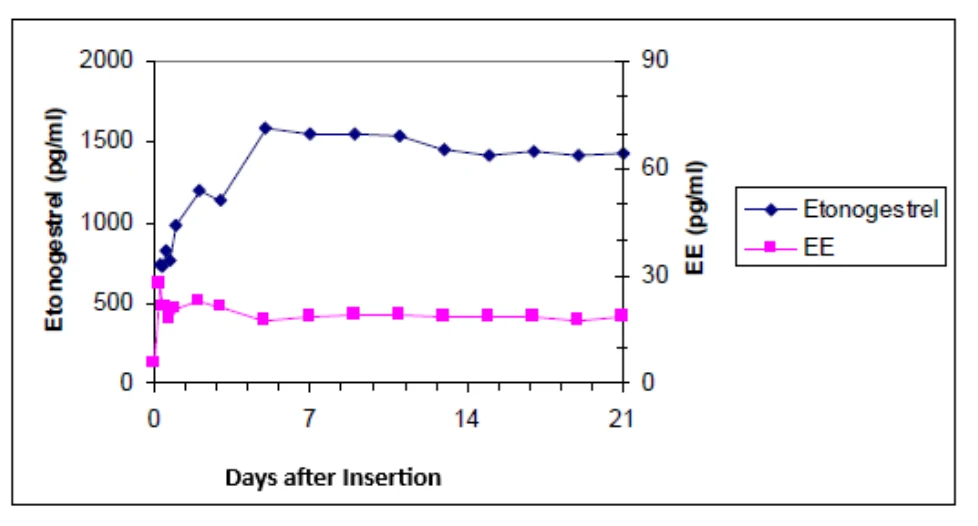
Serum ethinyl estradiol levels were measured in a comparative randomized trial (n=24) with an etonogestrel / ethinyl estradiol slow release vaginal ring (daily vaginal EE release of 0.015 mg), a transdermal patch (norelgestromin/EE; daily EE release of 0.020 mg) and a COC (levonorgestrel/EE; daily EE release of 0.030 mg) during one cycle in healthy female subjects. The monthly systemic ethinyl estradiol exposure (AUC0-¥) of etonogestrel / ethinyl estradiol slow release vaginal ring was 10.9 ng·h/mL.
Distribution:
Etonogestrel: Etonogestrel was found to be 98% protein bound, primarily to albumin and sex hormone- binding globulin (SHBG). The apparent volume of distribution of etonogestrel is 2.3 L/kg.
Ethinyl estradiol: Ethinyl estradiol is highly but not specifically bound to serum albumin (98.5%) and induces an increase in the serum concentrations of SHBG. An apparent volume of distribution of about 15 L/kg has been determined.
Metabolism:
In vitro data shows that both etonogestrel and ethinyl estradiol are metabolized in liver microsomes by the cytochrome P450 3A4 isoenzyme (see 9 DRUG INTERACTIONS). Ethinyl estradiol is primarily metabolized by aromatic hydroxylation, but a wide variety of hydroxylated and methylated metabolites are formed. These are present as free metabolites and as sulfate and glucuronide conjugates. The hydroxylated ethinyl estradiol metabolites have weak estrogenic activity. The biological activity of etonogestrel metabolites is unknown.
Elimination:
Etonogestrel and ethinyl estradiol are primarily eliminated in urine, bile and feces.
Special Populations and Conditions
- Pediatrics: The pharmacokinetics of etonogestrel / ethinyl estradiol slow release vaginal rings in healthy postmenarchal female adolescents under the age of 18 has not been studied.
- Ethnic Origin: No formal studies were conducted to evaluate the effect of race on the pharmacokinetics of etonogestrel / ethinyl estradiol slow release vaginal rings.
- Hepatic Insufficiency: No formal studies were conducted to evaluate the effect of hepatic disease on the pharmacokinetics, safety, and efficacy of etonogestrel / ethinyl estradiol slow release vaginal rings. However, steroid hormones may be poorly metabolized in patients with impaired liver function. Acute or chronic disturbances of liver function may necessitate the discontinuation of CHC use until markers of liver function return to normal (see 2 CONTRAINDICATIONS and 7 WARNINGS AND PRECAUTIONS).
- Renal Insufficiency: No formal studies were conducted to evaluate the effect of renal disease on the pharmacokinetics, safety, and efficacy of etonogestrel / ethinyl estradiol slow release vaginal rings.
11 STORAGE, STABILITY AND DISPOSAL
Keep HALOETTE at room temperature (between 2-25°C). Protect from light.
Keep in a safe place out of the reach of children and pets.
12 SPECIAL HANDLING INSTRUCTIONS
After removal, HALOETTE should be replaced in the reclosable sachet and disposed of with the normal household waste in a manner that avoids accidental contact with others. HALOETTE should not be flushed down the toilet.
PART II: SCIENTIFIC INFORMATION
13 PHARMACEUTICAL INFORMATION
Drug Substance
- I. Progestogen
Proper Name: Etonogestrel
Chemical Name: 1) 18,19-Dinor-17α-pregn-4-en-20-yn-3-one,13-ethyl-17-hydroxy-11- methylene-;
- 2) 13-Ethyl-17-hydroxy-11-methylene-18,19-dinor-17α-pregn-4-en-20yn- 3-one.
- 3) (17α)13-ethyl-17-hydroxy-11-methylene-18,19- dinorpregn-4-en-20- yn-3-one.
Molecular Formula: C22H28O2
Molecular Weight: 324.46 g/mol
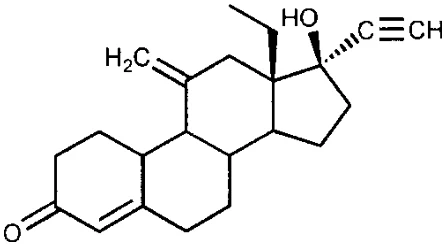
Structural Formula:
Physical Form: White to practically white crystalline powder which may have a slight odour.
Solubility: At 22oC: n-Hexane - 2 mg/mL
Ethanol (96%) - 60 mg/mL
Ethyl acetate - 60 mg/mL
Water - practically insoluble
Melting Point: 197.6oC
- II. Estrogen
Proper Name: Ethinyl Estradiol Ph.Eur.
Chemical Name: 19-Nor-17α-pregna-1,3,5(10)-trien-20-yne-3,17-diol
Molecular Formula: C20H24O2
Molecular Weight: 296.4 g/mol
Structural Formula:
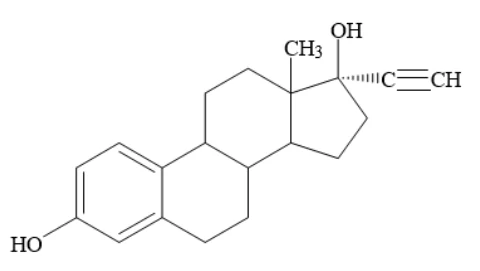
Physical Form: White, crystalline powder
Solubility: Soluble in ethanol, ether, acetone, chloroform.
Practically insoluble in water.
Melting Point: 182-184°C
14 CLINICAL TRIALS
14.1 Clinical Trials by Indication
Indication 1: Conception control
Table 10 - Summary of patient demographics for clinical trials in contraception
| Study # | Trial design | Dosage, route of administration and duration | Study subjects (n=number) | Mean age (Range) | Gender | Primary endpoint | Secondary endpoint | ||||
|---|---|---|---|---|---|---|---|---|---|---|---|
| 068003 | Open-label, non- comparative, multicenter, efficacy, cycle control, safety | Declared daily release rate of 0.120 mg ENG and 0.015 mg EE, vaginal – 13 cycles | 1,177 | 28.1 (18-41) | F | Contraception – Primary efficacy was based on contraceptive efficacy, ie, on the prevention of in- treatment pregnancies. Pearl indices (representing the expected number of pregnancies per 100 women-years of exposure) and overall cumulative probability of in- treatment pregnancy are estimated to evaluate the contraceptive efficacy of | Cycle control – The statistical analysis of the cycles focused on the following parameters:
| ||||
| 34219 | 1,145 | 28.2 (18-41) | |||||||||
| Study # | Trial design | Dosage, route of administration and duration | Study subjects (n=number) | Mean age (Range) | Gender | Primary endpoint | Secondary endpoint | ||
|---|---|---|---|---|---|---|---|---|---|
| etonogestrel / ethinyl estradiol slow release vaginal rings. |
| ||||||||
- a) Contraceptive Efficacy – Pearl Index
Clinical studies were performed worldwide in women between the age of 18 and 40 years.
In 2 large pivotal clinical trials of 13 cycles of etonogestrel/ethinyl estradiol slow release vaginal ring use, pregnancy rates were between 1 and 2 per 100 women-years of use.
- b) Cycle Control
Relative frequencies of bleeding/spotting and bleeding days showed a consistent pattern throughout all 13 cycles for the pivotal studies combined. The majority of subjects were bleeding/spotting during the ring-free period. The relative frequencies of bleeding days were acceptable during almost all ring period days.
For the combined pivotal studies, incidences of bleeding variables over Cycles 1-13 were acceptable and comparable to that of other combined hormonal contraceptives (Table 11). The incidence of breakthrough bleeding/spotting ranged from 5.1% - 7.9% and the incidence of absence of withdrawal bleeding ranged from 1.5% - 2.9% of Intent-to-Treat (ITT) evaluable cycles. Per Protocol (PP) cycles exhibited lower incidences than ITT cycles (Figure 2). Early (ranges 5.6% - 8.8%) and continued withdrawal bleeding (ranges 19.5% to 25.2%) consisted mostly of spotting days only. The incidence of intended bleeding pattern, which is representative of an “ideal” bleeding pattern where bleeding occurs primarily during the ring-free period (without breakthrough bleeding/spotting, without absence of withdrawal bleeding, without absence of early and continued (in the next cycle) withdrawal bleeding), over Cycles 1- 12 ranged from 59.9% - 68.5% of ITT evaluable cycles. The incidences of intended bleeding pattern were comparable between ITT and PP cycles.
Table 11 – Parameters of Bleeding Pattern during the First Year of use – Combined Pivotal Studies
| Cycle | Number of Evaluable Cycles | Number of Evaluable Cycles | Incidence of Breakthrough Bleeding/Spotting (%) | Incidence of Absence of Withdrawal Bleeding (%) | Incidence of Intended Bleeding Pattern (%) | |||||||||||||
|---|---|---|---|---|---|---|---|---|---|---|---|---|---|---|---|---|---|---|
| ITT | PP | ITT | PP | ITT | PP | ITT | PP | |||||||||||
| 1 | 1,971 | 1,709 | 7 | 5.9 | 2.9 | 2.3 | 59.9 | 60 | ||||||||||
| 3 | 1,796 | 1,368 | 7.9 | 6.6 | 2.1 | 1 | 63.6 | 65.2 | ||||||||||
| 6 | 1,649 | 1,299 | 6.2 | 5.7 | 1.5 | 1.2 | 66.5 | 67.1 | ||||||||||
| 9 | 1,499 | 1,177 | 6.0 | 4.8 | 2.4 | 1.7 | 65.8 | 66.7 | ||||||||||
| 12 | 1,300 | 1,053 | 6.6 | 5.3 | 2.2 | 1.7 | 68.5 | 70.0 | ||||||||||
| 13 | 948 | 734 | 5.5 | 3.5 | 2.2 | 1.2 | 84.8 | 87.9 | ||||||||||
ITT = Intent-to-Treat; PP = Per Protocol
Figure 2 – Incidence of Breakthrough Bleeding/Spotting (BTB/S) – Combined Pivotal Studies
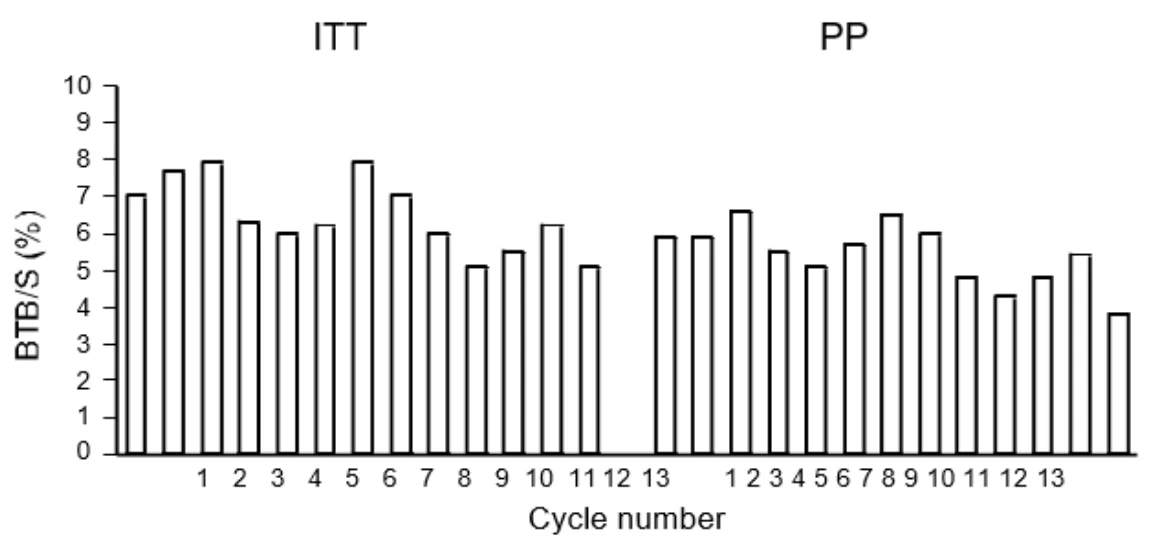
ITT = Intent-to-Treat; PP = Per Protocol
- c) Tolerance
Acceptability of etonogestrel/ethinyl estradiol slow release vaginal ring was evaluated in the pivotal studies on the basis of answers to questions completed by each subject at different timepoints during the studies. Acceptability data from last assessment related to the use of etonogestrel/ethinyl estradiol slow release vaginal ring are presented in Table12. Nearly all women found the ring easy to insert and remove. Eighteen percent of women reported at least occasionally feeling the ring during intercourse. Although this response was higher for the question of partners feeling the ring, 94% of completers’ partner and 83% of discontinuers’ partner did not object to women using the ring.
Table 12 – Responses from Acceptability Questionnaire at Last Assessment – Combined Pivotal Studies
| Population | Number of responders | Proportion of subjects responding | ||||||||
|---|---|---|---|---|---|---|---|---|---|---|
Never / rarely % | Occasionally % | Frequently / always % | ||||||||
| Completers | 1,499 | 1 | 1 | 98 | ||||||
| Population | Number of responders | Proportion of subjects responding | ||||||||||
|---|---|---|---|---|---|---|---|---|---|---|---|---|
Never / rarely % | Occasionally % | Frequently / always % | ||||||||||
| Was the ring easy to insert? | Discontinuers | 643 | 4 | 5 | 92 | |||||||
| Combined | 2,142 | 2 | 2 | 96 | ||||||||
| Was the ring easy to remove? | Completers | 1,499 | 0 | 1 | 98 | |||||||
| Discontinuers | 642 | 2 | 3 | 95 | ||||||||
| Combined | 2,141 | 1 | 2 | 98 | ||||||||
| Could feel ring during intercourse? | Completers | 1,498 | 85 | 12 | 3 | |||||||
| Discontinuers | 630 | 77 | 13 | 10 | ||||||||
| Combined | 2,128 | 83 | 13 | 5 | ||||||||
| Could partner feel ring during intercourse? | Completers | 1,498 | 71 | 22 | 7 | |||||||
| Discontinuers | 631 | 63 | 21 | 16 | ||||||||
| Combined | 2,129 | 68 | 22 | 10 | ||||||||
| Did partner mind | Completers | 1,498 | 94 | 4 | 2 | |||||||
| you using the ring? | Discontinuers | 635 | 83 | 6 | 10 | |||||||
| Combined | 2,133 | 91 | 5 | 5 | ||||||||
Ninety-six percent (96%) of completers at cycle 13 reported that they were satisfied with the ring and 97% would recommend this method to others. Eighty-five percent (85%) of all women (completers and premature study discontinuers) were satisfied with the use of etonogestrel/ethinyl estradiol slow release vaginal rings and 90% would recommend this method to others.
- d) Safety
In the combined pivotal non-controlled open-label studies 351/2322 (15.1%) treated subjects discontinued due to adverse events; most were drug-related adverse events. The most common adverse events leading to discontinuation of women were device related events (2.5%): foreign-body sensation, coital problems, device expulsion, vaginal symptoms (discomfort/vaginitis/leukorrhea), headache (1.3%), emotional lability (1.2%), and weight increase (1.0%).
Over the 13 cycles of treatment, the mean increase in body weight from baseline was 0.84 kg. Similarly, there was no clinically relevant change from baseline in blood pressure (Table 13).
Table 13 – Mean Change (± standard deviation) in Blood Pressure and Body Weight from Baseline – Combined Pivotal Studies (ITT)
| Cycle | |||||||||||
|---|---|---|---|---|---|---|---|---|---|---|---|
| 3 | 6 | 9 | 13 | ||||||||
| Diastolic (mmHg) | -0.1 ± 8.4 | -0.3 ± 8.9 | 0.0 ± 8.7 | 0.5 ± 8.9 | |||||||
| Systolic (mmHg) | -0.2 ± 10.3 | -0.1 ± 11.0 | -0.2 ± 11.0 | 0.6 ± 11.2 | |||||||
| Body weight (kg) | 0.02 ± 2.29 | 0.05 ± 3.12 | 0.47 ± 3.40 | 0.84 ± 3.81 | |||||||
Subjects withdrew at a rate of <1.0% for the following reasons: bleeding irregularities, vaginal discomfort, vaginitis, nausea, and leukorrhea.
Comparative Trials – Cycle Control
In 3 metabolic studies, the secondary objective was to examine cycle control and tolerability in etonogestrel/ethinyl estradiol slow release vaginal ring users compared to a 150 mcg levonorgestrel/30 mcg ethinyl estradiol combined oral contraceptive group (COC). All three trials were of similar design to permit pooling of the data for all 6 cycles.
Relative frequencies of bleeding/spotting and bleeding days showed a consistent pattern throughout all 6 cycles for both treatment groups, except for Cycle 1 in the COC group. In the etonogestrel/ethinyl estradiol slow release vaginal ring group, the relative frequencies of bleeding/spotting during the ring-free periods reached a maximum of at least 92.6% per cycle in the ITT analysis. In the COC group, the relative frequencies of bleeding/spotting during the ring-free periods reached a maximum of at least 91.8% per cycle. The relative frequencies of bleeding/spotting days are low during the ring/pill period beginning from the second half of the first week onwards while the relative frequencies of bleeding days are extremely low during almost all ring/pill period days.
Withdrawal bleeding occurred in nearly all cycles for both groups, 98.2 - 100%. Incidences of early withdrawal bleeding (Cycles 1-6) were low in both groups (1.3% to 13.0% in the etonogestrel/ethinyl estradiol slow release vaginal ring group, and 1.8% to 10.3% in the COC group). Continued withdrawal bleedings (over Cycles 1-5) ranged from 17.4% to 28.0% in the etonogestrel/ethinyl estradiol slow release vaginal ring group and from 45.9% to 57.1% in the LNG/EE OC group. This difference was statistically significant. In both groups early withdrawal bleeding and continued bleeding consisted mostly of spotting days only.
Incidences of breakthrough bleeding/spotting episodes for the etonogestrel/ethinyl estradiol slow release vaginal ring group over Cycles 1-6 ranged from 1.1% - 5.0% (Table 14). In the COC group, these incidences over Cycles 2-6 ranged from 5.4% - 11.0%, whereas in Cycle 1 the incidence was 38.8%. This observed difference for Cycle 1 was statistically significant. Note that, for Cycle 1, the etonogestrel/ethinyl estradiol slow release vaginal ring group inserted the ring on Day 5 of the menstrual period, whereas the LNG/EE group started pill intake on Day 1. To allow for this difference, a correction was made during data analysis by excluding the first seven days of Cycle 1.
The incidence of intended bleeding pattern for the etonogestrel/ethinyl estradiol slow release vaginal ring group was significantly higher over Cycles 1-5 (ranging from 65.3% - 68.4%) than the COC group (ranging from 28.4% - 46.8%) (Table 14). The high incidences of intended bleeding pattern during Cycle 6 (93.8% in the etonogestrel/ethinyl estradiol slow release vaginal ring group and 91.4% in the COC group) were due to continued withdrawal bleedings not being reported, since it would have required post-treatment bleeding data.
Table 14 – Cycle control in combined metabolic studies (etonogestrel/ethinyl estradiol slow release vaginal ring n=121; COC n=126) (ITT)
| Incidence of Breakthrough Bleeding / Spotting (%) | Incidence of Intended Bleeding Pattern (%) | ||||||||||
|---|---|---|---|---|---|---|---|---|---|---|---|
| Cycle | Etonogestrel/ethinyl estradiol slow release vaginal ring | COC | Etonogestrel/ethinyl estradiol slow release vaginal ring | COC | |||||||
| 1 | 1.9 | 38.8 | 65.4 | 28.4 | |||||||
| 2 | 4 | 10.7 | 68.3 | 35.7 | |||||||
| 3 | 3.1 | 10.1 | 65.3 | 44 | |||||||
| 4 | 1.1 | 6.3 | 68.4 | 46.8 | |||||||
| 5 | 4.3 | 11 | 66.3 | 45.9 | |||||||
| 6 | 5 | 5.4 | 93.8 | 91.4 | |||||||
A subsequent large comparative study with 150/30 mcg LNG/EE OC (n=512 vs n=518) evaluating vaginal bleeding characteristics over 13 cycles showed the incidence of breakthrough bleeding/ spotting for etonogestrel/ethinyl estradiol slow release vaginal rings ranged from 2.0 - 6.4%. The incidence of intended bleeding pattern for etonogestrel/ethinyl estradiol slow release vaginal rings ranged from 58.8 - 72.8%.
Overall, the cycle control achieved during etonogestrel/ethinyl estradiol slow release vaginal ring use was excellent and better than that in women who used an oral contraceptive for many of the parameters that were examined.
Metabolic Studies
Lipid Metabolism Study
A causal relationship between ischemic heart disease and unfavorable plasma lipid/lipoprotein profiles, specifically, a high LDL/HDL ratio, is now widely accepted on the basis of epidemiologic, biochemical and other evidence. It has also been demonstrated that androgens influence the lipid/lipoprotein ratio unfavourably, while estrogens have a beneficial effect, largely by increasing HDL2 and, to a lesser extent, by reducing LDL levels.
Etonogestrel/ethinyl estradiol slow release vaginal ring use had generally favorable effects on lipids. In a clinical study involving 40 etonogestrel/ethinyl estradiol slow release vaginal ring-treated subjects, the following effects on lipid metabolism parameters were observed: total cholesterol (Total-C) was unchanged, high-density lipoprotein cholesterol (HDL-C) was unchanged, HDL2 increased 26.3%, HDL3 decreased 4.6%, low-density lipoprotein cholesterol (LDL-C) was unchanged, triglycerides increased 23.8%, apolipoprotein A-1 (apo A-1) increased 10.3%, apolipoprotein B (apo B) increased 6.2%, and lipoprotein (a) decreased 12.9%.
In the same clinical study etonogestrel/ethinyl estradiol slow release vaginal ring use was also compared to a levonorgestrel/ethinyl estradiol oral contraceptive group (LNG/EE OC). Total cholesterol levels remained more or less unchanged in both groups. However, HDL-, HDL2-, and HDL3- cholesterol levels were significantly higher in etonogestrel/ethinyl estradiol slow release vaginal ring group than in the LNG/EE OC group. Levels of HDL-, HDL2-, and HDL3- cholesterol were decreased from baseline in the LNG/EE OC group and unchanged (HDL), increased (HDL2) and slightly decreased (HDL3) in etonogestrel/ethinyl estradiol slow release vaginal ring group. LDL-cholesterol levels were significantly lower in etonogestrel/ethinyl slow release estradiol vaginal ring group, due to an increase in the LNG/EE OC group and no change or decrease in etonogestrel/ethinyl estradiol slow release vaginal ring group. Triglyceride levels were increased in both groups. No significant difference between the two groups was noted. Group comparisons indicated significantly higher apolipoprotein A-I levels for the etonogestrel/ethinyl estradiol vaginal slow release ring group. No treatment differences for apolipoprotein B levels were observed. Compared to baseline, levels increased in the two groups, except for apolipoprotein A-I that decreased in the LNG/EE OC group. Lipoprotein (a) levels were decreased in both groups. No significant difference between the two groups was noted.
The magnitude of the effect of a combined hormonal contraceptive on plasma SHBG depends on both the estrogen dose and the dose and hormonal profile of the progestogenic component. A progestogen with low androgenic activity, such as etonogestrel, is expected to induce higher SHBG concentrations as compared to the ones with higher androgenic activity. Comparison between two treatment groups showed a significantly higher increase of adjusted SHBG levels for the etonogestrel/ethinyl estradiol slow release vaginal ring group (62% at Cycle 6) than the LNG/EE OC group. At Cycle 6, relative increases from baseline were 170% for the etonogestrel/ethinyl estradiol slow release vaginal ring group and 56% for the LNG/EE OC group.
Hemostasis Study
A specific hemostasis study (n=44) was performed with etonogestrel/ethinyl estradiol slow release vaginal rings. In addition to conventional parameters such as fibrinogen, plasminogen, tissue plasminogen activator and plasminogen activator inhibitor-I antigen, a number of new assays have been introduced. These assays detect markers that are generated in the proteolytic process of the thrombin-generating or fibrinolytic cascade and, in contrast to the more conventional parameters mentioned before, are considered to reflect the ‘in vivo’ hemostasis activity. Therefore they may be more predictive of a pre-thrombotic state (Winkler et al., 1995) than the conventional parameters. This concerns the procoagulation parameters prothrombin fragment 1 and 2 and the thrombin-antithrombin III complex, which are indicative of thrombin generation, and the profibrinolysis parameter plasmin-antiplasmin complex and fibrin turnover parameters such as D-dimer and fibrinogen degradation products as markers of the fibrinolytic cascade. Of further importance are Factor VII because it reflects ongoing coagulatory activity and the anticoagulation parameters antithrombin III, protein C and protein S, because women with a deficiency in any of these factors may not be able to adjust sufficiently to changes induced by external factors.
The effects of etonogestrel/ethinyl estradiol slow release vaginal ring on the above mentioned hemostasis parameters were investigated in an open- label, group-comparative study with a 0.150 mg LNG and 0.030 mg EE containing OC. The effects on the coagulation and fibrinolysis parameters seen in the etonogestrel/ethinyl estradiol slow release vaginal ring group were not statistically different from the effects seen in the LNG/EE OC group, except for the relatively higher increase of the procoagulation parameter Factor VII and the anticoagulation parameter Protein C, and the relative less decrease of the profibrinolysis parameter t-PA in the etonogestrel/ethinyl estradiol slow release vaginal ring group. No difference between the two treatment groups was observed for fibrin turnover. Both in etonogestrel/ethinyl estradiol slow release vaginal ring and in the LNG/EE OC group most of the hemostatic parameters that were investigated showed (small) changes from baseline. The clinical relevance of all these changes is not clear. The hemostatic system is very complex and intricately balanced; to a certain extent, the intrinsic balancing system can overcome the activation/inhibition of one or more of the hemostatic parameters. Furthermore, it is very difficult to correct for a possible natural rhythm, which hampers interpretation of changes from baseline. Nevertheless, both etonogestrel/ethinyl estradiol slow release vaginal rings and the LNG/EE OC had no effect on the end products of the fibrinolytic cascade, namely the fibrin degradation products.
In view of the knowledge that individual women might have increased susceptibility for thrombosis, the data obtained with etonogestrel/ethinyl estradiol slow release vaginal rings and the LNG/EE OC were also compared on an individual basis, with emphasis on women having one or more hemostasis parameters outside the reference ranges. During the study most of the subjects in both treatment groups had one or more in-treatment values outside the reference range. However, none were clinically significant nor considered clinically relevant by the investigator.
In conclusion, although for some parameters differences were observed between etonogestrel/ethinyl estradiol slow release vaginal rings and the LNG/EE OC, there was no evidence of a pronounced disturbance of the hemostatic balance with either product. Furthermore, both etonogestrel/ethinyl estradiol slow release vaginal rings and the LNG/EE OC had no effect on the end products of the fibrinolytic cascade, namely the fibrin degradation products.
Carbohydrate Metabolism Study
In another metabolic study (n=37) there was less of an effect on the adrenal function parameter total cortisol with etonogestrel/ethinyl estradiol slow release vaginal rings than with LNG/EE OC. The thyroid function parameter TSH showed a significantly higher relative increase in the etonogestrel/ethinyl estradiol slow release vaginal ring group at Cycle 3, but not at the Cycle 6 assessment. Free thyroxin levels were unchanged compared to baseline in both groups. The effects on carbohydrate metabolism parameters seen in the etonogestrel/ethinyl estradiol slow release vaginal rings group were similar to the effects seen in the LNG/EE OC group.
Bone Mineral Density
A controlled open-label, multicenter trial was conducted to evaluate the effects of etonogestrel/ethinyl estradiol slow release vaginal rings on bone mineral density (BMD) in healthy young women (n=105; 76 completers) over a 2 year period (26 cycles). The control group (n=39; 31 completers) consisted of women who did not use a hormonal method of contraception, and an IUD was offered as trial medication. The mean age of subjects was 27 years in the etonogestrel/ethinyl estradiol slow release vaginal ring group and 29 years in the control group.
For the etonogestrel/ethinyl estradiol slow release vaginal ring group, the BMD for lumbar spine and femoral neck were not statistically different from baseline after two years of follow-up (change in z-score was –0.093 and –0.048, respectively). In the control group, a slight increase of BMD for both the lumbar spine and femoral neck was observed (change in z-score of 0.257 and 0.223, respectively). At the end of 2 years, there was a statistically significant difference in the change of BMD from baseline, between the etonogestrel/ethinyl estradiol slow release vaginal ring group and the control group.
No adverse effects on bone mass have been observed.
Other Studies
Microbiological changes were investigated in a specific safety study (n=58, 13 cycles). The majority of these findings, based on Nugent scores, were Grade I (normal) at screening, at Cycle 6 and at last assessment, and more subjects showed improvement than worsening. No subjects showed a shift from Grade I at screening to Grade III (bacterial vaginosis) at Cycle 6. The majority of vaginal colposcopy observations were normal at screening, at Cycle 6 and at last assessment. The frequency of normal to abnormal changes was low and an equal number of subjects showed abnormal to normal changes. No adverse effects on the cervix and the vagina were found.
Overall Safety
Data from all clinical studies (n=2,501) with etonogestrel/ethinyl estradiol slow release vaginal rings showed that it is generally safe and well tolerated. Approximately 15% of etonogestrel/ethinyl estradiol slow release vaginal ring-treated subjects in all clinical studies with etonogestrel/ethinyl estradiol slow release vaginal rings discontinued due to an adverse event, primarily due to the ring-specific-adverse events, device-related problems and vaginal discomfort. The most commonly reported adverse events (≥5%) were vaginitis, headache, upper respiratory tract infection, leukorrhea, sinusitis, and nausea. There did not appear to be an increased incidence of these adverse events with long-term etonogestrel/ethinyl estradiol slow release vaginal ring treatment, and there were no clinically meaningful differences in the incidence of these common adverse events that could be attributed to differences in demographic characteristics age, body mass index, race, and starter/switcher status. There were no clinically relevant changes from baseline in blood chemistry, hematology, or heart rate measurement.
14.2 Comparative Bioavailability Studies
An open-label, randomized, two-treatment, two-period, single-dose, crossover comparative bioavailability study of HALOETTE slow release vaginal ring (Searchlight Pharma Inc.) and NUVARING® slow release vaginal ring (Merck Sharp & Dohme Corp., USA) was conducted in 20 healthy, adult, female volunteers. Comparative bioavailability data from the 20 subjects that were included in the statistical analysis are presented in the following tables:
Table 15 - Summary Table of the Comparative Bioavailability Data
Ethinyl Estradiol (1x 15 mcg per day) Geometric Mean Arithmetic Mean (CV %) | ||||
| Parameter | Test1 | Reference2 | % Ratio of Geometric Means | 90% Confidence Interval |
AUC0-504 (pg·h/mL) | 9021.81 9633.28 (46.58) | 10211.15 10896 (46.37) | 88.4 | 86.3 – 90.4 |
AUCT (pg·h/mL) | 9411.18 10109.74 (49.78) | 10631.53 11398.92 (48.95) | 88.5 | 86.6 – 90.5 |
| AUCI (pg·h/mL) | 9594.43 10274.22 (50.97) | 10800.88 11467.37 (49.40) | 88.8 | 86.8 – 90.9 |
Cmax (pg/mL) | 23.15 24.59 (43.78) | 26.73 28.10 (39.37) | 86.6 | 82.9 – 90.5 |
Tmax3 (h) | 84.11 (12.03 – 503.97) | 60.29 (2.00 – 432.24) | ||
T½4 (h) | 21.53 (42.54) | 20.12 (30.36) | ||
1 HALOETTE (etonogestrel / ethinyl estradiol) slow release vaginal ring, delivering 120 mcg / 15 mcg per day (Searchlight Pharma Inc.)
2 NUVARING® (Etonogestrel/Ethinyl estradiol) slow release vaginal ring, delivering 120 mcg /15 mcg per day (Merck Sharp & Dohme Corp., USA)
3 Expressed as the median (range) only
4 Expressed as the Arithmetic mean (%CV) only
Table 16 - Summary Table of the Comparative Bioavailability Data
Etonogestrel (1x 120 mcg per day) Geometric Mean Arithmetic Mean (CV %) | ||||
| Parameter | Test1 | Reference2 | % Ratio of Geometric Means | 90% Confidence Interval |
AUC0-504 (pg·h/mL) | 669358.65 694824.65 (28.04) | 736679.10 764050.82 (26.50) | 90.9 | 87.7 – 94.1 |
AUCT (pg·h/mL) | 719592.21 748769.27 (28.61) | 787746.89 819513.55 (27.40) | 91.3 | 88.1 – 94.7 |
| AUCI (pg·h/mL) | 723704.37 753370.92 (28.71) | 791521.82 823758.87 (27.50) | 91.4 | 88.1 – 94.9 |
Cmax (pg/mL) | 1606.25 1671.32 (28.76) | 1759.49 1831.57 (27.90) | 91.3 | 88.2 – 94.5 |
Tmax3 (h) | 288.04 (120.17 – 503.98) | 264.38 (120.15 – 432.28) | ||
T½4 (h) | 29.69 (24.77) | 28.22 (25.93) | ||
1 HALOETTE (etonogestrel / ethinyl estradiol) slow release vaginal ring, delivering 120 mcg / 15 mcg per day (Searchlight Pharma Inc.)
2 NUVARING® (Etonogestrel/Ethinyl estradiol) slow release vaginal ring, delivering 120 mcg /15 mcg per day (Merck Sharp & Dohme Corp., USA)
3 Expressed as the median (range) only
4 Expressed as the Arithmetic mean (%CV) only
15 MICROBIOLOGY
No microbiological information is required for this drug product.
16 NON-CLINICAL TOXICOLOGY
General Toxicology:
Acute Toxicity Studies
Acute toxicity studies were conducted in rats and in mice using the oral and intraperitoneal route. Etonogestrel (ENG) was dosed orally by gavage (2,000 mg/kg) or intraperitoneally by injection (500 mg/kg). No mortalities occurred at the dose levels used. This is in agreement with published data indicating that natural and synthetic sex steroids, in general, exert low toxic activity in animals.
Chronic Toxicity Studies
The chronic toxicity studies comprised of exposure to ENG by oral administration in rats (52 weeks) and dogs (26 weeks). In rats oral dosages of up to ~70 times and in dogs up to ~160 times the anticipated average human daily dose were administered. In general, ENG induced a pattern of endocrinological changes, in particular in the genital organs and the accessory glands in rats as well as in dogs. These changes were dose-related, generally reversible and they were to be expected on the basis of the hormonal activity of ENG. Studies in rats for up to 2 years and in dogs for up to 5.8 years using ENG- containing implants also revealed no systemic or local abnormalities considered to be related to ENG or the implant. These chronic toxicity studies showed that ENG lacks intrinsic toxic properties. This is consistent with the observation that ENG is the biologically active metabolite of desogestrel (DSG).
Special toxicity studies were performed in monkeys for up to 3 months using either suppositories, vaginal rings, or oral formulations containing ENG and ethinyl estradiol (EE). The results showed that treatment with ENG and EE at intravaginal dose levels up to about 25 times and oral dose levels up to 100 times the anticipated human vaginal dose did not induce overt signs of toxicity. Long-term exposure of monkeys to a placebo ethylene vinylacetate (EVA) copolymer-containing ring was also shown to be devoid of local or systemic effects. All effects could be ascribed to the pharmacological effects of the steroids released by the ring. These observations confirm the suitability of etonogestrel/ethinyl estradiol slow release vaginal rings for human vaginal use.
Additional studies were performed in which several components of the combined contraceptive vaginal ring were tested via a non-vaginal route. Extracts of EVA material caused neither sensitization nor irritation upon direct contact with tissues of mice and guinea pigs in vivo. Implantation of the EVA material (with or without ENG) caused no toxic, irritation or sensitizing effects in rabbit, rat and dog. Potentially leachable components, when extracted in conformity with ISO guidelines were not cytotoxic under in vitro conditions.
The carcinogenic potential of ENG and the EVA copolymer was assessed in rats by using subdermal EVA-containing implants continuously releasing ENG, up to 40 times the human vaginal dose, for a period of 2 years. Several assessments i.e., physical observations, body weight, food consumption, hematology, macroscopic post-mortem examinations and histopathological evaluation (55 tissues including the implant site) were performed. The data showed that EVA-containing implants continuously releasing ENG lack tumorigenic properties.
Since etonogestrel is the biologically active metabolite of desogestrel and since the metabolic profiles of the two compounds are very similar supportive evidence can be obtained from carcinogenicity studies previously performed with desogestrel. In these studies desogestrel was orally administered for 81 weeks either to mice at dose levels of 2x, 20x and 200x the human desogestrel dose or to rats for 104 weeks. In neither study were neoplastic changes observed. The conclusion that desogestrel and therefore etonogestrel was non-carcinogenic can also be derived from studies previously performed in rats, dogs and monkeys using oral administration of the combination of desogestrel and ethinyl estradiol. In these studies mice and rats were treated for 80 weeks and 104 weeks, respectively at dose levels 2x, 20x and 200x the human dose. Pituitary tumor and mammary tumor induction observed in mice and rats in those studies was fully ascribed to the estrogenic component. Dogs were treated for 3 years at dose levels 2x, 10x and 25x the anticipated human dose and monkeys for 3 years at dose levels 2x, 10x and 50x the human dose. In these species only the expected non-neoplastic changes were observed and no tumorigenic effects were seen. In conclusion, chronic toxicity and tumorigenicity studies demonstrated that there is no evidence of carcinogenicity of ENG, EE or the EVA copolymer.
Genotoxicity: Studies with etonogestrel also found no genotoxicity in the in vitro Ames/Salmonella reverse mutation assay, the chromosomal aberration assay in Chinese hamster ovary cells or in the in vivo mouse micronucleus test.
Reproductive and Developmental Toxicology: Reproductive toxicity studies were carried out in rats (Segment I and Segment II) and in rabbits (Segment II). Since pregnancy is a contraindication for the use of the vaginal ring no Segment III studies have been performed. The dose applied is approximately 500 times the anticipated average daily vaginal human dose. Treatment did not have any adverse effect on resulting litter parameters (after cessation of treatment), indicating no effect of ENG on the return of fertility after suppression with ENG. In rats and rabbits, at dosages up to ~250 times the anticipated human dose, ENG was neither embryotoxic nor teratogenic. Previous data reported using DSG support this conclusion. Thus, based on historical data on desogestrel and on recent data on ENG, it was concluded that ENG is devoid of reproductive toxicological hazards.
17 SUPPORTING PRODUCT MONOGRAPHS
- 1. NUVARING (etonogestrel/ethinyl estradiol slow release vaginal ring), 11.4 mg/2.6 mg to deliver 120 mcg etonogestrel/15 mcg ethinyl estradiol per day, submission control 286307, Product Monograph, Organon Canada Inc., (NOV 15, 2024)