


Patient Medication Information: uses, side effects, how to take - Hulio
Serious Warnings and Precautions
Before starting, during and after treatment with Hulio, you/your child should be checked for active or inactive tuberculosis infection with a tuberculin skin test. Any medicine can have side effects. Like all medicines that affect your/your child’s immune system, Hulio can cause serious side effects. The possible serious side effects include:
|
|---|
|
|---|
What is Hulio used for?
Hulio is a medicine that is used in:
- adults with rheumatoid arthritis, which is an inflammatory disease of the joints.
- adults with psoriatic arthritis, which is an inflammatory disease of the joints and skin.
- adults with ankylosing spondylitis, which is a form of arthritis.
- adults with Crohn’s disease, which is an inflammatory disease of the digestive tract.
- patients 2 years of age and older who have polyarticular juvenile idiopathic arthritis.
- children 13 to 17 years weighing ≥ 40 kg who have severe Crohn’s disease or who have Crohn’s disease which has not responded to other usual treatments.
- adults with ulcerative colitis, which is an inflammatory disease of the bowel (colon).
- adults or adolescents (12 to 17 years of age, weighing ≥ 30 kg) with moderate to severe hidradenitis suppurativa (HS) who have not responded to antibiotics. HS is a painful, progressive, chronic inflammatory skin disease that causes nodules, abscesses, sinus tracts and fistulas under the breasts, underarms, buttocks and groin.
- adults with psoriasis, which is an inflammatory disease of the skin. The doctor prescribed Hulio to reduce the signs and symptoms of your plaque psoriasis.
- adults with uveitis, which is an inflammatory disease of the eye.
- children with chronic non-infectious uveitis from 2 years of age with inflammation affecting the front of the eye.
- children 5 to 17 years of age who have ulcerative colitis.
Patients with rheumatoid arthritis, polyarticular juvenile idiopathic arthritis, psoriatic arthritis, ankylosing spondylitis, hidradenitis suppurativa, psoriasis, or uveitis may be given other medicines for their disease before they are given Hulio. If you have ulcerative colitis or you/your child have Crohn’s disease, you/your child will first be given other medicines. If you/your child do not respond well enough to these medicines, you/your child will be given Hulio to reduce the signs and symptoms of your/your child’s disease.
How does Hulio work?
Hulio is a fully human monoclonal antibody produced by cultured cells. Monoclonal antibodies are proteins that recognize and bind to other unique proteins. Hulio binds to a specific protein called TNF-alpha (also known as tumor necrosis factor). People with rheumatoid arthritis, psoriatic arthritis, ankylosing spondylitis, Crohn’s disease, ulcerative colitis, hidradenitis suppurativa or psoriasis have too much of TNF-alpha in their bodies. The extra TNF-alpha in your/your child’s body can attack normal healthy body tissues and cause inflammation, especially in the tissues of your bones, cartilage, joints, digestive tract and skin. By binding to TNF-alpha, Hulio decreases the inflammation process of these diseases.
Hulio helps reduce the signs and symptoms of rheumatoid arthritis, polyarticular juvenile idiopathic arthritis and psoriatic arthritis (such as pain and swollen joints), may help improve your/your child’s ability to perform daily activities (such as getting dressed, walking and climbing stairs), and may help prevent further damage to your/your child’s bones and joints. In addition, Hulio helps reduce the signs and symptoms of ankylosing spondylitis (back pain and morning stiffness), and adult and pediatric Crohn’s disease or adult and pediatric ulcerative colitis (abdominal pain and diarrhea). Hulio may also help normalize childhood growth and pubertal development and improve the quality of life in children who have Crohn’s disease (such as body image, functional and social skills, and emotional health). Hulio may help improve the work productivity and activity impairment in caregivers of children with Crohn’s disease or ulcerative colitis.
Hulio is also used to treat inflammatory lesions (nodules and abscesses) in adults and adolescents (12 to 17 years of age, weighing ≥ 30 kg) with hidradenitis suppurativa.
Hulio also helps reduce the signs and symptoms of psoriasis (such as pain, itching and scaly patches on skin).
Hulio helps control uveitis by reducing the risk of inflammation and loss of vision in adult and pediatric patients.
Hulio, however, can also lower your/your child’s body’s ability to fight infections. Taking Hulio can make you/your child more prone to getting infections or make any infection you/your child have worse.
What are the ingredients in Hulio?
Medicinal ingredients: adalimumab
Non-medicinal ingredients: diluted hydrochloric acid, methionine, monosodium glutamate, polysorbate 80, sorbitol and water for injection (distilled)
Hulio comes in the following dosage forms:
- Single-use, 1 mL pre-filled Pen containing 40 mg adalimumab dissolved in 0.8 mL sterile solution (50 mg/mL)
- Single-use, 1 mL pre-filled plastic syringe containing 40 mg adalimumab dissolved in 0.8 mL sterile solution (50 mg/mL)
- Single-use, 1 mL pre-filled plastic syringe containing 20 mg adalimumab dissolved in 0.4 mL sterile solution (50 mg/mL)
All packaging components are not made with natural rubber latex.
Do not use Hulio if:
You/your child should not take Hulio if you/your child have:
- an allergy to any of the ingredients in Hulio (see What are the ingredients in Hulio?).
- a serious infection such as tuberculosis, infections caused by bacteria or fungi, and bacterial infections that have spread throughout the body (sepsis).
- moderate to severe heart failure (NYHA class III/IV).
To help avoid side effects and ensure proper use, talk to your healthcare professional before you take Hulio. Talk about any health conditions or problems you may have, including if:
- you/your child have or have had any kind of infection including an infection that is in only one place in your/your child’s body (such as an open cut or sore), or an infection that is in your/your child’s whole body (such as the flu). Having an infection could put you/your child at risk for serious side effects from Hulio. If you are unsure, ask your/your child’s doctor.
- you/your child have a history of infections that keep coming back or other conditions that might increase your/your child’s risk of infections, including fungal infections.
- you/your child have ever had tuberculosis, or if you/your child have been in close contact with someone who has had tuberculosis. If you/your child develop any of the symptoms of tuberculosis (a dry cough that doesn't go away, weight loss, fever, night sweats), call your/your child’s doctor right away. Your/your child’s doctor will need to examine you/your child for tuberculosis and perform a skin test.
- you/your child resided or travelled to areas where there is a greater risk for certain kinds of infections such as tuberculosis, histoplasmosis, coccidioidomycosis, blastomycosis, or parasitic infections. These infections are caused by a bacteria or a fungus that can affect the lungs or other parts of your/your child’s body. If you/your child take Hulio, these may become active or more severe. If you don’t know if you/your child have lived in or travelled to an area where these infections are common, ask your/your child’s doctor.
- you/your child have ever had liver injury or hepatitis B virus infection or are at risk of developing this infection. Signs and symptoms include the following: yellowing of the skin or eyes (jaundice), feeling of sickness, tiredness, loss of appetite, joint pain, fever, dark brown-coloured urine, vomiting, and abdominal pain. If you/your child experience any of these signs and symptoms, contact your/your child’s doctor immediately. These symptoms may occur several months after starting therapy with Hulio.
- you/your child experience any numbness or tingling or have ever had a disease that affects your/your child’s nervous system like multiple sclerosis or Guillain-Barré syndrome.
- you/your child have or have had heart failure.
- you/your child are scheduled to have major surgery or dental procedures.
- you/your child are scheduled to be vaccinated for anything. It is recommended that pediatric patients, if possible, be brought up to date with all immunizations according to current guidelines before starting Hulio.
- you/your child are taking other medicines for your/your child’s rheumatoid arthritis, polyarticular juvenile idiopathic arthritis, psoriatic arthritis, ankylosing spondylitis, Crohn’s disease, psoriasis, or other conditions. You/your child can take other medicines provided your/your child’s doctor has prescribed them or has told you it is acceptable that you/your child take them while you/your child are taking Hulio. It is important that you tell your/your child’s doctor about any other medicines you/your child are taking for other conditions (for example, high blood pressure medicine) before you/your child start taking Hulio.
- you/your child are taking other medicines for your/your child’s Crohn’s disease or other conditions. You/your child can take other medicines provided your/your child’s doctor has prescribed them or has told you it is acceptable that you/ your child take them while you/your child are taking Hulio. It is important that you tell the doctor about any other medicines you/your child are taking for other conditions before you/your child start taking Hulio.
- you/your child are taking any over-the-counter drugs, herbal medicines and vitamin and mineral supplements.
you/your child are pregnant or could become pregnant.
- you/your child are breast-feeding or plan to breast-feed.
If you are not sure or have any questions about any of this information, ask your/your child’s doctor.
Other warnings you should know about:
If you/your child received Hulio while pregnant, your/her baby may be at higher risk for getting an infection for up to approximately five months after the last dose of Hulio received during pregnancy. It is important that you tell your/her baby's doctors and other healthcare professionals about your/her Hulio use during pregnancy so they can decide when your/her baby should receive any vaccine.
Tell your healthcare professional about all the medicines you take, including any drugs, vitamins, minerals, natural supplements or alternative medicines.
The following may interact with Hulio:
You/your child should not take Hulio with:
- other TNF-blockers such as Enbrel®, Remicade®, Cimzia®, or Simponi®
- abatacept (Orencia®)
- anakinra (Kineret®)
If you have questions, ask your/your child’s doctor.
How to take Hulio:
Hulio is administered by injection under the skin (by subcutaneous injection).
Usual dose:
Adults with Rheumatoid Arthritis, Psoriatic Arthritis or Ankylosing Spondylitis:
- The recommended dose is 40 mg administered every other week as a subcutaneous injection.
Patients, aged 2 years and older, with polyarticular juvenile idiopathic arthritis:
- weighing 10 kg to less than 30 kg: the recommended dose of Hulio is 20 mg every other week.
- weighing 30 kg or more: the recommended dose of Hulio is 40 mg every other week.
For patients who do not require a full 40 mg dose of Hulio, a 20 mg pre-filled syringe is also available.
Adults with Crohn’s Disease or Ulcerative Colitis:
- The recommended induction dose is 160 mg at Week 0 (dose can be administered as four injections in one day or as two injections per day for two consecutive days), followed by 80 mg at Week 2.
- The recommended maintenance dose regimen is 40 mg every other week beginning at Week 4.
Adults with Hidradenitis Suppurativa:
- The recommended initial dose is 160 mg, followed by 80 mg two weeks later. The first dose of 160 mg can be administered as four injections in one day or as two injections per day for two consecutive days. The second dose of 80 mg is given as two 40 mg injections in one day.
- The recommended maintenance dose regimen is 40 mg every week beginning four weeks after the initial dose.
Adults with Psoriasis or Uveitis:
- The recommended dose is an initial dose of 80 mg, followed by 40 mg given every other week starting one week after the initial dose.
Children, 13 to 17 years of age weighing ≥ 40 kg, with Crohn’s disease:
- The recommended dose is 160 mg initially at Week 0 (given as four 40 mg injections in one day, or as two 40 mg injections per day for two consecutive days), followed by 80 mg at Week 2 (given as two 40 mg injections). At Week 4, you/your child will begin a maintenance dose of 20 mg every other week. Depending on your/your child’s response, the doctor may increase the dose to 40 mg every other week (given as one 40 mg injection).
For children who do not require a full 40 mg dose of Hulio, a 20 mg pre-filled syringe is also available.
Adolescents, 12 to 17 years of age weighing ≥ 30 kg, with Hidradenitis Suppurativa:
- The recommended initial dose is 80 mg administered by subcutaneous injection, followed by 40 mg every other week starting one week later. Depending on your/your child’s response, the doctor may increase the dose to 40 mg every week.
Children, from 2 years of age with Uveitis:
- weighing less than 30 kg: the usual dose of Hulio is 20 mg every other week with methotrexate. Your child’s doctor may also prescribe an initial dose of 40 mg to be administered one week prior to the start of the usual dose if your child is older than 6 years of age.
- weighing 30 kg or more: the usual dose of Hulio is 40 mg every other week with methotrexate. Your child’s doctor may also prescribe an initial dose of 80 mg to be administered one week prior to the start of the usual dose.
Children, from 5 to 17 years of age with Ulcerative Colitis:
- weighing less than 40 kg: the induction dose of Hulio is 80 mg at Week 0, followed by 40 mg at Week 2. The recommended Hulio maintenance dose regimen is 40 mg every other week or 20 mg every week beginning at Week 4.
- weighing 40 kg or more: the induction dose of Hulio is 160 mg at Week 0, followed by 80 mg at Week 2. The recommended Hulio maintenance dose regimen is 80 mg every other week or 40 mg every week beginning at Week 4.
Overdose:
| If you think you, or a person you are caring for, have taken too much Hulio, contact a healthcare professional, hospital emergency department or regional poison control centre immediately, even if there are no symptoms. |
|---|
Missed Dose:
If you/your child forget to give yourself/your child an injection, you/your child should inject the missed dose of Hulio as soon as you/your child remember. Then administer the next dose as you would have on the originally scheduled date.
What are possible side effects from using Hulio?
These are not all the possible side effects you may feel when taking Hulio. If you experience any side effects not listed here, contact your healthcare professional.
Like all medicines, Hulio can cause side effects. Most side effects are mild to moderate. However, some may be serious and require treatment.
Tell your/your child’s doctor immediately if you/your child experience any of the following:
- severe rash, hives or other signs of allergic reaction
- swollen face, hands, feet
- trouble breathing, swallowing
- sudden weight gain; this is possibly indicative of new or worsening heart failure
- bruising or bleeding very easily, looking very pale; this could mean a blood problem such as low red blood cells (anemia) or low platelets
Tell the doctor as soon as possible if you/your child notice any of the following:
- signs of infection such as fever, malaise, wounds, dental problems, burning on urination
- feeling weak or tired
- coughing
- tingling
- numbness
- double vision
- arm or leg weakness
- arm or leg pain, swelling or redness
- bump or open sore that does not heal
- red scaly patches or raised bumps that are filled with pus; this could be new or worsening hidradenitis suppurativa, new or worsening psoriasis or a skin infection
- alopecia (loss of hair)
- changes in the colour of the skin
- changes in the colour of your/your child’s urine (dark or red)
- worsening of the appearance of a scar
- night sweats
- weight loss
- pain in the abdomen or chest
Serious side effects and what to do about them
| Symptom / effect | Talk to your healthcare professional | Stop taking drug and get immediate medical help | |
|---|---|---|---|
| Only if severe | In all cases | ||
| VERY COMMON | |||
| Injection site reaction | ✓ | ||
| COMMON | |||
| Cough and cold symptoms, including sore throat | ✓ | ||
| Headache | ✓ | ||
| Rash | ✓ | ||
Serious side effects and what to do about them
| Symptom / effect | Talk to your healthcare professional | Stop taking drug and get immediate medical help | |
|---|---|---|---|
| Only if severe | In all cases | ||
| Nausea | ✓ | ||
| Pneumonia | ✓ | ✓ | |
| Fever | ✓ | ||
| Abdominal Pain | ✓ | ||
| UNCOMMON | |||
| Tuberculosis | ✓ | ✓ | |
| Other serious infections | ✓ | ✓ | |
| Nerve disorder | ✓ | ✓ | |
| Appendicitis | ✓ | ✓ | |
| Blood clots: abdominal pain, chest pain, leg or arm pain with redness and swelling | ✓ | ✓ | |
| Bladder infection (painful urination) | ✓ | ✓ | |
| Hepatitis (jaundice [yellow skin, dark urine], abdominal pain, tiredness) | ✓ | ✓ | |
If you have a troublesome symptom or side effect that is not listed here or becomes bad enough to interfere with your daily activities, talk to your healthcare professional.
General Advice About Prescription Medicines
Talk to your/your child’s doctor or other healthcare provider if you have any questions about this medicine or your/your child’s condition. Medicines are sometimes prescribed for purposes other than those listed in a PATIENT MEDICATION INFORMATION leaflet. If you have any concerns about this medicine, ask the doctor. The doctor or pharmacist can give you information about this medicine that was written for healthcare professionals. Do not use this medicine for a condition for which it was not prescribed. Do not share this medicine with other people. A toll-free information service is also available at 1-844-596-9526.
Reporting Side Effects
You can report any suspected side effects associated with the use of health products to Health Canada by:
NOTE: Contact your health professional if you need information about how to manage your side effects. The Canada Vigilance Program does not provide medical advice. |
Storage:
Do not use beyond the expiration date on the container. Hulio must be refrigerated at 2°C to 8°C. DO NOT FREEZE. Do not use if frozen even if it has been thawed.
Store in original carton until time of administration to protect from light.
If needed, for example when traveling, Hulio may be stored at room temperature up to a maximum of 25°C (77°F) for a period of up to 56 days for 20 mg in 0.4 mL sterile solution and up to 56 days for 40 mg in 0.8 mL sterile solution, with protection from light. Hulio should be discarded if not used within that time period. Record the date when Hulio is first removed from the refrigerator in the space provided on the carton.
Do not store Hulio in extreme heat or cold.
Keep out of reach and sight of children.
If you want more information about Hulio:
- Talk to your healthcare professional
- Find the full product monograph that is prepared for healthcare professionals and includes this Patient Medication Information by visiting the Health Canada website, (https://www.canada.ca/en/health-canada/services/drugs-health-products/drug-products/drug-product-database.html); or by calling 1-833-986-1468.
Instructions for Use:
The following instructions explain how to inject Hulio. Please read the instructions carefully and follow them step-by-step. You will be instructed by your/your child’s doctor or assistant on the technique of injection. Do not attempt to inject until you are sure that you understand how to prepare and give the injection. After proper training, the injection can be self-administered or given by another person; for example, a healthcare professional, a family member or friend.
This injection should not be mixed in the same syringe with any other medicine.
Hulio Pen
| Gather Supplies for Injection |
|---|
Supplies you will need:
1 Pen
(taken from refrigerator 30 minutes prior to intended injection time to allow Pen to reach room temperature)
1 alcohol prep
1 sharps disposal container
(or puncture resistant container)
(not included in Hulio carton)
1 gauze pad (or cotton ball)
(not included in Hulio carton)
If you do not have all the supplies you need to give yourself an injection, visit or call your local pharmacist.
| Preparing the Pen |
|---|
Let Pen reach room temperature. Remove Pen from the carton in the refrigerator 30 minutes before using. Do not shake the Pen. Do not use the Pen if it has been left in direct sunlight. Do not use external heat sources such as hot water to warm Pen. Do not put Pen back in refrigerator once it has reached room temperature. Check the expiration date printed on the Pen. Do not use Pen past the expiration date. |


Check the Viewing Window to make sure:
- Medication is at or near the Fill Marker. You may need to shake gently to see liquid.
- Medication is clear to slightly opalescent, colorless to pale brownish-yellow and has no particles.
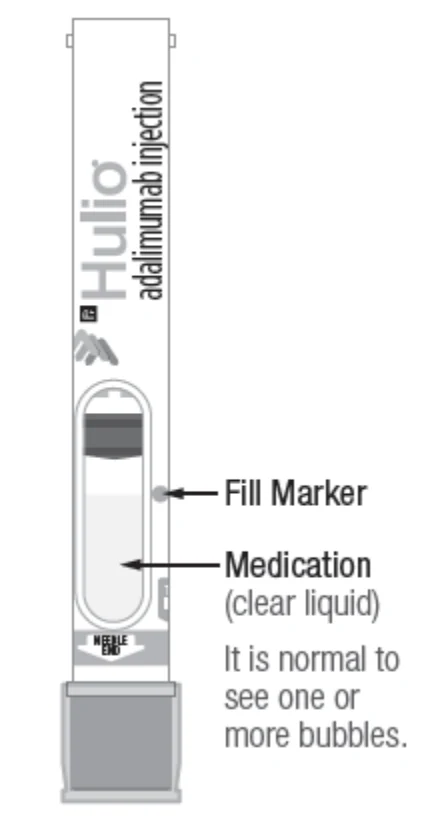
Do not use Pen if medication is not near the Fill Marker. Use another Pen and/or contact your healthcare provider.
Do not use Pen if it is cloudy, discolored, or has particles in it.
| Choosing & Preparing Injection Site |
|---|
| Your healthcare provider should show you proper injection site techniques. | |
|---|---|
Recommended subcutaneous (under the skin) injection sites are:
|
| You should rotate and change your injection site each time. | ||
|---|---|---|
| Stay at least 1 inch from a previous site used. | ||
| Do not inject into areas where the skin is tender, bruised, red, hard, scarred or has stretch marks. | ||
| If you have psoriasis, do not inject into any raised, thick, red, or scaly skin patches or lesions. | ||
| Do not inject through clothes. Roll back any clothing that may interfere with the injection site. | ||
| Wash your hands with soap and water. | ||
Wipe the chosen injection site with an alcohol prep. Wait for it to dry on its own, do not blow dry. | ||
| Do not touch this injection site again before receiving your injection |
| Giving the Injection |
|---|
| CAUTION: | Injection process must be completed without interruption. Read all steps first before beginning injection. |
DOSAGE: Use one Pen for one dose. |
|---|
| STEP 1 |
|---|



Uncap
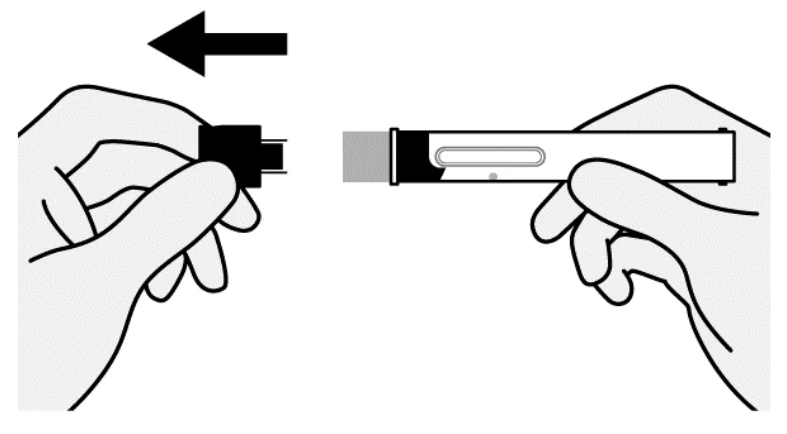
Pull straight to uncap Pen, don’t twist.
A few drops of liquid may come out of the needle, this is normal.
Do not re-cap Pen. Recapping can damage the needle.
Do not touch the Orange Activator with your fingers (this is where the needle comes out).
| STEP 2 |
|---|
Squeeze & Hold Injection Site
Thigh injection site shown here, perform these steps in a similar manner for abdomen injection sites.
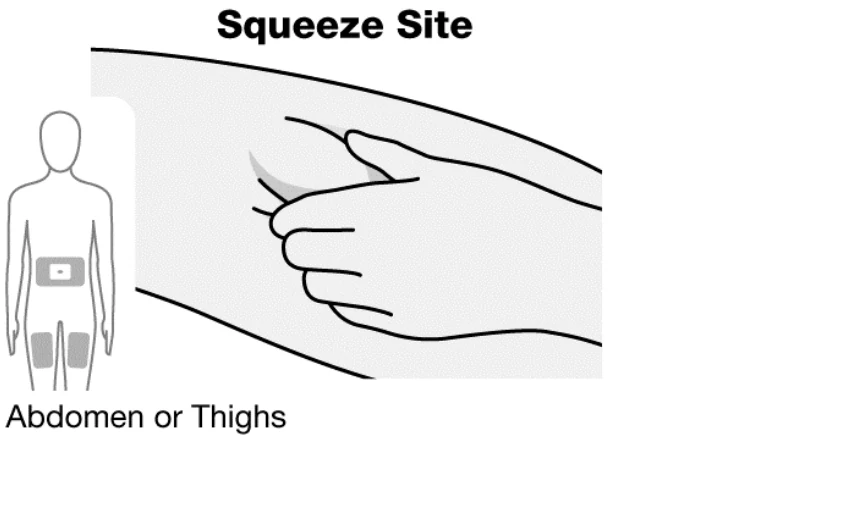
Gently squeeze the injection site to create a raised area, and hold that area firmly.
Recommended injection sites include the thighs or abdomen (belly).
Do not use area within 2 inches of belly button.
Rotate sites with each injection. Stay at least 1 inch from a previous site used.
Do not inject into areas where the skin is tender, bruised, red, hard, scarred or has stretch marks.
See “Choosing & Preparing Injection Site” or consult your healthcare provider for injection site assistance.
| STEP 3 |
|---|
Place Pen
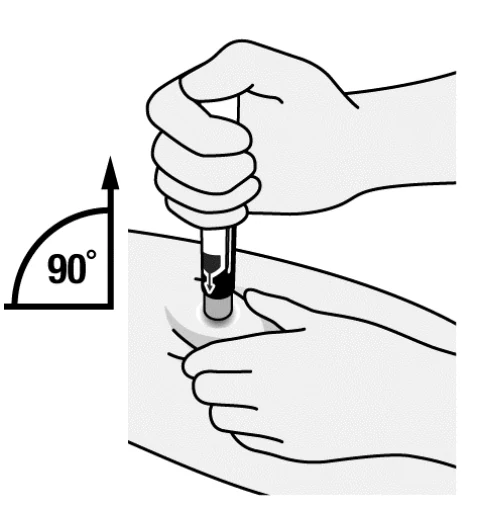
Place the Orange Activator end onto the injection site.
Keep the Pen held perpendicular (90° angle) to the injection site, and with the Viewing
Window visible to you.
Be careful to place the Pen so that it will not inject into your fingers holding the injection site.
| STEP 4 |
|---|
Begin Injection
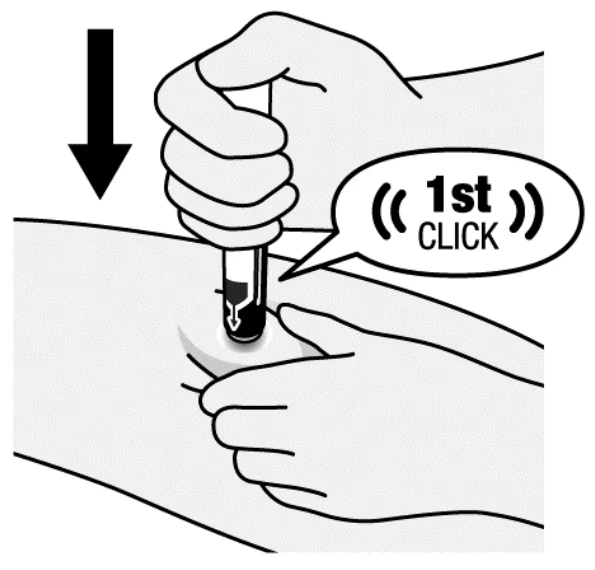
Firmly push the body of the Pen down against the injection site to engage the Orange Activator and begin injection.
Continue holding down after hearing the First “CLICK”. This First “CLICK” signals the start of the injection.
In the Viewing Window, the Orange-Indicator will advance to show the progress of the injection.
Do not move, twist, or rotate Pen during injection.
| STEP 5 |
|---|
Hold Down for 2nd “CLICK” & 10 Seconds
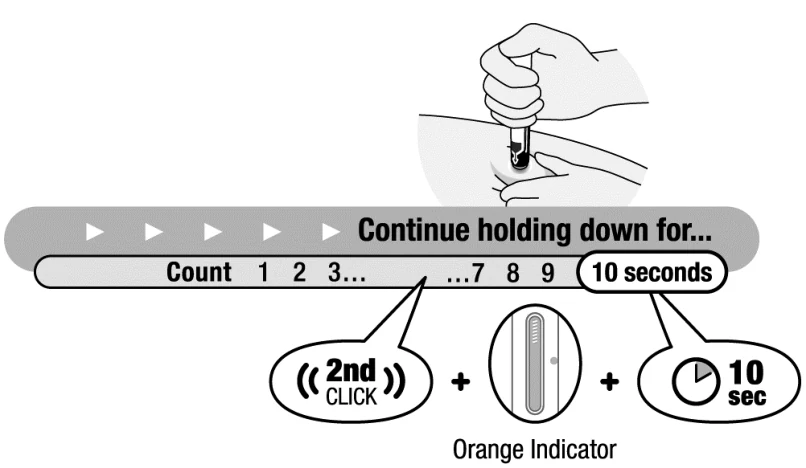
Continue holding the body of the Pen down against the injection site until...
- A Second “CLICK” was heard,
- 10 seconds has passed,
- Orange Indicator has stopped and completely blocked the Viewing Window.
| CAUTION: Confirm all three of these have occurred to ensure all medication was delivered. If you do not think you received the full dose, Do not take another dose. Contact your healthcare provider for assistance. |
| STEP 6 |
|---|
End of Injection, Remove Pen
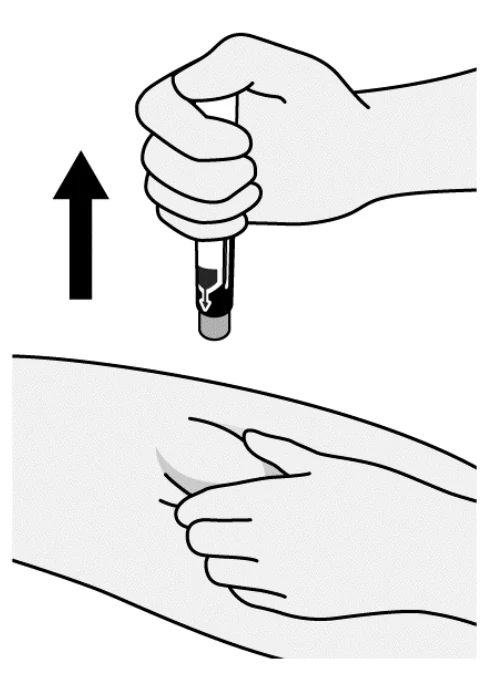
Pull Pen straight away from injection site.
After injection, if slight bleeding occurs from the injection site, press a gauze pad or cotton ball lightly against the site for a few seconds — Do not rub the injection site.
Dispose Pen & Cap Put the used Pen and Cap in a sharps disposal container. Pen is for single-dose only. Do not reuse. See “Disposing the Pen” for additional details. |
| Disposing the Pen |
|---|
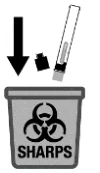
- You should always check with your/your child’s healthcare provider (e.g., doctor, nurse, or pharmacist) for instructions on how to properly dispose of used needles and syringes (including the Pen). Do NOT use the same needle and syringe more than once. You should follow any special provincial or local laws regarding the proper disposal of needles and syringes. Do NOT throw used needles or syringes (including the Pen) in the household trash or recycling bin.
- Dispose of used needles and syringes (including the Pen) in a container made especially for this purpose (sharps container), or a hard plastic container with a screw-on cap or metal container with a plastic lid labelled “Used Syringes”. Do not use glass or clear plastic containers.
- Always keep the container out of the reach of children.
- When the container is about two-thirds full, tape the cap or lid down so it does not come off and dispose of it as instructed by your/your child’s doctor, nurse or pharmacist. DO NOT THROW THE CONTAINER IN THE HOUSEHOLD TRASH OR RECYCLING BIN.
| Injection Diary |
|---|
| Date | Injection Site Used |
|---|
Hulio Pre-Filled Syringe
| Gather Supplies for Injection |
|---|
Supplies you will need:
1 Syringe
(taken from refrigerator 30 minutes prior to intended injection time to allow Syringe to reach room temperature)
- 1 alcohol prep
1 sharps disposal container
(or puncture resistant container)
(not included in Hulio carton)
1 gauze pad (or cotton ball)
(not included in Hulio carton)
If you do not have all the supplies you need to give yourself an injection, visit or call your local pharmacist.
| Preparing the Syringe |
|---|
Let Syringe reach room temperature. Remove Syringe from the carton in the refrigerator 30 minutes before using. Do not shake the Syringe. Do not use the Syringe if it has been left in direct sunlight. Do not use external heat sources such as hot water to warm Syringe. Do not put Syringe back in refrigerator once it has reached room temperature. Check the expiration date printed on the Syringe. Do not use Syringe past the expiration date. |
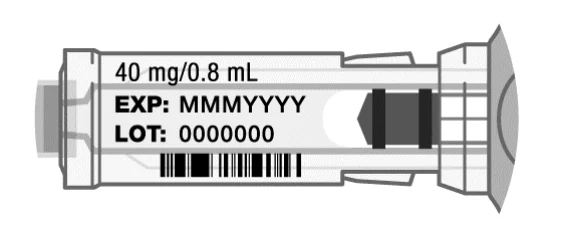
Check the Viewing Window to make sure:
- Medication is at or near the Fill Marker. You may need to shake gently to see liquid.
- Medication is clear to slightly opalescent, colorless to pale brownish-yellow and has no particles.
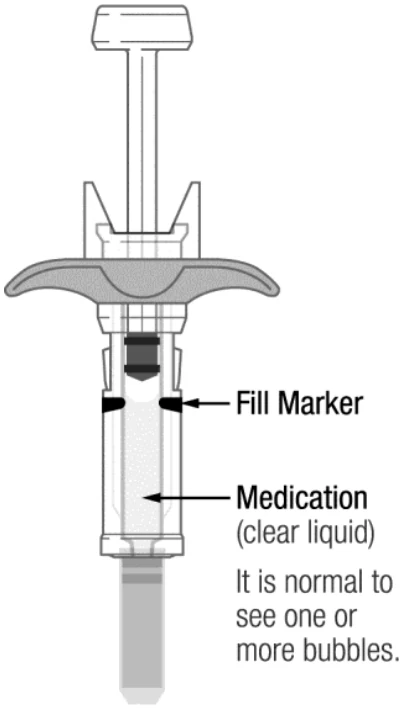
Do not use Syringe if medication is not near the Fill Marker. Use another Syringe and/or contact your healthcare provider.
Do not use Syringe if it is cloudy, discolored, or has particles in it.
| Choosing & Preparing Injection Site |
|---|
| Your healthcare provider should show you proper injection site techniques. | ||
|---|---|---|
Recommended subcutaneous (under the skin) injection sites are:
| ||
| You should rotate and change your injection site each time. | ||
| Stay at least 1 inch from a previous site used. | ||
| Do not inject into areas where the skin is tender, bruised, red, hard, scarred or has stretch marks. | ||
| If you have psoriasis, do not inject into any raised, thick, red, or scaly skin patches or lesions. | ||
| Do not inject through clothes. Roll back any clothing that may interfere with the injection site. | ||
| Wash your hands with soap and water. | ||
Wipe the chosen injection site with an alcohol prep. Wait for it to dry on its own, do not blow dry. | ||
| Do not touch this injection site again before receiving your injection | ||
| Giving the Injection |
|---|
| CAUTION: | Injection process must be completed without interruption. Read all steps first before beginning injection. |
DOSAGE: Use one Syringe for one dose. |
|---|
| STEP 1 |
|---|

Uncap
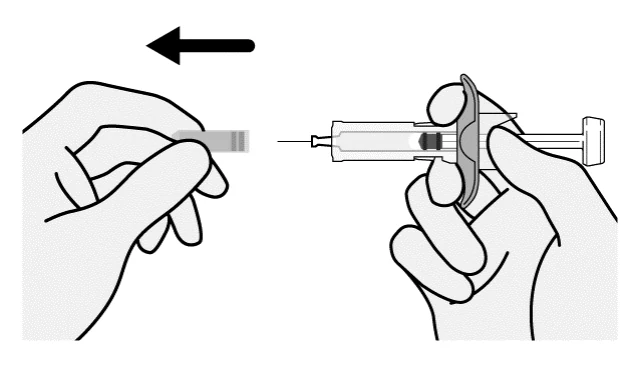
Pull straight to uncap Syringe, don’t twist.
A few drops of liquid may come out of the needle, this is normal.
It is normal to see air bubble(s).
CAUTION: Do not re-cap Syringe.
Do not expel air bubble(s).
Do not pull back on Plunger at any time.
Do not touch the needle with your fingers or let the needle touch anything.
Do not use Syringe if dropped after uncapping.
| STEP 2 |
|---|
Squeeze & Hold Injection Site
Thigh injection site shown here, perform these steps in a similar manner for abdomen injection sites.
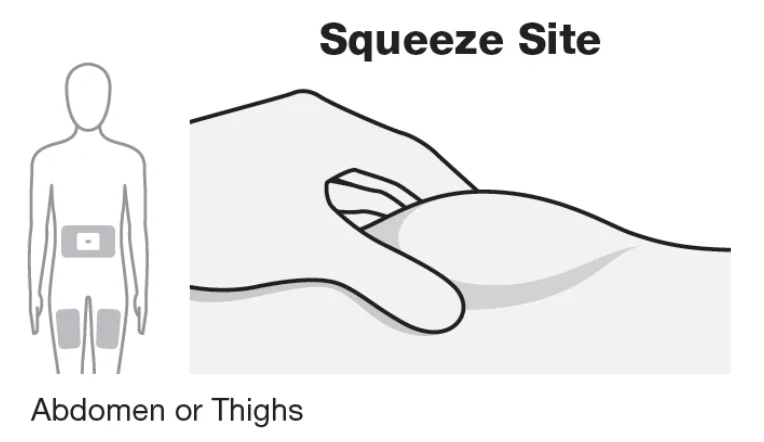
Gently squeeze the injection site to create a raised area, and hold that area firmly.
Recommended injection sites include the thighs or abdomen (belly).
Do not use area within 2 inches of belly button.
Rotate sites with each injection. Stay at least 1 inch from a previous site used.
Do not inject into areas where the skin is tender, bruised, red, hard, scarred or has stretch marks.
See “Choosing & Preparing Injection Site” or consult your healthcare provider for injection site assistance.
| STEP 3 |
|---|
Insert Needle Into Site
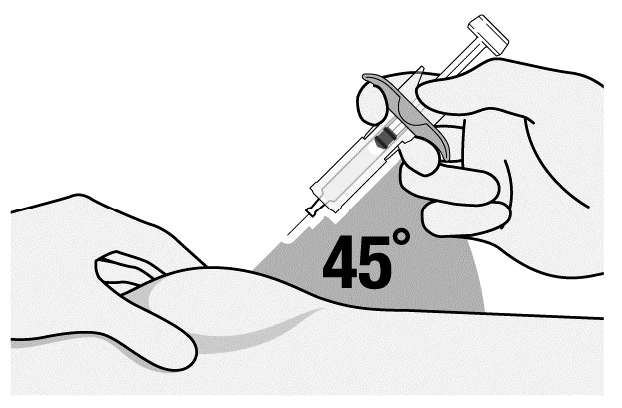
At a 45° angle to the injection site, use a quick dart-like motion to insert the needle into the site.
Be careful to insert the needle so that it will not inject into your fingers holding the injection site.
| STEP 4 |
|---|
Inject Medication
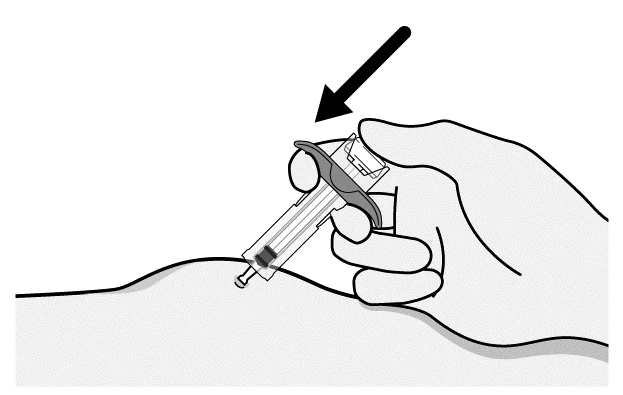
After the needle is in, let go of squeezing the site.
Slowly push the plunger all the way until all the medication is injected and the syringe is empty. If the plunger is not pressed all the way the Safety Feature will not activate afterwards to cover the needle.
Do not move, twist, or rotate Syringe during injection.
| STEP 5 |
|---|
End of Injection, Remove Syringe
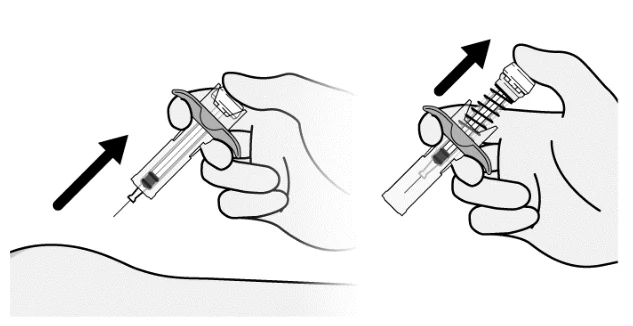
Pull the Syringe away from the injection site, then release your thumb from the plunger. The Safety Feature will retract and cover the needle.
CAUTION: If the needle did not retract or you do not think you received the full dose, Do not take another dose. Contact your healthcare provider for assistance. If the needle did not retract, carefully place the syringe into a sharps or puncture resistant container to avoid injury. |
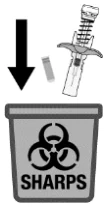
Dispose Syringe & Cap
Put the used Syringe and Cap in a sharps disposal container.
Syringe is for single-dose only.
Do not reuse Syringe.
Do not recap.
See “Disposing the Syringe” for additional details. After injection, if slight bleeding occurs from the injection site, press a gauze pad or cotton ball lightly against the site for a few seconds — Do not rub the injection site. |
| Disposing the Syringe |
|---|
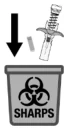
- You should always check with your/your child’s healthcare provider (e.g., doctor, nurse, or pharmacist) for instructions on how to properly dispose of used needles and syringes. Do NOT use the same needle and syringe more than once. You should follow any special provincial or local laws regarding the proper disposal of needles and syringes. Do NOT throw used needles or syringes in the household trash or recycling bin.
- Dispose of used needles and syringes in a container made especially for this purpose (sharps container), or a hard plastic container with a screw-on cap or metal container with a plastic lid labelled “Used Syringes”. Do not use glass or clear plastic containers.
- Always keep the container out of the reach of children.
- When the container is about two-thirds full, tape the cap or lid down so it does not come off and dispose of it as instructed by your/your child’s doctor, nurse or pharmacist. DO NOT THROW THE CONTAINER IN THE HOUSEHOLD TRASH OR RECYCLING BIN.
| Injection Diary |
|---|
| Date | Injection Site Used |
|---|

Manufactured by:
Biocon Biologics Canada Inc.
1 First Canadian Place
100 King Street West, Suite 6200
Toronto, ON M5X 1B8 Canada
Distributed by:
ACCURISTIX
100 Vaughan Valley Blvd,
Vaughan, ON L4H 3C5
1-833-986-1468
Hulio® is a registered trademark of Fujifilm Kyowa Kirin Biologics Co., Ltd., licensed use by Biosimilar Collaborations Ireland Limited, a Biocon Biologics company.