


Product Monograph - Hycodan Tablets
SUMMARY PRODUCT INFORMATION
| Route of Administration | Dosage Form / Strength | Nonmedicinal Ingredients |
| Oral | Tablets, 5mg | Corn starch, lactose, pregelatinized tapioca starch, stearic acid, talc and zinc stearate Sodium- and tartrazine- free |
| Syrup, 5 mg/5 mL | Artificial cherry flavour, caramel syrup, FD&C RED No. 2, hydrochloric acid, methylparaben, propylparaben, purified water, sorbitol solution 70% and sucrose Alcohol-, lactose-, sodium-, sulphite- and tartrazine-free |
INDICATIONS AND CLINICAL USE
Adults
HYCODAN (hydrocodone bitartrate) is indicated for the control of exhausting, non-productive cough.
Geriatrics (> 65 years of age)
In general, dose selection for an elderly patient should be cautious, usually starting at the low end of the dosing range, reflecting the greater frequency of decreased hepatic, renal, or cardiac function, concomitant disease or other drug therapy (see ACTION AND CLINICAL PHARMACOLOGY, Special Populations and Conditions, Geriatrics).
Pediatrics (< 18 years of age)
The use of hydrocodone is contraindicated in patients below the age of 6 years.
CONTRAINDICATIONS
Patients who are hypersensitive to the active substance hydrocodone bitartrate or other opioid analgesics or to any ingredient in the formulation. Patients known to be hypersensitive to
- other opioids may exhibit cross sensitivity to hydrocodone. For a complete listing, see the DOSAGE FORMS, COMPOSITION AND PACKAGING section of the Product Monograph.
- In patients with known or suspected mechanical gastrointestinal obstruction (e.g., bowel obstruction or strictures) or any diseases/conditions that affect bowel transit (e.g., ileus of any type).
- Patients with acute or severe bronchial asthma, chronic obstructive airway, or status asthmaticus.
- Patients with acute respiratory depression, elevated carbon dioxide levels in the blood and cor pulmonale.
- Patients with acute alcoholism, delirium tremens, and convulsive disorders.
- Patients with severe CNS depression, increased cerebrospinal or intracranial pressure, and head injury.
- Patients taking monoamine oxidase (MAO) inhibitors (or within 14 days of such therapy).
- Women who are pregnant or during labour and delivery.
- Patients under the age of 6
WARNINGS AND PRECAUTIONS
SERIOUS WARNINGS AND PRECAUTIONS Risks From Concomitant Use With Benzodiazepines Or Other CNS Depressants Concomitant use of opioids with benzodiazepines or other central nervous system (CNS) depressants, including alcohol, may result in profound sedation, respiratory depression, coma, and death (see WARNINGS AND PRECAUTIONS). Avoid use of opioid cough medications in patients taking benzodiazepines, other CNS depressants, or alcohol. |
General
Before prescribing medication to suppress or modify cough, it is important to ascertain that the underlying cause of the cough is identified, that modification of the cough does not increase the risk of clinical or physiological complications, and that appropriate therapy for the primary disease is provided.
Accidental ingestion, especially by children can result in a fatal overdose of hydrocodone bitartrate (see DOSAGE AND ADMINISTRATION, Disposal, for instructions on proper disposal).
Patients should be cautioned not to consume alcohol while taking HYCODAN (hydrocodone bitartrate) as it may increase the chance of experiencing serious adverse events, including death.
Abuse and Misuse
Like all opioids, HYCODAN is a potential drug of abuse and misuse, which can lead to overdose and death. Therefore, HYCODAN should be prescribed and handled with caution.
Opioids, such as HYCODAN, should be used with particular care in patients with a history of alcohol and illicit/prescription drug abuse.
Carcinogenesis and Mutagenesis
Carcinogenicity and mutagenicity studies have not been conducted with HYCODAN
Cardiovascular
Hydrocodone bitartrate administration may result in hypertension, hypotension, palpitations and dizziness.
Dependence/Tolerance
As with other opioids, tolerance and physical dependence may develop upon repeated administration of HYCODAN and there is a potential for development of psychological dependence.
Physical dependence and tolerance reflect the neuroadaptation of the opioid receptors to chronic exposure to an opioid, and are separate and distinct from abuse and addiction. Tolerance, as well as physical dependence, may develop upon repeated administration of opioids, and are not by themselves evidence of an addictive disorder or abuse.
Treatment of withdrawal is usually managed by providing sufficient quantities of an opioid to suppress severe withdrawal symptoms and then gradually reducing the dose of opioid over a period of several days.
Gastrointestinal Effects
Hydrocodone bitartrate and other morphine-like opioids have been shown to decrease bowel motility. Hydrocodone bitartrate may obscure the diagnosis or clinical course of patients with acute abdominal conditions.
Patients with chronic constipation should be given the drug only after weighing the potential therapeutic benefit against the hazards involved.
Neonatal Opioid Withdrawal Syndrome (NOWS)
Use of HYCODAN is contraindicated in pregnant women (see CONTRAINDICATIONS).
Prolonged maternal use of opioids during pregnancy can result in withdrawal signs in the neonate. Neonatal opioid withdrawal syndrome, unlike opioid withdrawal syndrome in adults, may be life-threatening.
Neonatal opioid withdrawal syndrome presents as irritability, hyperactivity and abnormal sleep pattern, high pitched cry, tremor, vomiting, diarrhea, increased respiratory rate, increased stool, sneezing, yawning, fever and failure to gain weight. The onset, duration, and severity of neonatal opioid withdrawal syndrome vary based on the specific opioid used, duration of use, timing and amount of last maternal use, and rate of elimination of the drug by the newborn.
The intensity of the syndrome does not always correlate with the duration of maternal opioids use or dose. There is no consensus on the best method of managing withdrawal. Chlorpromazine 0.7 to 1.0 mg/kg q6h, phenobarbital 2 mg/kg q6h, and paregoric 2 to 4 drops/kg q4h, have been used to treat withdrawal symptoms in infants. The duration of therapy is 4 to 28 days, with the dosages decreased as tolerated.
Neurologic
Interactions with Central Nervous System Depressants (including benzodiazepines and alcohol):
Concomitant use of opioids, including HYCODAN, with benzodiazepines, or other CNS depressants, including alcohol, may result in profound sedation, respiratory depression, coma, and death. Because of these risks, avoid use of opioid cough medications in patients taking benzodiazepines, other CNS depressants, or alcohol (see CONTRAINDICATIONS and DRUG INTERACTIONS).
Observational studies have demonstrated that concomitant use of opioid analgesics and benzodiazepines increases the risk of drug-related mortality compared to use of opioids alone. Because of similar pharmacologic properties, it is reasonable to expect similar risk with concomitant use of opioid cough medications and benzodiazepines, other CNS depressants, or alcohol.
Advise both patients and caregivers about the risks of respiratory depression and sedation if HYCODAN is used with benzodiazepines, alcohol, or other CNS depressants.
Head Injury: The respiratory depressant effects of Hydrocodone bitartrate, and the capacity to elevate cerebrospinal fluid pressure, may be greatly increased in the presence of an already elevated intracranial pressure produced by trauma. Also, Hydrocodone bitartrate may produce confusion, miosis, vomiting and other side effects which obscure the clinical course of patients with head injury. In such patients, Hydrocodone bitartrate must be used with extreme caution and only if it is judged essential (see CONTRAINDICATIONS).
Psychomotor Impairment
HYCODAN may impair the mental and/or physical abilities needed for certain potentially hazardous activities such as driving a car or operating machinery. Patients should be cautioned accordingly. Patients should also be cautioned about the combined effects of Hydrocodone bitartrate with other CNS depressants, including other opioids, phenothiazine, sedative/hypnotics and alcohol.
Respiratory
Hydrocodone bitartrate, including HYCODAN is not recommended for use in any patient in whom respiratory function might be compromised including neuromuscular disorders, severe cardiac or respiratory conditions, lung infections, multiple trauma or extensive surgical procedures.
Life-threatening respiratory depression is more likely to occur in the elderly, cachectic, or debilitated patients because they may have altered pharmacokinetics or altered clearance compared to younger, healthier patients.
In patients with asthma or pulmonary emphysema, indiscriminate use may precipitate respiratory insufficiency resulting from increased viscosity of bronchial secretions and suppression of the cough reflex.
The use of hydrocodone is contraindicated in patients below the age of 6 years. In young children, the respiratory centre is especially susceptible to the depressant action of narcotic cough suppressants. The use of hydrocodone bitartrate in children less than 6 years of age has been associated with fatal respiratory depression. A 5 year old child treated for cough died after a few hours of exposure to hydrocodone bitartrate; the child was a CYP2D6 poor metabolizer and was concomitantly exposed to clarithromycin, a CYP3A4 inhibitor and valproic acid, a broad-spectrum inhibitor of the uridine diphosphate glucoronosyltransferases (UGTs), resulting in blood hydrocodone levels associated with fatality. Such a scenario of hydrocodone overdose can be equally plausible in CYP2D6 intermediate, extensive, and ultrarapid metabolizers, especially in the presence of other drug interactions and physical vulnerabilities for children up to 18 years of age and adults. Exercise caution when administering HYCODAN in children ages 6 and up because of the potential for respiratory depression. If respiratory depression occurs, discontinue and use naloxone hydrochloride when indicated to antagonize the effect and other supportive measures as necessary. The benefit to risk ratio should be carefully considered, especially in children with respiratory embarrassment (e.g. croup). Estimation of dosage relative to the child's age and weight is of great importance.
Use in Patients with Chronic Pulmonary Disease: Monitor patients with significant chronic obstructive pulmonary disease or cor pulmonale, and patients having a substantially decreased respiratory reserve, hypoxia, hypercapnia, or preexisting respiratory depression for respiratory depression, particularly when initiating therapy and titrating with HYCODAN, as in these patients, even usual therapeutic doses of HYCODAN may decrease respiratory drive to the point of apnea. The use of HYCODAN is contraindicated in patients with acute or severe bronchial asthma, chronic obstructive airway, or status asthmaticus (see CONTRAINDICATIONS).
Special Populations
Special Risk Groups: Hydrocodone bitartrate should be administered with caution to patients with a history of alcohol and drug abuse and in a reduced dosage to debilitated patients, and in patients with severely impaired pulmonary function, Addison’s disease, hypothyroidism, myxedema, toxic psychosis, prostatic hypertrophy or urethral stricture.
Use with caution in sedated or debilitated patients, in patients who have undergone thoracotomies or laparotomies, since suppression of the cough reflex may lead to retention of secretions postoperatively in these patients.
Pregnant Women: Studies in humans have not been conducted. HYCODAN crosses the placental barrier. HYCODAN is contraindicated in pregnant patients (see CONTRAINDICATIONS).
Prolonged maternal use of opioids during pregnancy can result in withdrawal signs in the neonate. Neonatal Opioid Withdrawal Syndrome (NOWS), unlike opioid withdrawal syndrome in adults, may be life-threatening (see WARNINGS AND PRECAUTIONS, Neonatal Opioid Withdrawal Syndrome, ADVERSE REACTIONS, Post-marketing Experience.)
Labour, Delivery and Nursing Women: Respiratory depression can occur in the infant if opioids are administered during labour. Naloxone, a drug that counters the effects of opiates, should be readily available.
Labour and Delivery
Since opioids can cross the placental barrier and are excreted in breast milk, HYCODAN should not be used during labour and delivery (see CONTRAINDICATIONS).
Nursing Women:
Since opioids can cross the placental barrier and are excreted in breast milk, HYCODAN should not be used in nursing women unless, in the judgement of the physician, the potential benefits outweigh the risks.
Pediatrics (< 18 years of age): In young children the respiratory centre is especially susceptible to the depressant action of narcotic cough suppressants. Benefit to risk ratio should be carefully considered, especially in children with respiratory embarrassment, e.g., croup. Estimation of dosage relative to the child's age and weight is of great importance. The use of hydrocodone is contraindicated in patients below the age of 6 years due to increased safety concerns (i.e. respiratory depression) regardless of clinical setting (see CONTRAINDICATIONS).
Geriatrics (> 65 years of age): In general, dose selection for an elderly patient should be cautious, usually starting at the low end of the dosing range and titrate slowly, reflecting the greater frequency of decreased hepatic, renal, or cardiac function, and of concomitant disease or other drug therapy (see DOSAGE AND ADMINISTRATION).
ADVERSE REACTIONS
Adverse Drug Reaction Overview
Adverse Drug Reactions:
Cardiovascular: Hypertension, postural hypotension and palpitations.
Central nervous: Sedation, drowsiness, mental clouding, lethargy, impairment of mental and physical performance, anxiety, fear, dysphoria, dizziness, psychic dependence, mood changes and blurred vision.
Gastrointestinal: Nausea and vomiting occur more frequently in ambulatory than in recumbent patients. Constipation may also occur.
Genitourinary: Ureteral spasm, spasm of vesical sphincters and urinary retention have been reported with opiates.
Respiratory: Hydrocodone produces dose-related respiratory depression by acting directly on brain stem respiratory centers.
Other
Drug Abuse and Dependence
Patients physically dependent on opioids will develop an abstinence syndrome upon abrupt discontinuation of the opioid or following the administration of a narcotic antagonist. The character and severity of the withdrawal symptoms are related to the degree of physical dependence. Manifestations of opioid withdrawal are similar to but milder than that of morphine and include lacrimation, rhinorrhea, yawning, sweating, restlessness, dilated pupils, anorexia, gooseflesh, irritability and tremor. In more severe forms, nausea, vomiting, intestinal spasm and diarrhea, increased heart rate and blood pressure, chills, and pains in bones and muscles of the back and extremities may occur. Peak effects will usually be apparent at 48 to 72 hours.
DRUG INTERACTIONS
Interaction with Benzodiazepines and Other Central Nervous System (CNS) Depressants (including alchohol): Due to additive pharmacologic effect, the concomitant use of benzodiazepines or other CNS depressants (e.g. other opioids, sedatives/hypnotics, antidepressants, anxiolytics, tranquilizers, muscle relaxants, general anesthetics, antipsychotics, phenothiazines, neuroleptics, antihistamines, antiemetics, and alcohol) and beta-blockers, increases the risk of respiratory depression, profound sedation, coma, and death and should be avoided (see WARNINGS AND PRECAUTIONS, Neurologic, Interactions with Central Nervous System Depressants (including benzodiazepines and alcohol) and Psychomotor Impairment). HYCODAN should not be consumed with alcohol as it may increase the chance of experiencing dangerous side effects.
Drug-Lifestyle Interactions
The concomitant use of alcohol should be avoided (see WARNINGS AND PRECAUTIONS, General).
DOSAGE AND ADMINISTRATION
Recommended Dose and Dosage Adjustment
Adults:
One HYCODAN* TABLET or 5 mL (one teaspoonful) of HYCODAN SYRUP not less than 4 hours apart, after meals and at bedtime with food or a glass of milk, not to exceed six tablets or 30 mL (six teaspoonfuls) of syrup in a 24-hour period. Maximum single dose three tablets or 15 mL (three teaspoonfuls) of syrup.
Pediatrics:
The use of hydrocodone is contraindicated in patients below the age of 6 years due to increased safety concerns (i.e. respiratory depression) regardless of clinical setting. (See CONTRAINDICATIONS, WARNINGS AND PRECAUTIONS, Respiratory and Special Populations, Pediatrics)
Over 12 yrs: One HYCODAN TABLET or 5 mL (one teaspoonful) of HYCODAN SYRUP not less than 4 hours apart, after meals and at bedtime with food or a glass of milk, not to exceed 30 mL (six teaspoonfuls) in a 24-hour period. Maximum single dose two tablets or 10 mL (two teaspoonfuls) of syrup.
Age 6 to 12 yrs: One half of a HYCODAN* TABLET or 2.5 mL (1/2 teaspoonful) of HYCODAN* SYRUP not less than 4 hours apart, after meals and at bedtime with food or a glass of milk, not to exceed a total of three tablets or 15 mL (three teaspoonfuls) of syrup in a 24-hour period. Maximum single dose one tablet or 5 mL (1 teaspoonful) of syrup.
Geriatrics:
Respiratory depression has occurred in the elderly following administration of large initial doses of opioids to patients who were not opioid-tolerant or when opioids were co-administered with other agents that can depress respiration. HYCODAN should be initiated at a low dose and slowly titrated to effect (see WARNINGS AND PRECAUTIONS).
Disposal
HYCODAN should be kept in a safe place, out of the sight and reach of children before, during and after use. HYCODAN should not be used in front of children, since they may copy these actions.
HYCODAN should never be disposed of in household trash. Disposal via a pharmacy take back program is recommended. Unused or expired HYCODAN should be properly disposed of as soon as it is no longer needed to prevent accidental exposure to others, including children or pets.
OVERDOSAGE
| For management of a suspected drug overdose, contact your regional Poison Control Centre. |
Symptoms:
Serious overdosage with hydrocodone may be characterized by respiratory depression (a decrease in respiratory rate and/or tidal volume, Cheyne-Stokes respiration, cyanosis), extreme somnolence progressing to stupor or coma, skeletal muscle flaccidity, cold and clammy skin, and sometimes bradycardia and hypotension. In severe overdosage, apnea, circulatory collapse, cardiac arrest and death may occur.
Treatment:
Primary attention should be given to the re-establishment of adequate respiratory exchange through provision of a patent airway and the institution of assisted or controlled ventilation. The narcotic antagonist naloxone is a specific antidote against respiratory depression which may result from overdosage or unusual sensitivity to narcotics, including hydrocodone. An appropriate dose of naloxone hydrochloride should be administered, preferably by the intravenous route, simultaneously with efforts at respiratory resuscitation. Since the duration of action of hydrocodone may exceed that of the antagonist, the patient should be kept under continued surveillance and repeated doses of the antagonist should be administered as needed to maintain adequate respiration. The instructions contained in the package insert should be carefully observed. Oxygen, intravenous fluids, vasopressors, and other supportive measures should be employed as indicated. Gastric emptying may be useful in removing unabsorbed drug. Activated charcoal may be of benefit.
ACTION AND CLINICAL PHARMACOLOGY
Mechanism of Action
Clinical trials have proven hydrocodone bitartrate to be an effective antitussive agent which is pharmacologically two to eight times as potent as codeine. At equieffective doses, its sedative action is greater than that of codeine. The precise mechanisms of action of hydrocodone and other opiates are not known; however, hydrocodone is believed to act by directly depressing the cough center. In excessive doses, hydrocodone like other opium derivatives, can depress respiration. The effects of therapeutic doses of hydrocodone on the cardiovascular system are insignificant. The constipating effects of hydrocodone are much weaker than those of morphine and no stronger than those of codeine. Hydrocodone can produce miosis, euphoria, physical and psychological dependence.
Pharmacokinetics
At therapeutic antitussive doses, it does exert analgesic effects. Following a 10 mg oral dose of hydrocodone administered to five male human subjects, the mean peak serum concentration was 23.6 + 5.2 ng/mL. Maximum serum levels were achieved at 1.3 + 0.3 hours and the half-life was determined to be 3.8 + 0.3 hours. Hydrocodone exhibits a complex pattern of metabolism including 0-demethylation, N-demethylation and 6-keto reduction to the corresponding 6-α- and 6-β-hydroxymetabolites.
Special Populations and Conditions
Pediatrics: See WARNINGS and PRECAUTIONS
Geriatrics: See WARNINGS and PRECAUTIONS
STORAGE AND STABILITY
Patients should be instructed to store HYCODAN, as for any medication, well out of the reach of children. Keep tightly closed. Store at 15° to 30 °C. Dispense HYCODAN SYRUP in a tight, light-resistant container.
SPECIAL HANDLING INSTRUCTIONS
Not applicable.
DOSAGE FORMS, COMPOSITION AND PACKAGING
Composition:
HYCODAN TABLETS
Each white, biconvex and bisected tablet contains: hydrocodone bitartrate 5 mg. Nonmedicinal ingredients: cornstarch, lactose, pregelatinized tapioca starch, stearic acid, talc and zinc stearate. Sodium- and tartrazine-free.
HYCODAN SYRUP
Each 5 mL of red, wild cherry-flavored syrup contains: hydrocodone bitartrate 5 mg. Nonmedicinal ingredients: artificial cherry flavour, caramel syrup, FD&C RED No. 2, hydrochloric acid, methylparaben, propylparaben, purified water, sorbitol solution 70% and sucrose. Alcohol-, lactose-, sodium-, sulfite- and tartrazine-free.
Packaging:
HYCODAN TABLETS are supplied in bottles of 100 tablets.
HYCODAN SYRUP is supplied in bottles of 100 mL and 500 mL.
PART II: SCIENTIFIC INFORMATION
PHARMACEUTICAL INFORMATION
Drug Substance
Proper name:
Hydrocodone bitartrate
Chemical name:
Hydrocodone is 7,8-dihydrocodeinone, a derivative of codeine.
Molecular formula and molecular mass:
C18H21NO3 and 299.36
Structural formula:
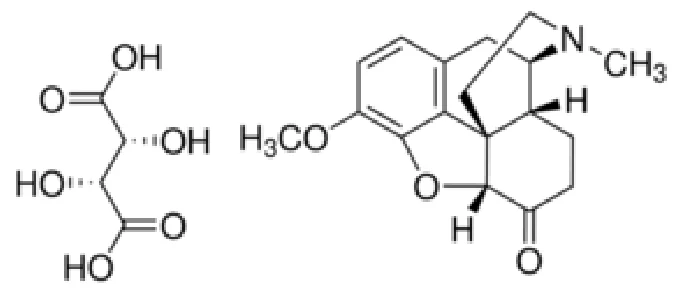
Physicochemical Properties:
Fine white or slightly yellow-white powder. Odorless. Solubility: soluble in water and 95% ethanol. Insoluble in chloroform.