


Product Monograph - Tussionex (Sanofi-Aventis Canada, Tablet (Extended-Release))
INDICATIONS AND CLINICAL USE
Tussionex is indicated for the treatment of exhausting or non-productive cough; associated with cold or with upper respiratory allergic condition that does not respond to non-narcotic antitussives. It is an effective antitussive which acts for approximately 8 to 12 hours.
CONTRAINDICATIONS
Hypersensitivity to any of the components, marked hypertension, patients receiving monoamine oxidose (MAO) inhibitors, pre-existing respiratory depression, intracranial lesions with increased intracranial pressure.
WARNINGS
It is important to provide appropriate therapy for the primary disease and to ensure that modification of the cough does not increase the risk of physical or psychological complications.
Children: in young children, the respiratory centre is especially susceptible to the depressant action of narcotic cough suppressants.
Pregnancy and Lactation: Since hydrocodone crosses the placenta, its use in pregnancy is not recommended. Babies of nursing mothers using opioids may become physically dependent.
Hydrocodone may inhibit peristalsis, and patients with chronic constipation should be given Tussionex only after weighing the potential therapeutic benefit against the hazards involved.
Occupational hazards: Caution patients not to operate vehicles or hazardous machinery until their response to the drug has been determined.
Since the depressant effects of some antihistamines are additive to those of other drugs affecting the CNS, caution patients against drinking alcoholic beverages or taking hypnotics/sedatives, tricyclic antidepressants, benzodiazepines or other opiate agonists during antihistaminic therapy.
Tussionex contains hydrocodone: may be habit forming.
Tussionex suspension must not be diluted with fluids or mixed with other drugs because this alters the resin-binding and changes the absorption rate, possibly increasing the toxicity.
PRECAUTIONS
Before prescribing medication to suppress or modify cough, it is important to identify the underlying cause of the cough.
In young children, the benefit to risk ratio should be carefully considered, especially in children with respiratory embarrassment (e.g. croup).
Use with caution in patients with hypertension, diabetes mellitus, thyrotoxicosis, glaucoma, cardiac disease and peripheral vascular disease and in patients receiving methyldopa or beta adrenergic blockers.
The use of hydrocodone bitartrate over a prolonged period may, in susceptible individuals, lead to habituation and, in some cases, true addiction.
ADVERSE REACTIONS
Negligible, but when encountered may include mild constipation, nausea, facial pruritus, and drowsiness that disappear with adjustment of dose or discontinuance of treatment. Other side effects reported with the use of cough and cold medications include: convulsions, hallucinations, allergic reaction, breathing difficulties, and rapid heart rate.
SYMPTOMS AND TREATMENT OF OVERDOSAGE
Symptoms: are similar to those of codeine overdosage. Narcosis is usually present, sometimes associated with convulsions. Tachycardia, bradycardia, pupillary constriction, nausea and vomiting and respiratory depression can occur. The resinated formulation mitigates the immediate absorption of large quantities of hydrocodone; however, the absorption period may be prolonged.
Treatment: If respiration is severely depressed, administer the narcotic antagonist, naloxone. Adults: 0.4 mg to 2.0 mg by intravenous, intramuscular or subcutaneous routes and repeated at 2 to 3 minute intervals if necessary. Children: 0.01 mg/kg by intravenous, intramuscular or subcutaneous routes. Dosage may be repeated also at 2 to 3 minute intervals if necessary. Since the duration of action of hydrocodone in this formulation may exceed that of naloxone, the patient should be kept under surveillance and repeated doses of naloxone should be administered as needed. Failure to obtain significant improvement after 2 to 3 doses suggests that causes other than narcotic overdosage may be responsible for the patient's condition.
If naloxone is unsuccessful, institute intubation and respiratory support and conduct gastric
lavage in the unconscious patient.
Convulsions, sometimes seen in children, can be controlled by intravenous administration of benzodiazepines (e.g., diazepam).
For management of a suspected drug overdose, contact your regional Poison Control Centre.
DOSAGE AND ADMINISTRATION
Tussionex should not be diluted with fluids or mixed with other drugs. Shake well before using.
Dosage in Adults: 5mL (1 teaspoonful) of suspension or one tablet every 8 to 12 hours. Maximum daily dose is 10mL of suspension or 2 tablets. May be adjusted to individual requirements.
Dosage in Children (Suspension): 6 years and over: 5mL (1 teaspoonful) every 12 hours (maximum daily dose of 10mL or 2 teaspoonsfuls). Tussionex is not recommended for children weighing less than 9 kg.
PHARMACEUTICAL INFORMATION
DRUG SUBSTANCE
- 1.
Proper Name: Hydrocodone Bitartrate
Chemical Name: 4,5α Epoxy - 3 methoxy -17- methylmorphinan -6- one tartrate.
Structural Formula:
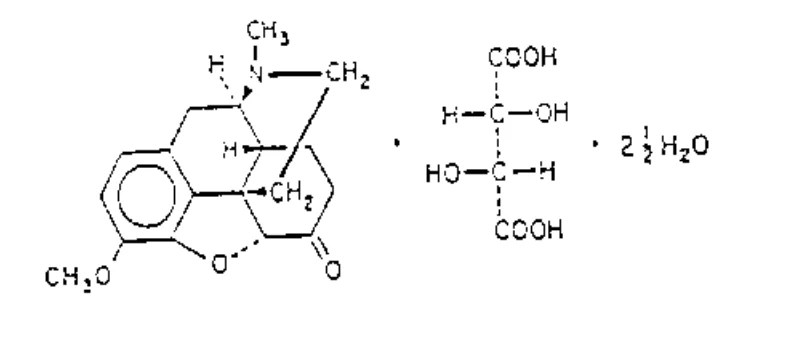
Molecular Weight: 494.5
Description: a white crystalline powder, soluble in water, melting point of 186E to 190EC.
- 2.
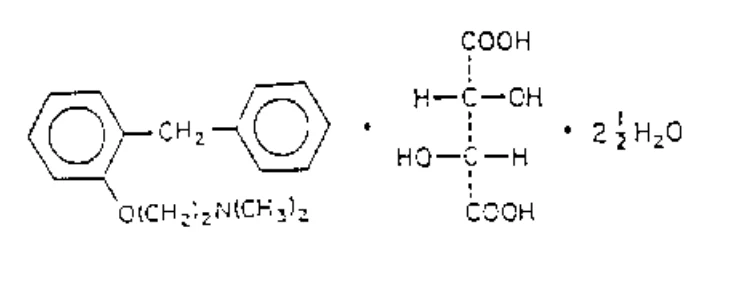
Proper Name: Phenyltoloxamine Citrate
Chemical Name: N,N - Dimethyl -2- (α - phenyl -0- tolyloxy) ethylamine.
Structural Formula:
Molecular Weight: 255.4
Description: a white crystalline powder, soluble in water, pH of 1% solution in water is 3.2 to 4.2, melting point 138 to 140EC.
NON-MEDICINAL INGREDIENTS
Liquid: sorbital solution 70%, alcohol 95%, propylene glycol, glycerin, xanthan gum, water, pineapple flavour, peach flavour, methylparaben, propylparaben, D&C yellow No. 10, FD&C yellow No. 6, washed hydrogen cycle resin.
Tablets: corn starch, confectioner’s sugar, lactose monohydrate, water, calcium phosphate dibasic, colloidal silicon dioxide, magnesium stearate, washed hydrogen cycle resin.
STABILITY AND STORAGE CONDITIONS
Liquid and Tablet: Store between 15 – 30°C.
DOSAGE FORMS
Availability
Each light brown, scored tablet or each 5 mL of neutral tasting, gold-coloured, thixotropic suspension contains: hydrocodone resin complex equivalent to 5 mg of hydrocodone bitartrate and phenyltoloxamine resin complex equivalent to 10mg of phenyltoloxamine citrate. The suspension is available in bottles of 500 mL. The tablets are available in bottles of 100.
CLINICAL PHARMACOLOGY
In a study of 44 pulmonary tuberculosis patients, hydrocodone was found to be highly effective as a cough suppressant in diminishing the intensity and frequency of the cough. However, when the tracheobronchial secretions reach the irritable level, patients had no difficulty expelling sputum.6
Cass and Frederik studied the long-term (from 3 to 29 months) effectiveness of Tussionex in the control of chronic cough due to asthma, bronchitis, tuberculosis, and emphysema7. Cough was suppressed without an increase in sputum. Tussionex retained its effectiveness over the course of the study. The antitussive medication was limited to two doses daily. In only one instance was it necessary to stop the medicine because of drowsiness. There was no evidence of addiction.
Tussionex has been found to provide excellent antitussive results lasting from eight to twelve hours3,4,8. Townsend carried out a clinical study on 356 patients with cough associated with measles, upper respiratory infection, and bronchitis, and with so-called allergic cough, and nocturnal cough with emesis. One group of patients received an aqueous solution of hydrocodone 5 mg/mL plus phenyltoloxamine 10 mg/5 mL. The second group received a resinated complex of the same drugs in equivalent dosage concentrations. Eighty-four percent of the patients receiving the resinated formulation experienced cough suppression for 10 hours or more. For those receiving the aqueous solution, a 4-hour cough suppression was maximal and was attained in only 36% of these patients.3
It has been found that antihistamines may potentiate the antitussive effects of hydrocodone. In a laboratory study using mongrel dogs, Chan and Hays compared the relative cough-suppressant effectiveness of (a) codeine (2.2 mg/kg), (b) hydrocodone (3.7 mg/kg), (c) hydrocodone (0.37 mg/kg) as a resin complex, and (d) hydrocodone (0.37 mg/kg) plus phenyltoloxamine (2.2 mg/kg) both as resin complexes.4
The antitussive effects of both the codeine and hydrocodone solutions disappeared after 5 and 6 hours respectively. By 10 hours into the experiment, the resinated hydrocodone formulation had also lost its effect, but the hydrocodone/phenyltoloxamine resin complex was still providing cough suppression even after 13 hours.
In a subsequent clinical study, these investigators noted that while Tussionex effectively suppressed the hacking non-productive cough for 8 to 12 hours, the less frequent productive cough still appeared and performed its physiological role.4
In another double-blind clinical study, Cass compared the relative clinical effectiveness of four antitussive preparations.
Each dose of the four preparations contained the following:
| mg/dose | |
| 1.66 5 3 25 20 |
| 5 1.5 12.5 60 10 85 |
| 5 10 |
| 10 5 3 25 20 |
The hydrocodone/phenyltoloxamine resin complex provided consistently superior results, compared to the other preparations, measured as the percent of maximal cough suppression achieved.9
Cass and Frederik (1958) in one double-blind study and one single blind study involving 127 chronic cough patients verified the 12-hour duration of cough relief provided by the Tussionex formulation. Control of cough was again 2 to 3 times longer than for the same active ingredients in aqueous salt form.8
BIBLIOGRAPHY
- 1.
Jaffe JH, Martin WR. Opiod analgesics and antagonists. In: Gilman AG, Goodman LS, Rall
TW, Murad F, eds. Goodman and Gilman's Pharmacological basis of therapeutics. Toronto: Collier Macmillan Canada 1985:491-531.
- 2. Hoekstra JB, Tisch DE, Rakieten N, Dickison HL. Pharmacological properties of a new antihistaminic agent, phenyltoloxamine (Bristamin). Journal of the American Pharmaceutical Association 1953; 42:587-593.
- 3.
Townsend EH. Prolonged cough suppression. New England Journal of Medicine 1958;
258:63-67.
- 4.
Chan YT, Hays EE. A resin complex for prolonged antitussive effects. The American
Journal of the Medical Sciences 1957; 234:207-212.
- 5. Becker BA, Swift JG. Effective reduction of the acute toxicity of certain pharmacological agents by use of synthetic ion exchange resins. Toxicology and Applied Pharmacology 1959; 1:42-54.
- 6.
Hyman S, Rosenblum SH. Clinical evaluation of a new antitussive agent. Illinois Medical
Journal 1953; 104:257-259.
- 7.
Cass LJ, Frederik WS. The prolonged use of a sustained release antitussive. Report dated
11/25/59 on file with University Health Services, Harvard University, Cambridge, Massachusetts, USA.
- 8.
Cass LJ, Frederik WS. The clinical evaluation of sustained released antitussives. Annals of
Internal Medicine 1958; 49:151-160.
- 9. Cass LJ. The clinical evaluation of a new sustained-release antitussive of low narcotic content. Current Therapeutic Research 1961; 3:355-359.