


Patient Medication Information: uses, side effects, how to take - Imcivree
What IMCIVREE is used for:
IMCIVREE is used to manage weight in:
- adults and children 4 years of age or older with obesity due to hypothalamic obesity.
adults and children 6 years of age or older with obesity due to one of the following inherited (genetic) conditions:
- Bardet-Biedl syndrome (BBS)
- Biallelic Pro-opiomelanocortin (POMC)
- Proprotein convertase subtilisin/kexin type 1 (PCSK1)
- Leptin receptor (LEPR) deficiency
Your healthcare professional will order a genetic test to confirm POMC, PCSK1, or LEPR deficiency before you start using IMCIVREE.
How IMCIVREE works:
Setmelanotide, the medicine in IMCIVREE is in a class of medicines called melanocortin 4 (MC4) receptor agonists. It works in the brain to promote weight loss.
The ingredients in IMCIVREE are:
Medicinal ingredient(s): Setmelanotide (as setmelanotide acetate)
Non-medicinal ingredients: Benzyl alcohol (preservative), carboxymethylcellulose sodium, edetate disodium dihydrate (EDTA), mannitol, mPEG-2000-DSPE, nitrogen, phenol (preservative), water for injection. May contain hydrochloric acid and sodium hydroxide to adjust pH.
IMCIVREE comes in the following dosage form(s):
solution: 10 mg/mL
Do not use IMCIVREE if:
- You are allergic to setmelanotide or any other ingredients in IMCIVREE.
To help avoid side effects and ensure proper use, talk to your healthcare professional before you take IMCIVREE. Talk about any health conditions or problems you may have, including if you:
have or have had any of the following conditions:
- have a history of hypothalamic or pituitary disease
- melanoma or areas of darkened skin, including skin discoloration (hyperpigmentation).
- depression, mood problems, suicidal thoughts or behaviour problems.
- kidney or liver problems.
are pregnant or planning to become pregnant. Losing weight while pregnant will harm your unborn baby. Tell your healthcare professional if you become pregnant or think you might be pregnant during treatment with IMCIVREE. Your healthcare professional will stop your treatment with IMCIVREE if you become pregnant
- are breastfeeding or plan to breastfeed. It is not known if IMCIVREE passes into your breastmilk. You should not breastfeed during treatment with IMCIVREE.
Other warnings you should know about:
IMCIVREE may cause serious side effects, including:
- allergic reactions: Taking IMCIVREE can cause allergic reactions, which can be serious and life-threatening. This may occur within minutes to hours after injecting IMCIVREE. If you experience an allergic reaction, stop taking IMCIVREE and seek medical attention right away.
- sexual problems: IMCIVREE can cause unwanted sexual reactions in both men and women. Men had erections at times other than sex (spontaneous penile erection) with IMCIVREE. These spontaneous penile erections may be experienced at a higher frequency. If you have an erection lasting more than 4 hours, get medical help right away.
- mental health problems: IMCIVREE may cause new or worsening symptoms of depression, suicidal thoughts or behaviors, or any unusual changes in your mood or behavior. Call your healthcare professional right away if your mental health changes in unexpected ways, and if you become suicidal (think about harming or killing yourself or plan or try to do so).
- skin problems: IMCIVREE may change your skin color. This includes darkening of your skin or skin lesions (moles or spots on the skin), you already have. These changes happen because of how IMCIVREE works in the body and will usually go away when you stop using IMCIVREE. Your healthcare professional will check your skin before starting and during your treatment with IMCIVREE.
- diabetes insipidus complications: You may experience higher or lower levels of sodium in your blood. Monitor for changes in fluid intake, urine output, and hydration level, mental status changes (e.g., confusion, lethargy) or significant nausea and vomiting as these can occur during treatment with IMCIVREE. Call your healthcare professional if you notice any of these symptoms.
- adrenal insufficiency: Monitor for significant changes in fatigue or lethargy, mental status, dizziness, fever, or signs of infection as you may require an increase in steroid dosing during treatment with IMCIVREE. Call your healthcare professional if you notice any of these symptoms.
- liver damage: You may develop liver damage if you are taking IMCIVREE to treat obesity due to hypothalamic obesity. Your healthcare professional may monitor your liver condition before and during treatment.
- See the Serious side effects and what to do about them table, below, for more information on these and other serious side effects.
Children:
- do not give IMCIVREE to children younger than 4 years old since IMCIVREE has NOT been approved for use in children below this age.
- Benzyl alcohol is a preservative in IMCIVREE. Benzyl alcohol can cause serious side effects, including death, in premature and low-birth weight infants who have received medicines that contain benzyl alcohol. Do not give IMCIVREE to a newborn or infant.
Tell your healthcare professional about all the medicines you take, including any drugs, vitamins, minerals, natural supplements or alternative medicines.
How to take IMCIVREE:
Before you use IMCIVREE:
- use IMCIVREE exactly as prescribed by your healthcare professional.
- children should have regular growth checks to monitor weight loss and growth.
- your healthcare professional will regularly check how well IMCIVREE is working and may adjust your dose if necessary.
- If you have POMC, PCSK1, or LEPR deficiency, your healthcare professional may tell you to stop using IMCIVREE if you have not lost a certain amount of weight after 12 to 16 weeks of treatment.
- If you have hypothalamic obesity, your healthcare professional may tell you to stop using IMCIVREE if you have not lost a certain amount of weight after 16 weeks of treatment
- If you have BBS, your healthcare professional may tell you to stop using IMCIVREE if you have not lost a certain amount of weight after 22 weeks of treatment.
How to inject IMCIVREE:
- see the detailed instructions for use below to learn how to prepare and inject IMCIVREE.
IMCIVREE is for injection under the skin (subcutaneous injection). The location of the injection site should be:
- under the skin of your belly (stomach area) if you have POMC, PCSK1 or LEPR deficiency or BBS.
- under the skin of your belly (stomach area), thigh or upper arm if you have developed hypothalamic obesity
- IMCIVREE may be given by your healthcare professional, yourself or your caregiver. If you will be giving yourself the shot, your healthcare professional will teach you how to prepare and inject your dose of IMCIVREE for the first time. Do not try to inject IMCIVREE unless you have been trained by a healthcare professional.
- inject IMCIVREE 1 time each day when you first wake up.
- change the site where you give the shot each day.
give IMCIVREE with or without food.
- only use the syringes and needles recommended by your healthcare professional for use with IMCIVREE.
- always use a new syringe and needle for each injection to prevent contamination.
- throw away used syringes and needles in a puncture-resistant, disposable sharps container as soon as you finish giving the injection.
- do not reuse or share your needles with other people.
- do not recap the needle. Recapping the needle can lead to a needle stick injury.
- keep IMCIVREE, needles, syringes, and all medicines out of the reach of children.
Usual dose:
Your healthcare professional will advise you on the right dose to inject.
Overdose:
If you, or a person you are caring for, have taken or received too much IMCIVREE, you may experience the side effects described in the below section “What are possible side effects from using IMCIVREE?”.
| If you think you, or a person you are caring for, have taken too much IMCIVREE, contact a healthcare professional, hospital emergency department, regional poison control centre or Health Canada’s toll-free number, 1-844 POISON-X (1-844-764-7669) immediately, even if there are no signs or symptoms. |
|---|
Missed dose:
If you miss a dose of IMCIVREE, inject your next dose at the regularly scheduled time the next day.
Possible side effects from using IMCIVREE:
These are not all the possible side effects you may have when taking IMCIVREE. If you experience any side effects not listed here, tell your healthcare professional.
- injection site reaction (pain, redness, irritation, swelling or other problems where the shot was given)
- nausea, diarrhea, stomach (belly) pain, throwing up, constipation
- headache
- back pain
- fatigue
- weakness
- dizziness
- dry mouth
- darkening of the skin
- spontaneous and/or increased erections
- mouth and throat pain
Serious side effects and what to do about them
| Serious side effects and what to do about them | |||
|---|---|---|---|
| Frequency/Side Effect/Symptom | Talk to your healthcare professional | Stop taking this drug and get immediate medical help | |
| Frequency/Side Effect/Symptom | Talk to your healthcare professional | Stop taking this drug and get immediate medical help | |
| Only if severe | In all cases | ||
| Only if severe | In all cases | ||
| Very common | |||
| Increased skin pigmentation or darkening of pre-existing skin lesions (mole) | X | ||
| Depression (sad mood that won’t go away) or suicidal thoughts or actions: difficulty sleeping or sleeping too much, feelings of worthlessness, guilt, helplessness or hopelessness, withdrawal from social situations, reduced libido (sex drive) and thoughts of harming or killing yourself or plan or try to do so | X | ||
| Erections lasting more than 4 hours | X | ||
| Rare | |||
| Acute Adrenal Insufficiency (sudden adrenal glands condition that results in low cortisol production): abdominal pain, fatigue, weakness, loss of appetite, dark patches of skin, unexplained weight loss | X | ||
| Hypersensitivity reaction (allergic reaction): difficulty swallowing or breathing, wheezing, feeling sick to your stomach and throwing up, hives or rash, swelling of the face, lips, tongue or throat. | X | ||
| Sodium imbalance: lethargy, confusion, muscular twitching, achy, stiff or uncoordinated muscles, seizures, coma, excessive thirst | X | ||
If you have a troublesome symptom or side effect that is not listed here or becomes bad enough to interfere with your daily activities, tell your healthcare professional.
Reporting side effects
You can report any suspected side effects associated with the use of health products to Health Canada by:
NOTE: Contact your healthcare professional if you need information about how to manage your side effects. The Canada Vigilance Program does not provide medical advice. |
Storage:
unopened and opened vials of IMCIVREE:
- keep out of reach and sight of children.
- do not use after the expiry date which is stated on the carton or the vial.
- keep vials in the original carton.
- store in the refrigerator between 2°C to 8°C. If needed, unopened and opened vials may be removed from the refrigerator and stored at temperatures ranging from refrigerated to room temperature (2°C to 30°C) for up to 30 days. unopened and opened vials may be returned to the refrigerator.
throw away:
- opened vials 30 days after first opening, even if some medicine is still left. Write the date on the carton when you first open the vial.
- unopened vials of IMCIVREE if it has been more than 30 days since the vial was first removed from the refrigerator.
If you want more information about IMCIVREE:
- Talk to your healthcare professional
- Find the full product monograph that is prepared for healthcare professionals and includes the Patient Medication Information by visiting the Health Canada Drug Product Database website (https://www.canada.ca/en/health-canada/services/drugs-health-products/drug-products/drug-product-database.html) ; the manufacturer’s website www.rhythmtx.ca; or by calling 1-833-789-6337.
Date of Authorization: 2026-09-18
Instructions for Use:
Calculate the number of doses of IMCIVREE in each vial:
- Each unopened IMCIVREE vial contains 10 milligrams (mg) of medicine in 1 milliliter (mL) of solution.
- The vial will contain both medicine and air. Most of the vial will be filled with air.
- Your healthcare professional will determine your dose of medicine in milligrams (mg).
- The IMCIVREE vial may be used to give more than 1 dose of medicine (multiple-dose vial).
- Use Table 1 to see how many times you may use each vial based on your prescribed dose.
- Do not use more doses from a single vial than listed in Table 1.
Table1: Dose Calculation
| Figure A | 10 mg/mL multiple dose vial | Prescribed dose (mg) | Prescribed dose (mL) | Number of doses per vial | |
| 0.5 mg | 0.05 mL | 20 | |||
| 1 mg | 0.1 mL | 10 | |||
| 1.5 mg | 0.15 mL | 6 | |||
| 2 mg | 0.2 mL | 5 | |||
| 2.5 mg | 0.25 mL | 4 | |||
| 3 mg | 0.3 mL | 3 | |||
Step 1
Gather Your Supplies
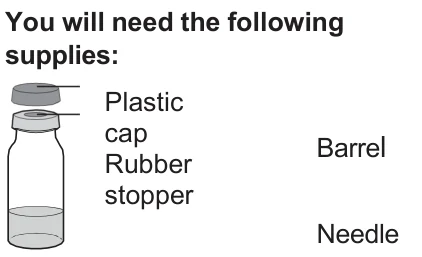
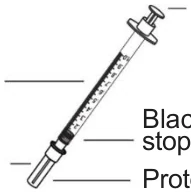
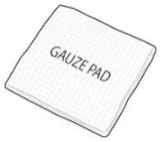
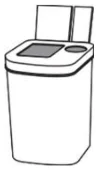
- Gather the supplies you will need for your injection (Figure B).
- Place your supplies on a clean, flat work surface.
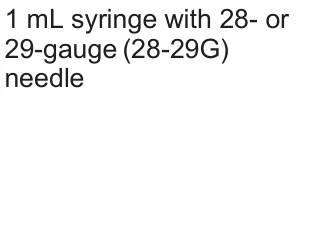
Figure B You will need the following supplies: Plastic cap Rubber stopper Plunger Barrel Needle Black rubber stopper Protective needle cap Vial 1 mL syringe with 28- or 29-gauge (28-29G) needle Gauze pad 2 Alcohol wipes Sharps container |
|---|


Step 2
Check your IMCIVREE vial
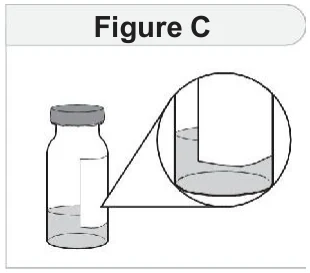
- Check the expiration (Exp) date on the vial label (Figure C).
- Check the liquid. The liquid should look clear to almost clear and colorless to slightly yellow. The liquid should be free of particles.

Do not use if:
- The expiration (Exp) date has passed.
- The liquid is cloudy.
- There are particles floating in the vial.
- The plastic cap on a new vial is broken or missing.
Step 3
Prepare your IMCIVREE vial
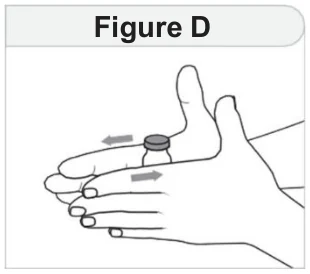
Allow the vial to reach room temperature.
- Remove the vial from the refrigerator 15 minutes before injection.
- You can also warm the vial by rolling it gently between the palms of your hands for 60 seconds (Figure D).
- Do not try to warm the vial by using a heat source such as hot water or a microwave.
- Do not shake the vial.
- Wash your hands with soap and warm water.
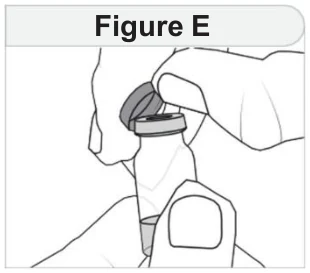
- If using a new vial, remove the plastic cap (Figure E) and throw away this plastic cap in the trash. Do not put the plastic cap back on the vial.
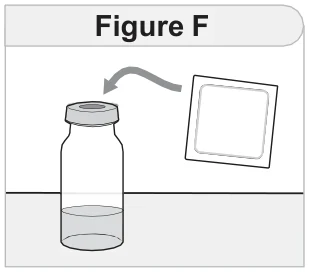
- Clean the top of the vial rubber stopper with 1 alcohol wipe (Figure F). Throw away the alcohol wipe in the trash.
- Do not remove the vial rubber stopper.
Figure C Figure D Figure E | Figure F |
|---|
Step 4
Prepare the syringe
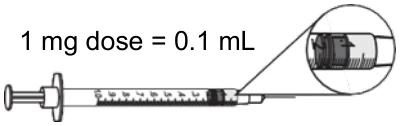
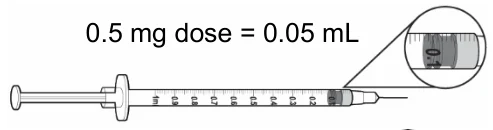
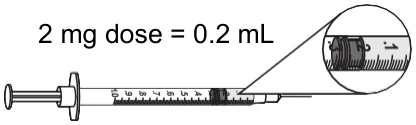
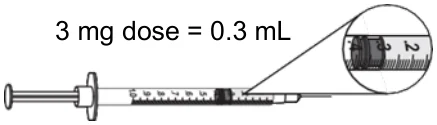
- When measuring your dose, be sure to read the markings starting from the end closest to the black rubber stopper (Figure G).
FIGURE G
Use a 1 ml syringe with 0.01 ml dosing increments and a 28-to-29-gauge needle with a 6 to 13 mm needle length, suitable for injection under the skin.
Fill the syringe with air.
- Keep the protective needle cap on the syringe.
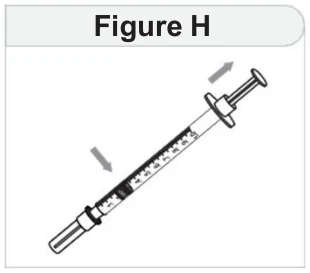
- Pull back on the plunger until the end of the black rubber stopper stops at your dose. Read the units starting from the end closest to the black rubber stopper. Fill the syringe with air equal to the amount of the medicine to be given (Figure H).
Remove the protective needle cap from the syringe.
- Remove the protective needle cap by pulling it straight off and away from your body.
Insert the needle.
- Place the vial on the clean, flat work surface.
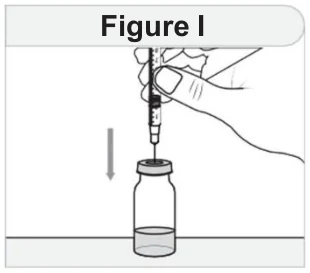
- With the vial in the upright position, place the syringe directly over the vial and insert the needle straight down into the center of the vial rubber stopper (Figure I).
- Push the air from the syringe into the vial.
Figure H Figure I |
|---|
1 mg dose = 0.1 mL
2 mg dose = 0.2 mL
3 mg dose = 0.3 mL
| 0.5 mg dose = 0.05 mL |
|---|
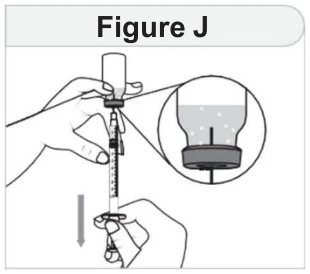
Fill the syringe with IMCIVREE.
- Keep the needle in the vial and slowly turn the vial upside down.
- Make sure to keep the tip of the needle in the medicine (Figure J).
- Slowly pull back on the plunger to fill the syringe with the amount of IMCIVREE needed for your prescribed dose.
- Be careful not to pull the plunger out of the syringe.
- Do not use more than 1 vial of IMCIVREE to give a single dose. Use a new vial that has enough medicine for your prescribed dose.
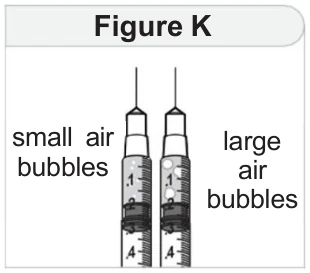
Check for large air bubbles (Figure K).
- Keep the needle in the vial and check the syringe for large air bubbles.
What to do if you see large air bubbles:
Large air bubbles can reduce the dose of medicine you receive. To remove large air bubbles:
- Gently tap the side of the syringe with your finger to move the air bubbles to the top of the syringe.
- Move the tip of the needle above the medicine and slowly push the plunger up to push the large air bubbles back into the vial.
- After the large air bubbles are removed, pull back on the plunger again (more slowly this time) to fill the syringe with your prescribed dose of medicine.
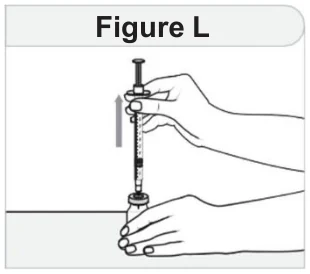
Withdraw the needle
- Return the vial to an upright position and place it on the clean, flat work surface.
- While holding the vial with 1 hand and the barrel of the syringe between the fingertips of your other hand, pull the needle straight out of the vial (Figure L).
- Set the syringe down on the clean, flat work surface.
- Make sure the needle does not touch the surface.
- Do not recap the needle
Figure J Figure K small air bubbles large air bubbles Figure L |
|---|
Step 5
Prepare your injection site
If you have:
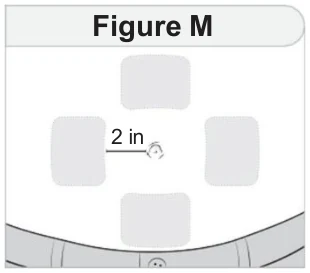
- POMC, PCSK1 or LEPR-deficiency or BBS, choose the area on the belly (abdomen) where you will give the injection (Figure M).
acquired hypothalamic obesity, choose from the following recommended injection sites:
- belly (abdomen) (Figure M)
- front of the middle thighs (Figure N)
- back of the upper arm (Figure O)
- Be sure to choose an area on the belly (abdomen) at least 2 inches from the belly button.
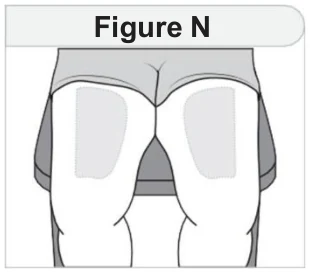
- Do not inject into the belly button, ribs, and hip bones, as well as scars or moles.
- Do not inject in an area that is red, swollen, or irritated.
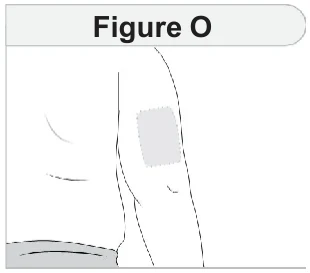
- Clean the injection site with the second alcohol wipe using a circular motion.
- Do not touch, fan, or blow on the cleaned area.
- Allow the skin to dry for about 10 seconds.
Rotate your injection site each day.
You should use a different injection site each time you give an injection, at least 1 inch away from the area you used for your previous injection. You may want to use a calendar or diary to record your injection sites.
Figure O Figure N Figure M 2 in |
|---|
Step 6
Place your hands for the injection
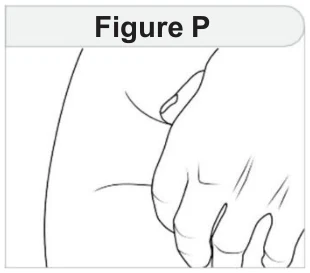
- With 1 hand, pinch about 2 inches of skin at the injection site between your thumb and index (pointer) finger (Figure P). Pinching the skin is important to help make sure that you inject the medicine under the skin (into fatty tissue) but not any deeper (into the muscle).
Step 7
Inject and release
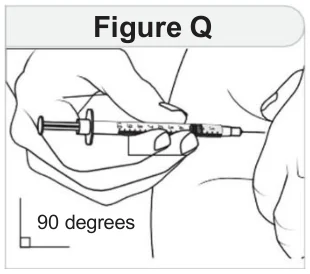
- With your other hand, place the syringe between the thumb and index (pointer) finger.
- Hold the middle of the syringe (where the markings are printed) at a 90-degree angle to your body and push the needle straight into the injection site (Figure Q). Make sure that you push the needle all the way into the skin.
- Do not hold or push on the plunger while inserting the needle.
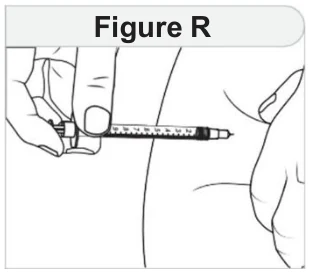
- Slowly push the plunger down to inject the medicine (Figure R)
- Keep the needle in your skin and count to 5 to make sure that all the medicine is given.
- Let go of the pinched skin and remove the needle.
- Use the gauze pad to gently apply pressure to the injection site.
- Do not recap the needle.
Tips for giving injections to children
When giving a child an injection, it can help to have the child do other things. Have the child:
- squeeze something soft like a ball or stuffed animal.
- slowly breathe in and out.
- sing a song, count, or name favorite colors or animals.
Date of Authorization: 2026-09-18
Figure P Figure Q 90 degrees Figure R |
|---|