


Product Monograph - Jeraygo
Recent Major Label Changes
Not applicable.
Table of Contents
Certain sections or subsections that are not applicable at the time of the preparation of the most recent authorized product monograph are not listed.
Recent Major Label Changes ................................................................................................. 2
Table of Contents ................................................................................................................. 2
Part 1: Healthcare Professional Information.......................................................................... 4
1 Indications ................................................................................................................ 4
1.1 Pediatrics ..................................................................................................................... 4
1.2 Geriatrics ...................................................................................................................... 4
2 Contraindications ...................................................................................................... 4
4 Dosage and Administration ....................................................................................... 4
4.1 Dosing Considerations ........................................................................................... 4
4.2 Recommended Dose and Dosage Adjustment ...................................................... 5
4.4 Administration ....................................................................................................... 5
4.5 Missed Dose ........................................................................................................... 5
5 Overdose .................................................................................................................. 5
6 Dosage Forms, Strengths, Composition, and Packaging .............................................. 6
7 Warnings and Precautions ......................................................................................... 6
Cardiovascular .................................................................................................................... 6
Hematologic ....................................................................................................................... 7
Hepatic ............................................................................................................................... 7
Renal .................................................................................................................................. 7
Reproductive Health .......................................................................................................... 7
7.1 Special Populations ................................................................................................ 8
7.1.1 Pregnancy ........................................................................................................... 8
7.1.2 Breastfeeding ..................................................................................................... 8
7.1.3 Pediatrics ............................................................................................................ 8
7.1.4 Geriatrics ............................................................................................................ 8
8 Adverse Reactions ..................................................................................................... 8
8.1 Adverse Reaction Overview ................................................................................... 8
8.2 Clinical Trial Adverse Reactions ............................................................................. 9
8.3 Less Common Clinical Trial Adverse Reactions .................................................... 11
8.4 Abnormal Laboratory Findings: Hematologic, Clinical Chemistry and Other Quantitative Data ............................................................................................................. 11
9 Drug Interactions .................................................................................................... 12
9.2 Drug Interactions Overview ................................................................................. 12
9.4 Drug-Drug Interactions ........................................................................................ 12
9.5 Drug-Food Interactions ........................................................................................ 13
9.6 Drug-Herb Interactions ........................................................................................ 14
9.7 Drug-Laboratory Test Interactions....................................................................... 14
10 Clinical Pharmacology ............................................................................................. 14
10.1 Mechanism of Action ........................................................................................... 14
10.2 Pharmacodynamics .............................................................................................. 14
10.3 Pharmacokinetics ................................................................................................. 14
11 Storage, Stability, and Disposal ................................................................................ 16
Part 2: Scientific Information .............................................................................................. 17
13 Pharmaceutical Information .................................................................................... 17
14 Clinical Trials ........................................................................................................... 17
14.1 Clinical Trials by Indication .................................................................................. 17
15 Microbiology ........................................................................................................... 22
16 Non-Clinical Toxicology ........................................................................................... 22
Patient Medication Information ......................................................................................... 24
Patient Card ....................................................................................................................... 29
Part 1: Healthcare Professional Information
1 Indications
JERAYGO (aprocitentan) is indicated for the treatment of resistant hypertension in adults as an adjunct to at least three antihypertensive medications from different classes.
1.1 Pediatrics
Pediatrics (< 18 years of age): The safety and efficacy of JERAYGO in pediatric patients have not been established; therefore, Health Canada has not authorized an indication for pediatric use.
1.2 Geriatrics
Geriatrics (≥ 65 years of age): Evidence from clinical studies suggests that geriatric patients are at higher risks of some adverse events than younger patients (see 7.1.4 Geriatrics). There is limited evidence available in patients over the age of 75 years.
2 Contraindications
JERAYGO is contraindicated in:
- Patients who are hypersensitive to aprocitentan or to any ingredient in the formulation, including any non-medicinal ingredient, or component of the container. For a complete listing, see 6 Dosage Forms, Strengths, Composition and Packaging.
- Pregnancy.
Breastfeeding (see 7.1.2 Breastfeeding and 16 Non-Clinical Toxicology – Reproductive and
Developmental Toxicology).
Patients with severe hepatic impairment (Child-Pugh class C; with or without cirrhosis) (see 7
Warnings and Precautions, 8.4 Abnormal Laboratory Findings).
4 Dosage and Administration
4.1 Dosing Considerations
Heart failure: JERAYGO has not been studied in patients with congestive heart failure New York Heart Association stage III–IV, unstable cardiac function, or with NT-proBNP plasma concentration ≥ 500 pg/mL. JERAYGO is not recommended in these patients. Due to the general risk of heart failure in patients with resistant hypertension, patients should be monitored for signs and symptoms of decompensated heart failure (see 7 Warnings and Precautions – Cardiovascular – Cardiovascular Events).
Monitoring before treatment initiation or during therapy:
Patients taking loop diuretics should not be switched to less effective diuretics prior to initiation of
JERAYGO (see 7 Warnings and Precautions – Cardiovascular – Fluid Retention).
Hepatic health:
- do NOT initiate JERAYGO in patients with elevated aminotransferases (> 3 × upper limit of normal [ULN]) or severe hepatic impairment.
- when clinically indicated, obtain liver enzyme tests prior to initiation of JERAYGO and during treatment.
- Reproductive health: Before treatment initiation, inform patient of risks regarding male fertility, teratogenicity, and transfer to breastmilk (see 7 Warnings and Precautions – Reproductive Health, 7.1.1 Pregnancy, 7.1.2 Breastfeeding, and 16 Non-Clinical Toxicology – Reproductive and developmental toxicology). Advise patient regarding appropriate safeguards (e.g., hormonal contraception; regular pregnancy tests; treatment interruption or abstention from breastfeeding) based on their personal goals and situation.
4.2 Recommended Dose and Dosage Adjustment
The recommended starting dose of JERAYGO is 12.5 mg orally once daily.
The dose may be increased to 25 mg once daily after at least 4 weeks of treatment for patients tolerating the initial dose and in need of tighter blood pressure control.
Renal impairment: No dose adjustment is required in patients with renal impairment (including severe impairment with estimated glomerular filtration rate [eGFR] 15–29 mL/min/1.73 m2) (see 10.3 Pharmacokinetics). JERAYGO has not been studied in patients with eGFR < 15 mL/min/1.73 m2 or in patients undergoing dialysis and is not recommended in these patients.
Hepatic impairment: See 2 Contraindications and 4.1 Dosing Considerations. No dose adjustment is required in patients with mild or moderate hepatic impairment (Child-Pugh class A or B, respectively) (see 10.3 Pharmacokinetics).
Pediatrics: Health Canada has not authorized an indication for pediatric use.
Geriatrics: No dose adjustment is required in patients over the age of 65 years.
4.4 Administration
The film-coated tablets are not scored and are designed to be swallowed whole.
JERAYGO may be taken with or without food.
4.5 Missed Dose
JERAYGO should be taken every day. If the patient misses a dose of JERAYGO, the patient should be told to resume treatment the next day and not take two doses in the same day.
5 Overdose
Aprocitentan has been administered as a single dose of up to 600 mg, and as multiple doses of up to 100 mg daily to healthy subjects (24 and 4 times the maximum approved dosage, respectively). Adverse events of headache, nasal congestion, nausea, and upper respiratory tract infection were observed. In the event of an overdose, patients should be closely monitored for signs or symptoms of adverse reactions and standard supportive measures should be taken, as required. Because of possible QT interval prolongation, consider the need for ECG monitoring. Dialysis is unlikely to be effective because aprocitentan is highly protein-bound. See 10.3 Pharmacokinetics.
For the most recent information in the management of a suspected drug overdose, contact your regional poison control centre or Health Canada’s toll-free number, 1-844 POISON-X (1-844-764-
7669).
6 Dosage Forms, Strengths, Composition, and Packaging
Table 1 – Dosage Forms, Strengths, and Composition
Film-coated tablets:
- 12.5 mg: yellow to orange round, film-coated tablet, debossed with “AN” on one side and plain on the other side.
- 25 mg: pink round, film-coated tablet, debossed with “AN” on one side, and “25” on the other side.
Nature and contents of the container:
- White, opaque, HDPE bottle with child-resistant closure and induction seal liner, containing a silica gel desiccant and 30 tablets.
- Blisters consisting of aluminum cold-form film with desiccant and aluminum push-through lidding film containing 10 tablets.
7 Warnings and Precautions
Cardiovascular
- Fluid retention
Peripheral edema and fluid retention are known effects of endothelin receptor antagonists (ERAs) and were observed in clinical studies with JERAYGO. Monitor for signs of fluid retention after JERAYGO initiation. If clinically significant fluid retention develops, evaluate the patient to determine the cause and the need for additional supportive treatment, including diuretics (see 8 Adverse Reactions).
Many factors increase the risk of developing fluid retention during JERAYGO treatment: renal
| Route of | Dosage Form / | Non-Medicinal Ingredients | ||||
| Administration | Strength/Composition | |||||
| Oral | Tablet 12.5 mg, 25 mg | Croscarmellose sodium Hydroxypropyl cellulose Iron oxide black Iron oxide red Iron oxide yellow Lactose monohydrate Magnesium stearate Microcrystalline cellulose Polyvinyl alcohol Silica colloidal hydrated Talc Titanium dioxide Triethyl citrate | ||||
impairment, heart failure, diabetes, body mass index (BMI) ≥ 40 kg/m2 and older age. Before increasing the dose in these patients, fluid management should be optimized and patients should be advised to be especially aware of fluid retention signs in the first few weeks following up-titration.
- Cardiovascular events
Due to the general risk of CV events in patients with resistant hypertension and since aprocitentan can cause fluid retention, patients at high risk of developing congestive heart failure or other CV events should be monitored for signs and symptoms of fluid retention.
Hematologic
Decreases in hemoglobin concentration and hematocrit have occurred following administration of other ERAs, and were observed in clinical studies with JERAYGO. These decreases have been attributed to plasma volume increase (hemodilution), presented early, stabilized on long-term treatment, and were reversible after discontinuation. Initiation of JERAYGO is not recommended in patients with severe anemia. If clinically indicated, measure hemoglobin prior to initiation of treatment and during treatment. See 8 Adverse Reactions.
Hepatic
Elevations of aminotransferases and hepatotoxicity are known effects of other ERAs.
If sustained, unexplained, clinically relevant aminotransferase elevations occur, or if elevations are accompanied by an increase in bilirubin > 2 × ULN, or by clinical symptoms of hepatotoxicity, discontinue JERAYGO. See 8 Adverse Reactions.
JERAYGO is supplied with a patient card which provides important safety information to support early recognition of hepatotoxicity (see Patient Medication Information).
Renal
Patients with eGFR below 60 mL/min/1.73 m2 have a higher risk of anaemia and fluid retention (including edema) than those with higher eGFR during treatment with JERAYGO. When clinically indicated, monitor haemoglobin and signs of fluid retention or heart failure.
Reproductive Health
Fertility
An increased incidence of testicular tubular dilation and tubular degeneration or atrophy in male rats and dogs was observed after treatment with aprocitentan, similar to other ERAs. However, such effects were only observed at 21-fold (rats) and 17-fold (dogs) the maximum recommended human dose, and no effects on fertility occurred. Pre- and post-natal development studies in female rats given macitentan (of which aprocitentan is a major metabolite) from late pregnancy through lactation showed reduced pup survival and impairment of male fertility at all doses (see 16 Non-Clinical Toxicology – Reproductive and developmental toxicology). Other ERAs have shown decreases in sperm count in patients. It is not known if aprocitentan may adversely affect spermatogenesis in men.
Teratogenic Risk
Based on data from animal reproduction studies with other ERAs, aprocitentan may cause fetal harm when administered to a pregnant patient. JERAYGO is contraindicated for use in patients who are pregnant. Advise patients of reproductive potential to use highly effective methods of contraception during treatment with JERAYGO and for one month after treatment discontinuation, as patients should not become pregnant during this time. Patients of reproductive potential should perform a pregnancy test before the start of treatment, monthly during treatment, and one month after stopping treatment with JERAYGO to allow for the early detection of pregnancy. If pregnancy is detected, discontinue JERAYGO. See 2 Contraindications and 7.1.1 Pregnancy.
JERAYGO is supplied with a patient card which provides important safety information to advise patients of fetal risks and how to prevent them (see Patient Medication Information).
7.1 Special Populations
7.1.1 Pregnancy
There is insufficient data on JERAYGO use in pregnant women. Based on data from animal reproduction studies with other ERAs, JERAYGO may cause embryo-fetal toxicity, including birth defects and fetal death, when administered to a pregnant patient, and is contraindicated during pregnancy (see 2 Contraindications).
There was one case of pre-conception and pregnancy exposure to JERAYGO during the clinical development program. The participant was exposed to 25 mg of aprocitentan for 139 days in total, which included the first 6 weeks of pregnancy, after which aprocitentan was permanently discontinued. The baby was born healthy, with no congenital abnormalities at 38 weeks.
7.1.2 Breastfeeding
There are no data on the presence of aprocitentan in human milk, the effects on the breastfed infant, or the effect on milk production. In rats, aprocitentan was excreted into milk during lactation approximately proportionally to plasma levels. Breastfeeding is contraindicated during treatment with JERAYGO.
7.1.3 Pediatrics
Pediatrics (< 18 years of age): The safety and efficacy of JERAYGO in pediatric patients have not been established. Therefore, Health Canada has not authorized an indication for pediatric use.
7.1.4 Geriatrics
Older patients (≥ 75 years of age) are more likely to develop anemia, fluid retention (including worsening of fluid retention), cerebrovascular events, and heart failure (including worsening of heart failure). See 1.2 Geriatrics, 4.1 Dosing Considerations, 4.2 Recommended Dose and Dosage Adjustment and 7 Warnings and Precautions – Cardiovascular and Hematologic.
8 Adverse Reactions
8.1 Adverse Reaction Overview
The most frequently reported adverse drug reactions for any dose of JERAYGO in study ID-080A301 were edema / fluid retention (26%) and hemoglobin decreased (11%). Permanent discontinuation due to adverse events over the entire study period (48 weeks) occurred in 6.2% of participants taking any
dose (see 8.2 Clinical Trial Adverse Reactions, 7 Warnings and Precautions – Cardiovascular and Hematologic).
Most adverse reactions were mild or moderate in intensity.
8.2 Clinical Trial Adverse Reactions
Clinical trials are conducted under very specific conditions. The adverse reaction rates observed in the clinical trials, therefore, may not reflect the rates observed in practice and should not be compared to the rates in the clinical trials of another drug. Adverse reaction information from clinical trials may be useful in identifying and approximating rates of adverse drug reactions in real-world use.
The safety of JERAYGO was evaluated in one placebo-controlled Phase 3 clinical study (ID-080A301) in patients with uncontrolled blood pressure (BP) (systolic blood pressure [SBP] ≥ 140 mmHg) despite the use of at least three antihypertensive medications. This study evaluated JERAYGO as add-on therapy for 48 weeks. Patients received either JERAYGO 12.5 mg, JERAYGO 25 mg or placebo once daily during the initial 4-week double-blind treatment (part 1). Thereafter all patients received JERAYGO 25 mg once daily during the 32-week single-blind treatment (part 2). At the end of the 32 weeks, patients were re-randomized to receive either JERAYGO 25 mg or placebo once daily during the 12-week double-blind withdrawal treatment (part 3).
The median exposure to JERAYGO was 37 weeks and the longest exposure was 56 weeks. A total of 724 patients received any dose of JERAYGO, of which 243 patients were exposed to aprocitentan 12.5 mg and 713 patients to aprocitentan 25 mg. This corresponded to 20 patient-years (12.5 mg) and 486 patient-years (25 mg) of exposure.
Table 2 includes adverse drug reactions defined as 1) treatment-emergent adverse events with a frequency of ≥ 2% in JERAYGO-treated patients and greater (≥ 1%) than in placebo-treated patients during the initial 4-week double-blind treatment (part 1) and 2) any other adverse event, not meeting the threshold criteria, but considered relevant due to the mechanism related to ERAs’ vasodilatory effect. For both categories, all 3 study parts are displayed.
Table 2 – Adverse drug reactions reported by trial treatment part and preferred term
Trial treatment part Preferred Term | Aprocitentan | Aprocitentan | Placebo (%) | ||||
| 12.5 mg | 25 mg | ||||||
| (%) | (%) | ||||||
Double-blind (part 1) Edema / fluid retention Hemoglobin decreased Dyspnoea Headache Upper respiratory tract infection Hypotension | N = 243 9.1 3.7 0.4 0 0 0.8 | N = 245 18.4 1.2 1.6 2.0 2.4 0.8 | N = 242 2.1 0 0.4 1.2 1.7 0.4 | ||||
Trial treatment part Preferred Term | Aprocitentan | Aprocitentan | Placebo (%) | ||||
| 12.5 mg | 25 mg | ||||||
| (%) | (%) | ||||||
Single-blind (part 2) Edema / fluid retention Hemoglobin decreased Headache Dyspnoea Hypotension Upper respiratory tract infection | N = 704 18.2 8.9 3.7 2.1 2.1 0.9 | ||||||
Double-blind withdrawal (part 3) Edema / fluid retention Hemoglobin decreased Dyspnoea Upper respiratory tract infection Hypotension Headache | N = 310 2.6 1.9 0.6 1.3 0.3 0.6 | N = 303 1.3 1.3 0 0.7 0 1.7 | |||||
Edema / fluid retention includes terms within the Standardised MedDRA Query of “Haemodynamic edema, effusions and fluid overload” and the terms swelling of eyelid, swelling face, eyelid edema, and face edema. Hemoglobin decreased is the combination of the following preferred terms: ‘Anaemia’ and ‘Haemoglobin decreased’.
Incidence rates are by study part and reflect number of participants experiencing a new or recurrent event in each part. For overall incidence over 48 weeks, see Table 3.
Table 3 presents the overall incidence of adverse drug reactions at any time during the study. Actions to be taken if edema / fluid retention or anemia occur are described in 7 Warnings and Precautions – Cardiovascular and Hematologic.
Table 3 – Overall incidence of adverse drug reactions during 48 weeks
| Overall incidence over 48 weeks for aprocitentan at any dose for N = 724 | |||||||||||||||||
Adverse drug reactions preferred term | Adverse drug reactions | Adverse drug reactions | Serious adverse drug reactions | ||||||||||||||
| leading to treatment | |||||||||||||||||
| discontinuation | |||||||||||||||||
| n/Nn (%) | n/Nn (%) | n/Nn (%) | |||||||||||||||
Edema / fluid retention 185 (25.6) 6 (0.8) 3 (0.4) Hemoglobin decreased 81 (11.2) 0 1 (0.1) Headache 34 (4.7) 0 0 Dyspnoea 22 (3. 0) 1 (0.1) 2 (0.3) Hypotension 18 (2.5) 1 (0.1) 1 (0.1) Upper respiratory tract infection 15 (2.1) 0 0 | |||||||||||||||||
The highest frequency of overall adverse drug reactions for participants exposed over 16 weeks to placebo (N = 444) was 2% for edema / fluid retention and headache each. One participant discontinued due to hypotension and no event was serious.
8.3 Less Common Clinical Trial Adverse Reactions
Immune system disorders: Hypersensitivity
Investigations: Glomerular filtration rate decreased during initial treatment, Weight increased during initial treatment
Hepatobiliary disorders: Transaminase increased
Vascular disorders: Flushing
8.4 Abnormal Laboratory Findings: Hematologic, Clinical Chemistry and Other Quantitative Data
Clinical Trial Findings
Mean hemoglobin at baseline was 139, 139 and 141 g/L for JERAYGO 12.5 mg, 25 mg and placebo, respectively. During the 4-week double-blind treatment (part 1), a mean decrease in hemoglobin of 8 and 9 g/L was reported in patients receiving JERAYGO 12.5 mg and 25 mg, respectively, compared to a decrease of 4 g/L in patients receiving placebo. At the end of the 32-week SB treatment (part 2), during which all patients received JERAYGO 25 mg, the mean decrease in hemoglobin remained unchanged at 9 g/L compared to baseline. Reversibility of the effect was observed within 4 weeks in patients re-randomized to placebo in the 12-week double-blind withdrawal treatment (part 3). A decrease from baseline in hemoglobin concentration to below 100 g/L was reported in 6% of patients during the 48-week exposure to JERAYGO 25 mg. Of these patients, the range for hemoglobin at baseline was 103 to 154 g/L.
A higher incidence of hemoglobin decrease was observed for patients ≥ 75 years of age compared to younger patients, see 7.1.4 Geriatrics.
Clinically significant abnormalities over 48 weeks are summarized in Table 4.
Table 4 – Clinically significant abnormal laboratory findings per study part
Marked laboratory findings per trial treatment part Aprocitentan 12.5 mg
n / Nn (%)
Aprocitentan 25 mg n / Nn (%)
Placebo n / Nn (%)
Double-blind (Part 1) N = 243 N = 245 N = 242
Hemoglobin (g/L)
< 80 0 / 222 0 / 230 0 / 226
< 100 7 / 221 (3.2) 3 / 229 (1.3) 0 / 226
Liver enzymes
ALT and/or AST > 3 × ULN 0 / 235 1 / 239 (0.4) 2 / 228 (0.9)
(ALT and/or AST > 3 × ULN) and (TBIL > 2 × ULN) 0 / 235 0 / 240 0 / 230
Glomerular filtration rate, estimated (mL/min/1.73 m2)
< 30 4 / 230 (1.7) 6 / 233(2.6) 2 / 227 (0.9) < 60 15 / 185(8.1) 8 / 180 (4.4) 14 / 190 (7.4)
Single-blind (Part 2) N = 704
Hemoglobin (g/L)
< 80 1 / 689 (0.1)
< 100 38 / 687 (5.5)
Liver enzymes
ALT and/or AST > 3 × ULN 10 / 689 (1.5)
(ALT and/or AST > 3 × ULN) and (TBIL > 2 × ULN) 0 / 691
Glomerular filtration rate, estimated (mL/min/1.73 m2)
< 30 32 / 674 (4.7)
< 60 108 / 542 (19.9)
Double-blind withdrawal (Part 3) N = 310 N = 303
Hemoglobin (g/L)
< 80 0 / 307 0 / 297
< 100 4 / 303 (1.3) 4 / 292 (1.4)
Liver enzymes
ALT and/or AST > 3 × ULN 4 / 305 (1.3) 3 / 296 (1.0)
(ALT and/or AST > 3 × ULN) and (TBIL > 2 × ULN) 0 / 306 0 / 297
Glomerular filtration rate, estimated (mL/min/1.73 m2)
< 30 14 / 296 (4.7) 2 / 288 (0.7)
< 60 28 / 228 (12.3) 28 / 237(11.8)
ALT = alanine aminotransferase; AST = aspartate aminotransferase; TBIL = total bilirubin; ULN = upper limit of normal.
Initiation of JERAYGO may cause an initial small and dose-dependent decrease in eGFR that occurs within the first 6 weeks of initializing therapy and then stabilizes.
9 Drug Interactions
9.2 Drug Interactions Overview
JERAYGO at higher than recommended doses may increase the risk of cardiac arrhythmias, including torsade de pointes, when given in combination with other drugs known to prolong the QT interval (see 9.4 Drug-Drug Interactions).
Effect of other compounds on the pharmacokinetics of JERAYGO
A clinically relevant impact on aprocitentan exposure by other compounds that are inhibitors or inducers of transporters and/or CYP enzymes is not expected.
Effect of JERAYGO on the pharmacokinetics of other co-administered compounds
A clinically relevant impact of aprocitentan on exposure to other compounds is not expected based on in vitro data with CYP enzymes and drug transporters, and the clinical drug-drug interaction studies with CYP3A4 substrate midazolam and breast cancer resistance protein (BCRP) substrate rosuvastatin (see 9.4 Drug-Drug Interactions).
9.4 Drug-Drug Interactions
The drugs listed in this table are based on either drug interaction case reports or studies, or potential
interactions due to the expected magnitude and seriousness of the interaction (i.e., those identified as contraindicated).
Table 5 – Established or Potential Drug-Drug Interactions
| Source of | Clinical | ||
| Proper/Common name | Effect | ||
| evidence | Comment | ||
Midazolam (sensitive CYP3A4 substrate) | CT | Co-administration of once daily 50 mg aprocitentan at steady state with the CYP3A4 substrate midazolam did not affect the PK of midazolam (Cmax = 1.04 [0.88, 1.23], AUC = 1.14 [1.06, 1.22]). | No dose adjustment. |
| Rosuvastatin (BCRP substrate) | CT | Co-administration of once daily 25 mg aprocitentan at steady state with 10 mg rosuvastatin, a BCRP substrate increased Cmax of rosuvastatin by 40% (Cmax = 1.40 [1.19, 1.65]) while AUC remained unchanged (AUC = 0.99 [0.86, 1.14]). | No dose adjustment. |
Ethinyl estradiol and levonorgestrel (combined oral contraceptives) | CT | Co-administration of once daily 25 mg aprocitentan at steady state with 20 mcg ethinyl estradiol and 100 mcg levonorgestrel did not affect the PK of ethinyl estradiol, with slightly increased Cmax (Cmax = 1.21 (1.10, 1.32) and unchanged AUC (AUC = 1.06 [1.01, 1.11]). For levonorgestrel, both Cmax and AUC were slightly increased (Cmax = 1.38 [1.26, 1.50], AUC = 1.26 [1.12, 1.42]). | No dose adjustment. |
QT-prolonging drugs e.g., Class 1A antiarrhythmics (procainamide, disopyramide), Class 3 antiarrhythmics (amiodarone, sotalol), antipsychotics (ziprasidone, chlorpromazine) and certain antibiotics (moxifloxacin). The list is not comprehensive. | T | — | Caution is required with use of JERAYGO at higher than recommended doses in combination with other drugs that prolong the QT interval. |
1-OH midazolam = 1-hydroxy midazolam; AUC = area under the plasma concentration-time curve; BCRP = breast cancer resistance protein; CI = confidence interval; Cmax = maximum plasma concentration; CT = Clinical Trial; PK = pharmacokinetics; T = Theoretical.
9.5 Drug-Food Interactions
JERAYGO may be taken with or without food.
9.6 Drug-Herb Interactions
Interactions with herbal products have not been established.
9.7 Drug-Laboratory Test Interactions
Interactions with laboratory tests have not been established.
10 Clinical Pharmacology
10.1 Mechanism of Action
Aprocitentan is a potent, orally active, dual ERA that inhibits the binding of endothelin (ET)-1 to ETA and ETB receptors. ET-1, via its receptors ETA and ETB, mediates a variety of deleterious effects such as vasoconstriction, fibrosis, cell proliferation and inflammation. In hypertension, ET-1 can cause endothelial dysfunction, vascular hypertrophy and remodeling, sympathetic activation and increased aldosterone synthesis. ET-1 is upregulated in hypertension and especially in low-renin salt-dependent conditions.
In different animal models of hypertension, aprocitentan decreased BP without affecting heart rate and demonstrated a stronger effect in salt-sensitive models, in which it also improved renal hemodynamics and cardiac remodeling.
10.2 Pharmacodynamics
Cardiac electrophysiology
A randomized, crossover, placebo- and positive-controlled thorough QT study was performed in which healthy participants received 25 mg (maximum therapeutic dose), or 100 mg (supratherapeutic dose, four times the maximum recommended clinical dose) aprocitentan once daily for 10 days to achieve steady state, matched placebo, and a single 400 mg dose of moxifloxacin (control). At the maximum therapeutic dose, the mean placebo- and baseline-corrected QTc change was 3.9 ms and the upper bound of the 90% confidence interval (CI) was 4.4 ms. At this dose, the mean concentration (Cmax) was 3.7 μg/mL (95% CI 3.4–4.0). At 100 mg, the mean placebo- and baseline-corrected QTc change was 8.5 ms and the upper limit of the 90% CI of the mean change from baseline in placebo-corrected QTc was 10.4 ms. At this dose, the mean concentration (Cmax) was 16.8 µg/ml (95% CI 15.5–18.1). Concentration—QT analysis demonstrated that QT prolongation may occur only above concentrations that are unlikely to be achieved in patients on the highest recommended dose. Cardiac adverse events including palpitations, tachycardia, and bradycardia were reported in the 100 mg group, and one subject in this group discontinued the study due to an increase in QTc prolongation exceeding 60 ms from baseline (see 9 Drug Interactions).
10.3 Pharmacokinetics
The pharmacokinetics of aprocitentan have been investigated mainly in healthy adult participants. A cross-study comparison of trough plasma concentration (Ctrough) values of aprocitentan at steady state in participants with resistant hypertension were similar to the values observed in healthy participants.
Table 6 – Summary of Aprocitentan Pharmacokinetic Parameters in Healthy Participants
| Cmax [μg/mL] | tmax [h] | AUCτ [μg*h/mL] | t½ [h] | |||||||||||
25 mg first dosing interval | 1.32 (0.98, 1.76) | 8.5 (4.0, 10.0) | 23.49 (18.06, 30.54) | – | ||||||||||
25 mg at steady state | 3.57 (2.67, 4.77) | 4.5 (3.0, 9.0) | 69.48 (52.44, 92.05) | 45.7 (38.7, 53.9) | ||||||||||
Data are geometric means (95% CI) or for tmax the median (range).
AUCτ = area under the plasma concentration-time curve during one dosing interval; CI = confidence interval; Cmax = maximum plasma concentration; t½ = terminal half-life; tmax = time to reach maximum plasma concentration.
Absorption:
Maximum plasma concentration (Cmax) of aprocitentan was achieved between 4 and 5 h after administration of 25 mg. Concentrations of aprocitentan in plasma increased in a dose-proportional manner following once daily administration of 5 mg, 25 mg, and 100 mg. The absolute bioavailability of aprocitentan after oral administration is not known.
With once daily administration, steady-state conditions were reached by Day 8 and accumulation compared to Day 1 was approximately 3-fold.
When a capsule formulation (used in early clinical studies) was taken with a high-fat, high-calorie meal by healthy participants, aprocitentan median tmax was reached approximately one hour earlier, with a Cmax approximately 1.7-fold that in the fasted condition. Total exposure expressed as AUC0-∞ was approximately 1.2-fold that observed in the fasted condition. The effect of food on the aprocitentan tablet has not specifically been studied. Aprocitentan tablets were administered without regard to food in the pivotal Phase 3 study and may be taken with or without food. See 4 Dosage and Administration.
Distribution:
The apparent volume of distribution of aprocitentan is approximately 20 L. Aprocitentan is highly bound to plasma proteins (> 99%), primarily albumin. The aprocitentan blood-to-plasma ratio is 0.63.
Metabolism:
In plasma, aprocitentan was almost exclusively detected unchanged (94.3%) and there were no major metabolites.
Aprocitentan is primarily metabolized by N-glucosidation of the sulfamide moiety catalyzed by glucuronyl transferases UGT1A1 and UGT2B7, and the hydrolysis of the sulfamide moiety to the corresponding aminopyrimidine. Hydrolysis was mostly non-enzymatic.
Elimination:
After administration of a radiolabeled dose of aprocitentan, approximately 52% of radioactive drug-related material was eliminated via urine and 25% via feces. A total of 0.2% and 6.8% of the administered dose was recovered in urine and feces as unchanged aprocitentan, respectively.
Following oral administration of aprocitentan in healthy subjects the apparent total body clearance was 0.30 L/h. The terminal plasma half-life of aprocitentan is approximately 46 h.
Special Populations and Conditions
Age, sex, ethnic origin, and body size: There were no clinically relevant effects of age, sex, body weight, or race on the pharmacokinetics of aprocitentan.
Hepatic insufficiency: Total exposure to aprocitentan (AUC) in patients with moderate hepatic impairment (Child-Pugh grade B) compared to healthy subjects was increased by an average of 23%. This increase is not considered clinically relevant. Aprocitentan binding to plasma proteins was not influenced by hepatic function. Based on these results, JERAYGO can be administered to patients with mild or moderate hepatic impairment without the need for dose adjustment. The pharmacokinetics of aprocitentan in patients with severe hepatic impairment have not been studied and JERAYGO is contraindicated in these patients.
Renal insufficiency: Total exposure to aprocitentan (AUC) in patients with severe renal impairment (eGFR 15–29 mL/min/1.73 m2) compared to healthy subjects was increased by an average of 34%. This increase is not considered clinically relevant. Aprocitentan binding to plasma proteins was not influenced by renal function. Based on these results, JERAYGO can be administered to patients with mild to severe renal impairment without the need for dose adjustment. Patients with renal impairment are at increased risk of fluid retention and anemia (see 7 Warnings and Precautions).
The pharmacokinetics of aprocitentan in patients with eGFR < 15 mL/min/1.73 m2 or in patients undergoing dialysis have not been studied and JERAYGO is not recommended in these patients.
11 Storage, Stability, and Disposal
Store in the original package (HDPE bottles or blisters). Do not store above 25°C. The HDPE bottles should be kept tightly closed to protect from moisture.
Part 2: Scientific Information
13 Pharmaceutical Information
Drug Substance
Non-proprietary name of the drug substance(s): aprocitentan
Chemical name: N-[5-(4-bromophenyl)-6-[2-[(5-bromo-2-pyrimidinyl)oxy]ethoxy]-4-pyrimidinyl]-sulfamide
Molecular formula: C16H14Br2N6O4S
Molecular mass: 546.2 g/mol
Structural formula:
Physicochemical properties: Aprocitentan is a white to almost white powder that is practically insoluble or insoluble in water and over the physiological pH range
14 Clinical Trials
14.1 Clinical Trials by Indication
Resistant Hypertension
The efficacy of JERAYGO (aprocitentan) was evaluated in one randomized, double-blind, placebo-controlled Phase 3 multicenter study (study 1).
Table 7 – Summary of Patient Demographics for Clinical Trials in Resistant Hypertension
| Study # | Study design | Dosage, route of administration and duration | Study | Mean age (Range) | Sex | ||
| subjects | |||||||
| (n) | |||||||
| 1 | Part 1 Double-blind, placebo-controlled, randomized (1:1:1) | Dosage 25 mg 12.5 mg Placebo Route of administration Oral, once daily Duration 4 weeks | 243 243 244 | 61.7 years (24–84) | 59.5% male 40.5% female | ||
Part 2 Single-blind | Dosage 25 mg Route of administration Oral, once daily Duration 32 weeks | 704 | |||
Part 3 Double-blind withdrawal, placebo-controlled, randomized (1:1) | Dosage 25 mg Placebo Route of administration Oral, once daily Duration 12 weeks | 307 307 |
Patients with uncontrolled BP (SBP ≥ 140 mmHg) despite the use of at least three antihypertensive medications were switched to background therapy consisting of an angiotensin receptor blocker, calcium channel blocker, and a diuretic throughout the study. Patients with concomitant use of beta-blockers continued this treatment throughout the study. A total of 730 patients received either JERAYGO 12.5 mg, JERAYGO 25 mg or placebo once daily during the initial 4-week double-blind treatment (part 1). Thereafter, patients received JERAYGO 25 mg once daily during the 32-week single-blind treatment (part 2). At the end of the 32 weeks, patients were re-randomized to receive either JERAYGO 25 mg or placebo, once daily, during the 12-week double-blind withdrawal treatment (part 3) [Table 7].
The primary efficacy endpoint was the change in sitting SBP (SiSBP) from baseline to Week 4 during double-blind treatment (part 1), measured at trough by unattended automated office blood pressure (uAOBP).
The key secondary endpoint was the change in SiSBP measured at trough by uAOBP from double-blind withdrawal baseline (Week 36) to Week 40 (part 3).
Patients had a mean age of 62 years (range 24 to 84 years) and 60% were male. Patients were White (83%), African American (11%) or Asian (5%). The mean BMI was 34 kg/m2 (range 18 to 64 kg/m2). Patients had a medical history of diabetes mellitus (54%), ischemic heart disease (31%), CNS vascular disorders (23%), congestive heart failure (20%), chronic kidney disease (19% with eGFR 30–59 mL/min/1.73 m2 and 3% with eGFR 15–29 mL/min/1.73 m2), sleep apnea syndrome (14%), and 2 patients had hepatic impairment. Most patients (63%) had four or more antihypertensive medications.
Doses of JERAYGO 12.5 and 25 mg showed a statistically significant reduction vs placebo on SiSBP at Week 4. The treatment effect was consistent for sitting diastolic BP (SiDBP) [Table 8].
Table 8 – Reduction in Sitting Trough BP (mmHg) at Week 4 of Double-Blind Treatment
| Difference to placebo | |||||||||||||||||||||
| Treatment | N | Baseline * | LS Mean | LS Mean | p-value | ||||||||||||||||
| group | Mean | ||||||||||||||||||||
SiSBP (primary endpoint) LS Mean (97.5% CL) LS Mean (97.5% CL) 12.5 mg 243 153.2 −15.3 (−17.4, −13.2) −3.8 (−6.8, −0.8) 0.0042 † 25 mg 243 153.3 −15.2 (−17.3, −13.1) −3.7 (−6.7, −0.8) 0.0046 † Placebo 244 153.3 −11.5 (−13.6, −9.4) - -
SiDBP LS Mean (95% CL) LS Mean (95% CL) 12.5 mg 243 87.9 −10.4 (−11.6, −9.3) −3.9 (−5.6, −2.3) < 0.0001 25 mg 243 87.7 −11.0 (−12.1, −9.8) −4.5 (−6.1, −2.9) < 0.0001 Placebo 244 87.1 −6.5 (−7.6, −5.3) - - * Observed baseline value.
† Statistically significant at the 2.5% level as prespecified in the testing strategy.
BP = blood pressure; CL = confidence limit; DB = double-blind; LS Mean = least squares mean; SiDBP = sitting diastolic blood pressure; SiSBP = sitting systolic blood pressure.
The persistence of the BP-lowering effect of JERAYGO was demonstrated in double-blind withdrawal treatment (part 3). In patients re-randomized to placebo, the mean SiSBP increased, whereas in patients re-randomized to JERAYGO 25 mg the mean effect on SiSBP was maintained, resulting in a statistically significant difference. The treatment effect was consistent for SiDBP [Table 9].
Table 9 – Sustained Reduction in Sitting Trough BP (mmHg) at Week 40 of Double-Blind Withdrawal Treatment
Difference to placebo
Treatment
group
N DB-WD Baseline *
Mean
LS Mean (95% CL) LS Mean (95% CL) p-value
SiSBP (key secondary endpoint)
25 mg 307 135.3 −1.5 (−3.0, 0.0) −5.8 (−7.9, −3.7) <0.0001 † Placebo 307 136.4 4.4 (2.9, 5.8) - -
SiDBP 25 mg 307 76.1 −0.5 (−1.5, 0.5) −5.2 (−6.6, −3.8) Placebo 307 76.3 4.7 (3.7, 5.7) - - * Observed baseline value. DB-WD baseline: Week 36.
† Statistically significant at the 5% level as prespecified in the testing strategy.
BP = blood pressure; CL = confidence limit(s); DB-WD = double-blind withdrawal; LS Mean = least squares mean; SiDBP = sitting diastolic blood pressure; SiSBP = sitting systolic blood pressure.
The effect was also consistent across SBP and DBP measured by ambulatory BP monitoring and assessed as daytime, night-time, and 24 h periods at Week 4 and Week 40.
A substantial proportion (i.e., at least 90%) of the BP-lowering effect was observed within the first two weeks of treatment with JERAYGO. The effect on trough BP as measured by uAOBP over the course of the 48-week study is presented in Figure 1.
Figure 1 – Mean SiSBP (A) and SiDBP (B) Over 48 Weeks
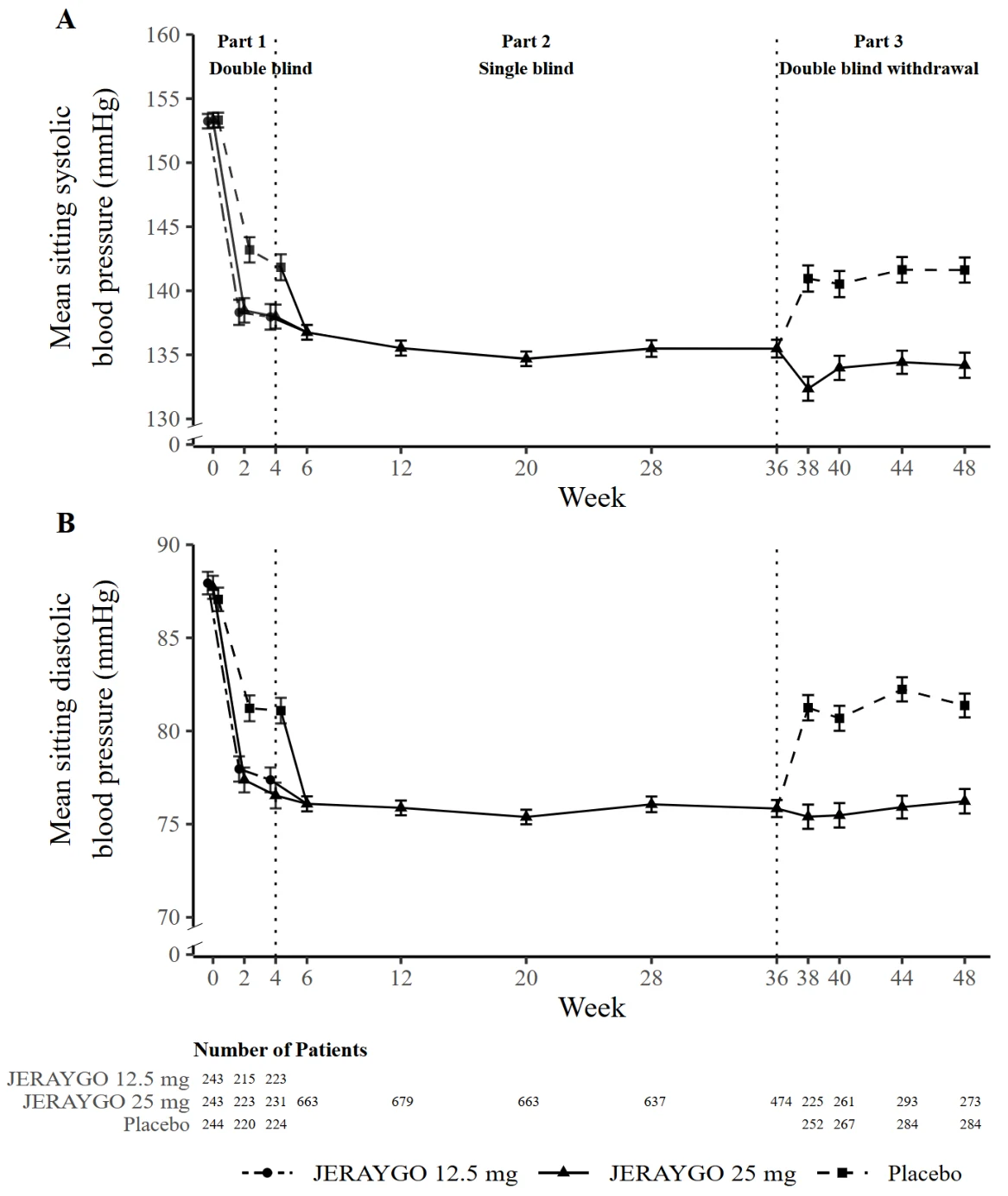
SiDBP = sitting diastolic blood pressure; SiSBP = sitting systolic blood pressure.
The effect of JERAYGO was consistent across subgroups of age (including patients ≥ 75 years), sex, race (including patients with Black or African American origin), BMI, baseline urine albumin-to-creatinine ratio (UACR), baseline eGFR and medical history of diabetes, and was consistent with the effect in the overall population [Figure 2].
Figure 2 – Subgroup Analyses for Change from Baseline to Week 4 (Double-Blind Part 1) in SiSBP
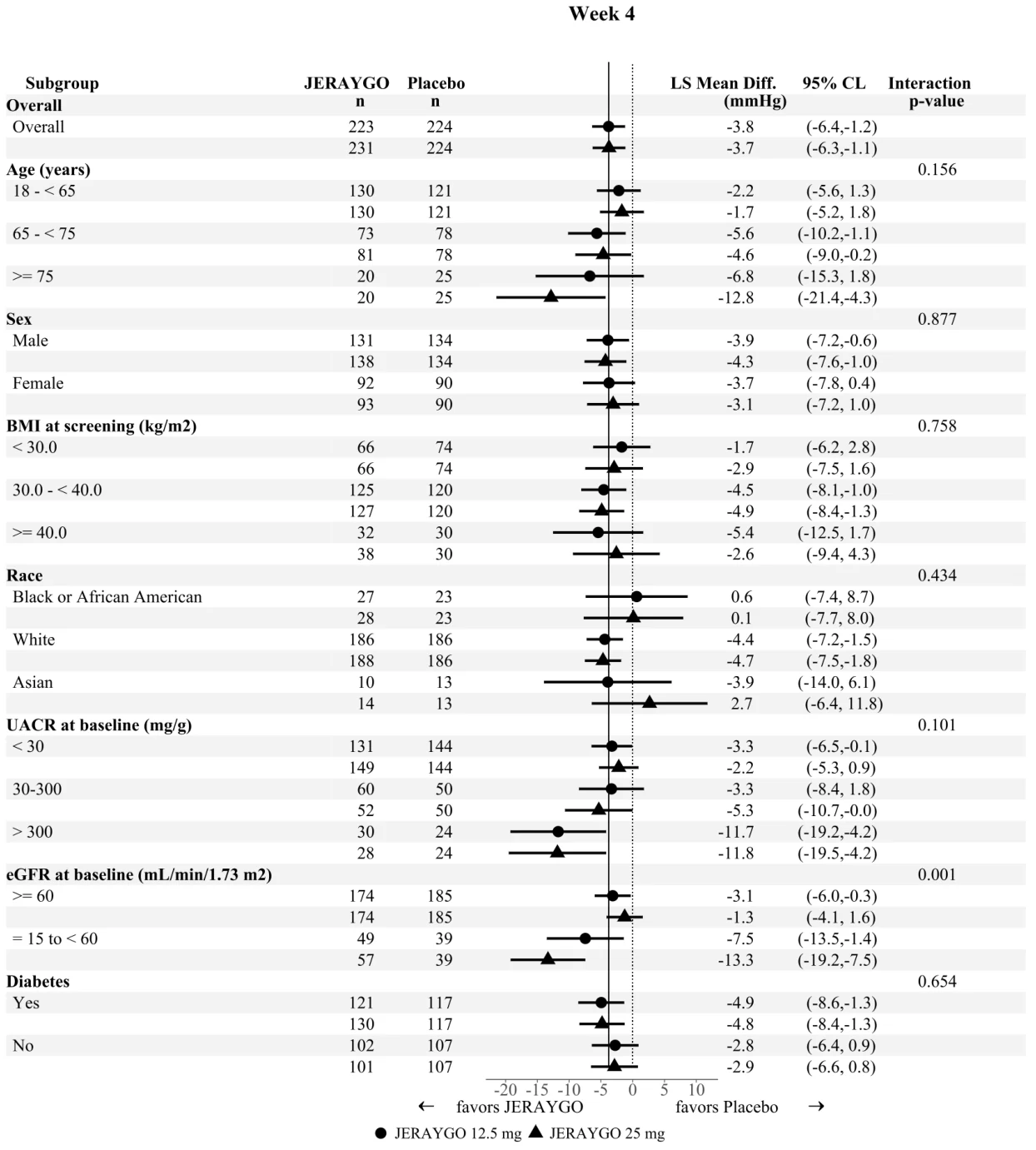
BMI = body mass index; CL = confidence limits; eGFR = estimated glomerular filtration rate; LS Mean Diff. = least squares mean difference; SiSBP = sitting systolic blood pressure; UACR = urine albumin-to-creatinine ratio.
Control rate
BP control rates were measured using uAOBP. At Week 4, 37% and 39% of patients who received 12.5 mg and 25 mg JERAYGO, respectively, reached target BP (SiSBP of < 135 mmHg and SiDBP of
< 85 mmHg), compared to 29% of patients treated with placebo. At Week 36, 46% of patients treated with 25 mg JERAYGO had reached target BP. At Week 40, 53% of patients who stayed on 25 mg JERAYGO were controlled, compared to 30% of patients switched to placebo.
15 Microbiology
No microbiological information is required for this drug product.
16 Non-Clinical Toxicology
General toxicology
Repeat-dose oral toxicity studies were conducted in rats and dogs for up to 26 and 39 weeks, respectively. The general toxicity profile of aprocitentan mainly reflects exaggerated pharmacodynamic effects of aprocitentan in animals. Observed changes in nasal cavities of dogs, testicular findings in rats and dogs, and minor decreases in red blood cell (RBC) variables (RBC count, hemoglobin, and hematocrit) in dogs are typical findings expected for ERAs. Furthermore, findings related to drug-metabolizing enzyme induction were observed in the liver of rats (degenerative hepatocellular changes including hydropic degeneration and apoptosis) and dogs and, secondary to liver enzyme induction, in the thyroid of rats (follicular adenoma) at ≥ 42-fold of the maximum recommended human dose (MRHD) exposure. Testicular tubular atrophy or degeneration was observed in rats at 21-fold MRHD exposure and in dogs at 17-fold MRHD exposure. The no observed adverse effect levels (NOAELs) for chronic treatment were identified at 50 mg/kg/day in rats and at 5 mg/kg/day in dogs. The resulting safety margins based on free drug concentrations are 23 for male and female rats, and 17 and 20 for male and female dogs, respectively).
Genotoxicity
Aprocitentan was not genotoxic in an in vitro bacterial reverse mutation assay (Ames test), a rat bone marrow micronucleus assay, or a human in vitro lymphocyte chromosomal aberrations assay.
Carcinogenicity
Based on 2-year carcinogenicity studies conducted with macitentan (a parent compound of aprocitentan), aprocitentan did not reveal any carcinogenic potential at exposures 15-fold and 42-fold the MRHD exposure in rats and mice, respectively.
Reproductive and developmental toxicology
Aprocitentan did not induce teratogenicity in embryo-fetal development studies with pregnant rats and rabbits at 6- and 3-fold MRHD exposure, respectively. However, since teratogenicity in animals is considered a class effect of ERAs and since teratogenic potential of aprocitentan was investigated only at exposures slightly above the exposure at the MRHD, it is not known which exposures may elicit adverse effects on embryo-fetal development. Care should be taken and patients should be informed of the potential risks.
Aprocitentan had no effect on fertility or spermatogenesis in male rats and no effects on mating performance or pregnancy rates in female rats. Testicular tubular degeneration was observed after repeated dosing in rats and dogs with safety margins of 21- and 17-fold the free exposure at MRHD, respectively. Minimally increased pre-implantation loss in female rats was observed at 29-fold the free exposure at MRHD.
In pre- and post-natal development studies, female rats treated with macitentan from late pregnancy
through lactation showed reduced pup survival and impairment of the fertility index of the offspring at aprocitentan exposure 3-fold MRHD. Aprocitentan was shown to transfer to milk approximately proportionally to its plasma levels, after oral administration of macitentan 10 days post-partum.
Special Toxicology
Based on a photosafety study conducted with macitentan (a parent compound of aprocitentan), aprocitentan was not phototoxic at 5-fold MRHD exposure.