


Patient Medication Information: uses, side effects, how to take - Kynmobi
What is KYNMOBI used for?
KYNMOBI is used, as needed, to treat OFF episodes in adults with Parkinson’s disease. An OFF episode is when your Parkinson’s movement symptoms (e.g., tremor, slowness, stiffness and difficulty moving) are unexpectedly not controlled by your regular Parkinson’s medication. KYNMOBI is for use with other drugs to treat Parkinson’s disease and does not replace the other drugs prescribed by your healthcare professional to treat your Parkinson’s symptoms.
How does KYNMOBI work?
KYNMOBI belongs to a group of drugs called dopamine agonists. It is not known exactly how it works. It seems to improve some of the chemical imbalance in the part of the brain affected by Parkinson’s disease.
What are the ingredients in KYNMOBI?
Medicinal ingredients: Apomorphine hydrochloride
Non-medicinal ingredients: disodium EDTA dihydrate, FD&C Blue #1, glycerin (natural), glyceryl monostearate, hydroxyethyl cellulose, hydroxypropyl cellulose, maltodextrin, menthol crystals, pyridoxine hydrochloride, sodium hydroxide, sodium metabisulfite, sucralose and white ink (ammonia, butyl alcohol, dehydrated alcohol, isopropyl alcohol, potassium hydroxide, propylene glycol, shellac and titanium dioxide).
Serious Warnings and Precautions
There have been reports of patients falling asleep suddenly, without warning, when taking drugs to treat Parkinson’s disease that are similar to KYNMOBI. While taking KYNMOBI, to avoid putting yourself and others at risk for serious injury or death, you should not:
If you start falling asleep suddenly, without warning, contact your healthcare professional right away. |
|---|
KYNMOBI comes in the following dosage forms:
Soluble films of 10 mg, 15 mg, 20 mg, 25 mg and 30 mg
Do not use KYNMOBI if:
- Are allergic to apomorphine hydrochloride or to any of the ingredients in KYNMOBI. KYNMOBI contains a sulfite called sodium metabisulfite. Sulfites can cause severe, life-threatening allergic reactions and asthma attacks in some people. If you have an allergic reaction to KYNMOBI you should not take it again.
- Are taking certain drugs used to treat nausea or vomiting such as ondansetron, granisetron and palonosetron. You could have very low blood pressure and loss of consciousness if you take KYNMOBI and these drugs.
- Have severe liver or kidney disease.
To help avoid side effects and ensure proper use, talk to your healthcare professional before you take KYNMOBI. Talk about any health conditions or problems you may have, including if you:
- Have difficulty staying awake during the daytime
- Have suspicious, undiagnosed changed patches of pigmented skin, including irritated or irregular moles, or moles in which you have noticed changes or a history of skin cancer (melanoma)
- Have dizziness
- Have fainting spells
- Have asthma
- Have a history of fibrosis
- Are allergic to any medicines containing sulfites
- Have severe uncontrolled involuntary movements that can look like fidgeting, writhing or swaying called dyskinesia
- Have liver or kidney problems
- Have any unusual conditions related to your eyes or eyesight
- Have had a stroke or other brain problems
- Have any mental disorders or have seen or heard things that are not there (hallucinations)
- Drink alcohol
Are pregnant or plan to become pregnant. It is not known if KYNMOBI will harm your unborn baby. KYNMOBI should not be used if you are pregnant.
- Are breastfeeding or plan to breastfeed. It is not known if KYNMOBI passes into your breast milk. You and your healthcare provider should decide if you will take KYNMOBI or breastfeed. You should not do both.
Other warnings you should know about:
KYNMOBI can cause problems with your heart rhythm called QTc prolongation. You may have no symptoms or you may have dizziness, feeling like your heart has skipped or added a beat, fainting or seizures. If these symptoms continue, they can lead to sudden death. You may be more at risk if you have had or have:
- a heart attack
- congestive heart failure
- an irregular heartbeat or heart rhythm
- a blockage in one or more of your arteries that affects blood flow to your heart
- an abnormally rapid heart rate
- heart palpitations (feeling like your heart has skipped a beat or added an extra beat)
- a family history of sudden cardiac death at less than 50 years of age
- problems of electrocardiogram (ECG) abnormality called “Long QT syndrome”
- diabetes
- imbalances in the electrolytes in your body (potassium, magnesium and calcium)
- KYNMOBI may cause low blood pressure at any time or when you go from sitting or lying down to standing. Your blood pressure may be monitored while you are taking KYNMOBI especially if you are taking medication for high blood pressure, if you have a history of low blood pressure or if you have any heart problems.
- KYNMOBI can cause neuroleptic malignant syndrome. This is a disorder that causes you to have a high fever, confusion, altered states and stiffness in your muscles.
- When reducing your dose of KYNMOBI or stopping treatment, you may have withdrawal symptoms. These include lack of interest, anxiety, depression, fatigue, sweating, panic attacks, insomnia, irritability and pain.
While taking KYNMOBI, you may have unusual urges and/or behaviors such as excessive:
- gambling
- sexual behavior
- eating
- spending
You or your caregiver should tell the healthcare professional if either of you notice that you have new or changes to your behavior.
Tell your healthcare professional about all the medicines you take, including any drugs, vitamins, minerals, natural supplements or alternative medicines.
Serious Drug Interactions
|
The following may interact with KYNMOBI:
- Other medicines used to treat Parkinson’s disease, including levodopa
- Alcohol. You should avoid alcohol when using KYNMOBI. It can worsen your side effects.
- Drugs to lower your blood pressure such as antihypertensive drugs or vasodilators
Drugs that can affect the levels of electrolytes (salts) in your body:
- Diuretics
- Laxatives and enemas
- Certain antibiotics
- High doses of steroids
Certain drugs that have an effect on your heart rate, such as:
- antiarrhythmics (such as flecainide and propafenone)
- antipsychotics (such as chlorpromazine and haloperidol)
- antidepressants (such as fluoxetine and amitriptyline)
- opioids (such as methadone)
- some antibiotics (such as erythromycin, clarithromycin and ciprofloxacin)
- antimalarials (such as quinone and chloroquine)
- antifungals (such as ketoconazole)
- kinase inhibitors (such as sunitinib)
- histone deacetylase inhibitors (such as vorinostat)
- beta-2 adrenoceptor agonists (such as salmeterol)
- Nitroglycerin, a drug used to improve blood flow. It may decrease your blood pressure and cause dizziness. You should lie down before and after taking nitroglycerin under your tongue.
How to take KYNMOBI:
- KYNMOBI is for sublingual (under your tongue) use only.
- KYNMOBI must be taken whole. Do NOT cut, chew or swallow KYNMOBI.
- Your healthcare professional may prescribe another medicine called an antiemetic (e.g., domperidone) to take while you are using KYNMOBI. Antiemetic medicines may help to decrease the symptoms of nausea and vomiting that can happen with KYNMOBI.
Do not take KYNMOBI until:
- you have read and understand these instructions.
- you have reviewed the steps with your healthcare professional on how to take it.
- You may need help from a caregiver to take KYNMOBI during your OFF episodes.
Usual dose:
Your healthcare professional will determine the right dose for you. Take it exactly as your healthcare professional has told you to. The usual starting dose of KYNMOBI is 10 mg. Depending on how you respond to KYNMOBI your healthcare professional may increase your dose 5 mg at a time to a maximum of 30 mg.
Take 1 film per OFF episode. Do not take another dose of KYNMOBI sooner than 2 hours after the last dose. Most patients need to take KYNMOBI 2 times a day. Do not take more than 5 films per day.
Do not change your dose of KYNMOBI or use it more often than prescribed unless your healthcare professional has told you to.
Instructions for Use:
Each KYNMOBI soluble film comes in a sealed foil pouch (see Figure A)
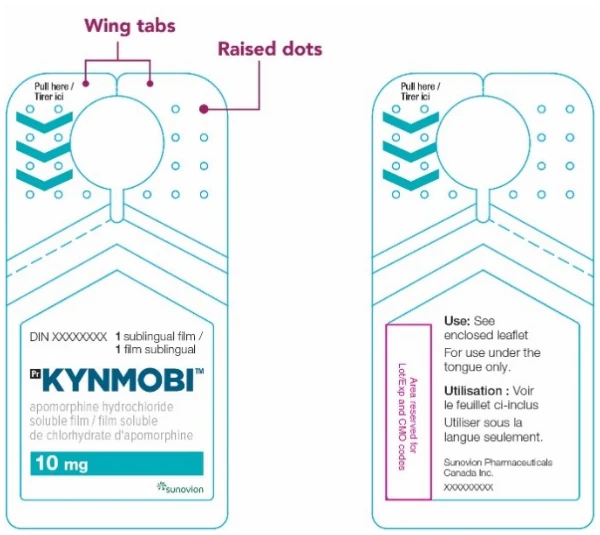
Figure A
Step 1: Drink water and swallow excess water before taking the KYNMOBI film. This helps the film dissolve more easily.
Step 2: Open the KYNMOBI foil pouch.
- Hold the wing tabs on the pouch between your thumb and finger of each hand. Make sure to place your fingers directly on the raised dots on each wing tab. Gently pull the tabs apart to open the pouch (see Figure B).
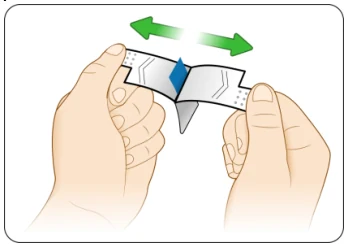
Figure B
Step 3: Take the film out of the pouch.
- Hold the film between your fingers by the outside edges and remove the entire film from the pouch (see Figure C).
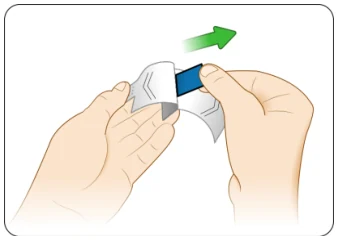
Figure C
Step 4: Place the film on the underside of your tongue.
- Place the film close to the base of your tongue, as far back as you can (see Figure D).
- Close your mouth.
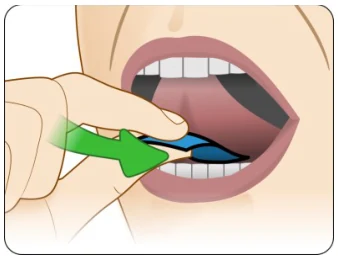
Figure D
Step 5: Keep the film in place under your tongue until it has completely dissolved.
- Do not chew or swallow the film.
- Try not to swallow your saliva.
- Do not talk while the film is dissolving because this can affect how well the medicine in KYNMOBI is absorbed (see Figure E).

Figure E
Step 6: Visually check if the film completely dissolves, if possible.
- You can use a mirror to check or ask someone to look under your tongue for you.
- It can take about 3 minutes for the film to dissolve.
- After the film completely dissolves, you may swallow.
- You may notice some leftover dye in your mouth after the film has dissolved.
Overdose:
| If you think you, or a person you are caring for, have taken too much KYNMOBI, contact a healthcare professional, hospital emergency department, or regional poison control centre immediately, even if there are no symptoms. |
Missed Dose:
You should only use KYNMOBI during an OFF episode. If you are unable to take KYNMOBI during an OFF episode, you can take it at your next OFF episode.
What are possible side effects from using KYNMOBI?
These are not all the possible side effects you may have when taking KYNMOBI. If you experience any side effects not listed here, tell your healthcare professional.
Common side effects of KYNMOBI include:
- Nausea
- Vomiting
- Dizziness
- Dry mouth
- Fatigue
- Yawning
- Sleepiness
- Runny nose
- Increased sweating
- Headache
- Chills
Serious side effects and what to do about them
| Symptom / effect | Talk to your healthcare professional | Stop taking drug and get immediate medical help | |
| Only if severe | In all cases | ||
VERY COMMON Oral irritation: redness, numbness, swelling, infection, ulceration, pain or dryness of mouth, lips or tongue | X | ||
COMMON Dyskinesia: severe uncontrolled movements, muscle twitching or unusual/abnormal movement of the face, tongue, or other parts of your body | X | ||
| Falls and injuries from falling | X | ||
| Hallucinations or psychotic-like behavior: seeing or hearing things that are not real, confusion, excessive suspicion, aggressive behavior, agitation, delusional beliefs and disorganized thinking | X | ||
| Hypotension (low blood pressure): dizziness, fainting, light-headedness, blurred vision, nausea, vomiting, fatigue (may occur when you go from lying or sitting to standing up) | X | ||
| Syncope: fainting when standing up, temporary loss of consciousness | X | ||
UNCOMMON Allergic reaction: hives, itching, rash, swelling of the face, lips, mouth, tongue or throat, trouble breathing and/or swallowing, feeling sick to your stomach and throwing up | X | ||
RARE Compulsive behavior: inability to resist the impulse to perform an action that could be harmful such as gambling too much, increased sexual urges, uncontrollable urge to eat or spend money, or repeating meaningless actions | X | ||
| Excessive sleepiness or falling asleep suddenly, without warning, while doing normal activities | X | ||
| Heart problems: uneven (irregular) heart beat, palpitation, chest pain and/or discomfort, pain in jaw, shoulders, arm and/or back, shortness of breath, sweating, nausea or light-headedness | X | ||
| Melanoma skin cancer: changed patches of pigmented skin, including irritated or irregular moles, or moles in which you have noticed changes | X | ||
| Neuroleptic Malignant Syndrome: high fever, rapid or irregular heart beat, sweating, confusion, reduced consciousness and stiffness in your muscles | X | ||
| Priapism: long-lasting (greater than 4 hours in duration) and painful erection | X | ||
UNKNOWN Hemolytic Anemia (breakdown of red blood cells): pale skin, skin or eyes look yellow, dark coloured urine, feeling tired or weak, dizziness, fainting, rapid breathing, fever | X |
If you have a troublesome symptom or side effect that is not listed here or becomes bad enough to interfere with your daily activities, tell your healthcare professional.
Reporting Side Effects
You can report any suspected side effects associated with the use of health products to Health Canada by:
NOTE: Contact your health professional if you need information about how to manage your side effects. The Canada Vigilance Program does not provide medical advice. |
Storage:
Store KYNMOBI at room temperature (15° – 30°C). Keep KYNMOBI in the foil pouch, protected from light, until ready to use.
Keep out of reach and sight of children.
If you want more information about KYNMOBI:
- Talk to your healthcare professional
- Find the full product monograph that is prepared for healthcare professionals and includes this Patient Medication Information by visiting the Health Canada website: (https://www.canada.ca/en/health-canada/services/drugs-health-products/drug-products/drug-product-database.html); the manufacturer’s website www.sunovion.ca , or by calling 1-866-260-6291, or by visiting www.kynmobi.ca .