


Product Monograph - Kyprolis
RECENT MAJOR LABEL CHANGES
| 1 INDICATIONS | 07/2023 |
|---|---|
| 4 DOSAGE AND ADMINISTRATION | 07/2023 |
| 7 WARNINGS AND PRECAUTIONS | 07/2023 |
TABLE OF CONTENTS
Sections or subsections that are not applicable at the time of authorization are not listed.
RECENT MAJOR LABEL CHANGES ........................................................................................ 2
TABLE OF CONTENTS ............................................................................................................. 2
PART I: HEALTH PROFESSIONAL INFORMATION ................................................................. 4
1 INDICATIONS ................................................................................................................. 4
1.1 Pediatrics ............................................................................................................... 4
1.2 Geriatrics ............................................................................................................... 4
2 CONTRAINDICATIONS .................................................................................................. 4
3 SERIOUS WARNINGS AND PRECAUTIONS BOX ........................................................ 5
4 DOSAGE AND ADMINISTRATION ................................................................................ 5
4.1 Dosing Considerations ........................................................................................... 5
4.2 Recommended Dose and Dosage Adjustment ....................................................... 6
4.3 Reconstitution ...................................................................................................... 14
4.4 Administration ...................................................................................................... 14
4.5 Missed Dose ........................................................................................................ 15
5 OVERDOSAGE ............................................................................................................. 15
6 DOSAGE FORMS, STRENGTHS, COMPOSITION AND PACKAGING ....................... 15
7 WARNINGS AND PRECAUTIONS ............................................................................... 15
7.1 Special Populations ............................................................................................. 23
7.1.1 Pregnant Women ...........................................................................................23
7.1.2 Breast-feeding ................................................................................................23
7.1.3 Pediatrics .......................................................................................................24
7.1.4 Geriatrics .......................................................................................................24
8 ADVERSE REACTIONS ............................................................................................... 24
8.1 Adverse Reaction Overview ................................................................................. 24
8.2 Clinical Trial Adverse Reactions........................................................................... 26
8.3 Less Common Clinical Trial Adverse Reactions ................................................... 38
8.4 Abnormal Laboratory Findings: Hematologic, Clinical Chemistry and Other
Quantitative Data .................................................................................................. 42
8.5 Post-Market Adverse Reactions ........................................................................... 46
9 DRUG INTERACTIONS ................................................................................................ 46
9.1 Serious Drug Interactions .................................................................................... 46
9.2 Drug-Interactions Overview .................................................................................. 47
9.3 Drug-Behavioural Interactions .............................................................................. 47
9.4 Drug-Drug Interactions ......................................................................................... 47
9.5 Drug-Food Interactions ........................................................................................ 47
9.6 Drug-Herb Interactions ......................................................................................... 47
9.7 Drug-Laboratory Test Interactions ........................................................................ 47
9.8 Drug-Lifestyle Interactions ................................................................................... 47
10 CLINICAL PHARMACOLOGY ...................................................................................... 48
10.1 Mechanism of Action ...................................................................................... 48
10.2 Pharmacodynamics ........................................................................................ 48
10.3 Pharmacokinetics ........................................................................................... 48
11 STORAGE,STABILITY AND DISPOSAL ...................................................................... 51
12 SPECIAL HANDLING INSTRUCTIONS ........................................................................ 51
PART II: SCIENTIFIC INFORMATION ..................................................................................... 52
13 PHARMACEUTICAL INFORMATION ........................................................................... 52
14 CLINICAL TRIALS ........................................................................................................ 52
14.1 Clinical Trials by Indication ............................................................................. 52
15 MICROBIOLOGY .......................................................................................................... 74
16 NON-CLINICAL TOXICOLOGY .................................................................................... 74
PATIENT MEDICATION INFORMATION ................................................................................. 78
PART I: HEALTH PROFESSIONAL INFORMATION
1 INDICATIONS
KYPROLIS (carfilzomib) is indicated for the treatment of patients with relapsed multiple myeloma who have received 1 to 3 prior lines of therapy in combination with:
- Dexamethasone; or
- Lenalidomide and dexamethasone; or
- Daratumumab and dexamethasone; or
- Isatuximab and dexamethasone
The clinical effectiveness of KYPROLIS when combined with lenalidomide and dexamethasone (KRd) has not been established in patients with renal impairment (creatinine clearance [CrCL] < 50 mL/min). The clinical effectiveness of KRd or KYPROLIS and dexamethasone (Kd) has not been established in patients who progressed during prior bortezomib therapy (see 7 WARNINGS AND PRECAUTIONS and 14 CLINICAL TRIALS).
1.1 Pediatrics
Pediatrics (< 18 years of age):
The safety and effectiveness of KYPROLIS in pediatric patients have not been established.
1.2 Geriatrics
Geriatrics (≥ 65 years of age):
No overall differences in effectiveness of KYPROLIS in combination with dexamethasone or lenalidomide and dexamethasone were observed between younger (< 65 years of age) and older (≥ 65 years of age) patients. Overall, the patient incidence of certain adverse events (including cardiac failure) in clinical trials was higher for patients who were ≥ 65 years of age compared to patients who were < 65 years of age (see 7 WARNINGS AND PRECAUTIONS).
2 CONTRAINDICATIONS
KYPROLIS is contraindicated in patients who are hypersensitive to this drug or to any ingredient in the formulation, including any non-medicinal ingredient, or component of the container. For a complete listing, see 6 DOSAGE FORMS, STRENGTHS, COMPOSITION AND PACKAGING .
3 SERIOUS WARNINGS AND PRECAUTIONS BOX
Serious Warnings and Precautions
KYPROLIS should be administered under the supervision of a physician experienced in the use of anticancer agents. KYPROLIS dosed at 56 mg/m2 and 70 mg/m2 must be infused over 30 minutes and KYPROLIS dosed at 27 mg/m2 must be infused over at least 10 minutes (see 7 WARNINGS AND PRECAUTIONS, General and 4 DOSAGE AND ADMINISTRATION). The following are clinically significant adverse events:
|
|---|
4 DOSAGE AND ADMINISTRATION
4.1 Dosing Considerations
Refer to the lenalidomide, daratumumab, isatuximab, and/or dexamethasone Product Monographs for additional dosing considerations when using these agents in combination with KYPROLIS.
Administration Precautions
KYPROLIS dosed at 56 mg/m2 and 70 mg/m2 must be infused over 30 minutes and KYPROLIS dosed at 27 mg/m2 must be infused over at least 10 minutes. The highest carfilzomib dose studied with a 10-minute infusion is 27 mg/m2. The dose of 56 mg/m2 carfilzomib infused over 30 minutes, given twice weekly as monotherapy, was determined to be the maximum tolerated dose of carfilzomib when given as the twice weekly dosing regimen, and was also evaluated in the clinical trial ENDEAVOR. The dose of 70 mg/m2 carfilzomib infused over 30 minutes, given once weekly in combination with dexamethasone, was determined to be the maximum tolerated dose of carfilzomib when given as the once weekly dosing regimen, and was also evaluated in the clinical trial ARROW.
KYPROLIS vials contain no antimicrobial preservatives and are intended for single use only. Proper aseptic technique must be observed.
Any unused medicinal product or waste material should be disposed of in accordance with local requirements.
On the days where both isatuximab and KYPROLIS are administered, administer dexamethasone first, followed by isatuximab infusion, then followed by KYPROLIS infusion.
Concomitant Medications
Consider antiviral prophylaxis in patients being treated with KYPROLIS to decrease the risk of herpes zoster reactivation.
Thromboprophylaxis is recommended in patients being treated with KYPROLIS, and the choice of antithrombotic agent should be based on an assessment of the patient’s underlying risks and clinical status (see 7 WARNINGS AND PRECAUTIONS, Cardiovascular).
Sodium Content
Following reconstitution, each mL of this medicinal product contains 0.3 mmols (7 mg) of sodium. This should be taken into consideration for patients on a controlled sodium diet.
Hydration and Fluid Monitoring
Adequate hydration is required prior to dosing in Cycle 1, especially in patients at high risk of tumour lysis syndrome or renal toxicity. All patients should be monitored for evidence of volume overload and fluid requirements should be tailored to individual patient needs. The total volume of fluids may be adjusted as clinically indicated in patients with baseline cardiac failure or who are at high risk for cardiac failure (see 7 WARNINGS AND PRECAUTIONS).
Recommended hydration includes both oral fluids (30 mL/kg/day for 48 hours before Cycle 1, Day 1) and intravenous fluids (250 mL to 500 mL of appropriate intravenous fluid prior to each dose in Cycle 1). Give an additional 250 mL to 500 mL of intravenous fluids as needed following KYPROLIS administration. Continue oral and/or intravenous hydration, as needed, in subsequent cycles.
When given in combination with IV daratumumab, oral and/or intravenous hydration is not required on days when IV daratumumab is dosed.
Premedication
Premedicate with the recommended dose of dexamethasone either orally or intravenously at least 30 minutes but no more than 4 hours prior to all doses of KYPROLIS to reduce the incidence and severity of infusion reactions.
When given in combination with daratumumab or isatuximab, more premedication options should be considered. Please see the respective Product Monographs for details.
Patients with Hepatic Impairment
Patients with mild or moderate hepatic impairment require a reduced carfilzomib starting dose (see 4.2 Recommended Dose and Dosage Adjustment). Liver enzymes and bilirubin should be assessed at treatment initiation and monitored during treatment with carfilzomib.
4.2 Recommended Dose and Dosage Adjustment
Health Canada has not authorized an indication for pediatric use (see 7 WARNINGS AND PRECAUTIONS, Special Populations, Pediatrics)
Recommended Dose
Table 1. KYPROLIS Dosing Information
| Regimen | KYPROLIS Starting Dose | If Tolerated, Increase KYPROLIS Dose on Day 8 of Cycle 1 to: | KYPROLIS Infusion Timea |
|---|---|---|---|
| KYPROLIS, lenalidomide, and dexamethasone (KRd) twice weekly | 20 mg/m2 | 27 mg/m2 | 10 minutes |
KYPROLIS with dexamethasone (Kd), with dexamethasone and daratumumab (KdD), or with isatuximab and dexamethasone (IsaKd) twice weekly | 20 mg/m2 | 56 mg/m2 | 30 minutes |
KYPROLIS with dexamethasone (Kd)b once weekly | 20 mg/m2 | 70 mg/m2 | 30 minutes |
a Infusion time remains consistent throughout each regimen regardless of any dose modifications. b The once weekly Kd regimen can be a treatment option, if the patient cannot adhere to the twice weekly Kd regimen due to the burden of dosing frequency. The once weekly Kd 20/70 mg/m2 regimen has not been compared with the twice weekly Kd 20/56 mg/m2 regimen within a clinical trial. | |||
Calculate the dose using the patient’s baseline body surface area (BSA). Patients with a BSA greater than 2.2 m2 should receive a dose based upon a BSA of 2.2 m2. Dose adjustments do not need to be made for weight changes of less than or equal to 20%.
KYPROLIS dosed at 20/27 mg/m2 must be infused over at least 10 minutes. KYPROLIS dosed at 20/56 mg/m2 and 20/70 mg/m2 must be infused over 30 minutes (see Table 1). Treatment should be continued until disease progression or unacceptable toxicity.
KYPROLIS in combination with lenalidomide and dexamethasone (KRd)
KYPROLIS is administered by intravenous (IV) infusion twice weekly, on two consecutive days, each week for three weeks (Days 1, 2, 8, 9, 15, and 16), followed by a 12-day rest period (Days 17 to 28) for the first 12 treatment cycles. KYPROLIS is omitted on Days 8 and 9 of Cycles 13 and higher. Each 28-day period is considered one treatment cycle.
KYPROLIS is administered at a starting dose of 20 mg/m2 in Cycle 1 on Days 1 and 2. If tolerated, the dose should be increased to a target dose of 27 mg/m2 on Day 8 of Cycle 1.
Lenalidomide is administered as 25 mg orally on Days 1-21 and dexamethasone is administered as 40 mg orally or IV on Days 1, 8, 15, and 22 of the 28-day cycles. Appropriate dose reduction for the starting dose of lenalidomide should be considered according to the recommendations in the lenalidomide Product Monograph, for example, for patients with baseline renal impairment. Dexamethasone should be administered 30 minutes to 4 hours before KYPROLIS.
The treatment schedule is outlined in Table 2.
KYPROLIS in combination with dexamethasone (Kd)
20/56 mg/m2 twice weekly dosing regimen
KYPROLIS is administered by IV infusion twice weekly, on two consecutive days, each week for three weeks (Days 1, 2, 8, 9, 15, and 16), followed by a 12-day rest period (Days 17 to 28). Each 28-day period is considered one treatment cycle.
KYPROLIS is administered at a starting dose of 20 mg/m2 in Cycle 1 on Days 1 and 2. If tolerated, the dose should be increased to a target dose of 56 mg/m2 on Day 8 of Cycle 1. Dexamethasone is administered as 20 mg orally or IV on Days 1, 2, 8, 9, 15, 16, 22 and 23 of the 28-day cycles. Dexamethasone should be administered 30 minutes to 4 hours before KYPROLIS.
The treatment schedule is outlined in Table 3.
20/70 mg/m2 once weekly dosing regimen
KYPROLIS administered by IV infusion once weekly can be a treatment option, if the patient cannot adhere to the twice weekly Kd regimen due to the burden of dosing frequency. The once weekly Kd 20/70 mg/m2 regimen has not been compared with the twice weekly Kd 20/56 mg/m2 regimen within a clinical trial.
With this once weekly dosing regimen, KYPROLIS is administered by IV infusion once weekly for three weeks (Days 1, 8, and 15), followed by a 13-day rest period (Days 16 to 28). Each 28-day period is considered one treatment cycle.
KYPROLIS is administered at a starting dose of 20 mg/m2 in Cycle 1 on Day 1. If tolerated, the dose should be increased to a target dose of 70 mg/m2 on Day 8 of Cycle 1.
Dexamethasone is administered as 40 mg orally or IV on Days 1, 8, 15 and 22. Dexamethasone is omitted on Day 22 of Cycles 10 and higher. Dexamethasone should be administered 30 minutes to 4 hours before KYPROLIS.
The treatment schedule is outlined in Table 4.
KYPROLIS in combination with dexamethasone and daratumumab (KdD)
For the combination regimen KdD, administer KYPROLIS intravenously twice weekly as a 30-minute infusion as described in Table 5 below.
Twice weekly 20/56 mg/m2 regimen by 30-minute infusion
KYPROLIS is administered intravenously as a 30-minute infusion on two consecutive days, each week for three weeks followed by a 12-day rest period as shown in Table 5. Each 28-day period is considered one treatment cycle. Administer KYPROLIS at a starting dose of 20 mg/m2 in Cycle 1 on Days 1 and 2. If tolerated, escalate the dose to 56 mg/m2 on Day 8 of Cycle 1 and thereafter. Dexamethasone 20 mg is taken by mouth or intravenously on Days 1, 2, 8, 9, 15 and 16 and 40 mg by mouth or intravenously on Day 22 of each 28-day cycle. Administer dexamethasone 30 minutes to 4 hours before KYPROLIS.
Daratumumab is administered intravenously at a dose of 16 mg/kg actual body weight; with a split dose of 8 mg/kg in Cycle 1 on Days 1 and 2. Administer 16 mg/kg once weekly on Days 8, 15 and 22 of Cycle 1 and Days 1, 8 and 15 and 22 of Cycle 2, then every 2 weeks for 4 cycles (cycles 3 to 6) and then every 4 weeks for the remaining cycles or until disease progression.
Treatment may be continued until disease progression or unacceptable toxicity occurs. Refer to the dexamethasone and daratumumab Product Monographs for additional information on those products.
KYPROLIS in combination with isatuximab and dexamethasone (IsaKd)
Twice weekly 20/56 mg/m2 regimen by 30-minute infusion
Administer KYPROLIS intravenously as a 30-minute infusion on Days 1, 2, 8, 9, 15, and 16 of each 28-day cycle as shown in Table 6 in combination with isatuximab plus dexamethasone until disease progression or unacceptable toxicity. The recommended starting dose of KYPROLIS is 20 mg/m2 on Cycle 1, Days 1 and 2. If tolerated, escalate the dose to 56 mg/m2 on Cycle 1, Day 8.
Refer to the Product Monographs for isatuximab and dexamethasone for additional information on those products.
Table 2. KYPROLIS Twice Weekly (10-minute Infusion) in Combination with Lenalidomide and Dexamethasone (KRd)
| Cycle 1 | |||||||||||||||||||||||||
|---|---|---|---|---|---|---|---|---|---|---|---|---|---|---|---|---|---|---|---|---|---|---|---|---|---|
| Week 1 | Week 2 | Week 3 | Week 4 | ||||||||||||||||||||||
| Day 1 | Day 2 | Days 3–7 | Day 8 | Day 9 | Days 10–14 | Day 15 | Day 16 | Days 17–21 | Day 22 | Days 23–28 | |||||||||||||||
| KYPROLIS (mg/m2) | 20 | 20 | - | 27 | 27 | - | 27 | 27 | - | - | - | ||||||||||||||
| Dexamethasone (mg) | 40 | - | - | 40 | - | - | 40 | - | - | 40 | - | ||||||||||||||
| Lenalidomide | 25 mg daily on Days 1-21 | - | - | ||||||||||||||||||||||
| Cycles 2 to 12 | |||||||||||||||||||||||||
| Week 1 | Week 2 | Week 3 | Week 4 | ||||||||||||||||||||||
| Day 1 | Day 2 | Days 3–7 | Day 8 | Day 9 | Days 10–14 | Day 15 | Day 16 | Days 17–21 | Day 22 | Days 23–28 | |||||||||||||||
| KYPROLIS (mg/m2) | 27 | 27 | - | 27 | 27 | - | 27 | 27 | - | - | - | ||||||||||||||
| Dexamethasone (mg) | 40 | - | - | 40 | - | - | 40 | - | - | 40 | - | ||||||||||||||
| Lenalidomide | 25 mg daily on Days 1-21 | - | - | ||||||||||||||||||||||
| Cycles 13 and Latera | |||||||||||||||||||||||||
| Week 1 | Week 2 | Week 3 | Week 4 | ||||||||||||||||||||||
| Day 1 | Day 2 | Days 3–7 | Day 8 | Day 9 | Days 10–14 | Day 15 | Day 16 | Days 17–21 | Day 22 | Days 23–28 | |||||||||||||||
| KYPROLIS (mg/m2) | 27 | 27 | - | - | - | - | 27 | 27 | - | - | - | ||||||||||||||
| Dexamethasone (mg) | 40 | - | - | 40 | - | - | 40 | - | - | 40 | - | ||||||||||||||
| Lenalidomide | 25 mg daily on Days 1-21 | - | - | ||||||||||||||||||||||
a KYPROLIS is administered through Cycle 18; lenalidomide and dexamethasone continue thereafter.
Table 3. KYPROLIS Twice Weekly (30-minute Infusion) in Combination with Dexamethasone (Kd)
| Cycle 1 | ||||||||||||||||||||||
|---|---|---|---|---|---|---|---|---|---|---|---|---|---|---|---|---|---|---|---|---|---|---|
| Week 1 | Week 2 | Week 3 | Week 4 | |||||||||||||||||||
| Day 1 | Day 2 | Days 3–7 | Day 8 | Day 9 | Days 10–14 | Day 15 | Day 16 | Days 17–21 | Day 22 | Day 23 | Days 24-28 | |||||||||||
| KYPROLIS (mg/m2) | 20 | 20 | - | 56 | 56 | - | 56 | 56 | - | - | - | - | ||||||||||
| Dexamethasone (mg) | 20 | 20 | - | 20 | 20 | - | 20 | 20 | - | 20 | 20 | - | ||||||||||
| Cycles 2 and Later | ||||||||||||||||||||||
| Week 1 | Week 2 | Week 3 | Week 4 | |||||||||||||||||||
| Day 1 | Day 2 | Days 3–7 | Day 8 | Day 9 | Days 10–14 | Day 15 | Day 16 | Days 17–21 | Day 22 | Day 23 | Days 24-28 | |||||||||||
| KYPROLIS (mg/m2) | 56 | 56 | - | 56 | 56 | - | 56 | 56 | - | - | - | - | ||||||||||
| Dexamethasone (mg) | 20 | 20 | - | 20 | 20 | - | 20 | 20 | - | 20 | 20 | - | ||||||||||
Table 4. KYPROLIS Once Weekly (30-minute Infusion) in Combination with Dexamethasone (Kd)
| Cycle 1 | ||||||||||||||||||||||||||
|---|---|---|---|---|---|---|---|---|---|---|---|---|---|---|---|---|---|---|---|---|---|---|---|---|---|---|
| Week 1 | Week 2 | Week 3 | Week 4 | |||||||||||||||||||||||
| Day 1 | Day 2 | Days 3–7 | Day 8 | Day 9 | Days 10–14 | Day 15 | Day 16 | Days 17–21 | Day 22 | Day 23 | Days 24-28 | |||||||||||||||
| KYPROLIS (mg/m2) | 20 | - | - | 70 | - | - | 70 | - | - | - | - | - | ||||||||||||||
| Dexamethasone (mg) | 40 | - | - | 40 | - | - | 40 | - | - | 40 | - | - | ||||||||||||||
| Cycles 2 to 9 | ||||||||||||||||||||||||||
| Week 1 | Week 2 | Week 3 | Week 4 | |||||||||||||||||||||||
| Day 1 | Day 2 | Days 3–7 | Day 8 | Day 9 | Days 10–14 | Day 15 | Day 16 | Days 17–21 | Day 22 | Day 23 | Days 24-28 | |||||||||||||||
| KYPROLIS (mg/m2) | 70 | - | - | 70 | - | - | 70 | - | - | - | - | - | ||||||||||||||
| Dexamethasone (mg) | 40 | - | - | 40 | - | - | 40 | - | - | 40 | - | - | ||||||||||||||
| Cycles 10 and Later | ||||||||||||||||||||||||||
| Week 1 | Week 2 | Week 3 | Week 4 | |||||||||||||||||||||||
| Day 1 | Day 2 | Days 3–7 | Day 8 | Day 9 | Days 10–14 | Day 15 | Day 16 | Days 17–21 | Day 22 | Day 23 | Days 24-28 | |||||||||||||||
| KYPROLIS (mg/m2) | 70 | - | - | 70 | - | - | 70 | - | - | - | - | - | ||||||||||||||
| Dexamethasone (mg) | 40 | - | - | 40 | - | - | 40 | - | - | - | - | - | ||||||||||||||
Table 5. KYPROLIS Twice Weekly (30-Minute Infusion) in Combination with Dexamethasone and Daratumumab (KdD)
| Cycle 1 | |||||||||||||||||||||||||||
|---|---|---|---|---|---|---|---|---|---|---|---|---|---|---|---|---|---|---|---|---|---|---|---|---|---|---|---|
| Week 1 | Week 2 | Week 3 | Week 4 | ||||||||||||||||||||||||
| Day 1 | Day 2 | Days 3–7 | Day 8 | Day 9 | Days 10–14 | Day 15 | Day 16 | Day 17–21 | Day 22 | Day 23 | Days 24-28 | ||||||||||||||||
| KYPROLIS (mg/m2) | 20 | 20 | - | 56 | 56 | - | 56 | 56 | - | - | - | - | |||||||||||||||
| Dexamethasone (mg)* | 20 | 20 | - | 20 | 20 | - | 20 | 20 | - | 40 | - | - | |||||||||||||||
| Daratumumab (mg/kg) | 8 | 8 | - | 16 | - | - | 16 | - | - | 16 | - | - | |||||||||||||||
| Cycle 2 | |||||||||||||||||||||||||||
| Week 1 | Week 2 | Week 3 | Week 4 | ||||||||||||||||||||||||
| Day 1 | Day 2 | Days 3–7 | Day 8 | Day 9 | Days 10–14 | Day 15 | Day 16 | Days 17–21 | Day 22 | Day 23 | Days 24-28 | ||||||||||||||||
| KYPROLIS (mg/m2) | 56 | 56 | - | 56 | 56 | - | 56 | 56 | - | - | - | - | |||||||||||||||
| Dexamethasone (mg)* | 20 | 20 | - | 20 | 20 | - | 20 | 20 | - | 40 | - | - | |||||||||||||||
| Daratumumab (mg/kg) | 16 | - | - | 16 | - | - | 16 | - | - | 16 | - | - | |||||||||||||||
| Cycles 3 to 6 | |||||||||||||||||||||||||||
| Week 1 | Week 2 | Week 3 | Week 4 | ||||||||||||||||||||||||
| Day 1 | Day 2 | Days 3–7 | Day 8 | Day 9 | Days 10–14 | Day 15 | Day 16 | Days 17–21 | Day 22 | Day 23 | Days 24-28 | ||||||||||||||||
| KYPROLIS (mg/m2) | 56 | 56 | - | 56 | 56 | - | 56 | 56 | - | - | - | - | |||||||||||||||
| Dexamethasone (mg)* | 20 | 20 | - | 20 | 20 | - | 20 | 20 | - | 40 | - | - | |||||||||||||||
| Daratumumab (mg/kg) | 16 | - | - | - | - | - | 16 | - | - | - | - | - | |||||||||||||||
| Cycles 7 and Later | |||||||||||||||||||||||||||
| Week 1 | Week 2 | Week 3 | Week 4 | ||||||||||||||||||||||||
| Day 1 | Day 2 | Days 3–7 | Day 8 | Day 9 | Days 10–14 | Day 15 | Day 16 | Days 17–21 | Day 22 | Day 23 | Days 24-28 | ||||||||||||||||
| KYPROLIS (mg/m2) | 56 | 56 | - | 56 | 56 | - | 56 | 56 | - | - | - | - | |||||||||||||||
| Dexamethasone (mg)* | 20 | 20 | - | 20 | 20 | - | 20 | 20 | - | 40 | - | - | |||||||||||||||
| Daratumumab (mg/kg) | 16 | - | - | - | - | - | - | - | - | - | - | - | |||||||||||||||
* For patients > 75 years of age, administer 20 mg of dexamethasone by mouth or intravenously weekly after the first week.
Table 6. KYPROLIS Twice Weekly (30-Minute Infusion) in Combination with Isatuximab and Dexamethasone (IsaKd)
| Cycle 1 | |||||||||||||||||||||||||||
|---|---|---|---|---|---|---|---|---|---|---|---|---|---|---|---|---|---|---|---|---|---|---|---|---|---|---|---|
| Week 1 | Week 2 | Week 3 | Week 4 | ||||||||||||||||||||||||
| Da y 1 | Day 2 | Days 3-7 | Day 8 | Day 9 | Days 10-14 | Day 15 | Day 16 | Days 17-21 | Day 22 | Day 23 | Days 24-28 | ||||||||||||||||
| KYPROLIS (mg/m2) | 20 | 20 | - | 56 | 56 | - | 56 | 56 | - | - | - | - | |||||||||||||||
| Isatuximab (mg/kg) | 10 | - | - | 10 | - | - | 10 | - | - | 10 | - | - | |||||||||||||||
| Dexamethasone (mg) | 20 | 20 | - | 20 | 20 | - | 20 | 20 | - | 20 | 20 | - | |||||||||||||||
| Cycles 2 and later | |||||||||||||||||||||||||||
| Week 1 | Week 2 | Week 3 | Week 4 | ||||||||||||||||||||||||
| Da y 1 | Day 2 | Days 3-7 | Day 8 | Day 9 | Days 10-14 | Day 15 | Day 16 | Days 17-21 | Day 22 | Day 23 | Days 24-28 | ||||||||||||||||
| KYPROLIS (mg/m2) | 56 | 56 | - | 56 | 56 | - | 56 | 56 | - | - | - | - | |||||||||||||||
| Isatuximab (mg/kg) | 10 | - | - | - | - | - | 10 | - | - | - | - | - | |||||||||||||||
| Dexamethasone (mg) | 20 | 20 | - | 20 | 20 | - | 20 | 20 | - | 20 | 20 | - | |||||||||||||||
Recommended Dosage Adjustments
Patients with hepatic impairment
For patients with baseline mild or moderate hepatic impairment, reduce the dose of KYPROLIS by 25%. Dosing recommendation cannot be made in patients with baseline severe hepatic impairment (see 10 CLINICAL PHARMACOLOGY, Special Populations and Conditions, Hepatic Insufficiency).
Patients with renal impairment
No dosage adjustment is required for patients with baseline renal impairment (see 10 CLINICAL PHARMACOLOGY, Special Populations and Conditions, Renal Insufficiency).
Dose Adjustments for Adverse Reactions
Modify dosing based on toxicity. Recommended actions and dose modifications are presented in Table 7. KYPROLIS dose level reductions are presented in Table 8.
| Table 7. Dose Modifications During KYPROLIS Treatment | |
|---|---|
| Hematologic Toxicity | Recommended Action |
|
|
|
|
|
|
| Renal Toxicity | Recommended Action |
|
|
| Other Non-hematologic Toxicity | Recommended Action |
|
|
|
|
Table 8. Recommended Dose Level Reductions for KYPROLIS
| Regimen | Dose | First Dose Reduction | Second Dose Reduction | Third Dose Reduction |
|---|---|---|---|---|
| KYPROLIS, lenalidomide, and | 27 mg/m2 | 20 mg/m2 | 15 mg/m2a | — |
| dexamethasone (KRd) twice weekly | ||||
|---|---|---|---|---|
| KYPROLIS and dexamethasone (Kd), or KYPROLIS with dexamethasone and daratumumab (KdD), or KYPROLIS with isatuximab and dexamethasone (IsaKd) twice weekly | 56 mg/m2 | 45 mg/m2 | 36 mg/m2 | 27 mg/m2a |
| KYPROLIS and dexamethasone (Kd) once weekly | 70 mg/m2 | 56 mg/m2 | 45 mg/m2 | 36 mg/m2a |
Note: Infusion times remain unchanged during dose reduction(s). a If symptoms do not resolve, discontinue KYPROLIS treatment. | ||||
4.3 Reconstitution
The reconstituted solution contains carfilzomib at a concentration of 2 mg/mL. Read the complete preparation instructions prior to reconstitution.
- 1. Calculate the dose (mg/m2) and number of vials of KYPROLIS required using the patient’s BSA at baseline. Patients with a BSA greater than 2.2 m2 should receive a dose based upon a BSA of 2.2 m2. Dose adjustments do not need to be made for weight changes of ≤ 20%.
- 2. Remove vial from refrigerator just prior to use.
- 3. Use only a 21-gauge or larger gauge hypodermic needle (0.8 mm or smaller external diameter needle) to aseptically reconstitute each vial by slowly injecting 5 mL (for 10 mg vial), 15 mL (for 30 mg vial), or 29 mL (for 60 mg vial) Sterile Water for Injection through the stopper and directing the solution onto the INSIDE WALL OF THE VIAL to minimize foaming. Do not reconstitute KYPROLIS with normal saline.
- 4. Gently swirl and/or invert the vial slowly for approximately 1 minute, or until complete dissolution. DO NOT SHAKE. If foaming occurs, allow the solution to settle in the vial until foaming subsides (approximately 5 minutes) and the solution is clear.
- 5. Visually inspect for particulate matter and discolouration prior to administration. The reconstituted product should be a clear, colourless to slightly yellow solution and should not be administered if any discolouration or particulate matter is observed.
- 6. Withdraw the calculated dose from the vial and discard any unused portion left in the vial.
- 7. KYPROLIS can be administered directly by IV infusion or optionally administered in an IV bag. Do not administer as an IV push or bolus.
- 8. When administering in an IV bag, use only a 21-gauge or larger gauge hypodermic needle (0.8 mm or smaller external diameter needle) to withdraw the calculated dose from the vial and dilute into a 50 or 100 mL IV bag containing 5% Dextrose Injection (D5W). Reconstituted KYPROLIS for injection should not be diluted into a 0.9% sodium chloride (normal saline) IV bag for IV administration.
4.4 Administration
Administer KYPROLIS intravenously (IV) as a 10-minute or 30-minute infusion depending on the KYPROLIS dose regimen (see Table 1). KYPROLIS should not be administered as a bolus.
The intravenous administration line should be flushed with normal saline or 5% dextrose injection immediately before and after KYPROLIS administration.
Do not mix KYPROLIS with or administer as an infusion with other medicinal products.
4.5 Missed Dose
For once weekly dosing, when making up for the missed dose, a minimum of 5 days is required between doses of KYPROLIS.
For twice weekly dosing, if a dose is missed, priority should be given to maintaining consecutive dosing days.
5 OVERDOSAGE
Acute onset of chills, hypotension, renal insufficiency, thrombocytopenia, and lymphopenia has been reported following a dose of 200 mg of KYPROLIS administered in error.
There is no known specific antidote for KYPROLIS overdose. In the event of an overdose, the patient should be monitored, specifically for the side effects and/or adverse drug reactions listed in section 8 ADVERSE REACTIONS.
| For management of a suspected drug overdose, contact your regional poison control centre. |
|---|
6 DOSAGE FORMS, STRENGTHS, COMPOSITION AND PACKAGING
Table 9. Dosage Forms, Strengths, Composition and Packaging
KYPROLIS single-use vial contains 10, 30, or 60 mg of carfilzomib. After reconstitution, each mL contains 2 mg of carfilzomib.
- Single-use 10 mL (10 mg vial), 30 mL (30 mg vial), or 50 mL (60 mg vial) vial Type 1 clear glass vial fluoropolymer laminated elastomeric stopper and aluminum seal with plastic flip off cap
- Pack size of one vial (10, 30 or 60 mg carfilzomib per vial)
7 WARNINGS AND PRECAUTIONS
Please see 3 SERIOUS WARNINGS AND PRECAUTIONS BOX.
General
KYPROLIS as a monotherapy did not show a benefit over an active comparator (corticosteroids and cyclophosphamide) in a Phase 3 trial in patients with relapsed and refractory multiple myeloma. There were no differences in overall survival (HR = 1.09 [0.84, 1.41]) or progression-free survival (HR = 0.98 [95% CI: 0.76-1.25]) between the two arms. KYPROLIS is not indicated as a monotherapy for the treatment of relapsed and refractory multiple myeloma.
| Route of Administration | Dosage Form / Strength/Composition | Non-medicinal Ingredients |
| Intravenous infusion | Powder for Solution / 10, 30, 60 mg carfilzomib per vial | anhydrous citric acid, sodium hydroxide (for pH adjustment), sulfobutylether beta-cyclodextrin |
The safety and efficacy of KYPROLIS when combined with lenalidomide and dexamethasone (KRd) have not been established in patients with renal impairment (creatinine clearance [CrCL] < 50 mL/min). These patients were excluded from the ASPIRE study, which is the pivotal Phase 3 combination study comparing KRd to lenalidomide and dexamethasone (Rd) alone. Limited data are available in KRd-treated patients with renal impairment at baseline (< 5% of patients were enrolled into ASPIRE with a CrCL = 30-50 mL/min and no patients had CrCL < 30 mL/min).
KYPROLIS administered with a short infusion time, without pre-medication with dexamethasone and adequate hydration, or without stepped up dosing, may not be well tolerated. In early studies, where a 1 to 2 minute intravenous (IV) bolus was used without pre-medication, adverse reactions were observed that appeared to be most severe within the first few doses. These reactions were characterized by chills, dyspnea, arthralgia or myalgia, and rigors. A longer infusion time, pre-medication and adequate hydration, and stepped up dosing in subsequent studies appeared to mitigate this risk. Nonclinical studies in rats have demonstrated that the tolerability of KYPROLIS is significantly lower when administered as an IV bolus compared to a 30-minute infusion. KYPROLIS dosed at 56 mg/m2 and 70 mg/m2 must be infused over 30 minutes, and KYPROLIS dosed at 27 mg/m2 must be infused over at least 10 minutes (see 4 DOSAGE AND ADMINISTRATION and 16 NON-CLINICAL TOXICOLOGY).
Infusion Reactions
Infusion reactions, including life-threatening reactions, have been reported in patients who received KYPROLIS. In a pooled KYPROLIS safety population (n = 3878), 34.3% of patients reported an adverse event potentially associated with an infusion reaction within a day of any dose of KYPROLIS and 3.4% of patients reported an event within a day of the first dose of KYPROLIS. Following the introduction of management strategies (see below and 4 DOSAGE AND ADMINISTRATION), most adverse events that were potentially associated with an infusion reaction in Phase 3 trials were low grade and non-serious.
In IKEMA, infusion-related reactions (IRRs), were reported in patients treated with isatuximab in combination with KYPROLIS and dexamethasone (IsaKd). Please refer to the isatuximab Product Monograph for further details.
Signs and symptoms have included fever, chills, arthralgia, myalgia, facial flushing, facial edema, laryngeal edema, vomiting, weakness, shortness of breath, hypotension, syncope, chest tightness, or angina. These reactions can occur immediately following or up to 24 hours after administration of KYPROLIS.
Ensure patients are appropriately hydrated and are administered dexamethasone prior to KYPROLIS to reduce the incidence and severity of reactions (see 4 DOSAGE AND ADMINISTRATION).
Tumour Lysis Syndrome
Cases of tumour lysis syndrome (TLS), including fatal outcomes, have been reported in patients who received KYPROLIS. In the ENDEAVOR study, which is the Phase 3 study comparing KYPROLIS and dexamethasone (Kd) versus bortezomib and dexamethasone (Vd), the incidence of TLS events was 0.6% in patients receiving Kd. In the ARROW study, a Phase 3 study evaluating the once weekly dosing of Kd, the incidence of TLS events was 2.9% in patients receiving Kd once weekly. In the ASPIRE study, the incidence of TLS events was 0.8% in patients receiving KRd. In the CANDOR study, the Phase 3 study comparing KYPROLIS in combination with dexamethasone and daratumumab (KdD) versus Kd twice weekly, the incidence of TLS events was 1.0% in patients receiving KdD.
Patients with a high tumour burden should be considered to be at greater risk for TLS. Ensure that patients are well hydrated before administration of KYPROLIS in Cycle 1, and in subsequent cycles as needed. Uric acid lowering drugs should be considered in patients at high risk for TLS (see 4 DOSAGE AND ADMINISTRATION). Monitor for evidence of TLS during treatment including regular measurement of serum electrolytes, and manage promptly. Interrupt KYPROLIS until TLS is resolved (see 4 DOSAGE AND ADMINISTRATION).
Infections
Infections, including serious and fatal events have been reported in patients receiving KYPROLIS (see 8 ADVERSE REACTIONS). Patients should be monitored for signs and symptoms of infection, and treated promptly.
Carcinogenesis and Mutagenesis
Second Primary Malignancies (SPMs)
The incidence of second primary malignancies is increased in patients treated with isatuximab-containing regimens. In IKEMA, SPMs were reported in 13 (7.3%) patients treated with IsaKd and in 6 (4.9%) patients treated with Kd. Please refer to the isatuximab Product Monograph for further details.
Cardiovascular
Cardiac Disorders
New or worsening cardiac failure (eg, congestive cardiac failure, pulmonary edema, decreased ejection fraction), cardiomyopathy, and myocardial ischemia and infarction have occurred following administration of KYPROLIS. Death due to cardiac arrest has occurred within a day of KYPROLIS administration and fatal outcomes have been reported with cardiac failure and myocardial infarction. In the ASPIRE study, the incidences of cardiac failure events in the KRd and Rd arms were 7.1% and 4.1%, respectively, and the incidences of myocardial infarction events were 6.9% versus 4.6%, respectively. In the ENDEAVOR study, the incidences of cardiac failure events in the Kd and Vd arms were 10.8% and 3.3%, respectively. In the ARROW study, the incidence of cardiac failure events in the Kd 20/70 mg/m2 once weekly arm was 3.8%. In the CANDOR study, the incidences of cardiac failure events in the KdD and Kd twice weekly arms were 7.5% and 10.5%, respectively.
In IKEMA, cardiac failure (including cardiac failure, cardiac failure congestive, cardiac failure acute, cardiac failure chronic, left ventricular failure and pulmonary edema) was reported in 7.3% of patients in the IsaKd group (4.0% of Grade ≥ 3) and in 6.6% of patients in the Kd group (4.1% of Grade ≥ 3). Serious cardiac failure was observed in 4.0% of patients in the IsaKd group and in 3.3% of patients in the Kd group. Fatal events of cardiac disorders occurred in 1.1% of patients in the IsaKd group (cardiac failure) and in 0.8% of patients in the Kd group (acute myocardial infarction).
The risk of cardiac failure is increased in Asian patients. In the ENDEAVOR study, the incidence of cardiac failure events for the Kd arm was 21% (11/53) for patients from Asian countries and 10% (40/410) for patients from non-Asian countries. Grade ≥ 3 cardiac failure events were reported in 11% of patients from Asian countries and 5% of patients from non-Asian countries. In the ARROW study, the incidence of cardiac failure events for the Kd 20/70 mg/m2 arm was 19% (5/26) for patients from Asian countries and 2% (4/212) for patients from non-Asian countries. Grade ≥ 3 cardiac failure events were reported in 15% of patients from Asian countries and 1% of patients from non-Asian countries. In the CANDOR study, the incidence of cardiac failure events for the KdD twice weekly arm was 6.8% (3/44) for patients from Asian countries and 7.6% (20/264) for patients from non-Asian countries.
While adequate hydration is required prior to dosing in Cycle 1, all patients should be monitored for evidence of volume overload, especially patients at risk for cardiac failure. The total volume of fluids may be adjusted as clinically indicated in patients with baseline cardiac failure or who are at high risk for cardiac failure (see 4 DOSAGE AND ADMINISTRATION).
Withhold KYPROLIS until Grade 3 or 4 cardiac events resolve. Carefully consider the benefit and risks when deciding if treatment with KYPROLIS should be re-initiated and, if so, resume at a 1 dose level reduction (see 4 DOSAGE AND ADMINISTRATION).
The risk of cardiac failure is increased in elderly patients (≥ 75 years).
Patients with New York Heart Association Class III and IV heart failure, recent myocardial infarction, conduction abnormalities, angina or arrhythmias uncontrolled by medications were not eligible for enrollment in KYPROLIS clinical trials and patients with left ventricular ejection fraction < 40% were also not eligible for enrollment in the ENDEAVOR study. These patients may be at greater risk for cardiac complications and should have a comprehensive medical assessment (particularly, blood pressure control and fluid management) prior to starting treatment with KYPROLIS and remain under close follow up.
Electrophysiology
There have been cases of QT interval prolongation reported in patients receiving KYPROLIS in clinical studies. An effect of KYPROLIS on QT interval cannot be excluded (see 10 CLINICAL PHARMACOLOGY).
Venous Thrombosis
Cases of venous thromboembolic events, including deep vein thrombosis and pulmonary embolism with fatal outcomes, have been reported in patients who received KYPROLIS. In the ASPIRE study, the incidence of venous thromboembolic events was 15.6% in the KRd arm vs. 9.0% in the control arm (Rd). In the ENDEAVOR study, the incidence of venous thromboembolic events was 12.5% in the Kd arm vs. 3.3% in the control arm (Vd). In the ARROW study, the incidence of venous embolic and thrombotic events in the Kd 20/70 mg/m2 once weekly arm was 4.2%. In the CANDOR study, the incidence of venous thromboembolic events was 6.2% in the KdD twice weekly arm vs. 11.1% in the control arm (Kd twice weekly). In the IKEMA study, thromboembolic events, venous and/or arterial, were reported at a similar incidence in the IsaKd and Kd arms (15.3% and 16.4%, respectively) and most events were not severe (Grade ≥ 3 4.0% and 5.7%, respectively).
The ASPIRE and IKEMA study protocols required thromboprophylaxis (including aspirin), while the ENDEAVOR, ARROW, and CANDOR study protocols did not.
Thromboprophylaxis is recommended in patients being treated with KYPROLIS, and the choice of antithrombotic agent should be based on an assessment of the patient’s underlying risks and clinical status. Monitor for signs and symptoms of venous thromboembolic events and pulmonary embolism.
Hypertension
Hypertension, including hypertensive crisis and hypertensive emergency, has been observed with KYPROLIS. Some of these events have been fatal. In the ASPIRE study, the incidence of hypertension events in KRd-treated patients was 15.8% and the incidence of hypertensive crisis/emergency events was 0.5%. In the ENDEAVOR and ARROW studies, the incidences of hypertension events in Kd 20/56 mg/m2 twice weekly and 20/70 mg/m2 once weekly treated patients were 33.7% and 21.8%, respectively, and the incidences of hypertensive crisis/emergency events were 0.9% and none, respectively. In the CANDOR study, the incidence of hypertension events in patients receiving KdD twice weekly was 31.8%, and there were no events of hypertensive crisis/emergency. In the IKEMA study, there was a > 5% difference between the IsaKd and Kd arms for the incidence of hypertension, all grade (36.7% for IsaKd, 31.1% for Kd) however, a similar incidence of Grade ≥ 3 hypertension was reported in both arms (20.3% for IsaKd and 19.7% for Kd).
Hypertension should be well-controlled prior to initiation of treatment with KYPROLIS and all patients should be routinely evaluated for hypertension and treated as needed. Withhold KYPROLIS until events of hypertensive crisis and hypertensive emergency resolve or hypertension is under control. Consider a dose reduction when resuming KYPROLIS and carefully consider the benefits and risks when deciding if treatment with KYPROLIS should be re-initiated following hypertensive crisis and hypertensive emergency (see 4 DOSAGE AND ADMINISTRATION).
Cardiac Impairment
Patients with New York Heart Association Class III and IV heart failure were not eligible for the clinical trials. Safety and efficacy in this population have not been established.
Hematologic
Hemorrhage
Cases of hemorrhage (eg, gastrointestinal, intracranial and pulmonary hemorrhage) have been reported in patients treated with KYPROLIS. Some of these events have been fatal. In the ASPIRE study, the incidence of hemorrhage events in KRd-treated patients was 17.3% (the incidence of Grade ≥ 3 events was 1.3%; the incidence of fatal events was 0.5%). In the ENDEAVOR and ARROW studies, the incidences of hemorrhage events in Kd 20/56 mg/m2 twice weekly and 20/70 mg/m2 once weekly treated patients were 22.7% and 8.8%, respectively (the incidences of Grade ≥ 3 events were 2.8% and 2.5%, respectively; the incidences of fatal events were none and 0.4%, respectively). In the CANDOR study, the incidence of hemorrhage events in patients receiving KdD twice weekly was 14.3% (the incidence of Grade ≥ 3 events was 1.9%; there were no fatal events in the study). In the IKEMA study, hemorrhages were reported more frequently in the IsaKd arm (19.8%) than in the Kd arm (12.3%). Grade 3 or 4 hemorrhages were reported in the IsaKd arm in 4 (2.3%) patients and 1 (0.6%) patient, respectively, and in the Kd arm Grade 3 in 1 (0.8%) patient and no Grade 4.
Thrombocytopenia
KYPROLIS causes thrombocytopenia with platelet nadirs observed on Day 8 or Day 15 of each 28-day cycle, which usually recovers to baseline platelet counts by the start of the next cycle (see 8 ADVERSE REACTIONS). In the ASPIRE study, the incidence of thrombocytopenia events in KRd-treated patients was 32.7% (the incidence of Grade ≥ 3 events was 20.2%). In the ENDEAVOR and ARROW studies, the incidences of thrombocytopenia events in Kd 20/56 mg/m2 twice weekly and 20/70 mg/m2 once weekly treated patients were 31.7% and 22.3%, respectively (the incidences of Grade ≥ 3 events were 12.3% and 10.9%, respectively). In the CANDOR study, the incidence of thrombocytopenia events in patients receiving KdD twice weekly was 37.3% (the incidences of Grade ≥ 3 events was 24.7%). In the IKEMA study, thrombocytopenia was reported more frequently in the Kd arm (9.8%) than in the IsaKd arm (2.8%).
Monitor platelet counts frequently during treatment with KYPROLIS. Reduce or withhold therapy as appropriate (see 4 DOSAGE AND ADMINISTRATION).
Thrombotic Microangiopathy
Cases of thrombotic microangiopathy, including thrombotic thrombocytopenic purpura (TTP) and hemolytic uremic syndrome (HUS), have been reported in patients who received KYPROLIS. Some of these events have been fatal.
Monitor for signs and symptoms of TTP/HUS. Withhold KYPROLIS if TTP/HUS is suspected and evaluate. If TTP/HUS is confirmed, discontinue KYPROLIS.
Hepatic/Biliary/Pancreatic
Hepatic Toxicity
Cases of hepatic failure, including fatal cases, have been reported in patients who received KYPROLIS. In a pooled KYPROLIS safety population (n = 3878), hepatic failure events were reported in 0.2% of patients.
KYPROLIS can cause elevations of serum transaminases (ALT and AST) and bilirubin (see 8 ADVERSE REACTIONS). Monitor liver enzymes regularly, regardless of baseline values. Reduce or withhold therapy as appropriate (see 4 DOSAGE AND ADMINISTRATION).
Hepatitis B Virus (HBV) Reactivation
Cases of Hepatitis B Virus (HBV) reactivation have been reported in patients receiving KYPROLIS.
Patients should be tested for HBV infection before initiating treatment. For patients who are carriers of HBV, prophylaxis with antivirals should be considered before, throughout, and for at least 6 months after the end of the treatment. Carriers of HBV who require treatment with KYPROLIS should be closely monitored for signs and symptoms of active HBV infection (jaundice, abdominal pain, joint pain, weakness and fatigue, nausea and vomiting) throughout and following the end of treatment. Consider consulting a specialist for patients who test positive for HBV infection prior to or during treatment.
The safety of resuming KYPROLIS after HBV reactivation is adequately controlled is not known. Therefore, prescribers should weigh the risks and benefits when considering resumption of therapy in this situation.
Hepatic Impairment
Reduce the dose of KYPROLIS by 25% in patients with baseline mild or moderate hepatic impairment (see 4 DOSAGE AND ADMINISTRATION, Patients with Hepatic Impairment). Dosing recommendation cannot be made in patients with baseline severe hepatic impairment.
In a pharmacokinetic study, the AUC of carfilzomib increased by approximately 50% in patients with baseline mild or moderate hepatic impairment compared to patients with normal hepatic function. The incidence of serious adverse events was higher in patients with baseline hepatic impairment (22/35 or 63%) than in patients with normal hepatic function (3/11 or 27%). Monitor liver enzymes regularly, regardless of baseline values, and modify dose based on toxicity (see 10 CLINICAL PHARMACOLOGY, Special Populations and Conditions, Hepatic Insufficiency).
The pharmacokinetics of KYPROLIS has not been evaluated in patients with severe hepatic impairment (see 10 CLINICAL PHARMACOLOGY).
Monitoring and Laboratory Tests
Blood pressure, complete blood cell count (CBC) including white blood cell count with differential, hemoglobin, platelets, blood chemistries including AST, ALT, total bilirubin, creatinine [or creatinine clearance (CrCL)], and electrolytes (including potassium) should be monitored at baseline and throughout treatment with KYPROLIS.
Patients treated with KYPROLIS should be monitored for hepatitis B virus infection at baseline and carriers of HBV should be monitored throughout treatment with KYPROLIS.
Neurologic
Posterior Reversible Encephalopathy Syndrome
Cases of posterior reversible encephalopathy syndrome (PRES), also termed reversible posterior leukoencephalopathy syndrome (RPLS), have been reported in patients receiving KYPROLIS. These patients presented with seizure, headache, lethargy, confusion, blindness, altered consciousness, and/or other visual and neurological disturbances, along with hypertension. Withhold KYPROLIS if PRES is suspected and evaluate by neuro-radiological imaging (eg, MRI). If PRES is confirmed, discontinue KYPROLIS.
Progressive Multifocal Leukoencephalopathy
Cases of Progressive Multifocal Leukoencephalopathy (PML) [blurred or double vision, blindness, aphasia, muscle weakness, coordination and gait difficulties, persistent numbness, sensory deficit, cognitive dysfunction], which can be fatal, have been reported in patients treated with KYPROLIS who have had prior or concurrent immunosuppressive therapy.
Patients should be monitored for any new or worsening neurologic, cognitive or behavioral signs or symptoms that may be suggestive of PML as part of the differential diagnosis of CNS disorders.
If PML is suspected, withhold administration of KYPROLIS; patients should be promptly referred to a specialist and appropriate diagnostic testing should be initiated. Discontinue KYPROLIS if PML diagnosis is confirmed.
Renal
Acute Renal Failure
Cases of acute renal failure have been reported in patients who received KYPROLIS. Some of these events have been fatal. In the ASPIRE study, the incidence of acute renal failure events in KRd-treated patients was 9.2% (the incidence of ≥ Grade 3 events was 3.8%; the incidence of serious adverse events was 2.6%). In the ENDEAVOR and ARROW studies, the incidences of acute renal failure events in Kd 20/56 mg/m2 twice weekly and 20/70 mg/m2 once weekly treated patients were 10.4% and 7.1%, respectively (the incidences of ≥ Grade 3 events were 5.6% and 3.8%, respectively; the incidences of serious adverse events were 3.9% and 4.6%, respectively). In the CANDOR study, the incidence of acute renal failure events in patients receiving KdD twice weekly was 5.8% (the incidence of Grade ≥ 3 events was 2.9%; the incidence of serious adverse events was 2.3%).
Monitor renal function with regular measurement of the serum creatinine and/or estimated creatinine clearance. Reduce, withhold or discontinue KYPROLIS as appropriate (see 4 DOSAGE AND ADMINISTRATION).
Renal Impairment
No starting dose adjustment is required in patients with baseline mild, moderate, or severe renal impairment or patients on chronic dialysis (see 10 CLINICAL PHARMACOLOGY, Special Populations and Conditions, Renal Insufficiency).
There are limited safety data for patients with renal impairment (CrCL < 50 mL/min) treated with KYPROLIS in combination with lenalidomide and dexamethasone (KRd). Patients with moderate (CrCL = 30 - 50 mL/min) and severe (CrCL = 15 - < 30 mL/min) renal impairment were included in the following studies: Phase 3 ENDEAVOR study comparing the safety and efficacy of Kd vs. Vd, and Phase 3 CANDOR study comparing the safety and efficacy of KdD vs. Kd. Patients with severe renal impairment at baseline were not enrolled in the ARROW study. The incidence of acute renal failure adverse events increased with the extent of renal impairment at baseline in patients treated with Kd 56 mg/m2 twice weekly and Kd 70 mg/m2 once weekly. The incidence of serious adverse events increased in patients with baseline renal impairment (CrCL < 50 mL/min ) treated with KdD in the CANDOR study (see 8 ADVERSE REACTIONS). The systemic concentrations of a major carfilzomib metabolite increase with the extent of renal impairment (see 10 CLINICAL PHARMACOLOGY).
Carefully monitor renal function in patients and make appropriate KYPROLIS dosing modifications (see 4 DOSAGE AND ADMINISTRATION and 10 CLINICAL PHARMACOLOGY).
Since dialysis clearance of carfilzomib concentrations has not been studied, the drug should be administered after the dialysis procedure. Refer also to the lenalidomide Product Monograph for appropriate dosing modifications of lenalidomide in patients with impaired renal function.
Respiratory
Acute Respiratory Distress Syndrome (ARDS), acute respiratory failure, and acute diffuse infiltrative pulmonary disease, such as pneumonitis and interstitial lung disease, have been reported in patients receiving KYPROLIS. Some of these events have been fatal. In the ASPIRE study, the incidence of ARDS events in KRd-treated patients was 2.0% and incidence of interstitial lung disease events was 1.8%. In the ENDEAVOR and ARROW studies, the incidences of ARDS events in Kd 20/56 mg/m2 twice weekly and 20/70 mg/m2 once weekly treated patients were 0.4% and 0.4%, respectively, and the incidences of interstitial lung disease events were 1.5% and 0.8%, respectively. In the CANDOR study, the incidence of ARDS events in patients receiving KdD twice weekly was 1%, and the incidence of interstitial lung disease events was 1.9%.
KYPROLIS should be withheld until these events resolve. Carefully consider the benefits and risks when deciding if treatment with KYPROLIS should be re-initiated (see 4 DOSAGE AND ADMINISTRATION).
Pulmonary Hypertension
Pulmonary hypertension has been reported in patients treated with KYPROLIS. Some of these events have been fatal. In the ASPIRE study, the incidence of pulmonary hypertension events in KRd-treated patients was 0.8%. In the ENDEAVOR and ARROW studies, the incidences of pulmonary hypertension events in Kd 20/56 mg/m2 twice weekly and 20/70 mg/m2 once weekly treated patients were 1.7% and 1.7%, respectively. In the CANDOR study, the incidence of pulmonary hypertension events in patients receiving KdD twice weekly was 1.9%. Evaluate as appropriate.
Withhold KYPROLIS until pulmonary hypertension resolves or returns to baseline. Carefully consider the benefits and risks when deciding if treatment with KYPROLIS should be re-initiated (see 4 DOSAGE AND ADMINISTRATION).
Dyspnea
Dyspnea was commonly reported in patients treated with KYPROLIS. In the ASPIRE study, the incidence of dyspnea events in KRd-treated patients was 23.0% (the incidence of ≥ Grade 3 events was 2.8%). In the ENDEAVOR and ARROW studies, the incidences of dyspnea events in Kd 20/56 mg/m2 twice weekly and 20/70 mg/m2 once weekly treated patients were 35.2% and 11.8%, respectively (the incidences of ≥ Grade 3 events were 6.5% and 0.4%, respectively). In the CANDOR study, the incidence of dyspnea events in patients receiving KdD twice weekly was 22.4% (the incidence of ≥ Grade 3 events was 3.9%). In the IKEMA study, the incidence of dyspnea was 27.7% (Grade ≥ 3: 5.1%] in the IsaKd arm and 21.3% [Grade ≥ 3: 0.8%) in the Kd arm.
Evaluate dyspnea to exclude cardiopulmonary conditions including cardiac failure and pulmonary syndromes. Withhold KYPROLIS until Grade 3 and 4 dyspnea resolves or returns to baseline. Carefully consider the benefits and risks when deciding if treatment with KYPROLIS should be re-initiated (see 8 ADVERSE REACTIONS and 4 DOSAGE AND ADMINISTRATION).
7.1 Special Populations
7.1.1 Pregnant Women
There are no data on the use of KYPROLIS in pregnant woman. Carfilzomib was clastogenic in in vitro tests. In animals, carfilzomib caused embryo-fetal toxicity and although it was not teratogenic during the period of organogenesis, exposure levels were lower in the animals than in patients receiving recommended clinical doses of KYPROLIS (see 16 NON-CLINICAL TOXICOLOGY). Based on these findings and its mechanism of action, KYPROLIS can cause fetal harm when administered to a pregnant woman. Female patients of reproductive potential should be advised to avoid becoming pregnant while being treated with KYPROLIS. If pregnancy occurs during this time, patients should be apprised of the potential hazard to the fetus. KYPROLIS should not be used during pregnancy unless the potential benefits to the mother outweigh the potential risks to the fetus.
Female patients of child bearing potential treated with KYPROLIS and/or their male partners should use effective contraception methods or abstain from sexual activity during therapy and for 30 days after treatment with KYPROLIS.
Male patients and/or their female partners (if of childbearing potential) should use effective contraceptive methods or abstain from sexual activity while treated with KYPROLIS and for 90 days after treatment.
KYPROLIS is associated with an increased risk of venous thrombosis (see 7 WARNINGS AND PRECAUTIONS, Cardiovascular, Venous Thrombosis) and it is not known if carfilzomib will reduce the efficacy of oral contraceptives as a result of drug-drug interactions (see 9 DRUG INTERACTIONS). Therefore, the concomitant use of oral contraceptives or hormonal methods of contraception associated with a risk of thrombosis should be carefully considered and be based on an individual benefit-risk assessment in patients receiving KYPROLIS.
7.1.2 Breast-feeding
It is not known whether carfilzomib is present in human breast milk. KYPROLIS should not be administered to women who are breast-feeding. Due to the potential for adverse effects in nursing infants from KYPROLIS, a decision should be made whether to discontinue nursing or to discontinue KYPROLIS, taking into account the potential benefit of KYPROLIS to the mother.
7.1.3 Pediatrics
Pediatrics (< 18 years of age)
The safety and effectiveness of KYPROLIS in pediatric patients have not been established.
7.1.4 Geriatrics
Geriatrics (≥ 65 years of age)
A total of 392 patients were treated with KYPROLIS in combination with lenalidomide and dexamethasone (KRd); the median age was 64 years. Of these, 185 patients (47%) were ≥ 65 years of age and 43 patients (11%) were ≥ 75 years of age. The incidence of serious adverse events was 57% in patients < 65 years of age, 73% in patients 65 to 74 years of age, and 81% in patients ≥ 75 years of age.
A total of 463 patients were treated with KYPROLIS in combination with dexamethasone (Kd); the median age was 65 years. Of these, 240 patients (52%) were ≥ 65 years of age and 77 patients (17%) were ≥ 75 years of age. The incidence of serious adverse events was 54% in patients < 65 years of age, 60% in patients 65 to 74 years of age, and 69% in patients ≥ 75 years of age.
A total of 308 patients were treated with KYPROLIS twice weekly in combination with dexamethasone and daratumumab (KdD); the median age was 64 years. Of these, 146 patients (47%) were ≥ 65 years of age and 28 patients (9%) were ≥ 75 years of age. The incidence of serious adverse events was 52% in patients < 65 years of age, 61% in patients 65 to 74 years of age, and 57% in patients ≥ 75 years of age. In the KdD arm, fatal treatment-emergent adverse events (TEAEs) occurred in 6% of patients < 65 years of age and 14% of patients ≥ 65 years of age. In the Kd arm, fatal TEAEs occurred in 8% of patients < 65 years of age and 3% of patients ≥ 65 years of age (see 8 ADVERSE REACTIONS).
There are increased risks for cardiovascular events in patients ≥ 75 years of age compared to patients < 75 years of age when treated with either KRd, Kd, or KdD.
8 ADVERSE REACTIONS
8.1 Adverse Reaction Overview
Safety data for KYPROLIS are available from clinical trials of a pooled patient population (n = 3878). The most common adverse reactions (> 20%) from this pooled safety set were: anemia, thrombocytopenia, neutropenia, nausea, diarrhea, fatigue, pyrexia, respiratory tract infection, dyspnea, cough, and hypertension. The most common serious adverse reactions (≥ 2%) from this pooled safety set that occurred during KYPROLIS treatment included: pneumonia (10.2%), acute kidney injury (4.1%), pyrexia (3.1%), cardiac failure (3.0%), respiratory tract infection (2.6%), sepsis (2.1%), dyspnea (2.1%), and anaemia (2.0%). The most common adverse events leading to discontinuation of any study drug (≥ 1%) included disease progression, pneumonia, and acute kidney injury, however the patient incidences were < 2% for each of these events.
In the ASPIRE study, which included 392 patients treated with at least one dose of KRd, the most common adverse reactions (> 20% in the KRd arm) included: diarrhea, anemia, neutropenia, fatigue, upper respiratory tract infection, pyrexia, cough, hypokalemia, thrombocytopenia, muscle spasms, pneumonia, nausea, constipation, insomnia, viral upper respiratory tract infection, and bronchitis. The most common serious adverse reactions reported in the KRd arm as compared with the Rd arm were pneumonia (17.1% vs. 13.4%), respiratory tract infection (4.1% vs. 2.1%), pyrexia (3.6% vs. 2.8%), pulmonary embolism (3.1% vs. 2.1%), atrial fibrillation (2.3% vs. 2.1%), deep vein thrombosis (2.3% vs. 1.5%), acute kidney injury (2.0% vs. 1.0%), and febrile neutropenia (2.0% vs. 1.0%). The most common adverse events leading to discontinuation of KYPROLIS included pneumonia (1.0%), myocardial infarction (0.8%) and upper respiratory tract infection (0.8%).
In the ENDEAVOR study, which included 463 patients in the KYPROLIS and dexamethasone (Kd) arm, the most common adverse reactions (> 20% in the Kd arm) included: anemia, thrombocytopenia, diarrhea, nausea, fatigue, pyrexia, peripheral edema, asthenia, respiratory tract infection, bronchitis, back pain, headache, insomnia, dyspnea, cough, and hypertension (Table 11). The most common serious adverse reactions reported in the Kd arm as compared with the bortezomib and dexamethasone (Vd) arm were pneumonia (2.6% vs. 2.9%), dyspnea (2.4% vs. none), pyrexia (2.2% vs. 0.2%), cardiac failure (1.3% vs. 0.2%), pulmonary embolism (1.1% vs. 0.4%), bronchitis (0.9% vs. 0.4%), and diarrhea (0.9% vs. 2.0%). The most frequent adverse events leading to discontinuation of KYPROLIS included cardiac failure (1.7%), asthenia (1.1%), ejection fraction decreased (1.1%), acute renal failure (1.1%), dyspnea (0.9%), multiple myeloma (0.9%), pyrexia (0.9%), disease progression (0.6%), and pneumonia (0.6%).
In the ARROW study, which included 238 patients in the Kd once weekly dosing arm, the most common adverse reactions (> 20%) included: respiratory tract infection, anemia, pyrexia, thrombocytopenia, hypertension, and fatigue (Table 12). The most common serious adverse reactions occurring with ≥ 2% incidences in the Kd once weekly treatment arm were pneumonia (8.4%), acute kidney injury (4.2%), sepsis (2.5%), and septic shock (2.1%). The most common adverse events leading to discontinuation of KYPROLIS in the Kd once weekly treatment arm included acute kidney injury (1.7%), plasma cell myeloma (1.3%), cardiac failure (0.8%), cardiac failure acute (0.8%), ejection fraction decreased (0.8%), acute lung injury (0.8%), pulmonary embolism (0.8%), and sepsis (0.8%).
In the CANDOR study, which either included 153 patients in the Kd twice weekly dosing arm or 308 patients in the KdD twice weekly dosing arm, the most common adverse reactions (> 20%) included: thrombocytopenia, anemia, diarrhea, fatigue, respiratory tract infection, cough, and hypertension (Table 13). Serious adverse events were reported in 56% of the patients in the KdD arm and 46% of the patients in the Kd arm. The most common serious adverse reactions occurred with ≥ 2% incidences in either treatment arm were: pneumonia, urinary tract infection, influenza, sepsis, pyrexia, pulmonary embolism, dyspnea, cardiac failure, acute kidney injury, anemia, and plasma cell myeloma. Grade ≥ 3 adverse events occurred in 82% of patients in the KdD arm as compared with 74% in the Kd arm. Discontinuation of any study treatment due to any adverse events occurred in 22% of patients in the KdD arm versus 25% in the Kd arm. The most common adverse reactions leading to discontinuation of any study drug were cardiac failure (n = 6, 2%) and fatigue (n = 6, 2%) in the KdD arm and cardiac failure (n = 3, 2%), hypertension (n = 3, 2%) and acute kidney injury (n = 3, 2%) in the Kd arm. The most common reactions leading to discontinuation of KYPROLIS were cardiac failure (n = 6, 2%) and fatigue (n = 6, 2%) in the KdD arm and cardiac failure (n = 3, 2%), hypertension (n = 3, 2%) and acute kidney injury (n = 3, 2%) in the Kd arm. The most common reaction leading to discontinuation of daratumumab was pneumonia (n = 4, 1%). Additionally, deaths due to adverse events within 30 days of the last dose of any study treatment occurred in 30/308 (10%) patients in the KdD arm compared with 8/153 (5%) patients in the Kd arm. The most common causes of death occurring in patients (%) in the two arms (KdD vs. Kd) was infections 14 (5%) vs. 4 (3%). The risk of fatal treatment-emergent adverse events was higher among patients ≥ 65 years of age (see 7 WARNINGS AND PRECAUTIONS, Special Populations, Geriatrics).
In the IKEMA Study, which compared IsaKd vs. Kd, the most frequent adverse reactions (in
≥ 20% of patients who received IsaKd) were upper respiratory tract infection (66.7%), infusion reactions (45.8%), fatigue (41.8%), hypertension (37.3%), pneumonia (36.2%), diarrhea (36.2%), dyspnea (28.8%), insomnia (23.7%), bronchitis (23.7%), and back pain (22.0%). Serious adverse reactions occurred in 59.3% of patients receiving IsaKd and in 57.4% of patients receiving Kd. The most frequent serious adverse reactions (in > 5% of patients) were pneumonia (24.9% with IsaKd vs 18.0% with Kd) and upper respiratory tract infections (9.0% with IsaKd vs 8.2% with Kd). Adverse reactions with a fatal outcome during treatment were reported in 3.4% of patients in the IsaKd group and in 3.3% of patients in the Kd group (those occurring in more than 1% of patients were pneumonia and cardiac failure both occurring in 1.1% of patients in the IsaKd group and in 0.8% of patients in the Kd group). Permanent discontinuation of treatment because of adverse reactions was reported in 8.5% of patients treated with IsaKd and in 13.9% of patients treated with Kd. The most frequent adverse reactions requiring permanent discontinuation in patients who received IsaKd were infections (2.8%). Isatuximab alone was discontinued in 0.6% of patients due to infusion-related reactions. Isatuximab dose interruptions due to an adverse reaction occurred in 32.8% of patients. The most frequent adverse reaction requiring isatuximab dose interruption was infusion-related reaction (29.9%).
8.2 Clinical Trial Adverse Reactions
Clinical trials are conducted under very specific conditions. The adverse reaction rates observed in the clinical trials; therefore, may not reflect the rates observed in practice and should not be compared to the rates in the clinical trials of another drug. Adverse reaction information from clinical trials may be useful in identifying and approximating rates of adverse drug reactions in real-world use.
KYPROLIS in Combination with Lenalidomide and Dexamethasone (KRd)
The safety of KYPROLIS has been evaluated in the ASPIRE study. The safety population includes open-label randomized Phase 3 pivotal study of patients with relapsed multiple myeloma receiving at least one dose of KYPROLIS in combination with lenalidomide and dexamethasone (N = 392) vs. patients receiving at least one dose of lenalidomide and dexamethasone (N = 389) (see 14 CLINICAL TRIALS). The median overall duration of treatment with any study drug in the KRd and Rd arms were 88.0 and 57.0 weeks, respectively; each treatment cycle was 4 weeks (28 days). In the KRd arm, the median number of cycles of KYPROLIS initiated were 18.0 (the maximum number of cycles allowed per protocol in that study after which patients in that arm continued on treatment with Rd). Adverse reactions that occurred in ≥ 5% of patients are presented in Table 10.
| Table 10. Adverse Reactions that Occurred in ≥ 5% of Patients in the ASPIRE Study | ||||
| KRd (N = 392) | Rd (N = 389) | |||
| System Organ Class Preferred Term | All Grades n (%) | ≥ Grade 3 n (%) | All Grades n (%) | ≥ Grade 3 n (%) |
| Blood and lymphatic system disorders | ||||
| Anemiaa | 173 (44.1%) | 75 (19.1%) | 161 (41.4%) | 69 (17.7%) |
| Neutropeniab | 170 (43.4%) | 132 (33.7%) | 150 (38.6%) | 114 (29.3%) |
| Thrombocytopeniac | 128 (32.7%) | 79 (20.2%) | 102 (26.2%) | 58 (14.9%) |
| Leukopeniad | 38 (9.7%) | 15 (3.8%) | 28 (7.2%) | 17 (4.4%) |
| Cardiac disorders | ||||
| Cardiac failuree | 20 (5.1%) | 9 (2.3%) | 13 (3.3%) | 6 (1.5%) |
| Eye disorders | ||||
| Cataract | 44 (11.2%) | 20 (5.1%) | 37 (9.5%) | 17 (4.4%) |
| Vision blurred | 24 (6.1%) | 0 | 15 (3.9%) | 1 (0.3%) |
| Gastrointestinal disorders | ||||
| Diarrhea | 174 (44.4%) | 18 (4.6%) | 145 (37.3%) | 17 (4.4%) |
| Nausea | 82 (20.9%) | 3 (0.8%) | 56 (14.4%) | 4 (1.0%) |
| Constipation | 81 (20.7%) | 1 (0.3%) | 70 (18.0%) | 2 (0.5%) |
| Vomiting | 49 (12.5%) | 1 (0.3%) | 33 (8.5%) | 2 (0.5%) |
| Abdominal painf | 58 (14.8%) | 7 (1.8%) | 38 (9.8%) | 5 (1.3%) |
| Dyspepsia | 24 (6.1%) | 0 | 22 (5.7%) | 2 (0.5%) |
| Toothache | 20 (5.1%) | 1 (0.3%) | 12 (3.1%) | 0 |
| General disorders and administration site conditions | ||||
| Fatigue | 131 (33.4%) | 32 (8.2%) | 124 (31.9%) | 26 (6.7%) |
| Pyrexia | 117 (29.8%) | 7 (1.8%) | 84 (21.6%) | 3 (0.8%) |
| Edema peripheral | 78 (19.9%) | 4 (1.0%) | 66 (17.0%) | 2 (0.5%) |
| Asthenia | 73 (18.6%) | 15 (3.8%) | 57 (14.7%) | 8 (2.1%) |
| Chills | 26 (6.6%) | 0 | 9 (2.3%) | 0 |
| Infections and infestations | ||||
| Bronchitis | 79 (20.2%) | 8 (2.0%) | 59 (15.2%) | 12 (3.1%) |
| Pneumonia | 91 (23.2%) | 63 (16.1%) | 66 (17.0%) | 47 (12.1%) |
| Respiratory tract infectiong | 195 (49.7%) | 28 (7.1%) | 161 (41.4%) | 17 (4.4%) |
| Urinary tract infection | 38 (9.7%) | 5 (1.3%) | 22 (5.7%) | 2 (0.5%) |
| Influenza | 29 (7.4%) | 2 (0.5%) | 15 (3.9%) | 3 (0.8%) |
| Viral infection | 28 (7.1%) | 0 | 11 (2.8%) | 0 |
| Gastroenteritis | 20 (5.1%) | 4 (1.0%) | 13 (3.3%) | 2 (0.5%) |
| Table 10. Adverse Reactions that Occurred in ≥ 5% of Patients in the ASPIRE Study | ||||
| KRd (N = 392) | Rd (N = 389) | |||
| System Organ Class Preferred Term | All Grades n (%) | ≥ Grade 3 n (%) | All Grades n (%) | ≥ Grade 3 n (%) |
| Investigations | ||||
| Blood creatinine increased | 27 (6.9%) | 5 (1.3%) | 20 (5.1%) | 1 (0.3%) |
| Alanine aminotransferase increased | 21 (5.4%) | 9 (2.3%) | 15 (3.9%) | 3 (0.8%) |
| Metabolism and nutrition disorders | ||||
| Hypokalemia | 116 (29.6%) | 41 (10.5%) | 58 (14.9%) | 23 (5.9%) |
| Hypocalcemia | 66 (16.8%) | 13 (3.3%) | 48 (12.3%) | 7 (1.8%) |
| Hypophosphatemia | 57 (14.5%) | 35 (8.9%) | 33 (8.5%) | 20 (5.1%) |
| Hyperglycemia | 50 (12.8%) | 21 (5.4%) | 39 (10.0%) | 18 (4.6%) |
| Decreased appetite | 47 (12.0%) | 0 | 35 (9.0%) | 2 (0.5%) |
| Hypomagnesemia | 40 (10.2%) | 4 (1.0%) | 29 (7.5%) | 3 (0.8%) |
| Hyperuricemia | 22 (5.6%) | 2 (0.5%) | 10 (2.6%) | 0 |
| Musculoskeletal and connective tissue disorders | ||||
| Muscle spasms | 106 (27.0%) | 5 (1.3%) | 82 (21.1%) | 4 (1.0%) |
| Back pain | 73 (18.6%) | 6 (1.5%) | 83 (21.3%) | 12 (3.1%) |
| Arthralgia | 57 (14.5%) | 2 (0.5%) | 58 (14.9%) | 2 (0.5%) |
| Pain in extremity | 48 (12.2%) | 4 (1.0%) | 43 (11.1%) | 6 (1.5%) |
| Bone pain | 39 (9.9%) | 2 (0.5%) | 36 (9.3%) | 5 (1.3%) |
| Muscular weakness | 28 (7.1%) | 5 (1.3%) | 24 (6.2%) | 7 (1.8%) |
| Musculoskeletal pain | 25 (6.4%) | 1 (0.3%) | 36 (9.3%) | 3 (0.8%) |
| Musculoskeletal chest pain | 26 (6.6%) | 1 (0.3%) | 29 (7.5%) | 2 (0.5%) |
| Myalgia | 25 (6.4%) | 0 | 22 (5.7%) | 0 |
| Nervous system disorders | ||||
| Headache | 56 (14.3%) | 4 (1.0%) | 32 (8.2%) | 2 (0.5%) |
| Dizziness | 53 (13.5%) | 2 (0.5%) | 44 (11.3%) | 2 (0.5%) |
| Peripheral neuropathyh | 57 (14.5%) | 9 (2.3%) | 54 (13.9%) | 7 (1.8%) |
| Paresthesia | 27 (6.9%) | 1 (0.3%) | 23 (5.9%) | 1 (0.3%) |
| Psychiatric disorders | ||||
| Insomnia | 81 (20.7%) | 12 (3.1%) | 65 (16.7%) | 11 (2.8%) |
| Anxiety | 33 (8.4%) | 1 (0.3%) | 17 (4.4%) | 2 (0.5%) |
| Table 10. Adverse Reactions that Occurred in ≥ 5% of Patients in the ASPIRE Study | ||||
| KRd (N = 392) | Rd (N = 389) | |||
| System Organ Class Preferred Term | All Grades n (%) | ≥ Grade 3 n (%) | All Grades n (%) | ≥ Grade 3 n (%) |
| Respiratory, thoracic, and mediastinal disorders | ||||
| Coughi | 128 (32.7%) | 2 (0.5%) | 78 (20.1%) | 0 |
| Dyspnea | 78 (19.9%) | 10 (2.6%) | 59 (15.2%) | 7 (1.8%) |
| Oropharyngeal pain | 28 (7.1%) | 0 | 22 (5.7%) | 0 |
| Epistaxis | 20 (5.1%) | 1 (0.3%) | 17 (4.4%) | 1 (0.3%) |
| Skin and subcutaneous tissue disorders | ||||
| Rash | 52 (13.3%) | 5 (1.3%) | 60 (15.4%) | 6 (1.5%) |
| Erythema | 30 (7.7%) | 0 | 13 (3.3%) | 0 |
| Pruritus | 31 (7.9%) | 0 | 16 (4.1%) | 1 (0.3%) |
| Hyperhidrosis | 28 (7.1%) | 0 | 18 (4.6%) | 1 (0.3%) |
| Vascular disorders | ||||
| Hypertension | 62 (15.8%) | 21 (5.4%) | 31 (8.0%) | 9 (2.3%) |
| Deep vein thrombosis | 26 (6.6%) | 7 (1.8%) | 15 (3.9%) | 4 (1.0%) |
| Hypotension | 26 (6.6%) | 8 (2.0%) | 24 (6.2%) | 4 (1.0%) |
a 'Anemia' includes Anemia PT, Hematocrit Decreased PT and Hemoglobin Decreased PT. b 'Neutropenia' includes Neutrophil Count Decreased PT and Neutropenia PT. c 'Thrombocytopenia' includes Platelet Count Decreased PT and Thrombocytopenia PT. d 'Leukopenia' includes Leukopenia PT and White Blood Cell Count Decreased PT. e 'Cardiac Failure' includes Cardiac Failure PT, and Cardiac Failure Congestive PT. f 'Abdominal Pain' includes Abdominal Pain PT, and Abdominal Pain Upper PT. g 'Respiratory Tract Infection' includes Respiratory Tract Infection PT, Lower Respiratory Tract Infection, Upper Respiratory Tract Infection PT and Viral Upper Respiratory Tract Infection. h 'Peripheral Neuropathy' includes Peripheral Sensory Neuropathy PT and Neuropathy Peripheral PT. i 'Cough' includes Productive Cough PT, and Cough PT.
KYPROLIS in Combination with Dexamethasone (Kd)
Kd Twice Weekly Dosing Regimen
The safety of KYPROLIS was evaluated in the ENDEAVOR study. The safety population includes open-label randomized Phase 3 study of patients with relapsed multiple myeloma receiving at least one dose of KYPROLIS and dexamethasone (Kd; N = 463) vs. patients receiving at least one dose of bortezomib and dexamethasone (Vd; N = 456). The median overall duration of treatment with Kd was 48.0 weeks (12 cycles) and with Vd was 27.0 weeks (8 cycles); the treatment cycle for Kd was 4 weeks (28 days), and the treatment cycle for Vd was 3 weeks (21 days). Adverse reactions that occurred in ≥ 5% of patients are presented in Table 11.
| Table 11. Adverse Reactions that Occurred in ≥ 5% of Kd Patients in the ENDEAVOR Study | |||||||||||||
| Kd (N = 463) | Vd (N = 456) | ||||||||||||
System Organ Class Preferred Term | All Grades n (%) | ≥ Grade 3 n (%) | All Grades n (%) | ≥ Grade 3 n (%) | |||||||||
| Blood and lymphatic system disorders | |||||||||||||
| Anemia | 197 (42.5%) | 76 (16.4%) | 129 (28.3%) | 46 (10.1%) | |||||||||
| Thrombocytopeniaa | 147 (31.7%) | 57 (12.3%) | 123 (27.0%) | 67 (14.7%) | |||||||||
| Lymphopeniab | 71 (15.3%) | 50 (10.8%) | 43 (9.4%) | 23 (5.0%) | |||||||||
| Neutropenia | 28 (6.0%) | 11 (2.4%) | 26 (5.7%) | 10 (2.2%) | |||||||||
| Cardiac disorders | |||||||||||||
| Cardiac failurec | 26 (5.6%) | 13 (2.8%) | 5 (1.1%) | 3 (0.7%) | |||||||||
| Palpitations | 23 (5.0%) | 0 | 6 (1.3%) | 0 | |||||||||
| Tachycardia | 23 (5.0%) | 0 | 10 (2.2%) | 0 | |||||||||
| Eye disorders | |||||||||||||
| Cataract | 32 (6.9%) | 11 (2.4%) | 17 (3.7%) | 9 (2.0%) | |||||||||
| Gastrointestinal disorders | |||||||||||||
| Diarrhea | 168 (36.3%) | 18 (3.9%) | 185 (40.6%) | 39 (8.6%) | |||||||||
| Nausea | 109 (23.5%) | 9 (1.9%) | 91 (20.0%) | 3 (0.7%) | |||||||||
| Vomiting | 77 (16.6%) | 7 (1.5%) | 45 (9.9%) | 7 (1.5%) | |||||||||
| Constipation | 75 (16.2%) | 2 (0.4%) | 127 (27.9%) | 8 (1.8%) | |||||||||
| Abdominal paind | 51 (11.0%) | 5 (1.1%) | 68 (14.9%) | 7 (1.5%) | |||||||||
| Dyspepsia | 35 (7.6%) | 3 (0.6%) | 25 (5.5%) | 1 (0.2%) | |||||||||
| General disorders and administration site conditions | |||||||||||||
| Pyrexia | 150 (32.4%) | 14 (3.0%) | 70 (15.4%) | 3 (0.7%) | |||||||||
| Fatigue | 149 (32.2%) | 31 (6.7%) | 140 (30.7%) | 35 (7.7%) | |||||||||
| Peripheral edema | 116 (25.1%) | 5 (1.1%) | 87 (19.1%) | 3 (0.7%) | |||||||||
| Asthenia | 107 (23.1%) | 21 (4.5%) | 79 (17.3%) | 14 (3.1%) | |||||||||
| Chest pain | 43 (9.3%) | 3 (0.6%) | 21 (4.6%) | 3 (0.7%) | |||||||||
| Chills | 26 (5.6%) | 0 | 12 (2.6%) | 1 (0.2%) | |||||||||
| Influenza like illness | 24 (5.2%) | 0 | 10 (2.2%) | 0 | |||||||||
| Malaise | 24 (5.2%) | 0 | 8 (1.8%) | 1 (0.2%) | |||||||||
| Infections and infestations | |||||||||||||
| Respiratory tract infectione | 166 (35.9%) | 26 (5.6%) | 121 (26.5%) | 15 (3.3%) | |||||||||
| Bronchitis | 108 (23.3%) | 13 (2.8%) | 48 (10.5%) | 4 (0.9%) | |||||||||
| Nasopharyngitis | 81 (17.5%) | 1 (0.2%) | 61 (13.4%) | 1 (0.2%) | |||||||||
| Pneumoniaf | 66 (14.3%) | 50 (10.8%) | 57 (12.5%) | 41 (9.0%) | |||||||||
| Table 11. Adverse Reactions that Occurred in ≥ 5% of Kd Patients in the ENDEAVOR Study | |||||||||||
| Kd (N = 463) | Vd (N = 456) | ||||||||||
System Organ Class Preferred Term | All Grades n (%) | ≥ Grade 3 n (%) | All Grades n (%) | ≥ Grade 3 n (%) | |||||||
| Urinary tract infection | 39 (8.4%) | 11 (2.4%) | 30 (6.6%) | 3 (0.7%) | |||||||
| Rhinitis | 29 (6.3%) | 0 | 10 (2.2%) | 0 | |||||||
| Gastroenteritis | 23 (5.0%) | 4 (0.9%) | 16 (3.5%) | 3 (0.7%) | |||||||
| Investigations | |||||||||||
| Blood creatinine increased | 53 (11.4%) | 4 (0.9%) | 28 (6.1%) | 2 (0.4%) | |||||||
| Creatinine renal clearance decreased | 29 (6.3%) | 10 (2.2%) | 18 (3.9%) | 3 (0.7%) | |||||||
| Alanine aminotransferase increased | 23 (5.0%) | 6 (1.3%) | 20 (4.4%) | 3 (0.7%) | |||||||
| Metabolism and nutrition disorders | |||||||||||
| Hypokalemia | 60 (13.0%) | 11 (2.4%) | 51 (11.2%) | 17 (3.7%) | |||||||
| Hyperglycemia | 54 (11.7%) | 22 (4.8%) | 42 (9.2%) | 17 (3.7%) | |||||||
| Decreased appetite | 50 (10.8%) | 4 (0.9%) | 62 (13.6%) | 6 (1.3%) | |||||||
| Hypophosphatemia | 32 (6.9%) | 15 (3.2%) | 28 (6.1%) | 6 (1.3%) | |||||||
| Hyperuricemia | 31 (6.7%) | 5 (1.1%) | 8 (1.8%) | 3 (0.7%) | |||||||
| Hypocalcemia | 27 (5.8%) | 6 (1.3%) | 19 (4.2%) | 1 (0.2%) | |||||||
| Musculoskeletal and connective tissue disorders | |||||||||||
| Back pain | 107 (23.1%) | 10 (2.2%) | 81 (17.8%) | 14 (3.1%) | |||||||
| Muscle spasms | 92 (19.9%) | 1 (0.2%) | 28 (6.1%) | 3 (0.7%) | |||||||
| Arthralgia | 60 (13.0%) | 3 (0.6%) | 52 (11.4%) | 4 (0.9%) | |||||||
| Bone pain | 55 (11.9%) | 9 (1.9%) | 40 (8.8%) | 6 (1.3%) | |||||||
| Pain in extremity | 55 (11.9%) | 3 (0.6%) | 50 (11.0%) | 4 (0.9%) | |||||||
| Muscular weakness | 44 (9.5%) | 8 (1.7%) | 47 (10.3%) | 8 (1.8%) | |||||||
| Musculoskeletal chest pain | 39 (8.4%) | 2 (0.4%) | 20 (4.4%) | 3 (0.7%) | |||||||
| Myalgia | 28 (6.0%) | 1 (0.2%) | 18 (3.9%) | 1 (0.2%) | |||||||
| Musculoskeletal pain | 25 (5.4%) | 3 (0.6%) | 24 (5.3%) | 3 (0.7%) | |||||||
| Nervous system disorders | |||||||||||
| Headache | 95 (20.5%) | 4 (0.9%) | 49 (10.7%) | 3 (0.7%) | |||||||
| Peripheral neuropathyg | 72 (15.6%) | 7 (1.5%) | 192 (42.1%) | 33 (7.2%) | |||||||
| Paresthesia | 43 (9.3%) | 3 (0.6%) | 76 (16.7%) | 2 (0.4%) | |||||||
| Dizziness | 42 (9.1%) | 1 (0.2%) | 70 (15.4%) | 3 (0.7%) | |||||||
| Hypoesthesia | 24 (5.2%) | 1 (0.2%) | 14 (3.1%) | 0 | |||||||
| Psychiatric disorders | |||||||||||
| Insomnia | 125 (27.0%) | 12 (2.6%) | 122 (26.8%) | 12 (2.6%) | |||||||
| Table 11. Adverse Reactions that Occurred in ≥ 5% of Kd Patients in the ENDEAVOR Study | ||||||||||||
| Kd (N = 463) | Vd (N = 456) | |||||||||||
System Organ Class Preferred Term | All Grades n (%) | ≥ Grade 3 n (%) | All Grades n (%) | ≥ Grade 3 n (%) | ||||||||
| Renal and urinary disorders | ||||||||||||
| Renal failure acute | 23 (5.0%) | 12 (2.6%) | 15 (3.3%) | 7 (1.5%) | ||||||||
| Respiratory, thoracic, and mediastinal disorders | ||||||||||||
| Dyspnea | 149 (32.2%) | 29 (6.3%) | 62 (13.6%) | 10 (2.2%) | ||||||||
| Coughh | 143 (30.9%) | 0 | 80 (17.5%) | 2 (0.4%) | ||||||||
| Oropharyngeal pain | 28 (6.0%) | 0 | 19 (4.2%) | 0 | ||||||||
| Epistaxis | 24 (5.2%) | 3 (0.6%) | 14 (3.1%) | 1 (0.2%) | ||||||||
| Skin and subcutaneous tissue disorders | ||||||||||||
| Rash | 41 (8.9%) | 4 (0.9%) | 35 (7.7%) | 1 (0.2%) | ||||||||
| Pruritus | 34 (7.3%) | 0 | 29 (6.4%) | 0 | ||||||||
| Vascular disorders | ||||||||||||
| Hypertension | 149 (32.2%) | 67 (14.5%) | 45 (9.9%) | 15 (3.3%) | ||||||||
| Hypotension | 29 (6.3%) | 5 (1.1%) | 40 (8.8%) | 8 (1.8%) | ||||||||
| Flushing | 24 (5.2%) | 1 (0.2%) | 7 (1.5%) | 0 | ||||||||
a ‘Thrombocytopenia’ includes Thrombocytopenia With Platelet Count Decreased preferred term (PT). b ‘Lymphopenia’ includes Lymphopenia with Lymphocyte Count Decreased PT. c ‘Cardiac Failure’ includes Cardiac Failure PT, and Cardiac Failure Congestive PT. d ‘Abdominal Pain’ includes Abdominal Pain PT, and Abdominal Pain Upper PT. e ‘Respiratory Tract Infection’ includes Respiratory Tract Infection PT, Lower Respiratory Tract Infection PT and Upper Respiratory Tract Infection PT. f ‘Pneumonia’ includes Bronchopneumonia PT, and Pneumonia PT. g ‘Peripheral Neuropathy’ includes Peripheral Sensory Neuropathy PT and Neuropathy Peripheral PT. h ‘Cough’ includes Productive Cough PT, and Cough PT. | ||||||||||||
Kd Once Weekly Dosing Regimen
The safety of KYPROLIS as a once weekly dosing regimen was evaluated in the ARROW study (see 14 CLINICAL TRIALS). The safety population of the open-label Phase 3 ARROW study includes patients with relapsed and refractory multiple myeloma receiving at least one dose of KYPROLIS and dexamethasone as a once weekly dosing regimen (Kd 20/70 mg/m2; N = 238) vs. patients receiving at least one dose of KYPROLIS and dexamethasone as a twice weekly dosing regimen (Kd 20/27 mg/m2; N = 235). The twice weekly Kd 20/27 mg/m2 regimen is not an authorized treatment. In the ARROW study, the median overall duration of treatment with the Kd once weekly dosing regimen was 38.0 weeks (9.5 cycles); the treatment cycle for Kd once weekly dosing in the ARROW study is 4 weeks (28 days). Adverse reactions that occurred in ≥ 5% of patients observed in the Kd once weekly arm in the ARROW study are presented in Table 12.
| Table 12. Adverse Reactions That Occurred in ≥ 5% of Patients in Kd Once Weekly Arm in the ARROW Study | ||
Once Weekly Kd 20/70 mg/m2 (N = 238) | ||
System Organ Class Preferred Term | All Grades n (%) | ≥ Grade 3 n (%) |
| Blood and lymphatic system disorders | ||
| Anemiaa | 64 (26.9%) | 42 (17.6%) |
| Thrombocytopeniab | 53 (22.3%) | 26 (10.9%) |
| Neutropeniac | 30 (12.6%) | 21 (8.8%) |
| Gastrointestinal disorders | ||
| Diarrhea | 44 (18.5%) | 2 (0.8%) |
| Nausea | 34 (14.3%) | 1 (0.4%) |
| Constipation | 19 (8.0%) | 0 |
| Vomiting | 19 (8.0%) | 0 |
| Abdominal paind | 12 (5.0%) | 2 (0.8%) |
| General disorders and administration site conditions | ||
| Pyrexia | 55 (23.1%) | 2 (0.8%) |
| Fatigue | 48 (20.2%) | 11 (4.6%) |
| Asthenia | 24 (10.1%) | 3 (1.3%) |
| Peripheral edema | 18 (7.6%) | 0 (0.0%) |
| Infections and infestations | ||
| Respiratory tract infectione | 70 (29.4%) | 7 (2.9%) |
| Pneumonia | 28 (11.8%) | 24 (10.1%) |
| Bronchitis | 27 (11.3%) | 2 (0.8%) |
| Influenza | 12 (5.0%) | 4 (1.7%) |
| Investigations | ||
| Blood creatinine increased | 14 (5.9%) | 2 (0.8%) |
| Metabolism and nutrition disorders | ||
| Hypokalemia | 19 (8.0%) | 6 (2.5%) |
| Decreased appetite | 13 (5.5%) | 1 (0.4%) |
| Musculoskeletal and connective tissue disorders | ||
| Back pain | 28 (11.8%) | 2 (0.8%) |
| Muscle spasms | 21 (8.8%) | 0 |
| Bone pain | 20 (8.4%) | 2 (0.8%) |
| Arthralgia | 15 (6.3%) | 0 |
| Pain in extremity | 15 (6.3%) | 1 (0.4%) |
| Table 12. Adverse Reactions That Occurred in ≥ 5% of Patients in Kd Once Weekly Arm in the ARROW Study | ||
Once Weekly Kd 20/70 mg/m2 (N = 238) | ||
System Organ Class Preferred Term | All Grades n (%) | ≥ Grade 3 n (%) |
| Musculoskeletal pain | 12 (5.0%) | 0 |
| Nervous system disorders | ||
| Headache | 25 (10.5%) | 1 (0.4%) |
| Psychiatric disorders | ||
| Insomnia | 35 (14.7%) | 2 (0.8%) |
| Renal and urinary disorders | ||
| Acute kidney injury | 15 (6.3%) | 8 (3.4%) |
| Respiratory, thoracic, and mediastinal disorders | ||
| Coughf | 37 (15.5%) | 2 (0.8%) |
| Dyspnea | 23 (9.7%) | 1 (0.4%) |
| Vascular disorders | ||
| Hypertension | 51 (21.4%) | 13 (5.5%) |
a 'Anemia' includes Anemia PT, Hematocrit Decreased PT and Hemoglobin Decreased PT. b 'Thrombocytopenia' includes Platelet Count Decreased PT and Thrombocytopenia PT. c 'Neutropenia' includes Neutrophil Count Decreased PT and Neutropenia PT. d 'Abdominal Pain' includes Abdominal Pain PT, and Abdominal Pain Upper PT. e 'Respiratory Tract Infection' includes Respiratory Tract Infection PT, Lower Respiratory Tract Infection, Upper Respiratory Tract Infection PT and Viral Upper Respiratory Tract Infection f 'Cough' includes Productive Cough PT, and Cough PT. | ||
KYPROLIS in Combination with Dexamethasone and Daratumumab (KdD)
The safety of 20/56 mg/m2 twice weekly KYPROLIS in combination with dexamethasone and daratumumab (KdD) was evaluated in an open-label, randomized Phase 3 trial (CANDOR) (see 14 CLINICAL TRIALS).
Twice Weekly KdD
CANDOR evaluated patients with relapsed or refractory multiple myeloma. The safety population includes patients with relapsed or refractory multiple myeloma who received at least one dose of KYPROLIS in combination with dexamethasone and daratumumab (KdD; N = 308) vs. patients receiving at least one dose of Kd (N = 153). Patients received treatment with any study drug for a median duration of 70 weeks in the KdD arm and 40 weeks in the Kd arm. Patients received a median of 58 weeks of treatment with KYPROLIS in the KdD arm and 40 weeks in the Kd arm. Patients in the KdD group received a median of 68 weeks of treatment with daratumumab. Adverse reactions that occurred in ≥ 5% of patients are presented in Table 13.
| Table 13. Adverse Reactions That Occurred in ≥ 5% of Patients in Either Kd or KdD Twice Weekly Arm in the CANDOR Study | ||||
|---|---|---|---|---|
| System Organ Class Preferred Term | 20/56 mg/m2 KdD BIW (N = 308) | 20/56 mg/m2 Kd BIW (N = 153) | ||
| Any Grade n (%) | ≥ Grade 3 n (%) | Any Grade n (%) | ≥ Grade 3 n (%) | |
| Blood and lymphatic system disorders | ||||
| Thrombocytopeniaa | 115 (37.3) | 76 (24.7) | 46 (30.1) | 25 (16.3) |
| Anaemiab | 101 (32.8) | 51 (16.6) | 48 (31.4) | 22 (14.4) |
| Neutropeniac | 45 (14.6) | 28 (9.1) | 15 (9.8) | 9 (5.9) |
| Lymphopeniad | 27 (8.8) | 21 (6.8) | 12 (7.8) | 11 (7.2) |
| Leukopeniae | 20 (6.5) | 9 (2.9) | 6 (3.9) | 2 (1.3) |
| Cardiac disorders | ||||
| Cardiac failuref | 15 (4.9) | 7 (2.3) | 8 (5.2) | 7 (4.6) |
| Eye disorders | ||||
| Cataract | 17 (5.5) | 7 (2.3) | 5 (3.3) | 3 (2.0) |
| Gastrointestinal disorders | ||||
| Diarrhea | 97 (31.5) | 12 (3.9) | 22 (14.4) | 1 (0.7) |
| Nausea | 56 (18.2) | 0 (0.0) | 20 (13.1) | 1 (0.7) |
| Vomiting | 37 (12.0) | 0 (0.0) | 13 (8.5) | 0 (0.0) |
| Constipation | 22 (7.1) | 0 (0.0) | 6 (3.9) | 0 (0.0) |
| Abdominal paing | 20 (6.5) | 0 (0.0) | 11 (7.2) | 2 (1.3) |
| General disorders and administration site conditions | ||||
| Fatigue | 75 (24.4) | 24 (7.8) | 28 (18.3) | 7 (4.6) |
| Pyrexia | 60 (19.5) | 6 (1.9) | 23 (15.0) | 1 (0.7) |
| Edema peripheral | 33 (10.7) | 0 (0.0) | 14 (9.2) | 1 (0.7) |
| Asthenia | 30 (9.7) | 9 (2.9) | 17 (11.1) | 5 (3.3) |
| Chills | 17 (5.5) | 0 (0.0) | 6 (3.9) | 0 (0.0) |
| Infections and infestations | ||||
| Respiratory tract infectionh | 124 (40.3) | 22 (7.1) | 45 (29.4) | 5 (3.3) |
| Pneumonia | 55 (17.9) | 41 (13.3) | 19 (12.4) | 13 (8.5) |
| Bronchitis | 52 (16.9) | 8 (2.6) | 18 (11.8) | 2 (1.3) |
| Influenza | 34 (11.0) | 11 (3.6) | 10 (6.5) | 1 (0.7) |
| Nasopharyngitis | 27 (8.8) | 1 (0.3) | 13 (8.5) | 1 (0.7) |
| Urinary tract infection | 18 (5.8) | 4 (1.3) | 4 (2.6) | 3 (2.0) |
| Injury, poisoning, and procedural complications | ||||
| Infusion related reaction | 24 (7.8) | 2 (0.6) | 3 (2.0) | 0 (0.0) |
| Table 13. Adverse Reactions That Occurred in ≥ 5% of Patients in Either Kd or KdD Twice Weekly Arm in the CANDOR Study | ||||
|---|---|---|---|---|
| System Organ Class Preferred Term | 20/56 mg/m2 KdD BIW (N = 308) | 20/56 mg/m2 Kd BIW (N = 153) | ||
| Any Grade n (%) | ≥ Grade 3 n (%) | Any Grade n (%) | ≥ Grade 3 n (%) | |
| Metabolism and nutrition disorders | ||||
| Hyperglycemia | 28 (9.1) | 13 (4.2) | 11 (7.2) | 5 (3.3) |
| Decreased appetite | 27 (8.8) | 3 (1.0) | 9 (5.9) | 1 (0.7) |
| Hypokalemia | 18 (5.8) | 5 (1.6) | 9 (5.9) | 2 (1.3) |
| Musculoskeletal and connective tissue disorders | ||||
| Back pain | 50 (16.2) | 6 (1.9) | 15 (9.8) | 2 (1.3) |
| Muscle spasms | 36 (11.7) | 2 (0.6) | 18 (11.8) | 2 (1.3) |
| Arthralgia | 26 (8.4) | 2 (0.6) | 8 (5.2) | 1 (0.7) |
| Pain in extremity | 19 (6.2) | 1 (0.3) | 10 (6.5) | 1 (0.7) |
| Nervous system disorders | ||||
| Peripheral neuropathyi | 45 (14.6) | 0 (0.0) | 7 (4.6) | 0 (0.0) |
| Headache | 41 (13.3) | 2 (0.6) | 18 (11.8) | 1 (0.7) |
| Dizziness | 23 (7.5) | 2 (0.6) | 4 (2.6) | 0 (0.0) |
| Psychiatric disorders | ||||
| Insomnia | 55 (17.9) | 12 (3.9) | 17 (11.1) | 3 (2.0) |
| Renal and urinary disorders | ||||
| Acute kidney injury | 12 (3.9) | 7 (2.3) | 9 (5.9) | 7 (4.6) |
| Respiratory, thoracic, and mediastinal disorders | ||||
| Coughj | 63 (20.5) | 0 (0.0) | 32 (20.9) | 0 (0.0) |
| Dyspnea | 61 (19.8) | 12 (3.9) | 34 (22.2) | 4 (2.6) |
| Skin and subcutaneous tissue disorders | ||||
| Rash | 17 (5.5) | 0 (0.0) | 10 (6.5) | 1 (0.7) |
| Vascular disorders | ||||
| Hypertension | 94 (30.5) | 54 (17.5) | 42 (27.5) | 20 (13.1) |
K: KYPROLIS; d: dexamethasone; D: Daratumumab; BIW: twice weekly.
a 'Thrombocytopenia' includes Platelet Count Decreased PT and Thrombocytopenia PT.
b 'Anemia' includes Anemia PT, Hematocrit Decreased PT and Hemoglobin Decreased PT.
c 'Neutropenia' includes Neutrophil Count Decreased PT and Neutropenia PT.
d 'Lymphopenia' includes Lymphocyte Count Decreased PT and Lymphopenia PT.
e 'Leukopenia' includes Leukopenia PT and White Blood Cell Count Decreased PT.
f 'Cardiac Failure' includes Cardiac Failure PT, and Cardiac Failure Congestive PT.
g 'Abdominal Pain' includes Abdominal Pain PT, and Abdominal Pain Upper PT.
h 'Respiratory Tract Infection' includes Respiratory Tract Infection PT, Lower Respiratory Tract Infection, Upper Respiratory Tract Infection PT and Viral Upper Respiratory Tract Infection.
i 'Peripheral Neuropathy' includes Peripheral Sensory Neuropathy PT and Neuropathy Peripheral PT.
j 'Cough' includes Productive Cough PT, and Cough PT.
Of the 307 patients in the KdD arm with baseline CrCL data, 174 had CrCL ≥ 80 mL/min (normal renal function), 96 had CrCL ≥ 50 to < 80 mL/min (mild renal impairment), 32 had CrCL ≥ 30 to < 50 mL/min (moderate renal impairment), and 5 had CrCL ≥ 15 to < 30 mL/min (severe renal impairment). Serious adverse events were reported in 58.0%, 56.3%, 87.5% and 80.0% of patients with normal renal function, mild renal impairment, moderate renal impairment and severe renal impairment, respectively; fatal adverse events were reported in 9.2%, 7.3%, 18.8% and 20.0% of patients, respectively. Of the 293 patients in the KdD arm with baseline hepatic status (based on bilirubin and transaminase levels), 269 had normal hepatic function and 24 had mild hepatic impairment. Patients with moderate or severe hepatic impairment were excluded from the study. Serious adverse events were reported in 58.7% and 70.8% of patients with normal hepatic function and mild hepatic impairment, respectively; fatal adverse events were reported in 8.9% and 12.5% of patients, respectively (see 7 WARNINGS AND PRECAUTIONS, Renal Impairment and Hepatic Impairment).
KYPROLIS in Combination with Isatuximab and Dexamethasone (IsaKd)
Error! Reference source not found. presents the adverse reactions observed during the treatment period of IKEMA in 299 patients with multiple myeloma, treated with isatuximab 10 mg/kg in combination with KYPROLIS and dexamethasone (IsaKd) or KYPROLIS and dexamethasone (Kd) (see 14 CLINICAL TRIALS).
| Table 14. Adverse Reactions (≥ 10%) in Patients Receiving IsaKd in IKEMA |
| Adverse Reactions | IsaKd (N = 177) | Kd (N = 122) | ||
| All Grades (%) | Grade 3 or 4 (%) | All Grades (%) | Grade 3 or 4 (%) | |
| Infections | ||||
| Upper respiratory tract infectiona | 67 | 9 | 57 | 7 |
| Pneumoniab | 36 | 22 | 30 | 18 |
| Bronchitisc | 24 | 2.3 | 13 | 0.8 |
| General Disorders and Administration Site Conditions | ||||
| Infusion-related reactiond | 46 | 0.6 | 3.3 | 0 |
| Fatiguee | 42 | 5 | 32 | 3.3 |
| Vascular Disorders | ||||
| Hypertensionf | 37 | 21 | 32 | 20 |
| Gastrointestinal Disorders | ||||
| Diarrhea | 36 | 2.8 | 29 | 2.5 |
| Vomiting | 15 | 1.1 | 9 | 0.8 |
| Respiratory, Thoracic and Mediastinal Disorders | ||||
| Dyspneag | 29 | 5 | 24 | 0.8 |
| Coughh | 23 | 0 | 15 | 0 |
Isa-Kd = Kyprolis, isatuximab, and dexamethasone
a Upper respiratory tract infection includes acute sinusitis, chronic sinusitis, H1N1 influenza, H3N2 influenza, influenza, laryngitis, laryngitis viral, nasal herpes, nasopharyngitis, pharyngitis, pharyngotonsillitis, respiratory syncytial virus infection, rhinitis, sinusitis, sinusitis bacterial, tonsillitis, tracheitis, upper respiratory tract infection, viral rhinitis, respiratory tract infection, respiratory tract infection viral, influenza like illness, parainfluenzae virus infection, respiratory tract infection bacterial, and viral upper respiratory tract infection.
b Pneumonia includes atypical pneumonia, lower respiratory tract infection, lower respiratory tract infection viral, pneumocystis jirovecii pneumonia, pneumonia, pneumonia influenzal, pneumonia legionella, pneumonia pneumococcal, pneumonia respiratory syncytial viral, pneumonia streptococcal, pneumonia viral, pulmonary sepsis, and pulmonary tuberculosis.
c Bronchitis includes bronchitis, bronchitis viral, respiratory syncytial virus bronchitis, bronchitis chronic, and tracheobronchitis.
d Infusion-related reaction includes infusion-related reaction, cytokine release syndrome, and hypersensitivity.
e Fatigue includes fatigue and asthenia.
f Hypertension includes hypertension, blood pressure increased, and hypertensive crisis.
g Dyspnea includes dyspnea and dyspnea exertional.
h Cough includes cough, productive cough, and allergic cough
Please refer to the isatuximab Product Monograph for further information regarding select adverse reactions.
8.3 Less Common Clinical Trial Adverse Reactions
Less Common Clinical Trial Adverse Reactions (< 5%)* in ASPIRE:
BLOOD AND LYMPHATIC SYSTEM DISORDERS: febrile neutropenia (3.6%), lymphopenia (3.3%)
CARDIAC DISORDERS: atrial fibrillation (4.6%), palpitations (3.6%), myocardial infarction (3.1%), tachycardia (2.3%), acute myocardial infarction (1.3%), cardiac arrest (0.5%), myocardial ischemia (0.5%), pericardial effusion (0.3%)
EAR AND LABYRINTH DISORDERS: tinnitus (1.5%)
GASTROINTESTINAL DISORDERS: gastrointestinal hemorrhage (0.3%)
GENERAL DISORDERS AND ADMINISTRATION SITE CONDITIONS: chest pain (3.8%), influenza like illness (3.8%), pain (3.8%), malaise (2.8%), infusion site reactions (2.0%), multi-organ dysfunction syndrome (0.5%)
HEPATOBILIARY DISORDERS: hyperbilirubinemia (4.1%)
IMMUNE SYSTEM DISORDERS: drug hypersensitivity (1.3%)
INFECTIONS AND INFESTATIONS: rhinitis (4.8%), nasopharyngitis (3.1%), Clostridium difficile colitis (1.8%), sepsis (1.8%), lung infection (1.3%)
INJURY, POISONING AND PROCEDURAL COMPLICATIONS: infusion related reaction (0.8%)
INVESTIGATIONS: C-reactive protein increased (4.1%), creatinine renal clearance decreased (3.3%), aspartate aminotransferase increased (2.3%), gamma-glutamyltransferase increase (1.8%), blood uric acid increased (1.3%)
METABOLISM AND NUTRITION DISORDERS: hyponatremia (4.6%), hyperkalemia (3.1%), hypoalbuminemia (2.6%), dehydration (1.5%), hypercalcemia (1.3%), tumour lysis syndrome (0.8%)
NERVOUS SYSTEM DISORDERS: hypoesthesia (4.6%), cerebrovascular accident (1.0%), intracranial hemorrhage (0.5%)
RENAL AND URINARY DISORDERS: acute kidney injury (4.3%), renal failure (2.6%), renal impairment (2.6%)
RESPIRATORY, THORACIC AND MEDIASTINAL DISORDERS: dysphonia (4.8%), pulmonary embolism (3.6%), acute respiratory distress syndrome (1.0%), pulmonary edema (1.0%), pulmonary hemorrhage (0.3%), pneumonitis (0.5%), pulmonary hypertension (0.5%), acute respiratory failure (0.3%), interstitial lung disease (0.3%), wheezing (0.3%)
VASCULAR DISORDERS: flushing (3.3%), hypertensive crisis (0.5%), hemorrhage (0.3%)
* All adverse reactions < 5% based on the KYPROLIS arm.
Less Common Clinical Trial Adverse Reactions (< 5%)* in ENDEAVOR
BLOOD AND LYMPHATIC SYSTEM DISORDERS: leukopenia (3.7%), febrile neutropenia (1.1%), thrombotic microangiopathy (0.4%), thrombotic thrombocytopenic purpura (0.2%)
CARDIAC DISORDERS: atrial fibrillation (2.8%), myocardial infarction (1.3%), cardiac arrest (0.4%), pericardial effusion (0.4%)
EAR AND LABYRINTH DISORDERS: tinnitus (3.0%)
EYE DISORDERS: vision blurred (4.8%)
GASTROINTESTINAL DISORDERS: toothache (2.8%), gastrointestinal hemorrhage (0.9%)
GENERAL DISORDERS AND ADMINISTRATION SITE CONDITIONS: pain (3.5%), infusion site reactions (3.2%)
HEPATOBILIRARY DISORDERS: hyperbilirubinemia (1.5%), cholestasis (1.1%), hepatic failure (0.4%)
IMMUNE SYSTEM DISORDERS: drug hypersensitivity (1.1%)
INFECTIONS AND INFESTATIONS: influenza (4.5%), viral infection (2.6%), lung infection (1.7%), sepsis (1.5%)
INVESTIGATIONS: ejection fraction decreased (3.2%), gamma-glutamyltransferase increased (3.2%), aspartate aminotransferase increased (3.0%), C-reactive protein increased (1.9%), blood uric acid increased (1.7%)
METABOLISM AND NUTRITION DISORDERS: hyperkalemia (3.2%), hyponatremia (3.2%), dehydration (2.4%), hypercalcemia (1.7%), hypomagnesemia (1.7%), hypoalbuminemia (1.5%), tumour lysis syndrome (0.6%)
NERVOUS SYSTEM DISORDERS: cerebrovascular accident (0.9%), Posterior Reversible Encephalopathy Syndrome (0.4%)
PSYCHIATRIC DISORDERS: anxiety (4.1%)
RENAL AND URINARY DISORDERS: renal failure (3.0%), renal impairment (2.2%)
RESPIRATORY, THORACIC AND MEDIASTINAL DISORDERS: pulmonary embolism (3.0%), dysphonia (3.0%), wheezing (2.6%), pulmonary hypertension (1.3%), pulmonary edema (1.1%), interstitial lung disease (0.6%), pneumonitis (0.4%), acute respiratory distress syndrome (0.4%), pulmonary hemorrhage (0.2%)
SKIN AND SUBCUTANEOUS TISSUE DISORDERS: erythema (4.3%), hyperhidrosis (2.6%)
VASCULAR DISORDERS: deep vein thrombosis (4.8%), hypertensive crisis (0.6%), hypertensive emergency (0.2%)
* All adverse reactions < 5% based on the KYPROLIS arm.
Less Common Clinical Trial Adverse Reactions (< 5%)* in ARROW
BLOOD AND LYMPHATIC SYSTEM DISORDERS: leukopenia (3.4%), febrile neutropenia (1.7%), lymphopenia (1.7%), thrombotic microangiopathy (0.4%)
CARDIAC DISORDERS: tachycardia (2.5%), palpitations (2.1%), cardiac failure (1.7%), atrial fibrillation (1.3%), myocardial infarction (0.4%), myocardial ischemia (0.4%), pericardial effusion (0.4%)
EAR AND LABYRINTH DISORDERS: tinnitus (0.4%)
EYE DISORDERS: cataract (4.6%), vision blurred (1.7%)
GASTROINTESTINAL DISORDERS: dyspepsia (1.7%), toothache (1.3%), gastrointestinal hemorrhage (0.4%)
GENERAL DISORDERS AND ADMINISTRATION SITE CONDITIONS: chest pain (4.6%), influenza like illness (2.5%), malaise (2.1%), infusion site reactions (1.7%), pain (1.7%), chills (0.8%)
HEPATOBILIRARY DISORDERS: cholestasis (0.4%), hyperbilirubinemia (0.4%)
INFECTIONS AND INFESTATIONS: rhinitis (4.2%), urinary track infection (4.2%), sepsis (2.5%), gastroenteritis (2.1%), lung infection (2.1%), nasopharyngitis (0.8%), clostridium difficile colitis (0.4%), viral infection (0.4%)
INJURY, POISONING AND PROCEDURAL COMPLICATIONS: infusion related reaction (1.7%)
INVESTIGATIONS: gamma-glutamyltransferase increased (3.4%), C-reactive protein increased (2.1%), alanine aminotransferase increased (1.3%), aspartate aminotransferase increased (1.3%), blood uric acid increased (1.3%), creatinine renal clearance decreased (0.8%), ejection fraction decreased (0.8%)
METABOLISM AND NUTRITION DISORDERS: hyperglycemia (4.2%), hyperuricemia (3.8%), tumour lysis syndrome (2.9%), hyponatremia (2.5%), hypercalcemia (2.1%), hypophosphatemia (2.1%), hyperkalemia (1.7%), hypoalbuminemia (1.7%), hypocalcemia (1.7%), hypomagnesemia (1.7%), dehydration (0.8%)
MUSCULOSKELETAL AND CONNECTIVE TISSUE DISORDERS: muscular weakness (2.9%), musculoskeletal chest pain (2.9%), myalgia (2.1%)
NERVOUS SYSTEM DISORDERS: peripheral neuropathy (3.8%), paresthesia (2.5%), dizziness (2.1%), hypoesthesia (0.8%), cerebrovascular accident (0.4%), intracranial hemorrhage (0.4%)
PSYCHIATRIC DISORDERS: anxiety (1.7%)
RENAL AND URINARY DISORDERS: renal failure (0.8%)
RESPIRATORY, THORACIC AND MEDIASTINAL DISORDERS: epistaxis (3.8%), oropharyngeal pain (3.8%), pulmonary embolism (1.7%), wheezing (0.8%), pulmonary hypertension (1.3%), acute respiratory distress syndrome (0.4%), acute respiratory failure (0.4%), dysphonia (0.4%), interstitial lung disease (0.4%), pneumonitis (0.4%), pulmonary hemorrhage (0.4%)
SKIN AND SUBCUTANEOUS TISSUE DISORDERS: rash (2.9%), hyperhidrosis (2.1%), pruritus (1.7%), erythema (0.4%)
VASCULAR DISORDERS: flushing (1.7%), deep vein thrombosis (1.3%), hypotension (0.4%)
* All adverse reactions < 5% based on the KYPROLIS once weekly arm.
Less Common Clinical Trial Adverse Reactions (< 5%)* in CANDOR
BLOOD AND LYMPHATIC SYSTEM DISORDERS: febrile neutropenia (1.3%), thrombotic thrombocytopenic purpura (0.6%)
CARDIAC DISORDERS: cardiac failure (4.9%), tachycardia (4.2%), atrial fibrillation (2.9%), palpitations (2.9%), cardiac arrest (1.0%), myocardial infarction (1.0%), myocardial ischemia (0.6%), pericardial effusion (0.3%)
EAR AND LABYRINTH DISORDERS: tinnitus (1.6%)
EYE DISORDERS: vision blurred (2.6%)
GASTROINTESTINAL DISORDERS: dyspepsia (2.9%), toothache (1.6%), gastrointestinal hemorrhage (1.0%)
GENERAL DISORDERS AND ADMINISTRATION SITE CONDITIONS: chest pain (4.2%), pain (4.2%), influenza like illness (3.6%), malaise (3.2%), infusion site reactions (0.6%)
HEPATOBILIARY DISORDERS: hyperbilirubinemia (1.9%), cholestasis (0.3%)
INFECTIONS AND INFESTATIONS: sepsis (3.9%), viral infection (3.9%), gastroenteritis (2.9%), lung infection (2.6%), rhinitis (2.6%), clostridium difficile colitis (0.3%)
INVESTIGATIONS: alanine aminotransferase increased (3.9%), blood creatinine increased (2.3%), aspartate aminotransferase increased (1.9%), gamma-glutamyltransferase increased (1.9%), C-reactive protein increased (1.3%), ejection fraction decreased (0.6%), creatinine renal clearance decreased (0.0%)
METABOLISM AND NUTRITION DISORDERS: hypocalcemia (4.9%), hypomagnesaemia (3.6%), hyperkalemia (1.9%), hyperuricemia (1.6%), hypoalbuminemia (1.3%), hyponatremia (1.3%), hypophosphatemia (1.3%), dehydration (1.0%), tumour lysis syndrome (1.0%), hypercalcemia (0.6%)
MUSCULOSKELETAL AND CONNECTIVE TISSUE DISORDERS: myalgia (4.5%), musculoskeletal chest pain (4.2%), muscular weakness (3.6%), bone pain (2.9%), musculoskeletal pain (2.9%)
NERVOUS SYSTEM DISORDERS: hypoesthesia (1.6%), cerebrovascular accident (0.6%), posterior reversible encephalopathy syndrome (0.6%), intracranial hemorrhage (0.3%), paresthesia (0.3%)
PSYCHIATRIC DISORDERS: anxiety (1.9%)
RENAL AND URINARY DISORDERS: acute kidney injury (3.9%), renal impairment (1.3%), renal failure (1.0%)
RESPIRATORY, THORACIC AND MEDIASTINAL DISORDERS: dysphonia (4.2%), oropharyngeal pain (3.9%), epistaxis (2.6%), pulmonary embolism (2.3%), pulmonary hypertension (1.6%), pulmonary edema (1.6%), interstitial lung disease (1.0%), wheezing (1.0%), pneumonitis (0.6%), pulmonary hemorrhage (0.6%), acute respiratory failure (0.0%)
SKIN AND SUBCUTANEOUS TISSUE DISORDERS: pruritus (4.5%), erythema (1.6%), hyperhidrosis (1.6%)
VASCULAR DISORDERS: hypotension (4.2%), deep vein thrombosis (1.6%), flushing (0.6%), hypertensive crisis (0.0%)
* All adverse reactions < 5% based on the KdD twice weekly arm.
Other TEAEs of clinical relevance in the IsaKd arm in IKEMA include:
EYE DISORDERS: cataract
EAR AND LABYRINTH DISORDERS: vertigo
CARDIAC DISORDERS: angina pectoris
GASTROINTESTINAL DISORDERS: dyspepsia, gastroesophageal reflux disease, stomatitis
INVESTIGATIONS: weight decreased
METABOLISM AND NUTRITION DISORDERS: decreased appetite, hyperglycemia, fluid retention
NEOPLASM BENIGN, MALIGNANT AND UNSPECIFIED (INCL CYSTS AND POLYPS): skin cancer, solid tumour other than skin cancer
NERVOUS SYSTEM DISORDER: paresthesia
PSYCHIATRIC DISORDERS: anxiety
RESPIRATORY, THORACIC AND MEDIASTINAL DISORDERS: pulmonary hypertension
SKIN AND SUBCUTANEOUS TISSUE DISORDERS: erythema, purpura
8.4 Abnormal Laboratory Findings: Hematologic, Clinical Chemistry and Other Quantitative Data
Clinical Trial Findings
Table 15 and Table 16 describe Grade 3-4 hematologic and laboratory abnormalities reported in the ASPIRE study.
Table 15. Abnormal Hematologic Findings in the ASPIRE Study*
| Grade 3 or 4 Laboratory Values | |||||
|---|---|---|---|---|---|
| KRd (N = 392) n (%) | Rd (N = 389) n (%) | ||||
| Absolute neutrophil count (ANC) decreased | 184 (47.0%) | 171 (44.0%) | |||
| Hemoglobin decreased | 84 (21.4%) | 97 (24.9%) | |||
| Lymphocyte count decreased | 200 (51.0%) | 147 (37.8%) | |||
| Platelet count decreased | 119 (30.4%) | 79 (20.4%) | |||
| Total white blood cell (WBC) count decreased | 128 (32.7%) | 94 (24.2%) | |||
* Patients whose grade remained the same post baseline were excluded from this table.
Table 16. Abnormal Clinical Chemistry Findings in the ASPIRE Study*
| Grade 3 or 4 Laboratory Values | |||||||
|---|---|---|---|---|---|---|---|
| KRd (N = 392) n (%) | Rd (N = 389) n (%) | ||||||
| ALT increased | 24 (6.1%) | 13 (3.4%) | |||||
| AST increased | 17 (4.4%) | 1 (0.3%) | |||||
| Hypocalcemia | 42 (10.7%) | 30 (7.7%) | |||||
| Hypercalcemia | 16 (4.1%) | 12 (3.0%) | |||||
| Hypermagnesemia | 23 (5.9%) | 11 (2.9%) | |||||
| Hypophosphatemia | 154 (39.3%) | 135 (34.7%) | |||||
| Hypokalemia | 73 (18.7%) | 43 (11.1%) | |||||
| Hyperkalemia | 20 (5.1%) | 19 (4.9%) | |||||
| Serum creatinine increased | 35 (8.9%) | 24 (6.2%) | |||||
| Hyponatremia | 47 (12.0%) | 34 (8.7%) | |||||
| Total bilirubin increased | 43 (11.0%) | 14 (3.6%) | |||||
* Patients whose grade remained the same post baseline were excluded from this table.
Table 17 and Table 18 describe Grade 3-4 hematologic and laboratory abnormalities reported in the ENDEAVOR study.
Table 17. Abnormal Hematologic Findings in the ENDEAVOR Study
| Grade 3 or 4 Laboratory Values | |||||
|---|---|---|---|---|---|
| Kd (N = 463) n (%) | Vd (N = 456) n (%) | ||||
| Lymphocyte count decreased | 377 (81.4%) | 257 (56.4%) | |||
| Platelet count decreased | 127 (27.4%) | 106 (23.2%) | |||
| Hemoglobin decreased | 103 (22.2%) | 75 (16.4%) | |||
| Neutrophils decreased | 54 (11.7%) | 47 (10.3%) | |||
| Total white blood cell (WBC) count decreased | 44 (9.5%) | 37 (8.1%) | |||
Table 18. Abnormal Clinical Chemistry Findings in the ENDEAVOR Study
| Grade 3 or 4 Laboratory Values | ||||||||
|---|---|---|---|---|---|---|---|---|
| Kd (N = 463) n (%) | Vd (N = 456) n (%) | |||||||
| Uric acid increased | 337 (72.7%) | 237 (52.0%) | ||||||
| Hypophosphatemia | 106 (22.9%) | 86 (18.9%) | ||||||
| Creatinine clearance | 92 (19.9%) | 62 (13.6%) | ||||||
| Hyperkalemia | 94 (20.3%) | 33 (7.2%) | ||||||
| Hyponatremia | 41 (8.9%) | 43 (9.4%) | ||||||
| Hypocalcemia | 43 (9.3%) | 8 (1.8%) | ||||||
| Hypokalemia | 28 (6.0%) | 30 (6.6%) | ||||||
| Serum creatinine increased | 21 (4.5%) | 25 (5.5%) | ||||||
| Hypoglycemia | 12 (2.6%) | 9 (2.0%) | ||||||
| Hypercalcemia | 9 (1.9%) | 17 (3.7%) | ||||||
| Serum albumin decreased | 9 (1.9%) | 4 (0.9%) | ||||||
| ALT increased | 9 (1.9%) | 3 (0.7%) | ||||||
| AST increased | 7 (1.5%) | 3 (0.7%) | ||||||
| Serum alkaline phosphatase increased | 3 (0.6%) | 3 (0.7%) | ||||||
| Hypomagnesemia | 3 (0.6%) | 1 (0.2%) | ||||||
| Hypermagnesemia | 1 (0.2%) | 1 (0.2%) | ||||||
| Hypernatremia | 0 | 1 (0.2%) | ||||||
| Total bilirubin increased | 2 (0.4%) | 1 (0.2%) | ||||||
Table 19 and Table 20 describe Grade 3-4 hematologic and laboratory abnormalities reported in the ARROW study.
Table 19. Abnormal Hematologic Findings in the ARROW Study
| Grade 3 or 4 Laboratory Values | |||
|---|---|---|---|
Kd 20/70 mg/m2 Once Weekly (N = 238) n (%) | |||
| Lymphocyte count decreased | 102 (42.9%) | ||
| Platelet count decreased | 52 (21.8%) | ||
| Hemoglobin decreased | 38 (16.0%) | ||
| Leukocytes decreased | 37 (15.5%) | ||
| Neutrophils decreased | 32 (13.4%) | ||
Table 20. Abnormal Clinical Chemistry Findings in the ARROW Study
| Grade 3 or 4 Laboratory Values | ||||
|---|---|---|---|---|
| Kd 20/70 mg/m2 Once Weekly (N = 238) n (%) | ||||
| Uric acid increased | 30 (12.6%) | |||
| Hypophosphatemia | 24 (10.1%) | |||
| Hyponatremia | 18 (7.6%) | |||
| Hypokalemia | 15 (6.3%) | |||
| Glucose increased | 15 (6.3%) | |||
| Hypercalcemia | 7 (2.9%) | |||
| Serum creatinine increased | 4 (1.7%) | |||
| Hypocalcemia | 4 (1.7%) | |||
| AST increased | 3 (1.3%) | |||
| ALT increased | 2 (0.8%) | |||
| Alkaline phosphatase increase | 2 (0.8%) | |||
| Serum albumin decreased | 1 (0.4%) | |||
| Hypomagnesemia | 1 (0.4%) | |||
| Hypermagnesemia | 1 (0.4%) | |||
Table 21 and Table 22 describe Grade 3-4 hematologic and laboratory abnormalities reported in the CANDOR study.
Table 21. Abnormal Hematologic Findings in the CANDOR Study
| Grade 3 or 4 Laboratory Values | ||||||
|---|---|---|---|---|---|---|
| KdD (N = 308) n (%) | Kd (N = 153) n (%) | |||||
| Absolute neutrophil count (ANC) decreased | 31 (10.1) | 13 (8.5) | ||||
| Hemoglobin decreased | 28 (9.1) | 20 (13.1) | ||||
| Lymphocyte count decreased | 177 (57.5) | 56 (36.6) | ||||
| Platelet count decreased | 59 (19.2) | 16 (10.5) | ||||
| Total white blood cell (WBC) count decreased | 58 (18.8) | 14 (9.2) | ||||
Table 22. Abnormal Clinical Chemistry Findings in the CANDOR Study
| Grade 3 or 4 Laboratory Values | ||
|---|---|---|
| KdD (N = 308) n (%) | Kd (N = 153) n (%) |
| ALT increased | 7 (2.3) | 1 (0.7) |
|---|---|---|
| AST increased | 1 (0.3) | 1 (0.7) |
| Hypocalcemia | 6 (1.9) | 1 (0.7) |
| Hypercalcemia | 6 (1.9) | 4 (2.6) |
| Hypokalemia | 13 (4.2) | 1 (0.7) |
| Hyperkalemia | 5 (1.6) | 0 (0.0) |
| Serum creatinine increased | 7 (2.3) | 2 (1.3) |
| Hyponatremia | 8 (2.6) | 8 (5.2) |
| Serum albumin decreased | 1 (0.3) | 3 (2.0) |
| Total bilirubin increased | 1 (0.3) | 0 (0.0) |
Table 23. Treatment Emergent Laboratory Abnormalities in Patients Receiving IsaKd Treatment Versus Kd Treatment – IKEMA Study
| Laboratory parameter | IsaKd (N = 177) | Kd (N = 122) | |||||||||||||||
| All Grades | Grade 3 | Grade 4 | All Grades | Grade 3 | Grade 4 | ||||||||||||
| Anemia | 99.4% | 22.0% | 0% | 99.2% | 19.7% | 0% | |||||||||||
| Lymphopenia | 94.4% | 52.0% | 16.9% | 95.1% | 43.4% | 13.9% | |||||||||||
| Thrombocytopenia | 94.4% | 18.6% | 11.3% | 87.7% | 15.6% | 8.2% | |||||||||||
| Neutropenia | 54.8% | 17.5% | 1.7% | 43.4% | 6.6% | 0.8% | |||||||||||
The denominator used for the percentage calculation is the number of patients with at least 1 evaluation of the laboratory test during the considered observation period. CTCAE version: 4.03
8.5 Post-Market Adverse Reactions
The following additional adverse reactions were reported in the post-marketing experience. This includes spontaneous case reports as well as adverse reactions from other clinical studies.
- Blood and Lymphatic System Disorders: hemolytic uremic syndrome (HUS)
- Cardiac Disorders: pericarditis, cardiomyopathy
- Gastrointestinal Disorders: gastrointestinal perforation, intestinal obstruction, acute pancreatitis
- Infections and Infestations: cytomegalovirus chorioretinitis, hepatitis B reactivation
- Neurologic disorders: progressive multifocal leukoencephalopathy
- Respiratory, Thoracic, and Mediastinal Disorders: laryngeal edema
9 DRUG INTERACTIONS
9.1 Serious Drug Interactions
No serious drug interactions at the time of authorization.
9.2 Drug-Interactions Overview
Carfilzomib is primarily metabolized via peptidase and epoxide hydrolase activities, and as a result, the pharmacokinetic profile of carfilzomib is unlikely to be affected by concomitant administration of cytochrome P450 inhibitors and inducers (see 10 CLINICAL PHARMACOLOGY).
9.3 Drug-Behavioural Interactions
Drug-behavioural interactions have not been established.
9.4 Drug-Drug Interactions
Based on in vitro studies, carfilzomib is not an inhibitor of CYP1A2, CYP2B6, CYP2C8, CYP2C9, CYP2C19 and CYP2D6, therefore, it is not expected to influence exposure of other drugs that are substrates of these enzymes as a result of inhibition.
In vitro studies indicated that carfilzomib does not induce CYP3A4/5 at the highest concentration tested (2.5 µM) in cultured human hepatocytes. In an in vitro study using human liver microsomes, carfilzomib showed modest direct (Ki = 1.7 micromolar) and time-dependent inhibition (Ki = 11 micromolar) of human cytochrome CYP3A4/5.
An open-label, Phase 1, non-randomized, fixed-sequence, drug-drug interaction study enrolled 18 evaluable patients with solid tumours in order to assess the effects of KYPROLIS on the pharmacokinetics of the CYP3A substrate midazolam. Repeated administration of KYPROLIS (27 mg/m2) did not result in a significant interaction on the pharmacokinetics of midazolam indicating that carfilzomib is not expected to inhibit the metabolism of CYP3A4/5 substrates and is not a CYP3A4 inducer in patients.
It is unknown whether carfilzomib is an inducer of CYP1A2, 2C8, 2C9, 2C19 and 2B6 at therapeutic concentrations. Caution should be observed when carfilzomib is combined with medicinal products that are substrates of these enzymes, including oral contraceptives.
In vitro, carfilzomib inhibited the efflux transport of P-glycoprotein (P-gp) substrate digoxin by 25% in a Caco-2 monolayer system when tested at 3 µM. Carfilzomib is a P-gp substrate. However, given that carfilzomib is administrated intravenously and is extensively metabolized, the pharmacokinetic profile of carfilzomib is unlikely to be affected by P-gp inhibitors or inducers.
9.5 Drug-Food Interactions
Interactions with food have not been established.
9.6 Drug-Herb Interactions
Interactions with herbal products have not been established.
9.7 Drug-Laboratory Test Interactions
Interactions with laboratory tests have not been established. When isatuximab is used in a therapy combination, consult its Product Monograph.
9.8 Drug-Lifestyle Interactions
Patients treated with KYPROLIS may experience fatigue, dizziness and a drop in blood pressure that could affect their ability to drive or operate machines.
10 CLINICAL PHARMACOLOGY
10.1 Mechanism of Action
Carfilzomib is a tetrapeptide epoxyketone proteasome inhibitor that irreversibly binds to the N terminal threonine containing active sites of the 20S proteasome, the proteolytic core particle within the 26S proteasome. Carfilzomib has antiproliferative and proapoptotic activities in preclinical models. In animals, carfilzomib inhibited proteasome activity in blood and tissue and delayed tumour growth in models of multiple myeloma, hematologic, and solid tumours. In vitro, carfilzomib was found to have minimal inhibition against a panel of twenty-one non-proteasomal proteases.
10.2 Pharmacodynamics
Intravenous carfilzomib administration resulted in suppression of proteasome chymotrypsin-like (CT-L) activity when measured in blood 1 hour after the first dose. Doses of ≥ 15 mg/m2 inhibited the CT-L activity (≥ 80%) of the proteasome. In addition, carfilzomib administration at 20 mg/m2 resulted in inhibition of the low molecular mass polypeptide 2 (LMP2) and multicatalytic endopeptidase complex-like 1 (MECL1) subunits of the immunoproteasome ranging from 26% to 32% and 41% to 49%, respectively. Proteasome inhibition (CT-L activity) in the blood and PBMC was maintained for ≥ 48 hours following the first dose of carfilzomib for each week of dosing. Combination dosing with lenalidomide and dexamethasone did not affect proteasome inhibition.
10.3 Pharmacokinetics
Absorption
The mean Cmax and AUC following a 2- to 10- minute IV infusion of 15 mg/m2, 20 mg/m2 and 27 mg/m2are shown in Table 24.
Table 24. Summary of Observed Carfilzomib PK Parameters Over 2- to 10-minute IV Infusion
| 15 mg/m2 (n = 8) | 20 mg/m2 (n = 30) | 27 mg/m2 (n = 5) | |
|---|---|---|---|
| Cmax (ng/mL) | 2077 (91.4) | 2390 (104) | 4232 (48.8) |
| AUC0-last (ng·hr/mL) | 187 (75.3) | 251 (92.0) | 379 (24.8) |
Values presented are geometric mean (geometric CV%).
The mean Cmax and AUC following a 30-minute IV infusion of 20 mg/m2, 45 mg/m2, 56 mg/m2 and 70 mg/m2 are shown in Table 25.
Table 25. Summary of Observed Carfilzomib PK Parameters Over 30-minute IV Infusion
| 20 mg/m2 (n = 30) | 45 mg/m2 (n = 4) | 56 mg/m2 (n = 12) | 70 mg/m2 (n = 21) | |
|---|---|---|---|---|
| Cmax (ng/mL) | 722 (62.1) | 1758 (25.8) | 2079 (43.9) | 2390 (30.7) |
| AUC0-last (ng∙hr/mL) | 269 (54.3) | 740 (24.8) | 948 (34.0) | 1040 (21.7) |
Values presented are geometric mean (geometric CV%).
Cmax and AUC0-last values were calculated based on a single dose for twice weekly regimens (20, 45 and 56 mg/m2) and once weekly regimen (70 mg/m2).
At doses between 20 and 70 mg/m2, carfilzomib administered as a 30-minute infusion resulted in dose-dependent increases in maximum plasma concentrations (Cmax) and area under the concentration-time curve from time zero to the last quantifiable concentration (AUC0-last). Following repeated administration of carfilzomib 70 mg/m2, systemic exposure (AUC) and half-life were similar on Day 15 of cycles 1 and 2, suggesting there was no systemic carfilzomib accumulation. A 30-minute infusion resulted in a similar half-life and AUC, but 2- to 3-fold lower Cmax compared to that observed with a 2- to 10-minute infusion of the same dose.
Distribution:
The mean steady-state volume of distribution of a 20 mg/m2 dose of carfilzomib on Day 1 of Cycle 1 was 28 L. When tested in vitro, the binding of carfilzomib to human plasma proteins averaged 97% over the concentration range of 0.4 to 4 µM.
Metabolism:
Carfilzomib is rapidly and extensively metabolized. Three predominant metabolites were identified in human plasma and urine. Two metabolites (M14 and M15) result from peptide hydrolysis of carfilzomib while the third metabolite (M16) of similar molecular mass to carfilzomib is formed by hydrolysis of the epoxyketone ring. The metabolites have no known biologic activity.
Elimination
Following intravenous administration of doses ≥ 15 mg/m2, carfilzomib was rapidly cleared from the systemic circulation with a half-life of ≤ 1 hour on Day 1 of Cycle 1. The systemic clearance ranged from 151 to 263 L/hour consistent with its rapid metabolism and distribution to tissues. Carfilzomib is eliminated primarily via metabolism with subsequent excretion of the metabolites in urine.
Special Populations and Conditions
Age
Population pharmacokinetic analyses indicate there are no effects of age on the pharmacokinetics of carfilzomib.
Sex
Population pharmacokinetic analyses indicate there are no effects of gender on the pharmacokinetics of carfilzomib.
Ethnic Origin
Population pharmacokinetic analyses indicate there are no effects of race on the pharmacokinetics of carfilzomib.
Hepatic Insufficiency
Reduce the dose of KYPROLIS by 25% in patients with baseline mild or moderate hepatic impairment. Dosing recommendation cannot be made for patients with baseline severe hepatic function (see 4 DOSAGE AND ADMINISTRATION, Patients with Hepatic Impairment).
The pharmacokinetics and safety of carfilzomib was studied in 46 patients with relapsed or progressive advanced malignancies (solid tumours; n = 43 or hematologic malignancies; n = 3) who had normal hepatic function (n = 11), mild hepatic impairment (bilirubin > 1 to 1.5×ULN or AST > ULN, n = 17), moderate hepatic impairment (bilirubin > 1.5 to 3×ULN, n = 14), or severe hepatic impairment (bilirubin > 3 x ULN, n=4). Pharmacokinetic data was not collected in patients with severe hepatic impairment. KYPROLIS, was administered intravenously over 30 minutes at 20 mg/m2 on Days 1 and 2 and at 27 mg/m2 on Days 8, 9, 15 and 16 of cycle 1. If tolerated, patients received 56 mg/m2 starting in cycle 2. The geometric mean ratio (%) in carfilzomib AUClast at the 27 mg/m2 dose for mild and moderate impairment vs. normal hepatic function were 144% and 126%, respectively; and at the 56 mg/m2 dose were 145% and 121%. Systemic exposure to M15 and M16 metabolites was approximately 60%-80% elevated in patients with moderate hepatic impairment compared to patients with normal hepatic function. These metabolites have no known biological activities.
In patients with baseline mild, moderate, or severe hepatic impairment, there was a higher subject incidence of hepatic function abnormalities, ≥ grade 3 adverse events and serious adverse events compared with patients with normal hepatic function.
Renal Insufficiency
No starting dose adjustment is required in patients with baseline renal impairment.
The pharmacokinetics of carfilzomib was studied in two dedicated renal impairment studies.
The first study was conducted in 50 multiple myeloma patients with normal renal function (CrCL > 80 mL/min, n = 12), mild (CrCL 50-80 mL/min, n = 12), moderate (CrCL 30-49 mL/min, n = 10), and severe (CrCL < 30 mL/min, n = 8) renal impairment, and patients on chronic dialysis (n = 8). KYPROLIS, as a single agent, was administered intravenously over 2 to 10 minutes at doses up to 20 mg/m2. Pharmacokinetic data were collected from patients following the 15 mg/m2 dose in cycle 1 and the 20 mg/m2 dose in cycle 2. The second study was conducted in 23 relapsed multiple myeloma patients with CrCL ≥ 75 mL/min (n = 13) and patients with end stage renal disease (ESRD) requiring dialysis (n = 10). Pharmacokinetic data were collected from patients following administration of a 27 mg/m2 dose as a 30-minute infusion on cycle 1, Day 16 and the 56 mg/m2 dose on cycle 2, Day 1.
Results from both studies show that renal function status had no marked effect on the exposure of carfilzomib following single or repeat-dose administration. The geometric mean ratio (%) in AUClast at the 15 mg/m2 dose for mild, moderate, severe renal impairment and chronic dialysis vs. normal renal function were 124%, 111%, 85% and 122%, respectively. The geometric mean ratios in AUClast at the 27 mg/m2 and 56 mg/m2 dose for ESRD vs. normal renal function were 140% and 133%, respectively.
Compared to patients with normal renal function, patients with ESRD showed elevated systemic exposure to the M14 metabolite by approximately 4- to 7-fold, and elevated systemic exposure to the M15 metabolite by approximately 2-fold. These metabolites have no known biological activities.
In the Phase 3 ENDEAVOR study, serious adverse events related to worsening renal function were more common in patients with baseline renal dysfunction.
Cardiac Electrophysiology
Analyses of ECG effects of carfilzomib via collection of triplicate ECG and central blind reading have been conducted in 2 clinical studies from 154 patients with advanced malignancies, including multiple myeloma. The effect of carfilzomib on cardiac repolarization using the QT interval with Fridericia’s correction (QTcF interval) and the analysis of concentration-QTc relationships show no clear signal of any dose-related effect. The upper bound of one-sided 95% confidence interval (CI) for predicted effect on QTcF at Cmax was 4.8 msec. With Bazett’s correction (QTcB interval), the upper bound of one-sided 95% confidence interval (CI) for predicted effect on QTcB at Cmax was 5.9 msec.
11 STORAGE, STABILITY AND DISPOSAL
Unopened vials should be stored refrigerated (2°C to 8°C). Retain in original package to protect from light. It is not necessary to protect the reconstituted or diluted product from light during administration.
Unopened vials of KYPROLIS are stable until the date indicated on the package when stored in the original package at 2°C to 8°C.
Reconstituted Solution:
The elapsed time from reconstitution to administration should not exceed 24 hours. Store reconstituted solutions in the vial, syringe, or IV bag refrigerated (2°C to 8°C) up to 24 hours or at room temperature (15°C to 30°C) for up to 4 hours.
12 SPECIAL HANDLING INSTRUCTIONS
Not Applicable
PART II: SCIENTIFIC INFORMATION
13 PHARMACEUTICAL INFORMATION
Drug Substance
Proper name: carfilzomib
Chemical name: (2S)-N-[(1S)-1-benzyl-2-[[(1S)-3-methyl-1-[[(2R)-2-methyloxiran-2-yl]carbonyl]butyl]amino]-2-oxoethyl]-4-methyl-2-[[(2S)-2-[(morpholin-4-ylacetyl)amino]-4-phenylbutanolyl]amino]pentamide
Molecular formula and molecular mass: C40H57N5O7 ; 719.9 g/mol
Structural formula:
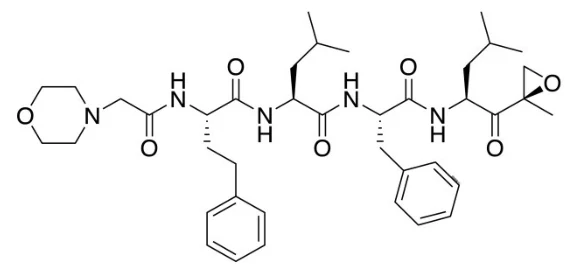
Physicochemical properties: KYPROLIS is a sterile, white to off-white lyophilized powder for solution for injection. Carfilzomib is practically insoluble in water, and very slightly soluble in acidic conditions.
Product Characteristics: Carfilzomib is a modified tetrapeptidyl epoxide, isolated as the crystalline free base.
14 CLINICAL TRIALS
14.1 Clinical Trials by Indication
The efficacy and safety of KYPROLIS in combination with dexamethasone alone (the Kd regimen), dexamethasone and daratumumab (the KdD regimen), or lenalidomide and dexamethasone (the KRd regimen) in the treatment of patients with relapsed multiple myeloma, have been evaluated in open-label, active-controlled Phase 3 studies as described in Table 26.
| Table 26. Summary of Pivotal Clinical Trials to Support KYPROLIS in Relapsed Multiple Myeloma | |||||
| Study # | Trial design | Dosage, route of administration and duration | Study patients (n = number) | Mean age (Range) | Gender (male/female) |
| ASPIRE | Randomized, open-label, active-controlled; Phase 3 | KRd: KYP (IV 10 min) 20/27 mg/m2 in 28-day cyclesa for up to 12 cycles then on D1, 2, 15 and 16 in Cycles 13−18 for up to 18 cycles; LEN 25 mg on D1–21 and DEX 40 mg on D1, 8, 15, 22 until PD or Rd: LEN 25 mg on D1–21 and DEX 40 mg on D1, 8, 15, 22 until PD | N = 792 (n = 396 KRd; n = 396 Rd) | 64.0 (38-87) KRd 65.0 (31-91) Rd | 215/181 KRd 232/164 Rd |
| ENDEAVOR | Randomized, open-label, active-controlled; Phase 3 | Kd: KYP (IV 30 min) 20/56 mg/m2 in 28-d cyclesa; DEX 20 mg on D1, 2, 8, 9, 15, 16, 22, 23 of 28-d cycles until PD or Vd: BOR 1.3 mg/m2 on D1, 4, 8, 11 of 21-day cycles; DEX 20 mg on D1, 2, 4, 5, 8, 9, 11, 12 of 21-day cycles until PD | N = 929 (n = 464 Kd; n = 465 Vd) | 65.0 (35-89) Kd 65.0 (30-88) Vd | 240/224 Kd 229/236 Vd |
| ARROW | Randomized, open-label, active-controlled; Phase 3 | Kd: KYP (IV 30 min) 20/70 mg/m2 in 28-d cyclesb; DEX 40 mg on D1, 8, 15, 22 for first 9 cycles. DEX is omitted on D22 for cycle 10 on or Kd: KYP (IV 10 min) 20/27 mg/m2 in 28-d cyclesa; DEX 40 mg on D1, 8, 15, 22 for first 9 cycles. DEX is omitted on D22 for cycle 10 on | N = 473 (n = 238 Kd QW; n = 235 Kd BIW) | 65.5 (39-85) Kd QW 64.8 (35-83) Kd BIW | 132/108 Kd QW 128/110 Kd BIW |
| Table 26. Summary of Pivotal Clinical Trials to Support KYPROLIS in Relapsed Multiple Myeloma | |||||
| Study # | Trial design | Dosage, route of administration and duration | Study patients (n = number) | Mean age (Range) | Gender (male/female) |
| CANDOR | Randomized, open-label, active-controlled; Phase 3 | KdD: KYP (IV 30 min) 20/56 mg/m2 in 28-d cycles DEX 40 mg on D1, 8, 15, 22; DARA 16 mg/kg (Cycles 1-2: D1, 8, 15, 22, Cycles 3-6: every 2 weeks, Cycle 7+ every 4 weeks) or | N = 466 n = 312 KdD | 64 (29, 84) KdD | 177/135 KdD |
Kd: KYP (IV 30 min) 20/56 mg/m2 in 28-d cycles DEX 40 mg on D1, 8, 15, 22 | n = 154 Kd | 65 (35, 83) Kd | 91/63 Kd | ||
| IKEMA (EFC15246) | Multicenter, multinational, randomized, open-label, 2-arm study in patients with relapsed and/or refractory multiple myeloma who had received one to three prior therapies; Phase 3 | IsaKd: ISA (10 mg/Kg IV)c + KYP IVd + DEX (20 mg IV/PO)e Kd: KYP IVd + DEX (20 mg IV/PO)e 28-day cycle | N = 302 n = 179 IsaKd n = 123 Kd | 63.1 (33-90) | 169/133 |
KYP = KYPROLIS; KRd = KYPROLIS, lenalidomide, and dexamethasone; D = day; DARA = daratumumab; DEX = dexamethasone; LEN = lenalidomide; Rd = lenalidomide and dexamethasone; Kd = KYPROLIS and dexamethasone; KdD = KYPROLIS, dexamethasone, and daratumumab; Vd = bortezomib and dexamethasone; BOR = bortezomib; PD = progressive disease; ISA = isatuximab; IsaKd = KYPROLIS, isatuximab, and dexamethasone; IV = intravenous; PO = taken orally
a KYPROLIS administered in 28-day cycles on Days 1, 2, 8, 9, 15, and 16. Stepped-up dosing occurs in Cycle 1 on Day 8. b KYPROLIS administered in 28-day cycles on Days 1, 8, and 15. Stepped-up dosing occurs in Cycle 1 on Day 8.
c administered as an IV weekly in the first cycle and every two weeks thereafter
d 20 mg/m² on days 1 and 2; 56 mg/m² on days 8, 9, 15 and 16 of cycle 1; and at the dose of 56 mg/m² on days 1, 2, 8, 9, 15 and 16 for subsequent cycles of each 28-day cycle
e IV on the days of isatuximab and/or KYPROLIS infusions, and PO the other days; given on days 1, 2, 8, 9, 15, 16, 22 and 23 for each 28-day cycle
KYPROLIS in Combination with Lenalidomide and Dexamethasone (KRd) for the Treatment of Patients with Relapsed Multiple Myeloma (the ASPIRE Study)
The safety and efficacy of KYPROLIS were evaluated in a randomized, open-label, multicenter Phase 3 study of 792 patients with relapsed multiple myeloma who had received 1 to 3 prior lines of therapy (median of 2), which evaluated the combination of KYPROLIS with lenalidomide and dexamethasone (KRd) vs. lenalidomide and dexamethasone alone (Rd), randomized 1:1.
The primary efficacy endpoint was progression-free survival (PFS) as determined by an Independent Review Committee (IRC) using standard objective International Myeloma Working Group (IMWG)/European Blood and Marrow Transplantation (EBMT) response criteria. Key secondary efficacy endpoints included overall survival (OS) and overall response rate (ORR).
Important exclusion criteria included: creatinine clearance rates < 50 mL/min, disease progression during the treatment with a bortezomib-containing regimen, progression during the first 3 months of initiating treatment with lenalidomide and dexamethasone, or progression at any time during treatment with lenalidomide and dexamethasone if this was the patient’s most recent line of therapy. Intolerance to bortezomib was not an exclusion criterion. KYPROLIS treatment was administered for a maximum of 18 cycles unless discontinued early for disease progression or unacceptable toxicity. Lenalidomide and dexamethasone administration could continue until progression or unacceptable toxicity.
The demographics and disease and baseline characteristics for the ASPIRE study are summarized in Table 27.
| Table 27. Demographic, Disease and Other Baseline Characteristics | ||
|---|---|---|
| Characteristic | KRd Arm (N = 396) | Rd Arm (N = 396) |
| Age, years | ||
| Median (min, max) | 64.0 (38, 87) | 65.0 (31, 91) |
| Age group, years, n (%) | ||
| ≥ 75 | 43 (10.9) | 53 (13.4) |
| Males | 215 (54.3) | 232 (58.6) |
| ECOG Performance Status, n (%) | ||
| 0 | 165 (41.7) | 175 (44.2) |
| 1 | 191 (48.2) | 186 (47.0) |
| 2 | 40 (10.1) | 35 (8.8) |
| ISS stage, n (%) | ||
| III | 73 (18.4) | 82 (20.7) |
| Measurable disease category, n (%) | ||
| UPEP disease | 97 (24.5) | 98 (24.7) |
| Genetic mutations, n (%) | ||
| High-risk genetic mutationsa | 48 (12.1) | 52 (13.1) |
| Standard risk genetic mutations | 147 (37.1) | 170 (42.9) |
| Unknown genetic mutations | 201 (50.8) | 174 (43.9) |
| CrCL, mL/min median (min, max) | 78.6 (38.7, 211.9) | 79.2 (30.0, 207.8) |
| 30 to < 50, n (%)b | 19 (4.8) | 32 (8.1) |
| 50 to < 80, n (%) | 185 (46.7) | 170 (42.9) |
| ≥ 80, n (%) | 192 (48.5) | 194 (49.0) |
| Table 27. Demographic, Disease and Other Baseline Characteristics | ||
|---|---|---|
| Characteristic | KRd Arm (N = 396) | Rd Arm (N = 396) |
| Hemoglobin, g/L median (min, max) | 114.0 (71.0, 154.0) | 111.0 (57.0, 166.0) |
| ANC, 109/L median (min, max) | 2.6 (0.6, 11.8) | 2.7 (0.7, 28.2) |
| Platelet count, 109/L median (min, max) | 185.0 (32.0, 540.0) | 192.5 (25.0, 597.0) |
| History of neuropathy, n (%) | 199 (50.3) | 188 (47.5) |
| Serum beta-2 microglobulin, mg/L median (min, max) | 3.5 (1.3, 13.0) | 3.6 (1.5, 31.7) |
| Heavy chain, n (%) | ||
| IgG | 275 (69.4) | 281 (71.0) |
| Light chain, n (%) | ||
| Kappa | 271 (68.4) | 256 (64.6) |
| Lambda | 124 (31.3) | 139 (35.1) |
ECOG = Eastern Cooperative Oncology Group; ANC = absolute neutrophil count; CrCL = creatinine clearance; IgG = immunoglobulin G; ISS = International Staging System; KRd = KYPROLIS, lenalidomide, and dexamethasone; Rd = lenalidomide and dexamethasone; UPEP = urine protein electrophoresis
| ||
Patients in the KYPROLIS, lenalidomide, and dexamethasone (KRd) arm demonstrated improved progression-free survival (PFS) compared with those in the lenalidomide and dexamethasone (Rd) arm (HR = 0.69, with 1-sided p-value < 0.0001). This represents a 45% improvement in PFS or a 31% reduction in the risk of disease progression or death. The median PFS was 26.3 months in the KRd arm vs. 17.6 months in the Rd arm (see Table 28 and Figure 1).
The PFS benefit of KRd was consistently observed in all subgroups including those defined according to age, cytogenetic risk and number of prior lines of therapy.
A pre-planned overall survival (OS) analysis was performed after 246 deaths in the KRd arm and 267 deaths in the Rd arm. The median follow-up was approximately 67 months. A statistically significant advantage in OS was observed in patients in the KRd arm compared to patients in the Rd arm. Patients in the KRd arm had a 21% reduction in the risk of death compared with those in the Rd arm (HR = 0.79; 95% CI: 0.67, 0.95; p-value = 0.0045). The median OS improved by 7.9 months in patients in the KRd arm compared with those in the Rd arm (see Table 28 and Figure 2). The overall response rate (ORR) was higher in the KRd arm vs. the Rd arm (87.1% vs. 66.7%; 1-sided p-value < 0.0001).
Patients treated with KRd reported a statistically significant improvement in global health status, with higher Global Health Status/Quality of Life (QoL) scores compared with Rd over 18 cycles of treatment measured with the European Organization for Research and Treatment of Cancer (EORTC) Quality of Life Questionnaire Core 30 (QLQ-C30), an instrument validated in multiple myeloma.
Table 28. Summary of Efficacy Analysis
| KRd Arma (N = 396) | Rd Arma (N = 396) | |||||||||
|---|---|---|---|---|---|---|---|---|---|---|
| PFS months median (95% CI) | 26.3 (23.3, 30.5) | 17.6 (15.0, 20.6) | ||||||||
| HR (95% CI); 1-sided p-valueb | 0.69 (0.57, 0.83); < 0.0001 | |||||||||
| OS months median (95% CI) | 48.3 (42.4, 52.8) | 40.4 (33.6, 44.4) | ||||||||
| HR (95% CI); 1-sided p-value | 0.79 (0.67, 0.95); 0.0045 | |||||||||
| ORR n (%) | 345 (87.1) | 264 (66.7) | ||||||||
| sCR | 56 (14.1) | 17 (4.3) | ||||||||
| CR | 70 (17.7) | 20 (5.1) | ||||||||
| VGPR | 151 (38.1) | 123 (31.1) | ||||||||
| PR | 68 (17.2) | 104 (26.3) | ||||||||
| Odds Ratio (95% CI) | 3.47 (2.41, 5.00) | |||||||||
CI = confidence interval; CR = complete response; EBMT = European Blood and Marrow Transplantation; HR = hazard ratio; IMWG = International Myeloma Working Group; KRd = KYPROLIS, lenalidomide, and dexamethasone; NE = not estimable; OS = overall survival; ORR = overall response rate; PR = partial response; PFS = progression-free survival; Rd = lenalidomide and dexamethasone; sCR = stringent complete response; VGPR = very good partial response aAs determined by an Independent Review Committee using standard objective IMWG/EBMT response criteria. bStatistically significant. | ||||||||||
Figure 1. Kaplan-Meier Plot of Progression-Free Survival in the ASPIRE Study
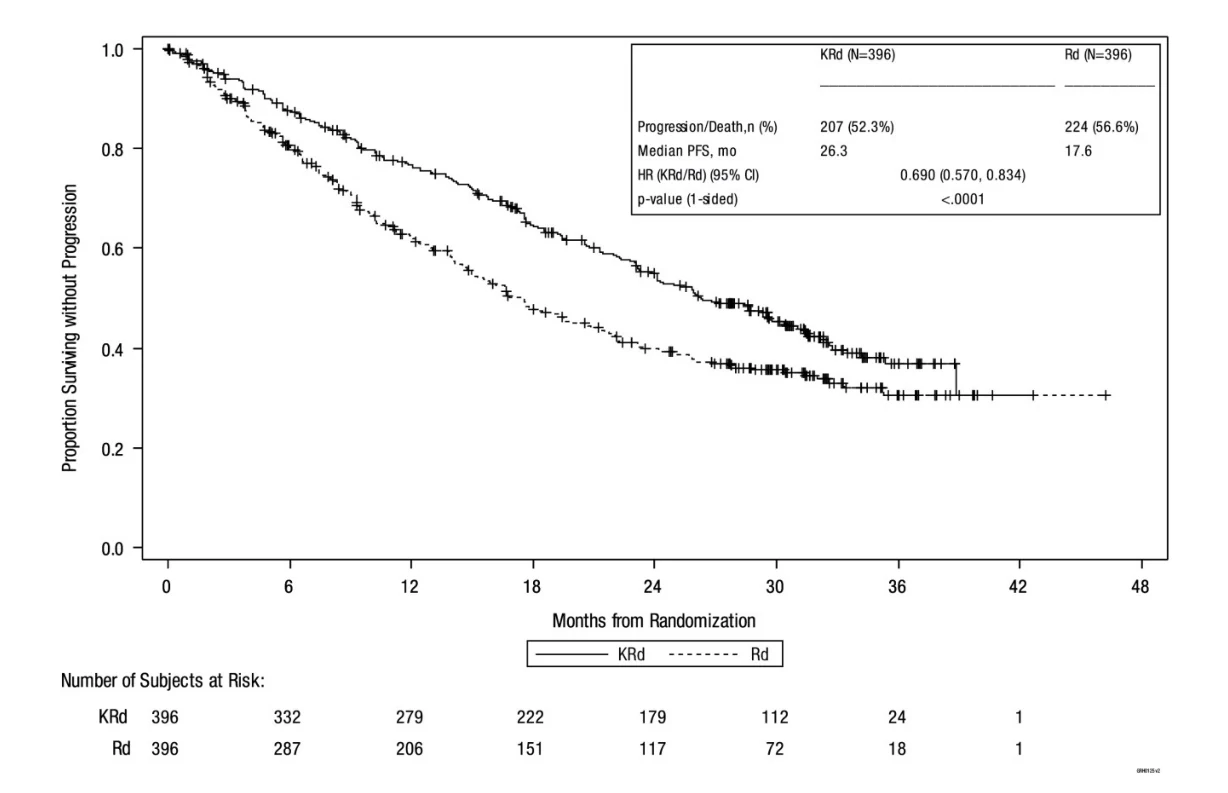
CI = confidence interval; EBMT = European Blood and Marrow Transplantation; HR = hazard ratio; IMWG = International Myeloma Working Group; KRd = KYPROLIS, lenalidomide, and dexamethasone; mo = months; PFS = progression-free survival; Rd = lenalidomide and dexamethasone arm
Note: The response and PD outcomes were determined using standard objective IMWG/EBMT response criteria.
Figure 2. Kaplan-Meier Plot of Overall Survival in the ASPIRE Studya
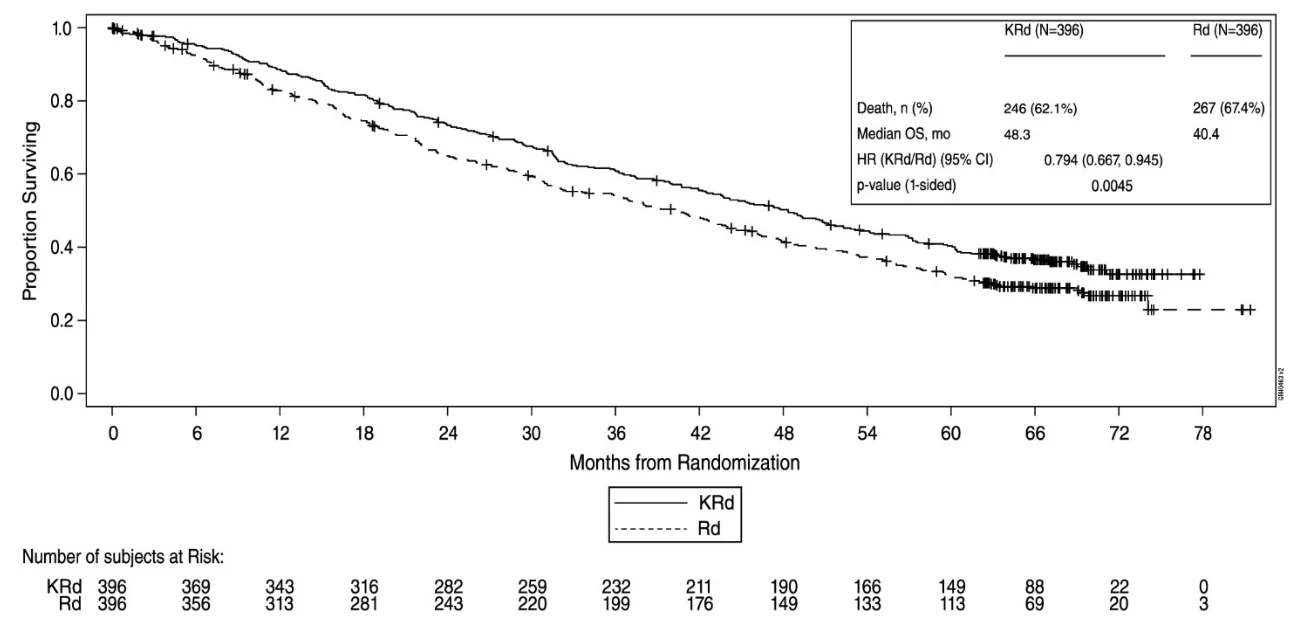
CI = confidence interval; HR = hazard ratio; KRd = KYPROLIS, lenalidomide, and dexamethasone; mo = months; OS = overall survival; Rd = lenalidomide and dexamethasone
a Study PX-171-009
KYPROLIS in Combination with Dexamethasone (Kd) for the Treatment of Patients with Relapsed or Refractory Multiple Myeloma (the ENDEAVOR Study) (Twice Weekly Dosing Regimen)
The safety and efficacy of KYPROLIS 56 mg/m2 twice weekly were evaluated in a Phase 3, randomized, open-label, multicenter study of KYPROLIS and dexamethasone (Kd) vs. bortezomib and dexamethasone (Vd) in patients with relapsed or refractory multiple myeloma who had received 1 to 3 prior lines of therapy. A total of 929 patients were enrolled and randomized (464 in the Kd arm; 465 in the Vd arm). This study evaluated KYPROLIS at an initial dose of 20 mg/m2, which was increased to 56 mg/m2 on Cycle 1, Day 8, administered twice weekly as a 30-minute infusion until disease progression or unacceptable toxicity.
The primary efficacy endpoint was progression-free survival (PFS) as determined by an Independent Review Committee (IRC) using standard objective International Myeloma Working Group (IMWG)/European Blood and Marrow Transplantation (EBMT) response criteria. Secondary efficacy endpoints included overall survival (OS), overall response rate (ORR), and duration of response (DOR).
Patients enrolled on study must have received at least one but not more than 3 prior treatment regimens. Patients were required to have a documented partial response (PR) to at least one line of prior therapy. Prior therapy with bortezomib or KYPROLIS was allowed as long as the patient had at least a PR to a previous treatment with these proteasome inhibitors.
The demographics and disease and baseline characteristics are summarized in Table 29.
| Table 29. Demographic, Disease and Other Baseline Characteristics | ||
|---|---|---|
| Characteristic | Kd Arm (N = 464) | Vd Arm (N = 465) |
| Age, years | ||
| Median (min, max) | 65.0 (35.0, 89.0) | 65.0 (30.0, 88.0) |
| Age Group, years, n (%) | ||
| < 65 | 223 (48.1) | 210 (45.2) |
| 65–74 | 164 (35.3) | 189 (40.6) |
| ≥ 75 | 77 (16.6) | 66 (14.2) |
| Sex, n (%) | ||
| Female | 224 (48.3) | 236 (50.8) |
| Male | 240 (51.7) | 229 (49.2) |
| ECOG Performance Status, n (%) | ||
| 0 | 221 (47.6) | 232 (49.9) |
| 1 | 210 (45.3) | 203 (43.7) |
| 2 | 33 (7.1) | 30 (6.5) |
| Creatinine Clearance Reported (mL/min) | ||
| Median (min, max) | 73.0 (14.0, 185.0) | 72.0 (12.0, 208.0) |
| < 30, n (%) | 28 (6.0) | 28 (6.0) |
| 30 – < 50, n (%) | 57 (12.3) | 71 (15.3) |
| 50 – < 80, n (%) | 186 (40.1) | 177 (38.1) |
| ≥ 80, n (%) | 193 (41.6) | 189 (40.6) |
| Absolute Neutrophils Count (109/L) | ||
| Median (min, max) | 2.8 (0.5, 16.1) | 2.9 (0.6, 14.9) |
| < 1.5, n (%) | 28 (6.0) | 48 (10.3) |
| ≥ 1.5, n (%) | 436 (94.0) | 417 (89.7) |
| FISH, n (%) | ||
| High-risk Groupa | 97 (20.9) | 113 (24.3) |
| Standard-risk Group | 284 (61.2) | 291 (62.6) |
| Unknown-risk Group | 55 (11.9) | 30 (6.5) |
| Prior Therapies, n (%) | 464 (100.0) | 465 (100.0) |
| Prior Proteasome Inhibitor Therapy | 252 (54.3) | 253 (54.4) |
| KYPROLIS | 2 (0.4) | 1 (0.2) |
| Bortezomib | 250 (53.9) | 252 (54.2) |
| Prior Transplant for Multiple Myeloma | 266 (57.3) | 272 (58.5) |
| Prior Thalidomide | 212 (45.7) | 249 (53.5) |
| Prior Lenalidomide | 177 (38.1) | 178 (38.3) |
ECOG = Eastern Cooperative Oncology Group; FISH = fluorescence in situ hybridization; Kd = KYPROLIS and dexamethasone; Vd = bortezomib and dexamethasone a The results were based on fluorescent in situ hybridization (FISH) analysis performed by a central laboratory, and the high-risk group consisted of the genetic subtypes t(4;14) or t(14;16) in 10% or more of screened plasma cells or deletion 17p in ≥ 20% of plasma cells | ||
The study showed a significant improvement in PFS for patients in the Kd arm over those in the Vd arm (HR: 0.53, 95% CI: 0.44, 0.65 [p-value < 0.0001]), with a difference in median PFS of 9.3 months (18.7 months [95 % CI: 15.6, NE] in the Kd arm vs. 9.4 months [95% CI: 8.4, 10.4] in the Vd arm) (see Table 30 and Figure 3).
The PFS benefit of Kd over Vd was consistently observed in all subgroups including those defined according to age, cytogenetic risk, prior bortezomib therapy and number of prior lines of therapy.
The pre-planned OS analysis was performed after 189 deaths in the Kd arm and 209 deaths in the Vd arm. The median follow-up was approximately 37 months. A statistically significant advantage in OS was observed in patients in the Kd arm compared to patients in the Vd arm (HR = 0.79; 95% CI: 0.65, 0.96; p-value = 0.010) (see Table 30 and Figure 4). The results of the secondary efficacy endpoints of ORR and DOR are also presented in Table 30.
Table 30. Summary of Key Results
| Kd Arma (N = 464) | Vd Arma (N = 465) | ||||||||||||
|---|---|---|---|---|---|---|---|---|---|---|---|---|---|
| PFS months median (95% CI) | 18.7 (15.6, —) | 9.4 (8.4, 10.4) | |||||||||||
| HR (95% CI); 1-sided p-valueb | 0.53 (0.44, 0.65); < 0.0001 | ||||||||||||
| OS months median (95% CI) | 47.6 (42.5, —) | 40.0 (32.6, 42.3) | |||||||||||
| HR (95% CI); 1-sided p-valueb | 0.79 (0.65, 0.96); 0.010 | ||||||||||||
| ORR n (%) (95% CI) | 357 (76.9) (72.8, 80.7) | 291 (62.6) (58.0, 67.0) | |||||||||||
| sCR | 8 (1.7) | 9 (1.9) | |||||||||||
| CR | 50 (10.8) | 20 (4.3) | |||||||||||
| VGPR | 194 (41.8) | 104 (22.4) | |||||||||||
| PR | 104 (22.4) | 157 (33.8) | |||||||||||
| Odds Ratio (95% CI) | 2.03 (1.52, 2.72) | ||||||||||||
| DOR, median (months) | 21.3 (21.3, —) | 10.4 (9.3, 13.9) | |||||||||||
CI = confidence interval; CR = complete response; DOR = duration of response; HR = hazard ratio; Kd = KYPROLIS and dexamethasone; ORR = overall response rate; OS = overall survival; PR = partial response; PFS = progression-free survival; sCR = stringent complete response; Vd = bortezomib and dexamethasone; VGPR = very good partial response a As determined by an Independent Review Committee using standard objective IMWG/EBMT response criteria. b Statistically significant. | |||||||||||||
Figure 3. Kaplan-Meier Plot of Progression-Free Survival in the ENDEAVOR Study
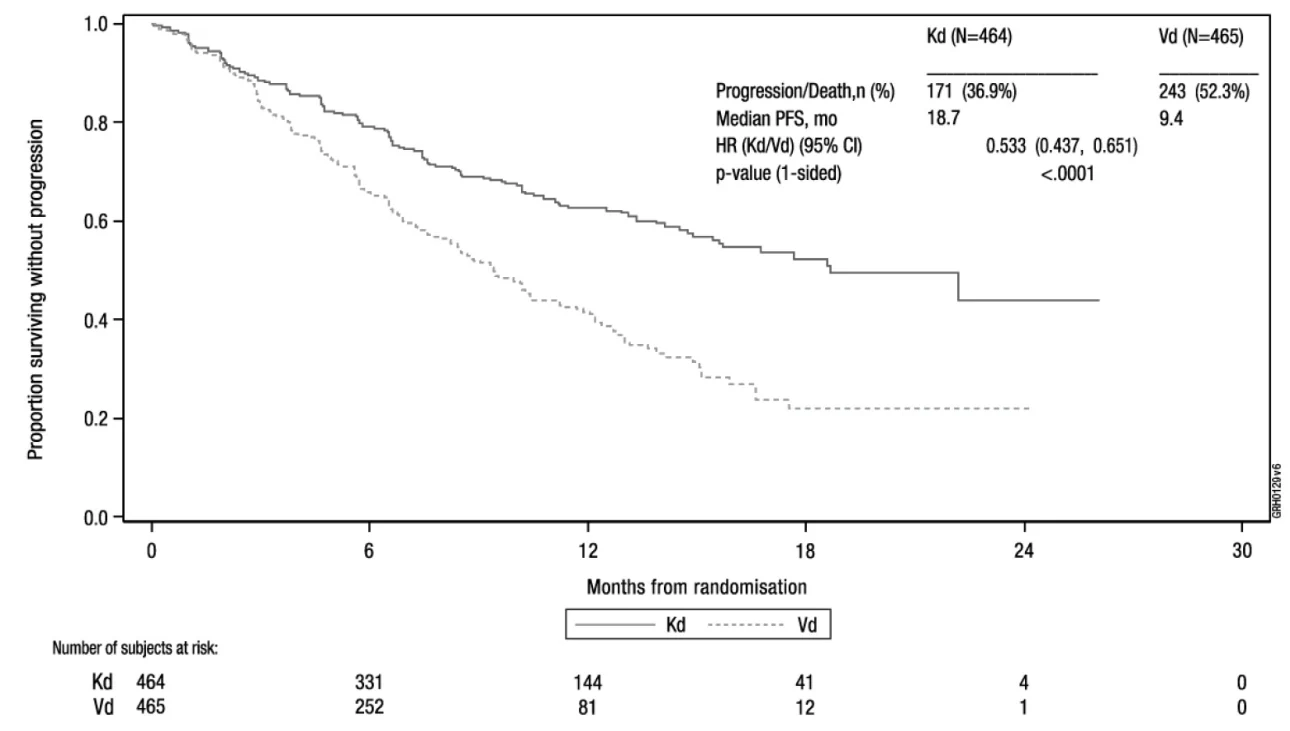
HR = hazard ratio; Kd = KYPROLIS and dexamethasone; mo = months; PFS = progression-free-survival; Vd = bortezomib and dexamethasone
Figure 4. Kaplan-Meier Plot of Overall Survival in the ENDEAVOR Study
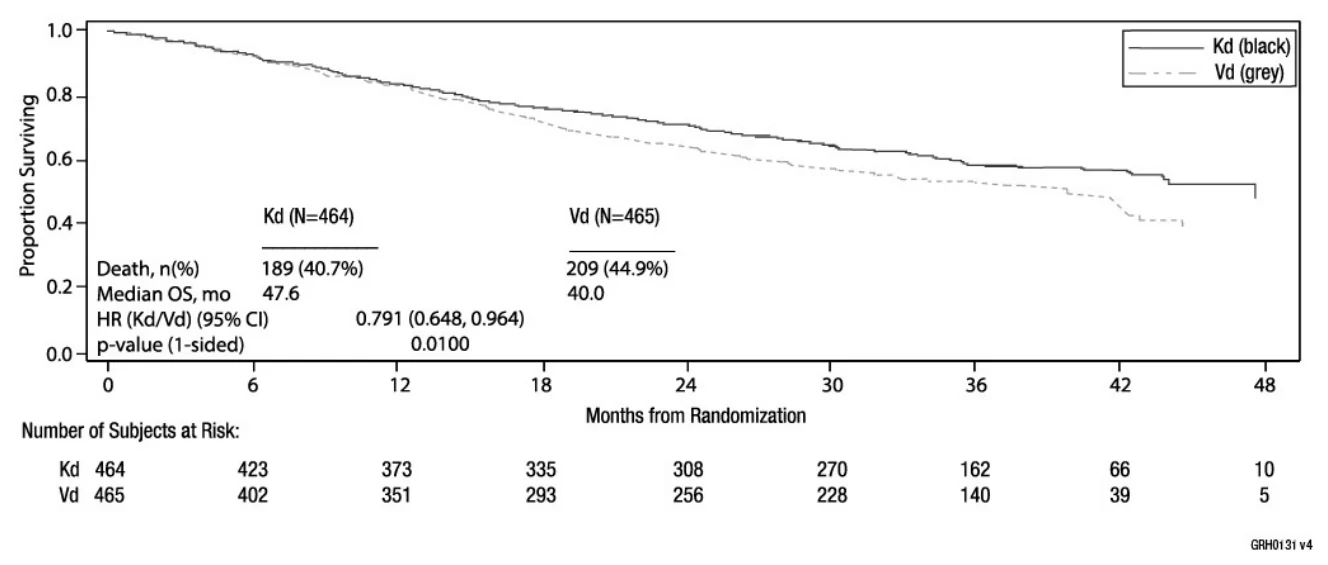
CI = confidence interval; HR = hazard ratio; Kd = KYPROLIS and dexamethasone; mo = months; OS = overall survival; Vd = bortezomib and dexamethasone
KYPROLIS in Combination with Dexamethasone (Kd) for the Treatment of Patients with Relapsed and Refractory Multiple Myeloma (the ARROW Study) (Once Weekly Dosing Regimen)
The safety and efficacy of KYPROLIS 70 mg/m2 once weekly were evaluated in a Phase 3, randomized, open-label, multicenter study of Kd 70 mg/m2 once weekly vs. Kd 27 mg/m2 twice weekly in patients with relapsed and refractory multiple myeloma who had received 2 to 3 prior lines of therapy. A total of 478 patients were enrolled and randomized (240 in the Kd 70 mg/m2 arm; 238 in the Kd 27 mg/m2 arm). This study evaluated KYPROLIS at an initial dose of 20 mg/m2, which was increased to 70 mg/m2 on Cycle 1, Day 8, administered once weekly as a 30-minute infusion until disease progression or unacceptable toxicity. The twice weekly Kd 20/27 mg/m2 regimen is not an authorized therapy.
The primary efficacy endpoint was progression-free survival (PFS), and secondary efficacy endpoints included overall response rate (ORR).
Eligible patients had previous exposure to a proteasome inhibitor and an immunomodulatory agent, and were required to have at least partial response to at least one prior line of therapy. Patients were also required to have left ventricular ejection fraction (LVEF) of 40% or higher, have adequate organ and bone marrow function within 21 days prior to randomization, and have measurable disease per International Myeloma Working Group (IMWG) diagnostic criteria. Important exclusion criteria included: prior treatment with carfilzomib, active congestive heart failure, uncontrolled hypertension or diabetes mellitus, and active infection requiring systemic treatment or significant neuropathy (≥ Grade 3) within 14 days prior to randomization.
The demographics and baseline characteristics are summarized in Table 31 and Table 32. The efficacy of Kd once weekly is summarized in Table 33.
| Table 31. Demographics | |
|---|---|
| Demographics | Kd 20/70 mg/m2 Once Weekly Arm (N =240) |
| Table 31. Demographics | |
|---|---|
| Demographics | Kd 20/70 mg/m2 Once Weekly Arm (N =240) |
| Age, years | |
| Median (min, max) | 66 (39, 85) |
| Age Group, years, n (%) | |
| < 65 | 104 (43.3) |
| 65–74 | 90 (37.5) |
| ≥ 75 | 46 (19.2) |
| Sex, n (%) | |
| Female | 108 (45.0) |
| Male | 132 (55.0) |
| Race, n (%) | |
| White | 200 (83.3) |
| 3 (1.3) | |
| Asian | 30 (12.5) |
| Other or Missing | 7 (3.0) |
| Geographic Region, n (%) | |
| Europe | 192 (80.0) |
| North America | 16 (6.7) |
| Asia Pacific | 32 (13.3) |
| Kd = KYPROLIS and dexamethasone | |
Table 32. Baseline Characteristics
| Characteristic | Kd 20/70 mg/m2 Once Weekly Arm (N = 240) |
|---|---|
| ECOG Performance Status, n (%) | |
| 0 | 118 (49.2) |
| 1 | 121 (50.4) |
| 2 | 1 (0.4) |
| Creatinine Clearance Reported, mL/min | |
| Median (min, max) | 70.80 (27.6, 211.8) |
| < 30, n (%) | 2 (0.8) |
| 30 – < 50, n (%) | 48 (20.0) |
| 50 – < 80, n (%) | 91 (37.9) |
| ≥ 80, n (%) | 99 (41.3) |
| Absolute Neutrophils Count, 109/L | |
| Median (min, max) | 2.31 (0.6, 7.3) |
| < 1.5, n (%) | 39 (16.3) |
| Characteristic | Kd 20/70 mg/m2 Once Weekly Arm (N = 240) |
|---|---|
| ≥ 1.5, n (%) | 201 (83.8) |
| FISH, n (%) | |
| High-risk Groupa | 34 (14.2) |
| Standard-risk Group | 47 (19.6) |
| Unknown-risk Group | 159 (66.3) |
| Prior Therapies, n (%) | |
| Bortezomib | 236 (98.3) |
| Transplantation | 146 (60.8) |
| Thalidomide | 119 (49.6) |
| Lenalidomide | 207 (86.3) |
| ECOG = Eastern Cooperative Oncology Group; FISH = fluorescence in situ hybridization; Kd = KYPROLIS and dexamethasone a Fluorescent in situ hybridization (FISH) data were historical and captured if available, and the high-risk group consisted of the genetic subtypes t(4;14), t(14;16), or deletion 17p. | |
In the Kd 70 mg/m2 once weekly arm, median PFS was 11.3 months (95% CI: 8.6, 13.2) and ORR was 63.8% (95% CI: 57.3, 69.8) (see Table 33 and Figure 5).
Table 33. Summary of Key Results
Kd 70 mg/m2 Once Weekly Arma (N = 240) | |||||
|---|---|---|---|---|---|
| PFS months median (95% CI) | 11.3 (8.6, 13.2) | ||||
| ORRb, n (%) | 153 (63.8) | ||||
| sCR | 4 (1.7) | ||||
| CR | 10 (4.2) | ||||
| VGPR | 70 (29.2) | ||||
| PR | 69 (28.8) | ||||
CI = confidence interval; CR = complete response; Kd = KYPROLIS and dexamethasone; ORR = overall response rate; PR = partial response; sCR = stringent complete response; VGPR = very good partial response a As assessed by Independent Review Committee using International Myeloma Working Group (IMWG)/European Blood and Marrow Transplantation (EBMT) response criteria. b Overall response is defined as achieving a best overall response of PR, VGPR, CR or sCR. | |||||
Figure 5. Kaplan-Meier Plot of Progression-Free Survival in the ARROW Studya
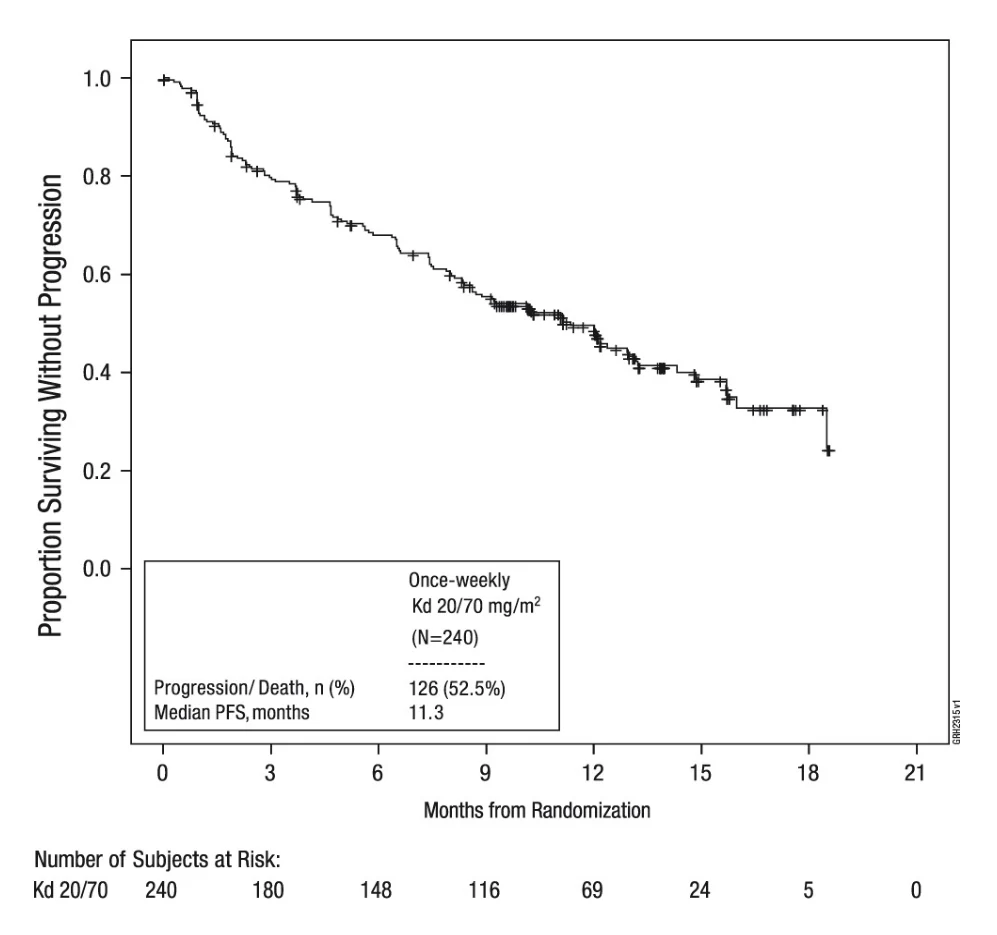
Kd = KYPROLIS and dexamethasone; PFS = progression-free survival
a As determined by Independent Review Committee
KYPROLIS in Combination with Dexamethasone and Daratumumab (KdD) in Multiple Myeloma (the CANDOR Study)
CANDOR was a randomized, open-label, multicenter superiority trial of KYPROLIS with dexamethasone and daratumumab (KdD) twice weekly (20/56 mg/m2) vs. KYPROLIS and dexamethasone (Kd) twice weekly (20/56 mg/m2) in patients with relapsed or refractory multiple myeloma who had received 1 to 3 prior lines of therapy. Patients were excluded if they had known moderate or severe persistent asthma within the past 2 years, known chronic obstructive pulmonary disease (COPD) with a FEV1 < 50% of predicted normal, and active congestive heart failure. A total of 466 patients were enrolled and randomized in a 2:1 randomization (312 in KdD arm and 154 in Kd arm). Randomization was stratified by the ISS (stage 1 or 2 vs stage 3) at screening, prior proteasome inhibitor exposure (yes vs no), number of prior lines of therapy (1 vs ≥ 2), and prior cluster differentiation antigen 38 (CD38) antibody therapy (yes vs no).
In the KdD and Kd arms, KYPROLIS was evaluated at a starting dose of 20 mg/m2, which was increased to 56 mg/m2 on Cycle 1, Day 8 onward. KYPROLIS was administered twice weekly as a 30-minute infusion on Days 1, 2, 8, 9, 15 and 16 of each 28 day cycle. In the KdD arm, daratumumab was evaluated at a 16 mg/kg split dose of 8 mg/kg in Cycle 1 on Days 1 and 2. Thereafter, daratumumab was administered 16 mg/kg once weekly on Days 8, 15 and 22 of Cycle 1 and Days 1, 8 and 15 and 22 of Cycle 2, then every 2 weeks for 4 cycles (cycles 3 to 6) and then every 4 weeks for the remaining cycles or until disease progression. In both arms, dexamethasone 20 mg was administered on Days 1, 2, 8, 9, 15 and 16 and then 40 mg by mouth or intravenously on Day 22 of each 28-day cycle. The demographics and baseline characteristics are summarized in Table 34.
| Table 34. Demographics and Baseline Characteristics | ||
|---|---|---|
| Characteristic | KdD Arm (N = 312) | Kd Arm (N = 154) |
| Age at randomization (years) | ||
| Median (min, max) | 64 (29,84) | 65 (35,83) |
| Age group – n (%) | ||
| 18 – 64 years | 163 (52.2) | 77 (50.0) |
| 65 – 74 years | 121 (38.8) | 55 (35.7) |
| 75 years and older | 28 (9.0) | 22 (14.3) |
| Sex – n (%) | ||
| Male | 177 (56.7) | 91 (59.1) |
| Female | 135 (43.3) | 63 (40.9) |
| Race – n (%) | ||
| Asian | 46 (14.7) | 20 (13.0) |
| Black or African American | 7 (2.2) | 2 (1.3) |
| White | 243 (77.9) | 123 (79.9) |
| Other | 16 (5.1) | 9 (5.8) |
| Table 34. Demographics and Baseline Characteristics | ||
|---|---|---|
| Characteristic | KdD Arm (N = 312) | Kd Arm (N = 154) |
| Geographic region – n (%) | ||
| North America | 21 (6.7) | 12 (7.8) |
| Europe | 207 (66.3) | 103 (66.9) |
| Asia Pacific | 84 (26.9) | 39 (25.3) |
| ECOG performance status – n (%) | 295 (94.6) | 147 (95.5) |
| 0 or 1 | 15 (4.8) | 7 (4.5) |
| 2 | 2 (0.6) | 0 (0.0) |
| Risk group as determined by fluorescent in situ hybridization – n (%) | ||
| High risk | 48 (15.4) | 26 (16.9) |
| Standard risk | 104 (33.3) | 52 (33.8) |
| Unknown | 160 (51.3) | 76 (49.4) |
| ISS stage per IxRS at screening – n (%) | ||
| I or II | 252 (80.8) | 127 (82.5) |
| III | 60 (19.2) | 27 (17.5) |
| Number of prior regimens – n (%) | ||
| 1 | 144 (46.2) | 70 (45.5) |
| 2 | 99 (31.7) | 46 (29.9) |
| 3 | 69 (22.1) | 37 (24.0) |
| Prior Therapies – n (%) | ||
| Lenalidomide | 123 (39.4) | 74 (48.1) |
| Refractory to lenalidomide | 99 (31.7) | 55 (35.7) |
| Bortezomib | 287 (92) | 134 (87) |
| Carfilzomib | 7 (2.2) | 2 (1.3) |
| Prior CD38 antibody therapy | 1 (0.3) | 0 (0.0) |
| Prior stem cell transplant (ASCT) | 195 (62.5) | 75 (48.7) |
ECOG = eastern cooperative oncology group; ISS = international staging system; Kd = KYPROLIS and dexamethasone; KdD = KYPROLIS, dexamethasone, and daratumumab * Subjects with number of prior regimens > 3 was 0 in the KdD arm and 1 in Kd arm. | ||
The primary efficacy endpoint of the CANDOR study was PFS determined by a Blinded Independent Review Committee using IMWG Uniform Response Criteria. Key secondary efficacy endpoints were overall response rate, minimal residue disease-negative complete response (MRD [-] CR) rate at 12 months and overall survival. The trial demonstrated an improvement in PFS in the KdD arm as compared to the KD arm; the median PFS has not been reached in the KdD arm vs. 15.8 months in the Kd arm (hazard ratio [HR]=0.630; 95% CI:
0.464, 0.854; p=0.0014) representing a 37% reduction in the risk of disease progression or death in patients treated with KdD.
Table 35. Summary of Efficacy Analysis
Twice Weekly KdD 20/56 mg/m2 Arm (N = 312) | Twice weekly Kd 20/56 Kd Arm (N = 154) | ||||||||||||||
|---|---|---|---|---|---|---|---|---|---|---|---|---|---|---|---|
| PFSa | |||||||||||||||
| Number of events, n (%) | 110 (35.3) | 68 (44.2) | |||||||||||||
| Median, Months (95% CI) | NE (NE, NE) | 15.8 (12.1, NE) | |||||||||||||
| Hazard Ratio (95% CI) | 0.630 (0.46, 0.85) | ||||||||||||||
| p-value (1-sided) | 0.0014 | ||||||||||||||
| Overall Responseb | |||||||||||||||
| N with Response | 263 | 115 | |||||||||||||
| ORR (%) (95% CI) | 84.3 (79.8, 88.1) | 74.7 (67.0, 81.3) | |||||||||||||
| Odds Ratio (95% CI) | 1.925 (1.18, 3.13) | ||||||||||||||
| p-value (1-sided) | 0.0040 | ||||||||||||||
| CR n (%) | 89 (28.5) | 16 (10.4) | |||||||||||||
| VGPR n (%) | 127 (40.7) | 59 (38.3) | |||||||||||||
| PR n (%) | 47 (15.1) | 40 (26.0) | |||||||||||||
MRD [-] CR at 12 months (at a 10-5 level) b,c MRD[-]CR rate (%) (95% CI) | 12.5 (9.0, 16.7) | 1.3 (0.2, 4.6) | |||||||||||||
| Odds Ratio (95% CI) | 11.329 (2.70, 47.48) | ||||||||||||||
| p-value (1-sided) | < 0.0001 | ||||||||||||||
CI = confidence interval; CR = complete response; Kd = KYPROLIS and dexamethasone; KdD = KYPROLIS, dexamethasone and daratumumab; MRD[-]CR = minimal residual disease negative-complete response; NE = not estimable; ORR = overall response rate; PR = partial response; PFS = progression-free survival; VGPR = very good partial response Stratification factors used in the analyses include (as assessed at randomization): International Staging System (ISS) stage (Stage 1 or 2 vs Stage 3) at screening; prior proteasome inhibitor exposure (yes vs no); number of prior lines of therapy (1 vs ≥ 2). a Hazard ratio and 95% CI were estimated using stratified Cox proportional hazards model; 1-sided p-value was calculated using log-rank test stratified by the randomization stratification factors at level of 0.025 (1-sided); medians were estimated using the Kaplan-Meier method. 95% CIs for medians were estimated using the method by Klein and Moeschberger (1997) with log-log transformation. b Odds ratio and 95% CI were estimated by a stratified analysis using the Mantel-Haenszel method; 1-sided p-values were calculated using Cochran-Mantel-Haenszel Chi-Square test controlling for the stratification factors at level of 0.025(1-sided); 95% CIs for proportions were estimated using the Clopper-Pearson method. c MRD[-]CR at 12-month is defined as achievement of CR or better per IMWG-URC and MRD[-] status as assessed by NGS at 12 months landmark (from 8 months to 13 months window). | |||||||||||||||
Figure 6. Kaplan-Meier Plot of Progression-Free Survival
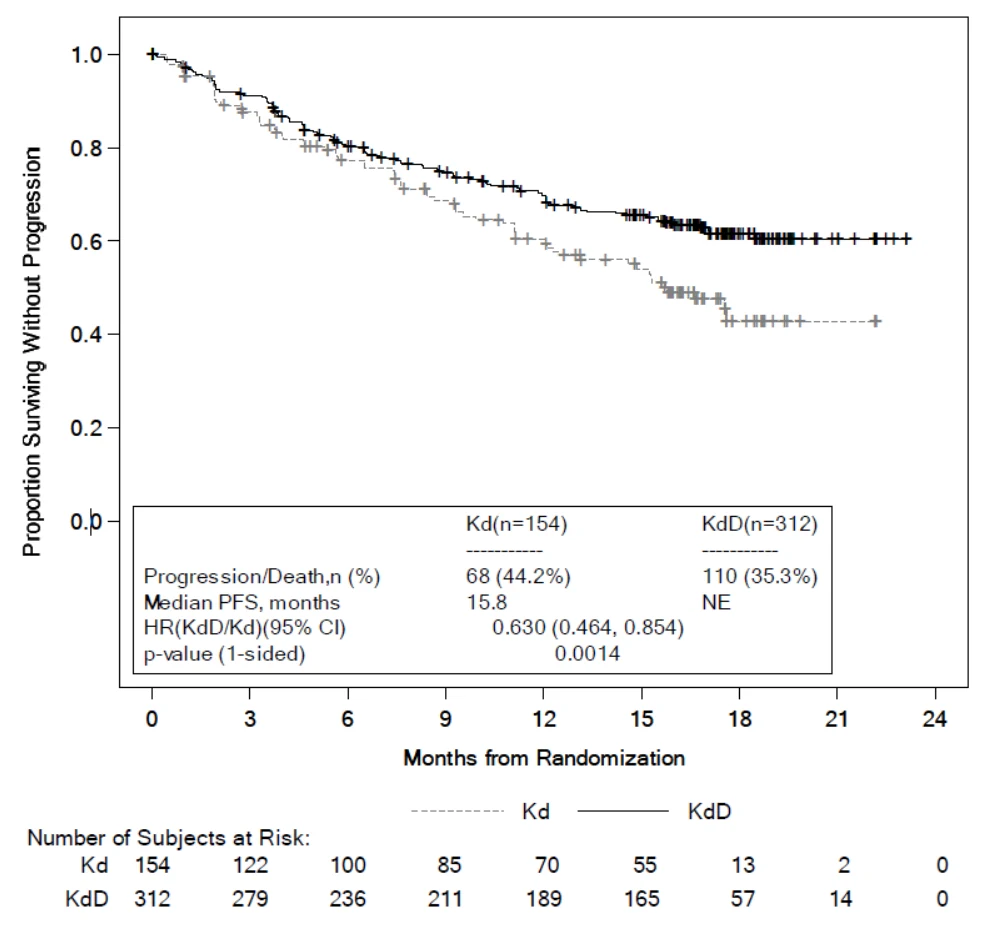
Overall survival data were not mature. The median duration of response was not estimable for the KdD arm and was 16.6 months (13.9, NE) for the Kd arm. The median time to response was 1 (range: 1, 14) months for the KdD arm and 1 (range: 1,10) months for the Kd arm.
KYPROLIS in Combination with Isatuximab and Dexamethasone (IsaKd) in Multiple Myeloma (the IKEMA Study)
The efficacy and safety of KYPROLIS in combination with isatuximab and dexamethasone were evaluated in IKEMA, a multicenter, multinational, randomized, open-label, 2-arm, phase 3 study in patients with relapsed and/or refractory multiple myeloma. Patients had received one to three prior lines of therapy. Patients were eligible for inclusion if they had an ECOG status of 0-2, platelets ≥ 50,000 cells/mm3, absolute neutrophil count ≥ 1 × 10⁹/L, creatinine clearance ≥ 15 mL/min/1.73 m2 (MDRD formula), AST ≤ 3 × ULN, and ALT ≤ 3 × ULN. Patients were excluded if they had primary refractory disease or were refractory to previous anti-CD38 monoclonal antibody treatment.
A total of 302 patients were randomized in a 3:2 ratio to receive either KYPROLIS in combination with isatuximab and dexamethasone (IsaKd, 179 patients) or KYPROLIS and dexamethasone (Kd, 123 patients). Treatment was administered in both groups in 28-day cycles until disease progression or unacceptable toxicity. Isatuximab 10 mg/kg was administered as an intravenous infusion weekly in the first cycle and every two weeks thereafter. KYPROLIS was administered as an intravenous infusion at a dose of 20 mg/m2 on days 1 and 2; 56 mg/m2 on days 8, 9, 15, and 16 of cycle 1; and at a dose of 56 mg/m2 on days 1, 2, 8, 9, 15, and 16 for subsequent cycles of each 28-day cycle. Dexamethasone (intravenously on the days of isatuximab and/or KYPROLIS infusions, and orally on the other days) 20 mg was given on days 1, 2, 8, 9, 15, 16, 22, and 23 for each 28-day cycle. On the days where both KYPROLIS and isatuximab were administered, dexamethasone was administered first, followed by isatuximab infusion, then followed by KYPROLIS infusion.
Overall, demographic and disease characteristics at baseline were similar between the two treatment groups. The median patient age was 64 years (range 33-90), 9% of patients were ≥ 75 years, 71% were White, 17% Asian, and 3% Black or African American. The proportion of patients with renal impairment (eGFR < 60 mL/min/1.73 m2) was 24% in the IsaKd group versus 15% in the Kd group. The International Staging System (ISS) stage at study entry was I in 53%, II in 31%, and III in 15% of patients. Overall, 24% of patients had high-risk chromosomal abnormalities at study entry; del(17p), t(4;14), t(14;16) were present in 11%, 14%, and 2% of patients, respectively. In addition, gain(1q21) was present in 42% of patients.
The median number of prior lines of therapy was 2 (range 1-4) with 44% of patients who received 1 prior line of therapy. Overall, 90% of patients received prior proteasome inhibitors, 78% received prior immunomodulators (including 43% who received prior lenalidomide), and 61% received prior stem cell transplantation. Overall, 33% of patients were refractory to prior proteasome inhibitors, 45% were refractory to prior immunomodulators (including 33% refractory to lenalidomide), and 21% were refractory to both a proteasome inhibitor and an immunomodulator.
The median duration of treatment was 80 weeks for the IsaKd group compared to 61 weeks for the Kd group.
Efficacy was based upon PFS. PFS results were assessed by an Independent Response Committee based on central laboratory data for M-protein and central radiologic imaging review using the IMWG criteria. The improvement in PFS represented a 46.9% reduction in the risk of disease progression or death in patients treated with IsaKd compared to patients treated with Kd.
Efficacy results are presented in
Table 36 and Figure 7.
Table 36. Efficacy of KYPROLIS in Combination with Isatuximab and Dexamethasone (IsaKd) versus KYPROLIS and Dexamethasone (Kd) in the Treatment of Multiple Myeloma (IKEMA)a
| Endpoint | IsaKd N = 179 | Kd N = 123 | |||||||
| Progression-Free Survivalb | |||||||||
Median (months) [95% CI] | NR [NR- NR] | 19.15 [15.77- NR] | |||||||
| Hazard ratioc [95% CI] | 0.531 [0.318-0.889] | ||||||||
| p-value (stratified log-rank test) c | 0.0013 | ||||||||
Overall Response Rated Responders (sCR+CR+VGPR+PR) n (%) [95% CI]e | 155 (86.6) [0.8071-0.9122] | 102 (82.9) [0.7509-0.8911] | |||||||
| p-value (stratified Cochran-Mantel-Haenszel)c | 0.3859 | ||||||||
| Complete Response (CR) n (%) | 71 (39.7) | 34 (27.6) | |||||||
| Very Good Partial Response (VGPR) n (%) | 59 (33.0) | 35 (28.5) | |||||||
| Partial Response (PR) n (%) | 25 (14.0) | 33 (26.8) | |||||||
NR: not reached.
* Median follow-up time 20.7 months.
a Results are based on a prespecified interim analysis.
b PFS results were assessed by the IRC based on central laboratory data for M-protein and central radiologic imaging review using the IMWG criteria. A comparison is considered statistically significant if the p-value is < 0.008 (efficacy boundary).
c Stratified on number of previous lines of therapy (1 versus > 1) and R-ISS (I or II versus III versus not classified) according to IRT.
d sCR, CR, VGPR, and PR were evaluated by the IRC using the IMWG response criteria.
e Estimated using Clopper-Pearson method.
The percentage of patients achieving a best overall response of VGPR or better, defined as patients with sCR, CR, or VGPR by the IRC using the IMWG response criteria, was 72.6% in the IsaKd group and 56.1% in the Kd group.
Subgroup analyses based on PFS hazard ratio were consistent across the pre-specified subgroups including patients with high-risk cytogenetics, ≥ 65 years of age, with baseline eGFR (MDRD) < 60 mL/min/1.73 m², with > 1 prior line of therapy, or with ISS stage III at study entry.
Figure 7. Kaplan-Meier Plot of Progression-Free Survival (Intent-to-Treat Population) in the IKEMA Study
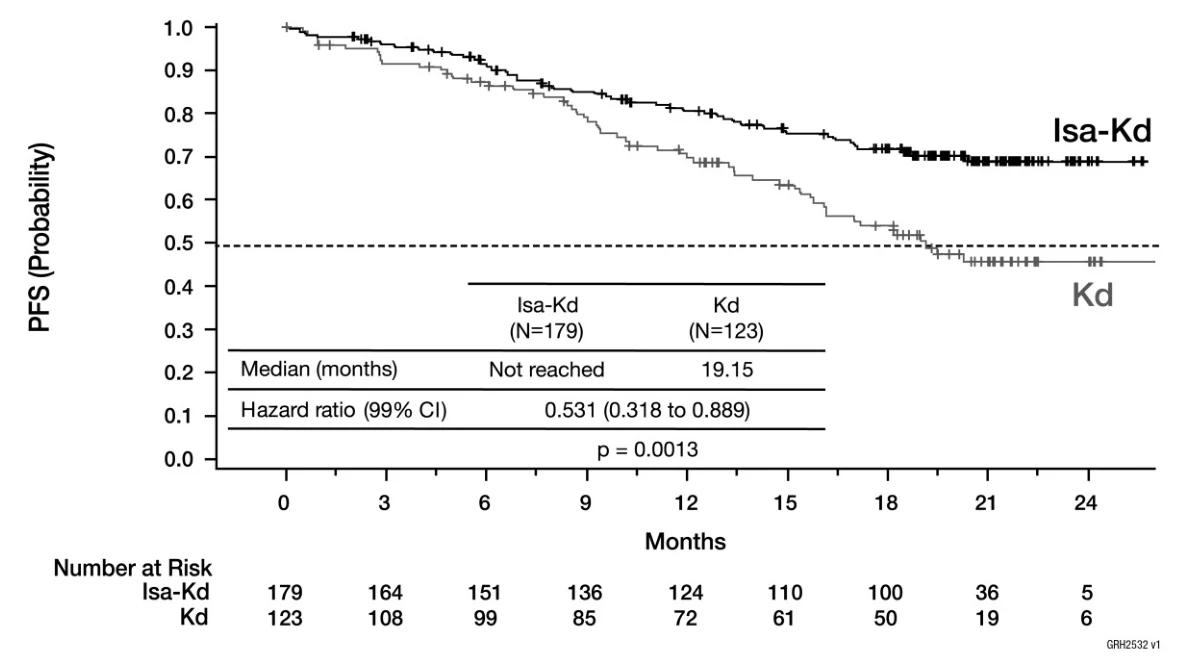
15 MICROBIOLOGY
No microbiological information is required for this drug product.
16 NON-CLINICAL TOXICOLOGY
General Toxicology
The potential impact of infusion length on carfilzomib tolerability and toxicity was assessed in a single-dose administration study in rats. Bolus administration of 8 mg/kg (48 mg/m2) resulted in mortality in 14 of 32 animals. The same dose administered as a 30-minute infusion resulted in no mortality in 24 animals; and when administered as a 10-minute infusion mortality was seen in 1 of 8 animals. When higher doses of carfilzomib, 10 and 12 mg/kg (60 and 72 mg/m2), were given as a 30-minute infusion, mortality was noted in 1 of 6 and 4 of 6 animals, respectively. Moreover, bolus administration of carfilzomib at 8 mg/kg (48 mg/m2) resulted in ruffled fur, dyspnea, lethargy, and pale ears in nearly all animals. A 30-minute infusion of the same dose resulted in fewer and less severe clinical observations that were limited to slightly ruffled fur in the animals. At 24 hours post-dose, bolus administration of carfilzomib at 8 mg/kg resulted in clinical chemistry changes consisting of an approximately 4-fold increase in blood urea nitrogen (BUN), 2-fold increase in creatinine, and 4-fold increase in alanine aminotransferase (ALT); the 30-minute infusion of carfilzomib at the same dose resulted in an approximately 2-fold increase in BUN, no changes in creatinine levels, and 2-fold increase in ALT. Clinical chemistry changes resolved by 72 hours.
Acute Dose Toxicity
Carfilzomib was toxic following single bolus injections in rats and monkeys at similar or lower exposures (based on AUC) achieved clinically in humans receiving 27 mg/m2. Rats administered ≥ 7 mg/kg showing signs of lethargy and piloerection at 1 and 4 hours after the bolus injection, respectively, with deaths reported in animals administered 9 mg/kg. Single carfilzomib doses of 4 mg/kg in monkeys resulted in considerable toxicity including deaths. Signs of nephrotoxicity and changes consistent with an acute phase response (APR) including increased C-reactive protein (CRP), neutrophils, monocytes and fibrinogen and decreased albumin in rats and pericardial effusion in monkeys along with congestion of the livers and kidneys and discolouration of the GI tract were observed. The toxicities were more severe in the rat than in the monkey, possibly owing to higher exposures of carfilzomib in these animals.
Repeat Dose Toxicity
Repeat-dose toxicity studies of 4-weeks and 3/6-months in rats and of 1, 4-weeks and 9-months in monkeys were conducted. The 3/6-month study in rats and 9-month study in monkeys used dosing schedules (Days 1, 2, 8, 9, 15 and 16 of a 28-day cycle) similar to those used clinically. Intravenous administration of carfilzomib at ≥ 2 mg/kg/dose in rats and 2 mg/kg/dose in monkeys, approximating human equivalent exposures of ≥ 0.3 and 0.1 times, respectively (based on AUClast), resulted in mortalities that were due to toxicities occurring in the cardiovascular (cardiac failure, cardiac fibrosis, pericardial fluid accumulation, cardiac hemorrhage/ degeneration), gastrointestinal (necrosis/hemorrhage), renal (glomerulonephropathy, tubular necrosis, dysfunction), and pulmonary (hemorrhage/ inflammation) systems. Carfilzomib achieved higher systemic concentrations in rats compared to monkeys at similar starting doses (based on mg/kg) and mortalities generally occurred earlier in rats than in monkeys.
Carcinogenicity
Carcinogenicity studies have not been conducted with KYPROLIS.
Carfilzomib was clastogenic in the in vitro chromosomal aberration test in peripheral blood lymphocytes. Carfilzomib was not mutagenic in the in vitro bacterial reverse mutation (Ames) test (Table 37).
Table 37. Summary of Mutagenicity Studies
| Study Title | Species/Number of Animals | Dosage/Route | Principal Findings |
|---|---|---|---|
| Carfilzomib: Bacterial Reverse Mutation Test | S. typhimurium: TA1535, TA1537, TA98, TA100; E. coli: WP uvrA (pKM101) | In vitro 5 to 5000 μg/plate | Carfilzomib showed no mutagenic potential |
| Carfilzomib: In Vitro Chromosome Aberration Test in Human Lymphocytes | Human lymphocytes | In vitro 0.001 to 2500 μg/mL | Carfilzomib caused an increase in the frequency of structural chromosome aberrations. |
| Carfilzomib: Mouse Micronucleus Test | CD-1 Mice/5 sex/group | IV injections at 0.31 to 7 mg/kg | Carfilzomib showed no evidence for causing an increase in the induction of micronucleated polychromatic erythrocytes or of causing bone marrow cell toxicity |
Reproductive and Developmental Toxicology
Fertility studies with carfilzomib have not been conducted. No effects on reproductive tissues were noted during 28-day repeat-dose rat and monkey toxicity studies or in 6-month rat and 9-month monkey chronic toxicity studies. Carfilzomib caused embryo-fetal toxicity in pregnant rabbits at doses that were lower than in patients receiving the recommended dose. Carfilzomib administered to pregnant rats during the period of organogenesis was not teratogenic at doses up to 2 mg/kg/day, which is approximately half the recommended dose in humans of 27 mg/m2 based on body surface area (see Error! Not a valid bookmark self-reference.).
Table 38. Summary of Embryo Fetal Development Studies
| Study Title | Species/Number of Animals | Dosage/Route | Principal Findings |
|---|---|---|---|
| Carfilzomib: An Intravenous Embryo-fetal Toxicity Study in Rats (GLP) | Time-mated Sprague-Dawley rats/ 22 females/group for controls, 28/group for carfilzomib groups | Daily IV from gestation day 6 to 17 inclusive at 0, 0.5, 1.0, 2.0 mg/kg | Mortality at 2 mg/kg (2 females) on gestation day (GD) 9 and GD 15. Thin fluid in the thoracic cavities, distended colon, discoloured jejunal serosa, small spleen, and enlarged heart at necropsy. At ≥ 1 mg/kg, there was decreased activity, anogenital staining, pallor, and labored breathing ↓ body weight gain was associated with ↓ food consumption from GD 6 through 18 with recovery and increased body weight gain from GD 18 through GD20 at ≥ 1 mg/kg. There were no effects on percent pre- or post-implantation loss, on placental or fetal weight, or on the incidence of external, visceral, or skeletal malformations. The maternal NOAEL was 0.5 mg/kg and the NOAEL for embryo-fetal toxicity was 2 mg/kg. |
| Carfilzomib: Preliminary Intravenous Embryo-fetal Toxicity Study in Rabbits (Non-GLP) | Time-mated New Zealand White rabbits/8 females/group | Daily IV from gestation day 6 to 19 inclusive at 0, 0.2, 0.4, 0.8 mg/kg | Mortality at 0.8 mg/kg (one female) preceded by ↓ food consumption and accumulation of thin, red fluid in the thoracic and pericardial cavities, edema in the pericardium and thymus, and enlarged mediastinal lymph node at necropsy. ↓ body weight, ↓body weight gain, food consumption, and/or fecal volume from GD 6 through 29 at 0.8 mg/kg. At 0.4 mg/kg, there was transient ↓ body weight and food consumption that were toxicologically insignificant. At scheduled necropsy, at 0.8 mg/kg one female had 60% post-implantation loss, signs of fetal toxicity and possible early abortion or premature delivery on GD 29. ↓fetal body weight at 0.8 mg/kg may have been secondary to the severe maternal toxicity. A NOAEL for embryo-fetal toxicity was established at 0.4 mg/kg/day, based on decreased fetal body weight at 0.8 mg/kg/day that were considered, in part, secondary to maternal toxicity. |