


Patient Medication Information: uses, side effects, how to take - Livmarli
What is LIVMARLI used for?
LIVMARLI is used to treat patients 12 months and older with:
- Cholestatic pruritus (itch caused by liver problems) in patients who have Alagille syndrome. (ALGS).
- Cholestatic pruritus (itch caused by liver problems) in patients who have Progressive familial intrahepatic cholestasis (PFIC).
How does LIVMARLI work?
Excess bile acids in the body can cause itching. LIVMARLI contains maralixibat which helps remove excess bile acids from the body. This helps reduce itching.
What are the ingredients in LIVMARLI?
Oral Solution
Medicinal ingredients: Maralixibat (as maralixibat chloride)
Non-medicinal ingredients: Edetate disodium, grape flavor, propylene glycol, purified water, and sucralose.
Tablets
Medicinal ingredients: Maralixibat (as maralixibat chloride)
Non-medicinal ingredients: Crospovidone Type A, glyceryl distearate Type I, lactose monohydrate, microcrystalline cellulose, and silicon dioxide.
LIVMARLI comes in the following dosage forms:
- Oral solution, 9.5 mg/mL
- Oral solution, 19 mg/mL
- Tablets: 10 mg, 15 mg, 20 mg and 30 mg
Do not use LIVMARLI if:
- You are allergic to maralixibat, or to any of the ingredients in LIVMARLI, or the container.
- If you have or have had in the past liver damage (including conditions such as variceal hemorrhage, ascites, hepatic encephalopathy).
To help avoid side effects and ensure proper use, talk to your healthcare professional before you take LIVMARLI. Talk about any health conditions or problems you may have, including if you:
- Have low levels of Vitamins A, D, E or K
- Have liver problems
Are pregnant or plan to become pregnant; or are breastfeeding or plan to breastfeed.
Other warnings you should know about:
Stomach/Digestive Problems:
- LIVMARLI can cause diarrhea, stomach pain and vomiting. Diarrhea and vomiting may lead to dehydration.
- Talk to your healthcare professional if your diarrhea gets worse while taking LIVMARLI. Your healthcare professional will check your hydration levels.
- If you get diarrhea, drink plenty of liquids so you do not become dehydrated.
See the “Serious side effects and what to do about them” table, below, for more information on these and other serious side effects.
Risk of Propylene Glycol Toxicity:
LIVMARLI oral solution contains a non-medicinal ingredient called propylene glycol. Patients less than 5 years of age are at highest risk for propylene glycol toxicity. Your healthcare professional will monitor your child for signs and symptoms of potential propylene glycol toxicity.
Tell your healthcare professional about all the medicines you take, including any drugs, vitamins, minerals, natural health products or alternative medicines.
The following may interact with LIVMARLI:
- Medicines called statins, used to treat cholesterol levels.
How to take LIVMARLI:
LIVMARLI is available in oral solution and tablet.
- Talk to your healthcare professional about how to measure your prescribed dose of LIVMARLI oral solution.
- Use only the oral dosing syringes provided by your healthcare professional to measure the correct dose of LIVMARLI oral solution.
- Take LIVMARLI exactly as your healthcare professional tells you to.
Take LIVMARLI by mouth, 1 time each day in the morning and if taking 2 times per day, take in the morning and evening, 30 minutes before a meal.
- See the Instructions for Use below on how to take or give the oral solution dose.
Instructions for Use:
Step 1: Draw dose
1.1 To open the bottle, remove the child-resistant cap by pushing down firmly while turning left (anti-clockwise) (see Figure A). Do not throw away the child-resistant cap as you will need to put it back when you have taken out the dose you need.
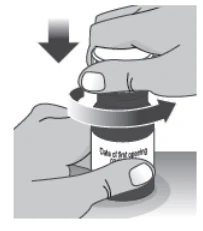
Figure A
1.2 Make sure you use the correct oral syringe size for your prescribed dose, provided by your healthcare professional.
- If using a new oral syringe, remove it from the wrapper (see Figure B). Throw away the wrapper.
- If using a used oral syringe, make sure it has been cleaned and is dry (see 2.4 for instructions for cleaning).
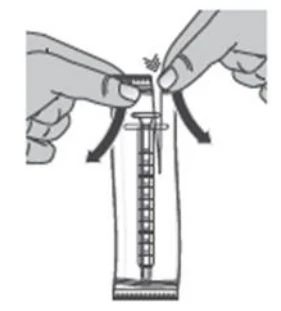
Figure B
- If there is a cap on the oral syringe, remove it and throw it away (see Figure C).
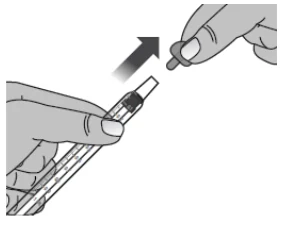
Figure C
The syringe has dose markings on the barrel. One end of the syringe has a tip that is used to insert into the medicine bottle. The other end of the syringe has a flange and a plunger, used to push the medicine out of the syringe (see Figure D).
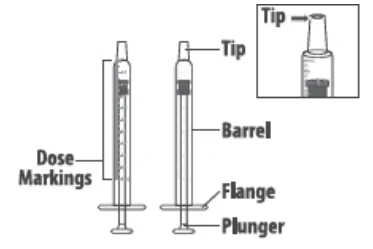
Figure D
1.3 Push the plunger down fully to remove air from the syringe (see Figure E).
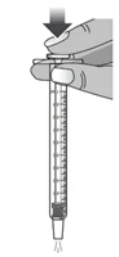
Figure E
1.4 Make sure that the cap is removed from the bottle and insert the tip of the syringe into the upright bottle. The tip of the syringe should fit snugly into the hole of the bottle (see Figure F).
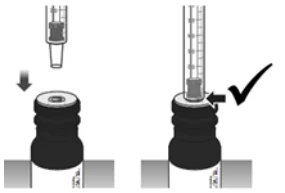
Figure F
1.5 With the syringe in place, turn the bottle upside down (see Figure G).
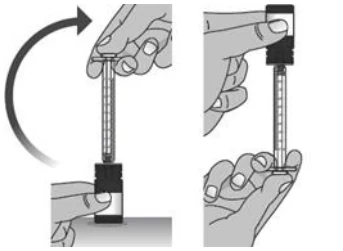
Figure G
1.6 To withdraw a dose from the bottle, slowly pull back on the plunger until the plunger lines up with the marking on the barrel of the syringe that matches the prescribed dose (see Figure H). There are two kinds of plungers that you might receive with the syringe: a flat tip plunger or a pointy tip plunger (see Figure I.a and l.b). See Figure I on how to align the plunger with your prescribed dose.
- For a flat tip plunger, the flat end of the plunger should be aligned with the marking on the barrel that matches the prescribed dose (Figure I.a.).
- For a clear pointy tip plunger, make sure that the flat, wide part of the plunger below the tip is lined up with the correct marking (Figure I.b.).
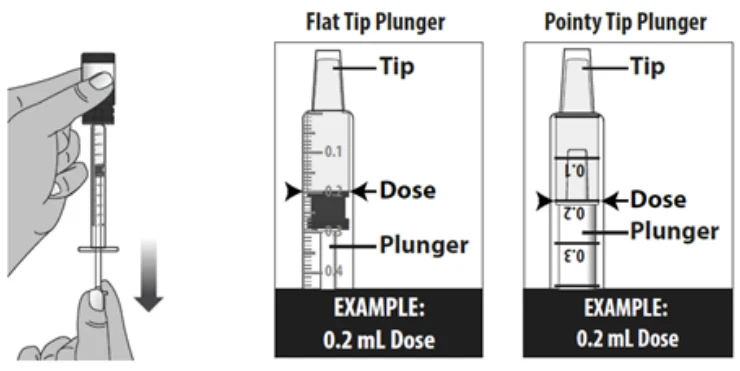
Figure H Figure I.a. Figure I.b.
1.7 Check the syringe for air bubbles. If you see any air bubbles:
- Push the air bubbles back into the bottle by pushing the plunger (see Figure J)
- When there are no more air bubbles, re-draw the prescribed dose following the instructions in Step 1.6.
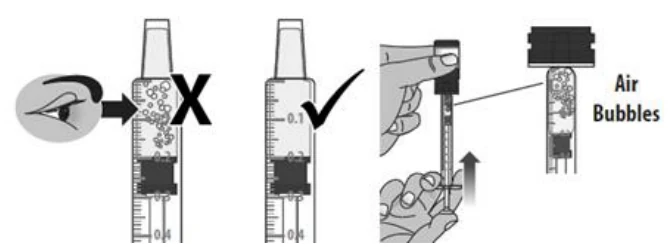
Figure J.a. Figure J.b.
Check for air bubbles Push plunger into syringe to remove air bubbles
1.8 When you have taken up the correct dose with no air bubbles, leave the syringe in the bottle and turn the bottle right side up (see Figure K).
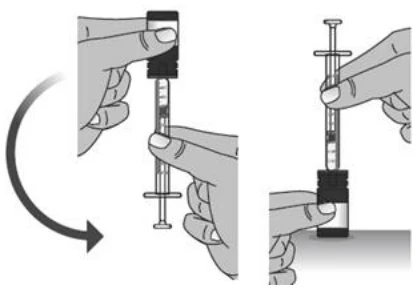
Figure K
1.9 Carefully remove the syringe from the bottle (see Figure L), by holding the bottle firmly in one hand and holding the syringe by the barrel in the other hand.
- Do not push the syringe plunger during this step.
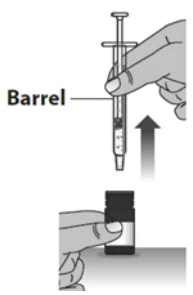
Figure L
Step 2: Give the dose
Note: You or your child should stay upright while taking the dose and for a few minutes after.
2.1 Insert the tip of the oral syringe against the inside of the cheek (see Figure M).
Slowly press the plunger all the way down to fully and gently squirt the oral solution into the mouth (see Figure N).
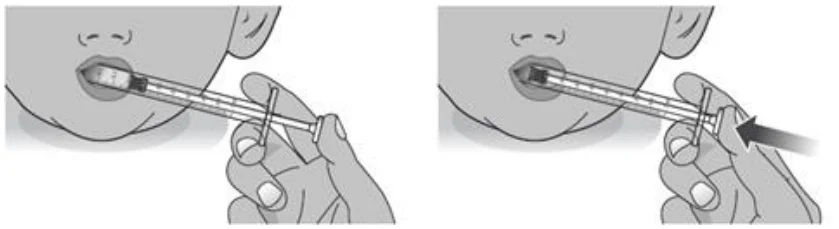
Figure M Figure N
2.2 Make sure you/the child swallow(s) the dose. If you are not sure if the entire dose was swallowed, do not give another dose. Wait until it is time for the next dose.
2.3 To close the bottle, screw the child-resistant cap back on the bottle by turning to the right (clockwise) (see Figure O).
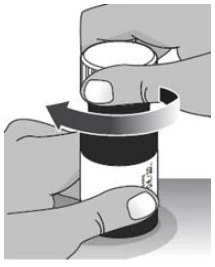
Figure O
2.4 Remove the plunger from the barrel of the syringe (see Figure P). Wash it with water after each use. Allow the plunger to air dry before using again.
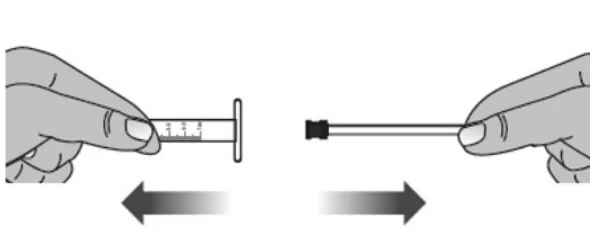
Figure P
- The oral syringes may be rinsed with water, air dried and reused for 130 days.
Usual dose:
- The dose of LIVMARLI is based on your weight. Your healthcare professional will decide the best dose for you. They will tell you how much to take and which oral syringe size to use.
- Your healthcare professional may change your dose, stop your treatment for a period of time or recommend that you stop treatment completely. This may happen if you experience serious side effects.
- Do not change your dose or stop taking LIVMARLI without talking to your healthcare professional.
Overdose:
If you think you, or a person you are caring for, have taken too much LIVMARLI, contact a healthcare professional, hospital emergency department, or regional poison control centre immediately, even if there are no symptoms.
Missed Dose:
If you miss a dose of LIVMARLI and it is:
- 12 hours or less from the time you usually take LIVMARLI: take the missed dose as soon as possible. Then take your next dose at the usual time.
- More than 12 hours from the time you usually take LIVMARLI: do not take the missed dose. Take your next dose at the usual time.
If you miss a dose of LIVMARLI and you take LIVMARLI 2-times a day:
- If it is 6 hours or less from the time you usually take LIVMARLI, take the missed dose as soon as possible. Then take your next dose at the usual time.
- If it is more than 6 hours from the time you usually take LIVMARLI, do not take the missed dose. Take your next dose at the usual time.
What are possible side effects from using LIVMARLI?
These are not all the possible side effects you may have when taking LIVMARLI. If you experience any side effects not listed here, tell your healthcare professional.
- Stomach pain
- Diarrhea
- Vomiting
- Nausea
LIVMARLI may cause abnormal blood test results. Your healthcare professional will do blood tests before and during your treatment. These will tell your healthcare professional how LIVMARLI is affecting your liver health and hydration levels.
Serious side effects and what to do about them
| Symptom / effect | Talk to your healthcare professional | Stop taking drug and get immediate medical help | |
|---|---|---|---|
| Only if severe | In all cases | ||
| VERY COMMON | |||
| Stomach and Digestive Problems: stomach pain, vomiting, diarrhea. | ✓ | ||
| UNKNOWN | |||
| Stomach and Digestive Problems: hematemesis (vomiting blood), internal bleeding following an endoscopy or biopsy. | ✓ | ||
| Intracranial hemorrhage (bleeding inside the skull): headache, nausea, confusion, slurred speech, loss of consciousness. | ✓ | ||
If you have a troublesome symptom or side effect that is not listed here or becomes bad enough to interfere with your daily activities, tell your healthcare professional.
Reporting Side Effects
You can report any suspected side effects associated with the use of health products to Health Canada by:
- Visiting the Web page on Adverse Reaction Reporting (https://www.canada.ca/en/health-canada/services/drugs-health-products/medeffect-canada/adverse-reaction-reporting.html) for information on how to report online, by mail or by fax; or
- Calling toll-free at 1-866-234-2345.
NOTE: Contact your health professional if you need information about how to manage your side effects. The Canada Vigilance Program does not provide medical advice.
Storage:
For oral solution:
- Store unopened LIVMARLI oral solution between 20-25oC. Do not freeze.
- Store bottle in the original package in order to protect from light.
- Always store LIVMARLI with the cap on the bottle.
- After opening the LIVMARLI bottle, store at 2o C -30oC (35.6-86o F), do not freeze, store in the original package to protect from light and discard any remaining LIVMARLI oral solution 9.5 mg/mL after 100 days and LIVMARLI oral solution 19 mg/mL after 130 days..
For tablets:
- Store unopened LIVMARLI tablets between 15-30°C (59-86°F). Store in the original package to protect from light.
- Keep out of reach and sight of children.
If you want more information about LIVMARLI:
- Talk to your healthcare professional
- Find the full product monograph that is prepared for healthcare professionals and includes this Patient Medication Information by visiting the Health Canada website (https://www.canada.ca/en/health-canada/services/drugs-health-products/drug-products/drug-product-database.html)NULL, the manufacturer’s website (www.mirumpharma.com), or by calling 1-833-548-6754.