


Product Monograph - Magnesium Sulfate in Water for Injection
1 INDICATIONS
Magnesium Sulfate in Water for Injection may be of therapeutic value in the following conditions:
- as an anticonvulsant for preeclampsia and eclampsia
- as an electrolyte replenisher for hypomagnesemia and magnesium deficiency to maintain normal neuromuscular irritability.
1.1 Pediatrics
Pediatrics (<18 years of age): Health Canada has not authorized an indication for pediatric use.
1.2 Geriatrics
Geriatrics: Health Canada has not authorized an indication for geriatric use.
2 CONTRAINDICATIONS
Magnesium Sulfate in Water for Injection should not be administered parenterally in patients with:
- heart block
- myocardial damage
- hypersensitivity to this drug or to any ingredient in the formulation, including any non-medicinal ingredient, or component of the container. For a complete listing, see 6 DOSAGE FORMS, STRENGTHS, COMPOSITION AND PACKAGING.
Intravenous magnesium should not be given to mothers with toxemia of pregnancy during the two hours preceding delivery.
4 DOSAGE AND ADMINISTRATION
4.1 Dosing Considerations
This product is a sterile ready-to-use product.
Renal
Parenteral use in the presence of renal insufficiency may lead to magnesium intoxication. In patients with severe renal impairment, dosage should not exceed 20 g in 48 hours. Serum magnesium should be monitored in such patients. (See 7 WARNINGS AND PRECAUTIONS, Renal, Aluminum toxicity).
4.2 Recommended Dose and Dosage Adjustment
Usual Dose Range
A total daily (24 hr) dose of 30 to 40 g magnesium sulfate should not be exceeded.
Route of administration:
- Intravenous
1 to 4 g (4.06 to 16.22 mmol) Magnesium Sulfate in Water for Injection may be given intravenously, but only with great caution; the rate should not exceed 150 mg magnesium sulfate per minute (3.75 mL/min 40 mg/mL solution or 1.88 mL/min 80 mg/mL solution) until relaxation is obtained.
IV use in eclampsia should be reserved for immediate control of life-threatening convulsions. See 7 WARNINGS AND PRECAUTIONS, For Pre-eclampsia or Eclampsia.
- Intravenous Infusion
4 g (16.22 mmol) at a rate not exceeding 48 mg per minute (1.2 mL/min 40 mg/mL solution or 0.6 mL/min 80 mg/mL solution).
Recommended Dose per indication:
- Electrolyte Replenisher
| Recommended Parenteral Dosing Regimens for Hypomagnesemia | |
|---|---|
| Intravenous Dose (diluted concentrated solution) | |
| Initial | |
| Mild deficiency (eg, serum magnesium >1.5 to 1.9 mg/dL) | 1 to 2 g over 1 to 2 hours |
| Moderate deficiency (eg, serum magnesium 1 to 1.5 mg/dL) | 2 to 4 g over 2 to 12 hours |
| Severe deficiency (eg, serum magnesium <1 mg/dL) | 4 to 8 g over 4 to 24 hours |
| Symptomatic patients (eg, tetany, arrhythmias, seizures)* | |
| Hemodynamically unstable | 1 to 2 g administered as a bolus over 2 to 15 minutes; may repeat as needed if patient remains unstable; once patient is stable, administer an additional 4 to 8 g over 12 to 24 hours. |
| Hemodynamically stable | 1 to 2 g over 5 to 60 minutes, followed by an additional 4 to 8 g over 12 to 24 hours. |
*Note: Continuous cardiac monitoring strongly recommended. Subsequent dosing may be based on serum magnesium levels assessed 6 to 12 hours after initial dosing. Repletion may take several days.
The above table provides a reference for dosing recommendations that may vary between patients and institutional practices.
Refer to clinical practice guidelines or institutional medical protocols for recommended dosing and administration of intravenous magnesium sulfate in the treatment of hypomagnesemia. Monitor patient’s clinical status to avoid symptoms of hypomagnesemia or hypermagnesemia or until symptoms of hypomagnesemia resolve. Monitor serum magnesium concentrations during therapy until serum magnesium concentration has returned to the normal reference range.
- For Pre-eclampsia or Eclampsia
Magnesium sulfate should be used for treatment of preeclampsia and eclampsia of pregnancy only if clearly needed and for the shortest time required. See 7 WARNINGS AND PRECAUTIONS.
In severe pre-eclampsia or eclampsia, the total initial dose is 10 to 14 g of magnesium sulfate. To initiate therapy, 4 g of Magnesium Sulfate in Water for Injection may be administered intravenously. The rate of I.V. infusion should generally not exceed 150 mg/minute, or 3.75 mL of a 4% concentration (or its equivalent) per minute, except in severe eclampsia with seizures. Simultaneously, 4 to 5 g (32.5 to 40.6 mEq) of magnesium sulfate may be administered intramuscularly into each buttock using undiluted 50% Magnesium Sulfate Injection, USP. After the initial I.V. dose, some clinicians administer 1 to 2 g/hour by constant I.V. infusion. Subsequent intramuscular doses of 4 to 5 g of magnesium sulfate may be injected into alternate buttocks every four hours, depending on the continuing presence of the patellar reflex, adequate respiratory function, and absence of signs of magnesium toxicity. Therapy should continue until paroxysms cease. A serum magnesium level of 6 mg/100 mL is considered optimal for control of seizures.
Parenteral drug products should be visually inspected for particulate matter and discolouration prior to administration whenever solution and container permit.
Considerations for special populations:
- Pediatrics
Health Canada has not authorized an indication for pediatric use.
- Geriatrics
Geriatric patients often require reduced dosage because of impaired renal function. In patients with severe impairment, dosage should not exceed 20 g in 48 hours. Serum magnesium should be monitored in such patients.
5 OVERDOSAGE
Hypermagnesemia is manifested by muscle weakness, hypotension, ECG changes, sedation, and confusion. As plasma concentrations of magnesium begin to exceed 4 mEq/L, the deep-tendon reflexes are decreased and may be absent at levels approaching 10 mEq/L. At 12 to 15 mEq/L, respiratory paralysis is a potential hazard; the respiratory effects can be antagonized to some extent by the intravenous administration of calcium salts. In cases of severe renal impairment, symptomatic hypermagnesemia may be an indication for dialysis. There are occasional instances when cardiac consequences may be seen in the form of complete heart block at concentrations well below 10 mEq/L.
Before the parenteral administration of each dose, the respiratory rate should be at least 16 per minute and urinary function should be adequate. In the event of overdosage, assisted ventilation must be provided until calcium can be given intravenously. Peritoneal dialysis or hemodialysis may be required in cases of extreme hypermagnesemia. Hypermagnesemia in the newborn may require resuscitation and assisted ventilation via endotracheal intubation or intermittent positive pressure ventilation as well as IV calcium.
When Magnesium Sulfate in Water for Injection is administered parenterally in doses that are sufficient to induce hypermagnesemia, the drug has a depressant effect on the central nervous system and, via the peripheral neuromuscular junction, on muscle.
| For management of a suspected drug overdose, contact your regional poison control centre. |
|---|
6 DOSAGE FORMS, STRENGTHS, COMPOSITION AND PACKAGING
Table – Dosage Forms, Strengths, Composition and Packaging
Description
Magnesium Sulfate in Water for Injection is a sterile, nonpyrogenic solution of magnesium sulfate in Water for Injection.
Each mL contains 40 (3.9 mg Mg++ and 15.6 mg SO42-) or 80 (7.9 mg Mg++ and 31.2 mg SO42-) mg magnesium sulfate heptahydrate.
The solution contains no bacteriostatic agent or other preservatives.
Magnesium sulfate heptahydrate is chemically designated MgSO4•7H2O and occurs as a white, bitter, crystalline powder which is freely soluble in water.
| Route of Administration | Dosage Form / Strength/Composition | Non-medicinal Ingredients |
| Intravenous | Solution / 40 mg / mL 80 mg / mL | Sulfuric Acid, USP-NF Sodium Hydroxide, Ph Eur/USP-NF Water for Injection, Ph Eur/USP |
| Product Number | Magnesium Sulfate Heptahydrate per mL | Magnesium per mL | Sulfate per mL | Volume |
|---|---|---|---|---|
| CJPE8001 | 40 mg | 3.9 mg | 15.6 mg | 50 mL |
| CJPE8002 | 80 mg | 7.9 mg | 31.2 mg | 50 mL |
| CJPE8003 | 40 mg | 3.9 mg | 15.6 mg | 100 mL |
7 WARNINGS AND PRECAUTIONS
General
Administer with caution if flushing and sweating occurs. (See 8.1 Adverse Reaction Overview.)
When barbiturates, narcotics or other hypnotics (or systemic anesthetics) are to be given in conjunction with magnesium, their dosage should be adjusted with caution because of additive CNS depressant effects of magnesium. A preparation of calcium salt should be readily available for intravenous injection to counteract potential serious signs of magnesium intoxication. (See 9.4 Drug-Drug Interactions.)
The principal hazard in parenteral magnesium therapy is the production of abnormally high levels of magnesium in the plasma. The most immediate danger to life is respiratory depression. A preparation of calcium, such as the gluconate or gluceptate, should be at hand for intravenous administration as an antidote. (See 5 OVERDOSAGE.)
Monitoring and Laboratory Tests
Magnesium Sulfate in Water for Injection should not be given unless hypomagnesemia has been confirmed and the serum concentration of magnesium is monitored. The normal serum level is 1.5 to 2.4 mEq/L.
Renal
Since magnesium is excreted almost entirely by the kidneys, it should be given very cautiously in the presence of serious impairment of renal function. Aluminium toxicity: This product contains aluminum that may be toxic. Aluminum may reach toxic levels with prolonged parenteral administration if kidney function is impaired. Premature neonates are particularly at risk because their kidneys are immature, and they require large amounts of calcium and phosphate solutions which contain aluminum. Research indicates that patients with impaired kidney function, including premature neonates, who receive parenteral levels of aluminum at greater than 4 to 5 mcg per kg per day accumulate aluminum at levels associated with central nervous system and bone toxicity. Tissue loading may occur at even lower rates of administration of TPN products and of the lock-flush solutions used in their administration.
Reproductive Health: Female and Male Potential
- Fertility
No studies have been conducted to determine if Magnesium Sulfate in Water for Injection has an effect on fertility.
- Teratogenic Risk
Continuous administration of magnesium sulfate (intravenous or intramuscular) beyond 5 to 7 days to pregnant women can lead to hypocalcemia and bone abnormalities in the developing fetus. These bone abnormalities include skeletal demineralization and osteopenia. In addition, cases of neonatal fracture have been reported. The shortest duration of treatment that can lead to fetal harm is not known. Magnesium sulfate should be used for treatment of preeclampsia and eclampsia of pregnancy only if clearly needed and for the shortest time required.
- Non-Teratogenic Risk
Magnesium Sulfate in Water for Injection can cause fetal harm when administered to a pregnant woman. When Magnesium Sulfate in Water for Injection is administered to a toxic mother, the newborn is usually not compromised. When Magnesium Sulfate in Water for Injection is administered intravenously by a continuous infusion for longer than 24 hours before delivery, the possibility of the baby showing signs of neuromuscular or respiratory depression of the newborn should be considered, since fetal toxicity can occur. A baby with hypermagnesemia may require resuscitation and assisted ventilation. If this drug is used during pregnancy, or if the patient becomes pregnant while taking this drug, the patient should be apprised of the potential hazard to the fetus.
7.1 Special Populations
7.1.1 Pregnant Women
Magnesium sulfate should be used for treatment of preeclampsia and eclampsia of pregnancy only if clearly needed and for the shortest time required. (See 4 DOSAGE AND ADMINISTRATION.)
Intravenous use in eclampsia should be reserved for immediate control of life-threatening convulsions.
Magnesium sulfate can cause fetal abnormalities when administered beyond 5-7 days to pregnant women. There are retrospective epidemiological studies and case reports documenting fetal abnormalities such as hypocalcemia, skeletal demineralization, osteopenia and other skeletal abnormalities with continuous maternal administration of magnesium sulfate for more than 5 to 7 days.
7.1.2 Breast-feeding
Since magnesium is distributed into milk during parenteral magnesium sulfate administration, caution should be exercised when Magnesium Sulfate in Water for Injection is administered to a nursing women.
7.1.3 Pediatrics
Pediatrics (<18 years of age): Health Canada has not authorized an indication for pediatric use.
7.1.4 Geriatrics
Geriatric patients often require reduce dosage because of impaired renal function. (See 7 WARNINGS AND PRECAUSTIONS, Renal , and 4.2 Recommended Dose and Dosage Adjustment, Considerations for special populations.)
8 ADVERSE REACTIONS
8.1 Adverse Reaction Overview
Principal adverse reactions are related to the high plasma levels of magnesium and include flushing, sweating, hypotension, circulatory collapse, and cardiac and central nervous system depression. Respiratory depression is the most life-threatening effect. Hypocalcemia with signs of tetany secondary to magnesium sulfate therapy for eclampsia has been reported.
9 DRUG INTERACTIONS
9.4 Drug-Drug Interactions
When barbiturates, narcotics, hypnotics (or systemic anesthetics), or other central nervous system depressants are to be given in conjunction with magnesium, their dosage should be adjusted with caution because of the additive central nervous system depressant effects of magnesium.
Central nervous system depression and peripheral transmission defects produced by magnesium may be antagonized by calcium.
9.5 Drug-Food Interactions
Interactions with food have not been established.
9.6 Drug-Herb Interactions
Interactions with herbal products have not been established.
9.7 Drug-Laboratory Test Interactions
Interactions with laboratory tests have not been established.
10 CLINICAL PHARMACOLOGY
Magnesium is the second most plentiful cation of the intracellular fluids. It is essential for the activity of many enzyme systems and plays an important role with regard to neurochemical transmission and muscular excitability. Deficiencies are accompanied by a variety of structural and functional disturbances.
10.1 Mechanism of Action
Magnesium prevents or controls convulsions by blocking neuromuscular transmission and decreasing the amount of acetylcholine liberated at the end plate by the motor nerve impulse. Magnesium is said to have a depressant effect on the central nervous system, but it does not adversely affect the mother, fetus or neonate when used as directed in eclampsia or pre-eclampsia. Normal serum magnesium levels range from 1.3 to 2.1 mEq/liter.
Some of the effects of magnesium on the nervous system are similar to those of calcium. An increased concentration of magnesium in the extracellular fluid causes depression of the central nervous system (CNS). Magnesium has a direct depressant effect on skeletal muscle.
Abnormally low concentrations of magnesium in the extracellular fluid result in increased acetylcholine release and increased muscle excitability that can produce tetany.
Magnesium slows the rate of SA nodal impulse formation. Higher concentrations of magnesium (greater than 15 mEq/L) produce cardiac arrest in diastole.
Excess magnesium causes vasodilation by both a direct action on blood vessels and ganglionic blockade.
10.3 Pharmacokinetics
Elimination
Magnesium is excreted principally by the kidney by glomerular filtration.
11 STORAGE, STABILITY AND DISPOSAL
Store between 15oC and 30oC. Do not freeze.
No preservative added. Unused portion of container should be discarded. Use only if solution is clear, and seal intact.
Incompatibilities
Magnesium sulfate in solution may result in a precipitate formation when mixed with solutions containing:
Alcohol (in high concentrations), Heavy metals, Alkali carbonates and bicarbonates, Hydrocortisone sodium succinate, Alkali hydroxides Phosphates, Arsenates, Polymyxin B sulfate, Barium Procaine hydrochloride, Calcium, Salicylates, Clindamycin phosphate, Strontium, Tartrates.
The potential incompatibility will often be influenced by the changes in the concentration of reactants and the pH of the solutions
12 SPECIAL HANDLING INSTRUCTIONS
This information is not available for this drug product.
PART II: SCIENTIFIC INFORMATION
13 PHARMACEUTICAL INFORMATION
Drug Substance
Proper name: Magnesium sulfate heptahydrate
Chemical name: Magnesium sulfate heptahydrate
| Molecular formula: MgSO4•7H2O |
Molecular mass: 246.4746
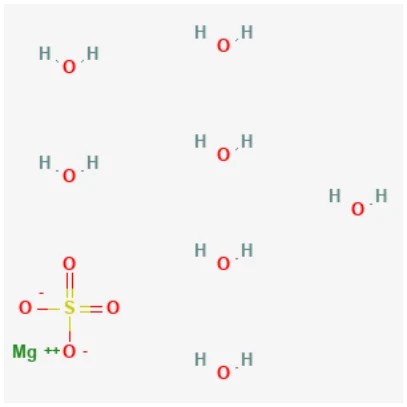
Structural formula:
Physicochemical properties: Freely soluble in water, very soluble in boiling water, practically insoluble in ethanol (96 per cent).
Product Characteristics: White or almost white, crystalline powder or brilliant, colourless crystals.
How Supplied
| Size Container | Total Magnesium Sulfate* | Total Magnesium Ion | Magnesium Sulfate* Concentration | Magnesium Ion Concentration | Osmolarity (calc.) |
|---|---|---|---|---|---|
| 50 mL | 2 g | 16.25 mEq | 4% (40 mg/mL) | 16.25 mEq/50mL | 325 mOsmol/L |
| 50 mL | 4 g | 32.5 mEq | 8% (80 mg/mL) | 32.5 mEq/50mL | 649 mOsmol/L |
| 100 mL | 4 g | 32.5 mEq | 4% (40 mg/mL) | 32.5 mEq/100mL | 325 mOsmol/L |
* As heptahydrate
14 CLINICAL TRIALS
The clinical trial data on which the original indication was authorized is not available.
15 MICROBIOLOGY
No microbiological information is required for this drug product.
16 NON-CLINICAL TOXICOLOGY
Information not available.
17 SUPPORTING PRODUCT MONOGRAPHS
- 1. Magnesium Sulfate Injection (solution, 500 mg/mL), submission control 255007, Product Monograph, Fresenius Kabi Canada Ltd., APR 04, 2022
- 2. Magnesium Sulfate Injection, BP 49.3% (solution, 493 mg/mL), submission control 233456, Prescribing Information, Baxter Corporation, MAR 02, 2021