


Patient Medication Information: uses, side effects, how to take - Menopur
What MENOPUR is used for:
The active ingredient in MENOPUR is known as menotropins. Menotropins contain follicle stimulating hormone (FSH), luteinizing hormone (LH), and human chorionic gonadotropin (hCG). FSH, LH and hCG in MENOPUR are obtained from the urine of women who have gone through menopause and women who are pregnant. FSH, LH and hCG are natural hormones produced in women. They help the reproductive organs to work normally.
Your doctor may have prescribed MENOPUR because your pituitary gland does not release FSH, or it releases FSH and LH in an improper balance. This imbalance means the follicles are unable to mature, so ovulation cannot take place. MENOPUR helps to provide the required amount of FSH to the ovaries, thereby allowing the ovarian follicles to develop.
MENOPUR is used in IVF (in-vitro fertilization or “test tube”) procedures or other assisted conception techniques to induce multiple follicular development.
How MENOPUR works:
MENOPUR provides you with the FSH that is necessary for the recruitment, growth and maturation of the ovarian follicles which contain eggs known as ova. This occurs at the beginning of the cycle. After MENOPUR is given to develop the ovarian follicle, additional hCG is given mid cycle to mature the egg and induce ovulation.
Length of one treatment cycle: The length of treatment depends on the average follicular response to therapy. Every cycle treatment is individualized and your doctor will need to carefully evaluate how you respond.
The ingredients in MENOPUR are:
Medicinal ingredients: Menotropins – FSH, LH and hCG
Non-medicinal ingredients: lactose monohydrate, polysorbate 20, sodium phosphate, and phosphoric buffer (sodium phosphate dibasic, heptahydrate and phosphoric acid)
MENOPUR comes in the following dosage form(s):
Sterile lyophilized powder, 75 IU / vial (75 IU FSH bioactivity/ 75 IU LH bioactivity)
Do not use MENOPUR if:
- You are pregnant
- You are breast-feeding
MENOPUR should also not be used if you have:
- A high level of FSH indicating primary ovarian failure.
- Uncontrolled thyroid or adrenal dysfunction.
- An organic intracranial lesion such as pituitary tumour.
- Abnormal vaginal bleeding of undetermined origin.
- Ovarian cyst or enlargement not due to polycystic ovarian syndrome (PCOS).
- Allergy to menotropins, lactose monohydrate, polysorbate 20, sodium phosphate buffer (sodium phosphate dibasic, heptahydrate and phosphoric acid).
- Tumour of the ovaries, fallopian tubes, uterus, vagina, breast and cervix.
MENOPUR should only be used under the supervision a specialist having the required facilities for laboratory monitoring.
Other warnings you should know about:
Risk of reproductive complications associated with MENOPUR: Treatment with gonadotropin preparations may lead to unwanted overstimulation of the ovaries known as ovarian hyperstimulation syndrome (OHSS). The first symptoms of ovarian stimulation may be noticed as pain in the abdomen, feeling sick or diarrhea. More severe cases may have accumulation of fluid in the abdomen and/or chest, weight gain and the occurrence of blood clots. Contact your doctor without delay if you experience any of these symptoms during treatment or within a few days after the last injection.
The incidence of multiple births with MENOPUR is no different from any other gonadotropin and is dependent upon the protocol used by the clinic. Your doctor will monitor you closely to help minimize the possibility of multiple gestations. The majority of births – about 85% are single babies. Of those women who have multiple births, the majority of these are twins. Only few women conceive 3 or more babies. Even so, neither single nor multiple births can be totally guaranteed.
Since women with infertility undergoing infertility assisted reproduction, and particularly IVF, often have tubal abnormalities, the incidence of ectopic pregnancies may be increased. Early ultrasound confirmation of pregnancy in the uterus is therefore of importance.
Tell your healthcare professional about all the medicines you take, including any drugs, vitamins, minerals, natural supplements or alternative medicines.
How to take MENOPUR:
MENOPUR must be taken by injection.
Every treatment is individualized. Yours has been carefully designed for you by your doctor according to your own specific needs. It is very important that you keep your appointments and follow your doctor's instructions, particularly with regard to the amount and frequency of the medication you are taking. If you have concerns regarding your dosage, consult your doctor. Do not adjust your dosage without being instructed to do so. If you forget or miss an injection, stay calm, and call your doctor for advice.
Instructions for Reconstitution and Subcutaneous Administration
Your doctor has prescribed MENOPUR for subcutaneous injection. This means that it is injected through a short injection needle into the tissue just under your skin. This instruction sheet will help you prepare and inject your medication at home. Please review it completely prior to starting the procedure.
Do not attempt this procedure if you are unsure of how to prepare or administer the injection. If you have any questions, call your doctor or nurse.
- 1) Before You Start
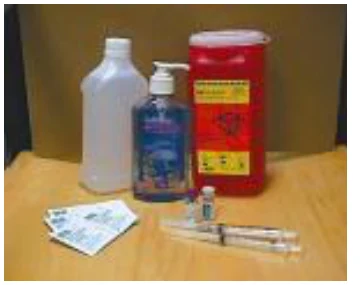
Wash your hands with antibacterial soap and use alcohol to clean the area you will be working on.
Have these supplies ready:
- Vial (or vials) of MENOPUR, 75 IU
- A vial of 0.9% Sodium Chloride (sterile diluent). If you have the kit, the diluent is conveniently packaged with MENOPUR
- A syringe and sterile needles (check with your doctor about which syringe and needle size to use)
- Alcohol pads and rubbing alcohol
- Gauze and cotton balls
- A needle disposal container
Preparing your medicine and filing the syringe
Remember: Only 0.9% Sodium Chloride injection, USP (sterile diluent) must be used to reconstitute MENOPUR.

- Remove syringe and larger needle from the wrapper. While holding the protective cap, twist needle clockwise to make sure needle is secure. Set syringe and needle aside.
- Remove plastic caps from tops of vials of MENOPUR and sterile diluent.
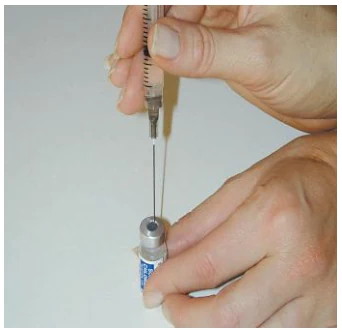
- Wipe tops of vials with alcohol to sterilize them. Don’t touch tops of vials once you have sterilized them.
- Uncap needle by carefully twisting needle cap clockwise and pulling cap upward. Avoid twisting needle counterclockwise, as this can cause needle to separate from syringe.
- Insert needle through rubber stopper of sterile diluent vials.
- Tip sterile diluent vial and, with needle in fluid, pull back on plunger to withdraw fluid into syringe up to the amount instructed by your doctor.
- Withdraw needle from sterile diluent vial. Slowly inject sterile diluent into vial containing MENOPUR powder, aiming sterile diluent at side of vial to avoid creating bubbles. The solution should be clear and colourless.
The MENOPUR powder will dissolve quickly. Do not shake vial because this will create bubbles.
For patients requiring a single injection from multiple vials of MENOPUR, up to 6 vials can be reconstituted with 1 mL of 0.9% sodium chloride injection, USP.
This can be accomplished by reconstituting a single vial as described above (see step 2). Then draw the entire contents of the first vial into a syringe, and inject the contents into a second vial of lyophilized MENOPUR. Gently swirl the second vial as described above, once again checking to make sure the solution is clear and free of particles. This step can be repeated with 4 additional vials for a total of up to 6 vials of lyophilized MENOPUR into 1 mL of diluent.
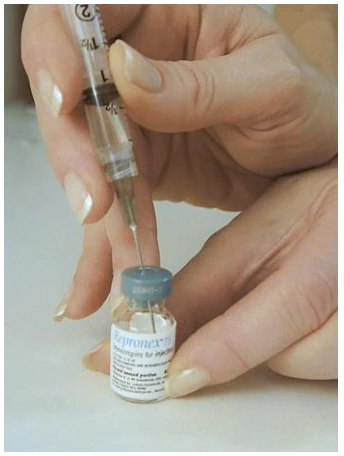
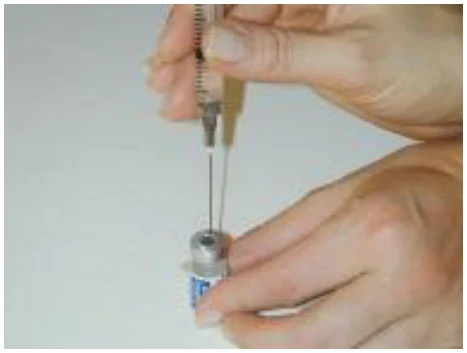
As soon as powder has completely dissolved, withdraw all MENOPUR solution into syringe. There are two ways of doing this:
- A. Leave vial on counter, tilt it, pull back on plunger to withdraw all solution, OR
- B. Turn vial upside down, pull back on plunger to withdraw solution as you slowly lower needle.
- Changing the Needle
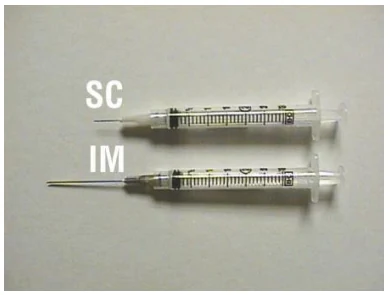
- While holding syringe upward, replace needle cap and remove large needle by twisting it counterclockwise. Replace with the small, subcutaneous needle by twisting it clockwise onto syringe.
- Hold syringe straight up. Draw back slightly on plunger and tap syringe so that any air bubbles rise to top. Slowly press plunger until all air is out of syringe and small drop of solution forms at tip of needle.
- Tap the syringe to remove the drop of solution at the tip of the needle.
- Carefully recap needle to keep it sterile.
- MENOPUR solution is now ready for injection.
If an uncapped needle EVER comes into contact with anything except MENOPUR or sterile diluent, do not inject yourself with it. Immediately remove needle and replace it with a new sterile needle.
- 4) Injecting the Medicine
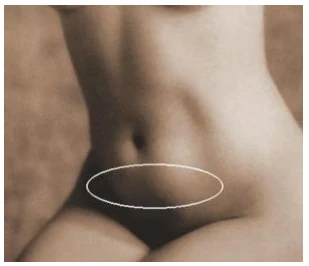
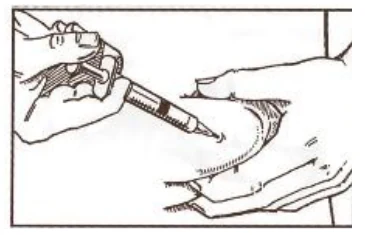
MENOPUR should be injected into a skin fold on your abdomen a few inches below your navel, to the left or right.
Each day, use the alternate side of your abdomen to help prevent soreness.
- Carefully clean injection site area with an alcohol pad and allow site to air-dry.
- Remove needle cap from syringe.
- Hold syringe in one hand. Use your other hand to gently grasp a fold of skin in the injection site area between your thumb and index finger.
- Hold syringe perpendicular (at right angle) to skin like a dart and quickly insert needle all the way into skin fold.
- Depress plunger of syringe with a steady motion until all fluid is injected beneath skin.
- Release skin fold and pull needle straight out. Recap needle and discard syringe and needle into a disposal container. If any bleeding should occur, simply place a small piece of gauze or cotton over the injection site and apply gentle pressure to stop bleeding.
- If injection site becomes sore, application of ice for brief intervals may help relieve any discomfort.
- Disposal of the Syringe and Needles

Safely dispose of all used syringes and needles in a needle disposal container with a lid. Extra sterile diluent should be thrown away. After you finish your course of treatment, ask your healthcare professional how to properly dispose of the needle disposal container.
Usual dose:
The dose is chosen by your doctor. Women participating in assisted reproduction programs are usually started on a dose of 225 IU MENOPUR. Based on clinical monitoring including ovarian ultrasound scans, and blood and urine tests, you doctor may adjust the dose once every two days. The maximum daily dose of MENOPUR is 450 IU daily.
Overdose:
If you think you, or a person you are caring for, have taken too much MENOPUR, contact a healthcare professional, hospital emergency department, regional poison control centre or Health Canada’s toll-free number, 1-844 POISON-X (1-844-764-7669) immediately, even if there are no signs or symptoms.
Missed dose:
If the patient misses a dose, the patient should be advised to take the missed dose and not to double dose.
Possible side effects from using MENOPUR:
These are not all the possible side effects you may have when taking MENOPUR. If you experience any side effects not listed here, tell your healthcare professional.
Fertility drugs are safe to take with close monitoring by your doctor. As with all medications, there is a potential for side effects. Some patients undergoing gonadotropin therapy may experience breast tenderness, bloating, flushing, vomiting, nausea and diarrhea. They are temporary and will resolve once treatment is stopped. Other adverse reactions may include allergic sensitivity such as a rash or local swelling at the injection site.
The greatest concern your doctor will have is ovarian hyperstimulation syndrome (OHSS). To avoid the development of OHSS, your doctor will carefully monitor your response to MENOPUR. Ovarian enlargement, sometimes accompanied by abdominal bloating and pain, may occur in about 20% of women taking gonadotropins. This is generally reversed with cessation of treatment and severe life-threatening cases are rare.
A causal relationship between treatment of fertility drugs and ovarian cancer has not been established.
If you experience any unusual symptoms or side effects, you should report them to your doctor immediately. It is also wise to discuss the possibility of side effects with your doctor before your treatment.
Serious side effects and what to do about them
| Frequency/Side Effect/Symptom | Talk to your healthcare professional | Stop taking this drug and get immediate medical help | |
|---|---|---|---|
| Only if severe | In all cases | ||
| Common | |||
| Mild OHSS | ✓ | ✓ | |
| Rare | |||
| Severe OHSS | ✓ | ✓ | |
If you have a troublesome symptom or side effect that is not listed here or becomes bad enough to interfere with your daily activities, tell your healthcare professional.
Reporting side effects
You can report any suspected side effects associated with the use of health products to Health Canada by:
- Visiting the Web page on Adverse Reaction Reporting (canada.ca/drug-device-reporting) for information on how to report online, by mail or by fax; or
- Calling toll-free at 1-866-234-2345.
NOTE: Contact your healthcare professional if you need information about how to manage your side effects. The Canada Vigilance Program does not provide medical advice.
Storage:
Store MENOPUR at room temperature (15° to 25°C). Protect from light. Use immediately after reconstitution. Discard unused material.
Keep out of reach and sight of children.
If you want more information about MENOPUR:
- Talk to your healthcare professional
- Find the full product monograph that is prepared for healthcare professionals and includes the Patient Medication Information by visiting the Health Canada Drug Product Database website (Drug Product Database: Access the database); Ferring Inc.’s website: www.ferring.ca, or by calling 1-866-384-1314.
Date of Authorization: 2026-03-23