


Product Monograph - Mylan-Atazanavir
RECENT MAJOR LABEL CHANGES
1 Indications 2 Contraindications 4 Dosage and Administration, 4.2 Recommended Dose and Dosage Adjustment 7 Warnings and Precautions, General | 08/2024 08/2024 08/2024 08/2024 |
|---|
TABLE OF CONTENTS
Sections or subsections that are not applicable at the time of authorization are not listed.
RECENT MAJOR LABEL CHANGES .......................................................................................... 2
TABLE OF CONTENTS ............................................................................................................ 2
PART I: HEALTH PROFESSIONAL INFORMATION .................................................................... 4
1 INDICATIONS ............................................................................................................. 4
1.1 Pediatrics .................................................................................................................. 4
1.2 Geriatrics .................................................................................................................. 4
2 CONTRAINDICATIONS ................................................................................................ 4
4 DOSAGE AND ADMINISTRATION ................................................................................ 6
4.1 Dosing Considerations ............................................................................................. 6
4.2 Recommended Dose and Dosage Adjustment ........................................................ 6
4.4 Administration ......................................................................................................... 8
4.5 Missed Dose ............................................................................................................. 8
5 OVERDOSAGE ............................................................................................................ 8
6 DOSAGE FORMS, STRENGTHS, COMPOSITION AND PACKAGING ................................ 8
7 WARNINGS AND PRECAUTIONS ............................................................................... 10
7.1 Special Populations ................................................................................................ 14
7.1.1 Pregnant Women ............................................................................................. 14
7.1.2 Breast-feeding .................................................................................................. 14
7.1.3 Pediatrics .......................................................................................................... 15
7.1.4 Geriatrics .......................................................................................................... 15
8 ADVERSE REACTIONS............................................................................................... 15
8.1 Adverse Reaction Overview ................................................................................... 15
8.2 Clinical Trial Adverse Reactions ............................................................................. 15
8.2.1 Clinical Trial Adverse Reactions – Pediatrics.................................................... 19
8.3 Less Common Clinical Trial Adverse Reactions ...................................................... 20
8.4 Abnormal Laboratory Findings: Hematologic, Clinical Chemistry and Other Quantitative Data ............................................................................................................. 20
8.5 Post-Market Adverse Reactions ............................................................................. 26
9 DRUG INTERACTIONS .............................................................................................. 27
9.1 Serious Drug Interactions ...................................................................................... 27
9.2 Drug Interactions Overview ................................................................................... 27
9.4 Drug-Drug Interactions .......................................................................................... 28
9.5 Drug-Food Interactions .......................................................................................... 57
9.6 Drug-Herb Interactions .......................................................................................... 57
10 CLINICAL PHARMACOLOGY ...................................................................................... 57
10.1 Mechanism of Action ....................................................................................... 57
10.2 Pharmacodynamics .......................................................................................... 57
10.3 Pharmacokinetics ............................................................................................. 58
11 STORAGE, STABILITY AND DISPOSAL ........................................................................ 62
12 SPECIAL HANDLING INSTRUCTIONS .......................................................................... 62
PART II: SCIENTIFIC INFORMATION ..................................................................................... 63
13 PHARMACEUTICAL INFORMATION .......................................................................... 63
14 CLINICAL TRIALS ...................................................................................................... 64
14.1 Clinical Trials by Indication .............................................................................. 64
14.2 Comparative Bioavailability Studies ................................................................ 72
15 MICROBIOLOGY ...................................................................................................... 73
16 NON-CLINICAL TOXICOLOGY .................................................................................... 76
17 SUPPORTING PRODUCT MONOGRAPHS ................................................................... 78
PATIENT MEDICATION INFORMATION ................................................................................ 79
PART I: HEALTH PROFESSIONAL INFORMATION
1 INDICATIONS
PrMYLAN-ATAZANAVIR (Atazanavir sulfate) is indicated in combination with other antiretroviral agents for the treatment of human immunodeficiency virus-1 (HIV-1) infection in adults and pediatric patients 6 years of age and older weighing at least 20 kg.
This indication is based on analyses of plasma HIV-1 RNA levels and CD4 cell counts from controlled studies of 96 weeks duration in antiretroviral-naive patients and 48 weeks duration in antiretroviral-treatment-experienced patients.
In antiretroviral-treatment-experienced patients with prior virologic failure, co-administration of MYLAN-ATAZANAVIR/ritonavir is recommended (see 14 CLINICAL TRIALS).
The number of baseline primary protease inhibitor mutations affects the virologic response to MYLAN-ATAZANAVIR/ritonavir (see 15 MICROBIOLOGY - Resistance).
(See 4 DOSAGE AND ADMINISTRATION, 7 WARNINGS AND PRECAUTIONS, 15 MICROBIOLOGY - Resistance).
1.1 Pediatrics
Pediatrics (from 6 to <18 years of age and weighing at least 20 kg): Based on the data submitted and reviewed by Health Canada, the safety and efficacy of Atazanavir sulfate capsules in pediatric patients have been established. Therefore, Health Canada has authorized an indication for pediatric use (see 7.1.3 Pediatrics, 14 CLINICAL TRIALS).
Dosage is based on body weight not to exceed the adult dose (see 4 DOSAGE AND ADMINISTRATION). There are no dosing recommendations for pediatric patients less than 6 years of age.
1.2 Geriatrics
Geriatrics (≥ 65 years of age): Clinical studies of atazanavir sulfate did not include sufficient numbers of patients aged 65 and over to determine whether they respond differently from younger patients. In general, dose selection for an elderly patient should reflect the greater frequency of decreased hepatic, renal, or cardiac function, and of concomitant disease or other drug therapy.
2 CONTRAINDICATIONS
Patients with previously demonstrated clinically significant hypersensitivity (e.g., Stevens-Johnson syndrome, erythema multiforme, or toxic skin eruptions) to any component of the product or container, including atazanavir. For a complete listing see 6 DOSAGE FORMS, STRENGTHS, COMPOSITION AND PACKAGING.
Coadministration of MYLAN-ATAZANAVIR is contraindicated with drugs that are highly dependent on CYP3A4 and/or UGT1A for clearance and for which elevated plasma concentrations are associated with serious and/or life-threatening events, and with drugs that are strong inducers of CYP3A due to the potential for loss of therapeutic effect and development of possible resistance. Therefore, coadministration is contraindicated with drugs listed in Table 1. Table 1 includes, but is not limited to, a list of drugs within a class for which co-administration with MYLAN-ATAZANAVIR is CONTRAINDICATED.
| Table 1 Drugs That Are Contraindicated with MYLAN-ATAZANAVIRa | |||
|---|---|---|---|
| Drug Class | Drugs within class that are contraindicated with MYLAN-ATAZANAVIR | ||
| Alpha 1-Adrenoreceptor Antagonists | alfuzosin | ||
| Antianginals | ranolazine (when used with ritonavir) | ||
| Antiarrhythmics | amiodarone (when used with ritonavir), dronedarone (when used with ritonavir) flecainide (when used with ritonavir), propafenone (when used with ritonavir), quinidine | ||
Anticoagulants: Direct-acting oral anticoagulants (DOACs) | apixaban, rivaroxaban (when used with ritonavir)b | ||
| Anticonvulsants | carbamazepine, phenobarbital, phenytoin | ||
| Antigout | colchicine (when used with ritonavir) | ||
| Antimycobacterials | rifampin | ||
| Antineoplastics | apalutamide, encorafenib, irinotecan, neratinib (when used with ritonavir), venetoclax (when used with ritonavir). | ||
| Antiplatelets | ticagrelor | ||
| Antipsychotics | lurasidone (when used with ritonavir), pimozide | ||
| Benzodiazepines | triazolam | ||
| Long-Acting Beta Andrenoreceptor | salmeterol (when used with ritonavir) | ||
| Ergot Derivatives | dihydroergotamine, ergotamine, ergonovine, methylergonovine | ||
Hepatitis C Direct-Acting Antivirals | glecaprevir/pibrentasvir | ||
| Herbal Products | St. John’s wort (Hypericum perforatum) | ||
Lipid-Modifying Agents: HMG-CoA Reductase Inhibitors Other Lipid-Modifying agents: | lovastatin, simvastatin lomitapide | ||
| Phosphodiesterase Type 5 (PDE5) Inhibitors | sildenafilc (when used for the treatment of pulmonary arterial hypertension [PAH]), vardenafil (when used for the treatment of erectile dysfunction) | ||
| Non-nucleoside Reverse Transcriptase Inhibitors | nevirapine | ||
a See Table 15 for more detailed information.
b See Table 15 for apixaban and rivaroxaban when co-administered with atazanavir without ritonavir c See Table 15 for sildenafil when dosed for erectile dysfunction.
4 DOSAGE AND ADMINISTRATION
4.1 Dosing Considerations
Concomitant Therapy: (see 7 WARNINGS AND PRECAUTIONS, 9 DRUG INTERACTIONS and 10 CLINICAL PHARMACOLOGY).
Ritonavir: Efficacy and safety of atazanavir with ritonavir in doses greater than 100 mg once daily have not been established. The use of higher ritonavir doses might alter the safety profile of atazanavir (cardiac effects, hyperbilirubinemia) and, therefore, is not recommended.
There are limited safety data from controlled trials for atazanavir plus ritonavir regimens without tenofovir DF (see 7 WARNINGS AND PRECAUTIONS and 9 DRUG INTERACTIONS).
Efavirenz - Therapy-Naive Patients:
If MYLAN-ATAZANAVIR is combined with efavirenz, MYLAN-ATAZANAVIR 400 mg (two 200 mg capsules) with ritonavir 100 mg should be administered once daily all as a single dose with food, and efavirenz should be administered on an empty stomach, preferably at bedtime.
Efavirenz - Therapy-Experienced Patients:
Do not co-administer MYLAN-ATAZANAVIR with efavirenz in treatment-experienced patients due to decreased atazanavir exposure.
Didanosine: When co-administered with didanosine buffered formulations, MYLAN-ATAZANAVIR should be given (with food) two hours before or one hour after didanosine.
Tenofovir disoproxil fumarate (DF): If co-administered with tenofovir DF, it is recommended that 300 mg of MYLAN-ATAZANAVIR and ritonavir 100 mg be given with tenofovir DF 300 mg (together as single daily doses with food). There are limited safety data from controlled trials for atazanavir plus ritonavir regimens without tenofovir DF. MYLAN-ATAZANAVIR without ritonavir should not be co-administered with tenofovir DF (see 7 WARNINGS AND PRECAUTIONS and 9 DRUG INTERACTIONS).
4.2 Recommended Dose and Dosage Adjustment
Recommended Adult Dose
Therapy-Naive Patients
MYLAN-ATAZANAVIR 300 mg once daily taken with ritonavir 100 mg once daily taken with food.
OR
- MYLAN-ATAZANAVIR 400 mg (two 200 mg capsules) once daily (without ritonavir) taken with food, for patients who are unable to tolerate ritonavir.
Therapy-Experienced Patients
- MYLAN-ATAZANAVIR 300 mg once daily taken with ritonavir 100 mg once daily taken with food.
Recommended Pediatric Dose (from 6 to < 18 years of age)
The recommended dosage of MYLAN-ATAZANAVIR for pediatric patients (6 to less than 18 years of age) is based on body weight as shown below in Table 2 and should not exceed the recommended adult dosage. MYLAN-ATAZANAVIR Capsules must be taken with food. The data are insufficient to recommend dosing of MYLAN-ATAZANAVIR for any of the following: (1) patients less than 6 years of age, (2) without ritonavir in patients less than 13 years of age, and (3) patients less than 40 kg receiving concomitant tenofovir DF, H2-receptor antagonists, or proton-pump inhibitors.
| Table 2 Dosage for Pediatric Patients (6 to less than 18 years of age)a for MYLAN-ATAZANAVIR Capsules with ritonavir | ||||||||
|---|---|---|---|---|---|---|---|---|
Body Weight (kg) (lbs) | MYLAN-ATAZANAVIR dose (mg) | ritonavir dose b (mg) | ||||||
| 20 to less than 40 | 44 to less than 88 | 200 | 100 | |||||
| at least 40 | at least 88 | 300 | 100 | |||||
a The atazanavir and ritonavir dose should be taken once daily with food.
b Ritonavir capsules, tablets or oral solution.
For treatment-naive patients at least 13 years of age and at least 40 kg, who are unable to tolerate ritonavir, the recommended dose is MYLAN-ATAZANAVIR 400 mg (without ritonavir) once daily with food. For patients at least 13 years of age and at least 40 kg receiving concomitant tenofovir DF, H2- receptor antagonists, or proton-pump inhibitors, MYLAN-ATAZANAVIR should not be administered without ritonavir.
Dose Adjustments:
Patients with Renal Impairment
For patients with renal impairment, including those with severe renal impairment who are not managed with hemodialysis, no dose adjustment is required for MYLAN-ATAZANAVIR. Treatment-naive patients with end stage renal disease managed with hemodialysis should receive MYLAN-ATAZANAVIR 300 mg with ritonavir 100 mg. MYLAN-ATAZANAVIR, with or without ritonavir, should not be used in antiretroviral-treatment-experienced patients with end stage renal disease managed with hemodialysis. MYLAN-ATAZANAVIR without ritonavir should not be administered to treatment-naive patients managed with hemodialysis (see 7 WARNINGS AND PRECAUTIONS, Renal and 10.3 Pharmacokinetics, Special Populations and Conditions).
Patients with Hepatic Impairment
MYLAN-ATAZANAVIR should be used with caution in patients with mild-to-moderate hepatic impairment. For patients with moderate hepatic impairment (Child-Pugh Class B) who have not experienced prior virologic failure, a dose reduction to 300 mg once daily should be considered. MYLAN-ATAZANAVIR should not be used in patients with severe hepatic impairment (Child-Pugh Class C). Atazanavir/ritonavir has not been studied in subjects with hepatic impairment and is not recommended (see 7 WARNINGS AND PRECAUTIONS, Hepatic/Biliary/Pancreatic and 10.3 Pharmacokinetics, Special Populations and Conditions).
Pregnant Women
MYLAN-ATAZANAVIR should not be administered without ritonavir.
During pregnancy:
For pregnant patients, no dose adjustment is required based on a PK study: MYLAN-ATAZANAVIR 300 mg with ritonavir 100 mg (see Pregnancy under 10 CLINICAL PHARMACOLOGY and 14 CLINICAL TRIALS sections) with the following exception:
For treatment-experienced pregnant women during the second or third trimester, when MYLAN-ATAZANAVIR is co-administered with either an H2-receptor antagonist or tenofovir DF, MYLAN-ATAZANAVIR 400 mg with ritonavir 100 mg once daily is recommended. There are insufficient data to recommend atazanavir dose for use with both an H2-receptor antagonist and tenofovir DF in treatment- experienced women.
During postpartum:
No dose adjustment is required for postpartum patients. However, patients should be closely monitored for adverse events because atazanavir exposures could be higher during the first 2 months after delivery.
4.4 Administration
Capsules should not be opened; they should be swallowed whole with water.
4.5 Missed Dose
If a dose of MYLAN-ATAZANAVIR is missed, patients should take the dose as soon as possible and then return to their normal schedule. However, if a dose is skipped, the patient should not double the next dose.
5 OVERDOSAGE
For management of a suspected drug overdose, contact your regional poison control centre.
Administration of activated charcoal may be used to aid in removal of unabsorbed drug. Treatment of overdosage with atazanavir should consist of general supportive measures, including monitoring of vital signs and ECG, and observations of the patient's clinical status. There is no specific antidote for overdose with atazanavir. Since atazanavir is extensively metabolized by the liver and is highly protein bound, dialysis is unlikely to be beneficial in significant removal of this medicine.
Human experience of acute overdose with atazanavir is limited. Single doses up to 1200 mg have been taken by healthy volunteers without symptomatic untoward effects. A single self- administered overdose of 58.4 g of atazanavir in an HIV-infected patient (146 times the 400 mg recommended dose) was associated with asymptomatic bilateral bundle branch block and PR interval prolongation. These events resolved spontaneously. At high doses that lead to high drug exposures, jaundice due to indirect (unconjugated) hyperbilirubinemia (without associated liver function test changes) or cardiac conduction abnormalities, including PR and/or QT interval prolongations, may be observed (see 7 WARNINGS AND PRECAUTIONS, Cardiovascular, and 10.2 Pharmacodynamics, Electrocardiogram: Effect on PR and QT intervals).
6 DOSAGE FORMS, STRENGTHS, COMPOSITION AND PACKAGING
Table 3 Dosage Forms, Strengths, Composition and Packaging
Mylan-Atazanavir 150 mg capsules are supplied in HDPE bottles of 60s.
Mylan-Atazanavir 200 mg capsules are supplied in HDPE bottles of 60s.
Mylan-Atazanavir 300 mg capsules are supplied in HDPE bottles of 30s.
Composition
Mylan-Atazanavir 150 mg Capsules
Greenish-blue opaque cap and blue opaque body, hard-shell gelatin capsule filled with white to pale yellow powder. The capsule is axially printed with MYLAN over AR150 in black ink on both the cap and body.
Each capsule contains atazanavir sulfate equivalent to 150 mg of atazanavir and the following non-medicinal ingredients: Crospovidone, Lactose Monohydrate, Magnesium Stearate. The capsule shell contains: D&C Red 28, FD&C Blue 1, FD&C Red 3, Gelatin, Iron Oxide Yellow, Titanium Dioxide. Black Imprinting Ink contains: Black Iron Oxide, Potassium Hydroxide, Propylene Glycol, Shellac, Strong Ammonia Solution.
Mylan-Atazanavir 200 mg Capsules
Blue opaque cap and blue opaque body, hard-shell gelatine capsule filled with white to pale yellow powder. The capsule is axially printed with MYLAN over ARC200 in black ink on both the cap and body.
Each capsule contains atazanavir sulphate equivalent to 200 mg of atazanavir and the following non-medicinal ingredients: Crospovidone, Lactose Monohydrate, Magnesium Stearate. The capsule shell contains: FD&C Blue 1, FD&C Red 3, Gelatin, Titanium Dioxide. Black Imprinting Ink contains: Black Iron Oxide, Potassium Hydroxide, Propylene Glycol, Shellac, Strong Ammonia Solution.
Mylan-Atazanavir 300 mg Capsules
Red opaque cap and greenish-blue opaque body, hard-shell gelatine capsule filled with white to pale yellow powder. The capsule is axially printed with MYLAN over AR300 in black ink on both the cap and body.
Each capsule contains atazanavir sulphate equivalent to 300 mg atazanavir and the following non-medicinal ingredients: Crospovidone, Lactose Monohydrate, Magnesium Stearate. The capsule shell
| Route of Administration | Dosage Form / Strength/Composition | Non-medicinal Ingredients |
| Oral | Capsules, 150 mg, 200 mg and 300 mg | Crospovidone, lactose monohydrate, magnesium stearate. Capsule shell: D&C Red 28 (150 mg), FD&C Blue 1 (all strengths), FD&C Red 3 (all strengths), gelatin (all strengths), iron oxide yellow (150 mg and 300 mg), iron oxide red (300 mg) and titanium dioxide (all strengths). Black imprinting ink: black iron oxide, potassium hydroxide, propylene glycol, shellac, strong ammonia solution. |
contains: FD&C Blue 1, FD&C Red 3, Gelatin, Iron Oxide Red, Iron Oxide Yellow, Titanium Dioxide. Black Imprinting Ink contains: Black Iron Oxide, Potassium Hydroxide, Propylene Glycol, Shellac, Strong Ammonia Solution.
7 WARNINGS AND PRECAUTIONS
General
Atazanavir should always be used in combination with other antiretroviral agents. Atazanavir should not be added as a single agent when antiretrovirals are changed due to loss of virologic response.
Drug Interactions
Co-administration of atazanavir and drugs primarily metabolized by CYP3A4 may result in increased plasma concentrations of the other drug with the potential for increased toxicity (see 9 DRUG INTERACTIONS).
Due to inhibition of CYP3A4 by Atazanavir, co-administration of Atazanavir with quetiapine may result in increased quetiapine concentrations. Serious and/or life-threatening quetiapine-related adverse reactions, including severe sedation and coma, have been reported for concomitant use of HIV protease inhibitors and quetiapine. Atazanavir should not be used in combination with quetiapine. If coadministration is necessary, reduce the quetiapine dose and monitor for quetiapine-associated adverse reactions as recommended in the quetiapine product monograph (see 9 DRUG INTERACTIONS).
Antiretroviral Treatment-Experienced Patients
Atazanavir 400 mg once daily has been shown to be inferior to lopinavir/ritonavir in antiretroviral experienced patients. There are limited safety data from controlled trials for atazanavir plus ritonavir regimens without tenofovir DF (see 4 DOSAGE AND ADMINISTRATION, 9 DRUG INTERACTIONS, and 14 CLINICAL TRIALS).
Carcinogenesis and Mutagenesis
The incidence of benign hepatocellular adenomas was increased in high-dose female mice at systemic exposures approximately 7-fold higher than those in humans at the recommended 400 mg clinical dose. There was no increase in the incidence of tumors in male mice or in male or female rats at any dose tested. The clinical significance of the carcinogenic findings in female mice is unknown as the benign hepatic tumors occurred only at doses that induced liver toxicity (see 16 NON-CLINICAL TOXICOLOGY - Carcinogenicity).
Cardiovascular
Cardiac Conduction Abnormalities: Atazanavir has been shown to prolong the PR interval of the electrocardiogram in some patients. In healthy volunteers and in patients, abnormalities in atrioventricular (AV) conduction were asymptomatic and limited to first degree AV block with some exceptions (see 5 OVERDOSAGE). There have been post-marketing reports of second- degree AV block, third-degree AV block, QTc prolongation, Torsades de Pointes and other conduction abnormalities in patients treated with atazanavir (see 8.5 Post-Market Adverse Reactions). In clinical trials, asymptomatic first-degree AV block was observed in 5.9 % of atazanavir-treated patients (n = 920), 3.0 % of efavirenz treated patients (n = 329), 5.2 % of lopinavir/ritonavir treated patients (n = 252) and 10.4 % of nelfinavir treated patients (n = 48). In study AI424-045 asymptomatic first-degree AV block was observed in 5 % (6/118) of atazanavir/ritonavir-treated patients and 5 % (6/116) of lopinavir/ritonavir-treated patients who had on-study electrocardiogram measurements. Because of limited clinical experience, atazanavir should be used with caution in patients with pre-existing conduction system disease (e.g., marked first-degree AV block or second or third-degree AV block).
Dose- related asymptomatic prolongations in PR interval with atazanavir have been observed in clinical studies. Caution should be used with medicinal products known to induce PR prolongations (e.g., atenolol, diltiazem). In patients with pre-existing conduction problems (second degree or higher atrioventricular or complex bundle-branch block), MYLAN-ATAZANAVIR should be used with caution and only if the benefits exceed the risk. Particular caution should be used when prescribing MYLAN-ATAZANAVIR in association with medicinal products which have the potential to increase the QT interval and/or in patients with pre-existing risk factors (bradycardia, long congenital QT, electrolyte imbalances) (see 10 CLINICAL PHARMACOLOGY).
Pharmacokinetic studies between atazanavir and other drugs that prolong the PR interval including beta blockers (other than atenolol), verapamil and digoxin have not been performed. An additive effect of atazanavir and these drugs cannot be excluded; therefore, caution should be exercised when atazanavir is given concurrently with these drugs, especially those that are metabolized by CYP3A4 (e.g., verapamil) (see 9 DRUG INTERACTIONS).
Endocrine and Metabolism
Diabetes mellitus/Hyperglycemia: New-onset diabetes mellitus, exacerbation of pre-existing diabetes mellitus, and hyperglycemia have been reported during post-marketing surveillance in HIV-infected patients receiving protease inhibitor therapy. Some patients required either initiation or dose adjustments of insulin or oral hypoglycemic agents for treatment of these events. In some cases, diabetic ketoacidosis has occurred. In those patients who discontinued protease inhibitor therapy, hyperglycemia persisted in some cases. Because these events have been reported voluntarily during clinical practice, estimates of frequency cannot be made and a causal relationship between protease inhibitor therapy and these events has not been established.
Fat Redistribution: Redistribution/accumulation of body fat including central obesity, dorsocervical fat enlargement (buffalo hump), peripheral wasting, facial wasting, breast enlargement, and "cushingoid appearance" have been observed in patients receiving antiretroviral therapy. The mechanism and long-term consequences of these events are currently unknown. A causal relationship has not been established.
Lactose: Patients with rare hereditary problems of galactose intolerance, the Lapp lactase deficiency or glucose-galactose malabsorption should not take this medicinal product.
Hematologic
Hemophilia: There have been reports of increased bleeding, including spontaneous skin hematomas and hemarthrosis, in patients with hemophilia type A and B treated with protease
inhibitors. In some patients additional factor VIII was given. In more than half of the reported cases, treatment with protease inhibitors was continued or reintroduced. A causal relationship between protease inhibitor therapy and these events has not been established.
Hepatic/Biliary/Pancreatic
Hepatic Impairment and Toxicity: MYLAN-ATAZANAVIR is principally metabolized by the liver; caution should be exercised when administering this drug to patients with hepatic impairment because atazanavir concentrations may be increased (see 4 DOSAGE AND ADMINISTRATION). Patients with underlying hepatitis B or C viral infections or marked elevations in transaminases prior to treatment may be at increased risk for developing further transaminase elevations or hepatic decompensation. In these patients, test for liver enzymes before initiating therapy with MYLAN-ATAZANAVIR and monitor liver enzymes during treatment. MYLAN-ATAZANAVIR should not be administered to patients with severe hepatic impairment. Atazanavir/ritonavir is not recommended for use in patients with hepatic impairment.
Hyperbilirubinemia: Most patients taking atazanavir experience elevations in indirect (unconjugated) bilirubin related to inhibition of UDP-glucuronosyl transferase (UGT). This hyperbilirubinemia is generally reversible upon discontinuation of MYLAN-ATAZANAVIR. If hepatic transaminase elevations occur with hyperbilirubinemia while a patient is receiving atazanavir, consideration should be given to also evaluating alternative etiologies. No long-term safety data are available for patients experiencing persistent elevations in total bilirubin > 5 x ULN. Alternative antiretroviral therapy to MYLAN-ATAZANAVIR may be considered if jaundice or scleral icterus associated with bilirubin elevations present cosmetic concerns for patients. Dose reduction of atazanavir is not recommended since long-term efficacy of reduced doses has not been established (see 8 ADVERSE REACTIONS).
Cholelithiasis, Cholecystitis, and Cholestasis: There have been post-marketing reports of cholelithiasis, cholecystitis, and cholestasis in patients treated with atazanavir with ritonavir as part of their ART regimen (see 8.5 Post-Market Adverse Reactions).
Immune
Immune Reconstitution Inflammatory Syndrome: Immune reconstitution inflammatory syndrome has been reported in patients treated with combination antiretroviral therapy, including MYLAN-ATAZANAVIR. During the initial phase of treatment, a patient whose immune system responds to therapy may develop an inflammatory response to indolent or residual opportunistic infections (such as MAC, CMV, PCP and TB), which may necessitate further evaluation and treatment.
Autoimmune disorders (such as Graves’ disease) have also been reported to occur in the setting of immune reactivation; however, the reported time to onset is more variable and these events can occur many months after initiation of treatment.
Angioedema: Cases of angioedema have been reported in patients taking atazanavir (see 8.5 Post-Market Adverse Reactions).
Renal
Renal Impairment: In healthy subjects, approximately 7 % of the dose of atazanavir is eliminated unchanged in the urine. Atazanavir has been studied in adult subjects with severe renal impairment (n = 20), including those on hemodialysis, at multiple doses of 400 mg once daily. The impact of renal impairment on atazanavir elimination for patients without hemodialysis is anticipated to be low. Moderate increases in atazanavir clearance and decreased exposure levels were seen in patients managed with hemodialysis. MYLAN-ATAZANAVIR should not be administered to HIV-treatment-experienced patients with end stage renal disease managed with hemodialysis (see 4 DOSAGE AND ADMINISTRATION and 10 CLINICAL PHARMACOLOGY).
Chronic kidney disease: Chronic kidney disease (CKD) has been reported in patients treated with atazanavir, with or without ritonavir, during post-marketing surveillance. Some resulted in fatal outcomes in patients with pre-existing CKD, and some resulted in the need for hemodialysis in patients with or without pre-existing CKD. MYLAN-ATAZANAVIR should be used with caution, particularly in those patients with other risk factors for chronic kidney disease. Prescribers should consider the risk-benefit in continuing MYLAN-ATAZANAVIR therapy if patients develop signs and symptoms of CKD.
Nephrolithiasis and Cholelithiasis: Cases of nephrolithiasis and/or cholelithiasis were reported during post-marketing surveillance in HIV-infected patients receiving atazanavir therapy. Some patients required hospitalization for additional management, and some had complications. Because these events were reported voluntarily during clinical practice, estimates of frequency cannot be made. If signs or symptoms of nephrolithiasis and/or cholelithiasis occur, temporary interruption or discontinuation of therapy may be considered.
Reproductive Health: Female and Male Potential
Fertility
In a fertility and early embryonic development study in rats, atazanavir altered estrus cycling with no effects on mating, fertility, or early embryonic development. Systemic drug exposure levels were equal (in male rats) or two times (in female rats) those at the human clinical dose (400 mg/day).
Sensitivity/Resistance
Resistance
In vitro HIV-1 isolates with a decreased susceptibility to ATV have been selected in vitro and obtained from patients treated with ATV or atazanavir/ritonavir (ATV/RTV). HIV-1 isolates that were 93- to 183-fold resistant to ATV from three different viral strains were selected in vitro by 5 months. The mutations in these HIV-1 viruses that contributed to ATV resistance included I50L, N88S, I84V, A71V, and M46I. Changes were also observed at the protease cleavage sites following drug selection. Recombinant viruses containing the I50L mutation were growth impaired and displayed increased in vitro susceptibility to other protease inhibitors (PIs) (amprenavir, lopinavir, nelfinavir, ritonavir, and saquinavir). The I50L and I50V substitutions yielded selective resistance to ATV and amprenavir, respectively, and did not appear to be cross-resistant.
Both genotypic and phenotypic resistances have developed during clinical studies (see 15 MICROBIOLOGY, Resistance).
Cross Resistance
Cross-resistance among PIs has been observed. Baseline phenotypic and genotypic analyses of clinical isolates from ATV clinical trials of PI-experienced subjects showed that isolates cross- resistant to multiple PIs were cross-resistant to ATV. Greater than 90 % of the isolates with mutations that included I84V or G48V were resistant to ATV. Greater than 60 % of isolates containing L90M, G73S/T/C, A71V/T, I54V, M46I/L, or a change at V82 were resistant to ATV, and 38 % of isolates containing a D30N mutation in addition to other changes were resistant to ATV. Isolates resistant to ATV were also cross-resistant to other PIs with > 90 % of the isolates resistant to lopinavir, nelfinavir, ritonavir, and saquinavir, and 80 % resistant to amprenavir. In treatment-experienced patients, PI-resistant viral isolates that developed the I50L mutation in addition to other PI resistance-associated mutations were also cross-resistant to other PIs.
Genotypic and/or phenotypic analysis of baseline virus may aid in determining ATV susceptibility before initiation of ATV/RTV therapy.
Overall, both the number and type of baseline PI mutations affected response rates in treatment- experienced patients (see 15 MICROBIOLOGY, Cross-Resistance).
Skin
Rash: In controlled clinical trials, rash (all grades, regardless of causality) occurred in approximately 20 % of patients treated with atazanavir. The median time to onset of rash in clinical studies was 7.3 weeks and the median duration of rash was 1.4 weeks. Rashes were generally mild-to-moderate maculopapular skin eruptions. Treatment-emergent adverse reactions of moderate or severe rash (occurring at a rate of ≥ 2 %) are presented for the individual clinical studies (see 8 ADVERSE REACTIONS). Dosing with atazanavir was often continued without interruption in patients who developed rash. The discontinuation rate for rash in clinical trials was < 1 %. MYLAN-ATAZANAVIR should be discontinued if severe rash develops. Cases of Stevens-Johnson syndrome, erythema multiforme and toxic skin eruptions including drug rash, eosinophilia, and systemic symptoms (DRESS) syndrome have been reported in patients receiving atazanavir (see 2 CONTRAINDICATIONS).
7.1 Special Populations
7.1.1 Pregnant Women
Pregnant Women: MYLAN-ATAZANAVIR should be used during pregnancy only if the potential benefit justifies the potential risk (see 7 WARNINGS AND PRECAUTIONS, Endocrine and Metabolism). There are no adequate and well-controlled studies in pregnant women. Cases of lactic acidosis, sometimes fatal, and symptomatic hyperlactatemia have been reported in patients (including pregnant women) receiving atazanavir in combination with nucleoside analogues, which are known to be associated with increased risk of lactic acidosis. Female gender and obesity are also known risk factors for lactic acidosis syndrome. The contribution of atazanavir to the risk of development of lactic acidosis syndrome has not been established.
Hyperbilirubinemia occurred frequently during treatment with atazanavir. It is not known whether atazanavir administered to the mother during pregnancy will exacerbate physiologic hyperbilirubinemia and lead to kernicterus in neonates and young infants. In the prepartum period, additional monitoring and alternative therapy should be considered. Atazanavir has been shown to cross the placenta.
In the pre-and post-natal development assessment in rats, atazanavir produced a transient reduction in body weight in the offspring at maternally toxic drug exposure levels two times those at the human clinical dose.
Antiretroviral Pregnancy Registry: To monitor maternal-fetal outcomes of pregnant women exposed to atazanavir, an Antiretroviral Pregnancy Registry has been established. Physicians are encouraged to register patients by calling 1-800-258-4263.
Antiretroviral Pregnancy Registry Data: As of January 2010, the Antiretroviral Pregnancy Registry (APR) has received prospective reports of 635 exposures to atazanavir-containing regimens (425 exposed in the first trimester and 160 and 50 exposed in second and third trimester respectively. Birth defects occurred in 9 of 393 (2.3 %) live births (first trimester exposure) and 5 of 212 (2.4 %) live births (second/third trimester exposure). There was no association between atazanavir and specific birth defects observed in the APR.
7.1.2 Breast-feeding
Atazanavir has been detected in human milk. No data are available regarding atazanavir effects on milk production.
A study in lactating rats demonstrated that atazanavir is secreted in milk. Because of both the potential for HIV transmission and the potential for serious adverse reactions in nursing infants, mothers should be instructed not to breastfeed if they are receiving MYLAN-ATAZANAVIR.
7.1.3 Pediatrics
The safety, pharmacokinetic profile, and virologic response of atazanavir were evaluated in pediatric patients in an open-label, multicenter clinical trial PACTG 1020A (see 14 CLINICAL TRIALS). The safety profile in pediatric patients was comparable to that observed in adults (see 8 ADVERSE REACTIONS).
The safety, activity, and pharmacokinetic profiles of atazanavir in pediatric patients ages 3 months to less than 6 years have not been established.
MYLAN-ATAZANAVIR should not be administered in pediatric patients below the age of 3 months due to the risk of kernicterus.
7.1.4 Geriatrics
Geriatrics (≥ 65 years of age): Clinical studies of atazanavir did not include sufficient numbers of patients aged 65 and over to determine whether they respond differently from younger patients. In general, appropriate caution should be exercised in the administration and monitoring of MYLAN-ATAZANAVIR in elderly patients reflecting the greater frequency of decreased hepatic, renal, or cardiac function, and of concomitant disease or other drug therapy.
8 ADVERSE REACTIONS
8.1 Adverse Reaction Overview
Because clinical trials are conducted under very specific conditions, the adverse reaction rates observed in clinical trials may not reflect the rates observed in practice and should not be compared to the rates in the clinical trials of another drug. Adverse drug reaction information from clinical trials is useful for identifying drug-related adverse events and for approximate rates.
8.2 Clinical Trial Adverse Reactions
Clinical trials are conducted under very specific conditions. The adverse reaction rates observed in the clinical trials; therefore, may not reflect the rates observed in practice and should not be compared to the rates in the clinical trials of another drug. Adverse reaction information from clinical trials may be useful in identifying and approximating rates of adverse drug reactions in real-world use.
Clinical Trial Experience in Adults
Atazanavir has been evaluated for safety and tolerability in combination therapy with other antiretroviral medications in controlled clinical trials in 1806 adult patients receiving atazanavir 400 mg once daily (1151 patients, 52 weeks median duration and 152 weeks maximum duration), or atazanavir 300 mg once daily plus ritonavir 100 mg once daily (655 patients, 96 weeks median duration and 108 weeks maximum duration).
The more frequent adverse events of any severity with at least a possible relationship to regimens containing atazanavir and one or more NRTIs were nausea (20%), diarrhea (10 %) and jaundice (13 %).
Jaundice was reported within a few days to a few months after the initiation of treatment and resulted in discontinuation of treatment in < 1% of patients. Discontinuation of treatment due to adverse reactions was 5 % in treatment-naive patients and 5 % in treatment-experienced patients.
Lipodystrophy, of moderate intensity or greater, was reported in regimens containing atazanavir and one or more NRTIs as shown in Table 5 and Table 6 below (see 7 WARNINGS AND PRECAUTIONS).
Treatment-Emergent Adverse Events in Antiretroviral Treatment-Naive Patients
Drug-related clinical adverse events of moderate or severe intensity in ≥ 2 % of treatment-naive patients receiving combination therapy including atazanavir 300 mg with ritonavir 100 mg and atazanavir 400 mg (without ritonavir) are presented in Table 4 and Table 5, respectively.
Table 4 Selected Treatment-Emergent Adverse Eventsa of Moderate or Severe Intensity Reported in ≥ 2% of Adult Treatment-Naive Patientsb, Study AI424-138 | |||||
|---|---|---|---|---|---|
| Phase III Study AI424-138 | |||||
96 weeksc Atazanavir 300 mg plus ritonavir 100 mg (once daily) and tenofovir DF plus emtricitabined N = 441 | 96 weeksc lopinavir 400 mg plus ritonavir 100 mg (twice daily) and tenofovir DF plus emtricitabined N = 437 | ||||
Digestive System Nausea Jaundice/ scleral icterus Diarrhea | 4 % 5 % 2 % | 8 % * 12 % | |||
Skin and Appendages Rash | 3 % | 2 % | |||
* None reported in this treatment arm.
a Includes events of possible, probable, certain, or unknown relationship to treatment regimen.
b Based on the regimen containing atazanavir.
c Median time on therapy.
d As a fixed-dose combination: 300 mg tenofovir DF, 200 mg emtricitabine once daily.
| Table 5 Treatment-Emergent Adverse Eventsa of Moderate or Severe Intensity Reported in ≥ 2% of Adult Treatment-Naive Patientsb, Studies AI424-034, AI424-007 and AI424-008 | ||||
|---|---|---|---|---|
| Phase III Study AI424-034 | Phase II Studies AI424-007, -008 | |||
| 64 weeksc | 64 weeksc efavirenz 600 mg | 120 weeksc,d | 73 weeksc,d nelfinavir 750 mg | |
Atazanavir 400 mg once daily + lamivudine + zidovudinee N = 404 | once daily + lamivudine + zidovudinee N = 401 | Atazanavir 400 mg once daily + stavudine / lamivudine or + stavudine / didanosine N = 279 | TID or 1250 mg BID + stavudine + lamivudine or + stavudine + didanosine N = 191 | |
Body as a Whole Headache | 6 % | 6 % | 1 % | 2 % |
Digestive System Diarrhea Dyspepsia Scleral icterus Jaundice Nausea Abdominal pain | 1 % 2 % 2 % 5 % 14 % 4 % | 2 % 2 % * * 12 % 4 % | 3 % < 1 % 2 % 5 % 6 % 4 % | 16 % < 1 % * * 4 % 2 % |
| Vomiting | 4 % | 7 % | 3 % | 3 % |
Metabolic and Nutritional System Lipodystrophy | 1 % | 1 % | 7 % | 3 % |
Nervous System Insomnia Dizziness Peripheral neurologic symptoms | 3 % 2% <1% | 3 % 7 % 1 % | <1 % <1 % 4 % | * * 3 % |
Skin and Appendages Rash | 7% | 10 % | 5% | 1 % |
* Not reported in this treatment arm.
a Includes adverse events of possible, probable, certain, or unknown relationship to treatment regimen.
Assessments of relationship refer to regimens containing atazanavir or comparator.
b Based on regimen(s) containing atazanavir.
c Median time on therapy. In study AI424-034 efficacy analyses are based on 48-week data. Safety data are derived from a 64-week safety update report.
d Includes long-term follow-up.
e As a fixed dose combination: 150 mg lamivudine, 300 mg zidovudine twice daily.
Treatment-Emergent Adverse Events in Antiretroviral Treatment-Experienced Patients
Drug related clinical adverse events of moderate or severe intensity in ≥ 2% of treatment-experienced patients receiving combination therapy including atazanavir are presented in Table 6.
| Table 6 Treatment-Emergent Adverse Eventsa of Moderate or Severe Intensity Reported in ≥ 2% of Adult Treatment-Experienced Patientsb, Studies AI424-043 and AI424-045 | ||||||||||||
|---|---|---|---|---|---|---|---|---|---|---|---|---|
| Phase III Study AI424-043 | Phase III Study AI424-045** | |||||||||||
48 weeksc Atazanavir 400 mg once daily + 2 NRTIs N = 144 | 48 Weeksc lopinavir + ritonavir (400/100 mg) BIDd + 2 NRTIs N = 146 | 48 weeksc Atazanavir 300 mg once daily + ritonavir 100 mg once daily + tenofovir DF+ NRTI N = 119 | 48 weeksc lopinavir + ritonavir (400/100 mg) BIDd + tenofovir DF + NRTI N = 118 | |||||||||
Body as a Whole Headache Fever | 4 % - | 3 % - | < 1 % 2 % | < 1 % * | ||||||||
Digestive System Diarrhea Scleral icterus Jaundice Nausea Vomiting Pain abdomen | 2 % * 3 % 3 % 2 % 3 % | 4 % * * 4 % 2 % 2 % | 3 % 3 % 6 % 3 % * 2 % | 11 % * * 2 % < 1 % 2 % | ||||||||
Metabolic and Nutritional System Lipodystrophy Weight decreased | 6 % 2 % | 1 % < 1 % | 5 % * | 4 % 2 % | ||||||||
Musculoskeletal System Myalgia | * | * | 4 % | * | ||||||||
| Nervous System | 2 % | 5 % | < 1 % | 3 % | ||||||||
Peripheral neurologic symptom Depression | - | - | 2%* | * | ||||||||
Skin and Appendages Rash | 2 % | * | * | < 1 % | ||||||||
* Not reported in this treatment arm.
** NOTE: There are limited safety data from controlled trials for atazanavir plus ritonavir regimens without tenofovir DF (see 9 DRUG INTERACTIONS).
a Includes adverse events of possible, probable, certain, or unknown relationship to treatment regimen.
Assessments of relationship refer to regimens containing atazanavir or comparator.
b Based on regimen(s) containing atazanavir.
c Median time on therapy.
d As a fixed dose combination.
8.2.1 Clinical Trial Adverse Reactions – Pediatrics
Clinical Trial Experience in Pediatric Patients
The safety and tolerability of atazanavir Capsules with and without ritonavir have been established in pediatric patients at least 6 years of age from the open-label, multicenter clinical trial PACTG 1020A. Use of atazanavir in pediatric patients less than 6 years of age is under investigation.
The safety profile of atazanavir in pediatric patients (6 to less than 18 years of age) was comparable to that observed in clinical studies of atazanavir in adults. The most common Grade 2 – 4 adverse events (≥ 5 %, regardless of causality) reported in pediatric patients were cough (21 %), fever (19 %), rash (14 %), jaundice/scleral icterus (13 %), diarrhea (8 %), vomiting (8 %), headache (7 %), and rhinorrhea (6 %). Asymptomatic second-degree atrioventricular block was reported in < 2 % of patients. The most common Grade 3 – 4 laboratory abnormality was elevation of total bilirubin (≥ 3.2 mg/dL) which occurred in 49 % of pediatric patients. All other Grade 3 – 4 laboratory abnormalities occurred with a frequency of less than 3 %. Both the frequency and severity of cardiac conduction abnormalities were greater in pediatric patients in this study than observed in clinical studies in adults.
Patients Co-infected With Hepatitis B and/or Hepatitis C Virus
Liver function tests should be monitored in patients with a history of hepatitis B or C.
In study AI424-138, 60 patients treated with atazanavir/ritonavir 300 mg/100 mg once daily, and 51 patients treated with lopinavir/ritonavir 400 mg/100 mg twice daily, each with fixed dose tenofovir DF-emtricitabine were seropositive for hepatitis B and/or C at study entry. ALT levels > 5 times ULN developed in 10 % (6/60) of the atazanavir/ritonavir-treated patients, and 8 % (4/50) of the lopinavir/ritonavir-treated patients. AST levels > 5 times ULN developed in 10 % (6/60) of the atazanavir/ritonavir-treated patients and none (0/50) of the lopinavir/ritonavir-treated patients.
In study AI424-045, 20 patients treated with atazanavir/ritonavir 300 mg/100 mg once daily and 18 patients treated with lopinavir/ritonavir 400 mg/100 mg twice daily were seropositive for hepatitis B and/or C at study entry. ALT levels > 5 times ULN developed in 25 % (5/20) of the atazanavir/ritonavir-treated patients and 6 % (1/18) of the lopinavir/ritonavir-treated patients. AST levels > 5 times ULN developed in 10 % (2/20) of the atazanavir/ritonavir-treated patients and 6 % (1/18) of the lopinavir/ritonavir-treated patients (see 7 WARNINGS AND PRECAUTIONS, Hepatic/Biliary, Pancreatic).
In studies AI424-008 and AI424-034, 74 patients treated with 400 mg of atazanavir once daily, 58 who received efavirenz, and 12 who received nelfinavir were seropositive for hepatitis B and/or C at study entry. AST levels > 5 times the upper limit of normal (ULN) developed in 9 % of the atazanavir-treated patients, 5 % of the efavirenz-treated patients, and 17 % of the nelfinavir-treated patients. ALT levels > 5 times ULN developed in 15 % of the atazanavir-treated patients, 14 % of the efavirenz-treated patients, and 17 % of the nelfinavir-treated patients. Within atazanavir and control regimens, no difference in frequency of bilirubin elevations was noted between seropositive and seronegative patients.
8.3 Less Common Clinical Trial Adverse Reactions
Less Common Clinical Trial Adverse Reactions (< 2%)
Treatment-Emergent Adverse Events in all Atazanavir-Treated Patients
Treatment-emergent adverse events of at least moderate intensity occurring in less than 2 % of adult patients receiving atazanavir in all phase II/III clinical trials with at least a possible relationship to treatment with atazanavir-containing regimens, and not listed in Table 4, Table 5 or Table 6 are listed below by body system.
Body as a Whole:
allergic reaction, asthenia, chest pain, fatigue, malaise
Cardiovascular System:
hypertension, palpitation, syncope, edema
Digestive System:
abdominal distension, aphthous stomatitis, dysgeusia, flatulence, gastritis, hepatitis, hepatosplenomegaly, pancreatitis, dry mouth
Immune System:
allergic reaction, angioedema
Metabolic and Nutritional
Disorders:
weight gain, anorexia, appetite increased, weight decreased
Musculoskeletal System:
arthralgia, muscle atrophy, myopathy
Nervous System:
abnormal dream, abnormal gait, amnesia, anxiety, confusion, sleep disorder, somnolence
Respiratory System:
dyspnea
Skin and Appendages:
alopecia, eczema, pruritus, urticaria, vesiculobullous rash, vasodilatation
Urogenital System:
gynecomastia, hematuria, kidney pain, proteinuria, pollakiuria, nephrolithiasis
8.4 Abnormal Laboratory Findings: Hematologic, Clinical Chemistry and Other Quantitative Data
Clinical Trial Findings
Laboratory Abnormalities
The percentages of adult treatment-naive and treatment-experienced patients treated with combination therapy including atazanavir 300 mg with ritonavir 100 mg and atazanavir 400 mg (without ritonavir) with Grade 3-4 laboratory abnormalities are presented in Table 7, Table 8 and Table 9. The most frequently reported laboratory abnormality in patients receiving regimens containing atazanavir and one or more NRTIs was elevated bilirubin. Elevations in bilirubin were reported predominantly as elevated indirect [unconjugated] bilirubin.
In clinical studies, the observed magnitude of dyslipidemia was less with atazanavir than with comparators. However, the clinical impact of such findings has not been demonstrated.
| Table 7 Grade 3-4 Laboratory Abnormalities Reported in ≥ 2% of Adult Treatment-Naive Patientsa, Studies AI424-138 | ||||||||||
|---|---|---|---|---|---|---|---|---|---|---|
| Variable | Limitc | Treatment-Naive Patients | ||||||||
| Phase III Studies AI424-138 | ||||||||||
96 weeksb atazanavir 300 mg plus ritonavir 100 mg (once daily) and tenofovir DF plus emtricitabined N = 441 | 96 weeksb lopinavir 400 mg plus ritonavir 100 mg (twice daily) and tenofovir DF plus emtricitabined N = 437 | |||||||||
Chemistry SGOT/AST SGPT/ALT Total Bilirubin Lipase Creatine Kinase Total Cholesterol Hematology | High ≥5.1 x ULN ≥5.1 x ULN ≥2.6 x ULN ≥2.1 x ULN ≥5.1 x ULN ≥240 mg/dL Low | 3% 3% 44% 2% 8% 11% | 1% 2% <1% 2% 7% 25% | |||||||
Neutrophils Prothrombin Time | <750 cells/mm3 ≥ 1.51 x ULN | 5% 2% | 2% 6% | |||||||
a Based on the regimen containing atazanavir.
b Median time on therapy.
c ULN = upper limit of normal.
d As a fixed-dose combination: 300 mg tenofovir DF, 200 mg emtricitabine once daily.
| Table 8 Selected Grade 3-4 Laboratory Abnormalities Reported in ≥ 2% of Adult Treatment-Naive Patientsa, Studies AI424-034, AI424-007 and AI424-008 | |||||||||||||
|---|---|---|---|---|---|---|---|---|---|---|---|---|---|
| Variable | Limitd | Treatment-Naive Patients | |||||||||||
| Phase III Study AI424-034 | Phase II Studies AI424-007-008 | ||||||||||||
64 weeksb atazanavir 400 mg once daily +lamivudine +zidovudinee N = 404 | 64 weeksb efavirenz 600 mg once daily +lamivudine +zidovudinee N = 401 | 120 weeksb,c atazanavir 400 mg once daily +stavudine +lamivudine or +stavudine +didanosine N = 279 | 73 weeksb,c nelfinavir 750 mg TID or 1250 mg BID +stavudine +lamivudine or +stavudine +didanosine N = 191 | ||||||||||
Chemistry AST ALT Total Bilirubin Amylase Lipase Creatine Kinase | High ≥ 5.1 X ULN ≥ 5.1 X ULN ≥ 2.6 XULN ≥ 2.1 X ULN ≥ 2.1 X ULN ≥ 5.1 X ULN | 2 % 4 % 35 % * < 1 % 6 % | 2 % 3 % < 1 % * 1 % 6 % | 7 % 9 % 47 % 14 % 4 % 11 % | 5 % 7 % 3 % 10 % 5 % 9 % | ||||||||
Hematology Hemoglobin Neutrophils | Low < 8.0 g/L < 750 cells/mm3 | 5 % 7 % | 3 % 9 % | < 1 % 3 % | 4 % 7 % | ||||||||
* Not reported in this treatment arm.
** NOTE: There are limited safety data from controlled trials for atazanavir plus ritonavir regimens without tenofovir DF (see 9 DRUG INTERACTIONS).
a Based on regimen(s) containing atazanavir.
b Median time on therapy. In Study AI424-034 efficacy analyses are based on 48-week data. Safety data are derived from a 64-week safety update report.
c Includes long term follow-up.
d ULN = upper limit of normal.
e As a fixed-dose combination: 150 mg lamivudine, 300 mg zidovudine twice daily.
| Table 9 Selected Grade 3-4 Laboratory Abnormalities Reported in ≥ 2% of Adult Treatment-Experienced Patientsa, Studies AI424-043 and AI424-045 | ||||||||||||||||||
|---|---|---|---|---|---|---|---|---|---|---|---|---|---|---|---|---|---|---|
| Variable | Limitc | Treatment-Experienced Patients | ||||||||||||||||
| Phase III Study AI424-043 | Phase III Studies AI424-045** | |||||||||||||||||
| 48 weeksb | 48 weeksb | 48 weeksb | ||||||||||||||||
atazanavir 400 mg once daily +2NRTIs N = 144 | lopinavir + ritonavir (400/100 mg) BIDd +2NRTIs N = 146 | atazanavir 300 mg once daily +ritonavir 100mg once daily +tenofovir DF +NRTI N = 119 | lopinavir + ritonavir (400/100 mg) BIDd +tenofovir DF +NRTI N = 118 | |||||||||||||||
| Chemistry | High | |||||||||||||||||
AST Alt Total Bilirubin Lipase Creatine Kinase | ≥ 5.1 X ULN ≥ 5.1 X ULN ≥ 2.6 X ULN ≥ 2.1 X ULN ≥ 5.1 X ULN | 3 % 7 % 25 % 4 % 8 % | 3 % 3 % < 1 % 3 % 6 % | 3 % 4 % 49 % 5 % 8 % | 3 % 3 % < 1 % 6 % 8 % | |||||||||||||
| Hematology | Low | |||||||||||||||||
| Platelets | < 50,000/mm3 | * | * | 2 % | 3 % | |||||||||||||
| Neutrophils | < 750 cells/mm3 | 6 % | 5 % | 7 % | 8 % | |||||||||||||
* Not reported in this treatment arm.
** NOTE: There are limited safety data from controlled trials for atazanavir plus ritonavir regimens without tenofovir DF (see 9 DRUG INTERACTIONS).
a Based on regimen(s) containing atazanavir.
b Median time on therapy. In Study AI424-034 efficacy analyses are based on 48-week data. Safety data are derived from a 64-week safety update report.
c ULN = upper limit of normal.
d As a fixed dose combination.
Lipids – Treatment-Naive Patients
Table 10 and Table 11 present the changes in lipids, insulin and glucose for the treatment-naive studies.
| Table 10 Lipid, Glucose and Insulin Mean Values, Study AI424-138 | |||||||||||||
|---|---|---|---|---|---|---|---|---|---|---|---|---|---|
| atazanavir/ritonavir a,b | Lopinavir/ritonavir b,c | ||||||||||||
Baseline mmol/Lh N = 428e | Week 48 mmol/Lh N = 372e | Week 48 Changed, g N = 372e | Week 96 mmol/Lh N = 342e | Week 96 Changed, g N = 342e | Baseline mmol/Lh N = 424e | Week 48 mmol/Lh N = 335e | Week 48 Changed, g N = 335e | Week 96 mmol/Lh N = 291e | Week 96 Changed, g N = 291e | ||||
| Total- Cholesterol f | 3.86 | 4.36 | +13 % | 4.38 | +13 % | 3.88 | 4.84 | +25 % | 4.81 | +25 % | |||
| HDL- Cholesterol f | 0.95 | 1.2 | +29 % | 1.14 | +21 % | 0.93 | 1.24 | +37 % | 1.19 | +29 % | |||
| LDL- Cholesterol f | 2.38 | 2.70 | +14 % | 2.72 | +14 % | 2.4 | 2.87 | +19 % | 2.84 | +17 % | |||
| Triglyceridesf | 1.42 | 1.63 | +15 % | 1.58 | +13 % | 1.46 | 2.2 | +52 % | 2.08 | +50 % | |||
| Insulin | 57.7 | 76.6 | + 18.1 | 58.9 | +1.1 | 59.9 | 61.1 | +1.2 | 51.8 | -5.5 | |||
| Glucose | 4.77 | 4.86 | +0.12 | 4.97 | +0.22 | 4.88 | 4.9 | +0.01 | 4.96 | +0.05 | |||
a Atazanavir 300 mg plus ritonavir 100 mg once daily with the fixed-dose combination: 300 mg tenofovir DF, 200 mg emtricitabine once daily.
b Values obtained after initiation of serum lipid-reducing agents were not included in these analyses. Use of serum lipid-reducing agents was more common in the lopinavir/ritonavir treatment arm (8 %) than in the atazanavir/ritonavir arm (2 %). Through Week 96, serum lipid-reducing agents were used in 10 % in the lopinavir/ritonavir treatment arm and 3 % in the atazanavir/ritonavir arm.
c Lopinavir 400 mg plus ritonavir 100 mg twice daily with the fixed-dose combination 300 mg tenofovir DF, 200 mg emtricitabine once daily.
d The change from baseline is the mean of within-patient changes from baseline for patients with both baseline and Week 48 or Week 96 values and is not a simple difference of the baseline and Week 48 or Week 96 mean values, respectively.
e Number of patients with LDL-cholesterol measured.
f Fasting.
gAbsolute changes are reported for insulin and glucose levels
h Units are pmol/L for insulin
| Table 11 Lipid, Insulin, and Glucose Mean Values from Study AI424-034* | ||||||||||||||||
|---|---|---|---|---|---|---|---|---|---|---|---|---|---|---|---|---|
| Atazanavira | Efavirenzb | |||||||||||||||
| Baseline | Week 48 | Baseline | Week 48 | |||||||||||||
mmol/Lc (n = 383e) | mmol/Lc (n = 283e) | % Changec,f (n = 272e) | mmol/Lc (n = 378e) | mmol/Lc (n = 264e) | % Changec,f (n = 253e) | |||||||||||
| Total Cholesterol | 4.24 | 4.34 | + 2 % | 4.19 | 5.04 | + 21 % | ||||||||||
| HDL-Cholesterol | 1.01 | 1.11 | + 13 % | 0.98 | 1.19 | + 24 % | ||||||||||
| LDL-Cholesterol g | 2.53 | 2.53 | + 1 % | 2.53 | 2.95 | + 18 % | ||||||||||
| Triglycerides g | 1.56 | 1.4 |
| 1.46 | 1.9 | + 23 % | ||||||||||
| Total-to-HDL Cholesterol Ratio < 3 | 13 % | 17 % | 9 % | 14 % | ||||||||||||
| Insulind. g | 81.1 | 88.3 | +9.3 | 71 | 82.5 | +10.1 | ||||||||||
| Glucosed, g | 5 | 5.2 | +0.17 | 5 | 5.2 | +0.33 | ||||||||||
* No multivariate analyses were performed on these data.
a Atazanavir 400 mg once daily with the fixed dose combination: 150 mg lamivudine, 300 mg zidovudine twice daily.
b Efavirenz 600 mg once daily with the fixed dose combination: 150 mg lamivudine, 300 mg zidovudine twice daily.
c Units are pmol/mL for insulin levels.
d Absolute changes are reported for insulin and glucose levels.
e Number of patients with LDL cholesterol measured.
f The change from baseline is the mean of within patient changes from baseline for patients with both baseline and Week 48 values and is not a simple difference of the baseline and Week 48 mean values.
g Fasting
Lipids – Treatment-Experienced Patients
Table 12, Table 13 and Table 14 present the changes from baseline in lipids, insulin and glucose for the treatment-experienced studies.
| Table 12 Lipid, Insulin, and Glucose Mean Values from Study AI424-043* | |||||||||||||||||
|---|---|---|---|---|---|---|---|---|---|---|---|---|---|---|---|---|---|
| Atazanavira | Lopinavir + ritonavirb | ||||||||||||||||
| Baseline | Week 48 | Baseline | Week 48 | ||||||||||||||
mmol/Lc (n = 143e) | mmol/Lc (n = 101e) | % Changed,g (n = 101e) | mmol/Lc (n = 144e) | mmol/Lc (n = 99e) | % Changed,g (n = 99e) | ||||||||||||
| Total Cholesterol | 4.68 | 4.50 |
| 4.53 | 5.02 | + 12 % | |||||||||||
| HDL-Cholesterol | 1.01 | 1.06 | + 9 % | 0.96 | 1.11 | + 10 % | |||||||||||
| LDL-Cholesterolf, h | 2.74 | 2.56 |
| 2.66 | 2.79 | + 3 % | |||||||||||
| Triglycerides h | 2.17 | 4.50 | + 1 % | 2.17 | 6.52 | + 53 % | |||||||||||
| Total-to-HDL Cholesterol Ratio < 3 | 7% | 12% | 7% | 10% | |||||||||||||
| Insulin h | 76.1 | 86.1 | +14.4 | 71.0 | 78.9 | +7.9 | |||||||||||
| Glucose h | 4.9 | 5.1 | +0.17 | 5 | 5.0 | -0.6 | |||||||||||
* No multivariate analyses were performed on these data.
a Atazanavir 400 mg once daily + 2 NRTIs.
b Lopinavir + ritonavir (400/100 mg) BID + 2 NRTIs.
c Units are pmol/mL for insulin levels.
d Absolute changes are reported for insulin and glucose levels.
e Number of patients with LDL cholesterol measured.
f Protocol-defined co-primary safety outcome measure.
g The change from baseline is the mean of within patient changes from baseline for patients with both baseline and Week 48 values and is not a simple difference of the baseline and Week 48 mean values.
h Fasting
| Table 13 Lipid and Glucose Mean Values from Study AI424-045* | ||||||||||||||||
|---|---|---|---|---|---|---|---|---|---|---|---|---|---|---|---|---|
| ATV 300/RTVa | LPV/RTVb | |||||||||||||||
| Baseline | Week 48 | Baseline | Week 48 | |||||||||||||
| mmol/L (n = 112c) | mmol/L (n = 75c) | % Change (n = 74) | mmol/L (n = 108c) | mmol/L (n = 76c) | % Change (n = 73) | |||||||||||
| Total Cholesterol | 4.86 | 4.40 | -8 % | 4.68 | 4.83 | 6 % | ||||||||||
| HDL-Cholesterol | 1.03 | 1.00 | -7 % | 1.01 | 1.06 | 2 % | ||||||||||
| LDL-Cholesterol e | 2.82 | 2.53 | -10 % | 2.69 | 2.66 | 1 % | ||||||||||
| Triglycerides | 2.43 | 4.16 | -4 % | 2.21 | 5.79 | 30 % | ||||||||||
Total-to-HDL Cholesterol Ratio < 3 | 9 % | 13 % | 12 % | 13 % | ||||||||||||
| Glucose d, e | 5.27 | 5.49 | +0.22 | 5.00 | 5.10 | +0.06 | ||||||||||
* There are limited safety data from controlled trials for atazanavir plus ritonavir regimens without tenofovir DF (see 9 DRUG INTERACTIONS)
No multivariate analyses were performed on these data.
a Atazanavir 300 mg + ritonavir 100 mg once daily + tenofovir DF + 1 NRTI
b Lopinavir + ritonavir (400/100 mg) BID + tenofovir DF + 1 NRTI.
c Number of patients with LDL cholesterol measured.
d Absolute changes are reported for glucose levels.
e Fasting
| Table 14 Lipid, Insulin and Glucose Values from Study AI424-044 (Nelfinavir patients in study AI424-008 who switched to atazanavira in the long term AI424-044 study)* | |||||||||||||
|---|---|---|---|---|---|---|---|---|---|---|---|---|---|
Baseline Study AI424-008 | Entry Study AI424-044 | Week 12 Study AI424-044 | |||||||||||
mmol/La (n = 54b) | mmol/La (n = 33b) | mmol/La (n = 41b) | % Changec (n = 29b) | ||||||||||
| Total Cholesterol | 4.34 | 5.53 | 4.53 | -16 % | |||||||||
| HDL-Cholesterol | 1.09 | 1.19 | 1.24 | +5 % | |||||||||
| LDL-Cholesterold | 2.53 | 3.57 | 2.69 | -21 % | |||||||||
| Triglyceridesd | 1.19 | 1.77 | 1.22 | -28 % | |||||||||
| Insulind | - | 70.3 | 66.7 | - | |||||||||
| Glucosed | - | 4.77 | 4.88 | - | |||||||||
* No multivariate analyses were performed on these data.
a Units are pmol/mL for insulin levels.
b Number of patients with LDL cholesterol measured.
c The change from entry is the mean of within patient changes from entry for patients with both entry and Week 12 values and is not a simple difference of the entry and Week 12 mean values.
d Fasting
8.5 Post-Market Adverse Reactions
The following events have been identified during post approval use of atazanavir. Because they are reported voluntarily from a population of unknown size, estimates of frequency cannot be made. These events have been chosen for inclusion due to their seriousness, frequency of reporting, or causal connection to atazanavir, or a combination of these factors.
Cardiac disorders and vascular disorders: second-degree AV block, third-degree AV block, QTc prolongation, Torsades de Pointes, left bundle branch block
Gastrointestinal system: pancreatitis
Hepatic system: hepatic function abnormalities
Hepatobiliary disorders: cholelithiasis, cholecystitis, cholestasis
Immune system: angioedema
Metabolism and nutrition disorders: hyperglycemia, diabetes mellitus
Renal system: nephrolithiasis, interstitial nephritis, chronic kidney disease
Skin and appendages: pruritus, maculopapular rash
9 DRUG INTERACTIONS
9.1 Serious Drug Interactions
Serious Drug Interactions
Atazanavir is an inhibitor of CYP3A and UGT1A1. Coadministration of MYLAN-ATAZANAVIR and drugs primarily metabolized by CYP3A or UGT1A1 may result in increased plasma concentrations of the other drug that could increase or prolong its therapeutic and adverse effects.
Atazanavir is a weak inhibitor of CYP2C8. Caution should be used when MYLAN-ATAZANAVIR without ritonavir is co-administered with drugs highly dependent on CYP2C8 with narrow therapeutic indices (e.g., paclitaxel, repaglinide). When MYLAN-ATAZANAVIR with ritonavir is co-administered with substrates of CYP2C8, clinically significant interactions are not expected.
The magnitude of CYP3A-mediated drug interactions on co-administered drug may change when MYLAN-ATAZANAVIR is co-administered with ritonavir. See the complete prescribing information for NORVIR® (ritonavir) for information on drug interactions with ritonavir.
Examples of drugs that are contraindicated for co-administration with MYLAN-ATAZANAVIR are included in 2 CONTRAINDICATIONS, Table 1. Information related to the respective contraindications and to drugs with established and other potentially significant drug interactions are included in Table 15.
9.2 Drug Interactions Overview
Atazanavir is an inhibitor of CYP3A and UGT1A1. Co-administration of atazanavir and drugs primarily metabolized by CYP3A [e.g., calcium channel blockers, HMG-CoA reductase inhibitors, immunosuppressants, and phosphodiesterase (PDE5) inhibitors], or UGT1A1 (e.g., irinotecan) may result in increased plasma concentrations of the other drug that could increase or prolong its therapeutic and adverse effects.
Atazanavir should not be administered concurrently with medications with narrow therapeutic windows that are substrates of CYP3A or UGT1A1 (see 2 CONTRAINDICATIONS).
Atazanavir is a weak inhibitor of CYP2C8. Caution should be used when atazanavir without ritonavir is co administered with drugs highly dependent on CYP2C8 with narrow therapeutic indices (e.g., paclitaxel, repaglinide). When atazanavir with ritonavir is co-administered with substrates of CYP2C8, clinically significant interactions are not expected. See the complete prescribing information for NORVIR® for information on other potential drug interactions with ritonavir.
Clinically significant interactions are not expected between atazanavir and substrates of CYP2C19, CYP2C9, CYP2D6, CYP2B6, CYP2A6, CYP1A2, or CYP2E1.
9.4 Drug-Drug Interactions
Examples of drugs that are contraindicated for co-administration with atazanavir are included in Table 1. Information related to the respective contraindications and to drugs with established and other potentially significant drug interactions are included in Table 15. These recommendations are based on either drug interaction studies or predicted interactions due to the expected magnitude of interaction and potential for serious events or loss of efficacy.
| Table 15 Established and Other Potentially Significant Drug Interactions: Alteration in Dose or Regimen May Be Recommended Based on Drug Interaction Studies or Predicted Interactionsa | ||||
|---|---|---|---|---|
| Concomitant Drug Class: Specific Drugs | Effect on Concentration of atazanavir or Concomitant Drug | Clinical Comment | ||
| Antiviral Agents - Human Immunodeficiency Virus | ||||
Non-nucleoside Reverse Transcriptase Inhibitors (NNRTIs):
| ↓ atazanavir | Efavirenz decreases atazanavir exposure (see Table 16, 9 DRUG INTERACTIONS). For treatment-naive patients: If atazanavir is combined with efavirenz, atazanavir 400 mg (two 200 mg capsules) with ritonavir 100 mg should be administered once daily all as a single dose with food, and efavirenz should be administered on an empty stomach, preferably at bedtime. For Treatment-experienced patients: Do not co-administer atazanavir with efavirenz in treatment-experienced patients due to decreased atazanavir exposure. | ||
| ↓ atazanavir | Nevirapine, an inducer of CYP3A4, substantially decreases atazanavir exposure. There is a potential risk for nevirapine associated toxicity due to the increased nevirapine exposures. Do not co-administer atazanavir with nevirapine. | ||
Nucleoside Reverse Transcriptase Inhibitors (NRTIs):
| ↓ atazanavir ↓ atazanavir ↓ didanosine | Co-administration with atazanavir did not alter exposure to didanosine; however, exposure to atazanavir was markedly decreased by coadministration of atazanavir with didanosine buffered tablets (presumably due to the increase in gastric pH caused by buffers in the didanosine tablets). Atazanavir should be given with food, 2 hours before or 1 hour after didanosine buffered formulations (which are given on an empty stomach). Due to the different food restrictions (didanosine EC given without food and atazanavir given with food) they should be administered at different times. Administration of the enteric-coated formulation of didanosine with atazanavir or atazanavir/ritonavir and a light meal decreased exposure to didanosine. | ||
Nucleotide Reverse Transcriptase Inhibitors (NRTIs): tenofovir DF | ↓ atazanavir ↑ tenofovir | Atazanavir as a single PI, without ritonavir, may be less effective due to decreased atazanavir concentrations in patients taking atazanavir and tenofovir DF (see Table 16, 9 DRUG INTERACTIONS). If | ||
| atazanavir is to be coadministered with tenofovir DF, it is recommended that atazanavir 300 mg with ritonavir 100 mg be coadministered with tenofovir DF 300 mg (see 4 DOSAGE AND ADMINISTRATION). Atazanavir without ritonavir should not be co-administered with tenofovir DF. Atazanavir increases tenofovir concentrations. Higher tenofovir concentrations could potentiate tenofovir- associated adverse events, including renal disorders. Patients receiving atazanavir and tenofovir DF should be monitored for tenofovir-associated adverse events. No dose adjustment for tenofovir DF is recommended. | ||||
Protease Inhibitor PIs:
| ↑saquinavir ↑ atazanavir | The safety and efficacy of this combination have not been established. In a clinical study, saquinavir 1200 mg coadministered with atazanavir 400 mg and tenofovir 300 mg (all given once daily) plus a nucleoside reverse transcriptase inhibitor did not provide adequate efficacy (see 14 CLINICAL TRIALS). If atazanavir is co-administered with ritonavir, it is recommended that atazanavir 300 mg once daily be given with ritonavir 100 mg once daily with food (see 4 DOSAGE AND ADMINISTRATION). See the complete product monograph for NORVIR® (ritonavir) for | ||
| ↑ Other PIs | information on drug interactions with ritonavir. Although not studied, the co-administration of atazanavir plus ritonavir with other protease inhibitors would be expected to increase exposure to the other protease inhibitor and is not recommended. | ||
| Other Agents | ||||
| Alpha 1adrenoreceptor antagonist | ↑ alfuzosin | CONTRAINDICATED due to potential for increased alfuzosin concentrations which can result in hypotension. | ||
| Antacids and buffered medications | ↓ atazanavir | Reduced plasma concentrations of atazanavir are expected if antacids, including buffered medications, are administered with atazanavir. Atazanavir should be administered 2 hours before or 1 hour after these medications. | ||
| Antianginal | ↑ranolazine | CONTRAINDICATED if atazanavir is co-administered with ritonavir, due to potential for serious and life- threatening reactions | ||
Antiarrhythmics: amiodarone quinidine lidocaine (systemic) | ↑ amiodarone, ↑ quinidine ↑dronedarone ↑flecainide ↑propafen ↑ lidocaine (systemic), | CONTRAINDICATED: Co-administration of atazanavir with ritonavir and either quinidine, amiodarone, dronedarone, flecainide, and propafenone due to the potential for serious or life-threatening reactions such as cardiac arrhythmias. Co-administration of atazanavir without ritonavir has the potential to produce serious and/or life-threatening adverse | ||
| events but has not been studied. Caution is warranted and therapeutic concentration monitoring of drug levels is recommended if they are used concomitantly with atazanavir without ritonavir | ||||
Anticoagulants: Vitamin K Antagonists Direct-acting oral anticoagulants (DOACs) | ↑ warfarin ↑ apixaban ↑ dabigatran, edoxaban | Co-administration with atazanavir has the potential to produce serious and/or life-threatening bleeding and has not been studied. It is recommended that International Normalized Ratio (INR) be monitored. CONTRAINDICATED: Co-administration of atazanavir with ritonavir, a strong CYP3A4/P-gp inhibitor, may result in an increased exposure of the respective DOAC, which could lead to an increased risk of bleeding. Concomitant use of atazanavir, a CYP3A4 inhibitor, and apixaban may result in increased exposure of apixaban, which could lead to an increased risk of bleeding. Close monitoring is recommended when apixaban is coadministered with atazanavir. Concomitant use of atazanavir and ritonavir, a strong CYP3A4/P-gp inhibitor, with either dabigatran or edoxaban, may result in an increased exposure of the respective DOAC, which could lead to an increased risk of bleeding. Refer to the respective DOAC | ||
| ↑ rivaroxaban | prescribing information regarding dosing instructions for coadministration with P-gp inhibitors. CONTRAINDICATED: Co-administration of atazanavir with ritonavir, a strong CYP3A4/P-gp inhibitor, may result in an increased exposure of the respective DOAC, which could lead to an increased risk of bleeding. Concomitant use of atazanavir, a CYP3A4 inhibitor, and rivaroxaban, may result in increased exposure of rivaroxaban, which could lead to an increased risk of bleeding. Close monitoring is recommended when rivaroxaban is co-administered with atazanavir. | |||
Anticonvulsants carbamazepine, phenobarbital, phenytoin lamotrigine | ↓ atazanavir ↓ lamotrigine | CONTRAINDICATED: Co-administration of either carbamazepine, phenytoin or phenobarbital and atazanavir with or without ritonavir due to the risk for loss of virologic response and development of resistance. Co-administration of lamotrigine and atazanavir with ritonavir may decrease lamotrigine plasma concentrations. Dose adjustment of lamotrigine may be required when co-administered with atazanavir and ritonavir. Co-administration of lamotrigine and atazanavir without ritonavir is not expected to decrease | ||
| lamotrigine plasma concentrations. No dose adjustment of lamotrigine is required when co-administered with atazanavir without ritonavir. | ||||
| Antidepressants: | ↑ tricyclic antidepressants ↑ trazodone | Co-administration with atazanavir has the potential to produce serious and/or life-threatening adverse events and has not been studied. Concentration monitoring of these drugs is recommended if they are used concomitantly with atazanavir. Concomitant use of trazodone and atazanavir with or without ritonavir may increase plasma concentrations of trazodone. Adverse events of nausea, dizziness, hypotension, and syncope have been observed following co-administration of trazodone and ritonavir. If trazodone is used with a CYP3A4 inhibitor such as atazanavir, the combination should be used with caution and a lower dose of trazodone should be considered. | ||
Antifungals: ketoconazole, itraconazole | ↑ atazanavir ↑ ritonavir ↑ ketoconazole ↑ itraconazole | Co-administration of ketoconazole has only been studied with atazanavir without ritonavir (negligible increase in atazanavir AUC and Cmax). Due to the effect of ritonavir on ketoconazole, high doses of ketoconazole and itraconazole (>200 mg/day) should be used with caution with atazanavir /ritonavir. | ||
| voriconazole | Atazanavir/ ritonavir in subjects with a functional CYP2C19 allele: ↓ atazanavir ↓ voriconazole Atazanavir/ ritonavir in subjects without a functional CYP2C19 allele: ↓ atazanavir ↑ voriconazole | Voriconazole should not be administered to patients receiving atazanavir and ritonavir (100 mg once daily) unless an assessment of the benefit/risk to the patient justifies the use of voriconazole. Patients should be carefully monitored for voriconazole-associated adverse events and loss of either voriconazole or atazanavir efficacy during the co-administration of voriconazole and atazanavir /ritonavir. Co-administration of voriconazole with atazanavir (without ritonavir) may increase atazanavir concentrations; however, no data are available. Co-administration of voriconazole with high-dose ritonavir (400 mg every 12 hours) is contraindicated due to a significant reduction in voriconazole plasma concentrations and possible loss of effect. Please see the NORVIR® and VFEND* Product Monograph for additional information. | ||
Antigout: colchicine | ↑ colchicine | For patients with renal and/or hepatic impairment: CONTRAINDICATED: Co-administration of colchicine with atazanavir (with ritonavir) is contraindicated due to potential for serious and/or life-threatening reactions For patients with normal renal and/or hepatic function: Recommended dosage of | ||
colchicine when administered with atazanavir: Treatment of gout flares: 0.6 mg (1 tablet) for 1 dose, followed by 0.3 mg (half tablet) 1 hour later. Not to be repeated before 3 days. Prophylaxis of gout flares: If the original regimen was 0.6 mg twice a day, the regimen should be adjusted to 0.3 mg once a day. If the original regimen was 0.6 mg once a day, the regimen should be adjusted to 0.3 mg once every other day. Treatment of familial Mediterranean fever (FMF): Maximum daily dose of 0.6 mg (may be given as 0.3 mg twice a day). | ||||
Antimycobacterials: rifabutin rifampin | ↑ rifabutin ↓ atazanavir | A rifabutin dose reduction of up to 75 % (e.g., 150 mg every other day or 3 times per week) is recommended. Concomitant use of atazanavir with or without ritonavir and rifabutin may result in decreased neutrophil count or neutropenia. Increased monitoring for neutropenia should be performed if these drugs are co-administered. Further dosage reduction of rifabutin may be necessary. CONTRAINDICATED: Co-administration of rifampin and atazanavir with or without ritonavir due to substantially decreased plasma concentrations of atazanavir, potentially resulting in the risk | ||
| of loss of virologic response and development of resistance | ||||
Antineoplastics: apalutamide encorafenib irinotecan neratinib | ↓ atazanavir ↓ atazanavir ↑ encorafenib ↑ irinotecan ↑neratinib | CONTRAINDICATED: Co-administration of apalutamide (a strong CYP3A4 inducer) with atazanavir with or without ritonavir is contraindicated due to the potential decrease in systemic exposure to atazanavir and ritonavir which may result in subsequent loss of virologic response and possible resistance to the class of protease inhibitors CONTRAINDICATED: Co-administration of encorafenib with atazanavir (with or without ritonavir) is contraindicated due to the potential risk for loss of virologic response, development of resistance, and risk of serious adverse events such as QT interval prolongation. CONTRAINDICATED: Co-administration with irinotecan is not recommended. Atazanavir inhibits UGT and may interfere with the metabolism of irinotecan resulting in increased irinotecan toxicities. CONTRAINDICATED: Co-administration of neratinib with atazanavir (with ritonavir) is contraindicated due to the potential for serious and/or life-threatening reactions including hepatotoxicity. | ||
| venetoclax | ↑venetoclax | CONTRAINDICATED: Co-administration of venetoclax with atazanavir (with ritonavir) is contraindicated due to the risk of tumor lysis syndrome at the dose initiation and during the ramp-up phase. | ||
Antiplatelets clopidogrel prasugrel ticagrelor | ↓ clopidogrel active metabolite ↔prasugrel ↑ ticagrelor | Co-administration with clopidogrel is not recommended due to potential reduction of the antiplatelet activity of clopidogrel. No dose adjustment is needed when prasugrel is coadministered with atazanavir with or without ritonavir. CONTRAINDICATED due to potential increase in antiplatelet activity of ticagrelor. | ||
Antipsychotics: Lurasidone pimozide | Atazanavir /ritonavir ↑ lurasidone Atazanavir ↑ lurasidone ↑ pimozide | CONTRAINDICATED: Co-administration of lurasidone with atazanavir/ritonavir Atazanavir without ritonavir If co-administration is necessary, reduce the lurasidone dose. Refer to the lurasidone prescribing information for concomitant use with moderate CYP3A4 inhibitors. CONTRAINDICATED due to potential for serious and/or life- | ||
| quetiapine | ↑ quetiapine | threatening reactions such as cardiac arrhythmias. Atazanavir should not be used in combination with quetiapine. Due to CYP3A4 inhibition by atazanavir, concentrations of quetiapine are expected to increase, which can result in serious and/or life-threatening adverse reactions. If coadministration is necessary, monitoring and quetiapine dose reduction may be required (see 7 WARNINGS AND PRECAUTIONS, General). | ||
Antiviral Agents - Direct Acting Hepatitis C glecaprevir /pibrentasvir | ↑ glecaprevir ↑ pibrentasvir | CONTRAINDICATED: Co-administration of atazanavir with glecaprevir/pibrentasvir is contraindicated because of the increased risk of ALT elevations due to an increase in glecaprevir and pibrentasvir plasma concentrations. | ||
Benzodiazepines: midazolam (Parenterally administered) | ↑ midazolam | If atazanavir is co-administered with parenteral midazolam, close clinical monitoring for respiratory depression and/or prolonged sedation should be exercised, and dosage adjustment should be considered. | ||
| triazolam | CONTRAINDICATED due to potential for serious and/or life-threatening events such as prolonged or increased sedation or respiratory depression. | |||
| Beta-adrenergic blocker atenolol | ↔ atenolol | In a pharmacokinetic study between atazanavir 400 mg once daily and atenolol 50 mg once daily, there was no substantial additive effect of atazanavir and atenolol on the PR interval. When used in combination with atazanavir, there is no need to adjust the dose of atenolol. | ||
Long-Acting Beta-Adrenoceptor salmeterol | ↑salmeterol | CONTRAINDICATED. Concomitant use of salmeterol and atazanavir co-administered with ritonavir may result in increased cardiovascular adverse events associated with salmeterol, including QT prolongation, palpitations and sinus tachycardia. Salmeterol and atazanavir with ritonavir are contraindicated. | ||
Calcium channel blockers: diltiazem | ↑ diltiazem and deacetyl-diltiazem | In a pharmacokinetic study between atazanavir 400 mg once daily and diltiazem 180 mg once daily, a CYP3A substrate, there was a 2-fold increase in the diltiazem plasma concentration and an additive effect on the PR interval. When used in combination with atazanavir, a dose reduction of diltiazem by one half should be considered and ECG monitoring is recommended Co-administration of atazanavir /ritonavir with diltiazem has not been studied. | ||
| felodipine, nifedipine, nicardipine, and verapamil | ↑ felodipine, nifedipine, nicardipine, and verapamil | Caution is warranted. Dose titration of the calcium channel blocker should be considered. ECG monitoring is recommended. | ||
| Dexamethasone and other corticosteroids (all routes of administration) | ↓ atazanavir | Co-administration with dexamethasone or other corticosteroids that induce CYP3A may result in loss of therapeutic effect of atazanavir and development of resistance to atazanavir and/or ritonavir. Alternative corticosteroids should be considered. Co-administration with corticosteroids (all routes of administration) that are metabolized by CYP3A, particularly for long-term use, may increase the risk for development of systemic corticosteroid effects including Cushing’s syndrome and adrenal suppression. Consider the potential benefit of treatment versus the risk of systemic corticosteroid effects. For co-administration of cutaneously-administered corticosteroids sensitive to CYP3A inhibition, refer to the prescribing information of the corticosteroid for conditions or uses which augment its systemic absorption. The mechanism of interaction is CYP3A4 induction by dexamethasone and CYP3A4 inhibition by atazanavir and/or ritonavir. In healthy volunteers, ritonavir significantly increased plasma fluticasone propionate exposures, resulting in | ||
| Inhaled/nasal corticosteroids (interaction with ritonavir) | ↑ fluticasone propionate | significantly decreased serum cortisol concentrations. Concomitant use of atazanavir /ritonavir with fluticasone propionate is expected to produce the same effects. Systemic corticosteroid effects including Cushing’s syndrome and adrenal suppression have been reported when ritonavir was co-administered with inhaled or intranasally administered fluticasone propionate. These effects could also occur with other corticosteroids metabolized via the cytochrome P450 3A pathway, e.g., budesonide. Therefore, concomitant use of atazanavir /ritonavir and fluticasone propionate or other inhaled or intranasal glucocorticoids that are metabolized by CYP3A4 is not recommended unless the potential benefit of treatment outweighs the risk of systemic corticosteroid effects. Concomitant use of fluticasone propionate and atazanavir (without ritonavir) may increase plasma concentrations of fluticasone propionate. Use with caution. Consider alternatives to fluticasone propionate, particularly for long-term use. | ||
Endothelin receptor antagonists: bosentan | ↓ atazanavir ↑ bosentan | Bosentan is metabolized by CYP3A4 and is an inducer of CYP3A4. Plasma concentrations of atazanavir may be decreased when bosentan is administered with atazanavir without ritonavir. Coadministration of bosentan and atazanavir | ||
without ritonavir is not recommended. Co-administration of bosentan in patients on atazanavir/ ritonavir: For patients who have been receiving atazanavir /ritonavir for at least 10 days, start bosentan at 62.5 mg once daily or every other day based on individual tolerability. Co-administration of atazanavir / ritonavir in patients on bosentan: Discontinue bosentan at least 36 hours before starting atazanavir /ritonavir. At least 10 days after starting atazanavir/ritonavir, resume bosentan at 62.5 mg once daily or every other day based on individual tolerability. | ||||
| Ergot Derivatives dihydroergotamine, ergotamine, ergonovine, methylergonovine | CONTRAINDICATED due to potential for serious and/or life-threatening events such as acute ergot toxicity characterized by peripheral vasospasm and ischemia of the extremities and other tissues. | |||
Gonadotropinreleasing hormone antagonist Receptor (GnRH) Antagonists: elagolix: | ↑ elagolix | Plasma concentrations of atazanavir and/or ritonavir may be decreased when elagolix is administered with atazanavir with or without ritonavir. Concomitant use of elagolix 200 mg twice daily with atazanavir with or without ritonavir for more than 1 month is not recommended due to the potential risk of adverse events such as bone loss and hepatic transaminase elevations. Limit concomitant use of elagolix 150 | ||
| mg once daily with atazanavir with or without ritonavir to 6 months. In addition, monitor virologic responses due to the potential reduction in atazanavir/ritonavir exposure. | ||||
| H2-Receptor Antagonists | ↓ atazanavir | Plasma concentrations of atazanavir were substantially decreased when atazanavir 400 mg once daily was administered simultaneously with famotidine 40 mg twice daily, which may result in loss of virologic response and development of resistance. Although not studied, similar results are expected with other H2-receptor antagonists. In treatment-naive patients: The H2-receptor antagonist dose should not exceed a 40 mg dose equivalent of famotidine twice daily. Atazanavir 300 mg with ritonavir 100 mg once daily (all as a single dose with food) should be administered simultaneously with, and/or at least 10 hours after, the dose of the H2-receptor antagonist. In treatment-experienced patients: The H2-receptor antagonist dose should not exceed a dose equivalent to famotidine 20 mg twice daily, and the atazanavir and ritonavir doses should be administered simultaneously with, and/or at least 10 hours after, the dose of the H2-receptor antagonist.
| ||
as a single dose with food) if taken with an H2-receptor
| ||||
Herbal Products St. John’s wort (Hypericum perforatum) | CONTRAINDICATED: Patients taking atazanavir should not use products containing St. John's wort (Hypericum perforatum) because co-administration may be expected to reduce plasma concentrations of atazanavir. This may result in loss of therapeutic effect and development of resistance. | |||
| Immunosuppressants: | ↑ cyclosporin, sirolimus, tacrolimus | Therapeutic concentration monitoring is recommended for immunosuppressant agents when co-administered with atazanavir. | ||
Kinase Inhibitors: fostamatinib | ↑ fostamatinib | Concomitant use of fostamatinib with atazanavir with or without ritonavir may increase the plasma concentration of R406, the active metabolite of fostamatinib. Monitor for toxicities of R406 exposure resulting in dose-related adverse events such as hepatotoxicity and neutropenia. Fostamatinib dose reduction may be required. | ||
Lipid-Modifying Agents: HMG-CoA Reductase Inhibitors: lovastatin, simvastatin | CONTRAINDICATED due to potential for serious reactions such as myopathy including rhabdomyolysis. | |||
atorvastatin rosuvastatin Other Lipid-Modifying Agents: lomitapide | The risk of myopathy including rhabdomyolysis may be increased when protease inhibitors, including atazanavir, are used in combination with these drugs. Caution should be exercised. Use the lowest possible dose with careful monitoring or consider other HMG-CoA reductase inhibitors such as pravastatin or fluvastatin in combination with atazanavir (with and without ritonavir). CONTRAINDICATED: Co-administration of atazanavir because of the potential for risk of markedly increased transaminase level and hepatotoxicity associated with increased plasma concentrations of lomitapide. The mechanism of interaction is CYP3A4 inhibition by atazanavir and/or ritonavir (see 7 WARNINGS AND PRECAUTIONS - Drug Interaction). | |||
| Macrolide Antibiotics: | ↑ clarithromycin ↓ 14-OH clarithromycin ↑ atazanavir | Increased concentrations of clarithromycin may cause QTc prolongations; therefore, a dose reduction of clarithromycin by 50 % should be considered when it is co-administered with atazanavir. In addition, concentrations of the active metabolite 14-OH clarithromycin are significantly reduced; consider alternative therapy for indications other than infections due to Mycobacterium avium complex. Caution is advised during coadministration as a high incidence of rash (20 %) was observed in the | ||
| pharmacokinetic trial in healthy volunteers. Co-administration of atazanavir/ritonavir with clarithromycin has not been studied. | ||||
Oral Contraceptives: ethinyl estradiol and norgestimate or norethindrone | ↑ ethinyl estradiol ↑ norethindroneb ↓ ethinyl estradiol ↑ norgestimatec | Mean concentrations of ethinyl estradiol and norethindrone, when co-administered with atazanavir, are increased. Administration of atazanavir /ritonavir with ethinyl estradiol and norgestimate decreases the mean concentration of ethinyl estradiol and increases the mean concentration of 17- deacetyl norgestimate, the active metabolite of norgestimate. If an oral contraceptive is administered with atazanavir plus ritonavir, it is recommended that the oral contraceptive contain at least 30 mcg of ethinyl estradiol. If atazanavir is administered without ritonavir, the oral contraceptive should contain no more than 30 mcg of ethinyl estradiol. Use with caution as the effect of increases in concentration of the progestational agent are unknown and could increase the risk of acne, dyslipidemia, and insulin resistance. Co-administration of atazanavir or atazanavir /ritonavir with other hormonal contraceptives (e.g., contraceptive patch, contraceptive vaginal ring, or injectable contraceptives) or oral contraceptives containing progestagens other than norethindrone or norgestimate, or less than 25 mcg of ethinyl estradiol have not been | ||
| studied; therefore, alternative methods of contraception are recommended. | ||||
| Phosphodiesterase Type 5 (PDE5) inhibitors: | ↑ sildenafil ↑ tadalafil vardenafil | Co-administration of atazanavir and PDE5 inhibitors has not been studied. Co-administration of a protease inhibitor with a PDE5 inhibitor is expected to substantially increase the PDE5 inhibitor concentration and may result in an increase in PDE5 inhibitor-associated adverse events, including hypotension, syncope, visual disturbances and priapism.
| ||
ritonavir (see 2 CONTRAINDICATIONS, Table 1). Co-administration of atazanavir and tadalafil for the treatment of pulmonary hypertension is not recommended. | ||||
a For magnitude of interactions see 9 DRUG INTERACTIONS
b In combination with atazanavir 400 mg once daily.
c In combination with atazanavir 300 mg and ritonavir 100 mg once daily.
Based on known metabolic profiles, clinically significant drug interactions are not expected between atazanavir and fluvastatin, pravastatin, dapsone, trimethoprim/sulfamethoxazole, azithromycin or erythromycin. Coadministration of methadone and atazanavir in subjects chronically treated with methadone did not result in clinically relevant interactions. Atazanavir does not interact with substrates of CYP2D6 (e.g., nortriptyline, desipramine, metoprolol). Additionally, no clinically significant drug interaction was observed when atazanavir was co-administered with fluconazole or acetaminophen.
Refer to Norvir® Product Monograph for drug interaction of ritonavir with these drugs before prescribing MYLAN-ATAZANAVIR 300 mg with ritonavir 100 mg.
Effect of Other Agents on the Pharmacokinetics of Atazanavir
| Table 16 Pharmacokinetic Parameters for Atazanavir in the Presence of Co-administered Drugs | ||||||
|---|---|---|---|---|---|---|
| Co-administered Drug | Co-administered Drug Dose/Schedule | Atazanavir Dose/Schedule | Na | Ratio (90 % Confidence Interval) of Atazanavir Pharmacokinetic Parameters with/without Co-administered Drug; No Effect = 1.00 | ||
| Cmax | AUC | Cmin | ||||
| Atenolol | 50 mg once daily, d 7-11 and d19-23 | 400 mg once daily, d 1-11 | 19 | 1.00 (0.89, 1.12) | 0.93 (0.85,1.01) | 0.74 (0.65, 0.86) |
| clarithromycin | 500 mg BID, d 7-10 and d 18-21 | 400 mg once daily, d 1-10 | 29 | 1.06 (0.93, 1.20) | 1.28 (1.16, 1.43) | 1.91 (1.66, 2.21) |
| didanosine (ddI) (buffered tablets) plus stavudine (d4T) | ddI: 200 mg x 1 dose, d4T: 40 mg x 1 dose | 400 mg x 1 dose simultaneously with ddI and d4T | 31 | 0.11 (0.06, 0.18) | 0.13 (0.08, 0.21) | 0.16 (0.10, 0.27) |
ddI: 200 mg x 1 dose, d4T: 40 mg x 1 dose | 400 mg x 1 dose 1 hour after ddI + d4T | 31 | 1.12 (0.67, 1.18) | 1.03 (0.64, 1.67) | 1.03 (0.61, 1.73) | |
| didanosine (ddI) (enteric-coated [EC] capsules)b | 400 mg d 8 (fed) 400 mg d 19 (fed) | 400 mg once daily d 2-8 300 mg/ritonavir 100 mg once daily d 919 | 34 31 | 1.03 (0.93, 1.14) 1.04 (1.01, 1.07) | 0.99 (0.91, 1.08) 1.00 (0.96, 1.03) | 0.98 (0.89, 1.08) 0.87 (0.82, 0.92) |
| diltiazem | 180 mg once daily, d 7-11 and d 19-23 | 400 mg once daily, d 1-11 | 30 | 1.04 (0.96, 1.11) | 1.00 (0.95, 1.05) | 0.98 (0.90, 1.07) |
| efavirenz | 600 mg once daily, d 7-20 | 400 mg once daily, d 1-20 | 27 | 0.41 (0.33, 0.51) | 0.26 (0.22, 0.32) | 0.07 (0.05, 0.10) |
| efavirenz and ritonavir | efavirenz 600 mg once daily 2 h after atazanavir and ritonavir 100 mg once daily simultaneously with atazanavir, d 7-20 | 400 mg once daily, d 1-6 then 300 mg once daily d 7-20 | 13 | 1.14 (0.83, 1.58) | 1.39 (1.02, 1.88) | 1.48 (1.24, 1.76) |
| efavirenz and ritonavir | 600 mg once daily, d 11-24 (pm) | 300 mg once daily / ritonavir 100 mg once daily, d 1-10 (pm), then 400 mg once daily / ritonavir 100 mg once daily, d 11-24 (pm), (simultaneous with efavirenz) | 14 | 1.17 (1.08, 1.27) | 1.00 (0.91, 1.10) | 0.58 (0.49, 0.63) |
| famotidine | 40 mg BID d 7-12 c | 400 mg once daily d 1-12 c | 15 | 0.53 (0.34, 0.82) | 0.59 (0.40, 0.87) | 0.58 (0.37, 0.89) |
40 mg BID d 7-12 d | 400 mg once daily (pm) d 1-6, d 7-12 d | 14 | 1.08 (0.82, 1.41) | 0.95 (0.74, 1.21) | 0.79 (0.60, 1.04) | |
40 mg BID d 11-20 c,e | 300 mg once daily / ritonavir 100 mg once daily d 1-20 c,e | 14 | 0.86 (0.79, 0.94) | 0.82 (0.75, 0.89) | 0.72 (0.64, 0.81) | |
20 mg BID, d 11-17 | 300 mg once daily /ritonavir 100 mg once daily /tenofovir DF 300 mg once daily, d 1-10 (am), then 300 mg once daily /ritonavir 100 mg once daily /tenofovir DF 300 mg once daily, d 11-17 (am) | 18 | 0.91 (0.84, 0.99) | 0.90 (0.82, 0.98) | 0.81 (0.69, 0.94) | |
| (simultaneous administration with am famotidine) m, n | ||||||
40 mg once daily (pm), d 18-24 | 300 mg once daily /ritonavir 100 mg once daily /tenofovir DF 300 mg once daily, d 1-10 (am), then 300 mg once daily /ritonavir 100 mg once daily /tenofovir DF 300 mg once daily, d 18-24 (am) (12h after pm famotidine) n | 20 | 0.89 (0.81, 0.97) | 0.88 (0.80, 0.96) | 0.77 (0.63, 0.93) | |
40 mg BID, d 18-24 | 300 mg once daily /ritonavir 100 mg once daily /tenofovir DF 300 mg once daily, d 1-10 (am), then 300 mg once daily /ritonavir 100 mg once daily /tenofovir DF 300 mg once daily, d 18-24 (am) (10h after pm famotidine and 2h before am famotidine)n | 18 | 0.74 (0.66, 0.84) | 0.79 (0.70, 0.88) | 0.72 (0.63, 0.83) | |
| fluconazole | 200 mg once daily, d 11-20 | 300 mg once daily /ritonavir 100 mg once daily, d 1-10, then 300 mg once daily /ritonavir 100 mg once daily, d 11-20 | 29 | 1.03 (0.95, 1.11) | 1.04 (0.95, 1.13) | 0.98 (0.85, 1.13) |
| ketoconazole | 200 mg once daily, d 7-13 | 400 mg once daily, d 1-13 | 14 | 0.99 (0.77, 1.28) | 1.10 (0.89, 1.37) | 1.03 (0.53, 2.01) |
| nevirapinefg | 200 mg BID, d 1-23 | 300 mg once daily / ritonavir 100 mg once daily, d 4-13, then 400 mg once daily / ritonavir 100 mg once daily, d 14-23 | 23, 22h | 0.72 (0.60, 0.86) 1.02 (0.85, 1.24) | 0.58 (0.48, 0.71) 0.81 (0.65, 1.02) | 0.28 (0.20, 0.40) 0.41 (0.27, 0.60) |
| omeprazole | 40 mg once daily d 7-12 i | 400 mg once daily d 1-12 | 16 | 0.04 (0.04, 0.05) | 0.06 (0.05, 0.07) | 0.05 (0.03, 0.07) |
| 40 mg once daily d 11-20 i | 300 mg once daily/ ritonavir 100 mg once daily d 1-20 | 15 | 0.28 (0.24, 0.32) | 0.24 (0.21, 0.27) | 0.22 (0.19, 0.26) | |
| 20 mg once daily, d 17-23 (am) | 300 mg once daily /ritonavir 100 mg once daily, d 7-16 (pm), then 300 mg once daily /ritonavir 100 mg once daily, d 17-23 (pm) o, p | 13 | 0.61 (0.46, 0.81) | 0.58 (0.44, 0.75) | 0.54 (0.41, 0.71) | |
| 20 mg once daily, d 17-23 (am) | 300 mg once daily /ritonavir 100 mg once daily, d 7-16 (am), then 400 mg once daily /ritonavir 100 mg once daily, d 17-23 (am) q, r | 14 | 0.69 (0.58, 0.83) | 0.70 (0.57, 0.86) | 0.69 (0.54, 0.88) | |
| rifabutin | 150 mg once daily, d 15-28 | 400 mg once daily, d 1-28 | 7 | 1.34 (1.14, 1.59) | 1.15 (0.98, 1.34) | 1.13 (0.68, 1.87) |
| rifampin | 600 mg once daily d 17-26 | 300 mg once daily/ ritonavir 100 mg once daily d 7-26 | 16 | 0.47 (0.41, 0.53) | 0.28 (0.25, 0.32) | 0.02 (0.02, 0.03) |
| ritonavir j | 100 mg once daily, d 11-20 | 300 mg once daily, d 1-20 | 28 | 1.86 (1.69, 2.05) | 3.38 (3.13, 3.63) | 11.89 (10.23, 13.82) |
| tenofovir DF k | 300 mg once daily with food d 9-16 | 400 mg once daily with food d 1-16 | 34 | 0.79 (0.73, 0.86) | 0.75 (0.70, 0.81) | 0.60 (0.52, 0.68) |
| tenofovir DF k and ritonavir | tenofovir DF k 300 mg once daily d 15-42 | 300 mg once daily with ritonavir 100 mg once daily d 1-42 | 10 | 0.72 l (0.50, 1.05) | 0.75 l (0.58, 0.97) | 0.77 l (0.54, 1.10) |
| voriconazole (Subjects with at least one functional CYP2C19 allele) | 200 mg BID, d 2-3, 22-30; 400 mg BID d 1, 21 | 300 mg/ritonavir 100 mg QD, d 11–30 | 20 | 0.87 (0.80, 0.96) | 0.88 (0.82, 0.95) | 0.80 (0.72, 0.90) |
| voriconazole (Subjects without a functional CYP2C19 allele) | 50 mg BID, d 2-3, 22-30; 100 mg BID d 1, 21 | 300 mg/ritonavir 100 mg QD, d 11–30 | 8 | 0.81 (0.66, 1.00) | 0.80 (0.65, 0.97) | 0.69 (0.54, 0.87) |
a N = number of subjects
b 400 mg ddI EC and atazanavir were administered together with food on Days 8 and 19.
c Simultaneous administration
d 10 hr after, 2 hr before famotidine
e Atazanavir 300 mg plus ritonavir 100 mg once daily co-administered with famotidine40 mg twice daily resulted in atazanavir geometric mean Cmax that was similar and AUC and Cmin values that were 1.79- and 4.46- fold higher relative to atazanavir 400 mg once daily alone.
f Study was conducted in HIV-infected individuals.
g Compared with atazanavir 400 mg historical data without nevirapine (n=13), the ratio of geometric means (90 % confidence intervals) for Cmax, AUC, and Cmin were 1.42 (0.98, 2.05), 1.64 (1.11, 2.42), and 1.25 (0.66, 2.36), respectively, for atazanavir/ritonavir 300/100 mg; and 2.02 (1.42, 2.87), 2.28 (1.54, 3.38), and 1.80 (0.94, 3.45), respectively, for atazanavir/ritonavir 400/100 mg.
h Parallel group design; n for atazanavir/ritonavir plus nevirapine, n for atazanavir 300 mg/ritonavir 100 mg without nevirapine. Subjects were treated with nevirapine prior to study entry.
i Omeprazole was administered on an empty stomach 2 hours before atazanavir.
j Compared with atazanavir 400 mg once daily historical data, administration of atazanavir/ritonavir 300/100 mg once daily increased the atazanavir geometric mean values of Cmax, AUC, and Cmin by 18 %, 103 %, and 671 %, respectively. The geometric mean values of atazanavir pharmacokinetic parameters when co-administered with ritonavir were: Cmax = 6129 ng/mL, AUC = 57039 ng•h/ml, and Cmin = 1227 ng/mL.
k Tenofovir disoproxil fumarate. Note that similar results were observed in studies where administration of tenofovir DF and atazanavir was separated by 12 hours.
l Ratio of atazanavir plus ritonavir plus tenofovir DF to atazanavir plus ritonavir. Atazanavir 300 mg plus ritonavir 100 mg results in higher atazanavir exposure than atazanavir 400 mg (see footnote g).
m Similar results were noted when famotidine 20 mg BID was administered 2 hours after and 10 hours before atazanavir 300 mg and ritonavir 100 mg plus tenofovir DF 300 mg.
n Atazanavir/ritonavir/tenofovir DF was administered after a light meal.
o Omeprazole 20 mg was administered 30 minutes prior to a light meal in the morning and atazanavir 300 mg plus ritonavir 100 mg in the evening after a light meal, separated by 12 hours from omeprazole.
p atazanavir 300 mg plus ritonavir 100 mg once daily separated by 12 hours from omeprazole 20 mg daily resulted in increases in atazanavir geometric mean AUC (10 %) and Cmin (2.4-fold), with a decrease in Cmax (29 %) relative to atazanavir 400 mg once daily in the absence of omeprazole (study days 1–6).
q Omeprazole 20 mg was given 30 min prior to a light meal in the morning and atazanavir 400 mg plus ritonavir 100 mg once daily after a light meal, 1 hour after omeprazole. Effects on atazanavir concentrations were similar when atazanavir 400 mg plus ritonavir 100 mg was separated from omeprazole 20 mg by 12 hours.
r atazanavir 400 mg plus ritonavir 100 mg once daily administered with omeprazole 20 mg once daily resulted in increases in atazanavir geometric mean AUC (32 %) and Cmin (3.3-fold), with a decrease in Cmax (26 %) relative to atazanavir 400 mg once daily in the absence of omeprazole (study days 1-6).
Effect of Atazanavir on the Pharmacokinetics of Other Agents
| Table 17 Pharmacokinetic Parameters for Co-administered Drugs in the Presence of Atazanavir | ||||||
|---|---|---|---|---|---|---|
| Co-administered Drug | Co-administered Drug Dose/Schedule | Atazanavir Dose/Schedule | Na | Ratio (90 % Confidence Interval) of Co-administered Drug Pharmacokinetic Parameters with/without Atazanavir; No Effect = 1.00 | ||
| Cmax | AUC | Cmin | ||||
| acetaminophen | 1 gm BID, d 1-20 | 300 mg once daily /ritonavir 100 mg once daily, d 11-20 | 10 | 0.87 (0.77, 0.99) | 0.97 (0.91, 1.03) | 1.26 (1.08, 1.46) |
| atenolol | 50 mg once daily, d 7-11 and d 19-23 | 400 mg once daily, d 1-11 | 19 | 1.34 (1.26, 1.42) | 1.25 (1.16, 1.34) | 1.02 (0.88, 1.19) |
| buprenorphine | 16 mg once daily naloxone 4 mg once daily | 300 mg once daily/ritonavir 100 mg once daily x 5 days | 10 | buprenorphine: 1.37 norbuprenorphin e: 16.1 | buprenorphine: 1.67 norbuprenorphine: 2.05 | buprenorphine: 1.69 norbuprenorphine: 2.01 |
| once daily stable maintenance dose with naloxone | 400 mg once daily x 5 days | 10 | buprenorphine: 1.64 norbuprenorphine: 1.36 | buprenorphine: 1.93 norbuprenorphine: 1.76 | buprenorphine: 1.99 norbuprenorphine: 1.64 | |
| clarithromycin | 500 mg BID, d 7-10 and d 18-21 | 400 mg once daily, d 1-10 | 21 | 1.50 (1.32, 1.71) OH-clarithromycin: 0.28 (0.24, 0.33) | 1.94 (1.75, 2.16) OH-clarithromycin: 0.30 (0.26, 0.34) | 2.60 (2.35, 2.88) OH-clarithromycin: 0.38 (0.34, 0.42) |
| didanosine (ddI) (buffered tablets) plus stavudine (d4T) | ddI: 200 mg x 1 dose d4T: 40 mg x 1 dose | 400 mg x 1 dose simultaneous with ddI and d4T | 31 | ddI: 0.92 (0.84, 1.02) d4T: 1.08 (0.96, 1.22) | ddI: 0.98 (0.92, 1.05) d4T: 1.00 (0.97, 1.03) | NA d4T: 1.04 (0.94, 1.16) |
| didanosine (ddI) (enteric coated [EC] capsules)b | 400 mg d 1 (fasted), 8 (fed) | 400 mg once daily, d 2-8 | 34 | 0.64 (0.55, 0.74) | 0.66 (0.60, 0.74) | 1.13 (0.91, 1.41) |
| 400 mg d 1 (fasted), 19 (fed) | 300 mg once daily/ritonavir 100 mg once daily, d 9-19 | 31 | 0.62 (0.52, 0.74) | 0.66 (0.59, 0.73) | 1.25 (0.92, 1.69) | |
| diltiazem | 180 mg once daily, d 7-11 and d 19-23 | 400 mg once daily, d 1-11 | 28 | 1.98 (1.78, 2.19) desacetyldiltiazem: 2.72 (2.44, 3.03) | 2.25 (2.09, 2.16) desacetyldiltiazem: 2.65 (2.45, 2.87) | 2.42 (2.14, 2.73) desacetyldiltiazem: 2.21 (2.02, 2.42) |
| ethinyl estradiol & norethindronec | Ortho-Novum® 7/7/7 once daily, d 1-29 | 400 mg once daily, d 16-29 | 19 | ethinyl estradiol: 1.15 (0.99, 1.32) norethindrone: 1.67 (1.42, 1.96) | ethinyl estradiol: 1.48 (1.31, 1.68) norethindrone: 2.10 (1.68, 2.62) | Ethinyl estradiol: 1.91 (1.57, 2.33) norethindrone: 3.62 (2.57, 5.09) |
| ethinyl estradiol & norgestimated | Tri-Cyclen® once daily, d 1-28, then Tri-Cyclen® LO | 300 mg once daily /ritonavir 100 mg once daily, d 29-42 | 13 | ethinyl estradiol: 0.84 (0.74, 0.95) 17-deacetyl | ethinyl estradiol: 0.81 (0.75, 0.87) 17-deacetyl | ethinyl estradiol: 0.63 (0.55, 0.71) 17-deacetyl |
| once daily, d 29-42e | norgestimate:f 1.68 (1.51, 1.88) | norgestimate:f 1.85 (1.67, 2.05) | norgestimate:f 2.02 (1.77, 2.31) | |||
| fluconazole | 200 mg once daily, d 1-20 | 300 mg once daily /ritonavir 100 mg once daily, d 11-20 | 30 | 1.05 (0.99, 1.10) | 1.08 (1.02, 1.15) | 1.07 (1.00, 1.15) |
| glecaprevir/ pibrentasvir | 300 mg glecaprevir | 300 mg QD/ritonavir 100 mg QD | 12 | ≥ 4.06g (3.15, 5.23) | ≥ 6.53g (5.24, 8.14) | ≥ 14.3g (9.85, 20.7) |
| 120 mg pibrentasvir | 300 mg QD/ritonavir 100 mg QD | 12 | ≥ 1.29g (1.15, 1.45) | ≥ 1.64g (1.48, 1.82) | ≥ 2.29g (1.95, 2.68) | |
| methadone | stable maintenance dose, d 1-15 | 400 mg once daily, d 2-15 | 16 | (R)-methadone h 0.91 (0.84, 1.0) total: 0.85 (0.78, 0.93) | (R)-methadone h 1.03 (0.95, 1.10) total: 0.94 (0.87, 1.02) | (R)-methadone h 1.11 (1.02, 1.20) total: 1.02 (0.93, 1.12) |
| nevirapineij | 200 mg BID, d 1-23 | 300 mg once daily / ritonavir 100 mg once daily, d 4-13, then 400 mg once daily / ritonavir 100 mg once daily, d 14-23 | 23 | 1.17 (1.09, 1.25) 1.21 (1.11, 1.32) | 1.25 (1.17, 1.34) 1.26 (1.17, 1.36) | 1.32 (1.22, 1.43) 1.35 (1.25, 1.47) |
| omeprazole k | 40 mg single dose d 7 and d 20 | 400 mg once daily d 1-12 | 16 | 1.24 (1.04, 1.47) | 1.45 (1.20, 1.76) | NA |
| rifabutin | 300 mg once daily, d 1-10 then 150 mg once daily, d 11-20 | 600 mg once daily l d 11-20 | 3 | 1.18 (0.94, 1.48) 25-O-desacetylrifabutin: 8.20 (5.90, 11.40) | 2.10 (1.57, 2.79) 25-O-desacetylrifabutin: 22.01 (15.97, 30.34) | 3.43 (1.98, 5.96) 25-O-desacetylrifabutin: 75.6 (30.1, 190.0) |
| 150 mg twice weekly, d 1-15 | 300 mg once daily / ritonavir 100 mg once daily, d 1-17 | 7 | 2.49 m (2.03, 3.06) 25-O-desacetylrifabutin: 7.77 (6.13, 9.83) | 1.48 m (1.19, 1.84) 25O-desacetylrifabutin: 10.90 (8.14, 14.61) | 1.40 m (1.05, 1.87) 25O-desacetylrifabutin: 11.45 (8.15, 16.10) | |
| Rosiglitazone n | 4 mg single dose, d 1, 7, 17 | 400 mg once daily D 2-7, then 300 mg once daily / ritonavir 100 mg once daily, d 8-17 | 14 | 1.08 (1.03, 1.13) 0.97 (0.91, 1.04) | 1.35 (1.26, 1.44) 0.83 (0.77, 0.89) | NA NA |
| saquinavir (soft gelatin capsules) | 1200 mg once daily, d 1-13 | 400 mg once daily, d 7-13 | 7 | 4.39 (3.24, 5.95) | 5.49 (4.04, 7.47) | 6.86 (5.29, 8.91) |
| sofosbuvir/ velpatasvir/ voxilaprevir | 400 mg sofosbuvir single dose | 300 mg/ 100 mg ritonavir single dose | 15 | 1.29 (1.09, 1.52) sofosbuvir metabolite GS331007 1.05 (0.99, 1.12) | 1.40 (1.25, 1.57) sofosbuvir metabolite GS331007 1.25 (1.16, 1.36) | NA |
| 100 mg velpatasvir single dose | 300 mg/ 100 mg ritonavir single dose | 15 | 1.29 (1.07, 1.56) | 1.93 (1.58, 2.36) | NA | |
| 100 mg voxilaprevir single dose | 300 mg/ 100 mg ritonavir single dose | 15 | 4.42 (3.65, 5.35) | 4.31 (3.76, 4.93) | NA | |
| tenofovir DF o | 300 mg once daily with food d 9-16 and d 24-30 | 400 mg once daily with food d 1-16 | 33 | 1.14 (1.08, 1.20) | 1.24 (1.21, 1.28) | 1.22 (1.15, 1.30) |
| 300 mg once daily d 1-7 (pm) d 25-34 (pm) o | 300 mg once daily/ritonavir 100 mg once daily d 25-34 (am)p | 12 | 1.34 (1.20, 1.51) | 1.37 (1.30, 1.45) | 1.29 (1.21, 1.36) | |
| voriconazole (Subjects with at least one functional CYP2C19 allele) | 200 mg BID, d 2-3, 22-30; 400 mg BID d 1, 21 | 300 mg/ ritonavir 100 mg QD, d 11–30 | 20 | 0.90 (0.78, 1.04) | 0.67 (0.58, 0.78) | 0.61 (0.51, 0.72) |
| voriconazole (Subjects without a functional CYP2C19 allele) | 50 mg BID, d 2-3, 22-30; 100 mg BID d 1, 21 | 300 mg/ ritonavir 100 mg QD, d 11–30 | 8 | 4.38 (3.55, 5.39) | 5.61 (4.51, 6.99) | 7.65 (5.71, 10.2) |
| lamivudine + zidovudine | 150 mg lamivudine + 300 mg zidovudine BID d 1-12 | 400 mg once daily, d 7-12 | 19 | lamivudine: 1.04 (0.92, 1.16) Zidovudine: 1.05 (0.88, 1.24) Zidovudine glucuronide: 0.95 (0.88, 1.02) | Lamivudine: 1.03 (0.98, 1.08) Zidovudine: 1.05 (0.96, 1.14) Zidovudine glucuronide: 1.00 (0.97, 1.03) | Lamivudine: 1.12 (1.04, 1.21) zidovudine: 0.69 (0.57, 0.84) zidovudine glucuronide: 0.82 (0.62, 1.08) |
a N = number of subjects
b 400 mg ddI EC and atazanavir were administered together with food on Days 8 and 19.
c Upon further dose normalization of ethinyl estradiol 25 mcg with atazanavir relative to ethinyl estradiol 35 mcg without atazanavir, the ratio of geometric means (90 % confidence intervals) for Cmax, AUC, and Cmin were 0.82 (0.73, 0.92), 1.06 (0.95, 1.17), and 1.35 (1.11, 1.63), respectively.
d Upon further dose normalization of ethinyl estradiol 35 mcg with atazanavir/ritonavir relative to ethinyl estradiol 25 mcg without atazanavir/ritonavir, the ratio of geometric means (90 % confidence intervals) for Cmax, AUC, and Cmin were 1.17 (1.03, 1.34), 1.13 (1.05, 1.22), and 0.88 (0.77, 1.00), respectively.
e All subjects were on a 28-day lead-in period; one full cycle of Ortho Tri-Cyclen® Ortho Tri-Cyclen® contains 35 mcg of ethinyl estradiol. Ortho Tri-Cyclen® LO contains 25 mcg of ethinyl estradiol. Results were dose normalized to an ethinyl estradiol dose of 35 mcg.
f 17-deacetyl norgestimate is the active component of norgestimate.
g Effect of atazanavir and ritonavir on the first dose of glecaprevir and pibrentasvir is reported.
h (R)-methadone is the active isomer of methadone.
i Study was conducted in HIV-infected individuals.
j Subjects were treated with nevirapine prior to study entry.
k Omeprazole was used as a metabolic probe for CYP2C19. Omeprazole was given 2 hours after atazanavir on Day 7; and was given alone 2 hours after a light meal on Day 20.
l Not the recommended therapeutic dose of atazanavir.
m When compared to rifabutin 150 mg once daily alone d1-10 (n=14). Total of rifabutin + 25-O-desacetyl-rifabutin: AUC 2.19 (1.78, 2.69).
n Rosiglitazone used as a probe substrate for CYP2C8.
o Tenofovir disoproxil fumarate. Note that similar results were observed in studies where administration of tenofovir DF and atazanavir was separated by 12 hours.
p Administration of tenofovir DF and atazanavir was temporally separated by 12 hours.
NA = not available
9.5 Drug-Food Interactions
See 10 CLINICAL PHARMACOLOGY Food Effects.
9.6 Drug-Herb Interactions
Concomitant use of MYLAN-ATAZANAVIR and St. John’s wort (Hypericum perforatum), or products containing St. John’s wort, is contraindicated. Co-administration of protease inhibitors, including MYLAN-ATAZANAVIR, with St. John’s wort is expected to substantially decrease concentrations of the protease inhibitor and may result in suboptimal levels of atazanavir and lead to loss of virologic response and possible resistance to atazanavir or to the class of protease inhibitors.
10 CLINICAL PHARMACOLOGY
10.1 Mechanism of Action
MYLAN-ATAZANAVIR (atazanavir sulfate) is an azapeptide HIV-1 protease inhibitor. The compound selectively inhibits the virus-specific processing of viral Gag and Gag-Pol polyproteins in HIV-1 infected cells, thus preventing formation of mature virions.
10.2 Pharmacodynamics
Electrocardiogram: Effect on PR and QT intervals
Concentration - and dose - dependent prolongation of the PR interval in the electrocardiogram has been observed in healthy volunteers receiving atazanavir. In a placebo-controlled study (AI424-076), the mean (+ / -SD) maximum change in PR interval from the pre-dose value was 24 (+ / -15 msec) following oral dosing with 400 mg of atazanavir (n = 65) compared to 13 (+11 msec) following dosing with placebo (n = 67). The PR interval prolongations in this study were asymptomatic. There is limited information on the potential for pharmacodynamic interaction in humans between atazanavir and other drugs that prolong the PR interval of the electrocardiogram (see 7 WARNINGS AND PRECAUTIONS).
Electrocardiographic effects of atazanavir were determined in a clinical pharmacology study of 72 healthy subjects. Oral doses of 400 mg and 800 mg were compared with placebo; there was no concentration - dependent effect of atazanavir on the QTc interval (using Fridericia’s correction). In 1793 HIV-infected patients receiving antiretroviral regimens, QTc prolongation was comparable in the atazanavir and comparator regimens. No atazanavir-treated healthy subject or HIV-infected patient had a QTc interval > 500 msec.
10.3 Pharmacokinetics
The pharmacokinetics of atazanavir were evaluated in healthy adult volunteers and in HIV- infected patients, after administration of atazanavir 400 mg once daily and after administration of atazanavir 300 mg with ritonavir 100 mg once daily.
| Table 18 Steady-State Pharmacokinetics of Atazanavir in Healthy Adult Subjects or HIV-Infected Patients in the Fed State | ||||
|---|---|---|---|---|
| Parameter | 400 mg once daily | 300 mg with ritonavir 100 mg once daily | ||
Healthy Subjects (n = 14) | HIV-Infected Patients (n = 13) | Healthy Subjects (n = 28) | HIV-Infected Patients (n = 10) | |
C max (ng/mL) Geometric mean (CV %) Mean (SD) | 5199 (26) 5358 (1371) | 2298 (71) 3152 (2231) | 6129 (31) 6450 (2031) | 4422 (58) 5233 (3033) |
Tmax (h) Median | 2.5 | 2.0 | 2.7 | 3.0 |
AUC (ng·h/mL) Geometric mean (CV %) Mean (SD) | 28132 (28) 29303 (8263) | 14874 (91) 22262 (20159) | 57039 (37) 61435 (22911) | 46073 (66) 53761 (35294) |
T-half (h) Mean (SD) | 7.9 (2.9) | 6.5 (2.6) | 18.1 (6.2)a | 8.6 (2.3) |
Cmin (ng/mL) Geometric mean (CV %) Mean (SD) | 159 (88) 218 (191) | 120 (109) 273 (298)b | 1227 (53) 1441 (757) | 636 (97) 862 (838) |
a n = 26
b n = 12
Absorption
Atazanavir is rapidly absorbed with a Tmax of approximately 2.5 hours. Atazanavir demonstrates nonlinear pharmacokinetics with greater than dose-proportional increases in AUC and Cmax values over the dose range of 200-800 mg once daily. Steady-state is achieved between Days 4 and 8, with an accumulation of approximately 2.3-fold.
Figure 1: displays the mean plasma concentrations of atazanavir on Day 29 (steady state) following atazanavir 400 mg once daily (as two 200 mg capsules) with a light meal and after atazanavir 300 mg (as two 150 mg capsules) with ritonavir 100 mg once daily with a light meal in HIV-infected adult patients.
Figure 1: Mean (SD) Steady-state Plasma Concentrations of Atazanavir 400 mg (n = 13)
and 300 mg with Ritonavir (n = 10) for HIV-infected Adult Patients
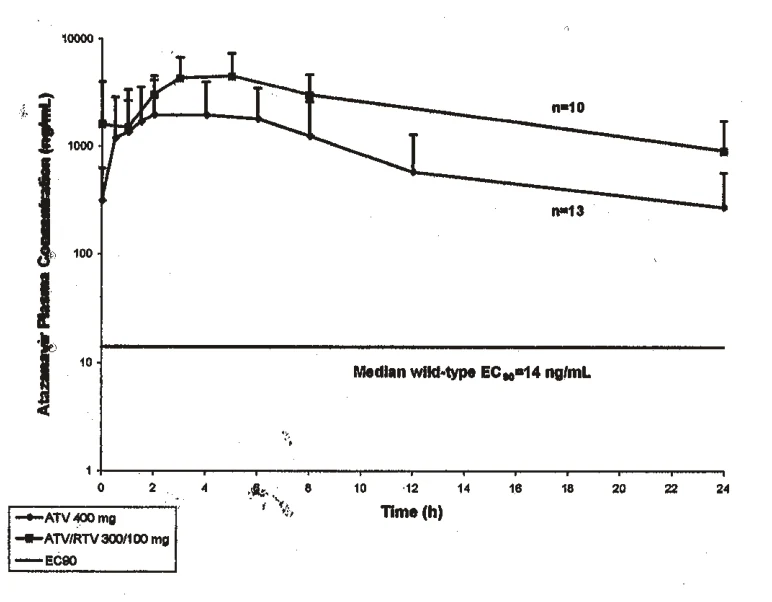
Food Effect
Administration of a single 400 mg dose of atazanavir with a light meal (357 kcal, 8.2 g fat, 10.6 g protein) resulted in a 70 % increase in AUC and 57 % increase in Cmax relative to the fasting state. Administration of a single 400 mg dose of atazanavir with a high fat meal (721 kcal, 37.3 g fat, 29.4 g protein) resulted in a mean increase in AUC of 35 % with no change in Cmax relative to the fasting state. Administration of atazanavir with either a light meal or high-fat meal decreased the coefficient of variation of AUC and Cmax by approximately one half compared to the fasting state. Thus, atazanavir is taken with food in order to enhance its bioavailability and reduce the pharmacokinetic variability.
Co-administration of atazanavir and ritonavir with food optimizes the bioavailability of atazanavir. Coadministration of a single 300 mg dose of atazanavir and a 100 mg dose of ritonavir with a light meal (336 total kcal, 5.1 g fat, 9.3 g protein and 63.3 g carbohydrates) resulted in a 33 % increase in the AUC and a 40 % increase in both the Cmax and the 24-hour concentration of atazanavir relative to the fasting state. Co-administration with a high-fat meal (951 total kcal, 54.7 g fat, 35.9 g protein and 77.9 g carbohydrates) did not affect the AUC of atazanavir relative to fasting conditions and the Cmax was within 11 % of fasting values. The 24- hour concentration following a high-fat meal was increased by approximately 33 % due to delayed absorption; the median Tmax increased from 2.0 to 5.0 hours. Co-administration of atazanavir with ritonavir with either a light or a high-fat meal decreased the coefficient of variation of AUC and Cmax by approximately 25 % compared to the fasting state.
Distribution:
Atazanavir is 86 % bound to human serum proteins and protein binding is independent of concentration. Atazanavir binds to both alpha-1-acid glycoprotein (AAG) and albumin to a similar extent (89 % and 86 %, respectively). In a multiple-dose study in HIV-infected patients dosed with atazanavir 400 mg once daily with a light meal for 12 weeks, atazanavir was detected in the cerebrospinal fluid and semen. The cerebrospinal fluid/plasma ratio for atazanavir (n = 4) ranged between 0.0021 and 0.0226 and seminal fluid/plasma ratio (n = 5) ranged between 0.11 and 4.42.
Metabolism:
Studies in humans and in vitro studies using human liver microsomes have demonstrated that atazanavir is principally metabolized by CYP3A4 isozyme to oxygenated metabolites, which are then excreted in the bile as either free or glucuronidated metabolites. Additional minor metabolic pathways consist of N-dealkylation, hydrolysis and oxygenation with dehydrogenation.
Two minor metabolites of atazanavir in plasma have been characterized. Neither metabolite demonstrated in vitro antiviral activity.
Elimination
Following a single 400 mg dose of 14C-atazanavir, 79 % and 13 % of the total radioactivity was recovered in the feces and urine, respectively. Unchanged drug accounted for approximately 20 % and 7 % of the administered dose in the feces and urine, respectively. The mean elimination half- life of atazanavir in healthy volunteers (n=214) and HIV-infected adult patients (n=13) was approximately 7 hours at steady state following a dose of 400 mg daily with a light meal.
Special Populations and Conditions
- Pediatrics (from 6 to <18 years of age) The pharmacokinetic data from pediatric patients receiving atazanavir Capsules with ritonavir based on body surface area are presented in Table 19.
| Table 19 Steady-State Pharmacokinetics of Atazanavir with ritonavir in HIV Infected Pediatric Patients (6 to < 18 years of age) in the Fed State | ||||||||
|---|---|---|---|---|---|---|---|---|
| 205 mg/m2 atazanavir with 100 mg/m2 ritonavir once daily | ||||||||
| Age range (years) | ||||||||
| At least 6 to 13 (n=17) | At least 13 to 18 (n=10) | |||||||
Dose mg Median [min-max] | 200 [150-400] | 400 [250-500] | ||||||
Cmax ng/mL Geometric Mean (CV %) | 4451 (33) | 3711 (46) | ||||||
AUC ng●h/mL Geometric Mean (CV %) | 42503 (36) | 44970 (34) | ||||||
Cmin ng/mL Geometric Mean (CV %) | 535 (62) | 1090 (60) | ||||||
- Geriatrics A study of the pharmacokinetics of atazanavir was performed in young (n=29; 18-40 years) and elderly (n=30; ≥ 65 years) healthy subjects. There were no clinically important pharmacokinetic differences observed due to age.
- Sex A study of the pharmacokinetics of atazanavir was performed in young (n=29; 18-40 years) and elderly (n=30; ≥ 65 years) healthy subjects. There were no clinically important pharmacokinetic differences observed due to gender.
- Pregnancy and Breast-feeding The pharmacokinetic data from HIV-infected pregnant women receiving atazanavir Capsules with ritonavir are presented in Table 20.
Table 20 Steady-State Pharmacokinetics of Atazanavir with ritonavir in HIV-Infected Pregnant Women in the Fed State
atazanavir 300 mg with ritonavir 100 mg
Pharmacokinetic
Parameter
2nd Trimester
(n=9)
3rd Trimester
(n=20)
Postpartum a
(n=36)
Cmax ng/mL
Geometric mean (CV %)
3729.09 (39)
3291.46 (48)
5649.10 (31)
AUC ng•h/mL
Geometric mean (CV %)
34399.1 (37)
34251.5 (43)
60532.7 (33)
Cmin ng/mL b
Geometric mean (CV %)
663.78 (36)
668.48 (50)
1420.64 (47)
a Atazanavir peak concentrations and AUCs were found to be approximately 26–40% higher during the postpartum period (4–12 weeks) than those observed historically in HIV-infected, non-pregnant patients.
Atazanavir plasma trough concentrations were approximately 2-fold higher during the postpartum period when compared to those observed historically in HIV-infected, non-pregnant patients.
b Cmin is concentration 24 hours post-dose.
- Ethnic Origin A study of the pharmacokinetics of atazanavir was performed in young (n=29; 1840 years) and elderly (n=30; ≥ 65 years) healthy subjects. There are insufficient data to determine whether there are any effects of race on the pharmacokinetics of atazanavir.
Hepatic Insufficiency Atazanavir is metabolized and eliminated primarily by the liver. Atazanavir has been studied in adult patients with moderate to severe hepatic impairment (14 Child-Pugh B and 2 Child-Pugh C) after a single 400-mg dose. The mean AUC (0-∞) was 42 % greater in patients with impaired hepatic function than in healthy volunteers. The mean half-life of atazanavir in hepatically impaired patients was 12.1 hours compared to 6.4 hours in healthy volunteers. Increased concentrations of atazanavir are expected in patients with moderately or severely impaired hepatic function. The pharmacokinetics of MYLAN-ATAZANAVIR in combination with ritonavir have not been studied in subjects with hepatic impairment. MYLAN-ATAZANAVIR should not be administered to patients with severe hepatic
- impairment. MYLAN-ATAZANAVIR /ritonavir is not recommended for use in patients with hepatic impairment (see 4 DOSAGE AND ADMINISTRATION and 7 WARNINGS AND PRECAUTIONS).
- Renal Insufficiency In healthy subjects, approximately 7 % of the dose of atazanavir is eliminated unchanged in the urine. Atazanavir has been studied in adult subjects with severe renal impairment (n=20), including those on hemodialysis, at multiple doses of 400 mg once daily. The mean atazanavir Cmax was 9 % lower, AUC was 19 % higher, and Cmin was 96 % higher in subjects with severe renal impairment not undergoing hemodialysis (n=10), than in age, weight, and gender matched subjects with normal renal function. Atazanavir was not appreciably cleared during hemodialysis. In a 4-hour dialysis session, 2.1 % of the administered dose was removed. Subjects on hemodialysis appeared to display lower exposures as compared to healthy subjects and renally-impaired subjects without hemodialysis. The geometric means for ATV AUC, Cmax and Cmin, for Atazanavir administered immediately following dialysis in subjects on hemodialysis (n=10) were 42 %, 37 % and 54 % lower, respectively, relative to subjects with normal renal function. When Atazanavir was administered 2 hours before a 4-hour hemodialysis session, the geometric means for ATV AUC, Cmax and Cmin in hemodialysis subjects were 28 %, 25 % and 43 % lower, respectively, then subjects with normal renal function. The mechanism of this decrease is unknown (see 4 DOSAGE AND ADMINISTRATION).
- Obesity See Fat Distribution (7 WARNINGS AND PRECAUTIONS)
The effects of co-administered drugs on the AUC, Cmax and Cmin of atazanavir are summarized in Table 16.
11 STORAGE, STABILITY AND DISPOSAL
MYLAN-ATAZANAVIR should be stored between 15°C and 30°C. Protect from moisture.
12 SPECIAL HANDLING INSTRUCTIONS
N/A
PART II: SCIENTIFIC INFORMATION
13 PHARMACEUTICAL INFORMATION
Drug Substance
Proper name: Atazanavir sulfate
Chemical name: (3S,8S,9S,12S)-3,12-Bis(1,1-dimethylethyl)-8-hydroxy-4,11-dioxo-9-(phenylmethyl)-6-[[4-(2-pyridinyl)phenyl]methyl]-2,5,6,10,13-pentaazatetradecanedioic acid dimethyl ester, sulfate (1:1)
1-[4-(pyridin-2-yl)phenyl]-5S-2,5-bis[[N-(methoxycarbonyl)-L-tert-leucinyl]amino]-4S-hydroxy-6-phenyl-2-azahexane, Bisulfate salt.
Molecular formula and molecular mass: C38H52N6O7.H2SO4
802.9 g/mol (as sulfate salt)
704 g/mol (as base)
Structural formula:
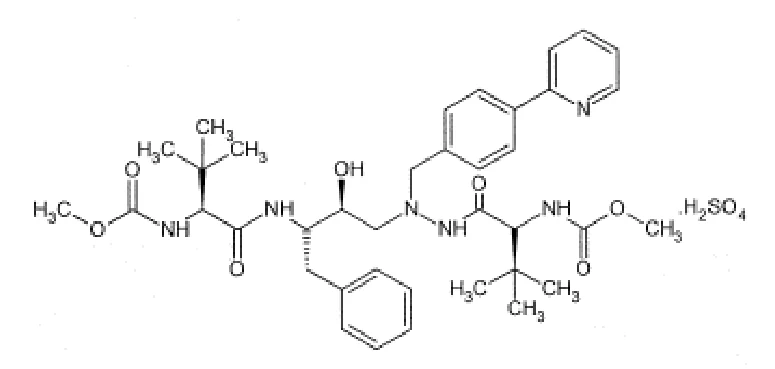
Physicochemical properties:
Description: White to pale yellow powder.
Solubility: Soluble in methanol.
Aqueous solubility:
| Dissolution medium | Solubility (mg/mL) | Descriptive Term (as defined in the USP) |
| pH 1.2 | 4.99 mg/mL | Slightly soluble |
| pH 4.5 | 1.8 mg/mL | Slightly soluble |
| pH 6.0 | 1.3 mg/mL | Slightly soluble |
| pH 6.8 | < 0.1 mg/mL | Practically insoluble |
| pH 8.0 | < 0.1 mg/mL | Practically insoluble |
Solubility in different solvents (25°C±1°C):
| Solvent | Solubility (mg/mL) | Descriptive Term (as defined in the USP) |
|---|---|---|
| Methanol | 250.0 mg/mL | Freely soluble |
| Ethanol | 12.0 mg/mL | Sparingly soluble |
| Ethyl acetate | < 0.1 mg/mL | Practically insoluble |
| Water | < 0.1 mg/mL | Practically insoluble |
| MDC | < 0.1 mg/mL | Practically insoluble |
| Chloroform | < 0.1 mg/mL | Practically insoluble |
| Acetone | < 0.1 mg/mL | Practically insoluble |
| DMF | 650.0 mg/mL | Freely soluble |
| DMSO | 610.0 mg/mL | Freely soluble |
pH: (1.0% in aqueous suspension): 2.13
pKa: (Strong acidic): 11.92 (As per literature, Drug bank)
(Strong basic): 4.42 (As per literature, Drug bank)
Melting range: 193.1°C to 194.2°C (with decomposition)
Log P: 4.5 (As per literature, Drug bank)
Hygroscopicity: Slightly hygroscopic in nature
14 CLINICAL TRIALS
14.1 Clinical Trials by Indication
Antiretroviral Treatment-Naive Adult Patients
Study AI424-138: a 96 Week study comparing the antiviral efficacy and safety of atazanavir/ritonavir with lopinavir/ritonavir, each in combination with fixed-dose tenofovir/emtricitabine in HIV-1 infected treatment naive subjects.
Table 21 Summary of patient demographics for clinical trial study AI424-138 in Antiretroviral Treatment-Naive Adult Patients
| Study # | Study Design | Dosage, route of administration and duration | Study Subjects (n) | Mean age (Range) | Sex |
|---|---|---|---|---|---|
| AI424-138 | open label, randomized, multicenter | Atazanavir 300 mg + ritonavir 100 mg (once daily) with tenofovir DF/emtricitabine (once daily) a Lopinavir 400 mg + ritonavir 100 mg (twice daily) with tenofovir DF/emtricitabine (once daily) a 96 Weeks | n = 440 n = 443 | 36 years (19–72) | 69 % male 31 % female |
a As a fixed-dose combination: 300 mg tenofovir DF, 200 mg emtricitabine once daily
Study AI424-138: A 96 Week study comparing the antiviral efficacy and safety of atazanavir/ritonavir with lopinavir/ritonavir, each in combination with fixed-dose tenofovir / emtricitabine in HIV-1 infected treatment naive subjects Study AI424-138 is a 96 Week open label, randomized, multicenter study, comparing atazanavir (300 mg once daily) with ritonavir (100 mg once daily) to lopinavir plus ritonavir (400/100 mg twice daily), each in combination with fixed-dose tenofovir DF plus emtricitabine (300/200 mg once daily), in 883 antiretroviral treatment-naive patients. Patients had a mean age of 36 years (range 19 – 72), 48 % were Caucasian, 18 % Black, 9 % Asian, 24 % Hispanic/Mestizo/mixed race and 69 % were male. The median baseline plasma CD4+ cell count was 205 cells/mm3 (range 2 to 810 cells/mm3) and the mean baseline plasma HIV-1 RNA level was 4.94 log10 copies/mL (range: 2.60 to 5.88 log10 copies/mL).
Study Results Treatment response and outcomes through Week 48 and Week 96 are presented in Table 22.
| Table 22 Outcomes of Randomized Treatment Through Week 48 and Week 96 (Study AI424-138) | ||||||||||||
|---|---|---|---|---|---|---|---|---|---|---|---|---|
| Outcome | Atazanavir 300 mg + ritonavir 100 mg (once daily) with tenofovir DF/emtricitabine (once daily)a (n = 440) | Lopinavir 400 mg + ritonavir 100 mg (twice daily) with tenofovir DF/emtricitabine (once daily)a (n = 443) | ||||||||||
| 48 Weeks | 96 Weeks | 48 Weeks | 96 Weeks | |||||||||
| Responderb | 78 %c | 75 %d | 76 %c | 69 %d | ||||||||
Virologic failuree Rebound Never suppressed through Week 48 or Week 96 | 13 % 4 % 9 % | 9 % 7 % 2 % | 10 % 4 % 6 % | 11 % 9 % 1 % | ||||||||
| Death | 1 % | 1 % | < 1 % | < 1 % | ||||||||
| Discontinued due to adverse event | 2 % | 3 % | 3 % | 5 % | ||||||||
| Discontinued for other reasonsf | 6 % | 12 % | 9 % | 15 % | ||||||||
a As a fixed-dose combination: 300 mg tenofovir DF, 200 mg emtricitabine once daily.
b Patients achieved confirmed HIV RNA < 50 copies/mL at Week 48. Roche Amplicor®, v1.5 ultra-sensitive assay.
c Pre-specified ITT analysis using as-randomized cohort: ATV/RTV 78 % and LPV/RTV 76 % [difference estimate: 1.7 (95 % confidence interval: -3.8, 7.1)].
d Pre-specified ITT analysis using as-randomized cohort: ATV/RTV 74 % and LPV/RTV 68 % [difference estimate: 6.1 (95 % confidence interval: 0.3, 12.0)].
e Includes viral rebound and failure to achieve confirmed HIV RNA < 50 copies/mL through Week 48 and Week 96, respectively.
f Includes lost to follow-up, patient’s withdrawal, noncompliance, protocol violation, and other reasons.
The proportion of responders among patients with high viral loads (i.e., baseline HIV RNA ≥ 100,000 copies/mL) were comparable for the atazanavir/ritonavir (164 of 223 patients, 74 % at 48 weeks and 165 of 223 patients, 74 % at 96 weeks) and lopinavir/ritonavir 161 of 222 patients, 73 % at 48 weeks and 149 of 222 patients, 67 % at 96 weeks) arms. The median increase from baseline in CD4+ cell count was 191 (48 weeks) and 261 (96 weeks) cells/mm3 for the atazanavir/ritonavir arm and 200 (48 weeks) and 273 (96 weeks) cells/mm3 for the lopinavir/ritonavir arm.
Study AI424-034: Atazanavir once daily compared to efavirenz once daily, each in combination with fixed dose lamivudine + zidovudine twice daily
Table 23 Summary of patient demographics for clinical trial Study AI424-034 in Antiretroviral Treatment-Naive Adult Patients
| Study # | Study design | Dosage, route of administration and duration | Study subjects (n) | Mean age (Range) | Sex |
|---|---|---|---|---|---|
| AI424-034 | randomized, double-blind, multicenter | atazanavir 400 mg once daily + lamivudine + zidovudined efavirenz 600 mg once daily + lamivudine + zidovudined 48 Weeks | n = 405 n = 443 | 34 years (18 to 73) | 65 % male 35 % female |
a As a fixed-dose combination: 150 mg lamivudine, 300 mg zidovudine twice daily.
Study AI424-034 was a randomized, double-blind, multicenter trial comparing atazanavir (400 mg once daily) (n=405) to efavirenz (600 mg once daily) (n=405), each in combination with a fixed dose combination of lamivudine (3TC) (150 mg) and zidovudine (ZDV) (300 mg) given twice daily, in 810 antiretroviral treatment-naive patients. Patients had a mean age of 34 years (range: 18 to 73), 36 % were Hispanic, 33 % were Caucasian, and 65 % were male. The mean baseline CD4 cell count was 321 cells/mm3 (range: 64 to 1424 cells/mm3) and the mean baseline plasma HIV-1 RNA level was 4.8 log10 copies/mL (range: 2.2 to 5.9 log10 copies/mL).
Study Results
| Table 24 Outcomes of Randomized Treatment Through Week 48 (Study AI424-034) | |||||||
|---|---|---|---|---|---|---|---|
| Outcome | atazanavir 400 mg once daily + lamivudine + zidovudined (n = 405) | efavirenz 600 mg once daily + lamivudine + zidovudined (n = 405) | |||||
Responder by TRWPF analysisa LOQ<400 copies/mL (< 50 copies/mL) | 67 % (31 %) | 63 % (36 %) | |||||
Virologic failureb Rebound Never suppressed through Week 48 | 20 % 13 % 7 % | 19 % 11 % 7 % | |||||
| Death or Disease Progression | < 1 % | < 1 % | |||||
| Discontinued due to adverse event | 6 % | 9 % | |||||
| Discontinued for other reasonsc | 6 % | 9 % | |||||
a The TRWPF defined as responders patients who achieved and maintained confirmed HIV RNA < 400 copies/mL (< 50 copies/mL) through week 48 without intervening replicated rebound, CDC Class C AIDS events, or treatment discontinuation. ATV-EFV (95 % CI): 3.8 (-2.8, 10.3); ATV is similar to EFV as the lower 95 % confidence interval is > -12 %, the pre-defined criteria for similarity. Roche Amplicor® HIV-1 MonitorTM Assay, test version 1.0 or 1.5 as geographically appropriate.
b Includes confirmed viral rebound and failure to achieve confirmed HIV RNA < 400 copies/mL through Week 48.
c Includes lost to follow-up, patient’s withdrawal, noncompliance, protocol violation and other reasons.
d As a fixed-dose combination: 150 mg lamivudine, 300 mg zidovudine twice daily.
The primary endpoint for this study was the proportion of treated patients who achieved and maintained confirmed HIV RNA < 400 copies/mL through Week 48.
Through 48 weeks of therapy, there was a similar proportion of patients with HIV RNA < 400 copies/mL in the atazanavir arm compared to the efavirenz arm (67 % vs. 63 %, respectively). Virologic failure was the most frequent reason for treatment failure on both regimens (20 % vs. 19 % respectively). Few subjects on either regimen did not achieve viral suppression through Week 48 (7 % on both regimens) and virologic failure was mainly due to viral rebound (13 % and 11 %, respectively). Discontinuation due to adverse events (AEs) and due to other reasons was slightly higher on EFV than on atazanavir (9 % vs. 6 % for discontinuation due to AEs, and 9 % vs. 7 % for discontinuation due to other reasons). Results for the proportion of patients in the atazanavir arm compared to the efavirenz arm with HIV RNA < 50 copies/mL were 31 % vs. 36 %, respectively. The mean increase from baseline in CD4 cell count was 176 cells/mm3 for the atazanavir arm and 160 cells/mm3 for the efavirenz arm.
Study AI424-008: Atazanavir 400 mg once daily compared to atazanavir 600 mg once daily, and compared to nelfinavir 1250 mg twice daily, each in combination with stavudine and lamivudine twice daily
Table 25 Summary of patient demographics for clinical trial study AI424-008 in Antiretroviral Treatment-Naive Adult Patients
| Study # | Study design | Dosage, route of administration and duration | Study subjects (n) | Mean age (Range) | Sex |
|---|---|---|---|---|---|
| AI424-008 | randomized, double-blind, multicenter | Atazanavir 400 mg once daily + lamivudine + stavudine nelfinavir 1250 mg twice daily + lamivudine + stavudine 48 Weeks | n = 181 n = 91 | 35 years (18 to 69), | 63 % male 37 % female |
a As a fixed-dose combination: 150 mg lamivudine, 300 mg zidovudine twice daily
Study AI424-008 was a 48-week, randomized, open-label, multicenter trial, blinded to dose of atazanavir, comparing atazanavir at two dose levels (400 mg and 600 mg once daily) (n=181 and n=195, respectively), to nelfinavir (1250 mg twice daily) (n=91), each in combination with stavudine (40 mg) and lamivudine (150 mg) given twice daily, in antiretroviral treatment-naive patients. Patients had a mean age of 35 years (range: 18 to 69), 55 % were Caucasian, and 63 % were male. The mean baseline CD4 cell count was 295 cells/mm3 (range: 4 to 1003 cells/mm3) and the mean baseline plasma HIV-1 RNA level was 4.7 log10 copies/mL (range: 1.8 to 5.9 log10 copies/mL).
Study results
Table 26 Outcomes of Randomized Treatment Through Week 48 (Study AI424-008)
| Outcome | atazanavir 400 mg once daily + lamivudine + stavudine (n = 181) | nelfinavir 1250 mg twice daily + lamivudine + stavudine (n = 91) |
|---|---|---|
| Responder by TRWPFa | 65 % (31 %) | 59 % (38 %) |
Virologic failureb Rebound Never suppressed through Week 48 | 23 % 11 % 12 % | 35 % 14 % 21 % |
| Death or disease progression | 2 % | - |
| Discontinued due to adverse event | 4 % | 3 % |
| Discontinued for other reasonsc | 4 % | 2 % |
a TRWPF defined responders as patients who achieved and maintained confirmed HIV RNA < 400 copies/mL (< 50 copies/mL) through Week 48 without intervening replicated rebound, CDC Class C AIDS events, or treatment discontinuation. Roche Amplicor ® HIV-1 Monitor TM Assay, test version 1.0 or 1.5 as geographically appropriate.
b Includes confirmed viral rebound and failure to achieve confirmed HIV RNA < 400 copies/mL through Week 48.
c Includes lost to follow-up, patient’s withdrawal, noncompliance, protocol violation and other reasons.
Through 48 weeks of treatment, the proportion of patients with HIV RNA < 400 (< 50) copies/mL was 65 % (31 %) for the atazanavir 400 mg arm and 59 % (38 %) for the nelfinavir arm. The mean increase from baseline in CD4 cell count was 234 cells/mm3 for the atazanavir 400 mg arm and 211 cells/mm3 for the nelfinavir arm. Virologic failure was comparable across all study regimens and was due to approximately equal numbers of subjects who never achieved virologic suppression (12 % on ATV 400, 13 % on ATV 600 and 21 % on NFV).
Antiretroviral Treatment-Experienced Adult Patients
Study AI424-043: Atazanavir once daily compared to lopinavir + ritonavir twice daily, each in combination with two nucleosides
Table 27 Summary of patient demographics for clinical trial AI424-043 in Antiretroviral Treatment- Naive Adult Patients
| Study # | Study design | Dosage, route of administration and duration | Study subjects (n) | Mean age (Range) | Sex |
|---|---|---|---|---|---|
| AI424-043 | randomized, open-label, multicenter | atazanavir 400 mg once daily to lopinavir + ritonavir + nelfinavir | n = 181 | 38 years (20 to 65) | 79 % male 21 % female |
nelfinavir 1250 mg twice daily + lamivudine + stavudine 48 Weeks | n = 91 | ||||
Study AI424-043 is a, randomized, open-label, multicenter trial comparing atazanavir (400 mg once daily) to lopinavir + ritonavir (400/100 mg twice daily), each in combination with two NRTIs, in 300 randomized subjects who experienced virologic failure to only one prior PI containing regimen. The mean time of prior exposure to antiretrovirals was 141 weeks for PIs, 181 weeks for NRTIs, and 93 weeks for NNRTIs (14 % of patients had prior exposure to NNRTIs). The mean age was 38 years (range: 20 to 65); 51 % were Hispanic, 42 % were Caucasian, and 79 % were male. The mean baseline CD4 cell count was 323 cells/mm3 (range: 54 to 1210 cells/mm3) and the mean baseline plasma HIV-1 RNA level was 4.14 log10 copies/mL (range: 2.60 to 5.87 log10 copies/mL). Based on results of the Week 24 analysis, patients in the atazanavir treatment arm were offered alternative treatment after 24 weeks of study therapy.
The co-primary endpoints for this study were the time-averaged difference in change from baseline in HIV RNA levels through Week 48 (efficacy) and the Week 48 percentage change from baseline in fasting LDL cholesterol (safety). Through 48 weeks of therapy, 57 % of patients treated with atazanavir has > 1 log10 virologic suppression (or < 400 copies/mL) compared to 75% of patients treated with lopinavir/ritonavir. There was a greater proportion of patients with HIV RNA < 400 copies/mL and HIV RNA < 50 copies/mL in the lopinavir/ritonavir arm compared to the atazanavir arm (67 % vs. 45 % and 51 % vs. 32 %).
Study Results
Based on the results of this study, atazanavir without ritonavir is inferior to lopinavir/ritonavir in PI-experienced patients with prior virologic failure and is not recommended for such patients.
Study AI424-043 also compared changes from baseline in LDL-cholesterol. Through 48 weeks, atazanavir resulted in significantly lower fasting LDL-cholesterol (co-primary endpoint), total cholesterol, and fasting triglyceride concentrations than lopinavir + ritonavir, as assessed by change from baseline. HDL cholesterol rose modestly and comparably between baseline to week 48 on both regimens (for more details, see 8 ADVERSE REACTIONS, Table 12).
Antiretroviral Treatment- Experienced Adult Patients (Salvage)
Study AI424-045: Atazanavir once daily + ritonavir once daily compared to atazanavir once daily + saquinavir (soft gelatine capsules) once daily, and compared to lopinavir + ritonavir twice daily, each in combination with tenofovir DF+ one NRTI
Table 28 Summary of patient demographics for clinical trials in Patients with Prior Antiretroviral Experience
| Study # | Study design | Dosage, route of administration and duration | Study subjects (n) | Mean age (Range) | Sex |
|---|---|---|---|---|---|
| AI424-045 | randomized, open-label, multicenter | atazanavir 300 mg once daily + ritonavir 100 mg once daily + tenofovir DF + NRTI (281 weeks) lopinavir + ritonavir (400/100 mg) BID + tenofovir DF + NRTI (85 weeks) | n = 120 n = 123 | 41 years (24 to 74) | 78 % male 22 % female |
Study AI424-045 is an ongoing, randomized, open-label, multicenter trial comparing atazanavir (300 mg once daily) taken with ritonavir (100 mg once daily) and atazanavir (400 mg once daily) in combination with saquinavir soft gelatine capsules (1200 mg once daily), to lopinavir + ritonavir (400/100 mg fixed dose combination twice daily), each in combination with tenofovir DF and one NRTI, in 358 randomized subjects with virologic failure on HAART regimens containing PIs, NRTIs, and NNRTIs. The mean time of prior antiretroviral exposure was 138 weeks for PIs, 281 weeks for NRTIs, and 85 weeks for NNRTIs. The mean age was 41 years (range: 24 to 74); 60 % were Caucasian and 78 % were male. The mean baseline CD4 cell count was 337 cells/mm3 (range: 14 to 1543 cells/mm3) and the mean baseline plasma HIV-1 RNA level was 4.40 log10 copies/mL (range: 2.6 to 5.9 log10 copies/mL). The primary endpoint for this study was the time-averaged difference in change from baseline in HIV RNA through 48 weeks.
Study Results
There are limited safety data from controlled clinical trials for atazanavir plus ritonavir regimens without tenofovir DF.
The similarity (non-inferiority) of the antiviral efficacy of the ATV 300/RTV and LPV/RTV regimens was demonstrated for the primary efficacy endpoint through Week 48 (TAD [97.5 % CI] for ATV 300/RTV - LPV/RTV was 0.13 [-0.12, 0.39]). In contrast, the antiviral efficacy of the ATV 400/SQV regimen was lower than that of the LPV/RTV regimen (TAD [97.5 % CI] ATV 400/SQV - LPV/RTV was 0.31 [0.07, 0.55]0.33 [0.07, 0.60]). At Week 48, HIV RNA levels declined from baseline by a mean of 1.93 log10 c/mL for ATV 300/RTV, and 1.87 log10 c/mL for LPV/RTV.
The comparability of the ATV 300/RTV regimen relative to the LPV/RTV regimen was supported by the analyses which included the proportion of subjects with HIV RNA levels
< 400 c/mL. Response rates at Week 48 were comparable between the ATV 300/RTV and LPV/RTV treatment groups. Using the TRWPF definition, response rates were 53 % for ATV 300/RTV and 54 % for LPV/RTV.
Study AI424-045, however was not large enough to reach a definite conclusion that atazanavir/ritonavir and lopinavir/ritonavir are equivalent on the secondary endpoint of proportions below the HIV RNA lower limit of detection.
Table 29 Outcomes of Treatment Through 48 Weeks in Study AI424-045 (Patients with Prior Antiretroviral Experience)*a
| Outcome | atazanavir 300 mg once daily + ritonavir 100 mg once daily + tenofovir DF + NRTI N = 120 | lopinavir + ritonavir (400/100 mg) BID + tenofovir DF + NRTI N = 123 |
|---|---|---|
| HIV RNA Mean Change from Baseline (log10 copies/mL)a,b,c | -1.93 | -1.87 |
| CD4 Mean Change from Baseline (cell/mm3)d | 110 | 121 |
| Percent of Randomized Patients Respondinge |
| HIV RNA <400 copies/mLa |
| HIV RNA <50 copies/mLa |
53 % 36 % | 54 % 42 % |
* There are limited safety data from controlled trials for atazanavir plus ritonavir regimens without tenofovir DF. (see 9 DRUG INTERACTIONS.)
a Roche Amplicor® HIV-1 MonitorTM Assay, test version 1.5.
b Based on patients with baseline and Week 48 HIV-1 RNA measurements (atazanavir + ritonavir, n=90; lopinavir + ritonavir, n=99).
c Protocol-defined primary efficacy outcome measure.
d Based on patients with baseline and Week 48 CD4 cell count measurements (atazanavir + ritonavir, n=83; lopinavir + ritonavir, n=94).
e TRWPF defined as responders patients who achieved and maintained confirmed HIV RNA < 400 copies/mL (< 50 copies/mL) through week 48 without intervening replicated rebound, CDC Class C AIDS events, or treatment discontinuation.
Pediatric Patients
Table 30 Summary of patient demographics for clinical trials in Pediatric Patients
| Study # | Study design | Dosage, route of administration and duration | Study subjects (n) | Mean age (Range) | Sex |
|---|---|---|---|---|---|
| PACTG 1020A | open-label, multicenter | atazanavir once daily + ritonavir + two NRTIs (281 weeks) | 182 patients (83 anti-retroviral naive and 99 anti-retroviral experienced) | 3 months to 21 years | 50 % male 50 % female |
Assessment of the pharmacokinetics, safety, tolerability, and efficacy of atazanavir is based on data from the open-label, multicenter clinical trial PACTG 1020A conducted in patients from 3 months to 21 years of age. In this study, 182 patients (83 antiretroviral-naive and 99 antiretroviral-experienced) received once daily atazanavir, with or without ritonavir, in combination with two NRTIs.
Study Results
Ninety-nine patients (6 to less than 18 years of age) treated with the atazanavir capsule formulation, with or without ritonavir, were evaluated. In this cohort, the overall proportions of antiretroviral-naive and -experienced patients with HIV RNA < 400 copies/mL at week 24 were 68 % (28/41) and 33 % (19/58), respectively. The overall proportions of antiretroviral-naive and-experienced patients with HIV RNA < 50 copies/mL at week 24 were 59 % (24/41) and 24 % (14/58), respectively. The median increase from baseline in absolute CD4 count at 20 weeks of therapy was 171 cells/mm3 in antiretroviral-naive patients and 116 cells/mm3 in antiretroviral- experienced patients. The efficacy of atazanavir in the pediatric population beyond 24 weeks has not yet been established.
Pregnant Women
Table 31 Summary of patient demographics for clinical trials in Pregnant Woman
| Study # | Study design | Dosage, route of administration and duration | Study subjects (n) | Mean age (Range) | Sex |
|---|---|---|---|---|---|
| AI424-182 | open label non-randomized | atazanavir/ritonavir (300/100 mg or 400/100 mg) + zidovudine/lamivudine | 41 women | 3 months to 21 years | 100 % female |
In clinical trial AI424-182 atazanavir/ritonavir (300/100 mg or 400/100 mg) in combination with zidovudine/lamivudine was administered to 41 pregnant women during the second or third trimester.
Study Results
Among the 39 women who completed the study, 38 women achieved an HIV RNA < 50 copies/mL at time of delivery. Six of 20 (30 %) women on atazanavir/ritonavir 300/100 mg and 13 of 21 (62 %) women on atazanavir/ritonavir 400/100 mg experienced grades 3 to 4 hyperbilirubinemia.
Forty infants had test results that were negative for HIV-1 DNA at the time of delivery and/or during the first 6 months postpartum. All 40 infants received antiretroviral prophylactic treatment containing zidovudine. Three of 20 infants (15 %) born to women treated with atazanavir/ritonavir 300/100 mg and four of 20 infants (20 %) born to women treated with atazanavir/ritonavir 400/100 mg experienced grade 3-4 bilirubin. There was no evidence of pathologic jaundice and six of 40 infants in this study received phototherapy for a maximum of 4 days.
See 4 DOSAGE AND ADMINISTRATION, Dosage Adjustments, Pregnant Women.
14.2 Comparative Bioavailability Studies
An open label, randomized, two-treatment, two-sequence, two-period, single-dose, crossover oral bioequivalence study of 1 x 300 mg Mylan-Atazanavir 300mg capsules (Mylan Pharmaceuticals ULC) and 1 x 300 mg Reyataz® (atazanavir sulfate) 300mg capsules (Bristol-Myers Squibb Company, Canada) was performed in 41 healthy, adult male subjects under fed conditions.
A summary of the results is presented in the following table.
SUMMARY TABLE OF THE COMPARATIVE BIOAVAILABILITY DATA
Atazanavir (1 x 300 mg) Geometric Mean Arithmetic Mean (CV %) | ||||
|---|---|---|---|---|
| Parameter | Test1 | Reference2 | % Ratio of Geometric Means | 90% Confidence Interval |
AUCT (ng.h/mL) | 7883.7 9142.0 (47.5) | 8715.7 9764.3 (43.3) | 90.5 | 83.2 - 98.3 |
AUCI (ng.h/mL) | 8442.9 9841.1 (49.7) | 9275.1 10427.9 (44.8) | 91.0 | 83.7 - 98.9 |
Cmax (ng/mL) | 1416.6 1590.5 (39.2) | 1653.5 1839.8 (39.6) | 85.7 | 78.7 - 93.3 |
Tmax3 (h) | 3.5 (2.0 - 5.5) | 3.5 (1.8 - 5.5) | ||
T½4 (h) | 5.9 (23.7) | 5.8 (20.5) | ||
1 Mylan-Atazanavir (atazanavir sulfate) 300 mg capsules (Mylan Pharmaceuticals ULC).
2 PrREYATAZ® (atazanavir sulfate) 300 mg capsules (Bristol-Myers Squibb) were purchased from Canada.
3 Expressed as the median (range) only.
4 Arithmetic mean (%CV)
15 MICROBIOLOGY
Antiviral activity in vitro
Atazanavir exhibits anti-HIV-1 activity with a mean 50 % effective concentration (EC50) in the absence of human serum of 2 to 5 nM against a variety of laboratory and clinical HIV-1 isolates grown in peripheral blood mononuclear cells, macrophages, CEM-SS cells, and MT-2 cells. ATV has activity against HIV-1 Group M subtype viruses A, B, C, D, AE, AG, F, G, and J isolates in cell culture. ATV has variable activity against HIV-2 isolates (1.9 to 32 nM), with EC50 values above the EC50 values of failure isolates. Two-drug combination studies with ATV showed additive to antagonistic antiviral activity in vitro with abacavir and the NNRTIs (delavirdine, efavirenz, and nevirapine) and additive antiviral activity in vitro with the PIs (amprenavir, lopinavir, nelfinavir, ritonavir, and saquinavir), NRTIs (didanosine, emtricitabine, lamivudine, stavudine, tenofovir DF, zalcitabine, and zidovudine), the HIV-1 fusion inhibitor enfuvirtide, and two compounds used in the treatment of viral hepatitis, adefovir and ribavirin, without enhanced cytotoxicity.
Resistance
Clinical Studies of Treatment-Naive Patients: Receiving atazanavir 400 mg Without Ritonavir: ATV-resistant clinical isolates from treatment-naive patients who experienced virologic failure developed an I50L mutation (after an average of 50 weeks of ATV therapy), often in combination with an A71V mutation. In treatment-naive patients, viral isolates that developed the I50L mutation showed phenotypic resistance to ATV but retained in vitro susceptibility to other PIs (amprenavir, lopinavir, nelfinavir, ritonavir, and saquinavir); however, there are no clinical data available to demonstrate the effect of the I50L mutation on the efficacy of subsequently administered PIs.
Clinical Studies of Treatment-Naive Patients Receiving atazanavir 300 mg With Ritonavir 10 mg: In Phase III study AI424-138, an as-treated genotypic and phenotypic analysis was conducted on samples from patients who experienced virologic failure ≥400 copies/mL or discontinued before achieving suppression on ATV/RTV (n=39; 9 %) and LPV/RTV (n=39; 9 %) through 96 weeks of treatment. In the ATV/RTV arm, one virologic failure isolate had a 56-fold decrease in ATV susceptibility emerge on therapy with the development of PI substitutions L10F, V32I, K43T, M46I, A71I, G73S, I85I/V, and L90M. Five of the treatment failure isolates in the ATV/RTV arm developed emtricitabine resistance with the emergence of either the MI84I (1 patient) or the M184V (4 patients) substitution on therapy. In the LPV/RTV arm, one virologic failure isolate had a 69-fold decrease in LPV susceptibility emerge on therapy with the development of PI substitutions L10V and V11I in addition to baseline PI substitutions V32I, I54I/V, V82A, L90M, L10I, A71I, G73S and L89V. Six of the failure isolates in the LPV/RTV arm developed emtricitabine resistance with the emergence of the M184V substitution.
Clinical Studies of Treatment-Experienced Patients: In contrast, from studies of treatment- experienced patients treated with ATV or ATV/RTV, most ATV-resistant isolates from patients who experienced virologic failure developed mutations that were associated with resistance to multiple PIs and displayed decreased susceptibility to multiple PIs. The most common protease mutations to develop in the viral isolates of patients who failed treatment with ATV 300 mg once daily and RTV 100 mg once daily (together with tenofovir DF and an NRTI) included V32I, L33F/V/I, E35D/G, M46I/L, I50L, F53L/V, I54V, A71V/T/I, G73S/T/C, V82A/T/L, I85V, and L89V/Q/M/T. Other mutations that developed on ATV/RTV treatment including E34K/A/Q, G48V, I84V, N88S/D/T, and L90M occurred in less than 10 % of patient isolates. Generally, if multiple PI resistance mutations were present in the HIV-1 of the patient at baseline, ATV resistance developed through mutations associated with resistance to other PIs and could include the development of the I50L mutation. The I50L mutation has been detected in treatment-experienced patients experiencing virologic failure after long-term treatment. Protease cleavage site changes also emerged on ATV treatment, but their presence did not correlate with the level of ATV resistance.
Clinical Studies of Treatment-Naive Patients: Comparison of Ritonavir-Boosted atazanavir vs. Unboosted atazanavir: Study AI424-089 compared atazanavir 300 mg once daily with ritonavir 100 mg vs. Atazanavir 400 mg once daily when administered with lamivudine and extended release stavudine in HIV-infected treatment-naive patients. A summary of the number of virologic failures and virologic failure isolates with ATV resistance in each arm is shown in Table 32.
Table 32 Summary of Virologic Failuresa at Week 96 in Study AI424-089: Comparison of Ritonavir Boosted atazanavir vs. Unboosted atazanavir: Randomized Patients
| atazanavir 300 mg + ritonavir 100 mg (n=95) | atazanavir 400 mg (n=105) | |
|---|---|---|
| Virologic Failure (≥50 copies/mL) at Week 96 | 15 (16 %) | 34 (32 %) |
| Virologic Failure with Genotypes and Phenotypes Data | 5 | 17 |
| Virologic Failure Isolates with ATV-resistance at Week 96 | 0/5 (0 %)b | 4/17 (24 %)b |
| Virologic Failure Isolates with I50L Emergence at Week 96c | 0/5 (0 %)b | 2/17 (12 %)b |
| Virologic Failure Isolates with Lamivudine Resistance at Week 96 | 2/5 (40 %)b | 11/17 (65 %)b |
a Virologic failure includes patients who were never suppressed through Week 96 and on study at Week 96, had virologic rebound or discontinued due to insufficient viral load response.
b Percentage of Virologic Failure Isolates with genotypic and phenotypic data.
c Mixture of I50I/L emerged in 2 other ATV 400 mg-treated patients. Neither isolate was phenotypically resistant to ATV.
Cross-Resistance
An association between virologic response at 48 weeks and the number and type of primary PI- resistance-associated mutations detected in baseline HIV-1 isolates from antiretroviral- experienced patients receiving ATV/RTV once daily or lopinavir (LPV)/RTV twice daily in Study AI424-045 is shown in Table 33.
Overall, both the number and type of baseline PI mutations affected response rates in treatment- experienced patients. In the ATV/RTV group, patients had lower response rates when 3 or more baseline PI mutations including a mutation at position 36, 71, 77, 82, or 90 were present compared to patients with 1-2 PI mutations including one of these mutations.
Table 33: HIV RNA Response by Number and Type of Baseline PI Mutation, Antiretroviral-Experienced Patients in Study AI424-045, As-Treated Analysis
Number and Type of Baseline PI Mutationsa
Virologic Response = HIV RNA < 400 copies/mLb
ATV/RTV LPV/RTV
(n=110) (n=113)
3 or more primary PI mutations including:c
D30N
75 % (6/8)
50 % (3/6)
M36I/V
19 % (3/16)
33 % (6/18)
M46I/L/T
24 % (4/17)
23 % (5/22)
I54V/L/T/M/A
31 % (5/16)
31 % (5/16)
A71V/T/I/G
34 % (10/29)
39 % (12/31)
G73S/A/C/T
14 % (1/7)
38 % (3/8)
V77I
47 % (7/15)
44 % (7/16)
V82A/F/T/S/I
29 % (6/21)
27 % (7/26)
I84V/A
11 % (1/9)
33 % (2/6)
N88D
63 % (5/8)
67 % (4/6)
L90M
10 % (2/21)
44 % (11/25)
Number of baseline primary PI mutationsa
All patients, as treated
58 % (64/110)
59 % (67/113)
0–2 PI mutations
75 % (50/67)
75 % (50/67)
3–4 PI mutations
41 % (14/34)
43 % (12/28)
5 or more PI mutations
0 % (0/9)
28 % (5/18)
a Primary mutations include any change at D30, V32, M36, M46, I47, G48, I50, I54, A71, G73, V77, V82, I84, N88, and L90.
b Results should be interpreted with caution because the subgroups were small.
c There were insufficient data (n<3) for PI mutations V32I, I47V, G48V, I50V, and F53L.
The response rates of antiretroviral-experienced patients in Study AI424-045 were analyzed by baseline phenotype (shift in in vitro susceptibility relative to reference, Table 34). The analyses are based on a select patient population with 62 % of patients receiving an NNRTI-based regimen before study entry compared to 35 % receiving a PI-based regimen. Additional data are needed to determine clinically relevant break points for atazanavir.
Table 34: Baseline Phenotype by Outcome, Antiretroviral-Experienced Patients in Study AI424-045, As-Treated Analysis
Baseline Phenotypea
Virologic Response = HIV RNA < 400 copies/mLb
ATV/RTV
(n=111)
LPV/RTV
(n=111)
0-2
> 2-5
> 5-10
> 10
71 % (55/78)
53 % (8/15)
13 % (1/8)
10 % (1/10)
70 % (56/80)
44 % (4/9)
33 % (3/9)
23 % (3/13)
a Fold change in in vitro susceptibility relative to the wild-type reference.
b Results should be interpreted with caution because the subgroups were small.
16 NON-CLINICAL TOXICOLOGY
General Toxicology:
Acute Toxicity
The single-dose oral toxicity of atazanavir was evaluated in mice and rats at doses of 200 to
1600 mg/kg. In mice, doses of 800 and 1600 mg/kg produced death; clinical signs including tremors, hypoactivity, ptosis, scant stool, and/or urogenital staining; and transient group mean body weight loss (males). Additional clinical signs observed at 1600 mg/kg included loss of righting reflex, recumbency, and labored respiration. Clinical signs were generally first noted on Day 2 and resolved within 2 to 3 days. Doses up to 400 mg/kg were well tolerated in mice with only transient scant stool observed at 400 mg/kg. The no-effect dose in mice was 200 mg/kg. In rats, no atazanavir-related effects were observed after administration of single oral doses up to 1600 mg/kg.
Short- and Long-Term Toxicity
Repeat-dose oral toxicity studies were conducted in rats for 2 weeks to 6 months, and in dogs for 2 weeks to 9 months to evaluate the short- and long-term toxicity of atazanavir. Atazanavir- related findings were generally confined to the liver and included increases in serum total bilirubin in both species and liver enzymes in dogs, and hepatocellular vacuolation and hypertrophy in rats. These liver changes were observed at systemic exposures (AUC) of atazanavir that were 0.4 to 4 times in rats and 0.2 to 20 times in dogs the exposure in humans given atazanavir at 400 mg once daily. Similar liver changes were also observed in a 3-month oral toxicity study in mice at exposures 0.4 to 12 times the exposure in humans given 400 mg once daily. Additionally in mice, cytotoxic liver changes were observed in males (increased transaminases) and females (increased transaminases and single-cell necrosis) at exposures equivalent to and 12 times, respectively, that observed in humans given 400 mg once daily, whereas no effects were observed at exposures of 0.4 and 4 times, respectively, human exposure.
Serum cholesterol and glucose were minimally to mildly increased in rats but not in mice. Similar increases were observed in an initial 2-week oral toxicity study performed in dogs. Subsequent 2-week and 9-month oral toxicity studies in dogs showed no drug-related changes in serum cholesterol and glucose.
Carcinogenicity
Carcinogenicity studies with atazanavir were conducted in mice and rats. Mice were administered doses of 20, 40, and 80 mg/kg/day in males and 40, 120, and 360 mg/kg/day in females. In female mice, there was an increase in the incidence of benign hepatocellular adenomas at the highest dose. The exposure in female mice at the high dose is approximately seven times exposure in humans given atazanavir 400 mg once daily. No increase in the incidence of tumors was observed in female mice at lower doses or male mice at any dose. Exposures in male and female mice at nontumorigenic doses are approximately four times human exposure at 400 mg/day. In rats administered doses of 100, 350, and 1200 mg/kg/day, there was no increased incidence of any tumor type. Exposures in rats at the high dose are approximately two (males) and six (females) times exposure in humans given atazanavir 400 mg once daily. The clinical significance of benign hepatocellular adenomas in high-dose female mice is unknown as these benign tumors occurred in mice only at exposures (approximately seven times human exposure at 400 mg/day) causing significant liver damage.
Genotoxicity
Atazanavir tested positive in an in vitro clastogenicity test using primary human lymphocytes, in the absence and presence of metabolic activation. Atazanavir tested negative in the in vitro Ames reverse-mutation assay, in vivo micronucleus and DNA repair tests in rats, and in vivo DNA damage test in rat duodenum (Comet assay).
Reproductive and Developmental Toxicology:
In a fertility and early embryonic development study in rats, atazanavir altered oestrus cycling with no effects on mating or fertility. No teratogenic effects were observed in rats or rabbits at maternally toxic doses. In the pre- and postnatal development assessment in rats, atazanavir produced a transient reduction in body weight in the offspring at a maternally toxic dose. Systemic exposure to atazanavir at doses that resulted in maternal toxicity was at least equal to or slightly greater than that observed in humans given 400 mg once daily.
Special Toxicology:
Cardiotoxicity: Atazanavir minimally increased the duration of the rabbit Purkinje fiber action potential, weakly inhibited sodium and potassium IKr (HERG-encoded) and IKs currents (IC50 > 30 µM), and moderately inhibited calcium current (IC50 = 10.4 µM) in vitro. Electrocardiographic changes (sinus bradycardia, prolongation of PR interval, prolongation of QT interval, and prolongation of QRS complex) were observed only in an initial 2-week oral toxicity study performed in dogs and were considered secondary to the marked clinical toxicity and not a direct drug effect. Subsequent 2-week and 9-month oral toxicity studies in dogs showed no drug-related electrocardiographic changes.
Juvenile Toxicity: In a fertility and early embryonic development study in rats, atazanavir altered oestrus cycling with no effects on mating or fertility. No teratogenic effects were observed in rats or rabbits at maternally toxic doses. In the pre- and postnatal development assessment in rats, atazanavir produced a transient reduction in body weight in the offspring at a maternally toxic dose. Systemic exposure to atazanavir at doses that resulted in maternal toxicity was at least equal to or slightly greater than that observed in humans given 400 mg once daily.
17 SUPPORTING PRODUCT MONOGRAPHS
- 1. PrREYATAZ® (capsule, 200 mg, 300 mg), submission control no. 287317, Product Monograph, Bristol-Myers Squibb Canada ( OCT 23, 2024)