


Product Monograph - Nozinan (Sanofi-Aventis Canada, 5 mg)
INDICATIONS AND CLINICAL USE
Psychotic disturbances: acute and chronic schizophrenias, senile psychoses, manic-depressive syndromes.
Conditions associated with anxiety and tension: autonomic disturbances, personality disturbances, emotional troubles secondary to such physical conditions as resistant pruritus, etc.
Nozinan is also employed:
- As an analgesic: In pain due to cancer, zona, trigeminal neuralgia and neurocostal neuralgia and in phantom limb pains and muscular discomforts.
- As a potentiator of anesthetics: In general anesthesia where it can be used as both a pre- and post-operative sedative and analgesic.
- As an antiemetic: For the treatment of nausea and vomiting of central origin.
- As a sedative: For the management of insomnia.
CONTRAINDICATIONS
In cases of coma or CNS depression due to alcohol, hypnotics, analgesics or narcotics.
It is also contraindicated in patients with blood dyscrasia, hepatic troubles or a sensitivity to phenothiazines.
WARNINGS
Occupational Hazards: Nozinan can reduce psychomotor activity especially during the first few days of treatment. Patients should therefore be cautioned not to drive a motor vehicle or to participate in activities requiring total mental alertness.
As with other neuroleptics, very rare cases of QT interval prolongation have been reported with Nozinan. Neuroleptic phenothiazines may potentiate QT interval prolongation, which increases the risk of onset of serious ventricular arrhythmias of the torsade de pointes type, which is potentially fatal (sudden death). QT prolongation is exacerbated, in particular, in the presence of bradycardia, hypokalemia, and congenital or acquired (i.e., drug induced) QT prolongation. If the clinical situation permits, medical and laboratory evaluations should be performed to rule out possible risk factors before initiating treatment with a neuroleptic agent and as deemed necessary during treatment (See also ADVERSE REACTIONS and DRUG INTERACTIONS).
Tardive Dyskinesia: As with all antipsychotic agents, tardive dyskinesia may appear in some patients on long-term therapy or after drug discontinuation. The syndrome is mainly characterized by rhythmical involuntary movements of the tongue, face, mouth or jaw. The manifestations may be permanent in some patients. The syndrome may be masked when treatment is reinstituted, when the dosage is increased or when a switch is made to a different antipsychotic drug. NOZINAN should be prescribed in a manner that is most likely to minimize the risk of tardive dyskinesia. The lowest effective dose and the shortest duration of treatment should be used, and treatment should be discontinued at the earliest opportunity, or if a satisfactory response cannot be obtained. If the signs and symptoms of tardive dyskinesia appear during treatment, discontinuation of NOZINAN should be considered.
Neuroleptic Malignant Syndrome: Neuroleptic malignant syndrome (NMS) may occur in patients receiving antipsychotic drugs. NMS is characterized by hyperthermia, muscle rigidity, altered consciousness, and signs of autonomic instability including irregular blood pressure, tachycardia, cardiac arrhythmias and diaphoresis. Additional signs may include elevated serum creatine kinase, myoglobinuria (rhabdomyolysis), acute renal failure and leukocytosis. Hyperthermia is often an early sign of this syndrome. Antipsychotic treatment should be withdrawn immediately and appropriate supportive therapy and careful monitoring instituted.
Pregnancy: The drug should be used with caution in pregnant women, particularly during the first trimester, unless the benefit to the patient outweighs any possible risk to the fetus.
PRECAUTIONS
In high oral or parenteral doses, orthostatic hypotension may be encountered at the start of treatment. Patients whose treatment is started by the parenteral route should be kept in bed during the first few days.
Nozinan therapy should be initiated at low doses in patients with arteriosclerosis or cardiovascular problems.
Because of its anticholinergic effects, Nozinan must be administered with caution in patients with glaucoma or prostatic hypertrophy.
During long-term therapy, periodic liver function tests should be performed. In addition, blood counts should be conducted regularly, particularly during the first 2 or 3 months of treatment, and physicians should watch for any signs of blood dyscrasia.
Nozinan does not alter EEG activity. Nevertheless, since phenothiazines can lower the threshold of cortical excitation, it is advisable to administer an appropriate anticonvulsant medication to epileptic patients receiving Nozinan therapy.
Drug Interactions
Nozinan potentiates the action of other phenothiazines and CNS depressants (barbiturates, analgesics, narcotics and antihistaminics). The usual doses of these agents should be reduced by half if they are to be given concomitantly with Nozinan until the dosage of the latter has been established.
Nozinan and its non-hydroxylated metabolites are reported to be inhibitors of cytochrome P450 2D6. Coadministration of Nozinan and drugs primarily metabolized by the cytochrome P450 2D6 enzyme system may result in increased plasma concentrations of these drugs.
Neuroleptic phenothiazines may potentiate QT interval prolongation. QT prolongation is exacerbated, in particular, in the presence of bradycardia, hypokalemia, and congenital or acquired (i.e., drug induced) QT prolongation (See also WARNINGS AND PRECAUTIONS).
Drug-Laboratory Interactions
False positive or negative pregnancy tests have occurred in patients receiving phenothiazine therapy.
ADVERSE REACTIONS
May be classified as follows:
CNS: Drowsiness may appear early in treatment but will gradually disappear during the first weeks or with an adjustment in the dosage.
Extrapyramidal effects are rare and usually appear only after prolonged therapy at high doses. These reactions may be corrected either by reducing the dose of Nozinan or by administering an antiparkinsonian agent.
Autonomic Nervous System: Dryness of the mouth and, in older patients occasional urinary retention, constipation and tachycardia.
Cardiovascular: Orthostatic hypotension may be encountered at the start of treatment by the parenteral route or with high oral doses. Very rare cases of QT interval prolongation have been reported. There have been isolated reports of sudden death, with possible causes of cardiac origin (see WARNINGS and DRUG INTERACTIONS), as well as cases of unexplained sudden death, in patients receiving neuroleptic phenothiazines.
Blood: Rare instances of agranulocytosis have been reported.
Endocrine: Weight gain has been occasionally reported in patients during prolonged treatment with high doses.
Gastrointestinal: Rare cases of cholostatic jaundice without liver damage have been observed. Necrotizing enterocolitis, which can be fatal, has been very rarely reported in patients treated with Nozinan.
Skin Reactions: Skin reactions due to photosensitivity or allergies are extremely rare.
Urogenital System: Priapism has been very rarely reported.
SYMPTOMS AND TREATMENT OF OVERDOSAGE
Symptoms: Symptoms of acute intoxication may include: simple CNS depression, spasms, tremor or tonic and clonic convulsions, coma accompanied by hypotension and respiratory depression.
Treatment: There is no specific antidote. After gastric lavage, treatment is symptomatic. Centrally acting emetics are ineffective because of the anti-emetic action of Nozinan.
Hypotension: A 5% glucose solution may be administered. If a hypertensive agent is required, norepinephrine or phenylephrine may be used, but not epinephrine, which can aggravate hypotension.
Respiratory depression: Oxygen by inhalation or controlled respiration after tracheal intubation.
Respiratory infection: Wide spectrum antibiotics.
Extrapyramidal reactions: An antiparkinsonian agent or chloral hydrate, however the latter must be used with caution because of its depressant effect on respiration.
Any CNS stimulant should be used with caution.
DOSAGE AND ADMINISTRATION
Dosage must be adjusted according to the indication and individual needs of the patient. If sedation during the day is too pronounced, lower doses may be given during the day and higher doses at night.
Adults
Oral:
Minor conditions in which Nozinan may be given in low doses as a tranquilizer, anxiolytic, analgesic or sedative: begin treatment with 6 to 25 mg/day in 3 divided doses at mealtimes. Increase the dosage until the optimum level has been reached. As a sedative, a single night time dose of 10 to 25 mg is usually sufficient.
Severe conditions: Such as psychoses or intense pain in which Nozinan is employed at higher doses: Begin treatment with 50 to 75 mg/day divided into 2 or 3 daily doses; increase the dosage until the desired effect is obtained. In certain psychotics doses may reach 1 g or more/day. If it is necessary to start therapy with higher doses, i.e., 100 to 200 mg/day, administer the drug in divided daily doses and keep the patient in bed for the first few days.
Parenteral:
I.M.: To be used primarily for the initial treatment of psychoses for certain severe pain as a premedication or for the treatment of postoperative pain. In psychoses and pain, doses vary from 75 to 100 mg given as 3 or 4 deep i.m. injections in a large muscle. When given as a premedication or post-operative analgesic, the average dose varies from 10 to 25 mg every 8 hours, which is equivalent to 20 to 40 mg given orally. The last dose during premedication, given 1 hour before surgery, can be 25 to 50 mg i.m.
I.V.: To be used primarily as an infusion during surgery or labour. The dose may range from 10 to 25 mg in 500 mL of a 5% glucose solution administered at a rate of 20 to 40 drops/minute. If Nozinan is administered with a barbiturate or narcotic, the doses of the latter must be reduced by at least one-half.
Children
Oral:
The initial dose has been established at 1/4 mg/kg daily given in 2 or 3 divided doses. This dosage may be increased gradually until an effective level is reached which should not surpass 40 mg/day for a child less than 12 years of age.
Parenteral:
I.M.: A dose of 1/16 to 1/8 mg/kg/day in one or divided among several injections. Oral medication should be substituted as soon as possible.
I.V.: In anesthesia, 1/16 mg/kg in 250 mL of a 5% glucose solution may be administered as a slow infusion (20 to 40 drops per minute) during surgery.
PHARMACEUTICAL INFORMATION
Drug substance
Proper name : Methotrimeprazine hydrochloride
Chemical name : 2-methoxy-N,N,β-trimethyl-10H-phenothiazine-10-propamine hydrochloride
Structural formula :
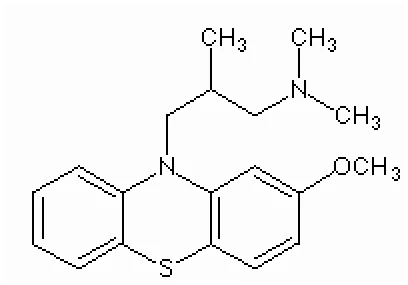
- HCl
Molecular formula : C19H24N2OS • HCl
Molecular weight : 364.9
Physical form : White to very slightly yellow, slightly hygroscopic powder Solubility : Freely soluble in water and in alcohol, practically insoluble in ether Melting point : 142˚C and 162˚C
Drug substance
Proper name : Methotrimeprazine maleate
Chemical name : 2-methoxy-N,N,β-trimethyl-10H-phenothiazine-10-propamine maleate
Structural formula :
- C4H4O4
Molecular formula : C19H24N2OS • C4H4O4
Molecular weight : 444.5
Physical form : White to very slightly yellow crystalline powder Solubility : Slightly soluble in water and in alcohol, practically insoluble in ether, sparingly soluble in dichloromethane Melting point : 186˚C
pH : 3.5 to 5.5
Composition
Injectable: Each mL contains: methotrimeprazine base 25 mg (as the hydrochloride). Non-medicinal ingredients: 0.1% ascorbic acid, 0.65% sodium chloride, 0.05% sodium sulfite and water for injection.
Syrup: Each 5 mL of brown liquid contains: methotrimeprazine base 25 mg (as the hydrochloride). Non-medicinal ingredients: alcohol, apricot essence, ascorbic acid, caramel, citric acid, glycerin, purified water and sucrose.
Tablets: Each yellow tablet contains: methotrimeprazine base 5, 25 or 50 mg (as the maleate). Non-medicinal ingredients: croscarmellose sodium, colloidal silicon dioxide, D&C Yellow #10 Aluminum Lake, dicalcium phosphate, FD&C Yellow #6 Aluminium Lake, magnesium stearate, microcrystalline cellulose, Opadry II White Y-22-7719, polyethylene glycol and talc.
Stability and storage recommendation
Nozinan (methotrimeprazine hydrochloride) injectable, syrup and Nozinan (methotrimeprazine maleate) tablets should be stored at 15˚ to 30˚C. Protect from light.
AVAILABILITY OF DOSAGE FORMS
Nozinan (methotrimeprazine base) 25 mg/mL (as hydrochloride) injectable is available in amber glass ampoules of 1 mL in boxes of 10 ampoules.
Nozinan (methotrimeprazine base) 25 mg/5 mL (as hydrochloride) syrup is available in amber glass bottles of 500 mL.
Nozinan (methotrimeprazine base) 5, 25 and 50 mg (as maleate) tablets are available in white HDPE bottles of 100 and 500 tablets.
PHARMACOLOGY
Nozinan possesses strong sedative properties. It potentiates ether and hexobarbital anesthesia as well as morphine analgesia. It also exerts a potent anti-apomorphine effect, a hypothermic action 3 times more potent than that of chlorpromazine and strong antispasmodic and anti-histaminic effects.
Nozinan is capable of reversing epinephrine-induced hypertension but has practically no effect against norepinephrine and acetylcholine. It readily protects rats against traumatic shock and produces deep local anesthesia following parasciatic injections.
TOXICOLOGY
In mice the LD50 of Nozinan is 70 mg/kg i.v., 250 mg/kg s.c., 344 mg/kg i.p. and 380 mg/kg p.o. Signs of acute toxicity consist of CNS depression interrupted by periods of convulsions and uncoordinated movements.
In the rat, a daily dose of 5 or 10 mg/kg p.o. for 4 consecutive weeks did not produce any digestive troubles or weight loss. During the first days of treatment, a state of depression appeared, which was most pronounced on the third or fourth day and then almost completed disappeared. Laboratory and function tests indicated no renal, hepatic or blood anomalies. Microscopic visceral examinations revealed no toxic lesions.
In the dog, a daily dose of 2.5 or 5 mg/kg p.o. for 4 consecutive weeks did not affect weight stability but animals appeared lethargic. Some relaxation of the nictitating membrane and a transient reduction of blood pressure were observed. During treatment, the leucocyte count and blood coagulation remained normal. Anatomopathological examination of the visceral parenchyma of sacrificed animals confirmed that all organs remain normal.
REFERENCES
- 1. Capron M, Lafitte B, Benedit M, Camard CN, Nicolas F, Beligon C, et al. Necrotizing colitis in a 29-year-old man under high-dose neuroleptics. Reanimation Urgences 1999;8(8):701-4.
- 2. Cubeddu LX. QT prolongation and fatal arrhythmias: a review of clinical implications and effects of drugs. American Journal of Therapeutics 2003;10(6):452-7.
- 3. Courvoisier S, Ducrot R, Fournel J, Julou L. Propriétés pharmacodynamiques générales de la lévomépromazine (7044 R.P.). C.R. Soc Biologie 1957;151(7):1378-82.
- 4. Divry P, Boron J, Collard J. La lévomépromazine dans les cures de sommeil potentialisées et les cures neuroleptiques. Acta Neurol Psych Belgica 1959;59(3):325-36.
- 5. Fekete Z. Control of pruritus with levomepromazine. Appl Therap 1963;5(4):333-4.
- 6. Fenichel RR, Malik M, Antzelevitch C, Sanguinetti M, Roden DM, Priori SG, et al. Drug-induced torsades de pointes and implications for drug development. J Cardiovasc Electr 2004;15(4):475-95.
- 7. Filloux MC, Marechal K, Bagheri H, Morales J, Nouvel A, Laurencin G. Phenothiazine-induced acute colitis: A positive rechallenge case report. Clin Neuropharmacol 1999;22(4):244-5.
- 8.
Flamant J. Utilisation à faibles doses d'un nouveau neuroleptique (lévomépromazine, 7044
R.P.) dans le traitement des dystonies neuro-végétatives. L'Hôpital 1960;March H.S.
- 9.
Gram LF, Hansen MG, Sindrup SH, Brösen K, Poulsen JH, Aaes-Jörgensen T, et al.
Citalopram: interaction studies with levomepromazine, imipramine and lithium. Ther Drug Monitoring 1993;15:18-24.
- 10. Hals PA, Dahl SG. Effect of levomepromazine and metabolites on debrisoquine hydroxylation in the rat. Pharmacology & Toxicology 1994;75:255-60.
- 11. Huot JM, Kristof AC. Lévomépromazine (Nozinan) - a new neuroleptic agent for treatment of senile patients. CMAJ 1959;81:546-8.
- 12. Kenbubpha K, Silpakit C. Association between antipsychotics and sudden death in psychotic in-patients. International Medical Journal 2002;9(1):27-31.
- 13. Lambert PA, Beaujard M, Achaintre A, Broussolle P, Perrin J, Berthier C, et al. Essais thérapeutiques d'un nouveau dérivé de la phénothiazine, la lévomépromazine ou 7044 R.P. Ann Medico-Psychol 1957;115(2):291-6.
- 14. Larrey D, Lainey E, Blanc P, Diaz D, David R, Biaggi A. Acute colitis associated with prolonged administration of neuroleptics. J Clin Gastroenterol 1992;14(1):64-7.
- 15. Levy L, Ban T. Phenothiazine drugs and the general practitioner. CMAJ 1962;86:415-7.
- 16. Mehtonen OP, Aranko K, Malkonen L, Vapaatalo H. A survey of sudden death associated with the use of antipsycgotic or antidepressant drugs: 49 cases in Finland. Acta Psychiatr Scand 1991;84:58-64.
- 17.
Muller D. The treatment of restless psychotics with methotrimeprazine (Veractil). J Ment Sci
1961;107(449):783-6.
- 18.
Panaccio V. La lévomépromazine dans le traitement des dermatoses prurigineuses. Union
Med Canada 1964;93(3):317-9.
- 19. Paradis B. La lévomépromazine en anesthésie. Anesthésie-Analgésie 1959;16(1):185-93.
- 20. Paradis B, Lamontagne A, Gagne-Desrosiers R, Lamarche Y. Association Nozinan-fluothane en anesthésie. Laval Medical 1959;28(3):337-44.
- 21.
Payne P, Veringer D. Levomepromazine in the treatment of neuroleptic resistant psychotics. J
Ment Sci 1960;106:1429-31.
- 22. Ray WA, Meredith S, Thapa PB, Meador KG, Hall K, Murray KT. Antipsychotics and the risk of sudden cardiac death. Arch Gen Psychiat 2001;58(12):1161-7.
- 23. Reilly JG, Ayis SA, Ferrier IN, Jones SJ, Thomas SHL. Thioridazine and sudden unexplained death in psychiatric in-patients. Brit J Psychiat 2002;180:515-22.
- 24. Sakurai T, Nishizono M, Nothohara N, Kitahara N. The treatment of schizophrenia with large doses of levomepromazine. Clin Psychiat 1963;4(10):741-54.
- 25. Sarwer-Foner GJ, Hajnsek F, Groszman M, Grauer H, Koranyi EK. Clinical investigation of levomepromazine (Nozinan) in open psychiatric settings. Med Services J Canada 1961;17(11):798-817.
- 26. Sigwald J, Bouttier D, Caille F. Le traitement du zona et des algies zostériennes. Étude des résultats obtenus avec la lévomépromazine. Thérapie 1959;14(5):818-24.
- 27. Sigwald J, Bouttier D, Solignac J. Essai de traitement de la névralgie essentielle du trijumeau par la lévomépromazine. Rev Neurol 1958;99(5):580-1.
- 28. Sigwald J, Bouttier D, Solignac J, Dumezil. L'action antialgique des phénothiazines. I- Le traitement par la lévomépromazine des algies intenses ou irréductibles. Thérapie 1959;14(6):978-84.
- 29. Simard-Savoie S, Bloomfield S, Bernier J, Tetreault L. Evaluation clinique des propriétés analgésiques de la lévomépromazine, de la morphine et du placebo sur la douleur chronique. Union Med Canada 1964;93(1):61-7.
- 30. Syvälathi EKG, Lindberg R, Kallio J, De Vocht M. Inhibitory effects of neuroleptics on debrisoquine oxidation in man. Brit J Clin Pharmacol 1986;22:89-92.
- 31. Taylor DM. Antipsychotics and QT prolongation. Acta Psychiat Scand 2003;107(2):85-95.
- 32.
Taylor RG, Doku HC. Use of methotrimeprazine after oral surgery. J Dental Med
1967;22:141-3.
- 33. Zeltser D, Justo D, Halkin A, Prokhorov V, Heller K, Viskin S. Torsade de pointes due to noncardiac drugs: most patients have easily identifiable risk factors. Medicine 2003;82(4):282-90.