


Product Monograph - Largactil 25
INDICATIONS
In psychiatry - schizophrenia, manic depressive psychoses (manic phase), behavioural disorders, involutional psychoses, senile psychoses and confusional states in the elderly.
In general medicine - nausea, vomiting; persistent hiccup and organic conditions associated with emotional stress: acute or chronic alcoholism and for the treatment of withdrawal symptoms of addicts and alcoholics.
In obstetrics and surgery - as a preoperative medication for the relief of apprehension; to reduce, by potentiation, narcotic and analgesic requirements; as an antiemetic; to prevent and treat traumatic or postoperative shock; for use in artificial hibernation and controlled hypotension.
CONTRAINDICATIONS
Severe CNS depression or comatose states due to alcohol, barbiturates, analgesics or other CNS depressants. In patients with blood dyscrasias, severe liver disease or a sensitivity to phenothiazines.
WARNINGS
As with other neuroleptics, very rare cases of QT interval prolongation have been reported with LARGACTIL. Neuroleptic phenothiazines may potentiate QT interval prolongation, which increases the risk of onset of serious ventricular arrhythmias of the torsade de pointes type, which is potentially fatal (sudden death). QT prolongation is exacerbated, in particular, in the presence of bradycardia, hypokalemia, and congenital or acquired (i.e., drug induced) QT prolongation. If the clinical situation permits, medical and laboratory evaluations should be performed to rule out possible risk factors before initiating treatment with a neuroleptic agent and as deemed necessary during treatment (See PRECAUTIONS and ADVERSE REACTIONS).
Tardive Dyskinesia: As with all antipsychotic agents, tardive dyskinesia may appear in some patients on long-term therapy or after drug discontinuation. The syndrome is mainly characterized by rhythmical involuntary movements of the tongue, face, mouth or jaw. The manifestations may be permanent in some patients. The syndrome may be masked when treatment is reinstituted, when the dosage is increased or when a switch is made to a different antipsychotic drug. LARGACTIL should be prescribed in a manner that is most likely to minimize the risk of tardive dyskinesia. The lowest effective dose and the shortest duration of treatment should be used, and treatment should be discontinued at the earliest opportunity, or if a satisfactory response cannot be obtained. If the signs and symptoms of tardive dyskinesia appear during treatment, discontinuation of LARGACTIL should be considered.
Neuroleptic Malignant Syndrome: Neuroleptic malignant syndrome (NMS) may occur in patients receiving antipsychotic drugs. NMS is characterized by hyperthermia, muscle rigidity, altered consciousness, and signs of autonomic instability including irregular blood pressure, tachycardia, cardiac arrhythmias and diaphoresis. Additional signs may include elevated serum creatine kinase, myoglobinuria (rhabdomyolysis), acute renal failure and leukocytosis.
Hyperthermia is often an early sign of this syndrome. Antipsychotic treatment should be withdrawn immediately and appropriate supportive therapy and careful monitoring instituted.
PRECAUTIONS
LARGACTIL can potentiate the effects of other phenothiazines and CNS depressants. When treatment is initiated, the usual doses of barbiturates, analgesics, narcotics or antihistamines should be reduced by half. Patients should be warned against consuming alcoholic beverages while on LARGACTIL therapy.
Neuroleptic phenothiazines may potentiate QT interval prolongation. QT prolongation is exacerbated, in particular, in the presence of bradycardia, hypokalemia, and congenital or acquired (i.e., drug induced) QT prolongation (See WARNINGS and ADVERSE REACTIONS).
LARGACTIL should be used cautiously in patients suffering from arteriosclerosis, cardiovascular disease or other conditions where it is necessary to avoid a sudden drop in blood pressure. If hypotension does occur and it is necessary to use a hypertensive agent, norepinephrine should be used, not epinephrine, as the latter agent can aggravate hypotension.
Because of its anticholinergic properties, LARGACTIL must be used with caution in patients with glaucoma or prostatic hypertrophy.
During protracted therapy and especially if high dosages are administered, it is recommended that blood counts and liver function tests be performed at regular intervals.
Drowsiness may occur at the beginning of treatment; patients should therefore be warned against operating motor vehicles or participating in activities requiring mental alertness until this effect has subsided.
Phenothiazines can provoke epileptic seizures by lowering the seizure threshold; therefore, during LARGACTIL therapy, the patient's usual anticonvulsant medication should be continued at the same dosage.
Because of its antiemetic effect, LARGACTIL can obscure symptoms of intracranial hypertension or intestinal obstruction.
False positive or negative pregnancy tests have occurred in patients receiving phenothiazine therapy.
ADVERSE REACTIONS
Drowsiness frequently occurs at the beginning of treatment but gradually disappears or subsides with a downward adjustment of the dosage - also at the beginning of treatment, there are rare cases of orthostatic hypotension, particularly when high doses are used - dystonic and extrapyramidal reactions may appear during prolonged treatment with elevated dosages, but can be eliminated by lowering the doses or administering an antiparkinsonian agent.
Other side effects which are observed less frequently include: nasal congestion, blurred vision, xerostomy, sedation, nausea, constipation, changes in libido, gynecomastia, weight gain, skin and corneal pigmentation, photosensitivity, blood dyscrasias, leukopenia, eosinophilia and EEG changes.
Very rare cases of QT interval prolongation have been reported. There have been isolated reports of sudden death, with possible causes of cardiac origin (see WARNINGS and PRECAUTIONS), as well as cases of unexplained sudden death, in patients receiving neuroleptic phenothiazines.
Cholestatic jaundice and liver injury, mainly of cholestatic or mixed type, are rarely reported in patients treated with LARGACTIL.
Systemic lupus erythematosis has been very rarely reported in patients treated with LARGACTIL. In some cases, positive anti-nuclear antibodies may be seen without evidence of clinical disease.
Priapism has been very rarely reported in patients treated with LARGACTIL.
SYMPTOMS AND TREATMENT OF OVERDOSAGE
Symptoms – Agitation, hyperactivity, confusion, CNS depression followed by somnolence, coma and circulatory collapse.
Treatment - No specific antidote. Gastric lavage and symptomatic treatment.
For hypotension: glucose solutions in I.V. infusion and, if necessary norepinephrine added to the infusion liquid.
For respiratory depression: oxygen and artificial respiration
For extrapyramidal reactions: antiparkinsonian drugs
To prevent respiratory infections: wide spectrum antibiotics
Because of the antiemetic action of LARGACTIL, centrally acting emetics are ineffective. Dialysis does not assist in eliminating the drug from the blood.
DOSAGE AND ADMINISTRATION
ADULTS
In general medicine and psychiatry
Oral route: average daily dose of 30 to 75 mg (mild cases) or 75 to 100 mg (more severe cases) in divided doses. It is occasionally necessary to give a higher dosage which, when increased gradually, can reach 900 mg or more per day in some psychiatric patients.
Once the optimum dosage has been reached, it is maintained as long as necessary for the control of symptoms during the critical phase of the illness. Eventually, however, it should be gradually reduced so that the patient can be maintained on the lowest effective dosage.
Rectal route: 100 to 300 mg or 1 to 3 suppositories of 100 mg daily.
In surgery and anesthesia
To potentiate hypnotics, analgesics and anesthetics and as an antiemetic.
Oral route: doses of 25 to 50 mg are administered 2 to 3 hours before anesthesia and every 4 to 6 hours after surgery.
CHILDREN
Usual single dose: 1/4 mg per pound (1/2 mg/kg) by oral route. This dose can be repeated every 4 to 6 hours as necessary. The normal daily dose is 40 mg for a child of 5 years (40 pounds), 75 mg for children of 5 to 12 years (50 to 100 pounds) except in psychiatric patients where dosages can be progressively elevated above these levels.
In surgery and anesthesia, doses of 1/4 mg per pound, by the same method recommended for adults.
PHARMACEUTICAL INFORMATION
2-chloro-10 (3-dimethylaminopropyl) phenothiazine or chlorpromazine utilized primarily as the hydrochloride. Its structural formula may be represented as follows:
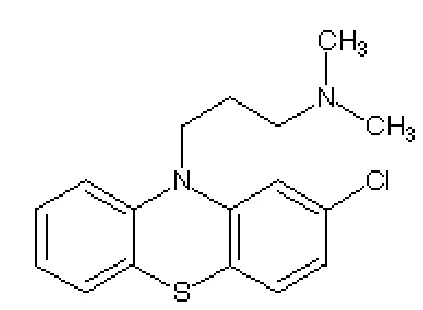
Molecular weight: 355.33
Chlorpromazine hydrochloride is a white or off-white crystalline powder which has a slightly pungent odor. It is very soluble in water, soluble in methanol, ethanol and chloroform, and insoluble in ether and benzene.
AVAILABILITY OF DOSAGE FORMS
Liquid of 25 mg/5 mL: Each 5 mL of colorless liquid contains: chlorpromazine base 25 mg (as the hydrochloride). Non-medicinal ingredients: alcohol, ascorbic acid, citric acid, ethyl vanillin, glycerin, peach flavor, purified water, sodium benzoate and sucrose. Alcohol: 0.5% v/v. Sucrose: 3.9 g/5 mL. Tartrazine-free.
Bottles of 500 mL. Protect from light or discoloration may occur.
Liquid of 100 mg/5 mL: Each 5 mL of yellow liquid contains: chlorpromazine base 100 mg (as the hydrochloride). Non-medicinal ingredients: alcohol, artificial fruit flavor, citric acid, D&C Yellow No. 10, ethyl vanillin, glycerin, purified water, sodium benzoate and sucrose. Alcohol: 0.5% v/v. Sucrose: 3.6 g/5 mL. Tartrazine-free. Bottles of 500 mL. Protect from light or discoloration may occur.
Oral Drops: Each mL of brown solution contains: chlorpromazine base 40 mg (4%) (as the hydrochloride). Non-medicinal ingredients: alcohol, artificial and natural custard flavor, caramel, citric acid, glycerin, purified water, sucrose and terpeneless orange oil. Alcohol: 17.5% v/v. Sucrose: 200 mg. Bottles of 100 mL with calibrated dropper. Protect from light or discoloration may occur.
Suppositories: Each rectal suppository contains: chlorpromazine base 100 mg (as the hydrochloride). Non-medicinal ingredients: hydrogenated vegetable glycerides. Tartrazine-free. Boxes of 10 suppositories. Store in a cool place.
PHARMACOLOGY
Chlorpromazine possesses potent sedative and antiemetic effects and potentiates CNS depressants. It is also a moderately strong adrenolytic agent, but has only weak anticholinergic activity. The LD50 in the mouse is 260 mg/kg P.O. and in the rat, 360 mg/kg P.O. The drug did not interfere with normal reproductive activity nor did it exert any teratogenic effect on the offspring of the animals studied.