


Product Monograph - Teva-Chlorpromazine
SUMMARY PRODUCT INFORMATION
Route of Administration | Dosage Form / Strength | Nonmedicinal Ingredients |
| Oral | Tablets: 25 mg, 50 mg & 100 mg | Colloidal silicon dioxide, hypromellose, maltodextrin, magnesium stearate, microcrystalline cellulose, polydextrose, polyethylene glycol/macrogol, pregelatinized starch (starch 1500), sodium lauryl sulfate, titanium dioxide, triacetin. |
INDICATIONS AND CLINICAL USE
TEVA-CHLORPROMAZINE (Chlorpromazine Hydrochloride) is indicated for:
- Management of psychotic disorders such as schizophrenia.
- Prevention and treatment of nausea and vomiting when other agents are ineffective or unavailable.
Geriatrics (> 65 years of age):
TEVA-CHLORPROMAZINE is not indicated in elderly patients with dementia. The safety and efficacy of TEVA-CHLORPROMAZINE in patients 65 years of age or older have not been studied (see WARNINGS AND PRECAUTIONS, Serious Warnings and Precautions Box and Special Populations).
Pediatrics (< 18 years of age):
The safety and efficacy of TEVA-CHLORPROMAZINE in children under the age of 18 have not been studied (see WARNINGS AND PRECAUTIONS, Special Populations).
CONTRAINDICATIONS
Patients who are hypersensitive to this drug or to any ingredient in the formulation or component of the container. Patients who are known to be hypersensitive to other
phenothiazines may display a cross-sensitivity to chlorpromazine and therefore should avoid taking it. For a complete listing, see the Dosage Forms, Composition and Packaging section of the product monograph.
- Comatose or depressed states due to CNS depressants.
- Blood dyscrasias.
- Bone marrow depression.
- Liver damage.
- TEVA-CHLORPROMAZINE should be avoided in children or adolescents with signs or symptoms suggestive of Reye's syndrome. Its antiemetic effect may mask the signs and its CNS effect may be confused with the signs of Reye's syndrome or other encephalopathies.
WARNINGS AND PRECAUTIONS
General
TEVA-CHLORPROMAZINE may increase the effects of general anesthetics, opiates, barbiturates, alcohol and other CNS depressants as well as atropine and phosphorus insecticides.
Cardiovascular
TEVA-CHLORPROMAZINE should be used with caution in patients with cardiovascular disease.
Prolongation of the QT interval, flattening and inversion of the T wave and appearance of a wave tentatively identified as a bifid T or a U wave have been observed in some patients receiving phenothiazines. These changes appear to be reversible and related to a disturbance in repolarization.
TEVA-CHLORPROMAZINE is an alpha-adrenergic blocking agent and increased pulse rate and transient hypotension have both been reported in some patients receiving this drug. Hypotension, which is typically orthostatic, may occur especially in elderly and in alcoholic patients. This effect may be additive with other agents that cause a lowering of blood pressure. If TEVA-CHLORPROMAZINE should cause severe hypotension, most patients will respond to cautious SERIOUS WARNINGS AND PRECAUTIONS
Increased Mortality in Elderly Patients with Dementia:
Elderly patients with dementia treated with atypical antipsychotic drugs are at an increased risk of death compared to placebo. Analyses of thirteen placebo controlled trials with various atypical antipsychotics (modal duration of 10 weeks) in these patients showed a mean 1.6 fold increase in death rate in the drug-treated patients. Although the causes of death were varied, most of the deaths appeared to be either cardiovascular (e.g., heart failure, sudden death) or infectious (e.g., pneumonia) in nature (see WARNINGS AND PRECAUTIONS, Special Populations, Use in Geriatric Patients with Dementia).
expansion of the vascular volume with sodium chloride. If vasopressor drugs should be needed, the drugs of choice are alpha-receptor agonists such as phenylephrine or methoxamine. The use of epinephrine in these cases should be avoided as it may cause a further fall in blood pressure.
Dependence/Tolerance
Abrupt Withdrawal: In general, phenothiazines do not produce psychic dependence; however, gastritis, nausea and vomiting, dizziness, and tremulousness have been reported following abrupt cessation of high-dose therapy. Reports suggest that these symptoms can be reduced if concomitant antiparkinsonian agents are continued for several weeks after the phenothiazine is withdrawn.
Endocrine and Metabolism
Hyperprolactinemia: Neuroleptic drugs elevate prolactin levels; the elevation persists during chronic administration. Long-standing hyperprolactinemia when associated with hypogonadism may lead to decreased bone mineral density in both female and male subjects.
Hyperglycemia: Diabetic ketoacidosis (DKA) has occurred in patients with no reported history of hyperglycemia. Patients should have baseline and periodic monitoring of blood glucose and body weight.
Gastrointestinal
The anticholinergic action of TEVA-CHLORPROMAZINE may be a factor in some cases of intestinal pseudo-obstruction. TEVA-CHLORPROMAZINE may mask signs of overdosage of toxic drugs and may obscure conditions such as intestinal obstruction.
Patients should be advised of the risk of severe constipation during treatment and that they should tell their doctor if constipation occurs or worsens, as they may need laxatives.
Genitourinary
Neuroleptic drugs elevate prolactin levels; the elevation persists during chronic administration. Although disturbance such as galactorrhea, amenorrhea, gynecomastia, and impotence have been reported, the clinical significance of elevated serum prolactin levels is unknown for most patients.
Rare cases of priapism have been reported with antipsychotic use, such as TEVA-CHLORPROMAZINE. This adverse reaction, as with other psychotropic drugs, did not appear to be dose-dependent and did not correlate with the duration of treatment.
Hematologic
Most reported cases of agranulocytosis associated with the administration of phenothiazine derivatives have occurred between the fourth and tenth week of treatment. Therefore, observe patients on prolonged therapy with particular care during that time for the appearance of such
signs as sore throat, fever and weakness. If these symptoms appear, discontinue the drug and perform WBC and differential counts.
Hepatic/Biliary/Pancreatic
If bilirubinemia, bilirubinuria or icterus occur, discontinue the drug and perform liver function tests.
Neurologic
Use TEVA-CHLORPROMAZINE cautiously in patients with a history of seizures since the drug tends to lower the seizure threshold.
TEVA-CHLORPROMAZINE may mask signs of overdosage of toxic drugs and may obscure conditions such as brain tumours.
Occupational Hazards: TEVA-CHLORPROMAZINE may cause drowsiness. Patients participating in activities requiring complete mental alertness, such as driving an automobile or operating machinery, should be warned to use TEVA-CHLORPROMAZINE cautiously. Dosage should be increased gradually to minimize the risk of drowsiness.
Ophthalmologic
Phenothiazines have been associated with retinopathy. Discontinue TEVA-CHLORPROMAZINE if retinal changes are observed.
Sensitivity/Resistance
TEVA-CHLORPROMAZINE may impair sensitivity and adaptation to changes of environmental temperature so that fatal hyperthermia and heat strokes are possible complications.
Skin
Photosensitivity may occur. Patients should utilize sunscreens when exposed to sunlight for significant lengths of time.
Special Populations
Pregnant Women:
Chlorpromazine and its metabolites cross the placental barrier. Therefore, TEVA-CHLORPROMAZINE should not be used during pregnancy unless the expected benefits to the mother markedly outweigh the potential risks to the fetus.
Teratogenic Effects
Safe use of TEVA-CHLORPROMAZINE in pregnancy has not been established. Most studies indicate that phenothiazines are not teratogenic but there are reports of malformation in infants
exposed to these drugs during the first trimester. Therefore, TEVA-CHLORPROMAZINE should be administered cautiously to women of childbearing potential or during the first trimester of pregnancy.
Non-Teratogenic Effects
Neonates exposed to antipsychotic drugs (including TEVA-CHLORPROMAZINE) during the third trimester of pregnancy are at risk of toxicity. Following delivery, there have been reports of extrapyramidal and/or withdrawal symptoms, agitation, hypertonia, hypotonia, depressed reflexes, tremor, somnolence, lethargy, respiratory distress, paralytic ileus, jaundice and feeding disorder in these neonates. These complications have varied in severity; while in some cases symptoms have been self-limited, in other cases neonates have required intensive care unit support and prolonged hospitalization. Therefore, TEVA-CHLORPROMAZINE should be used cautiously during pregnancy, particularly when near term.
Nursing Women:
Chlorpromazine and its metabolites are distributed in milk. Use with caution during lactation because of the possible sedative and anticholinergic side effects to the infant.
Pediatrics (< 18 years):
The safety and efficacy of TEVA-CHLORPROMAZINE in children under the age of 18 years have not been studied, therefore its use is not recommended.
Geriatrics (≥65 years of age): The safety and efficacy of TEVA-CHLORPROMAZINE in patients 65 years of age or older have not been studied. Use in reduced dose in these patients. Chlorpromazine may adversely affect many of the conditions commonly occurring in elderly patients, particularly cardiovascular problems.
ADVERSE REACTIONS
Adverse Drug Reaction Overview
In general, members of the dimethylaminopropyl group of phenothiazines have been observed to exert marked sedative effects, and have a definite potential to induce parkinsonian syndrome, cause cholestatic hepatitis with intrahepatic obstructive jaundice, and precipitate dermatological reactions.
Treatment Emergent Adverse Events
Behavioural Reactions: Oversedation; impaired psychomotor function; paradoxical effects, such as agitation, excitement, insomnia, bizarre dreams, aggravation of psychotic symptoms; and toxic confusional states.
CNS: Extrapyramidal reactions, including pseudoparkinsonism (with motor retardation, rigidity, mask-like facies, pill rolling and other tremors, drooling, shuffling galt, etc.); dystonic reactions (including perioral spasms, and trismus, tics, torticollis, oculogyric crises, protrusion of the tongue, difficulty swallowing, carpopedal spasm and opisthotonos of the back muscles); and akathisia. Persistent dyskinesias resistant to treatment have been reported, particularly in elderly
patients with previous brain damage. In addition, slowing of the EEG rhythm, disturbed body temperature and lowering of the convulsive threshold have occurred. Dizziness has been reported.
Tardive dyskinesia may appear in some patients on long-term antipsychotic therapy or may appear after drug therapy has been discontinued. The risk appears to be greater in elderly patients on high-dose therapy, especially females. The symptoms are persistent and in some patients appear to be irreversible. The syndrome is characterized by rhythmical involuntary movements of the tongue, face, mouth or jaw (e.g. protrusion of tongue, puffing of cheeks, puckering of mouth, chewing movements). Sometimes these may be accompanied by involuntary movements of extremities.
There is no known effective treatment for tardive dyskinesia; antiparkinsonian agents usually do not alleviate the symptoms of this syndrome. All antipsychotic agents should be discontinued if these symptoms appear. Should it be necessary to reinstitute treatment, or increase the dosage of the agent, or switch to a different antipsychotic agent, the syndrome may be masked. The physician may be able to reduce the risk of this syndrome by minimizing the unnecessary use of neuroleptics and reducing the dose or discontinuing the drug, if possible, when manifestations of this syndrome are recognized, particularly in patients over the age of 50. Fine vermicular movements of the tongue may be an early sign of the syndrome. If the medication is stopped at that time, the syndrome may not develop. Rarely, a neuroleptic malignant syndrome may occur. Symptoms include unstable pulse and blood pressure, high fever, and coma.
Autonomic Nervous System: Dry mouth, fainting, stuffy nose, photophobia, blurred vision, miosis. Tolerance is developed for most patients. If patients are too much impaired, bethanechol should be given.
Disturbance: Urinary retention, incontinence, priapism.
Gastrointestinal: Anorexia, increased appetite, gastric irritation, nausea, vomiting, constipation, paralytic ileus.
Endocrine System: Altered libido, menstrual irregularities, lactation disorder, false-positive pregnancy tests, inhibition of ejaculation, gynecomastia, weight gain.
Skin: Itching, rash, hypertrophic papillæ of the tongue, angioneurotic edema, erythema, allergic purpura, exfoliative dermatitis, contact dermatitis, photosensitivity.
Cardiovascular Effects: Hypotension, tachycardia, ECG changes.
Blood Dyscrasias: Agranulocytosis, leukopenia, granulocytopenia, eosinophilia, thrombocytopenia, anemia, aplastic anemia, pancytopenia. Agranulocytosis does not occur in more than 1 in 10,000 patients receiving chlorpromazine.
Allergic Reactions: Fever, laryngeal edema, angioneurotic edema, asthma.
Hepatic: Jaundice, biliary stasis.
Abnormal Pigmentation: A peculiar skin eye syndrome has been recognized as an adverse effect following long-term treatment with phenothiazines. This reaction is marked by progressive pigmentation of areas of skin or conjunctiva and/or discolouration of the exposed sclera and cornea. Opacities of the anterior lens and cornea described as irregular or stellate in shape have also been reported. Patients receiving higher doses of TEVA-CHLORPROMAZINE for prolonged periods should have periodic complete eye examinations.
Neuroleptic Malignant Syndrome: As with other neuroleptic drugs, a symptom complex sometimes referred to as neuroleptic malignant syndrome (NMS) has been reported. Cardinal features of NMS are hyperpyrexia, muscle rigidity, altered mental status (including catatonic signs), and evidence of autonomic instability (irregular pulse or blood pressure). Additional signs may include elevated CPK, myoglobinuria (rhabdomyolysis), and acute renal failure. NMS is potentially fatal, requires intensive symptomatic treatment and immediate discontinuation of neuroleptic treatment.
Neutropenia, granulocytopenia and agranulocytosis have been reported during antipsychotic use. Therefore, it is recommended that patients have their complete blood count (CRC) tested prior to starting TEVA-CHLORPROMAZINE and then periodically throughout treatment.
Miscellaneous: Patients should be advised of the risk of severe constipation during chlorpromazine treatment, and that they should tell their doctor if constipation occurs or worsens, as they may need laxatives.
DRUG INTERACTIONS
Overview
Alcohol, barbiturates and other sedatives may intensify the CNS depressant effects of chlorpromazine and respiratory depression may occur.
Drug-Drug Interactions
The hypotensive effect of most antihypertensive agents, especially alpha-adrenoceptor blocking agents, may be exaggerated by TEVA-CHLORPROMAZINE.
TEVA-CHLORPROMAZINE has mild anticholinergic activity which may be enhanced by other anticholinergic drugs.
Anticholinergic drugs may decrease the antipsychotic effect of TEVA-CHLORPROMAZINE.
TEVA-CHLORPROMAZINE may oppose the action of some drugs, including amphetamine, levodopa, epinephrine, clonidine and guanethidine.
At high dosage, chlorpromazine reduces the response to hypoglycaemic agents, which may require an increase in dosage of the latter.
Other drugs that may interfere with TEVA-CHLORPROMAZINE include: Cabergoline, guanadrel, metrizamide, sparfloxacin, cisapride, antihistamines.
Drug-Laboratory Interactions
Phenothiazines may produce false positive phenylketonuria test results.
DOSAGE AND ADMINISTRATION
Dosing Considerations
Dosage should be initiated at a low dose and increased gradually, carefully monitoring the clinical response. Patients on long-term therapy should be evaluated periodically to determine the need for continued therapy. Avoid using first-generation antipsychotic agents in elderly patients when possible. In general, lower doses are recommended for elderly or debilitated patients, and in patients with first-episode psychosis.
Recommended Dose and Dosage Adjustment
Psychotic Disorders:
Adults: Initially, 25 to 75 mg daily in 2 to 4 divided doses or one single 75 mg evening dose (prior to sleep). The daily dose may be increased twice weekly by 25 to 50 mg until symptoms are controlled. Optimum therapeutic response may not occur for weeks or months. The maximum recommended daily dose is 1 g. After optimal control of symptoms is achieved, the dose should be reduced to the lowest amount that will maintain relief of symptoms. During maintenance therapy the drug can be administered once or twice daily with the largest dose at bedtime.
Nausea and Vomiting:
Adults: 12.5 to 25 mg every 4 to 6 hours as a starting dose. The dose may be increased if needed. and as tolerated. The maximum dosage limit is 150 mg per day (25 mg every 4 hours).
Missed Dose
If a patient misses a dose, advise the patient to take the dose as soon as possible and continue with their regular schedule. If it is almost time for the next dose, advise the patient to skip the missed dose and continue with the next scheduled dose. Advise patients not to take 2 doses at the same time to make up for a missed dose.
Administration
The tablets should be taken with a full glass of water.
OVERDOSAGE
For management of a suspected drug overdose, contact your regional Poison Control Centre Immediately.
Symptoms: Parkinsonism, acute dystonias, somnolence, seizures, dry mouth, blurred vision, urinary retention, tachycardia, cardiac arrhythmias, hypotension, hypothermia or hyperthermia.
Treatment: Support respiratory and cardiac functions as needed. Maintain fluid and electrolyte balance. Treat hypotension with IV fluids and by placing patients in shock position. If unresponsive, dopamine may be required. If vasopressor drugs should be needed, the drugs of choice are alpha-receptor agonists such as phenylephrine or methoxamine. The use of epinephrine in these cases should be avoided as it may cause a further fall in blood pressure. Seizures may be treated with IV diazepam. Acute dystonic reactions may be treated with IV diphenhydramine, benztropine or trihexyphenidyl. Hemodialysis is ineffective. Hemoperfusion may be effective in severe cases.
ACTION AND CLINICAL PHARMACOLOGY
Pharmacodynamics
The principal pharmacologic effects of chlorpromazine are similar to those of other propylamino derivatives of phenothiazine. Chlorpromazine has strong anticholinergic and sedative effects and moderate extrapyramidal effects. Chlorpromazine has strong antiemetic and adrenergic blocking activity, and weak ganglionic blocking, antihistaminic and antiserotonergic activity.
Pharmacokinetics
Absorption: Owing to the first-pass effect, plasma concentrations following oral administration of chlorpromazine are much lower than those following intramuscular administration. Moreover, there is very wide intersubject variation in plasma concentrations of chlorpromazine and its metabolites.
Distribution: Chlorpromazine is very extensively bound to plasma proteins. It is widely distributed in the body and crosses the blood-brain barrier to achieve higher concentrations in the brain than in the plasma. Chlorpromazine and its metabolites also cross the placental barrier.
Metabolism: Chlorpromazine is extensively metabolized in the liver. Although the plasma half-life of chlorpromazine itself has been reported to be only a few hours, elimination of the metabolites may be very prolonged.
Excretion: Chlorpromazine is excreted in the urine and bile in the form of numerous active and inactive metabolites; there is evidence of enterohepatic recycling. Chlorpromazine and its metabolites are also excreted in milk.
STORAGE AND STABILITY
Store between 15 and 25°C.
DOSAGE FORMS, COMPOSITION AND PACKAGING
TEVA-CHLORPROMAZINE Tablets are supplied as follows:
25 mg: White, round, bi-convex, film coated tablets, engraved 2|5 on one side and modified N on the other side.
50 mg: White, round, bi-convex, film coated tablets, engraved N|N on one side and C50 on the other side.
100 mg: White, round, bi-convex, film coated tablets, engraved modified N on one side and 100 over scoreline on the other side.
Composition: TEVA-CHLORPROMAZINE (chlorpromazine hydrochloride) film-coated tablets contain 25mg/50mg/100mg of chlorpromazine respectively and the following non-medicinal ingredients: colloidal silicon dioxide, hypromellose, maltodextrin, magnesium stearate, microcrystalline cellulose, polydextrose, polyethylene glycol/macrogol, pregelatinized starch (starch 1500), sodium lauryl sulfate, titanium dioxide, triacetin.
Packaging:Available in white high density polyethylene bottles of 100 and 500. 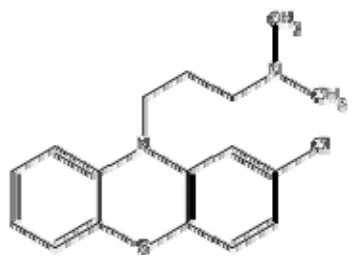
PART II: SCIENTIFIC INFORMATION
PHARMACEUTICAL INFORMATION
Drug Substance
Proper name: Chlorpromazine Hydrochloride
Chemical name: 10-H-Phenothiazine-10-propanamine, 2-chloro-N,N dimethyl-, monohydrochloride
or
2-Chloro-10-[3-(dimethylamino)propyl]phenothazine monohydrochloride
Molecular formula and molecular mass: C17H19ClN2S.HCl ; 355.33 Structural formula:
Physicochemical properties: White, Crystalline solid, Amine odor. Soluble in methanol, ethanol, chloroform. Practically insoluble in ether, benzene. Slightly acid to litmus.
REFERENCES
- 1.
ASHP Therapeutic Guidelines on the Pharmacologic Management of Nausea and
Vomiting in Adult and Pediatric Patients Receiving Chemotherapy or Radiation Therapy or Undergoing Surgery. American Journal of Health System Pharmcy. 1999 Apr
15;56(8):729-64.
- 2.
Johnson DA. Antipsychotic Medications: Clinical Guidelines for Maintenance Therapy. J
Clin Psychiatry. 1985 May;46(5 Pt 2):6-15.