


Product Monograph - NTP-Allopurinol
INDICATIONS AND CLINICAL USE
THIS IS NOT AN INNOCUOUS DRUG AND STRICT ATTENTION SHOULD BE GIVEN TO THE INDICATIONS FOR ITS USE. PENDING FURTHER INVESTIGATION, ITS USE IN OTHER HYPERURICEMIC STATES IS NOT INDICATED AT THIS TIME.
NTP-ALLOPURINOL (allopurinol) is intended for:
- 1. treatment of gout, either primary, or secondary to the hyperuricemia associated with blood dyscrasias and their therapy;
- 2. treatment of primary or secondary uric acid nephropathy, with or without accompanying symptoms of gout;
- 3. treatment of patients with recurrent uric acid renal stone formation;
- 4. prophylaxis of tissue urate deposition, renal calculi, or uric acid nephropathy in patients with leukemias, lymphomas and other malignancies who are receiving cancer chemotherapy with its resultant elevating effect on serum uric acid levels.
CONTRAINDICATIONS
NTP-ALLOPURINOL (allopurinol) is contraindicated for use in children with the exception of those with hyperuricemia secondary to malignancy. The drug should not be employed in nursing mothers.
PATIENTS WHO HAVE DEVELOPED A SEVERE REACTION TO NTP-ALLOPURINOL SHOULD NOT BE RESTARTED ON THE DRUG.
WARNINGS
NTP-ALLOPURINOL (ALLOPURINOL) SHOULD BE DISCONTINUED AT THE FIRST APPEARANCE OF SKIN RASH OR ANY SIGN OF ADVERSE REACTION. In some instances a skin rash may be followed by more severe hypersensitivity reactions such as exfoliative, urticarial and purpuric lesions as well as Stevens-Johnson syndrome (erythema multiforme) and very rarely a generalized vasculitis which may lead to irreversible hepatotoxicity and death.
A few cases of reversible clinical hepatotoxicity have been noted in patients taking NTP-ALLOPURINOL and in some patients asymptomatic rises in serum alkaline phosphatase or serum transaminase have been observed. Accordingly, periodic liver function tests should be performed during the early stages of therapy, particularly in patients with pre-existing liver disease.
Due to the occasional occurrence of drowsiness, patients should be alerted to the need for due precautions when engaging in activities where alertness is mandatory.
An increase in hepatic iron concentration has been reported in rats given allopurinol. Other investigators were unable to demonstrate that allopurinol has an effect on iron metabolism. Nevertheless, iron salts should not be given simultaneously with allopurinol. This drug should not be administered to immediate relatives of patients with idiopathic hemochromatosis.
In patients receiving mercaptopurine or azathioprine, the concomitant administration of 300-600 mg of allopurinol per day will require a reduction in dose to approximately one- third to one-fourth of the usual dose of mercaptopurine or azathioprine. Subsequent adjustment of doses of mercaptopurine or azathioprine should be made on the basis of therapeutic response and any toxic effects.
Usage in Pregnancy and Women of Childbearing Age:
Reproduction studies showed no adverse effect of allopurinol on animal litters. However, since the effect of xanthine oxidase inhibition on the human fetus is still unknown, allopurinol should be used in pregnant women or women of childbearing age only if the potential benefits to the patient are weighed against the possible risk to the fetus.
PRECAUTIONS
Some investigators have reported an increase in acute attacks of gout during the early stages of allopurinol administration, even when normal or subnormal serum uric acid levels have been attained. Accordingly, maintenance doses of colchicine (0.6 mg twice daily) generally should be given prophylactically when allopurinol is begun. In addition, it is recommended that the patient start with a low dose of allopurinol (100 mg daily) and increase at weekly intervals by 100 mg until a serum uric acid level of 6 mg per 100 ml or less is attained but without exceeding the maximal recommended dose. The use of therapeutic doses of colchicine or anti - inflammatory agents may be required to suppress attacks in some cases. The attacks usually become shorter and less severe after several months of therapy. A possible explanation for these flare-ups may be the mobilization of urates from tissue deposits followed by recrystallization, due to fluctuation in the serum uric acid level. Even with adequate therapy it may require several months to deplete the uric acid pool sufficiently to achieve control of the acute episodes.
The concomitant administration of a uricosuric agent with NTP-ALLOPURINOL may result in an increased excretion of urates and a decrease in urinary excretion of oxypurines as compared to their excretion with allopurinol alone. The latter may be possibly due to an increased excretion of oxypurinol and a lowering of the degree of inhibition of xanthine oxidase. Such combined therapy is not contraindicated, however, and for some patients, may provide optimum control. A report by Goldfinger et al on a patient treated with sulfinpyrazone and salicylates in addition to allopurinol showed a marked decrease in the excretion of oxypurines which they suggested was due to interference with their clearance at the renal tubular level. However, subsequent studies indicated no interference with oxypurine clearance by salicylates. Although clinical evidence to date has not demonstrated renal precipitation of oxypurines in patients either on allopurinol alone or in combination with uricosuric agents, the possibility should be kept in mind.
It has been reported that allopurinol prolongs the half-life of the anticoagulant dicumarol. The clinical significance of this has not been established, but this interaction should be kept in mind when allopurinol is given to patients already on anticoagulant therapy, and the coagulation time should be reassessed.
A fluid intake sufficient to yield a daily urinary output of at least 2 liters and the maintenance of a neutral or, preferably, slightly alkaline urine are desirable to (1) avoid the theoretic possibility of formation of xanthine calculi under the influence of NTP-ALLOPURINOL therapy and (2) help prevent renal precipitation of urates in patients receiving concomitant uricosuric agents.
A few patients with pre renal disease or poor urate clearance have shown a rise in BUN during allopurinol administration although a decrease in BUN also has been observed. Although the relationship of these observations to the drug has not been established, patients with impaired renal function require less drug and should be carefully observed during the early stages of NTP-ALLOPURINOL administration and the drug withdrawn if increased abnormalities in renal function appear.
In patients with severely impaired renal function, or decreased urate clearance, the half-life of oxypurinol in the plasma is greatly prolonged. Therefore, a dose of 100 mg per day or 300 mg twice a week, or perhaps less, may be sufficient to maintain adequate xanthine oxidase inhibition to reduce serum urate levels. Such patients should be treated with the lowest effective dose, in order to minimize side effects.
As with all new agents, periodic determination of liver and kidney function and complete blood counts should be performed especially during the first few months of therapy.
In the presence of allopurinol, there may be competition in the renal tubule for the excretion of chlorpropamide. When renal function is poor, the risk of prolonged hypoglycemic activity of chlorpropamide may be increased if NTP-ALLOPURINOL is given concomitantly.
ADVERSE REACTIONS
Dermatologic:
Because in some instances skin rash has been followed by severe hypersensitivity reactions, it is recommended that therapy be discontinued at the first sign of rash or other adverse reaction (see WARNINGS). Skin rash, usually maculopapular, is the adverse reaction most commonly reported. Exfoliative, urticarial and purpuric lesions, Stevens-Johnson syndrome (erythema multiforme) and toxic epidermal necrolysis have also been reported. A few cases of alopecia with and without accompanying dermatitis have been reported.
In some patients with a minor rash, restarting allopurinol therapy at lower doses (e.g. 50 mg/day) has been accomplished without untoward incident.
Gastrointestinal:
Nausea, vomiting, diarrhea and intermittent abdominal pain have been reported.
Vascular:
There have been rare instances of a generalized hypersensitivity vasculitis or necrotizing angiitis which have led to irreversible hepatotoxicity and death.
Hematopoietic
Agranulocytosis, anemia, aplastic anemia, bone marrow depression, leukopenia, pancytopenia, thrombocytopenia and reticulocytosis have been reported in patients, most of whom received concomitant drugs with potential for causing these reactions. Allopurinol has been neither implicated nor excluded as a cause of these reactions.
Neurologic:
There have been a few reports of peripheral neuritis occurring while patients were taking allopurinol. Drowsiness has also been reported in a few patients.
Ophthalmic:
There have been a few reports of cataracts found in patients receiving allopurinol. It is not known if the cataracts predated the allopurinol therapy. “Toxic” cataracts were reported in one patient who also received an anti-inflammatory agent; again, the time of onset is unknown. In a group of patients followed by Gutman and Yu for up to five years on allopurinol therapy, no evidence of ophthalmologic effect attributable to allopurinol was reported.
Drug Idiosyncrasy:
Symptoms suggestive of drug idiosyncrasy have been reported in a few patients. This was characterized by fever, chills, leukopenia or leukocytosis, eosinophilia, arthralgias, skin rash, pruritus, nausea and vomiting.
Whenever evidence of a hypersensitivity reaction occurs, allopurinol should be immediately and permanently discontinued.
SYMPTOMS AND TREATMENT OF OVERDOSAGE
Massive overdosing, or acute poisoning, by NTP-ALLOPURINOL (allopurinol) has not been reported. Therapeutic overdosage may result in nausea and vomiting which may be managed by discontinuing the use of allopurinol and assuring that the patient is adequately hydrated in order to promote excretion of the drug. Gastric lavage should be considered if other forms of acute distress are observed. Otherwise, the treatment is symptomatic.
DOSAGE AND ADMINISTRATION
The dosage of NTP-ALLOPURINOL (allopurinol) required to control gout and to lower serum uric acid to normal or near-normal levels varies with the severity of the disease. The minimum effective dosage is 100 to 200 mg/day. The average is 200 to 300 mg/day for patients with mild gout, and 400 to 600 mg/day for those with moderately severe tophaceous gout. The maximum recommended dosage is 800 mg/day. Dosages up to 300 mg/day may be given singly or in divided doses; divided doses are recommended for daily requirements in excess of 300 mg. Similar considerations govern the regulation of dosage for maintenance purposes in secondary hyperuricemia.
To reduce the possibility of precipitating acute gouty attacks during the initiation of therapy, start with 100 mg daily and increase this amount by 100 mg/day at weekly intervals until the serum uric acid falls to within the normal range (maximum normal values for serum uric acid are approximately 7 mg/dL in men and postmenopausal women, and 6 mg/dL in premenopausal women). Concomitant therapy with colchicine, 0.6 mg twice daily, or anti-inflammatory agents is recommended until normal serum uric acid and freedom from acute gouty attacks have been maintained for several months.
A fluid intake sufficient to maintain a daily urinary output of at least 2L and the maintenance of a neutral pH or, preferably, a slightly alkaline urine are desirable. Also, it should be noted that allopurinol is better tolerated when taken immediately after a meal.
Normal serum urate levels are achieved in 1 to 3 weeks. Too much reliance should not be placed on any single reading since, for technical reasons, the estimation of serum uric acid may be difficult. By the selection of appropriate dosage, together with the use of uricosuric agents in certain patients, it is possible to reduce the serum uric acid to normal and, if desired, to maintain it: as low as 2 to 3 mg/dL. The correct dosage and frequency of administration for maintaining a normal serum uric acid is best determined by using the latter as an index.
Since allopurinol and its metabolites are excreted only by the kidney, accumulation of the drug can occur in renal failure where the dosage consequently should be reduced. With a creatinine clearance of 20 to 10 mL/min, a daily dosage of 200 mg NTP-ALLOPURINOL is suitable. When the creatinine clearance is less than 10 mL/min, the daily dosage should not exceed 100 mg. With extreme renal impairment (creatinine clearance less than 3 mL/min) the interval between doses may also need to be lengthened.
For the prevention of uric acid nephropathy during the vigorous therapy of neoplastic disease, 600 to 800 mg of allopurinol may be given daily for 2 or 3 days prior to chemotherapy or radiotherapy. Subsequent dosage should be adjusted according to the level of serum uric acid until there is no longer a threat of hyperuricemia and hyperuricosuria. In prolonged treatment, 300 to 400 mg of NTP-ALLOPURINOL daily is usually enough to control the serum uric acid.
Children, 6 to 10 years of age, with secondary hyperuricemia associated with malignancies may be given 300 mg allopurinol daily. Those under 6 years of age are generally given 150 mg daily. The response is evaluated by measuring the serum uric acid after approximately 48 hours of therapy and a dosage adjustment is then made if necessary.
When transferring a patient from a uricosuric agent to NTP-ALLOPURINOL the dose of the uricosuric agent should be reduced gradually over a period of several weeks at the same time as the dose of allopurinol is increased gradually to that which is needed to maintain a normal level of serum uric acid.
AVAILABILITY
NTP-ALLOPURINOL is supplied as 100 mg white scored tablets in bottles of 100 and 500 as 200mg white scored tablets in bottles of 100 and 500 and as 300 mg white scored tablets in bottles of 100 and 1000.
PHARMACOLOGY
Chemistry:
Allopurinol is 1H-pyrazolo (3,4-d) pyrimidin-4-ol. Its chemical structure is as follows: 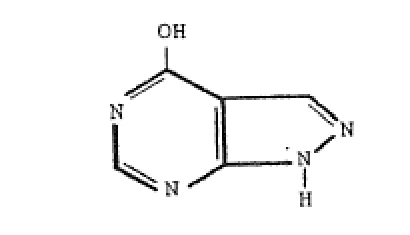
Molecular Formula: C5H4N40 Molecular Weight: 136.11
Allopurinol is a white, microcrystalline powder, very slightly soluble in water and ethanol; insoluble in ether; and readily soluble in solutions of the alkali hydroxides.
Allopurinol and its primary metabolite oxypurinol (alloxanthine) are inhibitors of xanthine oxidase. Inhibition of this enzyme accounts for the major pharmacological effects of this drug.
In man, uric acid is formed primarily by the xanthine oxidase- catalyzed oxidation of hypoxanthine and xanthine. At low concentrations, allopurinol is a substrate for and competitive inhibitor of the enzyme; at high concentrations, it is a non- competitive inhibitor. Oxypurinol, the metabolite of allopurinol formed by the action of xanthine oxidase, is a potent noncompetitive inhibitor of the enzyme; the formation of this compound, together with its long persistence in tissues, is undoubtedly responsible for much of the pharmacological activity of allopurinol. Inhibition of the penultimate and ultimate steps in uric acid biosynthesis reduces the plasma concentration and urinary excretion of uric acid and increases the plasma concentrations and renal excretion of the more soluble oxypurine precursors.
Pharmacokinetics: 7,8,23
Allopurinol is rapidly absorbed after oral ingestion and peak plasma concentration is reached within 30 to 60 minutes. About 20% is excreted in the feces in 48 to 72 hours, presumably as unabsorbed drug. Allopurinol is rapidly cleared from plasma with a half-life of 2 to 3 hours, primarily by oxidation conversion to oxypurinol (alloxanthine). Less than 10% of a single dose or about 30% of the drug ingested during chronic medication is excreted unchanged in the urine. Oxypurinol is slowly excreted in the urine by the net balance of glomerular filtration and probenecid-sensitive tubular reabsorption. The plasma half life of oxypurinol is 18 to 30 hours in patients with normal renal function and increases in proportion to the reduction of glomerular filtration in patients with renal impairment Allopurinol and oxypurinol are not bound to plasma proteins. Although alloxanthine is a less potent inhibitor of xanthine oxidase than allopurinol, the metabolite accumulates in the body during chronic administration of allopurinol and contributes significantly to the therapeutic effect of the drug.
Administration of allopurinol generally results in a fall in both serum and urinary uric acid within two to three days. The magnitude of this decrease can be manipulated to a certain extent by varying the dose of allopurinol almost at will since it is dose-dependent. A week or more of treatment with allopurinol may be required for the full effects of the drug to be manifest. Uric acid returns to pretreatment levels slowly, usually after a period of 7 to 10 days following cessation of therapy. This reflects primarily the accumulation and slow clearance of oxypurinol. In some patients, particularly those with tophaceous gout, a dramatic fall in urinary uric acid excretion may not occur. This may be due to the mobilization of urate from the tissue deposits as the serum uric acid level begins to fall.
The combined increase in hypoxanthine and xanthine excreted in the urine usually, but not always, is considerably less than the accompanying decline in urinary uric acid. This may be due to pseudo-feedback inhibition of purine biosynthesis by allopurinol ribonucleotide16. However, it has been shown that reutilization of both hypoxanthine and xanthine for nucleotide and nucleic acid synthesis is markedly enhanced when their oxidations are inhibited by allopurinol. This reutilization and the normal feedback inhibition which would result from an increase in available purine nucleotides serve to regulate purine biosynthesis, and, in essence, the defect of the over producer of uric acid is thereby compensated.
Innate deficiency of xanthine oxidase, which occurs in congenital xanthinuria as an inborn error of metabolism, has been shown to be compatible with normal health. While urinary levels of oxypurines attained with full doses of allopurinol may in exceptional cases equal those (250-600 mg per day) which in xanthinuric subjects have caused formation of urinary calculi, they usually fall in the range of 50-200 mg25. Xanthine crystalluria has been reported in a few exceptional cases.
The- serum concentration of oxypurines in patients receiving allopurinol is usually in the range of 0.3 mg to 0.4 mg percent compared to a normal level of approximately 0.15 mg/100 ml. A maximum of 0.9 mg percent was observed when the serum urate was lowered to less than 2 mg/100 ml with high doses of the drug. In one exceptional case a value of 2.7 mg/100 ml was reached.25 These are far below the saturation level at which precipitation of xanthine or hypoxanthine would be expected to occur.
The solubilities of uric acid and xanthine in the serum are similar (about 7 mg/100 ml) while hypoxanthine is much more soluble. The finding that the renal clearance of oxypurines is at least 10 times greater than that of uric acid explains the relatively low serum oxypurine concentration at a time when serum uric acid level has decreased markedly. At serum oxypurine levels of 0.3 mg to 0.9 mg/100 ml, oxypurine: inulin clearance ratios were between 0.7 and 1.925. Glomerular filtration rate and urate clearance in patients receiving allopurinol do not differ significantly from those obtained prior to therapy. The rapid renal clearance of oxypurines suggests that allopurinol therapy should be of value in allowing a patient with gout to increase his total purine excretion.
ANIMAL_TOXICOLOGY
The acute oral toxicity of allopurinol administered orally to mice and rats is as follows24:
Mice LD50 - 530 (95% C.L. 387—726) mg/kg body weight
Rats LD50 - 5400 (95% C.L. 4218-6912) mg/kg body weight
It has been reported that in a 13-week feeding experiment in rats at a drug level of 72 mg/kg per day, 2 of 10 rats died and at 225 mg/kg per day, 4 of 10 died before the completion of the experiment. Both groups exhibited renal tubular damage due to the deposition of xanthine that was more extensive at the higher dose25.
In chronic feeding experiments, rats showed no toxic effects at a level of 14 mg/kg per day after one year. At a level of 24 mg/kg per day for one year the rats showed very slight depression of weight gain and food intake and 5 out of 10 of the animals showed minor changes in the kidney tubules of the type exhibited by the rats on the higher doses described above 25.
Dogs survived oral doses of 30 mg/kg per day for one year with nil to minor changes in the kidney and no other significant abnormalities. At 90 mg/kg per day for one year there was some accumulation of xanthine in the kidneys with resultant chronic irritation and slight tubular changes. Occasional hemosiderin-like deposits were seen in the reticuloendothelial system. A higher dose (270 mg/kg per day) resulted in large concretions in the renal pelves, with severe destructive changes in the kidney secondary to xanthine accumulation. The deposition of xanthine appears to be a function both of the metabolic turnover of purines (which is proportionately larger in the smaller animals) and the degree of inhibition of xanthine oxidase25.
Reproduction studies in rats and rabbits indicated that allopurinol did not affect litter size, the mean weight of the progeny at birth or at three -weeks postpartum, nor did it cause an increase in the number of animals born dead or with malformations25.
BIBLIOGRAPHY
- 1.
Bartels, E.C.: Allopurinol (xanthine oxidase inhibitor) in the treatment of resistant gout:.
J.A.M.A. 198(7):708-712, 1966.
- 2. Bragonier, J.R. et al.: Teratogenesis: Effects of substituted purines and the influence of 4-hydroxy- pyrazolopyrimidine in the rat. Proc. Soc. Exptl. Biol. Med., 116:685-688, 1964.
- 3.
Brewis, I., Ellis, R.M. and Scott, J.T.: Single daily dose of allopurinol. Ann. Rheum. Dis.,
34(3):256-259, 1975.
- 4.
Briney, W.G. et al.: The influence of allopurinol on renal function in gout. Arth. Rheum.
18(6):Suppl. 877-881, 1975.
- 5. DeConti, R.C. and Calabresi, P.: Use of allopurinol for prevention and control of hyperuricemia in patients with neoplastic disease. New Eng. J. Med. 274(9):481-486, 1966.
- 6.
Elion, G.B., Callahan, S., Nathan, H., Bieber, S., Rundles, R.W. and Hitchings, G.H.:
Potentiation by inhibition of drug degradations: 6-substituted purines and xanthine oxidase. Biochem. Pharmacol. 12:85-93, 1963.
- 7. Elion, G.E., Kovensky, A., Hitchinys, G.H., Metz, E. and Rundles, R.W.: Metabolic studies of allopurinol, an inhibitor of xanthine oxidase. Biochem. Pharmacol., 15:863-880, 1966.
- 8. Elion, G.B., Yu, Ts’Ai-Fan, Gutman, A.B. and Hitchings, G..H.: Renal clearance of oxypurinol, the chief metabolite of allopurinol. Am. J. Med., 45:69-77, 1968.
- 9.
Fraser, D., Little, A.H. and Bartle, Wm. R.: Efficacy of allopurinol in single daily dose. Can.
Fam. Physician, 23:87-91, 1977.
- 10.
Goldfinger, S., Klinenberg, J.R. and Seegmiller, J.E.: The renal excretion of oxypurines. J.
Clin. Invest., 44(4):623-628, 1965.
- 11. Hitchings, G.H. Pharmacology of allopurinol. Arth. Rheum., 18(6)Suppl.:863-870, 1975.
- 12.
Krakoff, I.H. and Meyer, R.L.: Prevention of hyperuricemia in leukemia and lymphoma.
J.A.M.A., 193(1):l-6, 1965.
- 13. Krakoff, I.H.: Clinical pharmacology of drugs which influence uric acid production and excretion. Clin. Pharmacol. Therap, 8:124-138, 1967.
- 14. Landgrebe, A.R., Nyhan, W.L. and Coleman, N.: Urinary tract stones resulting from the excretion of oxypurinol. New Eng. J. Med., 292(12):626-627, 1975.
- 15.
Loebl, W.Y. and Scott, J.T.: Withdrawal of allopurinol in patients with gout. Ann. Rheum.
Dis., 33:304-307, 1974.
- 16. McCollister, R.J., Gilbert, W.R. Jr., Ashton, D.N. and Wyngaarden, J.B.: Pseudo feedback inhibition of purine synthesis by 6-mercaptopurine ribonucleotide and other purine analogues. J. Biol. Chem., 239(5):1560-1563, 1964.
- 17. Mikkelsen, W.M., Strottman, M.P. and Thompson, G.R.: The effects of allopurinol on serum and urinary uric acid. Arch. Int. Med., 118:224-228, 1966.
- 18. Muggia, F.M., Ball, T.J. Jr. and Ultmann, J.E.: Allopurinol in the treatment of neoplastic disease complicated by hyperuricemia. Arch. Int. Med., 120:12-18, 1967.
- 19. Ogryzlo, M.A., Urowitz, M.B., Weber, U.N. and Houpt, J.B.: The treatment of gout and disorders of uric acid metabolism with allopurinol. C.M.A.J., 95:1120-1127, 1966.
- 20. Rodnan, G.P., Robin, J.A., Toichin, S.F. and Elion, G.E.: Allopurinol and gouty hyperuricemia: Efficacy of a single daily dose. J.A.M.A. 231(l1):1143-1147, 1975.
- 21. Rundles, R.W., Wyngaarden, J.B., Hitching, G.E., Elion, G.E. and Silberman, H.R.: Effects of an xanthine oxidase inhibitor on thiopurine metabolism, hyperuricemia and gout. Trans. Am. Assoc. Physicians, 76:126-140, 1963.
- 22.
Yu, Ts Ai-Fun and Gutman, A.B.: Effect of allopurinol 4-hydroxypyrazolo-(3,4-d)
pyrimidine on serum and urinary uric acid in primary and secondary gout. Am. J. Med., 37:885-898, 1964.
- 23.
Flower, R.J., Moncada, S. and Vane, J.R.: Allopurinol Monograph in Goodman & Gilman’s
The Pharmacological Basis of Therapeutics, A.G. Gilman, L.S. Goodman and A. Gilman, eds., 6th ed., p. 720-722, Collier MacMillan Canada, Toronto, 1980.
- 24.
Acute Oral Toxicity of Allopurinol in Mice and Rats. Research Report #5672 on file at
Novopharm Ltd., Toronto, Jan. 7, 1977.
- 25.
Zyloprim (Allopurinol) Product Monograph, Burroughs Wellcome Ltd., LaSalle, Quebec, p.
11-12, Mar. 9, 1976.