


Product Monograph - Nyda
1 INDICATIONS
Dimethicone 100 cSt (NYDA) is indicated for:
Topical treatment of scalp hair in case of infestation with head lice (pediculosis capitis). If used as instructed, NYDA is also effective against nymphs and eggs (nits)
1.1 Pediatrics
Clinical studies have been performed in children; therefore, NYDA can be used with children from ages 2 and up.
1.2 Geriatrics
No clinical studies have been performed in elderly patients; however, the use of NYDA should not be of concern.
2 CONTRAINDICATIONS
NYDA is contraindicated in patients who are hypersensitive to this drug or to any ingredient in the formulation, including any non-medicinal ingredient, or component of the container. For a complete listing, see 6 DOSAGE FORMS, STRENGTHS, COMPOSITION AND PACKAGING.
NYDA should not be used in pregnant or breast-feeding women or in children under the age of 2 because of lack of experience in these patient groups.
4 DOSAGE AND ADMINISTRATION
4.2 Recommended Dose and dosage Adjustment
Appropriate dosage for adult and/or children (2 years or older).
NYDA is sprayed carefully over the whole hair. The solution should be massaged in well until the hair is completely wetted with the solution.
The amount of NYDA needed depends on the thickness and length of the hair. The hair near the scalp and behind the ears should be well covered with NYDA, as this is where most lice and nits are found. NYDA should be left on for at least 30 minutes.
Table 1: Appropriate dosage for adult and /or children (2years or older)
| Hair Length | Average vol. per appl. (mL) |
| Short | 10 |
| Shoulder length (medium) | 18 |
| Long | 22 |
| Very Long | 34 |
4.4 Administration
Before NYDA is used for the first time, the enclosed dispensing pump must be screwed onto the glass bottle. Always hold the spray bottle upright or the pump will not be able to work properly. Please note that the pump will need to be primed, by pumping, when used for the first time and when it has been unused for a long period.
Before treatment with NYDA
Inspect all scalp hair of each family member or care giver with the NYDA lice comb. Treat everyone with lice on the same day to avoid re-infestation. A normal comb or brush can be used before treatment to remove any tangles. This comb should be cleaned thoroughly after use. Cover the shoulders with a towel to protect the clothing.
Administration of NYDA
NYDA should be applied to dry hair.
- 1. The infested hair should be completely covered with NYDA and left for 30 minutes. NYDA is sprayed carefully over the whole hair. The solution should be massaged in well until the hair is completely wetted with the solution. This can be done using the lice comb, for example. This ensures that all lice, nymphs and nits come into contact with this solution and that the product can work with optimum efficacy.
- 2. After 30 minutes, the hair may be carefully combed using a lice comb. After NYDA has been left on for at least 30 minutes, the hair may be combed carefully with the lice comb to remove the suffocated lice and nymphs. NYDA makes combing easier because it contains special ingredients which make even long hair very easy to comb.
- 3. The hair should be left to dry for at least 8 hours (e.g. overnight).
- 4. The hair can then be washed with normal commercial shampoo.
- 5. After 8 to 10 days, the treatment must be repeated. For complete control of head lice and nits, the treatment must be repeated as described above after 8 to 10 days.
4.5 Missed Dose
In case the second treatment (8 to 10 days after the first treatment) was missed, the hair must be checked for live lice. If live lice are found, the treatment as described in 4.4 Administration must be repeated. In case no life lice are found, no further action is required.
5 OVERDOSAGE
In case of oral ingestion, contact a healthcare practitioner (e.g. doctor), hospital emergency department or regional Poison Control Centre, even if there are no symptoms.
| For management of a suspected drug overdose, contact your regional poison control centre. |
6 DOSAGE FORMS, STRENGTHS, COMPOSITION AND PACKAGING
Table 2: Dosage Forms, Strengths, Composition and Packaging
NYDA (Dimethicone 100 cSt) is supplied in a 50 mL amber glass bottle with a white screw cap.
NYDA’s (Dimethicone 100 cSt) package includes the 50 mL amber glass bottle containing dimethicone 100 cSt solution, a lice comb and a spray nozzle.
7 WARNINGS AND PRECAUTIONS
General
For external use only.
Patients should be told that NYDA could react with certain hair care and hair tinting products.
Patients should be told to keep away from any open flame or intense heat source which use an open flame and to keep away of any sources of ignition and not to smoke while using this product as the mixture is volatile.
If NYDA is spilled accidentally, there is a danger of slipping. Spillages should therefore be cleaned up immediately.
Ear/Nose/Throat
Patients should be warned to not use NYDA near the mucosa membranes (nose). Patients should be warned to avoid inhaling NYDA.
Gastrointestinal
Patients should be warned to not use NYDA near the mucosa membranes (nose or mouth).
Patients should be warned to avoid ingesting NYDA
Ophthalmologic
Patients should be warned to not use NYDA near the eyes. If product gets into their eyes, patients should immediately rinse for 10-15 minutes with water.
Reproductive Health: Female and Male Potential
See sections 2 Contraindications and 6.1.1 Pregnant and Breast-Feeding Women
Respiratory
Patients should be warned to avoid inhaling NYDA.
7.1 Special Populations
7.1.1 Pregnant Women
No clinical studies have been performed in pregnant women; therefore, NYDA should be used with caution.
| Route of Administration | Dosage Form / Strength/Composition | Non-medicinal Ingredients |
| Topical | solution, 50% w/w | Alpha-terpineol Boabo oil Jojoba wax Low viscosity dimethicone Medium chain triglycerides |
7.1.2 Breast-Feeding Women
No clinical studies have been performed in breast-feeding women; therefore, NYDA should be used with caution.
7.1.3 Pediatrics
Pediatrics (children less than 2 years of age): No data are available to Health Canada; therefore, Health Canada has not authorized an indication for children under the age of 2.
7.1.4 Geriatrics
No clinical studies have been performed in elderly patients; however, the use of NYDA should not be of concern.
8 ADVERSE REACTIONS
8.1 Adverse Reaction Overview
In a clinical study, 145 subjects were treated with either NYDA or with a permethrin-based product. The number of subjects experiencing any adverse events was similar in both groups.
In the NYDA group, 29 adverse events were reported in 25 participants; all but two of them were classified as being unrelated to the treatment (e.g., superficial wound after a fall, otitis externa following swimming in a pool). Two subjects in the NYDA group experienced ocular irritation after treatment when the product entered the eyes. The irritation resolved spontaneously in both cases after washing the eyes with clean water.
In a large Postmarketing Surveillance Study in Germany, (833 patients) a total of six adverse events were reported; these included four occurrences of a bothersome hair odour and one occurrence each of a headache and a burning sensation in the eyes.
9 DRUG INTERACTIONS
No drug interaction studies have been conducted for NYDA.
10 CLINICAL PHARMACOLOGY
10.1 Mechanism of Action
The efficacy of NYDA is exclusively based on a physical mode of action. This is important given the resistance present for current pesticide therapies approved in Canada. The “point of attack” of the physical mode of action of NYDA is the insect’s respiratory system. NYDA works by suffocating the lice, nymphs and the embryos in the eggs. The unique physical properties including the viscosity and creeping/spreading properties of this solution allow it to readily flow into the breathing system of all developmental stages of the insect, thus leading irreversibly to suffocation and death. It creeps through the stigmata (spiracles) deep into the tracheae of the head lice as well as through the aeropyles of the operculum of the eggs inside the eggs. When it reaches there, the solution displaces the air (oxygen). The low viscosity, volatile dimethicone enables the NYDA solution to penetrate into the breathing system. Its evaporation causes the thickening of the NYDA solution. The remaining high viscosity dimethicone finally seals the respiratory system and thus leading to suffocation of all stages of head lice (adult lice, larvae and eggs). This mode of action prevents development of resistance.
Studies done with house crickets and lice demonstrate a close correlation between death of the lice and the influx of the solution into the head tracheae. This strongly suggests that the complete filling of the head tracheae effectively and immediately blocks the oxygen supply of the central nervous system. Death, following various phases of disability after the entrance of dimethicone into the abdominal tracheal system, reflects the sequence of oxygen deprivation. This is further supported by the fact that NYDA had no effect on the insect when applied solely to the outside of the head or mouth. If the solution had a chemical neurotoxic effect, similar to permethrin or other chemical insecticides, one would expect mortality to occur upon contact, regardless of where the solution is applied on the body of the insect.
11 STORAGE, STABILITY AND DISPOSAL
Store between 15-30°C.
In order to prevent accidental ingestion by children, the remaining contents of NYDA should be discarded after use.
12 SPECIAL HANDLING INSTRUCTIONS
Keep away from heat, and open flames.
Do not smoke while using product as the mixture is volatile.
If NYDA is spilled accidentally, there is a danger of slipping. Spillages should therefore be cleaned up immediately.
PART II: SCIENTIFIC INFORMATION
13 PHARMACEUTICAL INFORMATION
Drug Substance
Proper name: Dimethicone (dimethicone) 100 cSt
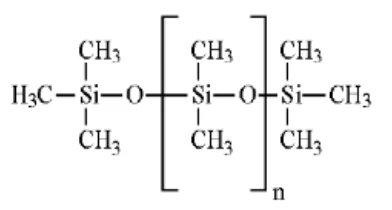
Chemical name: poly(dimethylsiloxane)
Molecular formula and molecular mass: CH3[Si(CH3)2O]nSi(CH3)3
Structural formula:
Physicochemical properties:
Dimethicone 100 cSt is a clear, colorless, hydrophobic liquid. Dimethicone 100 cSt is miscible with many organic solvents such as ethyl acetate or methyl ethyl ketone. It is sparingly soluble in ethanol (ratio of 1:9) and insoluble in water. The refractive index at 25°C for dimethicone 100 cSt is 1.4032. Dimethicone 100 cSt has a low surface tension and can therefore coat most surfaces.
14 CLINICAL TRIALS
- 1.
A randomized, controlled, observer-blinded study was performed in 145 infested children (ages 5-15 years) in Brazil. The study was registered in the database of the Brazilian Ministry of Health for studies involving human subjects. Lice infestation and its relative intensity for each subject were verified by visual inspection prior to treatment by a trained observer without combing. Combing was not used because this may have affected the number of lice present on the subject’s hair prior to treatment and thus may confound the
results. Participants with head lice were randomized to receive either topical treatment with a solution exactly equivalent in composition to NYDA or to topical permethrin 1% aqueous solution.
Table 3: Overall cure rates one day after first and second treatment
The number of subjects experiencing any adverse events was similar in both groups.
In the dimethicone group, 29 adverse events were reported in 25 participants; all but two of them were classified as being unrelated to the device or the treatment (e.g., superficial wound after a fall, otitis externa following swimming in a pool). Two subjects in the NYDA group experienced ocular irritation after treatment when the product entered the eyes. The irritation resolved spontaneously in both cases after washing the eyes with clean water. In the permethrin group, 32 adverse events were reported in 26 subjects. None of the adverse events were deemed to be related to the product.
- 2.
A large post marketing surveillance study (PMSS) was conducted in Germany with NYDA. In this investigation 833 patients (191 male, 642 female) from a total of 296 pediatric and general practitioner practices took part. The average age was 8.84 years (median 8 years), with the youngest participant being 1 year and the oldest being 58 years of age. Of the 781 patients in the ITT group, 97.4% were free of head lice after one or two treatments (95% confidence interval 96.8 - 99.1%). For the whole study population (833 patients) a total of six adverse events were reported; these included four occurrences of a bothersome hair odour and one occurrence each of a headache and a burning sensation in the eyes.
Table 4: Studies completed with NYDA
| Title | Purpose |
|---|---|
| In vitro studies to demonstrate physical mode of action | Demonstrate that NYDA works by a physical mode of action; show that the fragrance components have no impact on the pediculicidal effect. |
| In vitro Study on the Efficacy of the Dimeticone-Based Pediculicide NYDA and of Three Reference Medical Products Against Human Head Lice (Pediculus humanus capitis) | Examination of the pediculicidal efficacy of NYDA in comparison to three reference products. |
| Comparative in-vitro Study on the Efficacy of Five Head Lice Products Against Human Head Lice | Examination of the pediculicidal efficacy of NYDA in comparison to four reference products. |
| NYDA | Permethrin | P value | ||||||||||
| Cured/total | % | Cured/total | % | |||||||||
| Day 2 | 69/73 | 94.5% | 48/72 | 66.7% | P<0.0001 | |||||||
| Day 9 | 70/72 | 97.2% | 48/71 | 67.6% | P<0.0001 | |||||||
| Title | Purpose |
|---|---|
| Ovicidal Efficacy of NYDA, Infectopedicul®, Mosquito® Lauseshampoo, Goldgeist® forte and Etopril® against Young and Mature Eggs of Human Head Lice | Examination of the ovicidal efficacy of NYDA on young and mature eggs of head lice in comparison to several other lice treatments. |
| Ovicidal response of NYDA formulations on the human head louse (Anoplura: Pediculidae) using a hair tuft bioassay | Demonstrate 100% ovicidal effect after 8-h exposure of the eggs of the permethrin-resistant human head lice. |
14.1 Trial Design and Study Demographics
Trial Design and Study Demographics:
Table 5: Summary of patient demographics for clinical trials in head lice infestation
| Study # | Study design | Dosage, route of administration and duration | Study subjects (n) | Mean age (Range) | Sex |
| 1. | randomized, controlled, observer-blinded study | topical administration of 2 individual amounts of dimethicone according to hair length 7 days apart (application time 8 to 18 hours) | 145 | 5 – 15 years | m / f |
| 2. | prospective, open, multi-centre observational study | topical administration of 2 individual amounts of dimethicone according to hair length 8-10 days apart (application time 8 to 18 hours) | 833 | 1 – 58 years | m / f |
14.2 Study Results
Table 6: Results of study 1. in head lice infestation
| Primary Endpoints | Associated value and statistical significance for NYDA at specific dosages | Associated value and statistical significance for Permethrin | P value |
| proportion of participants cured of head lice infestation one and eight days after the first treatment | day 2 69/73 (94.5%) day 9 70/72 (97.2%) | day 2 48/72 (66.7%) day 9 48/71 (67.6) | P < 0.0001 P < 0.0001 |
Table 7: Results of study 2. in head lice infestation
| Primary Endpoints | Associated value and statistical significance for Drug at specific dosages | Associated value and statistical significance for Placebo or active control |
| proportion of participants cured of head lice infestation after one or two treatments | 97.4% (intent-to-treat population) | not applicable |
16 NON-CLINICAL TOXICOLOGY
The following studies have been conducted with NYDA:
Table 8: Non-clinical toxicology studies
| Test | Result | Test article | Conclusion |
| Cytotoxicity | None of the extract concentrations showed any cytotoxic reactions. | NYDA without fragrances | NYDA without fragrances is not cytotoxic. |
| Irritation (Intracutaneous Reactivity) | No irritant effects on intact skin after a contact time of 4 hours. | NYDA | No irritant/corrosive effects and NYDA is classified into the lowest response category (negligible). |
| Sensitization | The test item caused no reactions identified as sensitization. | NYDA | No sensitizing properties. |
| Acute Eye Irritation | Slight irritation (Redness of conjunctivae (grade 1)) in 2 out of 3 test animals at 24 hours post instillation, changes were fully reversible within 48 hours. | NYDA | Not an-eye irritant. |