


Patient Medication Information: uses, side effects, how to take - Obodence
What OBODENCE is used for:
treatment of osteoporosis (thinning and weakening of the bone) in women after menopause who
- have an increased risk for fractures or;
- cannot use other osteoporosis medicines, or other osteoporosis medicines did not work well.
- to increase bone mass in men with osteoporosis at high risk for fracture.
- to increase bone mass and may reduce fractures that occur when medication to reduce testosterone levels are taken for the treatment of prostate cancer that has not spread to other parts of the body (nonmetastatic).
- to increase bone mass in women who are receiving certain treatments for breast cancer, which has not spread to other parts of the body (nonmetastatic) and at high risk of fracture.
- to increase bone mass to treat osteoporosis in both women and men at high risk for fracture related to the use of corticosteroid medicines, such as prednisone.
- to increase bone mass to prevent osteoporosis in both women and men at high risk for fracture related to starting corticosteroid medicines, such as prednisone.
How OBODENCE works:
OBODENCE works differently than other osteoporosis medications. It is a RANK ligand inhibitor. RANK ligand is a protein which activates the cells that break down bone (osteoclasts). OBODENCE blocks RANK ligand to stop the cells that break down bone. This action strengthens your bones by increasing bone mass and lowers the chance of breaking bones of the hip, spine, and nonspinal sites.
The ingredients in OBODENCE are:
Medicinal ingredients: denosumab.
Nonmedicinal ingredients: histidine, histidine hydrochloride monohydrate, polysorbate 20, sorbitol, and water for injection. The prefilled syringe is not made with natural rubber latex.
OBODENCE comes in the following dosage form:
OBODENCE is a liquid for injection, available in a prefilled syringe.
Do not use OBODENCE if:
- you are allergic to denosumab or any other ingredient of OBODENCE. Allergic reactions (eg, rash, hives, or in rare cases, swelling of the face, lips, tongue, throat, or trouble breathing) have been reported.
- you have low calcium levels in your blood (hypocalcemia).
- you are less than 18 years of age (see also What OBODENCE is used for above and Other warnings you should know about below).
you are pregnant or breastfeeding.
- you are a woman before menopause [unless you have been diagnosed with breast cancer or are taking OBODENCE for the treatment or prevention of osteoporosis related to the use of corticosteroid medicines (see also What is OBODENCE used for above and Other warnings you should know about below)].
- you are currently taking other denosumab-containing medicinal products.
- you do not have access to a health professional or trained injector.
To help avoid side effects and ensure proper use, talk to your healthcare professional before you take OBODENCE. Talk about any health conditions or problems you may have, including if you:
- Have low blood calcium.
- Cannot take daily calcium and vitamin D.
- Had parathyroid or thyroid surgery (glands located in your neck).
- Have been told you have trouble absorbing minerals in your stomach or intestines (malabsorption syndrome).
- Have kidney problems or are on kidney dialysis.
- Have ever had an allergic reaction to OBODENCE.
- Plan to have dental surgery or teeth removed.
- Have a history of cancer.
- Are pregnant or could become pregnant.
OBODENCE may interfere with normal bone and tooth development in fetuses, nursing babies, and children under 18 years of age. OBODENCE is not indicated for use in patients under 18 years of age.
Do not take OBODENCE if you are pregnant or could become pregnant as OBODENCE may harm your unborn baby. Your healthcare provider should do a pregnancy test before you start treatment with OBODENCE. You should use an effective method of birth control (contraception) during treatment with OBODENCE and for at least 5 months after your last dose of OBODENCE. If you become pregnant while taking OBODENCE, stop taking OBODENCE and tell your doctor right away.
Nursing mothers should not take OBODENCE. It may also interfere with breastfeeding.
OBODENCE may lower levels of calcium in the blood. If you are prone to low calcium levels, your doctor will monitor your blood, especially in the first few weeks after starting OBODENCE.
Severe low blood calcium levels may lead to hospitalization, life-threatening events, and death. Low blood calcium should be treated before receiving OBODENCE. Symptoms of low blood calcium may include muscle spasms, twitches, cramps, numbness or tingling in hands, feet or around the mouth, and weakness. Some patients may not have any symptoms of low calcium. Tell your doctor if you have any of these symptoms. Tell your doctor if you have or have had severe kidney problems as this may increase your risk of getting low blood calcium.
Tell your doctor right away if you have symptoms of infection, including:
- Fever or chills
- Skin that looks red, swollen, hot or tender to touch
- Severe abdominal pain
- Frequent or urgent need to urinate or burning feeling when you urinate
Tell your doctor if you have any of the following symptoms of skin problems that do not go away or get worse:
- Redness
- Itching
- Rash
- Dry or leathery skin
- Open, crusted or peeling skin
- Blisters
After you start OBODENCE:
- Take good care of your teeth and gums, and see your dentist regularly.
- If you have a history of dental problems (such as poorly fitting dentures or gum disease), see your dentist before starting OBODENCE.
- Tell your dentist that you are taking OBODENCE, especially if you are having dental work.
A dental condition called osteonecrosis of the jaw (ONJ) which can cause tooth and jawbone loss has been reported in patients treated with OBODENCE. The risk of ONJ may increase with length of time on OBODENCE. Tell your doctor and dentist immediately about any dental symptoms, including pain or unusual feeling in your teeth or gums, or any dental infections.
Some people have developed unusual fractures in their thigh bone. Contact your doctor if you experience new or unusual pain in your hip, groin, or thigh.
After your treatment with OBODENCE is stopped, it is possible that broken bones in your spine may occur especially if you have a history of broken bones in the spine. Do not stop taking OBODENCE without first talking with your doctor. If your OBODENCE treatment is stopped, discuss other available treatment options with your doctor.
Other warnings you should know about:
OBODENCE contains the medicine denosumab. If you are being treated with OBODENCE, you should not be taking other medicines containing denosumab.
There is an increased risk of skin infection (cellulitis) with OBODENCE therapy, most commonly on the leg. See a doctor urgently if you develop swollen, red, hot or painful skin, with or without fever.
You should take calcium and vitamin D supplements as recommended by your healthcare professional.
Tell your healthcare professional about all the medicines you take, including any drugs, vitamins, minerals, natural supplements or alternative medicines.
The following may interact with OBODENCE:
In a drug interaction study, denosumab (60 mg) did not interfere with the action of a drug called midazolam which is metabolized (broken down) by a certain liver enzyme called cytochrome P450 3A4. No drug interactions are expected with denosumab and other drugs metabolised by this enzyme in women with postmenopausal osteoporosis.
You should discuss with your doctor any medications or vitamins or herbal products you are taking before using OBODENCE.
How to take OBODENCE:
OBODENCE is a clear, colourless to slightly yellow solution. Do not use if the solution looks cloudy or is leaking.
OBODENCE is administered as a single injection under the skin (subcutaneous) every 6 months. The injection can be in your upper arm, upper thigh, or abdomen. It can be given any time with or without food by a healthcare professional, by a trained injector, or a patient may self-inject if a healthcare professional determines that is appropriate.
Your prefilled syringe may be left outside the refrigerator to reach room temperature (up to 25°C) before injection. This will make the injection more comfortable. See instructions for injection.
Keep all medicines, including OBODENCE, away from children.
Do not share a OBODENCE product with others, even if they have a similar disease.
The following instructions are for preparing and giving an injection of OBODENCE using a single-use prefilled syringe with a needle guard:
| Guide to parts | |||
| Before use | After use | ||
| Important: The needle is covered by the needle cap before use. |
Important:
Before you use a OBODENCE prefilled syringe, read this important information:
Using the prefilled syringe
- Administration should be performed by an individual who has been trained in injection techniques. This includes patients who have been deemed appropriate by their healthcare professional to administer OBODENCE.
- Make sure the name OBODENCE appears on the carton and prefilled syringe label.
- Check the carton and prefilled syringe label to make sure the dose strength is 60 mg.
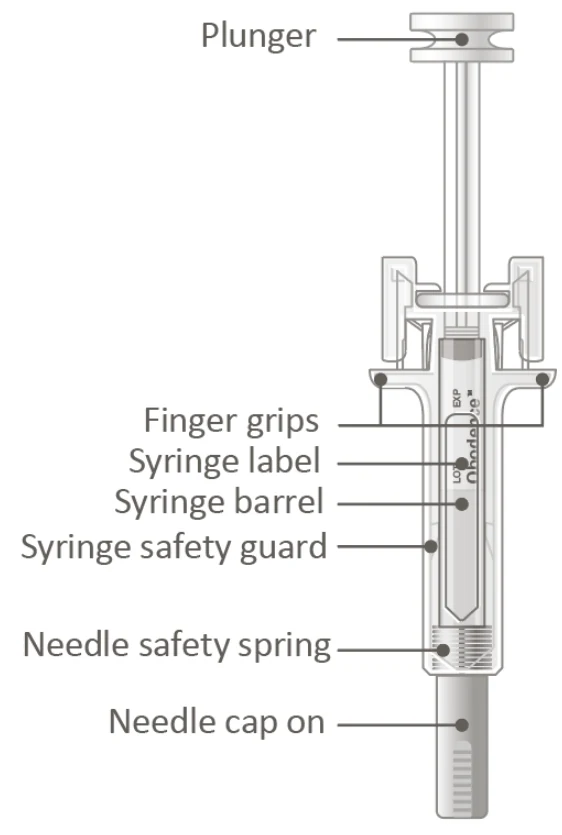 | 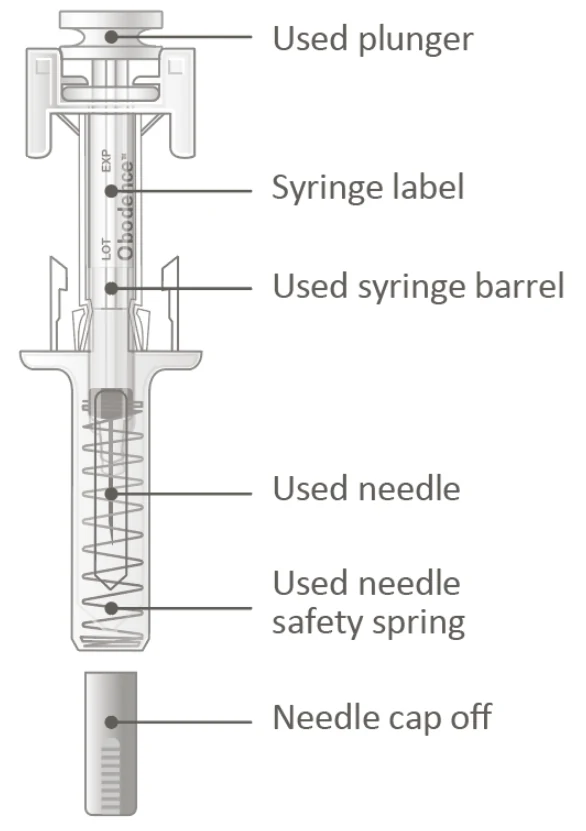 |
- Do NOT use a syringe after the expiration date on the label.
- Do NOT shake the syringe.
- Do NOT remove the needle cap from the syringe until you are ready to inject.
- Do NOT use the syringe if the carton is open or damaged.
- Do NOT use a syringe if it has been dropped on a hard surface. Part of the syringe may be broken even if you cannot see the break. Use a new syringe.
- The prefilled syringe is not made with natural rubber latex.
Call your healthcare provider or X-XXX-XXX-XXXX if you have any questions.
Step 1: Prepare
- A. Remove the prefilled syringe carton from the refrigerator.
On a clean, well-lit surface, place the syringe at room temperature for 15-30 minutes before you give an injection.
- Do NOT use the prefilled syringe if the carton is damaged.
- Do NOT try to warm the prefilled syringe by using a heat source such as hot water or microwave.
- Do NOT leave the prefilled syringe in direct sunlight.
- Do NOT shake the prefilled syringe.
Grab the safety guard to remove the prefilled syringe from the package.
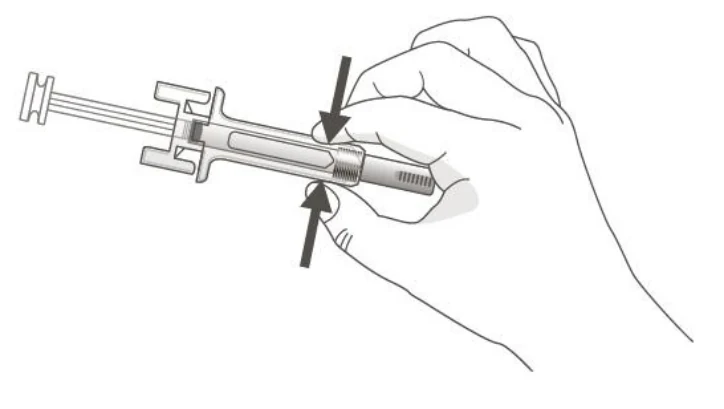
Grab Safety Guard
For safety reasons:
- Do NOT grab the plunger.
- Do NOT grab the needle cap.
- Inspect the medicine and prefilled syringe.
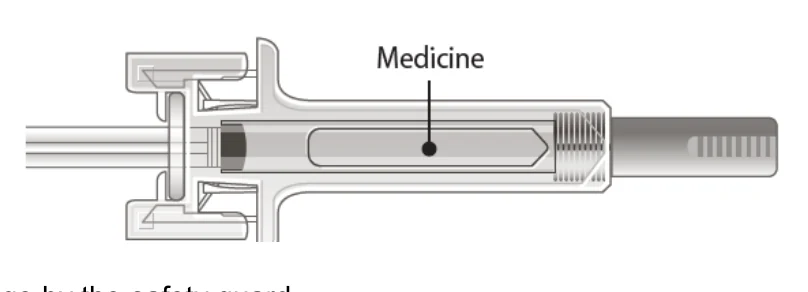
Always hold the syringe by the safety guard.
Make sure the medicine in the prefilled syringe is clear and colourless to slightly yellow.
Do NOT use the prefilled syringe if:
- The medicine is cloudy or discoloured.
- Any part appears cracked or broken.
- The prefilled syringe has been dropped.
- The needle cap is missing or not securely attached.
- The expiration date printed on the label has passed.
In all cases, use a new prefilled syringe and call your healthcare professional or X-XXX-XXX-XXXX.
- C. Gather all materials needed for the injection. Wash your hands thoroughly with soap and water. On a clean, well-lit work surface, place the:
- • Prefilled syringe
- • Alcohol wipe
- • Cotton ball or gauze pad
- • Adhesive bandage
- • Sharps disposal container
Step 2: Get ready
- A. Prepare and clean the injection site
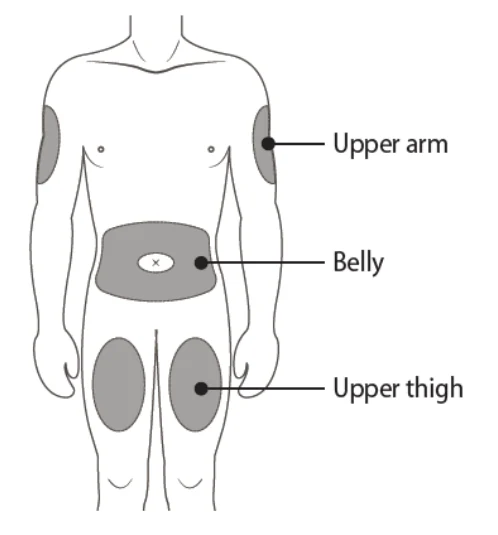
You can use:
- Upper thigh
- Stomach area (abdomen), except for a 5 cm (2-inch) area right around the navel (belly button)
- Outer area of upper arm (only if someone else is giving you the injection). Clean the injection site with an alcohol wipe. Let the skin dry.
- Do NOT touch this area again before injecting.
- Do NOT inject into areas where the skin is tender, bruised, red, or hard. Avoid injecting into areas with scars or stretch marks.
- Hold the prefilled syringe by the safety guard. Carefully pull the needle cap straight off and away from the body.
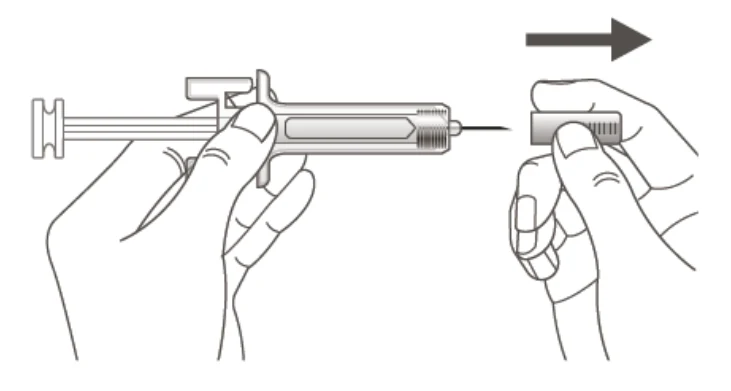
- Do NOT remove the needle cap from the prefilled syringe until you are ready to inject.
- Do NOT twist or bend the needle cap.
- Do NOT hold the prefilled syringe by the plunger.
- Do NOT put the needle cap back onto the prefilled syringe.
Important: Throw the needle cap into the sharps disposal container.
Step 3: Subcutaneous (under the skin) injection.
- E. Pinch the injection site to create a firm surface.
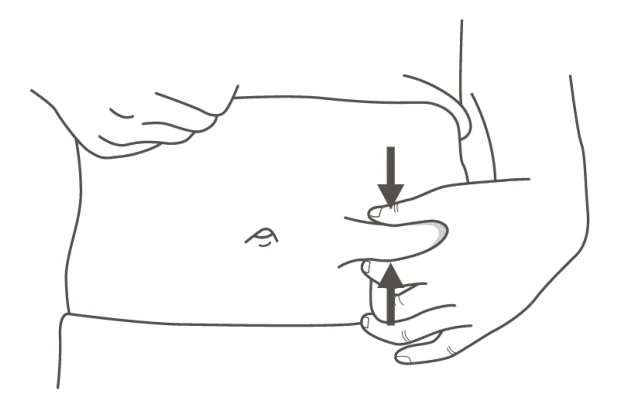
Important: Keep skin pinched while injecting.
- F. Hold the pinch. Insert the needle into the skin at 45 to 90 degrees.
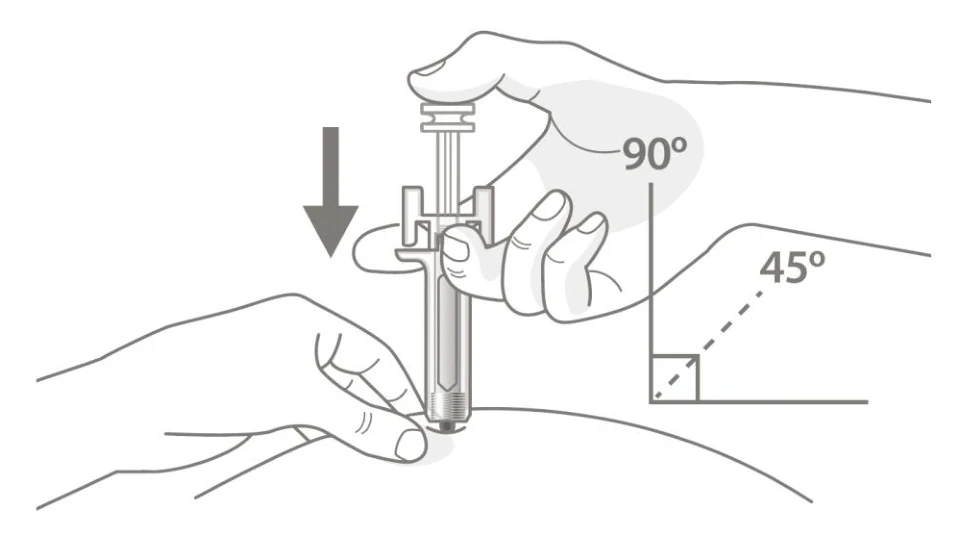
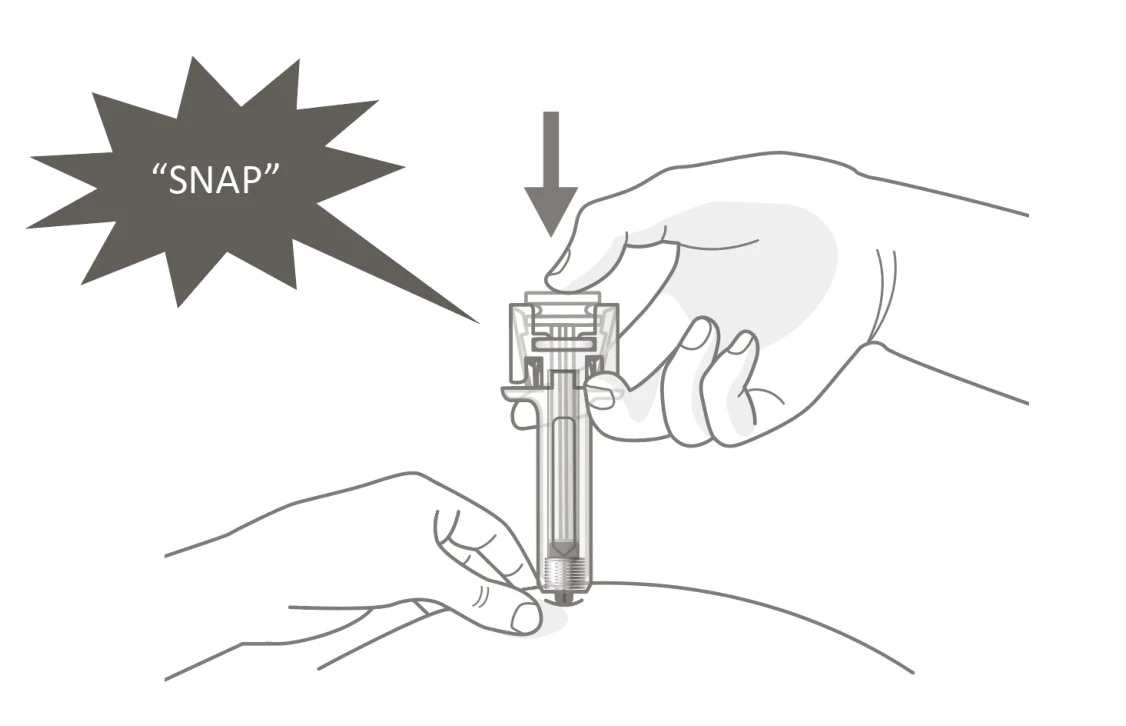
- G. Using slow and constant pressure, push the plunger until you feel or hear a “snap”. Push all the way down through the snap.
- • Do NOT pull back the plunger while the needle is inserted.
- H. When done, RELEASE your thumb. Then LIFT the syringe off skin.
- • After releasing the plunger, the pre-filled syringe safety guard will safely cover the injection needle.
- • Do Not put the needle cap back on used pre-filled syringes.
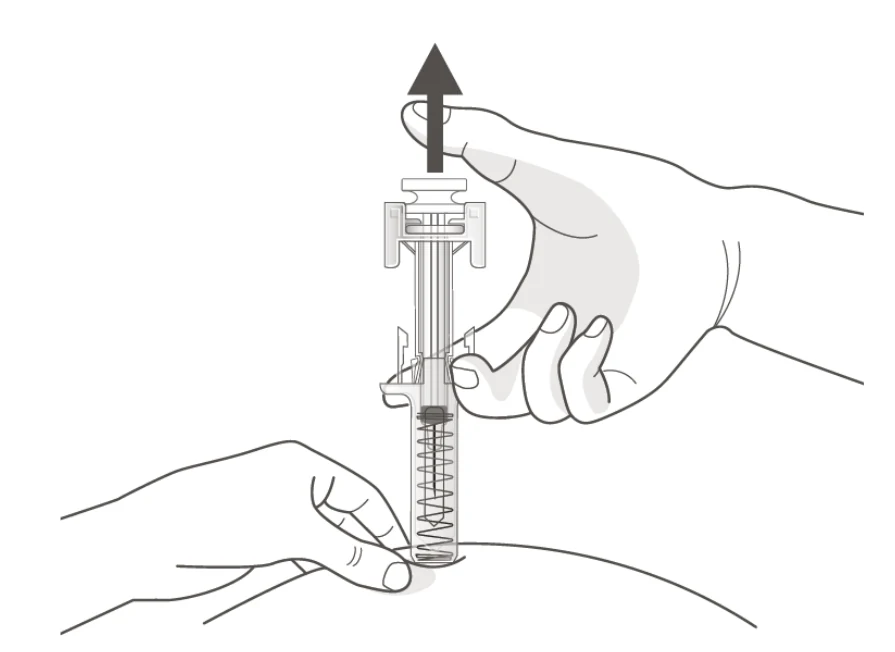
Important: When you remove the syringe, if it looks like the medicine is still in the syringe barrel, this means you have not received a full dose. Call your healthcare professional right away.
Step 4: Finish
- I. Discard (throw away) the used pre-filled syringe.
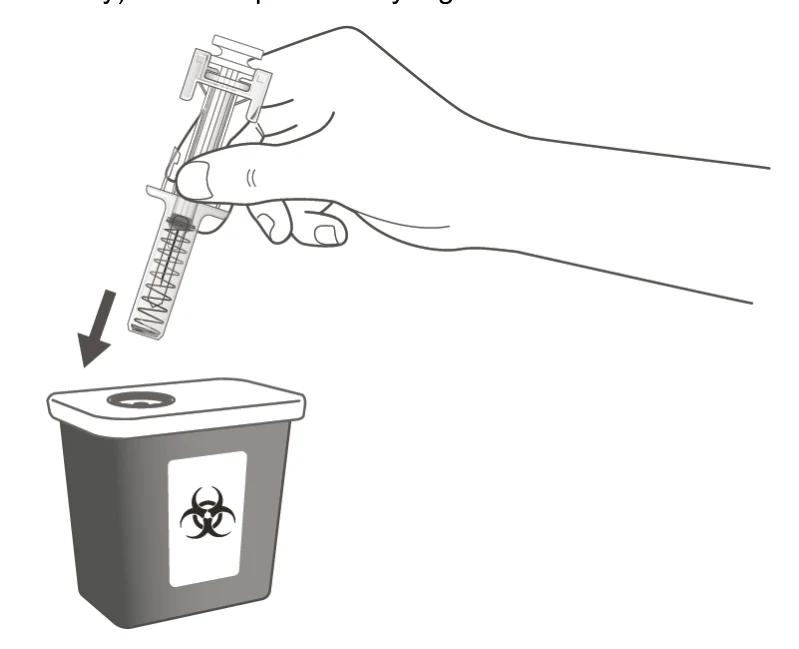
- Put the used prefilled syringe in a sharps disposal container right away after use. Do NOT throw away (dispose of) the syringe in the household trash.
If you do not have a sharps disposal container, you may use a household container that is:
- made of a heavy-duty plastic,
- can be closed with a tight-fitting, puncture-resistant lid, without sharps being able to come out,
- upright and stable during use,
- leak-resistant, and
- properly labeled to warn of hazardous waste inside the container.
- When your sharps disposal container is almost full, you will need to follow your community guidelines for the right way to dispose of your sharps disposal container. There may be state or local laws about how you should throw away used needles and syringes.
- Do NOT reuse the prefilled syringe.
- Do NOT recycle the prefilled syringe or sharps disposal container or throw them into household trash.
Important: Always keep the sharps disposal container out of the reach of children.
- J. Examine the injection site.
If there is blood, press a cotton ball or gauze pad on the injection site. Do NOT rub the injection site. Apply an adhesive bandage if needed.
Usual dose:
The usual dose of OBODENCE is 60 mg administered once every 6 months. You should also take supplements of calcium and vitamin D.
Overdose:
Missed dose:
If you miss a dose you should receive your next dose as soon as convenient. Schedule your next dose 6 months from the date of your last injection.
Possible side effects from using OBODENCE:
Like all medicines, OBODENCE can cause side effects, although not everybody gets them.
These are not all the possible side effects you may have when taking OBODENCE. If you experience any side effects not listed here, tell healthcare professional.
Possible side effects include:
- Pain, sometimes severe, in the muscles, joints, arms, legs or back.
- Low blood calcium (hypocalcemia). Symptoms of low blood calcium may include muscle spasms, twitches, cramps, numbness or tingling in fingers, toes or around the mouth.
- Allergic reactions (eg, rash, hives, or in rare cases, swelling of the face, lips, tongue, throat, or trouble breathing).
- Allergic reaction that can damage blood vessels mainly in the skin (eg, purple or brownish- red spots, hives or skin sores)
- Severe allergic reaction (drug reaction with eosinophilia and systemic symptoms [DRESS] syndrome) with skin rash/blisters, fever and/or increase in a type of white blood cell (eosinophils) with possible organ damage, such as liver, kidney, or lung.
- Skin condition with itching, redness and/or dryness (eczema). Injection site reactions were uncommon.
- Rash that may occur on the skin or sores in the mouth (lichenoid drug eruption).
- Hair loss (alopecia).
- Skin infection with swollen, red area of skin, that feels hot and tender and may be accompanied by fever (cellulitis).
- Common cold (runny nose or sore throat).
- Broken bones in the spine after stopping OBODENCE (multiple vertebral fractures).
Serious side effects and what to do about them
| Symptom / effect | Talk to your healthcare professional | Stop taking drug and get immediate medical help |
|---|---|---|
| Only if severe | In all cases | |
| Common (≥ 1%, in 1 to 10% of patients) | ||
If you think you, or a person you are caring for, have taken too much OBODENCE, contact a healthcare professional, hospital emergency department, regional poison control centre or Health Canada’s toll-free number, 1-844 POISON-X (1-844-764-7669) immediately, even if there are no signs or symptoms.
| Serious side effects and what to do about them | |||
|---|---|---|---|
| Symptom / effect | Talk to your healthcare professional | Stop taking drug and get immediate medical help | |
| Only if severe | In all cases | ||
| Skin condition with itching, redness and/or dryness (eczema) | X | ||
| Uncommon (≥ 0.1%, < 1%) | |||
| Skin infection (mainly cellulitis) leading to hospitalization, erysipelas (serious and rapid skin infection commonly on the face or legs) | X | ||
| Bladder infection, pancreatitis (inflamed pancreas causing severe stomach pains), and ear infection | X | ||
| Broken bones in the spine after stopping OBODENCE treatment (multiple vertebral fractures) | X | ||
| Rare (≥ 0.01%, < 0.1%) | |||
| Low calcium levels in the blood (muscle spasms, twitches, cramps, numbness or tingling in hands, feet or around the mouth, and weakness) | X | ||
| Endocarditis (inflammation of the inner lining of the heart) | X | X | |
| Sore in mouth involving gums or jaw bones (osteonecrosis of the jaw) | X | X | |
| Allergic reaction (feeling faint, trouble breathing/wheezing, throat tightness, swelling of face, lips or tongue, rash, hives) | X | X | |
| Unusual thigh bone fractures (atypical femoral fracture) | X | ||
If you have a troublesome symptom or side effect that is not listed here or becomes bad enough to interfere with your daily activities, tell your healthcare professional.
Storage:
Keep out of the reach and sight of children.
When prescribed OBODENCE, you will likely need to fill your prescription at a pharmacy. Store OBODENCE in your refrigerator at 2°C to 8°C until your injection appointment with your health professional or trained injector. Do not freeze.
When removed from the refrigerator, OBODENCE must be kept at room temperature (up to 25°C) in the original carton and must be used within 60 days. If not used within this period of up to 60 days, OBODENCE can be put back in the refrigerator for 28 days for future use.
Store in original carton in order to protect from light.
Do not use OBODENCE after the expiry date which is printed on the carton and label. The expiry date refers to the last day of that month.
Medicines should not be disposed of via wastewater or household waste. Ask your pharmacist how to dispose of medicines that are no longer required.
If you want more information about OBODENCE:
- Talk to your healthcare professional
- Find the full product monograph, that is prepared for health professionals and includes this Patient Medication Information by visiting the Health Canada website (https://www.canada.ca/en/health-canada/services/drugs-health-products/drug- products/drug-product-database.html); the manufacturer’s website [insert website] or by calling X-XXX-XXX-XXXX
Date of Authorization: April 13, 2026
Reporting Side Effects
You can report any suspected side effects associated with the use of health products to Health Canada by:
- Visiting the Web page on Adverse Reaction Reporting (canada.ca/drug-device-reporting) for information on how to report online, by mail or by fax; or
- Calling toll-free at 1-866-234-2345.
NOTE: Contact your health professional if you need information about how to manage your side effects. The Canada Vigilance Program does not provide medical advice.