


Product Monograph - Oxaliplatin for Injection
SUMMARY PRODUCT INFORMATION
| Route of Administration | Dosage Form / Strength | Clinically Relevant Nonmedicinal Ingredients |
| Intravenous Infusion | Lyophilized powder; 50 mg/vial; 100 mg/vial | lactose monohydrate |
Aqueous solution; 5mg/mL (50 mg/10 mL; 100 mg/20 mL; 200 mg/40 mL) | tartaric acid, sodium hydroxide and water for injection |
INDICATIONS AND CLINICAL USE
Oxaliplatin for Injection/Oxaliplatin Injection, in combination with infusional 5-fluorouracil/leucovorin, is indicated for:
- Treatment of patients with metastatic carcinoma of the colon or rectum.
Geriatrics (> 65 years of age): Clinical studies suggest that no specific dose adaptation is required for this population.
In the previously untreated for metastatic colorectal cancer randomized clinical trial of oxaliplatin, 160 patients treated with oxaliplatin and 5-fluorouracil/leucovorin were < 65 years and 99 patients were ≥ 65 years. Fatigue, dehydration, diarrhea, leukopenia, and syncope were reported more frequently in patients ≥ 65 years receiving oxaliplatin in combination with 5-FU/LV than in patients < 65 years, although the difference was not statistically significant. The starting doses were the same in both age groups. The same efficacy improvements in response rate, time to tumour progression, and overall survival were observed in the ≥ 65 year old patients as in the overall study population
In an adjuvant therapy colon cancer randomized clinical trial, patients ≥ 65 years of age receiving oxaliplatin combination therapy (393 of 1108) experienced more grade 3/4 granulocytopenia than patients < 65 years of age (45% versus 39%).
Pediatrics: The safety and efficacy of Oxaliplatin for Injection/Oxaliplatin Injection in pediatric patients have not been established. Use of Oxaliplatin for Injection/Oxaliplatin Injection is not indicated for use in children.
CONTRAINDICATIONS
- Patients who are hypersensitive to this drug, or any other platinum compounds, or to any ingredient in the formulation or component of the container. For a complete listing, see the DOSAGE FORMS, COMPOSITION AND PACKAGING.
- Patients who have severely impaired renal function (creatinine clearance less than 30 mL/min).
- Patients who are breast-feeding.
- Patients who are pregnant or who think they may be.
WARNINGS AND PRECAUTIONS
Serious Warnings and Precautions
- Oxaliplatin for Injection/Oxaliplatin Injection should be administered only under the supervision of a physician who is experienced in the use of cancer chemotherapeutic agents.
- Anaphylactic and hypersensitivity reactions to oxaliplatin have been reported and usually occur within minutes of administration (see Immune below).
- Hepatotoxicity (see Hepatic/Biliary/Pancreatic below).
- Neutropenia/febrile neutropenia, thrombocytopenia and anemia (see Hematologic below).
- Neuropathy (acute reversible sensory and persistent motor and peripheral sensory) (see Neurologic below; ADVERSE REACTIONS).
- Interstitial lung disease, sometimes fatal (see Respiratory below; ADVERSE REACTIONS).
- Cardiovascular – QT prolongation and Torsade de Pointes, including fatalities (see Cardiovascular below).
- Gastrointestinal - duodenal ulcer, duodenal hemorrhage, duodenal perforation and intestinal ischemia, including fatalities (see Gastrointestinal below).
- Musculoskeletal – rhabdomyolysis, including fatalities (see Musculoskeletal below).
- Sepsis, including fatalities (see Infections and Infestations below).
General
Do not use Oxaliplatin for Injection/Oxaliplatin Injection intraperitoneally. Peritoneal hemorrhage may occur when Oxaliplatin for Injection/Oxaliplatin Injection is administered by intraperitoneal route (not an approved route of administration). The approved route of administration is intravenous infusion.
No studies on the effects on the ability to drive and use machines have been performed; however, oxaliplatin treatment resulting in an increased risk of dizziness, nausea and vomiting and other neurological symptoms that affect gait and balance may influence the ability to drive and use machines. Vision abnormalities, in particular transient vision loss lasting for periods of seconds or minutes which may recur repeatedly during the event duration (usually hours to days), and which is reversible following therapy discontinuation, may affect patients’ ability to drive and use machines. Patients should be warned of the potential effects of these events (see ADVERSE REACTIONS).
Carcinogenesis and Mutagenesis
The carcinogenicity of oxaliplatin has not been studied in animals. However, given that oxaliplatin has been demonstrated to be genotoxic, Oxaliplatin for Injection/Oxaliplatin Injection should be considered a carcinogen. Oxaliplatin was not mutagenic to bacteria (Ames test) but was mutagenic to mammalian cells in vitro (L5178Y mouse lymphoma assay). Oxaliplatin was clastogenic both in vitro (chromosome aberration in human lymphocytes) and in vivo (mouse bone marrow micronucleus assay).
Cardiovascular
Cases of QT prolongation and Torsade de Pointes have been reported. QT prolongation may lead to an increased risk for ventricular arrhythmias including Torsade de Pointes, which can be fatal. Caution should be exercised in patients with a history or a predisposition for prolongation of QT, those who are taking medicinal products known to prolong QT interval, and those with electrolyte disturbances such as hypokalemia, hypocalcaemia, or hypomagnesaemia. In case of QT prolongation, oxaliplatin treatment should be discontinued (see ADVERSE REACTIONS: Post-Market Adverse Drugs Reactions, and DRUG INTERACTIONS).
Clinical cardiac safety studies and clinical QT studies have not been carried out. Preclinical data are limited and standard hERG or Purkinje fibre tests have not been done. Cardiotoxicity was observed in dogs (see TOXICOLOGY). The effect on QTc of oxaliplatin in combination with 5-HT3 blocker antiemetics has not been formally studied. ECG monitoring should be performed in cases of grade 3 or 4 hypersensitivity reaction associated with hemodynamic instability (eg. bradycardia, tachycardia, hypotension, hypertension).
Dermatologic
Extravasation of Oxaliplatin for Injection/Oxaliplatin Injection may result in local pain and inflammation which may be severe and lead to complications especially when infused through a peripheral vein. Accidental extravasation of oxaliplatin leading to a severe painful necrotic reaction has been reported. In the event of extravasation, administration must be discontinued immediately and local symptomatic treatment initiated.
Gastrointestinal
Gastrointestinal toxicity, which manifests as nausea and vomiting, warrants prophylactic and/or therapeutic anti-emetic therapy, including 5-HT3 antagonists.
Dehydration, paralytic ileus, intestinal obstruction, hypokalemia, metabolic acidosis and renal impairment may be associated with severe diarrhea/emesis particularly when combining oxaliplatin with 5-fluorouracil. Colitis (including Clostridium difficile diarrhea), has been reported.
Patients must be adequately informed of the risk of diarrhea/emesis and mucositis/stomatitis after Oxaliplatin for Injection/Oxaliplatin Injection and 5-fluorouracil administration so that they can urgently contact their treating physician for appropriate management. If mucositis/stomatitis occurs with or without neutropenia, the next treatment should be delayed until recovery from mucositis/stomatitis to grade 1 or less and until the neutrophil count is ≥ 1.5 x 10⁹/L. If mucositis/stomatitis or neutropenia is severe (grade 3/4), a dose reduction of oxaliplatin is recommended (see DOSAGE AND ADMINISTRATION: Recommended Dose and Dosage Adjustment).
Cases of intestinal ischaemia, including fatal outcomes, have been reported with oxaliplatin treatment. In case of intestinal ischaemia, Oxaliplatin for Injection/Oxaliplatin Injection treatment should be discontinued and appropriate measures initiated (see ADVERSE REACTIONS: Post-Market Adverse Drugs Reactions).
Oxaliplatin for Injection/Oxaliplatin Injection treatment can cause duodenal ulcer (DU) and potential complications, such as duodenal ulcer haemorrhage and perforation, which can be fatal. In case of duodenal ulcer, Oxaliplatin for Injection/Oxaliplatin Injection treatment should be discontinued and appropriate measures taken (see ADVERSE REACTIONS: Post-Market Adverse Drugs Reactions).
Hematologic
Clinical studies have shown that the principal hematologic toxicity associated with the administration of oxaliplatin is neutropenia. If hematological toxicity occurs (neutrophils < 1.5x10⁹/L or platelets < 50x109/L), administration of the next course of therapy should be postponed until hemotological values return to acceptable levels. A full blood count with white cell differential should be performed prior to start of therapy and before each subsequent course. Patients must be adequately informed of the risk of neutropenia after Oxaliplatin for Injection/Oxaliplatin Injection and 5-fluorouracil administration so that they can urgently contact their treating physician for appropriate management.
When oxaliplatin is administered in combination therapy, thrombocytopenia and anemia are commonly observed, but the risk of grade 3 or 4 bleeding is low (see ADVERSE REACTIONS). In rare cases, anemia may present as Hemolytic Uremic Syndrome (see ADVERSE REACTIONS: Post-Market Adverse Drug Reactions).
Cases of febrile neutropenia (including fatal cases) have been reported (see ADVERSE REACTIONS: Adverse Drug Reactions Overview – Blood and Lymphatic System Disorders). If neutropenia or febrile neutropenia (fever of unknown origin without clinically or microbiologically documented infection with an absolute neutrophil count < 1.0 x 10⁹/L, a single temperature of > 38.3°C or a sustained temperature of > 38°C for more than one hour) occurs, Oxaliplatin for Injection/Oxaliplatin Injection must be discontinued until improvement or resolution, and the dose of Oxaliplatin for Injection/Oxaliplatin Injection should be reduced at subsequent cycles, in addition to any 5-FU dose reductions required (see DOSAGE AND ADMINISTRATION).
Hemolytic Uremic Syndrome (HUS) is a life-threatening side effect. Oxaliplatin for Injection/Oxaliplatin Injection should be discontinued at the first signs of any evidence of microangiopathic hemolytic anemia, such as rapidly falling hemoglobin with concomitant thrombocytopenia, elevation of serum bilirubin, serum creatinine, blood urea nitrogen, or lactate dehydrogenase (LDH). Renal failure may not be reversible with discontinuation of therapy and dialysis may be required.
Disseminated intravascular coagulation (DIC), including fatal outcomes, has been reported in association with oxaliplatin treatment. If DIC is present, Oxaliplatin for Injection/Oxaliplatin Injection treatment should be discontinued and appropriate treatment should be administered (see ADVERSE REACTIONS: Post-Market Adverse Drugs Reactions).
Hepatic/Biliary/Pancreatic
Liver function should be routinely monitored in patients receiving oxaliplatin (see Monitoring and Laboratory Tests below). Hepatotoxicity with the use of oxaliplatin plus 5-FU/LV has been reported in clinical studies (see ADVERSE REACTIONS: Clinical Trial Adverse Drug Reactions).
Oxaliplatin for Injection/Oxaliplatin Injection may cause liver sinusoidal obstruction syndrome, also known as veno-occlusive disease of the liver which, on liver biopsy is manifested as peliosis, nodular regenerative hyperplasia, and perisinusoidal fibrosis. A case of fatal hepatic failure following liver metastasis resection in a patient treated pre-operatively with oxaliplatin has been reported in the literature. Cases of hepatic failure, hepatitis, and pancreatitis have been reported (see SERIOUS WARNINGS AND PRECAUTIONS and ADVERSE REACTIONS: Post-Market Adverse Drug Reactions).
In the case of abnormal liver function test results or portal hypertension, which could not be explained by liver metastases, adverse drug reactions related to vascular disorders including liver sinusoidal obstruction syndrome should be considered, and if appropriate, investigated.
Immune
Anaphylactic and hypersensitivity reactions to oxaliplatin have been reported and usually occur within minutes of administration. Grade 3/4 hypersensitivity, including anaphylactic/anaphylactoid reactions, to oxaliplatin has been observed in 2 to 3% of colon cancer patients, and can occur at any cycle. Anaphylactic and hypersensitivity reactions have included bronchospasm, urticaria, pruritus, rash, erythema, angioedema, hypotension and anaphylactic shock, including some fatal reactions. Allergic reactions can occur during any cycle. Patients with a history of allergic reaction to platinum compounds should be monitored for allergic symptoms. In case of an anaphylactic-like reaction to Oxaliplatin for Injection/Oxaliplatin Injection, the infusion should be immediately discontinued and appropriate symptomatic treatment initiated. These reactions are usually managed with standard epinephrine, corticosteroid, antihistamine therapy, and require immediate discontinuation of therapy. Rechallenge is contraindicated in these patients (see CONTRAINDICATIONS).
Infections and Infestations
Sepsis, neutropenic sepsis and septic shock have been reported in patients treated with oxaliplatin, including fatal outcomes. If any of these events occurs, Oxaliplatin for Injection/Oxaliplatin Injection should be discontinued.
Musculoskeletal
Rhabdomyolysis has been reported in patients treated with oxaliplatin, including fatal outcomes. In case of muscle pain and swelling, in combination with weakness, fever or darkened urine, Oxaliplatin for Injection/Oxaliplatin Injection treatment should be discontinued. If rhabdomyolysis is confirmed, appropriate measures should be taken. Caution is recommended if medicinal products associated with rhabdomyolysis are administered concomitantly with Oxaliplatin for Injection/Oxaliplatin Injection (see ADVERSE REACTION: Post-Market Adverse Drugs Reactions, and DRUG INTERACTIONS).
Neurologic
Neurological toxicity (see ADVERSE REACTIONS) of oxaliplatin should be carefully monitored, especially if co-administered with other medications with specific neurological toxicity. The risk factors that make a patient more likely to develop neuropathy have not been identified. A neurological examination should be performed before initiation of each administration, and periodically thereafter.
Oxaliplatin is associated with two types of neuropathy:
Acute, reversible, sensory peripheral neuropathy (characterized by dysesthesia and paresthesia), which may develop within hours or one to two days after administration of oxaliplatin.The symptoms usually present as transient paresthesia, dysesthesia and hypoesthesia in the hands, feet, perioral area, or throat. Other symptoms occasionally include abnormal tongue sensation, dysarthria, eye pain, and a feeling of throat or chest tightness/pressure. Acute motor symptoms have also been reported, including jaw spasms, muscle spasms, involuntary muscle contractions, ptosis, vocal cord paralysis and cranial nerve dysfunction. Acute neuropathy (all grades) occurred in 58% of patients with metastatic colorectal cancer receiving oxaliplatin + 5-FU/LV, but grade 3/4 events occurred in only 4% of patients. In any individual cycle, acute neurotoxicity was observed in about one third of patients. Neurological adverse effects are dose-limiting toxicity. The duration of these symptoms, which usually regress between courses of treatment, increase with the number of treatment cycles. In the majority of cases, the neurological signs and symptoms improve when treatment is discontinued. The symptoms frequently recur with additional cycles. They may be precipitated by or exacerbated by exposure to cold temperatures or cold objects.
Acute laryngopharyngeal dysesthesia (grade 3/4), which is characterized by subjective sensations of dysphagia or dyspnea/feeling of suffocation, without any objective evidence of respiratory distress (no cyanosis or hypoxia) or of laryngospasm or bronchospasm (no stridor or wheezing), occurs in 1 to 2% of patients, whereas all grades of laryngopharyngeal dysesthesias were reported in up to 38% of patients. To prevent such dysesthesia, advise the patient to avoid cold beverages because cold temperatures can precipitate or exacerbate acute neurological symptoms. For patients who develop acute laryngopharyngeal dysesthesias, during or within 48 hours following the 2-hour infusion, the next oxaliplatin infusion should be administered over 6 hours.
- Persistent symptoms of peripheral sensory neuropathy after the end of treatment can be experienced in the form of paresthesias, dysesthesias, and/or hypoesthesias, and may also include deficits in proprioception that may interfere with functional activities. Deficits in proprioception may result in difficulty performing activities of daily living (ADLs), difficulty with delicate movements such as writing or buttoning, as well as difficulty walking. It is difficult to assess the possible long term impact of the neuropathy; it needs to be carefully taken into consideration in determining the benefit to risk ratio of Oxaliplatin for Injection/Oxaliplatin Injection therapy.
In another clinical trial in patients with metastatic colorectal cancer, activities of daily living were evaluated. The most frequent abnormal abilities (up to 23% of the patients) were in relation with difficulties in fine movement/activities such as buttoning or zipping, writing and sewing, recognizing coins or keys, filling up a glass. Other activities were affected, such as going up or down stairs, walking in the dark, using car pedals. Abnormal ability was observed at 3 months after last treatment.
In the advanced colorectal cancer studies, neuropathy was graded using a study-specific neurotoxicity scale, which is different from the NCI CTC scale and is presented below.
| Grade | Definition |
| Grade 1 | Resolved and did not interfere with functioning |
| Grade 2 | Interfered with function but not daily activities |
| Grade 3 | Pain or functional impairment that interfered with daily activities |
| Grade 4 | Persistent impairment that is disabling or life-threatening |
Overall, neuropathy was reported in patients previously untreated for advanced colorectal cancer in 82% (all grades) and 19% (grade 3/4), and in the previously treated patients in 74% (all grades) and 7% (grade 3/4) events. These symptoms may improve in some patients upon discontinuation of oxaliplatin. Information regarding reversibility of neuropathy was not available from the trial for patients who had not been previously treated for colorectal cancer.
The probability of developing peripheral neuropathy is dependent upon the cumulative dose of oxaliplatin administered. The risk of occurrence of persistent symptoms for a cumulative dose of 850 mg/m² (10 cycles) is approximately 10% and 20% for a cumulative dose of 1020 mg/m² (12 cycles).
In the adjuvant colon cancer trial, neuropathy was graded using a prelisted module derived from the Neuro-Sensory section of the National Cancer Institute Common Toxicity Criteria (NCI CTC) as follows:
| Grade | Definition |
|---|---|
| Grade 0 | No change or none |
| Grade 1 | Mild paresthesias, loss of deep tendon reflexes |
| Grade 2 | Mild or moderate objective sensory loss, moderate paresthesias |
| Grade 3 | Severe objective sensory loss or paresthesias that interface with function |
In adjuvant patients, sensory neuropathy was reported in 92% (all grades) and 13% (grade 3) of patients. The median cycle of onset for grade 3 neuropathy was cycle 9. At the 28-day follow-up after the last treatment cycle, 60% of all patients had neuropathy of any grade (grade 1 – 40%; grade 2 – 16%; grade 3 – 5%) decreasing to 21% at 18 months (grade 1 – 17%; grade 2 – 3%; grade 3 – 1%). At the 48-month follow-up, neuropathy status was as follows: grade 0 – 62%; grade 1 – 9%; grade 2 – 2%; grade 3 – 0.5%; not evaluable – 26.5%. This suggests that there can be partial or complete recovery of sensory neuropathy over time after cessation of therapy. However, in some cases, an increase in severity of the sensory neuropathy was reported years after completion of adjuvant therapy.
Signs of sensory peripheral neurotoxicity of Oxaliplatin for Injection/Oxaliplatin Injection should be monitored, especially when administered with other drugs of known neurological toxicity.
Reversible posterior leucoencephalopathy syndrome (RPLS, also known as PRES, Posterior Reversible Encephalopathy Syndrome) has been reported with platinum agents and in combination regimens that include oxaliplatin. RPLS could be characterized by headache, altered mental functioning, seizures and abnormal vision from blurriness to blindness, associated or not with hypertension (see ADVERSE REACTIONS). Diagnosis of RPLS is based upon confirmation by brain imaging. Discontinuation of Oxaliplatin for Injection/Oxaliplatin Injection and initiation of treatment of hypertension if present is recommended in patients developing RPLS. The safety of reinitiating Oxaliplatin for Injection/Oxaliplatin Injection therapy in patients who previously experienced RPLS is unknown.
In nerve conduction studies performed at baseline and at the end of treatment during a clinical trial of patients treated with the FOLFOX-4 regimen, which included oxaliplatin 85 mg/m2 every 2 weeks, for a total of 12 cycles, a decrease in the sensory action potential amplitude (SAP) was seen as well as a slight decrease in the compound muscle action potential amplitude. The magnitude of the change in SAP amplitude increased in relation with the severity of the peripheral sensory neuropathy (PSN), as clinically evaluated using the oxaliplatin neurological specific scale for evaluation of PSN.
Respiratory
The administration of oxaliplatin has been associated with pulmonary fibrosis/interstitial lung disease which may be fatal. In the first-line metastatic setting, the combined incidence of cough, dyspnea and hypoxia (all symptoms of pulmonary fibrosis) was greater in the FOLFOX arm (43% all grades; 7% grade 3/4) compared to the IFL (irinotecan + 5-FU/LV) control arm (32% all grades; 5% grade 3/4). In the second-line metastatic setting, the combined incidence of cough, dyspnea and hypoxia was greater in patients receiving oxaliplatin + 5-FU/LV (30% all grades; 5% grade 3/4) compared to the 5-FU/LV control arm (21% all grades; 2% grade 3/4). (see ADVERSE REACTIONS). In the adjuvant trial, the combined incidence of cough and dyspnea in patients receiving oxaliplatin plus 5-FU/LV compared to patients receiving infusional 5 FU/LV alone was 7% vs. 5% (all grades) and 0.8% vs. 0.1% (grade 3/4), respectively. In one study, a patient died of eosinophilic pneumonia in the oxaliplatin combination arm.
In cases of unexplained respiratory symptoms such as non-productive cough, dyspnea, crackles, or radiological pulmonary infiltrates, Oxaliplatin for Injection/Oxaliplatin Injection should be discontinued until further pulmonary investigations can exclude interstitial lung disease or pulmonary fibrosis. Fatal cases of interstitial lung disease have been reported in the post-market setting.
Sexual Function/Reproduction
In a fertility study, male rats were given oxaliplatin at 0, 0.5, 1, or 2 mg/kg/day for five days every 21 days for a total of three cycles prior to mating with females that received two cycles of oxaliplatin on the same schedule. A dose of 2 mg/kg/day (less than one-seventh the recommended human dose on a body surface area basis) did not affect pregnancy rate, but caused developmental mortality (increased early resorptions, decreased live fetuses, decreased live births) and delayed growth (decreased fetal weight), and doses up to 12 mg/m2/day caused delayed ossifications. Related compounds with similar mechanism of action and genotoxicity profiles have been reported to be teratogenic. Oxaliplatin for Injection/Oxaliplatin Injection may increase the risk of genetic defects or fetal malformations. Appropriate contraceptive measures must be taken during and after cessation of therapy (4 months for women and 6 months for men). Oxaliplatin for Injection/Oxaliplatin Injection is contraindicated in pregnancy.
Testicular damage, characterized by degeneration, hypoplasia, and atrophy, was observed in dogs administered oxaliplatin at 0.75 mg/kg/day x 5 days every 28 days for three cycles. A no-effect level was not identified. This daily dose is approximately one-sixth of the recommended human dose on a body surface area basis. Men are advised to seek advice on conservation of sperm prior to treatment since oxaliplatin may have an irreversible anti-fertility effect. Appropriate contraceptive measures must be taken during and after cessation of therapy (4 months for women and 6 months for men).
Special Populations
Pregnant Women: To date, no information on the use of oxaliplatin in pregnancy in humans is available. Based on pre-clinical findings, Oxaliplatin for Injection/Oxaliplatin Injection is likely to be lethal and/or teratogenic to the human fetus at the recommended therapeutic dose, and is consequently contraindicated during pregnancy. Women of child-bearing potential should be advised to avoid becoming pregnant while receiving treatment with Oxaliplatin for Injection/Oxaliplatin Injection and for four months after cessation of therapy (see CONTRAINDICATIONS).
In rats administered intravenous. daily doses of 6 mg/m2/day for 5 days, oxaliplatin caused a growth delay in the fetuses of rats dosed at gestation days 6 to 10 and increased early resorption between gestation days 6 to 10 and days 11 to 16, but did not cause any significant malformations. Embryonic mortality, decreased fetal weight and delayed ossifications were manifested in rats at doses up to 12 mg/m2/day. This daily dose is approximately one-sixth of the recommended human dose.
Effective contraceptive measures should be taken in potentially fertile patients prior to initiating chemotherapy with Oxaliplatin for Injection/Oxaliplatin Injection.
Nursing Women: Excretion of oxaliplatin in breast milk has not been studied in animals or humans. Patients who are breast-feeding should not be administered Oxaliplatin for Injection/Oxaliplatin Injection (see CONTRAINDICATIONS).
Pediatrics (≤ 22 years of age): The safety and efficacy of oxaliplatin single agent has not been established in the pediatric population. Oxaliplatin as a single agent has been evaluated in pediatric population in 2 Phase I (69 patients) and 2 Phase II (166 patients) studies. A total of 235 pediatric patients (7 months to 22 years of age) with solid tumours have been treated. Both Phase II studies on solid tumours showed lack of tumour response. The use of Oxaliplatin for Injection/Oxaliplatin Injection in children, therefore, is not recommended (see INDICATIONS AND CLINICAL USE).
Geriatrics (> 65 years of age): No significant effect of age on the clearance of ultra-filterable platinum has been observed in clinical trials.
In the previously untreated for metastatic colorectal cancer randomized clinical trial of oxaliplatin, 160 patients treated with oxaliplatin and 5-fluorouracil/leucovorin were < 65 years and 99 patients were ≥ 65 years. Fatigue, dehydration, diarrhea, leukopenia, and syncope were reported more frequently in patients ≥ 65 years receiving oxaliplatin in combination with 5-FU/LV than in patients < 65 years, although the difference was not statistically significant. The starting doses were the same in both age groups. In the previously treated for advanced colorectal cancer randomized clinical trial of Oxaliplatin for Injection/Oxaliplatin Injection, 95 patients treated with oxaliplatin and 5-fluorouracil/leucovorin were <65 years and 55 patients were ≥ 65 years. The rates of overall adverse reactions, including grade 3 and 4 events, were similar across and within arms in the different age groups in all studies. The incidence of diarrhea, dehydration, hypokalemia, leukopenia, fatigue and syncope were higher in patients ≥ 65 years old. No specific dose adaptations are recommended for patients ≥ 65 years of age (see DOSAGE AND ADMINISTRATION).
In the adjuvant therapy colon cancer randomized clinical trial, patients ≥ 65 years of age receiving Oxaliplatin for Injection/Oxaliplatin Injection combination therapy experienced more grade 3/4 granulocytopenia than patients < 65 years of age (45% versus 39%).
Hepatic Impairment: Oxaliplatin has not been studied in patients with severe hepatic impairment. In a phase I study including patients with several levels of hepatic impairment, frequency and severity of hepato-biliary disorders appeared to be related to progressive disease and impaired liver function tests at baseline. No increases in oxaliplatin acute toxicities were observed in the subset of patients with baseline abnormal liver function tests. No specific dose adjustment for patients with abnormal liver function tests were performed during clinical development. However, clinical studies to date have not investigated patients with hepatic impairment in sufficient numbers for any meaningful assessments to be made.
Renal Impairment: The safety and effectiveness of the combination of oxaliplatin and 5-FU/LV (FOLFOX) in patients with renal impairment has not been evaluated. Since the primary route of platinum elimination is renal, FOLFOX should only be used with caution in patients with pre-existing mild to moderate renal impairment. The clearance of ultra-filterable platinum is known to decrease in patients with mild, moderate or severe renal impairment. However, a pharmacodynamic relationship between platinum ultra-filtrate levels and the clinical effectiveness or safety of oxaliplatin has not been established. There is limited information on safety in patients with moderately impaired renal function and administration should only be considered after suitable appraisal of the benefit/risk for the patient, however, treatment may be initiated at the normally recommended dose. In this situation, renal function should be closely monitored and the dose adjusted according to toxicity. Oxaliplatin for Injection/Oxaliplatin Injection is contraindicated in patients who have severely impaired renal function (see CONTRAINDICATIONS).
Monitoring and Laboratory Tests
Before each Oxaliplatin for Injection/Oxaliplatin Injection cycle, monitoring of the following laboratory tests is recommended: blood chemistries (including, ALT, AST, magnesium, electrolytes, bilirubin and creatinine), and complete blood count (including white blood cell count with differential, hemoglobin and platelet count) (see WARNINGS AND PRECAUTIONS: Hematologic).
A neurological examination should also be performed before each administration and periodically thereafter (see WARNINGS AND PRECAUTIONS: Neurologic). See DOSAGE AND ADMINISTRATION: Recommended Dose and Dosage Adjustment for guidance if neurological symptoms occur.
Monitoring for diarrhea, vomiting, and mucositis should be done in patients receiving oxaliplatin combination therapy as these conditions can lead to severe or life-threatening dehydration. If this occurs, discontinue Oxaliplatin for Injection/Oxaliplatin Injection until improvement or resolution (see DOSAGE AND ADMINISTRATION: Recommended Dose and Dosage Adjustment).
There have been reports during clinical trials and from post-marketing surveillance of prolonged prothrombin time and INR occasionally associated with hemorrhage in patients who received oxaliplatin plus 5-fluorouracil/leucovorin while on anticoagulants. Patients receiving Oxaliplatin for Injection/Oxaliplatin Injection plus 5-fluorouracil/leucovorin and requiring oral anticoagulants may require closer monitoring.
ADVERSE REACTIONS
Adverse Drug Reaction Overview
Both 5-FU and oxaliplatin are associated with gastrointestinal and hematologic adverse events. When oxaliplatin is administered in combination with 5-FU, the incidence of these events is increased.
Oxaliplatin used in association with 5-FU and LV is associated with neutropenia, thrombocytopenia, fatigue, anorexia, nausea, vomiting, diarrhea, stomatitis, and abdominal pain. Neurological toxicity occurs in up to 95% of patients treated. Allergic reactions are common when oxaliplatin is administered in combination with 5-FU plus LV. Anaphylactic reactions have included bronchospasm, angioedema, hypotension and anaphylactic shock. Elevation of liver enzymes is frequently observed during treatment with oxaliplatin. Disturbances in renal function have also been reported. Fever, either isolated from immunological mechanism or in the context of infection (with or without neutropenia), has been reported. Rare cases of immuno-allergic thrombocytopenia and hemolytic anemia have been reported, as have cases of acute interstitial lung disease and pulmonary fibrosis.
Blood and Lymphatic System Disorders
Anemia, neutropenia and thrombocytopenia were reported with the combination of oxaliplatin and infusional 5-FU/LV (see Clinical Trial Adverse Drug Reactions below).
In adjuvant patients the incidence of febrile neutropenia was 0.1% in the 5-FU/LV infusion arm and 0.7% in the oxaliplatin plus 5-FU/LV arm. The incidence of febrile neutropenia in the first-line therapy trial was 15% (3% of cycles) in the irinotecan plus 5-FU/LV arm and 4% (less than 1% of cycles) in the oxaliplatin plus 5-FU/LV arm. The incidence of febrile neutropenia in the second-line therapy trial was 1% in the 5-FU/LV arm and 5% (less than 1% of cycles) in the oxaliplatin plus 5-FU/LV combination arm.
In adjuvant patients the incidence of thrombocytopenia (all grades) was 77% vs. 19% (oxaliplatin plus 5-FU/LV vs. 5-FU/LV) while grade 3/4 thrombocytopenia incidence was 1.7% vs. 0.4%. There were more bleeding events in the oxaliplatin plus 5-FU/LV arm (gastrointestinal hemorrhage 0.5%; hematemesis 0.3%; rectal hemorrhage 1.3%). The incidence of thrombocytopenia in the first-line therapy trial was higher in the oxaliplatin plus 5-FU/LV arm vs irinotecan plus 5-FU/LV arm (all grade thrombocytopenia: 70% vs. 26%; grade 3 and 4: 5% vs 2%). However, bleeding events in the oxaliplatin plus 5-FU/LV arm were infrequent and included: epistaxis, rectal bleeding, melena, vaginal bleeding, hematuria, and hemoptysis. The incidence of thrombocytopenia in the second-line therapy trial was higher in the oxaliplatin plus 5-FU/LV arm vs. the 5-FU/LV arm (all grade thrombocytopenia: 67% vs 21%; grade 3 and 4: 6% vs. 0%).
Hemolytic Uremic Syndrome has been rarely reported with the use of oxaliplatin.
Gastrointestinal Disorders
Anorexia, nausea, vomiting, diarrhea, stomatitis/mucositis and abdominal pain were commonly reported in the first-line and second-line therapy trials (see Clinical Trial Adverse Drug Reactions below) as well as in the adjuvant treatment of patients with colon cancer.
Dehydration, hypokalemia, metabolic acidosis, ileus, intestinal obstruction and renal disorders may be associated with severe diarrhea or vomiting, particularly when oxaliplatin is combined with 5-FU (see WARNINGS AND PRECAUTIONS and Other Clinical Trial Adverse Drug Reactions below).
General Disorders and Administration Site Conditions
Fever and rigors (tremors) either from infection (with or without febrile neutropenia) or possibly from immunological mechanism were reported in the adjuvant treatment of patients with colon cancer and in the first- and second-line therapy trial (see Clinical Trial Adverse Drug Reactions below).
Injection Site
Injection site reactions, including local pain, redness, swelling and thrombosis have been reported (see Clinical Trial Adverse Drug Reactions below). In the literature, tissue necrosis has been reported with oxaliplatin extravasation.
Immune System Disorders
Allergic reactions such as: skin rash (particularly urticaria), conjunctivitis, rhinitis and anaphylactic reactions were reported (see WARNINGS AND PRECAUTIONS and ADVERSE REACTIONS, Clinical Trial Adverse Drug Reactions).
Musculoskeletal and Connective Tissue Disorders
Back pain was reported in patients receiving oxaliplatin plus 5-FU/LV as adjuvant therapy and as second-line therapy. In case of such adverse reaction, hemolysis (as part of Hemolytic Uremic Syndrome), which has been rarely reported, should be investigated (see Clinical Trial Adverse Drug Reactions below).
Arthralgia was also reported (see Clinical Trial Adverse Drug Reactions below).
Nervous System Disorders
Oxaliplatin is frequently associated with acute and chronic sensory peripheral neuropathy. There have been very rare reports of symptoms compatible with a diagnosis of Guillain-Barre Syndrome, for which a causal relationship has not been established (see Other Clinical Trial Adverse Drug Reactions below).
Peripheral sensory neuropathy was reported in adjuvant patients treated with the oxaliplatin combination with a frequency of 92% (all grades) and 13% (grade 3). In patients previously untreated for metastatic colorectal cancer, neuropathy was reported in 82% (all grades) and 19% (grade 3/4), and in the previously treated patients in 79% (all grades) and 11% (grade 3/4) events.
Peripheral Sensory Neuropathy
Acute sensory neuropathy
These symptoms usually develop at the end of the 2-hour oxaliplatin infusion or within a few hours, abate spontaneously within the next hours or days, and frequently recur with further cycles. They may be precipitated or exacerbated by exposure to cold temperatures or objects. They usually present as transient paresthesia, dysesthesia and hypoesthesia. An acute syndrome of laryngopharyngeal dysesthesia (grades 3/4) characterized by subjective sensations of dysphagia or dyspnea, feeling of suffocation, without any evidence of respiratory distress (no cyanosis or hypoxia) or of laryngospasm or bronchospasm (no stridor or wheezing) occurs in 1 to 2% of the patients. All grades of laryngopharyngeal dysesthesia were reported in up to 38% of the patients.
Dysesthesia / Paresthesia of Extremities and Peripheral Neuropathy
The dose-limiting toxicity of oxaliplatin is neurological. It involves a sensory peripheral neuropathy characterised by peripheral dysesthesia and/or paresthesia with or without cramps, often triggered by the cold (85 to 95% of patients).
The duration of these symptoms, which usually recede between the cycles of treatment, increases with the number of treatment cycles. The onset of pain and/or a functional disorder and their duration are indications for dose adjustment, or even treatment discontinuation (see WARNINGS AND PRECAUTIONS and DOSAGE AND ADMINISTRATION). This functional disorder, including difficulties in executing delicate movements, is a possible consequence of sensory impairment. The risk of occurrence of a functional disorder for a cumulative dose of approximately 800 mg/m² (i.e. 10 cycles) is 15% or less. The neurological signs and symptoms improve when treatment is discontinued in the majority of cases.
Other Neurologic Manifestations
Other symptoms occasionally observed include cranial nerve dysfunction, which may be either associated with above-mentioned events, occur as a single, isolated event or several events may occur in combination. These include: ptosis, diplopia, aphonia, dysphonia, hoarseness, sometimes described as vocal cord paralysis, abnormal tongue sensation or dysarthria, sometimes described as aphasia, trigeminal neuralgia, facial pain, fasciculations, eye pain, decrease of visual acuity, visual field disorders, transient blindness (reversible following therapy discontinuation), amaurosis and amaurosis fugax. In addition, the following have been observed: jaw spasm, muscle spasms, involuntary muscle contractions, muscle twitching, myoclonus, abnormal coordination, abnormal gait, ataxia, balance disorders and throat or chest tightness/pressure/ discomfort/pain (see WARNINGS AND PRECAUTIONS: General).
Dysgeusia (taste perversion) was also reported (see Clinical Trial Adverse Drug Reactions below).
Skin and Subcutaneous Tissue Disorders
Alopecia in patients receiving oxaliplatin has been reported with an incidence of approximately one third (all grades), most cases being mild hair loss only.
Clinical Trial Adverse Drug Reactions
Second-Line Therapy
In the study in the second-line setting, 791 patients with refractory and relapsed colorectal cancer were randomized to receive either 5-FU/LV (n = 257), oxaliplatin alone (n = 266) or the combination of oxaliplatin + 5-FU/LV (n = 268). Fourteen percent of previously treated patients in the oxaliplatin + 5-FU/LV-combination arm and 7% in the 5-FU/LV arm had to discontinue treatment because of adverse effects related to allergy, fatigue, gastrointestinal or hematological events, or to neuropathies. The adverse reactions in this trial are shown in Table 1 below. Adverse events are presented in decreasing order of frequency in the oxaliplatin + 5-FU/LV combination arm.
A neurotoxicity scale developed for this study was used, with Grade 1 events defined as reversible and not interfering with function, Grade 2 as interfering with function but not daily activities, Grade 3 as pain or functional impairment that interfered with daily living and Grade 4 as persistent and disabling or life-threatening.
Nausea and vomiting were common events in all three arms of the trial, although the combination of oxaliplatin and 5-FU/LV produced a greater incidence of Grade 3/4 nausea
(10%) or vomiting (9%) compared to oxaliplatin alone (nausea 4%, vomiting 5%) to the 5-FU/LV control (nausea 2%, vomiting 2%). The combined incidence of stomatitis, pharyngitis and mucositis was comparable in Arms A and C.
The incidence of death within 30 days of treatment in the previously treated study, regardless of causality, was 6% in the oxaliplatin + 5-FU/LV arm, 6% in the oxaliplatin arm and 5% in the 5-FU/LV arm.
Table 1: Adverse Events in Trial for Oxaliplatin Use as Second-Line Therapy
Arm A (5-FU/LV) (n=257) | Arm B (oxaliplatin) (n=266) | Arm C (oxaliplatin + 5-FU/LV) (n=268) | ||||||||||||||||
|---|---|---|---|---|---|---|---|---|---|---|---|---|---|---|---|---|---|---|
| Adverse Event | All Grades (%) | Grade 3/4 (%) | All Grades (%) | Grade 3/4 (%) | All Grades (%) | Grade 3/4 (%) | ||||||||||||
| (≥ 5% of all patients with ≥ 1% NCI Grade 3/4 events) | ||||||||||||||||||
| Any event | 98 | 44 | 100 | 46 | 100 | 81 | ||||||||||||
| Fatigue | 57 | 6 | 59 | 10 | 75 | 10 | ||||||||||||
| Nausea | 53 | 2 | 58 | 4 | 68 | 10 | ||||||||||||
| Diarrhea | 42 | 2 | 40 | 3 | 65 | 11 | ||||||||||||
| Sensory disturbances | 2 | 0 | 58 | 4 | 58 | 4 | ||||||||||||
| Paresthesia | 13 | 0 | 49 | 2 | 54 | 7 | ||||||||||||
| Granulocytopenia | 9 | 3 | 1 | 0 | 52 | 41 | ||||||||||||
| Vomiting | 27 | 2 | 38 | 5 | 44 | 9 | ||||||||||||
| Abdominal pain | 33 | 5 | 32 | 6 | 35 | 4 | ||||||||||||
| Constipation | 24 | 1 | 32 | 2 | 33 | 1 | ||||||||||||
| Anorexia | 22 | 2 | 25 | 2 | 33 | 3 | ||||||||||||
| Fever | 19 | 1 | 20 | 1 | 31 | 0 | ||||||||||||
| Stomatitis | 22 | 1 | 8 | 0 | 28 | 2 | ||||||||||||
| Dyspnea | 13 | 2 | 13 | 4 | 20 | 3 | ||||||||||||
| Anemia | 11 | 2 | 7 | 1 | 20 | 5 | ||||||||||||
| Coughing | 13 | 0 | 10 | <1 | 19 | 2 | ||||||||||||
| Back pain | 17 | 4 | 11 | <1 | 16 | 2 | ||||||||||||
| Pain | 12 | 3 | 13 | 3 | 16 | 2 | ||||||||||||
| Headache | 10 | 1 | 14 | 0 | 16 | <1 | ||||||||||||
| Dizziness | 9 | <1 | 7 | <1 | 15 | 1 | ||||||||||||
| Thrombocytopenia | 0 | 0 | 5 | 1 | 15 | 5 | ||||||||||||
| Aggravated neoplasm malignant | 13 | 13 | 10 | 9 | 13 | 12 | ||||||||||||
| Injection site reaction | 7 | 1 | 7 | 0 | 13 | 3 | ||||||||||||
| Upper Respiratory Tract Infection | 9 | 0 | 7 | 0 | 12 | 1 | ||||||||||||
| Arthralgia | 11 | 3 | 8 | <1 | 10 | 1 | ||||||||||||
| Skin exfoliation | 11 | 1 | 2 | 0 | 9 | 1 | ||||||||||||
| Dehydration | 4 | 2 | 5 | 3 | 9 | 4 | ||||||||||||
| Leukopenia | 1 | <1 | 0 | 0 | 9 | 4 | ||||||||||||
| Edema legs | 6 | 1 | 5 | 1 | 8 | <1 | ||||||||||||
| Mucositis (not otherwise specified) | 9 | 1 | 2 | 0 | 8 | 1 | ||||||||||||
| Chest pain | 5 | 1 | 4 | <1 | 8 | 1 | ||||||||||||
| Abnormal lacrimation | 8 | 0 | 1 | 0 | 8 | 0 | ||||||||||||
| Allergic reaction | 2 | 1 | 3 | 1 | 8 | 1 | ||||||||||||
| Depression | 5 | <1 | 5 | 0 | 7 | <1 | ||||||||||||
Arm A (5-FU/LV) (n=257) | Arm B (oxaliplatin) (n=266) | Arm C (oxaliplatin + 5-FU/LV) (n=268) |
|---|
| Adverse Event | All Grades (%) | Grade 3/4 (%) | All Grades (%) | Grade 3/4 (%) | All Grades (%) | Grade 3/4 (%) | |||||||
|---|---|---|---|---|---|---|---|---|---|---|---|---|---|
| Neuropathy | 2 | <1 | 9 | 0 | 6 | <1 | |||||||
| Peripheral edema | 5 | 1 | 3 | <1 | 6 | 0 | |||||||
| Myalgia | 2 | 0 | 4 | 0 | 6 | <1 | |||||||
| Hematuria | 3 | 1 | 1 | 0 | 6 | 2 | |||||||
| Dysuria | 2 | <1 | 1 | 0 | 6 | <1 | |||||||
| Urinary tract infection | 4 | 1 | 5 | 2 | 5 | <1 | |||||||
| Intestinal obstruction | 2 | 2 | 4 | 3 | 5 | 5 | |||||||
| Decreased neutrophils | <1 | <1 | 0 | 0 | 5 | 2 | |||||||
| Adverse Events in ≥ 5% of patients but < 1% NCI Grade 3/4 | |||||||||||||
| Insomnia | 5 | 0 | 9 | <1 | 16 | 0 | |||||||
| Rash | 5 | 0 | 4 | 0 | 14 | 0 | |||||||
| Dyspepsia | 9 | 0 | 7 | 0 | 13 | 0 | |||||||
| Rhinitis | 7 | 0 | 6 | 0 | 13 | 0 | |||||||
| Taste perversion | 4 | 0 | 3 | 0 | 12 | 0 | |||||||
| Rigors | 5 | 0 | 7 | 0 | 11 | 0 | |||||||
| Epistaxis | 3 | 0 | 3 | 0 | 11 | 0 | |||||||
| Pharyngitis | 7 | 0 | 2 | 0 | 10 | 0 | |||||||
| Flushing | 2 | 0 | 3 | 0 | 10 | 0 | |||||||
| Weight decrease | 6 | 0 | 8 | 0 | 9 | <1 | |||||||
| Flatulence | 8 | 0 | 5 | <1 | 9 | 0 | |||||||
| Alopecia | 4 | 0 | 3 | <1 | 8 | 0 | |||||||
| Sweating increased | 4 | 0 | 8 | 0 | 7 | 0 | |||||||
| Anxiety | 5 | 0 | 6 | 0 | 7 | <1 | |||||||
| Accidental injury | 4 | 0 | 2 | 0 | 7 | 0 | |||||||
| Sinusitis | 4 | 0 | 3 | 0 | 6 | 0 | |||||||
| Hiccup | 1 | <1 | 2 | 0 | 5 | <1 | |||||||
The following additional most common and potentially important adverse events regardless of treatment causality were reported in less than 5% of the patients in the oxaliplatin and 5-FU/LV combination arm in the previously treated for metastatic colorectal cancer pivotal study.
Body as a whole – General Disorders: ascites
Cardiovascular Disorders, General: edema
Central and Peripheral Nervous System Disorders: ataxia
Gastro-intestinal System Disorders: dry mouth, gastroesophageal reflux, tenesmus
Heart Rate and Rhythm Disorders: tachycardia
Metabolic/laboratory: magnesium levels were not prospectively tested
Musculo-Skeletal System Disorders: bone pain
Platelet, Bleeding and Clotting Disorders: bruise, deep thrombophlebitis, melena, rectal hemorrhage
Respiratory System Disorders: pneumonia
Skin and Appendage Disorders: dry skin, erythematous rash, pruritus, skin disorder
Vision Disorders: abnormal vision, conjunctivitis
White Cell and Reticulo-Endothelial System Disorders: febrile neutropenia
First-Line Therapy
In the NCI Trial studying oxaliplatin use as first-line therapy for advanced colorectal cancer, 267 patients were treated in the oxaliplatin + 5-F/LV (FOLFOX4) combination arm. Twenty six percent (n = 70) of patients in the FOLFOX arm, 8% (n = 22) in the IFL arm and 20% (n = 51) in the IROX arm discontinued therapy because of AEs related most commonly to gastrointestinal, hematologic or neurologic adverse effects.
The incidence of death within 30 days of treatment in the previously untreated for metastatic colorectal cancer study, regardless of causality, was 3% with the oxaliplatin plus 5-FU/LV, 5% with irinotecan plus 5-FU/LV and 3 % with oxaliplatin plus irinotecan. Deaths within 60 days from initiation of therapy were 2 % with oxaliplatin plus 5-FU/LV, 5 % with irinotecan plus 5-FU/LV and 3 % with oxaliplatin plus irinotecan. Deaths within 60 days from initiation of therapy on the oxaliplatin plus 5-FU/LV arm were attributed to disease progression, sepsis, dehydration/electrolyte imbalance, and liver failure.
Table 2 presents adverse events reported in the NCI trial. Adverse events are presented in decreasing order of frequency in the oxaliplatin + 5-FU/LV combination arm. Toxic effects (except paresthesias) were graded by the National Cancer Institute Common Toxicity Criteria, Version 2.0. A neurotoxic scale developed for this study was used, with Grade 1 events defined as reversible and not interfering with function, Grade 2 as interfering with function but not daily activities, Grade 3 as pain or functional impairment that interfered with daily living and Grade 4 as persistent and disabling or life-threatening.
The most common non-hematological events observed in the FOLFOX arm included peripheral neuropathy (all grades: 82%; Grade 3/4: 19%), nausea (all grades: 71%; Grade 3/4: 6%), fatigue (all grades: 70%; Grade 3/4: 7%), diarrhea (all grades: 56%; Grade 3/4: 12%) and vomiting (all grades: 41%; Grade 3/4: 4%). The most common hematological events were neutropenia (all grades: 83%; Grade 3/4: 54%) and thrombocytopenia (all grades: 71%; Grade 3/4: 5%).
In the oxaliplatin + 5-FU/LV arm, the incidence of Grade 3/4 nausea, vomiting and diarrhea was 6%, 4% and 12%, respectively.
The neurotoxic adverse event rate seen with FOLFOX was ~80%. Although cumulative, and dose-limiting, the neurotoxicity was generally reversible and Grade 3/4 neurotoxicity did not necessarily require discontinuation of treatment. The majority of patients (50%) experienced their first neurotoxic event within the first 2 cycles of treatment. In another 25% of patients, the first event occurred in cycles 3 to 10. The percentage of patients with neurotoxicity increased with increasing cycles on treatment. In any given cycle, 30 to 75% of patients suffered from sensory neuropathy (when the number of patients treated in the cycle was greater than 10).
Table 2: Adverse Effects in the NCI Trial for Previously Untreated Patients
Oxaliplatin + 5-FU/LV (FOLFOX4) (n=259) | Irinotecan + 5-FU/LV (IFL) (n=256) | Oxaliplatin + irinotecan (IROX) (n=258) | |||||||||||||
|---|---|---|---|---|---|---|---|---|---|---|---|---|---|---|---|
| Adverse Event | All Grades (%) | Grade 3/4 (%) | All Grades (%) | Grade 3/4 (%) | All Grades (%) | Grade 3/4 (%) | |||||||||
| (≥ 5% of all patients with ≥ 1% NCI Grade 3/4 events) | |||||||||||||||
| Any event | 99 | 82 | 98 | 70 | 99 | 76 | |||||||||
| Overall neuropathy | 82 | 19 | 18 | 2 | 69 | 7 | |||||||||
| Paresthesias | 77 | 18 | 16 | 2 | 62 | 6 | |||||||||
| Nausea | 71 | 6 | 67 | 15 | 83 | 19 | |||||||||
| Fatigue | 70 | 7 | 58 | 11 | 66 | 16 | |||||||||
| Diarrhea | 56 | 12 | 65 | 29 | 76 | 25 | |||||||||
| Vomiting | 41 | 4 | 43 | 13 | 64 | 23 | |||||||||
| Stomatitis | 38 | 0 | 25 | 1 | 19 | 1 | |||||||||
| Laryngopharyngeal dysesthesias | 38 | 2 | 1 | 0 | 28 | 1 | |||||||||
| Anorexia | 35 | 2 | 25 | 4 | 27 | 5 | |||||||||
| Cough | 35 | 1 | 25 | 2 | 17 | 1 | |||||||||
| Constipation | 32 | 4 | 27 | 2 | 21 | 2 | |||||||||
| Abdominal pain | 29 | 8 | 31 | 7 | 39 | 10 | |||||||||
| Dyspnea | 18 | 7 | 14 | 3 | 11 | 2 | |||||||||
| Myalgia | 14 | 2 | 6 | 0 | 9 | 2 | |||||||||
| Hyperglycemia | 14 | 2 | 11 | 3 | 12 | 3 | |||||||||
| Diarrhea-colostomy | 13 | 2 | 16 | 7 | 16 | 3 | |||||||||
| Neurosensory | 12 | 1 | 2 | 0 | 9 | 1 | |||||||||
| Hypersensitivity | 12 | 2 | 5 | 0 | 6 | 1 | |||||||||
| Hypokalemia | 11 | 3 | 7 | 4 | 6 | 2 | |||||||||
| Infection – no ANC | 10 | 4 | 5 | 1 | 7 | 2 | |||||||||
| Dehydration | 9 | 5 | 16 | 11 | 14 | 7 | |||||||||
| Infection – ANC | 8 | 8 | 12 | 11 | 9 | 8 | |||||||||
| Hypoalbuminemia | 8 | 0 | 5 | 2 | 9 | 1 | |||||||||
| Hyponatremia | 8 | 2 | 7 | 4 | 4 | 1 | |||||||||
| Pain | 7 | 1 | 5 | 1 | 6 | 1 | |||||||||
| Skin reaction – hand/foot | 7 | 1 | 2 | 1 | 1 | 0 | |||||||||
| Thrombosis | 6 | 5 | 6 | 6 | 3 | 3 | |||||||||
| Injection site reaction | 6 | 0 | 1 | 0 | 4 | 1 | |||||||||
| Lymphopenia | 6 | 2 | 4 | 1 | 5 | 2 | |||||||||
| Hypotension | 5 | 3 | 6 | 3 | 4 | 3 | |||||||||
| Vision abnormal | 5 | 0 | 2 | 1 | 6 | 1 | |||||||||
| Neuralgia | 5 | 0 | 0 | 0 | 2 | 1 | |||||||||
| Gastrointestinal NOS | 5 | 2 | 4 | 2 | 3 | 2 | |||||||||
| Urinary frequency | 5 | 1 | 2 | 1 | 3 | 1 | |||||||||
| Hiccups | 5 | 1 | 2 | 0 | 3 | 2 | |||||||||
| Febrile neutropenia | 4 | 4 | 15 | 14 | 12 | 11 | |||||||||
| Adverse Events in ≥ 5% of patients but < 1% NCI Grade 3/4 | |||||||||||||||
Oxaliplatin + 5-FU/LV (FOLFOX4) (n=259) | Irinotecan + 5-FU/LV (IFL) (n=256) | Oxaliplatin + irinotecan (IROX) (n=258) |
|---|
| Adverse Event | All Grades (%) | Grade 3/4 (%) | All Grades (%) | Grade 3/4 (%) | All Grades (%) | Grade 3/4 (%) |
|---|---|---|---|---|---|---|
| Alopecia | 38 | 44 | 67 | |||
| Fever – no ANC | 16 | 9 | 9 | |||
| Edema | 15 | 13 | 10 | |||
| Taste perversion | 14 | 6 | 8 | |||
| Headache | 13 | 6 | 9 | |||
| Insomnia | 13 | 9 | 11 | |||
| Dyspepsia | 12 | 7 | 5 | |||
| Rash | 11 | 4 | 7 | |||
| Weight loss | 11 | 9 | 11 | |||
| Rhinitis allergic | 10 | 6 | 6 | |||
| Epistaxis | 10 | 2 | 2 | |||
| Tearing | 9 | 1 | 2 | |||
| Flatulence | 9 | 6 | 5 | |||
| Depression | 9 | 5 | 7 | |||
| Rigors | 8 | 2 | 7 | |||
| Dizziness | 8 | 6 | 10 | |||
| Flushing | 7 | 2 | 5 | |||
| Hypocalcemia | 7 | 5 | 4 | |||
| Pruritis | 6 | 4 | 2 | |||
| Dry Skin | 6 | 2 | 5 | |||
| Dysphasia | 5 | 3 | 3 | |||
| Sweating | 5 | 6 | 12 | |||
| Arthralgia | 5 | 5 | 8 | |||
| Dry mouth | 5 | 2 | 3 | |||
| Anxiety | 5 | 2 | 6 | |||
| Elevated creatinine | 4 | 4 | 5 |
The following additional most common and potentially important adverse events regardless of treatment causality were reported in less than 5% of the patients in the oxaliplatin and 5-FU/LV combination arm in the previously untreated for metastatic colorectal cancer pivotal study.
Cardiovascular: hypertension, hypotension, prothrombin time
Dermatology/Skin: nail changes, pigmentation changes, urticaria
Gastrointestinal: gastrointestinal not otherwise specified (NOS)
Hemorrhage: rectal bleeding
Infection/Febrile neutropenia: catheter infection, febrile neutropenia, unknown infection
Metabolic/Laboratory: magnesium levels were not prospectively tested
Neurology: syncope, vertigo
Pain: bone pain, chest pain, neuralgia, rectal pain
Pulmonary: hiccups, hypoxia, pneumonitis, pulmonary NOS
Renal/Genitourinary: creatinine, dysuria
Adjuvant Therapy
One thousand one hundred and eight (1108) patients with colon cancer were treated adjuvantly in a clinical study with oxaliplatin in combination with infusional 5-FU/LV.
Treatment was discontinued due to an adverse event in 15% of patients on the oxaliplatin plus infusional 5-FU/LV arm compared to 6% of patients on the 5-FU/LV only arm.
The incidence of death within 28 days of last treatment, regardless of causality, was 0.5% (n = 6) in both the oxaliplatin combination (primarily septic deaths) and infusional 5-FU/LV arms, respectively.
Deaths within 60 days from initiation of therapy were 0.3% (n = 3) in both the oxaliplatin combination and infusional 5-FU/LV arms, respectively.
Although specific events can vary, the overall frequency of adverse events was similar in men and women and in patients < 65 and 65 years. However, the following grade 3/4 events were more common in females regardless of treatment arm: diarrhea, fatigue, granulocytopenia, nausea and vomiting. In patients 65 years old, the incidence of grade 3/4 granulocytopenia and diarrhea was higher than in younger patients, although the difference was not statistically significant.
The following table provides adverse events reported in the adjuvant treatment of patients with colon cancer pivotal study for events with overall incidences ≥ 5% in the arm combining oxaliplatin and 5-FU/LV.
Table 3: Adverse Events Reported in the Adjuvant Treatment of Patients with Colon Cancer Pivotal Clinical Trial (≥ 5 % of all patients in the oxaliplatin + 5-FU/LV arm) – by Body System
Oxaliplatin + 5-FU/LV (n=1108) | 5-FU/LV (n=1111) | ||||||||||
|---|---|---|---|---|---|---|---|---|---|---|---|
| Adverse Event (WHO/Pref) | All Grades (%) | Grade 3/4 (%) | All Grades (%) | Grade 3/4 (%) | |||||||
| Any event | 100 | 70 | 99 | 31 | |||||||
| Application Site Disorders | |||||||||||
| Injection site reaction | 11 | 3 | 2 | <1 | |||||||
| Body as a Whole – General Disorders | |||||||||||
| Allergic reaction | 10 | 3 | 2 | <1 | |||||||
| Fatigue | 44 | 4 | 38 | 1 | |||||||
| Fever | 27 | 1 | 12 | 1 | |||||||
| Pain | 5 | <1 | 5 | <1 | |||||||
| Weight increase | 10 | <1 | 10 | <1 | |||||||
Oxaliplatin + 5-FU/LV (n=1108) | 5-FU/LV (n=1111) |
|---|
| Adverse Event (WHO/Pref) | All Grades (%) | Grade 3/4 (%) | All Grades (%) | Grade 3/4 (%) | ||||
|---|---|---|---|---|---|---|---|---|
| Central and Peripheral Nervous System Disorders | ||||||||
| Headache | 7 | <1 | 5 | <1 | ||||
| Overall Peripheral Sensory Neuropathy1 | 92 | 12 | 16 | <1 | ||||
| Sensory disturbance | 8 | <1 | 1 | 0 | ||||
| Gastrointestinal System Disorders | ||||||||
| Abdominal pain | 18 | 1 | 17 | 2 | ||||
| Anorexia | 13 | 1 | 8 | <1 | ||||
| Constipation | 22 | 1 | 19 | <1 | ||||
| Diarrhea | 56 | 11 | 48 | 7 | ||||
| Dyspepsia | 8 | <1 | 5 | 0 | ||||
| Nausea | 74 | 5 | 61 | 2 | ||||
| Stomatitis | 42 | 3 | 40 | 2 | ||||
| Vomiting | 47 | 6 | 24 | 1 | ||||
| Liver and Biliary System Disorders | ||||||||
| Bilirubinemia | 20 | 4 | 20 | 5 | ||||
| Hepatic enzyme increased | 57 | 2 | 34 | 1 | ||||
| Metabolic and Nutritional Disorders | ||||||||
| Phosphatase alkaline increased | 42 | <1 | 20 | <1 | ||||
| Platelet, Bleeding and Clotting Disorders | ||||||||
| Epistaxis | 16 | <1 | 12 | 0 | ||||
| Thrombocytopenia | 77 | 2 | 19 | <1 | ||||
| Red Blood Cell Disorders | ||||||||
| Anemia | 76 | 1 | 67 | <1 | ||||
| Resistance Mechanism Disorders | ||||||||
| Infection | 25 | 4 | 25 | 3 | ||||
| Respiratory System Disorders | ||||||||
| Dyspnea | 5 | 1 | 3 | <1 | ||||
| Rhinitis | 6 | 0 | 8 | <1 | ||||
| Skin and Appendage Disorders | ||||||||
| Alopecia2 | 30 | 0 | 28 | 0 | ||||
| Skin disorders | 32 | 2 | 36 | 2 | ||||
| Special Senses Disorders | ||||||||
| Taste perversion | 12 | <1 | 8 | 0 | ||||
| Vision Disorders | ||||||||
| Conjunctivitis | 9 | 1 | 15 | 1 | ||||
| White Cell and RES Disorders | ||||||||
| Granulocytopenia | 79 | 41 | 40 | 5 | ||||
1 Overall Peripheral Sensory Neuropathy: only grades 1, 2 and 3 according to the NCI grading scale used.
2 Alopecia: only grades 1 and 2 according to the NCI grading scale used.
RES: reticulo-endothelial system
The following additional most common and potentially important adverse events regardless of treatment causality were reported in less than 5% of the patients in the oxaliplatin combined with 5-FU/LV arm in the pivotal study in the adjuvant treatment of patients with colon cancer.
Body as a Whole – General Disorders: chest pain
Central & Peripheral Nervous System Disorders: dizziness
Metabolic/Laboratory: magnesium levels were not prospectively tested
Psychiatric Disorders: insomnia
Respiratory System Disorders: coughing
Vision Disorders: abnormal lacrimation
White Cell and Reticulo-Endothelial System (RES) Disorders: leukopenia
Geriatrics
In the clinical trial studying oxaliplatin use as a second-line therapy in patients previously treated for metastatic colorectal cancer, the following adverse events were reported more frequently in patients ≥ 65 years old in the oxaliplatin + 5-FU/LV arm: cellulitis, general cardiovascular disorders, anorexia, dehydration, platelet, bleeding and clotting disorders and secondary terms.
Among patients previously untreated for colorectal cancer, in the NCI trial studying the use of oxaliplatin as first-line therapy, the overall rates of adverse events, including Grade 3/4 events, were similar across and within arms in the different age groups. When all grades were evaluated, patients ≥ 65 years of age had a higher incidence of hypersensitivity, anorexia, and leucopenia. Patients < 65 years old were reported to have a higher incidence of paresthesias, laryngopharyngeal dysesthesias, dysphasia, flatulence, and AST elevation. The following Grade 3/4 events occurred with a higher frequency in patients ≥ 65 years of age: fatigue, dehydration, leucopenia, syncope and pulmonary events.
Gender
In the study performed for second-line therapy, for all classes of adverse events, the proportion of patients reporting adverse events (all grades) was similar across arms and patient populations (male, female). When grade 3 or 4 events were calculated, the female patient populations reported a higher number of events independent of treatment arm.
Among patients previously untreated for colorectal cancer, a significantly higher proportion of males experienced depression (all grades), hiccups (all grades) and pulmonary events not otherwise specified (all grades). A significantly higher proportion of females experienced alopecia (all grades), urticaria (all grades), hematologic events (any event, Grade 3), and neutropenia (Grade 3).
Abnormal Hematologic and Clinical Chemistry Findings
Second-Line Therapy
A summary of hematologic abnormalities by grade and treatment arm in the clinical study performed for second-line therapy is presented below in Table 4.
Table 4: Adverse Hematological Events in ≥5% of Patients Previously Treated for Advanced Colorectal Cancer
Arm A (5-FU/LV) (n=257) | Arm B (oxaliplatin) (n=266) | Arm C (oxaliplatin + 5-FU/LV) (n=268) | |||||||||||||
| Adverse Event | All Grades (%) | Grade 3/4 (%) | All Grades (%) | Grade 3/4 (%) | All Grades (%) | Grade 3/4 (%) | |||||||||
| Anemia | 67 | 2 | 61 | 2 | 84 | 5 | |||||||||
| Leukopenia | 35 | 2 | 13 | <1 | 81 | 27 | |||||||||
| Neutropenia | 25 | 6 | 7 | 0 | 77 | 52 | |||||||||
| Thrombocytopenia | 21 | 0 | 28 | 2 | 67 | 6 | |||||||||
In this study, the clinical chemistry changes by grade and treatment arm associated with hepatic toxicity and metabolic events occurring in ≥ 5% of patients are shown in Tables 5 and 6 below.
Table 5: Adverse Hepatic – Clinical Chemistry Events in ≥5% of Patients Previously Treated for Metastatic Colorectal Cancer
Arm A (5-FU/LV) (n=257) | Arm B (oxaliplatin) (n=266) | Arm C (oxaliplatin + 5-FU/LV) (n=268) | |||||||||||||
| Adverse Event | All Grades (%) | Grade 3/4 (%) | All Grades (%) | Grade 3/4 (%) | All Grades (%) | Grade 3/4 (%) | |||||||||
| Alkaline phosphatase | 50 | 5 | 60 | 7 | 60 | 4 | |||||||||
| ALT (SGPT) | 27 | 1 | 39 | 1 | 36 | 0 | |||||||||
| AST (SGOT) | 42 | 2 | 57 | 4 | 53 | 0 | |||||||||
| Total bilirubin | 20 | 6 | 15 | 4 | 13 | 1 | |||||||||
| Lactate dehydrogenase | 46 | 24 | 53 | 23 | 53 | 22 | |||||||||
AST/SGOT: aspartate aminotransferase; ALT/SGPT: alanine aminotransferase
Table 6: Adverse Metabolic Events in ≥ 5% of Patients Previously Treated for Metastatic Colorectal Cancer
Arm A (5-FU/LV) (n=257) | Arm B (oxaliplatin) (n=266) | Arm C (oxaliplatin + 5-FU/LV) (n=268) | |||||||||||||
| Adverse Event | All Grades (%) | Grade 3/4 (%) | All Grades (%) | Grade 3/4 (%) | All Grades (%) | Grade 3/4 (%) | |||||||||
| Hypokalemia | 3 | 1 | 3 | 2 | 9 | 6 | |||||||||
First-Line Therapy
A summary of hematologic abnormalities by grade and treatment arm in the NCI study is presented in the Table 7.
Table 7: Adverse Hematological Events in ≥ 5% Patients Previously Untreated for Metastatic Colorectal Cancer
Oxaliplatin + 5-FU/LV (FOLFOX4) (n=259) | Irinotecan + 5-FU/LV (IFL) (n=256) | Oxaliplatin + irinotecan (IROX) (n=258) | ||||||||||||
| Hematology Adverse Event | All Grades (%) | Grade 3/4 (%) | All Grades (%) | Grade 3/4 (%) | All Grades (%) | Grade 3/4 (%) | ||||||||
| Anemia | 27 | 3 | 28 | 4 | 25 | 3 | ||||||||
| Leukopenia | 87 | 20 | 84 | 23 | 78 | 25 | ||||||||
| Neutropenia | 81 | 54 | 77 | 46 | 73 | 39 | ||||||||
| Thrombocytopenia | 71 | 5 | 26 | 3 | 45 | 4 | ||||||||
| Lymphopenia | 6 | 2 | 4 | 1 | 5 | 2 | ||||||||
Neutropenia observed with the combination of oxaliplatin + 5-FU/LV included Grade 3 and 4 events reported in 35% and 18% of patients, respectively. Febrile neutropenia or the requirement for platelet transfusion was not increased in the FOLFOX arm in comparison to the other two regimens. The incidence of febrile neutropenia was 15% (3% of cycles) in the IROX arm (oxaliplatin + irinotecan) and 4% (less than 1% of cycles) in the FOLFOX4 arm. Additionally, infection with Grade 3 or 4 neutropenia was 12% in the IFL arm (irinotecan + 5-FU/LV) and 8% in the FOLFOX4 arm.
The requirement for platelet transfusion was not increased in the oxaliplatin + 5-FU/LV arm. Table 8 presents a summary of the clinical chemistry changes by grade and treatment arm associated with hepatic toxicity occurring in ≥ 5% of patients in the NCI study.
Table 8: Adverse Hepatic – Clinical Chemistry Events in ≥ 5% of Patients Previously Untreated for Metastatic Colorectal Cancer
Oxaliplatin + 5-FU/LV (FOLFOX4) (n=259) | Irinotecan + 5-FU/LV (IFL) (n=256) | Oxaliplatin + irinotecan (IROX) (n=258) | ||||||||||||
| Clinical Chemistry | All Grades (%) | Grade 3/4 (%) | All Grades (%) | Grade 3/4 (%) | All Grades (%) | Grade 3/4 (%) | ||||||||
| ALT (SGPT-ALAT) | 6 | 1 | 2 | 0 | 5 | 2 | ||||||||
| AST (SGOT-ASAT) | 17 | 1 | 2 | <1 | 11 | 1 | ||||||||
| Alkaline pPhosphatase | 16 | 0 | 7 | 0 | 16 | 2 | ||||||||
| Total bilirubin | 6 | <1 | 3 | 1 | 3 | 2 | ||||||||
| Hypoalbuminemia | 8 | 0 | 5 | 2 | 9 | <1 | ||||||||
Table 9 presents a summary of the metabolic and laboratory findings by grade and treatment arm observed in the NCI Study. The hypokalemia was mostly associated with diarrhea.
Table 9: Metabolic and Laboratory Adverse Events in Patients Previously Untreated for Metastatic Colorectal Cancer
Oxaliplatin + 5-FU/LV (FOLFOX4) (n=259) | Irinotecan + 5-FU/LV (IFL) (n=256) | Oxaliplatin + irinotecan (IROX) (n=258) | ||||||||||||
| Clinical Chemistry | All Grades (%) | Grade 3/4 (%) | All Grades (%) | Grade 3/4 (%) | All Grades (%) | Grade 3/4 (%) | ||||||||
| Hypocalcemia | 7 | 0 | 5 | 1 | 4 | 0 | ||||||||
| Hyperglycemia | 14 | 2 | 11 | 3 | 12 | 3 | ||||||||
| Hypokalemia | 11 | 3 | 7 | 4 | 6 | 2 | ||||||||
| Hypomagnesemia | 2 | 0 | 2 | 0 | 3 | 0 |
| Hyponatremia | 8 | 2 | 7 | 4 | 4 | 1 |
Adjuvant Therapy
Table 10: Adverse Hepatic – Clinical Chemistry Events in ≥ 5% of Patients with Colon Cancer Receiving Adjuvant Therapy
Oxaliplatin + 5-FU/LV (n=1108) | 5-FU/LV (n=1111) | |||||||||
| Clinical Chemistry | All Grades (%) | Grade 3/4 (%) | All Grades (%) | Grade 3/4 (%) | ||||||
| Hepatic enzymes elevation | 57 | 2 | 34 | 1 | ||||||
| Phosphatase alkaline increased | 42 | <1 | 20 | <1 | ||||||
| Bilirubinemia | 20 | 4 | 20 | 5 | ||||||
Table 11: Adverse Hematological Events in ≥ 5% of Patients with Colon Cancer Receiving Adjuvant Therapy
Oxaliplatin + 5-FU/LV (n=1108) | 5-FU/LV (n=1111) | |||||||||
| Adverse Event* | All Grades (%) | Grade 3/4 (%) | All Grades (%) | Grade 3/4 (%) | ||||||
| Anemia | 76 | 1 | 67 | 0.3 | ||||||
| Neutropenia | 79 | 41 | 40 | 5 | ||||||
| Thrombocytopenia | 77 | 2 | 19 | <1 | ||||||
| *The hematology data were collected by NCI grade; no laboratory values were collected. The worst grade observed during each cycle period was reported. | ||||||||||
Other Clinical Trial Adverse Drug Reactions
Frequencies are defined using the following convention: very common (≥ 10%); common (≥ 1%, < 10%); uncommon (≥ 0.1%, < 1%); rare (≥ 0.01%, < 0.1%): very rare (< 0.01%), not known (cannot be estimated from the available data).
Blood and Lymphatic System Disorders
Rare: hemolysis.
Ear and Labyrinth Disorders
Rare: deafness.
Eye Disorders
Rare: visual acuity reduced transiently, optic neuritis, transient vision loss reversible following therapy discontinuation, visual field disturbances. Several cases of positive rechallenge associated with subsequent cycles of chemotherapy were reported indicating probable causal relationship to oxaliplatin.
Gastrointestinal Disorders:
Very common: dehydration, hypokalemia, metabolic acidosis, ileus, intestinal obstruction, renal disorders may be associated with severe diarrhea/vomiting, particularly when oxaliplatin is combined with 5-FU.
Common: gastrointestinal hemorrhage.
Rare: colitis, including Clostridium difficile diarrhea.
General Disorders and Administration Site Conditions
Very common: asthenia.
Extravasation may also result in local pain and inflammation, which may be severe and lead to complications including necrosis, especially when oxaliplatin is infused through a peripheral vein.
Hepatobiliary Disorders
Rare: pancreatitis.
Very rare: hepatic failure, hepatitis, liver sinusoidal obstruction syndrome, also known as veno-occlusive disease of liver, or pathological manifestations related to such liver disorder, including nodular regenerative hyperplasia, peliosis hepatis, perisinusoidal fibrosis. Clinical manifestations of this syndrome may be portal hypertension and/or increased transaminases.
Immune System Disorders
Common: anaphylactic reactions including bronchospasm, angioedema, hypotension, sensation of chest pain and anaphylactic shock.
Rare: immuno-allergic hemolytic anemia, immuno-allergic thrombocytopenia.
Nervous System Disorders
Very common: acute neurosensory manifestations, dysesthesia, paresthesia of extremities and peripheral neuropathy.
Rare: dysarthria, Lhermitte’s sign, loss of deep tendon reflexes, reversible posterior leucoencephalopathy syndrome (RPLS, also known as PRES) (see WARNINGS AND PRECAUTIONS: Neurologic).
Very rare: reports of symptoms compatible with a diagnosis of Guillain-Barre Syndrome. Causal relationship has not been established.
Renal and Urinary Disorders
Very rare: acute tubular necrosis, acute interstitial nephritis and acute renal failure were reported.
Respiratory, Thoracic and Mediastinal Disorders
Rare: acute interstitial lung diseases (including fatalities), pulmonary fibrosis (see WARNINGS AND PRECAUTIONS).
Vascular Disorders
Common: hypertension, thromboembolic events, including deep vein thrombosis.
Post-Market Adverse Drug Reactions
The following adverse reactions have been identified during post-approval use of oxaliplatin. Because these reactions are reported voluntarily from a population of uncertain size, it is not always possible to reliably estimate their frequency or establish a causal relationship to drug exposure.
Cardiac Disorders:
- QT prolongation, which may lead to ventricular arrhythmias including Torsade de Pointes, which may be fatal.
Gastrointestinal Disorders:
- Intestinal ischaemia (including fatalities); duodenal ulcer, and complications, such as duodenal ulcer haemorrhage or perforation, which can be fatal.
Hearing and Vestibular System Disorders:
- Ototoxicity.
Infections and Infestations:
- Sepsis, neutropenic sepsis, septic shock, including fatal outcome.
Metabolism and Nutrition Disorders:
- Hypomagnesemia.
Musculoskeletal and Connective Tissue Disorders:
- Rhabdomyolysis (including fatalities).
Nervous System Disorders:
- Cranial nerve palsies, fasciculations, convulsion.
Platelet, Bleeding, and Clotting Disorders:
- Immuno-allergic thrombocytopenia, prolongation of prothrombin time and of INR in patients receiving anticoagulants.
Blood and Lymphatic System Disorders:
- Hemolytic uremic syndrome; febrile neutropenia; disseminated intravascular coagulation (DIC), including fatalities
Skin and Subcutaneous Tissue Disorders:
- Angioedema.
Vision Disorders:
- Conjunctivitis, decrease of visual acuity, visual field disturbance, optic neuritis, amaurosis, amaurosis fugax, optic ischemic neuropathy, transient vision loss (reversible following therapy discontinuation). Cases of positive rechallenge associated with subsequent cycles of chemotherapy were reported for amaurosis/amaurosi fugax indicating probable causal relationship to oxaliplatin.
DRUG INTERACTIONS
Drug-Drug Interactions
Little information is available on the interaction of oxaliplatin with other medicinal products. No pharmacokinetic interaction between 85 mg/m2 oxaliplatin and 5-FU/LV has been observed in patients treated every 2 weeks. In patients treated every two weeks with 85 mg/m2 of oxaliplatin immediately before administration of 5-FU, no pharmacokinetic interaction has been observed. At doses of 130 mg/m2 administered every 3 weeks, increases of the plasma concentration of 5-FU by approximately 20% were observed. The authorized dose of Oxaliplatin for Injection/Oxaliplatin Injection is 85 mg/m2 every 2 weeks in combination with 5-FU/LV.
In vitro, no significant displacement of oxaliplatin binding to plasma proteins was observed with the following agents: erythromycin, salicylates, granisetron, paclitaxel, and sodium valproate. No protein-binding displacement reactions are anticipated in patients.
In vitro, oxaliplatin is not metabolized by, nor does it inhibit, human cytochrome P450 isoenzymes. No P450-mediated drug-drug interactions are anticipated in patients. Additionally, because the biotransformation of oxaliplatin is not dependent on CYP450, induction or inhibition of CYP450 activity by medications concomitantly administered with oxaliplatin is not expected to affect platinum clearance. No specific cytochrome P450-based drug interactions studies have been conducted.
There have been reports while on study and from post-marketing surveillance of prolonged prothrombin time and INR occasionally associated with hemorrhage in patients who received oxaliplatin plus 5-fluorouracil/leucovorin while on anticoagulants. Patients receiving Oxaliplatin for Injection or Oxaliplatin Injection plus 5-fluorouracil/leucovorin and requiring oral anticoagulants may require closer monitoring.
Since platinum-containing species are eliminated primarily through the kidneys, the clearance of these products may potentially be decreased by the co-administration of nephrotoxic compounds, although this has not been studied specifically.
Caution is advised when Oxaliplatin for Injection/Oxaliplatin Injection treatment is co-administered with other medicinal products known to cause QT interval prolongation. In case of combination with such medicinal products, the QT interval should be closely monitored.
Caution is advised when Oxaliplatin for Injection/Oxaliplatin Injection treatment is administered concomitantly with other medicinal products known to be associated with rhabdomyolysis.
Drug-Food Interactions
Interactions with food have not been established.
Drug-Herbs Interactions
Interactions with herbal products have not been established.
Drug-Laboratory Test Interactions
Interactions with laboratory tests have not been established.
DOSAGE AND ADMINISTRATION
Dosing Considerations
- Dosage given should be adjusted according to tolerability.
- If severe/life-threatening gastrointestinal, hematological or neurological toxicity occurs, a dose adjustment may be required (see WARNINGS AND PRECAUTIONS and Recommended Dose and Dosage Adjustment below).
Recommended Dose and Dosage Adjustment
The recommended dose of Oxaliplatin for Injection/Oxaliplatin Injection for the treatment of metastatic colorectal cancer, in combination with 5-fluorouracil and leucovorin (folinic acid), is 85 mg/m2 intravenously repeated every two weeks until disease progression or unacceptable toxicity, as follows (regimen FOLFOX4):
| FOLFOX 4 | |||||||
| 5-FU bolus 400 mg/m2 | 5-FU bolus 400 mg/m2 | ||||||
| D1 | D2 | ||||||
Leucovorin 200 mg/m2 | 5-FU infusion 600 mg/m2 | Leucovorin 200 mg/m2 | 5-FU infusion 600 mg/m2 | ||||
Oxaliplatin 85 mg/m2 | |||||||
| 0 h | 2 h | 0 h | 2 h | ||||
Day 1: Oxaliplatin for Injection or Oxaliplatin Injection 85 mg/m2 is administered intravenously, via a central venous line or peripheral vein, over 2 hours in 250 to 500 mL of D5W. Leucovorin 200 mg/m2 is administered by an intravenous infusion simultaneously over 2 hours in a separate bag using a Y-line. 5-FU follows the oxaliplatin and leucovorin, first as a bolus injection over 2 to 4 minutes in a dose of 400 mg/m2, then as a continuous infusion of 600 mg/m2 in D5W 500 mL over 22 hours.
Day 2: Leucovorin is repeated without oxaliplatin. The 5-FU bolus of 400 mg/m2 and the 22-hour infusion of 600 mg/m2 are then repeated on Day 2 after completion of the Day 2 leucovorin infusion.
Dose Adjustment
Dosage given should be adjusted according to tolerability. Prior to subsequent cycles of therapy, patients should be evaluated for clinical toxicities and laboratory tests. A dose reduction of oxaliplatin to 65 mg/m2 and 5-FU by 20% (300 mg/m2 bolus and 500 mg/m2 22-hour infusion) is recommended for patients who recover from Grade 3/4 gastrointestinal events (despite prophylactic treatment), Grade 3/4 neutropenia, febrile neutropenia (fever of unknown origin without clinically or microbiologically documented infection with an absolute neutrophil count < 1.0 X 10⁹/L, a single temperature of > 38.3°C or a sustained temperature of > 38°C for more than one hour) or Grade 3/4 thrombocytopenia. The following dose should be delayed until neutrophils recover to ≥ 1.5 X 10⁹/L, and platelets to ≥ 75 X 109/L.
For patients who develop acute laryngopharyngeal dysesthesia, during or within the hours following the 2-hour infusion and which can often occur on exposure to cold, the next oxaliplatin infusion should be administered over 6 hours. Prolongation of the infusion time for oxaliplatin from 2 hours to 6 hours decreases the Cmax by an estimated 32% and may mitigate acute toxicities. The infusion times for 5-FU and LV need not be changed. To prevent such dysesthesia, the patient should be advised to avoid fresh/cold food or beverages and exposure to cold during or within the hours following Oxaliplatin for Injection/Oxaliplatin Injection administration.
For patients who experience persistent Grade 2 neurosensory events that do not resolve, a dose reduction of oxaliplatin to 65 mg/m2 should be considered. For patients with persistent Grade 3 sensory events, discontinuation of therapy should be considered. The 5-FU/LV regimen need not be altered. During the metastatic colorectal cancer trials, neurotoxicity was graded using a study-specific neurotoxicity scale presented in WARNINGS AND PRECAUTIONS: Neurologic, and dose adjustments for oxaliplatin were recommended, as follows:
Table 12: Neurologic Toxicity Scale for Oxaliplatin Dose Adjustments
| Toxicity (grade) | Duration of Toxicity | Persistenta Between Cycles | ||||
| 1 – 7 Days | > 7 Days | |||||
| Paresthesias/dysesthesias that do not interfere with function (grade 1) | No change | No change | No change | |||
| Paresthesias/dysesthesias interfering with function, but not activities of daily living (ADL) (grade 2) | No change | No change | 65 mg/m2 | |||
| Paresthesias/dysesthesias with pain or with functional impairment that also interfere with ADL (grade 3) | No change | 65 mg/m2 | Stop | |||
| Persistent paresthesias/dysesthesias that are disabling or life-threatening (grade 4) | Stop | Stop | Stop | |||
| Acute (during or after the 2-hour infusion) laryngopharyngeal dysesthesias | Increase duration of next infusion to 6 hours | Increase duration of next infusion to 6 hours | Increase duration of next infusion to 6 hours | |||
a Not resolved by the beginning of the next cycle.
Dose Adjustments for Special Populations
Renal Impairment
In patients with normal renal function or mild to moderate renal impairment, the recommended dose of oxaliplatin is 85 mg/m2 and patients should be closely monitored for adverse reactions and renal function deterioration. Dose should be adjusted according to toxicity. Oxaliplatin has not been studied in patients with severe renal impairment.
Hepatic insufficiency
There was no increase in oxaliplatin acute toxicities observed in the patients with abnormal liver function tests at baseline subset. No specific dose adjustment for patients with abnormal liver function tests was performed during clinical development (see WARNINGS AND PRECAUTIONS).
Elderly patients
No specific dose adaptation is required for elderly patients. However, toxicity in elderly patients may be increased (see INDICATIONS AND CLINICAL USE and WARNINGS AND PRECAUTIONS).
Administration
The administration of Oxaliplatin for Injection/Oxaliplatin Injection does not require pre-hydration.
Oxaliplatin for Injection/Oxaliplatin Injection is considered moderately emetogenic. Premedication with antiemetics, including 5-HT3 blockers with or without dexamethasone, is recommended.
Oxaliplatin for Injection/Oxaliplatin Injection is administered by intravenous infusion following reconstitution and dilution as described under Reconstitution and Dilution below.
Oxaliplatin for Injection/Oxaliplatin Injection diluted in 250 to 500 mL of 5% dextrose injection to give a concentration not less than 0.2 mg/mL must be infused via a central venous line or peripheral vein over 2 to 6 hours.
Administration must be discontinued immediately in the event of extravasation (see WARNINGS AND PRECAUTIONS).
Oxaliplatin for Injection/Oxaliplatin Injection is to be co-administered with leucovorin infusion given at the same time in separate bags using a Y-tube placed immediately before the site of injection.
Leucovorin and Oxaliplatin for Injection/Oxaliplatin Injection should not be combined in the same infusion bag.
Leucovorin must not contain trometamol as an excipient and must never be diluted in alkaline solutions or sodium chloride or chloride-containing solutions.
For information on leucovorin, see its Product Monograph and/or package insert.
Oxaliplatin for Injection/Oxaliplatin Injection should always be administered before fluoropyrimidines – i.e. 5-FU.
After Oxaliplatin for Injection/Oxaliplatin Injection administration, flush the line and then administer 5-FU. For information on 5-FU, see its Product Monograph and/or package insert.
Do not use injection material containing aluminum.
Do not mix Oxaliplatin for Injection/Oxaliplatin Injection with any other medication in the same infusion bag or infusion line.
The compatibility of oxaliplatin solution for infusion has been tested with representative, PVC-based administration sets.
Reconstitution and Dilution
Lyophilized Powder for Injection
Oxaliplatin for Injection lyophilized powder must be reconstituted and further diluted before use.
DO NOT RECONSTITUTE OR DILUTE WITH SODIUM CHLORIDE SOLUTION OR WITH OTHER CHLORIDE-CONTAINING SOLUTIONS. Only the recommended diluents should be used to reconstitute and then dilute the freeze-dried product.
Reconstitution:
Parenteral Products
| Vial Size | Volume of Diluent to be Added to Vial | Approximate Available Volume | Nominal Concentration per mL |
| 50 mg | 10 mL | 10 mL | 5 mg/mL |
| 100 mg | 20 mL | 20 mL | 5 mg/mL |
Reconstitute the lyophilized powder with 10 mL (50 mg vial) or 20 mL (100 mg vial) of water for injection or 5% dextrose injection. Do not freeze the concentrated solution.
Do not administer the reconstituted solution without further dilution.
From a microbiological and chemical point of view, the reconstituted solution should be diluted immediately with a 5% dextrose injection.
Dilution before Infusion
The reconstituted solution must be further diluted in an infusion solution of 250 to 500 mL of 5% dextrose.
After final dilution with 250 to 500 mL of 5% dextrose injection, the diluted solution may be stored for 24 hours under refrigeration (2 to 8°C), protected from light or for a period of no more than 6 hours at room temperature (15 to 25°C).
Solution for Injection
Do not freeze the concentrated solution.
Oxaliplatin Injection must be diluted before use.
A final dilution must never be performed with a sodium chloride solution or other chloride-containing solutions.
The solution must be further diluted in an infusion solution of 250 to 500 mL of 5% dextrose injection.
After final dilution with 250 to 500 mL of 5% dextrose injection, the diluted solution may be stored for 24 hours under refrigeration (2 to 8°C) or for a period of no more than 6 hours at room temperature (15 to 25°C). After final dilution, protection from light is not required.
Oxaliplatin for Injection/Oxaliplatin Injection is for single-use only. Discard any unused portion.
Parenteral drug products should be inspected visually for clarity, particulate matter, precipitation, discolouration and leakage prior to administration. Only clear solution without particles, precipitate, discolouration or leakage should be used.
Needles or intravenous administration sets containing aluminum parts that may come in contact with Oxaliplatin for Injection/Oxaliplatin Injection should not be used for the preparation or mixing of the drug. Aluminum has been reported to cause degradation of platinum compounds.
The compatibility of oxaliplatin solution for infusion has been tested with representative, PVC-based administration sets.
Incompatibilities
Do not mix Oxaliplatin for Injection/Oxaliplatin Injection with alkaline solutions or medications (such as solutions of 5-FU, trometamol or leucovorin products containing trometamol as an excipient). Do not administer Oxaliplatin for Injection/Oxaliplatin Injection simultaneously through the same infusion line as solutions of alkaline medications. Flush thoroughly with 5% dextrose injection, prior to administration of Oxaliplatin for Injection/Oxaliplatin Injection through an intravenous infusion line used for alkaline medications, as well as prior to administration of concomitant medications such as 5-FU. Alkaline medicinal products or solutions will adversely affect the stability of Oxaliplatin for Injection/Oxaliplatin Injection.
Needles or intravenous administration sets containing aluminum parts that may come in contact with Oxaliplatin for Injection/Oxaliplatin Injection should not be used for the preparation or mixing of the drug.
OVERDOSAGE
In cases of overdose, exacerbation of adverse events can be expected.
Several cases of oxaliplatin overdoses have been reported. Adverse events observed were grade 4 thrombocytopenia (<25 000/mm3) without any bleeding, anemia, blood creatinine increased, sensory neuropathy such as paresthesia, dysesthesia, laryngospasm and facial muscle spasms, asthenia, fatigue, anxiety, dizziness, gastrointestinal disorders such as diarrhea, nausea, vomiting, stomatitis, flatulence, abdomen enlarged and grade 4 intestinal obstruction, grade 4 dehydration, dyspnea, wheezing, hypotension, chest pain, respiratory failure and severe bradycardia.
Two patients were mistakenly administered oxaliplatin instead of carboplatin, one of whom received a total dose of oxaliplatin of 500 mg and experienced dyspnea, wheezing, paresthesia, profuse vomiting and chest pain on the day of administration. She developed respiratory failure and severe bradycardia and, subsequently, did not respond to resuscitation efforts. Another patient experienced rapid onset of dysesthesia after having been mistakenly administered a 700 mg dose of oxaliplatin. After in-patient supportive care was given, which included hydration, electrolyte support and platelet transfusion, recovery occurred after 15 days. The maximum dose of oxaliplatin that has been administered in a single infusion is 825 mg. The patient who received this dose experienced intestinal obstruction, dehydration, nausea, flatulence and an enlarged abdomen. The treatment was discontinued and the patient recovered.
In cases of overdose, the patient should be monitored for the following hematological parameters and other anticipated complications: hypersensitivity reactions, thrombocytopenia, myelosuppression, nausea and vomiting, diarrhea and neurotoxicity and cardiotoxicity. Supportive treatment should be initiated as needed. There is no known antidote for overdose of oxaliplatin.
| For management of a suspected drug overdose, contact your regional Poison Control Centre. |
ACTION AND CLINICAL PHARMACOLOGY
Mechanism of Action
Oxaliplatin belongs to a class of platinum-based compounds in which the platinum atom is complexed with 1,2-diaminocyclohexane (DACH) and an oxolate group. Its mechanism of action has not been fully elucidated, however, cytotoxicity is believed to result from the inhibition of DNA synthesis. The major cytotoxic lesions formed by oxaliplatin are intra-strand platinum-DNA adducts as a result of cross-linking between activated platinum species and specific base sequences, notably two adjacent guanine residues or two adjacent guanine-adenine bases. Inter-strand cross-links may also be formed, although they account for less than 5% of the total platinum-DNA adducts.
Pharmacodynamics
Oxaliplatin has shown in vitro anti-proliferative activity against several human tumour cell lines and a synergistic cytotoxic action has been observed in combination with 5-FU and LV both in vivo and in vitro. However, oxaliplatin as a single agent displays only modest in vivo antitumour activity in HT-29 and DLD2 human colon cancer xenografts.
Pharmacokinetics
The reactive oxaliplatin derivatives are present as a fraction of the unbound platinum in plasma ultrafiltrate. Pharmacokinetic parameters obtained after a single 2-hour intravenous infusion of oxaliplatin at a dose of 85 mg/m2 expressed as ultrafilterable platinum were Cmax of 0.814 mcg/mL and volume of distribution of 440 L.
Interpatient and intrapatient variability in ultrafilterable platinum exposure (AUC ) assessed over 3 cycles was moderate to low (23% and 6%, respectively). A pharmacodynamic relationship between platinum ultrafiltrate levels and clinical safety and effectiveness has not been established.
Absorption: Multiple dose PK analysis of platinum in plasma ultrafiltrate, plasma, and blood cells has been investigated after oxaliplatin infusions at 85mg/m2.
Table 13 describes the PK parameters across studies of mean ultrafilterable platinum.
Table 13: Mean (±SD) Ultrafilterable Platinum PKs Following Dosing of Oxaliplatin at 85 mg/m2 Following a 2-hour Infusion
Dose (mg/m2) | Infusion Duration (hr) | Cmax (mcg/mL) | AUC0-inf (mcg/mL.hr) | t1/2α | t1/2β | t1/2γ | VSS | Clearance (litres/hr) |
| 85 | 2 | 0.681 ± 0.077 | 4.25 ± 1.18 | ND | ND | ND | 295 ± 142 | 18.5 ± 4.71 |
ND=not determined
Distribution: In the studies monitoring PK of platinum over 203 weeks post treatment, the PKs of platinum in ultrafiltrate were tri-exponential, characterized by short initial α and β distribution phases (0.28 and 16.3 hours, respectively) followed by a long terminal γ-phase (273 hours).
At the end of infusion (2 hour), approximately 15% of the administered platinum is present in the blood. The remaining 85% has undergone distribution from the plasma into tissues or has been subjected to urinary elimination. In patients, plasma protein-binding of platinum is irreversible and is greater than 90%. The main binding proteins are albumin and gamma-globulins. Platinum also binds irreversibly and accumulates (approximately 2-fold) in erythrocytes, where it appears to have no relevant activity. No platinum accumulation was observed in plasma ultrafiltrate following 85 mg/m2 every two weeks.
Metabolism: Oxaliplatin undergoes extensive nonenzymatic biotransformation in cancer patients. There is no evidence of cytochrome P450-mediated metabolism in vitro. Oxaliplatin was below the limit of detection in plasma ultrafiltrate at the end of infusion (2-hour) at 130 mg/m2 and could not be detected in urine. Up to 17 platinum-containing products were observed in the plasma ultrafiltrate, the major one of which corresponded to monochloro-DACH platin. Other putative DACH platinum complexes of dicholoro (2 to 8%), diaquo (2 to 26%), methionine (8 to 24%), monochlorocreatinine (2 to 11%), and glutathione (12%) appeared to be present in plasma ultrafiltrate. A number of unknown products were also observed.
Preclinical cytotoxicity studies indicate that the monochloro-, dichloro-, and diaquo-DACH platin represent the principal cytotoxic platinum species in the systemic circulation, whereas the conjugated platinum complexes were devoid of cytotoxic activity.
Excretion: The decline of ultrafilterable platinum levels following oxaliplatin administration is triphasic, characterized by two relatively short distribution phases (t1/2α; 0.43 hours and t1/2β; 16.8 hours) and a long terminal elimination phase (t1/2ν; 391 hours).
The elimination of platinum occurs mainly in urine rather than in feces. At five days after a single 2-hour infusion of oxaliplatin, urinary elimination accounted for about 54% of the platinum eliminated, with fecal excretion accounting for only about 2%. Platinum was cleared from plasma at a rate (10 to 17 L/hr) that was similar to or exceeded the average human glomerular filtration rate (GFR; 7.5 L/hr). There was no significant effect of gender on the clearance of ultrafilterable platinum. The renal clearance of ultrafilterable platinum is significantly correlated with GFR.
Special Populations and Conditions
Geriatrics (≥ 65 years of age): Age did not have a significant effect on the clearance of ultrafilterable platinum.
Gender: There was no significant effect of gender on the clearance of ultrafilterable platinum.
Hepatic Insufficiency: Mild to moderate hepatic impairment did not affect the clearance of platinum in a clinically significant manner. No increase in oxaliplatin acute toxicities was observed in the subset of patients with abnormal liver function tests at baseline. No specific dose adjustment for patients with abnormal liver function tests were performed during clinical development.
Renal Insufficiency: Clearance of ultrafilterable platinum is decreased in patients with mild, moderate and severe renal impairment as the primary route of platinum elimination is renal. The AUC0-48 of platinum in the plasma ultrafitrate increases as renal function decreases. The AUC0-48 of platinum in patients with mild (creatinine clearance, CLcr 50 to 80 mL/min), moderate (CLcr 30 to < 50 mL/min) and severe (CLcr < 30 mL/min) renal impairment is increased by about 60, 140 and 190% respectively, compared to patients with normal renal function (CLcr > 80 mL/min) (see WARNINGS AND PRECAUTIONS and DOSAGE AND ADMINISTRATION).
Oxaliplatin has not been studied in patients with severe renal impairment (see CONTRAINDICATIONS).
STORAGE AND STABILITY
Lyophilized Powder for Injection
Unreconstituted vials of Oxaliplatin for Injection should be stored between 15 and 25˚C, protected from light.
Solution for Injection
Unopened vials of Oxaliplatin Injection should be stored between 15 and 25˚C. Protect from freezing. Protection from light is not required.
SPECIAL HANDLING INSTRUCTIONS
As with other potentially toxic anticancer agents, care should be exercised in the handling and preparation of infusion solutions containing oxaliplatin. Preparation of oxaliplatin should be done in a vertical laminar flow hood. The use of gloves, safety glasses and protective clothing is recommended. If oxaliplatin solution contacts the skin, wash the skin immediately and thoroughly with soap and water. If oxaliplatin contacts the mucous membranes, flush thoroughly with water. All waste material that has come in contact with oxaliplatin should be properly segregated, sealed and incinerated. Remnants of the medicinal product as well as all materials that have been used for reconstitution, for dilution and administration must be destroyed according to hospital standard procedures applicable to cytotoxic agents in accordance with local requirements related to the disposal of hazardous waste.
DOSAGE FORMS, COMPOSITION AND PACKAGING
Lyophilized Powder for Injection
Oxaliplatin for Injection is supplied as a sterile, white to off-white lyophilized powder for reconstitution, available as a 50 mg and 100 mg presentation in clear Type I conventional glass ONCO-TAIN™ vials.
When reconstituted with water for injection or 5% dextrose injection, a final concentration of 5 mg/mL is obtained.
Each 50 mg vial of lyophilized powder contains: Oxaliplatin 50 mg and Lactose monohydrate 450 mg. Available in cartons of 1.
Each 100 mg vial of lyophilized powder contains: Oxaliplatin 100 mg and Lactose monohydrate 900 mg. Available in cartons of 1.
Solution for Injection
Oxaliplatin Injection, 5 mg/mL is supplied as a sterile aqueous solution for intravenous use after dilution, available in clear Type I conventional glass ONCO-TAIN™ vials of 10 mL, 20 mL and 40 mL. Each single-use vial is individually packaged in a carton. Oxaliplatin Injection is preservative-free and latex-free.
Each mL contains 5 mg of oxaliplatin with tartaric acid and sodium hydroxide used in combination as a buffering system, and water for injection.
PART II: SCIENTIFIC INFORMATION
PHARMACEUTICAL INFORMATION
Drug Substance
Proper name: Oxaliplatin
Chemical name: (SP-4-2)-[(1R,2R)-Cyclohexane-1,2-diamine-N, N’] [ethanedioato(2) –O, O’]platinum
Oxalato(trans-1-1,2-diaminocyclohexane)platinum(II)
[(R,R-1,2-Diaminocyclohexan)oxalatoplatin(II)]
Molecular formula: C8H14N2O4Pt
Molecular mass: 397.3
Structural formula:
H H O P t O O O N H 2 H 2 N
Physicochemical properties: White or almost white crystalline powder, slightly soluble in water at 6 mg/mL, very slightly soluble in methanol, practically insoluble in ethanol and acetone.
CLINICAL TRIALS
Second-Line Therapy in Metastatic Colorectal Cancer
A single, large, multicentre, randomized trial conducted in the US and Canada, compared the efficacy and safety of three treatment regimens in patients with metastatic colorectal carcinoma who had recurred or progressed during or within 6 months of completion of first-line therapy with irinotecan, bolus 5-FU and leucovorin (LV). The trial compared 5-FU/LV with oxaliplatin alone or with the combination of oxaliplatin and 5-FU/LV (FOLFOX4) as second-line therapy for colorectal cancer. The schedule and regimens of the three treatment arms are described in Table 14.
Table 14: Chemotherapy Regimen Dose and Schedule in Second-Line Metastatic Colorectal Cancer Therapy Trial*
| Arm | Drugs | Day | Regimen |
A (n=272) | 5-FU/LV | 1 and 2 | LV 200 mg/m2 intravenous infusion over 120 min, followed by 5-FU 400 mg/m2 intravenous bolus (2 to 4 min), followed by 5-FU 600 mg/m2 intravenous infusion in 500 mL D5W (recommended) over 22 hours (de Gramont regimen) |
B (n=274) | Oxaliplatin | 1 | 85 mg/m2 intravenous infusion in 250-500 mL D5W over 120 min |
C (n=270) | Oxaliplatin + 5-FU/LV | 1 1 and 2 | 85 mg/m2 intravenous infusion in 250-500 mL D5W over 120 min LV 200 mg/m2 intravenous infusion over 120 min, followed by 5-FU 400 mg/m2 intravenous bolus (2 to 4 min), followed by 5-FU 600 mg/m2 intravenous infusion in 500 mL D5W (recommended) over 22 hours (FOLFOX4 regimen) |
* All treatments were administered every two weeks.
The primary efficacy endpoint was overall survival. Secondary efficacy endpoints were time to tumour progression (TTP) and response rate (RR). Responses were evaluated using the “Response Evaluation Criteria in Solid Tumours” (RECIST), except that 6 target lesions instead of 5 could be chosen, and the duration of stable disease that was required for a designation of stable disease was not pre-defined. An independent consulting group, blinded to the treatment arm of the patient and the investigator’s assessment of response (including the investigator’s choice of target lesions), reviewed the radiological assessments. Patients entered into the study for evaluation of response must have had at least one unidimensional lesion measuring ≥ 20 mm using conventional CT or MRI scans, or ≥ 10 mm using a spiral CT scan. Tumour response and progression were assessed every 3 cycles (6 weeks) using the Response Evaluation Criteria in Solid Tumours (RECIST) until radiological documentation of progression or for 13 months following the first dose of study drug(s), whichever came first. Confirmed responses were based on two tumour assessments separated by at least 4 weeks.
In total, 821 patients were enrolled. Patients in the study had to be at least 18 years of age, have unresectable, measurable, histologically proven colorectal adenocarcinoma, with a Karnofsky performance status ≥ 50%. Patients had to have SGOT (AST) and SGPT (ALT) as well as alkaline phosphatase ≤ 2 x the institution’s ULN, unless liver metastases were present and documented at baseline by computed tomography (CT) or magnetic resonance imaging (MRI) scan, in which case ≤ 5 x ULN was permitted. Prior radiotherapy was permitted if it had been completed at least 3 weeks before randomization. The demographics of the patient population entered into this study are shown in Table 15 below.
Table 15: Summary of Patient Demographics in Second Line Metastatic Colorectal Cancer Therapy Trial
5-FU/LV (n=272) | Oxaliplatin (n=274) | Oxaliplatin + 5-FU/LV (n=270) | ||||||||||||||
| Median Age (years) | 59.0 | 59.0 | 59.0 | |||||||||||||
| Variable | No. of Patients (%) | No. of Patients (%) | No. of Patients (%) | |||||||||||||
| Sex | ||||||||||||||||
| Female | 120 (44%) | 110 (40%) | 117 (43%) | |||||||||||||
| Male | 152 (56%) | 164 (60%) | 153 (57%) | |||||||||||||
| Race | ||||||||||||||||
| White | 235 (86%) | 233 (85%) | 236 (87%) | |||||||||||||
| 19 (7%) | 22 (8%) | 19 (7%) | ||||||||||||||
| Asian | 5 (2%) | 4 (2%) | 6 (2%) | |||||||||||||
| Other | 13 (5%) | 15 (6%) | 9 (3%) | |||||||||||||
| KPS | ||||||||||||||||
| 70 - 100 | 260 (96%) | 264 (97%) | 263 (97%) | |||||||||||||
| 50 - 60 | 8 (3%) | 9 (3%) | 7 (3%) | |||||||||||||
| Not reported | 4 (2%) | 1 (0%) | 0 (0%) | |||||||||||||
| Prior adjuvant chemotherapy | 80 (29%) | 91 (33%) | 89 (33%) | |||||||||||||
| If yes | Adj. Saltz | 2 (1%) | 9 (3%) | 4 (2%) | ||||||||||||
| 5-FU only | 11 (4%) | 11 (4%) | 20 (7%) | |||||||||||||
| 5-FU+LV | 58 (21%) | 59 (22%) | 56 (21%) | |||||||||||||
| 5-FU+LV+other | 5 (2%) | 4 (2%) | 0 (0%) | |||||||||||||
| 5-FU+ other | 3 (1%) | 5 (2%) | 6 (2%) | |||||||||||||
| Other | 1 (0%) | 3 (1%) | 3 (1%) | |||||||||||||
| Prior radiotherapy | 67 (25%) | 57 (21%) | 64 (24%) | |||||||||||||
| Prior surgery for colon/rectal cancer | 261 (96%) | 246 (90%) | 248 (92%) | |||||||||||||
| Number of metastatic sites | ||||||||||||||||
| 1 | 98 (36%) | 95 (35%) | 94 (35%) | |||||||||||||
| ≥ 2 | 174 (64%) | 179 (65%) | 176 (65%) | |||||||||||||
| Liver involvement | ||||||||||||||||
| Liver only | 60 (22%) | 68 (25%) | 52 (19%) | |||||||||||||
| Liver + other | 165 (61%) | 157 (57%) | 150 (56%) | |||||||||||||
| KPS: Karnofsky Performance Status | ||||||||||||||||
The median number of cycles administered per patient was 7 for oxaliplatin and 5-FU/LV combination, 3 for 5-FU/LV alone and 4 for oxaliplatin alone.
At final analysis, when 90% of events had occurred in the ITT population, there was no statistically significant difference in the primary efficacy endpoint of overall survival between the oxaliplatin plus 5-FU/LV and the 5-FU/LV arms. Median overall survival was 9.9 months in the oxaliplatin plus 5-FU/LV arm (95% CI: 9.1 to 10.5) and 8.8 months in the 5-FU/LV arm (95% CI: 7.3 to 9.3, stratified log-rank test p = 0.09, not statistically significant). Thus, the study failed to show a statistically significant improvement in overall survival with the addition of oxaliplatin to 5-FU/LV. The efficacy results are summarized in Tables 16 and 17 below.
Table 16: Summary of Overall Survival – ITT Population (Updated Analysis) in Second-Line Metastatic Colorectal Cancer Therapy Trial
5-FU/LV (n = 272) | Oxaliplatin (n = 274) | Oxaliplatin + 5-FU/LV (n = 270) | |
| Number of deaths | 252 (93%) | 251 (92%) | 246 (91%) |
| Median survival (months) | 8.8 | 8.1 | 9.9 |
| (95% confidence limits) | (7.3, 9.3) | (7.2, 8.7) | (9.1, 10.5) |
Table 17: Response Rates (ITT Analysis) in Second-Line Metastatic Colorectal Cancer Therapy Trial
5-FU/LV (n = 272) | Oxaliplatin (n = 274) | Oxaliplatin + 5-FU/LV (n = 270) | ||||||
|---|---|---|---|---|---|---|---|---|
| Response rate | 2 (0.7%) | 3 (1.1%) | 30 (11.1%) | |||||
| 95% Confidence Interval | 0–2.7% | 0.2–3.2% | 7.6–15.5% | |||||
| p-value* | 0.001 for 5-FU/LV vs. oxaliplatin + 5-FU/LV | |||||||
| Complete response + Partial response + Disease stabilization | 132 (48.5%) | 127 (46.4%) | 198 (73.3%) | |||||
| 95% Confidence Interval | 42.4-54.7 | 40.3-52.5 | 67.6-78.6 | |||||
*p value from Fisher’s exact test.
The pre-specified primary analysis of TTP counted only radiographic progression as an event as assessed by an independent radiology group. The results are summarized below.
Table 18: Radiographic Time to Tumour Progression (TTP)* in Second-Line Metastatic Colorectal Cancer Therapy Trial
| Arm | 5-FU/LV (n = 272) | Oxaliplatin (n = 274) | Oxaliplatin + 5-FU/LV (n = 270) |
| Number of progressors | 173 (64%) | 195 (71%) | 164 (61%) |
| Median TTP (months) | 2.6 | 2.1 | 5.3 |
| 95% Confidence Interval | 1.8–2.9 | 1.6–2.7 | 4.7–6.1 |
p value: 0.001 for the comparison of Arm A vs. Arm C by stratified Log-Rank test
*This is not an ITT analysis. Events were limited to radiographic disease progression documented by independent review of radiographs. Clinical progression was not included in this analysis, and 18% of patients were excluded from the analysis because radiographs were not available for independent review.
First-Line Therapy in Metastatic Colorectal Cancer
A trial was conducted in the US and Canada by the National Cancer Institute as an intergroup study through NCCTG (North Central Cancer Treatment Group) to evaluate oxaliplatin regimens as a first-line therapy in metastatic colorectal cancer. This multi-centre, open-label, prospectively randomized study had 7 arms at different times during its conduct, four of which were closed due to either changes in the standard of care, toxicity, or simplification. Efficacy and safety data on a total of 795 patients concurrently randomized on three arms are summarized in the tables and discussion below.
The primary objective was to compare time-to-tumour progression (TTP) in the control arm with that in the investigational arms. The secondary endpoints included an evaluation of response and survival rates.
The results presented below are based on data analyzed from three arms that concurrently randomized 795 subjects. These arms were:
- Arm A: Irinotecan plus bolus 5-FU/LV (IFL, aka “Saltz” regimen)
- Arm F: Oxaliplatin plus infusional 5-FU/LV (aka FOLFOX4)
- Arm G: Irinotecan plus oxaliplatin (aka IROX)
IFL was the control arm for the analysis and the comparison of interest was between IFL and FOLFOX. The dosing regimen is given in Table 19. Patients were to be treated until a complete response was confirmed for two cycles, or until the patient progressed.
Table 19: Dosing Regimen* in First Line Metastatic Colorectal Cancer Therapy Trial
| Treatment Arm | Dose | Regimen |
Arm A: IFL (Control) Irinotecan + 5-FU/LV (n = 264) | Irinotecan 125 mg/m2 as a 90-minute infusion + LV 20 mg/m2 as a 15-minute infusion or i.v. push followed by 5-FU 500 mg/m2 i.v. bolus 4 times per week | q6w |
Arm F: FOLFOX4 Oxaliplatin + 5-FU/LV (n = 267) | Day 1: Oxaliplatin 85 mg/m2 (2-hour infusion) + LV 200 mg/m2 (2-hour infusion) followed by 5-FU 400 mg/m2 (bolus), then 600 mg/m2 (22-hour infusion) Day 2: LV 200 mg/m2 (2-hour infusion) followed by 5-FU 400 mg/m2 (bolus), then 600 mg/m2 (22-hour infusion) | q2w |
Arm G: IROX Oxaliplatin + Irinotecan (n = 264) | Oxaliplatin 85 mg/m2 (2-hour infusion) + Irinotecan 200 mg/m2 (30-minute infusion) | q3w |
* The dose of irinotecan was decreased to 100 mg/m2 after all patients were enrolled.
Although no post study treatment was specified in the protocol, 65 to 72% of patients received additional post study chemotherapy after study treatment discontinuation on all arms. Fifty-eight percent of patients on the oxaliplatin plus 5-FU/LV arm received an irinotecan-containing regimen and 23% of patients on the irinotecan plus 5-FU/LV arm received oxaliplatin-containing regimens. Oxaliplatin was not commercially available during the trial.
Patients had to be at least 18 years of age, have known locally advanced, locally recurrent, or metastatic colorectal adenocarcinoma not curable by surgery or amenable to radiation therapy with curative intent, histologically proven colorectal adenocarcinoma, measurable or evaluable disease, with an Eastern Cooperative Oncology Group (ECOG) performance status 0, 1 or 2. Patients had to have granulocyte count ≥ 1.5 x 10⁹/L, platelets ≥ 100 x 109/L, hemoglobin ≥ 9.0 g/dL (90 g/L), creatinine ≤ 1.5 x Upper Limit of Normal (ULN), total bilirubin ≤ 1.5 mg/dL (25 mcmol/L), AST ≤ 5 x ULN and alkaline phosphatase ≤ 5 x ULN. Patients may have received adjuvant therapy for resected Stage II or III disease without recurrence within 12 months. The patients were stratified for ECOG performance status (0, 1 vs. 2), prior adjuvant chemotherapy (yes vs. no), prior immunotherapy (yes vs. no) and age (< 65 vs. ≥ 65 years).
The following table presents the demographics and dosing of the patient population entered into this study.
Table 20: Summary of Patient Demographics in First Line Metastatic Colorectal Cancer Therapy Trial
Irinotecan and Fluorouracil Plus Leucovorin (control) (n=264) | Oxaliplatin and Fluorouracil Plus Leucovorin (n=267) | Oxaliplatin and Irinotecan (n=264) | |||||||||||||||
| Median Age (Range) | 61 (28 – 88) | 61 (27 – 88) | 61 (29 – 84) | ||||||||||||||
| < 65 years of age (%) | 61 | 62 | 63 | ||||||||||||||
| ≥ 65 years of age (%) | 39 | 38 | 37 | ||||||||||||||
| Variable | No. of Patients (%) | No. of Patients (%) | No. of Patients (%) | ||||||||||||||
| Disease status | |||||||||||||||||
| Measurable | 222 (84%) | 215 (80%) | 219 (83%) | ||||||||||||||
| Evaluable | 36 (14%) | 47 (18%) | 38 (14%) | ||||||||||||||
| Unknown | 6 (2%) | 5 (2%) | 7 (3%) | ||||||||||||||
| ECOG PS | |||||||||||||||||
| 0 – 1 | 246 (93%) | 247 (93%) | 244 (92%) | ||||||||||||||
| 2 | 12 (5%) | 15 (5%) | 13 (5%) | ||||||||||||||
| Unknown | 6 (2%) | 5 (2%) | 7 (3%) | ||||||||||||||
| Sex | |||||||||||||||||
| Female | 92 (35%) | 110 (41%) | 103 (39%) | ||||||||||||||
| Male | 172 (65%) | 157 (59%) | 161 (61%) | ||||||||||||||
| Involved organs | |||||||||||||||||
| Colon only | 2 (1%) | 2 (1%) | 1 (0.4%) | ||||||||||||||
| Liver only | 118 (44%) | 104 (39%) | 103 (39%) | ||||||||||||||
| Liver + other | 103 (39%) | 109 (41%) | 108 (41%) | ||||||||||||||
| Lung only | 10 (4%) | 17 (6%) | 14 (5%) | ||||||||||||||
| Other (including lymph nodes) | 29 (11%) | 31 (12%) | 34 (13%) | ||||||||||||||
| Not reported | 4 (2%) | 2 (1%) | 4 (2%) | ||||||||||||||
| Prior adjuvant chemotherapy | |||||||||||||||||
| Yes | 38 (15%) | 42 (16%) | 40 (15%) | ||||||||||||||
| No | 220 (83%) | 220 (82%) | 217 (82%) | ||||||||||||||
| Unknown | 6 (2%) | 5 (2%) | 7 (3%) | ||||||||||||||
| Prior Radiation | |||||||||||||||||
| Yes | 4 (2%) | 8 (3%) | 8 (3%) | ||||||||||||||
| Prior Surgery | |||||||||||||||||
| Yes | 209 (79%) | 199 (75%) | 216 (82%) | ||||
| Race | |||||||
| White | 226 (86%) | 238 (89%) | 237 (90%) | ||||
| 26 (10%) | 13 (5%) | 17 (6%) | |||||
| Other | 12 (4%) | 16 (6%) | 10 (4%) | ||||
| ECOG PS: Eastern Cooperative Oncology Group Performance Status | |||||||
There were 795 patients enrolled in this study. The arms were well-balanced with respect to stratification factors and other baseline characteristics. The median number of cycles administered (and median duration of treatment) per patient was 10 (23.9 weeks) for the oxaliplatin and 5-FU/LV regimen, 4 (23.6 weeks) for the irinotecan plus 5-FU/LV regimen, and 7 (21.0 weeks) for the oxaliplatin plus irinotecan regimen.
Compared to those in the IFL control arm, patients treated with FOLFOX4 showed an improvement in median TTP by almost 2 months from 6.9 months in the IFL arm to 8.7 months in the FOLFOX4 arm; and in median overall survival by almost 5 months, from 14.6 months in the IFL arm to 19.4 months in the FOLFOX4 arm. Treatment with FOLFOX4 also significantly improved response rate compared to IFL.
Table 21: Summary of Efficacy in First-Line Metastatic Colorectal Cancer Therapy Trial
IFL (control) (n=264) | FOLFOX4 (n=267) | IROX (n=264) | |
| Survival (ITT) | |||
| Number of deaths N (%) | 192 (72.7) | 155 (58.1) | 175 (66.3) |
| Median survival (months) | 14.6 | 19.4 | 17.6 |
| Hazard Ratio (95% confidence interval) | 0.66 (0.54 to 0.82) | 0.81 (0.66 to 1.00) | |
| Log-rank p-value (unadjusted) | - | 0.0001 | 0.04 |
| TTP (ITT, investigator assessment) | |||
| Percentage of progressors | 81.8 | 82.8 | 89.4 |
| Median TTP (months) | 6.9 | 8.7 | 6.5 |
| Hazard ratio (95% confidence interval) | 0.74 (0.61 to 0.89) | 1.02 (0.85 to 1.23 | |
| Log-rank p-value (unadjusted) | 0.0014 | 0.83 | |
| Response Rate (investigator assessment ) | |||
| Patients with measurable disease | 212 | 210 | 215 |
| Complete response N (%) | 5 (2.4) | 13 (6.2) | 7 (3.3) |
| Partial response N (%) | 64 (30.2) | 82 (39.0) | 67 (31.2) |
| Complete and partial response N (%) | 69 (32.5) | 95 (45.2) | 74 (34.4) |
| 95% confidence interval | (26.2 – 38.9) | (38.5 – 52.0) | (28.1 – 40.8) |
The figure below illustrates the Kaplan-Meier survival curves for the comparison of oxaliplatin and 5-FU/LV combination and oxaliplatin plus irinotecan to irinotecan plus 5-FU/LV.
Kaplan-Meier Overall Survival by Treatment Arm in First Line Metastatic Colorectal Cancer Therapy Trial
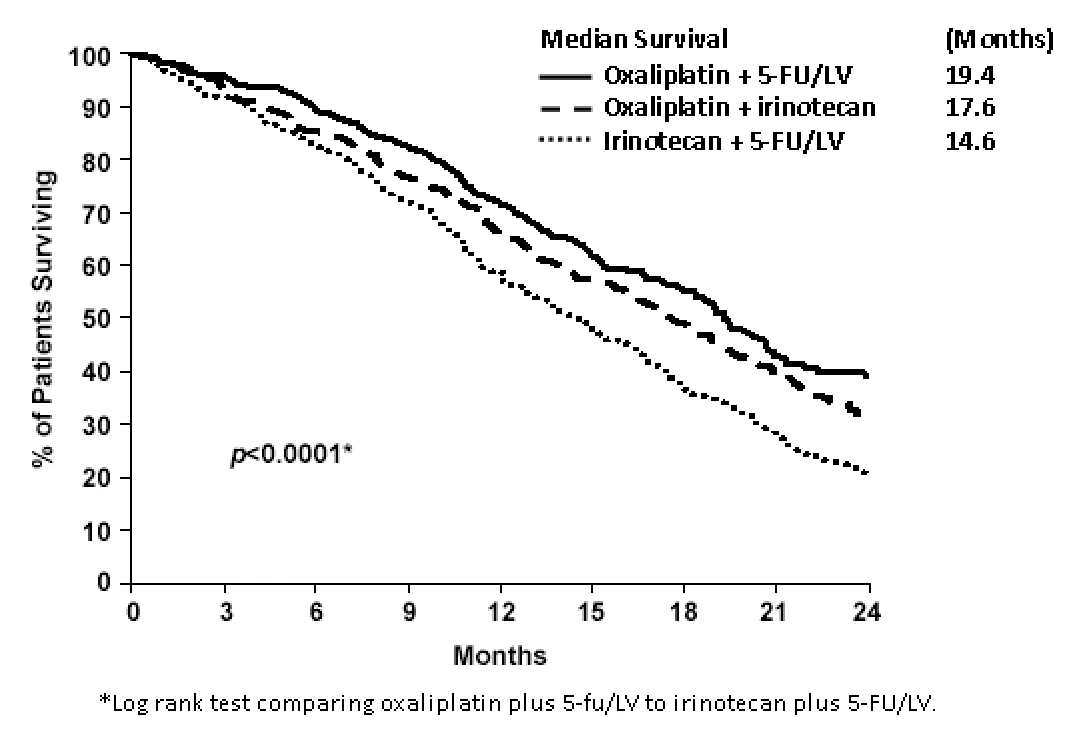
A pre-planned subgroup analysis demonstrated that the improvement in survival for oxaliplatin plus 5-FU/LV compared to irinotecan plus 5-FU/LV appeared to be maintained across age groups, prior adjuvant therapy, and number of organs involved.
The supportive study (EFC2962) in previously untreated patients (oxaliplatin plus 5-FU/LV vs. 5-FU/LV) demonstrated improvement in progression free survival (PFS) and response rate (RR), while overall survival (OS), based on unadjusted analysis, was not significantly improved with the addition of oxaliplatin. Patients treated with oxalpiplatin plus 5-FU/LV experienced higher grade 3/4 events of: vomiting (5% vs. 2%); diarrhea (12% vs. 5%); and stomatitis (6% vs. 1%) compared to patients treated with 5-FU/LV (see reference: de Gramont 2000).
DETAILED PHARMACOLOGY
Mechanism of Action
Oxaliplatin contains a platinum atom complexed to 1,2-diaminocyclohexane (DACH) in the trans-RR conformation and an oxalate as a leaving group. Oxaliplatin undergoes nonenzymatic conversion in physiologic solutions to active derivatives via displacement of the labile oxalate ligand. Several transient reactive species are formed, including monoaquo and diaquo DACH platinum, which covalently bind with macromolecules (plasma proteins, cellular proteins and DNA). The mechanism of action of oxaliplatin has not been fully elucidated. It is thought to be similar to that of other cytotoxic platinum drugs (i.e. cisplatin and carboplatin) which inhibit DNA synthesis mainly through the formation of platinum-DNA adducts. The major cytotoxic lesions generated by oxaliplatin are intra-strand platinum-DNA adducts, formed by cross-linking between activated platinum species and specific base sequences, notably two adjacent guanine residues or two adjacent guanine-adenine bases. Inter-strand cross-links may also be formed.
Pharmacodynamics
The antineoplastic properties of oxaliplatin have been demonstrated in vivo in mice.
The antitumour activity of oxaliplatin is confirmed both in vitro and in vivo in human colorectal cancer models. Oxaliplatin demonstrates in vitro cytotoxicity against HT-29, CaCo2 and HEC59 colon cancer cells. The molar potency of oxaliplatin was greater than cisplatin against the HT-29 cell line which is resistant to cisplatin (IC50 values of 0.97 ± 0.09 mcM for oxaliplatin compared to 20.36 ± 1.68 mcM for cisplatin). Oxaliplatin as a single agent displays only modest in vivo antitumour activity in HT-29 and DLD2 human colon cancer xenografts. A single dose of 45 mg/m2 oxaliplatin produces tumour growth inhibition (TGI) of 20.5% and 51.2% in HT-29 and DLD2 xenograft models, respectively. Additive or synergistic effects with 5-FU were also observed in in vitro studies in human colon cancer cell lines; synergistic cytotoxicity was demonstrated against CaCo2 and the 5-FU resistant HT-29 FU colon cell lines, but not in HT-29 colonic cells. The additive effects of oxaliplatin and 5-FU have been confirmed in vivo in a murine HT-29 xenograft model. An increase in systemic toxicity was observed when 5-FU/FA was combined with oxaliplatin.
The combination of oxaliplatin and CTP-11 resulted in a number of toxic deaths.
Pharmacokinetics
A study of the pharmacokinetics of oxaliplatin in mice demonstrated that, following administration of 17 mg/kg (51 mg/m2) oxaliplatin, free platinum declined rapidly with a t1/2 of 6.7 min and was undetectable after 1 hour. Platinum levels in red blood cells (RBCs) and total plasma reached a constant level from 1 hour through 24 hours, with platinum levels in RBCs approximately 3-fold higher than found in the plasma. The Cmax of free platinum was 12.16 mcg/mL and the AUC of free platinum was calculated to be 3.27 mcg•hr/mL. Plasma levels of total platinum initially declined within a few minutes with Cmax of 15.57 mcg/mL then more slowly (t1/2β, 0.82 hr).
In male rabbits following intravenous injection of oxaliplatin (3.97 mg/kg or 44 mg/m2): plasma ultrafiltrate platinum declined biexponentially and was detectable for up to 60 minutes post-dose.
The pharmacokinetic parameters obtained from an additional study conducted in mice and from three studies conducted in dogs are presented in Table 22. In general, the systemic exposures (AUC values) were reported to be consistent with the dose. In the 2-hour infusion studies, platinum levels in plasma ultrafiltrate peaked in most animals at the end of the 2-hour infusion, and then declined bi-phasically with an elimination half-life of approximately 24 hours. Higher platinum levels were detected in blood and plasma than in ultrafiltrate, and both blood and plasma platinum levels declined more slowly (with similar half-lives of 115 to 125 hours) than platinum plasma ultrafiltrate levels. These results were consistent with the 1.5-hour infusion study which used tritiated oxaliplatin.
Table 22: Summary of pharmacokinetics after single doses of oxaliplatin in mice and dogs
Species (# of animals) | Route and Schedule | Dose (mg/m2) | AUC0-inf (mcg•h/mL) | Cmax (mcg/mL) | t½ β (hr) |
Mice (324 males) | intravenous bolus, single dose | 51 | PUF: 11 760 (196 mg•min/L) | Bl: 12.5 Pl: 15.6 PUF: 12.2 | 0.82 |
Dogs (4 males) | intravenous infusion (1.5 hr), single dose | 72 (3H-DACH) | Bl: 108 mcg eq•hr/g Pl: 151 mcg eq•hr/g PUF: 12.4 mcg eq•hr/g | Bl: 1.67 mcg eq•hr/g Pl: 2.84 mcg eq•hr/g BUF: 1.33 mcg eq•hr/g | Bl:119 Pl: 119 PUF: 70 |
Dogs (4 male / 4 female) | intravenous infusion (2 hr), single dose | 134-190 | Pl: 122-207 Bl: 104-132 PUF: 5-14 (0-24) | Pl: 2.7-6.6 Bl: 1.5-2.8 PUF: 1.45-3.82 | Pl: 100 Bl: 115 PUF: 7 |
Dogs (5 males / 5 female) | intravenous infusion (2 hr), single dose | 150, 200 | Pl: 169, 211 Bl: 91, 128 PUF: 12, 14 | Pl: 3.44, 6.0 Bl: 1.5, 2.6 PUF: 1.95, 3.11 | Pl: 115 Bl: 125 PUF: 24 |
Abbreviations: Pl: plasma; Bl: Blood; PUF: plasma ultrafiltrate
Tissue distribution studies with oxaliplatin were conducted in mice, tumour bearing rats and in rabbits. In all species tested, the highest levels of platinum were detected in the spleen, followed by the kidney and liver.
The distribution of platinum in the tissues of mice dosed with 17 mg/kg oxaliplatin was largest in the spleen, kidney, gastrointestinal tract, skin, heart, thymus and lung. The lowest levels were noted in the brain and were negligible. Levels of platinum at 96 hours after oxaliplatin administration were minimally changed in the spleen and liver, halved in the kidney and quartered in the gastrointestinal tract.
Rats bearing CC531 peritoneal tumours were administered 6.6 mg/kg of oxaliplatin. Tissue distribution of oxaliplatin was observed in the liver, kidney, intestines, spleen and lungs, as well as in the tumour. Distribution of platinum from oxaliplatin treatment within the tumour (periphery versus centre) did not differ significantly.
Platinum from oxaliplatin was also widely distributed into tissues when administered i.v. to rabbits at 10 mcmol/kg (3.97 mg/kg or 44 mg/m2). The highest platinum levels from oxaliplatin were detected in the kidney and spleen. Similar to the mouse, platinum levels were not detected in the brain of rabbits administered oxaliplatin, indicating that oxaliplatin and its products either do not penetrate or are not retained in the CNS.
In vitro protein-binding of oxaliplatin was measured in human plasma at various concentrations. Oxaliplatin was 85 to 88% protein-bound, independent of initial incubation concentration within 5 hours. The half-life for disappearance of free platinum was approximately 1.7 hours. Between 25 and 50% of the platinum concentration in whole blood was associated with RBCs and did not exchange into plasma over time.
The single-dose 1.5-hour infusion study in dogs using titriated oxaliplatin indicated that oxaliplatin and its biotransformation products are primarily bound to plasma proteins.
Oxaliplatin biotransformed products were studied in both in vitro and in vivo test systems. The in vitro biotransformation products of oxaliplatin were examined in rat blood. In addition, [3H]-oxaliplatin was used to determine biotransformation products in human blood and hepatic microsomes and in dog blood and urine samples. In all species oxaliplatin formed several biotransformation products when incubated in whole blood. One in vivo biotransformation study on oxaliplatin was conducted in dog following intravenous administration of a single dose of 3.6 mg/kg (72 mg/m2) of [3H]-oxaliplatin. Plasma ultrafiltrates and urine were examined for radiolabeled oxaliplatin products.
Results showed that oxaliplatin undergoes rapid nonenzymatic biotransformation, initially by displacement of the oxalate group by a variety of nucleophiles, to give a mixture of DACH, chloro, or aquo derivatives, as well as amino acid derivatives, e.g. methionine DACH platin. Most of these biotransformed products of oxaliplatin appear to be common across all species tested. The reaction pathway via the diaquo and related derivatives is thought to produce the activated derivatives which interact with cellular DNA. In the dog, only 10% of the unchanged oxaliplatin was found in the plasma ultrafiltrate after a 1.5-hour infusion. Four major biotransformation products were observed in PUF, two of which identified as monochloro DACH platin and dichloro DACH platin. At two hours post infusion most of the radioactivity in PUF was distributed between 2 unknown components. Four major biotransformation products and at least seven minor ones were observed in the dog urine, where the free DACH was characterized as the major component.
In in vitro biotransformation of oxaliplatin in plasma studies, oxaliplatin was unchanged after 0.5 hours, but at 1 hour, 30% of the total platinum was in a peak with identical retention to that of (trans-1,2-diaminocyclohexane) dichloroplatinum (II). At 2 hours, in addition to this peak, three other platinum containing peaks were observed and no unchanged oxaliplatin remained.
Oxaliplatin fits a multi-compartment elimination model. Terminal-phase calculations were difficult as the free platinum rapidly disappeared.
Excretion of oxaliplatin was studied in rabbits and dogs following a single intravenous infusion of 44 mg/m2 for rabbits and 72 mg/m2 for dogs, administered over 1.5 hours. In rabbits, within 24 hours, urinary excretion of unchanged oxaliplatin and total platinum accounted for 28% and 76% of the administered dose, respectively. All unchanged oxaliplatin was excreted within two hours of dosing. In dogs, 77% of the administered dose was excreted within seven days of dosing, with the majority (66%) being excreted in the urine within the first 48 hours. Fecal excretion accounted for 5% to 6% of the dose over seven days. The terminal phase of excretion was slow in both species reflecting some irreversible binding of labelled products to cellular components.
Drug-Drug Interaction Studies
The effect of oxaliplatin on the PKs of 5-FU has been studied in 18 patients with colorectal carcinoma. The study adopted a parallel group design (n = 9 patients per group) with or without a single infusion of oxaliplatin at 85 mg/m2 immediately before administration of 5-FU. The study showed no significant differences in 5-FU exposure in the presence and absence of oxaliplatin. No pharmacokinetic interaction between 85 mg/m2 oxaliplatin and 5-FU/LV has been observed in patients treated every 2 weeks. Increases of 5-FU plasma concentrations by approximately 20% have been observed with doses of 130 mg/m2 oxaliplatin administered every 3 weeks. The approved dose of oxaliplatin is 85 mg/m2 every 2 weeks in combination with 5-
FU/LV (see DOSAGE AND ADMINISTRATION).
CYP450 Interactions: Oxaliplatin did not significantly inhibit (defined as a decrease in enzyme activity to <70% of control rate) CYP1A2, CYP2A6, CYP2C9, CY2C19, CYP3A4, CYP2D6, or CYP2E1.
Plasma Protein Binding Interactions: No significant displacement of platinum from plasma protein was observed with any of the concomitant medications tested (erythromycin, salicylate, sodium valproate, granisetron, and paclitaxel) with the exception of a small (2.85%) increase in free platinum concentrations in the presence of erythromycin.
TOXICOLOGY
Acute Toxicity
Single-dose toxicity studies were performed in mice (intravenous, intraperitoneal), rats (intravenous, intraperitoneal and oral gavage) and dogs (intravenous). A summary of the studies carried out is presented in Table 23.
The acute single doses for mice (LD10) were 84-172 mg/m2 (intravenous) and 105 mg/m2 (intraperitoneal).
The LD10 for rats were 114 to 138 mg/m2 (intravenous), 84 mg/m2 (intraperitoneal) and 600 mg/m2 (highest oral non-lethal dose). Oxaliplatin was found to cause hepatic toxicity in rats [gross pathology of liver damage and increased aspartate aminotransferase (AST) and alanine aminotransferase (ALT)].
The highest non-severely toxic dose (intravenous) for dogs was 150 mg/m2. The target organs for toxicity in dogs were the heart (actual cause of death), gastrointestinal tract (emesis and diarrhea), liver (an increase in AST) and the kidney (proteinuria and haematuria).
Respiratory effects were investigated in anesthetized dogs administered a single dose of oxaliplatin 2.6, 13.6, or 15 mg/kg (52, 272 or 300 mg/m2). Low- and mid-dose dogs received a second dose of 6.4 mg/kg (128 mg/m2) oxaliplatin. The high dose of oxaliplatin lowered blood pH levels (acidosis). One dog experienced pulmonary and systematic arterial hypertension and respiratory arrest.
The doses of 70 mg/m2 and 150 mg/m2 were lethal to the monkey. Cachexia and hepatotoxicity (increased AST and ALT) were reported in monkeys.
Dyspnea, neurotoxicity (coordination, motor activity), decreased WBC, and decreased RBC were also reported in animal studies.
Table 23: Summary of Single Dose Toxicology Studies with Oxaliplatin
| Species | Route | # Animals/ sex/dose | Critical Doses (mg/kg)a | Significant findings |
|---|---|---|---|---|
| Mouse (CD-1) | intravenous infusion (1 mL/min) | 5 | LD10 = 14-17 (84-102)b LD50 = 16-19 (96-114) | The 3 formulations tested had the same toxicity (mortality). |
| Mouse (CD-1) | 2-hr intravenous infusion after initial dose of citrate buffer c (1-2 mL/min) | 5 | LD10 = 28.7 (172) | |
| Mouse (OF1) | intravenous (25 mL/kg) | 10 | LD10 = 20 (120) LD50 = 22.5 (135) | |
| Mouse (OF1) | intraperitoneal (25 mL/kg) | 10 | LD10 = 17.5 (105) LD50 = 19 (114) | |
| Rat (Wistar) | intraperitoneal (10 mL/kg) | 10 | LD10 = 14 (84) LD50 = 17.5 (105) | |
| Rat (OFA-SD) | intravenous (2 mL/min) | 8 | LD10 = 19-23d (114-138) LD50 = 29 (174) | Liver damage seen at biopsy |
| Rat (Wistar). | intraperitoneal | 12 male | STD10 (highest non-lethal) = 14 (84) | Oxaliplatin was less toxic (decrease in body weight, neurotoxicity and renal toxicity) than cisplatin. Oxaliplatin increased AST levels by 15-25% |
| Rat Tac:N (SD)fBR | Oral gavage | 5 | Highest non-lethal dose = 100 (600) | No treatment-related clinical signs |
| Dog (Beagle) | intravenous (2 mL/min, 20 min) | 0-1 | HNSTD = 7.5 (150) Lethal dose = 10 (200) | At HD: emesis, diarrhea, decreased body weight, proteinuria, haematuria, decreased WBC and increased AST noted; cardiac toxicity likely as cause of death |
| Dog (Beagle and mongrel) | intravenous (5 mL/min, 2 infusions at 2.5 hour intervals) | 0-2 | Oxaliplatin was formulated in saline which resulted in compound degradation. Oxaliplatin caused death due to metabolic acidosis that led to respiratory arrest. |
a Equivalent value in mg/m2 is stated in brackets.
b The value range for three formulations tested: bulk substance, lactose lyophilisate and mannitol lyophilisate.
c Estimated values for mice receiving co-administration of citrate buffer: 50 mL/kg intravenously.
d The mean LD10 for both genders was between 17 (LD05) and 24 (LD50) mg/kg.
Key to abbreviations: AST: aspartate aminotransferase; HD: high dose; HNSTD, highest non-severely toxic dose; STD: safely tolerated dose
Repeated Dose Studies
Repeated dose studies have been conducted in rats, dogs and baboons, all with intravenous routes of administration. A summary of these studies is shown in Table 24.
Table 24: Summary of Repeat-Dose Toxicology Studies Conducted with Oxaliplatin
| Species | Route/ Duration | # animals/ sex/dose | Critical Doses (mg/kg)a | Significant findings |
|---|---|---|---|---|
| Rat (Wistar) | Slow i.v. 1 mL/min daily x 3 | 8 male | ND | Oxaliplatin was degraded in isotonic saline, therefore critical dose could not be assessed |
| Rat (SD) | i.v. 2 mL/min daily x 3, q21d x 3 cycles | 10 and 15 | HD = 2 (12) MD = 1 (6) | 1-2 deaths in each group including control group, probably due to dosing procedure. Oxaliplatin induced decreased body weight, myelosuppression, dose-related kidney necrosis in HD and MD, mild increase in creatinine, urea and decreases in testes and prostate weights |
| Dog (Beagle) | 1q 28 days or daily x 5, q28d 1-6 cycles slow i.v. 2 mL/min | 2 or 4 | LethalS = 10 (200) LethalR = 2 (40) HNSTDs= 2 (40) HNSTDR = 1 (20) | Oxaliplatin produced salivation, emesis, diarrhea, unsteady gait, shaking and trembling, leukopenia and anemia and decrease in testicular weight. Ventricular extrasystole and fibrillation in ECG (repeat HD animal died) |
| Dog (Beagle) | i.v. 2 mL/min, 20 min daily x 5 | 1-2 | HNSTD = 7.5 (45) Lethal = 10 (60) | Vomiting, diarrhea, decreased body weight and food consumption, proteinuria, hematuria, decreased WBC, increased AST; cardiac toxicity appeared to be cause of death |
| Dog (Beagle) | i.v. 2 mL/min daily x 5, q28d, 3 cycles | 3 | HNSTD = 1.75 (35) | Slight myelosuppression, dose-related testicular hypoplasia, decreased testes weight, degeneration of proximal tubules of kidneys, mild to severe pancreatitis |
| Dog (Beagle) | 2 h i.v. infusion, 1mL/min 1q21days x 3 cycles | 3 | HNSTD = 5 (100) | 150 mg/m2 dose resulted in 2 deaths possibly due to cardiac toxicity (contracted hearts), emesis, salivation, tremors and uncoordinated movements. Dose-dependent myelosuppression, atrophy of testes |
| Baboon (Papio cymoceph alus) | i.v. 100 mL/5 min 1q14/15 days, x 4 doses | 1 or 3 | HNSTD = 6.1 (67) | Oxaliplatin was formulated in saline which resulted in degradation. No significant clinical, biochemical or hematological toxicity observed. |
a equivalent value in mg/m2 is stated in brackets
Key to abbreviations: HNSTD: highest non-severely toxic dose; HD: high-dose; MD: mid-dose; WBC: white blood cell count; AST: aspartate aminotransferase; ND: not derived; R: repeat dose; S: single dose
Oxaliplatin was found to cause anorexia, myelosuppression, dose-related renal toxicity (kidney necrosis, interstitial inflammatory reaction, and urea), hepatotoxicity (ALT, inflammatory lesions, periportal sclerosis, stasis, periportal infiltration, bilirubin in the urine), respiratory toxicity (respiratory arrhythmia, dyspnea, moderate emphysema) and germinal aplasia. A decrease in the weight of the testes and prostate, testicular hypoplasia, granulomatous prostatitis, and mammary gland hypertrophy were also observed. However, no damage was reported to ovarian structure.
Oxaliplatin caused significant cardiac toxicity in dogs (increase in heart weight), ventricular extrasystole and fibrillation in ECG and death due to cardiac failure). Oxaliplatin also caused toxicities in the gastrointestinal tract (pancreatitis, vomiting and diarrhea), hematopoietic system (leukopenia and anemia), kidney (proteinuria, hematuria, degeneration of renal proximal tubules), nervous system (unsteady gait, shaking, tremors and trembling), liver (increase in AST) and the testis (a reduction in weight and testicular hypoplasia) in the dog. The toxicology studies conducted in baboons failed to generate informative data because of vehicle-facilitated drug degradation. The longest duration for the repeat-dose studies was conducted in dogs, with a schedule of daily treatment for five days repeated every 28 days for up to 6 cycles.
The highest non-severely toxic dose for such a schedule was 35 to 45 mg/m2/day. The lethal doses of oxaliplatin for dogs were 40 (6 cycles) and 60 (1 cycle) mg/m2/day.
Genetic Toxicology
All genotoxicity tests (mammalian thymidine kinase [TK] locus mutations, mouse micronucleus and the metaphase analysis) were positive, with the exception of the Ames test, which proved negative.
Oxaliplatin (4.11, 8.22 or 12.33 mg/kg) was administered intraperitoneally to mice, either once or twice, at an interval of 24 hours and the bone marrow observed for micronuclei 24 hours after the last drug injection. Mitomycin (1 mg/kg) was used as a positive control. All doses of oxaliplatin tested yielded a statistically significant increase in cells and micronuclei (over 35-fold greater than control, at least double the positive control). A second dose of oxaliplatin yielded too great a toxicity in the marrow to be able to evaluate micronuclei.
Assay of mutations at the TK locus in L5178Y mouse lymphoma cells was carried out comparing oxaliplatin to cisplatin. The number of mutated colonies increased with increasing dose of oxaliplatin and cisplatin independent of S9 activation. At concentrations of 6 mcM (with S9) and 8.3 mcM (without S9), cisplatin increased mutations by 5.5 and 3.7-fold, while oxaliplatin increased mutation by 4.8- and 4.0-fold.
In a study of chromosomal abnormalities by metaphase analysis of human lymphocytes in culture, oxaliplatin, without metabolic activation, caused no increase in the number of gaps per cell, but breaks per cell increased dose-dependently to a maximum of approximately 12-fold over the control. Total cells with all aberrations increased 4.5-fold in positive controls (mitomycin C and cyclophosphamide), 4-fold for oxaliplatin at 4 mcM, and 8-fold for equimolar concentrations of cisplatin. In lymphocytes with metabolic activation, aberrant metaphases increased approximately 3-fold in both positive controls and oxaliplatin-treated cells at 32 M; cisplatin increased aberrant metaphases by 24-fold.
Oxaliplatin showed no statistically significant increase in reverants in any line tested (strains: TA1535, TA1537, TA1538, TA9S and TA100) during in vitro mutagenicity testing using the Ames test.
Reproduction Toxicity
Reproduction studies have been conducted in the rat and rabbit. In one study, rats (40 animals/sex/dose group for the F0 generation) were administered 0, 0.5, 1.0 or 2.0 mg/kg/day oxaliplatin prior to mating, daily for five days every 21 days. Male rats were administered a total of three courses before mating, and females were administered two courses, with mating occurring at the end of the first course. Oxaliplatin, administered at a dose of 2.0 mg/kg/day prior to mating, significantly increased the number of post-implantation losses; 97% total resorption in females was observed at this dose. Oxaliplatin was found to induce a high level of early resorption in females administered 2.0 mg/kg/day (96% resorbed in relation to total number of implantations) and other developmental mortality (decreased live fetuses and decreased live births) as well as delayed growth (decreased fetal weight), but did not give rise to any malformation in the rats or affect postnatal development and reproductive function for the F1 generation. Reproductive toxicity in rats was found to be dose-dependent.
In a second study following i.v. daily dosing of 6 mg/m2/day for 5 days, oxaliplatin caused a growth delay (decrease in weight and ossification delay) in the fetuses of rats dosed at gestation days 6 to 10 and increased early resorption between gestation days 6 to 10 and days 11 to 16. Oxaliplatin did not cause any significant malformations.
In rabbits administered intravenous doses of 0, 3, 6 and 12 mg/m2/day for 13 days during gestation days 6 to18, oxaliplatin induced a dose-related decrease in food consumption in the pregnant rabbits, but did not induce abortions or embryotoxic or teratogenic effects in the fetuses.
Testicular damage, characterized by degeneration, hypoplasia, and atrophy, was observed in dogs administered oxaliplatin at 0.75 mg/kg/day x 5 days every 28 days for three cycles. A no-effect level was not identified. This daily dose is approximately one-sixth of the recommended human dose on a body surface area basis.
Carcinogenicity
The carcinogenicity of oxaliplatin has not been studied in animals.
Special Toxicity Studies
Several special toxicity studies were conducted to investigate specific target organ toxicities of oxaliplatin, including studies on local tolerance, cardiac toxicity, nephrotoxicity and myelotoxicity.
Local Tolerance
R41 (risk of serious damage) eye irritation, focal edema and irritation.
Cardiac Toxicity
In cultured neonatal rat, cardiac myocytes, oxaliplatin produced double beats (1 g/mL) and reduced beats (10 g/mL).
Oxaliplatin produced ventricular fibrillation, ventricular ectopic beats, increases in blood pressure and heart rate, and death in 2 out of the 3 dogs after 4.5 and 9 hours post 2-hour infusion of 7.5 mg/kg (150 mg/m2) or above. The hearts of dogs that died were unusually firm, although histologically normal. The dose of 150 mg/m2 produced delayed ventricular repolarization (QT interval prolongation) and changes in cardiovascular safety parameters such as RR interval, PR interval, QRS duration, and heart rhythm disorders: ventricular extrasystoles and ventricular fibrillation.
Cardiac toxicity was not detected in specific cardiac studies in rats or monkeys, suggesting either increased sensitivity in dogs or species-specific cardiotoxicity.
The ECG changes of animals that died at a dose of 10 mg/kg (200 mg/m2) are described as ventricular premature depolarizations with fixed coupling preceding and evolving into ventricular fibrillation. The onset of arrhythmic activity was closely associated with death. Repolarization and conductance abnormalities were not evaluated in the in vitro cardiotoxicity tests. To date, the mechanism of dose-dependent cardiotoxicity of oxaliplatin remains unknown.
The ECG abnormalities found in cynomolgous monkeys given oxaliplatin at 6.4, 13.6, or 18.2 mg/kg (70, 150, or 200 mg/m2) via 2-hour intravenous infusion, showed a decrease in heart rate and increase in QT prolongation 7 hours after infusion in one male and on Day 8 in one female in the 200 mg/m2 dose group; decrease in heart rate, increase in QT interval on Day 7 (male) and on Day 8 (female) in the 150 mg/m2 dose group. The post-dose ECG examinations were not performed in the 70 mg/m2 dose group, which is very close to the approved human dose. Two out of six animals (dosed 70 mg/m2 and 150 mg/m2) died, and 3/6 sacrificed in morbid condition. Mortality was attributed to severe diarrhea and marasmus.
Summary of Cardiac Toxicity
Based on preclinical studies, oxaliplatin is cardiotoxic. In the dog, a single dose of ≥ 150 mg/m2 oxaliplatin caused serious cardiovascular reactions such as increased blood pressure, arrhythmia, ventricular ectopic events, followed by fatal ventricular fibrillation. Oxaliplatin cardiac toxicity was the most frequent cause of lethal events observed in dogs. Given the similar drug biotransformation and exposure in dogs and humans, there is a safety concern for patients treated with oxaliplatin at a dose ≥ 130 mg/m2 (see DETAILED PHARMACOLOGY). In the event of overdose, it should be anticipated that oxaliplatin may cause cardiac dysfunction that may lead to the death of the patient. The approved dose of oxaliplatin in humans is 85 mg/m2 every 2 weeks in combination with 5-FU/LV (see DOSAGE AND ADMINISTRATION).
Nephrotoxicity
Nephrotoxicity studies in rats administered single intraperitoneal doses of oxaliplatin (6.6 mg/kg; 39.6 mg/m2), showed only a slight increase in urinary enzyme excretion. When rats were administered oxaliplatin 0, 1.5, 3, and 6 mg/kg/day (0, 9, 18, and 36 mg/m2) intravenously for five consecutive days, decreased kidney weights and proximal tubule cell necrosis were observed.
Myelotoxicity
Oxaliplatin had a lower potential to produce myelosuppression than carboplatin, but to a similar extent as cisplatin in an in vitro human bone marrow stem cell assay. Oxaliplatin is neurotoxic, affecting the morphometry of neuronal cells in vivo.
Oxaliplatin Combination Studies
Acute mouse toxicity studies were conducted with oxaliplatin in combination with other antineoplastic agents or antiemetics where intravenous administration of oxaliplatin at the approximate LD10 dose of 20 mg/kg (60 mg/m2) was followed by an antiemetic (metoclopramide, ondansetron, or granisetron) or an antineoplastic agent (cyclophosphamide, 5-FU, methotrexate, adriamycin, or cisplatin). In general, the combinations produced a slight increase in mortality compared to oxaliplatin alone, except for oxaliplatin in combination with cyclophosphamide or 5-FU, which appeared to be similar or less toxic than oxaliplatin alone. In addition, the combination of oxaliplatin plus cisplatin produced a significant increase in mortality.
REFERENCES
- 1. Argyriou AA, Polychronopoulos P, Iconomou G, Koutras A, Makatsoris T, Gerolymos MK, Gourzis P, Assimakopoulos K, Kalofonos HP, Chroni E. Incidence and characteristics of peripheral neuropathy during oxaliplatin-based chemotherapy for metastatic colon cancer. Acta Oncol. 2007;46(8):1131-7.
- 2. Baur M, Kienzer HR, Rath T, Dittrich C. Extravasation of Oxaliplatin (Oxaliplatin for Injection ®) – Clinical Course. Onkologie. 2000;23:468-471.
- 3. Cardonick E, Iacobucci A (2004) Use of chemotherapy during human pregnancy. Lancet Oncol 5:283–291.
- 4. Culy CR, Clemett D, Wiseman LR. Oxaliplatin – A review of its pharmacological properties and clinical efficacy in metastatic colorectal cancer and its potentials in other malignancies. Drugs 2000;60(4):895-924.
- 5. Cunningham D, Pyrhonen S, James RD, Punt CJ, Hickish TF, Heikkila R et al. Randomised trial of irinotecan plus supportive care versus supportive care alone after fluorouracil failure for patients with metastatic colorectal cancer. Lancet 1998;352(9138):1413-1418.
- 6. de Braud F, Munzone E, Nole F, De Pas T, Biffi R, Brienza S, Aapro MS. Synergistic activity of oxaliplatin and 5-fluorouracil in patients with metastatic colorectal cancer with progressive disease while on or after 5-fluorouracil. Am J Clin Oncol. 1998;21(3):279-283.
- 7. de Gramont A, Figer A, Seymour M, Homerin M, Hmissi A, Cassidy J et al. Leucovorin and fluorouracil with or without oxaliplatin as first-line treatment in advanced colorectal cancer. J Clin Oncol. 2000;18(16):2938-2947.
- 8. De Lemos ML, Walisser S. Management of extravasation of oxaliplatin. J Oncol Pharm Practice 2005;11:159-62.
- 9. Eloxatin – US Prescribing Information, Sanofi-Synthelabo Inc., December 2011.
- 10. Eloxatin – UK Summary of Product Characteristics, Sanofi-Synthelabo, May 2011.
- 11. Eloxatin Product Monograph, sanofi-aventis Canada Inc., Control number 164367, Date of revision, 30 July 2013.
- 12. Figer A, Perez N, Carola E, André T, Chirivella I, Lledo G et al. 5-fluorouracil, folinic acid and oxaliplatin (FOLFOX) in very old patients with metastatic colorectal cancer. J Clin Oncol. 2004;22(14S):263 (abstr 3571; suppl)
- 13.
Fizazi K, Ducreux M, Ruffié P, Bonnay M, Daniel C, Soria JC, Hill C, Fandi A, Poterre M, Smith M, Armand JP. Phase I, dose-finding, and pharmacokinetic study of raltitrexed
- combined with oxaliplatin in patients with advanced cancer. J Clin Oncol. 2000 Jun;18(11):2293-300.
- 14. Goldberg RM, Sargent DJ, Morton RF, Fuchs CS, Ramanathan RK, Williamson SK et al. A randomized controlled trial of fluorouracil plus leucovorin, irinotecan, and oxaliplatin combinations in patients with previously untreated metastatic colorectal cancer. J Clin Oncol. 2004;22(1):23-30.
- 15. Graham MA, Gamelin E, Misset JL, Brienza S, Allain P, Boisdron-Celle et al. Clinical pharmacokinetics of oxaliplatin. Proc Am Assoc Cancer Res. 1998;39:159.
- 16. Graham MA, Lockwood GF, Greenslade D, Bienza S, Bayssas et al. Clinical pharmacokinetics of oxaliplatin: A critical review. Clin Cancer Res. 2000;6:1205-1218.
- 17. Green E, Sargent DJ, Goldberg RM, et al. Detailed analysis of oxaliplatin-associated neurotoxicity in Intergroup trial N9741. GI Cancers Symposium, Holywood, FL, January 27-29, 2005 (abstr 182).
- 18. Grothey A, Deschler B, Kroening H, Ridwelski K, Reichardt P, Kretzschmarat A et al. Phase III study of bolus 5-fluorouracil (5-FU)/folinic acid (FA) (Mayo) vs weekly high-dose 24h 5-FU infusions/FA + oxaliplatin (OXA) (FUFOX) in advanced colorectal cancer (ACRC). Proc Am Soc Clin Oncol. 2002;21:129a (abstr 512, updated based on presentation).
- 19. Grothey A, Sargent D, Goldberg RM, Schmoll HJ. Survival of patients with advanced colorectal cancer improves with the availability of fluorouracil-leucovorin, irinotecan, and oxaliplatin in the course of treatment. J Clin Oncol. 2004;22(7):1209-1214.
- 20. Hewes JC, Dighe S, Morris RW, Hutchins RR, Bhattacharya S, Davidson BR. Preoperative chemotherapy and the outcome of liver resection for colorectal metastases. World J Surg 2007;31(2):353-64.
- 21. Kelly H, Goldberg RM. Systemic therapy for metastatic colorectal cancer: Current options, current evidence. J Clin Oncol. 2005;23(20):4553-4560.
- 22. Kidani Y, Inagaki K. Antitumour activities of 1,2-diaminocyclohexane platinum complexes against sarcoma-180 ascites form. J Med Chem. 1978;21(12):1315-1318.
- 23. Kidani Y, Inagaki K, Tsukagoshi S. Examination of antitumour activities of platinum complexes of 1,2-diaminocyclohexane isomers and their related complexes. Gann. 1976;67(6):921-922.
- 24. Levi F, Giacchetti S, Adam R, Zidani R, Metzger G, Misset JL. Chronomodulation of chemotherapy against metastatic colorectal cancer. Eur J Cancer 1995;31A:1264-1270.
- 25. Mathé G, Kidani Y, Noji M, Maral R, Bourut C, Chenu E. Antitumour activity of L-OHP in mice. Cancer Lett. 1985;27(2):135-143.
- 26. Mathé G, Kidani Y, Segiguchi M, Eriguchi M, Fredj G, Peytavin G et al. Oxalato-platinum or 1-OHP, a third-generation platinum complex: An experimental and clinical appraisal and preliminary comparison with cis-platinum and carboplatinum. Biomed Pharmacother. 1989;43(4):237-250.
- 27. Meta-Analysis Group in Cancer. Efficacy of intravenous continuous infusion of fluoruracil compared with bolus administration in advanced colorectal cancer. J Clin Oncol. 1998;16(1):301-308.
- 28. Papamichael D, Joel SP, Seymour MT, Richards F, Bowerbank M, Slevin ML. Pharmacokinetic (PK) interaction between 5-fluorouracil (5-FU), and oxaliplatin (L-OHP). Proc Am Soc Clin Oncol. 1998;17:202.
- 29. Pendyala L, Creaven PJ. In vitro cytotoxicity, protein binding, red blood cell partitioning and biotransformation of oxaliplatin. Cancer Research 1993;53(24):5970-5976.
- 30. Piedbois P, Michiels S, for the Meta-Analysis Group in Cancer. Survival benefit of 5FU/LV over 5FU bolus in patients with advanced colorectal cancer: An updated meta-analysis based on 2,751 patients. Proc Am Soc Clin Oncol. 2003;22:294 (abstr 1180).
- 31. Pinedo DM, Shah-Khan F, Shah PC. Reversible posterior leukoencephalopathy syndrome associated with oxaliplatin. J Clin Oncol. 2007 Nov 20;25(33):5320-1.
- 32. Rothenberg ML, Oza AM, Begelow RH, Berlin JD, Marshall JL, Ramanathan RK, et al. Superiority of oxaliplatin and fluorouracil-leucovorin compared with either therapy alone in patients with progressive colorectal cancer after irinotecan and fluorouracil-leucovorin: interim results of a phase III trial. J Clin Oncol 2003;21:2059-69
- 33. Rougier P, Van Cutsem E, Bajetta E, Niederle N, Possinger K, Labianca R et al. Randomised trial of irinotecan versus fluorouracil by continuous infusion after fluorouracil failure in patients with metastatic colorectal cancer. Lancet 1998;352(9138):1407-1412.
- 34. Rubbia-Brandt L, Audard V, Sartoretti P, Roth AD, Brezault C, Le Charpentier M, et al. Severe hepatic sinusoidal obstruction associated with oxaliplatin-based chemotherapy in patients with metastatic colorectal cancer. Annals of Oncology 2004;15(3):460-6.
- 35. Shao YY, Hu FC, Liang JT, Chiu WT, Cheng AL, Yang CH. Characteristics and risk factors of oxaliplatin-related hypersensitivity reactions. J Formos Med Assoc. 2010 May;109(5):362-8.
- 36. Sharief U, Perry DJ. Delayed reversible posterior encephalopathy syndrome following chemotherapy with oxaliplatin. Clin Colorectal Cancer. 2009 Jul;8(3):163-5.
- 37. Skelton MR, Goldberg RM, O'Neil BH. A case of oxaliplatin-related posterior reversible encephalopathy syndrome. Clin Colorectal Cancer. 2007 Jan;6(5):386-8.
- 38. Shouten van der Velden AP, Punt CJA, Van Krieken JHJ, Derleyn VA, Ruers TJM. Hepatic veno-occlusive disease after neoadjuvant treatment of colorectal liver metastases with oxaliplatin. European Journal of Surgical Oncology 2008;34: 353-5.
- 39. Simmonds PC. Palliative chemotherapy for advanced colorectal cancer: systematic review and meta-analysis. Colorectal Cancer Collaborative Group. BMJ 2000; 321 (7260): 531-535.
- 40. Summary Basis of Approval NDA Number 21-492 Oxaliplatin for Injection. Sanofi-Synthelabo. CDER Pharmacology Review 2002.
- 41. Summary Basis of Approval NDA Number 21-492 Oxaliplatin for Injection. Sanofi-Synthelabo. CDER Clinical Pharmacology and Biopharmaceutics Review.
- 42. Summary Basis of Approval NDA Number 21-492 Oxaliplatin for Injection. Sanofi-Synthelabo. CDER Medical Review, 2002.
- 43. Summary Basis of Approval NDA Number 21-492/S-002 Oxaliplatin for Injection. Sanofi-Synthelabo. CDER Medical Review, 2004.
- 44. Takimoto CH, Remick SC, Sharma S, Mani S, Ramanathan RK, Doroshow et al. Dose-escalating and pharmacological study of oxaliplatin in adult cancer patients with impaired renal function: A National Cancer Institute Organ Dysfunction Working Group Study. J Clin Oncol. 2003;21(14):2664-2672.
- 45. Tashiro T, Kawada Y, Sakurai Y, Kidani Y. Antitumour activity of a new platinum complex, oxalato (trans-l-1,2,-diaminocyclohexane) platinum II: New experimental data. Biomed Pharmacother. 1989;43(4):251-260.
- 46. Therasse P, Arbuck SG, Eisenhauer EA et al. New guidelines to evaluate the response to treatment in solid tumours. European Organization for Research and Treatment of Cancer, National Cancer Institute of the United States, National Cancer Institute of Canada. J Natl Cancer Inst. 2000;92(3):205-216.
- 47. Tisman G, MacDonald D, Shindell N, Reece E, Patel P, Honda N, et al. Oxaliplatin toxicity masquerading as recurrent colon cancer. Journal of Clinical Oncology 2004: 22 (15); 3202-4.
- 48. Tournigand C, André T, Chirivella I, Figer A, Lledo G, Flesch M et al. 5-Fluorouracil, folinic acid and oxaliplatin (FOLFOX) in poor prognosis patients with metastatic colorectal cancer. J Clin Oncol. 2004b;22(14S):261 (abstr 3565; suppl).
- 49. Vauthey JN, Pawlik TM, Ribero D, Wu TT, Zorzi D, Hoff PM, et al. Chemotherapy regimen predicts steatohepatitis and an increase in 90-day mortality after surgery for hepatic colorectal metastases. Journal of Clinical Oncology 2006; 24(13):2065-72.