


Patient Medication Information: uses, side effects, how to take - Pexegra
Serious warnings and precautions box
What PEXEGRA is used for:
PEXEGRA is used to treat neutropenia (nu-tro-peen-ee-ah). Neutropenia is a condition where the body makes too few white blood cells and which may be caused by drugs used to treat cancer. Neutropenia is the most serious common side-effect of chemotherapy. Neutropenia predisposes your body to infections and prevents you from fighting them. Your doctor has decided to prescribe PEXEGRA for you to increase the number of neutrophils (nu-tro-fils), which will fight infections.
PEXEGRA is a man-made, long-acting form of granulocyte colony-stimulating factor (G-CSF), a substance naturally produced by the body.
How PEXEGRA works:
PEXEGRA works by stimulating the bone marrow to make white blood cells. To make sure PEXEGRA is working, your doctor may ask that you have regular blood tests to count the number of white blood cells. It is important to follow the doctor's instructions about these tests.
The ingredients in PEXEGRA are:
Medicinal ingredient: pegfilgrastim
Non-medicinal ingredients: acetic acid, polysorbate 20, sodium hydroxide, sorbitol, water for injection
- Your spleen may become enlarged and can rupture while taking PEXEGRA. A ruptured spleen can cause death. Call your doctor right away if you have pain in the left upper stomach area or left shoulder tip area.
- If you have a sickle cell trait or sickle cell disease, make sure that you tell your doctor before you start taking PEXEGRA so that the potential risks and benefits can be discussed. In patients with sickle cell trait or sickle cell disease, severe sickle cell crises have been associated with the use of pegfilgrastim. Severe sickle cell crises, in some cases resulting in death, have also been associated with filgrastim, the parent compound of pegfilgrastim.
PEXEGRA comes in the following dosage form:
PEXEGRA is available in a single-use pre-filled syringe with UltraSafe PlusTM Passive Needle Guard. Each single-use syringe (0.6 mL) of PEXEGRA (10 mg/mL) contains 6 mg of pegfilgrastim, the active substance. Each blister packaged syringe is provided in a carton. The needle cap on the pre-filled syringe is not made with natural rubber latex.
Do not use PEXEGRA if:
- You are allergic to pegfilgrastim (PEXEGRA), filgrastim, or any of the ingredients of PEXEGRA.
- You are allergic to other products made using the bacteria Escherichia coli. Talk to your doctor if you have any questions about this information.
To help avoid side effects and ensure proper use, talk to your healthcare professional before you take PEXEGRA. Talk about any health conditions or problems you may have, including:
- If you have common signs of infection, such as fever, chills, rash, sore throat, diarrhea, or redness, swelling, or pain around a cut or sore. If you notice any of these symptoms during treatment with PEXEGRA, tell your doctor or nurse immediately. PEXEGRA can reduce the risk of infection, but it may not prevent all infections. An infection can still happen during the short time when your white blood cell levels are low.
- If there is a lump, swelling, or bruising at the injection site that does not go away, talk to your doctor. Occasionally a problem may develop at the injection site.
- If you have sickle cell trait or sickle cell disease, tell your doctor prior to treatment. If you develop left upper abdominal pain or pain at the tip of your shoulder, tell your doctor or nurse immediately.
Other warnings you should know about:
Your doctor will decide if you are able to give yourself a subcutaneous (i.e., under the skin) injection. PEXEGRA should only be injected on the day the doctor has determined for you and should not be injected until 24 hours after receiving your last dose of chemotherapy in each cycle. (If you are injecting someone else with PEXEGRA, it is important that you inform yourself about PEXEGRA to know how and when to give the PEXEGRA injection.)
Make sure your doctor knows about all medications you are taking before starting PEXEGRA injections. Patients taking lithium may need more frequent blood tests.
More information about PEXEGRA is available in the Product Monograph. Any questions should be discussed with your doctor.
Pregnancy and breastfeeding and PEXEGRA
PEXEGRA has not been studied in pregnant women, and its effects on developing babies are not known. It is possible that PEXEGRA can get into human breast milk. If you are pregnant, plan to become pregnant, think you may be pregnant, or are breast feeding, you should consult your doctor before using PEXEGRA.
Tell your healthcare professional about all the medicines you take, including any drugs, vitamins, minerals, natural supplements or alternative medicines.
The following may interact with PEXEGRA:
Drug interactions between PEXEGRA and other drugs have not been studied. Drugs such as lithium may affect the release of neutrophils into the blood stream. You should discuss your treatment with your doctor before using PEXEGRA.
How to take PEXEGRA:
Usual dose:
The recommended dosage of PEXEGRA is a single subcutaneous injection, just under the skin, of 6 mg (the contents of one pre-filled syringe), administered once per cycle of chemotherapy. You must wait at least 24 hours after your course of cancer chemotherapy before injecting PEXEGRA. PEXEGRA should not be administered less than 14 days before your next chemotherapy cycle.
Overdose:
If you think you, or a person you are caring for, have taken too much PEXEGRA, contact a healthcare professional, hospital emergency department, regional poison control centre or Health Canada’s toll-free number, 1-844 POISON-X (1-844-764-7669) immediately, even if there are no signs or symptoms.
Missed dose:
As there should be a two-week period between PEXEGRA and your next course of cancer chemotherapy, if you miss a planned dose, consult your doctor before taking the missed dose.
How to take PEXEGRA:
Guide to parts
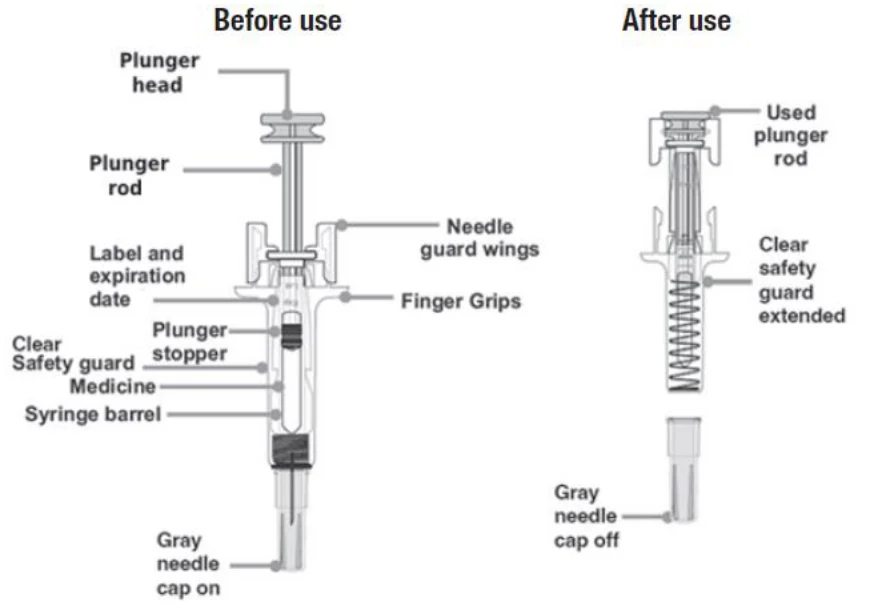
Important: The needle is covered by the gray needle cap before use. Read the complete Patient Medication Information for important information you need to know about PEXEGRA before using it.
Storing the pre-filled syringe
- Store PEXEGRA in the refrigerator between 2˚C and 8˚C.
- Do not freeze.
- Keep the pre-filled syringe in the original pack to protect from light or physical damage.
- Take the pre-filled syringe out of the refrigerator 30 minutes before use and allow it to reach room temperature before preparing an injection.
- Throw away any PEXEGRA that has been left at room temperature (20˚C to 25˚C) for more than 72 hours.
- Keep the PEXEGRA pre-filled syringe out of the reach of children.
Using the pre-filled syringe
- It is important that you do not try to give the injection unless you or your caregiver has received training from your healthcare professional.
- Make sure the name PEXEGRA appears on the pack and the pre-filled syringe label.
- Check the pack and pre-filled syringe label to make sure the dose strength is 6 mg/0.6 mL.
- Do not use a pre-filled syringe after the expiration date on the label.
- Do not shake the pre-filled syringe.
- Do not use the pre-filled syringe if the pack is opened or damaged.
- Do not remove the gray needle cap from the pre-filled syringe until you are ready to inject.
- Do not use the pre-filled syringe if it has been dropped on a hard surface. The pre-filled syringe may be broken even if you cannot see the break. Use a new pre-filled syringe.
- Do not attempt to activate the needle safety guard prior to injection.
Call your healthcare professional if you or your caregiver have any questions.
Step 1: Prepare
- A.
Remove the pre-filled syringe pack from the refrigerator. Remove the syringe tray from the pack. On a clean, well-lit surface, place the syringe tray at room temperature for 30 minutes before you give an injection.
- • Do not use the pre-filled syringe if the pack is damaged.
- • Do not warm the pre-filled syringe by using a heat source such as hot water or microwave.
- • Do not leave the pre-filled syringe in direct sunlight.
- • Do not shake the pre-filled syringe.
Open the tray by peeling away the cover. Grab the clear safety guard to remove the pre-filled syringe from the tray.
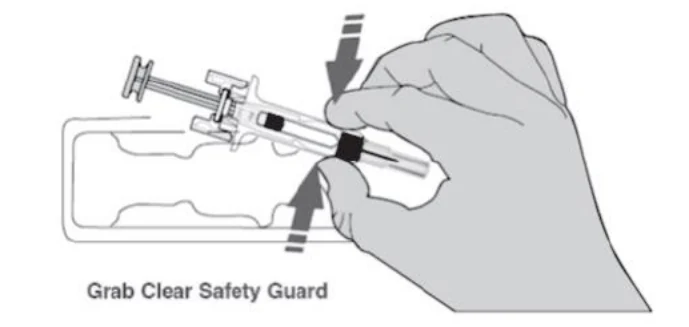
For safety reasons:
- Do not grab the plunger rod.
- Do not grab the gray needle cap.
- Inspect the medicine and pre-filled syringe.
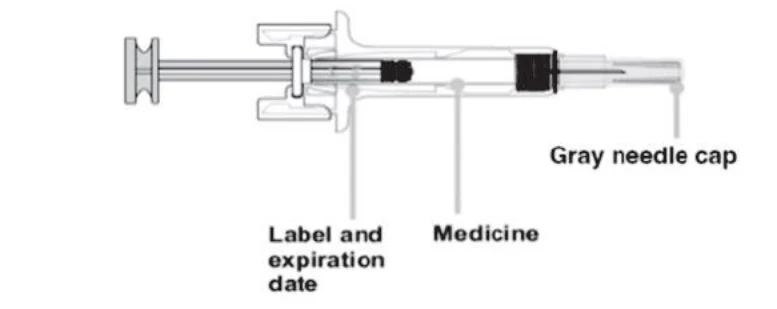
Make sure the medicine in the pre-filled syringe is clear and colourless to slightly yellow.
Do not use the pre-filled syringe if:
- The medicine is cloudy or discoloured or contains flakes or particles.
- Any part appears cracked or broken.
- The pre-filled syringe has been dropped.
- The gray needle cap is missing or not securely attached.
- The expiration date printed on the label has passed.
In all cases, use a new pre-filled syringe and call your healthcare professional.
- C.
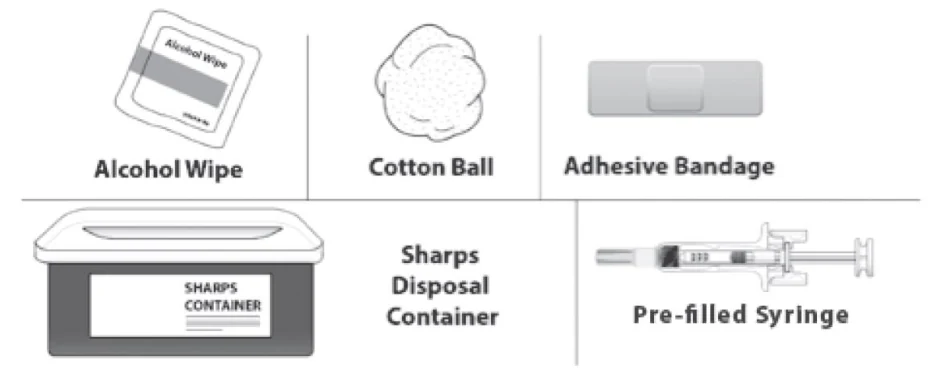
Gather all materials needed for the injection.
Wash your hands thoroughly with soap and water.
On a clean, well-lit work surface, place the:
- Pre-filled syringe
Alcohol wipe
- Cotton ball or gauze pad
- Adhesive bandage
- Sharps disposal container
Step 2: Get ready
- D. Prepare and clean the injection site(s).
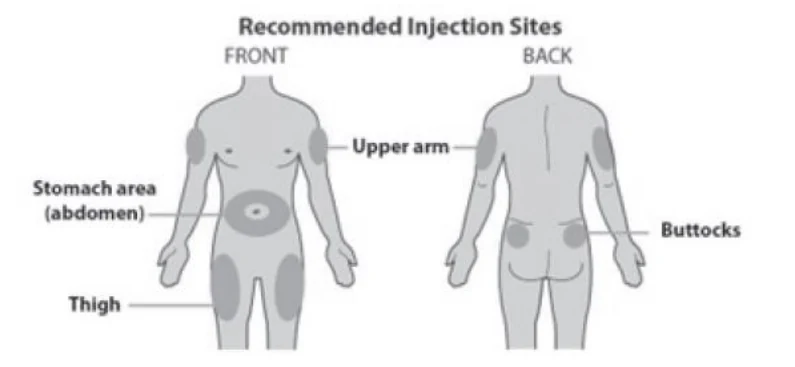
You can use:
- Thigh
- Stomach area (abdomen), except for a 5 cm area around the navel (belly button)
- Upper outer area of the buttocks (only if someone else is giving you the injection)
- Outer area of upper arm (only if someone else is giving you the injection)
Clean the injection site with an alcohol wipe. Let the skin dry.
- Do not touch this area again before injecting.
- If you want to use the same injection site, make sure it is not the same spot on the injection site you used for a previous injection.
- Do not inject into areas where the skin is tender, bruised, red or hard. Avoid injecting into areas with scars or stretch marks.
- Hold the pre-filled syringe by the barrel. Carefully pull the gray needle cap straight off and away from the body.
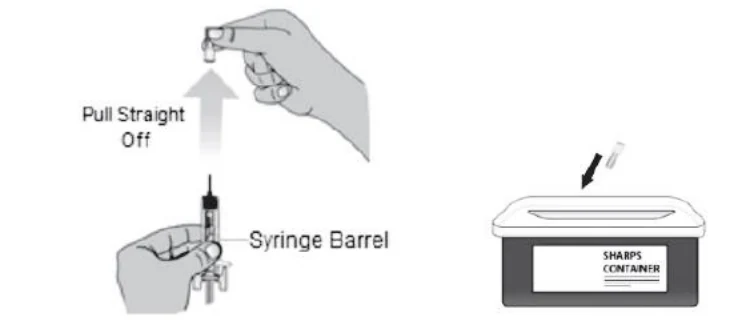
- Do not remove the gray needle cap from the pre-filled syringe until you are ready to inject.
- Do not twist or bend the gray needle cap.
- Do not hold the pre-filled syringe by the plunger rod.
- Do not put the gray needle cap back onto the pre-filled syringe.
Important: Throw away the gray needle cap into the sharps disposal container.
Step 3: Subcutaneous (under the skin) injection
- F. Pinch the injection site to create a firm surface.
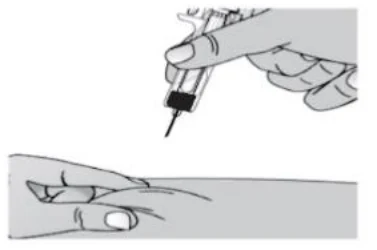
Important: Keep skin pinched while injecting.
- G. Hold the pinch. Insert the needle into the skin at 45 to 90 degrees.
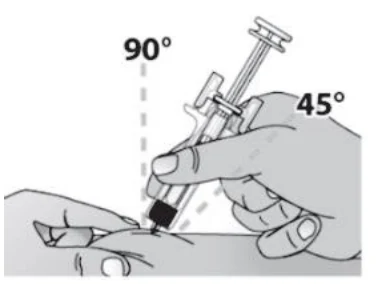
- H. Using slow and constant pressure, push the plunger rod until it reaches the bottom and the plunger head is completely between the needle guard wings.
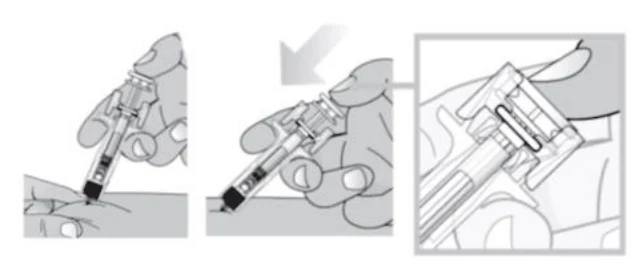
Important: When you remove the syringe, if it looks like the medicine is still in the syringe barrel, this means you have not received a full dose. Call your healthcare professional right away.
Step 4: Finish

- I.
Before you finish!
- • While you continue to hold the syringe, slowly let go of the plunger head.
- • As you let go of the plunger head, the needle will automatically slide into the clear safety guard until the needle is completely covered.
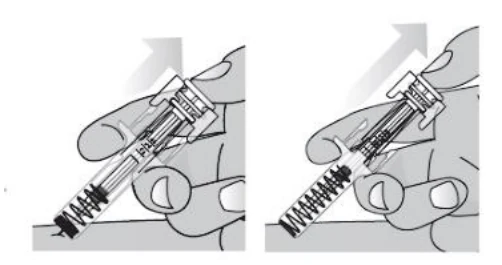
Important: If the clear safety guard does not activate after Step I, remove the needle from the skin and throw away the used pre-filled syringe as instructed in Step J right away. Keep your hands away from the needle at all times.
- J. Discard (throw away) the used pre-filled syringe.
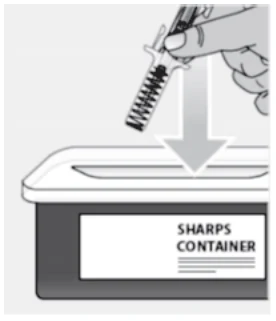
- Put the used pre-filled syringe in a sharps disposal container right away after use. Do not throw away the syringe in the household trash.
If you do not have a sharps disposal container, you may use a household container that is:
- Made of a heavy-duty plastic,
- Can be closed with a tight-fitting, puncture-resistant lid, without sharps being able to come out,
- Upright and stable during use,
- Leak-resistant, and
- Properly labeled to warn of hazardous waste inside the container.
- Please check with your healthcare professional for instructions on how to properly dispose of the sharps disposal container.
- Do not reuse the pre-filled syringe.
- Do not recycle the pre-filled syringe or sharps disposal container or throw them into the household trash.
Important: Always keep the sharps disposal container out of the reach of children.
- K.
Examine the injection site.
If there is blood, press a cotton ball or gauze pad on the injection site. Do not rub the injection site. Apply an adhesive bandage if needed.
Possible side effects from using PEXEGRA:
These are not all the possible side effects you may have when taking PEXEGRA. If you experience any side effects not listed here, tell your healthcare professional.
- Spleen Rupture. Your spleen may become enlarged and can rupture while taking PEXEGRA. A ruptured spleen can cause death. The spleen is located in the upper left section of your stomach area. Call your doctor right away if you have pain in the left upper stomach area or left shoulder tip area. This pain could mean your spleen is enlarged or ruptured.
- Serious Allergic Reactions. Serious allergic reactions can also happen. These reactions may cause a rash over the whole body, shortness of breath, wheezing, a drop in blood pressure (usually causing dizziness or lightheadedness), swelling around the mouth or eyes, fast pulse, or sweating. If you experience an allergic reaction during the injection of PEXEGRA, the injection should be stopped immediately. If at any time a serious allergic reaction occurs, immediately call a doctor or emergency services (for example, call 911).
- A serious lung problem called acute respiratory distress syndrome (ARDS). Call your doctor or seek emergency care right away if you have shortness of breath, trouble breathing or a fast rate of breathing.
- Kidney injury (glomerulonephritis) has been seen in patients who received PEXEGRA. Call your doctor immediately if you experience puffiness in your face or ankles, blood in your urine or brown coloured urine, or if you notice that you urinate less often than usual.
Most common side effects of PEXEGRA:
The most common side effect that you may experience is aching in the bones and muscles. If this occurs, it can usually be relieved with a non-acetylsalicylic acid over-the-counter pain reliever. Ask your doctor which is the most suitable one for you.
Some patients experience redness, swelling, or itching at the site of injection. This may be an allergy to the ingredients in PEXEGRA, or it may be a local reaction. If you notice any of these signs or symptoms, call your doctor.
Serious side effects and what to do about them
| Frequency / Side Effect / Symptom | Talk to your healthcare professional | Stop taking this drug and get immediate medical help | |
|---|---|---|---|
| Frequency / Side Effect / Symptom | Talk to your healthcare professional | Stop taking this drug and get immediate medical help | |
| Only if severe | In all cases | ||
| Only if severe | In all cases | ||
| Uncommon ≥ 0.1% and ˂ 1% | |||
| Bone Pain | √ | ||
| Low platelet counts (thrombocytopenia) (including the following symptoms: easy bruising and increased bleeding). | √ | ||
| Allergic reactions (including the following symptoms: rash over the whole body, shortness of breath, a drop in blood pressure (usually causing dizziness or lightheadedness), swelling around the mouth or eyes, fast pulse, weakness, sweating; severe redness or swelling or itching at injection site). | √ | √ | |
| Acute respiratory distress syndrome (including the following symptoms: fever, shortness of breath, cough, or congestion in your lungs). | √ | √ | |
| Very rare ˂ 0.01% | |||
| Splenomegaly (including the following symptoms: pain in the left upper stomach area or left shoulder tip area). | √ | ||
| *Unknown | |||
| Splenic rupture (including the following symptoms: left upper abdominal pain or pain at the tip of your shoulder). | √ | ||
| Cutaneous vasculitis (including the following symptoms: A rash in the skin surface that looks like purple or red spots or bumps, clusters of small dots, splotches or hives. Your skin may also be itchy.) | √ | ||
| Capillary Leak Syndrome (including the following symptoms: swelling or puffiness, which may be associated with passing water less frequently, difficulty breathing, abdominal swelling and feeling of fullness, and a general feeling of tiredness). | √ | ||
| Kidney Injury (glomerulonephritis) (including the following symptoms: puffiness in the face or ankles, blood in urine or brown coloured urine, or urinating less often than usual). | √ | √ | |
| **Abnormal number of immature bone marrow cells (myelodysplastic syndrome) that could lead to a type of cancer (acute myeloid leukemia) (including the following symptoms: fever, bone pain, bruising, difficulty breathing, bleeding and a general feeling of tiredness). | √ | √ | |
* Reported in the post-marketing setting where the incidence is not known.
** Adverse events in breast and lung cancer patients receiving chemotherapy and/or radiotherapy.
If you have a troublesome symptom or side effect that is not listed here or becomes bad enough to interfere with your daily activities, tell your healthcare professional.
Reporting side effects
You can report any suspected side effects associated with the use of health products to Health Canada by:
- Visiting the Web page on Adverse Reaction Reporting (canada.ca/drug-device-reporting) for information on how to report online, by mail or by fax; or
- Calling toll-free at 1-866-234-2345.
NOTE: Contact your healthcare professional if you need information about how to manage your side effects. The Canada Vigilance Program does not provide medical advice.
Storage:
PEXEGRA should be stored in the refrigerator at 2˚C to 8˚C, but not in the freezer. Keep the blistered syringe in the carton to protect from light. Do not shake. If PEXEGRA is accidentally frozen, allow it to thaw in the refrigerator before giving the next dose. However, if frozen a second time, do not use it and contact your healthcare professional. PEXEGRA can be left at room temperature for up to 72 hours. For any questions about storage, contact your healthcare professional.
Keep out of reach and sight of children.
If you want more information about PEXEGRA:
- Talk to your healthcare professional.
- Find the full product monograph that is prepared for healthcare professionals and includes the Patient Medication Information by visiting the Health Canada Drug Product Database website (Drug Product Database: Access the database); or by calling 1-866-399-9091.
Date of Authorization: 2026-05-01