


Product Monograph - Phesgo
Recent Major Label Changes
None at the time of the most recent authorization.
Table of Contents
Certain sections or subsections that are not applicable at the time of the preparation of the most recent authorized product monograph are not listed.
Recent Major Label Changes .................................................................................................. 2
Table of Contents .................................................................................................................. 2
Part 1: Health Professional Information ................................................................................. 4
- 1.
Indications ................................................................................................................. 4
1.1 Pediatrics ................................................................................................................. 4
1.2 Geriatrics ................................................................................................................. 4
- 2. Contraindications ....................................................................................................... 4
- 3. Serious Warnings and Precautions Box ....................................................................... 4
- 4.
Dosage and Administration ........................................................................................ 5
4.1 Dosing Considerations ............................................................................................ 5
4.2 Recommended Dose and Dosage Adjustment ....................................................... 5
4.4 Administration ........................................................................................................ 8
4.5 Missed Dose ............................................................................................................ 8
- 5. Overdose ................................................................................................................... 8
- 6. Dosage Forms, Strengths, Composition and Packaging ................................................ 8
- 7.
Warnings and Precautions .......................................................................................... 9
Cardiovascular ..................................................................................................................... 9
Driving and Operating Machinery ..................................................................................... 10
Gastrointestinal ................................................................................................................. 10
Hematologic ...................................................................................................................... 11
Immune ............................................................................................................................. 11
7.1 Special Populations ..................................................................................................... 12
7.1.1 Pregnancy .............................................................................................................. 12
7.1.2 Breastfeeding ........................................................................................................ 12
7.1.3 Pediatrics ............................................................................................................... 12
7.1.4 Geriatrics ............................................................................................................... 13
- 8.
Adverse Reactions .................................................................................................... 13
8.1 Adverse Reaction Overview .................................................................................. 13
8.2 Clinical Trial Adverse Reactions ............................................................................ 14
8.3 Less Common Clinical Trial Adverse Reactions ..................................................... 37
8.4 Abnormal Laboratory Findings: Hematologic, Clinical Chemistry and Other Quantitative Data .............................................................................................................. 38
8.5 Post-Market Adverse Reactions ............................................................................ 43
- 9.
Drug Interactions ..................................................................................................... 43
9.2 Drug Interactions Overview .................................................................................. 43
9.3 Drug-Behavioural Interactions .............................................................................. 43
9.4 Drug-Drug Interactions ......................................................................................... 44
9.5 Drug-Food Interactions ......................................................................................... 44
9.6 Drug-Herb Interactions ......................................................................................... 44
9.7 Drug-Laboratory Test Interactions........................................................................ 44
- 10.
Clinical Pharmacology .............................................................................................. 44
10.1 Mechanism of Action ............................................................................................ 44
10.2 Pharmacodynamics ............................................................................................... 44
10.3 Pharmacokinetics .................................................................................................. 44
10.4 Immunogenicity .................................................................................................... 48
- 11. Storage, Stability and Disposal .................................................................................. 48
- 12. Special Handling Instructions .................................................................................... 48
Part 2: Scientific Information ............................................................................................... 50
- 13. Pharmaceutical Information ..................................................................................... 50
- 14.
Clinical Trials ............................................................................................................ 51
14.1 Clinical Trials by Indication ................................................................................... 51
14.2 Comparative Bioavailability Studies ..................................................................... 65
- 15. Microbiology ............................................................................................................ 65
- 16. Non-Clinical Toxicology ............................................................................................ 65
- 17. Supporting Product Monographs .............................................................................. 68
Patient Medication Information .......................................................................................... 69
Part 1: Health Professional Information
1. Indications
- Early Breast Cancer
PHESGO (pertuzumab and trastuzumab injection) in combination with chemotherapy is indicated for the:
- neoadjuvant treatment of patients with HER2-positive, locally advanced, inflammatory, or early stage breast cancer (either >2 cm in diameter or node positive)
- adjuvant treatment of patients with HER2-positive early breast cancer with lymph node positive and/or hormone receptor negative disease.
- Metastatic Breast Cancer
PHESGO is indicated in combination with docetaxel for treatment of patients with HER2-positive metastatic breast cancer (MBC), who have not received prior anti-HER2 therapy or chemotherapy for metastatic disease.
1.1 Pediatrics
Pediatrics (<18 years of age): No data are available to Health Canada; therefore, Health Canada has not authorized an indication for pediatric use.
1.2 Geriatrics
Geriatrics (≥65 years of age): Evidence from clinical studies suggests the use of PHESGO in the geriatrics ≥65 years of age population may be associated with an increased risk of diarrhea. See 7 Warnings and Precautions, Gastrointestinal.
2. Contraindications
- PHESGO is contraindicated in patients who are hypersensitive to this drug or to any ingredient in the formulation, including any non-medicinal ingredient, or component of the container. For a complete listing, see 6 Dosage Forms, Strengths, Composition, and Packaging.
- Refer to the Product Monograph of docetaxel for further information on the contraindication of this drug.
3. Serious Warnings and Precautions Box
- Left Ventricular Dysfunction: PHESGO can result in subclinical and clinical cardiac failure manifesting as decreased LVEF and CHF. Evaluate cardiac function prior to and during treatment. Discontinue PHESGO treatment for a confirmed clinically significant decrease in left ventricular function. (See 7 Warnings and Precautions – Cardiovascular)
- Embryo-fetal Toxicity: Exposure to PHESGO can result in embryo-fetal death and birth defects. Advise patients of these risks and the need for effective contraception. (See 7 Warnings And Precautions, 0 Special Populations, 7.1.1Pregnancy)
4. Dosage and Administration
4.1 Dosing Considerations
Patient Selection:
Patients treated with PHESGO should have HER2-positive tumour status, defined as a score of 3+ by immunohistochemistry (IHC) or a ratio of ≥ 2.0 by in situ hybridization (ISH), assessed by a validated test.
To ensure accurate and reproducible results, the testing must be performed in a laboratory, which can ensure validation of the testing procedures. For full instructions on assay performance and interpretation, please refer to the package inserts of validated HER2 testing assays.
- PHESGO is for subcutaneous use only in the thigh. Do not administer intravenously.
- PHESGO has different dosage and administration instructions than intravenous pertuzumab, intravenous trastuzumab, and subcutaneous trastuzumab when administered alone.
- Patients currently receiving intravenous pertuzumab and trastuzumab can switch to PHESGO (and vice versa).
4.2 Recommended Dose and Dosage Adjustment
Recommended Dose:
Metastatic and Early Breast Cancer
For PHESGO dose recommendations in early and metastatic breast cancer refer to Table 1.
Table 1 PHESGO recommended dosing and administration
| Dose (irrespective of body weight) | Approximate duration of SC injection | Observation timeab | |
|---|---|---|---|
| Loading dose | 1200 mg pertuzumab and 600 mg trastuzumab in a 20 mL vial | 8 minutes | 30 minutes |
| Maintenance dose (every 3 weeks) | 600 mg pertuzumab and 600 mg trastuzumab in a 15 mL vial | 5 minutes | 15 minutes |
aPatients should be observed for injection-related and hypersensitivity reactions
bObservation period should start following administration of PHESGO and be completed prior to any subsequent administration of chemotherapy
In patients receiving intravenous pertuzumab and trastuzumab with < 6 weeks since their last dose, PHESGO should be administered as a maintenance dose of 600 mg pertuzumab/600 mg trastuzumab and every 3 weeks for subsequent administrations. In patients receiving intravenous pertuzumab and trastuzumab with ≥ 6 weeks since their last dose, PHESGO should be administered as a loading dose of 1200 mg pertuzumab/600 mg trastuzumab, followed by a maintenance dose of 600 mg pertuzumab/600 mg trastuzumab every 3 weeks for subsequent administrations.
The injection site should be alternated between the left and right thigh only. New injections should be given at least 1 inch/2.5 cm from the previous site on healthy skin and never into areas where the skin is red, bruised, tender, or hard. Do not split the dose between two syringes or between two sites of administration. During the treatment course with PHESGO, other medications for subcutaneous (SC) administration should preferably be injected at different sites.
In patients receiving a taxane, PHESGO should be administered prior to the taxane. When administered with PHESGO, the recommended initial dose of docetaxel is 75 mg/m2.
If a carboplatin-based regimen is used, the recommended dose for docetaxel is 75 mg/m2 throughout (no dose escalation).
In patients receiving an anthracycline-based regimen, PHESGO should be administered following completion of the entire anthracycline regimen.
Neoadjuvant Treatment of Early Breast Cancer (EBC)
In the neoadjuvant setting (before surgery), it is recommended that patients are treated with PHESGO for three to six cycles depending on the regimen chosen in combination with chemotherapy.
PHESGO should be administered every 3 weeks for 3 to 6 cycles as part of one of the following treatment regimens for early breast cancer:
- Four preoperative cycles of PHESGO in combination with docetaxel (75 mg/m2 with the option to escalate to 100 mg/m2 at physician discretion if initial dose is well tolerated), every 3 weeks, followed by 3 postoperative cycles of 5-fluorouracil (600 mg/m2), epirubicin (90 mg/m2), and cyclophosphamide (600 mg/m2) (FEC), every 3 weeks, as given in NEOSPHERE;
- Three or four preoperative cycles of FEC (F: 500 mg/m2; E: 100 mg/m2; C: 600 mg/m2) alone, every 3 weeks, followed by 3 or 4 preoperative cycles of PHESGO in combination with docetaxel (75 mg/m2 with the option to escalate to 100 mg/m2 at physician discretion if initial dose is well tolerated), every 3 weeks, as given in TRYPHAENA and BERENICE, respectively;
- Six preoperative cycles of PHESGO in combination with docetaxel (75 mg/m2: escalation of docetaxel above 75 mg/m2 is not recommended), carboplatin (AUC 6), every 3 weeks, as given in TRYPHAENA ; or,
- Four preoperative cycles of dose-dense doxorubicin and cyclophosphamide (ddAC; A: 60 mg/m2; C: 600 mg/m2) alone, every 2 weeks, followed by 4 preoperative cycles of PHESGO, every 3 weeks, and paclitaxel (80 mg/m2) every week for 12 weeks, as given in BERENICE and FeDeriCa; or,
- Four preoperative cycles of doxorubicin and cyclophosphamide (AC; A: 60 mg/m2; C: 600 mg/m2) alone, every 3 weeks, followed by 4 preoperative cycles of PHESGO in combination with docetaxel (75 mg/m2 with the option to escalate to 100 mg/m2 in subsequent cycles) every 3 weeks, as given in FeDeriCa.
Patients who start PHESGO in the neoadjuvant setting may, at the discretion of the physician, continue to receive PHESGO in the adjuvant setting to complete 1 year of treatment (maximum 18 cycles).
Adjuvant Treatment of Early Breast Cancer (EBC)
In the adjuvant setting (after surgery), PHESGO should be administered for a total of one year (maximum 18 cycles or until disease recurrence, or unmanageable toxicity, whichever occurs first), as part of a complete regimen for EBC, including standard anthracycline- and/or taxane-based chemotherapy. PHESGO treatment should start on Day 1 of the first taxane-containing cycle and should continue even if chemotherapy is discontinued (see 14 Clinical Trials).
Metastatic Breast Cancer (MBC)
PHESGO should be administered in combination with docetaxel until disease progression or unmanageable toxicity. Treatment with PHESGO may continue even if treatment with docetaxel is discontinued.
Dose Adjustment:
No dose reductions of PHESGO are recommended.
For chemotherapy dose modifications, see relevant Product Monograph.
Patients may continue therapy during periods of reversible chemotherapy-induced myelosuppression, but they should be monitored carefully for complications of neutropenia during this time. For docetaxel dose modifications, see the Product Monograph for docetaxel. A reduction in docetaxel dose was required in approximately 25% of patients in both treatment arms in the pivotal trial CLEOPATRA.
Injection-related reactions
The injection should be slowed or paused if the patient experiences injection-related symptoms (see 7 Warnings and Precautions).
Hypersensitivity/anaphylaxis
The injection should be discontinued immediately and permanently if the patient experiences a serious hypersensitivity reaction (e.g. anaphylaxis) (see 7 Warnings and Precautions, Immune).
Left ventricular dysfunction
See 7 Warnings and Precautions for information on dose recommendations in the event of left ventricular dysfunction.
Pediatrics (<18 years of age): No data are available to Health Canada; therefore, Health Canada has not authorized an indication for pediatric use.
Geriatric Use (≥65 years of age): No dose adjustment of PHESGO is required in patients ≥65 years of age (see 7 Warning and Precautions, 7.1 Special Populations and 10 Clinical Pharmacology, Special Populations and Conditions).
Renal Impairment: The safety and efficacy of PHESGO have not been studied in patients with renal impairment.
Hepatic Impairment: The safety and efficacy of PHESGO have not been studied in patients with hepatic impairment. No dose recommendation can be made for PHESGO (see 10 Clinical Pharmacology, Special Populations and Conditions).
4.4 Administration
Preparation for Administration: PHESGO therapy should only be administered under the supervision of a health professional experienced in the treatment of cancer patients.
In order to prevent medication errors, it is important to check the vial labels to ensure that the drug being prepared and administered is PHESGO.
Administration: PHESGO is for subcutaneous (SC) use in the thigh only. Do not administer intravenously.
4.5 Missed Dose
If the time between two sequential doses is less than six weeks, the 600 mg pertuzumab and 600 mg trastuzumab maintenance dose of PHESGO should be administered as soon as possible. Do not wait until the next planned dose.
If the time between two sequential injections is six weeks or more, the loading dose of 1200 mg pertuzumab and 600 mg trastuzumab should be re-administered followed by the maintenance dose of 600 mg pertuzumab and 600 mg trastuzumab every three weeks thereafter.
5. Overdose
There is no experience with overdose of PHESGO in human clinical trials. The highest PHESGO dose tested is the loading dose (1200 mg pertuzumab and 600 mg trastuzumab).
For the most recent information in the management of a suspected drug overdose, contact your regional poison control centre or Health Canada’s toll-free number, 1-844 POISON-X (1-844-764-7669).
6. Dosage Forms, Strengths, Composition and Packaging
To help ensure the traceability of biologic products, healthcare professionals should record both the brand name and the non-proprietary (active ingredient) name as well as other product-specific identifiers such as the Drug Identification Number (DIN) and the batch/lot number of the product supplied.
Table 2 Dosage Forms, Strengths, and Composition
| Route of Administration | Dosage Form/Strength/Composition | Non-medicinal Ingredients |
| Subcutaneous (SC) | Loading Dose: Sterile solution, 1200 mg pertuzumab and 600 mg trastuzumab | α,α-trehalose dihydrate, L-histidine, L-histidine hydrochloric monohydrate, L-methionine, polysorbate 20, recombinant human hyaluronidase PH20 (rHuPH20), sucrose |
Maintenance Dose: Sterile Solution, 600 mg pertuzumab and 600 mg trastuzumab | ||
Loading dose: Sterile solution consisting of 1200 mg (80 mg/mL) pertuzumab and 600 mg (40 mg/mL) trastuzumab in a 20 mL single use vial designed to deliver 15 mL by subcutaneous injection.
Maintenance dose: Sterile solution consisting of 600 mg (60 mg/mL) pertuzumab and 600 mg (60 mg/mL) trastuzumab in a 15 mL single use vial designed to deliver 10 mL by subcutaneous injection.
PHESGO (pertuzumab and trastuzumab) injection is a clear to opalescent, colorless to slightly brownish solution supplied in sterile, preservative-free, non-pyrogenic single use vials for subcutaneous administration.
7. Warnings and Precautions
Please see 3 Serious Warnings and Precautions Box.
Cardiovascular
Left ventricular dysfunction
Decreases in LVEF have been reported with drugs that block HER2 activity, including PHESGO, and intravenous formulations of pertuzumab and trastuzumab. In clinical studies with intravenous pertuzumab in combination with trastuzumab and chemotherapy, the incidence of symptomatic left ventricular systolic dysfunction (LVD [congestive heart failure]) was higher in patients treated with pertuzumab in combination with trastuzumab and chemotherapy compared to trastuzumab and chemotherapy. Patients who have received prior anthracyclines or prior radiotherapy to the chest area may be at higher risk of LVEF decreases based on studies with intravenous pertuzumab in combination with trastuzumab and chemotherapy. The majority of cases of symptomatic heart failure reported were in patients who received anthracycline-based chemotherapy (see 8 Adverse Reactions).
PHESGO and/or intravenous pertuzumab and trastuzumab have not been studied in patients with: a pretreatment LVEF value of <55% (EBC) or <50% (MBC); a prior history of congestive heart failure (CHF); conditions that could impair left ventricular function such as uncontrolled hypertension; recent myocardial infarction; serious cardiac arrhythmia requiring treatment; or a cumulative prior anthracycline exposure to >360 mg/m2 of doxorubicin or its equivalent.
Prior to the initiation of pertuzumab and trastuzumab, candidate patients should undergo thorough baseline cardiac assessment including history and physical exam, electrocardiogram (ECG) and either 2D echocardiogram or multiple gated acquisition (MUGA) scan to ensure that LVEF is within normal limits. A careful risk-benefit assessment should be made before deciding to treat with pertuzumab and trastuzumab. Cardiac assessments, as performed at baseline, should be repeated at regular intervals (see Table 3 below). If the LVEF declines as indicated in Table 3 and has not improved, or has declined further at the subsequent assessment, discontinuation of PHESGO should be strongly considered, unless the benefits for the individual patient are deemed to outweigh the risks. Following discontinuation of treatment, cardiac assessments should be performed every 6 months up until 24 months from the last administration of PHESGO.
Table 3 Dose Recommendations for Left Ventricular Dysfunction
| Pre-treatment LVEF: | Monitor LVEF every: | Withhold PHESGO for at least 3 weeks for an LVEF decrease to: | Resume PHESGO after 3 weeks if LVEF has recovered to: | |||||
|---|---|---|---|---|---|---|---|---|
| Metastatic Breast Cancera | ≥ 50% | ~12 weeks | Either | Either | ||||
| <40% | 40%-45% with a fall of ≥10%-points below pre-treatment value | >45% | 40%-45% with a fall of <10%-points below pre-treatment value | |||||
| Early Breast Cancer | ≥ 55%b | ~12 weeks (once during neoadjuvant therapy) | <50% with a fall of ≥10%-points below pre-treatment value | Either | ||||
| ≥ 50% | < 10%- points below pre-treatment value | |||||||
abased on intravenous pertuzumab data (CLEOPATRA study)
bfor patients receiving anthracycline-based chemotherapy, a LVEF of ≥ 50% is required after completion of anthracyclines, before starting PHESGO
Driving and Operating Machinery
PHESGO has a minor influence on the ability to drive and use machines. Injection-related reactions and dizziness may occur during treatment with PHESGO (see 7 Warnings and Precautions and 8 Adverse Reactions).
Gastrointestinal
PHESGO may elicit severe diarrhea (see 8 Adverse Reactions). Elderly patients (≥ 65 years) have a higher risk of diarrhea compared with younger patients (<65 years). In case of onset of severe diarrhea, an anti-diarrheal treatment should be instituted and interruption of the treatment with PHESGO should be considered if no improvement of the condition is achieved. When the diarrhea is under control the treatment with PHESGO may be reinstated.
Hematologic
Febrile Neutropenia
Patients treated with pertuzumab, trastuzumab and docetaxel are at increased risk of febrile neutropenia compared with patients treated with placebo, trastuzumab and docetaxel, especially during the first 3 cycles of treatment (see 8 Adverse Reactions). As nadir neutrophil counts were similar in pertuzumab-treated and placebo-treated patients, the higher incidence of febrile neutropenia in pertuzumab-treated patients may be related to the higher incidence of mucositis and diarrhea in these patients. Symptomatic treatment for mucositis and diarrhea should be considered.
Immune
Hypersensitivity reactions/anaphylaxis
Patients should be observed closely for hypersensitivity reactions. Although severe hypersensitivity reactions, including anaphylaxis and events with fatal outcomes, have not been observed in patients treated with PHESGO, caution should be exercised as these have been associated with intravenous pertuzumab in combination with trastuzumab and chemotherapy (see 8 Adverse Reactions). Medications to treat such reactions, as well as emergency equipment, should be available for immediate use. PHESGO must be permanently discontinued in case of NCI-CTCAE Grade 4 hypersensitivity reactions (anaphylaxis), bronchospasm or acute respiratory distress syndrome (ARDS). PHESGO is contraindicated in patients with known hypersensitivity to pertuzumab, trastuzumab, or to any of its excipients (see 2 Contraindications).
Injection/infusion-related reactions (IRRs)
PHESGO has been associated with injection-related reactions. Injection-related reactions were defined as any systemic reaction with symptoms such as fever, chills, headache, likely due to a release of cytokines occurring within 24 hours of administration of PHESGO. Close observation of the patient during and for 30 minutes after administration of the loading dose and during and for 15 minutes following the administration of the maintenance dose of PHESGO is recommended. If a significant injection-related reaction occurs, the injection should be slowed down or paused and appropriate medical therapies should be administered. Patients should be evaluated and carefully monitored until complete resolution of signs and symptoms. Permanent discontinuation should be considered in patients with severe injection-related reactions. This clinical assessment should be based on the severity of the preceding reaction and response to administered treatment for the adverse reaction (see 4 Dosage and Administration). Although fatal outcomes resulting from injection-related reactions have not been observed with PHESGO, caution should be exercised as fatal infusion related-reactions have been associated with intravenous pertuzumab in combination with intravenous trastuzumab and chemotherapy.
Reproductive Health
- Fertility
No clinical data are available on the possible effects of PHESGO on fertility.
No specific fertility studies in animals have been performed to evaluate the effects of PHESGO. No specific fertility studies in animals have been performed to evaluate the effect of pertuzumab.
No adverse effects on male and female reproductive organs were observed in repeat-dose toxicity studies of pertuzumab for up to six months duration in cynomolgus monkeys (see 16 Non-Clinical Toxicology).
Reproduction studies conducted in cynomolgus monkeys with trastuzumab revealed no evidence of impaired fertility in female cynomolgus monkeys (see 16 Non-Clinical Toxicology).
- Contraception
Women of childbearing potential including those who are partners of male patients should use effective contraception during treatment with PHESGO and for seven months following the last dose of PHESGO.
7.1 Special Populations
7.1.1 Pregnancy
No clinical studies of PHESGO in pregnant women have been performed
Based on findings in animal studies, PHESGO has the potential to cause fetal harm when administered to a pregnant woman. The effects of PHESGO are likely to be present during all trimesters of pregnancy. Women who become pregnant should be advised of the possibility of harm to the fetus. If a pregnant woman is treated with PHESGO, or if a patient becomes pregnant while receiving PHESGO or within seven months following the last dose of PHESGO, close monitoring by a multidisciplinary team is desirable.
Monitor patients who become pregnant during PHESGO therapy for oligohydramnios. If oligohydramnios occurs, perform fetal testing that is appropriate for gestational age and consistent with community standards of care. The efficacy of intravenous hydration in the management of oligohydramnios due to PHESGO exposure is not known.
Pertuzumab administered intravenously to cynomolgus monkeys during organogenesis led to oligohydramnios, delayed renal development and embryo fetal death. In the post-marketing setting for trastuzumab, cases of fetal renal growth and/or function impairment in association with oligohydramnios, some of which resulted in fatal pulmonary hypoplasia of the fetus, have been reported in pregnant women.
Labor and Delivery
The safe use of PHESGO during labor and delivery has not been established.
7.1.2 Breastfeeding
As human IgG is excreted in human milk, and the potential for absorption and harm to the infant is unknown, women should be advised to discontinue nursing during PHESGO therapy and for seven months after the last dose of PHESGO.
7.1.3 Pediatrics
Pediatrics (<18 years of age): No data are available to Health Canada; therefore, Health Canada has not authorised an indication for pediatric use.
7.1.4 Geriatrics
Geriatrics (≥65 years of age): No overall differences in safety of PHESGO was observed in patients ≥ 65 (n=26) and <65 years of age (n=222), with the exception of diarrhea where patients ≥65 years of age may have an increased risk (See 7 Warnings and Precautions, Gastrointestinal). Limited data are only available in patients > 75 years of age (n=4).
However, with intravenous pertuzumab in combination with trastuzumab, the incidence of the following all grade adverse events were at least 5% higher in patients ≥ 65 years of age compared to patients <65 years of age: decreased appetite; anemia; weight decreased; asthenia; dysgeusia; peripheral neuropathy; hypomagnesemia; and diarrhea.
8. Adverse Reactions
8.1 Adverse Reaction Overview
Study WO40324 (FEDERICA)
The safety of PHESGO has been evaluated in the WO40324 (FEDERICA) study conducted in patients with HER2-positive early breast cancer. Patients were treated with either neoadjuvant subcutaneous PHESGO (n=248) or intravenous pertuzumab and trastuzumab (n=252), in combination with chemotherapy, followed by surgery and continued as PHESGO or intravenous pertuzumab and trastuzumab as adjuvant treatment.
The median duration of exposure during the neoadjuvant phase was 9.1 weeks (range: 0 – 13 weeks) in the PHESGO in combination with chemotherapy arm and, 9.1 weeks (range 0 – 18 weeks) in the intravenous pertuzumab and trastuzumab with chemotherapy arm. The very common adverse reactions (>10%) were alopecia, rash, dry skin, nausea, diarrhea, stomatitis, constipation, vomiting, dyspepsia, asthenia, fatigue, mucosal inflammation, pyrexia, headache, dysgeusia, peripheral sensory neuropathy, peripheral neuropathy, anemia, neutropenia, leukopenia, neutrophil count decreased, alanine aminotransferase increased, aspartate aminotransferase increased, white blood cell count decreased, myalgia, arthralgia, cough, epistaxis, decreased appetite, procedural pain, infusion related reaction, and insomnia.
At the final analysis (median follow up of 51 months), the median duration of exposure of the overall treatment phase (neoadjuvant + adjuvant) was 56.3 weeks (range: 0 – 65 weeks) in the PHESGO in combination with chemotherapy arm and 56.3 weeks (range: 0 – 66 weeks) in the intravenous pertuzumab and trastuzumab with chemotherapy arm. The very common adverse reactions (≥10%) were back pain, dizziness, dyspnea, edema peripheral, hot flush, injection site reaction, nasopharyngitis, paraesthesia, pruritus, radiation skin injury and upper respiratory tract infection.
The common (≥ 1%) serious adverse events (SAEs) reported in patients treated with PHESGO in the neoadjuvant phase were febrile neutropenia, neutropenic sepsis, and neutrophil count decreased. SAEs were equally distributed between the PHESGO treatment arm and the intravenous pertuzumab in combination with trastuzumab treatment arm. At the final analysis of the overall treatment phase, cardiac failure was observed in 1.6% patients in the PHESGO arm.
The incidence of diarrhea, all Grades, in the neoadjuvant phase was 55.6% when chemotherapy was administered with targeted therapy (57.7% in the PHESGO-treated group vs. 53.6% in the intravenous pertuzumab and trastuzumab-treated group). The median duration of all Grades diarrhea was six days for the PHESGO -treated group vs. five days in the intravenous pertuzumab and trastuzumab-treated group. The median duration of Grade ≥ 3 diarrhea was fourteen days for PHESGO-treated group versus five days in the intravenous pertuzumab and trastuzumab-treated group. One patient required hospitalization for diarrhea as a serious adverse event in the PHESGO-treated group versus two patients in the intravenous pertuzumab and trastuzumab-treated group.
Adverse reactions resulting in permanent discontinuation of any component of study treatment occurred in the neoadjuvant phase in 10.3% of patients receiving pertuzumab (intravenous) and trastuzumab (intravenous or subcutaneous), and 6.9% for patients receiving PHESGO. Adverse reactions resulting in permanent discontinuation of PHESGO were ejection fraction decreased, cardiac failure, pneumonitis, pulmonary fibrosis, appendicitis, and infusion related reactions, each of which occurred in one patient in the PHESGO-treated group.
8.2 Clinical Trial Adverse Reactions
Clinical trials are conducted under very specific conditions. Therefore, the frequencies of adverse reactions observed in the clinical trials may not reflect frequencies observed in clinical practice and should not be compared to frequencies reported in clinical trials of another drug.
Early Breast Cancer - WO40324 (FEDERICA)
The safety profile of PHESGO was evaluated in the WO40324 (FEDERICA) study in which HER2-positive early breast cancer patients were treated with either subcutaneous PHESGO (n=248) or intravenous pertuzumab and trastuzumab (n=252), in combination with chemotherapy.
In the primary analysis, the median duration of study treatment was 24.1 weeks for patients in the PHESGO-treated group and 24.0 weeks for patients in the intravenous pertuzumab and intravenous trastuzumab-treated group. No dose reductions were permitted for PHESGO or for intravenous pertuzumab and intravenous trastuzumab.
The adverse drug reactions (ADRs) reported in ≥ 2% of patients treated with PHESGO in the neoadjuvant phase or intravenous pertuzumab in combination with trastuzumab after a median treatment duration of 9.1 weeks are summarised below (see Table 4).
Table 4 Adverse Drug Reactions (≥ 2% Incidence) reported in WO40324 (FEDERICA study) during the neoadjuvant phase
| System Organ Class/Preferred Term | PHESGO n=248 | Intravenous pertuzumab + intravenous trastuzumab n=252 | ||||||||||
|---|---|---|---|---|---|---|---|---|---|---|---|---|
| System Organ Class/Preferred Term | PHESGO n=248 | Intravenous pertuzumab + intravenous trastuzumab n=252 | ||||||||||
| System Organ Class/Preferred Term | PHESGO n=248 | Intravenous pertuzumab + intravenous trastuzumab n=252 | ||||||||||
| System Organ Class/Preferred Term | PHESGO n=248 | Intravenous pertuzumab + intravenous trastuzumab n=252 | ||||||||||
| All Grades n (%) | Grades 3 – 4 n (%) | All Grades n (%) | Grades 3 – 4 n (%) | |||||||||
| Skin and subcutaneous tissue disorders | ||||||||||||
| Alopecia | 191 (77.0) | 1 (0.4) | 177 (70.2) | 1 (0.4) | ||||||||
| Dry skin | 31 (12.5) | 1 (0.4) | 27 (10.7) | 0 | ||||||||
| Rash | 26 (10.5) | 1 (0.4) | 39 (15.5) | 0 | ||||||||
| Erythema | 10 (4.0) | 0 | 8 (3.2) | 0 | ||||||||
| Dermatitis | 10 (4.0) | 0 | 3 (1.2) | 0 | ||||||||
| Nail disorder* | 48 (19.4) | 1 (0.4) | 38 (15.1) | 1 (0.4) | ||||||||
| Palmar-plantar erythrodysaesthesia syndrome | 15 (6.0) | 2 (0.8) | 12 (4.8) | 1 (0.4) | ||||||||
| Pruritus | 4 (1.6) | 0 | 12 (4.8) | 1 (0.4) | ||||||||
| Rash maculo-papular | 5 (2.0) | 0 | 4 (1.6) | 0 | ||||||||
| Gastrointestinal disorders | ||||||||||||
| Nausea | 145 (58.5) | 5 (2.0) | 151 (59.9) | 4 (1.6) | ||||||||
| Diarrhea | 143 (57.7) | 17 (6.9) | 135 (53.6) | 10 (4.0) | ||||||||
| Stomatitis | 61 (24.6) | 2 (0.8) | 60 (23.8) | 2 (0.8) | ||||||||
| Constipation | 54 (21.8) | 0 | 51 (20.2) | 0 | ||||||||
| Vomiting | 46 (18.5) | 2 (0.8) | 45 (17.9) | 3 (1.2) | ||||||||
| Dyspepsia* | 62 (25.0) | 1 (0.4) | 51 (20.2) | 0 | ||||||||
| Hemorrhoids | 20 (8.1) | 0 | 9 (3.6) | 0 | ||||||||
| Gastrooesophageal reflux disease | 11 (4.4) | 0 | 9 (3.6) | 0 | ||||||||
| Mouth ulceration* | 14 (5.6) | 0 | 10 (4.0) | 0 | ||||||||
| Dry mouth | 3 (1.2) | 1 (0.4) | 6 (2.4) | 0 | ||||||||
| General disorders and administration site conditions | ||||||||||||
| Asthenia | 70 (28.2) | 1 (0.4) | 73 (29.0) | 5 (2.0) | ||||||||
| Fatigue | 64 (25.8) | 5 (2.0) | 55 (21.8) | 5 (2.0) | ||||||||
| Mucosal inflammation | 36 (14.5) | 2 (0.8) | 49 (19.4) | 3 (1.2) | ||||||||
| Injection site reaction | 17 (6.9) | 0 | 1 (0.4) | 0 | ||||||||
| Pyrexia | 27 (10.9) | 0 | 38 (15.1) | 1 (0.4) | ||||||||
| Oedema peripheral | 15 (6.0) | 0 | 17 (6.7) | 0 | ||||||||
| Malaise | 15 (6.0) | 0 | 13 (5.2) | 1 (0.4) | ||||||||
| Pain | 9 (3.6) | 0 | 8 (3.2) | 0 | ||||||||
| Influenza like illness | 9 (3.6) | 0 | 6 (2.4) | 0 | ||||||||
| Oedema | 6 (2.4) | 0 | 7 (2.8) | 1 (0.4) | ||||||||
| Chest pain | 5 (2.0) | 0 | 4 (1.6) | 0 | ||||||||
| Blood and lymphatic system disorders | ||||||||||||
| Anemia | 82 (33.1) | 3 (1.2) | 102 (40.5) | 11 (4.4) | ||||||||
| Neutropenia | 52 (21.0) | 35 (14.1) | 62 (24.6) | 34 (13.5) | ||||||||
| Leukopenia | 18 (7.3) | 6 (2.4) | 33 (13.1) | 5 (2.0) | ||||||||
| Febrile neutropenia | 16 (6.5) | 16 (6.5) | 14 (5.6) | 14 (5.6) | ||||||||
| Thrombocytopenia | 10 (4.0) | 0 | 6 (2.4) | 0 | ||||||||
| Leukocytosis | 7 (2.8) | 0 | 4 (1.6) | 1 (0.4) | ||||||||
| Lymphopenia | 3 (1.2) | 1 (0.4) | 6 (2.4) | 3 (1.2) | ||||||||
| Nervous system disorders | ||||||||||||
| Dysgeusia | 40 (16.1) | 0 | 35 (13.9) | 0 | ||||||||
| Headache | 35 (14.1) | 0 | 46 (18.3) | 2 (0.8) | ||||||||
| Neuropathy peripheral* | 65 (26.2) | 4 (1.6) | 67 (26.6) | 5 (2.0) | ||||||||
| Paraesthesia | 19 (7.7) | 2 (0.8) | 12 (4.8) | 0 | ||||||||
| Dizziness | 15 (6.0) | 0 | 20 (7.9) | 0 | ||||||||
| Neurotoxicity | 6 (2.4) | 0 | 8 (3.2) | 0 | ||||||||
| Taste disorder | 7 (2.8) | 0 | 6 (2.4) | 1 (0.4) | ||||||||
| Dysaesthesia | 2 (0.8) | 0 | 5 (2.0) | 0 | ||||||||
| Somnolence | 1 (0.4) | 0 | 5 (2.0) | 0 | ||||||||
| Investigations | ||||||||||||
| Neutrophil count decreased | 41 (16.5) | 26 (10.5) | 45 (17.9) | 30 (11.9) | ||||||||
| Alanine aminotransferase increased | 29 (11.7) | 4 (1.6) | 47 (18.7) | 3 (1.2) | ||||||||
| Aspartate aminotransferase increased | 23 (9.3) | 2 (0.8) | 36 (14.3) | 2 (0.8) | ||||||||
| Weight decreased | 21 (8.5) | 1 (0.4) | 10 (4.0) | 2 (0.8) | ||||||||
| White blood cell count decreased | 17 (6.9) | 9 (3.6) | 28 (11.1) | 18 (7.1) | ||||||||
| Ejection fraction decreased | 6 (2.4) | 0 | 9 (3.6) | 1 (0.4) | ||||||||
| Gamma-glutamyltransferase increased | 7 (2.8) | 0 | 5 (2.0) | 0 | ||||||||
| Lymphocyte count decreased | 6 (2.4) | 3 (1.2) | 6 (2.4) | 3 (1.2) | ||||||||
| Blood alkaline phosphatase increased | 6 (2.4) | 0 | 5 (2.0) | 0 | ||||||||
| Blood lactate dehydrogenase increased | 7 (2.8) | 0 | 3 (1.2) | 0 | ||||||||
| Platelet count decreased | 5 (2.0) | 0 | 2 (0.8) | 0 | ||||||||
| Musculoskeletal and connective tissue disorders | ||||||||||||
| Myalgia | 47 (19.0) | 1 (0.4) | 40 (15.9) | 1 (0.4) | ||||||||
| Arthralgia | 27 (10.9) | 0 | 31 (12.3) | 1 (0.4) | ||||||||
| Back pain | 16 (6.5) | 0 | 10 (4.0) | 0 | ||||||||
| Bone pain | 17 (6.9) | 0 | 11 (4.4) | 0 | ||||||||
| Pain in extremity | 8 (3.2) | 0 | 13 (5.2) | 0 | ||||||||
| Musculoskeletal pain | 8 (3.2) | 1 (0.4) | 11 (4.4) | 0 | ||||||||
| Muscle spasms | 7 (2.8) | 0 | 6 (2.4) | 0 | ||||||||
| Respiratory, thoracic and mediastinal disorders | ||||||||||||
| Cough | 32 (12.9) | 1 (0.4) | 28 (11.1) | 0 | ||||||||
| Epistaxis | 25 (10.1) | 0 | 34 (13.5) | 1 (0.4) | ||||||||
| Dyspnoea | 23 (9.3) | 1 (0.4) | 10 (4.0) | 0 | ||||||||
| Rhinorrhoea | 14 (5.6) | 0 | 8 (3.2) | 0 | ||||||||
| Oropharyngeal pain | 10 (4.0) | 0 | 8 (3.2) | 0 | ||||||||
| Nasal dryness | 6 (2.4) | 0 | 5 (2.0) | 0 | ||||||||
| Infections and infestations | ||||||||||||
| Upper respiratory tract infection* | 47 (19.0) | 0 | 54 (21.4) | 1 (0.4) | ||||||||
| Paronychia | 14 (5.6) | 1 (0.4) | 5 (2.0) | 0 | ||||||||
| Urinary tract infection | 12 (4.8) | 1 (0.4) | 11 (4.4) | 0 | ||||||||
| Conjunctivitis | 5 (2.0) | 0 | 9 (3.6) | 0 | ||||||||
| Cystitis | 6 (2.4) | 0 | 7 (2.8) | 0 | ||||||||
| Pharyngitis | 9 (3.6) | 0 | 4 (1.6) | 1 (0.4) | ||||||||
| Oral candidiasis | 10 (4.0) | 0 | 2 (0.8) | 0 | ||||||||
| Oral herpes | 2 (0.8) | 0 | 6 (2.4) | 0 | ||||||||
| Injury, poisoning and procedural complications | ||||||||||||
| Procedural pain | 26 (10.5) | 0 | 21 (8.3) | 0 | ||||||||
| Infusion related reaction | 9 (3.6) | 0 | 35 (13.9) | 2 (0.8) | ||||||||
| Wound complication | 4 (1.6) | 0 | 7 (2.8) | 0 | ||||||||
| Metabolism and nutrition disorders | ||||||||||||
| Decreased appetite | 38 (15.3) | 2 (0.8) | 43 (17.1) | 1 (0.4) | ||||||||
| Hypokalaemia | 15 (6.0) | 4 (1.6) | 18 (7.1) | 0 | ||||||||
| Hyperglycaemia | 5 (2.0) | 0 | 5 (2.0) | 0 | ||||||||
| Hypercholesterolaemia | 5 (2.0) | 0 | 3 (1.2) | 0 | ||||||||
| Hyperchloraemia | 5 (2.0) | 0 | 2 (0.8) | 0 | ||||||||
| Hypertriglyceridaemia | 5 (2.0) | 0 | 2 (0.8) | 0 | ||||||||
| Psychiatric disorders | ||||||||||||
| Insomnia | 33 (13.3) | 0 | 25 (9.9) | 1 (0.4) | ||||||||
| Depression | 6 (2.4) | 0 | 5 (2.0) | 1 (0.4) | ||||||||
| Anxiety | 8 (3.2) | 0 | 2 (0.8) | 0 | ||||||||
| Eye disorders | ||||||||||||
| Lacrimation increased | 13 (5.2) | 1 (0.4) | 13 (5.2) | 0 | ||||||||
| Dry eye | 13 (5.2) | 1 (0.4) | 7 (2.8) | 0 | ||||||||
| Vision blurred | 2 (0.8) | 0 | 6 (2.4) | 0 | ||||||||
| Vascular disorders | ||||||||||||
| Hot flush | 12 (4.8) | 0 | 20 (7.9) | 0 | ||||||||
| Flushing | 2 (0.8) | 0 | 6 (2.4) | 0 | ||||||||
| Hypertension | 6 (2.4) | 3 (1.2) | 2 (0.8) | 1 (0.4) | ||||||||
| Hypotension | 3 (1.2) | 0 | 5 (2.0) | 0 | ||||||||
| Haematoma | 5 (2.0) | 0 | 2 (0.8) | 1 (0.4) | ||||||||
| Reproductive system and breast disorders | ||||||||||||
| Breast pain | 5 (2.0) | 0 | 5 (2.0) | 0 | ||||||||
| Menstruation irregular | 4 (1.6) | 1 (0.4) | 6 (2.4) | 2 (0.8) | ||||||||
| Vulvovaginal dryness | 3 (1.2) | 0 | 7 (2.8) | 0 | ||||||||
| Cardiac disorders | ||||||||||||
| Tachycardia | 11 (4.4) | 0 | 6 (2.4) | 0 | ||||||||
| Palpitations | 4 (1.6) | 0 | 7 (2.8) | 0 | ||||||||
| Renal and urinary disorders | ||||||||||||
| Dysuria | 9 (3.6) | 0 | 7 (2.8) | 0 | ||||||||
| Ear and labyrinth disorders | ||||||||||||
| Vertigo | 2 (0.8) | 0 | 7 (2.8) | 0 | ||||||||
*Includes grouped preferred terms:
Nail disorder: nail disorder, nail discolouration, nail toxicity, onychoclasis, nail dystrophy;
Dyspepsia: dyspepsia, abdominal pain upper, abdominal pain, gastrointestinal pain, gastritis;
Mouth ulceration: mouth ulceration, aphthous ulcer;
Neuropathy peripheral: neuropathy peripheral, peripheral sensory neuropathy, polyneuropathy;
Upper respiratory tract infection: upper respiratory tract infection, nasopharyngitis, rhinitis, respiratory tract infection.
In the final analysis, the adverse reactions mucosal dryness, seroma, amenorrhea and hypertransaminasaemia were also reported in ≥ 2% of patients during the neoadjuvant phase.
During the adjuvant phase of the WO40324 (FEDERICA) study, when PHESGO was administered alone, all adverse reactions occurred in <10% of patients with the exception of radiation skin injury (20%), arthralgia (19%), diarrhea (17%), injection site reaction (13%), dyspepsia (12%), asthenia (11%), hot flush (11%), and pruritus (10%).
Intravenous pertuzumab and trastuzumab
Information in this section reports data from a separate Product Monograph for Pertuzumab.
The safety profile of intravenous pertuzumab in combination with trastuzumab and chemotherapy as seen in the pertuzumab and trastuzumab-treated arms of the following studies are described below:
- NEOSPHERE (n=309) and TRYPHAENA (n=218), in which neoadjuvant pertuzumab was given in combination with trastuzumab and chemotherapy to patients with locally advanced, inflammatory or EBC (Table 5 and Table 6);
- BERENICE, in which neoadjuvant pertuzumab was given in combination with trastuzumab and chemotherapy (Table 7);
- APHINITY, in which adjuvant pertuzumab was given in combination with trastuzumab and anthracycline-based or non-anthracycline-based, taxane-containing chemotherapy to patients with EBC (see Table 8, Table 9) and,
- CLEOPATRA, in which pertuzumab was given in combination with trastuzumab and docetaxel to patients with MBC (see Table 10, Table 11);
Early Breast Cancer
Neoadjuvant Treatment of Breast Cancer (NEOSPHERE)
Table 5 summarizes the ADRs from the pivotal clinical trial NEOSPHERE (n=417), in which pertuzumab was given in combination with trastuzumab and docetaxel to patients with locally advanced, inflammatory or early breast cancer.
Table 5 Summary of ADRs Occurring in ≥1% of Patients Receiving pertuzumab in the Neoadjuvant Setting in NEOSPHERE by Treatment Regimen
| Body System/ Adverse Reactions | Trastuzumab + docetaxel n=107 n (%) | Pertuzumab + trastuzumab + docetaxel n=107 n (%) | Pertuzumab + trastuzumab n=108 n (%) | Pertuzumab + docetaxel n=94 n (%) | ||||
|---|---|---|---|---|---|---|---|---|
| Body System/ Adverse Reactions | Trastuzumab + docetaxel n=107 n (%) | Pertuzumab + trastuzumab + docetaxel n=107 n (%) | Pertuzumab + trastuzumab n=108 n (%) | Pertuzumab + docetaxel n=94 n (%) | ||||
| Body System/ Adverse Reactions | Trastuzumab + docetaxel n=107 n (%) | Pertuzumab + trastuzumab + docetaxel n=107 n (%) | Pertuzumab + trastuzumab n=108 n (%) | Pertuzumab + docetaxel n=94 n (%) | ||||
| All Grades | Grades 3 – 4 | All Grades | Grades 3 – 4 | All Grades | Grades 3 – 4 | All Grades | Grades 3 – 4 | |
| All Grades | Grades 3 – 4 | All Grades | Grades 3 – 4 | All Grades | Grades 3 – 4 | All Grades | Grades 3 – 4 | |
| All Grades | Grades 3 – 4 | All Grades | Grades 3 – 4 | All Grades | Grades 3 – 4 | All Grades | Grades 3 – 4 | |
| General disorders and administration site conditions | ||||||||
| Fatigue | 29 (27) | 0 | 28 (26) | 1 (0.9) | 13 (12) | 0 | 24 (26) | 1 (1) |
| Mucosal inflammation | 23 (21) | 0 | 28 (26) | 2 (2) | 3 (3) | 0 | 24 (26) | 0 |
| Asthenia | 19 (18) | 0 | 22 (21) | 2 (2) | 3 (3) | 0 | 15 (16) | 2 (2) |
| Pyrexia | 11 (10) | 0 | 22 (17) | 0 | 9 (8) | 0 | 8 (9) | 0 |
| Infusion Related Reaction | 5 (5) | 0 | 7 (7) | 0 | 6 (6) | 1 (0.9) | 5 (5) | 0 |
| Edema peripheral | 11 (10) | 0 | 3 (3) | 0 | 1 (0.9) | 0 | 5 (5) | 0 |
| Skin and subcutaneous tissue disorders | ||||||||
| Alopecia | 70 (66) | 0 | 68 (64) | 0 | 1 (0.9) | 0 | 63 (67) | 0 |
| Rash | 23 (21) | 2 (2) | 28 (26) | 1 (0.9) | 12 (11) | 0 | 27 (29) | 1 (1) |
| Nail disorder | 9 (8) | 0 | 5 (5) | 0 | 2 (2) | 0 | 7 (7) | 0 |
| Pruritis | 8 (7) | 0 | 2 (2) | 0 | 3 (3) | 0 | 4 (4) | 0 |
| Dry skin | 5 (5) | 0 | 2 (2) | 0 | 3 (3) | 0 | 2 (2) | 0 |
| Gastrointestinal disorders | ||||||||
| Diarrhea | 36 (34) | 4 (4) | 49 (46) | 6 (6) | 30 (28) | 0 | 51 (54) | 4 (4) |
| Nausea | 39 (36) | 0 | 41 (38) | 0 | 15 (14) | 0 | 34 (36) | 1 (1) |
| Stomatitis | 8 (7) | 0 | 19 (18) | 0 | 5 (5) | 0 | 9 (10) | 0 |
| Vomiting | 13 (12) | 0 | 14 (13) | 0 | 5 (5) | 0 | 15 (16) | 2 (2) |
| Abdominal pain | 7 (7) | 0 | 7 (7) | 0 | 4 (4) | 0 | 7 (7) | 0 |
| Constipation | 8 (7) | 0 | 8 (7) | 0 | 3 (3) | 0 | 3 (3) | 0 |
| Dyspepsia | 4 (4) | 0 | 4 (4) | 0 | 4 (4) | 0 | 4 (4) | 0 |
| Blood and lymphatic system disorders | ||||||||
| Neutropenia | 67 (63) | 63 (59) | 54 (50) | 48 (45) | 1 (0.9) | 1 (0.9) | 59 (63) | 54 (57) |
| Leukopenia | 23 (21) | 12 (11) | 10 (9) | 5 (5) | 0 | 0 | 12 (13) | 8 (9) |
| Febrile neutropenia | 8 (7) | 7 (7) | 9 (8) | 9 (8) | 0 | 0 | 7 (7) | 7 (7) |
| Anaemia | 7 (7) | 0 | 3 (3) | 0 | 5 (5) | 0 | 6 (6) | 2 (2) |
| Nervous system disorders | ||||||||
| Dysgeusia | 11 (10) | 0 | 16 (15) | 0 | 5 (5) | 0 | 7 (7) | 0 |
| Headache | 12 (11) | 0 | 12 (11) | 0 | 15 (14) | 0 | 12 (13) | 0 |
| Peripheral Sensory Neuropathy | 13 (12) | 1 (0.9) | 9 (8) | 1 (0.9) | 2 (2) | 0 | 10 (11) | 0 |
| Neuropathy peripheral | 9 (8) | 0 | 5 (5) | 0 | 0 | 0 | 4 (4) | 0 |
| Dizziness | 4 (4) | 0 | 3 (3) | 0 | 6 (6) | 0 | 3 (3) | 0 |
| Paraesthesia | 4 (4) | 0 | 0 | 0 | 0.9 | 0 | 3 (3) | 0 |
| Musculoskeletal and connective tissue disorders | ||||||||
| Myalgia | 24 (22) | 0 | 24 (22) | 0 | 10 (9) | 0 | 19 (20) | 0 |
| Arthralgia | 9 (8) | 0 | 11 (10) | 0 | 5 (5) | 0 | 9 (10) | 0 |
| Pain in extremity | 1 (0.9) | 0 | 2 (2) | 0 | 1 (0.9) | 0 | 1 (1) | 0 |
| Metabolism and nutrition disorders | ||||||||
| Decreased appetite | 7 (7) | 0 | 15 (14) | 0 | 2 (2) | 0 | 14 (15) | 0 |
| Psychiatric disorders | ||||||||
| Insomnia | 12 (11) | 0 | 9 (8) | 0 | 4 (4) | 0 | 8 (9) | 0 |
| Infections and infestations | ||||||||
| Upper respiratory tract infection | 3 (3) | 0 | 5 (5) | 0 | 2 (2) | 0 | 6 (6) | 0 |
| Nasopharyngitis | 4 (4) | 0 | 4 (4) | 0 | 3 (3) | 0 | 2 (2) | 0 |
| Respitatory, thoracic and mediastinal disorders | ||||||||
| Epistaxis | 7 (7) | 0 | 10 (9) | 0 | 1 (0.9) | 0 | 6 (6) | 0 |
| Cough | 5 (5) | 0 | 3 (3) | 0 | 3 (3) | 0 | 8 (9) | 0 |
| Dyspnoea | 4 (4) | 0 | 5 (5) | 0 | 3 (3) | 0 | 3 (3) | 0 |
| Vascular disorders | ||||||||
| Hot flush | 7 (7) | 0 | 5 (5) | 0 | 0 | 0 | 2 (2) | 0 |
| Eye disorders | ||||||||
| Lacrimation increased | 2 (2) | 0 | 4 (4) | 0 | 1 (1) | 0 | 4 (4) | 0 |
| Cardiac disorders | ||||||||
| Left ventricular dysfunction | 1 (1) | 0 | 3 (3) | 0 | 0 | 0 | 1 (1) | 0 |
| Immune system disorders | ||||||||
| Drug hypersensitivity | 2 (2) | 0 | 6 (6) | 1 (1) | 6 (6) | 2 (2) | 5 (5) | 0 |
Neoadjuvant Treatment of Breast Cancer (TRYPHAENA)
Table 6 summarizes the ADRs from the clinical trial TRYPHAENA (n=218), in which pertuzumab was given in combination with trastuzumab and chemotherapy to patients with locally advanced, inflammatory or early breast cancer.
Table 6 Summary of Adverse Drug Reactions Occurring in ≥1% of Patients Receiving pertuzumab in the Neoadjuvant setting in TRYPHAENA
| Body System/Adverse Reactions | Pertuzumab + trastuzumab + FEC followed by pertuzumab + trastuzumab + docetaxel n=72 n (%) | Pertuzumab + trastuzumab + docetaxel following FEC n=75 n (%) | Pertuzumab + TCH n=76 n (%) | ||||||
|---|---|---|---|---|---|---|---|---|---|
| Body System/Adverse Reactions | Pertuzumab + trastuzumab + FEC followed by pertuzumab + trastuzumab + docetaxel n=72 n (%) | Pertuzumab + trastuzumab + docetaxel following FEC n=75 n (%) | Pertuzumab + TCH n=76 n (%) | ||||||
| Body System/Adverse Reactions | Pertuzumab + trastuzumab + FEC followed by pertuzumab + trastuzumab + docetaxel n=72 n (%) | Pertuzumab + trastuzumab + docetaxel following FEC n=75 n (%) | Pertuzumab + TCH n=76 n (%) | ||||||
| All Grades | Grades 3 – 4 | All Grades | Grades 3 – 4 | All Grades | Grades 3 – 4 | ||||
| All Grades | Grades 3 – 4 | All Grades | Grades 3 – 4 | All Grades | Grades 3 – 4 | ||||
| All Grades | Grades 3 – 4 | All Grades | Grades 3 – 4 | All Grades | Grades 3 – 4 | ||||
| General disorders and administration site conditions | |||||||||
| Fatigue | 26 (36) | 0 | 27 (36) | 0 | 32 (42) | 3(4) | |||
| Mucosal inflammation | 17 (24) | 0 | 15 (20) | 0 | 13 (17) | 1(1) | |||
| Pyrexia | 12 (17) | 0 | 7 (9) | 0 | 12 (16) | 0 | |||
| Asthenia | 7 (10) | 0 | 11 (15) | 1(1) | 10 (13) | 1(1) | |||
| Edema peripheral | 8 (11) | 0 | 3 (4) | 0 | 7 (9) | 0 | |||
| Skin and subcutaneous tissue disorders | |||||||||
| Alopecia | 35 (49) | 0 | 39 (52) | 0 | 41 (54) | 0 | |||
| Rash | 14 (19) | 0 | 8 (11) | 0 | 16 (21) | 1(1) | |||
| Palmar-plantar erythrodysaesthesia syndrome | 5 (7) | 0 | 8 (11) | 0 | 6 (8) | 0 | |||
| Dry skin | 4 (6) | 0 | 7 (9) | 0 | 8 (11) | 0 | |||
| Nail disorder | 7 (10) | 0 | 5 (7) | 0 | 8 (9) | 0 | |||
| Pruritus | 2 (3) | 0 | 3 (4) | 0 | 3 (4) | 0 | |||
| Gastrointestinal disorders | |||||||||
| Diarrhea | 44 (61) | 3(4) | 46 (61) | 4(5) | 55 (72) | 9(12) | |||
| Nausea | 38 (53) | 0 | 40 (53) | 2(3) | 34 (45) | 0 | |||
| Vomiting | 29 (40) | 0 | 27 (36) | 2 (3) | 30 (39) | 4 (5) | |||
| Dyspepsia | 18 (25) | 1 (1) | 6 (8) | 0 | 17 (22) | 0 | |||
| Constipation | 13 (18) | 0 | 17 (23) | 0 | 12 (16) | 0 | |||
| Stomatitis | 10 (14) | 0 | 13 (17) | 0 | 9 (12) | 0 | |||
| Abdominal pain | 3 (4) | 0 | 6 (8) | 0 | 5 (7) | 0 | |||
| Blood and lymphatic system disorders | |||||||||
| Neutropenia | 37 (51) | 34 (47) | 35 (47) | 32 (43) | 37 (49) | 35 (46) | |||
| Leukopenia | 16 (22) | 14 (19) | 12 (16) | 9 (12) | 13 (17) | 9 (12) | |||
| Anemia | 14 (19) | 1 (1) | 6 (8) | 2 (3) | 28 (37) | 13 (17) | |||
| Febrile neutropenia | 13 (18) | 13 (18) | 7 (9) | 7 (9) | 13 (17) | 13 (17) | |||
| Thrombocytopenia | 5 (7) | 0 | 1 (1) | 0 | 23 (30) | 9 (12) | |||
| Immune system disorders | |||||||||
| Drug hypersensitivity | 7 (10) | 2 (3) | 1 (1) | 0 | 8 (11) | 2 (3) | |||
| Hypersensitivity | 0 | 0 | 0 | 0 | 1 (1) | 0 | |||
| Nervous system disorders | |||||||||
| Headache | 16 (22) | 0 | 11 (15) | 0 | 12 (17) | 0 | |||
| Dysgeusia | 8 (11) | 0 | 10 (13) | 0 | 16 (21) | 0 | |||
| Dizziness | 6 (8) | 0 | 6 (8) | 1 (1) | 12 (16) | 0 | |||
| Neuropathy peripheral | 4 (6) | 0 | 1 (1) | 0 | 8 (11) | 0 | |||
| Peripheral sensory neuropathy | 3 (4) | 0 | 7 (9) | 0 | 5 (7) | 0 | |||
| Paraesthesia | 3 (4) | 0 | 1 (4) | 0 | 4 (5) | 0 | |||
| Musculoskeletal and connective tissue disorders | |||||||||
| Myalgia | 12 (17) | 0 | 9 (11) | 1(1) | 8 (11) | 0 | |||
| Arthralgia | 8 (11) | 0 | 9 (12) | 0 | 5 (7) | 0 | |||
| Pain in extremity | 3 (4) | 0 | 5 (7) | 0 | 2 (3) | 0 | |||
| Respiratory, thoracic, and mediastinal disorders | |||||||||
| Dyspnea | 9 (13) | 0 | 6 (8) | 2 (3) | 8 (11) | 1 (1) | |||
| Epistaxis | 8 (11) | 0 | 8 (11) | 0 | 12 (16) | 1 (1) | |||
| Cough | 7 (10) | 0 | 4 (5) | 0 | 9 (12) | 0 | |||
| Oropharyngeal pain | 6 (8) | 0 | 5 (7) | 0 | 9 (12) | 0 | |||
| Metabolism and nutrition disorders | |||||||||
| Decreased appetite | 15 (21) | 0 | 8 (11) | 0 | 16 (21) | 0 | |||
| Eye disorders | |||||||||
| Lacrimation increased | 9 (13) | 0 | 4 (5) | 0 | 6 (8) | 0 | |||
| Psychiatric disorders | |||||||||
| Insomnia | 8 (11) | 0 | 10 (13) | 0 | 16 (21) | 0 | |||
| Investigations | |||||||||
| ALT increased | 5 (7) | 0 | 2 (3) | 0 | 8 (11) | 3 (4) | |||
| Infections and infestations | |||||||||
| Nasopharyngitis | 5 (7) | 0 | 5 (7) | 0 | 6 (8) | 0 | |||
| Upper respiratory tract infection | 6 (8) | 0 | 3 (4) | 0 | 2 (3) | 0 | |||
| Paronychia | 0 | 0 | 1 (1) | 0 | 1 (1) | 0 | |||
| Vascular disorders | |||||||||
| Hot flush | 2 (3) | 0 | 4 (5) | 0 | 7 (9) | 0 | |||
| Cardiac disorders | |||||||||
| Left ventricular dysfunction | 4 (6) | 0 | 3 (4) | 2 (3) | 2 (3) | 0 | |||
Injury, poisoning and procedural complications | |||||||||
| Infusion related reaction | 2 (2.8) | 0 | 0 | 0 | 2 (2.6) | 0 | |||
FEC=5-fluorouracil, epirubicin, cyclophosphamide; TCH=docetaxel, carboplatin, and trastuzumab
Neoadjuvant Treatment of Breast Cancer (BERENICE)
Table 7 summarizes the ADRs from the clinical trial BERENICE, in which pertuzumab was given in combination with trastuzumab and chemotherapy to patients with locally advanced, inflammatory or early breast cancer.
Table 7 Summary of ADRs Occurring in ≥1% of Patients Receiving Pertuzumab in the Neoadjuvant setting in BERENICE
| Body System/Adverse Reactions | Pertuzumab + trastuzumab + paclitaxel following ddAC n=199 n (%) | Pertuzumab + trastuzumab + docetaxel following FEC n=198 n (%) | ||
|---|---|---|---|---|
| Body System/Adverse Reactions | Pertuzumab + trastuzumab + paclitaxel following ddAC n=199 n (%) | Pertuzumab + trastuzumab + docetaxel following FEC n=198 n (%) | ||
| Body System/Adverse Reactions | Pertuzumab + trastuzumab + paclitaxel following ddAC n=199 n (%) | Pertuzumab + trastuzumab + docetaxel following FEC n=198 n (%) | ||
| Body System/Adverse Reactions | Pertuzumab + trastuzumab + paclitaxel following ddAC n=199 n (%) | Pertuzumab + trastuzumab + docetaxel following FEC n=198 n (%) | ||
| All Grades | Grades 3 – 4 | All Grades | Grades 3 – 4 | |
| All Grades | Grades 3 – 4 | All Grades | Grades 3 – 4 | |
| All Grades | Grades 3 – 4 | All Grades | Grades 3 – 4 | |
| All Grades | Grades 3 – 4 | All Grades | Grades 3 – 4 | |
| General disorders and administration site conditions | ||||
| Fatigue | 116 (58) | 2 (1) | 76 (38) | 9 (5) |
| Asthenia | 37 (19) | 3 (2) | 82 (41) | 0 |
| Mucosal inflammation | 43 (22) | 2 (1) | 74 (37) | 7 (4) |
| Pyrexia | 30 (15) | 0 | 35 (18) | 0 |
| Edema peripheral | 18 (9) | 0 | 24 (12) | 2 (1) |
| Skin and subcutaneous tissue disorders | ||||
| Alopecia | 124 (62) | 0 | 116 (59) | 0 |
| Rash | 28 (14) | 0 | 21 (11) | 0 |
| Dry skin | 27 (14) | 0 | 19 (10) | 0 |
| Nail discoloration | 29 (15) | 0 | 3 (2) | 0 |
| Palmar-Plantar Erythrodysaesthesia Syndrome | 11 (6) | 0 | 20 (10) | 1 (0.5) |
| Nail disorder | 14 (7) | 0 | 19 (10) | 0 |
| Pruritis | 11 (8) | 2 (1) | 16 (8) | 1 (0.5) |
| Gastrointestinal disorders | ||||
| Nausea | 141 (71) | 5 (3) | 137 (69) | 4 (2) |
| Diarrhea | 133 (67) | 6 (3) | 137 (69) | 20 (10) |
| Constipation | 69 (35) | 1 (0.5) | 76 (38) | 1 (0.5) |
| Vomiting | 45 (23) | 2 (1) | 69 (35) | 8 (4) |
| Stomatitis | 49 (25) | 0 | 54 (27) | 10 (5) |
| Dyspepsia | 39 (19) | 0 | 38 (16) | 0 |
| Abdominal pain upper | 12 (6) | 0 | 26 (13) | 0 |
| Abdominal pain | 10 (5) | 0 | 20 (10) | 0 |
| Gastroesophageal reflux disease | 23 (12) | 0 | 4 (2) | 0 |
| Blood and lymphatic system disorders | ||||
| Anemia | 54 (27) | 6 (3) | 60 (30) | 5 (3) |
| Neutropenia | 44 (22) | 24 (12) | 32 (16) | 17 (9) |
| Febrile neutropenia | 14 (7) | 14 (7) | 34 (17) | 34 (17) |
| Leukopenia | 6 (3) | 2 (1) | 2 | 2 (1) |
| Nervous system disorders | ||||
| Headache | 60 (30) | 1 (0.5) | 28 (14) | 1 (0.5) |
| Dysgeusia | 39 (20) | 0 | 38 (19) | 1 (0.5) |
| Neuropathy peripheral | 85 (42) | 6 (3) | 41 (21) | 1 (0.5) |
| Paresthesia | 29 (15) | 0 | 18 (9) | 0 |
| Dizziness | 23 (12) | 0 | 15 (8) | 0 |
| Musculoskeletal and connective tissue disorders | ||||
| Myalgia | 40 (20) | 0 | 66 (33) | 2 (1) |
| Arthralgia | 39 (20) | 0 | 42 (21) | 2 (1) |
| Back pain | 20 (10) | 0 | 17 (9) | 0 |
| Pain in extremity | 20 (10) | 0 | 15 (8) | 0 |
| Bone pain | 23 (12) | 1 (0.5) | 9 (5) | 0 |
| Infections and infestations | ||||
| Urinary tract infection | 21 (11) | 2 (1) | 4 (2) | 0 |
| Nasopharyngitis | 14 (7) | 0 | 17 (9) | 0 |
| Upper respiratory tract infection | 14 (7) | 0 | 4 (2) | 0 |
| Paronychia | 1 (0.5) | 0 | 2 (1) | 0 |
| Respiratory, thoracic, and mediastinal disorders | ||||
| Epistaxis | 50 (25) | 0 | 37 (19) | 0 |
| Dyspnea | 29 (15) | 1 (0.5) | 29 (15) | 1 (0.5) |
| Cough | 40 (20) | 1 (0.5) | 17 (9) | 0 |
| Oropharyngeal pain | 20 (10) | 0 | 15 (8) | 1 (0.5) |
| Metabolism and nutrition disorders | ||||
| Decreased appetite | 39 (20) | 0 | 45 (23) | 0 |
| Eye disorders | ||||
| Lacrimation increased | 18 (9) | 0 | 36 (18) | 0 |
| Psychiatric disorders | ||||
| Insomnia | 37 (19) | 0 | 25 (13) | 0 |
| Vascular disorders | ||||
| Hot flush | 38 (19) | 0 | 26 (13) | 0 |
| Investigations | ||||
| White blood cell count decreased | 21 (11) | 8 (4) | 5 (3) | 4 (2) |
| Injury, poisoning and procedural complications | ||||
| Infusion related reaction | 31 (16) | 2 (1) | 25 (13) | 2 (1) |
| Immune system disorders | ||||
| Hypersensitivity | 5 (3) | 0 | 4 (2) | 1 (0.5) |
| Drug hypersensitivity | 2 (1) | 0 | 0 | 0 |
ddAC = dose-dense doxorubicin, cyclophosphamide, FEC=5-fluorouracil, epirubicin, cyclophosphamide
Adjuvant Treatment of Breast Cancer (APHINITY)
Table 8 summarizes the ADRs from the pivotal clinical trial APHINITY, in which pertuzumab was given in combination with trastuzumab and chemotherapy or placebo in combination with trastuzumab and chemotherapy. Table 8 reports the ADRs that occurred in at least 1% of patients in the pertuzumab-treated group.
When pertuzumab was administered in combination with trastuzumab and chemotherapy, the most common ADRs (>30%) were diarrhea, nausea, alopecia, fatigue, and vomiting. The most common NCI-CTCAE (version 4.0) Grade 3-4 ADRs (>2%) were neutropenia, febrile neutropenia, diarrhea, neutrophil count decreased, anemia, white blood cell count decreased, leukopenia, fatigue, nausea, and stomatitis.
Table 8 Summary of Adverse Drug Reactions Occurring in ≥ 1% of Patients Receiving Pertuzumab in the Pivotal Clinical Trial APHINITY
Adverse Drug Reaction (ADR) (MedDRA) System Organ Class | Placebo + trastuzumab + chemotherapy n=2405 Frequency rate % | Pertuzumab + trastuzumab + chemotherapy n=2364 Frequency rate % | ||
|---|---|---|---|---|
Adverse Drug Reaction (ADR) (MedDRA) System Organ Class | Placebo + trastuzumab + chemotherapy n=2405 Frequency rate % | Pertuzumab + trastuzumab + chemotherapy n=2364 Frequency rate % | ||
Adverse Drug Reaction (ADR) (MedDRA) System Organ Class | Placebo + trastuzumab + chemotherapy n=2405 Frequency rate % | Pertuzumab + trastuzumab + chemotherapy n=2364 Frequency rate % | ||
| All Grades | Grades 3-4 | All Grades | Grades 3-4 | |
| All Grades | Grades 3-4 | All Grades | Grades 3-4 | |
| All Grades | Grades 3-4 | All Grades | Grades 3-4 | |
| Cardiac disorders | ||||
| Cardiac Failure | 0.7 | 0.2 | 1.4 | 0.7 |
| General disorders and administration site conditions | ||||
| Fatigue | 44.3 | 2.5 | 48.8 | 3.9 |
| Mucosal inflammation | 18.6 | 0.7 | 23.4 | 1.7 |
| Asthenia | 20.8 | 1.7 | 21.4 | 1.4 |
| Pyrexia | 19.5 | 0.7 | 20.0 | 0.6 |
| Edema peripheral | 20.1 | 0.2 | 17.1 | - |
| Skin and subcutaneous tissue disorders | ||||
| Alopecia | 66.9 | <0.1 | 66.7 | <0.1 |
| Rash | 20.3 | 0.2 | 25.8 | 0.4 |
| Pruritus | 9.0 | <0.1 | 14.0 | 0.1 |
| Palmar-plantar erythrodysaesthesia syndrome | 6.6 | 0.4 | 9.1 | 1.2 |
| Dry skin | 11.1 | <0.1 | 13.2 | 0.1 |
| Nail disorder | 11.8 | 0.1 | 11.8 | 0.2 |
| Gastrointestinal disorders | ||||
| Diarrhea | 45.2 | 3.7 | 71.2 | 9.8 |
| Nausea | 65.5 | 2.5 | 69.0 | 2.4 |
| Vomiting | 30.5 | 1.8 | 32.5 | 1.9 |
| Constipation | 31.6 | 0.3 | 28.9 | 0.5 |
| Stomatitis | 23.8 | 1.0 | 28.4 | 2.2 |
| Dyspepsia | 14.2 | - | 13.7 | - |
| Abdominal pain | 10.9 | 0.6 | 12.1 | 0.5 |
| Abdominal pain upper | 9.1 | 0.2 | 10.4 | 0.3 |
| Blood and lymphatic system disorders | ||||
| Anemia | 23.2 | 4.7 | 27.7 | 6.9 |
| Neutropenia | 23.4 | 15.7 | 24.8 | 16.3 |
| Febrile neutropenia* | 11.1 | 11.1 | 12.1 | 12.1 |
| Leukopenia | 9.2 | 4.4 | 9.1 | 4.4 |
| Nervous system disorders | ||||
| Dysgeusia | 21.5 | <0.1 | 26.0 | 0.1 |
| Headache | 23.4 | 0.4 | 22.5 | 0.3 |
| Peripheral sensory neuropathy | 17.5 | 0.5 | 18.1 | 0.6 |
| Neuropathy peripheral | 15.3 | 0.6 | 15.5 | 0.5 |
| Parasthesia | 10.0 | 0.2 | 11.8 | 0.5 |
| Dizziness | 11.4 | 0.2 | 11.4 | - |
| Musculoskeletal and connective tissue disorders | ||||
| Arthralgia | 32.5 | 1.1 | 28.7 | 0.9 |
| Myalgia | 29.5 | 1.3 | 26.0 | 0.9 |
| Pain in extremity | 10.5 | 0.2 | 10.0 | 0.2 |
| Infections and infestations | ||||
| Nasopharyngitis | 11.8 | 0.1 | 13.4 | <0.1 |
| Upper respiratory tract infection | 7.4 | 0.2 | 8.1 | 0.3 |
| Paronychia | 2.3 | <0.1 | 3.9 | 0.1 |
| Respiratory, thoracic, and mediastinal disorders | ||||
| Epistaxis | 13.6 | - | 18.2 | <0.1 |
| Cough | 14.6 | <0.1 | 15.8 | <0.1 |
| Dyspnea | 11.5 | 0.5 | 11.9 | 0.4 |
| Metabolism and nutrition disorders | ||||
| Decreased appetite | 19.9 | 0.4 | 23.9 | 0.8 |
| Hypokalaemia | 4.0 | 0.6 | 6.5 | 1.9 |
| Hypomagnesaemia | 3.3 | 0.1 | 6.3 | 0.9 |
| Dehydration | 2.1 | 0.2 | 4.0 | 1.2 |
| Hypophosphataemia | 0.6 | 0.2 | 1.0 | 0.6 |
| Vascular disorders | ||||
| Hot flush | 21.2 | 0.4 | 20.4 | 0.2 |
| Eye disorders | ||||
| Lacrimation increased | 13.4 | <0.1 | 13.1 | - |
| Psychiatric disorders | ||||
| Insomnia | 16.6 | <0.1 | 17.1 | 0.3 |
| Investigations | ||||
| Neutrophil count decreased | 13.7 | 9.6 | 13.8 | 9.6 |
| Weight decreased | 3.2 | 1.1 | 8.0 | 4.2 |
| Injury, poisoning and procedural complications | ||||
| Radiation skin injury | 11.1 | 0.3 | 12.6 | 0.3 |
| Immune system disorders | ||||
| Hypersensitivity | 2.9 | 0.4 | 3.4 | 0.4 |
| Drug hypersensitivity | 0.5 | <0.1 | 1.3 | 0.2 |
*In this table, this denotes an ADR that has been reported in association with a fatal outcome.
Table 9 Summary of ADRs Occurring in ≥ 1% of Patients Receiving Pertuzumab in the Pivotal Clinical Trial APHINITY by Treatment Regimen and Chemotherapy Type
Adverse Drug Reaction (ADR) (MedDRA) System Organ Class | Placebo + trastuzumab + chemotherapy n=2405 Frequency rate % | Pertuzumab + trastuzumab + chemotherapy n=2364 Frequency rate % | ||
|---|---|---|---|---|
Adverse Drug Reaction (ADR) (MedDRA) System Organ Class | Placebo + trastuzumab + chemotherapy n=2405 Frequency rate % | Pertuzumab + trastuzumab + chemotherapy n=2364 Frequency rate % | ||
Adverse Drug Reaction (ADR) (MedDRA) System Organ Class | Placebo + trastuzumab + chemotherapy n=2405 Frequency rate % | Pertuzumab + trastuzumab + chemotherapy n=2364 Frequency rate % | ||
Placebo + trastuzumab + anthracycline N=1894 | Placebo + trastuzumab + non-anthracycline N=510 | Pertuzumab + trastuzumab + anthracycline N=1834 | Pertuzumab + trastuzumab + non-anthracycline N=528 | |
Placebo + trastuzumab + anthracycline N=1894 | Placebo + trastuzumab + non-anthracycline N=510 | Pertuzumab + trastuzumab + anthracycline N=1834 | Pertuzumab + trastuzumab + non-anthracycline N=528 | |
Placebo + trastuzumab + anthracycline N=1894 | Placebo + trastuzumab + non-anthracycline N=510 | Pertuzumab + trastuzumab + anthracycline N=1834 | Pertuzumab + trastuzumab + non-anthracycline N=528 | |
| Cardiac disorders | ||||
| Cardiac Failure | 0.8 | 0.4 | 1.6 | 0.8 |
| General disorders and administration site conditions | ||||
| Fatigue | 40.9 | 57.1 | 45.8 | 59.5 |
| Mucosal Inflammation | 18.4 | 19.4 | 23.4 | 23.1 |
| Asthenia | 22.5 | 14.1 | 23.9 | 12.5 |
| Pyrexia | 20.6 | 15.3 | 21.2 | 15.9 |
| Oedema Peripheral | 18.0 | 27.8 | 16.6 | 18.8 |
| Skin and subcutaneous tissue disorders | ||||
| Alopecia | 68.0 | 62.9 | 69.3 | 58.0 |
| Rash | 20.5 | 19.4 | 26.1 | 24.6 |
| Pruritus | 9.0 | 9.0 | 13.8 | 14.6 |
| Palmar-plantar erythrodysaesthesia syndrome | 7.1 | 4.5 | 10.7 | 3.8 |
| Dry Skin | 11.5 | 9.8 | 14.3 | 9.3 |
| Nail Disorder | 11.6 | 12.7 | 12.1 | 11.0 |
| Gastrointestinal disorders | ||||
| Diarrhea | 40.8 | 61.6 | 67.3 | 84.7 |
| Nausea | 65.8 | 64.3 | 69.1 | 69.1 |
| Vomiting | 30.5 | 30.4 | 30.4 | 39.8 |
| Constipation | 30.5 | 35.7 | 29.7 | 26.3 |
| Stomatitis | 24.6 | 21.2 | 30.5 | 21.0 |
| Dyspepsia | 13.4 | 17.1 | 13.4 | 15.0 |
| Abdominal Pain | 9.8 | 14.9 | 11.0 | 16.1 |
| Abdominal Pain upper | 9.8 | 6.5 | 11.1 | 7.8 |
| Blood and lymphatic system disorders | ||||
| Anaemia | 19.2 | 37.6 | 23.0 | 44.3 |
| Neutropenia | 23.3 | 23.5 | 24.5 | 25.9 |
| Febrile Neutropenia | 10.8 | 12.2 | 12.8 | 9.7 |
| Leukopenia | 10.1 | 5.9 | 10.3 | 5.3 |
| Nervous system disorders | ||||
| Dysgeusia | 19.5 | 28.8 | 24.6 | 30.9 |
| Headache | 23.3 | 23.7 | 22.9 | 21.0 |
| Peripheral Sensory Neuropathy | 16.7 | 20.6 | 18.4 | 16.9 |
| Neuropathy Peripheral | 13.3 | 22.9 | 14.0 | 20.6 |
| Paraesthesia | 10.1 | 9.4 | 13.0 | 7.6 |
| Dizziness | 10.6 | 14.7 | 10.7 | 13.8 |
| Musculoskeletal and connective tissue Disorders | ||||
| Arthralgia | 33.1 | 30.4 | 29.9 | 24.2 |
| Myalgia | 29.7 | 29.0 | 27.1 | 22.3 |
| Pain In Extremity | 9.8 | 12.9 | 9.7 | 11.0 |
| Infections and infestations | ||||
| Nasopharyngitis | 13.4 | 6.1 | 15.3 | 6.4 |
| Upper Respiratory Tract Infection | 6.8 | 9.6 | 8.1 | 8.1 |
| Paronychia | 2.4 | 1.8 | 4.4 | 2.5 |
| Respiratory, thoracic and mediastinal disorders | ||||
| Epistaxis | 13.6 | 13.3 | 18.4 | 17.6 |
| Cough | 14.9 | 13.5 | 15.9 | 15.7 |
| Dyspnoea | 10.6 | 15.1 | 11.1 | 14.8 |
| Metabolism and nutrition disorders | ||||
| Decreased Appetite | 18.8 | 23.7 | 22.8 | 27.8 |
| Hypokalaemia | 2.6 | 9.8 | 3.7 | 16.3 |
| Hypomagnesaemia | 1.1 | 11.6 | 1.9 | 22.0 |
| Dehydration | 1.0 | 6.5 | 1.3 | 13.4 |
| Hypophosphataemia | 0.2 | 2.2 | 0.3 | 3.4 |
| Vascular disorders | ||||
| Hot Flush | 21.0 | 21.8 | 20.7 | 19.3 |
| Eye disorders | ||||
| Lacrimation Increased | 12.2 | 17.8 | 12.1 | 16.7 |
| Psychiatric disorders | ||||
| Insomnia | 15.3 | 21.8 | 16.2 | 20.1 |
| Investigations | ||||
| Neutrophil Count Decreased | 14.9 | 9.2 | 15.0 | 9.8 |
| Weight decreased | 3.1 | 3.5 | 7.2 | 11.4 |
| Injury, poisoning and procedural complications | ||||
| Radiation Skin Injury | 10.7 | 12.5 | 12.4 | 13.3 |
| Immune system disorders | ||||
| Hypersensitivity | 2.6 | 3.9 | 3.1 | 4.4 |
| Drug Hypersensitivity | 0.5 | 0.6 | 0.9 | 2.5 |
ADRs reported in patients receiving pertuzumab and trastuzumab after discontinuation of chemotherapy
In the pivotal trial APHINITY, the frequency of ADRs decreased during the targeted treatment alone phase. All ADRs in the pertuzumab treatment group occurred in <10% of patients with the exception of diarrhea (18.1%), arthralgia (15.3%), radiation skin injury (12.4%), and hot flush (12.1%).
Metastatic Breast Cancer
Table 10 summarizes the adverse drug reactions (ADRs) from the pivotal clinical trial CLEOPATRA in which pertuzumab was given in combination with trastuzumab and docetaxel vs placebo with trastuzumab and docetaxel. The most common ADRs (>30%) seen in patients treated with pertuzumab in combination with trastuzumab and docetaxel were diarrhea, alopecia, neutropenia, nausea, fatigue, rash and peripheral neuropathy. The most common NCI-CTCAE (version 3) Grade 3-4 ADRs (≥ 10%) were neutropenia, febrile neutropenia and leukopenia. The most common serious adverse reactions were febrile neutropenia, neutropenia and diarrhea.
Table 10 Summary of Adverse Drug Reactions Occurring in ≥ 1% from the Pivotal Clinical Trial CLEOPATRA
Adverse Drug Reaction (ADR) (MedDRA) System Organ Class | Placebo + trastuzumab + docetaxel n =396 Frequency rate % | Pertuzumab + trastuzumab + docetaxel n =408 Frequency rate % | ||
|---|---|---|---|---|
Adverse Drug Reaction (ADR) (MedDRA) System Organ Class | Placebo + trastuzumab + docetaxel n =396 Frequency rate % | Pertuzumab + trastuzumab + docetaxel n =408 Frequency rate % | ||
Adverse Drug Reaction (ADR) (MedDRA) System Organ Class | Placebo + trastuzumab + docetaxel n =396 Frequency rate % | Pertuzumab + trastuzumab + docetaxel n =408 Frequency rate % | ||
| All Grades | Grades 3-4 | All Grades | Grades 3-4 | |
| All Grades | Grades 3-4 | All Grades | Grades 3-4 | |
| All Grades | Grades 3-4 | All Grades | Grades 3-4 | |
| General disorders and administration site conditions | ||||
| Fatigue | 37.4 | 3.3 | 38.5 | 2.2 |
| Asthenia | 30.8 | 1.8 | 28.2 | 2.7 |
| Edema peripheral | 28.0 | 0.8 | 25.0 | 0.5 |
| Mucosal inflammation/Mucositis | 19.9 | 1.0 | 27.2 | 1.5 |
| Pyrexia | 18.2 | 0.5 | 20.8 | 1.2 |
| Chills | 3.8 | - | 8.3 | - |
| Skin and subcutaneous tissue disorders | ||||
| Alopecia | 60.6 | 0.3 | 60.8 | - |
| Rash | 24.2 | 0.8 | 38.2 | 0.7 |
| Nail disorder | 23.2 | 0.3 | 23.5 | 1.2 |
| Pruritus | 10.1 | - | 18.4 | - |
| Dry skin | 6.3 | - | 11.5 | - |
| Erythema | 5.1 | - | 5.6 | - |
| Dermatitis acneiform | 1.8 | - | 3.9 | 0.2 |
| Gastrointestinal disorders | ||||
| Diarrhea | 48.2 | 5.1 | 68.4 | 9.6 |
| Nausea | 42.4 | 0.5 | 45.1 | 1.2 |
| Vomiting | 24.5 | 1.5 | 27.2 | 1.5 |
| Constipation | 25.5 | 1.0 | 16.9 | - |
| Stomatitis | 15.9 | 0.3 | 20.1 | 0.5 |
| Dyspepsia | 12.1 | - | 13.5 | - |
| Blood and lymphatic system disorders | ||||
| Neutropenia | 50.0 | 46.2 | 53.4 | 49.0 |
| Anaemia | 19.7 | 3.5 | 25.0 | 2.5 |
| Leukopenia | 20.7 | 14.9 | 18.4 | 12.3 |
| Febrile neutropenia* | 7.6 | 7.3 | 13.7 | 13.0 |
| Nervous system disorders | ||||
| Headache | 19.2 | 1.0 | 26.0 | 2.0 |
| Neuropathy peripheral | 19.9 | 1.8 | 23.3 | 2.7 |
| Dysgeusia | 15.7 | - | 18.4 | - |
| Peripheral sensory neuropathy | 14.9 | 0.3 | 12.7 | 0.5 |
| Dizziness | 13.4 | - | 16.4 | 0.7 |
| Musculoskeletal and connective tissue disorders | ||||
| Myalgia | 25.0 | 0.8 | 24.0 | 1.2 |
| Arthralgia | 17.9 | 0.8 | 20.3 | 0.2 |
| Infections and infestations | ||||
| Upper respiratory tract infection | 14.4 | - | 22.1 | 0.7 |
| Nasopharyngitis | 15.2 | 0.3 | 18.6 | - |
| Paronychia | 4.0 | 0.3 | 7.8 | - |
| Respiratory, thoracic and mediastinal disorders | ||||
| Cough | 19.9 | 0.3 | 24.8 | 0.5 |
| Dyspnea | 15.9 | 2.0 | 16.7 | 1.0 |
| Pleural effusion | 5.6 | 1.3 | 5.1 | 0.2 |
| Metabolism and nutrition disorders | ||||
| Decreased appetite | 26.8 | 1.5 | 29.7 | 1.7 |
| Eye disorders | ||||
| Lacrimation increased | 13.9 | - | 14.7 | - |
| Psychiatric disorders | ||||
| Insomnia | 13.9 | - | 16.4 | - |
| Cardiac disorders | ||||
| Left ventricular dysfunction1 | 8.6 | 3.3 | 7.8 | 1.5 |
| Immune system disorders | ||||
| Hypersensitivity | 5.3 | 0.8 | 7.4 | 1.2 |
| Drug hypersensitivity | 3.8 | 1.5 | 4.4 | 0.5 |
| Anaphylactic reaction | 0.5 | 0.3 | 1.0 | 0.5 |
| Infusion-Related Reactions2 | 10.1 | 0.3 | 13.7 | 0.2 |
*In this table, this denotes an adverse reaction that has been reported in association with a fatal outcome.
1Including Symptomatic Left Ventricular Systolic Dysfunction (CHF) (1.5% in the pertuzumab-treated group vs. 1.8% in the placebo-treated group).
2Incidences reflect those occurring on the first day of infusion, when only pertuzumab was administered.
Table 11 Summary of Adverse Events (AEs) with a ≥ 2% Higher Incidence in the Pertuzumab-treated Group Compared to the Placebo-treated Group from the Pivotal Clinical Trial CLEOPATRA
Adverse Event (AE) (MedDRA) System Organ Class | Placebo + trastuzumab + docetaxel n =396 Frequency rate % | Pertuzumab + trastuzumab + docetaxel n =408 Frequency rate % | ||
|---|---|---|---|---|
Adverse Event (AE) (MedDRA) System Organ Class | Placebo + trastuzumab + docetaxel n =396 Frequency rate % | Pertuzumab + trastuzumab + docetaxel n =408 Frequency rate % | ||
| All Grades | Grades 3-4 | All Grades | Grades 3-4 | |
| All Grades | Grades 3-4 | All Grades | Grades 3-4 | |
| General disorders and administration site conditions | ||||
| Influenza like illness | 2.5 | - | 5.9 | 0.2 |
| Gastrointestinal disorders | ||||
| Abdominal pain | 12.9 | 0.8 | 15.7 | - |
| Gastritis | 1.8 | - | 3.9 | - |
| Dysphagia | 0.3 | - | 2.7 | 0.2 |
| Musculoskeletal and connective tissue disorders | ||||
| Pain in extremity | 13.1 | 0.3 | 18.6 | 0.5 |
| Back Pain | 12.1 | 1.0 | 16.7 | 1.5 |
| Muscle spasms | 5.1 | - | 12.3 | 0.5 |
| Infections and infestations | ||||
| Urinary tract infection | 7.6 | 0.8 | 10.0 | 1.0 |
| Pharyngitis | 2.3 | 0.3 | 5.9 | 0.2 |
| Cellulitis | 3.3 | 0.5 | 5.6 | 2.0 |
| Cystitis | 1.5 | - | 3.9 | - |
| Rash pustular | - | - | 2.7 | 0.5 |
| Metabolism and nutrition disorders | ||||
| Hypokalaemia | 5.3 | 1.3 | 9.1 | 1.5 |
| Eye disorders | ||||
| Conjunctivitis | 4.8 | - | 7.6 | 0.2 |
| Dry eye | 2.0 | - | 5.9 | - |
| Investigations | ||||
| Weight decreased | 4.8 | 0.5 | 9.1 | 0.5 |
| Renal and urinary disorders | ||||
| Dysuria | 2.8 | - | 5.6 | - |
| Respiratory, thoracic and mediastinal disorders | ||||
| Rhinorrhea | 5.8 | - | 8.1 | - |
| Vascular Disorders | ||||
| Hypertension | 8.1 | 1.8 | 13.0 | 2.5 |
| Nervous System Disorders | ||||
| Hypoaesthesia | 2.8 | - | 5.1 | - |
QT Prolongation
In the CLEOPATRA trial; in the Placebo arm, 1.3% of patients experienced AEs suggestive of QT prolongation compared with 3.9% of patients in the pertuzumab arm.
AEs including ADRs reported in patients receiving pertuzumab and trastuzumab after discontinuation of docetaxel
In the pivotal trial CLEOPATRA, ADRs were reported less frequently after discontinuation of docetaxel treatment. After discontinuation of docetaxel, ADRs in the pertuzumab and trastuzumab treatment group occurred in <10% of patients with the exception of diarrhea (28.1%), rash (18.3%), upper respiratory tract infection (18.3%), headache (17.0%), nasopharyngitis (17.0%), pruritus (13.7%), fatigue (13.4%), asthenia (13.4%), nausea (12.7%) and arthralgia (11.4%).
After discontinuation of docetaxel treatment, AEs (regardless of causality) that were reported with a > 2% difference in patients in the pertuzumab-treated arm compared with the placebo-treated arm were diarrhea, abdominal pain, gastritis, upper respiratory tract infection, urinary tract infection, herpes zoster, pain in extremity, rash, dermatitis acneiform, pruritus, peripheral neuropathy, headache, hypoaesthesia, fatigue, asthenia, mucosal inflammation, edema, muscle spasms, back pain, musculoskeletal chest pain, paronychia, onycholysis, oropharyngeal pain, hypokalemia, conjunctivitis, hypertension, and lymphoedema.
Switching treatment from intravenous pertuzumab and trastuzumab to PHESGO (or vice versa)
PHranceSCa (MO40628)
Switching from intravenous pertuzumab and trastuzumab to PHESGO (or vice versa) did not reveal any new safety concerns; the adverse events experienced were consistent with those reported in FEDERICA and in previous studies using intravenous pertuzumab and trastuzumab administration (see section 14 Clinical Trials).
Among the patients in Arm A, the incidence of AEs was similar when switching from intravenous pertuzumab and trastuzumab to PHESGO. Within Arm A, the incidence of AEs during Cycles 1-3 (IV) was 77.5% compared to Cycles 4-6 (SC) which was 72.5%. Within Arm B, the incidence of AEs during Cycles 1-3 (SC) was 77.5% compared to Cycles 4-6 (IV) which was 63.8%. The total number of events was higher during Cycles 1-3 compared to Cycles 4-6, regardless of treatment administered.
8.3 Less Common Clinical Trial Adverse Reactions
Information in this section reports data from a separate Product Monograph for Pertuzumab.
Study NEOSPHERE - Early Breast Cancer - Neoadjuvant Treatment
Listing 1 Less Common Adverse Drug Reactions occurring in (<1%) of patients in the Pertuzumab-treated group in study NEOSPHERE:
(Ptz=pertuzumab; H=trastuzumab; D=docetaxel)
Cardiac disorders: Cardiac failure congestive (0.9% in the Ptz+H arm, 0% in H+D arm, 0% in Ptz+H+D arm and 0% in Ptz+D arm)
Infections and infestations: Paronychia (0.9% in the H+D arm, 0.9% in the Ptz+H+D arm, 0% in the Ptz+H arm and 0% in the Ptz+D arm)
Study BERENICE - Early Breast Cancer - Neoadjuvant Treatment
Listing 2 Less Common Adverse Drug Reactions occurring in (<1%) of patients receiving pertuzumab in study BERENICE:
(D=docetaxel, ddAC= dose-dense doxorubicin and cyclophosphamide, FEC= 5-fluorouracil, epirubicin, cyclophosphamide, H=trastuzumab, P=pertuzumab, T=paclitaxel)
Cardiac disorders: Cardiac failure congestive (0.5% in ddAC, T+PH v 0% in FEC, D+PH)
Study APHINITY - Early Breast Cancer - Adjuvant Treatment
Listing 3 Less Common Adverse Drug Reactions occurring in (<1%) of patients in the Pertuzumab-treated group in the study APHINITY:
Cardiac disorders: Cardiac failure congestive (<0.1% in the pertuzumab-treated group vs. <0.1% in the placebo-treated group), left ventricular dysfunction (0.0% in the pertuzumab-treated group vs. <0.1% in the placebo-treated group).
Nervous system disorders: Cerebral haemorrhage (All Grades: 0.1% in the pertuzumab-treated group vs. 0.0% in the placebo-treated group; Grade ≥3: 0.1% in the pertuzumab-treated group vs. 0.0% in the placebo-treated group). One Grade 5 cerebral haemorrhage was reported in the pertuzumab-treated group.
Respiratory, thoracic, and mediastinal disorders: Pleural effusion (0.1% in the pertuzumab-treated group vs. 0.2% in the placebo-treated group).
Study CLEOPATRA - Metastatic Breast Cancer
Listing 4 Less Common Adverse Drug Reactions occurring in (< 1%) of patients in the study CLEOPATRA:
Respiratory, Thoracic and Mediastinal Disorders: Interstitial Lung Disease
8.4 Abnormal Laboratory Findings: Hematologic, Clinical Chemistry and Other Quantitative Data
In FEDERICA, the incidence of NCI-CTCAE Grade 3-4 decreases in neutrophil counts were comparable in the PHESGO and intravenous pertuzumab and trastuzumab groups during the neoadjuvant and adjuvant phases.
In the pivotal trial CLEOPATRA, the incidence of NCI-CTCAE (version 3) Grade 3-4 leukopenia was higher in the intravenous pertuzumab-treated group (64.6% of pertuzumab-treated patients and 60.7% of placebo-treated patients, including 13.6% and 13.3% Grade 4 leukopenia, respectively).
The incidence of NCI-CTCAE (version 3) Grade 3-4 neutropenia was balanced in the pertuzumab-treated and control groups in the pivotal trial CLEOPATRA (82.4% of pertuzumab-treated patients and 81.1% of placebo-treated patients, including 57.9% and 60.4% Grade 4 neutropenia, respectively) and in the pivotal trial APHINITY.
In the APHINITY trial, the incidence of NCI-CTCAE v.4 Grade 3-4 neutropenia was 40.6% in patients treated with intravenous pertuzumab, trastuzumab and chemotherapy compared with 39.1% in patients treated with placebo, trastuzumab and chemotherapy, including 28.3% and 26.5% Grade 4 neutropenia, respectively.
In the NEOSPHERE trial, the incidence of NCI-CTCAE v.3 Grade 3-4 leukopenia was 51.4% (5.6% Grade 4) in patients treated with pertuzumab, trastuzumab and docetaxel and 56.1% (5.6% Grade 4) in patients treated with trastuzumab and docetaxel. The incidence of NCI-CTCAE v.3 Grade 3-4 neutropenia was 78.5% (56.1% Grade 4) in patients treated with pertuzumab, trastuzumab and docetaxel and 88.6% (64.8% Grade 4) in patients treated with trastuzumab and docetaxel.
In the TRYPHAENA study, the incidence of NCI-CTCAE v.3 Grade 3-4 leukopenia was 80.6% (29.2% Grade 4) in patients treated with 3 cycles of pertuzumab, trastuzumab and 5-fluorouracil, epirubicin, cyclophosphamide (FEC) followed by 3 cycles of pertuzumab, trastuzumab and docetaxel, 67.5% (24.3% Grade 4) in patients treated with 3 cycles of pertuzumab, trastuzumab and docetaxel following 3 cycles of FEC, and 62.6% (13.3% Grade 4) in patients treated with 6 cycles of pertuzumab, trastuzumab, docetaxel and carboplatin. The incidence of NCI-CTCAE v.3 Grade 3-4 neutropenia was 92.9% (70.4% Grade 4), 77.1% (59.5% Grade 4), and 85.4% (66.7% Grade 4) in the groups, respectively.
Further Information on Selected Adverse Drug Reactions
Metastatic and Early Breast Cancer
Left ventricular dysfunction
PHESGO
In FEDERICA, the incidence of symptomatic heart failure (NYHA class III or IV) with a LVEF decline of at least 10%-points from baseline and to <50% was 0.4% of PHESGO treated patients versus 0% of intravenous pertuzumab and trastuzumab-treated patients during neoadjuvant phase. Of the patients who experienced symptomatic heart failure, all PHESGO-treated patients had recovered (defined as 2 consecutive LVEF measurements above 50%) at the data cut-off. The incidences of symptomatic heart failure with a LVEF decline of at least 10%-points from baseline and to <50% were similar in the adjuvant and in the follow-up phases.
Asymptomatic or mildly symptomatic (NYHA class II) declines in LVEF of at least 10%-points from baseline and to <50% (confirmed by secondary LVEF) were reported in 0.4% of PHESGO-treated patients and 0.4% of intravenous pertuzumab and trastuzumab-treated patients during the neoadjuvant phase, of whom none of the PHESGO-treated patients or intravenous pertuzumab and trastuzumab-treated patients had recovered at the data cut-off. The incidences of asymptomatic or mildly symptomatic (NYHA class II) declines in LVEF of at least 10%-points from baseline and to <50% (confirmed by secondary LVEF) were similar in the adjuvant phase. In the follow-up phase, 3.6% of intravenous pertuzumab and trastuzumab-treated patients vs 1.6% of PHESGO-treated patients had this type of cardiac events.
Intravenous Pertuzumab and Trastuzumab
In the pivotal trial WO20698/TOC4129g (CLEOPATRA), the incidence of LVD during study treatment was 8.6% in the placebo with trastuzumab and docetaxel treated group and 7.8% in the pertuzumab with trastuzumab and docetaxel treated group. The incidence of symptomatic LVD was 1.8% in the placebo-treated group and 1.5% in the pertuzumab-treated group.
In NEOSPHERE, in which patients received four cycles of pertuzumab as neoadjuvant treatment, the incidence of LVD (defined as events identified under the Preferred Term “Left Ventricular Dysfunction” according to MedDRA) was higher in the pertuzumab, trastuzumab and docetaxel-treated group in the neoadjuvant treatment period (2.8% pertuzumab, trastuzumab, and docetaxel versus 0.9% trastuzumab and docetaxel) and overall treatment period (7.5% pertuzumab, trastuzumab and docetaxel versus 1.9% trastuzumab and docetaxel). There was one case of symptomatic LVD (NCI CTCAE Grade ≥3 and NYHA classification ≥2) in the pertuzumab and trastuzumab-treated group and no patients in the other 3 arms in the neoadjuvant treatment period or overall treatment period.
In TRYPHAENA with neoadjuvant treated patients, the incidence of LVD (defined as events identified under the Preferred Term “Left Ventricular Dysfunction” according to MedDRA) during the overall treatment period was 8.3% in the group treated with pertuzumab plus trastuzumab and 5-fluorouracil, epirubicin and cyclophosphamide (FEC) followed by pertuzumab plus trastuzumab and docetaxel; 9.3% in the group treated with pertuzumab plus trastuzumab and docetaxel following FEC; and 6.6% in the group treated with pertuzumab in combination with docetaxel, carboplatin and trastuzumab (TCH). The incidence of symptomatic LVD (congestive heart failure) was 1.3% in the group treated with pertuzumab plus trastuzumab and docetaxel following FEC (this excludes a patient that experienced symptomatic LVD during FEC treatment prior to receiving pertuzumab plus trastuzumab and docetaxel) and also 1.3% in the group treated with pertuzumab in combination with TCH. No patients in the group treated with pertuzumab plus trastuzumab and FEC followed by pertuzumab plus trastuzumab and docetaxel experienced symptomatic LVD.
In the neoadjuvant period of the BERENICE trial, the incidence of NYHA Class III/IV symptomatic LVD (congestive heart failure according to NCI-CTCAE v.4) was 1.5% in the group treated with dose dense AC followed by pertuzumab plus trastuzumab and paclitaxel and none of the patients (0%) experienced symptomatic LVD in the group treated with FEC followed by pertuzumab in combination with trastuzumab and docetaxel. The incidence of asymptomatic LVD (PT ejection fraction decrease according to NCI-CTCAE v.4) was 7% in the group treated with dose dense AC followed by pertuzumab plus trastuzumab and paclitaxel and 3.5% in the group treated with FEC followed by pertuzumab plus trastuzumab and docetaxel.
In the pivotal trial APHINITY, the incidence of symptomatic heart failure (NYHA class III or IV) with a LVEF decline of at least 10% from baseline and to <50% or cardiac death was <1% (0.7% of pertuzumab-treated patients vs 0.3% of placebo-treated patients). Of the patients who experienced symptomatic heart failure, 46.7% of pertuzumab-treated patients and 66.7% of placebo-treated patients had recovered (defined as 2 consecutive LVEF measurements above 50%) at the data cut-off. The majority of the events were reported in anthracycline-treated patients. Asymptomatic or mildly symptomatic (NYHA class II) declines in LVEF of at least 10% from baseline and to <50% were reported in 2.7% of pertuzumab-treated patients and 2.8% of placebo-treated patients, of whom 79.7% of pertuzumab-treated patients and 80.6% of placebo-treated patients had recovered at the data cut-off.
Injection/infusion-related Reactions
PHESGO
In FEDERICA, an injection/infusion-related reaction was defined as any systemic reaction reported within 24 hrs of PHESGO or intravenous pertuzumab in combination with trastuzumab administration. Injection-related reactions were reported in 0.8% of PHESGO-treated patients and infusion-related reactions were reported in 10.3% of intravenous pertuzumab and trastuzumab-treated patients in the neoadjuvant phase. Injection/infusion-related reactions were reported in 0% of PHESGO-treated patients and in 1.6% of intravenous pertuzumab and trastuzumab-treated patients in the adjuvant phase.
Injection site reactions (defined as any local reaction reported within 24 hrs of PHESGO) were reported in 6.9% and in 12.1% of PHESGO treated patients in the neoadjuvant phase and the adjuvant phase, respectively, and were all grade 1 or 2 events.
Intravenous Pertuzumab and Trastuzumab
An infusion-related reaction was defined in the pivotal trials as any event reported as hypersensitivity, anaphylactic reaction, acute infusion reaction or cytokine release syndrome occurring during an infusion or on the same day as the infusion. In the pivotal trial CLEOPATRA, the initial dose of pertuzumab was given the day before trastuzumab and docetaxel to allow for the examination of pertuzumab associated reactions. On the first day, the overall frequency of events was 10.1% in the placebo-treated group and 13.7% in the pertuzumab-treated group, with the majority of reactions being mild or moderate. The most common infusion-related reactions in the pertuzumab-treated group (≥1.0%) were pyrexia, chills, fatigue, headache, asthenia, hypersensitivity and vomiting.
During the 2nd cycle when all drugs were administered on the same day, the most common infusion-related reactions in the pertuzumab-treated group (≥1.0%) were fatigue, dysgeusia, hypersensitivity, myalgia and vomiting (see 7 Warnings and Precautions: Infusion-related reactions).
In the neoadjuvant and adjuvant trials, pertuzumab was administered on the same day as the other study treatment drugs. In the NEOSPHERE and TRYPHAENA trials, infusion-related reactions occurred in 18.6% - 25.0% of patients on the first day of pertuzumab administration (in combination with trastuzumab and chemotherapy). In the APHINITY trial, the incidence of infusion-related reactions (all grades) was 20.9% of patients in the pertuzumab-treated group and 18.0% in the placebo-treated group on the first day of administration (in combination with trastuzumab and chemotherapy). The incidence of Grade 3-4 adverse events in the APHINITY trial was 1.2% for the pertuzumab-treated group and 0.7% for the placebo-treated group. The type and severity of events were consistent with those observed in CLEOPATRA, with a majority of reactions being of mild or moderate severity.
Hypersensitivity reactions/anaphylaxis
PHESGO
In FEDERICA, the overall frequency of hypersensitivity/anaphylaxis reported events related to HER2-targeted therapy was 0.8% in PHESGO-treated patients and 1.6% in intravenous pertuzumab and trastuzumab-treated patients, of which none were NCI-CTCAE (version 4) Grade 3-4 (see 8 Adverse Reactions). During neoadjuvant phase, 0.8% intravenous pertuzumab and trastuzumab-treated patients had drug hypersensitivity and 0.4% PHESGO treated patients had hypersensitivity. During adjuvant phase, 0.4% PHESGO treated patients had drug hypersensitivity.
Intravenous pertuzumab and trastuzumab
In the pivotal trial CLEOPATRA in metastatic breast cancer, the overall frequency of events reported as hypersensitivity/ anaphylaxis was 9.3% in the placebo-treated patients and 11.3% in the pertuzumab-treated patients, of which 2.5% and 2.0% were NCI-CTCAE (version 3) Grade 3-4, respectively. Two (2) patients in the placebo-treated group and 4 patients in the pertuzumab-treated group experienced anaphylaxis (see 7 Warnings and Precautions: Hypersensitivity reactions/anaphylaxis). Overall, the majority of hypersensitivity reactions were mild or moderate in severity and resolved upon treatment.
In the neoadjuvant and adjuvant trials, hypersensitivity/anaphylaxis events were consistent with those observed in CLEOPATRA. In NEOSPHERE, two patients in the pertuzumab and docetaxel-treated group experienced anaphylaxis. In both TRYPHAENA and APHINITY, the overall frequency of hypersensitivity/anaphylaxis was highest in the pertuzumab and TCH treated group (13.2% and 7.6% respectively), of which 2.6% and 1.3% of events, respectively, were NCI-CTCAE Grade 3-4. In the APHINITY trial, the incidence of hypersensitivity/anaphylaxis events was 4.9% in the placebo + TCH group, of which 1.6% of events were NCI-CTCAE Grade 3-4.
Febrile Neutropenia
In the pivotal trial CLEOPATRA in metastatic breast cancer, no events of febrile neutropenia were reported after cessation of docetaxel. The median total dose of docetaxel was 940.8 mg and 1008.0 mg in the pertuzumab-treated and the placebo-treated patients, respectively. Febrile neutropenia occurred in 13.7% of pertuzumab -treated patients and 7.6% of placebo-treated patients. Treatment-related deaths occurred in 1.2% of patients in the pertuzumab-treated group and 1.5% of patients in the placebo-treated group and were mainly due to febrile neutropenia and/or infection.
In the APHINITY trial, febrile neutropenia occurred in 12.1% of pertuzumab-treated patients and 11.1% of placebo-treated patients.
In the NEOSPHERE trial, febrile neutropenia occurred in the neoadjuvant treatment period in 8.4% of pertuzumab, trastuzumab and docetaxel-treated patients and in 7.5% of trastuzumab and docetaxel-treated patients. In the TRYPHAENA trial, febrile neutropenia occurred in the neoadjuvant treatment period in 18.1% of patients treated with pertuzumab plus trastuzumab and FEC followed by pertuzumab plus trastuzumab and docetaxel, 9.3% of patients treated with pertuzumab plus trastuzumab and docetaxel following FEC, and 17.1% of patients treated with pertuzumab in combination with TCH.
Diarrhea
In the pivotal trial CLEOPATRA in metastatic breast cancer, diarrhea occurred in 68.6% of pertuzumab-treated patients and 48.2% of placebo-treated patients. Most events were mild to moderate in severity and occurred in the first few cycles of treatment. The incidence of NCI-CTCAE Grade 3-4 diarrhea was 9.8% in pertuzumab-treated patients vs 5.1% in placebo-treated patients. The median duration of the longest episode was 18 days in pertuzumab-treated patients and 8 days in placebo-treated patients. Diarrheal events responded well to proactive management with anti-diarrheal agents.
In the APHINITY trial, a higher incidence of diarrhea was reported in the pertuzumab-treated arm (71.2%) compared to the placebo arm (45.2%). Grade ≥ 3 diarrhea was reported in 9.8% of patients in the pertuzumab arm vs. 3.7% in the placebo arm. The majority of the reported events were Grade 1 or 2 in severity. The highest incidence of diarrhea (all Grades) was reported during the targeted therapy+taxane chemotherapy period (61.4% of patients in the pertuzumab arm vs. 33.8% of patients in the placebo arm). The incidence of diarrhea was much lower after chemotherapy cessation, affecting 18.1% of patients in the pertuzumab arm vs. 9.2% of patients in the placebo arm in the post-chemotherapy targeted therapy period. The median duration of the longest event was 35 days in the pertuzumab + trastuzumab + chemotherapy arm versus 13 days in the pertuzumab + trastuzumab arm. Elderly patients (> 65 years) had a higher risk of diarrhea compared with younger patients (< 65 years).
In the NEOSPHERE trial, diarrhea occurred in the neoadjuvant treatment period in 45.8% of pertuzumab, trastuzumab and docetaxel-treated patients and in 33.6% of trastuzumab and docetaxel-treated patients. In the TRYPHAENA trial, diarrhea in the neoadjuvant treatment period occurred in 61.1% of patients treated with pertuzumab plus trastuzumab and FEC followed by pertuzumab plus trastuzumab and docetaxel, 61.3% of patients treated with pertuzumab plus trastuzumab and docetaxel following FEC, and 72.4% of patients treated with pertuzumab in combination with TCH. The majority of cases were Grade 1-2 in severity; Grade >3 diarrhea was experienced by 4%, 5% and 12% of patients in the study groups, respectively.
Rash
In the pivotal trial CLEOPATRA in metastatic breast cancer, rash occurred in 52.2% of pertuzumab-treated patients, compared with 39.1% of placebo-treated patients. Most events were Grade 1 or 2 in severity, occurred in the first two cycles, and responded to standard therapies, such as topical or oral treatment for acne.
In the APHINITY trial, the adverse event of rash occurred in 25.8% of patients in pertuzumab arm vs. 20.3% of patients in placebo arm. The majority of rash events were Grade 1 or 2.
In the NEOSPHERE trial, rash occurred in 26.2% of pertuzumab, trastuzumab and docetaxel-treated patients and in 21.5% of trastuzumab and docetaxel-treated patients. The majority of rash events were Grade 1 or 2. In the TRYPHAENA trial, rash occurred in 19.4% of patients treated with pertuzumab plus trastuzumab and FEC followed by pertuzumab plus trastuzumab and docetaxel, 10.7% of patients treated with pertuzumab plus trastuzumab and docetaxel following FEC, and 21.1% of patients treated with pertuzumab in combination with TCH. One event of Grade 3 rash was recorded, occurring in the group treated with pertuzumab in combination with TCH.
8.5 Post-Market Adverse Reactions
No new ADRs have been identified in the post-market setting.
9. Drug Interactions
9.2 Drug Interactions Overview
No formal drug-drug interaction studies have been performed.
Intravenous Pertuzumab
A sub-study in 37 patients in the pivotal trial WO20698/TOC4129g (CLEOPATRA) showed no evidence of drug-drug interaction between pertuzumab and trastuzumab or between pertuzumab and docetaxel. This lack of drug-drug interaction was confirmed by pharmacokinetic data in a sub-study of 36 patients from the APHINITY study.
Five studies evaluated the effects of pertuzumab on the pharmacokinetics of co-administered cytotoxic agents, which included docetaxel, paclitaxel, gemcitabine, capecitabine, carboplatin, and erlotinib. There was no evidence of any pharmacokinetic interaction between pertuzumab and any of these agents. The pharmacokinetics of pertuzumab in these studies was comparable to those observed in single-agent studies.
9.3 Drug-Behavioural Interactions
Interactions with behaviour have not been established.
9.4 Drug-Drug Interactions
Interactions with other drugs have not been established.
9.5 Drug-Food Interactions
Interactions with food have not been established.
9.6 Drug-Herb Interactions
Interactions with herbal products have not been established.
9.7 Drug-Laboratory Test Interactions
No drug-laboratory interactions have been established.
10. Clinical Pharmacology
10.1 Mechanism of Action
Pertuzumab and trastuzumab are recombinant humanized immunoglobulin (Ig)G1κ monoclonal antibodies, which target the human epidermal growth factor receptor 2 (HER2, also known as c-erbB-2), a transmembrane glycoprotein with intrinsic tyrosine kinase activity. Pertuzumab and trastuzumab bind to distinct HER2 epitopes, subdomains II and IV, respectively, without competing and have complementary mechanisms for disrupting HER2 signaling. This results in augmented anti-proliferative activity in vitro and in vivo when pertuzumab and trastuzumab are given in combination.
Additionally, the Fc portion of both their IgG1 framework provides for potent activation of antibody-dependent cell-mediated cytotoxicity (ADCC). In vitro, both pertuzumab and trastuzumab ADCC are exerted preferentially on HER2-overexpressing cancer cells compared with cancer cells that do not overexpress HER2.
10.2 Pharmacodynamics
Refer to Section 10.1 Mechanism of Action.
10.3 Pharmacokinetics
Pertuzumab and trastuzumab exposure following subcutaneous administration of PHESGO (1200 mg pertuzumab and 600 mg trastuzumab loading dose followed by 600 mg pertuzumab and 600 mg trastuzumab maintenance dose every 3 weeks) in the FEDERICA study is shown in Table 14. The pharmacokinetic (PK) results for the primary endpoint of pertuzumab Cycle 7 Ctrough (i.e., pre-dose cycle 8), showed non-inferiority of pertuzumab within PHESGO compared to intravenous pertuzumab (see Table 12).
Table 12 Summary of Statistics for the Observed Pertuzumab Serum Ctrough (mcg/mL) at Cycle 7 (Pre-dose Cycle 8)
Pertuzumab IV + Trastuzumab IV Arm N = 203c | PHESGO SC Arm N = 206c | |
|---|---|---|
| Mean | 78.5 | 93.7 |
| Geometric mean | 72.4 | 88.7 |
| Range | 0.5-180.0 | 30.2-201.0 |
| SD | 26.8 | 31.5 |
| %CV | 34.1 | 33.6 |
| GMRa | 1.22 | |
| 90% CI of the GMRb | 1.14; 1.31 |
CI = confidence interval; CV = coefficient of variation; GMR = geometric mean ratio; SD = standard deviation.
aRatio of test treatment group (FDC SC arm; PHESGO) to reference treatment group (IV arm).
bNon-inferiority criteria met (lower bound of 90% CI >0.8).
c Of the 252 (P+H IV arm) and 248 (PH FDC SC arm) patients randomized, a total of 239 patients in the P+H IV arm and 234 patients in the PH FDC SC arm had pre-dose Cycle 8 PK measurements. Of these, 36 patients in the P+H IV arm and 28 patients in the PH FDC SC arm were excluded from the Per Protocol PK (PPP) population due to at least one pre-defined PK protocol violation. The most common reasons for exclusion in both arms were delays in Day 21 Ctrough sample collection (13 patients in P+H IV arm and 17 patients in the PH FDC SC arm), or due to a dose delay of more than 7 days (17 patients in P+H IV arm and 9 patients in the PH FDC SC arm). The reasons for exclusion were well balanced in PPP population across study arms.
The PK results for the secondary endpoint, trastuzumab Cycle 7 Ctrough (i.e., predose Cycle 8), showed non-inferiority of trastuzumab within PHESGO (see Table 13).
Table 13 Summary of Statistics for the Observed Serum Ctrough (mcg/mL) Trastuzumab at Cycle 7 (Pre-dose Cycle 8)
Pertuzumab IV + Trastuzumab IV Arm N = 203c | PHESGO SC Arm N = 206c | |||||||
|---|---|---|---|---|---|---|---|---|
| Mean | 47.1 | 61.6 | ||||||
| Geometric mean | 43.2 | 57.5 | ||||||
| Range | 0.5-95.2 | 16.5-150.0 | ||||||
| SD | 16.3 | 22.8 | ||||||
| %CV | 34.7 | 37.0 | ||||||
| GMRa | 1.33 | |||||||
| 90% CI of the GMR b | 1.24; 1.43 | |||||||
CI = confidence interval; CV = coefficient of variation; GMR = geometric mean ratio; SD = standard deviation.
aRatio of test treatment group (FDC SC arm; PHESGO) to reference treatment group (IV arm).
bNon-inferiority criteria met (lower bound of 90% CI >0.8).
c Of the 252 (P+H IV arm) and 248 (PH FDC SC arm) patients randomized, a total of 239 patients in the P+H IV arm and 234 patients in the PH FDC SC arm had pre-dose Cycle 8 PK measurements. Of these, 36 patients in the P+H IV arm and 28 patients in the PH FDC SC arm were excluded from the Per Protocol PK (PPP) population due to at least one pre defined PK protocol violation. The most common reasons for exclusion in both arms were delays in Day 21 Ctrough sample collection (13 patients in P+H IV arm and 17 patients in the PH FDC SC arm), or due to a dose delay of more than 7 days (17 patients in P+H IV arm and 9 patients in the PH FDC SC arm). The reasons for exclusion were well balanced in PPP population across study arms.
A population pharmacokinetic (PK) model of pertuzumab with linear elimination from the central compartment was constructed using pooled pertuzumab within PHESGO and intravenous pertuzumab PK data from FEDERICA to describe the observed pertuzumab PK concentrations following subcutaneous PHESGO administration and intravenous pertuzumab administration.
A population PK model with parallel linear and nonlinear elimination from the central compartment was constructed using pooled trastuzumab PK data from a phase III study BO22227 (Hannah) of subcutaneous trastuzumab vs. intravenous trastuzumab, to describe the observed PK concentrations following intravenous trastuzumab or subcutaneous trastuzumab administration in HER2 positive EBC patients.
The population PK predicted pertuzumab and trastuzumab exposures are summarized in Table 14 below.
Table 14 Pertuzumab and trastuzumab exposure (median with 5th-95th Percentiles) following subcutaneous administration of PHESGO or intravenous pertuzumab or trastuzumaba
| Parameter | Pertuzumab within PHESGO | Intravenous pertuzumab | Trastuzumab within PHESGOb | Intravenous trastuzumabb | |||||||||||
|---|---|---|---|---|---|---|---|---|---|---|---|---|---|---|---|
| Ctrough (mcg/mL) | Cycle 5 | 85.1 (48.7 – 122.5) | 74.9 (47.8 - 99.8) | 27.7 (13.6-43.2) | 31.4 (21.1-50.9) | ||||||||||
| Cycle 7 | 88.9 (51.8 - 142.5) | 78.5 (41.3 - 114.9) | 57.5 (27.2-92.7) | 44.9 (29.7-76.2) | |||||||||||
| Cmax (mcg/mL) | Cycle 5 | 106.5 (62.9 - 152.6) | 304.8 (191.1- 409.7) | 44.6 (31.0-63.1) | 172.9 (133.7-238.9) | ||||||||||
| Cycle 7 | 149.5 (88.5 - 218.5) | 225.9 (158.5 - 301.8) | 117.3 (72.2-166.6) | 169.1 (130.6-238.9) | |||||||||||
| AUC0-21 days (mcg/mL•day) | Cycle 5 | 2306.9 (1388.4 - 3376.2) | 2519.7 (1898.4 - 3138.9) | 1023.8 (634.3-1442.6) | 1341.0 (1033.1-2029.0) | ||||||||||
| Cycle 7 | 2569.3 (1487.4 - 3786.1) | 2454.3 (1561.4 - 3346.1) | 1838.7 (1024.3-2715.5) | 1668.6 (1264.7- 2576.9) | |||||||||||
a First dose of PHESGO, intravenous pertuzumab and trastuzumab administered at Cycle 5;
b Study BO22227 Hannah population PK model used for trastuzumab PK simulation.
Absorption: The median (CV%) maximum serum concentration (Cmax) of pertuzumab within PHESGO and the median (range) time to maximal concentration (Tmax) were 157 (25.3%) mcg/mL and 3.82 (0.785-21.1) days, respectively. Based on population PK analysis, the absolute bioavailability was 0.712 and the first-order absorption rate (Ka) is 0.348 (1/day).
The median (CV%) maximum serum concentration (Cmax) of trastuzumab within PHESGO and the median (range) time to maximal concentration (Tmax) were 114 (27.9%) mcg/mL and 3.84 (0.795-21.9) days, respectively. Based on population PK analysis, the absolute bioavailability was 0.771 and the first-order absorption rate (Ka) is 0.404 (1/day).
Distribution: Based on population PK analysis, the volume of distribution of the central (Vc) compartment of pertuzumab within PHESGO in the typical patient, was 2.77 L.
Based on population PK analysis, the volume of distribution of the central (Vc) compartment of subcutaneous trastuzumab in the typical patient, was 2.91 L.
Metabolism: The metabolism of PHESGO has not been directly studied. Antibodies are cleared principally by catabolism.
Elimination: Based on population PK analysis, the clearance of pertuzumab within PHESGO was 0.163 L/day and the elimination half-life (t1/2) was approximately 24.3 days.
Based on population PK analysis, the linear clearance of subcutaneous trastuzumab was 0.111 L/day. Trastuzumab is estimated to reach concentrations that are <1 mcg/mL (approximately 3% of the population predicted Cmin,ss, or about 97% washout) in at least 95% patients 7 months after the last dose.
Special Populations and Conditions
- Pediatrics No studies have been conducted to investigate the pharmacokinetics of PHESGO in the pediatric population. No data are available to Health Canada; therefore, Health Canada has not authorised an indication for pediatric use.
Geriatrics No studies have been conducted to investigate the pharmacokinetics of PHESGO in geriatric patients.
In population PK analyses of pertuzumab within PHESGO and intravenous pertuzumab, age (N= 489, aged 25-80 years in the population PK analysis of FEDERICA study and N=444, aged 18-84 years for in the population PK analysis of historical intravenous pertuzumab) was not found to significantly affect PK of pertuzumab. There was limited data from patients aged >75 years of age included in the population PK analysis of FEDERICA study (N=2) and in the population PK analysis of historical intravenous pertuzumab (N=34)
In population PK analyses of subcutaneous and intravenous trastuzumab (Hannah Study), age (N= 595, aged 24-82 years) has been shown to have no effect on the disposition of trastuzumab. There was limited data from patients aged >75 years of age included in the population PK analysis of Hannah study (N=6).
- Hepatic Insufficiency No formal pharmacokinetic study of PHESGO has been conducted in patients with hepatic impairment.
Renal Insufficiency No formal PK study of PHESGO has been conducted in patients with renal impairment.
Based on population PK analyses of pertuzumab within PHESGO and intravenous pertuzumab, mild (60 mL/min ≤creatinine clearance determined (CLcr) by Cockcroft-Gault<90 mL/min, n=158 in the population PK analysis of FEDERICA study, 50 mL/min ≤CLcr<80 mL/min, n= 158 in the population PK analysis of historical intravenous pertuzumab) and moderate (30 mL/min ≤CLcr<60 mL/min, n=26 in the population PK analysis of FEDERICA study, 30 mL/min ≤CLcr<50 mL/min, n= 38 in the population PK analysis of historical intravenous pertuzumab) renal impairment was shown not to affect pertuzumab exposure. Only limited data from patients with severe renal impairment (CLcr<30 mL/min, n=3 in the population PK analysis of historical intravenous pertuzumab) were included in population PK analyses and therefore meaningful conclusions cannot be made on the impact of severe renal impairment on the PK of pertuzumab.
In a population pharmacokinetic analysis of subcutaneous and intravenous trastuzumab, renal impairment (moderate (30 mL/min ≤CLcr<50 mL/min, n= 3), mild (50 mL/min ≤CLcr<80 mL/min, n=144) was shown not to affect trastuzumab disposition.
10.4 Immunogenicity
As with all therapeutic proteins, there is the potential for immune response in patients treated with PHESGO.
Immunogenicity assay results are highly dependent on several factors including assay sensitivity and specificity, assay methodology, sample handling, timing of sample collection, concomitant medications and underlying disease. For these reasons, comparison of incidence of treatment-emergent antibodies to PHESGO with the incidence of antibodies to other products may be misleading.
In the primary analysis of the FEDERICA study, the incidence of treatment-emergent anti-pertuzumab and anti-trastuzumab antibodies was 3% (7/237) and 0.4% (1/237), respectively, in patients treated with intravenous pertuzumab and trastuzumab.
The incidence of treatment-emergent anti-pertuzumab, anti-trastuzumab, and anti-rHuPH20 antibodies was 4.8% (11/231), 0.9% (2/232), and 0.9% (2/225), respectively, in patients treated with PHESGO. The clinical relevance of the development of anti-pertuzumab, anti-trastuzumab or anti-rHuPH20 antibodies after treatment with PHESGO is unknown.
In the final analysis of the FEDERICA study, the incidence of treatment-emergent anti-pertuzumab and anti-trastuzumab antibodies was 10.6% (26/245) and 0.4% (1/245), respectively, in patients treated with intravenous pertuzumab and trastuzumab. Among patients that tested positive to anti-pertuzumab antibodies, neutralizing anti-pertuzumab antibodies were detected in three patients.
The incidence of treatment-emergent anti-pertuzumab, anti-trastuzumab, and anti-rHuPH20 antibodies was 12.9% (31/241), 2.1% (5/241), and 6.3% (15/238), respectively, in patients treated with PHESGO. Among these patients, neutralizing anti-pertuzumab antibodies were detected in two patients, and neutralizing anti-trastuzumab antibodies were detected in one patient. The clinical relevance of the development of anti-pertuzumab, anti-trastuzumab or anti-rHuPH20 antibodies after treatment with PHESGO is unknown.
11. Storage, Stability and Disposal
Store PHESGO vials at 2 - 8°C. DO NOT FREEZE and DO NOT SHAKE. Do not use beyond the expiration date stamped on the carton. Keep the vial in its outer carton in order to protect from light.
12. Special Handling Instructions
PHESGO Loading Dose (1200 mg pertuzumab and 600 mg trastuzumab) and Maintenance Dose (600 mg pertuzumab and 600 mg trastuzumab) are ready to use sterile, colorless-to-slightly brownish solutions presented in vials. PHESGO is for single use only for subcutaneous injection and does not need to be mixed with other drugs or diluted.
PHESGO should be inspected visually to ensure there is no particulate matter or discolouration prior to administration. Do not shake.
Since PHESGO does not contain any antimicrobial preservative, it should be used immediately once transferred from the vial to the syringe. If not used immediately, preparation must take place in controlled and validated aseptic conditions. Once transferred from the vial to the syringe, the medicinal product is physically and chemically stable for 28 days at 2 - 8°C or 24 hours at 9 - 30°C.
After transfer of the solution to the syringe, it is recommended to replace the transfer needle by a syringe closing cap to avoid drying of the solution in the needle and to prevent compromise of the quality of the medicinal product. Label the syringe with a peel-off sticker. The hypodermic injection needle must be attached to the syringe immediately prior to administration followed by volume adjustment to 10 mL (600 mg pertuzumab and 600 mg trastuzumab Maintenance Dose) or 15 mL (1200 mg pertuzumab and 600 mg trastuzumab Loading Dose).
No incompatibilities between PHESGO and polypropylene, polycarbonate, polyurethane, polyethylene, polyvinyl chloride and fluorinated ethylene polypropylene have been observed.
The following points should be strictly adhered to regarding the use and disposal of syringes and other medicinal sharps:
- Needles and syringes should never be reused; and
- Place all used needles and syringes into a sharps container (puncture-proof disposable container).
Any unused medicinal product or waste material should be disposed of in accordance with local requirements.
Part 2: Scientific Information
13. Pharmaceutical Information
Drug Substance
Proper name: pertuzumab
Chemical name: Immunoglobulin G1, anti-[human neu (receptor)] (human-mouse monoclonal 2C4 heavy chain), disulfide with human-mouse monoclonal 2C4 k-chain, dimer
Molecular formula and molecular mass: Pertuzumab is a humanized IgG1 kappa monoclonal antibody with a molecular weight of 148,088 Daltons. It contains human framework regions with the complementarity-determining regions of a murine antibody that binds to the extracellular domain of HER2. Pertuzumab harbors one glycosylation site at an asparagine position (Asn299) that is conserved in human IgG1-type antibody heavy chains. The G0 structure is the predominant glycoform.
Pertuzumab acts by blocking the association of HER2 with the other HER family members, including HER1 (EGFR), HER3, and HER4. Pertuzumab can also prevent formation of HER2 homodimerization. As a result, pertuzumab inhibits ligand-initiated intracellular signaling pathways, mitogen-activated protein (MAP) kinase, and phosphoinositide 3 (PI3) kinase. Inhibition of these signaling pathways can result in growth arrest and apoptosis. In addition, pertuzumab mediates antibody-dependent cell-mediated cytotoxicity (ADCC).
Drug Substance
Proper name: trastuzumab
Chemical name: trastuzumab
The USAN for recombinant humanized anti-p185HER2 monoclonal antibody (rhuMAb HER2) is trastuzumab (CAS Registry Number: 180288-69-1).
Molecular formula and molecular mass: Trastuzumab is a humanized IgG1 kappa monoclonal antibody with a molecular weight of 148,220 Daltons. It contains human framework regions with the complementarity-determining regions of a murine antibody that binds to the extracellular domain of HER2. Trastuzumab harbors one glycosylation site at an asparagine position (Asn300) that is conserved in human IgG1-type antibody heavy chains.
Trastuzumab binds specifically and with high affinity to sub-domain IV of the extracellular domain of HER2 and inhibits the proliferation of human tumour cells overexpressing HER2 both in vitro and in vivo. Trastuzumab also engages cells of the immune system through its Fc domain to mediate antibody dependent cellular cytotoxicity (ADCC).
Pharmaceutical standard: Professed
Product Characteristics:
PHESGO is a combination of pertuzumab and trastuzumab, two humanized monovalent monoclonal antibodies (based on IgG1 framework).
Pertuzumab and trastuzumab are IgG1ĸ monoclonal antibodies that target the extracellular subdomains II and IV, respectively, of human epidermal growth factor receptor 2 (HER2), a member of the EGFR family of receptors. Binding of pertuzumab and trastuzumab to HER2-overexpressing cancer cells leads to the inhibition of growth-promoting cell signaling downstream of HER2 and the promotion of cell death via antibody-dependent cellular cytotoxicity.
14. Clinical Trials
14.1 Clinical Trials by Indication
This section presents the clinical experience from PHESGO (pertuzumab and trastuzumab) and intravenous pertuzumab in combination with trastuzumab patients with HER2-positive early and metastatic breast cancer. HER2 overexpression in all trials outlined below was determined at a central laboratory and defined as a score of 3+ by IHC or an ISH amplification ratio ≥2.0.
Early Breast Cancer
Fixed-dose combination of pertuzumab and trastuzumab PHESGO
FEDERICA WO40324
Table 15 Summary of patient demographics for study WO40324 (FEDERICA)
Study No. / Trial design | Dosage, route of administration and duration | Study subjects (n) | Mean age (Range) | Sex (%M/F) |
WO40324 (FEDERICA) Phase III, randomized, multicenter, open-label, two-arm study | Arm Aa: P plus H IV Loading dose: Trastuzumab IV: 8 mg/kg Pertuzumab: 840 mg Maintenance dose Trastuzumab IV: 6 mg/kg (Q3W) Pertuzumab: 420 mg (Q3W) Arm B: PH FDC SC Loading dose: PHESGO (1200 mg pertuzumab plus 600 mg trastuzumab) Maintenance dose: PHESGO (600 mg pertuzumab plus 600 mg trastuzumab) (Q3W) | Arm A n = 252 Arm B n = 248 | Arm A: 50 years (27 – 76) Arm B: 52 years (25 – 81) | Arm A: 0.8/99.2 Arm B: 0/100 |
IV = intravenous; Q3W = every 3 weeks; PH FDC SC = fixed dose combination of pertuzumab and trastuzumab for subcutaneous administration; SC = subcutaneous.
aAfter surgery (from Cycle 9 onwards), patients in Arm A continued pertuzumab and were allowed to switch from intravenous trastuzumab to subcutaneous (SC) trastuzumab, at the discretion of the investigator, in countries where SC trastuzumab is routinely used.
FEDERICA is an open-label, multicenter, randomized study conducted in 500 patients with HER2-positive early breast cancer that is operable or locally advanced (including inflammatory) breast cancer with a tumour size >2 cm or node-positive in the neoadjuvant and adjuvant setting. Patients were randomized to receive 8 cycles of neoadjuvant chemotherapy with concurrent administration of 4 cycles of either PHESGO (loading dose = 1200 mg pertuzumab and 600 mg trastuzumab and maintenance dose = 600 mg pertuzumab and 600 mg trastuzumab) or intravenous pertuzumab (loading dose = 840 mg, maintenance dose = 420 mg) and intravenous trastuzumab (loading dose = 8 mg/kg, maintenance dose =6 mg/kg) during cycles 5-8. Investigators selected one of two of the following neoadjuvant chemotherapy regimens for individual patients:
- 4 cycles of doxorubicin (60 mg/m2) and cyclophosphamide (600 mg/m2) every 2 weeks followed by paclitaxel (80 mg/m2) weekly for 12 weeks; or
- 4 cycles of doxorubicin (60 mg/m2) and cyclophosphamide (600 mg/m2) every 3 weeks followed by 4 cycles of docetaxel (75 mg/m2 for the first cycle and then 100 mg/m2 at subsequent cycles at the investigator’s discretion) every 3 weeks.
Following surgery, patients continued therapy with PHESGO or intravenous pertuzumab and trastuzumab as treated prior to surgery, for an additional 14 cycles, to complete 18 cycles of HER2-targeted therapy. Patients also received adjuvant radiotherapy and endocrine therapy as per local practice. In the adjuvant setting, substitution of intravenous trastuzumab for subcutaneous trastuzumab SC was permitted at investigator discretion. HER2-targeted therapy was administered every 3 weeks according to Table 16 as follows:
Table 16 Dosing and administration of PHESGO, intravenous pertuzumab, intravenous trastuzumab, and subcutaneous trastuzumab
| Medication | Administration | Dose | |
|---|---|---|---|
| Loading | Maintenance | ||
PHESGO (pertuzumab and trastuzumab) | Subcutaneous injection | 80 mg/mL (1200 mg) pertuzumab and 40 mg/mL (600) mg trastuzumab | 60 mg/mL (600 mg) pertuzumab and 60 mg/mL (600 mg) trastuzumab |
| pertuzumab | Intravenous infusion | 840 mg | 420 mg |
| trastuzumab | Intravenous infusion | 8 mg/kg | 6 mg/kg |
| trastuzumab | Subcutaneous injection | 600 mg (120 mg/mL) | |
FEDERICA was designed to demonstrate non-inferiority of the pertuzumab Cycle 7 (i.e., pre-dose Cycle 8) serum Ctrough of pertuzumab within PHESGO compared with intravenous pertuzumab (primary endpoint). Additional secondary endpoints at the time of primary analysis included non-inferiority of the Cycle 7 serum trastuzumab Ctrough of trastuzumab within PHESGO compared with intravenous trastuzumab, efficacy [total pathological complete response (tpCR)], and safety outcomes. The efficacy analysis of tpCR in the study was considered to be exploratory.
Demographics were well balanced between the two treatment arms and the median age of patients treated in the study was 51 years. The majority of patients had hormone receptor-positive disease (61.2%), node-positive disease (57.6%), and were Caucasian (65.8%). Non-inferiority of the pertuzumab and trastuzumab exposure from PHESGO was demonstrated (see 10 Clinical Pharmacology, Pharmacokinetics). The exploratory analysis of the secondary efficacy endpoint, tpCR, defined as an absence of invasive disease in the breast and axilla (ypT0/is, ypN0), is shown in Table 17.
Table 17 Summary of total pathological Complete Response (tpCR)
PHESGO (n=248) | Intravenous pertuzumab + trastuzumab (n=252) | ||||||
|---|---|---|---|---|---|---|---|
| tpCR (ypT0/is, ypN0) | 148 (59.7%) | 150 (59.5%) | |||||
| Exact 95% CI for tpCR Rate1 | (53.28, 65.84) | (52.18, 65.64) | |||||
| Difference in tpCR rate (SC minus IV arm) | 0.15 | ||||||
| 95% CI for the difference in tpCR2 rate | -8.67 to 8.97 | ||||||
1 Confidence interval for one sample binomial using Pearson-Clopper method
2 Hauck-Anderson continuity correction has been used in this calculation
Intravenous Pertuzumab and Trastuzumab
Neoadjuvant Treatment
NEOSPHERE (WO20697)
Table 18 Summary of patient demographics for study WO20697 (NEOSPHERE)
Study No. / Trial design | Dosage, route of administration and duration | Study subjects (n) | Mean age (Range) | Sex (%M/F) |
WO20697 (NEOSPHERE) Phase II, multicentre, open-label, four-arm, randomized study evaluating neoadjuvant treatment with Arm A: T+D Arm B: Ptz+T+D Arm C: Ptz+T Arm D: Ptz+D | Neoadjuvant (4 cycles): Pertuzumab: 420 mg IV q3w (840 mg loading dose) Trastuzumab: 6 mg/kg IV q3w (8 mg/kg loading dose) Docetaxel: 75 mg/m2 escalating to 100 mg/m2 IV q3w Adjuvant treatment up to one year: Trastuzumab: 6 mg/kg IV q3w FEC: 5-Fluorouracil: 600 mg/m2 (dose capping at 1200 mg) Epirubicin: 90 mg/m2 Cyclophosphamide: 600 mg/m2, (dose capping at 1200 mg) | Arm A: n = 107 Arm B: n=107 Arm C: n=107 Arm D: n=96 | Arm A: 50.9 years (32–74) Arm B: 49.6 years (28–77) Arm C: 49.7 years (22–80) Arm D: 48.9 years (27–70) | 0/100 |
| Docetaxel: 75 mg/m2 escalating to 100 mg/m2 IV q3w (Arm C only) | ||||
IV = intravenous; FEC= 5-Fluorouracil, Epirubicin, Cyclophosphamide; Q3W = every 3 weeks.
NEOSPHERE is a multicenter, randomized, open-label Phase II clinical trial conducted in 417 patients with operable, locally advanced, or inflammatory HER2-positive breast cancer (T2-4d) who were scheduled for neoadjuvant therapy.
Patients were randomized to receive one of four neoadjuvant regimens prior to surgery as follows:
- trastuzumab plus docetaxel;
- pertuzumab plus trastuzumab and docetaxel;
- pertuzumab plus trastuzumab; or,
- pertuzumab plus docetaxel.
Randomization was stratified by breast cancer type (operable, locally advanced, or inflammatory) and estrogen (ER) or progesterone (PgR) positivity.
Pertuzumab and trastuzumab were administered intravenously (see Table 16) every 3 weeks for 4 cycles. Docetaxel was given as an initial dose of 75 mg/m2 by intravenous infusion every 3 weeks for 4 cycles. The docetaxel dose could be escalated to 100 mg/m2 at the investigator’s discretion if the initial dose was well tolerated. Following surgery all patients received three cycles of 5-fluorouracil (600 mg/m2), epirubicin (90 mg/m2), cyclophosphamide (600 mg/m2) (FEC) given intravenously every 3 weeks and trastuzumab administered intravenously every 3 weeks to complete one year of therapy. Patients in the pertuzumab plus trastuzumab arm received docetaxel every 3 weeks for 4 cycles prior to FEC after surgery.
The primary endpoint of the study was pathological complete response (pCR) rate in the breast (ypT0/is). Additional exploratory pCR rates included nodal status (ypT0/isN0 and ypT0N0).
Demographics were well balanced (median age was 49-50 years old, the majority were Caucasian (71%) and all were female). Overall 7% of patients had inflammatory breast cancer, 32% had locally advanced breast cancer and 61% had operable breast cancer. Approximately half the patients in each treatment group had hormone receptor-positive disease (defined as ER positive and/or PgR positive).
The efficacy results are summarized in Table 19.
Table 19 NEOSPHERE - Summary of Efficacy (ITT population)
| NEOSPHERE | ||||||||||
| Parameter | T+D N=107 | Ptz+T+D N=107 | Ptz+T N=107 | Ptz+D N=96 | ||||||
pCR 1 n (%) [95% CI] 2 | 31 (29.0%) [20.6; 38.5] | 49 (45.8%) [36.1; 55.7] | 18 (16.8%) [10.3; 25.3] | 23 (24.0%) [15.8; 33.7] | ||||||
| p-value3 | 0.0141 (vs. T+D) | 0.0198 (vs. T+D) | 0.0030 (vs Ptz+T+D) | |||||||
ITT: Intention to treat; T:trastuzumab; D: docetaxel; Ptz: pertuzumab; CI: Confidence Interval
- 1. ypT0/is= bpCR, eradication of all invasive cancer from the breast
- 2. 95% CI for one sample binomial using Pearson-Clopper method.
- 3. p-value from Cochran-Mantel-Haenszel test, with Simes multiplicity adjustment
In exploratory analyses of pCR, pCR defined as the absence of invasive carcinoma in the breast and lymph nodes, irrespective of ductal carcinoma in situ (ypT0/is ypN0, or total pCR), and absence of invasive carcinoma in the breast and lymph nodes (ypT0 ypN0) were analyzed. The percentage of patients with pCR by ypT0/is ypN0 was 39.3% in patients treated with pertuzumab in combination with trastuzumab and docetaxel and 21.5% in patients treated with trastuzumab and docetaxel. The percentage of patients with pCR by ypT0 ypN0 was 32.7% and 12.1% in the groups, respectively.
In an exploratory sub-group analysis, the breast pCR rates and the magnitude of improvement with pertuzumab were lower in the subgroup of patients with hormone receptor-positive tumours compared to patients with hormone receptor-negative tumours. In the pertuzumab plus trastuzumab and docetaxel arm, the breast pCR rate was 26.0% in patients with hormone receptor-positive tumours and 63.2% in patients with hormone-receptor negative tumours. In the trastuzumab and doxetaxel arm, the breast pCR rate was 20% in patients with hormone receptor-positive tumours and 36.8% in patients with hormone-receptor negative tumours.
Adjuvant Treatment
APHINITY (BO25126)
Table 20 Summary of patient demographics for study BO25126 (APHINITY)
Study No. / Trial design | Dosage, route of administration and duration | Study subjects (n) | Mean age (Range) | Sex (%M/F) |
BO25126 (APHINITY) A Phase III, randomized, multicentre, double-blind, two-arm placebo-controlled study Arm A: Chemotherapy + P + T Arm B: Chemotherapy + Placebo + T Chemotherapy regimens FEC/FAC → Pac/Doc AC/EC → Pac/Doc Doc + Carbo | Arm A: Pertuzumab (P): 420 mg IV q3w (840 mg loading dose), 18 cycles Trastuzumab (T): 6 mg/kg IV q3w (8 mg/kg loading dose), 18 cycles Arm B: Placebo: IV q3w, 18 cycles Trastuzumab (T): 6 mg/kg IV q3w (8 mg/kg loading dose), 18 cycles Chemotherapy regimens FEC or FAC: F: 500-600 mg/m2 E: 90-120 mg/m2 or A: 50 mg/m2 C: 500-600 mg/m2 IV q3w, 3-4 cycles AC or EC: A: 60 mg/m2 or E: 90-120 mg/m2 C: 500 to 600 mg/m2 IV q3w OR q2w with G-CSF support, 4 cycles Docetaxel (doc): 75-100 mg/m2 IV q3w, 3-4 cycles OR 75 mg/m2 IV q3w, 6 cycles in combination with carboplatin Paclitaxel (pac): 80 mg/m2 IV q1w, 12 cycles Carboplatin: AUC 6 (900-mg maximum dose) IV q3w, 6 cycles | Arm A: n=2400 Arm B: n=2404 | Arm A: 51.7 years (22-86) Arm B: 51.4 years (18-85) | Arm A: 0.1/99.9 Arm B: 0.3/99.7 |
IV = intravenous; FEC= 5-Fluorouracil, Epirubicin, Cyclophosphamide; FAC=5-Fluorouracil, Doxorubicin, Cyclophosphamide; AC= Doxorubicin, Cyclophosphamide; EC= Epirubicin, Cyclophosphamide; Q3W = every 3 weeks.
APHINITY is a multicenter, randomized, double-blind, placebo-controlled Phase III trial conducted in 4804 patients with HER2-positive early breast cancer who had their primary tumour excised prior to randomization. Patients were then randomized to receive pertuzumab or placebo, in combination with adjuvant trastuzumab and chemotherapy. Patients were stratified by nodal status, central hormone receptor status, adjuvant chemotherapy regimen and protocol version Investigators selected one of the following anthracycline-based or non-anthracycline-based chemotherapy regimens for individual patients:
- 3 or 4 cycles of FEC or 5-fluorouracil, doxorubicin and cyclophosphamide (FAC), followed by 3 or 4 cycles of docetaxel or 12 cycles of weekly paclitaxel;
- 4 cycles of AC or EC, followed by 3 or 4 cycles of docetaxel or 12 cycles of weekly paclitaxel; or
- 6 cycles of docetaxel in combination with carboplatin.
Pertuzumab (loading dose= 840 mg/kg, maintenance dose= 420 mg/kg) and trastuzumab (loading dose=8 mg/kg, maintenance dose= 6 mg/kg) were administered intravenously Table 16starting on Day 1 of the first taxane-containing cycle, for a total of 52 weeks (maximum 18 cycles) or until recurrence, withdrawal of consent or unmanageable toxicity. Standard doses of 5-fluorouracil, epirubicin, doxorubicin, cyclophosphamide, docetaxel, paclitaxel and carboplatin were administered. After completion of chemotherapy, patients received radiotherapy and/or hormone therapy as per local clinical standard.
The primary endpoint of the study was invasive disease-free survival (IDFS), defined as the time from randomization to first occurrence of ipsilateral local or regional invasive breast cancer recurrence, distant recurrence, contralateral invasive breast cancer, or death from any cause. Secondary efficacy endpoints included, among others, overall survival (OS).
Demographics were well balanced between the two treatment arms. The median age was 51 years, and over 99% of patients were female. The majority of patients had node-positive (63%) and/or hormone receptor-positive disease (64%), and were Caucasian (71%). All patients had an ECOG performance score of 0 (88%) or 1 (12%). The number of patients that received anthracycline-based versus non-anthracycline-based chemotherapy was 78% and 22%, respectively.
Pertuzumab-treated patients and placebo-treated patients both received a median number of 18 cycles of anti-HER2 therapy.
After a median follow-up to 45.4 months, the APHINITY study demonstrated 19% reduction in risk of recurrence or death in patients randomized to receive pertuzumab compared with patients randomized to receive placebo, hazard ratio (HR) = 0.81 (95% CI: 0.66, 1.00).
The efficacy results from the APHINITY trial are summarized in Table 21 and in Figure 1.
Table 21 Overall Efficacy (ITT Population)
Pertuzumab + Trastuzumab + chemotherapy N=2400 | Placebo + Trastuzumab + chemotherapy N=2404 | ||||||||||
|---|---|---|---|---|---|---|---|---|---|---|---|
Pertuzumab + Trastuzumab + chemotherapy N=2400 | Placebo + Trastuzumab + chemotherapy N=2404 | ||||||||||
| Primary Endpoint | |||||||||||
| Invasive Disease Free Survival (IDFS) | |||||||||||
| Number (%) of patients with event | 171 (7.1%) | 210 (8.7%) | |||||||||
| HR [95% CI] | 0.81 [0.66, 1.00] | ||||||||||
| p-value (Log-Rank test, stratified1) | 0.0446 | ||||||||||
| 3 year event-free rate2 [95% CI] | 94.1 [93.1, 95.0] | 93.2 [92.2, 94.3] | |||||||||
| Secondary Endpoints | |||||||||||
| Overall Survival (OS)3 | |||||||||||
| Number (%) of patients with event | 80 (3.3%) | 89 (3.7%) | |||||||||
| HR [95% CI] | 0.89 [0.66, 1.21] | ||||||||||
| p-value1 | 0.4673 | ||||||||||
| 3 year event-free rate2 [95% CI] | 97.7 [97.0, 98.3] | 97.7 [97.1, 98.3] | |||||||||
Key to abbreviations (Table 21): ITT: Intent-to-treat; HR: Hazard Ratio; CI: Confidence Intervals.
1Log Rank test, stratified; all analyses stratified by nodal status, protocol version, central hormone receptor status, and adjuvant chemotherapy regimen.
23-year event-free rate derived from Kaplan-Meier estimates.
3Data from first interim analysis performed at 26% of target events for final OS analysis. Alpha level for OS analysis controlled by the O’Brien Fleming method with Lan-DeMets alpha spending function.
Figure 1 Kaplan-Meier curve of invasive disease free survival
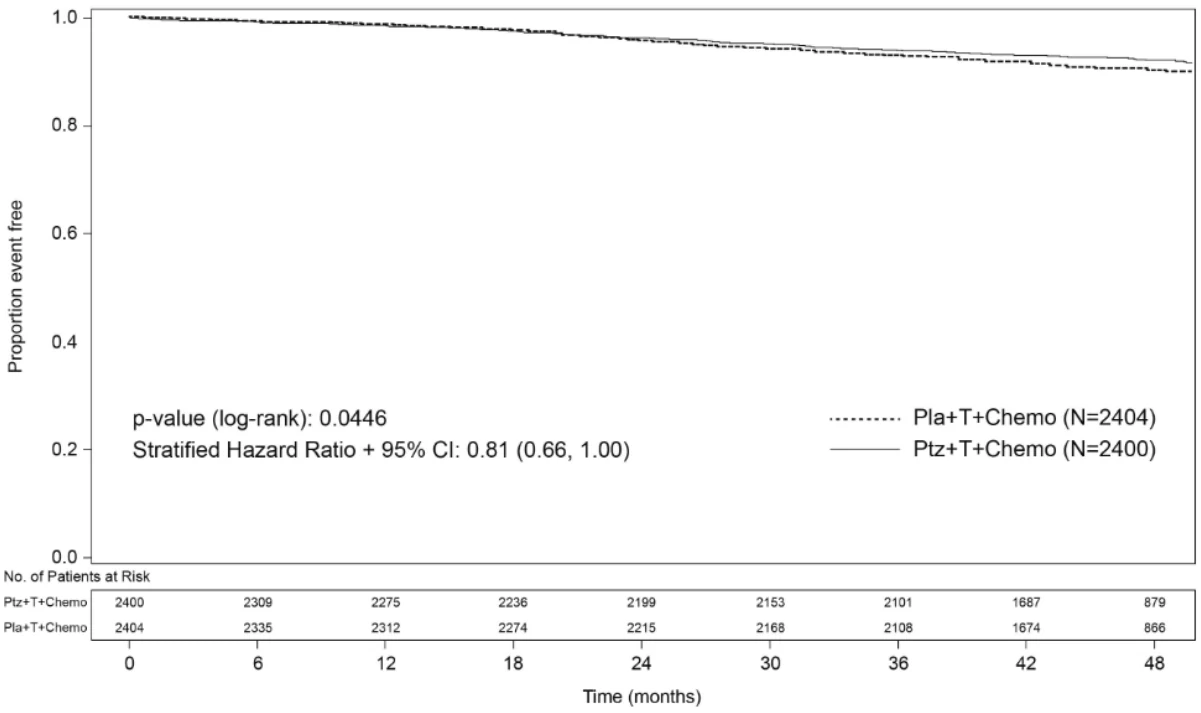
Pla = placebo; Ptz = pertuzumab; T = trastuzumab.
The estimate of IDFS at 4-years was 92.3% in the pertuzumab-treated group versus 90.6% in the placebo-treated group. At the time of the estimate the median follow-up was 45.4 months. Within the anthracycline subgroup, the estimate of IDFS at 4-years was 92.1% in the pertuzumab-treated group versus 90.1% in the placebo-treated group. Within the non-anthracycline subgroup, the estimate of IDFS at 4-years was 92.9% in the pertuzumab-treated group versus 92.1% in the placebo-treated group.
In a subgroup analysis, the benefits of pertuzumab were more apparent for patients with node-positive or hormone receptor-negative disease. The findings for these patients are presented in Table 22.
Table 22 Invasive Disease-Free Survival (IDFS) Efficacy Results by Lymph Node and Hormone Receptor Status from APHINTY Study1
| Nodal Status: | Positive | Negative | ||||||||||||||
|---|---|---|---|---|---|---|---|---|---|---|---|---|---|---|---|---|
Pertuzumab + Trastuzumab + chemotherapy N=1503 | Placebo + Trastuzumab + chemotherapy N=1502 | Pertuzumab + Trastuzumab + chemotherapy N=897 | Placebo + Trastuzumab + chemotherapy N=902 | |||||||||||||
| Number (%) of patients with event | 139 (9.2%) | 181 (12.1%) | 32 (3.6%) | 29 (3.2%) | ||||||||||||
| HR [95% CI] | 0.77 (0.62, 0.96) | 1.13 (0.68, 1.86) | ||||||||||||||
| 3 year event-free rate [95% CI]2 | 92.0 (90.6, 93.4) | 90.2 (88.6, 91.7) | 97.5 (96.5, 98.6) | 98.4 (97.6, 99.2) | ||||||||||||
| Hormone Receptor Status: | Positive | Negative | ||||||||||||||
Pertuzumab + Trastuzumab + chemotherapy N=1536 | Placebo + Trastuzumab + chemotherapy N=1546 | Pertuzumab + Trastuzumab + chemotherapy N=864 | Placebo + Trastuzumab + chemotherapy N=858 | |||||||||||||
| Number (%) of patients with event | 100 (6.5%) | 119 (7.7%) | 71 (8.2%) | 91 (10.6%) | ||||||||||||
| HR [95% CI] | 0.86 (0.66, 1.13) | 0.76 (0.56, 1.04) | ||||||||||||||
| 3 year event-free rate [95% CI]2 | 94.8 (93.7, 95.9) | 94.4 (93.2, 95.5) | 92.8 (91.0, 94.5) | 91.2 (89.2, 93.1) | ||||||||||||
HR: Hazard Ratio; CI: Confidence Intervals.
1Exploratory analyses of pre-specified subgroups without adjustment for multiple comparisons.
23-year event-free rate derived from Kaplan-Meier estimates.
Metastatic Breast Cancer
CLEOPATRA (WO20698)
Table 23 Summary of patient demographics for study CLEOPATRA (WO20698)
Study No. / Trial design | Dosage, route of administration and duration | Study subjects (n) | Mean age (Range) | Sex (%M/F) |
WO20698/ TOC4129g (CLEOPATRA) A Phase III, randomized, multicentre, double-blind, two-arm, placebo- controlled study | Arm A: P + T + doc Arm B: Placebo + T + doc Pertuzumab (P): 420 mg IV q3w (840 mg loading dose) Trastuzumab (T): 6 mg/kg IV q3w (8 mg/kg loading dose) Docetaxel (Doc): 75 mg/m2 escalating to 100 mg/m2 IV q3w, 6 cycles Placebo: IV q3w | Arm A: n=402 Arm B: n=406 | Arm A: 53.4 years (22-82) Arm B: 53.5 years (27-89) | Arm A: 0/100 Arm B: 0.5/99.5 |
IV = intravenous; Q3W = every 3 weeks;
CLEOPATRA is a multicenter, randomized, double-blind, placebo-controlled Phase III clinical trial conducted in 808 patients with HER2-positive metastatic or locally recurrent unresectable breast cancer who have not received previous anti-HER2 therapy or chemotherapy for their metastatic disease. Patients were randomized 1:1 to receive placebo plus trastuzumab and docetaxel (placebo-treated) or pertuzumab plus trastuzumab and docetaxel (pertuzumab-treated). Randomization was stratified by prior treatment status (de novo or prior adjuvant/neoadjuvant therapy) and geographic region (Europe, North America, South America and Asia). Patients with prior adjuvant or neoadjuvant therapy were required to have a disease-free interval of at least 12 months before enrolment into the trial.
Pertuzumab (loading dose of 840 mg/kg, followed by maintenance dose of 420 mg/kg every 3 weeks) and trastuzumab (loading dose of 8 mg/kg, followed by maintenance dose of 6 mg/kg every 3 weeks) were administered intravenously. Patients were treated with pertuzumab and trastuzumab until disease progression, withdrawal of consent or unmanageable toxicity. Docetaxel was given as an initial dose of 75 mg/m2 IV infusion every 3 weeks for at least 6 cycles. The dose of docetaxel could be escalated to 100 mg/m2 at the investigator’s discretion if the initial dose was well tolerated.
At the time of the primary analysis, the mean number of cycles of study treatment received was 16.2 in the placebo treatment group and 19.9 in the pertuzumab-treated group.
The primary endpoint of the study was PFS as assessed by an independent review facility (IRF) and defined as the time from the date of randomization to the date of disease progression or death (from any cause) if the death occurred within 18 weeks of the last tumour assessment.
Key secondary efficacy endpoints were overall survival (OS), progression-free survival (PFS) (investigator-assessed), objective response rate (ORR).
Patient demographics and baseline characteristics were balanced between treatment arms. The median age was 54 (range 22 to 89 years), 59% were Caucasian, 32% were Asian, and 4% were Black. All were female with the exception of 2 patients. Seventeen percent of patients were enrolled in North America, 14% in South America, 38% in Europe, and 31% in Asia. Tumour prognostic characteristics, including hormone receptor status (positive 48%, negative 50%), presence of visceral disease (78%) and non-visceral disease only (22%) were similar in the study arms. Approximately half of the patients received prior adjuvant or neoadjuvant anti-HER2 therapy or chemotherapy (placebo 47%, pertuzumab 46%). Among patients with hormone receptor positive tumours, 45% received prior adjuvant hormonal therapy and 11% received hormonal therapy for metastatic disease. Eleven percent of patients received prior adjuvant or neoadjuvant trastuzumab.
At the time of the primary progression-free survival analysis, a total of 242 patients (59%) in the placebo-treated group and 191 patients (47.5%) in the pertuzumab-treated group had IRF-confirmed progressive disease or had died.
At the time of the primary analysis the CLEOPATRA study demonstrated a statistically significant improvement in IRF-assessed PFS (hazard ratio [HR] = 0.62, 95% CI = 0.51, 0.75, p<0.0001) in the pertuzumab-treated group compared with the placebo-treated group, and an increase in median PFS of 6.1 months (median PFS of 12.4 months in the placebo plus trastuzumab plus docetaxel treated group vs 18.5 months in the pertuzumab-treated group) (see Figure 2). The results for investigator-assessed PFS were comparable to those observed for IRF-assessed PFS.
Consistent results were observed across several patient subgroups including age (< 65 or ≥ 65 years), race, geographic region, prior adjuvant/neoadjuvant anti-HER2 therapy or chemotherapy (yes or no), and prior adjuvant/neoadjuvant trastuzumab (yes or no). In the subgroup of patients with disease limited to non-visceral metastasis (n=178), the hazard ratio was 0.96 (95% CI: 0.61, 1.52) (see Figure 3).
At a second OS analysis performed (confirmatory analysis) one year after the primary analysis of efficacy, 267 patients had died with more deaths occurring in the placebo-treated group compared with the pertuzumab-treated group (154 deaths (37. 9%) versus 113 deaths (28.1%), respectively). A statistically significant OS benefit in favour of the pertuzumab-treated group was demonstrated (HR 0.66, Adjusted (98.62%) CI =0.49, 0.90, p = 0.0008 log-rank test). The median time to death was 37.6 months in the placebo-treated group but had not yet been reached in the pertuzumab-treated group (see Table 24 and Figure 4). OS results in patient subgroups were consistent with those observed for all patients with the exception of the subgroup of patients with disease limited to non-visceral metastases [HR = 1.42 (95% CI: 0.71, 2.84)].
The final analysis of OS was performed when 389 (48.1%) patients had died [221 (54.4%) in the placebo-treated group and 168 (41.8%) in the pertuzumab-treated group]. This occurred approximately 21 months after the confirmatory OS analysis. The median time to death was 40.8 months in the placebo-treated group and 56.5 months in the pertuzumab-treated group (see Table 24). The final OS analysis is considered descriptive as confirmatory statistical significance had already been achieved at the second interim analysis.
Duration of IRF-assessed objective response was assessed in the 233 patients in the placebo-treated group and 275 patients in the pertuzumab-treated group with a best overall response of CR or PR, as assessed by the IRF. The median duration of response was 12.5 months in the placebo-treated patients compared to 20.2 months in the pertuzumab-treated patients.
The efficacy results from the CLEOPATRA trial are summarized in Table 24 below.
Table 24 Summary of Efficacy from CLEOPATRA Study (ITT Population)
| Parameter | Placebo + trastuzuamb+ docetaxel n=406 | Pertuzumab + trastuzumab+ docetaxel n=402 | HR (95% CI) | p-value |
|---|---|---|---|---|
| Parameter | Placebo + trastuzuamb+ docetaxel n=406 | Pertuzumab + trastuzumab+ docetaxel n=402 | HR (95% CI) | p-value |
| Primary Endpoint: | ||||
Progression-Free Survival (IRF review) | ||||
| No. of patients with an event | 242 (59%) | 191 (47.5%) | 0.62 [0.51;0.75] | <0.0001 |
| Median PFS (months) | 12.4 | 18.5 | ||
| Secondary Endpoints: | ||||
| Overall Survival | ||||
| Confirmatory analysis (2nd Interim analysis) | ||||
| No. of patients with an event1 | 154 (37.9%) | 113 (28. 1%) | 0.66 [0.49;0.90]2 | 0.0008* |
| Median months | 37.6 | Not reached | ||
| Final analysis3 | ||||
| No. of patients with an event | 221 (54.4%) | 168 (41.8%) | 0.68 [0.56; 0.84]** | |
| Median months | 40.8 | 56.5 | ||
| Objective Response Rate (ORR)4 | ||||
| No. of patients with measureable disease | 336 | 343 | ||
| ORR (CR+PR) | 233 (69.3 %) | 275 (80.2 %) | ||
Complete response (CR) Partial Response (PR) | 14 (4.2 %) 219 (65.2 %) | 19 (5.5 %) 256 (74.6 %) | ||
1OS data based upon data with additional 1 year follow up after the primary data cut-off. The p-value met the O’Brien Fleming stopping boundary of the Lan DeMets alpha spending function for the second interim analysis of overall survival (p ≤ 0.0138). The result was therefore statistically significant.
2adjusted CI presented for OS, to reflect the stopping boundary of p≤ 0.0138. The interval represents the 98.62% CI.
3Final analysis of overall survival, cut-off date 11 Feb 2014. Final OS analysis considered descriptive only as the confirmatory statistical significance had already been achieved at the second interim analysis.
4Objective response rate is based on IRF-assessed tumour assessments.
Figure 2 Kaplan-Meier Curve of IRF-assessed Progression-Free Survival (ITT Population)
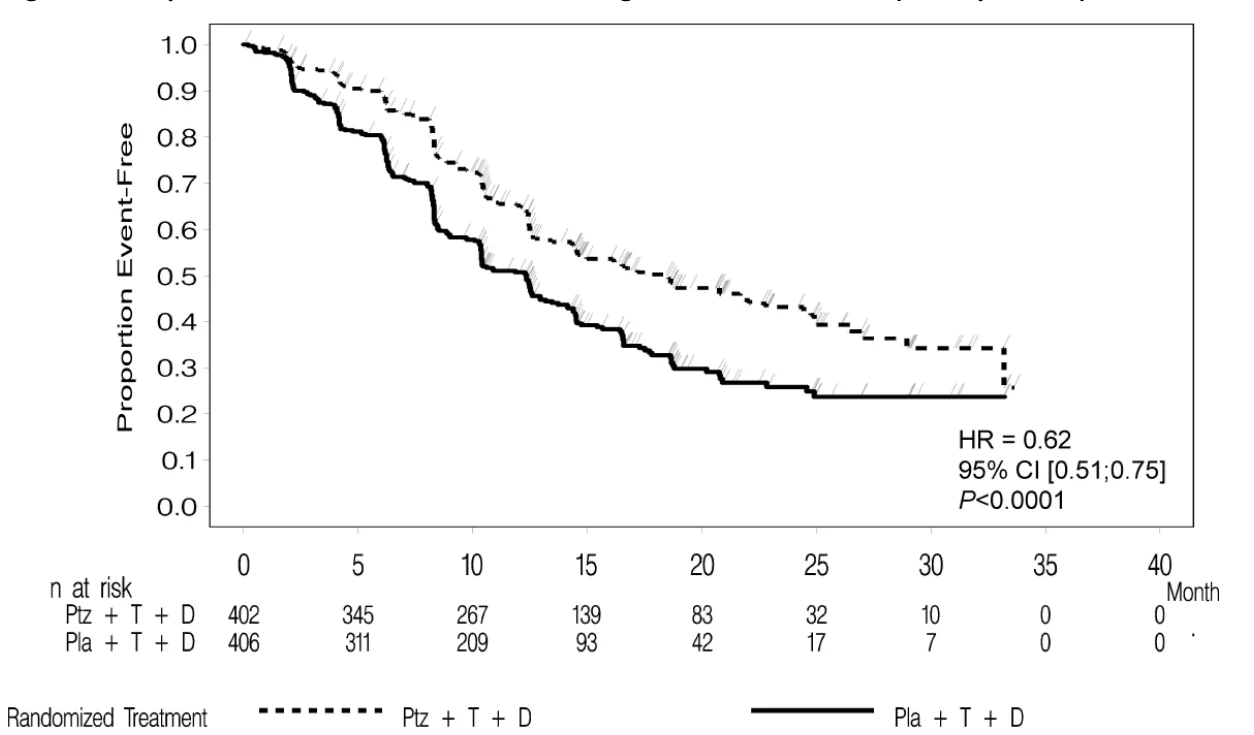
D= docetaxel; HR= hazard ratio; Ptz= pertuzumab; T=trastuzumab.
Figure 3 IRF-assessed PFS by Patient Subgroup (ITT Population)
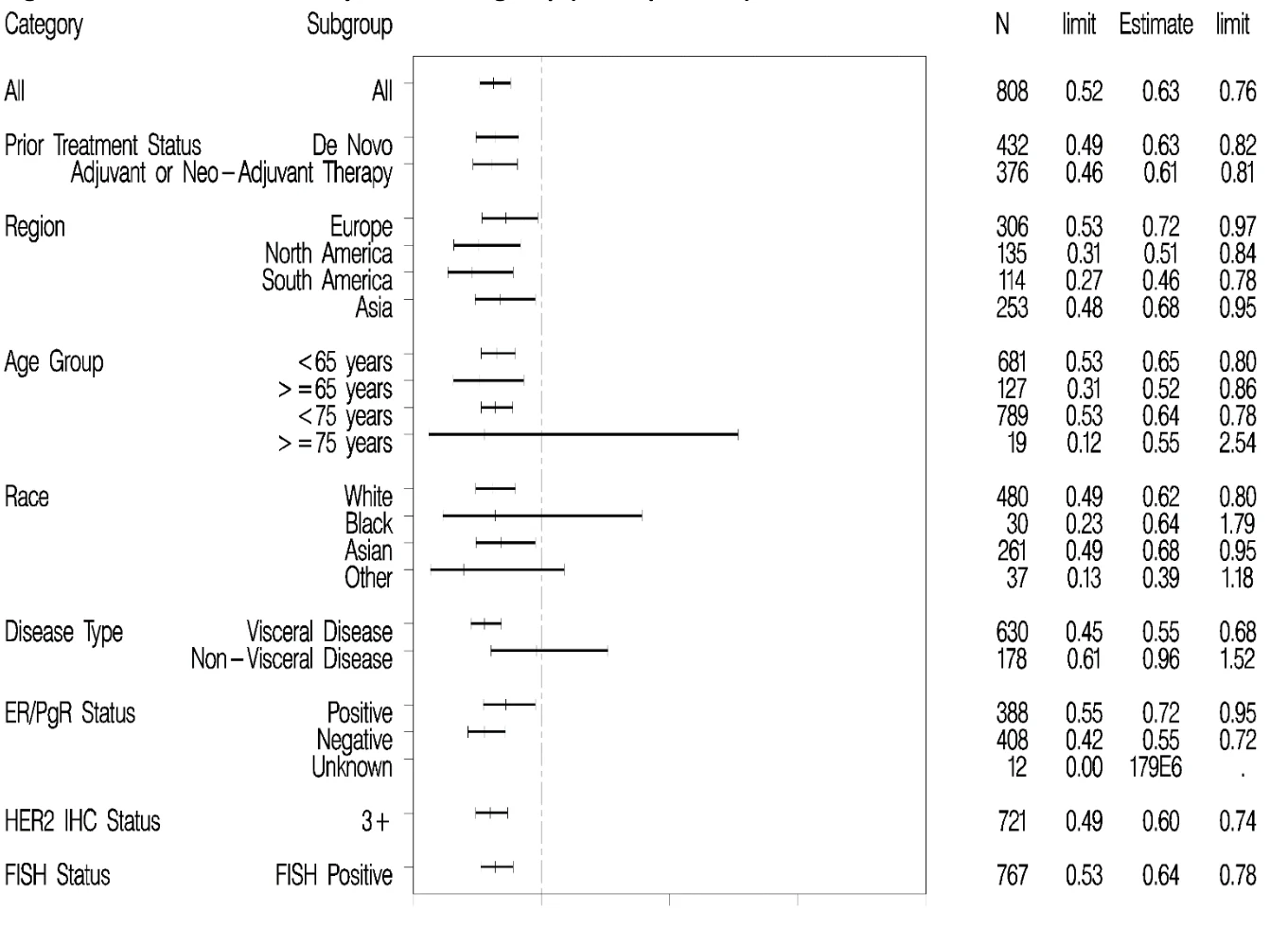
Figure 4 Kaplan-Meier Curve of Overall Survival (2nd Interim Analysis, ITT Population)
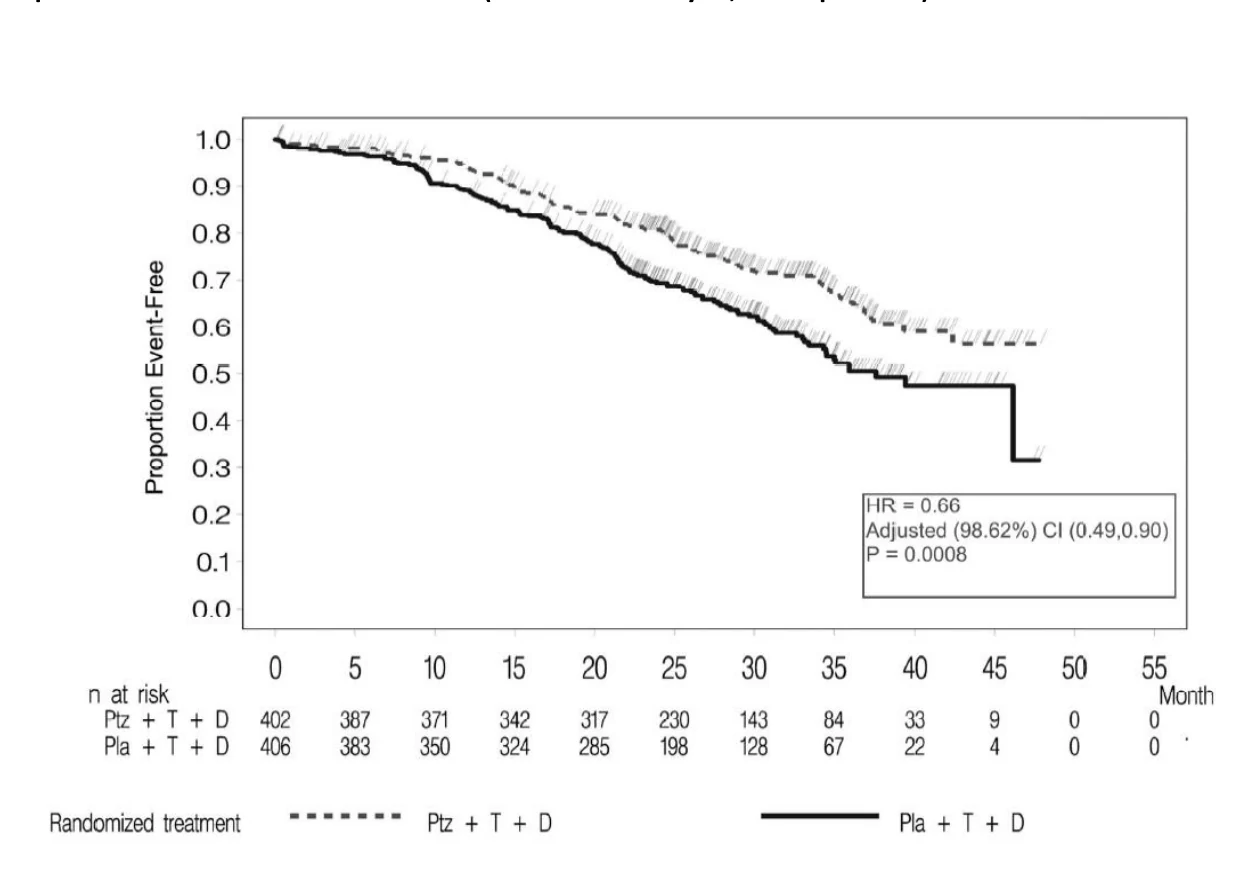
D= docetaxel; HR= hazard ratio; Ptz= pertuzumab; T=trastuzumab.
14.2 Comparative Bioavailability Studies
Not applicable.
15. Microbiology
No microbiological information is required for this drug product.
16. Non-Clinical Toxicology
General Toxicology: No dedicated studies were conducted with the combination of subcutaneous pertuzumab, trastuzumab, and rHuPH20.
Subcutaneous and Intravenous Pertuzumab and Trastuzumab
Pertuzumab
Subcutaneous pertuzumab (250 mg/kg/week for 4 weeks) and intravenous pertuzumab (up to 150 mg/kg weekly for up to 26 weeks) was well tolerated in cynomolgus monkeys (binding species), except for the development of diarrhea. With intravenous pertuzumab doses of 15 mg/kg and higher, intermittent mild treatment-associated diarrhea was noted. In a subset of monkeys, chronic dosing (26 weekly doses) resulted in episodes of diarrhea-related dehydration which were managed with intravenous fluid replacement therapy.
Trastuzumab
Acute Toxicity Studies/Local tolerance: In a single dose local tolerance study, single injections of 60 mg/injection site, were administered to New Zealand White rabbits subcutaneously in the right flank (0.5 mL/injection site containing 2000 U/mL of rHuPH20). No clinical signs of systemic toxicity were observed in the animals during the study, following a one or four day observation period (3 males/group). No trastuzumab related local reactions were observed after subcutaneous injection and there were no macroscopic and microscopic findings that were attributable to treatment with trastuzumab SC.
Multidose Toxicity Studies: In a 13-week repeat dose toxicity study in male and female Cynomolgus monkeys (5/gender/group), subcutaneous administration of trastuzumab as multiple subcutaneous doses in monkeys at 0 mg/kg and 30 mg/kg (containing 12,000 U/mL of rHuPH20, the rHuPH20 dose was approximately 3000 U/kg corresponding to approximately 0.025 mg/kg per SC injection) given weekly for 13 weeks, did not result in any adverse test article-related effects and consequently the no observed adverse effect level was considered to be 30 mg/kg. The results of this study confirm the favourable safety profile of trastuzumab SC and are in line with the toxicity studies conducted with trastuzumab IV formulation.
Hyaluronidase
Hyaluronidase is found in most tissues of the human body. Non-clinical data for recombinant human hyaluronidase (rHuPH20) reveal no special hazard for humans based on conventional studies of repeated dose toxicity including safety pharmacology endpoints. Reproductive toxicology studies with rHuPH20 at dose levels up to 2,200,000 U/kg, which is >2,400 and 3,600, based on loading and maintenance doses, respectively, times higher than the hyaluronidase human doses revealed decreased fetal body weights and increased late resorptions in mice, and did not show teratogenic potential. No effects were found at a daily dose of 360,000 U/kg, which is > 400 and 600, based on loading and maintenance doses, respectively, times higher than the hyaluronidase human doses.
For further information, see separate Product Monographs for pertuzumab, trastuzumab, and subcutaneous trastuzumab.
Genotoxicity: No studies have been performed to evaluate the mutagenic potential of pertuzumab and trastuzumab injection when delivered in combination.
Carcinogenicity: No carcinogenicity studies have been performed to establish the carcinogenic potential of pertuzumab or trastuzumab within PHESGO.
Reproductive and Developmental Toxicology: No studies have been performed to evaluate the reproductive and developmental toxicity of pertuzumab and trastuzumab injection when delivered in combination.
Impairment of Fertility
Intravenous pertuzumab
No specific fertility studies in animals have been performed to evaluate the effect of pertuzumab. No adverse effects on male and female reproductive organs were observed in repeat-dose toxicity studies of up to six month duration in cynomolgus monkeys.
Intravenous trastuzumab
Reproduction studies of female fertility have been conducted in cynomolgus monkeys at doses up to 25 times that of the weekly human maintenance dose of 2 mg/kg intravenous trastuzumab and have revealed no evidence of impaired fertility. Additionally, no adverse effects on male and female reproductive organs were observed in repeat-dose toxicity studies of up to six month duration in cynomolgus monkeys.
Reproductive toxicity
Intravenous pertuzumab
Reproductive toxicology studies have been conducted in cynomolgus monkeys at loading doses of 30 to 150 mg/kg and maintenance doses of 10 to 100 mg/kg achieving clinically relevant exposures. Intravenous administration of pertuzumab from Gestation Day (GD) 19 through 50 (period of organogenesis) has been shown to be embryotoxic with a dose dependent increase in embryo-fetal deaths between GD 25 to 70. Delayed renal development and oligohydramnios were identified at GD100.
Intravenous trastuzumab
Reproduction studies have been conducted in cynomolgus monkeys at doses up to 25 times that of the weekly human maintenance dose of 2 mg/kg intravenous trastuzumab and have revealed no evidence of harm to the fetus. Placental transfer of trastuzumab during the early (days 20 - 50 of gestation) and late (days 120 - 150 of gestation) fetal development period was observed.
Developmental Toxicity Studies of rHuPH20
In an embryo-fetal study, mice have been dosed daily by subcutaneous injection during the period of organogenesis with rHuPH20 at dose levels up to 2,200,000 U/kg, which is >2,400 and 3,600, based on loading and maintenance doses, respectively, times higher than the hyaluronidase human doses. The study found no evidence of teratogenicity. Reduced fetal weight and increased numbers of fetal resorptions were observed, with no effects found at a daily dose of 360,000 U/kg, which is > 400 and 600, based on loading and maintenance doses, respectively, times higher than the hyaluronidase human doses.
In a peri- and post-natal reproduction study, mice have been dosed daily by subcutaneous injection, with rHuPH20 from implantation through lactation and weaning at dose levels up to 1,100,000 U/kg, which is > 1,200 and 1,800, based on loading and maintenance doses, respectively, times higher than the hyaluronidase human doses. The study found no adverse effects on sexual maturation, learning and memory, or fertility of the offspring.
Lactation
Intravenous trastuzumab
A study conducted in cynomolgus monkeys that had received trastuzumab at doses 25 times that of the weekly human maintenance dose of 2 mg/kg intravenous trastuzumab from days 100 to 150 of pregnancy, demonstrated that trastuzumab is secreted in the milk postpartum. The exposure to trastuzumab in utero and the presence of trastuzumab in the serum of these infant monkeys was not associated with any adverse effects on their growth or development from birth to 1 month of age.
17. Supporting Product Monographs
PERJETA® (pertuzumab for injection, 420 mg/14 mL vial), submission control no.230602, Product Monograph, Hoffmann-La Roche, February 25, 2021.
HERCEPTIN® IV (trastuzumab for injection, 440 mg/vial sterile powder for IV infusion), submission control no. 235646, Product Monograph, Hoffmann-La Roche, May 7, 2020.
HERCEPTIN® SC (trastuzumab for injection, 600 mg/5 mL vial), submission control no. 235649, Product Monograph, Hoffmann-La Roche, May 7, 2020.