


Product Monograph - Phyllocontin
INDICATIONS
The symptomatic treatment of reversible bronchoconstriction associated with bronchial asthma, chronic obstructive pulmonary emphysema, chronic bronchitis and related bronchospastic disorders.
CONTRAINDICATIONS
Phyllocontin® and Phyllocontin®-350 (aminophylline sustained release tablets) should not be administered to patients with hypersensitivity to xanthines or ethylenediamine, to patients with
| PRODUCT MONOGRAPH | |||
| Phyllocontin | ® | and | |
coronary artery disease where cardiac stimulation might prove harmful or to patients with peptic ulcer.
WARNINGS
Phyllocontin® and Phyllocontin®-350 (aminophylline sustained release tablets) are not appropriate for use in an emergency where rapid relief of bronchospasm is required.
Children are very sensitive to xanthines; the margin of safety above therapeutic doses is small.
Phyllocontin and Phyllocontin-350 tablets are not presently recommended for children under 12 years of age, as a dosage schedule in this age group has not been established.
PRECAUTIONS
There is a marked variation in blood levels achieved in different patients given the same dose of theophylline. High serum levels may occur in some patients receiving doses considered to be conventional. Overdosage may lead to serious side effects such as tachycardia, arrhythmias, seizures, vascular collapse and even death, and may occur without warning signs such as nausea and vomiting. The variability in blood levels is primarily due to differences in the rate of metabolism.
Therefore, it is important to individualize the dosage regimen.
Ideally, all individuals should have serum theophylline levels measured and a theophylline half-life calculated which would enable doses and dosing regimens to be tailored to each patient to maintain a therapeutic level, to ensure optimal clinical response and to avoid toxicity. The incidence of toxicity increases at serum theophylline levels greater than 82.5 µmol/L (15 µg/mL) and levels above 110 µmol/L (20 µg/mL) are usually quite toxic in most patients (adults). Concurrent tea,
| PRODUCT MONOGRAPH | |||
| Phyllocontin | ® | and | |
coffee or cocoa administration may interfere with analytical results.
The equivalent content of theophylline anhydrous is the active ingredient which determines clinical response. If there is a change in the theophylline product and if it involves a change in the theophylline anhydrous equivalence the physician should adjust the dosage to avoid overdosage or underdosage.
Patients with Special Diseases and Conditions: Theophylline clearance is decreased, which may result in increased serum levels and resultant toxicity in patients:
- with impaired liver or kidney function
- over 55 years of age, particularly males and those with chronic lung disease
- with cardiac failure from any cause
- with active influenza or other viral disease or after influenza immunization
- with high carbohydrate, low protein diet
- taking certain drugs (see Drug Interactions, below)
- thyroid disease or associated treatment may alter theophylline plasma levels.
Laboratory monitoring of serum theophylline levels is especially appropriate in the above individuals in order to maintain the appropriate theophylline dosage.
Theophylline is known to stimulate gastric acid secretion and may also act as a local G.I. irritant.
Therefore, the drug should only be used with caution in patients with a history of peptic ulcer disease.
| PRODUCT MONOGRAPH | |||
| Phyllocontin | ® | and | |
Theophylline may cause arrhythmia and/or worsen pre-existing arrhythmia. Any significant change in rate and/or rhythm warrants monitoring and further investigation.
Many patients who require theophylline may exhibit tachycardia due to their underlying disease process so that the cause/effect relationship to elevated serum theophylline concentrations may not be appreciated.
Use with caution in patients with severe cardiac disease, severe hypoxemia, hypertension, hyperthyroidism, acute myocardial injury, cor pulmonale, congestive heart failure, liver disease, in the elderly (especially males).
| PRODUCT MONOGRAPH | |||
| Phyllocontin | ® | and | |
Drug Interactions:
A. Theophylline pharmacokinetics are altered by the concurrent use of various drugs as listed below:
Drug
Effect on Theophylline Clearance and Elimination Half-life
| Allopurinol, carbimazole, cimetidine, | diltiazem, | ||||||
| disulfiram, fluconazole, interferon, isoniazid, quinolone | |||||||
| antibacterials (ciprofloxacin, norfloxacin, ofloxacin), | |||||||
| macrolide antibiotics (erythromycin, clarithromycin, | |||||||
| troleandomycin), methotrexate, mexiletine, nizatidine, | |||||||
| oral contraceptives, propafenone, propanolol, | |||||||
| pentoxiphylline, selective serotonin re-uptake inhibitors | |||||||
| (e.g., fluvoxamine), thiabendazole, verapamil, viloxazine | |||||||
| hydrochloride | |||||||
8 t½, 9 clearance
Alkalinizing agents 8 t½, 9 clearance
Influenza vaccine 8 t½, clearance reported to be decreased or no change
| Aminoglutethimide, | barbiturates, carbamazepine, | |
| hypericum perforatum (St. John’s Wort), isoproterenol, | ||
| moracizine, phenytoin, rifampin, sulphinpyrazone | ||
9 t½, 8 clearance
Tobacco, alcohol 9 t½, 8 clearance
Acidifying agents 9 t½, 8 clearance
| PRODUCT MONOGRAPH | ||
| Phyllocontin® | and | |
B. Concurrent use of theophylline influences the actions of certain drugs:
Drug Influence of Theophylline
Digitalis glycosides 8 cardiac effect
Thiazides 8 diuresis
Nephrotoxic drugs 8 nephrotoxicity
Lithium 8 ratio of lithium/creatinine clearance, thus a decrease in serum lithium levels
Sympathomimetic amines 8 toxicity, 8 CNS stimulation
Coumarin anticoagulants 9 anticoagulant activity
8 prothrombin and fibrinogen blood concentrations
9 prothrombin time
Allopurinol 9 antihyperuricemic action
Probenicid and pyrazolon derivatives 9 uricosuric action
| T | here | is | also | a | pharmacological | i | nteraction | with | adenosine, | benzodiazepines, | halotha | ne and |
| lomustine. | Car | e should | also | be | taken | in | its | concomitant | use | with | glucagon | and | other | xanthine | drugs. |
| Hypokalemia r | esulting | from | $ |
2 agonist
| therapy, | steroids, | diuretics | and | hypoxia | may | be | potentiated |
| by | x | anthines. Particular care is advised in patients suffering from severe asthma who require |
| hospitalization | . It | is | recommended | that | serum | concentrations | are | monitored | in | such | situations. |
Theophylline may decrease steady-state phenytoin levels.
Use in Pregnancy and Lactation: Theophylline crosses the placental barrier and also passes freely into breast milk, where concentrations are similar to plasma levels. Safe use in pregnancy has not been established relative to possible adverse effects on fetal development. Therefore, use of theophylline in pregnant women should be balanced against the risk of uncontrolled disease.
| PRODUCT MONOGRAPH | |||
| Phyllocontin | ® | and | |
ADVERSE REACTIONS
The most common adverse reactions are gastric irritation, nausea, vomiting, epigastric pain, and tremor. These are usually early signs of toxicity, however, with high doses ventricular arrhythmias or seizures may be the first signs to appear.
Adverse reactions include:
Gastrointestinal: nausea, vomiting, epigastric pain, hematemesis, diarrhea, anorexia, intestinal bleeding and reactivation of peptic ulcer.
Central Nervous System: headache, irritability, restlessness, insomnia, twitching, convulsions and reflex hyperexcitability.
Cardiovascular: palpitation, tachycardia, hypotension, circulatory failure, ventricular arrhythmias, extrasystoles and flushing.
Renal: albuminuria, diuresis and hematuria.
Others: hyperglycemia, tachypnea and inappropriate ADH syndrome.
SYMPTOMS AND TREATMENT OF OVERDOSAGE
Symptoms: Treat symptoms on appearance. Sustained release tablets may release medication for
| hours. | Insomnia, | restlessness |
, mild excitement or irritability and rapid pulse are the early symptoms,
| PRODUCT MONOGRAPH | |||
| Phyllocontin | ® | and | |
which may progress to mild delirium.
Sensory disturbances such as tinnitus or flashes of light are common. Anorexia, nausea and vomiting are frequently early observations of theophylline overdosage.
Fever, diuresis, dehydration and extreme thirst may be seen. Severe poisoning results in bloody, syrup-like "coffee ground" vomitus, tremors, tonic extensor spasm interrupted by clonic convulsions, extrasystoles, quickened respiration, stupor and finally coma. Cardiovascular disorders and respiratory collapse leading to shock, cyanosis and death follow gross overdosages.
Treatment:
A. If potential oral overdosage is established and seizure has not occurred:
- 1) Induce vomiting.
- 2) Administer a cathartic (this is particularly important when a sustained release preparation has been taken).
- 3) Administer activated charcoal.
B. If patient is having a seizure:
- 1) Establish an airway.
- 2) Administer oxygen.
- 3) Treat the seizure with intravenous diazepam, 0.1 to 0.3 mg/kg up to 10 mg.
- 4) Monitor vital signs, maintain blood pressure and provide adequate hydration.
C. Post Seizure Coma:
- 1) Maintain airway and oxygenation.
- 2) If a result of oral medication, follow the above recommendations to prevent absorption of
| PRODUCT MONOGRAPH | |||
| Phyllocontin | ® | and | |
the drug. Intubation and lavage will have to be performed instead of inducing emesis and the cathartic and charcoal will need to be introduced via a large bore gastric lavage tube.
- 3)
Continue to provide full supportive care and adequate hydration while waiting for the drug to be metabolized. In general, the drug is metabolized sufficiently rapidly so as not to warrant consideration of dialysis. However, if serum levels exceed 275 µmol/L (50 µg/mL)
charcoal hemoperfusion may be indicated.
DOSAGE AND ADMINISTRATION
Adults: The recommended initial dose is 225-350 mg every 12 hours (equivalent to 182.25 - 283.5 mg anhydrous theophylline).
Dosage adjustments should be based on the patient's clinical response and/or serum theophylline levels, with increases of 1/2 tablet per dose at 3 to 4 day intervals. Individual requirements vary considerably, therefore, the physician should be prepared to adjust each patient's dose. Doses greater than 1125 mg per day should not be given unless serum theophylline levels are monitored.
Monitoring serum theophylline levels is important, especially during dosage adjustment.
At steady-state,
| P | hyllocontin | ® | and |
Phyllocontin®-350 (aminophylline sustained release tablets)
produce peak theophylline levels 3-5 hours after dosing. For serum levels to be most useful, it is important the patient not have missed any doses during the previous three days. The optimum serum theophylline concentration is in the 44 to 110 µmol/L (8.0 to 20.0 µg/mL) range, depending on the severity of the condition. The incidence of adverse effects increases at levels greater than 82.5
µmol/L (15 µg/mL). In cases where it is not possible to monitor theophylline levels, patients should
| PRODUCT MONOGRAPH | |||
| Phyllocontin | ® | and | |
be closely observed for signs of toxicity.
| Phyllocontin | and | Phyllocontin-350 | tablets | should | not | be | chewed, | dissolved | or | crushed | as | this | may |
lead to a rapid release of theophylline with the potential for toxicity. Tablets may be halved.
AVAILABILITY
Phyllocontin® (sustained release aminophylline tablets) are available in two strengths.
Phyllocontin® - Round, flat-faced, off-white, scored tablets engraved P on one side and PF on the reverse. Contain 225 mg aminophylline U.S.P.
(equivalent to 182.25 mg anhydrous theophylline). Supplied in bottles of 100 tablets.
Phyllocontin®-350 mg - Square, off-white, scored tablets engraved PF on one side and P 350 on the reverse. Contain 350 mg aminophylline U.S.P. (equivalent to
283.5 mg anhydrous theophylline). Supplied in bottles of 100 tablets.
Store tablets at room temperature (below 30°C).
NON-MEDICINAL INGREDIENTS (all strengths): Cetostearyl Alcohol, Hydroxyethyl
Cellulose, Magnesium Stearate, Povidone, Talc.
| PRODUCT MONOGRAPH | |||
| Phyllocontin | ® | and | |
INFORMATION FOR THE PATIENT
| Your | doctor | has | prescribed | Phyllocontin | ®/ | Phy | llocontin | ® | -350 | (aminophylline | sustained | release |
| tablets) | , | which | contain | the | drug | aminophylline | incorporated | i | nto a sustained release system. |
| Aminophylline | opens | the | airways | in | you | r | lungs | so | that | you | may | breathe more easily, and |
| Phyllocontin’s/Phyllocontin-350's | sustained | release | mechanism | gradually | releases | aminophylline |
| so that most patients need to take | Phyllocontin/Phyllocontin-350 | only twice daily |
.
When Phyllocontin/Phyllocontin-350 should not be used
Phyllocontin/Phyllocontin-350 should not be used if:
- you are allergic to aminophylline, xanthines or ethylenediamine;
- you have coronary heart disease;
- you suffer from peptic ulcers.
| Phyllocontin/Phyllocontin-350 | tablets, | sustained | release | formulation, | are | not | appropriate | for |
use in an emergency where rapid relief of bronchospasm is required.
Phyllocontin/Phyllocontin-350 is not recommended for use in children under 12 years of age.
You should also inform your doctor if you:
- start or stop smoking;
- are breast-feeding, pregnant or want to become pregnant;
- have impaired liver or kidney function;
| PRODUCT MONOGRAPH | |||
| Phyllocontin | ® | an | |
d Phyllocontin®-350 Tablets Page 14
- are over 55 years of age, particularly male and with chronic lung disease;
- have heart disease;
- have influenza or other viral diseases or after influenza immunization;
- have a high carbohydrate, low protein diet;
- are taking certain drugs (see Drug Interactions, below);
- have thyroid disease;
- suffered from seizures (fits or convulsions).
In these situations, your dosage may need to be adjusted.
Drug Interactions
| Many | medications | interact | with | theophylline, | therefore | it | is | important | that | your | doctor | knows | all | the |
medications which you are taking and if you stop taking them. These include:
•
| aminoglutethimide | , | antibiotics, | ephedr | ine, fluconazole, glucagon, halothane, interferons, |
lithium, lomustine, methotrexate, oral contraceptives or other xanthine drugs;
- if you have had or you are going to have flu injections;
•
| medicines | for | alcoholism, | asthma, | epilepsy, | gout, | heart problems, insomnia (sleeping |
problems), stomach ulcers, thyroid problems, tuberculosis;
- St. John’s Wort (Hypericum perforatum);
- thiabendazole (a drug used for killing worms, for example threadworm and roundworm);
•
| viloxazine | or | selective | serotonin | re-uptake | inhibitors, | e.g., | fluvoxamine | (drugs | used | to | treat |
depression). PRODUCT MONOGRAPH
Phyllocontin® and Phyllocontin®-350 Tablets Page 15
How to take Phyllocontin/Phyllocontin-350
| It i | s important th | at you | take y | our | Phyllocontin/Phyllocontin-350 r | egularly, a | t the | tim | e and | in |
| the | e | x | act | quantity | that | your | doctor | has | direct | ed. | Do | n | ot | increas | e | your |
Phyllocontin/Phyllocontin-350 dose unless specifically directed to do so by your doctor.
| To | swallow | Phyllocontin/Phyllocontin-350 | mo | re | easily, an | d to ensure | that | the | tablets promptly |
| reach | your s | tomac | h, each | dose | should | be | taken | w | ith a | full gl | ass (120 | to | 180 | mL | ; 4 | to | 6 f | l. oz.) | of |
| water | while | you a | re standing o | r sitting | upright. | Your tablets should be taken whole or halved (if a |
| dosage | containing | halved | table | ts was | directed | by | your | doctor) | , but do | not | crush, | dissolve | or | chew |
| the | tablets a | s this | will | affect th | e sustained | release | mechanism. Unles | s | directed o | therwise | by | your |
| doctor | , Phyllocontin/Phyllocontin-350 | should | be t | aken | with, o | r shortly | following, | the | evening | meal. |
| Misse | d | dos | es can | cause | your | symptoms | of | asthma | or bron | chitis to reappear and taking more |
| Phyllocontin/Phyllocontin-35 | 0 than | prescribed | can l | ead to s | ide effects | such | as headache, nausea |
| or | vomiting. | If these side effects occur at any time during Phyl | locontin/Phyllocontin-350 | therapy, |
| yo | u should | contac | t your d | octor | before | taking a | ny | additional do | ses. If your symptoms become more |
severe and you have been taking your medication regularly, you should also contact your doctor.
| If y | ou | find t | hat you have missed a dose, and less than | 4 hours have elapsed since your scheduled |
| dosing | time | , take | your | regular d | ose | immediately, | then | resume | taking y | our | regular | dose | at y | our | next |
| scheduled d | osing | time | . I | f mor | e than 4 | hours | hav | e elapsed, ca | ll your | doctor f | or a | dvice | . They may |
give you another medicine until you are due to take your next tablet.
| PRODUCT MONOGRAPH | ||
| Phyllocontin | ® and | |
| During | a | feve | r o | r viral infection (e.g., flu), your dosage of | Phyllocontin/Phyllocontin-350 | may | need |
| to | be | adjusted | . If you develop side effects during such an infection, do not take your next dose of |
Phyllocontin/Phyllocontin-350 and call your doctor.
Side effects you may have while taking Phyllocontin/Phyllocontin-350
| When | t | aking | Phyllocontin/Phyllocontin-350, | you | m | ay feel sick, have an upset stomach, loss of |
| appetite, | headache, | tachycardia | or | palpitations | (a | fast, | strong | heart | beat) | or | arrhythmia | (an | irregular |
| heart | beat). | You may also have problems sleeping or feel restless, irritable and shaky. Occasionally, |
| convulsions ( | fits) | have | been | reported. | If any of these problems bother you or you have any other |
problems, please contact your doctor immediately.
Overdose
| In | case | of | a | suspected | overdos | e | call | your | doctor | or | your | Regional | Poison | Control | Centre |
immediately.
| PRODUCT MONOGRAPH | |||
| Phyllocontin | ® | and | |
CHEMISTRY
Structure: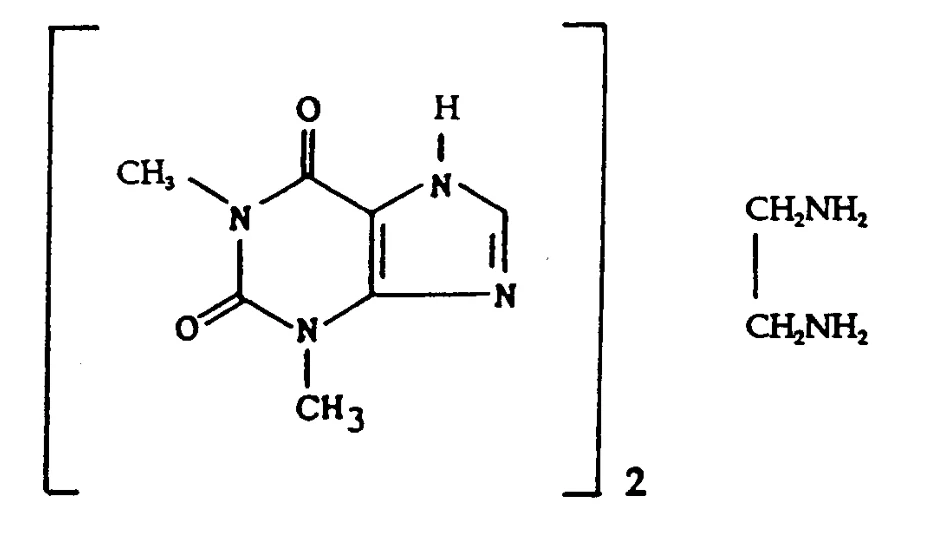
| Aminophylline | is | a | theophylline | compound | with | ethylenediamine | (2:1). | Aminophylline is |
anhydrous or contains not more than two molecules of water of hydration.
Molecular Weight: 420.43 (anhydrous)
456.46 (dihydrate)
Description:
| White | or | slightly | yellow | granules | with | a | slight | ammoniacal | odour | and | a | bitter |
taste. Soluble in water, insoluble in alcohol and ether.
PHARMACOLOGY
The principal pharmacologic actions of theophylline are to stimulate the central nervous system, act on the kidney to produce diuresis, stimulate cardiac muscle and relax smooth muscle, notably the bronchial muscle.
PRODUCT MONOGRAPH
Phyllocontin® and Phyllocontin®-350 Tablets Page 18
Theophylline is usually readily absorbed following oral administration. The extent of absorption
| is n | egligibly | influenced | by | food | . Following absorption 55-65% of theophylline is reversibly bound |
| to p | lasma pr | otein. | Theophylline is distributed in the extracellular fluids and uniformly to all tissues. |
| Th | e drug ha | s a mean | biological | half-life | of | 5.0 | hours | in | adults | and | 3.5 | hours | in | children | with | great |
| individual v | ariability | . Theophylline is metabolized in the liver. The major metabolites are 1,3- |
| dimethyluri | c acid, | 1-methyluric | acid | and | 3-methylxanthine | with | only | 7 | to | 13% | excreted | unchanged. |
| Th | e enzym | es involved | in | theophylline | metabolism | are | unknown, but do not include xanthine |
oxidase. Serum uric acid concentrations are not increased during theophylline administration and
| the | drug is n | ot contraindicated i | n the | presence | of | gout | or | allopurinol | administration. | Theophylline |
| clearance is | markedly | increased | in | smokers, | likely | due | to | stimulation | o | f the | metabolizing | enzymes. |
TOXICOLOGY
The human oral lethal dose is estimated to be from 50 to 500 mg/kg.
| Children are | more | susceptible to | the t | oxic | effects | of | theophylline | than | adults | . The therapeutic serum |
| theophyllin | e concentration | for a | dults | is | in | th | e range | of | 44-110 | µmol/L | (8-20 | µg/mL). | The incidence |
| of | adverse e | ffects | inc | reases at serum concentrations over 82.5 µmol/L (15 µg/mL). Tolerance to |
some of the toxic effects of theophylline is known to occur.
| PRODUCT MONOGRAPH | ||
| Phyllocontin® | and | |
BIOAVAILABILITY
| I | n a crossover bioavailability study | , 11 male volunteers received single doses of two 225 mg |
Phyllocontin (aminophylline sustained release) tablets or two 200 mg tablets of a reference sustained
| release | theophylline | product | (Theo-Dur, | Astra). | The following mean pharmacokinetic parameters |
were determined (adjusted to a common dose of 400 mg anhydrous theophylline):
| Cmax | tmax | ||
| AUC o-4 | t½ |
| L | |||
| µg/m | hr | ||
| µg.hr/mL | hr |
Phyllocontin 2 x 225 mg 7.9 5.3 161.9 9.7
Reference 2 x 200 mg 7.9 8.6 171.2 9.2
| In | a | se | parate, multiple dose crossover bioavailability study | , 12 volunteers received one 350 mg |
Phyllocontin-350 tablet q12h or one 300 mg tablet of a reference sustained release theophylline
| produc | t (Theo-Dur, | Astra) | q12h | for | 5 days. | Multiple blood samples were obtained following the |
| first | dose | (Da | y | 1) | and | following | the | morning | dos | e | after | steady- | state | had | been | achie | ved (Day 4). |
| The | following | mean | pharmacokinetic | parameters | were | determined | (adjusted | to | a c | ommon | dose | of |
300 mg anhydrous theophylline):
Day 1 Day 4
Cmax
µg/mL
tmax
hr
Cmax µg/mL
Cmin µg/mL
tmax hr
AUC 0-4 µg.hr/mL
Phyllocontin-350 7.2 5.3 14.9 9.6 4.1 141.1
Reference 300 mg 6.3 7.2 13.4 9.5 5.2 131.0
| These s | tudies | indicate | that | Phyllocontin | is | a | reliable | sustained | release | formulation | and | that, | except |
for a slight difference in tmax, Phyllocontin and the reference compound are bioequivalent.
| PRODUCT MONOGRAPH | ||
| Phyllocontin | ® and | |
Clinical Findings:
| Followin | g | a 4 | 8 | hou | r t | heophylline | washout | , | 25 | adult | asthmatic | s | bega | n | dosin | g with | one 350 mg |
| Phyllocontin-350 | table | t q12h | . Three days later, morning trough theophylline levels were measured. |
| Fifteen o | f the | patients | had | trough l | evels | greater | than 7 | .0 µg/mL | (38.5 | µmol/L) | and | they | continued |
dosing at one 350 mg tablet q12h. Nine patients had trough theophylline levels below 7.0 µg/mL and their dosage was increased to 1½ 350 mg tablets q12h. Eight of these nine patients has subsequent trough levels greater than 7.0 µg/mL and they continued dosing at 1½ 350 mg tablets q12h. After a further 7 days dosing, all patients returned to multiple serum theophylline measurements following a morning dose. Results by dosage group were:
MEAN STEADY-STATE THEOPHYLLINE LEVELS
H
| ours Post-Dose |
Dosage Group
| 0 | 1 | 2 | 4 | 5 | 6 | 7 |
8
1 x 350 mg, q12h
| 8.8 | 8.8 | 10.5 | 11.4 | 11.3 | 11.2 | 10.6 |
9.5
1½ x 350 mg, q12h
| 9.9 | 11.6 | 13.5 | 14.3 | 13.0 | 11.7 | 11.7 |
10.5
| This, | and | othe | r studies | demonstrate | that | individualized | dosages | of | Phyllocontin | tablets | can | maintain |
| therapeutic | theophyllin | e concentrations | throughout | a 1 | 2 hour d | osage | interval. T | he most frequently |
| reported | side | effects | (>10% | incidence), | in | order | of | decreasing | severity, | were: h | eadache, | insomnia, |
| nausea, j | itteriness | and | palpitations | . All but 2 patients tolerated the side effects and continued the |
medication following termination of the trial.
| PRODUCT MONOGRAPH | ||
| Phyllocontin® | and | |
REFERENCES
1.
| Achary | a A | B. | The | role | of | oral | bronc | hodilator drugs in an acute chest unit. Pharma- |
therapeutica 1977;6(1):373-7.
2.
| Boroda | C, | Miller | RB, | Leslie | ST, | Nicol | EG | an | d Thompson I. Comparison of the |
bioavailability of aminophylline in a conventional base and in a continuous-release base.
J Clin Pharmacol 1973;13(10):383-7.
3.
| Cornis | h HH | and Christman AA. A study of the metabolism of theobromine, theophylline |
and caffeine in man. J Biol Chem 1957;228(1):31523.
4.
| Dhatariya | RC. | A t | rial | of | Phyllocontin | ( | slow aminophylline) tablets in patients with |
bronchospasm. J Int Med Res 1975;3:236-40.
5.
| Jenne J | W, | Nagasaw | a HT | , Hugh | R, | MacDonald | F | and | Wyse | E. | Decreased theophylline half- |
life in cigarette smokers. Life Sci 1975;17:195-8.
6.
| Jenne | JW, | Wyse | E | , Reed | FS | and | MacDonald | FM. | Pharmacokinetics of theophylline. |
| Application | to | adju | stment of the clinical dose of aminophylline. Clin Pharmacol Ther |
1972;13(3):349-60.
- 7. Maneksha S. A comparative trial of choline theophylline (Choledyl) and controlled-release aminophylline (Phyllocontin). Brit J Clin Pract 1978;32(2):52-5.
| PRODUCT MONOGRAPH | |||
| Phyllocontin | ® | and | |
- 8.
Maneksha S. A comparative crossover study of two long-acting bronchodilator preparations.
Curr Med Res Opin 1976;4(3):207-11.
9.
| Mitenko | PA | and | Ogil | vie RI. Rational intravenous doses of theophylline. NEJM 1973; |
289(12):600-3.
10.
| Mitenko | PA | and | Ogilvie | RI. | Pharmacokinetics of intravenous theophylline. Clin Pharmacol |
Ther 1973;14(4):509-13.
11.
| Ogilvie | RI. | Clinical pharmacokinetics of theophylline. Clin Pharmacokinet 1978;3(4):367- |
93.
12.
| Piafsky | KM, | Sitar | DS, | Rango | RE | and | Ogilvie | RI. | Theophylline kinetics in acute pulmonary |
edema. Clin Pharmacol Ther 1977;21:310-6.
- 13. Ritchie JM. The xanthenes. In: Goodman LS, Gilman A, editors. Pharmacological basis of therapeutics. New York: MacMillan; 1975. P. 367.
- 14.
Rivington RN, Gajdowski R. Serum theophylline levels following administration of
Phyllocontin 350 mg tablets to asthmatic patients. Brit J Clin Prac 1983;Suppl 23:32.
| PRODUCT MONOGRAPH | |||
| Phyllocontin | ® | and | |
- 15.
Rouleau M. Serum theophylline levels following multiple doses of 350 mg Phyllocontin tablets or 300 mg Theo-Dur tablets in volunteers. Data on file, Purdue Frederick Inc.,
Pickering, Canada.
- 16. Walker SE, Paton TW, Iazzetta J. Single dose crossover theophylline bioavailability study. Brit J Clin Prac 1983;37(1):23-7.
- 17.
Sahay JN and Chatterjee SS. A comparison of controlled release aminophylline
(Phyllocontin Continuous tablets) and sympathomimetic bronchodilators. J Int Med Res
1979;7(Supp. 1):5661.
- 18. Trembath PW and Boobis SW. Plasma theophylline levels after sustained release aminophylline. Clin Pharmacol Ther 1979;26(5):654-9.