


Patient Medication Information: uses, side effects, how to take - PRISM0CAL
ABOUT THIS MEDICATION
What the medication is used for:
Prism0CAL is used in adults:
in the treatment of acute kidney disease
- as replacement solution for fluid lost from the blood during hemofiltration or hemodiafiltration
- as a dialysis solution in hemodialysis or hemodiafiltration in Continuous Renal Replacement Therapy (CRRT).
- for patients suffering from high potassium and/or calcium level in your blood (hyperkalaemic and/or hypercalcaemic).
- in case of drug poisoning with substances that can be removed by dialysis or hemofiltration
Prism0CAL should only be used under the direction of a healthcare professional competent in the treatment of acute kidney failure using hemofiltration, hemodiafiltration and hemodialysis in CRRT in a hospital setting.
What it does:
Prism0CAL is a solution used to replace water and electrolytes removed during hemofiltration, hemodiafiltration and hemodialysis in Continuous Renal Replacement Therapy.
When it should not be used:
Prism0CAL should not be used in the following cases:
- Hypokalaemia (a low concentration of potassium in your blood)
- Hypocalcaemia (a low concentration of calcium in your blood)
- Metabolic alkalosis (a process that primarily raises the plasma bicarbonate concentration)
- Hypersensitivity to Prism0CAL
Hemofiltration/ dialysis should not be used in the following cases:
Kidney failure with pronounced hypercatabolism (abnormally increased destructive breakdown of complex substances on the body), if the uraemic symptoms (symptoms caused by high concentration of urea in your blood) cannot be corrected with hemofiltration,
- Insufficient arterial (blood) pressure in the vascular access (cathether area),
- Systemic anticoagulation (reduced clotting of your blood), if there is a high risk of hemorrhage (bleeding).
What the medicinal ingredients are:
Lactic acid solution 90% w/w, Magnesium chloride hexahydrate, Sodium bicarbonate, Sodium chloride.
What the nonmedicinal ingredients are:
Carbon dioxide
Water for Injection
What dosage forms it comes in:
Solution for hemodialysis, hemofiltration and hemodiafiltration
WARNINGS AND PRECAUTIONS
The solution should be used only by, or under the direction of a physician competent in renal failure treatments using hemofiltration, hemodiafiltration and hemodialysis.
Before and during treatment, your blood condition will be checked, e.g. your acid-base balance and concentrations of salts in the blood (electrolytes) and sugar levels (glucose)
Tell your doctor if you are pregnant, planning to become pregnant or nursing.
The product will be checked to ensure that all seals are intact and the reconstituted solution is clear and free of precipitate.
There is no adequate data for the use of Prism0CAL in patients less than 16 years of age or over the age of 65
INTERACTIONS WITH THIS MEDICATION
As with most medicines, interactions with other drugs are possible. Tell your doctor, nurse, or pharmacist about all the medicines you take, including drugs prescribed by other doctors, vitamins, minerals, natural supplements, or alternative medicines. The blood concentration of some of your other medicines may be reduced during the treatment. Your doctor will decide if your medication should be changed.
In particular tell your doctor if you are taking:
- Digitalis. The risk of digitalis (medicine for treatment of certain heart conditions)-induced cardiac arrhythmia (irregular or rapid beating of the heart) is increased during hypokalaemia (low concentration of potassium in your blood).
- Additional sodium bicarbonate [or buffer source] contained in the CRRT fluids or in other fluids administered during therapy may increase the risk of metabolic alkalosis (a process that primarily raises the plasma bicarbonate concentration).
- When citrate is used as an anticoagulant, it contributes to the overall buffer load and can reduce plasma calcium levels.
PROPER USE OF THIS MEDICATION
Usual dose:
Prism0CAL is used as a replacement solution and/or dialysate.
The rate at which Prism0CAL is administered depends on the blood concentration of electrolytes, acid-base balance, fluid balance and overall clinical condition of the patient. The volume of Prism0CAL replacement solution and/or dialysate to be administered will also depend on desired intensity (dose) of the treatment. The solution should be prescribed and administration (dose, infusion rate and cumulative volume) should be established only by a physician experienced in critical care medicine and CRRT.
Overdose:
Your fluid balance, electrolyte and acid-base balance will be carefully monitored.
Overdose could lead to severe consequences, such as congestive heart failure, electrolyte or acid-base disturbances.
Continuation of CRRT allows for removal of excess fluid and correction of electrolyte abnormalities.
In case of drug overdose, contact a health care practitioner, hospital emergency department or regional Poison Control Centre immediately, even if there are no symptoms.
Reconstitution:
Prism0CAL will be checked before use to ensure that all seals are intact and the reconstituted solution is clear, colourless and free of precipitate
The solution in the small compartment A is added to the solution in the large compartment B after breaking the peel seal immediately before use to obtain the reconstituted solution.
INSTRUCTION FOR USE:
Aseptic technique should be used throughout the handling and administration to the patient:
Use only if the overwrap is not damaged, all seals are intact, peel seal is not broken and, the solution is clear. Press bag firmly to test for any leakage. If leakage is discovered, discard the solution immediately since sterility can no longer be assured. Do not remove unit from over wrap until ready for use. The reconstituted solution is for single use only and should be used immediately (not to exceed 24 hours). Discard any unused portion.
The introduction and mixing of additives must always be performed prior to connecting the solution bag to the extracorporeal circuit.
A peel seal separates the two compartments of the bag the following instructions for use should be followed:
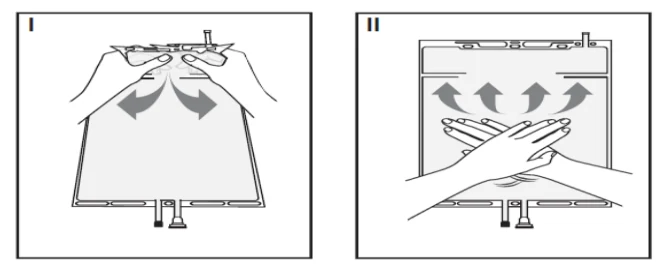
I Remove the overwrap from the bag immediately before use and discard any other packaging materials. Open the seal by holding the small compartment with both hands and squeeze it until an opening is created in the peel seal between the two compartments. (See figure I below)
II Push with both hands on the large compartment until the peel seal between the two compartments is entirely open. (See figure II below)
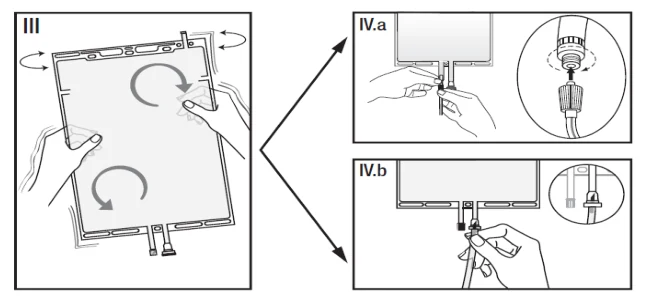
III Secure complete mixing of the solution by shaking the bag gently. The solution is now ready for use, and can be hung on the equipment. (See figure III below)
IV The dialysis or replacement line may be connected to the luer access or the injection port.
IVa If the luer access is used, using aseptic technique, remove the cap with a twist and pull motion and connect the male luer lock on the dialysis or replacement line to the female luer receptor on the bag using a push and twist motion. Ensure that the connection is fully seated and tighten. The connector is now open. Verify that the the fluid is flowing freely. (See figure IV.a below). When the dialysis or replacement line is disconnected from the luer connector, the connector will close and the flow of the solution will stop. The luer port is a needle-less and swabbable port.
IVb If the injection port is used, first remove the snap-off cap. The injection port is a swabbable port. Then introduce the spike through the rubber septum. Verify that the fluid is flowing freely. (See figure IV.b below)
SIDE EFFECTS AND WHAT TO DO ABOUT THEM
Side effects may include:
- nausea, vomiting
- muscle cramps
- hypotension
- acid–base balance disorders
- fluid imbalance
If any of these affects you severely, tell your doctor, nurse or pharmacist.
| SERIOUS SIDE EFFECTS, HOW OFTEN THEY HAPPEN AND WHAT TO DO ABOUT THEM | ||||
|---|---|---|---|---|
| Symptom / effect | Talk with your doctor, nurse or pharmacist | Seek immediate medical help | ||
| Only if severe | In all cases | |||
Low Blood Pressure: dizziness, fainting, lightheadedness May occur when you go from lying or sitting to standing up. | √ | |||
| Electrolyte Imbalance: weakness, drowsiness, muscle pain or cramps, irregular heartbeat √ | √ | |||
| Abnormally high volume of water in your body: swelling in the hands, ankles, feet or stomach, shortness of breath especially when lying down, fast heartbeat | √ | ||
|---|---|---|---|
| Abnormally low volume of water in your body: dry mouth, cold, clammy and pale skin, rapid breathing and heartbeat, weakness, decreased or absent urine output, sweating, confusion, unconsciousness | √ | ||
| Low levels of phosphate in your blood: muscle cramps, numbness and tingling around the mouth, shortness of breath, nausea, vomiting, trouble sleeping | √ | ||
| Metabolic alkalosis: rapid breathing and heartbeat, headache, confusion, weakness, nausea, vomiting | √ |
This is not a complete list of side effects. For any unexpected effects while taking Prism0CAL, contact your doctor, nurse, or pharmacist.
HOW TO STORE IT
Keep out of the reach and sight of children
Store between 4ºC and 30ºC. Do not refrigerate. Protect from freezing
Chemical and physical in-use stability of the reconstituted solution has been demonstrated for 24 hours at 22o C.
The solution may be heated to no more than 37°C to enhance patient comfort. Warming of Prism0CAL prior to use should be done before reconstitution with dry heat only (e.g., heating pad, warming plate). Solutions should not be heated in water or in a microwave oven due to the potential for patient injury or discomfort. After heating, verify that the solution is clear and without particles.
Use immediately after mixing, or before the in-use storage directions above have expired, then discards the remaining solution.
Do not use after the expired date printed on the label and the packaging.
REPORTING SIDE EFFECTS
You can report any suspected side effects associated with the use of health products to Health Canada by:
NOTE: Contact your health professional if you need information about how to manage your side effects. The Canada Vigilance Program does not provide medical advice. |
MORE INFORMATION
This document, plus the full prescribing information, prepared for health professionals can be found by contacting the sponsor, Vantive ULC, at: 1-800-387-8399.