


Product Monograph - Pro-Enzalutamide
RECENT MAJOR LABEL CHANGES
N/A
TABLE OF CONTENTS
Certain sections (as indicated in section 2.1. of the PM Guidance) or subsections that are not applicable at the time of the preparation of the most recent authorized product monograph are not listed.
RECENT MAJOR LABEL CHANGES ............................................................................................. 2
TABLE OF CONTENTS ................................................................................................................ 2
PART 1: HEALTH PROFESSIONAL INFORMATION ....................................................................... 5
1 INDICATIONS .................................................................................................................... 5
1.1 Pediatrics .................................................................................................................... 5
1.2 Geriatrics .................................................................................................................... 5
2 CONTRAINDICATIONS ....................................................................................................... 5
3 SERIOUS WARNINGS AND PRECAUTIONS BOX .................................................................. 6
4 DOSAGE AND ADMINISTRATION ....................................................................................... 6
4.1 Dosing Considerations ................................................................................................ 6
4.2 Recommended Dose and Dosage Adjustment ............................................................ 6
4.4 Administration ............................................................................................................ 7
4.5 Missed Dose ................................................................................................................ 7
5 OVERDOSE ........................................................................................................................ 7
6 DOSAGE FORMS, STRENGTHS, COMPOSITION, AND PACKAGING ...................................... 8
7 WARNINGS AND PRECAUTIONS ........................................................................................ 8
General .................................................................................................................................. 8
Carcinogenesis and Genotoxicity ........................................................................................... 9
Cardiovascular ....................................................................................................................... 9
Driving and Operating Machinery ....................................................................................... 10
Ear/Nose/Throat ................................................................................................................. 10
Hepatic / Biliary / Pancreatic ............................................................................................... 10
Immune ............................................................................................................................... 10
Monitoring and Laboratory Tests ........................................................................................ 10
Musculoskeletal .................................................................................................................. 11
Neurologic ........................................................................................................................... 12
Renal ................................................................................................................................... 13
Reproductive Health ............................................................................................................ 13
7.1 Special Populations ................................................................................................... 13
7.1.1 Pregnancy ............................................................................................................ 13
7.1.2 Breastfeeding ............................................................................................14
7.1.3 Pediatrics ..................................................................................................14
7.1.4 Geriatrics ..................................................................................................14
8 ADVERSE REACTIONS ...................................................................................................... 14
8.1 Adverse Reaction Overview ....................................................................................... 14
8.2 Clinical Trial Adverse Reactions ................................................................................. 14
8.3 Less Common Clinical Trial Adverse Reactions ........................................................... 24
8.4 Abnormal Laboratory Findings: Hematologic, Clinical Chemistry, and Other Quantitative Data..................................................................................................... 24
8.5 Post-Market Adverse Reactions ................................................................................ 25
9 DRUG INTERACTIONS ..................................................................................................... 25
9.2 Drug Interactions Overview ....................................................................................... 25
9.4 Drug-Drug Interactions ............................................................................................. 25
9.5 Drug-Food Interactions ............................................................................................. 33
9.6 Drug-Herb Interactions ............................................................................................. 33
9.7 Drug-Laboratory Test Interactions ............................................................................. 33
10 CLINICAL PHARMACOLOGY ............................................................................................. 33
10.1 Mechanism of Action ................................................................................................ 33
10.2 Pharmacodynamics .................................................................................................. 34
10.3 Pharmacokinetics ..................................................................................................... 34
11 STORAGE, STABILITY, AND DISPOSAL ............................................................................... 38
12 SPECIAL HANDLING INSTRUCTIONS ................................................................................. 38
PART 2: SCIENTIFIC INFORMATION ......................................................................................... 39
13 PHARMACEUTICAL INFORMATION .................................................................................. 39
14 CLINICAL TRIALS ............................................................................................................. 39
14.1 Clinical Trials by Indication ....................................................................................... 39
14.2 Comparative Bioavailability Studies .................................................................72
15 MICROBIOLOGY .............................................................................................................. 73
16 NON-CLINICAL TOXICOLOGY ........................................................................................... 73
17 SUPPORTING PRODUCT MONOGRAPHS ......................................................................... 80
PATIENT MEDICATION INFORMATION .................................................................................... 81
PART 1: HEALTH PROFESSIONAL INFORMATION
1 INDICATIONS
PRO-ENZALUTAMIDE (enzalutamide capsules) is indicated for the treatment of patients with non-metastatic castration-sensitive prostate cancer (nmCSPC) with biochemical recurrence at high risk of metastasis (high-risk BCR) (see 14 CLINICAL TRIALS).
PRO-ENZALUTAMIDE is indicated for the treatment of patients with metastatic castration- sensitive prostate cancer (mCSPC).
PRO-ENZALUTAMIDE is indicated for the treatment of patients with non-metastatic castration-resistant prostate cancer (nmCRPC).
PRO-ENZALUTAMIDE has not been studied in patients with nmCRPC at low risk of developing metastatic disease (see 14 CLINICAL TRIALS). The benefit and risk profile in these patients is unknown.
PRO-ENZALUTAMIDE is indicated in the setting of medical or surgical castration for the treatment of metastatic castration-resistant prostate cancer (CRPC) in patients who:
- are chemotherapy-naïve with asymptomatic or mildly symptomatic disease after failure of androgen deprivation therapy.
- have received docetaxel therapy.
1.1 Pediatrics
The safety and efficacy of enzalutamide has not been established for patients less than 18 years of age.
1.2 Geriatrics
No overall differences in safety and effectiveness were observed between geriatric patients and younger patients in clinical studies (see 7 WARNINGS AND PRECAUTIONS, 7.1 Special Populations).
2 CONTRAINDICATIONS
PRO-ENZALUTAMIDE is contraindicated in:
- patients who are hypersensitive to enzalutamide or to any ingredient in the formulation, including any non-medicinal ingredient, or component of the container. For a complete listing, see the 6 DOSAGE FORMS, STRENGTHS, COMPOSITION AND PACKAGING section of the product monograph.
- women who are or may become pregnant, or who are lactating.
3 SERIOUS WARNINGS AND PRECAUTIONS BOX
PRO-ENZALUTAMIDE should only be prescribed by a qualified healthcare professional who is experienced with the treatment of prostate cancer and the use of antineoplastic endocrine therapies.
The following are clinically significant adverse events:
4 DOSAGE AND ADMINISTRATION
4.1 Dosing Considerations
PRO-ENZALUTAMIDE is for use in patients with nm-CRPC, metastatic CRPC or m-CSPC who are maintaining treatment with a GnRH analogue or who have had previously undergone surgical castration. Patients started on enzalutamide capsules who are receiving a GnRH analogue should continue to receive a GnRH analogue.
Patients with nm-CSPC with high-risk BCR may be treated with PRO-ENZALUTAMIDE with or without a GnRH analogue.
4.2 Recommended Dose and Dosage Adjustment
The recommended dose of PRO-ENZALUTAMIDE is 160 mg (four 40 mg capsules) as a single oral daily dose. PRO-ENZALUTAMIDE can be taken with or without food.
Co-administration of PRO-ENZALUTAMIDE with CYP2C8 inhibitors may increase the plasma exposure of enzalutamide and should be avoided if possible. In patients who must be co-administered a strong CYP2C8 inhibitor, reduce the PRO-ENZALUTAMIDE dose to 80 mg once daily.
If a patient experiences ≥ Grade 3 toxicity or an intolerable side effect, withhold dosing for one week or until symptoms improve to ≤ Grade 2, then resume at the same or a reduced dose (120 mg or 80 mg), if warranted.
Intermittent treatment for nm-CSPC with high-risk BCR: Treatment with PRO-ENZALUTAMIDE and a GnRH analogue (if applicable) should be suspended if PSA is undetectable (< 0.2 ng / mL) after 36 weeks of therapy. Re-initiate treatment with PRO-ENZALUTAMIDE and a GnRH analogue (if applicable) when PSA has increased to ≥ 2.0 ng / mL for patients who had prior radical prostatectomy or ≥ 5.0 ng / mL for patients who had prior primary radiation therapy.
Enzalutamide capsules have been studied in nm-CPSC patients with high-risk BCR in combination with leuprolide (See 14 CLINICAL TRIALS). Caution is advised when using other GnRH analogues to treat patients with high-risk BCR due to potential differences in patterns of testosterone recovery, PSA expression, duration of treatment suspension and compliance to treatment. There is a potential risk that rapid testosterone recovery after treatment suspension results in shorter treatment suspension duration.
Elderly patients: No dose adjustment is necessary for elderly patients (see 10 CLINICAL PHARMACOLOGY, Special Populations and Conditions).
Patients with hepatic impairment: No dose adjustment is necessary for patients with mild, moderate or severe hepatic impairment (Child-Pugh Class A, B or C. An increased drug half-life, however, has been observed in patients with severe hepatic impairment; see 10 CLINICAL PHARMACOLOGY, Special Populations and Conditions).
Patients with renal impairment: No dose adjustment is necessary for patients with mild or moderate renal impairment (calculated creatinine clearance (CrCL) values ≥ 30 mL / min; see 10 CLINICAL PHARMACOLOGY, Special Populations and Conditions).
The effect of severe renal impairment on enzalutamide pharmacokinetics has not been studied. Caution is advised in patients with severe renal impairment or end-stage renal disease (see 10 CLINICAL PHARMACOLOGY, Special Populations and Conditions).
Health Canada has not authorized an indication for pediatric use.
4.4 Administration
PRO-ENZALUTAMIDE capsules should be swallowed whole with a sufficient amount of water and can be taken with or without food.
Do not chew, dissolve or open the capsules.
4.5 Missed Dose
If a patient misses taking PRO-ENZALUTAMIDE at the usual time, the prescribed dose should be taken as close as possible to the usual time. If a patient misses a dose for a whole day, treatment should be resumed the following day with the usual daily dose.
5 OVERDOSE
There is no antidote for PRO-ENZALUTAMIDE. In the event of an overdose, stop treatment with PRO-ENZALUTAMIDE and initiate general supportive measures taking into consideration the half-life of 5.8 days. It is unlikely that enzalutamide will be significantly removed by intermittent hemodialysis or continuous ambulatory peritoneal dialysis, owing to its large volume of distribution and low unbound free fraction. Patients may be at increased risk of seizures following an overdose.
For the most recent information in the management of a suspected drug overdose, contact your regional poison control centre or Health Canada’s toll-free number, 1-844 POISON-X (1-844-764-7669).
6 DOSAGE FORMS, STRENGTHS, COMPOSITION, AND PACKAGING
Table 1 – Dosage Forms, Strengths, and Composition
| Route of Administration | Dosage Form/ Strength/Composition | Non-Medicinal Ingredients |
| Oral | Capsule / 40mg | Butylated hydroxyanisole, butylated hydroxytoluene and caprylocaproyl polyoxylglycerides. |
Description
PRO-ENZALUTAMIDE is supplied as an oblong opaque white to off-white coloured capsule filled with liquid, printed with "APO40" in black ink across one side.
The ingredients of the capsule shell are gelatin, glycerin, purified water, sorbitol sorbitan solution, and titanium dioxide.
The ingredients of the ink are ammonium hydroxide, ethanol and ethyl acetate, ferrosoferric oxide, hypromellose, polyvinyl acetate phthalate and propylene glycol.
PRO-ENZALUTAMIDE capsules are available in the following package sizes:
- Bottles of 120 capsules
Do not use beyond expiration date indicated on the package.
7 WARNINGS AND PRECAUTIONS
See 3 Serious Warnings and Precautions Box.
General
PRO-ENZALUTAMIDE contains sorbitol (see 6 DOSAGE FORMS, STRENGTHS, COMPOSITION, AND PACKAGING). Patients with rare hereditary problems of fructose intolerance should not take PRO-ENZALUTAMIDE.
Enzalutamide is a strong inducer of CYP3A4 and a moderate inducer of CYP2C9 and CYP2C19. Medicinal products with a narrow therapeutic range that are substrates of CYP3A4, CYP2C9, and CYP2C19 should be avoided, as co-administration of PRO-ENZALUTAMIDE may decrease their exposure. If co-administration cannot be avoided, dose adjustment may be required to maintain therapeutic plasma concentrations (see 9 DRUG INTERACTIONS).
Enzalutamide is metabolized by CYP2C8. Co-administration of enzalutamide capsules with strong CYP2C8 inhibitors should be avoided. If patients must be co-administered a strong CYP2C8 inhibitor, the dose of PRO-ENZALUTAMIDE should be reduced to 80 mg once daily (see 9 DRUG INTERACTIONS).
Carcinogenesis and Genotoxicity
Daily oral dosing of rats for two years with enzalutamide at 10, 30, and 100 mg / kg / day increased the incidence of neoplastic findings that were considered related to the primary pharmacology of enzalutamide. Enzalutamide did not show carcinogenic potential (absence of neoplastic findings) in a 6-month study in transgenic rasH2 mice and was devoid of genotoxic potential in the standard panel of in vitro and in vivo genotoxicity tests. An inactive metabolite (M1) showed genotoxic potential in an in vitro mammalian genotoxicity assay, but only at concentrations that caused extensive cytotoxicity (see 16 NON-CLINICAL TOXICOLOGY, Carcinogenesis and Genotoxicity).
Cardiovascular
Ischemic Heart Disease: In randomized placebo-controlled phase 3 studies, higher incidences of ischemic heart disease were reported in patients treated with enzalutamide capsules (see 8 ADVERSE REACTIONS, Cardiovascular). Ischemic events led to death in 0.4% of patients on the enzalutamide capsules plus ADT arm compared to 0.1% on the placebo plus ADT arm.
Monitor for signs and symptoms of ischemic heart disease. Optimize management of cardiovascular risk factors, such as hypertension, diabetes, or dyslipidemia. Discontinue PRO-ENZALUTAMIDE for Grade 3 to 4 ischemic heart disease.
Patients with clinically significant cardiovascular disease, including recent myocardial infarction (in the past 6 months) or unstable angina (in the past 3 months), New York Heart Association Class (NYHA) III or IV heart failure, except if Left Ventricular Ejection Fraction (LVEF) ≥ 45%, bradycardia or uncontrolled hypertension (resting systolic blood pressure > 170 mm Hg and / or diastolic blood pressure > 105 mm Hg) were excluded from the Phase 3 clinical trials (see 14 CLINICAL TRIALS). Therefore, the safety of enzalutamide capsules in these patients has not been established.
QTc Prolongation: In the AFFIRM trial, enzalutamide capsules was associated with QTc prolongation of 3.0 to 6.5 msec (placebo-adjusted mean change from baseline) during weeks 5 to 25 of treatment when administered to metastatic CRPC patients with pre-dose ECG recordings (see 10 CLINICAL PHARMACOLOGY, Cardiac Electrophysiology). In the PREVAIL trial, the largest placebo adjusted mean increase from baseline was 3.4 msec observed at week 37. Consider these observations in clinical decisions to prescribe to patients with a known history of QT prolongation, risk factors for Torsades de pointes (e.g. hypokalemia) or patients who are taking medications known to prolong the QT interval (see 9 DRUG-DRUG INTERACTIONS, Drugs that Cause QT / QTc Prolongation).
Hypertension: Enzalutamide capsules was associated with increases in systolic and diastolic blood pressure and an increased risk of hypertension or worsening of pre-existing hypertension when administered to patients in the Phase 3 clinical trials (see 10 CLINICAL PHARMACOLOGY, Blood Pressure). In the Phase 3 trials, the overall incidence of any hypertension-related events was higher in the enzalutamide capsules plus ADT group compared to the placebo plus ADT group (14.2% vs. 7.4%). Hypertension rarely led to discontinuation or dose modification and, in general, was not associated with major cardiovascular adverse sequelae. However, approximately 75% of patients with this adverse event required initiation of new antihypertensive treatment or increase in dose of prior therapy.
Blood pressure should be measured at baseline and periodically during treatment. Treatment-emergent hypertension should be treated appropriately.
Driving and Operating Machinery
No studies on the effects on the ability to drive and use machines have been performed.
Ear/Nose/Throat
Dysphagia Related to Product Size: There have been reports of patients experiencing difficulty swallowing enzalutamide capsules, including reports of choking, due to product size. The swallowing difficulties were mostly reported with the capsule formulation. Advise patients to swallow the capsules whole with a sufficient amount of water.
Hepatic / Biliary / Pancreatic
Mild, moderate or severe hepatic impairment (Child-Pugh Class A, B or C) had no significant effects on the pharmacokinetics of enzalutamide (see 10 CLINICAL PHARMACOLOGY, Special Populations and Conditions). Patients with baseline severe hepatic impairment (Child-Pugh C) were excluded from both the AFFIRM and PREVAIL trials.
Immune
Hypersensitivity reactions manifested by symptoms including, but not limited to face, tongue, lip and pharyngeal oedema have been observed with enzalutamide (see 8 ADVERSE REACTIONS, Post-Market Adverse Reactions). Advise patients who experience any symptoms of hypersensitivity to temporarily discontinue PRO-ENZALUTAMIDE and promptly seek medical care. Permanently discontinue PRO-ENZALUTAMIDE for serious hypersensitivity reactions.
Monitoring and Laboratory Tests
Monitoring for laboratory or clinical parameters should be conducted as per routine practice. Blood pressure should be measured at baseline and periodically during treatment.
Monitoring of ECG and serum electrolyte levels at baseline and during treatment should be considered for patients at risk for electrolyte abnormality and QTc prolongation.
Enzalutamide is a moderate inducer of CYP2C9. If PRO-ENZALUTAMIDE is co-administered with an anticoagulant metabolised by CYP2C9 (e.g. warfarin or acenocoumarol), additional International Normalised Ratio (INR) monitoring should be conducted.
Patients with cardiac history should be assessed for active cardiac disease before starting therapy with PRO-ENZALUTAMIDE.
Patients with nm-CSPC with high-risk BCR or nm-CRPC should be monitored for disease progression radiographically at the discretion of their treating physician in addition to serum Prostate Specific Antigen (PSA). In the EMBARK trial, 33 out of 37 (89.2%) nm-CSPC patients with high-risk BCR treated with enzalutamide capsules in combination with leuprolide and 40 out of 54 (74.1%) of patients treated with enzalutamide capsules monotherapy reported radiographic progression without PSA progression. PSA progression was defined as the date that a ≥25% increase and an absolute increase of ≥2 mcg / L (2 ng / mL) above the nadir (or baseline for participants with no PSA decline by Week 25) and that was confirmed by a second consecutive value at least 3 weeks later. In the PROSPER trial, 104 out of 219 nm-CRPC patients treated with enzalutamide capsules in the PROSPER trial reported radiographic progression without PSA progression.
Musculoskeletal
Bone Fractures: PRO-ENZALUTAMIDE is indicated for use in patients who are maintaining castration status through GnRH analogue therapy or surgical castration. In the Phase 3 clinical trials, a higher incidence of non- pathological bone fractures was reported in the enzalutamide capsules plus ADT group compared to the placebo plus ADT group (see 8 ADVERSE REACTIONS); no assessments of bone mineral density were conducted in these trials (see 14 CLINICAL TRIALS).
Falls and Fall-related Injuries: In Phase 3 clinical trials, adverse events of falls were reported in 12.0% enzalutamide capsules plus ADT-treated patients and 5.5% placebo plus ADT-treated patients. A fall of Grade 3 or greater was reported in 1.2% of patients in the enzalutamide capsules plus ADT-treated group and in 0.6% of patients in the placebo plus ADT group. Non-pathological fractures associated with falls were reported in 5.4% of patients treated with enzalutamide capsules plus ADT and in 2.0% of patients in the placebo plus ADT arms. Additionally, in AFFIRM and PREVAIL, fall-related injuries were reported at a greater frequency in the enzalutamide capsules plus ADT arm than the placebo plus ADT arm (2.4% vs. 1.0%) and included contusion, excoriation, head injury, joint injury, laceration, periorbital haematoma, and skeletal injury. Concomitant neurological symptoms, such as dizziness or syncope, were rarely reported as an adverse event with the falls.
Neurologic
Enzalutamide capsules are associated with neuropsychiatric adverse events including seizure, memory impairment, and hallucination.
Seizures: In the Phase 3 clinical studies (AFFIRM, PREVAIL, PROSPER, ARCHES and EMBARK) (see 14 CLINICAL TRIALS), seizure occurred in 0.9% (7 / 800), 0.1% (1 / 871) and 0.3% (3 / 930), 0.3% (2 / 572), 1.1% (4 / 353) respectively in patients treated with a daily dose of enzalutamide capsules 160 mg plus ADT. Three patients treated with placebo plus ADT in the Phase 3 clinical studies experienced a seizure 0.1% (3 / 2636).
In a single-arm Phase 4 trial to assess incidence of seizure in patients with predisposing factors for seizure, 8 of 366 (2.2%) patients treated with enzalutamide capsules (160 mg per day) experienced a seizure. The median duration of treatment was 9.3 months. Use of enzalutamide has been associated with seizure. PRO-ENZALUTAMIDE should be used with caution in patients with history of seizures or other predisposing risk factors for seizures. Permanently discontinue PRO-ENZALUTAMIDE in patients who develop a seizure during treatment.
Patients with a history of seizure or conditions that may pre-dispose them to seizure, including brain injury with loss of consciousness, transient ischemic attack within the past 12 months, cerebral vascular accident, brain metastases, and brain arteriovenous malformation, were generally excluded from the Phase 3 clinical trials. The AFFIRM trial excluded the use of concomitant medications that may lower the seizure threshold, whereas the EMBARK, PREVAIL and PROSPER trials permitted the use of these medications.
Data from in vitro studies show that enzalutamide and its active metabolite (M2) cross the blood brain barrier, bind to, and inhibit the activity of the GABA-gated chloride channel (see 16 NON-CLINICAL TOXICOLOGY, Animal Pharmacology).
The dose of PRO-ENZALUTAMIDE may be a predictor of seizure in humans, with a greater risk of seizure at daily doses higher than 160 mg. In a dose escalation study involving 140 patients, no seizures were reported at or below daily doses of 240 mg, whereas three seizures were reported, one each at 360, 480, and 600 mg per day.
Mental Impairment Disorders: In the Phase 3 clinical trials, the combined adverse events of amnesia, cognitive disorder, disturbance in attention, memory impairment, and the related term dementia were reported more frequently in patients treated with enzalutamide capsules plus ADT than in patients treated with placebo plus ADT (6.4% vs. 2.5%).
Patients should be advised of the risk of engaging in any activity where mental impairment or sudden loss of consciousness could cause serious harm to themselves or others.
Posterior Reversible Encephalopathy Syndrome: There have been reports of posterior reversible encephalopathy syndrome (PRES) in patients receiving enzalutamide capsules. PRES is a rare, reversible neurological disorder which can present with rapidly evolving symptoms including seizure, headache, consciousness impairment (including confusion, somnolence, lethargy, encephalopathy or coma), blindness, and other visual and neurological disturbances, with or without associated hypertension. A diagnosis of PRES requires confirmation by brain imaging, preferably magnetic resonance imaging (MRI). Discontinuation of PRO-ENZALUTAMIDE in patients who develop PRES is recommended.
Renal
Mild or moderate renal impairment (calculated creatinine clearance (CrCL) values ≥ 30 mL / min) had no significant effects on the pharmacokinetics of enzalutamide (based on population pharmacokinetic analysis). The effect of severe renal impairment on enzalutamide pharmacokinetics has not been studied. Caution is advised in patients with severe renal impairment or end-stage renal disease (see 10 CLINICAL PHARMACOLOGY, Special Populations and Conditions).
Reproductive Health
- Function
It is not known whether enzalutamide or its metabolites are present in semen. A condom should be used if the patient engages in sexual activity with a pregnant woman. If the patient is engaged in sex with a woman of child-bearing potential, a condom is recommended along with another effective contraceptive method. These measures are recommended during and for three months after treatment with PRO-ENZALUTAMIDE (see 2 CONTRAINDICATIONS; 7.1.1 Pregnancy).
Animal studies showed that enzalutamide affected the reproductive organs in rats and dogs (see 16 NON- CLINICAL TOXICOLOGY). Considering the pharmacological consequences of androgen receptor inhibition, an effect on male fertility cannot be excluded in humans.
7.1 Special Populations
7.1.1 Pregnancy
Animal studies demonstrated that enzalutamide can cause fetal harm when administered during pregnancy (see 16 NON- CLINICAL TOXICOLOGY). Pregnant women who have taken PRO-ENZALUTAMIDE should be informed about the potential hazards to embryo-fetal developmental and the risk of pregnancy loss. There are no human data on the use of enzalutamide in pregnancy. Considering the pharmacological consequences of androgen receptor inhibition, maternal use of enzalutamide is expected to produce changes in hormone levels that could affect development of the fetus.
PRO-ENZALUTAMIDE is not indicated for use in women. PRO-ENZALUTAMIDE is contraindicated in women who are or may become pregnant (see 2 CONTRAINDICATIONS; 16 NON- CLINICAL TOXICOLOGY). If this drug is used during pregnancy, or if the patient becomes pregnant while taking this drug, the patient should be apprised of the potential hazard to the fetus.
7.1.2 Breastfeeding
PRO-ENZALUTAMIDE is not indicated for use in women and is contraindicated in women who are lactating (see 2 CONTRAINDICATIONS). It is unknown whether enzalutamide or its metabolites are present in human milk. Enzalutamide and / or its metabolites are secreted in rat milk (see 16 NON-CLINICAL TOXICOLOGY, Nonclinical Pharmacokinetics).
7.1.3 Pediatrics
The safety and efficacy of enzalutamide capsules has not been established for patients less than 18 years of age.
7.1.4 Geriatrics
Of the 3526 patients in Phase 3 trials who received enzalutamide capsules, 78.5% of patients were 65 years and over and 34% were 75 years and over. No overall differences in safety and effectiveness were observed between geriatric patients and younger patients in clinical studies. However, an increased frequency of dose interruption, dose reduction and treatment discontinuation was observed with higher age (≥ 65 years) and greater sensitivity of some older individuals cannot be ruled out.
8 ADVERSE REACTIONS
8.1 Adverse Reaction Overview
Adverse reactions in this section were defined as treatment-emergent adverse events if the incidences in the enzalutamide capsules group were greater than those in the placebo group.
In the Phase 3 clinical trials, the most common adverse reactions (≥ 10%) seen with enzalutamide capsules were arthralgia, back pain, constipation, decreased appetite, dizziness / vertigo, diarrhea, fatigue / asthenia, hot flush, hypertension, fall, and headache. The rate of serious adverse events was 34.4% for enzalutamide capsules and 27.5% for placebo. Patients treated with enzalutamide capsules also had a higher incidence of Grade 3 or higher serious adverse events (of any causality) than patients treated with placebo (30.0% vs 23.7%). Adverse events as the primary reason that led to treatment discontinuation were reported for 15.9% of enzalutamide capsules-treated patients and 15.1% of placebo-treated patients.
8.2 Clinical Trial Adverse Reactions
Clinical trials are conducted under very specific conditions. Therefore, the frequencies of adverse reactions observed in the clinical trials may not reflect frequencies observed in clinical practice and should not be compared to frequencies reported in clinical trials of another drug.
EMBARK: enzalutamide capsules with or without leuprolide versus Placebo plus leuprolide in Non-metastatic CSPC Patients with High-Risk BCR
The EMBARK study enrolled 1068 patients with nm-CPSC with high-risk BCR who were randomized 1:1:1 to receive treatment with enzalutamide capsules at a dose of 160 mg once daily concurrently with leuprolide (N = 355), enzalutamide capsules at a dose of 160 mg once daily as open-label monotherapy (N = 355), or placebo once daily concurrently with leuprolide (N = 358). At week 37, treatment was suspended for patients whose PSA values were undetectable (<0.2 ng / mL) at week 36. Treatment was reinitiated when PSA values increased to ≥ 2.0 ng / mL for patients who had prior radical prostatectomy or ≥ 5.0 ng / mL for patients who had prior primary radiation therapy. For patients whose PSA values were detectable (≥ 0.2 ng / mL) at week 36, treatment continued without suspension until permanent treatment discontinuation criteria were met. Refer to Table 2 for the extent of drug exposure in the EMBARK study.
Table 2 - Drug Treatment and Suspension in EMBARK
Enzalutamide capsules + leuprolide (N= 353) | Placebo + leuprolide (N= 354) | Enzalutamide capsules Monotherapy (N= 354) | |||||||
|---|---|---|---|---|---|---|---|---|---|
| Total Duration of treatmenta | |||||||||
| Median (months) | 60.6 | 55.6 | 60.4 | ||||||
| Range (months) | 0.1 – 90.4 | 0.7 – 94.1 | 0.4 – 95.0 | ||||||
| Duration receiving Drug treatment | |||||||||
| Median (months) | 32.4 | 35.4 | 45.9 | ||||||
| Range (months) | 0.1 – 83.4 | 0.7 – 85.7 | 0.4 – 88.9 | ||||||
| Duration of suspension from Drug Treatment | |||||||||
| Median (months) | 18.0 | 16.6 | 9.4 | ||||||
| Range (months) | 1.4 – 87.9 | 3.4 – 83.0 | 2.0 – 77.7 | ||||||
| Patients who had Drug Treatment Suspended at Week 37 | |||||||||
| Number (%) | 321 (90.9) | 240 (67.8) | 304 (85.9) | ||||||
| Patients who had Drug Treatment suspended and re-initiated | |||||||||
| Number (%) | 241 (68.3) | 203 (57.3) | 270 (76.3) | ||||||
a. Inclusive of the treatment suspension period due to undetectable PSA levels at week 37 (if applicable)
Overall, deaths from adverse events during the total duration of treatment occurred in 6 patients (1.7%) receiving enzalutamide capsules plus leuprolide, 8 patients (2.3%) receiving enzalutamide capsules as monotherapy, and 3 patients (0.8%) receiving placebo plus leuprolide. The reason for death in ≥2 patients receiving enzalutamide capsules plus leuprolide was infection (n=2), and the reason for death in ≥2 patients receiving enzalutamide capsules monotherapy was arterial thromboembolism (n=2).
During the duration receiving drug treatment, Grade 3 or higher adverse reactions were reported among 38.2% % of enzalutamide capsules plus leuprolide treated patients, 43.8% of enzalutamide capsules monotherapy treated patients and 37.3% of placebo plus leuprolide treated patients.
During the duration receiving drug treatment, serious adverse events were reported among 26.6 % of enzalutamide capsules plus leuprolide treated patients, 31.6% of patients receiving enzalutamide capsules as monotherapy and 28.0% of placebo plus leuprolide treated patients. Of these, the most common serious adverse reactions were ischemic heart disease (3.1% of patients treated with enzalutamide capsules plus leuprolide, 5.4% of patients treated with enzalutamide capsules monotherapy and 2.8% of patients treated with placebo plus leuprolide).
Discontinuations with an adverse event as the primary reason were reported for 20.7% of enzalutamide capsules plus leuprolide treated patients, 17.8% of patients receiving enzalutamide capsules as monotherapy and 10.2% of placebo plus leuprolide treated patients. The most common adverse reactions (≥ 1%) leading to treatment discontinuation in the enzalutamide capsules plus leuprolide arm were fatigue (3.4%), hot flush (2%), cognitive disorders (2.3%) and nausea (1.1%). The most common adverse reactions (≥ 1%) leading to treatment discontinuation in the enzalutamide capsules monotherapy arm were fatigue (4.2%) and cognitive disorders (2.0%). Dose reductions due to an adverse event were reported for 7.1% of enzalutamide capsules plus leuprolide treated patients, 15.8% of patients who received enzalutamide capsules as monotherapy and 4.5% of placebo plus leuprolide treated patients. The most common adverse reactions (≥ 1%) leading to dose reduction in the enzalutamide capsules plus leuprolide arm were fatigue (3.1%), cognitive disorder (1.4%) and hypertension (1.4%). The most common adverse reactions (≥ 1%) leading to dose reduction in the enzalutamide capsules monotherapy arm were fatigue (9.6%), cognitive disorder (1.7%) dizziness (1.4%) and gynecomastia (1.4%). The median time to deterioration in ECOG status by 1 point (92% of patients had baseline ECOG 0) was 66 months in the enzalutamide capsules plus leuprolide arm, 63 months in the enzalutamide capsules monotherapy arm and 75 months in the placebo plus leuprolide arm (enzalutamide capsules plus leuprolide arm vs. placebo plus leuprolide: HR=1.14 [95% CI: 0.90-1.43], enzalutamide capsules monotherapy arm vs. placebo plus leuprolide: HR=1.19 [0.95; 1.50]).
Table 3 shows adverse reactions reported in EMBARK that occurred at ≥ 5% (All Grade) or ≥ 2% (Grade ≥ 3), and a ≥ 2% higher frequency in the either of the enzalutamide capsules arms compared to the placebo plus leuprolide arm during the duration receiving drug treatment.
Table 3 – Adverse Reactionsa,b in EMBARK
| System Organ Class / MedDRA Preferred Term, MedDRA v25.1 | Enzalutamide capsules + leuprolide (N = 353) | Placebo + leuprolide (N = 354) | Enzalutamide capsules monotherapy (N = 354) | ||||||||||||||
|---|---|---|---|---|---|---|---|---|---|---|---|---|---|---|---|---|---|
| System Organ Class / MedDRA Preferred Term, MedDRA v25.1 | Enzalutamide capsules + leuprolide (N = 353) | Placebo + leuprolide (N = 354) | Enzalutamide capsules monotherapy (N = 354) | ||||||||||||||
| System Organ Class / MedDRA Preferred Term, MedDRA v25.1 | Enzalutamide capsules + leuprolide (N = 353) | Placebo + leuprolide (N = 354) | Enzalutamide capsules monotherapy (N = 354) | ||||||||||||||
| All Grades (%) | Grade 3-4 (%) | All Grades (%) | Grade 3-4 (%) | All Grades (%) | Grade 3-4 (%) | ||||||||||||
| All Grades (%) | Grade 3-4 (%) | All Grades (%) | Grade 3-4 (%) | All Grades (%) | Grade 3-4 (%) | ||||||||||||
| All Grades (%) | Grade 3-4 (%) | All Grades (%) | Grade 3-4 (%) | All Grades (%) | Grade 3-4 (%) | ||||||||||||
| Blood and lymphatic system disorders | |||||||||||||||||
| Anaemia | 20 (5.7%) | 5 (1.4%) | 12 (3.4%) | 3 (0.8%) | 15 (4.2%) | 2 (0.6%) | |||||||||||
| Cardiac Disorders | |||||||||||||||||
| Ischemic heart diseasec | 14 (4.0%) | 12 (3.4%) | 18 (5.1%) | 10 (2.8%) | 28 (7.9%) | 17 (4.8%) | |||||||||||
| General Disorders and Administration Site Conditions | |||||||||||||||||
| Fatigued | 176 (49.9%) | 14 (4.0%) | 131 (37.0%) | 6 (1.7%) | 187 (52.8%) | 16 (4.5%) | |||||||||||
| Infections and infestations | |||||||||||||||||
| Nasopharyngitis | 20 (5.7%) | 0 (0%) | 16 (4.5%) | 0 (0%) | 25 (7.1%) | 0 (0%) | |||||||||||
| Urinary Tract Infection | 16 (4.5%) | 1 (0.3%) | 21 (5.9%) | 2 (0.6%) | 30 (8.5%) | 7 (2.0%) | |||||||||||
| Investigations | |||||||||||||||||
| Weight Decreased | 19 (5.4%) | 1 (0.3%) | 11 (3.1%) | 0 (0%) | 37 (10.5%) | 1 (0.3%) | |||||||||||
| Reproductive System and Breast Disorders | |||||||||||||||||
| Gynecomastia | 18 (5.1%) | 0 (0%) | 25 (7.1%) | 0 (0%) | 154 (43.5%) | 3 (0.8%) | |||||||||||
| Breast Paine | 8 (2.3%) | 0 (0%) | 3 (0.8%) | 0 (0%) | 76 (21.5%) | 0 (0%) | |||||||||||
| Breast Tenderness | 5 (1.4%) | 0 (0%) | 4 (1.1%) | 0 (0%) | 51 (14.4%) | 0 (0%) | |||||||||||
| Vascular Disorders | |||||||||||||||||
| Hot Flush | 242 (68.6%) | 2 (0.6%) | 201 (56.8%) | 3 (0.8%) | 76 (21.5%) | 1 (0.3%) | |||||||||||
| Hypertension | 73 (20.7%) | 22 (6.2%) | 56 (15.8%) | 15 (4.2%) | 55 (15.5%) | 15 (4.2%) | |||||||||||
| Hemmorhagesf | 58 (16.4%) | 11 (3.1%) | 42 (11.9%) | 5 (1.4%) | 68 (19.2%) | 11 (3.1%) | |||||||||||
| Injury, poisoning and procedural complications | |||||||||||||||||
| Fall | 58 (16.4%) | 3 (0.8%) | 46 (13.0%) | 4 (1.1%) | 49 (13.8%) | 4 (1.1%) | |||||||||||
| Non-pathological fracturesg | 49 (13.9%) | 10 (2.8%) | 34 (9.6%) | 7 (2.0%) | 32 (9.0%) | 6 (1.7%) | |||||||||||
| Gastrointestinal disorders | |||||||||||||||||
| Diarrhoea | 41 (11.6%) | 2 (0.6%) | 27 (7.6%) | 1 (0.3%) | 41 (11.6%) | 1 (0.3%) | |||||||||||
| Nausea | 41 (11.6%) | 1 (0.3%) | 27 (7.6%) | 1 (0.3%) | 51 (14.4%) | 2 (0.6%) | |||||||||||
| Constipation | 36 (10.2%) | 0 (0%) | 25 (7.1%) | 0 (0%) | 31 (8.8%) | 1 (0.3%) | |||||||||||
| Metabolism and nutrition disorders | |||||||||||||||||
| Decreased appetite | 26 (7.4%) | 2 (0.6%) | 14 (4.0%) | 0 (0%) | 30 (8.5%) | 1 (0.3%) | |||||||||||
| Skin and subcutaneous tissue disorders | |||||||||||||||||
| Dry skin | 21 (5.9%) | 0 (0%) | 10 (2.8%) | 0 (0%) | 16 (4.5%) | 0 (0%) | |||||||||||
| Nervous system disorders | |||||||||||||||||
| Cognitive disordersh | 51 (14.4%) | 1 (0.3%) | 22 (6.2%) | 2 (0.6%) | 47 (13.3%) | 0 (0%) | |||||||||||
| Dizziness | 35 (9.9%) | 2 (0.6%) | 30 (8.5%) | 2 (0.6%) | 38 (10.7%) | 3 (0.8%) | |||||||||||
| Musculoskeletal and connective tissue disorders | |||||||||||||||||
| Musculoskeletal Paini | 134 (38.0%) | 13 (3.7%) | 132 (37.3%) | 6 (1.7%) | 148 (41.8%) | 9 (2.5%) | |||||||||||
| Respiratory, thoracic and mediastinal disorders | |||||||||||||||||
| Epistaxis | 19 (5.4%) | 0 (0%) | 1 (0.3%) | 0 (0%) | 18 (5.1%) | 0 (0%) | |||||||||||
| Renal and urinary disorders | |||||||||||||||||
| Nocturia | 23 (6.5%) | 0 (0%) | 14 (4.0%) | 0 (0%) | 7 (2.0%) | 0 (0%) | |||||||||||
| Urinary Incontinence | 29 (8.2%) | 1 (0.3%) | 23 (6.5%) | 2 (0.6%) | 31 (8.8%) | 5 (1.4%) | |||||||||||
- a. CTCAE v 4.03.
- b. Adverse Events (AEs) were considered Adverse Reactions if the incidences of AEs in either of the enzalutamide capsules arms was greater than those in the placebo group during the duration receiving drug treatment, which excludes the treatment suspension period.
- c. Includes angina pectoris, coronary artery disease, acute coronary syndrome, coronary artery occlusion, myocardial infarction, acute myocardial infarction, angina unstable, coronary artery stenosis, myocardial ischaemia.
- d. Includes asthenia and fatigue.
- e. Includes breast and nipple pain.
- f. Includes multiple terms.
- g. Includes All Preferred Terms under MedDRA High Level Group Term of "Bone and Joint Injuries" and "Fractures" but excluding pathological fractures.
- h. Includes memory impairment, amnesia, disturbance in attention, cognitive disorder, dementia, dementia Alzheimer's type, vascular dementia, mental impairment.
- i. Includes Arthralgia, Arthritis, Back pain, Bone pain, Musculoskeletal chest pain, Musculoskeletal discomfort, Musculoskeletal pain, Musculoskeletal stiffness, Myalgia, Neck pain, Non-cardiac chest pain, Pain in extremity, Spinal pain.
Less common adverse reactions (<5% incidence) that were more frequently reported with enzalutamide capsules were anxiety (4.8% of patients treated with enzalutamide capsules plus leuprolide, 4.8% of patients receiving enzalutamide capsules as monotherapy and 2.5% of patients receiving placebo plus leuprolide) and alopecia (4.8% of patients treated with enzalutamide capsules plus leuprolide, 3.7% of patients receiving enzalutamide capsules as monotherapy and 1.1% of patients receiving placebo plus leuprolide).
ARCHES Study: enzalutamide capsules versus Placebo in Metastatic Castration-Sensitive Prostate Cancer Patients
The ARCHES trial enrolled 1150 patients with metastatic castration-sensitive prostate cancer (mCSPC). Patients received either enzalutamide capsules at a dose of 160 mg once daily (N = 572) or placebo (N = 574). The median duration of treatment at the time of analysis was 12.8 months with enzalutamide capsules and 11.6 months with placebo.
Table 4 shows adverse reactions reported in ARCHES that occurred at a ≥ 2% higher frequency in the enzalutamide capsules arm than the placebo arm.
Table 4 – Adverse Reactionsa in ARCHES
| System Organ Class / MedDRA Preferred Term, MedDRA v21.0 | Enzalutamide capsules N = 572 | Placebo N = 574 | |||||||||||
|---|---|---|---|---|---|---|---|---|---|---|---|---|---|
| All Grades (%) | Grade 3-4 (%) | All Grades (%) | Grade 3-4 (%) | ||||||||||
| General disorders and administration site conditions | |||||||||||||
| Asthenic Conditionsb | 138 (24.1%) | 10 (1.7%) | 112 (19.5%) | 9 (1.6%) | |||||||||
| Vascular disorders | |||||||||||||
| Hot Flush | 155 (27.1%) | 2 (0.3%) | 128 (22.3%) | 0 | |||||||||
| Hypertension | 46 (8.0%) | 19 (3.3%) | 32 (5.6%) | 10 (1.7%) | |||||||||
| Musculoskeletal and connective tissue disorders | |||||||||||||
| Musculoskeletal Pain | 36 (6.3%) | 1 (0.2%) | 23 (4.0%) | 1 (0.2%) | |||||||||
| Injury, Poisoning and Procedural Complications | |||||||||||||
| Fracturesc | 37 (6.5%) | 6 (1.0%) | 24 (4.2%) | 6 (1.0%) | |||||||||
- a. Adverse Events (AEs) were considered Adverse Reactions if the incidences of AEs in the enzalutamide capsules group were greater than those in the placebo group, and if the treatment differences were maintained when the event rates were adjusted per 100 patient-years of exposure.
- b. Includes asthenia and fatigue.
- c. Fracture related preferred terms under high level terms: fractures NEC; fractures and dislocations NEC; limb fractures and dislocations; pelvic fractures and dislocations; skull and brain therapeutic procedures; skull fractures, facial bone fractures and dislocations; spinal fractures and dislocations; thoracic cage fractures and dislocations.
PROSPER Study: Non-Metastatic Prostate Cancer that Progressed on Androgen Deprivation Therapy
The PROSPER trial enrolled 1401 patients with non-metastatic CRPC. Patients were randomized 2:1 and received either enzalutamide capsules at a dose of 160 mg once daily (N = 930) or placebo (N = 465). The median duration of treatment at the time of analysis was 18.4 months with enzalutamide capsules and 11.1 months with placebo. All patients continued on a GnRH analogue or had prior bilateral orchiectomy. Patients were allowed, but not required, to continue or initiate corticosteroids (e.g. prednisone).
Grade 3 or higher adverse reactions were reported among 31.4% of enzalutamide capsules-treated patients and 23.4% of placebo-treated patients. Discontinuations with an adverse event as the primary reason were reported for 9.4% of enzalutamide capsules-treated patients and 6.0% of placebo-treated patients. Of these, the most common adverse reaction leading to treatment discontinuation was fatigue, which occurred in 1.6% of the enzalutamide capsules-treated patients compared to none for the placebo-treated patients.
Overall, 32 patients (3.4%) receiving enzalutamide capsules died from adverse events. The reasons for death with ≥ 2 patients included coronary artery disorders (n = 7), sudden death (n = 2), cardiac arrhythmias (n = 2), general physical health deterioration (n = 2), stroke (n = 2), and secondary malignancy (n = 5; one each of acute myeloid leukemia, brain neoplasm, mesothelioma, small cell lung cancer, and malignant neoplasm of unknown primary site). Three patients (0.6%) receiving placebo died from adverse events of cardiac arrest (n = 1), left ventricular failure (n = 1), and pancreatic carcinoma (n = 1).
Table 5 shows adverse reactions occurring at an incidence of ≥ 2% in patients randomized to enzalutamide capsules in the PROSPER study.
Table 5 – Adverse Reactionsa Occurring at an Incidence of ≥ 2% in Patients Randomized to Enzalutamide capsules in the PROSPER Study
System Organ Class / MedDRA Preferred Term, MedDRA v16.1 | Enzalutamide capsules N = 930 | Placebo N = 465 | |||||||||||
|---|---|---|---|---|---|---|---|---|---|---|---|---|---|
System Organ Class / MedDRA Preferred Term, MedDRA v16.1 | Enzalutamide capsules N = 930 | Placebo N = 465 | |||||||||||
| All Grades (%) | Grade 3-4 (%) | All Grades (%) | Grade 3-4 (%) | ||||||||||
| All Grades (%) | Grade 3-4 (%) | All Grades (%) | Grade 3-4 (%) | ||||||||||
| General disorders and administration site conditions | |||||||||||||
| Asthenic Conditionsb | 372 (40.0%) | 37 (4.0%) | 91 (19.6%) | 4 (0.9%) | |||||||||
| Vascular disorders | |||||||||||||
| Hot Flush | 121 (13.0%) | 1 (0.1%) | 36 (7.7%) | 0 (0.0%) | |||||||||
| Hypertension | 111 (11.9%) | 43 (4.6%) | 24 (5.2%) | 10 (2.2%) | |||||||||
| Nervous system disorders | |||||||||||||
| Dizzinessc | 108 (11.6%) | 5 (0.5%) | 24 (5.2%) | 0 (0.0%) | |||||||||
| Headache | 85 (9.1%) | 2 (0.2%) | 21 (4.5%) | 0 (0.0%) | |||||||||
| Mental Impairment Disordersd | 43 (4.6%) | 1 (0.1%) | 7 (1.5%) | 0 (0.0%) | |||||||||
| Investigations | |||||||||||||
| Weight decreased | 55 (5.9%) | 2 (0.2%) | 7 (1.5%) | 0 (0.0%) | |||||||||
| Injury, poisoning and procedural complications | |||||||||||||
| Fall | 106 (11.4%) | 12 (1.3%) | 19 (4.1%) | 3 (0.6%) | |||||||||
| Metabolism and nutrition disorders | |||||||||||||
| Decreased appetite | 89 (9.6%) | 2 (0.2%) | 18 (3.9%) | 1 (0.2%) | |||||||||
| Gastrointestinal disorders | |||||||||||||
| Constipation | 85 (9.1%) | 2 (0.2%) | 32 (6.9%) | 2 (0.4%) | |||||||||
- a. Adverse Events (AEs) were considered Adverse Reactions if the incidences of AEs in the enzalutamide capsules group were greater than those in the placebo group, and if the treatment differences were maintained when the event rates were adjusted per 100 patient-years of exposure.
- b. Includes asthenia and fatigue.
- c. Includes dizziness and vertigo.
- d. Includes amnesia, memory impairment, cognitive disorder, and disturbance in attention.
PREVAIL Study: Chemotherapy-naïve Metastatic Prostate Cancer that Progressed on Androgen Deprivation Therapy
In the PREVAIL trial of patients with metastatic prostate cancer that progressed on a GnRH analogue or after bilateral orchiectomy and had not received prior cytotoxic chemotherapy, enzalutamide capsules was administered at a dose of 160 mg daily (N = 871) versus placebo (N = 844). The median duration of treatment was 17.5 months with enzalutamide capsules and 4.6 months with placebo. All patients continued on a GnRH analogue or had prior bilateral orchiectomy. Patients were allowed, but not required, to continue or initiate corticosteroids (maximum daily dose allowed was 10 mg prednisone or equivalent).
Table 6 shows adverse reactions occurring at an incidence of ≥ 2% in patients randomized to enzalutamide capsules in the PREVAIL study.
Table 6 – Adverse Reactionsa Occurring at an Incidence of ≥ 2% in Patients Randomized to Enzalutamide capsules in the PREVAIL Study
| System Organ Class / MedDRA Preferred Term, MedDRA v16.0 | Enzalutamide capsules N = 871 | Placebo N = 844 | ||||||||||||
|---|---|---|---|---|---|---|---|---|---|---|---|---|---|---|
All Grades (%) | Grade 3-4 (%) | All Grades (%) | Grade 3-4 (%) | |||||||||||
| General disorders and administration site conditions | ||||||||||||||
| Asthenic Conditionsb | 409 (47.0%) | 30 (3.4%) | 280 (33.2%) | 24 (2.8%) | ||||||||||
| Influenza-like illness | 21 (2.4%) | 0 (0.0%) | 12 (1.4%) | 0 (0.0%) | ||||||||||
| Vascular disorders | ||||||||||||||
| Hot Flush | 157 (18.0%) | 1 (0.1%) | 66 (7.8%) | 0 | ||||||||||
| Hypertension | 124 (14.2%) | 63 (7.2%) | 35 (4.1%) | 19 (2.3%) | ||||||||||
| Nervous system disorders | ||||||||||||||
| Mental Impairment Disordersc | 52 (6.0%) | 0 | 13 (1.5%) | 2 (0.2%) | ||||||||||
| Restless Legs Syndrome | 18 (2.1%) | 1 (0.1%) | 3 (0.4%) | 0 | ||||||||||
| Somnolence | 19 (2.2%) | 0 (0.0%) | 6 (0.7%) | 0 (0.0%) | ||||||||||
| Injury, poisoning and procedural complications | ||||||||||||||
| Contusion | 26 (3.0%) | 0 (0.0%) | 10 (1.2%) | 0 (0.0%) | ||||||||||
| Fall | 111 (12.7%) | 14 (1.6%) | 45 (5.3%) | 6 (0.7%) | ||||||||||
| Non-Pathological Fracture | 68 (7.8%) | 18 (2.1%) | 25 (3.0%) | 9 (1.1%) | ||||||||||
| Reproductive system and breast disorder | ||||||||||||||
| Gynecomastia | 30 (3.4%) | 0 | 12 (1.4%) | 0 | ||||||||||
| Ear and labyrinth disorders | ||||||||||||||
| Vertigo | 24 (2.8%) | 1 (0.1%) | 7 (0.8%) | 0 (0.0%) | ||||||||||
| Infections and infestations | ||||||||||||||
| Herpes Zoster | 19 (2.2%) | 0 (0.0%) | 3 (0.4%) | 1 (0.1%) | ||||||||||
| Respiratory, thoracic and mediastinal disorders | ||||||||||||||
| Epistaxis | 24 (2.8%) | 0 (0.0%) | 11 (1.3%) | 1 (0.1%) | ||||||||||
- a. Adverse Events (AEs) were considered Adverse Reactions if the incidences of AEs in the group were enzalutamide capsules greater than those in the placebo group, and if the treatment differences were maintained when the event rates were adjusted per 100 patient-years of exposure.
- b. Includes asthenia and fatigue.
- c. Includes amnesia, memory impairment, cognitive disorder, and disturbance in attention.
AFFIRM Study: Metastatic Castration-Resistant Prostate Cancer Following Chemotherapy
In the AFFIRM trial of patients with metastatic castration-resistant prostate cancer who maintained treatment with a GnRH analogue or who had previously undergone surgical castration and had received docetaxel therapy, enzalutamide capsules was administered at a dose of 160 mg daily (N = 800) versus placebo (N = 399). The median duration of treatment with enzalutamide capsules was 8.3 months, while with placebo it was 3.0 months. Patients were allowed, but not required, to continue or initiate corticosteroids (e.g. prednisone).
Table 7 shows adverse reactions occurring at an incidence of ≥ 2% in patients randomized to enzalutamide capsules in the AFFIRM study.
Table 7 – Adverse Reactionsa Occurring at an Incidence of ≥ 2% in Patients Randomized to Enzalutamide capsules in the AFFIRM Study
| System Organ Class / MedDRA Preferred Term, MedDRA v11.0 | Enzalutamide capsules N = 800 | Placebo N = 399 | ||||||||
|---|---|---|---|---|---|---|---|---|---|---|
All Grades (%) | Grade 3b (%) | All Grades (%) | Grade 3b (%) | |||||||
| General disorders and administration site conditions | ||||||||||
| Fatigue | 269 (33.6%) | 50 (6.3%) | 116 (29.1%) | 29 (7.3%) | ||||||
| Injury, poisoning and procedural complications | ||||||||||
| Fall | 32 (4.0%) | 2 (0.3%) | 5 (1.3%) | 0 | ||||||
| Nervous system disorders | ||||||||||
| Headache | 93 (11.6%) | 6 (0.8%) | 22 (5.5%) | 0 | ||||||
| Psychiatric disorders | ||||||||||
| Anxiety | 51 (6.4%) | 2 (0.3%) | 16 (4.0%) | 0 | ||||||
| Skin and subcutaneous tissue disorders | ||||||||||
| Dry skin | 28 (3.5%) | 0 | 5 (1.3%) | 0 | ||||||
| Pruritus | 29 (3.6%) | 0 | 5 (1.3%) | 0 | ||||||
| Vascular disorders | ||||||||||
| Hot flush | 162 (20.3%) | 0 | 41 (10.3%) | 0 | ||||||
| Hypertension | 49 (6.1%) | 16 (2.0%) | 11 (2.8%) | 5 (1.3%) | ||||||
- a. Adverse Events (AEs) were considered Adverse Reactions if the incidences of AEs in the enzalutamide capsules group were greater than those in the placebo group, and if the treatment differences were maintained when the event rates were adjusted for patient-years of exposure.
- b. Grade 4 and 5 events were not observed.
Cardiovascular:
In randomized placebo-controlled phase 3 studies (AFFIRM, PREVAIL, PROSPER, ARCHES and EMBARK), ischemic heart disease was observed in 3.5% of patients treated with enzalutamide plus ADT compared to 2.0% of patients treated with placebo plus ADT. Grade 3 to 5 ischemic events occurred in 2.1% of patients on the enzalutamide capsules plus ADT arm compared to 1.2% on the placebo plus ADT arm. Cardiac failure was observed in 1.6% of patients treated with enzalutamide plus ADT compared to 1.0% treated with placebo plus ADT. The following preferred terms were observed in at least 2 patients: angina pectoris, coronary artery disease, myocardial infarctions, acute myocardial infarction, acute coronary syndrome, angina unstable, myocardial ischemia, arteriosclerosis coronary artery, coronary artery occlusion and coronary artery stenosis.
8.3 Less Common Clinical Trial Adverse Reactions
In the Phase 3 clinical trials, the following less common (< 2%) and clinically significant adverse reactions were reported with higher frequencies in patients treated with enzalutamide capsules.
Psychiatric Disorders: Hallucinations (including hallucination, hallucination tactile and hallucination visual)
Infections and Infestations: Infections and sepsis with fatal outcome
Nervous System Disorders: Seizure
Gastrointestinal Disorders: Gastrointestinal bleeding
8.4 Abnormal Laboratory Findings: Hematologic, Clinical Chemistry, and Other Quantitative Data
Clinical Trial Findings
Table 8 below shows laboratory values of interest from the Phase 3 placebo-controlled trials (AFFIRM, PREVAIL, PROSPER, ARCHES and EMBARK).
Table 8 – Selected Laboratory Abnormalities in Patients Receiving enzalutamide capsules in Phase 3 Studies (AFFIRM, PREVAIL, PROSPER, ARCHES, EMBARK)
| Parameter | Enzalutamide capsules N = 3526 | Placebo N = 2636 | ||||||||||
|---|---|---|---|---|---|---|---|---|---|---|---|---|
All Grades N (%) | Grade 3-4 N (%) | All Grades N (%) | Grade 3-4 N (%) | |||||||||
| Hematologic Parameters | ||||||||||||
| Neutrophils (low) | 18 (0.5%) | 8 (0.2%) | 11 (0.4%) | 4 (0.2%) | ||||||||
| Chemistry Parameters | ||||||||||||
| AST increased | 37 (1.0%) | 10 (0.3%) | 53 (2.0%) | 7 (0.3%) | ||||||||
| ALT increased | 41 (1.2%) | 9 (0.3%) | 48 (1.8%) | 6 (0.2%) | ||||||||
| Bilirubin | 5 (0.1%) | 2 (0.1%) | 4 (0.2%) | 0 | ||||||||
| ALT: alanine aminotransferase; AST: aspartate aminotransferase. | ||||||||||||
8.5 Post-Market Adverse Reactions
The following adverse reactions have been identified during the post-approval use of enzalutamide capsules. Because post-market events are reported voluntarily from a population of uncertain size, it is not always possible to reliably estimate their frequency or establish a causal relationship to drug exposure.
Gastrointestinal disorders: diarrhea, nausea, vomiting, dysphagia (reports of dysphagia were related to enzalutamide capsules product size) (see 7 WARNINGS AND PRECAUTIONS, Dysphagia Related to Product Size)
Immune disorders: face, tongue, lip, or pharyngeal oedema
Nervous system disorders: posterior reversible encephalopathy syndrome (PRES), dysgeusia
Skin and subcutaneous tissue disorders: rash, severe skin reactions (including Stevens-Johnson syndrome (SJS), erythema multiforme, toxic epidermal necrolysis (TEN), drug reaction with eosinophilia and systemic symptoms (DRESS) and acute generalized exanthematous pustulosis (AGEP))
9 DRUG INTERACTIONS
9.2 Drug Interactions Overview
Enzalutamide is a substrate of CYP2C8 and, to a lesser extent, CYP3A4, both of which play a role in the formation of the active metabolite, N desmethyl enzalutamide (M2). Therefore, the metabolism of enzalutamide may be influenced by medicinal products that affect CYP2C8 and CYP3A4 (see 10 CLINICAL PHARMACOLOGY).
9.4 Drug-Drug Interactions
The drugs listed in this table are based on either drug interaction case reports or studies, or potential interactions due to the expected magnitude and seriousness of the interaction (i.e., those identified as contraindicated).
Table 9 – Established or Potential Drug-Drug Interactions
| [Non-proprietary name(s) of the drug product(s)] | Source of evidence | Effect | Clinical comment |
|---|---|---|---|
| [Non-proprietary name(s) of the drug product(s)] | Source of evidence | Effect | Clinical comment |
| [Non-proprietary name(s) of the drug product(s)] | Source of evidence | Effect | Clinical comment |
| [Non-proprietary name(s) of the drug product(s)] | Source of evidence | Effect | Clinical comment |
| [Non-proprietary name(s) of the drug product(s)] | Source of evidence | Effect | Clinical comment |
| [Non-proprietary name(s) of the drug product(s)] | Source of evidence | Effect | Clinical comment |
| [Non-proprietary name(s) of the drug product(s)] | Source of evidence | Effect | Clinical comment |
| [Non-proprietary name(s) of the drug product(s)] | Source of evidence | Effect | Clinical comment |
| Potential for other medicinal products to affect enzalutamide exposures | |||
| CYP2C8 inhibitors | CT | Following oral administration of the strong CYP2C8 inhibitor gemfibrozil (600 mg twice daily) to healthy male volunteers, the composite area under the plasma concentration-time curve (AUC) of enzalutamide plus M2 increased 2.17-fold. | Co-administration of PRO-ENZALUTAMIDE with CYP2C8 inhibitors (e.g. gemfibrozil) may increase the plasma exposure of enzalutamide and should be avoided if possible. If patients must be co-administered a strong CYP2C8 inhibitor, a dose adjustment is recommended (see 4 DOSAGE AND ADMINISTRATION). |
| CYP3A4 inhibitors | CT | Following oral administration of the strong CYP3A4 inhibitor itraconazole (200 mg once daily) to healthy male volunteers, the AUC of enzalutamide plus M2 increased by 1.28-fold. | No dose adjustment is necessary when PRO-ENZALUTAMIDE is co-administered with inhibitors of CYP3A4. |
| CYP2C8 and CYP3A4 inducers | CT | In a drug-drug interaction trial in healthy volunteers, a single 160 mg oral dose of enzalutamide capsules was administered alone or after multiple oral doses of rifampin 600 mg once daily (moderate CYP2C8 and strong CYP3A4 inducer). Rifampin decreased the AUC0-inf of enzalutamide plus | No dose adjustment is necessary when PRO-ENZALUTAMIDE is co-administered with inducers of CYP2C8 or CYP3A4. However, the concomitant use of strong CYP3A4 inducers with enzalutamide is not recommended. |
| M2 by 37% with no effect on Cmax. | |||
| Potential for enzalutamide capsules to affect exposures to other medicinal products | |||
| Substrates of CYP3A4, CYP2B6, CYP2C9, CYP2C19, UGT1A1 or UGT1A4 | CT | Enzalutamide is a strong inducer of CYP3A4 and a moderate inducer of CYP2C9 and CYP2C19. Co-administration of enzalutamide capsules (160 mg once daily) with single oral doses of sensitive CYP substrates in prostate cancer patients resulted in an 86% decrease in the AUC of midazolam (CYP3A4 substrate), a 56% decrease in the AUC of S-warfarin (CYP2C9 substrate), and a 70% decrease in the AUC of omeprazole (CYP2C19 substrate). An in vitro study suggests that CYP2B6, and uridine 5’-diphospho-glucuronosyltransferas es (UGT1A1 and UGT1A4) are also induced by enzalutamide. | Medicinal products with a narrow therapeutic range that are substrates of CYP3A4, CYP2B6, CYP2C9, CYP2C19, UGT1A1 and UGT1A4 should be avoided, as enzalutamide may decrease their exposure. Such substrates include, but are not limited to:
|
*not marketed in Canada If co-administration cannot be avoided, dose adjustment may be required to maintain therapeutic plasma concentrations. If PRO-ENZALUTAMIDE is co-administered with an anticoagulant metabolised by CYP2C9 (such as warfarin or acenocoumarol), additional International Normalised Ratio (INR) monitoring should be | |||
conducted. In consideration of the long half-life of enzalutamide (5.8 days), effects on enzymes may persist for one month or longer after stopping PRO-ENZALUTAMIDE. | |||
| Substrates of CYP1A2 or CYP2D6 | CT | In a drug-drug interaction study in patients with prostate cancer (N = 14), a single oral dose of 100 mg caffeine (CYP1A2 substrate) and 30 mg dextromethorphan (CYP2D6 substrate) was administered before and concomitantly with enzalutamide (after at least 49 days of dosing at 160 mg daily). Enzalutamide capsules did not cause clinically meaningful changes in exposure to the CYP1A2 or CYP2D6 substrates. | |
| CYP2C8 substrates | CT | Enzalutamide capsules (160 mg once daily) did not cause a clinically relevant change in the AUC of pioglitazone (CYP2C8 substrate). | No dose adjustment is indicated when a CYP2C8 substrate is co-administered with enzalutamide capsules. |
| P-gp substrates | CT | In a drug-drug interaction study in patients with prostate cancer, a single oral | Medicinal products with a narrow therapeutic range that are substrates for P-gp (e.g. colchicine, |
| dose of the P-gp substrate digoxin was administered before and concomitantly with enzalutamide (after at least 55 days of dosing at 160 mg daily). The plasma levels of digoxin were measured using a validated liquid chromatography-tandem mass spectrometry assay. At steady-state, enzalutamide caused a small increase in the exposure to digoxin (17% and 33% increase in Cmax and AUCinf, respectively). | dabigatran etexilate, digoxin) should be used with caution when administered concomitantly with PRO-ENZALUTAMIDE and may require dose adjustment to maintain optimal plasma concentrations. | ||
| Substrates of MRP2 | T | In vitro, enzalutamide and its major metabolites are inhibitors of multidrug resistance-associated protein 2 (MRP2). The effects of enzalutamide on MRP2 substrates have not been evaluated in vivo. PRO-ENZALUTAMIDE may increase the plasma concentrations of co-administered medicinal products that are MRP2 substrates. | Oral medicinal products with a narrow therapeutic range that are MRP2 substrates (e.g. methotrexate) should be used with caution when administered concomitantly with PRO-ENZALUTAMIDE and may require dose adjustments to maintain optimal plasma concentrations. |
| Substrates of BCRP | CT | In a drug-drug interaction study in patients with prostate | No dose adjustment is necessary when a breast cancer resistant protein |
| cancer, a single oral dose of the BCRP substrate rosuvastatin was administered before and concomitantly with enzalutamide (after at least 55 days of dosing at 160 mg daily). At steady-state, enzalutamide did not cause a clinically meaningful change in exposure to the BCRP substrate rosuvastatin. | (BCRP) substrate is co-administered with PRO-ENZALUTAMIDE. | ||
| Substrates of OAT1 or OCT2 | T | In vitro data indicate that enzalutamide and its major metabolites do not inhibit organic anion transporter 1 (OAT1) or OCT2 at clinically relevant concentrations. | |
| Substrates of OAT3, OCT1, OATP1B1 or OATP1B3 | T | Based on in vitro data, the possibility of in vivo inhibition of OAT3, organic anion transporting polypeptide 1B1 (OATP1B1), OATP1B3 and OCT1 cannot be excluded. Therefore, enzalutamide may alter the pharmacokinetics of drugs that are substrates of OATP1B1/3 (e.g. statins), OAT3 (e.g. furosemide, methotrexate), and | |
| OCT1 (e.g. metformin). The effects of enzalutamide on these transporters have not been evaluated in vivo. | |||
| Drugs That Cause QT/QTc Prolongation | T | Caution should be observed if PRO-ENZALUTAMIDE is administered with drugs that cause QTc prolongation, including, but not limited to, the following: Class IA, IC, and III antiarrhythmics; antipsychotics (e.g. chlorpromazine, pimozide, haloperidol, droperidol, ziprasidone); antidepressants (e.g. fluoxetine, citalopram, venlafaxine, tricyclic/tetracyclic antidepressants (e.g. amitriptyline, imipramine)); opioids (e.g. methadone); macrolide antibiotics and analogues (e.g. erythromycin, clarithromycin, telithromycin, tacrolimus); quinolone antibiotics (e.g. moxifloxacin, levofloxacin); antimalarials (e.g. quinine, chloroquine); azole antifungals; domperidone; 5-HT3 receptor antagonists (e.g. dolasetron, ondansetron); tyrosine kinase inhibitors (e.g. vandetanib, sunitinib, | |
nilotinib, lapatinib); histone deacetylase inhibitors (e.g. vorinostat); beta-2 adrenoceptor agonists. Chemical/pharmacological classes are listed if some, although not necessarily all, class members have been implicated in QTc prolongation and/or Torsades de pointes (see 10 CLINICAL PHARMACOLOGY, Cardiac Electrophysiology). | |||
9.5 Drug-Food Interactions
Food has no clinically significant effect on the extent of exposure (AUC) to enzalutamide. However, the peak plasma enzalutamide concentration (Cmax) was 30% higher when administered to subjects in the fasted state. In clinical trials, enzalutamide capsules were administered without regard to food (see 4 DOSAGE AND ADMINISTRATION).
9.6 Drug-Herb Interactions
Products that contain St. John’s wort might induce CYP3A, which may lead to decreased plasma concentrations of enzalutamide.
9.7 Drug-Laboratory Test Interactions
Enzalutamide has been shown to interfere with the Chemiluminescent Microparticle Immunoassay (CMIA), resulting in falsely elevated digoxin plasma level results. Therefore, results from the CMIA method should be interpreted cautiously in patients receiving enzalutamide capsules and should be confirmed by other assay methods. In patients taking enzalutamide capsules and digoxin, monitoring of digoxin levels should be done with tests that do not use the CMIA method.
10 CLINICAL PHARMACOLOGY
10.1 Mechanism of Action
Enzalutamide is an androgen receptor inhibitor that acts on several steps in the androgen receptor signalling pathway. Enzalutamide competitively inhibits binding of androgens to androgen receptors and, as a result, inhibits translocation of androgen receptors and association of androgen receptors with DNA. The active metabolite (M2) exhibited similar in vitro activity to enzalutamide. Enzalutamide treatment decreased proliferation and induced cell death of prostate cancer cells in vitro, and decreased tumour volume in a mouse prostate cancer xenograft model. In preclinical studies, enzalutamide lacked androgen receptor agonist activity in cell growth assays using LNCaP cells expressing clinically relevant mutant ARs (T877A and / or W741C).
10.2 Pharmacodynamics
Pharmacodynamic Effects:
In the Phase 3 clinical study of patients who failed prior chemotherapy with docetaxel (AFFIRM), 54% of patients treated with enzalutamide capsules, versus 1.5% of patients who received placebo, had at least a 50% decline from baseline in PSA levels.
Cardiac Electrophysiology:
A comprehensive ECG assessment was embedded in the placebo-controlled Phase 3 AFFIRM study. ECGs were collected at baseline and prior to dosing on weeks 2, 5, 9, 13, 17, 21, and 25 and every 12 weeks thereafter. Enzalutamide 160 mg QD was associated with statistically significant QTc prolongation.
During steady-state treatment, the placebo-adjusted mean increase from baseline in the QTcF interval ranged from 3.0 to 6.5 milliseconds between weeks 5 and 25. The magnitude of QTc prolongation at maximal concentrations of enzalutamide was predicted to be 6.0 ms, with a one-sided upper 95% confidence interval bound of 7.0 ms, using pharmacokinetic / pharmacodynamic modeling.
Blood Pressure:
Serial blood pressure assessments were performed in the placebo-controlled Phase 3 AFFIRM study. Statistically significant mean differences from placebo in systolic blood pressure were observed at most time points during steady-state treatment (weeks 5, 9, 17, 21, and 25), with point estimates in the range of 2 to 4 mm Hg and one-sided 95% CI upper bounds up to 7.4 mm Hg. Statistically significant mean differences from placebo in diastolic blood pressure were observed at weeks 5, 9, 13, 17, and 21, with point estimates ranging from approximately 1 to 4 mm Hg and one-sided 95% CI upper bounds as high as 5.2 mm Hg.
10.3 Pharmacokinetics
Table 10 – Arithmetic Mean ± SD (CV%) Pharmacokinetic Parameters of enzalutamide capsules in Adult Subjects
| Study Number | Dosage Regimen | Subject Population | Cmax (mcg / mL) | AUC (mcg·h / mL)a | t1 / 2 (h) | CL / F (L / h) | V / F (L) | ||||||||
|---|---|---|---|---|---|---|---|---|---|---|---|---|---|---|---|
| Study Number | Dosage Regimen | Subject Population | Cmax (mcg / mL) | AUC (mcg·h / mL)a | t1 / 2 (h) | CL / F (L / h) | V / F (L) | ||||||||
| MDV3100 - 05 | 160 mgb single dose (fasted) | Healthy volunteers (n = 27) | 5.25 ± 1.06 (20%) | 292 ± 88 (30%) | 94.3 ± 30.0 (32%) | 0.600 ±0.193 (32%) | 76.4 ± 21.9 (29%) | ||||||||
| 160 mgb single dose (fed) | Healthy volunteers (n = 30) | 3.74 ±1.15 (31%) | 285 ± 73 (26%) | 87.4 ±24.7 (28%) | 0.599 ±0.160 (27%) | 71.9 ±16.6 (23%) | |||||||||
| S-3100-1- 01 | 150 mgc single dose | CRPC patients (n = 3) | 3.36 ± 0.78 (23%) | 334 ± 50 (15%) | 143.7 ± 34.8 (24%) | 0.456 ±0.064 (14%) | 92.4 ± 11.8 (13%) | ||||||||
| 150 mgc once daily (day 84) | CRPC patients (n = 23) | 14.46 ±3.29 (23%) | 300 ± 68 (23%) | Not applicable | 0.530 ±0.149 (28%) | Not applicable | |||||||||
| 9785-CL-0009 | 160 mgb (fasted) | Subjects with MHI (n = 8) | 3.68 ±2.09 (57%) | 303 ± 126 (41%) | 196 ± 185 (94%) | 0.604 ±0.229 (38%) | 142 ± 105 (74%) | ||||||||
| [matched subjects] | Subjects with NHF (n = 8) | 3.83 ±0.822 (22%) | 225 ± 50.7 (23%) | 108 ± 53.3 (49%) | 0.753 ±0.213 (28%) | 109 ± 40.9 (38%) | |||||||||
- a. AUCinf and AUCτ (steady-state) were calculated in single dose and multiple dose studies, respectively;
- b. Administered as 4 x 40 mg soft gelatin capsules;
- c. Administered as 5 x 30 mg hard gelatin capsules.
CRPC: Castration-resistant prostate cancer; MHI: moderate hepatic impairment; NHF: normal hepatic function.
The pharmacokinetics of enzalutamide have been evaluated in metastatic castration-resistant prostate cancer patients and in healthy male volunteers.
Absorption
Following oral administration of enzalutamide capsules 160 mg in patients with metastatic castration-resistant prostate cancer, the median time to reach maximum plasma enzalutamide (tmax) was 1.02 h (range 0.52 h to 3.02 h). With the daily dosing regimen, steady-state is achieved after approximately 28 days, and enzalutamide accumulates approximately 8.3-fold relative to a single dose. At steady-state, the active metabolite M2 circulates at approximately the same plasma concentration as enzalutamide; the mean Cmax values for enzalutamide and M2 were 16.6 mcg / mL (23% CV) and 12.7 mcg / mL (30% CV), respectively. The steady-state Cmin values of enzalutamide (11.4 mcg / mL) and M2 (13.0 mcg / mL) in individual patients remained constant during more than one year of chronic therapy, demonstrating time-linear pharmacokinetics once steady-state is achieved. The plasma concentration of the inactive metabolite M1 was approximately 75% that of enzalutamide at steady-state. Daily fluctuations in plasma concentrations are low (peak-to-trough ratio of 1.25). No major deviations from dose proportionality are observed over the dose range 30 to 360 mg.
Based on a mass balance study in healthy volunteers, oral absorption of enzalutamide is estimated to be at least 84.2%. Enzalutamide is not a substrate of the efflux transporters P-gp or BCRP.
Food has no clinically significant effect on the extent of absorption (Table 10). However, the peak plasma enzalutamide concentration (Cmax) was 30% higher when administered to subjects in the fasted state. In clinical trials, enzalutamide capsules was administered without regard to food.
Distribution
The mean apparent volume of distribution (V / F) of enzalutamide in patients after a single oral dose is 110 L (29% CV). The volume of distribution of enzalutamide is greater than the volume of total body water, indicative of extensive extravascular distribution.
Studies in rodents indicate that enzalutamide and M2 can cross the blood brain barrier.
Enzalutamide is 97% to 98% bound to plasma proteins, primarily albumin. The active metabolite (M2) is 95% bound to plasma proteins. There is no protein binding displacement between enzalutamide and other highly bound drugs (warfarin, ibuprofen, and salicylic acid) in vitro.
Metabolism
Enzalutamide is extensively metabolized. There are two major metabolites in human plasma: N-desmethyl enzalutamide (M2, active) and a carboxylic acid derivative (M1, inactive).
In vitro studies show that enzalutamide is metabolized by CYP2C8 and, to a lesser extent, by CYP3A4 / 5, both of which play a role in the formation of the active metabolite (M2). Enzalutamide is not metabolized in vitro by CYP1A1, CYP1A2, CYP2A6, CYP2B6, CYP2C9, CYP2C18, CYP2C19, CYP2D6, or CYP2E1.
In addition, in vitro data show that M2 is metabolized to M1 by carboxylesterase 1, which also plays a minor role in the metabolism of enzalutamide to the M1. Carboxylesterase 2 does not appear to play a role in the metabolism of either enzalutamide or M2.
Following a single oral dose of 160 mg 14C-enzalutamide to healthy volunteers, a total of 7 Phase I metabolites were identified in plasma, urine, and feces. These metabolites were formed via demethylation, oxidation, and hydrolysis reactions. No Phase II conjugation products were observed. Enzalutamide, N-desmethyl enzalutamide (M2, active) and a carboxylic acid derivative (M1, inactive) accounted for 88% of the 14C-radioactivity in plasma, representing 30%, 49%, and 10%, respectively, of the total 14C-AUC0-inf.
Elimination
Clearance of enzalutamide is primarily via renal excretion of hepatic metabolites. Following a single oral dose of 160 mg 14C-enzalutamide to healthy volunteers, 84.6% of the radioactivity is recovered by 77 days post dose: 71.0% is recovered in urine (primarily as M1, with trace amounts of enzalutamide and M2), and 13.6% is recovered in feces (0.39% of dose as unchanged enzalutamide).
The mean apparent clearance (CL / F) of enzalutamide is between 0.520 and 0.564 L / h in patients and 0.596 to 0.753 L / h in healthy volunteers.
The mean t1 / 2 of enzalutamide in patients is 5.8 days, while the mean t1 / 2 of enzalutamide is shorter in healthy volunteers, averaging 2.9 to 4.8 days. The t1 / 2 of M1 and M2 in patients has not been evaluated. The mean t1 / 2 for M1 in healthy volunteers ranges from 7.8 to 9.3 days, and the mean t1 / 2 for M2 in healthy volunteers ranges from 7.5 to 8.8 days, respectively. The t1 / 2 does not appear to be affected by dose.
Special Populations and Conditions
- Pediatrics
The pharmacokinetics of enzalutamide has not been evaluated in pediatric patients.
- Geriatrics
Of the 3526 patients in the Phase 3 clinical trials who received enzalutamide capsules, 2768 patients (78.5%) were 65 years and over and 1199 patients (34%) were 75 years and over. Based on the population pharmacokinetic analysis for age, no dose adjustment is necessary in the elderly.
- Sex
The pharmacokinetics of enzalutamide has not been evaluated in women.
- Genetic polymorphism
No formal study has been completed to assess the effect of genetic polymorphisms on exposure or response.
- Ethnic origin
The majority of patients in the randomized clinical trials were Caucasian (~> 74%). Based on pharmacokinetic data from a study in Japanese patients with prostate cancer, there were no clinically relevant differences in exposure between Japanese and Caucasians. There are insufficient data to evaluate potential differences in the pharmacokinetics of enzalutamide in other races.
- Hepatic Insufficiency
The pharmacokinetics of enzalutamide were examined in subjects with baseline mild (n = 6) or moderate (n = 8) hepatic impairment (Child-Pugh Class A and B, respectively) and in 14 matched control subjects with normal hepatic function. Following a single oral 160 mg dose of enzalutamide capsules, the enzalutamide plus M2 AUC increased by 1.13-fold in subjects with mild hepatic impairment, and 1.18-fold in subjects with moderate hepatic impairment, compared to healthy control subjects.
In a separate study, subjects with severe hepatic impairment (Child-Pugh C; n = 8) and matched healthy control subjects with normal hepatic function (n = 8) were evaluated. Following a single oral 160 mg dose of enzalutamide, the AUC and Cmax for enzalutamide plus M2 in subjects with severe hepatic impairment increased by 1.04-fold and decreased by 0.58-fold, respectively, compared to healthy control subjects. An increased drug half-life was observed in patients with severe hepatic impairment, possibly related to increased tissue distribution. The clinical relevance of this observation remains unknown. Patients with baseline severe hepatic impairment (Child-Pugh C) were excluded from both the AFFIRM and PREVAIL trials.
Overall, the results indicate that no dose adjustment is necessary for patients with baseline mild, moderate or severe hepatic impairment.
- Renal Insufficiency
No formal renal impairment study for enzalutamide capsules has been completed. Patients with serum creatinine > 177 micromol / L (2 mg / dL) were excluded from clinical trials. Based on a population pharmacokinetic analysis, no dose adjustment is necessary for patients with calculated creatinine clearance (CrCL) values ≥ 30 mL / min (estimated by the Cockcroft and Gault formula). Enzalutamide capsules has not been evaluated in patients with severe renal impairment (CrCL < 30 mL / min) or end-stage renal disease, and caution is advised when treating these patients. It is unlikely that enzalutamide will be significantly removed by intermittent hemodialysis or continuous ambulatory peritoneal dialysis.
11 STORAGE, STABILITY, AND DISPOSAL
Store PRO-ENZALUTAMIDE (enzalutamide capsules) between 15°C - 30°C.
12 SPECIAL HANDLING INSTRUCTIONS
PRO-ENZALUTAMIDE should not be handled by persons other than the patient or his caregivers. Based on its mechanism of action and embryo-fetal toxicity observed in mice, enzalutamide may harm a developing fetus. Women who are or may become pregnant should not handle damaged or opened PRO-ENZALUTAMIDE capsules without protection (e.g. gloves). Do not dissolve or open the capsules.
PART 2: SCIENTIFIC INFORMATION
13 PHARMACEUTICAL INFORMATION
Drug Substance
Non-proprietary name of the drug substance:
Enzalutamide
Chemical names:
IUPAC
4-{3-[4-Cyano-3-(trifluoromethyl)phenyl]-5,5- dimethyl-4-oxo-2-thioxoimidazolidin-1-yl}-2-fluoro- N-methylbenzamide
Alternate names
4-{3-[4-Cyano-3-(trifluoromethyl)phenyl]-5,5- dimethyl-4-oxo-2-sulfanylideneimidazolidin-1-yl}-2- fluoro-N-methylbenzamide
3-(4-Cyano-3-trifluoromethylphenyl)-1-[3-fluoro-4- (methylcarbamoyl)phenyl]-5,5-dimethyl-2- thioxoimidazolin-4-one
Benzamide, 4-[3-[4-cyano-3- (trifluoromethyl)phenyl]-5,5-dimethyl-4-oxo-2- thioxo-1-imidazolidinyl]-2-fluoro-N-methyl
Molecular formula:
C21H16F4N4O2S
Molecular mass:
464.44 g / mol
Structural formula:
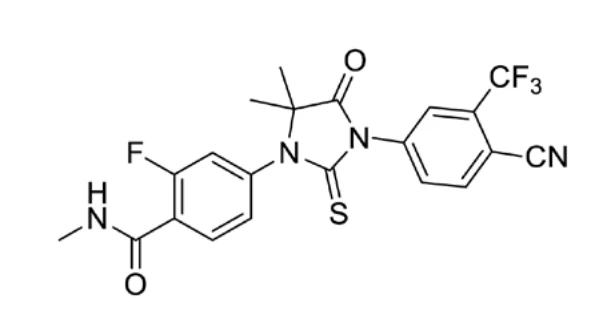
Physicochemical properties:
Enzalutamide is a White or off-white powder Very soluble in DMSO and DMF. Freely soluble in N-dimethylpyrrolidone, dichloromethane, acetone, acetonitrile, tetrahydrofuran, and ethyl acetate. Soluble in isopropyl acetate and methanol. Sparingly soluble in absolute ethanol and very slightly soluble in isopropanol. Insoluble in N-heptane.
14 CLINICAL TRIALS
14.1 Clinical Trials by Indication
The efficacy of enzalutamide capsules was established in five randomized placebo-controlled multicentre Phase 3 clinical studies (PREVAIL, AFFIRM, PROSPER, ARCHES, EMBARK) of patients with progressive non-metastatic (PROSPER) or metastatic prostate cancer (AFFIRM, PREVAIL) who had failed androgen deprivation therapy [Gonadotropin-releasing hormone (GnRH) analogue or after bilateral orchiectomy], patients with metastatic castration-sensitive prostate cancer (ARCHES) and patients with non-metastatic castration-sensitive prostate cancer with high-risk BCR (EMBARK). All patients continued on a GnRH analogue or had prior bilateral orchiectomy, unless otherwise indicated.
Non-metastatic Castration-sensitive Prostate Cancer with High-risk Biochemical Recurrence (EMBARK)
The EMBARK study enrolled 1068 patients with nm-CSPC with high-risk BCR who were randomized 1:1:1 to receive treatment with enzalutamide capsules plus leuprolide (N = 355), enzalutamide capsules as monotherapy (N = 355), or placebo plus leuprolide (N = 358). Enzalutamide capsules was administered at 160 mg once daily and leuprolide acetate was administered at a dose of 22.5 mg by injection once every 12 weeks on an intermittent schedule (see 8.2 Clinical Trial Adverse Reactions). Treatment with enzalutamide and placebo was double-blind in combination with open-label leuprolide. Treatment with enzalutamide monotherapy was open-label.
All patients had prior definitive therapy with radical prostatectomy or radiotherapy (including brachytherapy) or both, with curative intent and were not candidates for salvage radiotherapy at the time of screening. Patients were required to have confirmation of non-metastatic disease by central review and high-risk BCR (defined by a PSA doubling time ≤ 9 months and screening PSA: PSA values ≥1 ng / mL if they had prior radical prostatectomy (with or without radiotherapy) as the primary treatment for prostate cancer or PSA values at least 2 ng / mL above the nadir if they had prior radiotherapy only). Prior hormonal therapy was not permitted except neoadjuvant / adjuvant therapy to treat prostate cancer ≤36 months in duration and ≥9 months before randomization, or a single dose or a short course (≤6 months) of hormonal therapy given for rising PSA ≥9 months before randomization.
Patients were stratified by screening PSA (≤10 ng / mL vs. >10 ng / mL), PSA doubling time (≤3 months versus >3 months to ≤ 9 months), and prior hormonal therapy (prior hormonal therapy vs. no prior hormonal therapy). For patients whose PSA values (by central laboratory) were undetectable (<0.2 ng / mL) at week 36, treatment was suspended at week 37 and then reinitiated when PSA values (by central laboratory) increased to ≥2.0 ng / mL for patients with prior prostatectomy or ≥5.0 ng / mL for patients without prior prostatectomy. For patients whose PSA values were detectable (≥0.2 ng / mL) at week 36, treatment continued without suspension until permanent treatment discontinuation criteria were met. For all patients, treatment was permanently discontinued upon radiographic disease progression confirmed by blinded independent central review (BICR), initiation of new treatment, unacceptable toxicity, or withdrawal.
Metastasis-free survival (MFS) as per Blinded Independent Central Review (BICR) in patients randomized to receive enzalutamide capsules plus leuprolide compared to patients randomized to receive placebo plus leuprolide was the primary endpoint. Metastasis-free survival was defined as the time from randomization to radiographic progression or death on study, whichever occurred first. Radiographic imaging for bone lesions (defined as the appearance of 1 or more metastatic lesions on bone scan) or soft tissue disease by CT or MRI (assessed by RECIST 1.1) was performed every 6 months until detection of metastasis. Imaging by PET was not permitted. Metastasis-Free Survival as per BICR in patients randomized to enzalutamide capsules as monotherapy compared to placebo plus leuprolide and Overall Survival were key secondary endpoints.
The patient demographics and baseline disease characteristics were generally balanced between the treatment arms (see Table 11).
Table 11 – EMBARK Key Demographics and Baseline Disease Characteristics (ITT Population)
| Baseline Characteristic | Enzalutamide capsules plus leuprolide (N = 355) | Placebo plus leuprolide (N = 358) | Enzalutamide capsules as monotherapy (N = 355) | ||||||||||||||||
|---|---|---|---|---|---|---|---|---|---|---|---|---|---|---|---|---|---|---|---|
| Baseline Characteristic | Enzalutamide capsules plus leuprolide (N = 355) | Placebo plus leuprolide (N = 358) | Enzalutamide capsules as monotherapy (N = 355) | ||||||||||||||||
| Baseline Characteristic | Enzalutamide capsules plus leuprolide (N = 355) | Placebo plus leuprolide (N = 358) | Enzalutamide capsules as monotherapy (N = 355) | ||||||||||||||||
| Age category (years), n (%) | |||||||||||||||||||
| < 65 | 81 (22.8%) | 91 (25.4%) | 91 (25.6%) | ||||||||||||||||
| 65 to < 75 | 201 (56.6%) | 180 (50.3%) | 174 (49.0%) | ||||||||||||||||
| ≥ 75 | 73 (20.6%) | 87 (29.3%) | 90 (25.4%) | ||||||||||||||||
| Age (years) | |||||||||||||||||||
| N | 355 | 358 | 355 | ||||||||||||||||
| Mean (SD) | 69.1 (6.49) | 69.1 (7.30) | 69.1 (7.65) | ||||||||||||||||
| Median (minimum, maximum) | 69.0 (51.0, 87.0) | 70.0 (50.0, 92.0) | 69.0 (49.0, 93.0) | ||||||||||||||||
| Race, n (%) | |||||||||||||||||||
| American Indian or Alaskan Native | 4 (1.1%) | 1 (0.3%) | 0 (0.0%) | ||||||||||||||||
| Asian | 26 (7.3%) | 26 (7.3%) | 26 (7.3%) | ||||||||||||||||
| Black or African American | 16 (4.5%) | 16 (4.5%) | 15 (4.2%) | ||||||||||||||||
| Native Hawaiian or Other Pacific Islander | 1 (0.3%) | 0 (0.0%) | 0 (0.0%) | ||||||||||||||||
| White | 293 (82.5%) | 301 (84.1%) | 295 (83.1%) | ||||||||||||||||
| Multiple | 2 (0.6%) | 4 (1.1%) | 4 (1.1%) | ||||||||||||||||
| Other | 3 (0.8%) | 5 (1.4%) | 1 (0.3%) | ||||||||||||||||
| Not Reported | 10 (2.8%) | 5 (1.4%) | 14 (3.9%) | ||||||||||||||||
| Ethnicity, n (%) | |||||||||||||||||||
| Hispanic or Latino | 17 (4.8%) | 24 (6.7%) | 18 (5.1%) | ||||||||||||||||
| Not Hispanic or Latino | 319 (89.9%) | 322 (89.9%) | 320 (90.1%) | ||||||||||||||||
| Not Reported / Unknown | 19 (5.4%) | 12 (3.4%) | 17 (4.8%) | ||||||||||||||||
| Geographic Region, n (%) | |||||||||||||||||||
| North America | 144 (40.6%) | 137 (38.3%) | 133 (37.5%) | ||||||||||||||||
| Europe | 130 (36.6%) | 128 (35.8%) | 146 (41.1%) | ||||||||||||||||
| Rest of World | 81 (22.8%) | 93 (26.0%) | 76 (21.4%) | ||||||||||||||||
| Weight (kg) | |||||||||||||||||||
| n | 355 | 357 | 355 | ||||||||||||||||
| Mean (SD) | 87.5 (15.16) | 87.2 (15.86) | 87.5 (15.55) | ||||||||||||||||
| Median (minimum, maximum) | 85.0 (55.6, 157.7) | 85.7 (53.7, 148.2) | 85.0 (50.0, 171.8) | ||||||||||||||||
| Missing | 0 | 1 | 0 | ||||||||||||||||
| Body mass index (kg / m2) | |||||||||||||||||||
| N | 353 | 354 | 354 | ||||||||||||||||
| Mean (SD) | 28.5 (4.22) | 28.3 (4.37) | 28.6 (4.70) | ||||||||||||||||
| Median (minimum, maximum) | 28.1 (19.9, 47.1) | 28.0 (18.5, 45.9) | 27.9 (17.3, 53.2) | ||||||||||||||||
| Missing | 2 | 4 | 1 | ||||||||||||||||
| Baseline ECOG Performance Status, n (%) | |||||||||||||||||||
| 0 | 328 (92.4%) | 336 (93.9%) | 321 (90.4%) | ||||||||||||||||
| 1 | 26 (7.3%) | 21 (5.9%) | 34 (9.6%) | ||||||||||||||||
| 2 | 1 (0.3%) | 0 (0.0%) | 0 (0.0%) | ||||||||||||||||
| Missing | 0 | 1 (0.3%) | 0 | ||||||||||||||||
| Serum PSA (ng / mL) | |||||||||||||||||||
| N | 355 | 356 | 354 | ||||||||||||||||
| Mean (SD) | 8.1 (17.56) | 8.5 (11.76) | 7.5 (6.54) | ||||||||||||||||
| Median (minimum, maximum) | 5.0 (1.0, 308.3) | 5.5 (1.1, 163.3) | 5.3 (1.1, 37.0) | ||||||||||||||||
| Missing | 0 | 2 | 1 | ||||||||||||||||
| Screening PSA Doubling Time Category (DT), n (%) | |||||||||||||||||||
| ≤ 3 months | 69 (19.4%) | 80 (22.3%) | 76 (21.4%) | ||||||||||||||||
| > 3 -≤ 6 months | 187 (52.7%) | 142 (39.7%) | 164 (46.2%) | ||||||||||||||||
| > 6 -≤ 9 months | 98 (27.6%) | 135 (37.7%) | 114 (32.1%) | ||||||||||||||||
| > 9 months | 1 (0.3%) | 1 (0.3%) | 1 (0.3%) | ||||||||||||||||
| PSA DT, n (months) | |||||||||||||||||||
| N | 355 | 358 | 355 | ||||||||||||||||
| Mean (SD) | 4.9 (2.04) | 5.2 (2.20) | 5.1 (2.15) | ||||||||||||||||
| Median (minimum, maximum) | 4.6 (0.9, 9.36) | 5.0 (1.1, 10.8) | 5.0 (1.1, 18.9) | ||||||||||||||||
| History of Cardiovascular Disease | |||||||||||||||||||
| Yes | 42 (11.8%) | 42 (11.7%) | 47 (13.2%) | ||||||||||||||||
| No | 313 (88.2%) | 316 (88.3%) | 308 (86.8%) | ||||||||||||||||
| Prior Hormonal Therapy | |||||||||||||||||||
| Yes | 107 (30.1%) | 113 (31.6%) | 112 (31.5%) | ||||||||||||||||
| No | 248 (69.9%) | 245 (68.4%) | 243 (68.5%) | ||||||||||||||||
| Prior Prostatectomy alone | |||||||||||||||||||
| n (%) | 90 (25.4%) | 75 (20.9%) | 99 (27.9%) | ||||||||||||||||
| Prior Radiation Therapy alone | |||||||||||||||||||
| n (%) | 86 (24.2%) | 104 (29.1%) | 90 (25.4%) | ||||||||||||||||
| Prior Prostatectomy and Radiation Therapy | |||||||||||||||||||
| n (%) | 179 (50.4%) | 179 (50.0%) | 166 (46.8%) | ||||||||||||||||
All patients who were randomized in the study (ITT population).
The analysis data cut-off date was 31 Jan 2023.
ECOG: Eastern Cooperative Oncology Group; ITT: intent-to-treat, PSA: prostate-specific antigen.
Metastatic Castration-Sensitive Prostate Cancer (ARCHES)
The ARCHES study enrolled 1150 patients with mCSPC randomized 1:1 to receive treatment orally once daily with enzalutamide capsules 160 mg (N = 574) or placebo (N = 576). All patients in the trial received a GnRH analog or had a prior bilateral orchiectomy. Patients were stratified by volume of disease (low vs high) and prior docetaxel therapy for prostate cancer (no prior docetaxel, 1 to 5 cycles, or 6 prior cycles). Treatment with concurrent docetaxel was not allowed. Patients were required to have confirmation of metastatic prostate cancer by positive bone scan or metastatic lesions on CT or MRI scan. Patients continued treatment until radiographic disease progression, initiation of new treatment, unacceptable toxicity, or withdrawal.
Radiographic progression-free survival (rPFS) was the primary endpoint defined as the time from randomization to the first objective evidence of radiographic disease progression or death (any cause from time of randomization through 24 weeks after study drug discontinuation), whichever occurred first. Key secondary efficacy endpoints assessed in the study were time to PSA progression, time to start of new antineoplastic therapy, PSA undetectable rate (decline to < 0.2 mcg / L), objective response rate (RECIST 1.1) based on independent review, time to deterioration of urinary symptoms, and overall survival.
The demographic and baseline disease characteristics were balanced between the two treatment arms (Table 12).
Table 12 – ARCHES Key Demographics and Baseline Disease Characteristics (ITT Population)
| Baseline Characteristic | Enzalutamide capsules (N = 574) | Placebo (N = 576) |
|---|---|---|
| Baseline Characteristic | Enzalutamide capsules (N = 574) | Placebo (N = 576) |
| Age category (years), n (%) | ||
| < 65 | 148 (25.8) | 152 (26.4) |
| 65 to < 75 | 256 (44.6%) | 255 (44.3%) |
| ≥ 75 | 170 (29.6%) | 169 (29.3%) |
| Age (years) | ||
| Mean (SD) | 69.5 (8.0%) | 69.5 (5.4%) |
| Median (minimum, maximum) | 70.0 (46, 92) | 70.0 (42, 92) |
| Race, n (%) | ||
| White | 466 (81.2%) | 460 (79.9%) |
| Black or African American | 8 (1.4%) | 8 (1.9%) |
| Asian | 75 (13.1%) | 80 (13.9%) |
| Other | 2 (0.3%) | 3 (0.5%) |
| Missing | 23 (4.0%) | 25 (4.3%) |
| Ethnicity, n (%) | ||
| Hispanic or Latino | 46 (8.0%) | 37 (6.4%) |
| Not Hispanic or Latino | 504 (87.8%) | 514 (89.2%) |
| Missing | 24 (4.2%) | 25 (4.3%) |
| Weight (kg) | ||
| N | 573 | 575 |
| Mean (SD) | 81.25 (16.17) | 81.26 (16.22) |
| Median (minimum, maximum) | 80.00 (42.7, 163.0) | 80.00 (39.1, 157.5) |
| Body mass index (kg / m2) | ||
| N | 567 | 570 |
| Mean (SD) | 27.20 (4.44) | 27.21 (4.61) |
| Median (minimum, maximum) | 26.65 (16.7, 45.2) | 26.91 (16.4, 48.8) |
| ECOG performance status at study entry, n (%) | ||
| 0 | 448 (78.0) | 443 (76.9) |
| 1 | 125 (21.8) | 133 (23.1) |
| Baseline serum PSAa (ng / mL) | ||
| N | 572 | 574 |
| Mean (SD) | 75.37 (356.36) | 104.78 (834.48) |
| Median (minimum, maximum) | 5.36 (0.0, 4823.5) | 5.07 (0.0, 19000.0) |
| Total Gleason score at initial diagnosis, n (%) | ||
| < 8 | 171 (29.8) | 187 (32.5) |
| ≥ 8 | 386 (67.2) | 373 (64.8) |
| Volume of diseaseb, n (%) | ||
| Low | 220 (38.3) | 203 (35.2) |
| High | 354 (61.7) | 373 (64.8) |
| Prior docetaxel therapyb, n (%) | ||
| None | 471 (82.1) | 474 (82.3) |
| 1 to 5 cycles | 14 (2.4) | 11 (1.9) |
| 6 cycles | 89 (15.5) | 91 (15.8) |
| Previous use of ADT, n (%) | ||
| None | 39 (6.8) | 61 (10.6) |
| ≤ 3 months | 414 (72.1) | 394 (68.4) |
| > 3 months | 121 (21.1) | 120 (20.8) |
| Unknownc | 0 | 1 (0.2) |
All patients who were randomized in the study (ITT population).
The analysis data cut-off date was 14 Oct 2018.
ADT: androgen deprivation therapy; ECOG: Eastern Cooperative Oncology Group; ICR: independent central review; ITT: intent- to-treat; PSA: prostate-specific antigen.
- a. PSA levels of 0 were observed, which could have been due to prior treatment with docetaxel and / or use of ADT within 3 months of study start. One patient receiving placebo plus ADT had a baseline PSA level of > 19000 ng / mL, which impacted the calculation of mean baseline PSA for this group.
- b. Volume of disease and prior docetaxel therapy were stratification factors at randomization. High volume of disease is defined as metastases involving the viscera or, in the absence of visceral lesions, there must be 4 or more bone lesions, at least 1 of which must be in a bony structure beyond the vertebral column and pelvic bone.
- c. The patient had ADT; however, the duration of ADT use was not known.
Non-Metastatic Prostate Cancer that Progressed on Androgen Deprivation Therapy (PROSPER)
The PROSPER study enrolled 1401 patients with non-metastatic CRPC who continued on androgen deprivation therapy (ADT; defined as GnRH analogue or prior bilateral orchiectomy). Patients were randomized 2:1 to receive either enzalutamide capsules at a dose of 160 mg once daily (N = 933) or placebo (N = 468).
Patients discontinued treatment for radiographic disease progression confirmed by blinded independent central review (BICR), unacceptable toxicity, initiation of new treatment, or withdrawal. PSA results were blinded and were not used for treatment discontinuation.
Patients were required to have a PSA doubling time ≤ 10 months (considered to be at high risk of developing metastatic disease), PSA ≥ 2 ng / mL, and confirmation of non-metastatic disease by (BICR) using conventional scans.
Metastasis-free survival (MFS) was the primary endpoint defined as the time from randomization to loco-regional and / or distant radiographic progression or death within 112 days of treatment discontinuation without evidence of radiographic progression, whichever occurred first. Radiographic progression for bone disease was defined as the appearance of 1 or more metastatic lesions on the bone assessed by whole-body radionuclide bone scan, while assessment of soft tissue disease was performed by CT or MRI performed every 16 weeks (earlier if progression was clinically suspected). Radiographic progression for soft tissue disease was defined by RECIST 1.1.
Key secondary endpoints assessed in the study were time to PSA progression time to first use of new antineoplastic therapy and overall survival. PSA progression was defined according to PCWG2 guidelines; time to PSA progression was defined as the time from randomization to the date of first PSA value demonstrating progression, which was subsequently confirmed.
The demographic and baseline characteristics were balanced between the two treatment arms (Table 13). The median age at randomization was 74 years in the enzalutamide capsules arm and 73 years in the placebo arm.
Fifty-four percent (54%) of patients received prior treatment for prostate cancer with either surgery or radiation. Sixty-three percent (63%) of patients received prior treatment with an anti-androgen; 56% of patients received bicalutamide and 11% of patients received flutamide.
Table 13 – PROSPER Key Demographics and Baseline Disease Characteristics (ITT Population)
| Baseline Characteristic | Enzalutamide capsules (N = 933) | Placebo (N = 468) | |||||||||||
|---|---|---|---|---|---|---|---|---|---|---|---|---|---|
| Baseline Characteristic | Enzalutamide capsules (N = 933) | Placebo (N = 468) | |||||||||||
| Age (years) | |||||||||||||
| Mean (SD) | 73.8 (7.83) | 72.9 (7.63) | |||||||||||
| Min, Max | 50, 95 | 53, 92 | |||||||||||
| Race | |||||||||||||
| White | 671 (71.9%) | 320 (68.4%) | |||||||||||
| Other, multiple, or unknown | 99 (10.6%) | 50 (10.7%) | |||||||||||
| Asian | 142 (15.2%) | 88 (18.8%) | |||||||||||
| 21 (2.3%) | 10 (2.1%) | ||||||||||||
| Time from initial diagnosis to randomization, months | |||||||||||||
| Mean (SD) | 99.1 (57.27) | 94.1 (56.73) | |||||||||||
| Median (minimum, maximum) | 90.4 (2.2, 381.8) | 86.8 (2.2, 275.7) | |||||||||||
| Total Gleason Score at initial diagnosis, n (%) | |||||||||||||
| Low (2 to 4) | 21 (2.3%) | 12 (2.6%) | |||||||||||
| Medium (5 to 7) | 491 (52.6%) | 230 (49.1%) | |||||||||||
| High (8 to 10) | 381 (40.8%) | 207 (44.2%) | |||||||||||
| Unknown or missing | 40 (4.3%) | 19 (4.1%) | |||||||||||
| Baseline use of BTA | |||||||||||||
| No | 828 (88.7%) | 420 (89.7%) | |||||||||||
| Yes | 105 (11.3%) | 48 (10.3%) | |||||||||||
| 1 | 103 (11.0%) | 47 (10.0%) | |||||||||||
| 2 | 2 (0.2%) | 1 (0.2%) | |||||||||||
| PSA Doubling Time Category n (%) | |||||||||||||
| < 6 months | 715 (76.6%) | 361 (77.1%) | |||||||||||
| > 6 months | 217 (23.3%) | 107 (22.9%) | |||||||||||
| Missing | 1 (0.1%) | 0 | |||||||||||
| Baseline serum PSA (ng / mL) | |||||||||||||
| N | 933 | 468 | |||||||||||
| Mean (SD) | 22.2 (46.14) | 22.1 (41.08) | |||||||||||
| Median | 11.1 | 10.2 | |||||||||||
| Min, max | 0.8, 1071.1 | 0.2, 467.5 | |||||||||||
| Baseline ECOG performance status | |||||||||||||
| 0 | 747 (80.1%) | 382 (81.6%) | |||||||||||
| 1 | 185 (19.8%) | 85 (18.2%) | |||||||||||
| > 1 | 0 (0.0%) | 0 (0.0%) | |||||||||||
| Missing | 1 (0.1%) | 1 (0.2%) | |||||||||||
ITT: Intent to Treat; BTA: Bone targeting agents; PSA: Prostate Specific Antigen. Patients with soft tissue pelvic disease were eligible if lesions do not qualify as target lesions (e.g., lymph nodes below aortic bifurcation are permissible if the short axis of the largest lymph node is < 15 mm).
Chemotherapy-naïve mCRPC that Progressed on Androgen Deprivation Therapy (PREVAIL)
In the PREVAIL study, a total of 1717 patients with asymptomatic or mildly symptomatic metastatic castration-resistant prostate cancer who had not received prior chemotherapy were randomized 1:1 to receive either enzalutamide capsules orally at a dose of 160 mg once daily (N = 872) or placebo orally once daily (N = 845). Patients were allowed, but not required, to continue or initiate corticosteroids (maximum daily dose allowed was 10 mg prednisone or equivalent). Patients with visceral disease, patients with a history of mild to moderate heart failure (NYHA Class 1 or 2), and patients taking medications associated with lowering the seizure threshold were allowed. Patients with a previous history of seizure or a condition that might predispose to seizure and patients with moderate or severe pain from prostate cancer were excluded. Study treatment continued until disease progression (evidence of radiographic progression, a skeletal-related event, or clinical progression) and the initiation of either a cytotoxic chemotherapy or an investigational agent, or until unacceptable toxicity or withdrawal.
Changes in PSA serum concentration independently do not always predict clinical benefit. PSA rise without evidence of confirmed radiographic progression or a skeletal-related event was strongly discouraged as a criterion to start a new systemic antineoplastic therapy during the first 12 weeks of therapy and was discouraged as a criterion to start a new systemic antineoplastic therapy throughout the study.
Co-primary efficacy endpoints were overall survival and radiographic progression-free survival (rPFS). In addition to the co-primary endpoints, benefit was also assessed using secondary endpoints as follows: time to initiation of cytotoxic chemotherapy, best overall soft tissue response, time to first skeletal-related event, PSA response (≥ 50% decrease from baseline), and time to PSA progression.
Radiographic progression was assessed with the use of sequential imaging studies as defined by Prostate Cancer Clinical Trials Working Group 2 (PCWG2) criteria (for bone lesions) and / or Response Evaluation Criteria in Solid Tumors (RECIST v 1.1) criteria (for soft tissue lesions).
Analysis of rPFS utilized centrally-reviewed radiographic assessment of progression.
Patient demographics and baseline disease characteristics were balanced between the treatment arms (see Table 14). Fifty-four percent of patients had radiographic evidence of disease progression and 43% had PSA-only progression. Approximately 45% of patients had measurable soft tissue disease at study entry, and 12% of patients had visceral (lung and / or liver) metastases.
Table 14 – PREVAIL Key Demographics and Baseline Disease Characteristics
| Baseline Characteristic | Enzalutamide capsules (N = 872) | Placebo (N = 845) | |||||||||
|---|---|---|---|---|---|---|---|---|---|---|---|
| Baseline Characteristic | Enzalutamide capsules (N = 872) | Placebo (N = 845) | |||||||||
| Age (years) | |||||||||||
| Mean (SD) | 71.3 (8.5%) | 71.2 (8.42%) | |||||||||
| Min, Max | 43.0, 93.0 | 42.0, 93.0 | |||||||||
| Race | |||||||||||
| White | 669 (76.7%) | 655 (77.5%) | |||||||||
| Other, multiple, or unknown | 95 (10.9%) | 94 (11.1%) | |||||||||
| Asian | 85 (9.7%) | 82 (9.7%) | |||||||||
| 21 (2.4%) | 13 (1.5%) | ||||||||||
| American Indian or Alaska Native | 1 (0.1%) | 0 (0.0%) | |||||||||
| Native Hawaiian or other Pacific Islander | 1 (0.1%) | 1 (0.1%) | |||||||||
| Time from initial diagnosis or first treatment of prostate cancer to randomization | |||||||||||
| N | 872 | 844 | |||||||||
| Median (months) | 62.7 | 64.6 | |||||||||
| Baseline ECOG performance status (n [%]) | |||||||||||
| 0 | 584 (67.0%) | 585 (69.2%) | |||||||||
| 1 | 288 (33.0%) | 260 (30.8%) | |||||||||
| Distribution of disease at screeninga | |||||||||||
| Bone | 741 (85.0%) | 690 (81.7%) | |||||||||
| Lymph node | 437 (50.1%) | 434 (51.4%) | |||||||||
| Visceral disease (lung or liver) | 98 (11.2%) | 106 (12.5%) | |||||||||
| Other soft tissue | 113 (13.0%) | 105 (12.4%) | |||||||||
| Baseline mean pain scoreb | |||||||||||
| N | 859 | 840 | |||||||||
| 0 to 1 | 569 (66.2%) | 567 (67.5%) | |||||||||
| 2 to 3 | 275 (32.0%) | 262 (31.2%) | |||||||||
| > 3 | 15 (1.7%) | 11 (1.3%) | |||||||||
| Number of bone metastases at screening | |||||||||||
| 0 | 131 (15.0%) | 155 (18.3%) | |||||||||
| 1 | 97 (11.1%) | 85 (10.1%) | |||||||||
| 2 to 4 | 213 (24.4%) | 186 (22.0%) | |||||||||
| 5 to 9 | 146 (16.7%) | 147 (17.4%) | |||||||||
| 10 to 20 | 140 (16.1%) | 122 (14.4%) | |||||||||
| > 20 | 145 (16.6%) | 150 (17.8%) | |||||||||
| Baseline serum PSA (ng / mL) | |||||||||||
| N | 872 | 844 | |||||||||
| Mean (SD) | 140.7 (284.22) | 137.9 (298.61) | |||||||||
| Min, max | 0.1, 3182.0 | 0.3, 3637.0 | |||||||||
| Baseline use of corticosteroids (> 7 days) (n [%])c | 35 (4.0%) | 36 (4.3%) | |||||||||
- a. Patients can be summarized for more than 1 category but are counted only once for each category.
- b. Protocol defined by a score of < 4 on question 3 on the Brief Pain Inventory Short Form (BPI) [worst prostate cancer-related pain over past 24 hours] assessed both at screening and again before randomization at baseline visit.
- c. Includes all oral steroid use on the date of first dose of study drug. Excludes steroids taken for indications not associated with prostate cancer and continuous steroids taken for less than 7 days. ECOG, Eastern Cooperative Oncology Group; PSA, prostate-specific antigen.
mCRPC Patients with Prior Docetaxel Treatment (AFFIRM)
In the AFFIRM study, a total of 1199 patients with metastatic castration-resistant prostate cancer who had previously received docetaxel were randomized 2:1 to receive either enzalutamide capsules orally at a dose of 160 mg once daily (N = 800) or placebo once daily (N = 399). Patients were allowed, but not required, to continue or initiate corticosteroids (47.8% vs. 45.6% were administered corticosteroids in enzalutamide capsules and placebo arms, respectively). In addition, 51.0% vs. 49.6% of patients in the enzalutamide capsules and placebo arms, respectively, were using bisphosphonates at baseline.
Patients were excluded if having a history of seizure, including any febrile seizure, loss of consciousness, or transient ischemic attack within 12 months of enrollment (Day 1 visit), or any condition that may pre-dispose to seizure (e.g. prior stroke, brain arteriovenous malformation, head trauma with loss of consciousness requiring hospitalization). Patients were also excluded if they had clinically significant cardiovascular disease, significant renal impairment, hepatic impairment, or histologically or cytologically confirmed adenocarcinoma of the prostate without neuroendocrine differentiation or small cell features were excluded from the study.
Patients randomized to either arm were to continue treatment until either:
- 1. Disease progression (defined as radiographic progression or the occurrence of a skeletal-related event) and initiation of a new systemic antineoplastic treatment
- 2. Death
- 3. Unacceptable toxicity
- 4. Withdrawal
Increases in PSA, especially during the first 12 weeks of therapy, were not considered disease progression.
The primary efficacy endpoint for the AFFIRM study was overall survival defined as time from randomization to death from any cause.
The following key secondary efficacy endpoints were evaluated:
- • Radiographic progression-free survival, defined as the time to the earliest objective evidence of radiographic progression or death due to any cause. Radiographic disease progression is defined by RECIST v 1.1 for soft tissue disease, or the appearance of two or more new lesions on bone scan, as per PCWG2 criteria, with a confirmatory scan 6 or more weeks only after the first assessment (13 weeks after initial dose).
- • Time to PSA progression, defined as the time from randomization to PSA progression. PSA progression was assessed for each patient in the study using the Prostate Cancer Clinical Trials Working Group 2 (PCWG2) criteria. PSA progression could only be declared on or after the Week 13 assessment and required a confirmation that was consecutive and conducted at least 3 weeks later.
- • Time to first skeletal-related event, where skeletal-related event was defined as radiation therapy or surgery to bone, pathologic bone fracture, spinal cord compression, or change of antineoplastic therapy to treat bone pain.
Additional efficacy endpoints included PSA response rate (≥ 50% or ≥ 90% reduction from baseline), and the response rate for quality of life as measured by Functional Assessment of Cancer Therapy – Prostate [FACT-P]. Patients were defined as having a positive quality of life response if they had a 10-point improvement in their global FACT-P score, compared with baseline, on 2 consecutive measurements obtained at least 3 weeks apart.
The patient demographics and baseline disease characteristics were balanced between the treatment arms (see Table 15).
Table 15 – Summary of Patient Demographics and Baseline Characteristics for the Phase 3 AFFIRM Study
Enzalutamide capsules (160 mg / day) N = 800 | Placebo N = 399 | ||||||||||||
|---|---|---|---|---|---|---|---|---|---|---|---|---|---|
Enzalutamide capsules (160 mg / day) N = 800 | Placebo N = 399 | ||||||||||||
| Age (years) | |||||||||||||
| Mean (SD) | 68.8 (7.96) | 68.6 (8.39) | |||||||||||
| Min, Max | 41.0, 92.0 | 49.0, 89.0 | |||||||||||
| Race | |||||||||||||
| Asian | 5 (0.6%) | 8 (2.0%) | |||||||||||
| 27 (3.4%) | 20 (5.0%) | ||||||||||||
| White | 745 (93.1%) | 366 (91.7%) | |||||||||||
| Other | 23 (2.9%) | 5 (1.3%) | |||||||||||
| Baseline ECOG Performance Status | |||||||||||||
| 0 | 298 (37.3%) | 156 (39.1%) | |||||||||||
| 1 | 432 (54.0%) | 211 (52.9%) | |||||||||||
| 2 | 70 (8.8%) | 32 (8.0%) | |||||||||||
| Baseline PSA (ng / mL) | |||||||||||||
| Mean (SD) | 415.6 (930.76) | 389.4 (1105.72) | |||||||||||
| Median | 107.7 | 128.3 | |||||||||||
| Min, Max | 0.2, 11794.1 | 0.0, 19000.0 | |||||||||||
| Average Pain Score as Assessed by Brief Pain Inventorya | |||||||||||||
| < 4 | 574 (71.8%) | 284 (71.2%) | |||||||||||
| ≥ 4 | 226 (28.3%) | 115 (28.8%) | |||||||||||
| Type of Disease Progression at Study Entry | |||||||||||||
| PSA progression only | 326 (40.8%) | 164 (41.2%) | |||||||||||
| Radiographic progressionb | 470 (58.8%) | 234 (58.8%) | |||||||||||
| Missing | 4 | 1 | |||||||||||
| Distribution of Disease at Screening | |||||||||||||
| Bone | 730 (92.2%) | 364 (91.5%) | |||||||||||
| Lymph node | 442 (55.8%) | 219 (55.0%) | |||||||||||
| Visceral liver | 92 (11.6%) | 34 (8.5%) | |||||||||||
| Visceral lung | 122 (15.4%) | 59 (14.8%) | |||||||||||
| Other soft tissue | 147 (18.6%) | 70 (17.6%) | |||||||||||
| Missing | 8 | 1 | |||||||||||
- a. Mean of patient’s reported worst pain over the previous 24 hours calculated for seven days prior to randomization. Randomization was stratified by baseline ECOG performance status score (0–1 vs. 2) and mean Brief Pain Inventory – Short Form Question #3 score averaged over the 7 days prior to randomization.
- b. Bone and or soft tissue.
Study Results
Non-metastatic Castration-sensitive Prostate Cancer with High-risk Biochemical Recurrence (EMBARK)
At a median follow up time of 61 months across the three treatment arms, enzalutamide capsules plus leuprolide demonstrated a statistically significant 58% reduction in the risk of developing an MFS event as compared to placebo plus leuprolide [HR = 0.42 (95% CI: 0.30, 0.61), p < 0.0001]. Enzalutamide capsules as monotherapy also demonstrated a statistically significant 37% reduction in the risk of developing an MFS event as compared to placebo plus leuprolide [HR = 0.63 (95% CI: 0.46, 0.87), p = 0.0049]. The results are summarized in Table 16 and Figure 1. Pre-specified MFS subgroup analyses are presented in Figures 2 to 3.
Table 16 – Summary of efficacy results in the EMBARK study (intent-to-treat analysis)
Enzalutamide capsules plus leuprolide (N = 355) | Placebo plus leuprolide (N = 358) | Enzalutamide capsules as Monotherapy (N = 355) | |||||||||||
|---|---|---|---|---|---|---|---|---|---|---|---|---|---|
Enzalutamide capsules plus leuprolide (N = 355) | Placebo plus leuprolide (N = 358) | Enzalutamide capsules as Monotherapy (N = 355) | |||||||||||
| Metastasis-free survivala | |||||||||||||
| Number of Events (%)b | 45 (12.7) | 92 (25.7) | 63 (17.7) | ||||||||||
| Bone progression | 12 (3.4%) | 24 (6.7%) | 24 (6.8%) | ||||||||||
| Soft tissue progression | 23 (6.5%) | 54 (15.1%) | 29 (8.2%) | ||||||||||
| Concurrent Bone and | 2 (0.6%) | 6 (1.7%) | 1 (0.3%) | ||||||||||
| soft tissue progression | |||||||||||||
| Death without documented | 8 (2.3%) | 8 (2.2%) | 9 (2.5%) | ||||||||||
| radiographic progression | |||||||||||||
| Median, months (95% CI)c | NR (NR, NR) | NR (85.1, NR) | NR (NR, NR) | ||||||||||
| Hazard ratio relative to Placebo plus leuprolide (95% CI)d | 0.42 (0.30, 0.61) | -- | 0.63 (0.46, 0.87) | ||||||||||
| P-value for comparison to Placebo plus leuprolidee | p < 0.0001 | -- | p = 0.0049 | ||||||||||
NR = Not reached.
- a. MFS assessed by Blinded independent central review.
- b. Based on the earliest contributing event (radiographic progression or death). Based on pre-specified analysis, Data Cut-off 31 Jan 2023.
- c. Based on Kaplan-Meier estimates.
- d. Hazard Ratio is based on a Cox regression model stratified by screening PSA, PSA doubling time, and prior hormonal therapy.
- e. Two-sided P-value is based on a stratified log-rank test by screening PSA, PSA doubling time, and prior hormonal therapy.
Overall survival was not mature at the time of MFS analysis (9.3% deaths in the enzalutamide capsules plus leuprolide arm vs. 15.4% deaths in the placebo plus leuprolide arm).
The most commonly used first subsequent new anti-neoplastic therapies was endocrine therapy (89.7% in enzalutamide capsules plus leuprolide arm, 86.4% in the placebo plus leuprolide arm and 86.9% in the enzalutamide capsules monotherapy arm). The second most commonly used first subsequent anti-neoplastic therapy was chemotherapy (6.9% in enzalutamide capsules plus leuprolide arm, 12.1% in the placebo plus leuprolide arm and 10.7% in the enzalutamide capsules monotherapy arm.
Figure 1: Kaplan-Meier curves of MFS in the enzalutamide capsules plus leuprolide vs. Placebo plus leuprolide vs. Enzalutamide capsules as monotherapy treatment arms of the EMBARK study (intent-to-treat analysis)
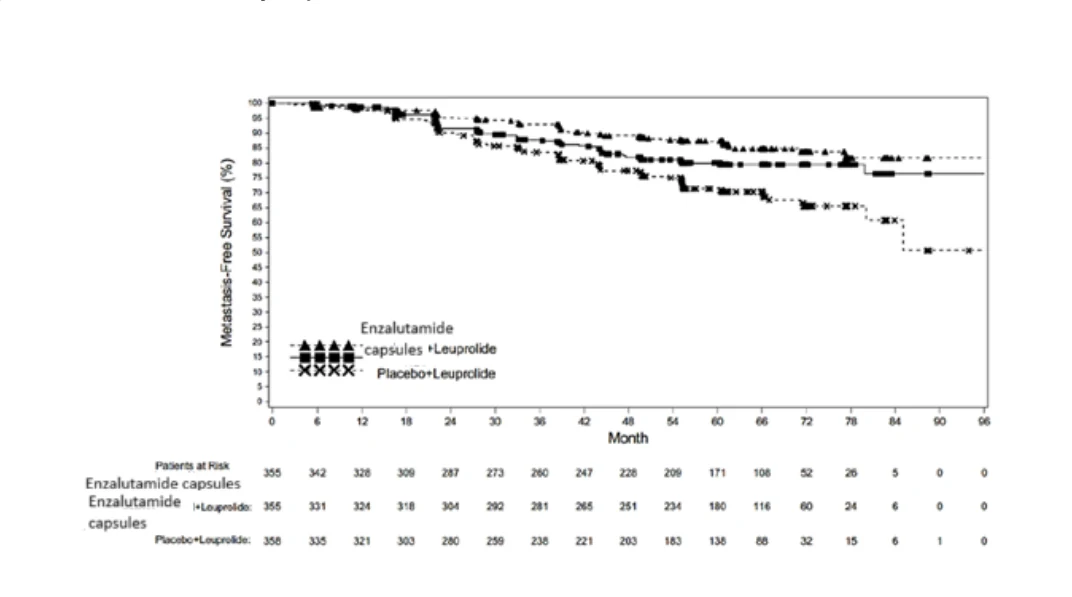
Figure 2: Forest Plot of MFS by Subgroup in the Enzalutamide capsules plus leuprolide vs. Placebo plus leuprolide Treatment Arms of the EMBARK study (Intent-to-Treat Analysis)
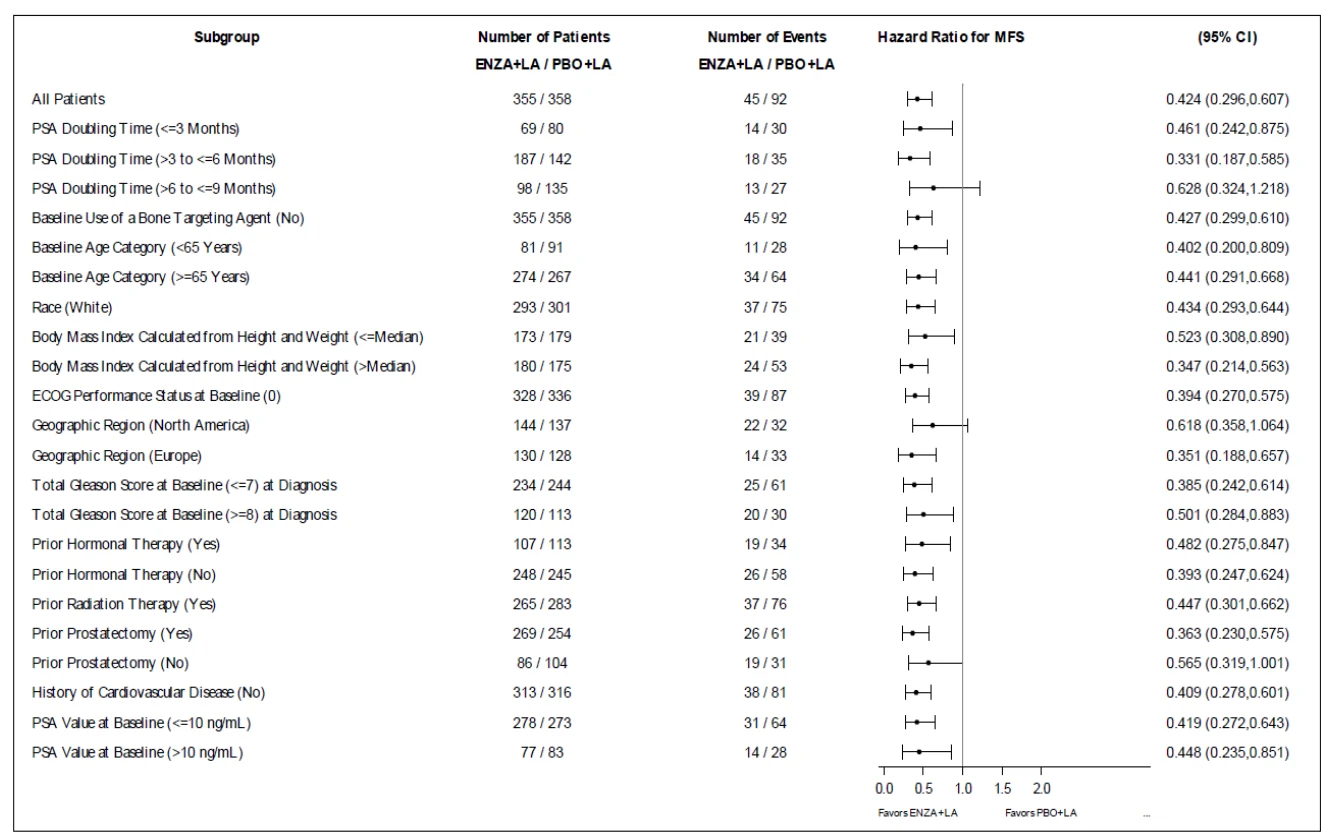
Figure 3: Forest Plot of MFS by Subgroup in the Enzalutamide capsules as Monotherapy vs. Placebo plus leuprolide Treatment Arms of the EMBARK study (Intent-to-Treat Analysis)
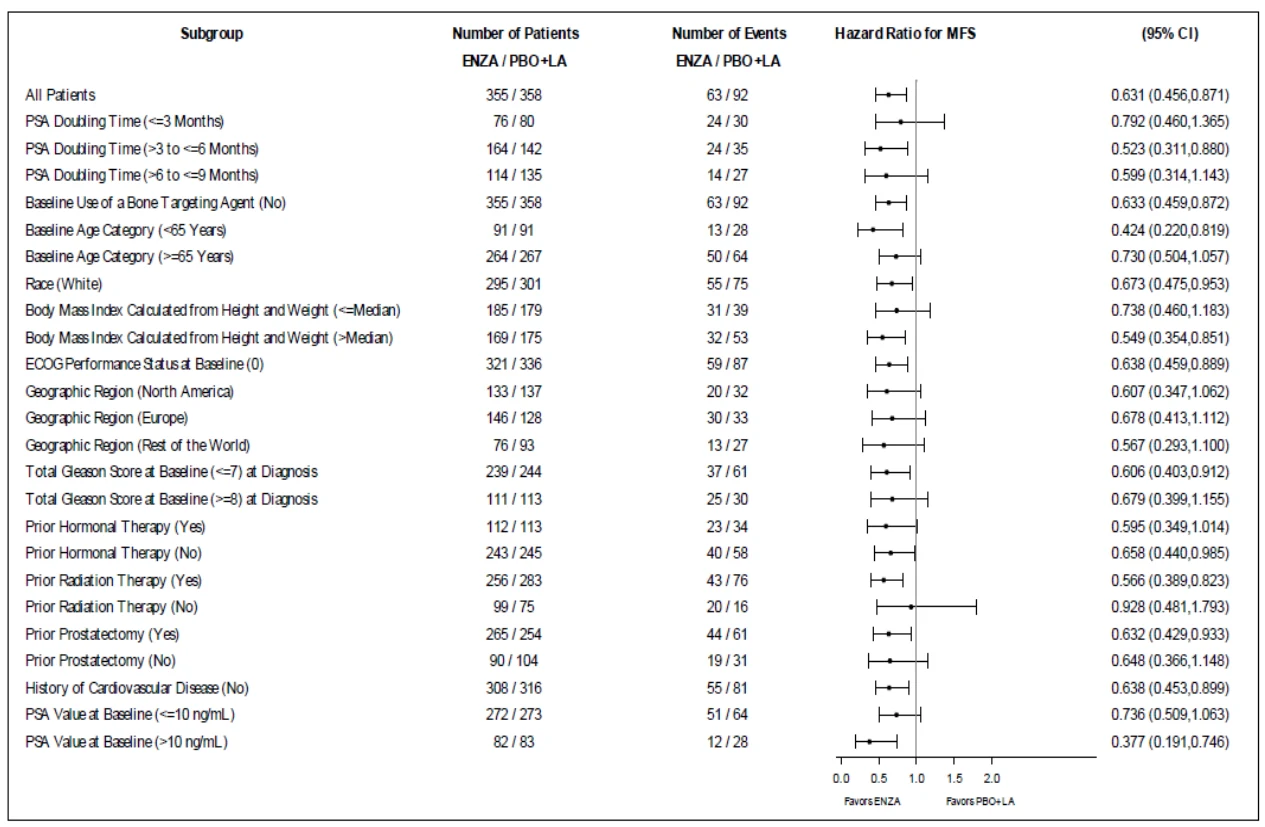
Metastatic Castration-Sensitive Prostate Cancer (ARCHES)
Enzalutamide capsules demonstrated a statistically significant 61% reduction in the risk of an rPFS event compared to placebo [HR = 0.39 (95% CI: 0.30, 0.50), p < 0.0001]. The median time to an rPFS event was not reached in the enzalutamide capsules plus ADT arm and was 19.0 months (95% CI: 16.6, 22.2) in the placebo plus ADT arm (Table 17, Figure 6).
The rPFS results were further supported by clinically meaningful and statistically significant improvements in overall survival in addition to 4 other key secondary endpoints. At the pre-specified final analysis for overall survival, conducted when 356 deaths were observed, a statistically significant 34% reduction in the risk of death was demonstrated in the group randomized to receive enzalutamide capsules compared with the group randomized to receive placebo [HR = 0.66, (95% CI: 0.53, 0.81), p < 0.0001]. The median time for overall survival was not reached in either treatment group (see Figure 6).
Assessments of Patient Reported Outcomes data showed that patients enrolled in ARCHES had a high baseline level of Quality of Life, with the enzalutamide capsules plus ADT arm showing no statistically significant difference versus the placebo plus ADT arm over time.
Table 17 – Summary of efficacy results in the ARCHES study (intent-to-treat analysis)
Enzalutamide capsules (N = 574) | Placebo (N = 576) | ||||||||||||||||||||||
|---|---|---|---|---|---|---|---|---|---|---|---|---|---|---|---|---|---|---|---|---|---|---|---|
Enzalutamide capsules (N = 574) | Placebo (N = 576) | ||||||||||||||||||||||
Enzalutamide capsules (N = 574) | Placebo (N = 576) | ||||||||||||||||||||||
| Primary Endpoint | |||||||||||||||||||||||
| Radiographic Progression-free Survivala | |||||||||||||||||||||||
| Number of Events (%) | 91 (15.9) | 201 (34.9) | |||||||||||||||||||||
| Median, months (95% CI)b | NR (NR, NR) | 19.0 (16.6, 22.2) | |||||||||||||||||||||
| Hazard Ratio (95% CI)c | 0.39 (0.30, 0.50) | ||||||||||||||||||||||
| P-valuec | p < 0.0001 | ||||||||||||||||||||||
| Key Secondary Efficacy Endpoints | |||||||||||||||||||||||
| Overall Survivald | |||||||||||||||||||||||
| Number of Events (%) | 154 (26.8) | 202 (35.1) | |||||||||||||||||||||
| Median, months (95% CI)b | NR (NR, NR) | NR (49.7, NR) | |||||||||||||||||||||
| Hazard Ratio (95% CI)c | 0.66 (0.53, 0.81) | ||||||||||||||||||||||
| P-valuec | p < 0.0001 | ||||||||||||||||||||||
| Time to PSA progressiona,e | |||||||||||||||||||||||
| Number of Events (%) | 45 (7.8) | 189 (32.8) | |||||||||||||||||||||
| Median, months (95% CI)b | NR (NR, NR) | NR (16.6, NR) | |||||||||||||||||||||
| Hazard Ratio (95% CI)c | 0.19 (0.13, 0.26) | ||||||||||||||||||||||
| P-valuec | p < 0.0001 | ||||||||||||||||||||||
| Time to first use of new antineoplastic therapya | |||||||||||||||||||||||
| Number of Events (%) | 46 (8.0) | 133 (23.1) | |||||||||||||||||||||
| Median, months (95% CI)b | 30.2 (NR, NR)f | NR (21.1, NR) | |||||||||||||||||||||
| Hazard Ratio (95% CI)c | 0.28 (0.20, 0.40) | ||||||||||||||||||||||
| P-valuec | p < 0.0001 | ||||||||||||||||||||||
| PSA Undetectable Ratesa | |||||||||||||||||||||||
| Patients with PSA detectable at baseline | 511 | 506 | |||||||||||||||||||||
| Patients with PSA undetectable at baseline | 63 | 70 | |||||||||||||||||||||
| Undetectable PSA during treatment period | 348 / 511 (68.1) | 89 / 506 (17.6) | |||||||||||||||||||||
| 95% CI for rate | (63.9, 72.1) | (14.4, 21.2) | |||||||||||||||||||||
| Difference in rate (95% CI)c | 50.5% (45.3, 55.7) | ||||||||||||||||||||||
| P-value | p < 0.0001 | ||||||||||||||||||||||
| Objective Response Ratea | |||||||||||||||||||||||
| Patients with PSA detectable at baseline | 177 | 182 | |||||||||||||||||||||
| Number of Events (%) | 147 (83.1) | 116 (63.7) | |||||||||||||||||||||
| 95% CI for rate | (76.7, 88.3) | (56.3, 70.7) | |||||||||||||||||||||
| Difference in rate (95% CI)c | 19.3% (10.4, 28.2) | ||||||||||||||||||||||
| P-value | p < 0.0001 | ||||||||||||||||||||||
| Time to deterioration in urinary symptomsa,g | |||||||||||||||||||||||
| Events, n (%) | 184 (32.06) | 201 (34.90) | |||||||||||||||||||||
| Kaplan-Meier median (95% CI)b (months) | NR (19.35, NR) | 16.8 (14.06, NR) | |||||||||||||||||||||
| Hazard Ratio (95% CI)c | 0.88 (0.72, 1.08) | ||||||||||||||||||||||
| P-valuec | p = 0.2162 | ||||||||||||||||||||||
| Other Secondary Efficacy Endpoints | |||||||||||||||||||||||
| Time to first SSE (Symptomatic Skeletal Event)a,h | |||||||||||||||||||||||
| Patients with SSE events, n (%) | 31 (5.40) | 56 (9.72) | |||||||||||||||||||||
| Median, months (95% CI)b | NR (NR, NR) | NR (NR, NR) | |||||||||||||||||||||
| Hazard Ratio (95% CI)c | 0.52 (0.33, 0.80) | ||||||||||||||||||||||
| P-value (nominal)c | p = 0.0026 | ||||||||||||||||||||||
| Time to castration resistancea,i | |||||||||||||||||||||||
| Events, n (%) | 90 (15.68) | 257 (44.62) | |||||||||||||||||||||
| Kaplan-Meier median (95% CI)b (months) | NR (NR, NR) | 13.9 (11.40, 17.18) | |||||||||||||||||||||
| Hazard Ratio (95% CI)c | 0.28 (0.22, 0.36) | ||||||||||||||||||||||
| P-value (nominal)c | p < 0.0001 | ||||||||||||||||||||||
| Time to deterioration of quality of lifea,j | |||||||||||||||||||||||
| Events, n (%) | 280 (48.78) | 274 (47.57) | |||||||||||||||||||||
| Kaplan-Meier median (95% CI)b (months) | 11.3 (11.04, 13.83) | 11.1 (8.48, 13.83) | |||||||||||||||||||||
| Hazard Ratio (95% CI)c | 0.96 (0.81, 1.14) | ||||||||||||||||||||||
| P-value (nominal)c | p = 0.6548 | ||||||||||||||||||||||
| Time to pain progressiona,k | |||||||||||||||||||||||
| Events, n (%) | 324 (56.45) | 329 (57.12) | |||||||||||||||||||||
| Kaplan-Meier median (95% CI)b (months) | 8.3 (8.25, 10.91) | 8.3 (5.65, 8.38) | |||||||||||||||||||||
| Hazard Ratio (95% CI)c | 0.92 (0.78, 1.07) | ||||||||||||||||||||||
| P-value (nominal)c | 0.2715 | ||||||||||||||||||||||
NR = Not reached.
- a. Based upon a pre-specified analysis with data cut-off date of 14 October 2018.
- b. Calculated using Brookmeyer and Crowley method.
- c. Stratified by volume of disease (low vs high) and prior docetaxel use (yes or no).
- d. Based upon a pre-specified final analysis with data cut-off date of 28 May 2021.
- e. PSA progression was defined as a ≥ 25% increase and an absolute increase of ≥ 2 mcg / L above nadir.
- f. While an estimate of the median time was provided for the enzalutamide capsules plus ADT arm (30.2 months), this estimate was not reliable as it resulted from an event observed in the only remaining patient at risk at approximately 30 months, leading to a vertical drop at the end of the Kaplan-Meier curve.
- g.
A deterioration in urinary symptoms was defined as an increase in the QLQ-PR25 modified urinary symptoms score by
≥ 50% of the standard deviation observed in the QLQ-PR25 modified urinary symptoms score at baseline. In patients with a deterioration in urinary symptoms, the time to deterioration in urinary symptoms was defined as the time interval between randomization and the first deterioration in urinary symptoms. In patients without a deterioration in urinary symptoms the time to deterioration in urinary symptoms was censored on the date that the last urinary symptoms QLQ- PR25 score was calculable.
- h. An SSE was defined as radiation or surgery to bone, clinically apparent pathological bone fracture or spinal cord compression whichever occurred first. Time to the first SSE was the time from randomization to the occurrence of the first SSE. In patients with no SSE, time to SSE was censored on the last visit date or the date of randomization, whichever occurred last.
- i. A castration resistance event was defined as an occurrence of radiographic disease progression by ICR, PSA progression or an SSE with castration levels of testosterone (< 50 ng / mL), whichever occurred first. In patients with a castration resistance event, the time to castration resistance was the time from randomization to the first castration resistance event. In patients with no documented castration resistance event, the time to castration resistance was censored on the latest date from the following: the last radiologic assessment, the last PSA sample taken prior to the start of any new prostate cancer therapy and prior to 2 or more consecutive missed PSA assessments or the last visit date performed.
- j. Deterioration of QoL was defined as a decrease from baseline of a least 10 points in the FACT-P total score. In patients with a deterioration in QoL, the time to deterioration in QoL was the time interval from the date of randomization to the first date a decline from baseline of 10 points or more in the FACT-P total score was recorded. In patients without FACT-P progression, the time to deterioration of QoL was censored on the date that the last FACT-P total score was calculable.
- k. Pain progression was defined as an increase of ≥ 30% from baseline in the average BPI-SF item scores. In patients with pain progression, time to pain progression was defined as the time from randomization to the first pain progression event. In patients with no pain progression event, time to pain progression was censored on the last visit date where BPI-SF data were collected.
Figure 4: Kaplan-Meier Curve of rPFS in ARCHES study (Intent-to-Treat Analysis)
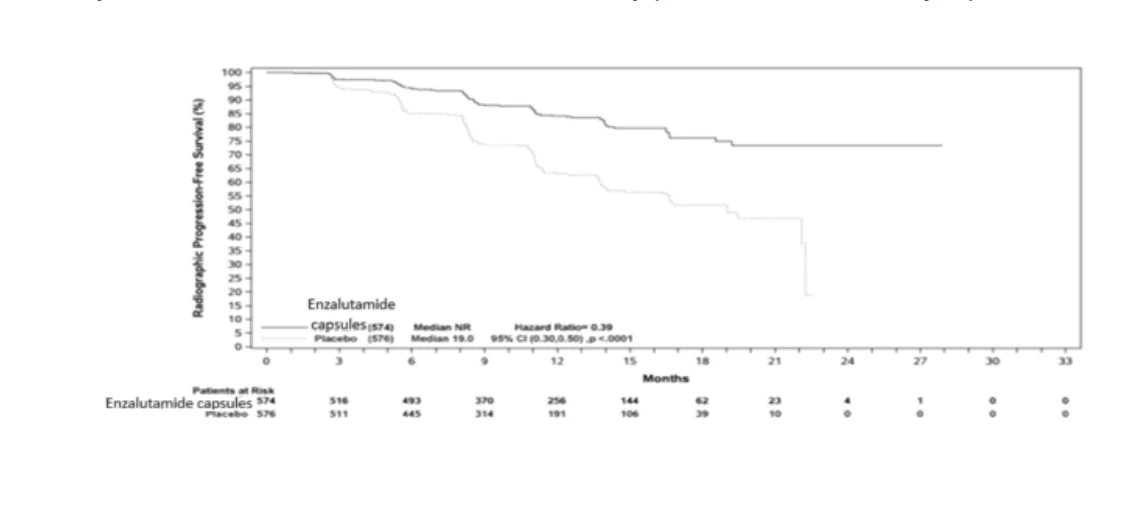
Figure 5: Forest Plot of rPFS by Prespecified Subgroup in ARCHES (Intent-to-Treat Analysis)
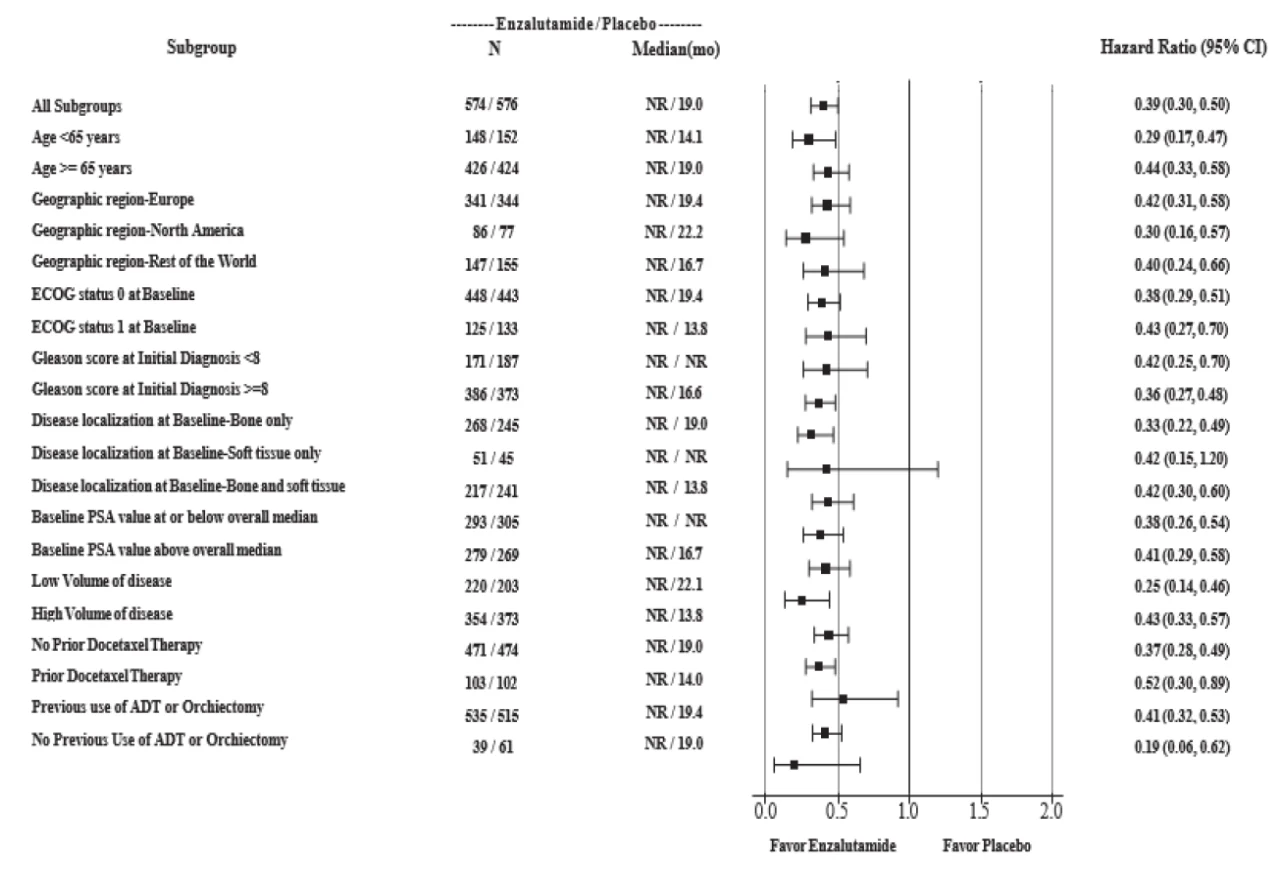
Figure 6: Kaplan-Meier Curves of Final Overall Survival in the ARCHES Study (Intent-to-Treat Analysis)
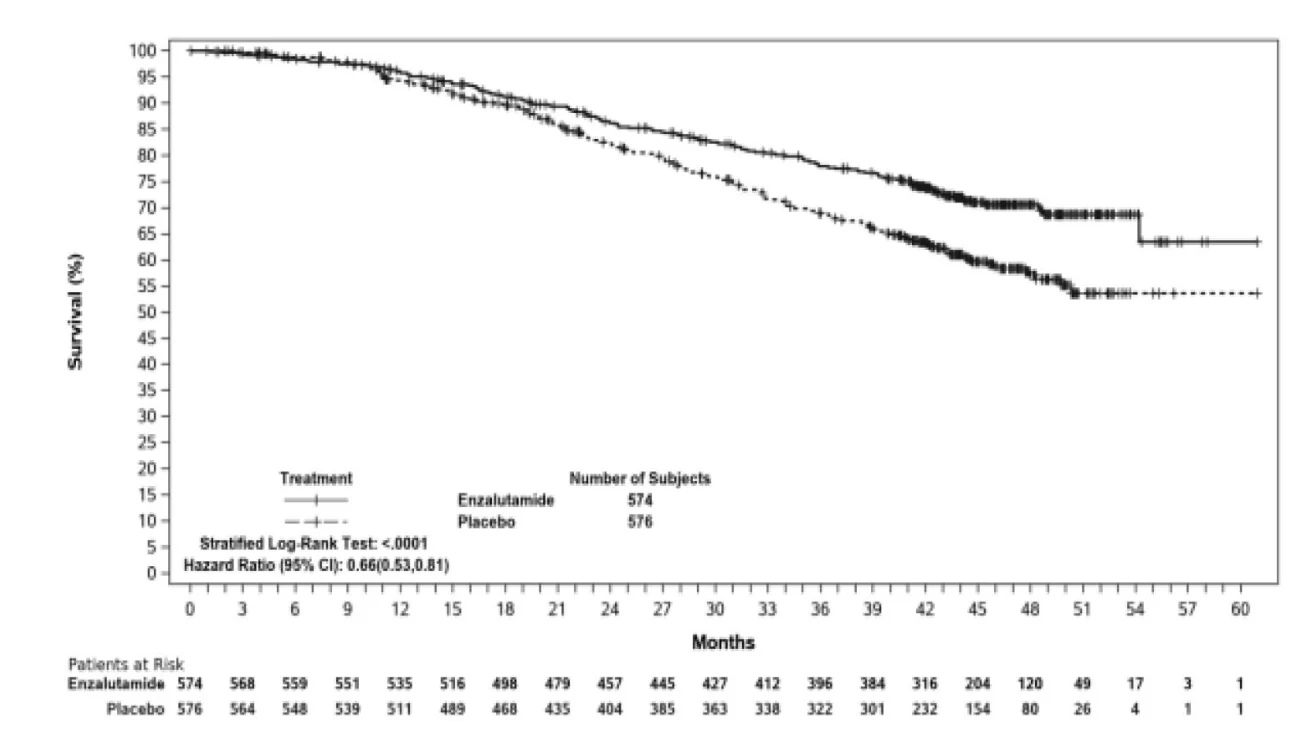
Non-Metastatic Prostate Cancer that Progressed on Androgen Deprivation Therapy (PROSPER)
Enzalutamide capsules demonstrated a statistically significant 71% reduction in relative risk of radiographic progression or death as compared to placebo [HR = 0.29 (95% CI: 0.24, 0.35), p < 0.0001]. Median MFS was 36.6 months (95% CI: 33.1, NR) in the enzalutamide capsules arm versus 14.7 months (95% CI: 14.2, 15.0) in the placebo arm (Table 18, Figure 7). Consistent MFS results were observed across all pre-specified patient subgroups (Figure 8).
In addition to the primary efficacy endpoint, statistically significant improvements were shown for secondary endpoints overall survival, time to PSA progression, and time to first use of new antineoplastic therapy (Table 18).
At a prespecified interim analysis for overall survival, conducted when 466 deaths were observed, a statistically significant improvement in overall survival was demonstrated in patients randomized to receive enzalutamide capsules compared with patients randomized to receive placebo with a 26.6% reduction in risk of death [hazard ratio (HR) = 0.734, (95% CI: 0.608, 0.885), p = 0.0011] (Figure 9).
The median follow-up time was 48.6 months in the enzalutamide capsules group and 47.2 months in the placebo group.
Table 18 – Summary of efficacy results in the PROSPER study (intent-to-treat analysis)
| Enzalutamide capsules (N = 933) | Placebo (N = 468) | |||||||||||
|---|---|---|---|---|---|---|---|---|---|---|---|---|
| Primary Endpoint | ||||||||||||
| Metastasis-free survival | ||||||||||||
| Number of Events (%) | 219 (23.5) | 228 (48.7) | ||||||||||
| Median, months (95% CI)a | 36.6 (33.1, NR) | 14.7 (14.2, 15.0) | ||||||||||
| Hazard Ratio (95% CI)b | 0.29 (0.24, 0.35) | |||||||||||
| P-valuec | p < 0.0001 | |||||||||||
| Key Secondary Efficacy Endpoints | ||||||||||||
| Overall Survivald | ||||||||||||
| Number of Events (%) | 288 (30.9) | 178 (38.0) | ||||||||||
| Median, months (95% CI)a | 67.0 (64.0, NR) | 56.3 (54.4, 63.0) | ||||||||||
| Hazard Ratio (95% CI)b | 0.734 (0.608, 0.885) | |||||||||||
| P-valuec | P = 0.0011 | |||||||||||
| Time to PSA progression | ||||||||||||
| Number of Events (%) | 208 (22.3) | 324 (69.2) | ||||||||||
| Median, months (95% CI)a | 37.2 (33.1, NR) | 3.9 (3.8, 4.0) | ||||||||||
| Hazard Ratio (95% CI)b | 0.07 (0.05, 0.08) | |||||||||||
| P-valuec | p < 0.0001 | |||||||||||
| Time to first use of new antineoplastic therapy | ||||||||||||
| Number of Events (%) | 142 (15.2) | 226 (48.3) | ||||||||||
| Median, months (95% CI)a | 39.6 (37.7, NR) | 17.7 (16.2, 19.7) | ||||||||||
| Hazard Ratio (95% CI)b | 0.21 (0.17, 0.26) | |||||||||||
| P-valuec | p < 0.0001 | |||||||||||
NR = Not reached.
a. Based on Kaplan-Meier estimates.
b. HR is based on a Cox regression model (with treatment as the only covariate) stratified by PSA doubling time and prior or concurrent use of a bone-targeting agent. The HR is relative to placebo with < 1 favouring enzalutamide.
c. P-value is based on a stratified log-rank test by PSA doubling time (< 6 months, ≥ 6 months) and prior or concurrent use of a bone targeting agent (yes, no).
d. Based upon a prespecified interim analysis with data cut-off date of 15 Oct 2019.
Figure 7: Kaplan-Meier Curves of metastasis-free survival in the PROSPER study (intent-to-treat analysis)
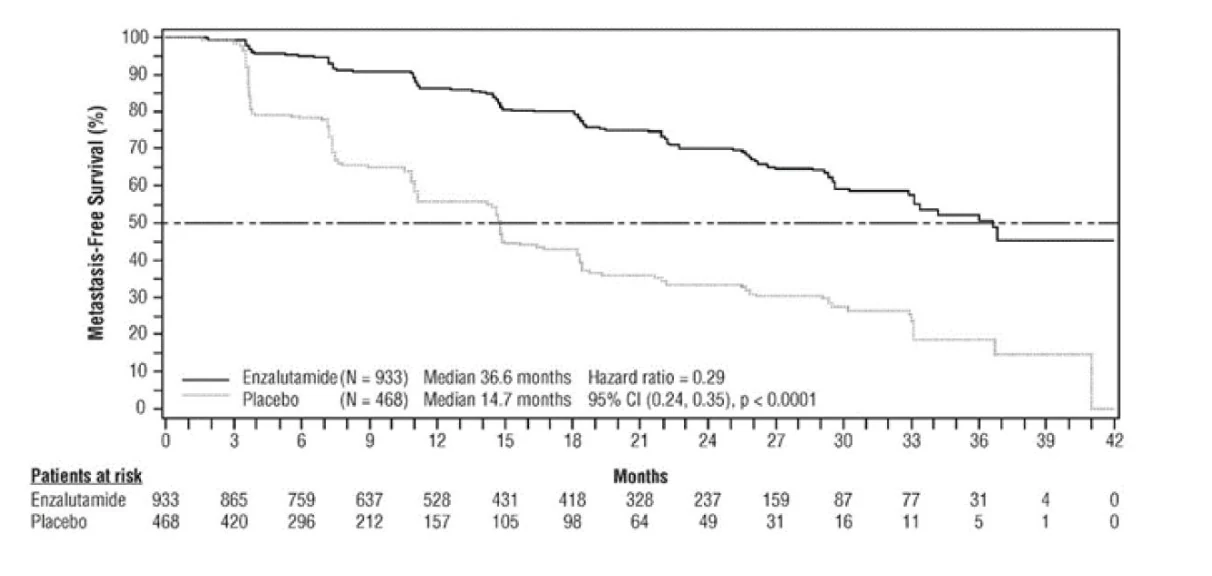
Figure 8: Forest Plot of MFS in Study MDV3100-14 - Subgroup Analysis (ITT Population)
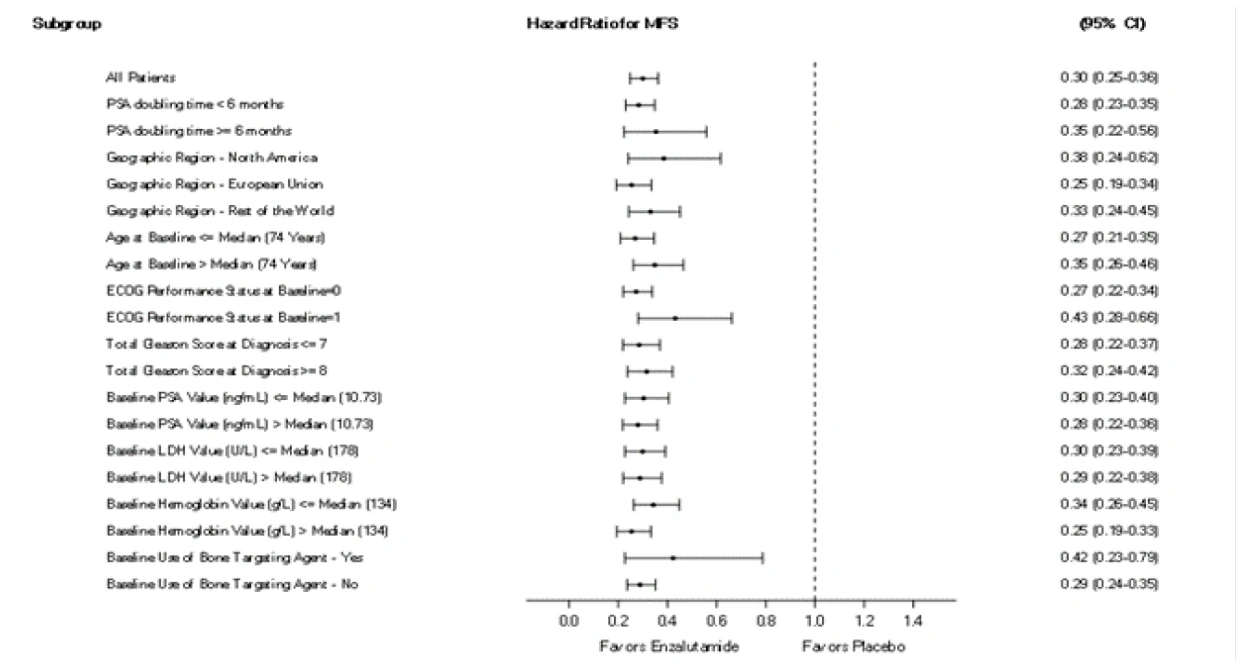
All patients randomly assigned to study treatment and based on randomized treatment assignment regardless of whether or not treatment was administered (ITT Population).
Hazard ratios for all patients and for all other subgroups were based on an unstratified Cox regression model with treatment as the only covariate.
ECOG: Eastern Cooperative Oncology Group; ITT: intent-to-treat; LDH: lactate dehydrogenase; MFS: metastasis-free survival; PSA: prostate-specific antigen.
Figure 9: Kaplan-Meier Curves of overall survival in the PROSPER study (intent-to-treat analysis)
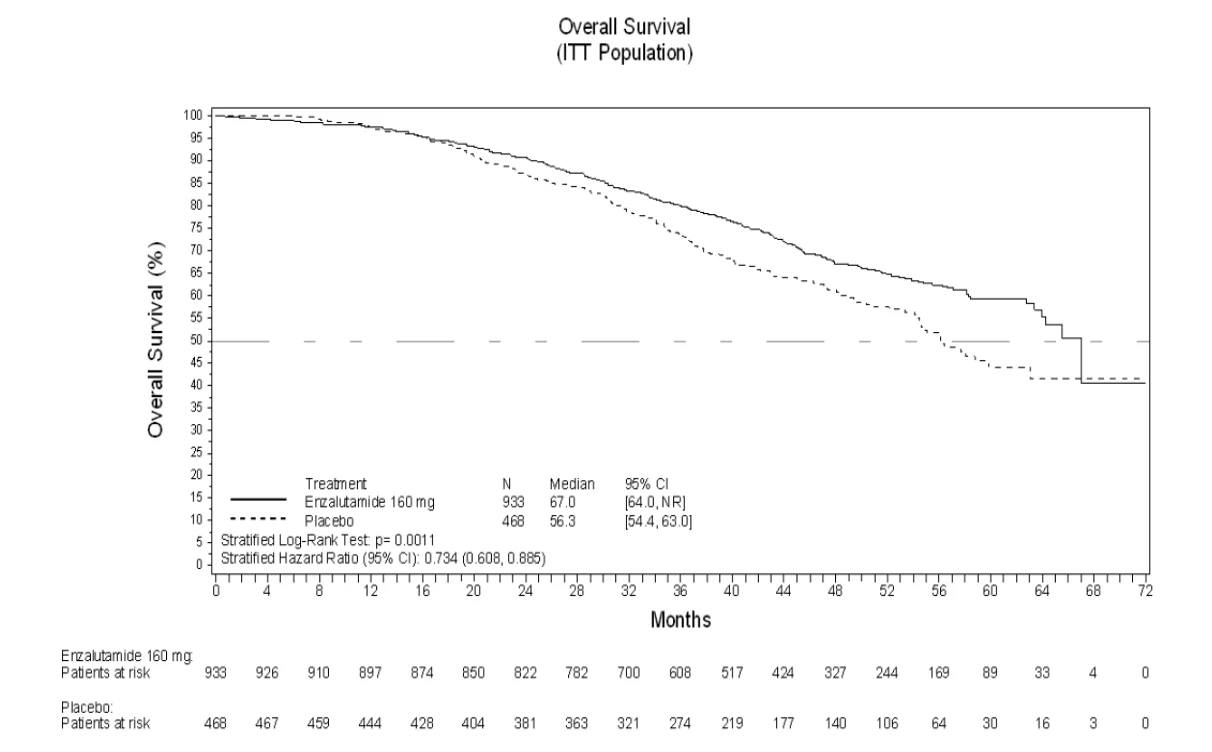
Figure 10: Forest Plot of overall survival in the PROSPER study (intent-to-treat analysis)
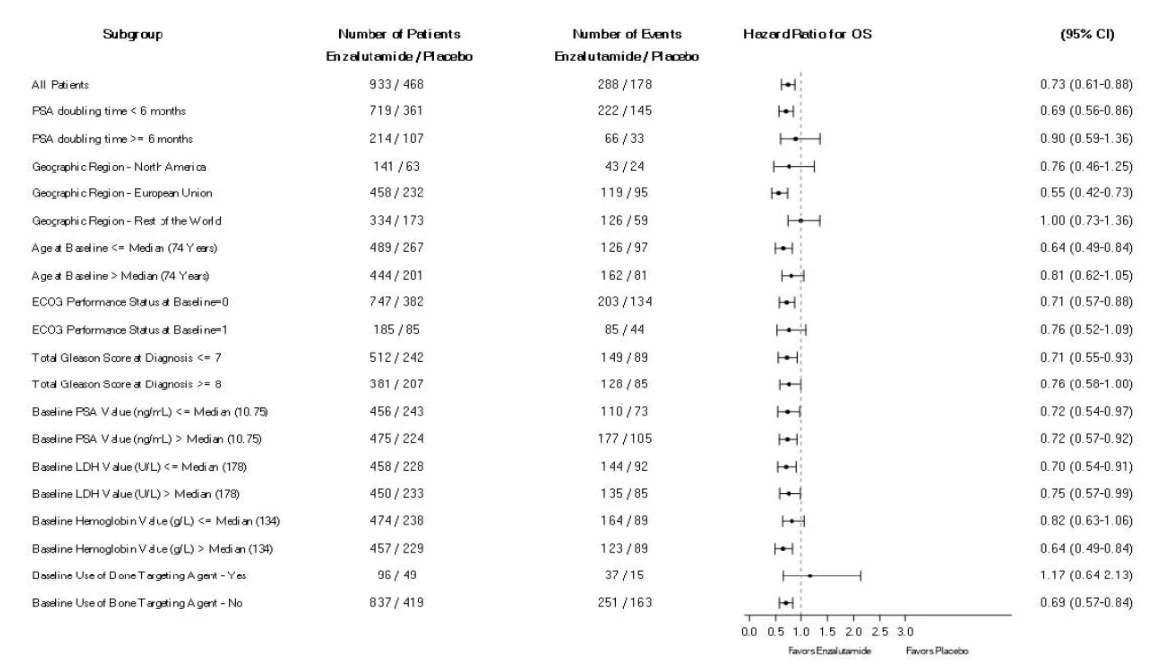
Chemotherapy-naïve mCRPC that Progressed on Androgen Deprivation Therapy (PREVAIL)
At the pre-specified interim analysis for overall survival, treatment with enzalutamide capsules demonstrated a statistically significant improvement in overall survival compared to treatment with placebo with a 29.4% reduction in risk of death [HR = 0.706, (95% CI: 0.596, 0.837), p < 0.0001]. At the interim analysis, 27.6% (241 of 872) of patients treated with enzalutamide capsules, compared with 35.4% (299 of 845) of patients treated with placebo, had died. Estimated median overall survival was 32.4 months (95% CI: 30.1, not reached) in the enzalutamide capsules -treated patients and was 30.2 months (95% CI: 28.0, not reached) in the placebo-treated patients (Table 19). In addition, 40.4% of enzalutamide capsules -treated patients and 70.5% of placebo- treated patients received subsequent therapies with a demonstrated survival benefit. Median follow-up time based on reverse Kaplan-Meier estimates were 22.2 months for enzalutamide capsules -treated patients and 22.4 months for placebo-treated patients.
An analysis of 5-year data (September 30, 2017) showed a statistically significant increase in overall survival maintained in patients treated with enzalutamide capsules compared to placebo [HR = 0.835, (95% CI: 0.75, 0.93), p-value = 0.0008] despite 28% of patients on placebo crossing over to enzalutamide capsules. The 5-year OS rate was 26% for the enzalutamide capsules arm compared to 21% for the placebo arm (Table 19, Figure 11).
Table 19 – PREVAIL Duration of Overall Survival – Co-primary Analysis (ITT Population)
| Parameter | Enzalutamide capsules (N = 872) | Placebo (N = 845) | |||||||||
|---|---|---|---|---|---|---|---|---|---|---|---|
| Pre-Specified Interim Analysisa | |||||||||||
| Deaths | 241 (27.6%) | 299 (35.4%) | |||||||||
| Median survival, months (95% CI) | 32.4 (30.1, NYR) | 30.2 (28.0, NYR) | |||||||||
| P-valueb | < 0.0001 | ||||||||||
| Hazard ratio (95% CI)c | 0.706 (0.596, 0.837) | ||||||||||
| 5-year Survival Analysisa | |||||||||||
| Deaths | 689 (79) | 693 (82) | |||||||||
| Median survival, months (95% CI) | 35.5 (33.5, 38.0) | 31.4 (28.9, 33.8) | |||||||||
| P-valueb | P = 0.0008 | ||||||||||
| Hazard ratio (95% CI)c | 0.835 (0.75, 0.93) | ||||||||||
- a. Cut-off dates: September 16, 2013 (interim analysis) and September 30, 2017 (5-year analysis).
- b. P-value is derived from unstratified log-rank test.
- c. The hazard ratio is based on an unstratified Cox regression model (with treatment as the only covariate) and is relative to placebo with < 1 favouring enzalutamide capsules. ITT, intent-to-treat; NYR, not yet reached.
The treatment effect was apparent after the first three months of treatment and maintained through the follow-up period (Figure 11). Subgroup survival analysis showed a consistent survival benefit for treatment with enzalutamide capsules (Figure 12).
Figure 11: Kaplan-Meier Overall Survival Curves of Patients Treated with Either enzalutamide capsules or Placebo in the PREVAIL Study (Intent-to-Treat Analysis*)
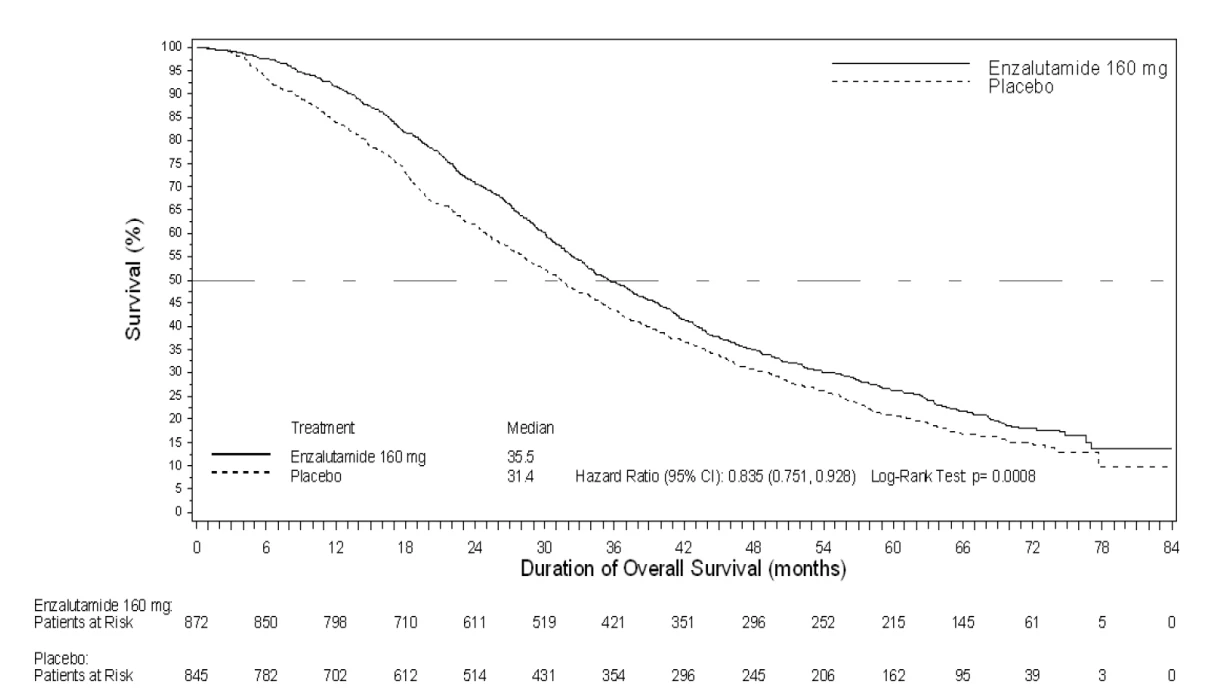
- 5-year survival analysis (September 30, 2017)
Figure 12: Overall Survival Analysis by Subgroup: Hazard Ratio and 95% Confidence Interval in the PREVAIL Study (Intent-to-Treat Analysis*)
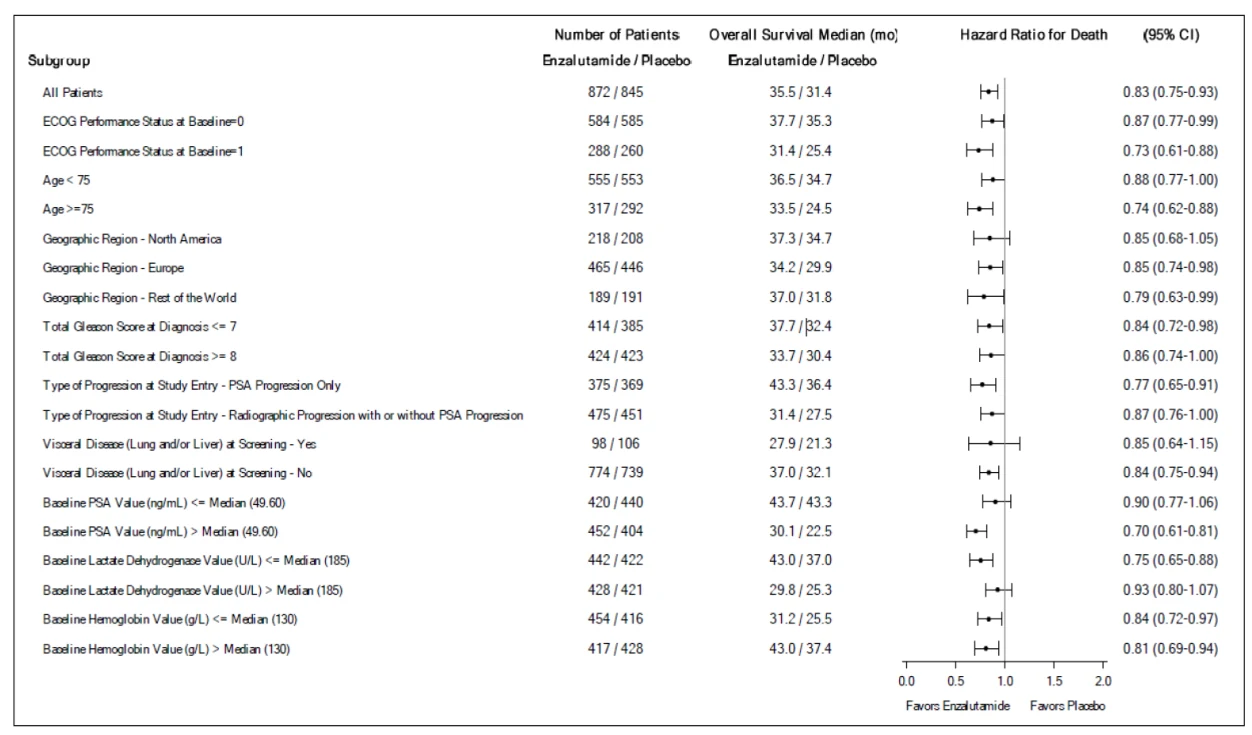
- 5-year survival analysis (September 30, 2017)
At the pre-specified rPFS analysis, a statistically significant improvement was demonstrated between the treatment groups with an 81.4% reduction in risk of radiographic progression or death [HR = 0.186 (95% CI: 0.149, 0.231), p < 0.0001]. One hundred and eighteen (14%) enzalutamide capsules -treated patients and 321 (40%) of placebo-treated patients had an event. The median rPFS was not reached (95% CI: 13.8, not reached) in the enzalutamide capsules -treated group and was 3.9 months (95% CI: 3.7, 5.4) in the placebo-treated group (Figure 13, Table 20). Consistent rPFS benefit was observed across all pre-specified patient subgroups (Figure 14). Median follow-up time based on reverse Kaplan-Meier estimates were 5.4 months for enzalutamide capsules -treated patients and 3.6 months for placebo-treated patients.
Table 20 – PREVAIL, Duration of Radiographic Progression-Free Survival – Co-primary Analysis Based on Independent Central Review (ITT Population)
| Radiographic Progression-Free Survival Follow-Up | Enzalutamide capsules (N = 832) | Placebo (N = 801) | ||||
|---|---|---|---|---|---|---|
| rPFS Eventsa | 118 (14.2%) | 321 (40.1%) | ||||
| Duration of rPFS (months)b,c | ||||||
| Median duration of rPFS (months)b,c (95% CI) | NYR (13.8, NYR) | 3.9 (3.7, 5.4) | ||||
| P-value (unstratified) | < 0.0001 | |||||
| Hazard ratio (95% CI)d | 0.186 (0.149, 0.231) | |||||
- a. Based on the earliest contributing event (radiographic progression or death due to any cause within 168 days after treatment discontinuation).
- b. Patients who were not known to have had an rPFS event at the time of analysis data cut-off are censored at date of last assessment showing no objective evidence of radiographic progression prior to scan modality change, new antineoplastic treatment, initiation of radiation therapy for prostate cancer, skeletal-related event, treatment discontinuation, and 2 or more consecutive missed tumour assessments.
- c. Based on Kaplan-Meier estimates.
- d.
The hazard ratio is based on a Cox regression model (with treatment as the only covariate) and is relative to placebo with
< 1 favouring enzalutamide capsules. ITT, intent-to-treat; NYR, not yet reached; rPFS, radiographic progression-free survival.
Figure 13: Kaplan-Meier Curves of Radiographic Progression-Free Survival in Patients Treated with Either enzalutamide capsules or Placebo in the PREVAIL Study (Intent-to-Treat Analysis*)
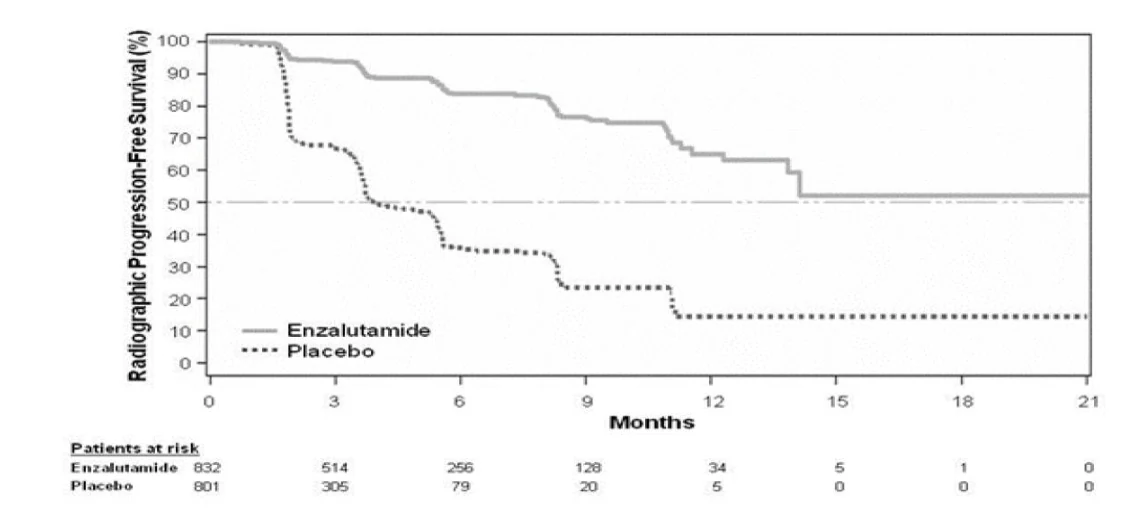
* At the time of the primary analysis there were 1633 patients randomized.
Figure 14: Radiographic Progression-Free Survival by Subgroup: Hazard Ratio and 95% Confidence Interval in the PREVAIL Study (Intent-to-Treat Analysis)
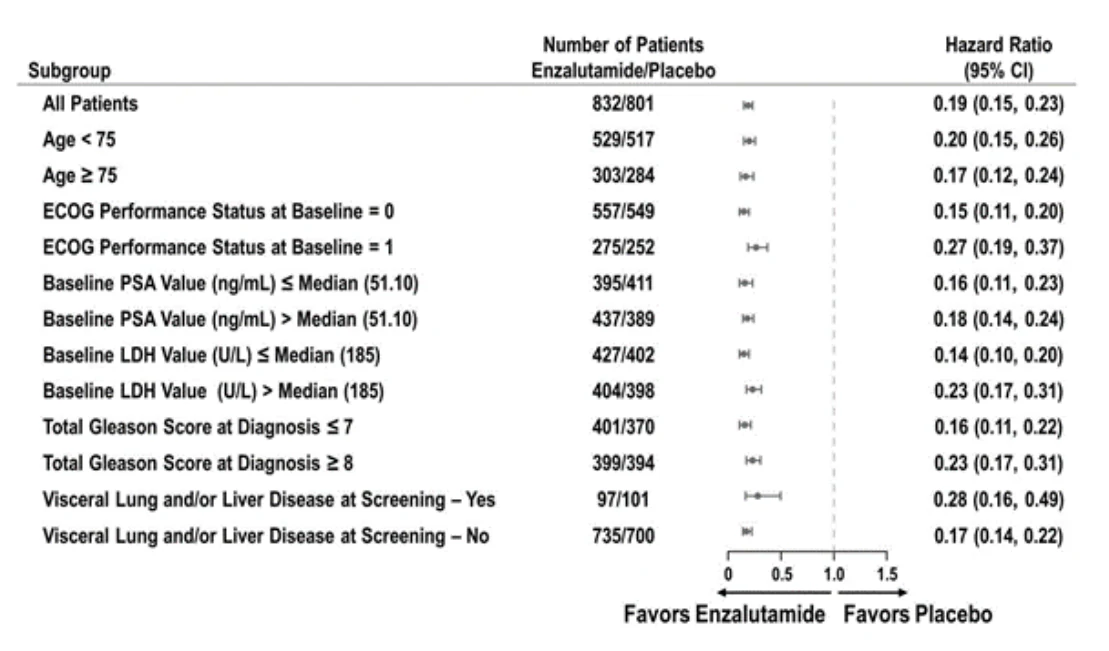
In addition to the co-primary efficacy endpoints, statistically significant improvements were also demonstrated in prospectively defined secondary endpoints, see Table 21.
Table 21 – Summary of Secondary Endpoint Results (PREVAIL)
| Endpoint | Enzalutamide capsules | Placebo | Hazard Ratio [95% CI] | P-Value | ||||||
|---|---|---|---|---|---|---|---|---|---|---|
| Secondary Efficacy Endpoints | ||||||||||
| Time To Initiation Of | 28.0 months | 10.8 | 0.349 | < 0.0001 | ||||||
| Cytotoxic | months | (0.303, | ||||||||
| Chemotherapya | 0.403) | |||||||||
| Best Overall Soft | 58.8% | 5.0% | 53.85% | < 0.0001 | ||||||
| Tissue Response | (48.53, 59.17%) | |||||||||
| Complete response | 19.7% | 1.0% | ||||||||
| Partial response | 39.1% | 3.9% | ||||||||
| Time to First Skeletal- | 31.1 months | 31.3 | 0.718 | < 0.0001 | ||||||
| Related Event | months | (0.610, 0.844) | ||||||||
| (median)a,b | ||||||||||
| Time to PSA | 11.2 months | 2.8 months | 0.169 | < 0.0001 | ||||||
| Progressiona,c | (0.147, 0.195) | |||||||||
PSA Response Rate ≥ 50% Decrease | 78.0% | 3.5% | N / A | < 0.0001 | ||||||
- a. Based on Kaplan-Meier estimates.
- b. Skeletal-related event was defined as radiation therapy or surgery to bone for prostate cancer, pathological bone fracture, spinal cord compression, or change of antineoplastic therapy to treat bone pain from prostate cancer.
- c. Based on PSA progression compliant with Prostate Cancer Clinical Trials Working Group 2 criteria.
Best overall soft tissue response was analyzed for the ITT population with measurable soft tissue disease at baseline, defined by the presence of at least 1 target lesion according to RECIST v 1.1 as assessed by the investigator. Response categories are based on target, non-target, and new lesions. Confirmation of response was not required. The trial used the same modality of imaging (CT or MRI) throughout the trial for each institution.
PSA response ≥ 50% decreased from baseline was evaluated in 854 patients (97.9%) in the enzalutamide capsules treatment group and 777 patients (92.0%) in the placebo treatment group who had both baseline and at least 1 post-baseline PSA assessment during the study (ITT evaluable population). Confirmation required a subsequent assessment that was consecutive and conducted at least 3 weeks later.
mCRPC Patients with Prior Docetaxel Treatment (AFFIRM)
The pre-specified interim analysis was conducted after 520 deaths were observed. A statistically significant 4.8-month improvement in median overall survival was observed with treatment with enzalutamide capsules versus placebo (18.4 months and 13.6 months respectively), (Table 22). The stratified hazard ratio for death for enzalutamide capsules -treated patients was 0.631 (95% CI: 0.529, 0.752; p < 0.0001), a 37% reduction in the risk of patient death.
At all evaluation time points after the initial few months of treatment, a higher proportion of patients treated with enzalutamide capsules remained alive, compared to those treated with placebo (Figure 15). The median duration of follow-up was 14.4 months.
Table 22 – Overall Survival of Patients Treated with Either enzalutamide capsules or Placebo in the AFFIRM Study (Intent-to-Treat Analysis)
| Parameter | Enzalutamide capsules (N = 800) | Placebo (N = 399) | ||||||
|---|---|---|---|---|---|---|---|---|
| Deaths (%) | 308 (38.5%) | 212 (53.1%) | ||||||
| Median survival (months) (95% CI) | 18.4 (17.3, NR) | 13.6 (11.3, 15.8) | ||||||
| P-valuea | < 0.0001 | |||||||
| Hazard ratio (95% CI)b | 0.631 (0.529, 0.752) | |||||||
- a. P-value is derived from a log-rank test stratified by ECOG performance status score (0-1 vs. 2) and mean pain score (< 4 vs. ≥ 4).
- b. Hazard Ratio is derived from a stratified proportional hazards model. Hazard ratio < 1 favours enzalutamide capsules. NR: not reached.
Figure 15: Kaplan-Meier Overall Survival Curves of Patients Treated with Either Enzalutamide Capsules or Placebo in the AFFIRM Study (Intent-to-Treat Analysis)
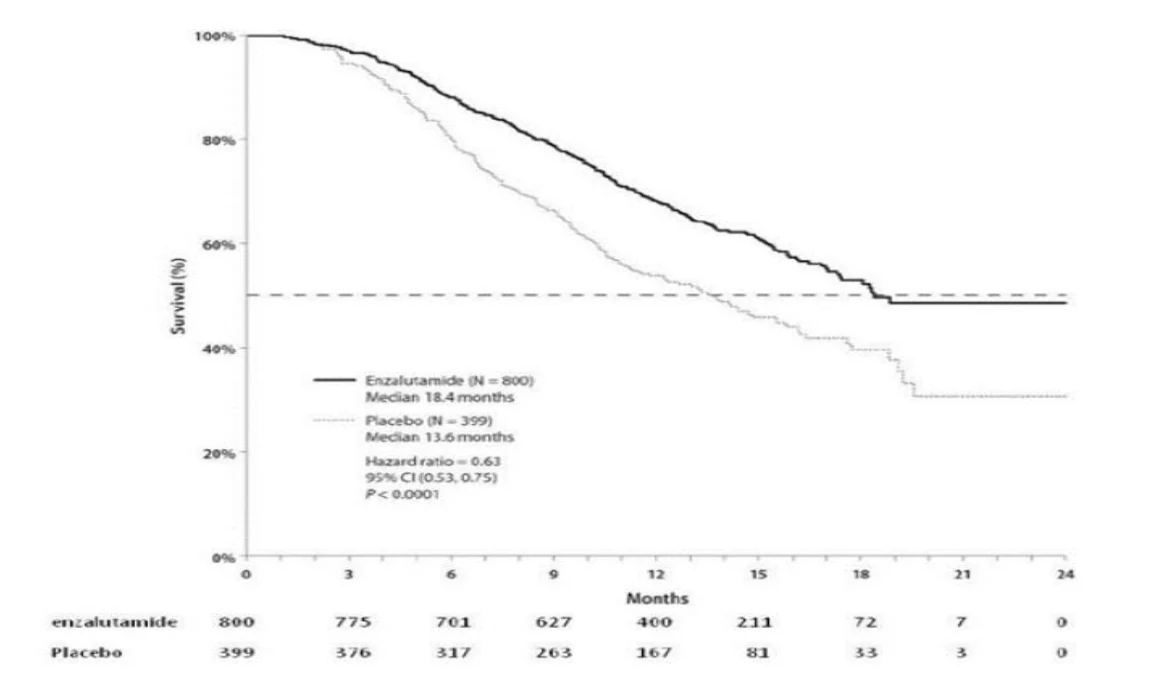
The median duration of therapy on enzalutamide capsules was 8.3 months vs. 3.0 months for placebo.
Subgroup survival analysis demonstrated a consistent favourable survival benefit for treatment with enzalutamide capsules (Figure 16).
Figure 16: Overall Survival by Subgroup – Hazard Ratio and 95% Confidence Interval in the AFFIRM Study
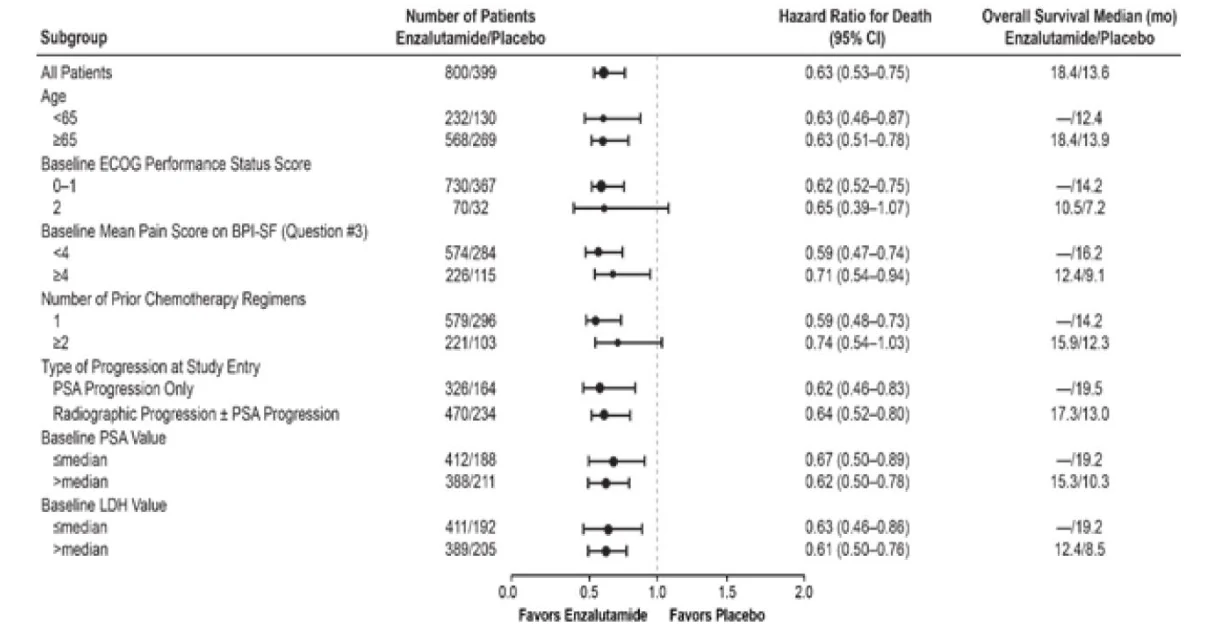
The benefit observed for enzalutamide capsules in overall survival was supported by significant improvements in all secondary endpoints (see Table 23).
Table 23 – Summary of Secondary Endpoint Results (AFFIRM)
| Endpoint | Enzalutamide capsules | Placebo | Hazard Ratio [95% CI] | P-Value | |||||||
|---|---|---|---|---|---|---|---|---|---|---|---|
| Endpoint | Enzalutamide capsules | Placebo | Hazard Ratio [95% CI] | P-Value | |||||||
| Key Secondary Efficacy Endpoints | |||||||||||
| Time to PSA | 8.3 months | 3.0 | 0.248 | < 0.0001 | |||||||
| Progression (median) | months | [0.204, 0.303] | |||||||||
| Radiographic | 8.3 months | 2.9 | 0.404 | < 0.0001 | |||||||
Progression-Free Survival (median) | months | [0.350, 0.466] | |||||||||
| Time to First Skeletal- | 16.7 months | 13.3 | 0.688 | 0.0001 | |||||||
| Related Event | months | [0.566, 0.835] | |||||||||
| (median) | |||||||||||
| Other Secondary Efficacy Endpointsa | |||||||||||
| FACT-P Response Rateb | 43.2% | 18.3% | NA | < 0.0001 | |||||||
PSA Response Rate ≥ 50% Decrease ≥ 90% Decrease | 54.0% 24.8% | 1.5% 0.9% | NA | < 0.0001 < 0.0001 | |||||||
- a. No corrections for multiplicity were made for these efficacy endpoints.
- b. The evaluable population consists of 85.9% (651 / 758) of patients in the enzalutamide capsules group with a Global FACT-P score at baseline and 66.8% (257 / 385) of patients in the placebo group with a Global FACT-P score at baseline. The disparity in the evaluable population for FACT-P analysis was due to a higher number of placebo patients who discontinued study treatment early due to disease progression.
14.2 Comparative Bioavailability Studies
A randomized, two-way, single-dose, crossover comparative bioavailability study of PRO-ENZALUTAMIDE 40 mg capsules (Pro Doc Ltée.) and prXTANDI® 40 mg capsules (Astellas Pharma Canada, Inc.) was conducted in healthy, adult, Asian male subjects under fasting conditions. Comparative bioavailability data from the 30 subjects that were included in the statistical analysis are presented in the following table:
SUMMARY TABLE OF THE COMPARATIVE BIOVAILABILITY DATA
Enzalutamide (1 x 40 mg) Geometric Mean Arithmetic Mean (CV%) | ||||
| Parameter | Test1 | Reference2 | % Ratio of Geometric Means | 90% Confidence Interval |
AUC0-72h (ng·h / mL) | 39811.4 40605.6 (20.7) | 39326.0 39975.5 (19.1) | 101.2 | 99.5 - 103.0 |
Cmax (ng / mL) | 1946.7 1981.2 (20.0) | 1802.1 1833.6 (18.2) | 108.0 | 100.9 - 115.7 |
Tmax3 (h) | 0.84 (0.33- 2.00) | 1.00 (0.50- 3.50) | ||
1 PRO-ENZALUTAMIDE (enzalutamide) capsules, 40 mg (Pro Doc Ltée.) 2 prXTANDI® (enzalutamide) capsules, 40 mg (Astellas Pharma Canada, Inc.) 3 Expressed as the median (range) only Due to the long elimination half-life of Enzalutamide, AUCI and T½ could not be accurately calculated from the data obtained in this study. | ||||
15 MICROBIOLOGY
Not Applicable
16 NON-CLINICAL TOXICOLOGY
Animal Pharmacology
Decreased activity, tremor and / or convulsions were observed in mice following a single oral dose of enzalutamide ≥ 400 mg / kg. Enzalutamide treatment was also associated with convulsions in mice upon oral dosing of ≥ 200 mg / kg for 7 days. A low incidence of convulsions was observed in the pivotal repeat dose toxicity studies in rats and dogs (1 individual animal in the highest dose group per study). In vitro, enzalutamide and its metabolites bind and inhibit the GABA-gated chloride channel, an off-target mechanism associated with the onset of seizure in animals. Enzalutamide and M2 were also found to cross the blood-brain barrier in rodents.
Table 24 – Non-clinical Studies Related to the Convulsion Potential of Enzalutamide
| Studies | Observation | |
|---|---|---|
| Studies | Observation | |
| In vitro | Chloride channel binding | Enzalutamide binds to the GABA-gated chloride channel: IC50 = 2.6 micromol (1.2 mcg / mL) Ki = 2.1 micromol (1.0 mcg / mL) |
M2 binds to the GABA-gated chloride channel: IC50 = 7.1 micromol (3.2 mcg / mL) Ki = 5.9 micromol (2.7 mcg / mL) | ||
| Inhibition of GABA-gated chloride channel activity in whole cells | Enzalutamide inhibits the GABA-gated chloride channel IC50 = 3.0 micromol (1.4 mcg / mL) | |
| M2 inhibits the GABA-gated chloride channel IC50 = 2.3 micromol (1.04 mcg / mL) | ||
| In vivo | Brain penetration studies in rodents | Enzalutamide and M2 crossed the blood-brain barrier in rats and mice. Based on the brain-to-plasma ratios in rats, enzalutamide and M2 concentrations in brain are approximately the same as those in the plasma. |
| 2-week oral gavage bridging toxicity study in rats | Enzalutamide treatment was associated with a convulsion in a single rat at a dose of 100 mg / kg. | |
| Single-dose study in mice | Enzalutamide treatment was associated with convulsions in mice at a dose ≥ 400 mg / kg. | |
| Repeat-dose oral toxicity study in mice | Enzalutamide treatment was associated with a convulsion in a single female mouse (1 / 5 per group) at a dose of 300 mg / kg on Day 2 | |
| Convulsion model in mice | Enzalutamide treatment was associated with a dose- dependent incidence of convulsions in mice at doses ≥ 200 mg / kg. | |
| 4-week dog toxicity study | Enzalutamide treatment in 28-day dog toxicity study was associated with a single convulsion on Day 28 in a dog receiving 60 mg / kg / day. | |
| 39-week dog toxicity study | Enzalutamide treatment was associated with convulsions on Day 13 in one dog receiving 45 mg / kg / day. Dosing (45 mg / kg / day) in this animal was re-started at day 17; no convulsions occurred for the remainder of the study duration. |
IC50, concentration required for 50% inhibition; GABA, gamma aminobutyric acid.
Nonclinical Pharmacokinetics
The absorption, distribution, metabolism and excretion of [14C]-enzalutamide was studied in rats and dogs. Enzalutamide was extensively metabolized in these species via the same Phase I reactions observed in humans, mainly via demethylation, oxidation and hydrolysis. The two major metabolites in human plasma also circulate in rat and dog plasma; however, the exposure (Cmax and AUC24h) of M2 in these species was ≤ 15% that of humans. In rodents, M2 is hydrolyzed to M1 by plasma esterases. Enzalutamide was eliminated mainly as metabolites in the feces of rats and in the urine of dogs. M1 was the major metabolite in excreta. Phase I metabolites were the precursors to Phase II products, such as glutathione, glucuronide, and taurine conjugates that were observed in animal bile. Acyl glucuronides and their rearrangement isomers have been detected in bile of both rats and dogs; whether enzalutamide is metabolized to form acyl glucuronides in humans is not known.
Tissue distribution studies in rodents have shown that enzalutamide and M2 readily cross the blood-brain barrier, whereas M1 poorly penetrates the brain.
Studies in lactating rats have shown that enzalutamide and / or its metabolites are secreted in rat milk. After oral administration of radiolabeled 14C-enzalutamide to lactating rats at a dose of 30 mg / kg, the maximum radioactivity in the milk was reached 4 hours after administration and was up to 3.54-fold higher than that in the maternal plasma. Study results also have shown that enzalutamide and/or its metabolites are transferred to infant rat tissues via milk and subsequently eliminated.
Studies in pregnant rats have shown that enzalutamide and / or its metabolites are transferred to fetuses. After oral administration of radiolabeled 14C-enzalutamide to rats on day 14 of pregnancy at a dose of 30 mg / kg, the maximum radioactivity in the fetus was reached 4 hours after administration and was lower than that in the maternal plasma with a tissue / plasma ratio of 0.27. The radioactivity in the fetus decreased to 0.08 times the maximum concentration at 72 hours after administration.
Human Pharmacology - In Vitro
A summary of the in vitro evaluations with human biomaterials and enzalutamide and major human metabolites M1 and M2 are presented in the table below, along with the primary study conclusions.
Table 25 – Overview of In Vitro Evaluations of Enzalutamide and Metabolites
| Type of Study | Results and Conclusion |
|---|---|
| Type of Study | Results and Conclusion |
| Caco-2 permeability | Mean permeability flux values for enzalutamide in the absorptive apical-to-basolateral (A→B) direction were ≥ 31 × 10-6 cm / s at all concentrations, more than twice the apparent permeability of propranolol. Bidirectional permeability indicated that transport is passive. Enzalutamide is a high permeability compound that crosses Caco-2 cell monolayers by passive diffusion. |
| Protein binding in human plasma | Enzalutamide, M1, and M2 are highly protein bound in plasma. Enzalutamide: 97%–98%. M1: 98%, M2: 95% |
| Protein binding in solutions | Albumin is the main binding protein in human plasma. Albumin: 97%, High density lipoprotein: 75% to 77% Low density lipoprotein: 70% to 75%, α1-acid glycoprotein: 44% to 52% γ-globulin: 10% to 19% |
| Red blood cell distribution | Enzalutamide was preferentially retained in the plasma component of blood. Whole blood-to-plasma 14C-AUCinf ratio: 0.55 |
| Metabolism with human recombinant CYP enzymesa | Mean recovery of enzalutamide after a 2 hour incubation with CYP2C8, CYP3A4, and CYP3A5 ranged from 67.0% to 81.8% suggesting slow metabolism. CYP2C8, CYP3A4, and CYP3A5 may play a role in the metabolism of enzalutamide. |
| Metabolism with human liver microsomes and human plasma | Incubation of enzalutamide (4.64 mcg / mL) with microsomes produced metabolites M2 and a N-hydroxymethyl derivative of enzalutamide (M6); whereas, no metabolites were observed in enzalutamide incubations with human plasma or phosphate buffer. Incubation with M6 (10 micromol) with microsomes, human plasma, or phosphate buffer resulted in M2 formation. Enzalutamide is metabolized to M2 and M6 in the presence of human microsomes, and M6 degrades to M2 in a reaction that does not require metabolic enzymes. |
| Induction of CYP enzymes in human primary hepatocytes | Enzalutamide or M2 increased mRNA expression and enzyme activity of CYP2B6, CYP2C8, CYP2C9, CYP2C19, and CYP3A4. M1 increased mRNA expression of CYP2C8 but did not increase enzyme activity. Enzalutamide, M1 or M2 increased mRNA expression of UGT1A1 and UGT1A4. |
Enzalutamide, M1 or M2 did not increase mRNA expression of CYP1A2. Enzalutamide has the potential to induce CYP2B6, CYP2C8, CYP2C9, CYP2C19, CYP3A4, UGT1A1 and UGT1A4 in the clinical setting. | |
| Inhibition of CYP enzymes in human liver microsomes | Enzalutamide, M1, and / or M2 are inhibitors of CYP2C8 and CYP2C19 with lesser inhibitory effects on CYP2B6 and CYP2C9. Enzalutamide showed time-dependent inhibition of CYP1A2 with a pattern suggesting that a metabolite formed in vitro (other than M1 or M2) may be a more potent inhibitor of this enzyme than enzalutamide itself. M2 showed weak time-dependent inhibition of CYP3A4 / 5. Enzalutamide has the potential to inhibit CYP1A2, CYP2B6, CYP2C8, CYP2C9, CYP2C19, and CYP3A4 / 5 in the clinical setting. |
| P-glycoprotein (MDR1 transporter) interactions | Enzalutamide and M2 are inhibitors of P-gp at lower concentrations (IC50: 0.775 mcg / mL and 0.491 mcg / mL, respectively), and inducers at higher concentrations (4.64 mcg / mL and 4.50 mcg / mL, respectively). Enzalutamide and M2 are not substrates of P-gp. M1 is not an inhibitor, inducer, nor substrate of P-gp. Enzalutamide has the potential to affect exposures to drugs that are substrates for the efflux transporter P-gp. |
| Breast Cancer Resistant Protein (BCRP) interactions | Enzalutamide, M1 and M2 are inhibitors of BCRP. Enzalutamide has the potential to affect exposures to drugs that are substrates of BCRP. |
| Organic anion transporters | M1 is a substrate of human organic anion transporters 3 (hOAT3) but not a substrate of hOAT1. Organic anion transporters 3 (OAT3) inhibitors have the potential to affect the exposure of M1. |
- a.
12 human recombinant CYP isoforms: CYP1A1, CYP1A2, CYP2A6, CYP2B6, CYP2C8, CYP2C9, CYP2C18, CYP2C19, CYP2D6, CYP2E1, CYP3A4 and CYP3A5.
AUC, area under the curve; CYP, cytochrome P450; IC50, concentration required for 50% inhibition; mRNA, messenger ribonucleic acid; P-gp, permeability-glycoprotein; mcg / mL, micrograms per milliliter; mcM, micromolar; cm / s, centimeters per second
Human Pharmacology – In Vivo
See 9 DRUG INTERACTIONS and 10 CLINICAL PHARMACOLOGY sections.
The results of studies evaluating the Effect of Intrinsic / Extrinsic Factors on the PK of enzalutamide are shown in Figure 17.
Figure 17: Effect of Intrinsic / Extrinsic Factors on the PK of Enzalutamide
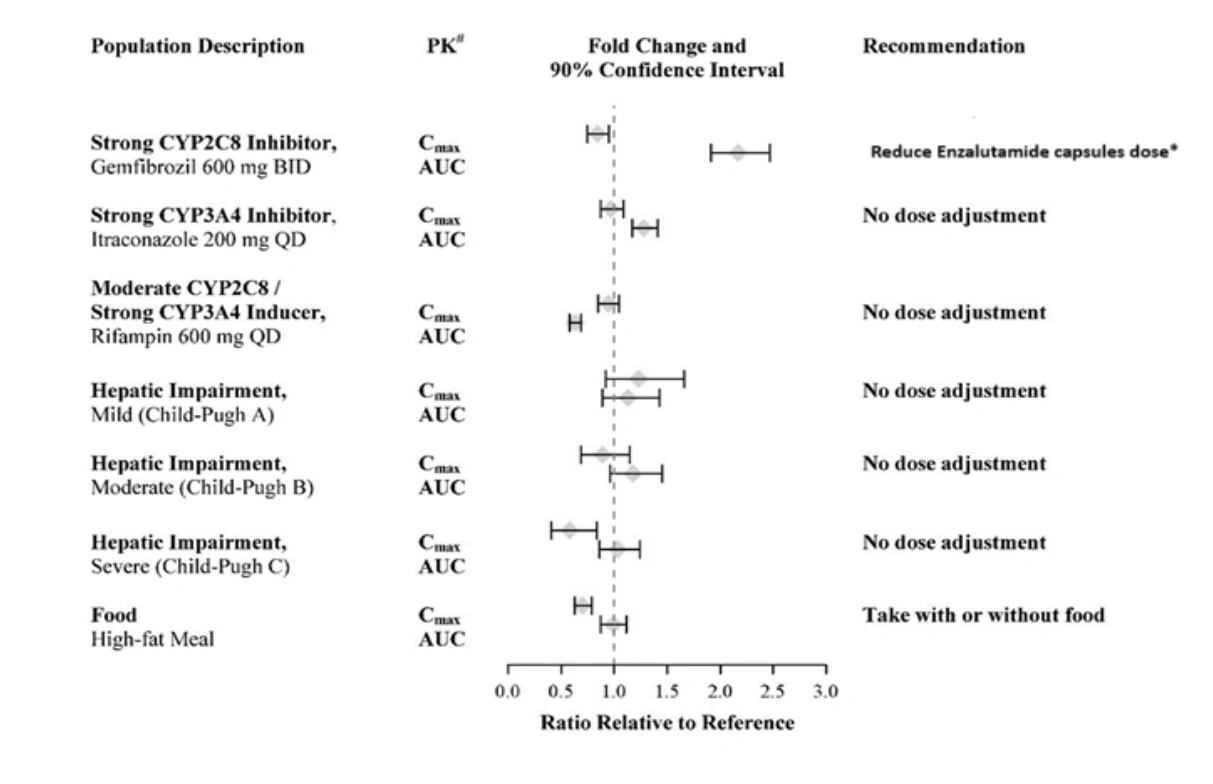
# PK parameters (Cmax and AUC0-inf) are for enzalutamide plus M2, except in the food-effect trial, where they are for enzalutamide alone.
* See Dosage and Administration.
See Drug-Drug Interactions.
In patients, the inter-subject variability, expressed as CV%, on the enzalutamide PK parameters AUCτ, Cmin, and Cmax ranged from 23.0% to 29.3%. The inter-subject variability of the M2 PK parameters AUCτ, Cmin and Cmax ranged from 29.7% to 30.9%. In a dose-escalation study, intra-subject variability on the enzalutamide PK parameter Cmin ranged between 3% and 59% after once daily administration.
General toxicology
Safety pharmacology:
In safety pharmacology studies, enzalutamide and its active metabolite M2, caused a concentration- dependent inhibition of hERG potassium currents in HEK293 cells with IC50 values of 15.7 micromol (7.3 mcg / mL) and 18.6 micromol (8.4 mcg / mL), respectively. No treatment-related electrocardiographic effects were detected when enzalutamide was administered at single oral doses of 5, 15, or 30 mg / kg in a Latin square crossover conscious dog telemetry study (N = 4), but maximal plasma concentrations in the dogs were less than the human Cmax at the therapeutic dose.
Repeated dose studies in mice:
In mice dosed with 30 and 60 mg / kg / day enzalutamide for 4 weeks, changes related to the pharmacological activity included decreased weights of the epididymis, seminal vesicles and prostate. Decreased cytoplasmic vacuoles in the zona fasciculata were observed in all enzalutamide-dosed groups. Increased liver weight was observed in both sexes at 30 and 60 mg / kg / day and histopathology revealed hypertrophy of centrilobular hepatocytes. Thickening of mucosa in the forestomach was found in both sexes at 60 mg / kg / day, while ulcer and focal hyperplasia in the mucosa in the forestomach occurred only in the 60 mg / kg / day females. Two male animals dosed with 60 mg / kg / day died. All treatment-related changes observed at the end of the administration period were essentially reversible after a 4-week withdrawal of the test article. The doses used in mice (10, 30 and 60 mg / kg) resulted in systemic exposures (combined sex AUC) of 0.4, 1.0 and 1.4 times, respectively, the AUC in patients.
Repeated dose studies in rats:
Morphological and / or histopathological changes were observed in the reproductive and hormone-sensitive organs of rats in all enzalutamide-dose groups in the 26-week repeated dose study. These changes included atrophy of the prostate and seminal vesicles, enlarged pituitary glands in females marked by hyperplasia on pars distalis, mammary gland atrophy in males and mammary gland hyperplasia in females. Effects on the pituitary and mammary glands persisted beyond the eight-week recovery period. Systemic exposure (combined sex AUC) at the doses used (10, 30 and 100 mg / kg / day) were 0.7, 1.4 and 1.8 times, respectively, the AUC in patients.
Repeated dose studies in dogs:
In the 39-week study in dogs, atrophy of the prostate, epididymides and seminiferous tubules and hypertrophy and / or hyperplasia of the Leydig cells in the testes were observed in all enzalutamide-dose groups. In one male animal in the 45 mg / kg / day group, convulsions were observed before dosing on Day 13. Dosing in this animal was re-initiated on Day 17 and no recurrence of convulsions was observed in this animal or in any of the other animals up to the end of the study period. All changes to the reproductive organs were either partially or fully reversed after a thirteen-week recovery period.
Systemic exposure (combined sex AUC) at the doses used (5, 15 and 45 mg / kg / day) were 0.4, 0.8 and 1.1 times, respectively, the AUC in patients.
Carcinogenesis and Genotoxicity:
Enzalutamide was devoid of genotoxic potential in the standard panel of genotoxicity tests, including an in vitro bacterial reverse mutation (Ames) assay, in vitro mouse lymphoma thymidine kinase (Tk) gene mutation assay and in the in vivo mouse micronucleus assay. Metabolites M1 and M2 were not mutagenic in the bacterial Ames assay. M1 but not M2 showed mutagenic and clastogenic potential in the in vitro mouse lymphoma thymidine kinase assay at concentrations that also caused extensive cell death (≥ 50 mcg / mL).
In a 6-month study in transgenic rasH2 mice, enzalutamide did not show carcinogenic potential (absence of neoplastic findings) at doses up to 20 mg / kg per day (AUC24h ~317 mcg.h / mL), which resulted in plasma exposure levels similar to the clinical exposure (AUC24h 322 mcg.h / mL) in metastatic CRPC patients receiving 160 mg daily.
Daily oral dosing of rats for two years with enzalutamide at 10, 30 and 100 mg / kg / day increased the incidence of neoplastic findings that were considered related to the primary pharmacology of enzalutamide. These included benign thymoma, fibroadenoma in the mammary glands, and benign Leydig cell tumours in the testes in males; benign granulosa cell tumour in the ovaries in females; and adenoma in the pars distalis of the pituitary in both sexes. In addition, urothelial papilloma and carcinoma of the urinary bladder in male rats were observed at the 100 mg / kg / day dose. Benign Leydig cell tumours are expected based on the pharmacological properties of this antiandrogen drug and not considered relevant to humans. The observed urothelium papilloma and carcinoma of the urinary bladder may be due to continuous irritation caused by urinary bladder crystals / calculi which is more pronounced in rats because of anatomical differences and positioning of the rat urinary bladder (horizontal in rat versus upright in human). However, no obvious mechanistic rationale to explain specifically this malignancy can be established. Taking into account that exposure levels based on AUC for enzalutamide plus its active metabolite M1 and M2 (AUC24: enzalutamide ~457 mcg·h / mL, M1 ~321 mcg·h / mL, M2 ~35 mcg·h / mL), achieved in this study in male rats at week 26 at 100 mg / kg / day, were less than or similar to those in prostate cancer patients at the recommended dose of 160 mg / day (AUC24: enzalutamide ~322 mcg·h / mL, M1 ~193 mcg·h / mL, M2 ~278 mcg·h / mL), urinary bladder carcinogenicity potential of enzalutamide in humans cannot be excluded.
Reproductive and developmental toxicology
Reproductive Toxicology
In a developmental toxicity study in mice, enzalutamide (10 and 30 mg / kg / day) caused embryo-fetal lethality (increased post-implantation loss and decreased number of live fetuses). Also at 10 and 30 mg / kg / day, there was a higher incidence of fetuses with external abnormalities (shortened anogenital distance). At 30 mg / kg / day, cleft palate and absent palatine bone were increased. The doses (1, 10, and 30 mg / kg / day) tested in mice resulted in systemic exposures (AUC) approximately 0.04, 0.4 and 1.1 times, respectively, the AUC in patients.
In the developmental toxicity study in rabbits, there were no treatment-related effects in any dam up to 10 mg / kg / day, although a preliminary study showed maternal and fetal toxicity at a dose of 30 mg / kg.
No treatment-related effects were noted on the viability, growth, external, visceral, or skeletal morphology or the degree of ossification of embryos / fetuses up to 10 mg / kg / day. The No Observed Adverse Effect Level was considered to be 10 mg / kg / day for maternal general toxicity, maternal reproductive function and embryo-fetal development. At the tested doses (0.3, 3 and 10 mg / kg / day), the systemic exposures (AUC) were approximately 0.016, 0.1 and 0.36 times, respectively, the AUC in patients.
Overall, enzalutamide induced embryo-fetal deaths and / or external and skeletal abnormalities in mice and rabbits. These findings are consistent with the pharmacological activity of enzalutamide. For this reason, enzalutamide capsules is contraindicated in pregnancy.
17 SUPPORTING PRODUCT MONOGRAPHS
- 1. Xtandi® (Enzalutamide capsules, 40 mg), submission control 300782, Product Monograph, Astellas Pharma Canada, Inc., (2026-01-26)