


Product Monograph - Sandomigran DS
RECENT MAJOR LABEL CHANGES
None at time of most recent authorization.
TABLE OF CONTENTS
Sections or subsections that are not applicable at the time of authorization are not listed.
RECENT MAJOR LABEL CHANGES ........................................................................................... 2
TABLE OF CONTENTS ............................................................................................................. 2
PART I: HEALTH PROFESSIONAL INFORMATION ..................................................................... 4
1 INDICATIONS .............................................................................................................. 4
1.1 Pediatrics ................................................................................................................. 4
1.2 Geriatrics ................................................................................................................. 4
2 CONTRAINDICATIONS ................................................................................................. 4
4 DOSAGE AND ADMINISTRATION ................................................................................. 5
4.1 Dosing Considerations ............................................................................................ 5
4.2 Recommended Dose and Dosage Adjustment ....................................................... 5
4.5 Missed Dose ............................................................................................................ 5
5 OVERDOSAGE ............................................................................................................. 5
6 DOSAGE FORMS, STRENGTHS, COMPOSITION AND PACKAGING ................................. 6
7 WARNINGS AND PRECAUTIONS .................................................................................. 6
7.1 Special Populations ................................................................................................. 8
7.1.1 Pregnant Women ................................................................................................ 8
7.1.2 Breast-feeding ..................................................................................................... 8
7.1.3 Pediatrics ............................................................................................................. 8
7.1.4 Geriatrics ............................................................................................................. 8
8 ADVERSE REACTIONS.................................................................................................. 8
8.1 Adverse Reaction Overview .................................................................................... 8
8.5 Post-Market Adverse Reactions .............................................................................. 9
9 DRUG INTERACTIONS ............................................................................................... 10
9.1 Serious Drug Interactions ..................................................................................... 10
9.2 Drug Interactions Overview .................................................................................. 10
9.3 Drug-Behavioral Interactions ................................................................................ 11
9.4 Drug-Drug Interactions ......................................................................................... 11
9.5 Drug-Food Interactions ......................................................................................... 12
9.6 Drug-Herb Interactions ......................................................................................... 12
9.7 Drug-Laboratory Test Interactions........................................................................ 12
10 CLINICAL PHARMACOLOGY ....................................................................................... 12
10.1 Mechanism of Action ............................................................................................ 12
10.2 Pharmacodynamics ............................................................................................... 12
10.3 Pharmacokinetics .................................................................................................. 13
11 STORAGE, STABILITY AND DISPOSAL ......................................................................... 13
12 SPECIAL HANDLING INSTRUCTIONS ........................................................................... 13
PART II: SCIENTIFIC INFORMATION ...................................................................................... 14
13 PHARMACEUTICAL INFORMATION ........................................................................... 14
14 CLINICAL TRIALS ....................................................................................................... 14
15 MICROBIOLOGY ....................................................................................................... 14
16 NON-CLINICAL TOXICOLOGY ..................................................................................... 14
PATIENT MEDICATION INFORMATION ................................................................................. 16
PART I: HEALTH PROFESSIONAL INFORMATION
1 INDICATIONS
SANDOMIGRAN DS (pizotifen tablets) is indicated for:
- the prophylactic management of migraine.
In various clinical trials, about 1/3 to 2/3 of patients with migraine experienced some benefit from SANDOMIGRAN DS and in most trials it was more effective than placebo in reducing the frequency or severity of attacks.
SANDOMIGRAN DS is not useful for the clinical treatment of acute migrainous attack or for the treatment of tension headaches.
1.1 Pediatrics
Pediatrics (< 12 years of age): Based on the data submitted and reviewed by Health Canada, the safety and efficacy of SANDOMIGRAN DS in pediatric patients has not been established; therefore, Health Canada has not authorized an indication for pediatric use (see 2 CONTRAINDICATIONS).
Adolescents (12-17 years of age): There is limited evidence supporting the safety and efficacy of SANDOMIGRAN DS in adolescents 12-17 years of age, therefore SANDOMIGRAN DS should be used with caution in this age group (see 4.2 Recommended Dose and Dosage Adjustment).
1.2 Geriatrics
Geriatrics (>65 years of age): The safety and efficacy of SANDOMIGRAN DS in patients 65 years of age or older have not been established. Caution should be exercised with the use of SANDOMIGRAN DS in the elderly, recognizing the more frequent hepatic, renal, central nervous system and cardiovascular dysfunctions, and more frequent use of concomitant medications in this population.
2 CONTRAINDICATIONS
SANDOMIGRAN DS (pizotifen tablets) is contraindicated in:
- patients taking monoamine oxidase inhibitors (MAOIs) or within 14 days of such therapy as it may prolong and intensify the anticholinergic effects of antihistaminic substances (see 9.4 Drug-Drug Interactions).
- patients with pyloroduodenal obstruction and stenosing pyloric ulcer.
- patients who are hypersensitive to this drug or to any ingredient in the formulation, including any non-medicinal ingredient, or component of the container. For a complete listing, see 6 DOSAGE FORMS, STRENGTHS, COMPOSITION AND PACKAGING.
- children under the age of 12.
4 DOSAGE AND ADMINISTRATION
4.1 Dosing Considerations
- Since migraine is a paroxysmal but basically chronic disorder, treatment must extend over an adequate period of time in order to obtain maximal benefit. While some patients have responded rather quickly, a 4-week trial period should be instituted to determine the true efficacy of SANDOMIGRAN DS in specific cases. The periodic nature of the disorder will have to be considered in determining when and for how long therapy should be maintained.
- Since some investigators have observed a change in headache pattern after several months of therapy, a drug-free interval is advisable to reassess the necessity of continuing treatment. The dosage should be reduced gradually during the last 2 weeks of each treatment course to avoid a "headache rebound".
- As with other antiserotonin agents, the benefits of SANDOMIGRAN DS decrease after a period of time in a certain number of patients.
- SANDOMIGRAN DS coated tablets contain lactose. Its use is not recommended in patients with rare hereditary problems of galactose intolerance, lactase deficiency or glucose-galactose malabsorption.
4.2 Recommended Dose and Dosage Adjustment
Adults: Oral treatment should be initiated with a dose of 0.5 mg at bedtime. This is increased gradually to a total dose of 1.5 mg administered at bedtime or in three divided doses. The dosage range is 1 to 6 mg/day. Up to 3 mg may be given as a single dose. The average maintenance dose is 1.5 mg/day.
Pediatrics (<12 years of age): SANDOMIGRAN DS is contraindicated in children under the age of 12.
Adolescents (12-17 years of age): SANDOMIGRAN DS may be prescribed to adolescents over the age of 12 years. Oral treatment should be initiated with a dose of 0.5 mg at bedtime. A maximum single dose of 1 mg can be given at night. Daily doses up to a maximum of 1.5 mg may be given in divided doses.
4.5 Missed Dose
If a dose is missed and the patient normally takes SANDOMIGRAN DS tablets 2 or more times a day, the patient should be instructed to take the last dose they missed as soon as they remember. However, if there is less than 4 hours left before the next scheduled dose, the patient should go back to their regular dosing schedule and skip the missed dose. The patient should not double doses or take more than the maximum daily dose.
5 OVERDOSAGE
Adults: The symptoms of overdosage in adults are sedation, drowsiness, dizziness, hypotension, dryness of the mouth, confusion, tachycardia, ataxia, nausea, vomiting, dyspnea, cyanosis, convulsions, coma, respiratory paralysis and CNS depression. Drowsiness precedes excitement, convulsions and postictal depression.
Children: Antihistamine poisoning in children exhibits excitation, hallucinations, ataxia, incoordination, convulsions, fixed dilated pupils, flushed faces, and fever (pyrexia), leading to coma and cardiorespiratory collapse.
Treatment: Administration of activated charcoal is recommended. Supportive measures should be instituted to maintain respiration and vital signs should be monitored; severe hypotension must be corrected (caveat: adrenaline (epinephrine) may produce paradoxical effects).
Because SANDOMIGRAN DS can cause tachycardia, an ECG should be performed and attention directed at the QRS and QT intervals. Patients with abnormal ECGs or signs of evolving toxicity should undergo ECG monitoring.
Short-acting barbiturates or benzodiazepines (diazepam or lorazepam) may be used for the treatment of excitatory states or convulsions. Analeptics (i.e., stimulating the central nervous system, the respiratory system or the cardiovascular system) should be avoided.
For management of a suspected drug overdose, contact your regional poison control centre.
6 DOSAGE FORMS, STRENGTHS, COMPOSITION AND PACKAGING
Table 1 – Dosage Forms, Strengths, Composition and Packaging
1 mg tablets: Each tablet is whitish with bevelled edge, scored on one side and embossed with a shield logo on the other side of the tablet.
SANDOMIGRAN DS is supplied in bottles of 100 tablets.
7 WARNINGS AND PRECAUTIONS
Cardiovascular
Patients with cardiovascular disease should be given SANDOMIGRAN DS with caution, and appropriate laboratory tests should be done at regular intervals.
Dependence/Tolerance
Some patients developed tolerance to SANDOMIGRAN DS with prolonged use of the drug. Increase in dosage, not exceeding the maximum recommended daily dose, may overcome this tolerance.
Withdrawal symptoms: Acute withdrawal reactions have been reported following abrupt cessation of pizotifen, therefore, gradual withdrawal is recommended. Withdrawal symptoms include depression, tremor, nausea, anxiety, malaise, dizziness, sleep disorder, loss of consciousness, anorexia and rapid weight loss (see 8 ADVERSE REACTIONS).
| Route of Administration | Dosage Form / Strength/Composition | Non-medicinal Ingredients |
| Oral | Tablet 1 mg pizotifen (as pizotifen malate) | Lactose anhydrous, magnesium stearate, and microcrystalline cellulose |
Driving and Operating Machinery
Patients should be warned that SANDOMIGRAN DS may cause dizziness, somnolence, fatigue, sedation and other CNS effects. Therefore, caution should be exercised when driving or using machines.
Patients being treated with SANDOMIGRAN DS and presenting with somnolence, dizziness and/or fatigue episodes must be instructed to refrain from engaging in activities where impaired alertness may put themselves or others at risk.
Endocrine and Metabolism
Patients with diabetes should be given SANDOMIGRAN DS with caution, and appropriate laboratory tests should be done at regular intervals.
SANDOMIGRAN DS coated tablets contain lactose. Its use is not recommended in patients with rare hereditary problems of galactose intolerance, lactase deficiency, or glucose-galactose malabsorption.
Effects on Weight: SANDOMIGRAN DS treatment leads to weight gain in a significant number of patients and may be associated with excessive weight loss upon discontinuation. Caution is advised in patients who are vulnerable to excess weight gain or weight loss.
Hepatic/Biliary/Pancreatic
Caution is required in patients with hepatic impairment. Dosage adjustment may be necessary.
After prolonged use, hepatotoxic effects might occur and patients should be advised to report for adequate laboratory evaluation. Hepatic injury has been reported, ranging from transaminase elevations to severe hepatitis. SANDOMIGRAN DS should be discontinued if there is any clinical evidence of hepatic dysfunction during treatment and until the cause of the liver abnormality is determined.
Neurologic
Drowsiness (including somnolence and fatigue) is among the most common side effects with SANDOMIGRAN DS use. A gradual increase in the dosage of SANDOMIGRAN DS is recommended to minimize or reduce the incidence of drowsiness.
Anticholinergic effects: In view of the weak anticholinergic effect of SANDOMIGRAN DS, caution is required in patients with narrow-angle glaucoma (see 7 WARNINGS AND PRECAUTIONS, Ophthalmologic) or with a predisposition to urinary retention (e.g., prostatic hypertrophy).
[Minor update to section title as per the 2024 Product Monograph Master Template]
Epilepsy: Seizures as undesirable effects have been observed more frequently in patients with epilepsy. SANDOMIGRAN DS should be used with caution in patients with epilepsy.
Ophthalmologic
A limited number of cases of lens opacities have been reported but did not appear to be drug-related. SANDOMIGRAN DS use has also been associated with ocular dysfunctions including increased intraocular pressure, pupil dilation and diplopia. It is recommended that any impairment in vision be reported to the attending health professional for further investigation.
Caution is required in patients with narrow-angle glaucoma (see 7 WARNINGS AND PRECAUTIONS, Neurologic, Anticholinergic effects). In general, patients with narrow-angle glaucoma should not be given drugs with possible anticholinergic effects, unless they are required and the patient is under special care and medical supervision for this condition.
Renal
Caution is required in patients with renal impairment. Dosage adjustment may be necessary.
Caution is required in patients with a predisposition to urinary retention (e.g., prostatic hypertrophy) (see 7 WARNINGS AND PRECAUTIONS, Neurologic, Anticholinergic effects).
7.1 Special Populations
7.1.1 Pregnant Women
The safety of SANDOMIGRAN DS for use during human pregnancy has not been established. SANDOMIGRAN DS should be used during pregnancy only if the potential benefit justifies the potential risk to the fetus.
7.1.2 Breast-feeding
Animal studies show that pizotifen enters the milk. Although the concentrations of pizotifen measured in the milk of treated mothers are not likely to affect the infant, its use in nursing mothers is not recommended.
7.1.3 Pediatrics
Pediatrics (<12 years of age): SANDOMIGRAN DS is contraindicated in children under the age of 12 (see 2 CONTRAINDICATIONS).
Adolescents (12-17 years of age): There is limited evidence supporting the safety and efficacy of SANDOMIGRAN DS in adolescents 12-17 years of age, therefore SANDOMIGRAN DS should be used with caution in this age group (4.2 Recommended Dose and Dosage Adjustment, Adolescents).
7.1.4 Geriatrics
The safety and efficacy of SANDOMIGRAN DS in patients 65 years of age or older have not been established. Caution should be exercised with the use of SANDOMIGRAN DS in the elderly, recognizing the more frequent hepatic, renal, central nervous system and cardiovascular dysfunctions, and more frequent use of concomitant medications in this population.
8 ADVERSE REACTIONS
8.1 Adverse Reaction Overview
Increased appetite, weight gain and drowsiness (including somnolence and fatigue) are the most common side effects. Health professionals should be aware of the potential negative effects of SANDOMIGRAN DS in special populations already with an excess in weight or in normal weight population where an excess in weight could be deleterious (e.g., arterial hypertension, diabetes mellitus, and hypercholesterolemia). A gradual increase in the dosage of SANDOMIGRAN DS is recommended to minimize or reduce the incidence of drowsiness (see 7 WARNINGS AND PRECAUTIONS, Neurologic).
8.5 Post-Market Adverse Reactions
Table 2 is based on pizotifen post-market spontaneous adverse event reports. The percentages shown are calculated by dividing the number of adverse events reported by the estimated number of patients exposed to the drug during the same time period. The causal relationship between pizotifen and the emergence of these events has not been established.
Table 2 – Pizotifen Post-Market Spontaneous Adverse Event Reports
| Adverse Event | Reported Frequency | |||||||||||
| Adverse Event | Reported Frequency | |||||||||||
| Very Common ≥ 10% | Common ≥ 1% | Un-common < 1% and ≥ 0.1% | Rare < 0.1% and ≥ 0.01% | Very Rare < 0.01% | ||||||||
| Very Common ≥ 10% | Common ≥ 1% | Un-common < 1% and ≥ 0.1% | Rare < 0.1% and ≥ 0.01% | Very Rare < 0.01% | ||||||||
| Gastrointestinal disorders | ||||||||||||
| Nausea | X | |||||||||||
| Dry mouth | X | |||||||||||
| Constipation | X | |||||||||||
| General disorders and administration site conditions | ||||||||||||
| Fatigue | X | |||||||||||
| Immune system disorders | ||||||||||||
| Hypersensitivity reactions | X | |||||||||||
| Face edema | X | |||||||||||
| Urticaria | X | |||||||||||
| Rash | X | |||||||||||
| Metabolism and nutrition disorders | ||||||||||||
| Appetite stimulating effect and increase in body weight | X | |||||||||||
| Musculoskeletal and connective tissue disorders | ||||||||||||
| Myalgia | X | |||||||||||
| Arthralgia | X | |||||||||||
| Nervous system disorders | ||||||||||||
| Somnolence | X | |||||||||||
| Dizziness | X | |||||||||||
| Paresthesia | X | |||||||||||
| Seizures | X | |||||||||||
| Psychiatric disorders | ||||||||||||
| Depression | X | |||||||||||
| CNS stimulation (e.g., aggression, agitation) in children | X | |||||||||||
| Hallucination | X | |||||||||||
| Insomnia | X | |||||||||||
| Anxiety | X | |||||||||||
| Sleep disorder | X | |||||||||||
SANDOMIGRAN DS use has also been associated with ocular dysfunctions including increased IOP (intraocular pressure), pupil dilation and diplopia.
Acute withdrawal reactions have been reported following abrupt cessation of pizotifen, therefore, gradual withdrawal is recommended. Withdrawal symptoms include anxiety, tremors, insomnia, nausea, and loss of consciousness. Anorexia and rapid weight loss have also been observed.
The following adverse reactions have also been identified during post-approval use of SANDOMIGRAN DS:
Hepatobiliary disorders: Fulminant hepatitis, hepatitis, jaundice
Investigations: Hepatic enzyme increased
Musculoskeletal and connective tissue disorders: Muscle cramps
Nervous system disorders: Sedation
Reproductive system and breast disorders: Amenorrhoea, breast enlargement, breast pain, nonpuerperal lactation
9 DRUG INTERACTIONS
9.1 Serious Drug Interactions
Serious Drug Interactions
Do not use SANDOMIGRAN DS in patients currently using a monoamine oxidase inhibitor (MAOI) or within 14 days of such therapy (see 2 CONTRAINDICATIONS; 9.4 Drug-Drug Interactions).
9.2 Drug Interactions Overview
SANDOMIGRAN DS should not be consumed with alcohol, as it may enhance the central effects of alcohol, such as drowsiness and dizziness (see 9.3 Drug-Behavioral Interactions).
SANDOMIGRAN DS may interact with central nervous systems agents, antihypertensives and monoamine oxidase inhibitors (see 9.4 Drug-Drug Interactions). In addition, given that pizotifen is extensively metabolized by the liver, primarily by N-glucuronidation, increased plasma concentration of pizotifen upon concomitant administration of drugs which exclusively undergo glucuronidation cannot be excluded.
9.3 Drug-Behavioral Interactions
The concomitant use of alcohol should be avoided. SANDOMIGRAN DS may increase central effects of alcohol, such as drowsiness and dizziness.
9.4 Drug-Drug Interactions
The drugs listed in Table 3 are based on either drug interaction case reports or studies, or potential interactions due to the expected magnitude and seriousness of the interaction (i.e., those identified as contraindicated).
Table 3 – Established or Potential Drug-Drug Interactions
| Proper/Common name | Source of Evidence | Effect | Clinical comment |
| Central Nervous System (CNS) agents | T | Central effects of sedatives, hypnotics, antihistamines (including certain common cold preparations), alcohol, psychotherapeutic agents or other drugs with CNS depressant effects may be enhanced. Tolerance to alcohol may be reduced. | |
| Antihypertensives | T | SANDOMIGRAN DS may reduce the efficacy of antihypertensive medications (adrenergic neurone blockers) as it antagonizes their hypotensive effect. | Patient blood pressure monitoring is recommended. |
| Monoamine Oxidase Inhibitors (MAOIs) (e.g., linezolid, methylene blue, moclobemide, phenelzine, procarbazine, and tranylcypromine) | T | MAOIs can prolong and intensify the anticholinergic effects of antihistaminic substances. | Concomitant use with MAOIs or use within 14 days of such therapy should be avoided (see 2 CONTRAINDICATIONS). |
Legend: T = Theoretical
9.5 Drug-Food Interactions
Interactions with food have not been established.
9.6 Drug-Herb Interactions
Interactions with herbal products have not been established.
9.7 Drug-Laboratory Test Interactions
Interactions with laboratory tests have not been established.
10 CLINICAL PHARMACOLOGY
10.1 Mechanism of Action
Pizotifen malate is a strong serotonin and tryptamine antagonist, with weak anticholinergic, anti-histaminic and anti-kinin effects. It also possesses sedative and appetite-stimulating properties.
The mode of action of pizotifen malate in preventing migraine is not fully understood but it is known to inhibit the permeability increasing effect of serotonin and histamine to control the transudation of plasmakinin across cranial vessel membranes, an effect which may alter pain thresholds. Pizotifen malate also inhibits serotonin re-uptake by blood platelets, impacting tonicity and decreasing passive distension of extracranial arteries.
10.2 Pharmacodynamics
A variety of in vitro and in vivo laboratory investigations indicated antagonistic or blocking actions of pizotifen towards serotonin and histamine and relatively weak anticholinergic activity. Pizotifen had very little effect as an epinephrine or bradykinin antagonist.
Tests for potentiation of barbiturate anesthesia and inhibition of locomotion in the mouse indicated that pizotifen had weak sedative properties. However, pizotifen was found to be more active in rats than either imipramine or amitriptyline in the antagonism of tetrabenazine-induced depression.
Pizotifen given orally (40 mg/kg), subcutaneously (5 mg/kg) and intravenously (1.25 mg/kg) to male Rhesus monkeys produced slight sedation, but no change in cardiac or respiratory rates during the subsequent four hours.
Pizotifen given intravenously (i.v.; 1 to 10 mg/kg) rapidly produced hypotension in dogs; reversion to normal pressures occurred within 30 minutes. Immediate increased heart rates were produced by the maximal dose but they quickly subsided. Blood pressure response to adrenaline was enhanced (2 mg/kg i.v.).
Blood sugar studies of normal and alloxan-treated rats did not indicate any hypoglycemic effects of pizotifen.
10.3 Pharmacokinetics
Absorption
Absorption half-life of pizotifen in man by the gastro-intestinal tract is 0.5 to 0.8 hours and nearly complete (80%). The absolute bioavailability is 78%. Maximum blood levels are reached 5 hours after oral administration.
Metabolism
Pizotifen is highly metabolised. Metabolism is mostly achieved through glucuronidation, and the main metabolite, N-glucuronide conjugate, accounts for at least 50% of the plasma and 60-70% of urinary excreted radioactivity.
Distribution
Plasma protein binding of pizotifen is over 90%. The distribution volume in man is 833L and 70L for pizotifen and N-glucuronide conjugate, respectively.
Elimination
Excretion of pizotifen by the feces is equivalent to about one-third of the given oral dose. Less than 1% of the administered dose is excreted unchanged in the urine, whereas up to 55% is excreted as metabolites. The elimination half-life for pizotifen and N-glucuronide conjugate is about 23 hours.
11 STORAGE, STABILITY AND DISPOSAL
Store at room temperature (15°C to 30°C) and protect from exposure to light and moisture. Keep in a safe place out of the sight and reach of children.
12 SPECIAL HANDLING INSTRUCTIONS
Not applicable.
PART II: SCIENTIFIC INFORMATION
13 PHARMACEUTICAL INFORMATION
Drug Substance
Proper name: Pizotifen malate
Chemical name: 4 -(9,10-Dihydro-4H-benzo[4,5] cycloheptal [1,2-b]thien-4-ylidene)-1-methylpiperidine malate
Molecular formula and molecular mass: C19H21NS.C4H6O5; 429.5 g/mol
Structural formula:
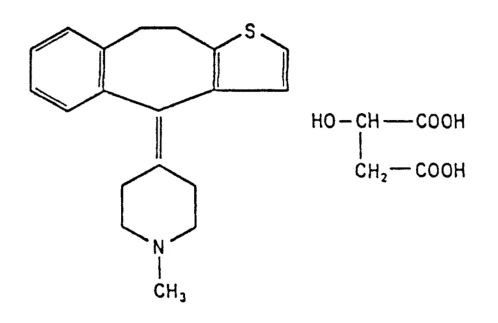
Physicochemical properties: Pizotifen malate is a white to yellowish crystalline powder, readily soluble in water and organic solvents.
14 CLINICAL TRIALS
The clinical trial data on which the original indication was authorized is not available.
15 MICROBIOLOGY
No microbiological information is required for this drug product.
16 NON-CLINICAL TOXICOLOGY
General Toxicology:
Acute Toxicity:
Acute toxicity studies were conducted in mice, rats and rabbits:
LD50 (mg/kg)
| Mouse | Rat | Rabbit | |||||
| Oral | I.V. | Oral | I.V. | Oral | I.V. | ||
| 880 | 43 | 1500 | 17 | 700 | 19 | ||
| ∀102 | ∀2 | ∀330 | ∀1 | ∀252 | ∀2 | ||
Signs of toxicity after oral administration to mice and rats included motor disturbances (ataxia, jumping, twitching, sporadic convulsions, hyperreflexia), ventral decubitus, prostration, stupor, dyspnea and bradypnea. The signs lasted several hours in mice and up to 60 hours in rats. In rabbits, ventral decubitus, weakness and drooping of the head were observed. In all three species prior to death, ataxia, ventral or lateral decubitus, convulsions, dyspnea, paralysis and cyanosis were observed.
Chronic Toxicity:
Chronic oral toxicity studies were done in both rats and dogs for durations of 26 weeks and two years.
Pizotifen was administered orally to rats at 3 dosage levels (5, 16 and 55 mg/kg/day) for 26 weeks. Weights of livers, adrenals and thyroids were increased in the high-dose group and there were mild signs of dose-dependent, centrolobular hepatic lipidosis and thyroidal hyperactivity in the mid and high-dose groups. There was no evidence of cholestasis.
Doses of 3, 9 and 27 mg/kg/day were administered to rats for 2 years. Cellular and clinical hematologic, ophthalmoscopic and histologic examinations did not indicate drug-induced abnormalities in animals sacrificed after 16 months. The only changes observed after 2 years of treatment were increased liver and kidney weights in high-dose females and increased liver weights in mid-dose females.
Pizotifen was administered to dogs at levels of 3, 10 and 30 mg/kg/day for 26 weeks. Increased relative organ weights of spleens, livers and thyroids were observed in the mid- and high-dose dogs. Microscopy indicated thyroidal hyperactivity and increased hepatic cellular turnover in a high-dose dog. Serum alkaline phosphatase was slightly increased in one mid-dose and one high-dose dog at the end of the experiment. There was no evidence of cholestasis. Doses of 1, 3 and 9 mg/kg/day also were administered to dogs for 2 years. Mean SGPT values were increased in high-dose dogs compared to control means. Other liver function tests were within normal range. The effect was more pronounced in males. Concomitant histopathologic changes were not evident.
Reproductive and Developmental Toxicology:
Pizotifen was administered orally at the dose levels of 3, 10, and 30 mg/kg/day to female rats and rabbits from the 6th to 15th, and 6th to 18th days of pregnancy respectively. The animals were sacrificed at term and examined together with their fetuses. Embryotoxic or teratogenic drug effects could not be detected in either animal species. Male and female fertility tests were done. Conception rates, litter sizes and litter weights were not affected.