


Product Monograph - Sandoz Polytrimethoprim
ACTION AND CLINICAL PHARMACOLOGY
Sandoz Polytrimethoprim is a sterile antimicrobial solution for topical ophthalmic use. Trimethoprim is a synthetic antibacterial drug active against a wide variety of aerobic Gram-positive and Gram-negative ophthalmic pathogens. Trimethoprim blocks the production of tetrahydrofolic acid from dihydrofolic acid by binding to and reversibly inhibiting the enzyme dihydrofolate reductase. This binding is very much stronger for the bacterial enzyme than for the corresponding mammalian enzyme. For this reason, trimethoprim selectively interferes with bacterial biosynthesis of nucleic acids and proteins.
Polymyxin B, a cyclic lipopeptide antibiotic, is rapidly bactericidal for a variety of Gram-negative organisms, especially Pseudomonas aeruginosa. It increases the permeability of the bacterial cell membrane by interacting with the phospholipid components of the membrane.
In combination, trimethoprim and polymyxin B are effective against a wide range of aerobic Gram-negative and Gram-positive bacterial pathogens capable of causing external infections of the eye.
INDICATIONS AND CLINICAL USE
Sandoz Polytrimethoprim is active against the following Gram-positive and Gam-negative organisms which may be associated with surface ocular bacterial infections:
Gram-positive
Staphylococcus aureus
Staphylococcus epidermidis
Streptococcus spp. (Group A beta-hemolytic
and non-hemolytic)
Streptococcus pneumoniae
Gram-neqative
Pseudomonas aeruginosa Haemophilus influenzae Haemophilus aegyptius Escherichia coli
Klebsiella pneumoniae Proteus mirabilis (indole-positive) Proteus spp. (indole-negative) Enterobacter aerogenes
Citrobacter freundii
Citrobacter diversus
Acinetobacter calcoaceticus Moraxella lacunata (some strains) Serratia marcescens
Sensitivity tests should be performed wherever possible to determine the optimum therapy for any given infection.
Sandoz Polytrimethoprim is indicated for the following surface ocular bacterial infections when caused by susceptible strains of the above organisms: Acute bacterial conjunctivitis
Blepharitis
Blepharoconjunctivitis
CONTRAINDICATIONS
Sandoz Polytrimethoprim is contraindicated in patients with known hypersensitivity to any of its components.
WARNINGS
NOT FOR INJECTION INTO THE EYE. If a sensitivity reaction to Sandoz Politrimethoprim occurs, discontinue use. Sandoz Politrimethoprim is not indicated for the prophylaxis or treatment of ophthalmia neonatorum.
PRECAUTIONS
General
As with other antimicrobial preparations, prolonged use may result in overgrowth of non-susceptible organisms, including fungi. If superinfection occurs, appropriate therapy should be initiated.
Information for Patient
Avoid contamination of the dropper tip with material from the eye, fingers, or other source. This precaution is necessary to maintain sterility of the drops.
If redness, irritation, swelling or pain persists or increases, discontinue use immediately and contact your physician.
Use in Children: The safety and effectiveness in children below the age of 2 months has not been established (see WARNINGS).
ADVERSE REACTIONS
The most frequent adverse reaction to Sandoz Polytrimethoprim is local irritation consisting of transient burning or stinging, itching or increased redness upon instillation. These reactions occur in less than 4 of 100 patients treated. Sandoz Polytrimethoprim has a low incidence of hypersensitivity reactions (less than 2 of 100 patients treated) consisting of lid edema, itching, increased redness, tearing and/or circumocular rash.
SYMPTOMS AND TREATMENT OF OVERDOSAGE
Poisoning is unlikely to occur from the ingestion of Sandoz Polytrimethoprim. If poisoning does occur, remove the agent from the stomach by lavage and/or emesis. If renal function is normal, force fluids orally or parenterally to promote excretion.
In extreme overdosage in patients with impaired renal function, consideration should be given to dialysis as a means of both eliminating the drug from the blood and in reducing the risk of uremia. Calcium folinate (3 to 6 i.m. for 5 to 7 days) is an effective antidote for adverse effects in the hemopoietic system caused by trimethoprim.
DOSAGE AND ADMINISTRATION
Adults: In mild to moderate infections, instill 1 or 2 drops in the affected eye every 3 hours (maximum of 6 doses per day) for a period of 7-10 days.
More severe infections may require instillation of 1 or 2 drops every hour until improvement is observed and then reduced to 1 or 2 drops every 3 hours.
Children: Children over two months of age are treated in the same manner as adults.
PART II: SCIENTIFIC INFORMATION
PHARMACEUTICAL INFORMATION
Drug Substance - Trimethoprim sulfate
Proper name: Trimethoprim sulfate
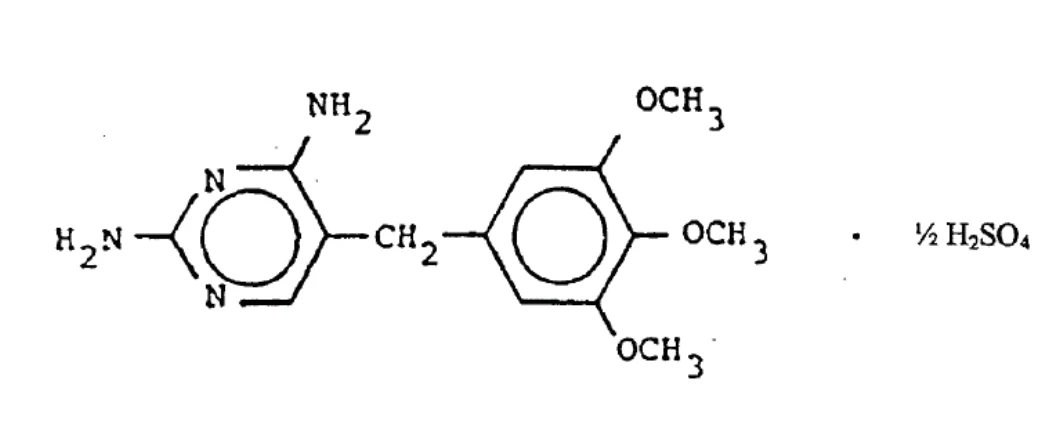
Chemical name: 2,4-diamino-5-(3,4,5-trimethoxybenzyl) pyrimidine sulfate (2: 1 )
Molecular formula and molecular mass: C14H18N4O3•½H2SO4 339.36
Structural formula:
Physicochemical properties: Trimethoprim sulfate is a white, odourless, crystalline powder with a melting range of 239 - 242°C. The pH of a 0.05% (w/v) aqueous solution is between 4 and 5.
Drug Substance - Polymyxin B
Proper name: Polymyxin B sulfate
Chemical name: Polymyxin B sulfate
Molecular formula and molecular mass: C56H98N16O13 / C55H96N16O13 1202 / 1188
Structural formula:
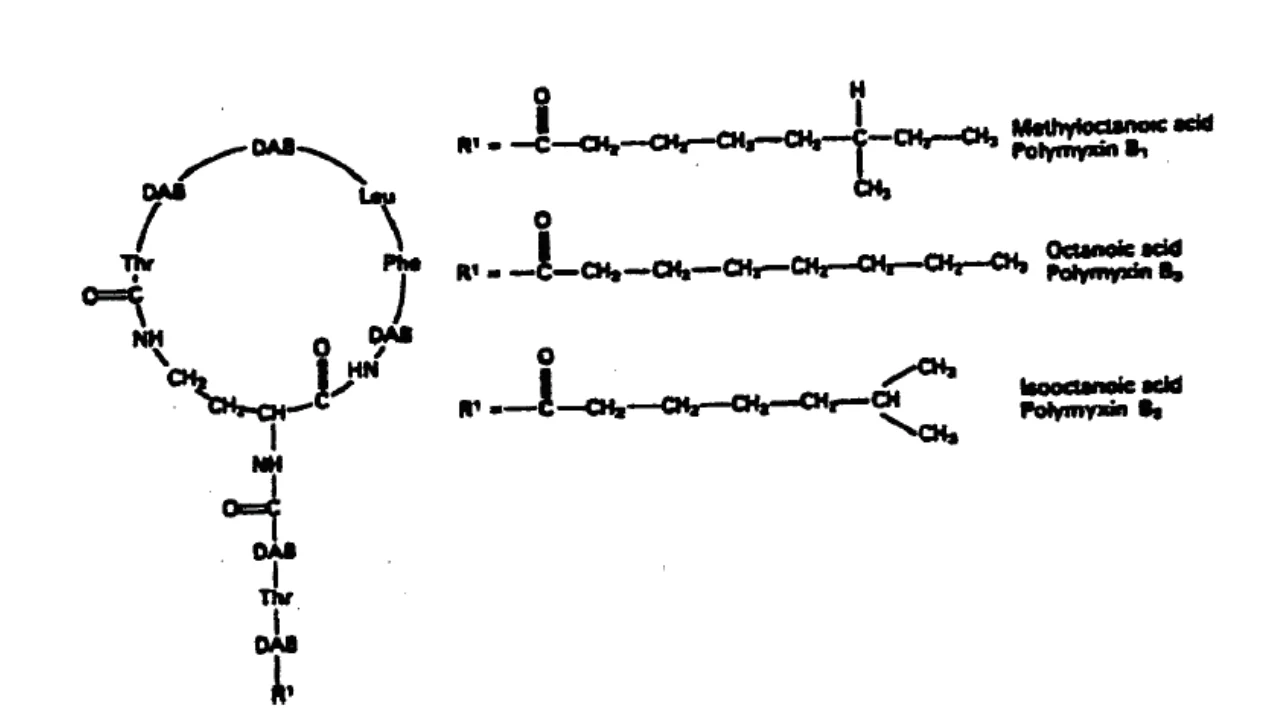
DAB = α,y-diaminobutyric acid (all linked through the α-group except where shown); Leu = leucine; Phe = phenylalanine;
Thr - threonine
Solubility: Fully soluble in water (20 mg/mL) and slightly soluble in alcohol.
Physical Characteristics: Polymyxin B sulfate is a white to buff coloured powder which may have a faint sour-like odour. Polymyxin is a generic term for antibiotics derived from the fermentations of various media by the strain of Bacillus polymyxa. The pH of an aqueous solution is between 5 and 7.5.
COMPOSITION
Active Ingredient: Trimethoprim sulfate equivalent to 1 mg/mL trimethoprim and polymyxin B sulfate 10 000 units/mL
Preservative: Benzalkonium chloride 0.004%
Nonmedicinal ingredients: Sodium chloride, sodium hydroxide or sulfuric acid (to adjust pH) and purified water.
STABILITY AND STORAGE RECOMMENDATIONS
Store at room temperature (15 - 30°C). Protect from light.
AVAILABILITY OF DOSAGE FORMS
Sandoz Polytrimethoprim is available in plastic DROP-TAINER™ dispensers of 10 mL.
MICROBIOLOGY
The in vitro spectrum of action of trimethoprim sulfate and polymyxin B sulfate encompasses most bacterial pathogens that cause external infections of the eye.
Trimethoprim is bacteriostatic against many Gram-negative and Gram-positive organisms with the most notable exception being Pseudomonas aeruginosa.1 Polymyxin B is proven bactericidal against Pseudomonas aeruginosa as well as other Gram-negative bacteria. Synergy has also been demonstrated in vitro for combinations of trimethoprim and polymyxin B against some bacteria.2- 6
PHARMACOLOGY
When used topically, trimethoprim and polymyxin B are rarely sensitizing and absorption through intact skin and mucous membrane is insignificant.
Blood samples were obtained from eleven human volunteers at 20 minutes, one hour and three hours following instillation of two drops of a solution continuing 1 mg trimethoprim and 10 000 units of polymyxin B per mL. On the nine previous days, each patient received two drops of solution four times per day. No detectable levels of drug were noted with assay limits of 0.03 mg trimethoprim per mL of serum and 1 unit polymyxin B per mL of serum.
TOXICOLOGY
A study was undertaken to determine the effects of trimethoprim and polymyxin B (TP) on the eyes of normal human volunteers. In a double-blind comparative study, TP eye drops were administered to one eye and a saline control preparation to the other in each of 20 healthy volunteers. Dosage administered was one drop, four times daily for a period of ten days. The eyes were examined on days 3,5,8 and 11. Volunteers were questioned regarding possible side effects at the time of their visits.
TP drops caused significantly (p < .05) more stinging, gritty sensations and circumocular itching than the control drops. These three actions were always transient and almost invariably mild. A transient and minimal degree of redness was occasionally observed (8 occasions in 6 volunteers) in TP treated eyes. The mean scores of the redness were not significantly different to those of the control preparation.
A second study was done in normal human volunteers with TSP sterile ophthalmic solution. TSP contained trimethoprim (1 mg/mL), sulfacetamide (5 mg/mL) and polymyxin B (10 000 units/mL). The study was conducted in a double-blind, placebo-controlled fashion with each volunteer receiving TSP and vehicle into separate eyes. The dosage was two drops into each eye, four times a day for ten days. Ophthalmic evaluations were conducted before and after each instillation of the drops.
Forty-eight completed the study. Conjunctival erythema was observed after instillation of active drug with a frequency of 65%. Vehicle produced erythema after instillation in 32%.
Burning (stinging) was reported after 54% of the instillations with TSP. Burning was reported in 2.5% of eyes receiving vehicle. Cyclic changes in the amplitude of reactivity were noted depending on the day of the study. The overall severity of the reactions was mild.
No significant changes in urinalyses, hematograms and organ function tests were revealed during the study. Ophthalmic examination including conjunctival, funduscopic and slitlamp photographs revealed nothing outstanding.
REFERENCES
- 1. Bushby S.R.M. Combined antibacterial action in vitro of trimethoprim and sulfonamides - the in vitro nature of synergy. Postgrad Med J Suppl 1969; 45: 10-18.
- 2. Bushby S.R.M. Trimethoprim + polymyxin B versus trimethoprim + sulfacetamide + polymycin B. Burroughs Wellcome Co., Research Triangle Park, N.C., Doc. No. TMAC/76/2, March 29, 1976. (Unpublished – on file at Burroughs Wellcome Inc.)
- 3. Noall E.W.P., Sewards H.F.G., Waterworth P.M. Successful treatment of a case of Proteus septicaemia. Br Med J 1962; 2: 1101 -1102.
- 4.
Barber M. Drug combinations in antibacterial chemotherapy. Proc Roy Soc Med
1965;58:990-995.
- 5. Quesnel L.B., Handley P.S. Synergism between polymyxins, polysorbate and antimetabolites of folic acid synthesis, and a paper disc technique for routine testing for synergism. Microbios 1974; 10: 199-210.
- 6. Rosenblatt J.E., Stewart P.R. Combined activity of sulfamethoxazole, trimethoprim and polymxin B against Gram-negative bacilli. Antimicrob Ag Chemother 1974; 6(1):84-92.