


Product Monograph - Fucithalmic (Amdipharm, PM 00053758)
1. INDICATIONS
FUCITHALMIC 1% Viscous Eye Drops (fusidic acid) is indicated for the treatment of superficial infections of the eye and its adnexa (ie., conjunctivitis) caused by fusidic acid susceptible strains of the designated bacteria in adults and children (≥2 years of age): Staphylococcus aureus, Streptococcus pneumoniae and Haemophilus influenzae.
Enterobacteriaciae and Pseudomonas are resistant to fusidic acid.
There are currently no NCCLS approved standards for testing in vitro susceptibility of conjunctival isolates toward topical ophthalmic antibiotics, including fusidic acid.
To reduce the development of drug-resistant bacteria and maintain the effectiveness of FUCITHALMIC and other antibacterial drugs, FUCITHALMIC should be used only to treat infections that are proven or strongly suspected to be caused by susceptible bacteria.
1.1 Pediatrics
Pediatrics (≥2 years of age): Based on the data submitted and reviewed by Health Canada, the safety and efficacy of FUCITHALMIC 1% Viscous Eye Drops (fusidic acid) in pediatric patients has been established; therefore, Health Canada has authorized an indication for pediatric use.
<See 1 INDICATIONS >
1.2 Geriatrics
Geriatrics (>65 years old): No data are available to Health Canada; therefore, Health Canada has not authorized an indication for geriatric use.
2. CONTRAINDICATIONS
FUCITHALMIC 1% Viscous Eye Drops (fusidic acid) (multi-dose preserved preparation is contraindicated in patients with hypersensitivity to fusidic acid or any of the other components of the preparations.For a complete listing, see Dosage Forms, Strengths, Composition and Packaging.The component benzalkonium chloride in the preserved preparation can be allergenic.
4. DOSAGE AND ADMINISTRATION
4.2 Recommended Dose and Dosage Adjustment
Adults and children (≥2 years): Instill 1 drop of FUCITHALMIC Viscous Drops (fusidic acid) into the conjunctival sac of both eyes every 12 hours (ie., twice daily application) for 7 days.
If clinical resolution has not been achieved after 7 days of treatment, the patient should be re-evaluated
4.5 Missed dose
If you forget to use FUCITHALMIC 1% Viscous Drops (fusidic acid) at the right time, use it as soon as you remember. Then continue as before.
5. OVERDOSAGE
Symptoms and treatment of overdosage
There is no experience with overdosage of FUCITHALMIC 1% Viscous Drops (fusidic acid).
6. DOSAGE FORMS, STRENGTHS, COMPOSITION AND PACKAGING
Table 1: Dosage Forms, Strengths, Composition and Packaging
- 7. DESCRIPTION
FUCITHALMIC Viscous Drops (fusidic acid) is available as:
FUCITHALMIC Viscous Eye Drops, a preserved formulation in 5 g multi-dose tubes.
FUCITHALMIC Viscous Eye Drops are an aqueous suspension of fusidic acid in a sterile viscous eye drop formulation. FUCITHALMIC in 5 g multi-dose tubes contain the preservative benzalkonium chloride.
8. WARNINGS AND PRECAUTIONS
FUCITHALMIC Viscous Eye Drops (fusidic acid) are not for injection into the eye.
Susceptibility /Resistance
Development of Drug Resistant Bacteria
Prescribing FUCITHALMIC in the absence of a proven or strongly suspected bacterial infection is unlikely to provide benefit to the patient and risks the development of drug-resistant bacteria. Potential for Microbial Overgrowth:
Prolonged use of antibacterials such as FUCITHALMIC may result in overgrowth of non-susceptible organisms, including fungi. If superinfection occurs, treatment should be discontinued and appropriate therapy should be initiated.
Prescribing FUCITHALMIC in the absence of a proven or strongly suspected bacterial infection is unlikely to provide benefit to the patient and risks the development of drug-resistant bacteria.
Whenever clinical judgement dictates, the patient should be examined with the aid of magnification,
| Route of Administration | Dosage Form / Strength/Composition | Non-medicinal Ingredients |
| Ophthalmic | Eye drops Fusidic acid (anhydrous) 10 mg/g | Preservative: benzalkonium chloride 0.11 mg/g Other Ingredients: carbomer 5 mg/g disodium edetate 0.5 mg/g mannitol 50 mg/g sodium hydroxide (to adjust pH)as necessary water q.s. to 1 mL |
such as slit lamp biomicroscopy and, where appropriate, fluorescein staining.
Contact lenses (hard or soft) should not be worn during treatment with FUCITHALMIC. Wearing contact lenses concomitant with an infection could cause eye damage. Treatment with FUCITHALMIC while wearing contact lenses has not been studied in clinical trials. In addition, the preservative benzalkonium chloride in FUCITHALMIC multidose vials may deposit in contact lenses.
Patient should be advised to avoid contaminating the tip of the FUCITHALMIC multi-dose tube through contact with the eye, eyelid or any other objects during administration.
Skin
If irritation (other than transient stinging upon administration) or sensitization to any of the components of FUCITHALMIC develops, then treatment should be discontinued
8.1 Special Populations
8.1.1 Pregnant Women:
There are no adequate and well controlled studies in pregnant women. Therefore, the use of FUCITHALMIC in pregnancy requires that the benefits be weighed against the potential risks to the foetus. Fusidic acid has been shown to penetrate the placental barrier of humans following systemic administration. Animal studies have not demonstrated teratogenicity with fusidic acid.
8.1.2 Breast Feeding
Following systemic administration of fusidic acid, the drug has been detected in the milk of nursing mothers. The use of FUCITHALMIC while nursing requires that the benefits be weighed against the potential risks to the nursing infant.
8.1.3 Paediatric Use
Quantitative bacteriology studies have not been conducted in children <2 years of age and thus the efficacy of FUCITHALMIC has not been established. The incidence and spectrum of adverse reactions in children <2 years is similar to children ≥2 years of age.
Use in Neonates:
FUCITHALMIC should not be used in the treatment of neonatal conjunctivitis. The etiology of bacterial conjunctivitis in neonates can be different as compared to adults and children. FUCITHALMIC has inadequate antibiotic activity toward pathogens associated with neonatal conjunctivitis (eg., Chlamydia, Pseudomonas, Neisseria gonorrhea, Coliforms etc.). Treatment of neonates should not be empirical but instead based on a diagnosis of conjunctivitis established following culture of conjunctival samples.
8.1.4 Geriatrics
Geriatrics (>65 years old) : No data are available to Health Canada; therefore, Health Canada has not authorized an indication for geriatric use.
9. ADVERSE REACTIONS
9.2 Clinical Trial Adverse Reactions
Adverse drug reactions (events deemed possibly or probably related to FUCITHALMIC Viscous Drops (fusidic acid)) were reported for 6.4% of clinical trial patients (n=1214 patients studied) with 1.1% requiring discontinuation of treatment. The most frequent reaction was transient stinging or irritation upon administration (3.4% of patients). Severity was usually mild and discontinuation of therapy was not required.
In clinical trials, adverse drug reactions reported for <1% of patients include transient burning sensation and/or tearing, eye soreness, eyelid edema, eyelid stickiness, temporary blurring of vision immediately after administration, headache, and worsening of conjunctivitis. Reactions reported by ≤0.1% of patients include: localized allergic reaction, cobblestone appearance of the conjunctival sulcros, eyelid abscess, eye pain, tired eyes, skin rash, urticaria, oral candidiasis, chest infection, tonsillitis, enuresis, loss of appetite, and vomiting.
Hypersensitivity reactions to FUCITHALMIC are reported rarely and have been characterized by urticaria (localized or generalized). Cross-hypersensitivity between fusidic acid and other antibiotics has not been reported.
10. Drug Interactions
There is no clinical trial experience of concomitant use of FUCITHALMIC with other ophthalmic preparations
11. ACTION AND CLINICAL PHARMACOLOGY
11.1 Mechanism of Action
FUCITHALMIC Viscous Eye Drops contain the antibiotic fusidic acid. The antibacterial action of fusidic acid results from the inhibition of bacterial protein synthesis. Fusidic acid interferes with amino acid transfer from aminoacyl-tRNA to protein on the ribosomes. Fusidic acid may be bacteriostatic or bactericidal depending on inoculum size. Although bacterial cells stop dividing almost within two minutes after contact with the antibiotic in vitro, DNA and RNA synthesis continue for 45 minutes and 1-2 hours, respectively. Fusidic acid has a steroid like structure but does not exhibit any steroid like pharmacological activity (ie. hormonal or anti-inflammatory effects).
11.2 Pharmacodynamics
(see MICROBIOLOGY)
Pharmacotherapeutic group: Topical Ophthalmic Antibiotic
11.3 Pharmacokinetics
FUCITHALMIC is a 1% microcrystalline suspension of fusidic acid in a carbomer gel. The sustained release formulation of FUCITHALMIC provides prolonged contact with the eye. Pharmacokinetic studies in humans demonstrated that 1 hour following administration of a single drop of FUCITHALMIC into the fornix of the eye, fusidic acid concentrations in lacrimal fluid ranged between 15.7 to 40 mcg/mL. Fusidic acid concentrations ranged between 1.4 to 5.6 mcg/mL 12 hours after administration. Median antibiotic levels of 0.3 mcg/mL are maintained for 12 hours in aqueous humour. Since high ocular concentrations of fusidic acid are achieved after topical application of FUCITHALMIC, standardized susceptibility tests may not be appropriate to predict clinical effectiveness,
12. STORAGE, STABILITY AND DISPOSAL
FUCITHALMIC multi-dose tubes should be discarded 28 days after first opening the tube.
Store at 2-25°C.
Others:
Keep this and all medications out of reach and sight of children.
13. SPECIAL HANDLING INSTRUCTIONS
There are no special handling instructions.
PART II: SCIENTIFIC INFORMATION
14. PHARMACEUTICAL INFORMATION
Drug Substance
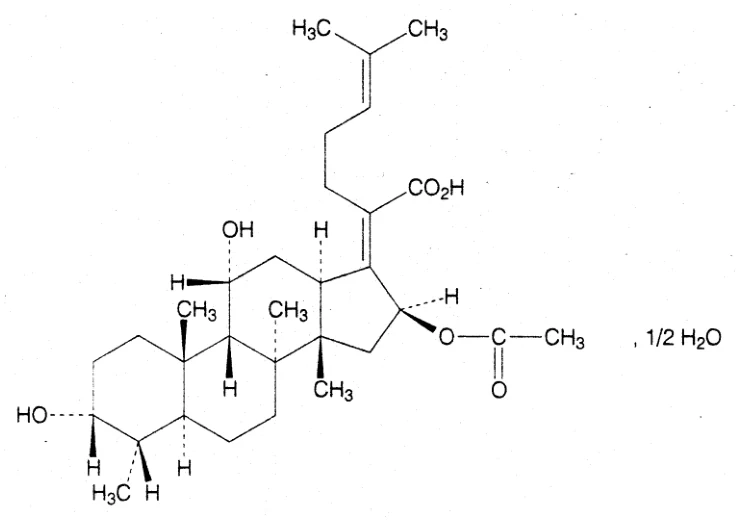
Proper Name: Fusidic Acid Hemihydrate
Chemical Name: ent-(17Ζ)-16α-(Acetyloxy)-3β,11β-dihydroxy-4β,8,14-trimethyl-18-nor-5β,10α-cholesta-17(20),24-dien-21-oic acid hemihydrate
Molecular Formula: C31H48O6, ½ H2O
Molecular Weight: 525.7
Structural Formula:
 |
Description: A white or almost white crystalline powder.
Solubility: Insoluble in water. Freely soluble in alcohol or chloroform.
15. CLINICAL TRIALS
Clinical Studies
Administration of a single drop of FUCITHALMIC to human volunteers resulted in fusidic acid concentrations 15-40 mcg/mL in lacrimal fluid 1 hour after administration and 1.4-5.6 mcg/mL 12 hours after administration.
Intraocular penetration studies in patients undergoing cataract extraction show that fusidic acid passes the corneal aqueous barrier. In patients (n=12) administered a single drop of FUCITHALMIC
1-5 hours prior to surgery, fusidic acid concentrations were 0.14-2.2 mcg/mL in the anterior chamber fluid. In patients (n=20) administered 1 drop of FUCITHALMIC 1, 5, or 12 hours prior to surgery, median fusidic acid concentrations were 0.3 mcg/mL. Repeated administration (ie., 2 or 5 dose occasions) resulted in a median fusidic acid concentration of 0.76 mcg/mL.
16. MICROBIOLOGY
The microbiological activity of FUCITHALMIC Viscous Eye Drops (fusidic acid) is attributed to fusidic acid.
In Vitro Studies
Fusidic acid is a narrow-spectrum antibiotic. Fusidic acid has potent antibacterial activity toward Gram-positive bacteria and Neisseria species. Fusidic acid is most notable for its activity against Staphylococci, whether coagulase-positive or negative, and regardless of resistance to methicillin and related penicillins. Fusidic acid is active against Haemophilus sp. but has almost no antibacterial activity against other Gram-negative organisms such as E. Coli, Proteus, Klebsiella and Salmonella. Fungi are also insensitive to fusidic acid. The efficacy of fusidic acid against different microorganisms is outlined in Table 2.
Microorganisms associated with conjunctivitis that are sensitive to fusidic acid include Staphylococcus aureus, Streptococcus pneumoniae and Haemophilus influenzae. There is no data on the clinical effectiveness of fusidic acid toward Chlamydia trachomatis. The in vitro susceptibility of a range of Canadian clinical isolates associated with conjunctivitis is illustrated in Table 3.
In vitro sensitivity to fusidic acid in relation to systemic antibiotic treatment is generally determined by the Kirby-Bauer disc diffusion methods using discs containing 10 mcg sodium fusidate. Sensitivity of Staph. aureus to fusidic acid has typically been interpreted as a growth inhibition zone equal to or greater than 20 mm diameter which corresponds to a minimum inhibitory concentration (MIC) of 2 mcg/mL or less. Resistant organisms are generally defined as having a growth inhibition zone equal to or less than 19 mm diameter (MIC > 2 mcg/mL). Human pharmacokinetic studies have shown that lacrimal fluid concentrations of fusidic acid are in the range of 15.7-40 mcg/mL 1 hour after administration of a single drop of FUCITHALMIC and 1.4-5.5 mcg/mL 12 hours after administration. Since high lacrimal fluid concentrations of fusidic acid are achieved after topical application of FUCITHALMIC, standardized susceptibility tests may not be appropriate to predict clinical effectiveness. There are currently no NCCLS approved standards for testing in vitro susceptibility of conjunctival isolates toward topical antibiotics, including fusidic acid.
Table 2. Antimicrobial Spectrum of Fusidic Acid
| Microorganisms | MIC90%* | MIC-range* | MBC-range* |
Gram-positive Staph. aureus (methicillin-susceptible) Staph. aureus (methicillin-resistant) Staph. epi. (methicillin-susceptible) Staph. epi. (methicillin-resistant) Corynebacterium diptheriae Clostridium tetani Clostridium perfringens Propionibacterium acnes Other Corynebacterium spp. Clostridium difficile Other Clostridium spp. Staphylococcus saprophyticus Streptococcus faecalis Streptococcus pyogenes Streptococcus pneumoniae JK diphteroids Gram-negative Neisseria meningitidis Legionella pneumophila Neisseria gonorrhoeae Bacteroides fragilis Other Bacteroides spp. Others Mycoplasma spp. Mycobacterium tuberculosis Nocardia asteroids Other Nocardia spp. RESISTANT Other Gram-Negative E. coli, Pseudomonas, Klebsiella, Proteus, Salmonella, Shigella, Pasteurella | 0.06 0.12 0.25 0.50 0.0044 (a) 0.05 (a) 0.5 1.0 2.0 2.0 ≤1.0 3.12 6.25 12.5 25.0 32.0 0.12 ≤0.25 (a) 1.0 2.0 ≤2.0 ≤0.8 (a) 3.0 (a) 16.0 32.0 | 0.007-0.195 0.015-8.0 0.024-8.0 0.03≥32 ND ND 0.06- 1.0 ≤0.06- 2.0 ≤0.04- 12.5 ≤0.25- 64 ≤0.06- 1.0 0.048-6.25 1.56- 6.25 <1.6 - 50 <0.25->64 0.015- 0.5 ND ≤0.03- 8.0 0.5- 4.0 ≤0.06- 8.0 ND ND ≤0.5 - 32.0 ≤0.5 - >32.0 | 0.097-25.0 0.040-12.5 0.024-12.5 ND ND ND ND ND ND ND ND 0.097-12.5 1.56 -50.0 ND ND ND ND ND ND ND ND ND ND ND |
| *mcg/mL (a) MIC-value ND - No data | |||
Table 3. Fusidic Acid Sensitivity for Conjunctival Isolates - Canadian data
| Organism | No. of Isolates | MIC90 (mcg/mL) | MIC Range (mcg/mL) |
| Staph. aureus | n=200* n=35** | 0.06 0.125 | 0.06 - 8 <0.06 - 0.125 |
| Coag. Neg. Staph. | n=230* n=318** | 0.25 16 | 0.06 - 4 <0.06 - 32 |
| Strep. pneumoniae | n=160* n=15** | 32 16 | 4 - 64 16 |
| Strep. viridans | n=90** | 2 | 2 - 8 |
| Haemophilus influenzae | n=500** | 8 | 2 - 32 |
| Moraxella catarrhalis | n=30* n=3** | <2 8 | <2 0.25 - 8 |
| Corynebacterium sp. | n=90* n=21** | <2 16 | <2 0.25 - >128 |
| Enterobacteriaceae | n=18* n=4* | >128 >128 | >128 128 - >128 |
| Pseudomonas sp. | n=8** | >128 | >128 |
* 1991 Canadian Clinical Survey (Data on file, LEO Pharma Inc.) ** Clinical trial FUM 9402 CAN (Data on file, LEO Pharma Inc.) | |||
Resistance to Fusidic Acid
During more than 30 years of therapeutic use of fusidic acid, resistance by Staph. aureus has remained extremely low (<2%). An ongoing Canadian program has monitored resistance of clinical isolates of Staph. aureus to fusidic acid since 1986. As of 1994, over 12,500 strains of Staph. aureus have been tested with an overall resistance rate of 1.47%. The annual resistance rate has never exceeded 2%, indicating the stability of the anti-staphylococcal activity of fusidic acid.
Resistance In Vivo: Although resistance to fusidic acid has been rapidly induced in vitro, resistant strains have only occasionally been observed in the clinical setting. In one study, only 3 out of 1025 naturally occurring strains of Staphylococcus aureus were found to be resistant to fusidic acid. In another study, only 10 out of 2700 clinical isolates of Staphylococcus showed resistance to fusidic acid and all 10 strains were coagulase positive Staphylococci. The degree of resistance exhibited by these strains was comparable to the resistance shown by various mutants in vitro.
Two mechanisms explain emergence of resistance to fusidic acid in Staph. aureus strains. The first one is chromosomal mutation. All populations of Staph. aureus produce resistant variants by chromosomal mutation at a frequency of 1 in 106 to 107. This type of resistance is readily detected in vitro, and is due to a modification of elongation factor G, the target at which fusidic acid inhibits bacterial protein synthesis. Such variants appear to be defective in that they grow more slowly than the parent strain, have a lower pathogenicity and subsequently revert to full sensitivity in the absence of fusidic acid. This type of mutation occurs at a high rate in vitro, but emergence of resistance in the clinical setting occurs less readily than is indicated by this observation. The second mechanism is plasmid-mediated resistance. These strains have been shown to be distinct from the chromosomal variants, as they do not have a modification of elongation factor G. Protein synthesis of cell free extracts is still inhibited by fusidic acid and there is no evidence of enzyme-mediated inactivation of fusidic acid. However, it has been suggested that there may be a permeability barrier at the cell surface, which reduces entry of the antibiotic. This theory is supported by the fact that they grow normally and are pathogenic. However, some plasmids that confer resistance to fusidic acid are unstable, which may make them inefficient at transmitting resistance.
17. NON-CLINICAL TOXICOLOGY
Acute Toxicity
The following table 4 summarizes the acute toxicity data obtained for mice, rats and pups
Table 4; Summary of Acute Toxicity data obtained for mice, rats and pups
Drug Substance | Species | Route of Administration | LD50 (mg/kg b.w.) |
Na Fusidate Fusidic Acid | Mice Rats Mice Rats - Adults
| Oral Intravenous Oral Intravenous Oral Intraperitoneal Oral Oral | 860 180 3000 140 5400 355 2263 443 |
The signs and symptoms of toxicity of fusidic acid and its salts in mice were decreased activity, ataxia, staggering, tremors, convulsions and increased respiratory rate in a few cases; in rats, the only symptoms preceding death were decreased activity, slight salivation and in some cases coma and increased respiration.
Dogs: Sodium fusidate was administered as a 10% solution by stomach tube to 2 fasted dogs in single doses of 250 and 500 mg/kg, respectively. Two other fasted dogs received the drug in the form of gelatin capsules in doses of 500 and 1500 mg/kg, respectively. No effects were noted in the dog receiving 500 mg/kg by capsules. The remaining 3 dogs vomited within 8 to 60 minutes; the dog given 1500 mg/kg was lethargic for 12 hours but no other effects were observed during a 7 day observation period. A dose-dependent increase in BSP retention times was observed.
Subacute Toxicity
Rats: Sodium fusidate was administered in the diet of 2 groups composed of 5 male and 5 female rats at doses of 0 or 270 mg/kg/day for 4 weeks. A similar group received 500 mg/kg/day for 1 week and subsequently 1200 mg/kg/day for 3 weeks. None of the animals died during testing and no significant lesions attributable to the drug were found. Except for a slight to moderate weight retardation in males in the high dose group, the average rates of growth of the treated animals were comparable to those of the controls.
In a more recent study, sodium fusidate was administered intravenously for 2 weeks to 2 groups of rats composed of 10 males and 10 females in a dose of 21.5 mg/kg per day diluted with saline to a concentration of 2.15 mg/mL. There were no mortalities and no changes in appearance or behaviour in any of the animals. No toxic or other adverse effects attributable to the drug were seen.
Dogs: Sodium fusidate was administered in the diet of 3 groups of 2 dogs each. One group served as the control; another group was dosed at 110 mg/kg/day for 4 weeks and the third group at 250 mg/kg/day for 1 week followed by 470 mg/kg/day for the next 3 weeks. None of the dogs showed any significant gross or micropathological alterations which were considered to be drug related.
During the second and third weeks the 2 dogs on the low dose showed reduction in appetite which was apparently due to poor palatability of the drug. One of the 2 dogs showed a slight weight loss. In the high dose group reductions in appetite limited drug intake to an average of 470 mg/kg/day. Both these animals had small weight losses, probably associated with reduced food intake.
Sodium fusidate was also administered intravenously to 2 male and 2 female dogs for 2 weeks at a dose of 21.5 mg/kg per day given in two equal doses of 62.5 mL each. Apart from local swelling at the site of catheterization, no changes were seen which were considered to be related to the administration of the sodium fusidate compound by gross or histopathological examination.
In a further study, 2 male dogs received daily, for 2 weeks, 2 infusions of 10.75 mg/kg of sodium fusidate in a volume of 62.5 mL administered by slow infusion over a period of 90 minutes. The infusion of sodium fusidate provoked a local intolerance manifested by a reddening and swelling at the site of cannulation. At the histological level, a venous intolerance reaction was noted.
Chronic Toxicity
Rats: Sodium fusidate was administered in the diet to 4 groups of 40 rats at doses of 0, 200, 420 or 840 mg/kg daily for 34 weeks. High dose females and to a lesser degree, high dose males showed a small retardation of weight gain. Slight neutrophilia was also noted in both high dose males and females. Ten of the 14 high dose males showed mild fatty metamorphosis of the liver without significant cytopathological change.
In another study, rats received sodium fusidate administration orally at a dose of 200 mg/kg/day for 24 weeks. No influence on growth or hematology and no other toxic effects were observed.
In a third study, fusidic acid was administered orally to a group of 25 male and 25 female rats at a dose of 400 mg/kg/day, 6 days a week for 5 months. No hematological changes or other toxic effects were noted.
Guinea Pigs: No toxic effects were seen when sodium fusidate was administered orally to guinea pigs at doses of 80 mg/kg/day for 50 days.
Dogs: Sodium fusidate was included in the diet of 4 groups of 5 dogs in amounts to result in doses of 0, 90, 190 or 300 mg/kg for 26 weeks. Significant changes observed were: 1) weight loss with significantly reduced appetite in one animal on the high dose; however, all other test animals maintained or gained weight comparable to the control group in spite of slightly reduced food intake ascribed by the investigator to poor palatability; 2) one dog on the high dose showed definite increases in plasma bilirubin and BSP; one dog on the intermediate dose showed slight to moderate increases in BSP, SGPT and alkaline phosphatase; one dog on the low dose showed a moderate increase in alkaline phosphatase and a slight increase in plasma bilirubin.
In another study, post mortem examination revealed mild to moderate liver cell damage in one high dose dog (400 mg/kg/day) at 26 weeks but the other animals showed no morphological changes with this dose attributable to the drug.
Fertility and Reproduction Studies
Two groups, each comprised of 20 males and 20 female rats, received either 0 or 400 mg/kg sodium fusidate per day for 2 weeks before mating to weaning. Caesarian sections were performed on half the dams on the 20th day; the remainder were allowed to deliver naturally.
There were no significant differences between the treated and control dams with respect to per cent resorptions, the condition of the uteri or the number and weights of the pups. No soft tissue abnormalities were found in the pups of either group but skeletal anomalies (control group 2 pups missing ribs and dosed group 1 pup occipital bone formation incomplete and 1 pup rib deformities) appeared in 4% of the pups in both groups. These rates were similar to that seen in the control group. The viability and lactation indices, reflecting neonatal development, were higher in the treated group than the control group but all values were within normal limits.
Teratology Studies
Mice: Pregnant mice were divided into 3 groups of 16-19 animals each and given daily doses of 20, 100 and 200 mg/kg sodium fusidate by gavage from the 6th to 15th day of gestation. Another group of 23 pregnant mice, serving as controls, received just water by gavage. On the 18th day of pregnancy, half the dams were sacrificed. The remainder were allowed to go to term.
Sex distribution of fetuses and young, fetal weight, birth weight and weight increase were normal and similar for all groups. The mean incidence of resorption was 1.2, 1, 0.5 and 0.6 per dam for the 20, 100 and 200 mg/kg groups and control group, respectively. Average litter size in the treated group did not differ significantly from that of the controls of any of the groups.
Rats: Pregnant rats were divided into 3 groups of 29-31 animals each and given daily doses of 20, 100 or 200 mg/kg sodium fusidate by gavage from the 3rd to the 15th day of gestation. Another group of 59 pregnant rats, serving as controls, received just water by gavage. On the 21st day of pregnancy, half the dams were sacrificed. The remaining dams were allowed to go to term.
Litter size and sex distribution of the fetuses and young of the dosed animals were comparable to the controls with no dose-related differences. Birth weights and weight gain over a 4-month period were comparable for all groups. No fetal deformities were observed in any group.
Rabbits: Eighteen pregnant rabbits were treated orally with 125 mg sodium fusidate in tablet form once per day from the 6th to the 18th day of pregnancy. Eleven pregnant animals, serving as controls, received a placebo tablet each day. On the 30th day of pregnancy 9 treated animals and 3 controls were sacrificed. The remaining animals were allowed to go to term.
Sex distribution of fetuses and young, fetal and birth weights and weight gain were normal and similar for both groups. Three dead fetuses were found in each of 2 treated animals and in 1 control animal. Average litter size was lower in the treated group (4.8 young per litter) than in the control group (7.6 young per litter). Macroscopic examinations of the young failed to reveal any teratogenic or other abnormalities.
Clastogenicity Studies
Sodium fusidate was evaluated using a micronucleus test in mouse bone marrow. The micronucleus test is a mammalian in vivo test to detect damage to chromosomes or to mitotic apparatus induced by chemicals. Fasting mice (10 male and 10 female per group) were treated orally at doses of 0, 250, and 500 mg/kg sodium fusidate in a dosing volume of 10 mL/kg. The animals were sacrificed 24 and 48 hours after dosing and bone marrow samples obtained. Smears were prepared from the bone marrow for microscopic examination of cell morphology and staining characteristics. There was no difference between the sodium fusidate treated groups and the negative control group with respect to the incidence of micronucleated polychromatic or normochromatic erythrocytes. It was concluded that sodium fusidate showed no evidence of clastogenic potential.
Eye Tolerance Studies
Ocular tissue irritation was evaluated in New Zealand White rabbits (n=6) during 5 days of FUCITHALMIC administration (2 drops twice daily) to the right eye. There was no difference in redness or swelling between the treated side and the untreated control side.
In male Chinchilla rabbits (n=6), the irritant effect of FUCITHALMIC (1 drop twice daily for 6 week on the cornea, iris and conjunctiva was assessed. Daily clinical evaluation and ophthalmoscopic examination showed no abnormalities in the FUCITHALMIC treated right eyes as compared to the vehicle treated left eyes. Histopathological examination at the end of treatment was comparable between treatment groups. Minimal focal subepithelial lymphoid hyperplasia of the conjunctiva and minimal focal superficial chronic keratitis was observed in both treatment groups. There was no difference in irritation due to FUCITHALMIC versus vehicle control.
The allergic potential of FUCITHALMIC was assessed in guinea pigs. None of the animals (10 FUCITHALMIC treated and 10 controls) were sensitized and therefore FUCITHALMIC was classified as a weak potential allergen.