


Product Monograph - Sandoz Tacrolimus XR
Recent Major Label Changes
| 2026/03 |
|---|---|
| 2026/03 |
Table of Contents
Certain sections or subsections that are not applicable at the time of the preparation of the most recent authorized product monograph are not listed.
Recent Major Label Changes .................................................................................................... 2
Table of Contents ..................................................................................................................... 2
Part 1: Healthcare Professional Information ............................................................................ 5
- 1. Indications .................................................................................................................... 5
1.1. Pediatrics ........................................................................................................................... 5
1.2. Geriatrics ........................................................................................................................... 5
- 2. Contraindications ......................................................................................................... 5
- 3. Serious Warnings and Precautions Box ......................................................................... 6
- 4. Dosage and Administration .......................................................................................... 6
4.1. Dosing Considerations ....................................................................................................... 6
4.2. Recommended Dose and Dosage Adjustment ................................................................... 7
4.3. Reconstitution ................................................................................................................... 9
4.4. Administration ................................................................................................................... 9
4.5. Missed Dose ...................................................................................................................... 9
- 5. Overdose ...................................................................................................................... 9
- 6. Dosage Forms, Strengths, Composition, and Packaging .............................................. 10
- 7. Warnings and Precautions .......................................................................................... 11
General ........................................................................................................................................ 11
Carcinogenesis and Genotoxicity ................................................................................................. 12
Cardiovascular ............................................................................................................................. 13
Driving and Operating Machinery ............................................................................................... 14
Gastrointestinal ........................................................................................................................... 14
Hematologic ................................................................................................................................ 14
Hepatic/Biliary/Pancreatic ........................................................................................................... 14
Immune ....................................................................................................................................... 15
Monitoring and Laboratory Tests ................................................................................................ 15
Neurologic ................................................................................................................................... 17
Renal ........................................................................................................................................... 17
Reproductive Health .................................................................................................................... 18
7.1. Special Populations .......................................................................................................... 18
7.1.1. Pregnancy .................................................................................................................... 18
7.1.2. Breastfeeding............................................................................................................... 19
7.1.3. Pediatrics ..................................................................................................................... 19
7.1.4. Geriatrics ..................................................................................................................... 19
- 8. Adverse Reactions ...................................................................................................... 19
8.1. Adverse Reaction Overview ............................................................................................. 19
8.2. Clinical Trial Adverse Reactions ....................................................................................... 20
8.3. Less Common Clinical Trial Adverse Reactions ................................................................ 23
8.4. Abnormal Laboratory Findings: Hematologic, Clinical Chemistry, and Other Quantitative Data….. ........................................................................................................................................ 25
8.5. Post-Market Adverse Reactions ....................................................................................... 25
- 9. Drug Interactions ........................................................................................................ 27
9.2. Drug Interactions Overview ............................................................................................. 27
9.3. Drug-Behaviour Interactions............................................................................................ 27
9.4. Drug-Drug Interactions .................................................................................................... 27
9.5. Drug-Food Interactions .................................................................................................... 38
9.6. Drug-Herb Interactions .................................................................................................... 38
9.7. Drug-Laboratory Test Interactions ................................................................................... 38
- 10. Clinical Pharmacology ................................................................................................. 38
10.1. Mechanism of Action ................................................................................................... 38
10.2. Pharmacodynamics ...................................................................................................... 39
10.3. Pharmacokinetics ........................................................................................................ 39
- 11. Storage, Stability, and Disposal .................................................................................. 47
- 12. Special Handling Instructions ...................................................................................... 47
Part 2: Scientific Information ................................................................................................. 48
- 13. Pharmaceutical Information ....................................................................................... 48
- 14. Clinical Trials .............................................................................................................. 48
14.1. Clinical Trials by Indication .......................................................................................... 49
14.2. Study Results ............................................................................................................... 54
14.3. Comparative Bioavailability Studies ............................................................................. 60
- 15. Microbiology .............................................................................................................. 61
- 16. Non-Clinical Toxicology .............................................................................................. 61
- 17. Supporting Product Monographs ................................................................................ 66
Patient Medication Information ............................................................................................ 67
Sandoz Tacrolimus XR (tacrolimus) Page 5 of 77
Part 1: Healthcare Professional Information
1. Indications
De novo
Sandoz Tacrolimus XR (tacrolimus extended-release capsules) is indicated for prophylaxis of organ rejection in adult patients receiving allogeneic kidney and liver transplants.
Sandoz Tacrolimus XR is to be used concomitantly with adrenal corticosteroids and mycophenolate mofetil (MMF) in de novo renal transplant recipients and adrenal corticosteroids in de novo liver transplants. Antibody induction therapy should also be used in kidney transplant recipients.
Conversion
Stable renal transplant patients may be converted from Sandoz Tacrolimus (twice daily) to Sandoz Tacrolimus XR (once daily), in combination with adrenal corticosteroids and MMF, based on equivalent tacrolimus whole blood trough concentrations. Stable liver transplant patients may be converted from Sandoz Tacrolimus (immediate-release formulation) to Sandoz Tacrolimus XR (extended-release formulation), in combination with adrenal corticosteroids, based on equivalent tacrolimus whole blood trough concentrations (See 4. Dosage and Administration).
Any changes in immunosuppressive therapy must be initiated by physicians experienced in immunosuppressive therapy and the management of transplant patients.
1.1. Pediatrics
Pediatrics (< 18 years of age): A safe and effective dose of tacrolimus extended-release capsules in pediatric liver and kidney transplant recipients has not been determined.
1.2. Geriatrics
Geriatrics (≥ 65 years of age): Experience with tacrolimus extended-release capsules in patients older than 65 years of age is limited.
2. Contraindications
Sandoz Tacrolimus XR (tacrolimus extended-release capsules) is contraindicated in patients with hypersensitivity to tacrolimus or to any ingredient in the formulation or component of the capsules. For a complete listing, see 6. Dosage Forms, Strengths, Composition, and Packaging.
- 3. Serious Warnings and Precautions Box
4. Dosage and Administration
4.1. Dosing Considerations
Sandoz Tacrolimus XR is a once-a-day oral formulation of tacrolimus. Sandoz Tacrolimus XR therapy requires careful monitoring by adequately qualified and equipped personnel. The medicinal product should only be prescribed, and changes in immunosuppressive therapy initiated, by physicians experienced in immunosuppressive therapy and the management of transplant patients.
Medication errors, including inadvertent, unintentional or unsupervised substitution of tacrolimus immediate-release or tacrolimus extended-release formulations, have been observed. This has led to serious adverse events, including graft rejection, or other side effects which could be a consequence of either under- or over-exposure to tacrolimus. Patients should be maintained on a single formulation of tacrolimus with the corresponding daily dosing regimen; alterations in formulation or regimen should only take place under the close supervision of a transplant specialist.
Following conversion to any alternative formulation, therapeutic drug monitoring must be performed and dose adjustments made to ensure that systemic exposure to tacrolimus is maintained.
Patients converting from tacrolimus immediate-release formulation to Sandoz Tacrolimus XR extended-release formulation should be administered a single daily morning dose of Sandoz Tacrolimus XR equivalent to the patient’s previous stable total daily dose of tacrolimus immediate-release formulation. Subsequent doses of Sandoz Tacrolimus XR should be adjusted
Serious Warnings and Precautions
- Increased susceptibility to infection and the possible development of lymphoma and skin cancer may result from immunosuppression (see 7. Warnings and Precautions – Carcinogenesis and Genotoxicity, and Immune).
- Only physicians experienced in immunosuppressive therapy and management of organ transplant should prescribe Sandoz Tacrolimus XR (tacrolimus extended-release capsules). Patients receiving the drug should be managed in facilities equipped and staffed with adequate laboratory and supportive medical resources. The physician responsible for maintenance therapy should have complete information requisite for the follow-up of the patient and should be consulted if a patient is converted to an alternative formulation so that therapeutic drug monitoring can be instituted.
in order to maintain trough concentrations similar to those prior to conversion.
Due to intersubject variability following dosing with tacrolimus, individualization of the dosing regimen is necessary for optimal therapy.
Sandoz Tacrolimus XR is to be used concomitantly with adrenal corticosteroids and mycophenolate mofetil (MMF) in de novo renal transplant recipients. Antibody induction therapy should be used in kidney transplant recipients. Sandoz Tacrolimus XR is to be used concomitantly with adrenal corticosteroids in de novo liver transplants.
4.2. Recommended Dose and Dosage Adjustment
Initial dosage and typical tacrolimus whole blood trough concentrations are shown in Table 1 below; blood concentration details are described under 7. Warnings and Precautions – Monitoring and Laboratory Tests – Blood Concentration Monitoring.
| Table 1: Sandoz Tacrolimus XR (tacrolimus extended-release capsules) – Summary of Initial Oral Dosage Recommendations and Typical Whole Blood Trough Concentrations | |||||
| Patient Population | Recommended Initial Once Daily (AM) Oral Dose | Typical Whole Blood Trough Concentrations | |||
| Adult Kidney Transplant Patients | 0.15-0.20 mg/kg/day | Month 1-3: 7-16 ng/mL Month 4-12: 5-15 ng/mL | |||
| Adult liver transplant | 0.10-0.20 mg/kg/day | Day 1 to 60: 5 to 20 ng/mL Month 3 to 12: 5 to 15 ng/mL | |||
The recommended starting oral dose of Sandoz Tacrolimus XR for kidney transplant patients is 0.15 to 0.20 mg/kg and for liver transplant patients 0.10-0.20 mg/kg administered once daily in the morning. The initial dose of Sandoz Tacrolimus XR should be administered within 24 hours of kidney transplantation and within 12-18 hours of liver transplantation. Dosing should be titrated to maintain the whole blood trough concentration levels noted above; blood concentration details are described under 7. Warnings and Precautions – Monitoring and Laboratory Tests – Blood Concentration Monitoring.
Conversion from Tacrolimus immediate-release formulation to Sandoz Tacrolimus XR extended-release formulation
Stable kidney and liver transplant recipients can be converted from tacrolimus immediate-release formulation twice daily to once-daily Sandoz Tacrolimus XR extended-release formulations. Patients converting from tacrolimus immediate-release formulation to Sandoz Tacrolimus XR extended-release formulation should be administered a single daily morning dose of Sandoz Tacrolimus XR extended-release formulation equivalent to the patient’s previous stable total daily dose of tacrolimus immediate-release formulation. The same target trough range and whole blood trough concentration monitoring should be used as with tacrolimus immediate-release formulation in order to maintain whole blood trough concentrations of tacrolimus similar to those prior to conversion.
In patients unable to take oral Sandoz Tacrolimus XR extended-release capsules, therapy may be initiated with tacrolimus injection and the patient subsequently converted to oral Sandoz Tacrolimus XR. The recommended starting dose of tacrolimus injection is 0.03-0.05 mg/kg/day (kidney) as a continuous IV infusion. Adult patients should receive doses at the lower end of the dosing range.
In a liver conversion adult study from tacrolimus immediate-release formulation to tacrolimus extended-release formulation (n=62), tacrolimus extended-release formulation dose adjustments were needed in approximately 16% of patients in the early conversion period. After conversion, it is strongly recommended that the tacrolimus blood trough be monitored every 4-7 days until stable within the desired therapeutic range.
Patients with Hepatic or Renal Dysfunction
Tacrolimus extended-release formulation has not been studied in patients with hepatic or renal dysfunction; the following are based on experiences obtained from use of tacrolimus immediate-release formulation.
Due to the reduced clearance and prolonged half-life, patients with severe hepatic impairment (Pugh ≥ 10) may require lower doses of Sandoz Tacrolimus XR. Close monitoring of blood concentrations is warranted. Due to the potential for nephrotoxicity in patients with renal or hepatic impairment, these patients should receive doses at the lowest value of the recommended oral dosing range. Further reductions in dose below these ranges may be required.
Conversion from Cyclosporine to Sandoz Tacrolimus XR
Tacrolimus should not be used simultaneously with cyclosporine. Patients converted from cyclosporine to Sandoz Tacrolimus XR should receive the first Sandoz Tacrolimus XR dose no sooner than 24 hours after the last cyclosporine dose. Dosing may be further delayed in the presence of elevated cyclosporine levels.
Conversion from Sandoz Tacrolimus XR to Cyclosporine
Patients converted from Sandoz Tacrolimus XR to cyclosporine should receive the first cyclosporine dose no sooner than 24 hours after the last Sandoz Tacrolimus XR dose. Dosing may be further delayed in the presence of elevated tacrolimus levels.
Race
The data from tacrolimus extended-release capsules administration in de novo kidney transplant patients indicate that Black patients required a higher dose to attain comparable trough concentrations compared to White patients (Table 2).
| Table 2: Tacrolimus extended-release capsules trough concentrations in kidney transplant patients | |||||||||
| Time After Transplant | White n=160 | n=41 | |||||||
| Dose (mg/kg) | Mean Trough Concentration (ng/mL) | Dose (mg/kg) | Mean Trough Concentration (ng/mL) | ||||||
| Day 7 | 0.14 | 10.79 | 0.14 | 7.85 | |||||
| Month 1 | 0.14 | 11.11 | 0.18 | 10.83 | |||||
| Month 6 | 0.10 | 7.96 | 0.13 | 8.50 | |||||
| Month 12 | 0.09 | 7.54 | 0.12 | 7.52 | |||||
4.3. Reconstitution
Not Applicable.
4.4. Administration
Sandoz Tacrolimus XR can be administered with or without food; however, doses should be administered in a consistent manner (see 10. Clinical Pharmacology).
Avoid eating grapefruit or drinking grapefruit juice or alcohol when taking Sandoz Tacrolimus XR.
4.5. Missed Dose
If a dose of Sandoz Tacrolimus XR is missed, the dose may be taken up to 14 hours after the scheduled time without risk of overexposure (i.e., for a missed 8:00 am dose, take by 10:00 pm). Beyond the 14-hour time frame, the patient should wait until the usual scheduled time the following morning to take the next regular daily dose.
5. Overdose
Limited overdosage experience with tacrolimus is available.
An overdosage of 5 times the intended dose has been reported with tacrolimus extended-release capsules, followed by an adverse event of hypomagnesaemia that was successfully treated with medication.
Acute overdosages of up to 30 times the intended dose have been reported with tacrolimus immediate-release formulation. Almost all cases have been asymptomatic and all patients recovered with no sequelae. Occasionally, acute overdosage has been followed by adverse reactions consistent with those listed in the adverse reactions section except in one case where transient urticaria and lethargy were observed. Based on the poor aqueous solubility and extensive erythrocyte and plasma protein binding, it is anticipated that tacrolimus is not dialyzable to any significant extent; there is no experience with charcoal hemoperfusion. The oral use of activated charcoal has been reported in treating acute overdoses, but experience has not been sufficient to warrant recommending its use. General supportive measures and treatment of specific symptoms should be followed in all cases of overdosage.
For the most recent information in the management of a suspected drug overdose, contact your regional poison control centre or Health Canada’s toll-free number, 1-844 POISON-X (1-844-764-7669).
- 6. Dosage Forms, Strengths, Composition, and Packaging
Table 3: Dosage Forms, Strengths, Composition and Packaging
| Route of Administration | Dosage Form/ Strength/ Composition | Non-medicinal Ingredients |
| Oral | Capsules 0.5 mg, 1 mg, 2 mg, 3 mg and 5 mg | Allura red AC, allura red AC aluminum lake, brilliant blue FCF, brilliant blue FCF aluminum lake, ethylcellulose, gelatin, hypromellose, lactose monohydrate, lecithin, magnesium stearate, propylene glycol, shellac glaze, simethicone, sunset yellow FCF, sunset yellow FCF aluminum lake, and titanium dioxide. The following capsules contain the following additional coloring agents: Capsule 0.5 mg and 2 mg: tartrazine Capsule 5 mg: erythrosine |
Sandoz Tacrolimus XR is available for oral administration as hard gelatin capsules (tacrolimus extended-release capsules) containing the equivalent of 0.5 mg, 1 mg, 2 mg, 3 mg or 5 mg of tacrolimus. Inactive ingredients include ethylcellulose, hypromellose, lactose monohydrate, and magnesium stearate. The ingredients are directly proportional across all capsule strengths. The capsule shells and the printing ink contain following ingredients in alphabetical order: Allura red AC, allura red AC aluminum lake, brilliant blue FCF, brilliant blue FCF aluminum lake, gelatin, lecithin, propylene glycol, shellac glaze, simethicone, sunset yellow FCF, sunset yellow FCF aluminum lake, and titanium dioxide.
The following capsule shells contain the following additional coloring agents:
Capsule 0.5 mg and 2 mg: tartrazine
Capsule 5 mg: erythrosine
Sandoz Tacrolimus XR capsule 0.5 mg
Capsules with light brown body and light yellow cap with black print 0.5 mg. Capsules, supplied in 30-count blister packs (10 capsules per card).
Sandoz Tacrolimus XR capsule 1 mg
Capsules with light brown body and white cap with black print 1 mg. Capsules, supplied in 30-count blister packs (10 capsules per card).
Sandoz Tacrolimus XR capsule 2 mg
Capsules with light brown body and dark green cap with black print 2 mg. Capsules, supplied in 30-count blister packs (10 capsules per card).
Sandoz Tacrolimus XR capsule 3 mg
Capsules with light brown body and light orange cap with black print 3 mg. Capsules, supplied in 30-count blister packs (10 capsules per card).
Sandoz Tacrolimus XR capsule 5 mg
Capsules with light brown body and pink cap with black print 5 mg. Capsules, supplied in 30-count blister packs (10 capsules per card).
7. Warnings and Precautions
Please see the Serious Warnings and Precautions Box at the beginning of Part I: Health
Professional Information.
General
Switching of Tacrolimus immediate-release formulation or Tacrolimus extended-release formulation should be done under supervision of a transplant specialist. Inadvertent, unintentional or unsupervised switching of immediate-release or extended-release formulations of tacrolimus is unsafe. This can lead to graft rejection or increased incidence of side effects, including under- or over-immunosuppression, due to clinically relevant differences in systemic exposure to tacrolimus. Patients should be maintained on a single formulation of tacrolimus with the corresponding daily dosing regimen; alterations in formulation or regimen should only take place under the close supervision of a transplant specialist (see 4. Dosage and Administration).
Following conversion to any alternative formulation, therapeutic drug monitoring must be performed and dose adjustments made to ensure that systemic exposure to tacrolimus is maintained.
In de novo kidney and liver transplant patients, AUC0-24 of tacrolimus for tacrolimus extended-release formulation on day 1 is significantly lower in comparison with that for tacrolimus immediate-release formulation at equivalent doses. By day 4, tacrolimus exposure as measured by trough levels is similar for both formulations. All patients in the clinical kidney de novo studies received antibody induction therapy. All patients in the clinical liver de novo studies received adrenal corticosteroids with tacrolimus extended-release capsules. Tacrolimus extended-release capsules are approved to be used in combination with adrenal corticosteroids and MMF in de novo kidney patients and approved to be used with adrenal corticosteroids in de novo liver patients.
In clinical studies for stable patients converted from tacrolimus immediate-release formulation to tacrolimus extended-release formulation on 1:1 (mg:mg) total daily dose basis, up to one-third of patients required dose adjustment after conversion during the early conversion period due to dosing errors, adverse events, or whole blood trough levels outside the target range. Tacrolimus whole blood trough levels should be measured and closely monitored prior to and after conversion. Conversion to tacrolimus extended-release formulation has primarily been studied from tacrolimus immediate-release formulation in combination with adrenal corticosteroids and MMF based on equivalent tacrolimus whole blood trough concentrations.
Tacrolimus is extensively metabolized by the mixed-function oxidase system, primarily the cytochrome P450 system (CYP3A). Since tacrolimus is metabolized mainly by CYP3A enzyme systems, substances known to inhibit these enzymes may decrease the metabolism or increase bioavailability of tacrolimus with resultant increases in whole blood or plasma levels. Drugs known to induce these enzyme systems may result in an increased metabolism of tacrolimus or decreased bioavailability as indicated by decreased whole blood or plasma levels. Monitoring of blood levels and appropriate dosage adjustments in transplant patients are essential when such drugs are used concomitantly (see 4. Dosage and Administration, 4.2. Recommended Dose and Dose Adjustment, and 9. Drug Interactions).
Sandoz Tacrolimus XR contains lactose and is not recommended for patients with rare hereditary disease of galactose intolerance, the Lapp lactase deficiency or glucose-galactose malabsorption.
Carcinogenesis and Genotoxicity
An increased incidence of malignancy is a recognized complication of immunosuppression in recipients of organ transplants. The most common forms of neoplasms are non-Hodgkin’s lymphomas and carcinomas of the skin and Kaposi’s sarcoma. As with other immunosuppressive therapies, the risk of developing lymphomas and other malignancies, particularly of the skin or Kaposi’s sarcoma, may be higher in Sandoz Tacrolimus XR recipients than in the normal, healthy population. This risk appears to be related to the intensity and duration of immunosuppression rather than to the use of any specific agent.
Lymphoproliferative disorders associated with Epstein-Barr Virus infection have been seen with tacrolimus. It has been reported that reduction or discontinuation of immunosuppression may cause the lesions to regress.
Kaposi’s sarcoma, including cases with aggressive forms of disease and fatal outcomes, has been reported in patients receiving tacrolimus. In some cases, regression of Kaposi’s sarcoma has been observed after reducing the intensity of immunosuppression.
No evidence of genotoxicity was seen in bacterial (Salmonella and E. coli) or mammalian (Chinese hamster lung-derived cells) in vitro assays of mutagenicity, the in vitro CHO/HGPRT assay of mutagenicity, or in vivo clastogenicity assays performed in mice; tacrolimus did not cause unscheduled DNA synthesis in rodent hepatocytes.
Carcinogenicity studies were carried out in male and female rats and mice. In the 80-week mouse study and in the 104-week rat study, no relationship of tumor incidence to tacrolimus dosage was found. The highest doses used in the mouse and rat studies were 0.8 - 2.5 times (mice) and 3.5 - 7.1 times (rats) the recommended clinical dose range when corrected for body surface area.
Cardiovascular
Hypertension is a common adverse effect of tacrolimus therapy (see 8. Adverse Reactions). Mild or moderate hypertension is more frequently reported than severe hypertension. Antihypertensive therapy may be required; the control of blood pressure can be accomplished with any of the common antihypertensive agents. Since tacrolimus may cause hyperkalemia, potassium-sparing diuretics should be avoided. Tacrolimus should be discontinued in patients in whom hypertension and hyperkalemia cannot be controlled.
While calcium-channel blocking agents can be effective in treating tacrolimus-associated hypertension, care should be taken since interference with tacrolimus metabolism may require a dosage reduction (see 9. Drug Interactions).
Heart failure, myocardial hypertrophy and arrhythmia have been reported in association with the administration of tacrolimus immediate-release formulation. Myocardial hypertrophy has been reported in association with the administration of tacrolimus as tacrolimus immediate-release formulation, and is generally manifested by echocardiographically demonstrated concentric increases in left ventricular posterior wall and interventricular septum thickness. Hypertrophy has been observed in infants, children and adults. This condition appears reversible in most cases following dose reduction or discontinuance of therapy. In a group of 20 patients with pre- and post-treatment echocardiograms who showed evidence of myocardial hypertrophy, mean tacrolimus whole blood concentrations during the period prior to diagnosis of myocardial hypertrophy ranged from 11 to 53 ng/mL in infants (n=10, age 0.4 to 2 years), 4 to 46 ng/mL in children (n=7, age 2 to 15 years) and 11 to 24 ng/mL in adults (n=3, age 37 to 53 years).
In patients who develop renal failure or clinical manifestations of ventricular dysfunction while receiving tacrolimus therapy, echocardiographic evaluation should be considered. If myocardial hypertrophy is diagnosed, dosage reduction or discontinuation of tacrolimus should be considered.
Tacrolimus may prolong the QT interval and may cause Torsades de pointes. Caution should be exercised in patients with known risk factors for QT prolongation (including but not limited to, congenital or acquired QT prolongation and concomitant medications known to prolong the QT interval or known to increase tacrolimus exposure) (see 9. Drug Interactions).
Driving and Operating Machinery
Tacrolimus may cause visual and neurological disturbances. No studies have been performed on the effects of tacrolimus on the ability to drive and use machines.
Gastrointestinal
Gastrointestinal perforation has been reported in patients treated with tacrolimus, although all cases were considered a complication of transplant surgery or were accompanied by infection, diverticulum, or malignant neoplasm. As gastrointestinal perforation may be serious or life-threatening, appropriate medical/surgical management should be instituted promptly (see 8. Adverse Reactions).
Hematologic
Cases of pure red cell aplasia (PRCA) have been reported in patients treated with tacrolimus. A mechanism for tacrolimus induced PRCA has not been elucidated. All patients reported risk factors for PRCA such as parvovirus B19 infection, underlying disease or concomitant medications associated with PRCA. If PRCA is diagnosed, discontinuation of tacrolimus should be considered.
Thrombotic microangiopathy (TMA) (including hemolytic uremic syndrome (HUS) and thrombotic thrombocytopenic purpura (TTP))
Concurrent use of tacrolimus and mTOR inhibitors may contribute to the risk of thrombotic microangiopathies (TMA) including hemolytic uremic syndrome (HUS) and thrombotic thrombocytopenic purpura (TTP).
Hepatic/Biliary/Pancreatic
Tacrolimus extended-release capsules were shown to cause new onset diabetes mellitus in clinical trials of kidney transplant patients. New onset diabetes after transplantation (NODAT) may be reversible in some patients. Black and Hispanic kidney transplant patients are at an increased risk. Blood glucose concentrations should be monitored frequently in patients using Sandoz Tacrolimus XR (see 8. Adverse Reactions).
In de novo liver transplant patients, the overall proportion of patients with NODAT as defined by the composite endpoint was 44.8% in the tacrolimus extended-release capsule group and 44.9% in the tacrolimus immediate-release capsule group [Table 4]. The difference between the groups was not statistically significant (P > 0.1) in the 12 month study.
Table 4: Proportion of At-risk Adult De Novo Liver Transplant Recipients with NODAT Through 12 Months
| Tacrolimus extended-release / Corticosteroids (n=181) | Tacrolimus immediate-release / Corticosteroids (n=185) | |
| Fasting Plasma Glucose ≥ 7 mmol/L | 26.0% | 24.3% |
| Insulin Use ≥ 30 days | 30.4% | 29.2% |
| Oral Hypoglycemic Use | 5.5% | 4.9% |
| HbA1c ≥ 6.5% | 9.4% | 9.2% |
Immune
A lymphoproliferative disorder (LPD) related to Epstein-Barr Virus (EBV) infection has been reported in immunosuppressed organ transplant recipients. The risk of LPD appears greatest in young children who are at risk for primary EBV infection while immunosuppressed or who are switched to tacrolimus extended-release capsules following long-term immunosuppression therapy. Because of the danger of over-suppression of the immune system which can increase susceptibility to infection, combination immunosuppressant therapy other than corticosteroids and MMF is not recommended.
Immunosuppressed patients are at increased risk of developing bacterial, viral, fungal, and protozoal infections, including infection reactivation (e.g. Hepatitis B reactivation) and opportunistic infections, including latent viral infections. These include BK virus-associated nephropathy and JC virus-associated progressive multifocal leukoencephalopathy (PML) which have been observed in patients receiving tacrolimus. These infections are often related to a high immunosuppressive burden and may lead to serious or fatal conditions that physicians should consider in the differential diagnosis in immunosuppressed patients with deteriorating renal function or neurological symptoms.
Cytomegalovirus (CMV) Infections
CMV is the most frequent opportunistic infection reported with tacrolimus. CMV seronegative transplant patients who receive an organ from a CMV seropositive donor disease are at higher risk of developing CMV viremia and CMV disease.
Monitoring and Laboratory Tests
Serum creatinine, potassium, and fasting glucose should be assessed regularly. Routine monitoring of metabolic and hematologic systems should be performed as clinically warranted.
Blood Concentration Monitoring
Monitoring of tacrolimus blood levels in conjunction with other laboratory and clinical parameters is considered an essential aid to transplant patient management. During the immediate post-operative period, trough blood concentrations should be measured every 1-3 days. Tacrolimus doses are usually reduced in the post-transplant period. In patients with hepatic or renal dysfunction, or in those receiving or discontinuing concomitant interacting medications, more intensive monitoring may be required, since tacrolimus clearance may be affected under each of these circumstances. More frequent monitoring may also be required in patients early after transplantation since it is at this time that the patients experience the highest risk of rejection. Blood concentration monitoring is not a replacement for renal and liver function monitoring and tissue biopsies. Following discharge from the hospital, the frequency of patient monitoring will decrease with time post-transplant.
Methods commonly used for the assay of tacrolimus include high performance liquid chromatography with tandem mass spectrometric detection (HPLC/MS/MS), enzyme immunoassay (EIA), microparticle enzyme immunoassay (MEIA), and enzyme-linked immunosorbent assay (ELISA). Comparison of the concentrations in published literature to patient concentrations using the current assays must be made with detailed knowledge of the assay methods and biological matrices employed. Whole blood is the matrix of choice and specimens should be collected into tubes containing ethylene diamine tetraacetic acid (EDTA) anti-coagulant. Heparin anti-coagulation is not recommended because of the tendency to form clots on storage. Samples which are not analyzed immediately should be stored at room temperature or in a refrigerator and assayed within 7 days; if samples are to be kept longer, they should be deep frozen at -20°C for up to 12 months.
Data from kidney and liver transplant recipients receiving tacrolimus administered as tacrolimus immediate-release formulation indicate that trough concentrations of tacrolimus in whole blood, as measured by IMx® MEIA (kidney) and ELISA (liver), were most variable during the first week of dosing, and the relative risk of toxicity is increased with higher whole blood trough concentrations. Therefore, monitoring of whole blood trough concentrations is recommended to assist in the clinical evaluation of toxicity. Long-term post-transplant patients often are maintained at the low end of the recommended target range. For stable transplant recipients converted from tacrolimus immediate-release formulation to tacrolimus extended-release formulation, the same type of therapeutic monitoring can be used.
Kidney
Data from the phase III tacrolimus extended-release capsule kidney study indicate that trough concentrations of tacrolimus in whole blood were most variable during the first week of dosing. By month 2, 76% of the patients had trough concentrations between 7 – 16 ng/mL, and greater than 78% maintained concentrations between 5 – 15 ng/mL, from month 4 through 1 year.
Liver
Data from a phase III study with tacrolimus extended-release capsule in de novo liver transplant recipients indicate that trough concentrations of tacrolimus in whole blood were most variable during the first week post-transplantation. Mean trough concentrations from this study were 11.40 ng/mL for months 1 and 8.40 ng/mL for month 6 and 7.60 ng/mL for month 12 post-transplantation.
Neurologic
Tacrolimus can cause neurotoxicity, particularly when used in high doses. Nervous system disorders, including tremor, headache, and other changes in motor function, mental status, and sensory function were reported in 63.1% of de novo kidney transplant recipients. Tremor occurred in 35.0% of tacrolimus extended-release capsules-treated kidney transplant patients compared to 19.8% of Neoral-treated kidney transplant patients. The incidence of other neurological events in kidney transplant patients was similar in the two treatment groups (see 8. Adverse Reactions). Tremor and headache have been associated with high whole blood concentrations of tacrolimus and may respond to dosage adjustment. Seizures have occurred in adult and pediatric patients receiving tacrolimus as tacrolimus immediate-release formulation. Coma and delirium also have been associated with high plasma concentrations of tacrolimus received as tacrolimus immediate-release formulation.
Patients treated with tacrolimus have been reported to develop posterior reversible encephalopathy syndrome (PRES). Symptoms indicating PRES include headache, altered mental status, seizures, visual disturbances. Diagnosis should be confirmed by radiological procedure (e.g., MRI). If PRES is suspected or diagnosed, blood pressure and seizure control and immediate discontinuation of immunosuppression is advised. Most patients completely recover after appropriate measures are taken.
Renal
Tacrolimus can cause nephrotoxicity, particularly when used in high doses. Renal and urinary disorders were reported in 36.9% of de novo kidney transplantation patients and 50% of de novo liver transplantation patients receiving tacrolimus extended-release capsules. In de novo kidney transplant recipients, increased creatinine was reported in 18.7% of tacrolimus extended-release capsules-treated patients and 22.6% of Neoral-treated patients (see 8. Adverse Reactions). Tacrolimus can result in renal function impairment in post-transplant patients. Acute renal impairment without active intervention may progress to chronic renal impairment. Patients with impaired renal function should be monitored closely as the dosage of tacrolimus may need to be reduced. The risk for nephrotoxicity may increase when tacrolimus is concomitantly administered with drugs associated with nephrotoxicity (see 9. Drug Interactions). When concurrent use of tacrolimus with other known nephrotoxic drugs is required, monitor renal function and tacrolimus blood concentrations frequently, and dose adjustments of both tacrolimus and/or concomitant medications should be considered upon initiation, throughout concurrent treatment and at discontinuation of such concomitant drugs. In particular, to avoid excess nephrotoxicity, when switching patients from a cyclosporine-based regimen to a tacrolimus extended-release capsules-based regimen, cyclosporine should be discontinued at least 24 hours prior to initiating Sandoz Tacrolimus XR. Sandoz Tacrolimus XR dosing may be further delayed in the presence of elevated cyclosporine levels (see 9. Drug Interactions – 9.4. Drug-Drug Interactions – Drug Interactions Potentially Affecting Renal Function). When switching from tacrolimus to cyclosporine, tacrolimus should be discontinued for at least 24 hours before initiating the other medication.
Mild to severe hyperkalemia was reported in 22.0% of kidney de novo transplant recipients treated with tacrolimus extended-release capsules and may require treatment (see 8. Adverse Reactions). Serum potassium levels should be monitored. Potassium-sparing diuretics should not be used and high intake of potassium should be avoided during Sandoz Tacrolimus XR therapy (see 7. Warnings and Precautions – Cardiovascular, Monitoring and Laboratory Tests).
The use of tacrolimus extended-release formulation in liver transplant recipients experiencing post-transplant hepatic impairment may be associated with increased risk of developing renal insufficiency related to high whole blood levels of tacrolimus. These patients should be monitored closely and dose adjustment should be considered (see 4. Dosage and Administration).
Reproductive Health
- Fertility
In reproduction studies in rats and rabbits, adverse effects on the fetus were observed mainly at dose levels that were toxic to dams. However, in female rats dosed during organogenesis, embryo toxicity (expressed as reduced pup weights) was seen at a dose which was one-third of the maternally toxic dose. At this same dose, when administered prior to mating and during gestation, tacrolimus was associated with adverse effects on female reproductive parameters and embryolethality. This dose was equivalent to 0.5X the clinical dose. (See 7. Warnings and Precautions – Special Populations).
7.1. Special Populations
7.1.1. Pregnancy
Sandoz Tacrolimus XR (extended-release formulation) should not be used during pregnancy unless the potential benefit to the mother outweighs potential risk to the fetus (See 16. Non-Clinical Toxicology, Reproductive and Developmental Toxicity). There are no adequate and well-controlled studies in pregnant women.
Tacrolimus is transferred across the placenta and infants exposed to tacrolimus in utero may be at a risk of prematurity, birth defects/congenital anomalies, low birth weight, and fetal distress. The use of tacrolimus during pregnancy has been associated with preterm delivery, neonatal hyperkalemia and renal dysfunction.
Tacrolimus may increase hyperglycemia in pregnant women with diabetes (including gestational diabetes). Monitor maternal blood glucose levels regularly.
Tacrolimus may exacerbate hypertension in pregnant women and increase pre-eclampsia. Monitor and control blood pressure. Females and males of reproductive potential should consider the use of appropriate contraception prior to starting treatment with tacrolimus.
A post-authorization safety study analyzed 2,905 pregnancies from the Transplant Pregnancy Registry International (TPRI), assessing outcomes of pregnancies in women treated with regimens containing tacrolimus (number of pregnancies = 1299) or other immunosuppressants (number of pregnancies = 1606). The study results did not indicate an increased risk of major malformations. There was a trend towards a higher prevalence of spontaneous abortion among women treated with tacrolimus compared with alternative immunosuppressants. Among kidney transplant patients, there was also a trend towards a higher prevalence of pre-eclampsia in women treated with tacrolimus. Among kidney and liver transplant patients exposed to tacrolimus, 45%-55% of their live births were premature, with 75%-85% having a normal birth weight for gestational age. Similar results were observed for other immunosuppressants.
7.1.2. Breastfeeding
Tacrolimus is excreted in human milk. The effects of tacrolimus on the breastfed infant, or on milk production have not been assessed. As detrimental effects on the newborn cannot be excluded, women should not breastfeed while receiving tacrolimus.
7.1.3. Pediatrics
Heart failure, cardiomegaly and increased thickness of the myocardium have been reported in patients taking tacrolimus.
7.1.4. Geriatrics
No formal studies have been performed to evaluate the effect of tacrolimus specifically in the geriatric population.
Forty-three patients ≥ 65 years of age have been treated with tacrolimus extended-release capsules in phase II and III studies in solid organ transplantation; there were no patient deaths or graft failures in these patients. Two of these 43 patients experienced acute rejection. No overall differences in safety or effectiveness were observed between elderly patients and younger patients, but greater sensitivity of some older individuals cannot be ruled out. In general, dose selection for an elderly patient should be cautious, reflecting the greater frequency of decreased hepatic, renal, or cardiac function and of concomitant disease or other drug therapy.
8. Adverse Reactions
8.1. Adverse Reaction Overview
The most common adverse reactions reported were infection, tremor, hypertension, decreased renal function, constipation, diarrhea, headache, abdominal pain and insomnia. Many of these adverse reactions were mild and responded to a reduction in dosage. Insulin-dependent post-transplant diabetes mellitus (PTDM) was related to increased whole blood trough concentrations of tacrolimus and higher doses of corticosteroids. The median time to onset of PTDM was 68 days.
8.2. Clinical Trial Adverse Reactions
Because clinical trials are conducted under very specific conditions, the adverse reaction rates observed in the clinical trials may not reflect the rates observed in practice and should not be compared to the rates in the clinical trials of another drug. Adverse reaction information from clinical trials is useful for identifying drug-related adverse events and for approximating rates.
Kidney
In a large (n=668), phase III, randomized, comparative trial, de novo kidney transplant recipients received either tacrolimus extended-release formulation plus mycophenolate mofetil (MMF) or tacrolimus immediate-release formulation plus MMF or Neoral plus MMF. All three regimens included corticosteroids and basiliximab induction. The incidence of adverse events that occurred in ≥15% of tacrolimus extended-release capsules-treated de novo kidney transplant recipients is shown in Table 5 below.
Table 5: De Novo Kidney Transplantation: Adverse Events Occurring in ≥ 15% of tacrolimus extended-release capsules + MMF Treated Patients
Tacrolimus immediate- release capsules + MMF N =212 (% Patients) | Tacrolimus extended-release capsules+ MMF N =214 (% Patients) | Neoral + MMF N =212 (% Patients) | ||||
Tacrolimus immediate- release capsules + MMF N =212 (% Patients) | Tacrolimus extended-release capsules+ MMF N =214 (% Patients) | Neoral + MMF N =212 (% Patients) | ||||
| Gastrointestinal Disorders | ||||||
Diarrhea Nausea Constipation Vomiting Dyspepsia | 44.3% 38.7% 35.8% 25.5% 17.9% | 45.3% 42.1% 41.6% 26.2% 15.0% | 25.5% 46.7% 41.0% 24.5% 15.1% | |||
| Injury, Poisoning and Procedural Complications | ||||||
| Post-procedural pain Incision site complication | 28.8% 28.3% | 29.4% 20.6% | 27.4% 23.1% | |||
| Metabolism and Nutritional Disorders | ||||||
| Hypomagnesemia Hypophosphatemia Hyperkalemia Hyperglycemia Hyperlipidemia Hypokalemia | 28.3% 27.8% 25.5% 21.2% 17.5% 16.0% | 25.7% 23.8% 22.0% 19.2% 16.4% 15.9% | 22.2% 21.2% 19.3% 15.1% 24.5% 17.5% | |||
| Infections and Infestations | ||||||
| Urinary tract infection | 25.5% | 15.9% | 22.2% | |||
| General Disorders and Administration Site Conditions | ||||||
| Edema peripheral Fatigue | 34.9% 10.8% | 35.5% 15.9% | 45.8% 12.3% | |||
| Nervous System Disorder | ||||||
Tremor Headache | 34.4% 24.1% | 35.0% 21.5% | 19.8% 24.5% | |||
| Investigations | ||||||
| Blood creatinine increased | 23.1% | 18.7% | 22.6% | |||
| Blood and Lymphatic System Disorders | ||||||
Anemia Leukopenia | 30.2% 15.6% | 33.6% 16.4% | 27.8% 11.8% | |||
| Vascular Disorders | ||||||
| Hypertension | 32.1% | 29.9% | 34.9% | |||
| Musculoskeletal and Connective Tissue Disorders | ||||||
| Back pain | 12.7% | 15.0% | 14.2% | |||
| Psychiatric Disorders | ||||||
| Insomnia | 30.2% | 25.7% | 21.2% | |||
Liver
In a phase III (n=467), randomized, double-blind comparative trial, de novo liver transplant recipients received either tacrolimus extended-release capsules (0.2 mg/kg/day) or tacrolimus immediate-release capsules (0.1 mg/kg/day in two divided doses). Both regimens included corticosteroids. The incidence of adverse events that occurred in ≥ 15% of tacrolimus extended-release capsule-treated de novo liver transplant recipients is shown in Table 6. The most common events among recipients who received tacrolimus extended-release capsule (≥ 15% of patients in the tacrolimus extended-release capsule group) were anemia, diarrhea, hyperglycemia, hypertension, pleural effusion, pyrexia, renal insufficiency and thrombocytopenia.
Table 6: De novo liver transplantation: Adverse events occurring in ≥ 15% of Tacrolimus extended-release capsule or Tacrolimus immediate-release capsule -treated patients incidence of most frequently reported adverse events regardless of relationship to study medication
Tacrolimus extended-release capsule (N=237) Patients (%) | Tacrolimus immediate- release capsule (N=234) Patients (%) | |
| Blood and lymphatic system disorders | ||
| Anaemia | 31.2% | 30.8% |
| Thrombocytopenia | 15.2% | 16.2% |
| Gastrointestinal disorders | ||
| Diarrhea | 24.9% | 18.4% |
| General disorders and administration site conditions | ||
| Pyrexia | 17.3% | 17.5% |
| Metabolism and nutrition disorders | ||
| Hyperglycaemia | 18.6% | 22.6% |
| Renal and urinary disorders | ||
| Renal insufficiency | 24.5% | 23.1% |
| Respiratory, thoracic and mediastinal disorders | ||
| Pleural effusion | 15.2% | 17.9% |
| Vascular disorders | ||
| Hypertension | 30.8% | 32.5% |
The following adverse events were also reported in clinical studies of solid organ transplant recipients who were treated with tacrolimus extended-release capsule at a frequency of ≥ 3% to <15%.
Blood and Lymphatic System Disorders: leukopenia, secondary anemia, leukocytosis, pancytopenia;
Cardiac Disorders: atrial fibrillation, tachycardia;
Gastrointestinal Disorders: abdominal pain, abdominal pain upper, ascites, constipation, dyspepsia, flatulence, gastroenteritis, nausea, vomiting;
General Disorders and Administration Site Conditions: asthenia, chest pain, edema, peripheral edema, pyrexia, pain;
Hepatobiliary Disorders: bile duct stenosis, cholestasis, cytolytic hepatitis, hepatic artery stenosis, hyperbilirubinemia;
Infections and Infestations: bacterial urinary tract infection, bacterial pneumonia, bacterial sepsis, biliary tract infection, cytomegalovirus infection, hepatitis C, herpes simplex, influenza, nasopharyngitis, pneumonia, sinusitis, upper respiratory tract infection, wound infection;
Injury, Poisoning and Procedural Complications: graft dysfunction, incision site complication, necrotic preservation injury or graft, post-procedural bile leak;
Investigations: abnormal liver function test, increased blood glucose, increased blood creatinine, hepatic enzyme increased, hepatitis C virus;
Metabolism and Nutrition Disorders: dehydration, metabolic acidosis, hyperkalemia, hyperuricemia, noninsulin-dependent diabetes mellitus, hypoalbuminemia, hypocalcemia, hypokalemia, diabetes mellitus, hypomagnesemia, hyperlipidemia, hyponatremia, insulin-dependent diabetes mellitus;
Musculoskeletal and Connective Tissue Disorders: arthralgia, back pain, muscle spasm, pain in extremity including Calcineurin-Inhibitor Induced Pain Syndrome (CIPS);
Nervous System Disorders (see 7. Warnings and Precautions): dizziness, tremor, headache;
Psychiatric Disorders: agitation, anxiety, depression, confusional state, insomnia, psychotic disorder;
Renal and Urinary Disorders (see 7. Warnings and Precautions): acute renal failure, hematuria, oliguria, renal impairment, renal insufficiency;
Respiratory, Thoracic and Mediastinal Disorders: cough, dyspnea, pharyngolaryngeal pain, respiratory failure;
Skin and Subcutaneous Tissue Disorders: acne, pruritus;
Vascular Disorders: hypotension, hemorrhage.
8.3. Less Common Clinical Trial Adverse Reactions
The following adverse events were reported in clinical trials of solid organ transplant recipients treated with tacrolimus extended-release capsules at a frequency rate of ≥ 1% and < 3%:
Blood and Lymphatic System Disorders: bone marrow depression, coagulopathy, neutropenia, febrile neutropenia, polycythemia, thrombocytopenia;
Cardiac Disorders: cardiac failure;
Eye Disorders: vision blurred;
Gastrointestinal Disorders: abdominal discomfort, abdominal distension, abdominal pain lower, gastritis, gastroesophageal reflux disease, hemorrhoids, hernial eventration, loose stools, esophagitis, post-procedural nausea, toothache, umbilical hernia;
General Disorders and Administration Site Conditions: anasarca, chest discomfort, fatigue, multi-organ failure, impaired healing, rigors;
Hepatobiliary Disorders: hepatic artery thrombosis, hepatic steatosis, hepatic fibrosis, hepatic function abnormal, jaundice;
Infections and Infestations: ascites infection, bacterial infections, bronchitis, candidiasis, cellulitis, diarrhea infections, Escherichia urinary tract infection, fungal infection, herpes zoster, herpes virus infection, human polyomavirus infection, liver abscess, lower respiratory tract infection, oral candidiasis, pharyngeal candidiasis, pharyngitis, pyelonephritis, respiratory moniliasis, respiratory tract infection, respiratory tract infection bacterial, sepsis, upper respiratory fungal infection;
Injury, Poisoning, and Procedural Complications: anemia postoperative, anastomotic stenosis, complications of transplant surgery, contusion, drug toxicity, fall, hepatic hematoma, incisional hernia, overdose, post-procedural discharge, procedural hypotension, post-procedural hemorrhage, post-procedural pain, therapeutic agent toxicity, wound dehiscence, wound secretion;
Investigations: blood alkaline phosphatase increased, blood bilirubin increased, blood glucose fluctuation, blood magnesium decreased, blood phosphorus decreased, blood potassium decreased, c-reactive protein increased, cardiac murmur, drug level decreased, drug level increased, gamma-glutamyltransferase increased, international normalized ratio increased, platelet count decreased, urine output decreased, weight decreased, weight increased, white blood cell count increased;
Metabolism and Nutrition Disorders: acidosis, anorexia, decreased appetite, dehydration, dyslipidemia, fluid overload, glucose tolerance impaired, gout, hypercalcemia, hypercholesterolemia, hyperhomocysteinemia, hyperphosphatemia, hypophosphatemia, hypoglycemia, hypertriglyceridaemia;
Musculoskeletal and Connective Tissue Disorders: joint swelling, myalgia, osteopenia, osteoporosis;
Nervous System Disorders: convulsion, disturbance in attention, hypoesthesia, neurotoxicity, neuropathy, neuropathy peripheral, paraesthesia;
Psychiatric Disorders: delirium, hallucination, restlessness;
Renal and Urinary Disorders: dysuria, nephropathy toxic, proteinuria, pollakiuria, renal cyst, urethral pain;
Reproductive System and Breast Disorders: erectile dysfunction, prostatic hypertrophy;
Respiratory, Thoracic and Mediastinal Disorders: atelectasis, dyspnea exertional, epistaxis, hydrothorax, lung disorder, nasal congestion, pneumothorax, productive cough, pulmonary edema;
Skin and Subcutaneous Tissue Disorders: alopecia, ecchymosis, hyperhidrosis, night sweats, rash, skin lesion, scar pain;
Vascular Disorders: hematoma, hemodynamic instability, hot flush, orthostatic hypotension.
8.4. Abnormal Laboratory Findings: Hematologic, Clinical Chemistry, and Other Quantitative Data
Not Applicable.
8.5. Post-Market Adverse Reactions
The following adverse events have been reported from worldwide marketing experience with tacrolimus extended-release formulation and/or tacrolimus immediate-release formulation. Because these events are reported voluntarily from a population of uncertain size, are associated with concomitant diseases and multiple drug therapies and surgical procedures, it is not always possible to reliably estimate their frequency or establish a causal relationship to drug exposure. Decisions to include these events in labeling are typically based on one or more of the following factors: (1) seriousness of the event, (2) frequency of the reporting, or (3) strength of causal connection to the drug.
Blood and Lymphatic System Disorders: agranulocytosis, disseminated intravascular coagulation, eosinophilia, febrile neutropenia, hemolytic anemia, hemolytic-uremic syndrome, pure red cell aplasia, thrombocytopenic purpura, thrombotic thrombocytopenic purpura, thrombotic microangiopathy;
Cardiac Disorders: atrial flutter, cardiac arrhythmia, cardiac arrest, congestive cardiomyopathy, electrocardiogram T wave abnormal, myocardial infarction, myocardial ischemia, pericardial effusion, QT prolongation with or without Torsades de pointes, venous thrombosis deep limb, ventricular extrasystoles, ventricular fibrillation;
Ear and Labyrinth Disorders: hearing loss including deafness, tinnitus;
Endocrine Disorders: hypothyroidism;
Eye Disorders: blindness, blindness cortical, diplopia, eyelid edema, optic neuropathy, photophobia;
Gastrointestinal Disorders: colitis, enterocolitis, gastrointestinal obstruction, gastrointestinal perforation, granulomatous liver disease, hepatocellular injury, impaired gastric emptying, liver fatty, mouth ulceration, Mikulicz’s syndrome, pancreatitis hemorrhagic, pancreatitis necrotizing, stomach ulcer;
General Disorders and Administration Site Conditions: disease recurrence, drug effect delayed, drug effect increased, drug ineffective, drug interaction, drug intolerance, fatigue, feeling of body temperature change, feeling jittery, mobility decreased, multi-organ failure, thirst;
Hepatobiliary Disorders: cholestasis of pregnancy, hepatic cytolysis, hepatic necrosis, hepatotoxicity, venoocclusive liver disease;
Infections and Infestations: eczema infected, Escherichia, urinary tract infection, BK virus associated nephropathy;
Injury, Poisoning and Procedural Complications: drug dispensing error, drug prescribing error, maternal exposure during pregnancy, medication error, primary graft dysfunction;
Investigations: blood urea increased, drug level below therapeutic, drug level fluctuating, immunosuppressant drug level decreased, platelet count increased, transaminases increased;
Metabolism and Nutrition Disorder: appetite disorder, diabetes mellitus inadequate control, hyperammonaemia, amylase increased, ketoacidosis;
Musculoskeletal and Connective Tissue Disorders: immunoglobulin G4 related sclerosing disease, muscular weakness;
Neoplasms benign, malignant and unspecified (including cysts and polyps): breast cancer, haematological malignancy, hepatic neoplasm malignant, lung neoplasm malignant, pharyngeal cancer stage unspecified, Kaposi's sarcoma;
Nervous System Disorders: aphasia, balance disorder, brachial plexopathy, carpal tunnel syndrome, cerebrovascular accident, cerebral infarction, encephalopathy, hemiparesis, incoherent, leukoencephalopathy, mononeuropathy multiplex, mutism, neuralgia, neurotoxicity, paraesthesia, peripheral nerve lesion, peripheral sensory neuropathy, polyneuropathy, posterior reversible encephalopathy syndrome (PRES), progressive multifocal leukoencephalopathy (PML), quadriplegia, somnolence, speech disorder, syncope, tremor;
Psychiatric Disorders: intentional drug misuse, mental disorder;
Renal and Urinary Disorders: albuminuria, cystitis hemorrhagic, glycosuria, micturition disorder, renal failure, renal failure chronic;
Respiratory, Thoracic and Mediastinal Disorders: acute pulmonary edema, acute respiratory distress syndrome, interstitial lung disease, lung infiltration, respiratory distress;
Skin and Subcutaneous Tissue Disorders: dermatosis, Stevens-Johnson syndrome, toxic epidermal necrolysis;
Vascular Disorders: flushing, hot flushes.
There have been rare spontaneous reports of myocardial hypertrophy associated with clinically manifested ventricular dysfunction in patients receiving tacrolimus immediate-release formulation therapy (see 7. Warnings and Precautions).
9. Drug Interactions
9.2. Drug Interactions Overview
Tacrolimus is extensively metabolized by the mixed-function oxidase system, primarily the cytochrome P450 system (CYP3A). Tacrolimus dose reductions and prolongation of dosing interval may be required in order to maintain similar tacrolimus exposure when co-administered with strong CYP3A4 inhibitors. Drugs known to induce these enzyme systems may result in an increased metabolism of tacrolimus or decreased bioavailability as indicated by decreased whole blood or plasma concentrations, thereby potentially requiring dose increases in order to maintain similar tacrolimus exposure when co-administered with strong CYP3A4 inducers (Refer to Table 7). Close monitoring of tacrolimus blood levels, renal function and other side effects (including ECG monitoring for QT prolongation) is strongly recommended when administered with strong CYP3A4 inhibitors (see 4. Dosage and Administration, 4.2. Recommended Dose and Dose Adjustment, and 7. Warnings and Precautions, General).
9.3. Drug-Behaviour Interactions
As with other immunosuppressive agents, owing to the potential risk of malignant skin changes, exposure to sunlight and ultraviolet (UV) light should be limited by wearing protective clothing and using sunscreen with a high protection factor.
9.4. Drug-Drug Interactions
Drug Interactions Potentially Affecting Renal Function
Due to the potential for additive or synergistic impairment of renal function, care should be taken when administering Sandoz Tacrolimus XR with drugs that may be associated with renal dysfunction. These include, but are not limited to, aminoglycosides, amphotericin B, ganciclovir, acyclovir and cisplatin. NSAIDs may interact with Sandoz Tacrolimus XR causing deteriorations in blood pressure (BP) control and serum creatinine levels. The half-life of cyclosporine has been shown to increase when tacrolimus is given simultaneously. Initial clinical experience with tacrolimus immediate-release formulation and cyclosporine resulted in additive/synergistic nephrotoxicity when both agents were co-administered. For these reasons, the combined administration of cyclosporine and tacrolimus is not recommended and care should be taken when administering tacrolimus to patients who have previously received cyclosporine. Patients switched from cyclosporine to Sandoz Tacrolimus XR should receive the first Sandoz Tacrolimus XR dose no sooner than 24 hours after the last cyclosporine dose. Dosing may be further delayed in the presence of elevated cyclosporine levels.
Drug Interactions Potentially Affecting Tacrolimus Blood Concentrations
Since tacrolimus is metabolized mainly by the CYP3A (cytochrome P450 3A) enzyme systems, substances known to inhibit these enzymes may decrease the metabolism or increase bioavailability of tacrolimus with resultant increases in whole blood or plasma concentrations. Drugs known to induce these enzyme systems may result in an increased metabolism of tacrolimus or decreased bioavailability as indicated by decreased whole blood or plasma concentrations.
Rapid increase in tacrolimus levels may occur when co-administered with CYP3A4 inhibitors. Early, within the first few days of co-administration, and frequent continued monitoring of tacrolimus blood levels, as well as monitoring for renal function, for QT prolongation with ECG, and for other side effects is strongly recommended.
Monitoring of blood concentrations and appropriate dosage adjustments are essential when such drugs (Table 7) are used concomitantly with tacrolimus.
| Table 7: Established or Potential Drug-Drug Interactions | |||||||
| Table 7: Established or Potential Drug-Drug Interactions | |||||||
| Table 7: Established or Potential Drug-Drug Interactions | |||||||
| Table 7: Established or Potential Drug-Drug Interactions | |||||||
| Table 7: Established or Potential Drug-Drug Interactions | |||||||
| Table 7: Established or Potential Drug-Drug Interactions | |||||||
| Table 7: Established or Potential Drug-Drug Interactions | |||||||
| Table 7: Established or Potential Drug-Drug Interactions | |||||||
| Table 7: Established or Potential Drug-Drug Interactions | |||||||
| Table 7: Established or Potential Drug-Drug Interactions | |||||||
| Concomitant Drug Class: Drug Name | Reference | Effect on concentration of tacrolimus | Comment | ||||
| Concomitant Drug Class: Drug Name | Reference | Effect on concentration of tacrolimus | Comment | ||||
| Concomitant Drug Class: Drug Name | Reference | Effect on concentration of tacrolimus | Comment | ||||
| Concomitant Drug Class: Drug Name | Reference | Effect on concentration of tacrolimus | Comment | ||||
| Concomitant Drug Class: Drug Name | Reference | Effect on concentration of tacrolimus | Comment | ||||
| Concomitant Drug Class: Drug Name | Reference | Effect on concentration of tacrolimus | Comment | ||||
| Concomitant Drug Class: Drug Name | Reference | Effect on concentration of tacrolimus | Comment | ||||
| Concomitant Drug Class: Drug Name | Reference | Effect on concentration of tacrolimus | Comment | ||||
| Concomitant Drug Class: Drug Name | Reference | Effect on concentration of tacrolimus | Comment | ||||
| Concomitant Drug Class: Drug Name | Reference | Effect on concentration of tacrolimus | Comment | ||||
Antacid: magnesium-aluminium- hydroxide | CT | ↑ tacrolimus | In a single-dose crossover study in healthy volunteers, co- administration of tacrolimus (administered as immediate-release formulation) and magnesium-aluminium- hydroxide resulted in a 21% increase in the mean tacrolimus AUC and a 10% decrease in the mean tacrolimus Cmax relative to tacrolimus administration alone. | ||||
| Anti-Arrhythmic Agent: amiodarone† | T | ↑ tacrolimus | The concomitant use of tacrolimus immediate-release capsule with amiodarone may lead to increased levels of tacrolimus and/or a potential pharmacodynamic interaction based on displacement of amiodarone from its plasma protein binding site. †When co-administered with amiodarone, dose adjustment may be required in most patients. | ||||
| Azole antifungals: ketoconazole† | CT | ↑ tacrolimus | In a study of 24 healthy male volunteers, co-administration of a 4 mg tacrolimus extended-release capsule dose with ketoconazole (400 mg/day) increased the mean AUCinf and Cmax of tacrolimus by 645% and 356%, respectively. In a study of 6 normal volunteers, a significant increase in tacrolimus (administered as immediate-release formulation]) oral bioavailability (14 ± 5% vs 30 ± 8%) was observed with concomitant administration of ketoconazole (200 mg), a strong CYP3A4 and P-glycoprotein inhibitor. The apparent clearance of oral tacrolimus during ketoconazole administration was significantly decreased compared to tacrolimus alone (0.430+0.129 L/hr/kg vs. 0.148+0.043 L/hr/kg). Overall, clearance of IV tacrolimus was not significantly changed by ketoconazole co-administration, although it was highly variable between patients. †When co-administered with ketoconazole, a dose adjustment of tacrolimus is required in most patients. | ||||
| Azole antifungals, cont’d : clotrimazole fluconazole‡ itraconazole‡ voriconazole‡ | T | ↑ tacrolimus | The concomitant use of Sandoz Tacrolimus XR with azole antifungals that are strong or moderate CYP3A4 and P-glycoprotein inhibitors (e.g. itraconazole, fluconazole, voriconazole) might lead to an increased Sandoz Tacrolimus XR concentration. ‡When co-administered with fluconazole, itraconazole and voriconazole, a dose adjustment of tacrolimus is required in most patients. | ||||
Calcium channel blockers: diltiazem nicardipine nifedipine verapamil | T | ↑ tacrolimus | Co-administration of substrates and/or inhibitors of CYP3A4 and P-glycoprotein with Sandoz Tacrolimus XR might increase blood concentrations of tacrolimus. | ||||
| GI Prokinetic Agents: cisapride* metoclopramide | T | ↑ tacrolimus | Co-administration of Sandoz Tacrolimus XR with substrates of CYP3A4 might increase blood concentrations of tacrolimus. | ||||
| Macrolide antibiotics: erythromycin‡‡ clarithromycin‡ troleandomycin | T | ↑ tacrolimus | Co-administration of Sandoz Tacrolimus XR with substrates and/or inhibitors of CYP3A4 and P-glycoprotein might increase blood concentrations of tacrolimus. ‡Cases have been reported in which a sharp rise in tacrolimus levels occurred very rapidly, as early as within 1-3 days after co-administration with clarithromycin despite an immediate reduction of tacrolimus dose. Early, within the first few days of co-administration, and frequent continued monitoring of tacrolimus whole blood trough levels within 1-3 days is strongly recommended when co-administered with strong CYP3A4 inhibitors. ‡‡When co-administered with erythromycin, a dose adjustment of tacrolimus is required in most patients. | ||||
| Proton pump inhibitor: lansoprazole omeprazole | T | ↑ tacrolimus | Lansoprazole and omeprazole (CYP2C19 and CYP3A4 substrate, inhibitor) may potentially inhibit CYP3A4- mediated metabolism of tacrolimus and thereby substantially increase tacrolimus whole blood concentrations, especially in transplant patients who are intermediate or poor CYP2C19 metabolizers, as compared to those patients who are efficient CYP2C19 metabolizers. | ||||
Other drugs: bromocriptine cimetidine chloramphenicol cyclosporine danazol ethinyl estradiol methylprednisolone nefazodone | T | ↑ tacrolimus | Co-administration of Sandoz Tacrolimus XR with substrates and/or inhibitors of CYP3A4 and P-glycoprotein might increase blood concentrations of tacrolimus. | ||||
Protease Inhibitors: boceprevir nelfinavir ritonavir saquinavir telaprevir | CT | ↑ tacrolimus | Interaction studies with drugs used in HIV/HCV therapy have not been conducted. However, care should be exercised when drugs that are metabolized by CYP3A4 (for example but not limited to boceprevir, nelfinavir, ritonavir, saquinavir, telaprevir) are administered concomitantly with tacrolimus. In a single dose study in 9 healthy volunteers, coadministration of tacrolimus (0.5 mg single dose) with telaprevir (750 mg TID for 13 days) increased tacrolimus dose-normalized Cmax by 9.3-fold and AUC by 70-fold. In a single dose study in 12 subjects, coadministration of tacrolimus (0.5 mg single dose) with boceprevir (800 mg three times daily for 11 days) increased tacrolimus Cmax by 9.9-fold and AUC by 17-fold compared to tacrolimus alone. Based on a clinical study of 5 liver transplant recipients, co- administration of tacrolimus (administered as immediate-release formulation) with nelfinavir increased blood concentrations of tacrolimus significantly and, as a result, a reduction in the tacrolimus dose by an average of 16- fold was needed to maintain mean trough tacrolimus blood concentrations of 9.7 ng/mL. Thus, frequent monitoring of tacrolimus blood concentrations and appropriate dosage adjustments are essential when used concomitantly with protease inhibitors. | ||||
Cytomegalovirus (CMV) antivirals: letermovir | CT | ↑ tacrolimus | Co-administration of Sandoz Tacrolimus XR with letermovir may result in clinically relevant increases in the plasma concentrations of Sandoz Tacrolimus XR. Monitor blood concentrations and if needed make appropriate dosage adjustments when letermovir is used concomitantly with tacrolimus. | ||||
| Anticonvulsants : carbamazepine phenobarbital phenytoin†† | T | ↓ tacrolimus | Co-administration of Sandoz Tacrolimus XR with inducers of CYP3A4 and P-glycoprotein might decrease blood concentrations of tacrolimus. ††When co-administered with phenytoin, a dose adjustment of tacrolimus is required in most patients. | ||||
| Anti-Infectives: Rifampicin** | CT | ↓ tacrolimus | In a study of 28 healthy male volunteers, co-administration of a single 10 mg tacrolimus extended-release capsules dose with rifampicin (600 mg/day) decreased mean AUCinf and Cmax of tacrolimus by 56% and 46%, respectively. In a study of 28 healthy male volunteers, coadministration of a single 10 mg tacrolimus extended-release capsule dose and two 5 mg tacrolimus immediate-release capsule doses with rifampicin (600 mg/day) decreased mean AUCinf and Cmax of tacrolimus by 56% and 46%, respectively. In a study of 6 normal volunteers, a significant decrease in tacrolimus (administered as immediate-release formulation) oral bioavailability (14 ± 6% vs 7 ± 3%) was observed with concomitant administration of rifampicin (600 mg), a strong CYP3A4 and P-glycoprotein inducer. In addition, there was a significant increase in tacrolimus clearance (0.036 ± 0.008 L/hr/kg vs. 0.053 ± 0.010 L/hr/kg) with concomitant rifampicin administration. In a study of 9 normal volunteers, concomitantly administered 10 mL doses of aluminum hydroxide or milk of magnesia antacids did not affect the rate and extent of absorption of orally administered tacrolimus, as indicated by Cmax, Tmax and AUC0-t. **When co-administered with rifampicin, a dose adjustment of tacrolimus is required in most patients. | ||||
Anti-infectives, cont’d: rifabutin | T | ↓ tacrolimus | Co-administration of tacrolimus extended-release capsules with inducers of CYP3A4 and P-glycoprotein might decrease blood concentrations of tacrolimus. | ||||
Anti-infectives, cont’d: caspofungin | T | ↓ tacrolimus | Caspofungin reduced the blood AUC0-12 of tacrolimus by approximately 20%, peak blood concentration (Cmax) by 16%, and 12-hour blood concentration (C12hr) by 26% in healthy adult subjects when tacrolimus (2 doses of 0.1 mg/kg 12 hours apart) was administered on the 10th day of CANCIDAS 70 mg daily, as compared to results from a control period in which tacrolimus was administered alone. | ||||
| Calcineurin inhibitor: Sirolimus | CT | ↓ tacrolimus | Following 14 days co-administration of tacrolimus (administered as immediate-release formulation) and sirolimus (2 mg/day or 5 mg/day; a substrate for both CYP3A4 and P-glycoprotein) in stable renal transplant patients, tacrolimus AUC and Cmin decreased approximately 30% relative to tacrolimus alone. Mean tacrolimus AUC0-12 and Cmin following co-administration of 1 mg/day of sirolimus decreased approximately 3% and 11%, respectively. The safety and efficacy of the use of tacrolimus with sirolimus has not been established. | ||||
| Direct-acting antiviral (DAA): Sofosbuvir | T | ↓ or ↑ tacrolimus | The pharmacokinetics of tacrolimus may be impacted by changes in liver function during DAA therapy, related to clearance of HCV virus. Impact on tacrolimus concentration may vary depending on the combination of DAA drugs used. A close monitoring and potential dose adjustment of tacrolimus is warranted to ensure continued efficacy and safety. | ||||
| Herbal preparations: St. John’s Wort | T | ↓ tacrolimus | St. John’s Wort (Hypericum perforatum) induces CYP3A4 and P-glycoprotein. Since tacrolimus is a substrate for CYP3A4, there is the potential that the use of St. John’s Wort in patients receiving Sandoz Tacrolimus XR could result in reduced tacrolimus levels. | ||||
| Schisandra sphenanthera extracts | T | ↑ tacrolimus | Co-administration of Sandoz Tacrolimus XR with substrates and/or inhibitors of CYP3A4 and P-glycoprotein might increase blood concentrations of tacrolimus. | ||||
| Cannabidiol | T | ↑ tacrolimus | Co-administration of Sandoz Tacrolimus XR with cannabidiol might increase blood concentrations of tacrolimus. Monitor tacrolimus whole blood trough concentrations and adjust the Sandoz Tacrolimus XR dose if needed. | ||||
| *No longer marketed in Canada CT=Clinical Trial T=Theoretical | |||||||
Sandoz Tacrolimus XR and Vaccinations
Immunosuppressants may affect vaccination. Therefore, during treatment with Sandoz Tacrolimus XR, vaccination may be less effective. The use of live vaccines should be avoided; live vaccines may include, but are not limited to, measles, mumps, rubella, oral polio, BCG, yellow fever and TY 21a typhoid.
Lack of Drug Interaction with Sandoz Tacrolimus XR
At a given mycophenolate mofetil (MMF) dose, mycophenolic acid (MPA) exposure is higher with tacrolimus (administered as immediate-release formulation) co-administration than with cyclosporine co-administration due to the inhibitory action of cyclosporine on biliary excretion of MPA-glucuronide by MRP-2 and the resulting reduction in enterohepatic recirculation of MPA. As a result, exposure to MPA when mycophenolate mofetil is given in combination with cyclosporine is approximately 30-40% lower than that observed when given alone or with tacrolimus. No effect on enterohepatic MPA-glucuronide recirculation is exerted by tacrolimus; thus, clinicians should be aware that there is a potential for increased MPA exposure after crossover from cyclosporine to tacrolimus in patients concomitantly receiving MMF or mycophenolate sodium (MPS). Conversely, there is a potential for decreased MPA exposure after crossover from tacrolimus to cyclosporine in patients concomitantly receiving MMF or MPS. Therapeutic drug monitoring of MPA is recommended.
9.5. Drug-Food Interactions
Grapefruit juice inhibits P450 3A-mediated metabolism and should be avoided.
9.6. Drug-Herb Interactions
St. John’s Wort (Hypericum perforatum) induces CYP3A4 and P-glycoprotein. Since tacrolimus is a substrate for CYP3A4, there is the potential that the use of St. John’s Wort in patients receiving Sandoz Tacrolimus XR could result in reduced tacrolimus levels.
Schisandra sphenanthera extracts inhibit CYP3A4 and P-glycoprotein and may increase blood concentrations of tacrolimus.
9.7. Drug-Laboratory Test Interactions
Interactions with laboratory tests have not been established.
10. Clinical Pharmacology
10.1. Mechanism of Action
Tacrolimus, the active ingredient in ‘Sandoz Tacrolimus XR’ is a macrolide immunosuppressant produced by Streptomyces tsukubaensis.
Tacrolimus prolongs the survival of the host and transplanted graft in animal transplant models of liver, kidney, heart, bone marrow, small bowel and pancreas, lung and trachea, skin, cornea, and limb.
In animals, tacrolimus has been demonstrated to suppress some humoral immunity and, to a greater extent, cell-mediated reactions such as allograft rejection, delayed-type hypersensitivity, collagen-induced arthritis, experimental allergic encephalomyelitis, and graft versus host disease.
Tacrolimus inhibits T-lymphocyte activation, although the exact mechanism of action is not known. Experimental evidence suggests that tacrolimus binds to an intracellular protein, FKBP-12. A complex of tacrolimus-FKBP-12, calcium, calmodulin, and calcineurin is then formed and the phosphatase activity of calcineurin inhibited. This effect may prevent the dephosphorylation and translocation of nuclear factor of activated T-cells (NF-AT), a nuclear component thought to initiate gene transcription for the formation of lymphokines (such as interleukin-2, gamma interferon). The net result is the inhibition of T-lymphocyte activation (i.e., immunosuppression).
10.2. Pharmacodynamics
See 10. Clinical Pharmacology, 10.1. Mechanism of Action.
10.3. Pharmacokinetics
Tacrolimus activity is primarily due to the parent drug. The pharmacokinetic parameters of tacrolimus have been determined following oral administration of tacrolimus extended-release capsules in healthy volunteers, and in kidney and liver transplant recipients (Table 8).
| Table 8: Pharmacokinetic Parameters of tacrolimus extended-release capsules | ||||||||||||||
| Population | N | Dose | Day§ | Pharmacokinetic Parameters | ||||||||||
| Cmax‡ (ng/mL) | Tmax† (hr) | AUC0-24‡ (ng•hr/m L) | ||||||||||||
| Healthy Volunteers | 24 | 4mg | Day 1 Day 10 | 6.2 11.6 | 2.0 2.0 | 74.3 155.0 | ||||||||
| Adult Kidney De Novo | 34 | 0.19 mg/kg 0.20 mg/kg | Day 1 Day 14 | 18.2 29.9 | 3.0 2.0 | 231.9 363.9 | ||||||||
| Adult Kidney Conversion | 66 | 5.8 mg 6.1 mg | Day 1 Day 14 | 14.8 14.2 | 2.0 2.0 | 204.6 197.6 | ||||||||
| Adult Liver De Novo | 45 | 0.12 mg/kg 0.22 mg/kg | Day 1 Day 14 | 8.8 23.4 | 4.0 2.0 | 114 305 | ||||||||
| Adult Liver Conversion | 62 | 5.2 mg | Day 14 | 12.5 | 2.0 | 177 | ||||||||
| Pediatric Liver Conversion | 18 | 5.4 mg | Day 7 | 14.2 | 2.0 | 181 | ||||||||
Dose is the group mean once daily dose (transplant patients) or the actual administered dose (healthy volunteers). Conversion refers to 1:1 (mg:mg) conversion from tacrolimus immediate-release formulation to tacrolimus extended-release formulation on a total daily dose basis.
† Median values ‡ Arithmetic means § Day of tacrolimus extended-release capsules treatment.
There was a marked reduction of intra-subject variability for exposure (AUC0-24) in Black kidney transplant recipients at steady state after converting from tacrolimus immediate-release formulation (% coefficient of variation; %CV: 25.4%) to tacrolimus extended-release formulation (% CV: 12.2%). In white kidney transplant recipients, the intra-subject variability for exposure at steady state was similar after converting from tacrolimus immediate-release formulation (% CV: 12.2%) to tacrolimus extended-release formulation (% CV: 14.1%).
There was a statistically significant reduction (P=0.044) of intra-patient variability for dose adjusted exposure (AUC24) in liver transplant recipients at steady state after converting from tacrolimus immediate-release formulation (%CV: 15%) to tacrolimus extended-release formulation (%CV: 12%).
Due to intersubject variability in tacrolimus pharmacokinetics, individualization of dosing regimen is necessary for optimal therapy (see 4. Dosage and Administration). Pharmacokinetic data indicate that whole blood concentrations rather than plasma concentrations serve as the more appropriate sampling compartment to describe tacrolimus pharmacokinetics.
Absorption: Absorption of tacrolimus from the gastrointestinal tract after oral administration is incomplete and variable.
In 20 healthy subjects, oral administration of an aqueous suspension of tacrolimus was associated with a 5% higher AUC0-inf and a 30% higher Cmax compared with oral administration of intact capsules; administration of the aqueous suspension via nasogastric tube was associated with a 17% lower AUC0-inf and 28% higher Cmax compared with intact capsules.
Stable kidney and liver transplant recipients were converted from twice-daily tacrolimus immediate-release formulation) to once-daily tacrolimus extended-release formulation on a 1:1 (mg:mg) total daily dose basis to achieve appropriate tacrolimus blood concentrations. The ratio and CI of the AUC after conversion from tacrolimus immediate-release formulation to tacrolimus extended-release formulation are shown in the table below (Table 9).
| Table 9: Relative Biopharmaceutics (AUC0-24) at Steady State in Stable Transplant Recipients Converted from tacrolimus immediate-release formulation to tacrolimus extended-release formulation | ||||||
| N | Tacrolimus extended-release capsules / Tacrolimus immediate-release capsules | 90% CI | ||||
| Adult Kidney Transplant Recipients | 66 | 95.0% | 90.7%, 99.4% | |||
| Adult Liver Transplant Recipients | 62 | 88.8% | 85.4%, 92.3% | |||
| Pediatric Liver Transplant Recipients | 18 | 100.9% | 90.8%, 112.1% | |||
CI: confidence interval. Least square mean parameters were generated from ANOVA. The ratio of least square mean AUC0-24 and 90% confidence intervals consist of natural log-transformed values (expressed as a percent) transformed back to linear scale. For all adult studies, data represent a comparison of two steady state profiles for each drug.
There was a strong correlation between trough (Cmin) and exposure (AUC0-24) after tacrolimus extended-release capsules administration in de novo kidney (r=0.83) and de novo liver (r=0.92) transplant recipients as well as postconversion to tacrolimus extended-release capsules in kidney (r=0.86) and liver (r=0.90) transplant recipients.
Food Effects: The presence of food affects the absorption of tacrolimus; the rate and extent of absorption is greatest under fasted conditions. In 24 healthy volunteers, administration of tacrolimus extended-release capsules immediately following a high fat meal (150 protein calories, 250 carbohydrate calories, and 500 to 600 fat calories) reduced Cmax, AUC0-t, and AUC0-inf by approximately 25% compared with fasting values. Food delayed the median Tmax from 2 hours in the fasted state to 4 hours in the fed state; however the terminal half-life remained 36 hours regardless of dosing conditions.
In 24 healthy volunteers, the time of the meal affected tacrolimus bioavailability. When tacrolimus extended-release capsules was administered immediately after consumption of a high-fat breakfast, tacrolimus AUC0-inf was decreased approximately 25% relative to the fasted state. When tacrolimus extended-release capsules was administered 1.5 hours after consumption of a high-fat breakfast, tacrolimus exposure was decreased approximately 35%. Administration of tacrolimus extended-release capsules 1 hour prior to a high-fat breakfast reduced tacrolimus exposure by 10%.
In 23 healthy volunteers, a diurnal effect on the absorption of tacrolimus was observed. Evening dosing of tacrolimus extended-release formulation reduced AUC0-inf by 35% relative to morning dosing.
Distribution: The apparent volume of distribution (based on whole blood concentrations) of tacrolimus is approximately 1.91, 1.41 and 0.85 L/kg in healthy volunteers, kidney and liver transplant patients, respectively (Table 10).
| Table 10: Distribution in healthy volunteers and kidney and liver transplant patients | ||||||||||
| Parameter | Volunteers (n=8) | Kidney Transplant Patients (n=26) | Liver Transplant Patients (n=17) | |||||||
| Mean IV Dose | 0.025 mg/kg/4 hr | 0.02 mg/kg/4 hr | 0.05 mg/kg/12 hr | |||||||
| V (L/kg) | 1.91 ± 0.31 | 1.41 ± 0.66 | 0.85 ± 0.3 | |||||||
| Cl (L/hr/kg) | 0.040 ± 0.009 | 0.083 ± 0.050 | 0.053 ± 0.017 | |||||||
The plasma protein binding of tacrolimus is approximately 99% and is independent of concentration over a range of 5-50 ng/mL. Tacrolimus is bound to proteins, mainly albumin and alpha-1-acid glycoprotein, and has a high level of association with erythrocytes. The distribution of tacrolimus between whole blood and plasma depends on several factors, such as hematocrit, temperature at the time of plasma separation, drug concentration, and plasma protein concentration. In a U.S. study in which tacrolimus was administered as tacrolimus immediate-release formulation, the ratio of whole blood concentration to plasma concentration averaged 35 (range 12 to 67).
Metabolism: Tacrolimus is extensively metabolized in the liver by the mixed-function oxidase systems, primarily the cytochrome P-450-3A4 (CYP3A4) and the cytochrome P450-3A5 (CYP3A5) enzyme systems. A metabolic pathway leading to the formation of 8 possible metabolites has been proposed. Demethylation and hydroxylation were identified as the primary mechanisms of biotransformation in vitro. The major metabolite identified in incubations with human liver microsomes is 13-demethyl tacrolimus. In in vitro studies, a 31-demethyl metabolite has been reported to have the same activity as tacrolimus; the 13-demethyl, 15-demethyl and 15- and 31- double-demethylated metabolites were shown to retain an activity of less than 10%.
Elimination: The mean clearance following IV administration of tacrolimus is 0.040, 0.083 and 0.053 L/hr/kg in healthy volunteers, adult kidney transplant patients and adult liver transplant patients respectively. In man, less than 1% of the dose administered is excreted unchanged in urine.
Human Studies
The pharmacokinetic profile of tacrolimus as tacrolimus immediate-release formulation after intravenous or oral administration is well defined. Tacrolimus as tacrolimus immediate-release formulation requires twice-a-day dosing. Tacrolimus extended-release formulation was developed as a once-a-day morning dosing formulation. Evidence to date with tacrolimus as tacrolimus immediate-release formulation indicates that the total exposure over a dosing interval as measured by AUC or trough whole blood concentration is most important for determining the risk of acute rejection after organ transplantation.
In contrast, tacrolimus whole blood peak concentrations (Cmax) following administration as tacrolimus immediate-release formulation do not appear to be predictive of either the risk of biopsy-confirmed acute rejection or the likelihood of an adverse event. No statistically significant relationship between tacrolimus whole blood Cmax and adverse events or biopsy-confirmed acute rejection was found using a Cox regression analysis (with time to the first event as the dependent variable and maximum value of the peak concentration as a covariate) of data from 181 kidney transplant recipients who received tacrolimus immediate-release formulation. However, while not predictive of any individual adverse event, a higher Cmax could potentially increase the overall safety risk.
Therefore, the target biopharmaceutic goals for the development of a once-a-day formulation of tacrolimus were to achieve AUC relative to tacrolimus immediate-release formulation within equivalence criteria and an equal or reduced Cmax as compared with that of tacrolimus immediate-release formulation. In addition, clinical development of a once-a-day formulation required a good correlation of trough concentration to AUC (similar to that obtained for tacrolimus immediate-release formulation) and the same trough target range as tacrolimus immediate-release formulation, using the same therapeutic monitoring system.
The pharmacokinetic parameters of the tacrolimus extended-release formulation has been studied in patients. Results indicate that the same therapeutic monitoring as used with tacrolimus immediate-release formulation can be used with tacrolimus extended-release formulation. In addition, the same trough target range as used with tacrolimus immediate-release formulation can be used with tacrolimus extended-release formulation. In conversion patients, tacrolimus exposure (AUC0-24) at steady state is equivalent between tacrolimus immediate-release formulation and extended-release formulation supporting continued prophylaxis of organ rejection. Data from studies of transplant recipients indicate that once-daily administration of tacrolimus extended-release formulation results in consistently lower Cmax values than twice-daily administration of tacrolimus immediate-release formulation. In addition, pharmacokinetic profiles for tacrolimus extended-release formulation did not indicate signs of dose dumping (i.e., complete dose is more rapidly released from the dosage form) during any treatment.
Table 11: Relative Biopharmaceutics (AUC0-24) at Steady State
| Study Population | N | Tacrolimus extended-release / Tacrolimus immediate-release (Ratio of Least Square Means) | 90% CI |
| Adult Kidney | 66 | 95.0% | 90.7%, 99.4% |
| Adult Liver | 62 | 88.8% | 85.4%, 92.3% |
| Pediatric Liver | 18 | 100.9% | 90.8%, 112.1% |
Patient Base: stable transplant recipients converted from tacrolimus immediate-release formulation to tacrolimus extended-release formulation. The least square mean parameters were generated from ANOVA. Ratio of parameter means and 90% confidence intervals consist of natural log-transformed parameters (expressed as a percent) transformed back to linear scale. For all adult studies, data represent a comparison of two steady state profiles for each drug. CI: confidence interval.
There are no adequate and well-controlled studies in pregnant women. Tacrolimus is transferred across the placenta and infants exposed to tacrolimus in utero may be at a risk of prematurity, birth defects/congenital anomalies, low birth weight, and fetal distress. The use of tacrolimus during pregnancy has been associated with preterm delivery, neonatal hyperkalemia and renal dysfunction. Tacrolimus may increase hyperglycemia in pregnant women with diabetes (including gestational diabetes). Monitor maternal blood glucose levels regularly. Tacrolimus may exacerbate hypertension in pregnant women and increase pre-eclampsia. Monitor and control blood pressure. Females and males of reproductive potential should consider the use of appropriate contraception prior to starting treatment with tacrolimus. Tacrolimus extended-release capsules should be used during pregnancy only if the potential benefit to the mother justifies potential risk to the fetus.
In experience reported by the University of Pittsburgh, eleven female transplant patients maintained on tacrolimus therapy throughout pregnancy delivered twelve babies, with one patient conceiving twice. These patients received tacrolimus from week one to 20 months prior to conception. Ten of the pregnancies were successful, four with C-sections. The neonates showed no growth retardation or congenital anomalies. Hyperkalemia was observed in the majority of babies, but resolved within 24-48 hours without adverse effects. Two babies (both premature 22 and 24 weeks) died shortly after birth. One pregnancy was complicated by diabetes, hypertension and proteinuria, the other by CMV infection requiring ganciclovir therapy. Additional information includes a report of one newborn who had temporary anuria associated with high cord blood tacrolimus concentration, however, renal function was normal within one week. Another reference reports on the successful pregnancy (normal healthy male) in a 28 year-old female with bolus steroids and increased doses of tacrolimus for liver graft rejection. In this case, the cord blood plasma concentration was approximately one half that noted in maternal plasma.
Special Populations and Conditions
- Pediatrics
Experience with tacrolimus in pediatric kidney transplant patients is limited.
- Geriatrics
The pharmacokinetics of tacrolimus has not been established in the geriatric population.
- Sex
Data from kidney transplant recipients converted from tacrolimus immediate-release formulation to tacrolimus extended-release formulation in a phase II, open-label study showed equivalence in exposure for both male and female patients; the ratio of least square means (tacrolimus extended-release formulation : tacrolimus immediate-release formulation) for AUC0-24 at steady state was 92.0% [90% CI: 86.1%, 98.3%] for females (n=24) and 96.7% [90% CI: 90.9%, 102.9%] for males (n=42).
Similar data from a phase II, open-label study in liver transplant recipients converted from tacrolimus immediate capsules formulation to tacrolimus extended-release capsules showed equivalence in exposure for both male and female patients; the ratio of least square means (tacrolimus extended-release capsules : tacrolimus immediate-release capsules) for AUC24 at steady state was 89.2% [90% CI: 82.7%, 96.1%] for females (n=26) and 88.5% [90% CI: 84.9%, 92.3%] for males (n=36).
- Ethnic origin
The data from tacrolimus extended-release capsules administration in de novo kidney transplant patients indicate that Black patients required a higher dose to attain comparable trough concentrations compared to White patients.
Black kidney transplant recipients (n=12) were converted from tacrolimus immediate-release formulation to tacrolimus extended-release formulation on a 1:1 (mg:mg) total daily dose basis. The ratio of least square means (tacrolimus extended-release capsules: tacrolimus immediate-release capsules) for AUC0-24 at steady state was 109.8% [90% CI: 99.0%, 121.7%] for Black patients. Intra-subject variability in exposure for Black patients was reduced with tacrolimus extended-release capsules compared with tacrolimus immediate-release capsules.
- Hepatic Insufficiency
The pharmacokinetics of tacrolimus administered as tacrolimus immediate-release formulation were determined in six subjects with mild hepatic dysfunction (mean Pugh score: 6.2) following single IV and oral administrations. The pharmacokinetic parameters obtained were as follows:
Table 12: Tacrolimus (Immediate-Release Formulation) Pharmacokinetics in Patients with Mild Hepatic Impairment
Parameter (N = 6) | Dose and Route | |
| 7.7 mg P.O. | 1.3 mg IV | |
| Age Range (yrs) | 52-63 | |
| Absolute Bioavailability (%) | 22.3 ± 11.4 | - |
| Cmax (ng/mL) | 48.2 ± 17.9 | - |
| Tmax (hr) | 1.5 ± 0.6 | - |
| AUC0-72 (ng•hr/mL) | 488 ± 320 | 367 ± 107 |
| V (L/kg) | 3.7 ± 4.7* | 3.1 ± 1.6 |
| Cl (L/hr/kg) | 0.034 ± 0.019* | 0.042 ± 0.020 |
| t1/2 (hr) | 66.1 ± 44.8 | 60.6 ± 43.8 |
*Corrected for bioavailability.
The disposition of tacrolimus in patients with mild hepatic dysfunction was not substantially different from that in normal volunteers (see previous tables). In general, tacrolimus elimination half-life was longer and volume of distribution larger in patients with mild hepatic dysfunction compared to normal volunteers. The clearance in both populations was similar and since tacrolimus is extensively metabolized at multiple sites, patients with mild hepatic dysfunction may not require lower maintenance doses of tacrolimus than patients with normal hepatic function.
Tacrolimus pharmacokinetics were also studied in 6 subjects with severe hepatic dysfunction (mean Pugh score > 10) administered tacrolimus immediate-release formulation. The mean clearance was substantially lower in patients with severe hepatic dysfunction, irrespective of the route of administration.
Table 13: Tacrolimus (Immediate-Release Formulation) Pharmacokinetics in Patients with Severe Hepatic Impairment
| Route, N | Dose | AUC ng•hr/mL (0-t) | T1/2(hr) | V (L/kg) | Cl (L/hr/kg) | |||||||
|---|---|---|---|---|---|---|---|---|---|---|---|---|
| IV, n=6 | 0.02 mg/kg/4hr IV (n=2) | 762 (t=120 hr) | 198 ± 158 Range: 81-436 | - | - | |||||||
0.01 mg/kg/8hr IV (n=4) | 289±117 (t=144 hr) | 3.9 ± 1.0 | 0.017 ± 0.013 | |||||||||
| PO, n=5† | 8 mg PO (n=1) | 658 (t=120 hr) | 119 ± 35 Range: 85-178 | 3.1 ± 3.4 | 0.016 ± 0.011 | |||||||
5 mg PO (n=4) | 533 ± 156 (t=144 hr) | |||||||||||
4 mg PO (n=1) | - | |||||||||||
† 1 patient did not receive the PO dose.
- Renal Insufficiency
The pharmacokinetics of tacrolimus following a single IV administration of tacrolimus immediate-release formulation were determined in 12 subjects (7 not on dialysis and 5 on dialysis). The pharmacokinetic parameters obtained are presented in the table below:
| Table 14: Tacrolimus Pharmacokinetics in Patients with Renal Insufficiency | |||||||||||
| Serum Creatinine (mg/dL) | 3.9 ± 1.6 (not on dialysis) 12.0 ± 2.4 (on dialysis) | ||||||||||
| Age range (yrs) | 25-65 | ||||||||||
| Route | IV | ||||||||||
| Dose (mg) | 1.17 ± 0.28 | ||||||||||
| AUC0-60 (ng•hr/mL) | 393 ± 123 | ||||||||||
| AUC0-inf (ng•hr/mL) | 499 ± 155 | ||||||||||
| V (L/kg) | 1.07 ± 0.20 | ||||||||||
| Cl (L/hr/kg) | 0.038 ± 0.014 | ||||||||||
| t1/2(hr) | 26.3 ± 9.2 | ||||||||||
The disposition of tacrolimus in patients with renal dysfunction was not different from that in normal volunteers (see previous tables). The clearance was similar whereas volume of distribution was smaller and the mean terminal elimination half-life shorter than that of normal volunteers.
Diabetes: Stable kidney transplant recipients who had diabetes or new onset diabetes after transplant (NODAT) and were converted to tacrolimus extended-release capsules had ratios of least square means (tacrolimus extended-release capsules: tacrolimus immediate-release capsules) for AUC0-24 of 92.0% [90% CI: 84.8%, 99.7%] in kidney transplant recipients (n=13).
- 11. Storage, Stability, and Disposal
Store between 15°C - 30°C in the original package in order to protect from light and moisture.
12. Special Handling Instructions
Based on immunosuppressive effects of tacrolimus, inhalation or direct contact with skin or mucous membranes of powder contained in tacrolimus products should be avoided. If such contact occurs, wash the skin and eyes.
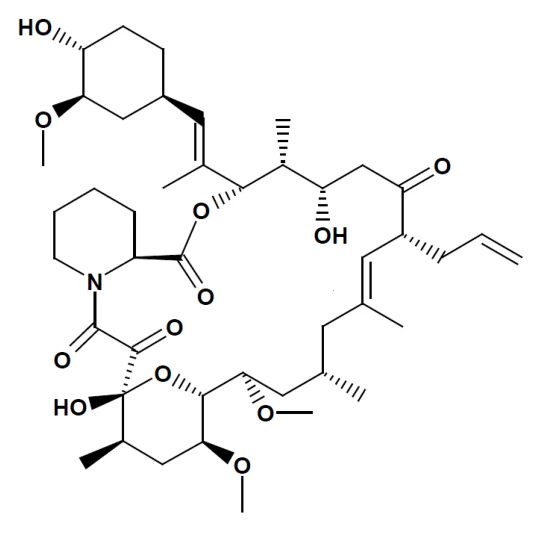
Sandoz Tacrolimus XR (tacrolimus) Page 48 of 77
Part 2: Scientific Information
13. Pharmaceutical Information
Drug Substance
Non-proprietary name of the drug substance: tacrolimus
Chemical name:
[3S-[3R*[E(1S*,3S*,4S*)],4S*,5R*,8S*,9E,12R*,14R*,15S*,16R*,18S*,19S*,26aR*]]-5,6,8,11,12,13,14,15,16,17,18,19,24,25,26,26ahexadecahydro-5,19-dihydroxy-3-[2-(4-hydroxy-3-methoxycyclohexyl)-1-methylethenyl]-14,16-dimethoxy-4,10,12,18-tetramethyl-8-(2-propenyl)-15,19-epoxy-3H-pyrido[2,1-c][1,4] oxaazacyclotricosine-1,7,20,21(4H,23H)-tetrone, monohydrate
Molecular formula and molecular mass: C44H69NO12•H2O and 822.03 g/mol (monohydrate)
Structural formula:
•H2O
Physicochemical properties: Tacrolimus appears as white to almost white, crystalline powder. It is freely soluble in ethanol, and very soluble in methanol and chloroform.
Melting Point: 124.9 - 126.8°C by thermal analysis
Partition Coefficient: > 1000 (in n-octanol/water)
14. Clinical Trials
14.1. Clinical Trials by Indication
Kidney Transplantation
Table 15: Summary of patient demographics for clinical trials in kidney transplantation
| Study # | Trial design | Dosage, route of administration and duration | Number of study subjects | Mean age (Range) | Gender | Race (W/B/A/O ) |
| Study # | Trial design | Dosage, route of administration and duration | Number of study subjects | Mean age (Range) | Gender | Race (W/B/A/O ) |
| Study # | Trial design | Dosage, route of administration and duration | Number of study subjects | Mean age (Range) | Gender | Race (W/B/A/O ) |
| KIDNEY – De novo transplant | ||||||
| 02-0-158 | Phase III randomized, open-label, multicentre, comparative | Tacrolimus extended-release: initial dose 0.15mg- 0.2 mg/kg/day, orally, once daily morning, 1 year.* | 214 | 47.84 ± 12.995 (17 - 77) | M=13 8 F=76 | 160/41/5/8 |
| Tacrolimus immediate-release: initial dose 0.075mg- 0.1mg/kg orally, twice daily, 1 year.* | 212 | 48.62 ± 12.855 (19 - 74) | M=13 6 F=76 | 152/51/5/4 | ||
| Neoral: initial dose 4 -5mg/kg, orally, twice daily, 1 year.* | 212 | 47.63 ± 12.953 (17 - 77) | M=13 0 F=82 | 163/36/8/5 | ||
| FG- 506E-12-01 | Phase II, open- label, randomized, multi-center, comparative trial | Tacrolimus extended-release: Initial dose 0.2 mg/kg orally, once daily morning‡. Study duration 6 weeks. | 60 | 44.0 (19-66) | M=3 4 F=26 | 58/0/0/2 |
| Tacrolimus immediate-release: Initial dose 0.20mg/kg orally, twice daily‡. Study duration 6 weeks | 59 | 43.6 (21-65) | M=4 4 F=15 | 59/0/0/0 | ||
| KIDNEY – Transplant Recipients Converted from Tacrolimus immediate-release formulation to Tacrolimus extended-release formulation | ||||||
| 02-0-131 | Phase II, open- label, multicenter, safety, PK conversion (1:1) study | Individualized oral dose (tacrolimus trough levels 5-20 ng/mL). The tacrolimus immediate-release twice daily dose is given for 1 week followed by tacrolimus extended-release once daily dose for 4 weeks. | 68 | 46.7 ± 12.57 (22-71) | M=4 2 F=26 | 54/12/1/1 |
| FG-506E-12-02 | Phase II, open-label, multi-centre, single-sequence, four period crossover replicate design, comparative PK study. | Individualized oral dose (tacrolimus trough levels 5-15 ng/mL). Tacrolimus immediate-release twice daily or tacrolimus extended-release once daily for 14 days for each of 4 treatment periods. | 69 | 44.8 (20-65) | M=4 9 F=20 | 52/1/8/8 |
W= White, B= Black, A= Asian, O= other (includes East Indian, Pacific Islander, Native Hawaiian, Filipino, Brazilian Indian)
*Target concentration range for tacrolimus (extended-release formulation and immediate-release formulation) was 7 - 16 ng/mL for days 0 - 90 and 5 to 15 ng/mL thereafter.
‡Target trough concentration 10 - 20 ng/mL (day 1 - 14) and 5 - 15 ng/mL (day 15 - week 6).
Sandoz Tacrolimus XR (tacrolimus) Page 52 of 77
Liver Transplantation
Table 16: Summary of patient demographics for clinical trials in liver transplantation
| Study # | Trial design | Dosage, route of administration and duration | Number of study subjects | Mean age (Range) | Gender | Race (W/B/A/O ) |
| Study # | Trial design | Dosage, route of administration and duration | Number of study subjects | Mean age (Range) | Gender | Race (W/B/A/O ) |
| LIVER – De novo transplant | ||||||
| LIVER – De novo transplant | ||||||
| FG-506E- 11-03 | Phase III randomized, double-blind (24 weeks, open label (12 months), multicentre, comparative trial, with PK substudy | Tacrolimus extended-release: initial dose 0.2 mg/kg/day + corticosteroids, orally, once daily morning Study Duration: 14 days PK and 1 year Efficacy and Safety | 237 | 52.7 ± 9.1 (24 -70) | M=161 F=76 | 233/1/0/3 |
Tacrolimus immediate-release: initial dose 0.05 mg/kg + corticosteroids, orally, twice daily. Study Duration: 14 days PK and 1 year Efficacy and Safety | 234 | 52.8 ± 9.5 (19 -72) | M=170 F=64 | 225/1/2/6 | ||
| FG-506E- 11-01 | Phase II, open- label, randomized, multi-centre, comparative trial | Tacrolimus extended-release: Initial dose 0.1-0.15 mg/kg + corticosteroids, orally, once daily morning‡. Study duration 6 weeks. | 67 | 49.4 ± 10.2 (24-65) | M=49 F=18 | 65/1/0/1 |
| Tacrolimus immediate-release: Initial dose 0.05-0.075 mg/kg + corticosteroids, orally, twice daily. Study duration 6 weeks | 62 | 52.4± 9.1 (27-68) | M=45 F=17 | 61/0/1/0 | ||
Table 17: LIVER– Transplant Recipients Converted from Tacrolimus immediate-release formulation to Tacrolimus extended-release formulation
| 02-0-152 | Phase II, open- label, multicentre, 4 period crossover, Pharmacokinet ic, safety study | Individualized oral dose (tacrolimus trough levels 10-20 ng/mL). The tacrolimus immediate-release twice daily dose is given on day 1 day 14 and on day 29 and 42. They converted to tacrolimus extended-release on day 15, 28 and day 43 and day 56. Some patients were followed up for 5 years period | 70 | 49.6 ± 9.08 (24-68) | M=4 0 F=30 | 65/5/0/1 |
| 02-0-160 | Phase II, open- label, multi- centre, two parallel, conversion in stable pediatric liver transplant recipients | Individualized oral dose (tacrolimus trough levels 5-15 ng/mL). Tacrolimus immediate-release twice daily or Tacrolimus extended-release once daily for 7 days followed by Long term safety study. | 19 | 9 (5-13) | M=6 F=13 | 11/8/8/0 |
W= White, B= Black, A= Asian, O= other
14.2. Study Results
Kidney Transplantation
Kidney Transplant Recipients
The efficacy and safety of tacrolimus extended-release formulation + mycophenolate mofetil (MMF) and corticosteroids (S) (n=214) was compared with that of tacrolimus immediate-release formulation + MMF + S (n=212) and cyclosporine + MMF + S (n=212) in a phase III, randomized (1:1:1), multi-center, open-label, comparative, non-inferiority study in de novo kidney transplant recipients. Study drugs were administered as initial oral doses as follows: tacrolimus immediate-release formulation 0.075-0.10 mg/kg twice daily, tacrolimus extended-release formulation 0.15-0.20 mg/kg once daily AM; cyclosporine 4-5 mg/kg twice daily. MMF was administered according to package insert (mycophenolate mofetil). Dosing of these immunosuppressants was adjusted based on clinical evidence of efficacy, safety and/or whole blood trough concentrations. Patients received two 20 mg IV doses of basiliximab induction therapy. Efficacy failure was a composite endpoint comprising any patient who died, had graft failure (return to dialysis >30 days or retransplant), had a biopsy confirmed acute rejection, or was lost to follow-up. Efficacy failure rates at 1 year were similar among treatment groups (Table 16, 17, 18, and 19).
| Table 18: Efficacy Failure in De Novo Kidney Transplant Recipients at 1 Year Post-transplant | |||||||||
Tacrolimus extended-release/MMF (n=214) | Tacrolimus immediate-release/MMF (n=212) | Cyclosporine/ MMF (n=212) | |||||||
| Efficacy Failure | 14.0% | 15.1% | 17.0% | ||||||
| Treatment Difference | -3.0% | -1.9% | |||||||
| 95.2% CI | -9.9%, 4.0% | -8.9%, 5.2% | |||||||
CI: confidence interval. Treatment differences are relative to Cyclosporine treatment group (Tacrolimus extended-release formulation minus Cyclosporine; Tacrolimus immediate-release formulation minus Cyclosporine).
Table 19: Patient and Graft Survival in De Novo Kidney Transplant Recipients at 1 Year Post-transplant
| Tacrolimus extended-release/MMF (n=214) | Tacrolimus immediate-release/M MF (n=212) | Cyclosporine/ MMF (n=212) | ||||||
| Patient Survival | 98.6% | 95.7% | 97.6% | |||||
| Kaplan-Meier Estimate Difference | 1.0% | -1.9% | - | |||||
| 95% CI | -1.6%, 3.6% | -5.3%, 1.5% | ||||||
| Graft Survival | 96.7% | 92.9% | 95.7% | |||||
| Kaplan-Meier Estimate Difference | 1.0% | -2.9% | - | |||||
| 95% CI | -2.7%, 4.6% | -7.3%, 1.6% | ||||||
CI: confidence interval. Kaplan-Meier estimate differences are relative to Cyclosporine treatment group (Tacrolimus extended-release minus Cyclosporine; Tacrolimus immediate-release minus Cyclosporine). Data censored at time of last follow-up.
Table 20: Renal Function in De Novo Kidney Transplant Recipients at 6 and 12 Months Post-transplant
| Tacrolimus extended-release/M MF (n=214) | Tacrolimus immediate-release/M MF (n=212) | Cyclosporine /MMF (n=212) | p-values | |||||||||
| Tacrolimus extended-release vs. Cyclosporine | Tacrolimus immediate-release vs. Cyclosporine | |||||||||||
| Mean Serum Creatinine Levels (mg/dL): | ||||||||||||
| 6 Months | 1.46±0.55 | 1.42±0.43 | 1.51±0.50 | 0.238 | 0.015 | |||||||
| 12 Months | 1.39±0.44 | 1.42±0.56 | 1.48±0.51 | 0.047 | 0.057 | |||||||
| Mean Creatinine Clearance Levels (mL/min): | ||||||||||||
| 6 Months | 56.7± 18.24 | 56.8± 17.25 | 53.6± 15.92 | 0.036 | 0.015 | |||||||
| 12 Months | 58.7± 18.26 | 57.7± 18.81 | 54.6± 17.60 | 0.008 | 0.013 | |||||||
Table 21: Additional Efficacy Data in De Novo Kidney Transplant Recipients at 1 Year Post-transplant
| Tacrolimus extended- release/ MMF (n=214) | Tacrolimus immediate-release)/ MMF (n=212) | Cyclosporine / MMF (n=212) | p-values | ||||||||||
| Tacrolimus extended-release vs. Cyclosporine | Tacrolimus immediate-release vs. Cyclosporine | ||||||||||||
| Treatment Failure | 14.5% | 15.6% | 28.8% | <0.001 | 0.001 | ||||||||
| Cross Over Due to Treatment Failure | 4.7% | 2.8% | 18.4% | <0.001 | <0.001 | ||||||||
| Patient Discontinuations | |||||||||||||
| Adverse Events | 8.9% | 10.8% | 17.5% | 0.010 | 0.069 | ||||||||
| Non-compliance | 0.9% | 1.9% | 2.4% | 0.283 | 1.000 | ||||||||
| Rejection | 0.5% | 0 | 7.5% | <0.001 | <0.001 | ||||||||
Treatment failure is defined as discontinuation of randomized study drug for any reason.
Transplant Recipients Converted from tacrolimus immediate-release capsules to tacrolimus extended-release capsules
Data from phase II, randomized, comparative, open-label studies showed that kidney transplant recipients were safely converted from tacrolimus immediate-release capsules (twice daily) to tacrolimus extended-release capsules (once daily) on a 1:1 (mg:mg) total daily dose basis to achieve appropriate tacrolimus whole blood concentrations. The majority of patients in these studies did not require tacrolimus extended-release formulation dosing adjustments in the early conversion period (Table 22).
| Table 22: Patient and Graft Survival in Stable Transplant Recipients 1 or 2 Years After Conversion from Tacrolimus Immediate-Release Formulation to Tacrolimus Extended-Release Formulation | ||||
| Patient Survival | Graft Survival | |||
| US Adult Kidney Study (2 Years) | 100% | 98.5% | ||
| EU Adult Kidney Study (1 Year) | 97.0% | 97.0% | ||
Kaplan-Meier estimates.
There were no graft losses due to rejection in the kidney conversion studies.
Liver Transplantation
Liver Transplant Recipients
In Study FG-506E-11-03, the primary efficacy endpoint was the event rate of patients with BPAR within the first 24 weeks (based on local biopsy assessment) and at 12 months. Efficacy failure was also assessed in Study FG-506E-11-03 as well as patient and graft survival.
For the primary efficacy endpoint of BPAR at 24 weeks, the local BPAR event rates (Kaplan-Meier analysis) were 32.6% for the tacrolimus extended-release capsules group and 29.3% for the tacrolimus immediate-release capsules group. The difference in the event rates (tacrolimus extended-release capsules minus tacrolimus immediate-release capsules) was 3.3% with 95% Confidence Interval [CI] of -5.7% to 12.3% [Table 23]. The CI for the difference between the treatment arms was within the predefined noninferiority margin of 15%, demonstrating noninferiority of tacrolimus extended-release capsules vs tacrolimus immediate-release capsules.
Overall, the frequency of BPAR events and event-rates of BPAR episodes at 12 months were similar to the 24-week results and were similar for both treatment groups. Similarly, the difference in the event rates (tacrolimus extended-release capsules minus tacrolimus immediate-release capsules) was 3.3% with 95% CI of -5.9% to 12.5% at 12 months.
Table 23: Event Rate of Patients with Local BPAR within the First 24 Weeks and 12 Months in Study FG-506E-11-03
| Tacrolimus extended-release/corticosteroid (n=237) | Tacrolimus immediate-release/corticosteroid (n=234) | |||||
| Event rate for BPAR (FAS) – 24 weeks | 32.6% | 29.3% | ||||
Treatment Difference† 95% CI P value‡ | 3.3% -5.7%, 12.3% 0.354 | |||||
| Event rate for BPAR (FAS) – 12 months | 33.8% | 30.5% | ||||
Treatment Difference† 95% CI P value‡ | 3.3% -5.9%, 12.5% 0.356 | |||||
| BPAR frequency (12 months) | 29.5% | 26.9% | ||||
Treatment difference† 95% CI P value‡ | 2.6% -5.5%, 10.7% 0.490 | |||||
BPAR: biopsy-proven acute rejection; FAS: Full Analysis Set.
† Rate of tacrolimus extended-release capsules arm minus the rate of the tacrolimus immediate-release capsules arm.
‡ Wilcoxon-Gehan test for a difference between treatments over 24 weeks.
In the phase III study, the Event Rate of patients with Local BPAR at 12 months were similar between tacrolimus extended-release capsules and tacrolimus immediate-release capsules. The difference in the event rates (tacrolimus extended-release minus tacrolimus immediate-release) was 2.6% with 90% CI of -5.5% to 10.7%.
The Kaplan-Meier estimated patient survival rates were similar at both 24 weeks post-transplant (tacrolimus extended-release capsules: 92.2%; tacrolimus immediate-release capsules: 93.5%) and at 12 months post-transplant (tacrolimus extended-release capsules: 89.2%; tacrolimus immediate-release capsules: 90.8%) [Table 24]. The Kaplan-Meier estimated patient survival rates were also similar at both 24 weeks and 12 months post-transplantation.
The Kaplan-Meier estimated graft survival rates were similar at both 24 weeks post-transplant (tacrolimus extended-release capsules: 88.8%; tacrolimus immediate-release capsules: 89.1%) and at 12 months post-transplant (tacrolimus extended-release capsules: 85.3%; tacrolimus immediate-release capsules: 85.6%). The Kaplan-Meier estimated graft survival rates were also similar at both 24 weeks and 12 months post-transplant.
Table 24: Kaplan-Meier Estimates of Patient Survival and Graft Survival in Study FG-506E-11-03
| Parameter | Tacrolimus extended-release: (n = 237) | Tacrolimus immediate-release (n = 234) | ||
| Patient survival | ||||
| 24 weeks | 92.2% | 93.5% | ||
| 12 months | 89.2% | 90.8% | ||
| Graft survival | ||||
| 24 weeks | 88.8% | 89.1% | ||
| 12 months | 85.3% | 85.6% | ||
In a post-hoc analysis of study FG-506E-11-03, de novo liver transplant study (n=571), a higher mortality rate at 12 months was observed in female patients treated with tacrolimus extended-release capsules (14/76, 18.4%) than in female patients treated with tacrolimus immediate-release capsules (5/64, 7.8%) or male patients treated with tacrolimus extended-release capsules (11/161, 6.8%).
Transplant Recipients Converted from Tacrolimus immediate-release capsules to Tacrolimus extended-release capsules
Data from phase II, randomized, comparative, open-label studies showed that adult and pediatric liver transplant recipients were safely converted from tacrolimus immediate-release capsules (twice daily) to tacrolimus extended-release capsules (once daily) on a 1:1 (mg:mg) total daily dose basis to achieve appropriate tacrolimus whole blood concentrations. The majority of patients in these studies did not require tacrolimus extended-release formulation dosing adjustments in the early conversion period. The Kaplan-Meier estimates of both patient and graft survival at 4 years for study 02-0-160 were 94.4% and 94.7% and 93.0% for patient and graft survival after 5 years in study 02-0152 (Table 25).
Table 25: Patient and Graft Survival in Stable Transplant Recipients 4 or 5 Years After Conversion from Tacrolimus Immediate-Release Formulation to Tacrolimus Extended-Release Formulation
| Patient Survival | Graft Survival | |
| 02-0-160 Pediatric Liver Study (4 Years) | 94.4% | 94.4% |
| 02-0-152 Adult Liver Study (5 Years) | 94.7% | 93.0% |
Eighteen stable pediatric (5 to 13 years of age) liver transplant recipients were converted from tacrolimus immediate-release capsules to tacrolimus extended-release capsules on a 1:1 (mg:mg) total daily dose basis. Dose errors were the main reason for dose adjustments after the conversion. Sixteen patients were enrolled in the 5 year extension study. There were no episodes of acute rejection or graft failure, no deaths and no patient discontinued the study due to an adverse event through 2 year postconversion. Significant tacrolimus extended-release capsules dose increases in this clinical trial were observed, from 4.0 mg mean daily dose at beginning of the study to 8.0 mg mean daily dose by the end of the 4 year period of study.
14.3. Comparative Bioavailability Studies
Fasting Study
A single-dose, two-treatment, two-period, crossover comparative oral bioavailability study of Sandoz Tacrolimus XR extended-release capsules, 5 mg (Sandoz Canada Inc.) and PrAdvagraf® extended-release capsules, 5 mg (Astellas Pharma Canada Inc.) was conducted in 113 healthy male and female subjects under fasted conditions. Comparative bioavailability data from 112 subjects that were included who completed the study are summarized in the following table.
SUMMARY TABLE OF THE COMPARATIVE BIOAVAILABILITY DATA
Tacrolimus (1 x 5 mg) From measured data Geometric Mean Arithmetic Mean (CV%) | ||||
| Parameter | Test1 | Reference2 | % Ratio of Geometric Means | 90% Confidence Interval |
AUC0-72 (ng·h/mL) | 170.32 184.13 (39.8) | 161.10 174.19 (38.3) | 105.7 | 101.7 - 109.9 |
Cmax (ng/mL) | 9.79 10.67 (41.7) | 10.01 10.91 (40.5) | 97.8 | 93.1 - 102.8 |
Tmax3 (h) | 1.75 (1.00 - 6.00) | 1.75 (1.00 - 6.05) | ||
1 Sandoz Tacrolimus XR (tacrolimus) extended-release capsules, 5 mg (Sandoz Canada Inc.)
2 PrAdvagraf® (tacrolimus) extended-release capsules, 5 mg (Astellas Pharma Canada Inc.)
3 Expressed the median (range) only
Due to the study design and long elimination half-life of tacrolimus, AUCI and T1/2 could not be accurately calculated from the data obtained in this study.
Fed Study
A single-dose, two-treatment, two-period, crossover comparative oral bioavailability study of Sandoz Tacrolimus XR extended-release capsules, 5 mg (Sandoz Canada Inc.) and PrAdvagraf® extended-release capsules, 5 mg (Astellas Pharma Canada Inc.) was conducted in 112 healthy male and female subjects under high fat, high calorie fed conditions. Comparative bioavailability data from 108 subjects that were included in the statistical analysis are presented in the following table:
Sandoz Tacrolimus XR (tacrolimus) Page 61 of 77
SUMMARY TABLE OF THE COMPARATIVE BIOAVAILABILITY DATA
Tacrolimus (1 x 5 mg) From measured data Geometric Mean Arithmetic Mean (CV%) | ||||
| Parameter | Test1 | Reference2 | % Ratio of Geometric Means | 90% Confidence Interval |
AUC0-72 (ng·h/mL) | 106.66 118.09 (48.7) | 105.59 117.33 (53.3) | 101.0 | 98.2 - 103.9 |
Cmax (ng/mL) | 5.67 6.15 (41.4) | 5.51 6.00 (45.0) | 102.9 | 98.3 - 107.6 |
Tmax3 (h) | 5.33 (2.50 - 14.00) | 4.67 (2.00 - 14.00) | ||
1 Sandoz Tacrolimus XR (tacrolimus) extended-release capsules, 5 mg (Sandoz Canada Inc.)
2 PrAdvagraf® (tacrolimus) extended-release capsules, 5 mg (Astellas Pharma Canada Inc.)
3 Expressed the median (range) only
Due to the study design and long elimination half-life of tacrolimus, AUCI and T1/2 could not be accurately calculated from the data obtained in this study.
15. Microbiology
Not Applicable.
16. Non-Clinical Toxicology
The tacrolimus toxicology profile is well defined and was established as part of the development program for tacrolimus immediate-release formulation. No additional toxicology studies were performed as part of the development for the tacrolimus extended-release formulation. Toxicology data summarized from the tacrolimus immediate-release capsules Product Monograph is presented below.
Animal Studies
The primary mechanism of rejection following transplantation involves activation of T-lymphocytes and the subsequent formation of factors such as interleukin-2 (IL-2). Tacrolimus inhibits the activation of T-lymphocytes in both animals and humans, especially the activation that is calcium-dependent. The minimum inhibitory tissue culture level of tacrolimus that prevents antigen stimulation of T-lymphocytes is 0.1 nM - 0.3 nM. Tacrolimus interferes with the formation of active transcription factor NF-AT (nuclear factor of activated T-cells) and inhibits the formation of lymphokines such as IL-2, IL-3, IL-4, and interferon-γ. The net result is immunosuppression.
Safety pharmacology studies in mice, rats, dogs, cats, and rabbits and with various tissues in vitro have been conducted as part of the tacrolimus immediate-release formulation development program for liver and kidney transplantation.
At intravenous doses of 0.32 to 3.2 mg/kg, and at oral doses of 3.2 to 32 mg/kg, tacrolimus showed little effect on general activity and the central nervous system; little or no effect on somatic and autonomic nervous systems and smooth muscle.
Most of the effects shown by IV tacrolimus in dogs and cats were also shown by the tacrolimus-placebo IV formulation. Intravenous tacrolimus at ≥ 0.1 mg/kg increased the respiration rate in dogs only; blood pressure was decreased by IV tacrolimus at ≥ 0.1 mg/kg in dogs, to a lesser extent at 3.2 mg/kg in cats, and by PO tacrolimus at 32 mg/kg in rats; heart rate was decreased by IV tacrolimus at ≥ 0.1 mg/kg in dogs, at ≥ 0.32 mg/kg in cats, at 3.2 mg/kg in rats, and by PO tacrolimus at 10 and 32 mg/kg in rats; blood flow in femoral artery of dogs was decreased by IV tacrolimus at ≥ 0.1 mg/kg; carotid artery blood flow was increased at 3.2 mg/kg IV in cats.
Intravenous tacrolimus at ≥ 1.0 mg/kg increased pilocarpine-induced salivary secretion in rabbits and decreased gastric fluid secretion in rats; and, at 3.2 mg/kg, increased accumulation of intestinal fluid and slightly inhibited gastrointestinal transit rate in rats. Intravenous tacrolimus did not affect bile secretion nor produce irritation to gastric mucosa in rats. Gastrointestinal transit rate and accumulation of intestinal fluid in rats were not affected by PO tacrolimus. Bleeding time in mice and prothrombin time and activated partial thromboplastin time in rats were not affected by IV or PO tacrolimus. Tacrolimus did not affect ADP- or collagen-induced aggregation of rabbit platelets, or produce hemolysis in rabbit blood. Oral tacrolimus at 32 mg/kg slightly increased urine volume and Na+ excretion, but not excretion of K+, Cl-, or uric acid, in rats; IV tacrolimus at 3.2 mg/kg had no effect. Oral tacrolimus had no effect on carrageenin-induced paw edema in rats.
When 14C-tacrolimus was dosed orally to pregnant or lactating rats, trace amounts of tacrolimus were found in fetal liver and in breast milk, respectively.
When 14C-tacrolimus was administered to rats, either intravenously or orally, total recovery of radioactivity in urine and feces was over 95%. Trace amounts of unchanged tacrolimus, as well as small amounts of numerous metabolites, were detected in urine, feces, and bile, indicating that the drug is extensively metabolized. In vitro studies identified the main metabolite as 13-demethylated-tacrolimus in animals and humans.
Tacrolimus as tacrolimus immediate-release formulation significantly prolonged host survival and/or graft viability in animal transplant models involving the liver, kidney, heart, small bowel, lung, pancreas, pancreatic islet, bone marrow, skin, limb, cornea, and trachea. A dose range of 0.1 to 1 mg/kg/day PO or IM was used in most studies in various dosing regimens: (pre- and post-surgery, short- and long-term administration).
To assess the relationship of peak concentration versus area under the curve (AUC) to efficacy, a study was conducted to evaluate the effect of tacrolimus in preventing skin allograft rejection when administered as a bolus (comparable with immediate-release) or when continuously infused (sustained-release profile somewhat representative of the extended-release formulation). In this study, ear skin grafts from Fisher rats were transplanted to the thorax of MCH-incompatible recipients (WKAH rats). Tacrolimus (0.01 mg/kg, 0.1 mg/kg, 1.0 mg/kg) or placebo was administered to four groups of male rats (7 or 8/group) by daily bolus intramuscular injections (IM) or continuous intravenous infusion (IV) for 14 days with mini-osmotic pumps starting on the day of graft placement. The median survival times of the allografts were counted in days after transplantation (Table 26).
Table 26: Effect of Tacrolimus (FK506) on Allograft Skin Survival in Rats
| IM Dose | IV Dose | |||||||||
| n | MST (days) | n | MST (days) | |||||||
| Control (placebo) | 7 | 5 | 7 | 6 | ||||||
| FK506 0.01 mg/kg | 7 | 6 | 7 | 7 | ||||||
| FK506 0.1 mg/kg | 8 | 10 | 8 | 10* | ||||||
| FK506 1.0 mg/kg | 8 | 20** | 8 | 22** | ||||||
*p<0.05; **p<0.01 versus each control; IM: Intramuscular injection; IV: Intravenous infusion; MST: Median survival time in days after transplantation.
At each dose tested, there were no significant differences in median skin allograft survival times between rats administered tacrolimus by intramuscular bolus injections and those receiving continuous intravenous infusion, supporting the concept that total exposure (i.e., AUC) is the critical component for the efficacy of an extended-release formulation.
Acute Toxicology
Table 27: Acute Toxicology Studies of Tacrolimus in Rats and Baboon
| Species | No./ Group (M/F) | Route | Dose Range (mg/kg) | Overt Signs of Toxicology | LD50 (mg/kg) | ||||
| Species | No./ Group (M/F) | Route | Dose Range (mg/kg) | Overt Signs of Toxicology | LD50 (mg/kg) | ||||
| Rat, Sprague-Dawley | 5/5 | Gavage | 32-320 | Tremor, ptosis, salivation, hyperreactivity, decreased spontaneous motility | 134 (M) 194 (F) | ||||
| 5/5 | IV | 10-100 | Bloody urine, prone position, ptosis, hyper-reactivity, salivation, decreased motility | 57.0 (M) 23.6 (F) | |||||
| Rat, Sprague-Dawley (21 days old) | 5/5 | Gavage | 10-320 | Hyperreactivity, salivation, decreased motility | 70 (M) 32-100 (F) | ||||
| Baboon | 1/1 | Gavage | 5-250 | Huddled posture, emesis | ND* | ||||
| 1/1 | IV | 2-50 | Debility and exhaustion: 1 of 2 | ND* | |||||
*Not determined.
Repeat Dose Toxicity
Table 28: Overview of Repeated Dose Toxicity Studies of Tacrolimus
| Species | Strain | No. / Group | Route | Dose (mg/kg/day) | Duration (Weeks) | NOAEL (mg/kg/day) |
| Rat | Crl:CD(SD)BR | 20/sex | Gavage | 0, 0.15, 0.5, 1.5 | 52 | 0.15 |
| Crl:CD(SD)BR | 12/sex | Gavage | 0, 0.32, 1, 3.2 | 13 | 1 | |
| Jcl:SD † | 12/sex | Gavage | 0, 0.32, 1, 3.2 | 4 | 0.32 | |
| Crl:SC(SD)BR | 12/sex | IV | 0, 0.032, 0.1, 0.32, 1 | 4 | 0.032 | |
| Baboon | Papio spp. | 4/sex | Gavage | 0, 1, 3.2, 10 | 52 | 1 |
| 3/sex | Gavage | 0, 18, 36 | 13 | - | ||
| 3/sex | Gavage | 0, 1, 3, 6, 9 | 13 | 1 | ||
| 3/sex | IV | 0, 0.5, 1, 2 | 4 | - |
NOAEL (no observable adverse effect level (no observable toxic effect). † Immature rats.
Both rats and baboons showed a similar toxicologic profile following oral or intravenous administration of tacrolimus. Toxicity following intravenous administration was evident at lower doses than after oral administration for both rats and baboons. Toxicity was seen at lower doses in rats than in baboons. The primary target organs of toxicity were the kidney, pancreatic islets of Langerhans and exocrine pancreas, spleen, thymus, gastrointestinal tract, and lymph nodes. In addition, decreases in erythrocyte parameters were seen. Effects such as atrophy of the spleen, lymph nodes, and thymus may be a reflection of the immunosuppressant actions of tacrolimus. In rats, chronic oral administration of tacrolimus at high doses resulted in changes in sex organs, and glaucoma/eye changes.
Genotoxicity
No evidence of genotoxicity was seen in bacterial (Salmonella and E. coli) or in mammalian (Chinese hamster lung-derived cells) in vitro assays of mutagenicity. Tacrolimus did not cause unscheduled DNA synthesis in rodent hepatocytes in either the in vitro CHO/HGRPT assay of mutagenicity, or in vivo clastogenicity assays performed in mice.
Carcinogenicity
Dietary carcinogenicity studies were carried out in rats (104-week) and mice (80-week). In the rat studies, no increased incidence of tumors was observed compared to concurrent controls, and all tumor incidence was within the range found in historical control groups. Similarly in the mouse study, tacrolimus was not associated with an increased incidence nor was there a dose related incidence of tumors compared to control animals.
Reproductive and developmental toxicity
The reproductive toxicity of tacrolimus was evaluated in Segment 1 (rats), Segment 2 (rats and rabbits) and Segment 3 (rats) studies. The results of these studies are summarized below in Table 29.
Table 29: Reproductive and Developmental Toxicity Studies of Orally Administered Tacrolimus
| Study | Oral Dose (mg/kg/day) | Major Findings |
| Study | Oral Dose (mg/kg/day) | Major Findings |
| Parental | F1 Offspring | |
| Parental | F1 Offspring | |
| Segment 1, Rat | ||
| 0.32 | No observable effect | No observable effect |
| 1 | Incomplete delivery | No observable effect |
| 3.2 | ↓Body weight with ↓food consumption ↓Male copulatory index ↑Copulatory interval Incomplete delivery ↑Female diestrus period | Some lethality; ↓Implantation ↑Post-implantation loss ↓Embryo/offspring viability |
| Segment 2, Rat | ||
| 0.32 | No observable effect | No observable effect |
| 1 | No observable effect | ↓Fetal body weight |
| 3.2 | Some lethality; ↓Body weight with ↓food consumption | ↓Fetal body weight ↑Post-implantation loss ↓Offspring viability ↑Skeletal variations |
| Segment 2, Rabbit | ||
| 0.1 | ↓Body weight | No observable effect |
| 0.32 | ↓Body weight Abortions | ↑Developmental variations |
| 1 | ↓Body weight Abortions | ↑Developmental variations ↑Post-implantation loss ↓Viable fetuses ↑Morphological variations |
| Segment 3, Rat | ||
| 0.32, 1 | No observable effect | No observable effect |
| 3.2 | ↓Body weight | ↓Body weight |
Tacrolimus subcutaneously administered to male rats at doses of 2 or 3 mg/kg/day (1.6 to 6.4 times the clinical dose range based on body surface area) resulted in a dose-related decrease in sperm count.
Special toxicology
The acute IV toxicity of known heat- and light-degradation products of tacrolimus, a tacrolimus tautomer, related compounds, and a tacrolimus metabolite was assessed in mice. The acute toxicity of these compounds was not greater than that of tacrolimus as bulk drug or as the IV formulation.
Antigenicity studies produced no antibody formation in mice, and no skin reactions, sensitization, or delayed hypersensitivity reactions.
Tacrolimus produced a reversible, dose-dependent, pancreatic islet cell toxicity in rats; there were no effects on pancreatic exocrine function.
The irritation potential of the IV formulation of tacrolimus was similar to that of 0.425% acetic acid.
17. Supporting Product Monographs
- 1. PrAdvagraf®, tacrolimus extended-release capsules, 0.5 mg, 1 mg, 3 mg and 5 mg capsules, control number 300193, product monograph, Astellas Pharma Canada, Inc. (2025-12-17)