


Product Monograph - Sarclisa SC
1. Indications
SARCLISA SC (isatuximab injection) is indicated:
- in combination with bortezomib, lenalidomide, and dexamethasone, for the treatment of patients with newly diagnosed multiple myeloma who are not eligible for autologous stem cell transplant (ASCT).
- in combination with pomalidomide and dexamethasone, for the treatment of patients with relapsed and refractory multiple myeloma who have received at least two prior therapies including lenalidomide and a proteasome inhibitor.
- in combination with carfilzomib and dexamethasone, for the treatment of adult patients with relapsed or refractory multiple myeloma who have received 1 to 3 prior lines of therapy.
1.1. Pediatrics
Pediatrics (< 18 years of age): No data are available to Health Canada; therefore, Health Canada has not authorized an indication for pediatric use (see 7 Warnings and Precautions, 7.1.3 Pediatrics (< 18 years of age):).
1.2. Geriatrics
Geriatrics (≥ 65 years of age): No overall differences in efficacy were observed between elderly and younger patients. Some differences in clinical safety were reported between elderly and younger subjects (see 7 Warnings and Precautions, 7.1.4 Geriatrics).
2. Contraindications
SARCLISA SC is contraindicated in patients who are hypersensitive to this drug or to any ingredient in the formulation, including any non-medicinal ingredient, or component of the container. For a complete listing, see 6 Dosage Forms, Strengths, Composition and Packaging.
4. Dosage And Administration
4.1. Dosing Considerations
SARCLISA SC is for subcutaneous use only. SARCLISA SC and intravenous SARCLISA are not interchangeable. Do not substitute SARCLISA SC for or with intravenous SARCLISA.
To prevent medication errors, check SARCLISA SC vial label to ensure it is the correct medication for subcutaneous use.
Patients may start treatment using intravenous or subcutaneous isatuximab. Patients currently receiving intravenous SARCLISA may transition to SARCLISA SC subcutaneous injection at any time during their treatment, once cycle 1 is completed.
SARCLISA SC should be administered by a healthcare professional. For the first dose only, immediate access to medical support should be available to manage systemic administration reactions if they occur (see 7 Warnings and Precautions).
The SARCLISA SC vial is for single-use only.
Premedication
Prevention of systemic administration reaction
The following premedications should be administered 15 to 60 minutes prior to starting a SARCLISA SC administration to reduce the risk and severity of systemic administration reactions (SARs):
Dexamethasone:
- 40 mg (or 20 mg for patients ≥ 75 years of age) oral or intravenous in combination with pomalidomide (Pd).
- 20 mg oral or intravenous in combination with carfilzomib (Kd), or in combination with bortezomib and lenalidomide (VRd).
- The recommended dose corresponds to the total dose to be administered as part of the premedication and of the backbone treatment; do not administer another dose (See 14 Clinical Trial).
- Administer dexamethasone before SARCLISA SC and other components of backbone treatment (pomalidomide, carfilzomib, bortezomib and lenalidomide).
- Montelukast 10 mg PO (or equivalent) at cycle 1 only.
- Acetaminophen 650 mg to 1000 mg orally (or equivalent).
- Diphenhydramine 25 mg to 50 mg IV or PO (or equivalent [e.g., cetirizine, promethazine, dexchlorpheniramine]). The intravenous route is preferred for at least the first 4 administrations of SARCLISA-SC.
Patients who do not experience a SAR after 4 consecutive administrations of SARCLISA SC may have their need for subsequent premedication reconsidered.
Prophylaxis for infection
Antibacterial and antiviral prophylaxis, such as herpes zoster prophylaxis, should be considered during treatment. (see 8 Adverse Reactions, 8.2 Clinical Trial Adverse Reactions, Infections).
4.2. Recommended Dose and Dosage Adjustment
The recommended dose of SARCLISA SC is 1,400 mg administered as a subcutaneous (SC) injection with the CirCLIQ On-Body Delivery System (OBDS) or with a syringe and infusion set for manual administration in combination with pomalidomide and dexamethasone (Isa SC-Pd) or in combination with carfilzomib and dexamethasone (Isa SC-Kd), or in combination with bortezomib, lenalidomide, and dexamethasone (Isa SC-VRd).
Treatment is repeated until disease progression or unacceptable toxicity.
SARCLISA SC dosing schedules are provided in Table 1 and Table 2.
| Table 1: SARCLISA SC dosing schedule in combination with pomalidomide and dexamethasone (Isa SC-Pd) or in combination with carfilzomib and dexamethasone (Isa SC-Kd) | |||
|---|---|---|---|
| Cycles | Dosing Schedule | ||
| Cycle 1 (28-day cycle) | Days 1, 8, 15 and 22 (weekly) | ||
| Cycle 2 and beyond (28-day cycles) | Days 1, 15 (every 2 weeks) | ||
| Table 2: SARCLISA SC dosing schedule in combination with bortezomib, lenalidomide, and dexamethasone (Isa SC-VRd) for patients with newly diagnosed multiple myeloma (NDMM) who are not eligible for autologous stem cell transplant (ASCT) | |||
|---|---|---|---|
| Cycles | Dosing schedule | ||
| Cycle 1 (42-day cycle) | Days 1, 8, 15, 22, and 29 | ||
| Cycles 2 to 4 (42-day cycles) | Days 1, 15, and 29 (every 2 weeks) | ||
| Cycles 5 to 17 (28-day cycles) | Days 1 and 15 (every 2 weeks) | ||
| Cycle 18 and beyond (28-day cycles) | Days 1 (every 4 weeks) | ||
For dosing instructions of other medicinal products that are administered with SARCLISA SC, see 14 Clinical Trials and the respective current Product Monographs.
Dosage Adjustment
General
Dose reduction of SARCLISA SC is not permitted. Dose delay or omission may be required (see 7 Warnings and Precautions).
Pediatric patients
Health Canada has not authorized an indication for pediatric use (see 1 Indications and 7 Warnings and Precautions, 7.1.3 Pediatrics (< 18 years of age):).
Elderly patients
No dose adjustment is recommended in geriatric patients (≥ 65 years of age) (see 10 Clinical Pharmacology, 10.3 Pharmacokinetics, Geriatrics).
Hepatic impairment
No dose adjustment is recommended in patients with mild hepatic impairment. Limited data are available in patients with moderate hepatic impairment, and no data are available in patients with severe hepatic impairment. (see 10 Clinical Pharmacology, 10.3 Pharmacokinetics, Hepatic Insufficiency).
Renal impairment
No dose adjustment is recommended in patients with renal impairment. (see 10 Clinical Pharmacology, 10.3 Pharmacokinetics, Renal Insufficiency).
Patients with extreme body weights
No dose adjustment is recommended in patients with body weight below 50 kg or above 100 kg (see 10 Clinical Pharmacology, 10.3 Pharmacokinetics)
Administration adjustments should be made if patients experience the following adverse reactions:
Systemic administration reactions (SARs)
- In case of Grade 2 SAR during SARCLISA SC administration, current administration should be stopped and not completed. Additional premedication should be administered, as needed, for subsequent SARCLISA SC administration (see 4 Dosage And Administration, 4.1 Dosing Considerations and 7 Warnings and Precautions).
- In case of Grade 3 SAR during SARCLISA SC administration, current administration should be stopped and not completed. SARCLISA SC administration may be resumed at the next planned administration with additional pre-medication.
- In case of a third occurrence of a Grade 3 SAR, SARCLISA SC treatment should be permanently discontinued.
- In case of Grade 4 SAR, SARCLISA SC treatment should be permanently discontinued.
Injection site reactions (ISRs)
In case of Grade 2 ISR:
- During administration: SARCLISA SC administration should be interrupted and resumed only after recovery to Grade ≤1 with pauses during the administration (if using CirCLIQ OBDS) or a slower administration (if manual injection).
- After administration: Continue SARCLISA SC treatment after recovery to Grade ≤1.
- In case of Grade 3 or 4 ISR, SARCLISA SC must be permanently discontinued.
In case SARCLISA SC administration using CirCLIQ OBDS needs to be interrupted, please refer to the OBDS Instructions for Use.
Neutropenia
Dose delay or omission of SARCLISA SC and the use of colony-stimulating factors (e.g. G-CSF) according to local guidelines may be required to allow recovery of blood cell counts in the event of hematological toxicity (see 7 Warnings and Precautions).
For dosage adjustment information concerning medicinal products given in combination with SARCLISA SC, consult the corresponding Product Monographs.
4.4. Administration
Preparation of the subcutaneous administration
- SARCLISA SC should be prepared and administered by a healthcare professional.
- To prevent medication errors, check SARCLISA SC vial label to ensure it is the correct medication for subcutaneous use (vial with green cap). Do not administer SARCLISA SC intravenously.
SARCLISA SC 1,400 mg is only for abdominal subcutaneous administration using:
CirCLIQ On-Body Delivery System (OBDS)
or
- 20 mL syringe and infusion set for manual administration
- SARCLISA SC is ready to use. Do not dilute. Prepare and administer SARCLISA SC subcutaneously using clean technique (a hood is not required).
- Prior to use‚ allow SARCLISA SC to reach room temperature for approximately 20 minutes to minimize pain during the injection. Keep the unpunctured vial in the original carton prior to use to protect from light. Do not heat. Do not shake.
- Vials of SARCLISA SC should be visually inspected before use. The solution may contain a few translucent to white particles. SARCLISA SC should not be used if the solution is cloudy or discoloured, or if particles other than those described above are present.
- Check the expiration date.
Preparation with On-Body Delivery System
- CirCLIQ On-Body Delivery System (OBDS) is packaged separately from SARCLISA SC.
- Refer to the Instructions for Use for CirCLIQ OBDS provided with the device for full preparation and administration information.
- Once the vial is punctured, the injection with the CirCLIQ OBDS should be performed as soon as possible. If the injection is not completed within 4 hours, discard the vial and the OBDS.
Preparation with syringe and infusion set for manual administration
- 1.
Before you begin, collect your supplies:
- The syringe must be a 20 mL polypropylene syringe with Luer-fitting connector.
- The transfer needle must be made of 18G stainless steel with 5-micron filter and Luer-fitting connector.
- The subcutaneous infusion set must have 23G stainless steel needle and tubing up to 30 cm length made of polyethylene, or polyvinyl chloride (PVC), with a Luer-fitting connector.
- 2. Remove green vial cap and wipe vial rubber stopper with an alcohol wipe and allow to air dry.
- 3.
Attach the transfer needle and fill the syringe.
Using the transfer needle, withdraw the full content of the SARCLISA SC vial into a 20 mL compatible syringe.
Note: if the syringe containing SARCLISA SC is not used immediately:
- replace the transfer needle with a syringe closing cap. Label the syringe appropriately to include the drug name and route of administration per institutional standards.
- store it for up to 4 hours at room temperature (15 to 25 °C) and ambient light, including the administration time. Discard after 4 hours, if not used.
- 4.
Attach the subcutaneous infusion set to the syringe and set the dose.
Prime the syringe and subcutaneous infusion set and set the dose to 10 mL.
Note: To avoid needle clogging, attach the subcutaneous infusion set to the syringe immediately prior to injection.
Administration
- On the days where both SARCLISA SC and carfilzomib are administered, administer dexamethasone first, followed by SARCLISA SC administration, then followed by carfilzomib infusion.
- SARCLISA SC is only for abdominal subcutaneous administration.
- Rotate the site of each subcutaneous administration.
- Do not inject other medications in the area where SARCLISA SC is injected.
- Do not inject into areas where the skin is injured, tender, red, hot, has scars, or is excessively hairy.
Administration with On-Body Delivery System
Refer to the Instructions for Use for CirCLIQ OBDS provided with the device for full preparation and administration information.
Administration with syringe and infusion set for manual administration
- 1.
Prepare injection site and insert needle
- Wipe injection site with an alcohol swab and allow it to dry
- Avoid injecting within 5 cm around the belly button
- Remove protective needle cover
- Pinch skin at the injection site on the abdomen. It is important to pinch enough skin to inject under the skin and not into the muscle.
Insert needle at a 45-degree angle with a quick, dart-like motion.
Note: Try to limit needle and syringe movement during the injection. If needed, secure the subcutaneous infusion set in place with a bandage.
- 2. Inject 10 mL of SARCLISA SC subcutaneously into the abdomen, over approximately 6 minutes.
Pause or slow down delivery rate if the patient experiences pain. In the event pain is not alleviated by pausing or slowing down delivery rate, a second injection site may be chosen on the opposite side of the abdomen to deliver the remainder of the dose.
Disposal
Unused portions of solution must be discarded. All materials that have been utilized for preparation and administration should be disposed of according to standard procedures.
4.5. Missed Dose
The administration schedule must be carefully followed. If a planned dose of SARCLISA SC is missed, administer the dose as soon as possible and adjust the treatment schedule, accordingly, maintaining the treatment interval.
5. Overdose
There has been no experience of overdosage of isatuximab in clinical studies. Doses of subcutaneous SARCLISA SC up to 1,400 mg have been administered in clinical studies. There is no known specific antidote for isatuximab overdose. In the event of overdose, closely monitor patients for signs and symptoms of adverse reactions and initiate appropriate symptomatic and supportive treatment (see 7 Warnings and Precautions, 8 Adverse Reactions).
| For the most recent information in the management of a suspected drug overdose, contact your regional poison control centre. or Health Canada’s toll-free number, 1-844 POISON-X (1-844-764- |
|---|
| 7669). |
6. Dosage Forms, Strengths, Composition and Packaging
To help ensure the traceability of biologic products, health professionals should record both the brand name and the non-proprietary (active ingredient) name as well as other product-specific identifiers such as the Drug Identification Number (DIN) and the batch/lot number of the product supplied.
CirCLIQ On-Body Delivery System (OBDS) is packaged separately from SARCLISA SC.
7. Warnings and Precautions
General
SARCLISA SC is administered in combination with other medications; therefore, the contraindications, warnings and precautions and distribution restriction applicable for use with those medications also apply to SARCLISA SC combination therapy. The Product Monographs of all medications used in combination with SARCLISA SC should be consulted before starting the therapy.
Carcinogenesis and Genotoxicity
Second Primary Malignancies
The incidence of second primary malignancies (SPMs) is increased in patients treated with isatuximab-containing regimens. The overall incidence of SPMs in patients treated with SARCLISA SC in clinical trials is 5.1%, including 3.7% skin cancers and 1.5% non-skin cancers (see 8 Adverse Reactions). The most frequently reported skin cancers were basal cell carcinoma and squamous cell carcinoma of skin (1.5% for each). The most frequently reported non-skin cancer was adenocarcinoma of colon and prostate cancer (0.4% for each).
Healthcare professionals should carefully monitor patients for the development of second primary malignancies and initiate treatment as necessary.
| Table 3: Dosage Forms, Strengths and Composition | |||||
| Route of Administration | Dosage Form/Strength/Composition | Non-medicinal Ingredients | |||
| Subcutaneous (SC) | Solution for subcutaneous injection:
Each mL of SARCLISA SC solution contains 140 mg of isatuximab. | arginine hydrochloride, histidine, histidine hydrochloride monohydrate, poloxamer 188, sucrose, and water for injection | |||
Driving and Operating Machinery
Fatigue and dizziness have been reported in patients taking isatuximab. Patients should avoid driving or using machines until these events resolve.
Endocrine and Metabolism
Tumour Lysis Syndrome
Cases of tumour lysis syndrome (TLS) have been reported in patients who received regimens containing isatuximab administered intravenously. Patients should be monitored closely and appropriate precautions taken. No TLS were reported in clinical studies of SARCLISA SC.
Hematologic
Neutropenia
Neutropenia was reported in patients receiving SARCLISA SC subcutaneously in combination with Pd, Kd, or VRd. In clinical trials (N=455), neutropenia occurred in 99.3% of patients based on laboratory value and in 39.8% of patients as an adverse reaction. Grade 3-4 neutropenia occurred in 68.1% of patients based on laboratory value and in 34.9% of patients as an adverse reaction. Neutropenic complications have been observed in 15.6% of patients, including 3.1% of febrile neutropenia and 13.0% of neutropenic infections (see 8 Adverse Reactions).
Monitor complete blood cell counts periodically during treatment. Antibacterial and antiviral prophylaxis (such as herpes zoster prophylaxis) can be considered during treatment. Monitor patients with neutropenia for signs of infection. No dose reductions of SARCLISA SC are recommended. SARCLISA SC dose delays and the use of colony-stimulating factors (e.g. G-CSF) may be required to allow improvement of neutrophil count (see 4 Dosage And Administration, 4.2 Recommended Dose and Dosage Adjustment).
Immune
Systemic administration reactions (SARs)
In clinical trials (N=455), SARs occurred in 3.3% of patients. SARs occurred with the first SARCLISA SC administration in (2.2%) patients. They were mostly low grades (Grade 1 or 2) and resolved at the most within 3 days. The reported symptoms of SARs (all below 1%) were mainly pyrexia, dyspnoea, and sinus tachycardia. There was one Grade 3 episode of SAR in one patient that experienced hypertension and dyspnoea.
Anaphylactic reactions, including those with a fatal outcome, have been reported after intravenous SARCLISA. Signs and symptoms of anaphylactic reactions included bronchospasm, dyspnea, angioedema, and swelling.
To decrease the risk and severity of SARs, patients should be premedicated prior to SARCLISA SC administration with montelukast (at cycle 1 only), acetaminophen, diphenhydramine or equivalent; dexamethasone is to be used as both premedication and anti-myeloma treatment (see 4 Dosage And Administration, 4.1 Dosing Considerations). In case of Grade >2 SARs, administration adjustments should be considered (see 4 Dosage And Administration, 4.2 Recommended Dose and Dosage Adjustment and 8 Adverse Reactions).
Infections
Infections were reported in patients receiving SARCLISA SC subcutaneously in combination with Pd, Kd, or VRd. In clinical trials (N=455), infections occurred in 73.2% of patients, including grade ≥ 3 infections reported in 29.2% of patients, mainly pneumonia, upper respiratory tract infection and Covid-19 (see 8 Adverse Reactions).
Patients receiving SARCLISA SC should be closely monitored for signs of infection and appropriate standard therapy instituted. Antibacterial and antiviral prophylaxis (such as herpes zoster prophylaxis) should be considered during treatment (see 4 Dosage And Administration, 4.1 Dosing Considerations).
Monitoring and Laboratory Tests
Interference with Response Assessment
Isatuximab is an IgG kappa monoclonal antibody that can be incidentally detected on both serum protein electrophoresis (SPE) and immunofixation (IFE) assays used for the clinical monitoring of endogenous M-protein. This interference can impact the accuracy of the determination of complete response in some patients with IgG kappa-expressing myeloma protein. It may persist for at least 6 months after the last administration of isatuximab. In patients with persistent very good partial response, where interference is suspected, consider using other methods to evaluate the depth of response (see 9 Drug Interactions, 9.7 Drug-Laboratory Test Interactions).
Interference with Serological Testing (indirect antiglobulin test)
Isatuximab binds to CD38 on red blood cells (RBCs) and may result in a false positive indirect antiglobulin test (indirect Coombs test). ABO/RhD typing was not affected by SARCLISA treatment. To avoid potential problems with RBC transfusion, patients being treated with isatuximab should have blood type and screen tests performed prior to the first isatuximab administration. Phenotyping may be considered prior to starting isatuximab treatment as per local practice. If treatment with isatuximab has already started, the blood bank should be informed that the patient is receiving isatuximab and isatuximab interference with blood compatibility testing can be resolved using dithiothreitol (DTT)-treated RBCs. If an emergency transfusion is required, non-cross-matched ABO/RhD-compatible RBCs can be given as per local blood bank practices (see 9 Drug Interactions, 9.7 Drug-Laboratory Test Interactions).
Reproductive Health
- Fertility
No human and animal data are available to determine potential effects of isatuximab on fertility in males and females (see 16 Non-Clinical Toxicology).
7.1. Special Populations
7.1.1. Pregnancy
There are no available data on isatuximab use in pregnant women. Animal reproduction toxicity studies have not been conducted with isatuximab. Immunoglobulin G1 monoclonal antibodies are known to cross the placenta. Based on its mechanism of action and findings in CD38-knockout mice, exposure to isatuximab may cause fetal harm, e.g., immune cell depletion, neurological deficits, decreased bone density and metabolic disorders. The use of isatuximab in pregnant women is not recommended. Women of childbearing potential treated with isatuximab should use effective contraception during treatment and for at least 7 months after cessation of isatuximab treatment.
SARCLISA SC in combination with pomalidomide or lenalidomide is contraindicated in pregnant women and women at risk of becoming pregnant, as pomalidomide and lenalidomide is contraindicated in these populations. Refer to pomalidomide, lenalidomide and dexamethasone Product Monographs for requirements regarding contraception and for additional details).
7.1.2. Breast-feeding
There are no available data on the presence of isatuximab in human milk, milk production, or the effects on the breastfed infant. Human immunoglobulin G antibody is known to be present in human milk. Antibodies can be secreted in human milk. However, the effect of exposure to isatuximab via gastrointestinal tract is unclear in breastfed infants. As there is a potential for serious adverse reactions in breastfed infants, the use of SARCLISA SC in breastfeeding women is not recommended.
SARCLISA SC in combination with pomalidomide or lenalidomide is contraindicated in breast-feeding women, as pomalidomide and lenalidomide is contraindicated in this population. Refer to pomalidomide, lenalidomide and dexamethasone Product Monographs for additional details.
7.1.3. Pediatrics (< 18 years of age):
No data are available to Health Canada; therefore, Health Canada has not authorized an indication for pediatric use. (see 1 Indications).
7.1.4. Geriatrics (≥ 65 years of age):
Of the total number of patients in clinical studies of SARCLISA SC (N=455), 62.0% (282 patients) were 65 and over, while 21.3% (97 patients) were 75 and over. Differences in safety were observed between patients > 65 years of age and younger patients. Grade >3 TEAEs were reported in 76.3% of patients < 65 years and in 81.9% of patients ≥ 65 years, fatal TEAEs during the treatment period were reported in 3.5% of patients < 65 years and in 7.1% of patients ≥ 65; serious TEAEs were reported in 46.8% of patients < 65 years and in 53.5% of patients ≥ 65 years, TEAEs leading to definitive treatment discontinuation were reported in 6.4% of patients less than 65 and in 7.8% of patients 65 and over.
8. Adverse Reactions
8.1. Adverse Reaction Overview
Subcutaneous Formulation (SARCLISA SC):
In clinical trials for SARCLISA SC, the most frequent adverse reactions (in ≥20% of patients) were neutropenia (39.8% as an adverse reaction and 99.3 % as a laboratory abnormality), diarrhoea (23.7%), and upper respiratory tract infection (21.1%). Serious adverse reactions occurred in 51.0% of patients receiving SARCLISA SC. The most frequent serious adverse reaction (in ≥ 5% of patients) was pneumonia (10.3%). Adverse reactions with a fatal outcome during treatment were reported in 5.1% of patients.
Definitive study treatment discontinuation because of adverse reactions was reported in 7.3% of patients treated with SARCLISA SC.
Combination therapy with Sarclisa SC, pomalidomide, and dexamethasone in relapsed and/or refractory multiple myeloma (IRAKLIA, Isa-SC + Pd versus Isa-IV + Pd)
The safety data described in this section are based on IRAKLIA, a randomized, open-label phase 3 clinical trial in patients with relapsed and refractory multiple myeloma (see 14 Clinical Trials). For adverse reaction evaluation, SARCLISA SC 1,400 mg administered subcutaneously and combined with pomalidomide and dexamethasone (Isa-SC + Pd) was compared with SARCLISA IV 10 mg/kg administered intravenously and combined with pomalidomide and dexamethasone (Isa-IV + Pd).
The most frequent adverse reactions (in ≥20% of patients in either arm) were neutropenia (31.9% with Isa-SC + Pd vs 31.1% with Isa-IV + Pd as an adverse reaction, 98.1% with Isa-SC + Pd vs 95.0% with Isa-IV + Pd as a laboratory abnormality), pneumonia (26.6% with Isa-SC + Pd vs 28.0% with Isa-IV + Pd), upper respiratory tract infection (22.8% with Isa-SC + Pd vs 23.9% with Isa-IV + Pd), diarrhea (19.8% with Isa-SC + Pd vs 20.1% with Isa-IV + Pd ), and systemic administration reactions (1.5% with Isa-SC + Pd vs 25.0% with Isa-IV + Pd). Serious adverse reactions occurred in 52.9% of patients receiving Isa-SC + Pd and in 48.1% of patients receiving Isa-IV + Pd. The most frequent serious adverse reaction (in ≥ 5% of patients) was pneumonia (20.5% with Isa-SC + Pd vs 19.7% with Isa-IV + Pd). Adverse reactions with a fatal outcome during treatment were reported in 3.8% of patients in Isa-SC + Pd arm and in 4.2% of patients in Isa-IV + Pd arm (the one occurring in more than 1% of patients was pneumonia, occurring in 1.5% of patients in Isa-SC + Pd arm and 3.0% in Isa-IV + Pd arm).
Definitive study treatment discontinuation because of adverse reactions was reported in 8.4% of patients treated with Isa-SC + Pd and in 8.7% of patients treated with Isa-IV + Pd.
Injection site reactions associated with the subcutaneous route of administration were reported in 0.37% of injections from 4.2% of patients, and incidence of systemic administration reactions (SARs) was lower in Isa-SC + Pd (1.5% vs 25% in Isa-IV + Pd).
Safety results of Isa-SC + Pd were consistent across body weight categories and with the known safety profile of Isa-IV + Pd (see 10 Clinical Pharmacology, 10.3 Pharmacokinetics).
Combination therapy with SARCLISA SC, carfilzomib, and dexamethasone in relapsed and/or refractory multiple myeloma (IZALCO, Isa-SC + Kd)
The safety data described in this section are based on IZALCO, a randomized, sequential, open-label, phase 2 clinical trial in patients with relapsed and refractory multiple myeloma. In IZALCO, SARCLISA SC 1,400 mg was administered subcutaneously in combination with carfilzomib and dexamethasone (Isa-SC + Kd). SARCLISA SC was administered either by CirCLIQ OBDS or by manual administration in 3 cohorts of patients (see 14 Clinical Trials).
The most frequent adverse reaction (in ≥20% of Isa-SC + Kd patients) was upper respiratory tract infections (37.8%). Serious adverse reactions occurred in 40.5% of patients receiving Isa-SC + Kd. The most frequent (>5%) serious adverse reaction was pneumonia (10.8%). Adverse reactions with a fatal outcome during treatment were reported in 5.4% of patients (meningitis, acute pulmonary edema, acute respiratory distress syndrome, death from unknown cause were reported in 1 patient each).
Definitive study treatment discontinuation because of adverse reactions was reported in 8.1% of patients treated with Isa-SC + Kd.
SARs (Grade 1 or 2) occurred in 2.7% (N=2) of patients. The two episodes occurred on first manual injection of isatuximab. and resolved within one day. No SAR were reported with CirCLIQ OBDS administration.
The incidence of Injection Site Reactions was similar with the CirCLIQ OBDS administration (0.86% of OBDS injections and 4.7% of patients) and manual administration (1.34% of manual injections and 6.8% of patients).
Combination therapy with SARCLISA SC, bortezomib, lenalidomide, and dexamethasone in newly diagnosed multiple myeloma not eligible for autologous stem cell transplant (ASCT) (IsaSocut, Isa-SC + VRd)
The safety data described in this section are based on IsaSocut, a multicenter, open-label, single-arm, phase 2 clinical trial in patients with newly diagnosed multiple myeloma who are not eligible for stem cell transplantation. SARCLISA SC 1,400 mg was administered subcutaneously with CirCLIQ OBDS in combination with bortezomib, lenalidomide, and dexamethasone (Isa-SC + VRd) (see 14 Clinical Trials).
The most frequent adverse reactions (in ≥20% of Isa-SC + VRd patients) were neutropenia (77.0%), lymphopenia (66.2%), peripheral sensory neuropathy (47.3%), constipation (43.2%), diarrhea (40.5%), asthenia (31.1%), thrombocytopenia (29.7%), injection site reaction (27.0%), insomnia (25.7%), and erythema (20.3%). Serious adverse reactions occurred in 44.6% of patients receiving Isa-SC + VRd. The most frequent (>5%) serious adverse reaction was pneumonia (8.1%). Adverse reactions with a fatal outcome during treatment were reported in 2 patients (2.7%) (cardio-respiratory arrest and myocardial infarction reported in 1 patient each).
Definitive study treatment discontinuation because of adverse reactions was reported in 4.1% of patients.
Injection Site Reactions were reported in 2.05% of injections and 27.0% of patients with CirCLIQ OBDS administration. Systemic Administration Reactions were reported in 9.5% of patients.
Intravenous Formulation (SARCLISA):
Combination therapy with SARCLISA, pomalidomide and low-dose dexamethasone (Isa-Pd) in relapsed and/or refractory multiple myeloma (ICARIA-MM study)
The safety data described in this section are based on ICARIA-MM, a randomized, open-label clinical trial in patients with multiple myeloma. In ICARIA-MM, patients received SARCLISA 10 mg/kg in combination with pomalidomide and dexamethasone (Isa-Pd) or pomalidomide and dexamethasone (Pd) (see 14 Clinical Trials).
The most frequent treatment-emergent adverse events (TEAEs, in >20% of Isa-Pd patients) were neutropenia, infusion related reactions, pneumonia, upper respiratory tract infection, diarrhea and bronchitis.
The overall incidence of serious TEAEs was 61.8% in the Isa-Pd group and 53.7% in the Pd group. Serious TEAEs (≥2%) with at least a 2% higher incidence in the Isa-Pd group versus the Pd group included infections (39.5% vs. 30.9 %), febrile neutropenia (6.6% vs. 2.0%), neutropenia (3.3% vs. 1.3%) and infusion-related reactions (3.9% vs. 0 %). Fatal adverse events (AEs) were reported in 11.2% of patients in the Isa-Pd group and 11.4% in the Pd group. Fatal AEs reported in > 1% of patients in the Isa-Pd group were pneumonia and other infections (3.3%) (see 8.2 Clinical Trial Adverse Reactions).
Permanent discontinuation of treatment because of TEAEs was reported in 11 patients (7.2%) treated with Isa-Pd and in 19 patients (12.8%) treated with Pd. The most common TEAEs leading to treatment discontinuation in the Isa-Pd group were infections (2.6%).
SARCLISA dose reduction was not permitted in ICARIA-MM. In the Isa-Pd group, SARCLISA dose delay because of TEAEs was reported in 58.6% of patients, most frequently (≥ 3% of patients) due to neutropenia (27.0%), pneumonia (6.6%), bronchitis (4.6%), upper respiratory infection (3.9%) and diarrhea (3.9%).
Combination therapy with SARCLISA, carfilzomib and dexamethasone (Isa-Kd) in relapsed and/or refractory multiple myeloma (IKEMA study)
The safety data described in this section are based on IKEMA, a randomized, open-label clinical trial in adult patients with previously treated multiple myeloma. In IKEMA, patients received SARCLISA 10 mg/kg in combination with carfilzomib and dexamethasone (Isa-Kd) (N=177) or carfilzomib and dexamethasone (Kd) (N=122) (see 14 Clinical Trials). Among patients who received Isa-Kd, the median duration of SARCLISA exposure was 79.9 weeks (range: 1 to 111 weeks).
The most frequent adverse reactions (in ≥20% of patients who received Isa-Kd) were upper respiratory tract infection (66.7%), infusion related reactions (45.8%), fatigue (41.8%), hypertension (37.3%), pneumonia (36.2%), diarrhea (36.2%), dyspnea (28.8%), insomnia (23.7%), bronchitis (23.7%), and back pain (22.0%).
Serious adverse reactions occurred in 59.3% of patients receiving Isa-Kd and in 57.4% of patients receiving Kd. The most frequent serious adverse reactions (in >5% of patients) were pneumonia (24.9% with Isa-Kd vs 18.0% with Kd) and upper respiratory tract infections (9.0% with Isa-Kd vs 8.2% with Kd). Adverse reactions with a fatal outcome during treatment were reported in 3.4% of patients in the Isa-Kd group and in 3.3% of patients in the Kd group (those occurring in more than 1% of patients were pneumonia and cardiac failure both occurring in 1.1% of patients in the Isa-Kd group and in 0.8% of patients in the Kd group).
Permanent discontinuation of treatment because of adverse reactions was reported in 8.5% of patients treated with Isa-Kd and in 13.9% of patients treated with Kd. The most frequent adverse reactions requiring permanent discontinuation in patients who received Isa-Kd were infections (2.8%). SARCLISA alone was discontinued in 0.6% of patients due to infusion-related reactions.
SARCLISA dose interruptions due to an adverse reaction occurred in 32.8% of patients. The most frequent adverse reaction requiring SARCLISA dose interruption was infusion-related reaction (29.9%).
Combination therapy with SARCLISA, bortezomib, lenalidomide, and dexamethasone (Isa-VRd) in newly diagnosed multiple myeloma not eligible for ASCT (IMROZ study)
The safety data described in this section are based on IMROZ, a randomized, open-label clinical trial in patients with newly diagnosed multiple myeloma. In IMROZ, SARCLISA 10 mg/kg was administered in combination with bortezomib, lenalidomide, and dexamethasone (see 14 Clinical Trials). For adverse reaction evaluation, SARCLISA combined with bortezomib, lenalidomide, and dexamethasone (Isa-VRd) was compared with bortezomib, lenalidomide, and dexamethasone (VRd).
In IMROZ, the most frequent adverse reactions (in ≥20% of Isa-VRd patients) were diarrhea (54.8%), peripheral sensory neuropathy (54.4%), pneumonia (39.9%), cataract (38.0%), constipation (35.7%), fatigue (34.6%), upper respiratory tract infections (34.2%), edema peripheral (32.7%), neutropenia (30.0%), infusion related reaction (23.6%), insomnia (22.4%), Covid-19 (22.4%), back pain (22.1%), bronchitis (22.1%) and asthenia (21.7%). Serious adverse reactions occurred in 70.7% of patients receiving Isa-VRd and in 67.4% of patients receiving VRd. The most frequent serious adverse reaction (in > 5% of Isa-VRd patients) was pneumonia (29.7% with Isa-VRd vs 21.0% with VRd, including Covid-19 pneumonia). Adverse reactions with a fatal outcome during treatment (Grade 5 TEAEs) were reported in 11% of patients with Isa-VRd and in 5.5% of patients treated with VRd (those occurring in more than 1% of patients, based on preferred terms, were Covid-19 pneumonia occurring in 3.0% of patients in the Isa-VRd group, and pneumonia occurring in 1.5% of patients in the Isa-VRd group and in 1.1% of patients in the VRd group). Permanent discontinuation of treatment because of adverse reactions was reported in 22.8% of patients treated with Isa-VRd and in 26% of patients treated with VRd (those occurring in more than 1% of patients, based on preferred terms, were Covid-19 pneumonia occurring in 3.0% of patients in the Isa-VRd group and in 0.6% in the VRd group, pneumonia. occurring in 2.3% of patients in the Isa-VRd group and in 2.2% in the VRd group, and sudden death occurring in 1.5% of patients in the Isa-VRd group).
8.2. Clinical Trial Adverse Reactions
Clinical trials are conducted under very specific conditions. The adverse reaction rates observed in the clinical trials; therefore, may not reflect the rates observed in practice and should not be compared to the rates in the clinical trials of another drug. Adverse reaction information from clinical trials may be useful in identifying and approximating rates of adverse drug reactions in real-world use.
Subcutaneous Formulation (SARCLISA SC):
Combination therapy with SARCLISA SC, pomalidomide, and dexamethasone in relapsed and/or refractory multiple myeloma (IRAKLIA, Isa-SC + Pd versus Isa-IV + Pd)
Table 4 presents the adverse reactions observed during the treatment period in 527 patients with multiple myeloma, treated with SARCLISA SC 1,400 mg in combination with pomalidomide and dexamethasone (Isa-SC + Pd) versus SARCLISA IV 10 mg/kg in combination with pomalidomide and dexamethasone (Isa-IV + Pd).
Table 10 presents treatment-emergent hematology laboratory abnormalities in IRAKLIA study.
| Table 4: Adverse Reactions Reported in ≥ 10% of patients in Isa-SC + Pd or Isa-IV + Pd arm - IRAKLIA | ||||||||||||
|---|---|---|---|---|---|---|---|---|---|---|---|---|
| Table 4: Adverse Reactions Reported in ≥ 10% of patients in Isa-SC + Pd or Isa-IV + Pd arm - IRAKLIA | ||||||||||||
| Primary System Organ Class Preferred Term | Subcutaneous isatuximab + pomalidomide + dexamethasone (N=263) | Intravenous isatuximab + pomalidomide + dexamethasone (N=264) | ||||||||||
| Primary System Organ Class Preferred Term | Subcutaneous isatuximab + pomalidomide + dexamethasone (N=263) | Intravenous isatuximab + pomalidomide + dexamethasone (N=264) | ||||||||||
| All Grades | Grade 3 | Grade 4 | All Grades | Grade 3 | Grade 4 | |||||||
| All Grades | Grade 3 | Grade 4 | All Grades | Grade 3 | Grade 4 | |||||||
| Infections and infestations | ||||||||||||
| Pneumoniaa | 26.6% | 16.3% | 2.3% | 28.0% | 17.8% | 2.7% | ||||||
| Upper respiratory tract infection | 22.8% | 1.5% | 0% | 23.9% | 1.5% | 0% | ||||||
| COVID-19 | 12.5% | 1.9% | 0.4% | 15.2% | 1.9% | 0% | ||||||
| Blood and lymphatic system disorders | ||||||||||||
| Neutropeniab | 31.9% | 11.4% | 20.2% | 31.1% | 13.3% | 17.8% | ||||||
| Psychiatric disorders | ||||||||||||
| Insomnia | 14.8% | 2.7% | 0% | 14.8% | 4.5% | 0% | ||||||
| Gastrointestinal disorders | ||||||||||||
| Diarrhea | 19.8% | 1.5% | 0% | 20.1% | 0.8% | 0% | ||||||
| Constipation | 14.4% | 0% | 0% | 12.9% | 0% | 0% | ||||||
| General disorders and administration site conditions | ||||||||||||
| Fatigue | 19.4% | 3.8% | 0% | 14.0% | 1.1% | 0% | ||||||
| Edema peripheral | 8.4% | 0% | 0% | 11.7% | 1.1% | 0% | ||||||
| Investigations | ||||||||||||
Neutrophil count decreasedb | 18.3% | 4.2% | 14.1% | 15.5% | 3.4% | 12.1% | ||||||
| Injury, poisoning and procedural complications | ||||||||||||
| Systemic administration reaction | 1.5% | 0.4% | 0% | 25.0% | 1.1% | 0% | ||||||
a The term pneumonia is a grouping of the following terms: Pneumonia, COVID-19 pneumonia, pneumocystis jirovecii pneumonia, pneumonia influenzal, pneumonia parainfluenzae viral, pneumonia bacterial, atypical pneumonia, coronavirus pneumonia, metapneumovirus pneumonia, pneumonia escherichia, pneumonia haemophilus, pneumonia respiratory syncytial viral, pneumonia viral, herpes simplex pneumonia, pneumonia acinetobacter, pneumonia adenoviral, pneumonia cytomegaloviral, pneumonia legionella, pneumonia mycoplasmal, pneumonia pneumococcal, and pneumonia pseudomonal. b Hematology laboratory values were recorded as TEAEs only if they led to treatment discontinuation and/or dose modification and/or fulfilled a serious criterion. MedDRA 27.0 Note: Grade 5 events of pneumonia were reported in 5 (1.9%) and 4 (1.5%) patients from Isa-IV +PD and Isa-SC +Pd arm, respectively. One (0.4%) Grade 5 event of COVID-19 was reported from Isa-SC+Pd arm. No Grade 5 events were reported from other PTs included in this table. | ||||||||||||
Combination therapy with SARCLISA SC, carfilzomib, and dexamethasone in relapsed and/or refractory multiple myeloma (IZALCO, Isa-SC + Kd)
Table 5 presents the adverse reactions observed during the treatment period in 74 patients with multiple myeloma, treated with SARCLISA SC 1,400 mg in combination with carfilzomib and dexamethasone (Isa-SC + Kd) (see 14 Clinical Trials).
Table 11 presents treatment-emergent hematology laboratory abnormalities in IZALCO study.
| Table 5: Adverse Reactions Reported in ≥ 10% of Patients – IZALCO | ||||||
| Primary System Organ Class Preferred Term | Subcutaneous isatuximab + carfilzomib + dexamethasone (N=74) | |||||
| All Grades | Grade 3 | Grade 4 | ||||
| Infections and infestations | ||||||
| Upper respiratory tract infection | 37.8% | 1.4% | 0% | |||
| Pneumoniaa | 17.6% | 9.5% | 0% | |||
| Covid-19 | 12.2% | 0% | 0% | |||
| Vascular disorders | ||||||
| Hypertension | 13.5% | 4.1% | 0% | |||
| Psychiatric disorders | ||||||
| Insomnia | 12.2% | 2.7% | 0% | |||
| Gastrointestinal disorders | ||||||
| Diarrhea | 10.8% | 0% | 0% | |||
| General disorders and administration site conditions | ||||||
| Pyrexia | 10.8% | 1.4% | 0% | |||
a The term pneumonia is a grouping of the following terms: Pneumonia, bronchopulmonary aspergillosis, pneumocystis jirovecii pneumonia, and pneumonia respiratory syncytial viral. MedDRA 27.0 | ||||||
Combination therapy with SARCLISA SC, bortezomib, lenalidomide, and dexamethasone in newly diagnosed multiple myeloma not eligible for autologous stem cell transplant (ASCT) (IsaSocut, Isa-SC + VRd)
Table 6 presents the adverse reactions observed during the treatment period in IsaSocut study, in 74 patients with newly diagnosed multiple myeloma treated with SARCLISA SC 1,400 mg in combination with bortezomib, lenalidomide, and dexamethasone (Isa-SC + VRd).
Table 12 presents treatment-emergent hematology laboratory abnormalities in IsaSocut study.
| Table 6: Adverse Reactions Reported in ≥ 10% of Patients - IsaSocut | |||||||
| Primary System Organ Class Preferred Term | Subcutaneous isatuximab + bortezomib + lenalidomide + dexamethasone (N=74) | ||||||
| All Grades | Grade 3 | Grade 4 | |||||
| Infections and infestations | |||||||
| Pneumoniaa | 14.9% | 6.8% | 1.4% | ||||
| Bronchitis | 13.5% | 0% | 0% | ||||
| Influenza | 12.2% | 0% | 0% | ||||
| Blood and lymphatic system disorders b | |||||||
| Neutropenia | 77.0% | 36.5% | 13.5% | ||||
| Lymphopenia | 66.2% | 39.2% | 27.0% | ||||
| Thrombocytopenia | 29.7% | 14.9% | 10.8% | ||||
| Anemia | 18.9% | 9.5% | 0% | ||||
| Psychiatric disorders | |||||||
| Insomnia | 25.7% | 0% | 0% | ||||
| Nervous system disorders | |||||||
| Peripheral sensory neuropathy | 47.3% | 2.7% | 0% | ||||
| Gastrointestinal disorders | |||||||
| Constipation | 43.2% | 2.7% | 0% | ||||
| Diarrhea | 40.5% | 0% | 0% | ||||
| Nausea | 14.9% | 0% | 0% | ||||
| Vomiting | 10.8% | 0% | 0% | ||||
| Skin and subcutaneous tissue disorders | |||||||
| Erythema | 20.3% | 0% | 0% | ||||
| Rash macular | 10.8% | 1.4% | 0% | ||||
| Musculoskeletal and connective tissue disorders | |||||||
| Back pain | 16.2% | 0% | 0% | ||||
| Muscle spasms | 13.5% | 0% | 0% | ||||
| General disorders and administration site conditions | |||||||
| Asthenia | 31.1% | 2.7% | 0% | ||||
| Injection site reaction | 27.0% | 0% | 0% | ||||
| Edema peripheral | 18.9% | 1.4% | 0% | ||||
| Pyrexia | 10.8% | 0% | 0% | ||||
| Investigations | |||||||
| Weight decreased | 13.5% | 0% | 0% | ||||
Description of Selected Adverse Reactions
Cardiac Failure
In patients receiving subcutaneous isatuximab in combination with carfilzomib and dexamethasone, two cases of cardiac failure (2.7%, one serious case) were reported.
Infections
In clinical trials of SARCLISA SC (N=455), the most commonly reported infections (≥ 10%) were upper respiratory tract infection (21.1%), pneumonia (14.9%), , and Covid-19 (12.7%). Grade >3 infections were reported in 29.2% of patients with 10.5% Grade ≥3 pneumonia, 2.2% Grade >3 Covid-19, and 1.1% Grade ≥3 upper respiratory tract infection. Serious infections were reported in 29.9% of patients. The most frequent serious infection (≥ 5%) was pneumonia (15.8%). Discontinuations from treatment due to infection were reported in 3.1% of patients. Fatal infections were reported in 2.9% of patients.
Injection site reactions (ISRs)
In clinical trials of SARCLISA SC (N=455), injection site reactions (ISRs) with isatuximab subcutaneous administration were reported in 12.3% (10.5% Grade 1 and 1.8% Grade 2) of patients and in 1.52% of injections (148 episodes out of 9,743 injections). No grade 3, 4, or 5 ISRs were reported. The ISRs occurred the day of the administration in 86.0% of patients. All ISRs resolved, 76.7% of them resolved on the same day. With Isa-SC + Pd and Isa-SC + Kd, 5% of patients experienced symptoms of ISR (not collected in Isa-VRd studies). The most frequent (>1%) symptoms of ISR were injection site erythema (3.1%) and, injection site bruising (1.3%).
In IZALCO, the incidence of ISR (8.1% of patients) was similar with CirCLIQ OBDS administration (0.86% of CirCLIQ OBDS injections) and manual administration (1.34% of manual injections).
In IRAKLIA, of the 11 (4.2%) patients, with at least one SARCLISA SC administration performed at home (55 [1.1%] administrations), 1 ISR was reported. The ISR was a single grade 1 episode that resolved within the same day.
Second primary malignancies (SPMs)
In clinical trials of SARCLISA SC (N=455), second primary malignancies (SPMs) were reported in 5.1% of patients. SPMs were skin cancer in 3.7% of patients, solid tumors other than skin cancer in 1.5% of patients, and hematological malignancy in 0.2% of patients. Permanent full treatment discontinuation due to SPM occurred in 2 patients (0.4%) (1 patient with invasive breast carcinoma and 1 patient with myelodysplastic syndrome).
Systemic administration reactions (SARs)
In clinical trials of SARCLISA SC (N=455), SARs related to SARCLISA SC were reported in 3.3% of patients. SARs occurred at the first administration in 2.2% of patients and at subsequent administrations in 1.3%
| Table 6: Adverse Reactions Reported in ≥ 10% of Patients - IsaSocut | ||||
| Primary System Organ Class Preferred Term | Subcutaneous isatuximab + bortezomib + lenalidomide + dexamethasone (N=74) | |||
| All Grades | Grade 3 | Grade 4 | ||
a The term pneumonia is a grouping of the following terms: COVID-19 pneumonia, pneumonia, pneumonia bacterial, and pneumonia viral. b All neutropenia (Grade 1 to 5) and all hematologic events of Grade >3 were systematically recorded as TEAEs even if they were not clinically significant. MedDRA 27.0 | ||||
of patients. For patients who experienced SARs, SARs occurred from the day of the administration (44.4% of patients) to 3 days after the administration (16.7% of patients). Grade 1 SARs were reported in 2.0% of patients, Grade 2 in 1.1%, and Grade 3 in 0.2%. No Grade 4 or 5 SARs were reported. All SARs resolved within 3 days. The most frequently reported symptoms of SARs (all below 1%) were pyrexia, dyspnea, and sinus tachycardia, and Grade >3 symptoms were hypertension and dyspnea with Isa-SC + Pd and Isa-SC + Kd (not collected in Isa-VRd studies). No isatuximab SC administrations were interrupted or permanently discontinued due to SARs (see 7 Warnings and Precautions).
In multiple myeloma clinical trials with intravenous isatuximab, anaphylactic reactions occurred in <1% of patients.
Intravenous Formulation (SARCLISA):
Combination therapy with SARCLISA, pomalidomide and low-dose dexamethasone (Isa-Pd) in relapsed and/or refractory multiple myeloma (ICARIA-MM study)
Adverse reactions presented in Table 7 were observed during the treatment period in 301 patients in ICARIA-MM (see 14 Clinical Trials). At the time of analysis, the median duration of exposure was 41 weeks (range 1.3 to 76.7) in the Isa-Pd arm and 24 weeks (range 1.0 to 73.7) in the Pd arm. Table 13 presents treatment-emergent hematology laboratory abnormalities in ICARIA-MM study.
| Table 7: Summary of treatment-emergent adverse events with an all grades incidence ≥5% in the Isa-Pd group and with an all grades incidence difference ≥2% between Isa-Pd group and Pd group in ICARIA-MM (EFC14335) study - Safety Population | ||||||||||||||||||||
| Table 7: Summary of treatment-emergent adverse events with an all grades incidence ≥5% in the Isa-Pd group and with an all grades incidence difference ≥2% between Isa-Pd group and Pd group in ICARIA-MM (EFC14335) study - Safety Population | ||||||||||||||||||||
| Pd (N=149) | Isa-Pd 10 mg/kg (N=152) | |||||||||||||||||||
| Pd (N=149) | Isa-Pd 10 mg/kg (N=152) | |||||||||||||||||||
| Primary System Organ Class# Preferred Term# | All Grades* (n%) | Grade 3 (n%) | Grade 4 (n%) | All grades* (n%) | Grade 3 (n%) | Grade 4 (n%) | ||||||||||||||
| Primary System Organ Class# Preferred Term# | All Grades* (n%) | Grade 3 (n%) | Grade 4 (n%) | All grades* (n%) | Grade 3 (n%) | Grade 4 (n%) | ||||||||||||||
| Blood and lymphatic system disorders | ||||||||||||||||||||
| Neutropeniaa | 50 (33.6) | 25 (16.8) | 23 (15.4) | 71 (46.7) | 24 (15.8) | 45 (29.6) | ||||||||||||||
| Febrile neutropenia | 3 (2.0) | 2 (1.3) | 1 (0.7) | 18 (11.8) | 16 (10.5) | 2 (1.3) | ||||||||||||||
| Gastrointestinal disorders | ||||||||||||||||||||
| Diarrhea | 29 (19.5) | 1 (0.7) | 0 | 39 (25.7) | 3 (2.0) | 0 | ||||||||||||||
| Nausea | 14 (9.4) | 0 | 0 | 23 (15.1) | 0 | 0 | ||||||||||||||
| Vomiting | 5 (3.4) | 0 | 0 | 18 (11.8) | 2 (1.3) | 0 | ||||||||||||||
| Stomatitis | 4 (2.7) | 0 | 0 | 10 (6.6) | 1 (0.7) | 0 | ||||||||||||||
| General disorders | ||||||||||||||||||||
| Edema peripheral | 16 (10.7) | 0 | 0 | 20 (13.2) | 1 (0.7) | 0 | ||||||||||||||
| Infections and infestations | ||||||||||||||||||||
| Upper respiratory tract infection | 26 (17.4) | 1 (0.7) | 0 | 43 (28.3) | 5 (3.3) | 0 | ||||||||||||||
| Pneumoniac | 34 (22.8) | 24 (16.1) | 4 (2.7) | 47 (30.9) | 33 (21.7) | 5 (3.3) | ||||||||||||||
| Bronchitis | 13 (8.7) | 1 (0.7) | 0 | 36 (23.7) | 5 (3.3) | 0 | ||||||||||||||
| Herpes viral infection d | 4 (2.7) | 0 | 0 | 15 (9.9) | 1 (0.7) | 0 | ||||||||||||||
| Nasopharyngitis | 7 (4.7) | 0 | 0 | 14 (9.2) | 0 | 0 | ||||||||||||||
| Injury, poisoning and procedural complications | ||||||||||||||||||||
| Infusion related reactionb | 0 | 0 | 0 | 58 (38.2) | 2 (1.3) | 2 (1.3) | ||||||||||||||
| Investigations | ||||||||||||||||||||
| Weight decreased | 2 (1.3) | 0 | 0 | 10 (6.6) | 0 | 0 | ||||||||||||||
| Metabolism and nutrition disorders | ||||||||||||||||||||
| Decreased appetite | 7 (4.7) | 1 (0.7) | 0 | 15 (9.9) | 2 (1.3) | 0 | ||||||||||||||
| Musculoskeletal and connective tissue disorders | ||||||||||||||||||||
| Musculoskeletal chest pain | 7 (4.7) | 0 | 0 | 13 (8.6) | 0 | 0 | ||||||||||||||
| Bone pain | 8 (5.4) | 2 (1.3) | 0 | 12 (7.9) | 1 (0.7) | 0 | ||||||||||||||
| Muscular weakness | 7 (4.7) | 0 | 0 | 11 (7.2) | 1 (0.7) | 0 | ||||||||||||||
| Myalgia | 5 (3.4) | 0 | 0 | 10 (6.6) | 0 | 0 | ||||||||||||||
| Nervous system disorders | ||||||||||||||||||||
| Headache | 8 (5.4) | 0 | 0 | 15 (9.9) | 0 | 0 | ||||||||||||||
| Tremor | 6 (4.0) | 0 | 0 | 12 (7.9) | 3 (2.0) | 0 | ||||||||||||||
| Dizziness | 4 (2.7) | 0 | 0 | 8 (5.3) | 0 | 0 | ||||||||||||||
| Respiratory, thoracic and mediastinal disorders | ||||||||||||||||||||
| Dyspnea | 15 (10.1) | 2 (1.3) | 0 | 23 (15.1) | 6 (3.9) | 0 | ||||||||||||||
| Pd: pomalidomide and dexamethasone; Isa-Pd: isatuximab in combination with pomalidomide and dexamethasone |
| a Grade 5 neutropenia was reported in 1 patient (0.7%) in the Isa-Pd arm; considered as non-related to study treatment |
| b Infusion related reaction was a TEAE considered to be related to infusion by site investigators and with onset typically within 24 hours from the start of infusion |
| c Pneumonia includes TEAEs in the narrow Standard MedDRA Query (SMQ) Infective pneumonia. Grade 5 pneumonia was reported in 1 patient (0.7%) in the Pd arm and in 2 patients (1.3%) in the Isa-Pd arm. |
| d Herpes viral infection includes the following list of terms: Herpes simplex, Herpes zoster, Herpes zoster disseminated, Oral herpes and Varicella |
| Note: Percentages are calculated using the number of treated patients as denominator. |
| #MedDRA 21.0 |
| *CTCAE 4.03 |
Combination therapy with SARCLISA, carfilzomib and dexamethasone (Isa-Kd) in relapsed and/or refractory multiple myeloma (IKEMA study)
Table 8 and Table 14 presents the adverse reactions and abnormal laboratory findings observed during the treatment period of IKEMA in 299 patients with multiple myeloma, treated with SARCLISA 10 mg/kg in combination with carfilzomib and dexamethasone (Isa-Kd) or carfilzomib and dexamethasone (Kd) (see 14 Clinical Trials).
| Table 8: Adverse Reactions (≥10%) in Patients Receiving Sarclisa, Carfilzomib, and Dexamethasone (Isa-Kd) with a Difference Between Arms of ≥5% Compared to Control Arm in IKEMA | |||||||||||||
| Adverse Reactions | Sarclisa + Carfilzomib + Dexamethasone (Isa-Kd) (N=177) | Carfilzomib + Dexamethasone (Kd) (N=122) | |||||||||||
| All Grades | Grade 3 | Grade 4 | All Grades | Grade 3 | Grade 4 | ||||||||
| Gastrointestinal disorders | |||||||||||||
| Diarrhea | 36.2% | 2.8% | 0% | 28.7% | 2.5% | 0% | |||||||
| Vomiting | 15.3% | 1.1% | 0% | 9.0% | 0.8% | 0% | |||||||
| General disorders and administration site conditions | |||||||||||||
| Fatigueh | 41.8% | 5.1% | 0% | 32.0% | 3.3% | 0% | |||||||
| Infections | |||||||||||||
| Upper respiratory tract infectionb | 66.7% | 9.0% | 0% | 57.4% | 7.4% | 0% | |||||||
| Pneumoniac | 36.2% | 19.2% | 3.4% | 30.3% | 14.8% | 2.5% | |||||||
| Bronchitisd | 23.7% | 2.3% | 0% | 13.1% | 0.8% | 0% | |||||||
| Injury, poisoning and procedural complications | |||||||||||||
| Infusion-related reactiona | 45.8% | 0.6% | 0% | 3.3% | 0% | 0% | |||||||
| Respiratory, thoracic and mediastinal disorders | |||||||||||||
| Dyspneaf | 28.8% | 5.1% | 0 | 23.8% | 0.8% | 0% | |||||||
| Coughg | 22.6% | 0% | 0% | 14.8% | 0% | 0% | |||||||
| Vascular disorders | |||||||||||||
| Hypertensione | 37.3% | 20.3% | 0.6% | 32.0% | 18.0% | 1.6% | |||||||
a Infusion-related reaction includes infusion-related reaction, cytokine release syndrome, and hypersensitivity. b Upper respiratory tract infection includes acute sinusitis, chronic sinusitis, H1N1 influenza, H3N2 influenza, influenza, laryngitis, laryngitis viral, nasal herpes, nasopharyngitis, pharyngitis, pharyngotonsillitis, respiratory syncytial virus infection, rhinitis, sinusitis, sinusitis bacterial, tonsillitis, tracheitis, upper respiratory tract infection, viral rhinitis, respiratory tract infection, respiratory tract infection viral, influenza like illness, parainfluenzae virus infection, respiratory tract infection bacterial, and viral upper respiratory tract infection. c Pneumonia includes atypical pneumonia, lower respiratory tract infection, lower respiratory tract infection viral, pneumocystis jirovecii pneumonia, pneumonia, pneumonia influenzal, pneumonia legionella, pneumonia pneumococcal, pneumonia respiratory syncytial viral, pneumonia streptococcal, pneumonia viral, pulmonary sepsis, and pulmonary tuberculosis. d Bronchitis includes bronchitis, bronchitis viral, respiratory syncytial virus bronchitis, bronchitis chronic, and tracheobronchitis. e Hypertension includes hypertension, blood pressure increased, and hypertensive crisis. f Dyspnea includes dyspnea and dyspnea exertional. g Cough includes cough, productive cough, and allergic cough. h Fatigue includes fatigue and asthenia. | |||||||||||||
Combination therapy with SARCLISA, bortezomib, lenalidomide, and dexamethasone (Isa-VRd) in newly diagnosed multiple myeloma not eligible for autologous stem cell transplant (ASCT) (IMROZ study)
Table 9 presents the adverse reactions observed during the treatment period in IMROZ study, in 263 patients with newly diagnosed multiple myeloma treated with SARCLISA 10 mg/kg in combination with bortezomib, lenalidomide, and dexamethasone (Isa-VRd) versus bortezomib, lenalidomide, and dexamethasone (VRd) (see 14 Clinical Trials). Table 15 present treatment-emergent hematology laboratory abnormalities in IMROZ study.
| Table 9: Adverse Reactions Reported in IMROZ study – ≥ 10% of Patients and ≥5% Higher in the Isa-VRd Group Versus VRd Group | |||||||||||||||
| Primary System Organ Class Preferred Term | Sarclisa + Bortezomib + Lenalidomide + Dexamethasone (N=263) | Bortezomib + Lenalidomide + Dexamethasone (N=181) | |||||||||||||
| All Grades | Grade 3 | Grade 4 | All Grades | Grade 3 | Grade 4 | ||||||||||
| Blood and lymphatic system disorders | |||||||||||||||
| Neutropenia | 30.0% | 19.0% | 11.0% | 21.5% | 16.0% | 4.4% | |||||||||
| Eye disorders | |||||||||||||||
| Cataract | 38.0% | 15.6% | 0% | 25.4% | 11.0% | 0% | |||||||||
| Gastrointestinal disorders | |||||||||||||||
| Diarrhea | 54.8% | 7.2% | 0.4% | 48.6% | 8.3% | 0% | |||||||||
| General disorders and administration site conditions | |||||||||||||||
| Fatigue | 34.6% | 8.0% | 0% | 26.5% | 6.6% | 0% | |||||||||
| Immune system disorders | |||||||||||||||
| Anaphylactic reaction | 0.4% | 0% | 0.4% | 0% | 0% | 0% | |||||||||
| Infections and infestations | |||||||||||||||
| Pneumoniaa | 39.9% | 25.1% | 2.3% | 27.6% | 15.5% | 3.9% | |||||||||
| Covid-19c | 22.4% | 0.8% | 0% | 16.6% | 1.1% | 0.6% | |||||||||
| Injury, poisoning and procedural complications | |||||||||||||||
| Infusion related reaction | 23.6% | 0.4% | 0% | 1.1% | 0% | 0% | |||||||||
| a The term pneumonia is a grouping of the following terms: Atypical pneumonia, Bronchopulmonary aspergillosis, Covid-19 pneumonia, Pneumocystis jirovecii pneumonia, Pneumonia, Pneumonia bacterial, Pneumonia haemophilus, Pneumonia influenzal, Pneumonia klebsiella, Pneumonia legionella, Pneumonia parainfluenzae viral, Pneumonia pneumococcal, Pneumonia pseudomonal, Pneumonia respiratory syncytial viral, Pneumonia viral, Pulmonary sepsis, Pulmonary tuberculosis, Tuberculosis. c Covid-19 includes TEAEs in the SMQ "Covid-19-Narrow", except "Covid-19 pneumonia" term. Observed preferred terms are: Covid-19. MedDRA 26.0 | |||||||||||||||
In IMROZ, the median duration of exposure is 53.2 months in the Isa-VRd group and 31.3 months in the VRd group
Description of Selected Adverse Reactions
Cardiac Arrhythmias
In ICARIA-MM, a higher incidence of all Grades cardiac arrhythmias TEAEs occurred in the Isa-Pd group (11.2%) compared with Pd group (2.0%). Grade ≥ 3 arrhythmias were reported in 3.3% patients in the Isa-Pd group compared with 0.7% in the Pd group. Most patients had pre-existing cardiovascular disorders. The most common TEAE in this category in the Isa-Pd group was atrial fibrillation (4.6%; Grade ≥ 3 2.0%).
Cardiac Failure
In IKEMA, cardiac failure (including cardiac failure, cardiac failure congestive, cardiac failure acute, cardiac failure chronic, left ventricular failure and pulmonary edema) was reported in 7.3% of patients in the Isa-Kd group (4.0% of Grade ≥3) and in 6.6% of patients in the Kd group (4.1% of Grade ≥3). Serious cardiac failure was observed in 4.0% of patients in the Isa-Kd group and in 3.3% of patients in the Kd group. Fatal events of cardiac disorders occurred in 1.1% of patients in the Isa-Kd group (cardiac failure) and in 0.8% of patients in the Kd group (acute myocardial infarction). See the current Product Monograph for carfilzomib for additional information.
Infusion-Related Reactions (IRRs)
In IMROZ, infusion-related reactions were reported in 63 patients (24.0%) treated with Isa-VRd. Grade 1 IRRs were reported in 1.9%, Grade 2 in 21.3%, Grade 3 in 0.4%, and Grade 4 in 0.4% of the patients treated with Isa-VRd. Signs and symptoms of Grade 3 or 4 IRRs included hypertension, bronchospasm, and hypoxia. Isatuximab was discontinued in 0.8% of patients due to infusion-related reactions.
In ICARIA-MM, IRRs, defined as adverse reactions associated with the SARCLISA infusions, with an onset typically within 24 hours from the start of the infusion, were reported in 58 patients (38.2%) treated with SARCLISA. All patients who experienced IRRs, had the events during the 1st infusion of SARCLISA, with 3 patients (2.0%) also having IRRs at their 2nd infusion, and 2 patients (1.3%) at their 4th infusion. Grade 1 IRRs were reported in 3.9%, Grade 2 in 31.6%, Grade 3 in 1.3%, and Grade 4 in 1.3% of the patients. The incidence of infusion interruptions because of IRRs was 28.9%. The incidence of infusion interruptions because of infusion-related reactions was 28.9%. The median time to infusion interruption was 55 minutes. The median duration of SARCLISA infusion was 3.3 hours during the first infusion and 2.8 hours for the subsequent infusions.
In IKEMA, IRRs were reported in 81 patients (45.8%) treated with Isa-Kd. Grade 1 IRRs were reported in 13.6%, Grade 2 in 31.6%, and Grade 3 in 0.6% of the patients treated with Isa-Kd. Signs and symptoms of Grade 3 IRRs included dyspnea and hypertension. The incidence of SARCLISA infusion interruptions due to IRRs was 29.9%. SARCLISA was discontinued in 0.6% of patients due to IRRs.
In multiple myeloma clinical trials, anaphylactic reactions have been reported in association with IRRs in 5 patients (0.3%). Signs and symptoms of anaphylactic reactions included bronchospasm, dyspnea, angioedema, and swelling. No anaphylactic reactions were reported in the ICARIA-MM and IKEMA clinical trials, 1 patient (0.4%) experienced an anaphylactic reaction (Grade 4 IRR) in the IMROZ clinical trial.
In a separate study (TCD14079 Part B) with SARCLISA 10 mg/kg administered from a 250 mL fixed infusion volume in combination with Pd, IRRs (all Grade 2) were reported in 19 patients (40.4%), at the first administration. The median duration of infusion was 3.9 hours for the first infusion, 1.9 hours for the second infusion and 1.3 hours from third infusion onwards.
In all patients treated with SARCLISA in the clinical studies, 267 patients (46.4%) had at least one IRR symptom and 28 (4.9%) experienced Grade 3 or 4 symptoms. SARCLISA was discontinued due to a Grade 3 or 4 IRR in 4 (2.6%) patients. The most common symptoms of an IRR were dyspnea, cough, nasal congestion, chills and nausea. Other reported symptoms included hypertension, hypoxia, pulmonary edema, hypotension, tachycardia, syncope, bronchospasm, cytokine release syndrome, anaphylactic reaction, face edema, and hyperglycemia.
Infections
In IMROZ, the incidence of Grade 3 or higher infections was 44.9% in the Isa-VRd group and 38.1% in the VRd group (0.174 versus 0.171 event rate per patient year, respectively). Pneumonia was the most commonly reported severe infection with Grade 3 reported in 25.1% of patients in the Isa-VRd group compared to 15.5% in the VRd group, Grade 4 in 2.3% of patients in the Isa-VRd group compared to 3.9% in the VRd group. Grade 5 pneumonia, based on preferred term, occurred in 1.5% of patients in the Isa-VRd group compared to 1.1% in the VRd group. Discontinuations from treatment due to infection were reported in 8.4% of patients in the Isa-VRd group compared to 9.4% in the VRd group. Fatal infections were reported in 6.5% of patients in the Isa-VRd group and 4.4% in the VRd group.
In ICARIA-MM, the incidence of Grade 3 or higher infections was 42.8%. Pneumonia was the most commonly reported severe infection with Grade 3 reported in 21.7% of patients in the Isa-Pd group compared to 16.1% in the Pd group, and Grade 4 in 3.3% of patients in the Isa-Pd group compared to 2.7% in the Pd group. Discontinuations from treatment due to infection were reported in 2.6% of patients in the Isa-Pd group compared to 5.4% in the Pd group. Fatal infections were reported in 3.3% of patients in the Isa-Pd group and 4.0% in the Pd group.
In IKEMA, the incidence of Grade 3 or higher infections was 38.4% in the Isa-Kd group. Pneumonia was the most commonly reported severe infection with Grade 3 reported in 19.2% of patients in the Isa-Kd group compared to 14.8% in the Kd group, and Grade 4 in 3.4% of patients in the Isa-Kd group compared to 2.5% in the Kd group. Treatment was discontinued due to infection in 2.8% of patients in the Isa-Kd group compared to 4.9% in the Kd group. Fatal infections were reported in 2.3% of patients in the Isa-Kd group and 0.8% in the Kd group.
In relapsed and refractory multiple myeloma clinical trials, herpes zoster was reported in 2.0% of patients. In ICARIA-MM, the incidence of herpes zoster was 4.6% in the Isa-Pd group compared to 0.7% in the Pd group, and in IKEMA, the incidence was 2.3% in the Isa-Kd group compared to 1.6% in the Kd group. In newly diagnosed multiple myeloma clinical trials, herpes zoster was reported in 3.3% of patients. In IMROZ, the incidence of herpes zoster was 5.7% in the Isa-VRd group compared to 5.5% in the VRd group.
Neutropenia
In IMROZ, neutropenia was reported as a laboratory abnormality in 87.5% of patients and as an adverse reaction in 30% of patients, with Grade 3-4 neutropenia reported as a laboratory abnormality in 54.4% of patients (with 35.7% Grade 3 and 18.6% Grade 4) and as an adverse reaction in 30% of patients. Neutropenic complications have been observed in 12.5% of patients, including 2.3% of febrile neutropenia and 10.6% of neutropenic infection.
In ICARIA-MM, Grade 3 and 4 neutropenia as laboratory abnormalities were reported in 24.3% and 60.5% of patients treated with SARCLISA in combination with pomalidomide and dexamethasone (Isa-Pd). Neutropenic complications included febrile neutropenia (11.8% of patients) and neutropenic infections (25% of patients). SARCLISA infusion was omitted due to neutropenia in 9.2% of patients. Pomalidomide and dexamethasone dose reduction or omission due to neutropenia occurred in 29.6% and 9.2% of patients, respectively. Use of granulocyte-colony stimulating factor (G-CSF) was required in 69.1% of the patients, either for prophylaxis or as treatment for neutropenia.
In the pivotal study IKEMA, in patients treated with SARCLISA in combination with carfilzomib and dexamethasone (Isa-Kd), neutropenia was reported as a laboratory abnormality in 54.8% of patients, with Grade 3-4 neutropenia reported as a laboratory abnormality in 19.2% of patients (with 17.5% Grade 3 and 1.7% Grade 4). Neutropenic complications occurred in 2.8% of patients, including febrile neutropenia (1.1%) and neutropenic infections (1.7%).
Second primary malignancies (SPMs)
In IMROZ study, at a median follow-up time of 59.7 months, SPMs were reported in 16.0% of patients in the Isa-VRd group and in 8.8% in the VRd group. SPMs were skin cancers in 8.4% of patients in the Isa-VRd group and in 3.9% in the VRd group, were solid tumors other than skin cancer in 6.5% of patients in the Isa-VRd group and in 3.9% in the VRd group, and hematological malignancy in 1.1% of patients in each treatment group. Patients with SPM of skin cancer continued treatment after resection of the skin cancer, except one patient in each treatment group. In the Isa-VRd group (6/263) 2.3% of patients (4 with solid tumor other than skin cancer, 1 with skin cancer, and 1 with hematological malignancy) and (3/181) 1.7% of patients in the VRd group (1 with solid tumor other than skin cancer, 1 with skin cancer, and 1 with hematological malignancy) discontinued treatment due to SPM. SPMs with fatal outcome were reported in (6/263) 2.3% of patients in the Isa-VRd group (neuroendocrine carcinoma of the skin, malignant melanoma, squamous cell carcinoma of skin, squamous cell carcinoma of lung, colorectal cancer, and rectal adenocarcinoma) and in (2/181) 1.1% of patients in the VRd group (metastases to peritoneum and adenocarcinoma of colon).
In ICARIA-MM, second primary malignancies were reported after a median follow-up time of 52.4 months in 10 (6.6%) patients in the Isa-Pd group and in 3 patients (2.0%) in the Pd group. Second primary malignancies were most commonly skin cancer (3.9% of patients in the Isa-Pd group and in 2.0% in the Pd group). Other solid tumours occurred in 2.0% of patients in the Isa-Pd group (one patient also had skin cancer) compared to none in the Pd group. One hematological malignancy occurred in the Isa-Pd group (myelodysplastic syndrome [0.7%]). Two patients discontinued treatment with Isa-Pd due to second primary malignancy (one with metastatic melanoma, one with myelodyplastic syndrome). The remainder continued treatment after resection of the new malignancy.
In IKEMA, at a medium follow-up time of 20.7 months, SPMs were reported in 13 (7.3%) patients treated with Isa-Kd and in 6 (4.9%) patients treated with Kd. SPMs were skin cancers in 9 (5.1%) patients in the Isa-Kd group and in 3 (2.5%) patients in the Kd group, and were solid tumours other than skin cancer in 5 (2.8%) patients in the Isa-Kd group and in 4 (3.3%) patients in the Kd group. One (0.6%) patient in the Isa-Kd group and one (0.8%) patient in the Kd group had both skin cancer and solid tumours other than skin cancer. Patients with skin cancer continued treatment after resection of the skin cancer.
8.3. Less Common Clinical Trial Adverse Reactions
Other TEAEs of clinical relevance in IRAKLIA include:
Blood and lymphatic system disorders: febrile neutropenia
Gastrointestinal disorders: abdominal distension, abdominal pain, dyspepsia
General disorders and administration site conditions: injection site reaction, malaise
Immune system disorders: hypogammaglobulinaemia
Infections and infestations: bronchitis, herpes zoster, nasopharyngitis, oral candidiasis, parainfluenzae virus infection
Investigations: weight increased
Nervous system disorders: hypoaesthesia
Psychiatric disorders: agitation, anxiety, nervousness
8.4. Abnormal Laboratory Findings: Hematologic, Clinical Chemistry, and Other Quantitative Data
Clinical Trial Findings
Subcutaneous Formulation (SARCLISA SC):
| Table 10: Hematology Laboratory Abnormalities during the on-treatment period in patients Receiving Isa-SC + Pd Treatment Versus Isa-IV + Pd Treatment - IRAKLIA | |||||||||||
| Laboratory parameter | Subcutaneous isatuximab + pomalidomide dexamethasone (N=263) | Intravenous isatuximab + pomalidomide + dexamethasone (N=264) | |||||||||
| All Grades | Grade 3 | Grade 4 | All Grades | Grade 3 | Grade 4 | ||||||
| Neutropenia | 98.1% | 33.7% | 51.0% | 95.0% | 30.7% | 43.7% | |||||
| Anemia | 96.2% | 17.6% | 0% | 94.6% | 19.5% | 0% | |||||
| Lymphopenia | 94.3% | 39.8% | 9.6% | 88.9% | 36.8% | 5.4% | |||||
| Thrombocytopenia | 85.1% | 12.6% | 13.4% | 83.5% | 12.3% | 10.7% | |||||
The denominator used for the percentage calculation is the number of patients with at least 1 evaluation of the laboratory test during the considered observation period. CTCAE version: 5 | |||||||||||
| Table 11: Hematology Laboratory Abnormalities during the on-treatment period in Patients Receiving Isa-SC + Kd– IZALCO | |||||||
| Laboratory parameter | Subcutaneous isatuximab + carfilzomib + dexamethasone (N=74) | ||||||
| All Grades | Grade 3 | Grade 4 | |||||
| Anemia | 100% | 20.5% | 0% | ||||
| Lymphopenia | 90.4% | 52.1% | 6.8% | ||||
| Thrombocytopenia | 89% | 11% | 8.2% | ||||
| Neutropenia | 52.1% | 13.7% | 1.4% | ||||
| The denominator used for the percentage calculation is the number of patients with at least 1 evaluation of the laboratory test during the considered observation period. CTCAE version: 5 | |||||||
| Table 12: Hematology Laboratory Abnormalities during the on-treatment period in Patients Receiving Isa-VRd Treatment - IsaSocut) | ||||||||
| Table 12: Hematology Laboratory Abnormalities during the on-treatment period in Patients Receiving Isa-VRd Treatment - IsaSocut) | ||||||||
| Laboratory parameter | Subcutaneous isatuximab + bortezomib + lenalidomide + dexamethasone (N=74) | |||||||
| Laboratory parameter | Subcutaneous isatuximab + bortezomib + lenalidomide + dexamethasone (N=74) | |||||||
| All grades | Grade 3 | Grade 4 | ||||||
| All grades | Grade 3 | Grade 4 | ||||||
| Anemia | 98.6% | 9.5% | 0% | |||||
| Lymphopenia | 93.2% | 39.2% | 25.7% | |||||
| Thrombocytopenia | 85.1% | 14.9% | 10.8% | |||||
| Neutropenia | 75.7% | 35.1% | 13.5% | |||||
The denominator used for the percentage calculation is the number of patients with at least 1 evaluation of the laboratory test during the considered observation period. CTCAE version: 5 | ||||||||
Intravenous Formulation (SARCLISA):
| Table 13: Treatment Emergent Hematology Laboratory Abnormalities in Patients Receiving Isa-Pd Treatment Versus Pd Treatment - ICARIA-MM (EFC14335) | ||||||||||
| Laboratory parameter | Pomalidomide + low-dose Dexamethasone (N=149) | Sarclisa + Pomalidomide + low-dose Dexamethasone (N=152) | ||||||||
All grades* n (%)a | Grade 3 n (%)a | Grade 4 n (%)a | All grades* n (%)a | Grade 3 n (%)a | Grade 4 n (%)a | |||||
| Anemia | 145 (98.6) | 41 (27.9) | 0 | 151 (99.3) | 48 (31.6) | 0 | ||||
| Neutropenia | 137 (93.2) | 57 (38.8) | 46 (31.3) | 146 (96.1) | 37 (24.3) | 92 (60.5) | ||||
| Lymphopenia | 137 (93.2) | 52 (35.4) | 12 (8.2) | 140 (92.1) | 64 (42.1) | 19 (12.5) | ||||
| Thrombocytopenia | 118 (80.3) | 14 (9.5) | 22 (15.0) | 127 (83.6) | 22 (14.5) | 25 (16.4) | ||||
a The denominator used for the percentage calculation is the number of patients with at least 1 evaluation of the laboratory test during the considered observation period. * CTCAE version: 4.03 | ||||||||||
Table 14: Treatment emergent laboratory abnormalities in patients receiving Isa-Kd treatment versus Kd treatment – IKEMA study
| Laboratory parameter | Sarclisa + Carfilzomib + Dexamethasone (N=177) | Carfilzomib + Dexamethasone (N=122) | ||||||||||
| All Grades | Grade 3 | Grade 4 | All Grades | Grade 3 | Grade 4 | |||||||
| Anemia | 99.4% | 22.0% | 0% | 99.2% | 19.7% | 0% | ||||||
| Lymphopenia | 94.4% | 52.0% | 16.9% | 95.1% | 43.4% | 13.9% | ||||||
| Thrombocytopenia | 94.4% | 18.6% | 11.3% | 87.7% | 15.6% | 8.2% | ||||||
| Neutropenia | 54.8% | 17.5% | 1.7% | 43.4% | 6.6% | 0.8% | ||||||
The denominator used for the percentage calculation is the number of patients with at least 1 evaluation of the laboratory test during the considered observation period. CTCAE version: 4.03 | ||||||||||||
Table 15: Treatment Emergent Hematology Laboratory Abnormalities in Patients Receiving Isa-VRd Treatment Versus VRd Treatment – IMROZ study
| Laboratory parameter | Sarclisa + Bortezomib + Lenalidomide + Dexamethasone (N=263) | Bortezomib + Lenalidomide + Dexamethasone (N=181) | ||||||||||
| All Grades | Grade 3 | Grade 4 | All Grades | Grade 3 | Grade 4 | |||||||
| Anemia | 98.9% | 17.5% | 0% | 97.8% | 16.0% | 0% | ||||||
| Lymphopenia | 95.4% | 44.9% | 15.2% | 92.3% | 37.6% | 15.5% | ||||||
| Thrombocytopenia | 95.4% | 14.8% | 15.2% | 84.5% | 19.3% | 8.3% | ||||||
| Neutropenia | 87.5% | 35.7% | 18.6% | 80.1% | 28.2% | 8.8% | ||||||
The denominator used for the percentage calculation is the number of patients with at least 1 evaluation of the laboratory test during the considered observation period. CTCAE version: 4.03.
9. Drug Interactions
9.4. Drug-Drug Interactions
Isatuximab has no impact on the pharmacokinetics of pomalidomide, or carfilzomib, or bortezomib, or lenalidomide, or vice versa.
9.5. Drug-Food Interactions
Interactions with food have not been established.
9.6. Drug-Herb Interactions
Interactions with herb have not been established.
9.7. Drug-Laboratory Test Interactions
Interference with Serological Testing
Because CD38 protein is expressed on the surface of red blood cells, isatuximab, an anti-CD38 antibody, may interfere with blood bank serologic tests with potential false positive reactions in indirect antiglobulin tests (indirect Coombs tests), antibody detection (screening) tests, antibody identification panels, and antihuman globulin (AHG) crossmatches in patients treated with isatuximab (see 7 Warnings and Precautions). This interference with the indirect Coombs test may persist for at least 6 months after the last administration of isatuximab. The indirect antiglobulin test was positive during Isa-SC+Pd treatment in 60.5% of the tested patients, during Isa-IV + Pd treatment in 67.7% of patients, and during Isa-IV + Kd treatment in 63.3% of patients. In patients with a positive indirect antiglobulin test, blood transfusions were administered without evidence of hemolysis. ABO/RhD typing was not affected by isatuximab treatment.
Interference with Serum Protein Electrophoresis and Immunofixation Tests
Isatuximab may be incidentally detected by serum protein electrophoresis (SPE) and immunofixation (IFE) assays used for the monitoring of M-protein and could interfere with accurate response classification based on International Myeloma Working Group (IMWG) criteria. Because of this interference, Hydrashift assay was routinely used in IRAKLIA and IZALCO clinical studies for efficacy assessment to determine the complete response for patients with IgG kappa myeloma protein. It may persist for at least 6 months after the last administration of isatuximab. In patients with persistent very good partial response, where interference is suspected, consider using a validated isatuximab-specific IFE assay (Sebia Hydrashift) to remove isatuximab interference and specifically visualize any remaining serum M protein, to facilitate determination of complete response (see 7 Warnings and Precautions).
10. Clinical Pharmacology
10.1. Mechanism of Action
Isatuximab is an IgG1-derived monoclonal antibody that binds to a specific extracellular epitope of CD38 and triggers several mechanisms leading to the death of CD38 expressing tumour cells. CD38 is a transmembrane glycoprotein with ectoenzymatic activity, expressed in hematological malignancies, including multiple myeloma cells, as well as other cell types and tissues at various levels.
Isatuximab acts through IgG Fc-dependent mechanisms including: antibody dependent cell mediated cytotoxicity (ADCC), antibody dependent cellular phagocytosis (ADCP), and complement dependent cytotoxicity (CDC). Isatuximab can also trigger tumour cell death by induction of apoptosis via an Fc-independent mechanism.
Isatuximab inhibits the enzymatic activity of CD38 which catalyzes the synthesis and hydrolysis of cyclic ADP-ribose (cADPR), which may contribute to immunoregulatory functions. Isatuximab inhibits the cADPR production from extracellular nicotinamide adenine dinucleotide (NAD) in multiple myeloma cells.
The combination of isatuximab and pomalidomide in vitro enhances cell lysis of CD38-expressing multiple myeloma cells by effector cells (ADCC), and by direct tumour cell killing compared to that of isatuximab alone. In vivo experiments using a human multiple myeloma xenograft model demonstrated that the combination of isatuximab and pomalidomide results in enhanced antitumour activity compared to the activity of isatuximab or pomalidomide alone.
10.2. Pharmacodynamics
NK Cell, CD19+ B-cells, CD4+ T-cell and TREG Cell Count
The pharmacodynamic activity of isatuximab was characterized in monotherapy. A decrease in absolute counts of total NK cells (including inflammatory CD16+ low CD56+ bright and cytotoxic CD16+ bright CD56+ dim NK cells), CD19+ B-cells, CD4+ T-cells and TREG (CD3+, CD4+, CD25+, CD127-) was observed in peripheral blood.
The decrease of the TREG was higher in the responder patients compared to non-responder patients.
T-cell receptor (TCR) DNA sequencing was used to quantify expansion of individual T-cell clones, each of them having a unique TCR conferring antigen specificity. In multiple myeloma patients, SARCLISA monotherapy induced clonal expansion of the T-cell receptor repertoire.
In multiple myeloma patients treated with subcutaneous or intravenous isatuximab in combination therapies (Pd, Kd, or VRd), a decrease in absolute counts of total NK cells (including inflammatory CD16+ low CD56+ bright and cytotoxic CD16+ bright CD56+ dim NK cells) was observed in bone marrow or peripheral blood respectively.
A relationship between isatuximab exposure and overall response rate for both SC and IV formulations was observed.
10.3. Pharmacokinetics
In the pivotal clinical study of SARCLISA SC, isatuximab was administered subcutaneously as a flat dose of 1,400 mg with the same schedule of administration as isatuximab 10 mg/kg administered intravenously in patients with relapsed and refractory multiple myeloma (see 14 Clinical Trials, 14.1 Clinical Trials by Indication). The observed Ctrough of isatuximab at steady state (corresponding to pre-dose at Cycle 6 Day 1) was a co-primary endpoint to demonstrate non-inferiority of subcutaneous isatuximab to intravenous isatuximab.
In 121 evaluable patients in each arm, Ctrough at steady state showed non-inferiority of subcutaneous isatuximab 1,400 mg (426 mcg/mL) compared to intravenous isatuximab 10 mg/kg (278 mcg/mL), with a geometric mean ratio of 1.53 (90% CI: 1.32 -1.78).
Absorption
Following subcutaneous administration, isatuximab absolute bioavailability is 75.9% with a median time to reach maximum concentration (Tmax) of approximately 4 days in TCD15484.
Distribution
Based on the population pharmacokinetic analysis, the total volume of distribution is 5.68 L.
Metabolism
As a large protein, isatuximab is expected to be metabolized by non-saturable proteolytic catabolism processes.
Elimination
Isatuximab is eliminated by two parallel pathways, a nonlinear target-mediated pathway predominating at low concentrations, and a nonspecific linear pathway predominating at higher concentrations. In the therapeutic plasma concentrations range, the linear pathway is predominant. Isatuximab clearance decreases over time by 60% to a steady state value of 0.00445 L/h (0.107 L/day). This is associated with a terminal half-life of 40 days.
Special Populations and Conditions
Pediatrics:
Subcutaneous formulation: No dedicated studies with subcutaneous isatuximab have been conducted in pediatric patients.
Intravenous formulation: In the pediatric patient population (from 17 months to 17 years old), after the first intravenous isatuximab administration, among the 3 cohorts, the mean Cmax ranged from 322 to 433 mcg/mL, mean AUC1week from 28,592 to 31 703 mcg.h/mL, and after repeated intravenous isatuximab administrations over 3 weeks, cumulative mean AUC ranged from 130,862 to 148,397 mcg.h/mL. Pharmacokinetics data reported in pediatric population with acute myeloid leukemia (AML) and acute lymphoblastic leukemia (ALL) were consistent with those from adults with ALL and MM at the same intravenous isatuximab dose.
- Geriatrics: Age had no effect on the pharmacokinetics of subcutaneous isatuximab based on the population PK analysis with 769 patients aged 31 to 86 years (17.8% of patients ≥ 75 years old).
- Sex: Based on population pharmacokinetic analyses, gender had no clinically meaningful effect on the pharmacokinetics of isatuximab.
- Ethnic Origin: Based on population pharmacokinetic analyses, race (Caucasian 66.5%, Asian 15.2%, Black 2.6%, other races 1.7%) had no effect on isatuximab pharmacokinetics.
- Hepatic Insufficiency: No formal studies of isatuximab in patients with hepatic impairment have been conducted. Among the 769 patients included in the population PK analysis, 95 patients had mild hepatic impairment (total bilirubin 1.0 to 1.5 times upper limit of normal [ULN] or AST >ULN), and 7 patients had moderate hepatic impairment (total bilirubin >1.5 to 3 times ULN and any AST). Mild hepatic impairment had no meaningful effect on the pharmacokinetics of subcutaneous isatuximab. The effect of moderate (total bilirubin >1.5 times to 3 times ULN and any AST) and severe hepatic impairment (total bilirubin >3 times ULN and any AST) on subcutaneous isatuximab pharmacokinetics is unknown.
Renal Insufficiency: No formal studies of isatuximab in patients with renal impairment have been conducted. The population pharmacokinetic analyses on 769 patients included 380 patients with mild renal impairment (eGFR ≥ 60 - < 90 mL/min/1.73 m2), 187 patients with moderate renal impairment (eGFR ≥ 30 - < 60 mL/min/1.73 m2) and 8 patients with severe renal impairment (eGFR <30 mL/min/1.73 m2).
For the intravenous formulation, a pharmacokinetics analysis on 22 patients with End-Stage Renal Disease (ESRD) including patients on dialysis (eGFR <15 mL/min/1.73 m²) showed no clinically meaningful effects of ESRD on SARCLISA IV pharmacokinetics compared to those of normal, mild, or moderate renal function. No dose adjustment of isatuximab is needed in patients with mild, moderate, severe, or end-stage renal impaired function.
Analyses suggested no meaningful effect of mild to severe renal impairment, including ESRD, on isatuximab pharmacokinetics compared to normal renal function.
Weight: The flat-dose administration of isatuximab 1,400 mg subcutaneous formulation achieved adequate exposure for all body weight subgroups (18 patients below 50 kg, 91 patients below 65 kg, 68 patients above 85kg, 23 patients above 100 kg, and 5 patients over 120 kg).
At steady state following subcutaneous administration, the mean predicted Ctrough and AUC were 44% and 41% lower, respectively, in patients with body weight >100 kg, and 24% and 26% higher, respectively, in patients with body weight ≤50 kg, compared with patients weighting 51 kg–100 kg. However, the impact of this increased exposure on the safety in patients with low body weight (≤50 kg) has not been established.
In the limited number of patients evaluated with a body weight >120 kg, there is a potential for reduced efficacy with isatuximab subcutaneous formulation due to the effect of body weight on exposure.
10.4. Immunogenicity
As with all therapeutic proteins, there is a potential for immunogenicity to isatuximab.
In clinical studies in relapsed and/or refractory multiple myeloma with SARCLISA SC in combination therapy (RRMM, 371 evaluable patients), the incidence of treatment-emergent anti-drug antibodies (ADAs) was 4.9%, with an incidence of treatment-emergent ADAs of 4.3% in the pivotal study IRAKLIA. The incidence of treatment-emergent neutralizing antibodies in RRMM was 0.5%.
In the clinical study in newly diagnosed multiple myeloma, in patients evaluable for immunogenicity (NDMM, N=65) and treated with SARCLISA SC in combination with VRd, the incidence of treatment-emergent ADAs was 15.4%. The incidence of treatment-emergent neutralizing antibodies was 3.1%.
Overall, most of the ADA responses were transient (88.9% of RRMM and 90.0% of NDMM patients with ADA), with no patient with persistent ADA response. In both RRMM and NDMM patient populations, immunogenicity profile in Isa-SC studies was consistent with the Isa-IV studies. In patients treated with SARCLISA SC, in the small subgroup of ADA positive patients, there was no evident effect of ADA on isatuximab pharmacokinetics, safety, or efficacy.
11. Storage, Stability and Disposal
Vials of SARCLISA SC solution for subcutaneous injection should be stored in a refrigerator (2°C - 8°C) until 20 minutes prior to use. Unpunctured vials may be stored at room temperature (≤ 30°C) for a single period of up to 24 hours. Once the vial has been taken out of the refrigerator, it must not be returned to the refrigerator.
Store in the original package in order to protect from light. Do not freeze. Do not shake.
Store the solution in the syringe for manual administration for up to 4 hours at room temperature (15 to 25 °C) and ambient light, including the administration time. Discard after 4 hours, if not used.
Once the vial is punctured, the injection with the CirCLIQ On-Body Delivery System should be performed as soon as possible. If the injection is not completed within 4 hours, discard the vial and the OBDS. For storage condition of CirCLIQ OBDS, please refer to CirCLIQ OBDS Instructions For Use.
Disposal
Unused portions of solution must be discarded. All materials that have been utilized for preparation and administration should be disposed of according to standard procedures.
12. Special Handling Instructions
SARCLISA SC must not be mixed with other medicinal products.
Part 2: Scientific Information
13. Pharmaceutical Information
Drug Substance
Non-proprietary name: Isatuximab
Chemical name: Immunoglobulin G1, anti – (human CD38 antigen) (human-Mus musculus monoclonal hu38SB19 heavy chain), disulfide with human-Mus musculus monoclonal hu38SB19 light chain, dimer
Molecular formula and molecular mass: Isatuximab is composed of light and heavy chains. Each light chain consists of 214 amino acid residues and each heavy chain consists of 450 amino acid residues. The heavy chain N-terminal glutamine residue is fully converted to pyroglutamate.
The majority of the heavy chain C-terminal K450 is clipped (between 9 and 11 % of C-terminal K450 using reduced peptide mapping).
Isatuximab contains 32 cysteines leading to 16 disulfide bonds and two glycosylation sites located on Asparagine N300 of heavy chain.
147 825 Da (G0F-G0F glycosylated form)
Structural formula: Isatuximab is an IgG1 derived-monoclonal antibody binding selectively the human CD38 membrane protein.
The protein structure is composed of 2 kappa light chains each with molecular weight of approximately 23 kDa and 2 IgG1 heavy chains each with a molecular weight of approximately 49 kDa (deglycosylated form) linked through disulfide bridges.
Physicochemical properties: The solution for subcutaneous injection is a clear to slightly opalescent, colorless to slightly yellow solution, that may contain a few translucent to white particles.
Pharmaceutical standard: Professed
Product Characteristics: Isatuximab is produced by recombinant deoxyribonucleic acid (DNA) technology from a mammalian cell line (Chinese Hamster Ovary, CHO). The manufacturing process of isatuximab consists of a series of steps which include cell culture, harvest, purification (including viral inactivation/removal steps), and formulation buffer exchange. The purification process includes a combination of chromatographic steps.
14. Clinical Trials
14.1. Clinical Trials by Indication
SARCLISA SC
Relapsed and/or Refractory Multiple Myeloma
IRAKLIA (Isa-SC + Pd vs Isa-IV + Pd)
Study demographics and study design
| Table 16: Summary of Patient Demographics in IRAKLIA (Isa-SC + Pd vs Isa-IV + Pd) | ||||||||||||
| Study # | Trial design | Dosage, route of administration and duration | Study subjects (n) | Mean age, years (Range) | Sex | |||||||
IRAKLIA EFC15951 | Phase 3 Multicenter, multinational, randomized, open-label, 2-arm in patients with relapsed and/or refractory multiple myeloma. Patients had received at least one prior therapy including lenalidomide and a proteasome inhibitor. | Isa-SC+Pd arm: SARCLISA SCa (1400 mg; SC with CirCLIQ device injector (OBDS)) + pomalidomideb (4 mg; PO) + dexamethasonec (40 mg PO/IV; 20mg for patients ≥ 75) | Isa-IV+Pd arm: SARCLISAa (10 mg/kg; IV) + pomalidomideb (4 mg; PO) + dexamethasonec (40 mg PO/IV; 20 mg for patients ≥ 75) | Total:531 Isa-SC+Pd: 268 Isa-IV+Pd: 263 | 65.2 (range: 31-86) | Male: 293 (55.2%) Female: 238 (44.8%) | ||||||
a on day 1, 8, 15 and 22, in the first cycle and on day 1 and 15, and 29, from cycle 2 b from day 1 to 21 of each cycle c on day 1, 8, 15 and 22 of each cycle Each cycle consists of a 28-day period. IV = Intravenous; PO = Taken orally, SC = Subcutaneous | ||||||||||||
The efficacy and safety of SARCLISA SC administered subcutaneously in combination with pomalidomide and dexamethasone (Isa-SC + Pd) were evaluated in IRAKLIA (EFC15951), a multicenter, multinational, randomized, open-label, 2-arm, phase 3 clinical study in patients with relapsed and/or refractory multiple myeloma. Patients had received at least one prior therapy including lenalidomide and a proteasome inhibitor.
A total of 531 patients were randomized in a 1:1 ratio to receive either SARCLISA SC 1,400 mg fixed dose as subcutaneous administration with CirCLIQ OBDS device (Isa-SC + Pd arm, 263 patients) or SARCLISA IV as a 10 mg/kg intravenous infusion (Isa-IV + Pd arm, 268 patients), in combination with pomalidomide and dexamethasone. The randomization was stratified by body weight (<65 kg, >65-<85 kg, >85 kg), myeloma isotype (IgG versus non-IgG), and the number of prior lines of therapy (1-2 versus ≥3). Treatment was administered in both arms in 28-day cycles until disease progression or unacceptable toxicity. In both treatment arms, isatuximab was administered weekly in the first cycle and every two weeks thereafter at clinical study centres. Eleven patients received at least one isatuximab subcutaneous administration at home by a healthcare professional after Cycle 6 Day 1, with a total of 55 injections. Pomalidomide 4 mg was taken orally once daily from day 1 to day 21 of each cycle. Dexamethasone orally 40 mg (20 mg for patients ≥75 years of age) was given on days 1, 8, 15, and 22 of each cycle.
Overall, demographic and disease characteristics at baseline were similar between the two treatment arms. The median patient age was 66 years (range 31-86), 17.9% of patients were ≥75 years; 69.4% of patients were White, 20.9% Asian, and 4.2% Black or African American. The proportion of patients with renal impairment (eGFR <60 mL/min/1.73 m2) was 32% in the Isa-SC+ Pd arm and 23% in the Isa-IV + Pd arm. The International Staging System (ISS) stage at study entry was I in 59.3%, II in 26.6% and III in 12.1% of patients. Overall, 20.5% of patients had high-risk chromosomal abnormalities at study entry; del(17p), t(4;14), t(14;16), and chromosomal 1q21 abnormality were present in 10%, 9.6%, 2.1% and 35.6% of patients, respectively. The median body weight was 72 kg (range: 36 to 161), with 32% of patients with a weight <65 kg, 44.1% with a weight >65 kg to <85 kg, and 23.9% with a weight >85 kg.
The median number of prior lines of therapy was 2 (range 1-8) and 30% of patients had received 1 prior line of therapy. All patients except 1 received a prior proteasome inhibitor and prior lenalidomide, and 56% of patients received prior stem cell transplantation. Patients were previously exposed to daratumumab in 14.1% of patients in Isa-SC + Pd arm vs 10.8% in Isa-IV + Pd arm. The majority of patients (83.6%) were refractory to lenalidomide, 50% to a proteasome inhibitor, and 44% to both an immunomodulator and a proteasome inhibitor.
The median duration of treatment with isatuximab was 34 weeks in both treatment arms.
IRAKLIA was designed to demonstrate non-inferiority of treatment with SARCLISA SC 1,400 mg versus IV SARCLISA based on the co-primary efficacy endpoints Overall Response Rate (ORR) and the pharmacokinetic endpoint of Ctrough at steady state (corresponding to pre-dose at Cycle 6 Day 1)
ORR results were assessed by an Independent Review Committee (IRC), based on central laboratory data for M-protein and central radiologic imaging review using the International Myeloma Working Group (IMWG) criteria.
Study results
The results show that SARCLISA SC 1,400 mg administered subcutaneously in combination with Pd is non-inferior to SARCLISA IV 10 mg/kg administered intravenously in combination with Pd in terms of ORR and Ctrough at steady state.
ORR was 71.1% in the SARCLISA SC arm and 70.5% in the IV SARCLISA arm.
The efficacy results are presented in Table 17
| Table 17: IRC-Assessed ORR of SARCLISA SC versus IV SARCLISA in Combination with Pomalidomide and Dexamethasone in the Treatment of Relapsed and Refractory Multiple Myeloma (IRAKLIA) | |||||||||
|---|---|---|---|---|---|---|---|---|---|
| Endpoints | Subcutaneous isatuximabd + pomalidomide + dexamethasone (Isa-SC + Pd) (N=263) | Intravenous isatuximab + pomalidomide + dexamethasone (Isa-IV +Pd) (N=268) | |||||||
Overall response rate (sCR, CR, VGPR or PR) n (%) a | 187 (71.1%) | 189 (70.5%) | |||||||
| [95% CI]b | [65.2% to 76.5%] | [64.7% to 75.9%] | |||||||
| Relative risk [95% CI] c vs Isa-IV+Pd | 1.008 [0.903 to 1.126] | ||||||||
Stringent complete response (sCR) + Complete response (CR) n (%) | 47 (17.9%) | 55 (20.5%) | |||||||
Very good partial response (VGPR) n (%) | 75 (28.5%) | 68 (25.4%) | |||||||
Partial response (PR) n (%) | 65 (24.7%) | 66 (24.6%) | |||||||
Median follow-up time: 12 months a ORR was defined as the proportion of participants who have a best overall response of stringent complete response (sCR), complete response (CR), very good partial response (VGPR), or partial response (PR) according to the 2016 IMWG criteria. b Estimated using Clopper-Pearson method. c Estimated using Farrington-Manning method. The non-inferiority was met if lower limit of 95% CI is greater or equal to 0.839. d Subcutaneous isatuximab was administered using CirCLIQ OBDS and median (Q1, Q3) duration of the injection was 13 (11, 15) minutes. | |||||||||
SARCLISA IV
Relapsed and/or Refractory Multiple Myeloma
SARCLISA (isatuximab for injection) is indicated in combination with pomalidomide and dexamethasone, for the treatment of patients with relapsed and refractory multiple myeloma who have received at least two prior therapies including lenalidomide and a proteasome inhibitor.
Study ICARIA-MM (EFC14335)
Study demographics and trial design
| Table 18: Summary of Patient Demographics in ICARIA-MM (EFC14335) | |||||||||
| Study # | Trial design | Dosage, route of administration and duration | Study subjects (n) | Mean age, years (Range) | Sex | ||||
| ICARIA-MM (EFC14335) | Phase 3 Multicenter, multinational, randomized, open-label, 2-arm clinical study in patients with relapsed and refractory multiple myeloma (MM) | Isa-Pd: Sarclisa (10mg/kg; IV)a + pomalidomide (4mg; PO)b + low-dose dexamethasone (40mg PO/IV; 20mg for patients ≥ 75)c Pd: Pomalidomide (4mg; PO)b + low-dose dexamethasone (40mg PO/IV; 20mg for patients ≥ 75)c 28-day cycle | Total: 307 Isa-Pd: 154 Pd: 153 | 67 (range 36-86) | Male: 148 (48.2%) Female: 159 (51.8%) | ||||
a administered as an IV weekly in the first cycle and every two weeks thereafter b 4mg taken orally once daily from day 1 to day 21 of each 28-day cycle c Given on days 1, 8, 15 and 22 for each 28-day cycle IV = Intravenous; PO = Taken orally | |||||||||
The efficacy and safety of SARCLISA in combination with pomalidomide and low-dose dexamethasone were evaluated in ICARIA-MM (EFC14335), a multicenter, multinational, randomized, open-label, 2-arm, phase III study in patients with relapsed and refractory multiple myeloma. Patients had received at least two prior therapies including lenalidomide and a proteasome inhibitor. All patients had refractory disease to the last prior therapy.
Key eligibility criteria included patients aged ≥18 years with a known diagnosis of multiple myeloma with evidence of measurable disease who had received prior treatment with at least 2 prior lines of therapy for multiple myeloma including lenalidomide and a proteasome inhibitor (PI) alone or in combination, and demonstrated disease progression on or within 60 days of completion of the last therapy. Eligible patients should have Eastern Cooperative Oncology Group (ECOG) status of 0-2, platelets ≥75,000 cells/mm3, absolute neutrophil count ≥1 × 10⁹/L, creatinine clearance ≥30 mL/min (MDRD formula), and aspartate aminotransferase (AST) and/or alanine aminotransferase (ALT) ≤3 × upper limit of normal (ULN). Patients who had primary refractory disease or who received prior anti-CD38 therapy were not eligible.
A total of 307 patients were randomized in a 1:1 ratio to receive either SARCLISA in combination with pomalidomide and low-dose dexamethasone (Isa-Pd, 154 patients) or pomalidomide and low-dose dexamethasone (Pd, 153 patients). Randomization was stratified by age (<75 years versus ≥75 years) and number of previous lines of therapy (2 or 3 versus more than 3).
Treatment was administered in both groups in 28-day cycles until disease progression or unacceptable toxicity. SARCLISA 10 mg/kg was administered as an IV infusion weekly in the first cycle and every two weeks thereafter. Pomalidomide 4 mg was taken orally once daily from day 1 to day 21 of each 28-day cycle. Low-dose dexamethasone (PO/IV) 40 mg (20 mg for patients ≥ 75 years of age) was given on days 1, 8, 15 and 22 for each 28-day cycle.
Overall, demographic and disease characteristics at baseline were similar between the two treatment groups. The median patient age was 67 years (range 36-86), 19.9% of patients were ≥ 75 years, 10.4% of patients entered the study with a history of chronic obstructive pulmonary disease (COPD) or asthma. The proportion of patients with renal impairment (creatinine clearance <60 mL/min/1.73 m²) was 38.7% in Isa-Pd group versus 33.8% in Pd group. The International Staging System (ISS) Stage at initial diagnosis was I in 25.1%, II in 31.6% and III in 28.0% of patients. Overall, 19.5% of patients had high-risk chromosomal abnormalities at study entry; del(17p), t(4;14) and t(14;16) were present in 12.1%, 8.5% and 1.6% of patients, respectively.
The median number of prior lines of therapy was 3 (range 2-11) . All patients received a prior proteasome inhibitor, all patients received prior lenalidomide, 56.4% of patients received prior stem cell transplantation, and 93.5% of patients received prior alkylating agents. The majority of patients were refractory to lenalidomide (92.5%), to a proteasome inhibitor (75.9%), and to both an immunomodulator and a proteasome inhibitor (72.6%); 59% of patients were refractory to lenalidomide at last prior line of therapy.
The median duration of treatment was 10.3 months for the Isa-Pd group compared to 6 months for the Pd group.
Progression free survival (PFS) was the primary efficacy endpoint of ICARIA-MM. PFS results were assessed by an Independent Response Committee (IRC) based on central laboratory data for M-protein and central radiologic imaging review using the 2016 International Myeloma Working Group (IMWG) criteria. Key secondary efficacy endpoints included overall response rate (ORR) as per IMWG criteria and overall survival (OS).
Study Results
Progression-Free Survival (PFS) was significantly prolonged in the Isa-Pd group compared to the Pd group. The median PFS was 11.6 months (95% confidence interval [CI]: 8.9-13.9) in the Isa-Pd group versus 6.5 months (95% CI: 4.5-8.3) in the Pd group (hazard ratio [HR] = 0.596; 95% CI: 0.436-0.814, p=0.0010) , representing a 40.4% reduction in the risk of disease progression or death in patients treated with Isa-Pd (Table 19, Figure 1).
Key efficacy results are presented in the following table.
| Table 19: Efficacy of SARCLISA in combination with pomalidomide and low-dose dexamethasone versus pomalidomide and low-dose dexamethasone in the treatment of multiple myeloma (intent-to-treat analysis) | ||||||||||||
|---|---|---|---|---|---|---|---|---|---|---|---|---|
| Endpoint | Sarclisa + pomalidomide + low-dose dexamethasone (N = 154) | Pomalidomide + low-dose dexamethasone (N = 153) | ||||||||||
| Progression-Free Survival | ||||||||||||
| Median (months) [95%CI] | 11.5 [8.9-13.9] | 6.5 [4.5-8.3] | ||||||||||
| Hazard Ratioa [95%CI] | 0.596 [0.44-0.81] | |||||||||||
| p-valuea (stratified-log-rank test) | 0.0010 | |||||||||||
Overall Response Rateb Responders (sCR+CR+VGPR+PR) n(%) [95% CI]c | 93 (60.4) [0.522-0.682] | 54 (35.3) [0.278-0.434] | ||||||||||
| p-value (stratified Cochran-Mantel-Haenszel)a | < 0.0001 | |||||||||||
| Stringent Complete Response (sCR) + Complete Response (CR) n(%) | 7 (4.5) | 3 (2.0) | ||||||||||
| Very Good Partial Response (VGPR) n(%) | 42 (27.3) | 10 (6.5) | ||||||||||
| Partial Response (PR) n(%) | 44 (28.6) | 41 (26.8) | ||||||||||
CI= Confidence Interval. CI for Kaplan-Meier estimates are calculated with log-log transformation of survival function and methods of Brookmeyer and Crowle. | ||||||||||||
The median duration of response was 13.3 months (95% CI: 10.6-NR) in the Isa-Pd group versus 11.1 months (95% CI: 8.5-NR) in the Pd group.
Subgroup analyses based on PFS hazard ratio were generally consistent with that of the primary PFS analysis across the pre-defined subgroups, including patients with high-risk cytogenetics, > 75 years, with ISS stage III at study entry, with baseline creatinine clearance < 60 ml/min/1.73 m², with > 3 prior lines of therapy, refractory to lenalidomide or proteasome inhibitor, and refractory to lenalidomide at the last line before the study entry.
The median time to first response was 35 days in the Isa-Pd group versus 58 days in the Pd group. The median duration of response was 13.3 months (95% CI: 10.6-not reached [NR]) in the Isa-Pd group versus 11.0 months (95% CI: 8.5-NR) in the Pd group.
Figure 1: Kaplan-Meier Curves of PFS – ITT population – ICARIA-MM (assessment by the IRC)
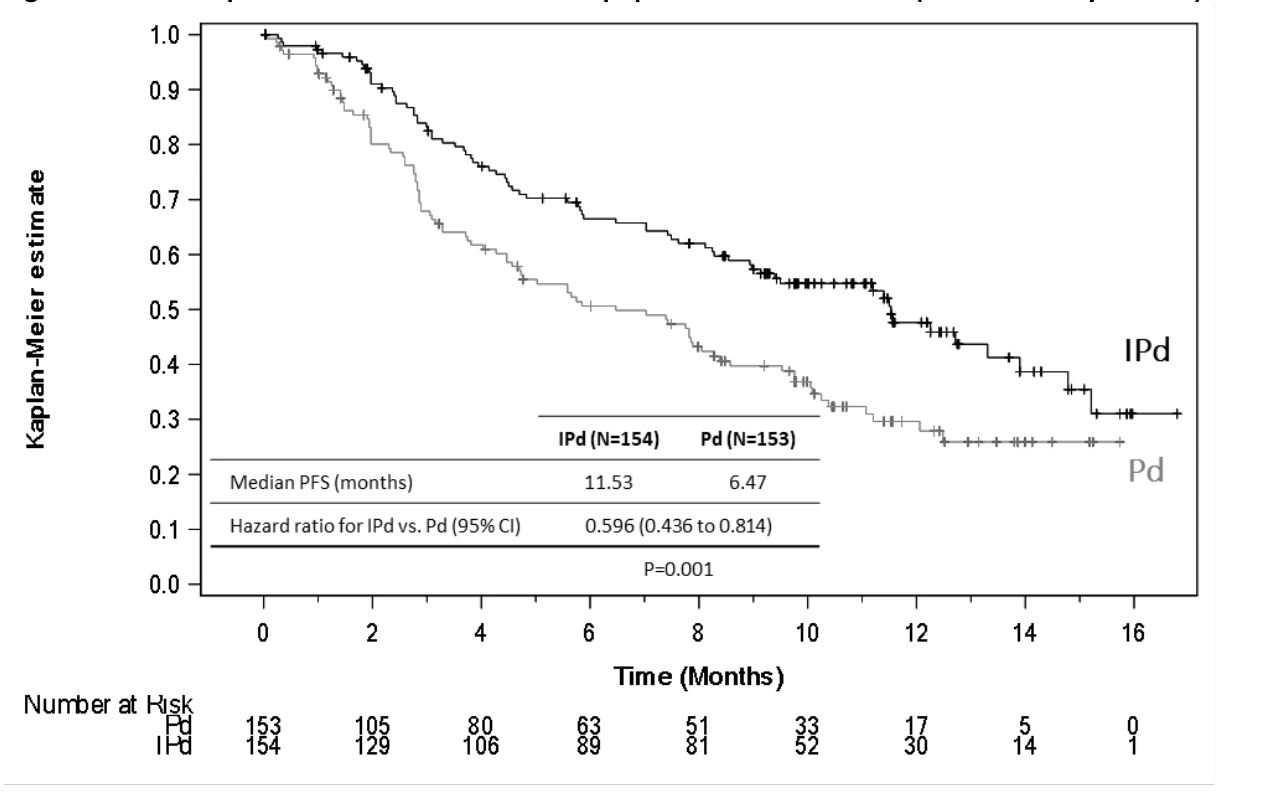
Overall Survival (OS) was analyzed at a preplanned interim analysis when the primary analyses for PFS and ORR were conducted. The OS was not mature at the time of the interim analysis. At the pre-specified primary OS analysis, conducted after 220 events had occurred (median follow-up time = 51.09 Months), median overall survival was estimated to be 24.6 months in the Isa-Pd group and 17.7 months in Pd group (HR=0.776; 95% CI: 0.594 to 1.015). The results did not achieve statistical significance.
SARCLISA (isatuximab for injection) is indicated in combination with carfilzomib and dexamethasone, for the treatment of adult patients with relapsed or refractory multiple myeloma who have received 1 to 3 prior lines of therapy.
Study IKEMA (EFC15246)
Study demographics and trial design
| Table 20: Summary of Patient Demographics for IKEMA (EFC15246) | ||||||||||
| Study # | Trial design | Dosage, route of administration and duration | Study subjects (n) | Mean age, years (Range) | Sex | |||||
IKEMA (EFC15246) | Phase 3 Multicenter, multinational, randomized, open-label, 2-arm study in patients with relapsed and/or refractory multiple myeloma who had received one to three prior therapies. | Isa-Kd: Sarclisa (10 mg/Kg IV)a + carfilzomib IVb + dexamethasone (20 mg IV/PO)c Kd: Carfilzomib IVd + dexamethasone (20 mg IV/PO)e 28-day cycle | Total:302 Isa-Kd: 179 Kd: 123 | 63.1 (range: 33-90) | Male: 169 (56%) Female: 133 (44%) | |||||
a administered as an IV weekly in the first cycle and every two weeks thereafter b 20 mg/m² on days 1 and 2; 56 mg/m² on days 8, 9, 15 and 16 of cycle 1; and at the dose of 56 mg/m² on days 1, 2, 8, 9, 15 and 16 for subsequent cycles of each 28-day cycle c IV on the days of isatuximab and/or carfilzomib infusions, and PO the other days; given on days 1, 2, 8, 9, 15, 16, 22 and 23 for each 28-day cycle IV = Intravenous; PO = Taken orally | ||||||||||
The efficacy and safety of SARCLISA in combination with carfilzomib and dexamethasone were evaluated in IKEMA (EFC15246), a multicenter, multinational, randomized, open-label, 2-arm, phase III study in adult patients with relapsed and/or refractory multiple myeloma. Patients had received one to three prior lines of therapy. Eligible patients had an ECOG status of 0-2, platelets ≥50,000 cells/µL if <50% of bone marrow nucleated cells were plasma cells and ≥30,000 cells/µL if ≥50% of bone marrow nucleated cells were plasma cells, absolute neutrophil count ≥1 x 10⁹/L, creatinine clearance ≥15 mL/min/1.73 m2 (MDRD formula), aspartate aminotransferase (AST) and alanine aminotransferase (ALT) ≤3 x upper limit of normal (ULN). Patients with primary refractory disease or who were refractory to previous anti-CD38 monoclonal antibody treatment were excluded.
A total of 302 patients were randomized in a 3:2 ratio to receive either SARCLISA in combination with carfilzomib and dexamethasone (Isa-Kd, 179 patients) or carfilzomib and dexamethasone (Kd, 123 patients). Treatment was administered in both groups in 28-day cycles until disease progression or unacceptable toxicity. SARCLISA10 mg/kg was administered as an intravenous (IV) infusion weekly in the first cycle and every two weeks thereafter. Carfilzomib was administered as an IV infusion at the dose of 20 mg/m² on days 1 and 2; 56 mg/m² on days 8, 9, 15 and 16 of cycle 1; and at the dose of 56 mg/m² on days 1, 2, 8, 9, 15 and 16 for subsequent cycles of each 28-day cycle. Dexamethasone (IV on the days of isatuximab and/or carfilzomib infusions, and orally on the other days) 20 mg was given on days 1, 2, 8, 9, 15, 16, 22 and 23 for each 28-day cycle. On the days where both SARCLISA and carfilzomib were administered, dexamethasone was administered first, followed by SARCLISA infusion, then followed by carfilzomib infusion.
Overall, demographic and disease characteristics at baseline were similar between the two treatment groups. The median patient age was 64 years (range 33-90), 8.9% of patients were ≥75 years. The proportion of patients with renal impairment (eGFR<60 mL/min/1.73 m2) was 24.0% in the Isa-Kd group versus 14.6% in the Kd group. The International Staging System (ISS) stage at study entry was I in 53.0%, II in 31.1%, and III in 15.2% of patients. Overall, 24.2% of patients had high-risk chromosomal abnormalities at study entry; del(17p), t(4;14), t(14;16) were present in 11.3%, 13.9% and 2.0% of patients, respectively. In addition, gain(1q21) was present in 42.1% of patients.
The median number of prior lines of therapy was 2 (range 1-4) with 44.4% of patients who received 1 prior line of therapy. Overall, 89.7% of patients received prior proteasome inhibitors, 78.1% received prior immunomodulators (including 43.4% who received prior lenalidomide), and 61.3% received prior stem cell transplantation. Overall, 33.1% of patients were refractory to prior proteasome inhibitors, 45.0% were refractory to prior immunomodulators (including 32.8% refractory to lenalidomide), and 20.5% were refractory to both a proteasome inhibitor and an immunomodulator.
The median duration of treatment was 80.0 weeks for the Isa-Kd group compared to 61.4 weeks for the Kd group.
Study Results
Progression-free survival (PFS) was the primary efficacy endpoint of IKEMA. PFS results were assessed by an Independent Response Committee based on central laboratory data for M-protein and central radiologic imaging review using the IMWG criteria.
Efficacy results are presented in Table 21 and Kaplan-Meier curves for PFS are provided in Figure 2:
| Table 21: Efficacy of SARCLISA in combination with carfilzomib and dexamethasone versus carfilzomib and dexamethasone in the treatment of multiple myeloma in IKEMA (intent-to-treat analysis)* | |||||||||
|---|---|---|---|---|---|---|---|---|---|
| Table 21: Efficacy of SARCLISA in combination with carfilzomib and dexamethasone versus carfilzomib and dexamethasone in the treatment of multiple myeloma in IKEMA (intent-to-treat analysis)* | |||||||||
| Endpoint | Sarclisa + carfilzomib + dexamethasone N = 179 | Carfilzomib + dexamethasone N = 123 | |||||||
| Endpoint | Sarclisa + carfilzomib + dexamethasone N = 179 | Carfilzomib + dexamethasone N = 123 | |||||||
| Progression-Free Survivala | |||||||||
Median (months) [95%CI] | NR [NR -NR] | 19.15 [15.77-NR] | |||||||
| Hazard Ratiob [99%CI] | 0.531 [0.318-0.889] | ||||||||
| p-value (stratified-log-rank test)b | 0.0013 | ||||||||
Overall Response Ratec Responders (sCR+CR+VGPR+PR) n (%) [95% CI]d | 155 (86.6) [0.8071-0.9122] | 102 (82.9) [0.7509-0.8911] | |||||||
| p-value (stratified Cochran-Mantel-Haenszel)b | 0.3859 | ||||||||
| Complete Response (CR) n (%) | 71 (39.7) | 34 (27.6) | |||||||
| Very Good Partial Response (VGPR) n (%) | 59 (33.0) | 35 (28.5) | |||||||
| Partial Response (PR) n (%) | 25 (14.0) | 33 (26.8) | |||||||
*Results are based on a prespecified interim analysis. Cut-off date of 7 February 2020. Median follow-up time 20.7 months NR: not reached. | |||||||||
Figure 2: Kaplan-Meier Curves of PFS – ITT population – IKEMA (assessment by the IRC)
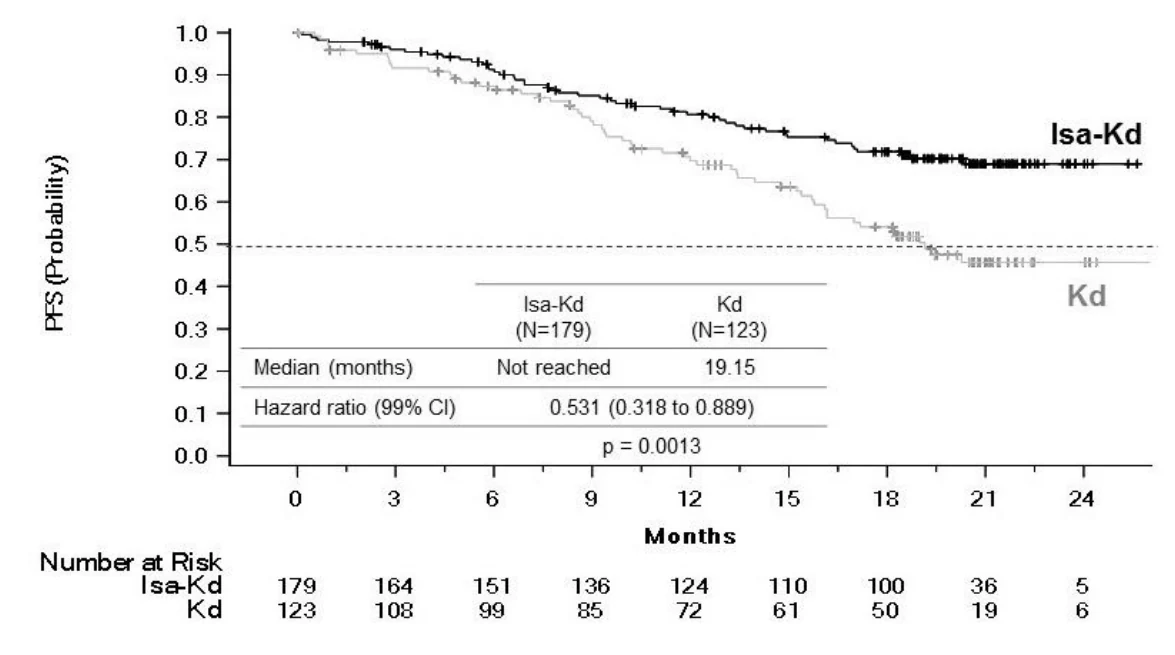
At a median follow-up time of 44 months, final PFS analysis showed a median PFS of 35.6 months (95%CI: 25.8 to 44) for Isa-Kd group compared to 19.2 months (95%CI: 15.8 to 25.0) for Kd group. Final complete response, determined using an isatuximab-specific IFE assay to remove isatuximab interference (see 9.7 Drug-Laboratory Test Interactions), was 44.1% (n=79) in Isa-Kd group compared to 28.5% (n=35) in Kd group. Note that in the Isa-Kd group, 4 patients who achieved VGPR at the interim analysis were reclassified to CR using the isatuximab-specific IFE.
At a median follow-up time of 56.6 months, median overall survival was not reached in the Isa-Kd group (95% CI: 52.2-NR) and was 50.60 months in Kd group (95% CI: 38.9-NR) (HR=0.855; 95% CI: 0.6-1.2).
The percentage of patients achieving a best overall response of VGPR or better, defined as patients with sCR, CR, or VGPR by the IRC using the IMWG response criteria, was 72.6% in the Isa-Kd group and 56.1% in the Kd group.
Subgroup analyses based on PFS hazard ratio were consistent across the pre-specified subgroups including patients with high-risk cytogenetics, ≥ 65 years of age, with baseline eGFR (MDRD) < 60 mL/min/1.73 m², with >1 prior line of therapy, or with ISS stage III at study entry.
Newly Diagnosed Multiple Myeloma Ineligible for Autologous Stem Cell Transplant
SARCLISA (Isatuximab for injection) is indicated in combination with bortezomib, lenalidomide, and dexamethasone, for the treatment of patients with newly diagnosed multiple myeloma who are not eligible for autologous stem cell transplant (ASCT)
Study IMROZ (EFC12522)
Study demographics and trial design
| Table 22: Summary of Patient Demographics in IMROZ (EFC12522) | ||||||||||
| Study # | Trial design | Dosage, route of administration and duration | Study subjects (n) | Mean age, years (Range) | Sex | |||||
IMROZ EFC12522 | Phase 3 Multicenter, international, randomized, open-label, 2-arm study in patients with newly diagnosed multiple myeloma who are not eligible for stem cell transplantation. | Induction period: 42-day cycles Isa-VRd; Sarclisa (10mg/Kg IV) a + bortezomib (1.3 mg/m² SC) b + lenalidomide (25 mg PO)c + dexamethasone (20 mg IV/PO)d VRd: bortezomib (1.3 mg/m² SC) b + lenalidomide (25 mg PO)c + dexamethasone (20 mg IV/PO)d | Continuous period: 28-day cycles Isa-Rd: Sarclisa (10mg/Kg IV)e + lenalidomide (25 mg PO)f + dexamethasone (20 mg IV/PO)g Rd: lenalidomide (25 mg PO)f + dexamethasone (20 mg IV/PO)g | Total:446 Isa-VRd: 265 VRd: 181 | 72 (range: 60-80) | Male: 237 (53.1%) Female: 209 (46.9%) | ||||
a on day 1, 8, 15, 22, and 29, in the first cycle and on day 1, 15, and 29, from cycle 2 to 4 b on days 1, 4, 8, 11, 22, 25, 29, and 32 of each cycle c from day 1 to 14 and from day 22 to 35 of each cycle d IV on the days of isatuximab infusions, and PO the other days; on days 1, 2, 4, 5, 8, 9, 11, 12, 15, 22, 23, 25, 26, 29, 30, 32, and 33 of each cycle, and administered on days 1, 4, 8, 11, 15, 22, 25, 29, and 32 of each cycle for patients ≥75 years old e on day 1 and 15 from cycle 5 to 17, and on day 1 from cycle 18 f from day 1 to 21 of each cycle g IV on the days of isatuximab infusions, and PO the other days; on days 1, 8, 15, and 22 of each cycle IV = Intravenous; PO = Taken orally | ||||||||||
The efficacy and safety of SARCLISA in combination with bortezomib, lenalidomide, and dexamethasone were evaluated in IMROZ (EFC12522), a multicenter, international, randomized, open-label, 2-arm, phase III study in patients with newly diagnosed multiple myeloma who are not eligible for stem cell transplantation.
A total of 446 patients were randomized in a 3:2 ratio to receive either SARCLISA in combination with bortezomib, lenalidomide, and dexamethasone (Isa-VRd, 265 patients) or bortezomib, lenalidomide, and dexamethasone (VRd, 181 patients) administered in both groups during 4 cycles of 42-day for the induction period. After completion of cycle 4, patients entered the continuous treatment period starting from cycle 5, 28-day cycles administered up to disease progression or unacceptable toxicity. During the continuous treatment period, patients of the Isa-VRd group received SARCLISA in combination with lenalidomide, and dexamethasone (Isa-Rd), and patients in the VRd group received lenalidomide, and dexamethasone (Rd).
During the induction period (cycle 1 to 4, 42-day cycles), SARCLISA 10 mg/kg was administered as an IV infusion on day 1, 8, 15, 22, and 29, in the first cycle and on day 1, 15, and 29, from cycle 2 to 4. Bortezomib was administered subcutaneously at the dose of 1.3 mg/m² on days 1, 4, 8, 11, 22, 25, 29, and 32 of each cycle. Lenalidomide was administered per os at the dose of 25 mg/day from day 1 to 14 and from day 22 to 35 of each cycle. Dexamethasone (IV on the days of isatuximab infusions, and PO on the other days) 20 mg/day was given on days 1, 2, 4, 5, 8, 9, 11, 12, 15, 22, 23, 25, 26, 29, 30, 32, and 33 of each cycle, and administered on days 1, 4, 8, 11, 15, 22, 25, 29, and 32 of each cycle for patients ≥75 years old. During the continuous treatment period (from cycle 5, 28-day cycles), SARCLISA 10 mg/kg was administered as an IV infusion on day 1 and 15 from cycle 5 to 17, and on day 1 from cycle 18. Lenalidomide was administered per os at the dose of 25 mg/day from day 1 to 21 of each cycle. Dexamethasone (IV on the days of isatuximab infusions, and PO on the other days) 20 mg/day was given on days 1, 8, 15, and 22 of each cycle.
Overall, demographic and disease characteristics at baseline were similar between the two treatment groups. The median patient age was 72 years (range 60-80), 26% of patients were ≥75 years. The proportion of patients with renal impairment (eGFR<60 mL/min/1.73m2) was 24.9% in the Isa-VRd group versus 34.3% in the VRd group. The Revised International Staging System (R-ISS) stage at study entry was I in 24.9%, II in 61.5%, and III in 10.2% of patients. Overall, 15.1% of patients had high-risk chromosomal abnormalities at study entry; del(17p), t(4;14), and t(14;16) were present in 5.7%, 7.9% and 1.9% of patients, respectively. In addition, 1q21+ was present in 35.8% of patients.
The median duration of treatment was 53.2 months for the Isa-VRd group compared to 31.3 months for the VRd group.
Study Results
Progression-free survival (PFS) was the primary efficacy endpoint of IMROZ. PFS results were assessed by an Independent Response Committee based on central laboratory data for M-protein and central radiologic imaging review using the International Myeloma Working Group (IMWG) criteria. Key secondary endpoints were complete response (CR) rate, minimal residual disease (MRD) negativity rate in patients with CR, very good partial response (VGPR) or better rate, and overall survival (OS).
With a median follow-up time of 59.73 months, the pre-planned second interim analysis of PFS showed a statistically significant improvement in PFS representing a 40.4% reduction in the risk of disease progression or death in patients treated with Isa-VRd compared to patients treated with VRd.
Efficacy results are presented in Table 23 and Kaplan-Meier curves for PFS are provided in Figure 3:
| Table 23: Efficacy of SARCLISA in combination with bortezomib, lenalidomide, and dexamethasone versus bortezomib, lenalidomide, and dexamethasone in the treatment of multiple myeloma (intent-to-treat analysis) | ||||||||||
| Endpoint | Sarclisa + bortezomib + lenalidomide + dexamethasone N =265 | Bortezomib + lenalidomide + dexamethasone N = 181 | ||||||||
Progression-Free Survival a Median (months) [95% CI] Hazard ratio b [98.5% CI] | NR [NR-NR] | 54.34 [45.21-NR] | ||||||||
| 0.596 [0.406-0.876] | ||||||||||
| p-value (Stratified Log-Rank test, 1-sided)b | 0.0005 | |||||||||
CR or better (sCR and CR) [95% CI]c | 74.7% [0.690-0.798] | 64.1% [0.566-0.711] | ||||||||
| p-value (Stratified Log-Rank test, 1-sided)b | 0.0080 | |||||||||
Minimal Residual Disease negativityd CR [95% CI]c | 55.5% [0.493-0.616] | 40.9% [0.337-0.484] | ||||||||
| p-value (stratified Cochran-Mantel-Haenszel, 1-sided) b | 0.0013 | |||||||||
a PFS results were assessed by an Independent Response Committee based on central laboratory data for M-protein and central radiologic imaging review using the International Myeloma Working Group (IMWG) criteria. b Stratified by age (<70 years vs ≥70 years) and Revised International Staging System (R-ISS) stage (I or II vs. III or not classified) according to IRT c Estimated using Clopper-Pearson method. d Based on a sensitivity level of 10-5 by NGS in ITT population.
CR: complete response; sCR: stringent complete response
Cut-off date of 26 September 2023. Median follow-up time=59.73 months. NR: not reached.
The ORR was 91.3% in the IVRd group and 92.3% in the VRd group. A statistically significantly higher rate of CR (including sCR) was observed in the IVRd group (74.7%) than in the VRd group (64.1%). The very good partial response (VGPR) and partial response (PR) rates were 14.3% and 2.3%, respectively in IVRd group compared to 18.8% and 9.4%, respectively in VRd group.
At a median follow-up time of 59.73 months, the median overall survival was not reached for either treatment group, and 26.0% of patients in the Isa-VRd group and 32.6% of patients in the VRd group had died (HR=0.776; 99.97% CI: 0.407 to 1.48). The 60-month survival rate estimates were respectively 72.3% (95% CI: 66.1 to 77.5) in the Isa-VRd group and 66.3% (95% CI: 58.5 to 73.1) in the VRd group.
Figure 3: Kaplan-Meier Curves of PFS – ITT population – IMROZ (assessment by the IRC)
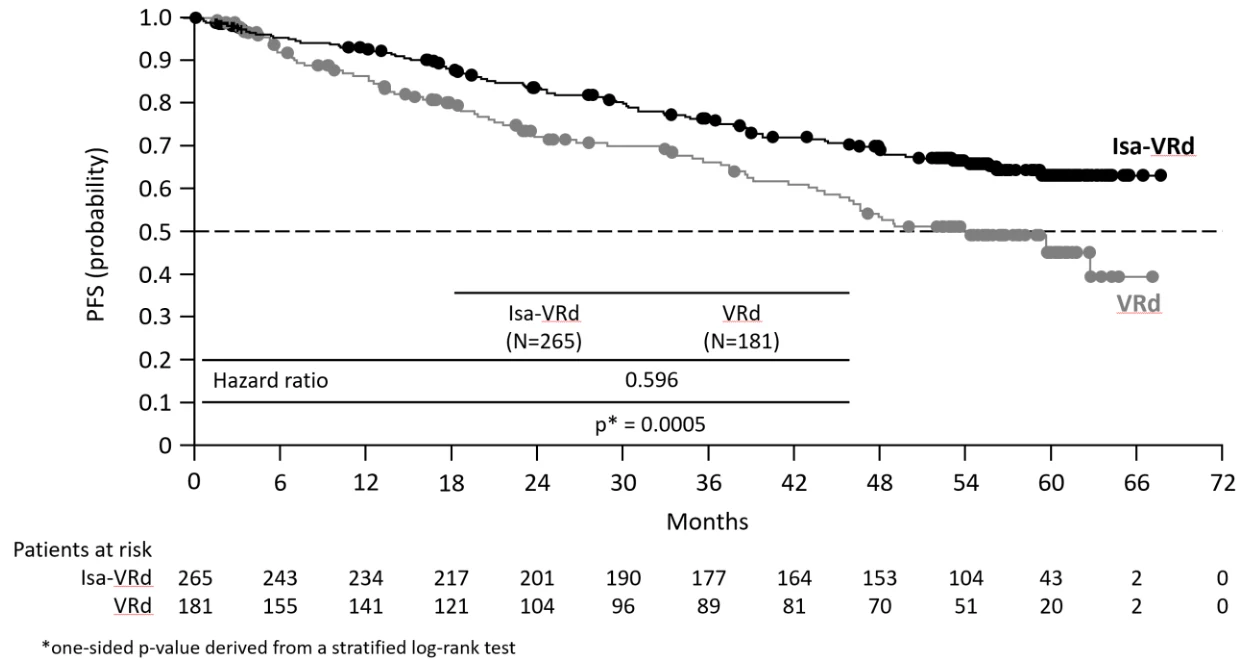
16. Non-Clinical Toxicology
General toxicology: General safety was investigated in cynomolgus monkeys, involving IV administration once weekly for 3 weeks. No adverse effects were observed up to the highest dose tested (100 mg/kg/week), albeit the species selected is not pharmacologically responsive and therefore the relevance for humans is not known.
Genotoxicity: No studies have been performed to evaluate the genotoxic potential of isatuximab. As a large protein molecule, isatuximab is not expected to interact with DNA or other chromosomal material.
Carcinogenicity: No long-term animal studies have been performed to evaluate the carcinogenic potential of isatuximab.
Reproductive and Developmental Toxicology: Reproductive, developmental toxicity and embryofetal toxicity studies have not been conducted with isatuximab. Immunoglobulin G1 monoclonal antibodies are known to cross the placenta after the first trimester, with transfer increasing in a linear fashion as pregnancy progresses. Based on its mechanism of action and findings in CD38-knockout mice, exposure to isatuximab may cause fetal harm, e.g., immune cell depletion, neurological deficits, decreased bone density and metabolic disorders.