


Patient Medication Information: uses, side effects, how to take - Saxenda
What SAXENDA® is used for:
SAXENDA® (liraglutide injection) is used for chronic weight management in addition to reduced calorie diet and increased physical activity in adults aged 18 and above who have either:
- BMI* of 30 or greater (obesity), or
- BMI* of 27-30 (overweight) in the presence of at least one weight-related comorbidity and who have failed a previous weight management intervention.
*BMI (Body Mass Index) is a simple measure of your weight in relation to your height. See your doctor to have your BMI measured.
SAXENDA® can be used in addition to a reduced calorie diet and increased physical activity in adolescents aged 12 to less than 18 years with obesity, as diagnosed by a doctor, who have failed on a reduced calorie diet and increased physical activity alone.
Consult your doctor regarding use of SAXENDA® in adolescents aged 12 to less than 18 years.
How SAXENDA® works:
SAXENDA® helps adults who are overweight or have obesity, or adolescents with obesity, who also have weight related medical problems lose weight and keep the weight off. SAXENDA® should be used with a reduced calorie diet and increased physical activity.
Serious Warnings and Precautions
Possible Risk of thyroid tumours, including cancer
As part of drug testing, liraglutide, the active ingredient in SAXENDA® was given to rats and mice in long term studies. In these studies, liraglutide caused both rats and mice to develop medullary thyroid tumours, some of which were cancer. It is not known if liraglutide will cause thyroid tumours or a rare type of thyroid cancer called medullary thyroid cancer in people. If medullary thyroid cancer occurs, it may lead to death if it is not found early and treated. If you develop a tumour of the thyroid, it may have to be surgically removed.
While taking SAXENDA®, tell your doctor if you get a lump or swelling in your neck, hoarseness, trouble swallowing or shortness of breath. These may be symptoms of thyroid cancer. You should discuss any safety concerns you have about the use of SAXENDA® with your doctor.
The ingredients in SAXENDA® are:
Medicinal ingredients: Liraglutide
Non-medicinal ingredients: Disodium phosphate dihydrate, propylene glycol, phenol and water for injections.
SAXENDA® belongs to a class of medicines called GLP-1 analogue.
SAXENDA® comes in the following dosage forms:
SAXENDA® is provided in a disposable, prefilled, multi-dose pen. Each pen can deliver a dose of 0.6 mg, 1.2 mg, 1.8 mg, 2.4 mg or 3.0 mg. Each pen contains 3 mL of SAXENDA® at a concentration of 6 mg/mL
Pens are available in packages of three and five.
Do not use SAXENDA® if:
- You or any of your family members have a history of medullary thyroid cancer.
- You have Multiple Endocrine Neoplasia syndrome type 2 (MEN 2). This is a disease where people have tumours in more than one gland in their body.
- You are allergic to liraglutide or any of the ingredients in SAXENDA® (see “What are the ingredients in SAXENDA®?” for a complete list of ingredients).
You are pregnant or planning to become pregnant. SAXENDA® may harm your unborn baby.
To help avoid side effects and ensure proper use, talk to your healthcare professional before you take SAXENDA®. Talk about any health conditions or problems you may have, including if you:
- have palpitations (you feel aware of your heart beat) or if you have feelings of a racing heart beat while at rest during SAXENDA® treatment.
- lose substantial weight you are at risk of gallstones and thereby inflamed gallbladder. Stop taking SAXENDA® and contact a doctor immediately if you experience severe pain in your upper abdomen, usually worse on the right side under the ribs. The pain may be felt through to your back or right shoulder (see ‘What are the possible side effects of SAXENDA®?’).
- have or have had depression or suicidal thoughts.
- have severe heart failure. There is little to no experience with this medicine in patients with heart failure.
- have ever had a heart attack (myocardial infarction). There is little or no experience with this medicine in patients who have ever had a heart attack.
- have unstable angina, a type of chest pain that happens when there is not enough blood to the heart and that is also either new or different from before. There is little or no experience with this medicine in patients with unstable angina.
- have a problem with your heart beating too fast (tachyarrhythmia) or with the normal electric impulses of your heart (conduction disorder, for example atrioventricular block). There is little or no experience with this medicine in patients with conduction disorders and arrhythmias.
- have diabetes, do not use SAXENDA® instead of insulin and do not use SAXENDA® with insulin.
- adolescents who are aged 12 to less than 18 years without type 2 diabetes mellitus have a risk of low blood sugar (see ‘What are the possible side effects of SAXENDA®?’).
have the symptoms of inflammation of the pancreas (pancreatitis), such as severe stomach pain which does not go away, talk to your doctor immediately. Pancreatitis can be severe and lead to death. You may be more likely to get pancreatitis if you have had pancreatitis before,
- or if you have had stones in your gallbladder, alcoholism or high levels of triglycerides in your blood.
- have ever had an allergic reaction to liraglutide or any of the other ingredients in SAXENDA®.
- have kidney problems.
- have liver problems.
- have severe stomach problems, such as slowed emptying of your stomach (gastroparesis) or problems digesting your food.
- are pregnant or plan to have a baby. SAXENDA® may harm your unborn baby. Tell your doctor if you become pregnant while taking SAXENDA®. If you are pregnant, stop using SAXENDA®.
- are breastfeeding or plan to breastfeed. It is not known if SAXENDA® passes into your breast milk. You and your doctor should decide if you will take SAXENDA® or breastfeed.
- have severe vomiting and/or diarrhea and/or dehydration.
Other warnings you should know about:
Effects on the digestive system and dehydration
When starting SAXENDA® treatment, you might have side effects like throwing up (vomiting), feeling sick (nauseated) and getting diarrhea. Throwing up and diarrhea can cause dehydration (loss of fluids). It is important to avoid dehydration by drinking plenty of fluids. Call your doctor if you have any questions. Dehydration can cause kidney problems that sometimes require hemodialysis.
Children and adolescents
SAXENDA® is not recommended for use in children under 12 years of age or in adolescents with a body weight below or equal to 60 kg.
Food or liquid getting into lungs during anesthesia or sedation
- Some patients taking medicines like SAXENDA® have had problems with food or liquid from their stomach getting into their lungs while under general anesthesia or sedation.
- Tell your healthcare professional that you are taking SAXENDA® before you have a procedure that requires general anesthesia or sedation.
Cardiovascular
SAXENDA® may increase heart rate and could cause changes known as PR prolongation, which are detected by electrocardiogram (ECG) tracings. Increased heart rate is the same as a faster pulse. These heart rhythm changes are more likely if you have heart disease, or if you are taking certain other drugs. It is important to follow your doctor's advice about the dose of SAXENDA® or about any special tests that you may need. See ‘What are possible side effects from using SAXENDA®?’
Driving and using machines
Having low or high blood sugar can affect your ability to drive or use any tools or machines. If your blood sugar is low or high, your ability to concentrate or react might be affected. This could be dangerous to yourself or others. Do not drive if you feel dizzy.
Tell your healthcare professional about all the medicines you take, including any drugs, vitamins, minerals, natural supplements or alternative medicines.
The following may interact with SAXENDA®:
Don’t take SAXENDA® if you take insulin. Tell your doctor, Diabetes Nurse Educator or pharmacist if you are taking diabetes medicines called ‘sulphonylurea’ (such as glimepiride or glibenclamide). Using these medicines with SAXENDA® can make your blood sugar go too low (hypoglycemia). Your doctor may adjust the dose of your diabetes medicine to prevent you from getting low blood sugar.
How to take SAXENDA®:
Use SAXENDA® exactly as prescribed by your healthcare professional (see ‘Instructions for Use’).
Do not share your SAXENDA® pen with anyone else, even if the needle is changed. Do not reuse or share needles with another person including family members. You may give another person an infection or get an infection from them.
Usual dose:
When you first start using SAXENDA®, the starting dose is 0.6 mg once a day. Your dose should be increased after using SAXENDA® for one week until you reach the 3.0 mg dose. After that, do not change your dose unless your healthcare professional tells you to.
- SAXENDA® is injected 1 time each day, at any time during the day.
- You can take SAXENDA® with or without food.
- Your doctor should start you on a diet and exercise program when you start taking SAXENDA®. Stay on this program while you are taking SAXENDA®.
Administering SAXENDA®:
SAXENDA® is an injection which is given under the skin (subcutaneously). Do not inject it into a vein or muscle.
Before you use the pen for the first time, your doctor or Diabetes Nurse Educator will show you how to use it. The best places to give yourself the injection are the front of your thighs, the front of your waist (abdomen) or your upper arm. Change the place within the area where you inject each day to reduce the risk of developing lumps under the skin. You can give yourself the injection at any time of the day (see ‘Instructions for Use’).
Overdose:
If you use more SAXENDA® than you should, talk to your doctor straight away. You may need medical treatment. If you use too much SAXENDA® you may feel sick (have nausea), become sick (vomit), or have low blood sugar (hypoglycemia). Please refer to ‘What are the possible side effects from using SAXENDA®’ for early warning signs of low blood sugar.
If you think you, or a person you are caring for, have taken too much SAXENDA®, contact a healthcare professional, hospital emergency department, regional poison control centre or Health Canada’s toll-free number, 1-844 POISON-X (1-844-764-7669) immediately, even if there are no signs or symptoms.
Missed Dose:
If you miss your daily dose of SAXENDA®, use SAXENDA® as soon as you remember. Then take your next daily dose as usual on the following day. Do not take an extra dose of SAXENDA® or increase your dose on the following day to make up for your missed dose.
If you miss your dose of SAXENDA® for 3 days or more, call your healthcare professional to talk about how to restart your treatment.
What are possible side effects from using SAXENDA®?
These are not all the possible side effects you may feel when taking SAXENDA®. If you experience any side effects not listed here, contact your healthcare professional.
Like all medicines, SAXENDA® can cause side effects. The following side effects may happen with this medicine.
Some severe allergic reactions (anaphylaxis) have been reported rarely in patients using SAXENDA®. You should see your doctor straight away if you get symptoms such as breathing problems, swelling of face and throat and fast heart beat.
Cases of inflammation of the pancreas (pancreatitis) have been reported uncommonly in patients using SAXENDA®. Pancreatitis can be a serious, potentially life-threatening medical condition. Talk to your doctor straight away if you get severe stomach pain which does not go away.
Very common: may affect more than 1 in 10 people
- feeling sick (nausea), being sick (vomiting), diarrhea, constipation, headache – these usually go away after a few days or weeks
- lower appetite
Common: may affect up to 1 in 10 people
- problems affecting the stomach and intestines such as: indigestion (dyspepsia), inflamed lining of the stomach (gastritis), stomach discomfort, upper stomach pain, heart burn, feeling bloating, wind (flatulence), belching, dry mouth
- feeling weak or tired
- changed sense of taste
- dizziness
- gallstones
- injection site reactions (such as bruising, pain, irritation, itching and rash)
- low blood sugar (hypoglycemia) – the warning signs of low blood sugar may come on suddenly and can include: cold sweat, cool pale skin, headache, fast heart beat, feeling sick, feeling very hungry, changes in vision, feeling sleepy, feeling weak, nervous, anxious, confused, difficulty concentrating, shaking (tremor). Your doctor will tell you how to treat low blood sugar and what to do if you notice these warning signs.
- difficulty sleeping (insomnia). This usually occurs during the first 3 months of treatment
- increase of pancreatic enzymes, such as lipase and amylase
Uncommon: may affect up to 1 in 100 people
- loss of fluids (dehydration) – this is more likely at the start of treatment and may be due to being sick (vomiting), feeling sick (nausea) and diarrhea
- inflamed gallbladder
- allergic reactions including skin rash
- feeling generally unwell
- faster pulse
- inflammation of the pancreas (pancreatitis)
Rare: may affect up to 1 in 1,000 people
- reduced kidney function
- acute kidney failure – signs include metallic taste in mouth and easily bruising
- severe allergic reactions (anaphylaxis)
Unknown:
- Lumps under the skin may be caused by build-up of a protein called amyloid (cutaneous amyloidosis). SAXENDA® may not work very well if you inject into a lumpy area. Change the injection site with each injection to help prevent this skin change.
- Delay in the emptying of the stomach
- Bowel obstruction and ileus: A condition where your intestine can’t push food and waste out of your body (can cause constipation, with additional symptoms such as stomach ache, bloating, vomiting, etc.)
If any of the side effects do not go away or get worse, or if you notice any side effects not listed in the leaflet, please tell your doctor, Diabetes Nurse Educator or pharmacist.
Serious side effects and what to do about them
| Symptom / effect | Talk to your healthcare professional | Stop taking drug and get immediate medical help | |
|---|---|---|---|
| Only if severe | In all cases | ||
COMMON Increases in heart rate. If you experience, while at rest, a racing or pounding feeling in your chest lasting several minutes when taking SAXENDA®, notify your doctor. | √ | ||
RARE Severe form of allergic reaction (anaphylactic reaction) with symptoms of breathing problems, swelling of throat and face, and fast heart beat. You should seek immediate medical attention. | √ | ||
UNKNOWN Cutaneous amyloidosis: lumps under the skin | √ | ||
If you have a troublesome symptom or side effect that is not listed here or becomes bad enough to interfere with your daily activities, talk to your healthcare professional.
Reporting Side Effects
You can report any suspected side effects associated with the use of health products to Health Canada by:
- Visiting the Web page on Adverse Reaction Reporting (canada.ca/drug-device-reporting) for information on how to report online, by mail or by fax; or
- Calling toll-free at 1-866-234-2345.
NOTE: Contact your health professional if you need information about how to manage your side effects. The Canada Vigilance Program does not provide medical advice.
Storage:
Do not use SAXENDA® after the expiry date which is stated on the label and carton. The expiry date refers to the last day of that month.
- Before you start to use SAXENDA®, store it in a refrigerator (2˚C to 8˚C) away from the freezer compartment. Do not freeze it.
- When SAXENDA® is being used, you can keep it for 1 month either at room temperature (not above 30˚C) or in a refrigerator (2˚C to 8˚C).
- Do not use SAXENDA® if it has been frozen.
- Do not use SAXENDA® if it is not clear and colourless.
- Always remove the injection needle after each injection and store your SAXENDA® pen without an injection needle attached. This prevents contamination, infection, and leakage. It also ensures that the dosing is accurate.
- When you are not using the pen, keep the cap on. This will protect the medicine from light.
- Protect SAXENDA® from high temperatures and sunlight.
- Medicines should not be disposed of via waste water or household waste. Ask your pharmacist how to dispose of medicines no longer required. These measures will help to protect the environment.
Keep out of reach and sight of children.
If you want more information about SAXENDA®:
- Talk to your healthcare professional
- Find the full product monograph that is prepared for healthcare professionals and includes this Patient Medication Information by visiting the Health Canada website (https://www.canada.ca/en/health-canada/services/drugs-health-products/drug-products/drug-product-database.html); or by contacting the manufacturer, Novo Nordisk Canada Inc. at 1-800-465-4334, http://www.novonordisk.ca.
Date of Authorization: 2025-09-10
SAXENDA®, NovoFine® and NovoFine® Plus are trademarks of Novo Nordisk A/S and used under license by Novo Nordisk Canada Inc.
© 2025 Novo Nordisk Canada Inc.
PrSAXENDA® Instructions for use
Instructions on how to use SAXENDA® 6 mg/mL solution for injection in prefilled pen Please read these instructions carefully before using your SAXENDA® prefilled pen. Do not use the pen without proper training from your doctor or Diabetes Nurse Educator. Start by checking your pen to make sure that it contains SAXENDA® 6 mg/mL, then look at the illustrations below to get to know the different parts of your pen and needle. If you are blind or have poor eyesight and cannot read the dose counter on the pen, do not use this pen without help. Get help from a person with good eyesight who is trained to use the SAXENDA® prefilled pen. Your pen is a prefilled dial-a-dose pen. It contains 18 mg of liraglutide, and delivers doses of 0.6 mg, 1.2 mg, 1.8 mg, 2.4 mg and 3.0 mg. Your pen is designed to be used with NovoFine® or NovoFine® Plus disposable needles up to a length of 8 mm. Do not share your SAXENDA® pen with another person, even if the needle is changed. Do not reuse or share needles with another person including family members. You may give another person an infection, or get an infection from them. Needles are not included in the pack. Important information Pay special attention to these notes as they are important for safe use of the pen. | |||
|---|---|---|---|
Saxenda® pre-filled pen and needle (example) Pen cap Outer needle cap Inner needle cap Needle Paper tab Pen scale Pen window Pen label Dose counter Dose pointer Dose selector Dose button Flow check symbol S a x e n d a ® 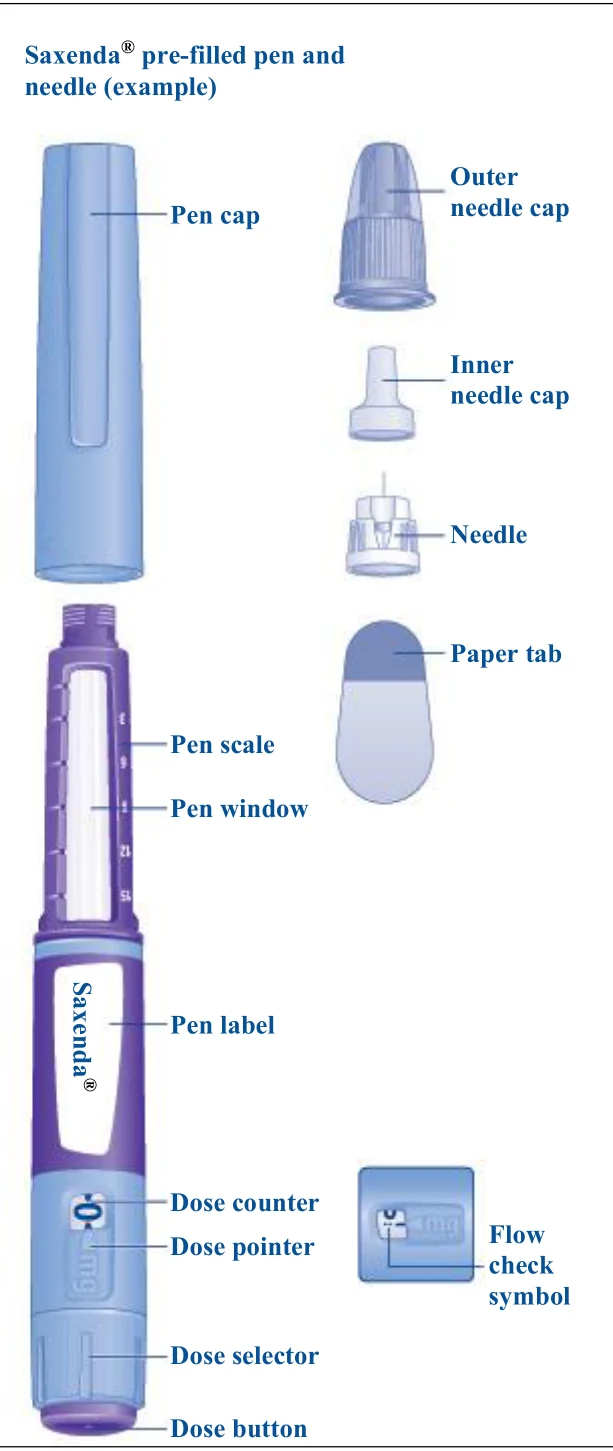 | |||
1 Prepare your pen with a new needle
| A 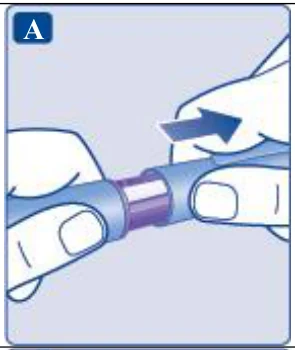 | ||
| B 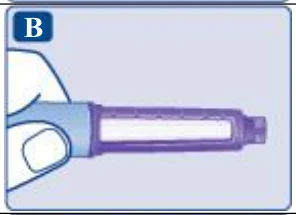 | ||
| C 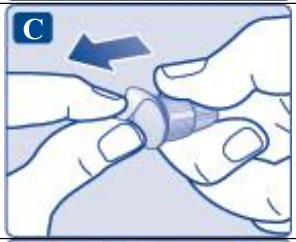 | ||
| D 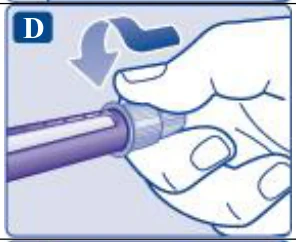 | ||
| E 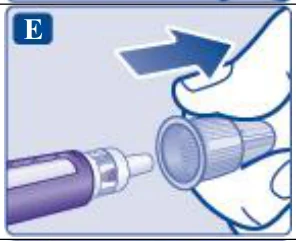 | ||
A drop of SAXENDA® may appear at the needle tip. This is normal, but you must still check the flow, if you use a new pen for the first time. Do not attach a new needle to your pen until you are ready to take your injection. Always use a new needle for each injection. This may prevent blocked needles, contamination, infection and inaccurate dosing. Do not reuse or share needles with another person. | F 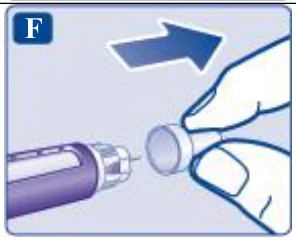 | ||
| Never use a bent or damaged needle. | |||
2 Check the flow with each new pen
 | A Flow check symbol selected 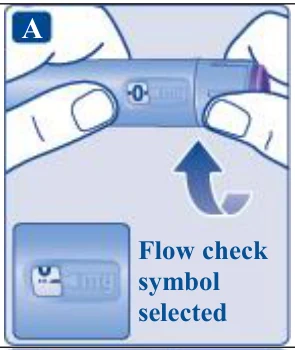  | ||
Press and hold in the dose button until the dose counter returns to 0. The 0 must line up with the dose pointer. A drop of SAXENDA® should appear at the needle tip. A small drop may remain at the needle tip, but it will not be injected. If no drop appears, repeat steps 2 ‘Check the flow with each new pen’ up to 6 times. If there is still no drop, change the needle and repeat step 2 ’Check the flow with each new pen’ once more. If a drop of SAXENDA® still does not appear, dispose of the pen and use a new one. Only check the SAXENDA® flow, before your first injection with each new pen. Always make sure that a drop appears at the needle tip before you use a new pen for the first time. This makes sure that SAXENDA® flows. If no drop appears, you will not inject any SAXENDA®, even though the dose counter may move. This may indicate a blocked or damaged needle. If you do not check the flow before your first injection with each new pen, you may not get the prescribed dose and the intended effect of SAXENDA®. | B 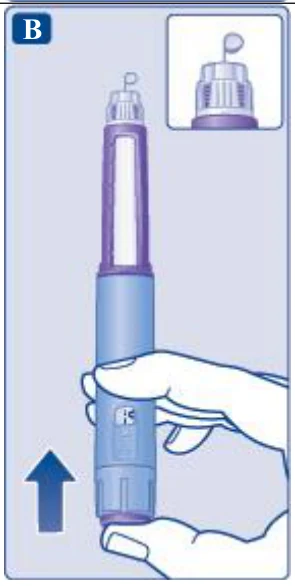 | ||
3 Select your dose
If you select the wrong dose, you can turn the dose selector forward or backwards to the correct dose. The pen can dial up to a maximum of 3.0 mg. The dose selector changes the dose. Only the dose counter and dose pointer will show how many mg you select per dose. You can select up to 3.0 mg per dose. When your pen contains less than 3.0 mg the dose counter stops before 3.0 is shown. The dose selector clicks differently when turned forward, backwards or past the number of mg left. Do not count the pen clicks. Always use the dose counter and the dose pointer to see | A Example 0.6 mg selected 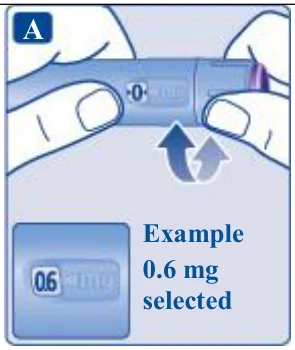  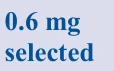 | ||
how many mg you have selected before injecting SAXENDA®. Do not count the pen clicks. Do not use the pen scale. It only shows approximately how much SAXENDA® is left in your pen. Only doses of 0.6 mg, 1.2 mg, 1.8 mg, 2.4 mg or 3.0 mg can be selected with the dose selector. The selected dose must line up precisely with the dose pointer to ensure that you get a correct dose. | |||
How much SAXENDA® is left?
| A Approx. how much SAXENDA® is left 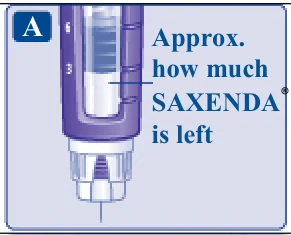 | ||
Turn the dose selector until the dose counter stops. If it shows 3.0, at least 3.0 mg are left in your pen. If the dose counter stops before 3.0 mg, there is not enough SAXENDA® left for a full dose of 3.0 mg. If you need more SAXENDA® than what is left in your pen Only if trained or advised by your doctor or Diabetes Nurse Educator, you may split your dose between your current pen and a new pen. Use a calculator to plan the doses as instructed by your doctor or Diabetes Nurse Educator. Be very careful to calculate correctly. If you are not sure how to split your dose using two pens, then select and inject the dose you need with a new pen. | B Example Dose counter stopped: 2.4 mg left 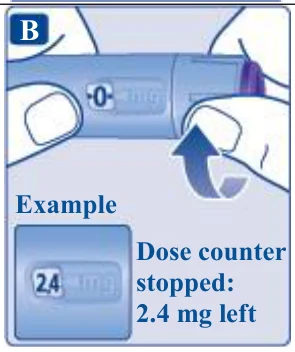   | ||
4 Inject your dose
| A 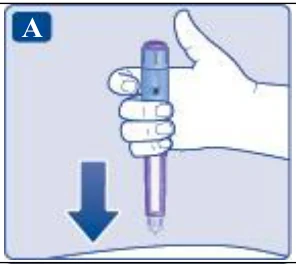 | ||
| B 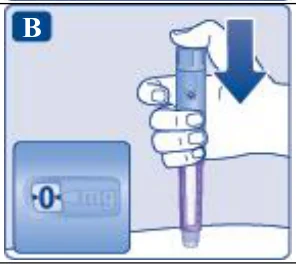 | ||
| C Count slowly: 1-2-3-4-5-6 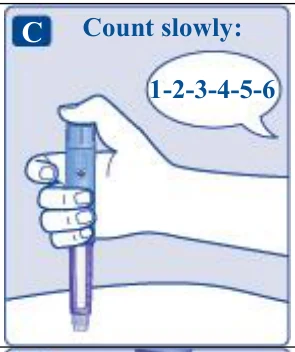   | ||
If blood appears at the injection site, press lightly. Do not rub the area. You may see a drop of SAXENDA® at the needle tip after injecting. This is normal and does not affect your dose. Always watch the dose counter to know how many mg you inject. Hold the dose button down until the dose counter shows 0. How to identify a blocked or damaged needle?
How to handle a blocked needle? Change the needle as described in section 5 ‘After your injection’, and repeat all steps starting with section 1 ‘Prepare your pen with a new needle’. Make sure you select the full dose you need. Never touch the dose counter when you inject. This can interrupt the injection. | D 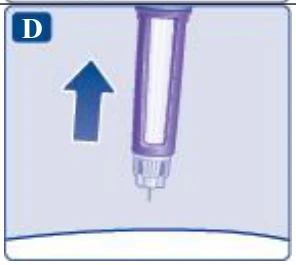 | ||
5 After your injection
| A 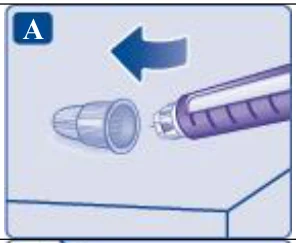 | ||
| B 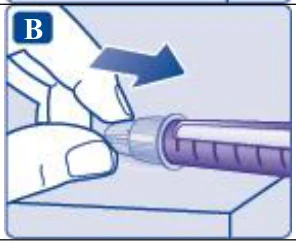 | ||
Always dispose of the needle after each injection to ensure convenient injections and prevent blocked needles. If the needle is blocked, you will not inject any SAXENDA®. When the pen is empty, throw it away without a needle on as instructed by your doctor, nurse, pharmacist or local authorities. Never try to put the inner needle cap back on the needle. You may stick yourself with the needle. Always remove the needle from your pen after each injection. This may prevent blocked needles, contamination, infection, leakage of SAXENDA® and inaccurate dosing. | 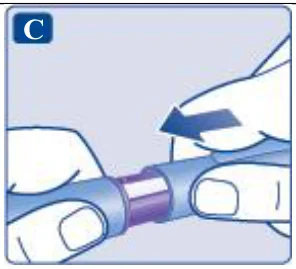 | ||
Further important information
| |||
Caring for your pen
| |||