


Patient Medication Information: uses, side effects, how to take - Signifor
Serious warnings and precautions box
Serious side effects include:
|
What SIGNIFOR is used for:
SIGNIFOR (pasireotide) is a medicine to treat Cushing’s disease in adults. It is used when surgery is not an option or has not produced the required results.
SIGNIFOR should only be prescribed and supervised by a qualified doctor. To receive SIGNIFOR, you must be enrolled in the Access Program for SIGNIFOR.
How SIGNIFOR works:
Cushing’s disease is a condition caused by an enlargement (pituitary adenoma) in the pituitary gland. This causes the body to make excessive amounts of certain hormones.
SIGNIFOR works by blocking the production of certain hormones, that cause Cushing’s disease.
The ingredients in SIGNIFOR are:
Medicinal ingredient: Pasireotide diaspartate
Non-medicinal ingredients: Mannitol, sodium hydroxide, tartaric acid, and water for injections.
SIGNIFOR comes in the following dosage forms:
SIGNIFOR is a solution supplied in an ampoule containing 1 mL of a clear, colourless solution.
Each ampoule contains 0.3 mg or 0.6 mg or 0.9 mg pasireotide (as pasireotide diaspartate).
SIGNIFOR is available in packs containing 6 and 60 ampoules.
Do not use SIGNIFOR if:
- If you are allergic to pasireotide or to any other ingredient in the medication or its container
- If you have moderate or severe liver problems
- If you have uncontrolled diabetes
- If you have heart problems
To help avoid side effects and ensure proper use, talk to your healthcare professional before you take SIGNIFOR. Talk about any health conditions or problems you may have, including if you:
- have problems with your blood sugar levels, either too high (hyperglycemia/diabetes) or too low (hypoglycaemia)
- have problems with your liver
- have severe kidney problems
- have heart problems. This includes an abnormal heart rate or rhythm. This can also include problems with the electrical system of your heart called QT prolongation
- have a history of fainting spells
- have low levels of pituitary hormones
- have low levels of potassium or magnesium in your blood
- have conditions such as vomiting, diarrhea, dehydration
- have gallstones
are pregnant, may be pregnant or thinking or becoming pregnant. SIGNIFOR should not be taken during pregnancy. SIGNIFOR may restore fertility in woman with child bearing potential. You should use effective contraception while taking SIGNIFOR to avoid pregnancy
- are breastfeeding or planning to breastfeed. SIGNIFOR should not be used in nursing woman
Other warnings you should know about:
Before your doctor prescribes SIGNIFOR, they should do tests including:
- Blood tests
- Liver tests
- Electrocardiogram, to measure the electrical activity of the heart
- Gallbladder ultrasound
These tests should be repeated during treatment.
Your doctor may wish to check your gallbladder, liver enzymes and pituitary hormones on a regular basis.
Your doctor may wish to check your blood sugar levels. You may need to start taking medicines to control your blood sugar levels or your doctor may adjust the medicines you are now taking to control your blood sugar levels.
Driving and Using Machines: Before you perform tasks which may require special attention, wait until you know how you respond to SIGNIFOR as fatigue or headache can occur.
Tell your healthcare professional about all the medicines you take, including any drugs, vitamins, minerals, natural supplements or alternative medicines.
The following may interact with SIGNIFOR:
The following list includes some, but not all, of the drugs that may increase the risk of heart rhythm problems while receiving SIGNIFOR. You should check with your doctor or pharmacist before taking any other medication with SIGNIFOR.
- Anti-arrhythmics used to treat irregular heartbeat such as amiodarone, disopyramide, procainamide, quinidine, sotalol, ibutilide, dronedarone, flecainide, propafenone
Medicines that may have an unwanted effect on the function of the heart (QT prolongation) such as:
- antipsychotics (e.g., haloperidol, pimozide, droperidol, ziprasidone, chlorpromazine)
- antidepressants (e.g., imipramine, citalopram, amitriptyline, maprotiline, venlafaxine)
- methadone
- antibiotics (e.g., clarithromycin, moxifloxacin, erythromycin, azithromycin, tacrolimus, levofloxacin, ciprofloxacin)
- antimalarials (e.g., chloroquine, quinine)
- antifungals (e.g., ketoconazole, fluconazole, voriconazole)
- dopamine receptor antagonists (e.g. domperidone)
- antiemetics (e.g., intravenous ondansetron)
- cancer drugs (e.g., sunitinib, nilotinib, vandetanib, lapatinib, vorinostat)
- Asthma drugs (e.g., formoterol, salmeterol)
- Diuretics (water pills)
- Laxatives and enemas
- Amphotericin B
- High dose corticosteroids
Medicines that decrease heart rate and prolong the PR interval:
- antihypertensives (e.g., atenolol, diltiazem, verapamil, clonidine)
- drugs to treat heart failure (e.g., digoxin)
- drugs to treat multiple sclerosis (e.g., fingolimod)
- drugs to treat HIV infection (e.g., atazanavir)
- Certain other medicines, such as cyclosporine, bromocriptine
- Medicines that work to prevent blood clots (anticoagulants)
- Antidiabetic drugs including insulin and oral medicines
This list includes some, but not all, of the drugs that may increase the risk of side effects while receiving SIGNIFOR.
How to take SIGNIFOR:
- Your health care practitioner will have instructed you on how to use SIGNIFOR ampoules.
- Before using the ampoule, please read the following information carefully. If you are not sure about how to give the injection or you have any questions, please ask your doctor, nurse or pharmacist for help.
- The injection can be prepared using either two different needles to draw up and inject the solution or one short fine injection needle for both steps. Based on the local clinical practice, your doctor or nurse will tell you which method to use. Please follow their instructions.
Important Safety Information
What you need, to give yourself a subcutaneous injection:
- 1. One SIGNIFOR ampoule
- 2.
Alcohol wipes or similar
- 3. One sterile syringe
- 4. One long thick blunt sterile needle for drawing up the solution (your doctor or nurse will tell you if this is needed)
- 5. One short fine sterile needle
- 6. A sharps container or other rigid closed disposal container
The Injection Site
The injection site is the place on your body where you are going to give yourself the injections. SIGNIFOR is intended for subcutaneous use. This means that it is injected through a short needle into the fatty tissue just under the skin. The thighs or the abdomen are good areas for subcutaneous injection (avoid the navel and waistline). Avoid soreness and skin irritation by choosing a different site from the previous one for each injection. You should also avoid injections at sites that are sore or where the skin is irritated.
Getting started
When you are ready to give yourself the injection, carefully follow the steps below:
- Wash your hands thoroughly with soap and water.
- Always use new disposable needles and syringes every time you give yourself an injection.
- Use syringes and needles only once. Never share needles and syringes with someone else.
- Take the ampoule out of the box.
Ampoules should be opened just prior to administration, and any unused portion discarded.
Check the expiry date and the dose:
Check the expiry date (EXP) which is stated on the ampoule label and check that it is the dose your doctor has prescribed for you.
DO NOT USE if the product has expired or if the dose is not the one you have been prescribed. In both cases, return the entire product pack to the pharmacy.
How to inject SIGNIFOR
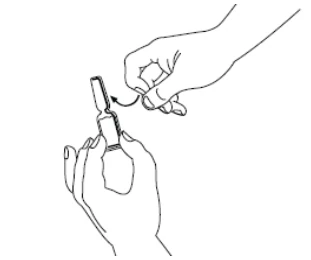 | Step 1: SIGNIFOR solution for injection is filled in a break-off ampoule. The colored dot on the top part marks the position of the breaking cut on the neck of the ampoule. Tap the ampoule with your finger in order to make sure there is no liquid in the top part when you open the ampoule. The solution should be free of visible particles, clear and colorless. Do not use SIGNIFOR if the solution is not clear or contains particles. |
 | Step 2: Recommended procedure: hold the ampoule in an upright position with the colored dot facing away from you. Hold the base of the ampoule in one hand. Keeping your thumbs together above and below the neck, break off the top of the ampoule at the breaking cut. Once open, put the ampoule upright on a clean, flat surface. |
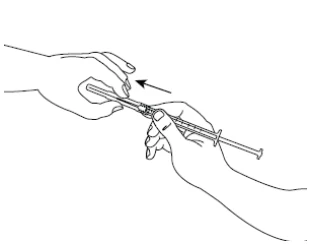 | Step 3: Take the sterile syringe and attach the needle to it. If you have been told to use two needles, you should use the long thick blunt one for this step. Before you proceed to step 4, clean the injection site with an alcohol wipe. |
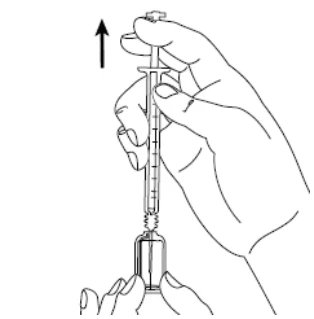 | Step 4: Remove the cover from the needle. Put the needle into the ampoule and pull the plunger to draw the entire contents of the ampoule into the syringe. If you have been told to use two needles, you should now replace the long needle with the short one. |
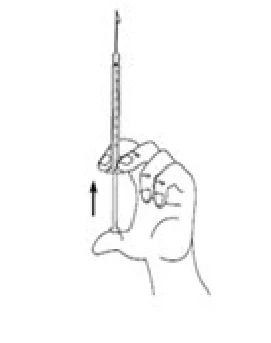 | Step 5: Hold the syringe in one hand between two fingers with your thumb at the bottom of the plunger. Tap the syringe with your fingers to get rid of air bubbles. Make sure there is no air bubble in the syringe by pressing the plunger until the first drop appears on the tip of the needle. Do not let the needle touch anything. You are now ready to inject. |
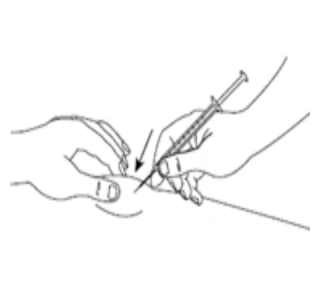
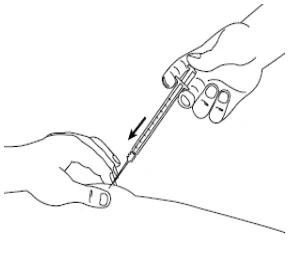
Step 6: Gently pinch the skin at the injection site and, holding the needle at an angle of approximately 45 degrees (as shown in the picture) insert it into the injection site. Pull slightly on the plunger to check that a blood vessel has not been punctured. If you see blood in the syringe, first remove the needle from the skin, then replace the short needle with a new one and insert it into a different injection site. | |
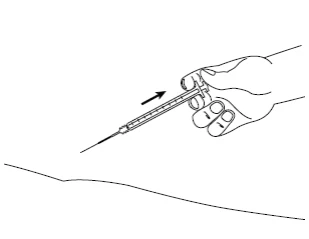
| Step 7: Always keeping your skin pinched, slowly press down the plunger as far as it will go until all the solution is injected. Keep the plunger pressed down and hold the syringe in place for 5 seconds. | |
| Step 8: Slowly release the skin fold and gently pull the needle out. Put the cover back on the needle. | |
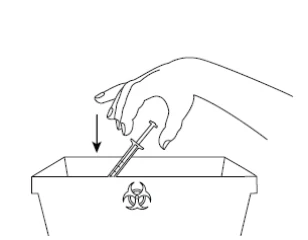
| Step 9: Dispose of the used syringe immediately in a sharps container or other rigid closed disposal container. Any unused product or waste material should be disposed of in accordance with local requirements. |
Usual dose:
The recommended dose of SIGNIFOR is 0.6 mg injected under your skin (subcutaneous) two times a day (approximately every 12 hours). Using SIGNIFOR at the same time each day will help you remember when to use your medicine.
Your doctor will monitor how you respond to the treatment with SIGNIFOR and may ask you to change to a higher or lower dose.
How long to take SIGNIFOR
Your doctor will regularly check your condition to see if the treatment is working. You will need to take SIGNIFOR for as long as your doctor tells you. This is a long-term treatment, possibly lasting for years. If you stop your treatment your symptoms may come back.
 | |
 | |
 | |
 |
Overdose:
| If you think you, or a person you are caring for, have taken too much SIGNIFOR, contact a healthcare professional, hospital emergency department, regional poison control centre or Health Canada’s toll-free number, 1-844 POISON-X (1-844-764-7669) immediately, even if there are no signs or symptoms. |
Missed Dose:
Do not use a double dose of SIGNIFOR to make up for a forgotten dose. If you forgot to administer a dose of SIGNIFOR simply take your next injection at the scheduled time.
What are possible side effects from using SIGNIFOR?
These are not all the possible side effects you may have when taking SIGNIFOR. If you have any side effects not listed here, tell your healthcare professional.
Side effects may include:
- Diarrhea, nausea, abdominal pain, vomiting, loss of appetite, constipation, indigestion, bloating, weight loss, altered taste, flatulence, dry mouth
- Fatigue, weakness, discomfort, muscle and joint pain, drowsiness, fainting, dizziness, tremor
- Local pain, redness, irritation, itching, rash, hives and/or swelling at the injection site
- Dry, itchy, sweaty, bruised skin
- Headache
- Hair loss
- Blurred vision
- Flushing
SIGNIFOR can cause abnormal blood test results. Your doctor will decide when to perform blood tests and will interpret the results.
Serious side effects and what to do about them
| Frequency / Side Effect / Symptom | Talk to your healthcare professional | Stop taking drug and get immediate medical help | ||||
| Frequency / Side Effect / Symptom | Talk to your healthcare professional | Stop taking drug and get immediate medical help | ||||
| Only if severe | In all cases | |||||
| Only if severe | In all cases | |||||
| Very Common | ||||||
| Hyperglycemia (high blood sugar): increased thirst, frequent urination, increased appetite with weight loss, tiredness, nausea, vomiting, abdominal pain | √ | |||||
| Cholelithiasis (gallstones): Yellowing of the skin and eyes, dark coloured urine and light coloured stool. After eating, you may have intense pain in the upper abdomen, pain in right shoulder, nausea, and vomiting | √ | |||||
| Common | ||||||
| Hypocortisolism (Low cortisol levels): extreme weakness, weight loss, nausea, vomiting, low blood pressure | √ | |||||
| Adrenal Insufficiency: fatigue, muscle weakness, loss of appetite, weight loss, abdominal pain | √ | |||||
| Heartbeat disturbance: weakness, tiredness, shortness of breath, lightheadedness, fainting, dizziness, palpitations, seizures | √ | |||||
| Prolongation of QT interval (a heart rhythm condition): irregular heartbeat, fainting, loss of consciousness, seizures | √ | |||||
| Hypotension (low blood pressure): dizziness, fainting, light-headedness | √ | |||||
| Hypertension (high blood pressure): shortness of breath, headache, nosebleeds | √ | |||||
| Liver disorder: nausea, vomiting, loss of appetite combined with itching, yellowing of the skin or eyes, dark urine, abdominal pain | √ | |||||
| Pancreatic disorder: acute or chronic abdominal pain (frequently radiating to the back), indigestion, nausea and vomiting, diarrhea, swollen and tender abdomen, bloating | √ | |||||
| Coagulation disorder: severe bruising or unusual bleeding from the skin or other areas | √ | |||||
| Uncommon | ||||||
| Anemia (decreased number of red blood cells): fatigue, loss of energy, looking pale | √ | |||||
| Reported from Post-Marketing with Unknown Frequency | ||||||
| Ketoacidosis (buildup of acids in your blood): feeling very thirsty, urinating often, nausea, feeling weak, fruity scented breath, trouble breathing, confusion | √ | |||||
| Steatorrhea and Malabsorption of Dietary Fats: new or worsening symptoms of oily stools, stool discoloration, loose stools, abdominal bloating, and weight loss | √ | |||||
If you have a troublesome symptom or side effect that is not listed here or becomes bad enough to interfere with your daily activities, tell your healthcare professional.
Reporting side effects
You can report any suspected side effects associated with the use of health products to Health Canada by:
NOTE: Contact your health professional if you need information about how to manage your side effects. The Canada Vigilance Program does not provide medical advice. |
Storage:
- Store between 15- 30°C.
- Keep this medicine out of the reach and sight of children.
- Store in the original package in order to protect from light.
- Medicines should not be disposed via household waste. Ask your pharmacist how to dispose of medicines no longer required. These measures will help to protect the environment.
If you want more information about SIGNIFOR:
- Talk to your healthcare professional
- Find the full product monograph that is prepared for healthcare professionals and includes this Patient Medication Information by visiting the Health Canada website: (https://www.canada.ca/en/health-canada/services/drugs-health-products/drug-products/drug-product-database.html); the manufacturer’s website (www.recordatirarediseases.com/ca), or by calling 1-877-827-1306.
Date of Authorization: 2025-05-20
PrSIGNIFOR is a registered trademark