


Patient Medication Information: uses, side effects, how to take - Sohonos
Serious warnings and precautions box
SOHONOS should only be prescribed by doctors who are knowledgeable in the:
- use and monitoring of types of medicines called systemic retinoids
- risk of teratogenicity (potential to cause birth defects during pregnancy) in women who can become pregnant
- SOHONOS can cause bone growth to stop early in growing children. This may lead to possible short height and differences in arm or leg length. Your doctor will explain the risks to you (i.e. the patient) or caregiver and child. Children who are actively growing should be closely monitored (every 3 months or as determined by your doctor) during treatment with SOHONOS. Educational materials can be found at www.ipsen.com/canadaen/SOEDUMAT.
- SOHONOS can cause birth defects when taken during pregnancy. Do NOT use SOHONOS if you are pregnant, think you may be pregnant or are planning to become pregnant. If you can become pregnant, you should only take SOHONOS if ALL the conditions described below under “SOHONOS Pregnancy Prevention Plan” are met.
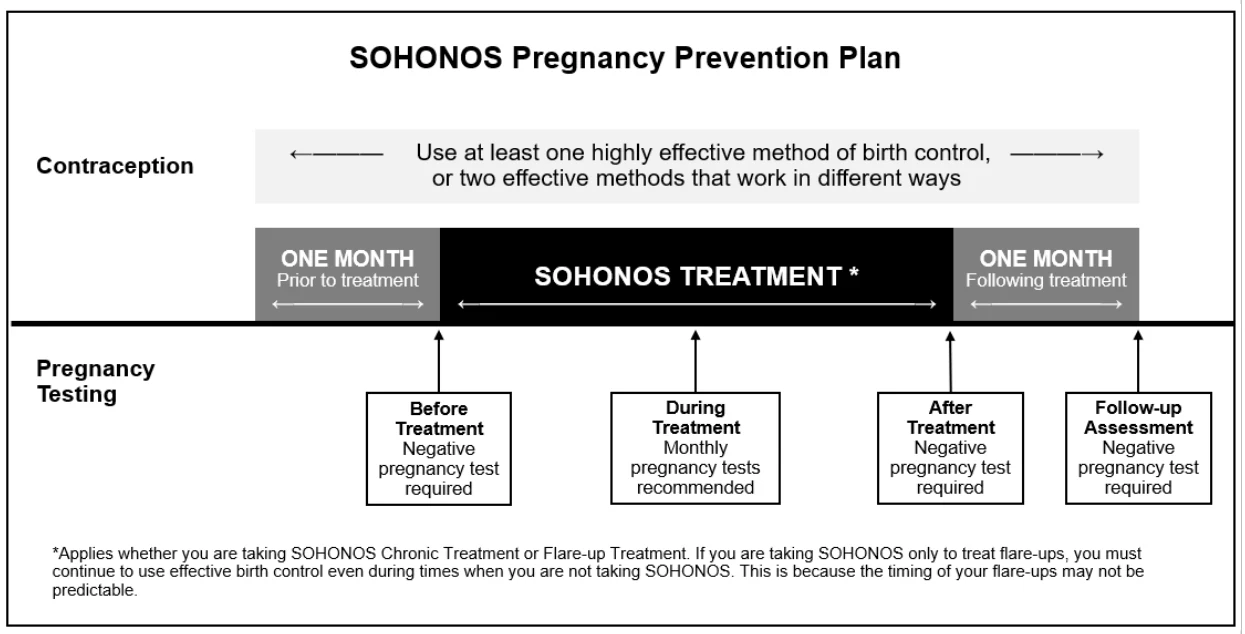
SOHONOS Pregnancy Prevention Plan
Patients who can become pregnant must meet ALL of the conditions below to use SOHONOS.
- 1.
You must NOT take SOHONOS if you are pregnant, or breastfeeding
SOHONOS can seriously harm an unborn baby. It can cause serious defects to the unborn baby’s brain, face, ears, eyes, heart and certain glands (thymus gland and parathyroid gland). It also makes a miscarriage more likely. This may happen even if SOHONOS is taken only for a short time during pregnancy.
You must NOT
- take SOHONOS if you are pregnant or if you think you might be pregnant.
- take SOHONOS if you are breastfeeding. The medicine is likely to pass into your milk and may harm your baby.
- take SOHONOS if you could get pregnant during treatment.
- get pregnant for one month after stopping this treatment because some medicine may still be left in your body.
- 2.
If you could get pregnant, you and your doctor must discuss the strict rules to follow before, during and after taking SOHONOS.
- • Your doctor must explain the risk of harm to the unborn baby. You must understand why you must not get pregnant and what you need to do to prevent pregnancy.
- • You must have talked about contraception (birth control) with your doctor. The doctor will give you information on how to avoid getting pregnant. Your doctor may send you to a specialist for birth control advice.
- • You must have talked about pregnancy testing with your doctor. You must understand and agree to have regular pregnancy testing.
- • Your doctor must explain to you what to do if you become pregnant, or think you might be pregnant.
- 3.
You must avoid getting pregnant by using effective birth control before, during and after taking SOHONOS.
- • You must be able and willing to comply with the mandatory birth control measures. Discuss with your doctor which methods would be suitable for you.
- • You must use birth control even if you are not sexually active (unless your doctor decides this is not necessary).
- • You must use birth control for a month before taking SOHONOS, during treatment and for a month afterwards.
- • You must use at least one highly effective method of birth control (for example an intrauterine device) or, two effective methods that work in different ways (for example a hormonal birth control pill and a condom).
If you are taking SOHONOS only to treat flare-ups, you must continue to use effective birth control even during times when you are not taking SOHONOS. This is because the timing of your flare-ups may not be predictable.
- 4.
You must have pregnancy testing before, during and after taking SOHONOS
- • Before you start treatment, you must take a pregnancy test. The test must show that you are not pregnant when starting treatment with SOHONOS.
- • You must have regular pregnancy tests during treatment with SOHONOS. It is recommended that you take a pregnancy test on a monthly basis, unless otherwise advised by your doctor. Your doctor may also ask you to take a pregnancy test 1 month after stopping SOHONOS because some medicine may still be left in your body.
- 5.
If you become pregnant while taking SOHONOS or within one month after stopping treatment, you must contact your doctor right away
- • If you are still taking SOHONOS, you must stop treatment and tell your doctor right away.
- •
You and your doctor must discuss:
If you want to continue with your pregnancy
- The serious risk of your baby having severe birth defects
- • You or your doctor should report the pregnancy by calling 1-855-215-2288. If you agree, your doctor can also enroll you in the SOHONOS registry by calling the same
What SOHONOS is used for:
SOHONOS is used to reduce the formation of heterotopic ossification. This is a condition where bone forms in soft tissues outside the skeleton. It is used in adults and children (females 8 years and older, males 10 years and older) who have the genetic disorder fibrodysplasia ossificans progressiva, also called FOP.
How SOHONOS works:
SOHONOS contains palovarotene which belongs to a group of medicines called retinoids. It works by preventing bone formation in muscles, tendons or soft tissue.
The ingredients in SOHONOS are:
Medicinal ingredients: palovarotene
Non-medicinal ingredients: Croscarmellose sodium, gelatin, lactose monohydrate, magnesium stearate, microcrystalline cellulose, pharmaceutical grade printing ink, povidone, sodium lauryl sulfate, and titanium dioxide.
SOHONOS comes in the following dosage forms:
Capsules: 1 mg, 1.5 mg, 2.5 mg, 5 mg and 10 mg
- number (1-855-215-2288). Educational materials can be found at www.ipsen.com/canadaen/SOEDUMAT.
- -treatment counselling did not include an in-depth conversation about the SOHONOS Pregnancy Prevention Plan, please contact your doctor.
Do not use SOHONOS if:
- You are pregnant or breastfeeding. Physicians and patients can report pregnancies by calling 1-855-215-2288.
- There is a chance you could become pregnant. You must follow the precautions under “SOHONOS Pregnancy Prevention Plan”.
- You are allergic to palovarotene, or any of the other ingredients of SOHONOS.
- You are allergic to other retinoids.
To help avoid side effects and ensure proper use, talk to your healthcare professional before you take SOHONOS. Talk about any health conditions or problems you may have, including if you:
- are pregnant, think you may be pregnant or are planning to have a baby.
- are breastfeeding.
- have liver problems.
- have kidney problems.
have risk factors for fractures, such as if you have:
- a history of fractures
- osteoporosis (thin, fragile bones) or any other bone problems.
- have an intolerance to some sugars. This is because SOHONOS contains lactose.
Other warnings you should know about:
SOHONOS may cause:
Sensitivity to sunlight and ultraviolet light and skin effects (e.g. dry skin, loss of hair, itching, rashes). To reduce these side effects, your healthcare professional may recommend the use of:
- Skin moisturizers, sunscreen with a broad-spectrum SPF value of 15 or higher, lip moisturisers, or other helpful treatments
- Protective clothing and sunglasses to help reduce exposure to sunlight.
- Dry eyes. Your healthcare professional may recommend use of artificial tears (drops to lubricate the eye).
- Hypertriglyceridemia. This is a condition in which you have too many fats in your blood.
Liver problems. Depending on the dose, you may experience:
- High levels of liver enzymes in your blood
- Severe inflammation of the liver
- Pancreatitis (inflammation of the pancreas). This may cause severe pain of the belly and back. Fatal cases of pancreatitis have been reported with other systemic retinoids.
- Increased pressure around your brain. Taking systemic retinoids, such as SOHONOS, can increase the pressure around your brain. SOHONOS taken with tetracyclines can also cause an increase in the pressure around your brain.
Check-ups and testing
You will have regular visits with your healthcare professional during treatment with SOHONOS. They will:
- Check for problems with normal bone growth (in growing children). This will be done every 3 months or as determined by your healthcare professional.
- Check for signs and symptoms of mental health problems, such as depression, anxiety, mood alterations, suicidal thoughts and behaviours.
- Follow-up on monthly pregnancy testing in patients who can become pregnant.
- Do regular bone imaging scans to check for signs of fractures of the spine.
Driving and using machines
SOHONOS may affect your ability to see in the dark. Before you drive or do tasks that require special attention, wait until you know how you respond to SOHONOS.
Fertility
It is not known if SOHONOS affects your ability to have children. Talk to your healthcare professional if this is a concern for you.
Tell your healthcare professional about all the medicines you take, including any drugs, vitamins, minerals, natural supplements or alternative medicines.
The following may interact with SOHONOS:
- Medicines or vitamin supplements containing Vitamin A or other medicines derived from Vitamin A used for skin conditions, known as ‘retinoids’ such as acitretin, alitretinoin, isotretinoin, tretinoin, adapalene and tazarotene. Vitamin A in high doses has many of the same side effects as SOHONOS. Taking both together may increase your chance of getting side effects.
- Medicines used to treat fungal infections (antifungals), such as itraconazole, ketoconazole and fluconazole.
- Medicines used to treat bacterial infections (antibiotics) such as erythromycin, clarithromycin, rifampicin/rifampin and tetracyclines.
- Medicines called “protease inhibitors” used to treat human immunodeficiency virus (HIV) and acquired immunodeficiency syndrome (AIDS) or COVID-19 infection.
- Medicines used to treat depression.
- Medicines used to treat epilepsy or seizures such as phenytoin and carbamazepine.
- Herbal preparations containing St. John’s Wort extract (Hypericum perforatum), sometimes used for treating depression or depression-related conditions such as anxiety.
How to take SOHONOS:
- Take SOHONOS exactly as your healthcare professional tells you. Check with your healthcare professional if you are not sure.
Swallow whole with food (after a meal), preferably at the same time each day.
- Avoid taking grapefruit-containing products for as long as you are using this medicine. It may increase the amount of SOHONOS in your blood.
If you are unable to swallow capsules:
- Open the capsules and sprinkle contents onto a teaspoon of soft food (such as applesauce, yogurt or pudding).
- Swallow the mixture. If you want to take it later, the mixture can be stored for up to 1 hour at room temperature, provided that it is not exposed to direct sunlight.
Instructions for handling SOHONOS:
- If you are pregnant, or are planning on becoming pregnant, you should avoid contact with SOHONOS.
For caregivers emptying the capsule contents onto soft food:
- Wear disposable gloves to avoid unintended exposure.
- Use disposable paper towels and a container (e.g. a re-sealable bag) to collect waste.
Usual dose:
- Your doctor will decide the dose of SOHONOS you need to take daily. This may depend on your age, weight and symptoms. Do NOT change your dose of SOHONOS before discussing with your doctor.
- If you have side effects during treatment, tell your doctor. They may need to adjust your dose, temporarily stop or completely stop your treatment with SOHONOS.
The recommended dosage regimen of SOHONOS is a combination of:
- Chronic treatment: daily treatment; and
- Flare-up treatment: higher-dose treatment taken at the time of a flare-up.
Do NOT take both chronic treatment and flare-up treatment at the same time. Your doctor will decide which treatment you should follow.
Contact your doctor right away when:
- You notice any symptom of a flare-up. Your doctor will explain to you the signs and symptoms that you should look for. Symptoms may include but are not limited to: localized pain, swelling/inflammation in soft tissues such as muscles and tendons, redness, warmth, decreased joint range of motion, and stiffness.
- You have a soft tissue injury. This can happen during surgery, vaccinations, dental procedures, muscle weakness, bumps/bruises/falls or flu-like illnesses. Your doctor may start you on treatment to prevent a flare-up in these cases.
- Your flare-up symptoms do not go away. Your doctor may extend your flare-up treatment until the flare-up resolves.
- You have another flare-up at any time during treatment. This may be a new flare-up location or worsening of the original flare-up. Your doctor may need to consider restarting the 12-week flare-up treatment.
- Your flare-up has resolved. Your doctor will determine if you should return to the chronic daily treatment.
Overdose:
If you think you, or a person you are caring for, have taken too much SOHONOS, contact a healthcare professional, hospital emergency department, or regional poison control centre or Health Canada’s toll-free number, 1-844 POISON-X (1-844-764-7669) immediately, even if there are no signs or symptoms.
Missed dose:
- If you miss a dose, take the dose as soon as you remember. Take your next dose at the usual time.
- If you miss a dose by more than 6 hours, skip the missed dose. Continue with the next scheduled dose at the usual time.
- Do NOT take two doses at the same time or in the same day to make up for a dose you missed.
Possible side effects from using SOHONOS:
These are not all the possible side effects you may have when taking SOHONOS. If you experience side effects not listed here, tell your healthcare professional.
Side effects you may experience include:
- Acid reflux disease
- Back pain
- Dry and scaly lips
- Dry eyes
- Dry mouth
- Dry skin
- Diarrhea
- Eczema
- Hair loss
- Headache
- Hives
- Infection of the nail
- Itching
- Joint pain
- Lip inflammation (cheilitis)
- Nausea
- Nose bleed
- Rash
- Sensitivity to sunlight
- Skin growth
- Skin shedding
Serious side effects and what to do about them
| Frequency/Side Effect/Symptom | Talk to your healthcare professional | Stop taking this drug and get immediate medical help | |
|---|---|---|---|
| Only if severe | In all cases | ||
| Very common | |||
| Bone mineral density problems and fractures, including loss in bone mass, osteoporosis, and fractures of the spine (as seen on an x-ray) | X | ||
| Common | |||
Mental health problems such as depression or psychosis (a severe mental disturbance):
| X | ||
Bone/growth changes such as premature closure of the growth plate (in growing children):
| X | ||
| Anemia (decreased number of red blood cells): fatigue, loss of energy or weakness, looking pale, shortness of breath | X | ||
| Cellulitis (skin infection): pain, tenderness, swelling, redness of the skin | X | ||
| Conjunctivitis (eye infection): itchy, red eyes with discharge, swelling | X | ||
If you have a troublesome symptom or side effect that is not listed here or becomes bad enough to interfere with your daily activities, tell your healthcare professional.
Reporting side effects
You can report any suspected side effects associated with the use of health products to Health Canada by:
- Visiting the Web page on Adverse Reaction Reporting (canada.ca/drug-device-reporting) for information on how to report online, by mail or by fax; or
- Calling toll-free at 1-866-234-2345.
NOTE: Contact your health professional if you need information about how to manage your side effects. The Canada Vigilance Program does not provide medical advice.
Storage:
- Store at room temperature (15° to 30°C). Keep blister strip in the carton in order to protect from light.
- Keep out of reach and sight of children.
If you want more information about SOHONOS:
- Talk to your healthcare professional
- Find the full product monograph that is prepared for healthcare professionals and includes the Patient Medication Information by visiting the Health Canada Drug Product Database website (https://www.canada.ca/en/health-canada/services/drugs-health-products/drug-products/drug-product-database.html); the manufacturer’s website www.ipsen.ca, or by calling 1-855-215-2288.
Date of Authorization: 2026-07-07