


Product Monograph - Somavert
RECENT MAJOR LABEL CHANGES
| Not applicable | Not applicable |
|---|
TABLE OF CONTENTS
Sections or subsections that are not applicable at the time of authorization are not listed.
RECENT MAJOR LABEL CHANGES ............................................................................................. 2
TABLE OF CONTENTS ............................................................................................................... 2
PART I: HEALTH PROFESSIONAL INFORMATION ....................................................................... 4
1 INDICATIONS ................................................................................................................ 4
1.1 Pediatrics ................................................................................................................. 4
1.2 Geriatrics ................................................................................................................. 4
2 CONTRAINDICATIONS .................................................................................................. 4
4 DOSAGE AND ADMINISTRATION .................................................................................. 4
4.1 Dosing Considerations ............................................................................................. 4
4.2 Recommended Dose and Dosage Adjustment ........................................................ 4
4.3 Reconstitution ......................................................................................................... 5
4.4 Administration ......................................................................................................... 5
5 OVERDOSAGE ............................................................................................................... 6
6 DOSAGE FORMS, STRENGTHS, COMPOSITION AND PACKAGING .................................. 6
7 WARNINGS AND PRECAUTIONS ................................................................................... 7
7.1 Special Populations................................................................................................ 11
7.1.1 Pregnant Women ............................................................................................ 11
7.1.2 Breast-feeding ................................................................................................. 11
7.1.3 Pediatrics ......................................................................................................... 11
7.1.4 Geriatrics ......................................................................................................... 11
7.1.5 Fertility ............................................................................................................ 12
8 ADVERSE REACTIONS ................................................................................................. 12
8.1 Adverse Reaction Overview ................................................................................... 12
8.2 Clinical Trial Adverse Reactions ............................................................................. 12
8.4 Abnormal Laboratory Findings: Hematologic, Clinical Chemistry and Other Quantitative Data ............................................................................................................ 13
8.5 Post-Market Adverse Reactions ............................................................................ 14
9 DRUG INTERACTIONS ................................................................................................. 14
9.4 Drug-Drug Interactions .......................................................................................... 14
9.5 Drug-Food Interactions .......................................................................................... 15
9.6 Drug-Herb Interactions .......................................................................................... 15
9.7 Drug-Laboratory Test Interactions ......................................................................... 15
10 CLINICAL PHARMACOLOGY ........................................................................................ 15
10.2 Pharmacodynamics ......................................................................................... 15
10.3 Pharmacokinetics ............................................................................................ 16
11 STORAGE, STABILITY AND DISPOSAL .......................................................................... 17
PART II: SCIENTIFIC INFORMATION ........................................................................................ 18
13 PHARMACEUTICAL INFORMATION ............................................................................. 18
14 CLINICAL TRIALS ......................................................................................................... 19
14.1 Trial Design and Study Demographics ............................................................. 19
14.2 Study Results ................................................................................................... 19
14.4 Immunogenicity ............................................................................................... 23
15 MICROBIOLOGY ......................................................................................................... 23
16 NON-CLINICAL TOXICOLOGY ...................................................................................... 23
PATIENT MEDICATION INFORMATION ................................................................................... 26
PART I: HEALTH PROFESSIONAL INFORMATION
1 INDICATIONS
SOMAVERT (pegvisomant for injection) is indicated for the treatment of acromegaly in patients who have had an inadequate response to surgery, and/or radiation therapy or for whom these therapies are not appropriate. The goal of treatment is to normalize serum insulin-like growth factor-I (IGF-I) levels and to improve clinical signs and symptoms.
1.1 Pediatrics
Pediatrics (< 18 years of age): The safety and effectiveness of Somavert in pediatric patients have not been established.
1.2 Geriatrics
There is limited information in patients over 65 years of age (see 7 WARNINGS AND PRECAUTIONS, Special Populations, Geriatrics).
2 CONTRAINDICATIONS
- Somavert is contraindicated in patients who are hypersensitive to this drug or to any ingredient in the formulation, including any non-medicinal ingredient, or component of the container. For a complete listing, see 6 DOSAGE FORMS, STRENGTHS, COMPOSITION AND PACKAGING.
4 DOSAGE AND ADMINISTRATION
4.1 Dosing Considerations
Acromegalic patients with diabetes mellitus being treated with insulin and/or oral hypoglycemic agents may require dose reductions of these therapeutic agents after the initiation of therapy with Somavert (pegvisomant for injection) (see 7 WARNINGS AND PRECAUTIONS, Endocrine and Metabolism, Glucose Metabolism and see 9 DRUG INTERACTIONS, Drug-Drug Interactions).
Some patients concomitantly receiving opioids may require higher serum concentrations of pegvisomant to achieve appropriate IGF-I suppression (see 7 WARNINGS AND PRECAUTIONS, General and see 9 DRUG INTERACTIONS, Drug-Drug Interactions).
4.2 Recommended Dose and Dosage Adjustment
The recommended loading dose of pegvisomant is 40 mg given subcutaneously (SC), under the supervision of a healthcare provider. Proper training in SC injection technique should be provided to patients or their caregivers so that patients can receive once-daily SC injections. On the next day following the loading dose, patients or their caregivers should be instructed to begin daily injections of pegvisomant 10 mg SC.
The pegvisomant dose should be titrated to normalize serum IGF-I concentrations, and serum IGF-I concentrations should be measured every 4-6 weeks. The dose should not be based on GH concentrations. It is unknown whether patients who remain symptomatic while achieving normalized IGF-I concentrations would benefit from increased pegvisomant dosage.
- The dose should be increased by 5 mg increments every 4-6 weeks if IGF-I concentrations are elevated.
- The dose should be decreased by 5 mg decrements every 4-6 weeks if IGF-I concentrations are below the normal range.
- IGF-I levels should also be monitored when a pegvisomant dose given in multiple injections is converted to a single daily injection.
The recommended dose range is between 10 to 30 mg SC once daily, and the maximum daily dose is 30 mg SC once daily.
4.3 Reconstitution
Parenteral Products:
Table 1 – Reconstitution
Parenteral Products:
| Vial Size | Volume of Diluent to be Added to Vial | Approximate Available Volume of diluent | Nominal Concentration per mL |
| 8 mL | 1 mL of Sterile Water for Injection, Ph. Eur | 1 mL (pre-filled syringe) | 10, 15, 20, 25 or 30 mg of pegvisomant protein in 1 mL of solution |
4.4 Administration
Somavert is supplied as a lyophilized powder in a vial. Each vial of Somavert should be reconstituted with 1 mL of the diluent (Sterile Water for Injection, Ph. Eur) provided in a pre-filled syringe that is included in the package. Detailed instructions regarding reconstitution and administration are included in the package of Somavert and should be closely followed.
Diluent Pre-filled syringe presentation:
To prepare the solution, inject the diluent (Sterile Water for Injection, Ph. Eur.) from the pre-filled syringe into the vial of Somavert, aiming the stream of liquid against the glass wall. Hold the vial between the palms of both hands and gently roll it to dissolve the powder. DO NOT SHAKE THE VIAL, as this may cause denaturation of pegvisomant. After reconstitution, each vial of Somavert contains 10, 15, 20, 25 or 30 mg of pegvisomant protein in 1 mL of solution. Parenteral drug products should be inspected visually for particulate matter and discoloration prior to administration. The solution should be clear after reconstitution. If the solution is cloudy, do not inject it. Only one dose should be administered from each vial. Somavert should be administered within three hours after reconstitution. The site of injection should be rotated daily to help prevent lipohypertrophy.
5 OVERDOSAGE
There was one reported incident of acute overdosage with Somavert (pegvisomant for injection) during pre-marketing clinical studies in which a patient self-administered 80 mg/day for seven days. The patient experienced a slight increase in fatigue, had no other complaints, and demonstrated no significant clinical laboratory abnormalities.
In cases of overdose, administration of Somavert should be discontinued and not resumed until IGF-I levels return to within or above the normal range.
| For management of a suspected drug overdose, contact your regional poison control centre. |
|---|
6 DOSAGE FORMS, STRENGTHS, COMPOSITION AND PACKAGING
Table 2 – Dosage Forms, Strengths, Composition and Packaging
| Route of Administration | Dosage Form / Strength/Composition | Non-medicinal Ingredients |
| Subcutaneous injection | Lyophilized powder, 10, 15, 20, 25 and 30 mg per vial in package that also includes diluent (Sterile Water for Injection, Ph. Eur.) in a pre-filled syringe | Glycine, mannitol, sodium phosphate dibasic anhydrous, sodium dihydrogen phosphate monohydrate |
Description
Somavert is supplied as a sterile, white lyophilized powder intended for subcutaneous injection after reconstitution with 1 mL of Sterile Water for Injection, Ph. Eur. It is available in single-dose vials containing 10, 15, 20, 25 and 30 mg of pegvisomant protein. The diluent (Sterile Water for Injection, Ph. Eur) is provided in a pre-filled syringe that is included in the same package as the Somavert vial. Each 10, 15 and 20 mg vial also contains 1.36 mg of glycine, 36.0 mg of mannitol, 1.04 mg of sodium phosphate dibasic anhydrous, and 0.36 mg of sodium dihydrogen phosphate monohydrate. Each 25 mg vial also contains 1.7 mg of glycine, 45.0 mg of mannitol, 1.3 mg of sodium phosphate dibasic anhydrous, and 0.45 mg of sodium dihydrogen phosphate monohydrate. Each 30 mg vial also contains 2.04 mg of glycine, 54.0 mg of mannitol, 1.56 mg of sodium phosphate dibasic anhydrous, and 0.54 mg of sodium dihydrogen phosphate monohydrate.
Availability of Dosage Forms
Somavert (pegvisomant for injection) is available in single-dose vial in the following 5 strengths, in packages that also include pre-filled syringes with 1 mL of Sterile Water for Injection, Ph. Eur. Pack size of 1 or 30.
Somavert10 mg, 15 mg, 20 mg, 25 mg, 30 mg are all available in the following presentations:
- Package of 1 vial of Somavert powder with 1 diluent pre-filled syringe
- Packages of 30 vials of Somavert powder with 30 diluent pre-filled syringes
The stopper on the vial of Somavert is latex free.
7 WARNINGS AND PRECAUTIONS
General
Patients and any other persons who may administer Somavert should be carefully instructed by a health care professional on how to properly reconstitute and inject the product (see PATIENT MEDICATION INFORMATION)
In clinical studies, patients on opioids often needed higher serum pegvisomant concentrations to achieve appropriate IGF-I suppression compared with patients not receiving opioids (see 9 DRUG INTERACTIONS, Drug-Drug Interactions and see 4 DOSAGE AND ADMINISTRATION, Recommended Dose and Dosage Adjustment).
Carcinogenesis and Mutagenesis
Tumour Growth
Tumours that secrete growth hormone (GH) may expand and cause serious complications. Therefore, all patients with these tumours, including those who are receiving Somavert (pegvisomant for injection), should be carefully monitored with periodic imaging scans of the sella turcica. During clinical studies of Somavert, two patients manifested progressive tumour growth. Both patients had, at baseline, large globular tumours impinging on the optic chiasm, which had been relatively resistant to previous anti-acromegalic therapies. Overall, mean tumour size was unchanged during the course of treatment with Somavert in the clinical studies.
Driving and Operating Machinery
No studies on the effect on the ability to drive and use machines have been performed.
Endocrine and Metabolism
Glucose Metabolism
GH opposes the effects of insulin on carbohydrate metabolism by decreasing insulin sensitivity; thus, glucose tolerance may increase in some patients treated with Somavert. Although no clinically relevant hypoglycemia was observed during clinical trials among acromegalic patients with diabetes treated with Somavert, these patients should be carefully monitored and doses of anti-diabetic drugs reduced as necessary (see 9 DRUG INTERACTIONS, Drug-Drug Interactions and see 4 DOSAGE AND ADMINISTRATION, Recommended Dose and Dosage Adjustment).
GH Deficiency
Somavert is a potent antagonist of GH action. A state of functional GH deficiency may result from administration of Somavert, despite the presence of elevated serum GH levels. During treatment with Somavert, patients should be carefully observed for clinical signs and symptoms of a GH-deficient state. Dose adjustments of Somavert should be made to maintain serum IGF-I concentrations within the age-adjusted normal range.
Hepatic/Biliary/Pancreatic
Liver Tests (LTs)
Elevations of serum concentrations of alanine aminotransferase (ALT) and aspartate aminotransferase (AST) greater than 10 times the upper limit of normal (ULN) were reported in two patients (0.8%)
treated with Somavert during pre-marketing clinical studies. One patient was rechallenged with Somavert, and the recurrence of elevated transaminase levels suggested a probable causal relationship between administration of the drug and the elevation in liver enzymes. A liver biopsy performed on the second patient was consistent with chronic hepatitis of unknown etiology. In both patients, the transaminase elevations normalized after discontinuation of the drug.
During the pre-marketing clinical studies, the incidence of elevations in ALT greater than 3 times but less than or equal to 10 times the ULN in patients treated with Somavert and placebo were 1.2% and 2.1%, respectively.
Elevations in ALT and AST levels were not associated with increased levels of serum total bilirubin (TBIL) and alkaline phosphatase (ALP), with the exception of two patients with minimal associated increases in ALP levels (i.e., less than 3 times ULN). The transaminase elevations did not appear to be related to the dose of Somavert administered, generally occurred within 4 to 12 weeks of initiation of therapy, and were not associated with any identifiable biochemical, phenotypic, or genetic predictors.
In a global post-marketing combination study with a somatostatin analogue, one out of 25 patients in the pegvisomant group and 1 out of 27 in the octreotide acetate group had transaminases greater than three or more times the upper limit of normal (ULN). Three patients out of 26 (approximately 10%) treated with the combination were found to have serum concentrations of alanine aminotransferase (ALT) and aspartate aminotransferase (AST) ranging from 13 to 45 times the ULN within 3 months of starting this treatment. Two of these patients received supratherapeutic doses of octreotide acetate (30 mg every 2 weeks) combined with a normal dose of Somavert (10 mg daily). All three patients completely recovered after discontinuation of treatment. The safety and efficacy of pegvisomant in combination with other medicinal products, including somatostatin analogues, in the treatment of acromegaly have not been established and, therefore, the combination of somatostatin analogues with pegvisomant is not recommended.
Baseline serum ALT, AST, TBIL, and ALP levels should be obtained prior to initiating therapy with Somavert. Somavert should not be initiated or continued if signs of liver disease are present, pending a comprehensive hepatic evaluation. Table 3 lists recommendations regarding initiation of treatment with Somavert, based on the results of these liver tests (LTs).
If a patient develops LT elevations, or any other signs or symptoms of liver dysfunction while receiving Somavert, the following patient management is recommended (Table 4).
| Table 3. Initiation of Treatment with Somavert Based on Results of Liver Tests | |||
| Baseline LT Levels | Recommendations | ||
| Normal | May treat with Somavert. Monitor LTs at monthly intervals during the first 6 months of treatment, quarterly for the next 6 months, and then biannually for the next year. | ||
| Elevated, but less than or equal to 3 times ULN | May treat with Somavert; however, monitor LTs monthly for at least one year after initiation of therapy and then biannually for the next year. | ||
| Greater than 3 times ULN | Do not treat with Somavert until a comprehensive workup establishes the cause of the patient’s liver dysfunction. Determine if cholelithiasis or choledocholithiasis is present, particularly in patients with a history of prior therapy with somatostatin analogs. Based on the workup, consider initiation of therapy with Somavert. If the decision is to treat, LTs and clinical symptoms should be monitored very closely. |
| Table 4. Continuation of Treatment with Somavert Based on Results of Liver Tests | |||
| LT Levels and Clinical Signs/Symptoms | Recommendations | ||
| Elevated, but less than or equal to 3 times ULN | May continue therapy with Somavert. However, monitor LTs monthly to determine if further increases occur. | ||
| Greater than 3 but less than 5 times ULN (without signs/ symptoms of hepatitis or other liver injury, or increase in serum TBIL) | May continue therapy with Somavert. However, monitor LTs weekly to determine if further increases occur (see below). In addition, perform a comprehensive hepatic workup to discern if an alternative cause of liver dysfunction is present. | ||
| At least 5 times ULN, or transaminase elevations at least 3 times ULN associated with any increase in serum TBIL (with or without signs/symptoms of hepatitis or other liver injury) | Discontinue Somavert immediately. Perform a comprehensive hepatic workup, including serial LTs, to determine if and when serum levels return to normal. If LTs normalize (regardless of whether an alternative cause of the liver dysfunction is discovered), consider cautious reinitiation of therapy with Somavert, with frequent LT monitoring. | ||
| Signs or symptoms suggestive of hepatitis or other liver injury (e.g., jaundice, bilirubinuria, fatigue, nausea, vomiting, right upper quadrant pain, ascites, unexplained edema, easy bruisability) | Discontinue Somavert immediately. Immediately perform a comprehensive hepatic workup. If liver injury is confirmed, the drug should be discontinued permanently. | ||
Patients should be informed about the need for serial monitoring of liver enzyme tests, and told to discontinue therapy and contact their physician if they become jaundiced immediately. In addition, patients should be made aware that serial IGF-I levels will need to be obtained to allow their physician to properly adjust the dose of Somavert.
Immune
Immunogenicity
In pre-marketing clinical studies, approximately 17% of the patients had low titer, non-neutralizing anti-GH antibodies. These antibodies do not appear to have clinical significance. An assay for anti-pegvisomant antibodies in a patient receiving Somavert is not commercially available.
Systemic hypersensitivity
Systemic hypersensitivity reactions including anaphylactic/anaphylactoid reactions, laryngospasm, angioedema, generalized skin reactions have been reported with Somavert. Caution and close monitoring should be exercised when re-initiating Somavert therapy (see 8 ADVERSE REACTIONS, Immune system disorders).
Cross-Reactivity with GH Assays Somavert has significant structural similarity to growth hormone (GH) which causes it to cross-react in commercially available GH assays. Since serum concentrations of therapeutically effective doses of Somavert are generally 100 to 1000 times higher than the actual serum GH concentrations seen in patients with acromegaly, measurements of serum GH concentrations will appear falsely elevated.
Monitoring and Laboratory Tests
Liver Tests
Recommendations for monitoring liver function are stated above (see 7 WARNINGS AND PRECAUTIONS, Hepatic/Biliary/Pancreatic, Liver Tests [LTs]).
IGF-I Levels
Treatment with Somavert should be evaluated by monitoring serum IGF-I concentrations four to six weeks after therapy is initiated or any dose adjustments are made, and at least every six months after IGF-I levels have normalized. The goals of treatment should be to maintain a patient’s serum IGF-I concentration within the age-adjusted normal range and to control the signs and symptoms of acromegaly.
GH Levels
Pegvisomant interferes with the measurement of serum GH concentrations by commercially available GH assays (see 9 DRUG INTERACTIONS, Drug-Laboratory Test Interactions). Furthermore, even when accurately determined, GH levels usually increase during therapy with Somavert. Therefore, treatment with Somavert should not be monitored or adjusted based on serum GH concentrations.
Reproductive Health: Female and Male Potential
- Fertility
Women of childbearing potential
Pegvisomant may indirectly impact childbearing potential in women as it relates to fertility and pregnancy as noted in the Fertility subsection below. Female patients should be advised to inform their healthcare professional if they are, or become, pregnant, or are contemplating pregnancy.
Skin
Lipohypertrophy
There have been cases of lipohypertrophy in patients treated with Somavert. In a double-blind, 12-week, placebo-controlled study, there was one case (1.3%) of injection site lipohypertrophy reported in a subject receiving 10 mg/day. The subject recovered while on treatment. Among two open-label trials (with a total of 147 patients), there were two subjects, both receiving 10 mg/day, who developed lipohypertrophy. One case recovered while on treatment, and one case resulted in a discontinuation of treatment. Injection sites should be rotated daily to help prevent lipohypertrophy (different area than the last injection).
7.1 Special Populations
7.1.1 Pregnant Women
There are no adequate and well-controlled studies in pregnant women, therefore, the safety of Somavert has not been established in this population. It is not known whether Somavert can cause fetal harm when administered to a pregnant woman. Somavert is not recommended during pregnancy and should be used only if the potential benefit justifies the potential risk to the patient.
If pegvisomant is used during pregnancy, IGF-I levels should be closely monitored, especially during the first trimester. It may be necessary to adjust the dose of pegvisomant during pregnancy.
7.1.2 Breast-feeding
It is not known whether pegvisomant is excreted in human milk. Because many drugs are excreted in human milk, caution should be exercised when Somavert is administered to a nursing woman.
7.1.3 Pediatrics
The safety and effectiveness of Somavert in pediatric patients have not been established.
7.1.4 Geriatrics
Clinical studies of Somavert did not include sufficient numbers of subjects aged 65 and over to determine whether these subjects respond differently from younger subjects. In general, dose selection for an elderly patient should be cautious, usually starting at the low end of the dosing range, reflecting the greater frequency of decreased hepatic, renal, or cardiac function, and of concomitant disease or other drug therapy.
7.1.5 Fertility
The therapeutic benefits of a reduction in IGF-I concentration which results in improvement of the patient’s clinical condition could potentially increase fertility in female patients. Patients should be advised to use adequate contraception if necessary.
8 ADVERSE REACTIONS
8.1 Adverse Reaction Overview
Safety was evaluated in a randomized, multicenter, placebo-controlled, 12-week study, of patients treated with 10 mg/day (n=26), 15 mg/day (n=26), or 20 mg/day (n=28) of Somavert (pegvisomant for injection) or placebo (n=32).
Table 5 shows the incidence of treatment-emergent adverse events reported in at least two patients treated with Somavert and at frequencies greater than placebo during the 12-week, placebo-controlled study. The majority of reported adverse events were of mild to moderate intensity and limited duration. Adverse events did not appear to be dose dependent.
8.2 Clinical Trial Adverse Reactions
Clinical trials are conducted under very specific conditions. The adverse reaction rates observed in the clinical trials; therefore, may not reflect the rates observed in practice and should not be compared to the rates in the clinical trials of another drug. Adverse reaction information from clinical trials may be useful in identifying and approximating rates of adverse drug reactions in real-world use.
| Table 5. Number of Patients with Acromegaly (Incidence) Reporting Adverse Events in a 12-week Placebo-controlled Study with Somavert 1 | ||||||||||||
| Event | Somavert | Placebo n=32 | ||||||||||
10 mg/day n=26 | 15 mg/day n=26 | 20 mg/day n=28 | ||||||||||
| Body as a Whole | ||||||||||||
| Infection † | 6 (23%) | 0 | 0 | 2 (6%) | ||||||||
| Pain | 2 (8%) | 1 (4%) | 4 (14%) | 2 (6%) | ||||||||
| Injection site reaction* | 2 (8%) | 1(4%) | 3 (11%) | 0 | ||||||||
| Injury | 2 (8%) | 1(4%) | 0 | 1 (3%) | ||||||||
| Back pain | 2 (8%) | 0 | 1 (4%) | 1 (3%) | ||||||||
| Influenza | 1 (4%) | 3 (12%) | 2 (7%) | 0 | ||||||||
| Chest pain | 1 (4%) | 2 (8%) | 0 | 0 | ||||||||
| Digestive | ||||||||||||
| Liver function test Abnormal | 3 (12%) | 1 (4%) | 1 (4%) | 1 (3%) | ||||||||
| Diarrhea | 1 (4%) | 0 | 4 (14%) | 1 (3%) | ||||||||
| Table 5. Number of Patients with Acromegaly (Incidence) Reporting Adverse Events in a 12-week Placebo-controlled Study with Somavert 1 | |||||||||||||
| Event | Somavert | Placebo n=32 | |||||||||||
10 mg/day n=26 | 15 mg/day n=26 | 20 mg/day n=28 | |||||||||||
| Nausea | 0 | 2 (8%) | 4 (14%) | 1 (3%) | |||||||||
| Nervous | |||||||||||||
| Dizziness | 2 (8%) | 1 (4%) | 1 (4%) | 2 (6%) | |||||||||
| Paresthesia | 0 | 0 | 2 (7%) | 2 (6%) | |||||||||
| Metabolic and nutritional disorders | |||||||||||||
| Edema peripheral | 2 (8%) | 0 | 1 (4%) | 0 | |||||||||
| Cardiovascular | |||||||||||||
| Hypertension | 0 | 2 (8%) | 0 | 0 | |||||||||
| Respiratory | |||||||||||||
| Sinusitis | 2 (8%) | 0 | 1 (4%) | 1 (3%) | |||||||||
1Table includes only those events that were reported in at least 2 patients and at a higher incidence in patients treated with Somavert than in patients treated with placebo. † The 6 events coded as "infection" in the group treated with Somavert 10 mg were reported as cold symptoms (3), upper respiratory infection (1), blister (1), and ear infection (1).The 2 events in the placebo group were reported as cold symptoms (1) and chest infection (1). *including injection site hypersensitivity and/or injection site hypertrophy (e.g, lipohypertrophy) | |||||||||||||
Nine acromegalic patients (5.6%) withdrew from pre-marketing clinical studies because of adverse events, including two patients with marked transaminase elevations (see 7 WARNINGS AND PRECAUTIONS, Hepatic/Biliary/Pancreatic, Liver Tests [LTs]), one patient with lipohypertrophy at the injection sites, and one patient with substantial weight gain.
8.4 Abnormal Laboratory Findings: Hematologic, Clinical Chemistry and Other Quantitative Data
Clinical Trial Findings
Laboratory Changes
Elevations of serum concentrations of ALT and AST greater than ten times the ULN were reported in two subjects (0.8%) exposed to Somavert in pre-marketing clinical studies (see 7 WARNINGS AND PRECAUTIONS, Hepatic/Biliary/Pancreatic, Liver Tests [LTs]).
Immunogenicity
In pre-marketing clinical studies, approximately 17% of the patients had low titer, non-neutralizing anti-GH antibodies. These antibodies do not appear to have clinical significance. An assay for anti-pegvisomant antibodies in a patient receiving Somavert is not commercially available.
8.5 Post-Market Adverse Reactions
The following adverse reactions have been identified during post-approval use of Somavert. Because these reactions are reported voluntarily from a population of uncertain size, it is not possible to reliably estimate their frequency.
Immune system disorders
Systemic hypersensitivity reactions including anaphylactic/anaphylactoid reactions, laryngospasm, angioedema, generalized skin reactions (rash, erythema, pruritus, urticaria) have been reported with Somavert (see 7 WARNINGS AND PRECAUTIONS). Some patients required hospitalization. Upon re-administration, symptoms did not re-occur in all patients.
Registry of Patients with Acromegaly Treated with Somavert
ACROSTUDY is an international observational registry that captures long term safety data in patients with acromegaly treated with Somavert, as used in clinical practice. Treatment dose and schedule were at the discretion of each treating physician. Although safety monitoring as per the recommended schedule was mandatory, not all assessments were performed at all time points for every patient. Because of this, comparison of rates of adverse events to those in the original clinical trial is not appropriate. In an interim report, there were 1288 patients enrolled (mean duration of treatment 3.7 years).
At the start of Somavert treatment 648 patients were on Somavert monotherapy for acromegaly. Of the 454 patients who had a normal AST and ALT at baseline, 4 patients had elevated tests >3 times ULN, two of whom had elevated tests >5 times ULN.
Lipohypertrophy was reported in 6 (0.5%) patients.
MRIs were compared to any previous ones, and a change in tumour volume was reported as significant locally only if the diameter increased by more than 3 mm for microadenomas or volume increased by more than 20% for macroadenomas. All MRI changes considered significant at the local reading were reanalyzed centrally. Of the 747 patients who had a MRI reported at baseline and at least once during follow up in the study, 51 (7%) were reported to have an increase by local MRI. Of these, 16 patients (2%) had confirmation of this increase, 6 patients had a decrease, 12 had “no change”; there was 1 with insufficient data and 16 patients did not have a central MRI reading.
9 DRUG INTERACTIONS
9.4 Drug-Drug Interactions
Acromegalic patients with diabetes mellitus being treated with insulin and/or oral hypoglycemic agents may require dose reductions of these therapeutic agents after the initiation of therapy with Somavert (pegvisomant for injection) (see 7 WARNINGS AND PRECAUTIONS, Endocrine and Metabolism, Glucose Metabolism and see 4 DOSAGE AND ADMINISTRATION, Recommended Dose and Dosage Adjustment).
Some patients concomitantly receiving opioids required higher serum concentrations of pegvisomant to achieve appropriate IGF-I suppression as compared to patients not receiving opioids, suggesting opioids may confer a resistance to the clinical effects of pegvisomant. The mechanism of action and their clinical relevance is unclear (or unknown) (see 7 WARNINGS AND PRECAUTIONS, General and see 4 DOSAGE AND ADMINISTRATION, Recommended Dose and Dosage Adjustment).
Pegvisomant in combination with Somatostatin analogues
Hepatic enzyme elevations (greater than 10 times upper limit of normal [ULN]) have been reported in patients treated with the combination of Somavert and octreotide acetate particularly when higher than recommended doses of octreotide acetate were used. The safety and efficacy of pegvisomant in combination with other medicinal products, including somatostatin analogues, in the treatment of acromegaly have not been established and, therefore, the combination of somatostatin analogues with pegvisomant is not recommended (see 7 WARNINGS AND PRECAUTIONS, Hepatic/Biliary/Pancreatic).
9.5 Drug-Food Interactions
Interactions with food have not been established
9.6 Drug-Herb Interactions
Interactions with herbal products have not been established.
9.7 Drug-Laboratory Test Interactions
Pegvisomant has significant structural similarity to GH, which causes it to cross-react in commercially available GH assays. Because serum concentrations of pegvisomant at therapeutically effective doses are generally 100 to 1000 times higher than endogenous serum GH levels seen in patients with acromegaly, commercially available GH assays will overestimate true GH levels. Treatment with Somavert should therefore not be monitored or adjusted based on serum GH concentrations reported from these assays. Instead, monitoring and dose adjustments should only be based on serum IGF-I levels.
10 CLINICAL PHARMACOLOGY
10.2 Pharmacodynamics
Somavert (pegvisomant for injection) contains pegvisomant for injection, an analog of human growth hormone (GH) that has been structurally altered to act as a GH receptor antagonist.
Pegvisomant selectively binds to GH receptors on cell surfaces, where it blocks the binding of endogenous GH, and thus interferes with GH signal transduction. Pegvisomant is highly selective for the GH receptor, and does not cross-react with other cytokine receptors, including prolactin. Inhibition of GH action results in decreased serum concentrations of insulin-like growth factor-I (IGF-I), as well as other GH-responsive serum proteins, including IGFBP-3 (IGF binding protein-3), and the acid-labile subunit (ALS).
Pegvisomant may improve insulin sensitivity. The mechanism of action of this effect is not known with certainty. A decrease in doses of insulin or hypoglycemic medicinal products may be needed in acromegalic patients with diabetes mellitus (see 7 WARNINGS AND PRECAUTIONS and see 9 DRUG INTERACTIONS).
10.3 Pharmacokinetics
Absorption:
Following subcutaneous administration, peak serum pegvisomant concentrations are not generally attained until 33 to 77 hours after administration. The mean extent of absorption of a 20-mg subcutaneous dose was 57%, relative to a 10-mg intravenous dose.
Distribution:
The mean apparent volume of distribution of pegvisomant is 7 L (12% coefficient of variation), suggesting that pegvisomant does not distribute extensively into tissues. Proportional increases in Cmax and AUC are not observed when pegvisomant is given in single, escalating doses; however, approximate dose linear pharmacokinetics are observed at steady state following multiple doses. Mean ± SD serum pegvisomant concentrations after long term therapy with daily doses of 10, 15, and 20 mg were 9300 ± 6300; 14,300 ± 7500; and 18,100 ± 10,100 ng/mL, respectively.
Studies in rats show that radiolabeled pegvisomant does not cross the blood-brain barrier.
Metabolism and Elimination:
The pegvisomant molecule contains covalently bound polyethylene glycol polymers in order to reduce the clearance rate. The mean total body systemic clearance of pegvisomant following multiple doses is estimated to be 28 mL/h (95% CI: 23.8, 32.4 mL/h) for subcutaneous doses ranging from 10 to 20 mg/day. Clearance of pegvisomant was found to increase by 0.6 mL/h for each kilogram of body weight above 94 kg. Pegvisomant had a mean serum half-life of 138 ± 68 hours following a 20 mg subcutaneous dose. Less than 1% of administered drug is recovered in the urine over 96 hours, suggesting that renal excretion is not the primary route of elimination. The elimination route of pegvisomant has not been studied in humans.
The relative bioavailability of 1 x 30 mg pegvisomant was compared to 2 x 15 mg pegvisomant in a single dose study. The AUCinf and Cmax of pegvisomant when administered as one injection of 30 mg strength was approximately 6% and 4% greater, respectively, as compared to when administered as two injections of 15 mg strengths.
Special Populations and Conditions
- Pediatrics Differences in the pharmacokinetics of Somavert in these populations has not been studied.
- Geriatrics Differences in the pharmacokinetics of Somavert in these populations has not been studied.
- Sex No gender effect on the pharmacokinetics of Somavert was found in a population pharmacokinetic analysis.
- Ethnic Origin Differences in the pharmacokinetics of Somavert in these populations has not been studied.
- Hepatic and Renal Insufficiency No pharmacokinetic studies have been conducted in patients with renal insufficiency or hepatic insufficiency.
11 STORAGE, STABILITY AND DISPOSAL
- The 30 day packages contain 30 diluent pre-filled syringes and 30 vials of Somavert powder (The 30 vials are supplied within 3 smaller boxes (10 vials per small box)).
- The 1 day package contains one pre-filled syringe and one vial of Somavert powder.
Prior to reconstitution, Somavert (pegvisomant for injection) should be stored as follows:
30 day packages
30 Pre-filled syringes:
- If room temperature is below 30°C, the pre-filled syringes may be stored at room temperature (below 30°C);
- If room temperature is above 30°C, the pre-filled syringes should be stored in a refrigerator (2°C - 8°C). Protect from freezing.
30 Vials
- If the room temperature is below 25°C, all 3 boxes of vials of Somavert may be stored at room temperature (below 25°C); The Use by date should be written on the carton (up to 30 days from the date removed from the refrigerator). The vials must be protected from light and should not be placed back into the refrigerator. The Somavert powder vials must be discarded if not used within the 30 days of room temperature storage or the expiry date printed on the carton, whichever is earlier.
- If the room temperature is above 25°C, store all 3 boxes of vials of Somavert powder in a refrigerator (at 2 to 8 °C). Protect the vials from light. Protect from freezing.
One day packages
- If the room temperature is below 25°C, the entire package may be stored at room temperature (below 25°C); The Use by date should be written on the carton (up to 30 days from the date removed from the refrigerator). The entire package must be protected from light and should not be placed back into the refrigerator. The Somavert powder vial must be discarded if not used within the 30 days of room temperature storage or the expiry date printed on the carton, whichever is earlier.
- If the room temperature is above 25°C, store the entire package in the refrigerator (at 2 to 8°C). Protect from freezing. Protect the vial from light.
Pre-filled syringe:
- If room temperature is below 30°C, the diluent pre-filled syringe may be stored at room temperature (below 30°C).
- If room temperature is above 30°C, the diluent pre-filled syringe should be stored in a refrigerator (2°C - 8°C). Protect from freezing.
Reconstituted Solutions
Somavert should be administered within three hours of reconstitution. Only one dose should be administered from each vial.
PART II: SCIENTIFIC INFORMATION
13 PHARMACEUTICAL INFORMATION
Drug Substance
Proper name: Pegvisomant for Injection
Chemical name: B2036-PEG
Molecular formula and molecular mass: C980H1519N259O303S7●[(CH2CH2O)112±10%-CH2CH2O]4-6
The molecular weight of the protein of pegvisomant is 21,998 Daltons.
Structural formula:
| Physicochemical properties: Description | Clear to slightly opalescent, colorless liquid |
|---|---|
| pH | 7.2 to 7.6 |
| pI | Approximately 4.5 |
| Biological Activity | B2036-PEG is capable of reducing hGH-stimulated cell proliferation in a dose-dependent manner by competing for hGH binding sites on the cells. |
| Molecular Weight or Size | The B2036 protein has a molecular weight of 22kDa. The PEGylated protein (B2036-PEG) has predominately 4, 5, or 6 covalently attached PEG side chains which lead to a product of predominantly 42kD, 47kD, and 52kD molecules. |
| Isoform Pattern | Isoelectric focusing shows that B2036-PEG is observed as a predominantly single band with a pI of approximately 4.5. |
| Extinction Coefficient | 0.79 mL/mg-cm (1 or 2 nm bandwidth, ignoring the mass due to PEG) |
| Electrophoretic Patterns | A pattern is observed on SDS-PAGE and capillary electrophoresis that corresponds to the pegylation profile of the mixture of molecules. |
|---|---|
| Liquid Chromatography Patterns | Purity can be evaluated by SE-HPLC. The PEG group interferes with other chromatography techniques (e.g. RP-HPLC, and IEX-HPLC). |
| Spectroscopic Profiles | Analysis of the CD spectra demonstrated that B2036 is predominantly α-helical as evidenced by the strong double minimum at 222 nm and 208-210 nm. |
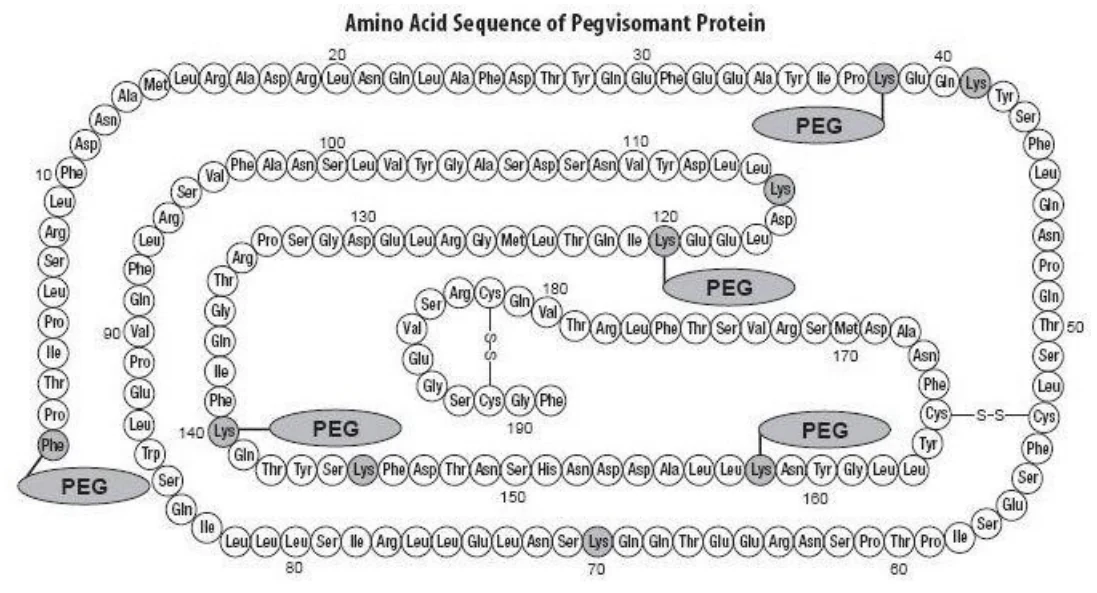
Product Characteristics:
Pegvisomant is a protein containing 191 amino acid residues, to which polyethylene glycol (PEG) polymers are covalently bound (predominantly 4 to 6 PEG/protein molecule). The average molecular weight of the PEG polymers is 5000 daltons. The amino acid sequence of the pegvisomant protein is the same as that for human GH, except for substitutions at nine residues. Pegvisomant is synthesized in a special strain of Escherichia coli bacteria that has been genetically modified by the addition of a plasmid that carries a gene for GH receptor antagonist.
14 CLINICAL TRIALS
14.1 Trial Design and Study Demographics
Table 6 - Summary of patient demographics for clinical trials in acromegaly
| Study # | Study design | Dosage, route of administration and duration | Study subjects (n) | Mean age (Range) | Sex |
| Study SEN-3614 | a randomized, placebo-controlled, double-blind, fixed-dose, multicenter parallel-group study | 10 mg/15 mg/20 mg; subcutaneous injection; 12 weeks | 112 patients | mean age: 47.5 years (range, 20-78 years) | Male/Femal e |
14.2 Study Results
One hundred twelve patients with acromegaly previously treated with surgery, radiation therapy, and/or medical therapies participated in a 12-week, randomized, double-blind, multi-center study comparing placebo and Somavert (pegvisomant for injection). Following withdrawal from previous medical therapy, the 80 patients randomized to treatment with Somavert received an 80 mg subcutaneous (SC) loading dose, followed by fixed doses of 10, 15, or 20 mg/day SC. The three groups that received Somavert showed dose-dependent, statistically significant reductions in serum levels of IGF-I, free IGF-I, IGFBP-3, and ALS compared with placebo at all post-baseline visits (Figure 1 and Table 7).
Figure 1. Effects of Somavert on Serum Markers (Mean ± Standard Error)
| Table 7. Mean Change (95% Confidence Interval) in Serum Markers at Week 12 | ||||||||
| Somavert | Placebo n=31 | |||||||
10 mg/day n=25-26 | 15 mg/day n=24-26 | 20 mg/day n=27-28 | ||||||
Mean percent change in IGF-I | -26.7* (-38.0, -15.5) | -48.3* (-58.9, -37.6) | -62.5* (-70.7, -54.2) | -4.0 (-10.1, 2.2) | ||||
| Mean change in free IGF-I (ng/mL) | -2.5† (-3.7, -1.4) | -3.6‡ (-5.1, -2.2) | -3.9‡ (-5.4, -2.5) | -0.2 (-1.2, 0.9) | ||||
| Mean change in IGFBP-3 (ng/mL) | -0.7† (-1.1, -0.3) | -1.6‡ (-2.2, -1.0) | -1.6‡ (-2.0, -1.2) | -0.1 (-0.4, 0.2) | ||||
| Mean change in ALS (ng/mL) | -3.1† (-4.7, -1.5) | -6.4‡ (-8.7, -4.0) | -9.5‡ (-11.2, -7.8) | -0.5 (-1.8, 0.9) | ||||
* p value versus placebo ≤ 0.0001 † p value versus placebo < 0.05 ‡ p value versus placebo < 0.001 | ||||||||
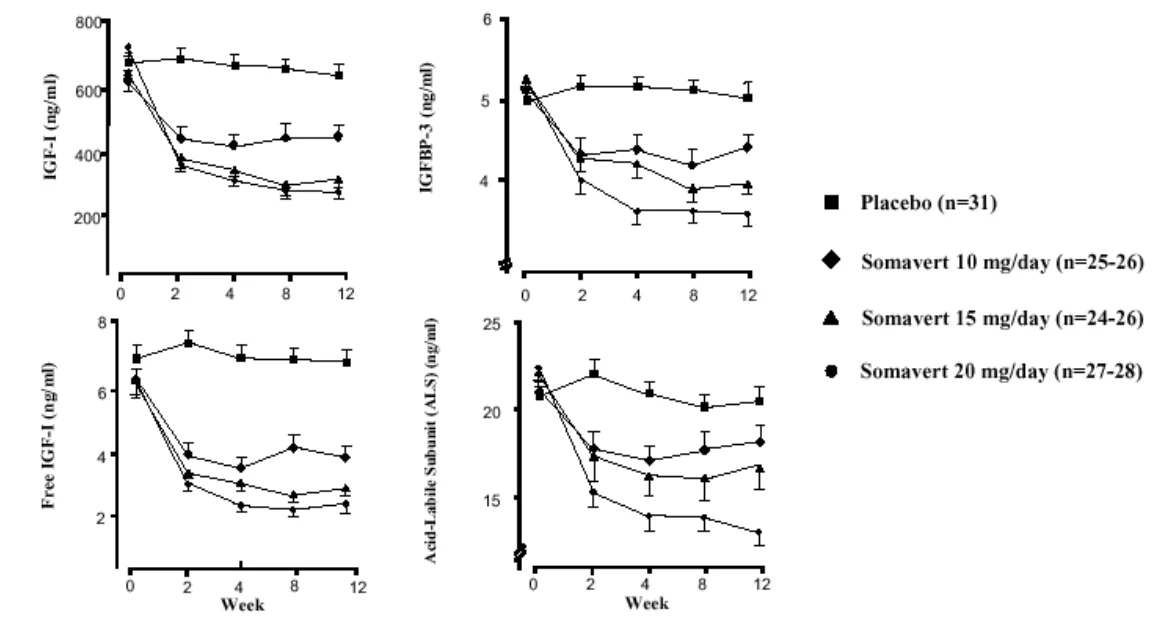
After 12 weeks of treatment, serum IGF-I levels were normalized in 10% (95% CI: 0.2, 0.1), 39% (95% CI: 19.8, 57.2), 75% (95% CI: 57.7, 92.3), and 82% (95% CI: 68.0, 96.3) of subjects treated with placebo, 10, 15, or 20 mg/day of Somavert, respectively (Figure 2).
Figure 2. Percent of Patients Whose IGF-I Levels Normalized at Week 12
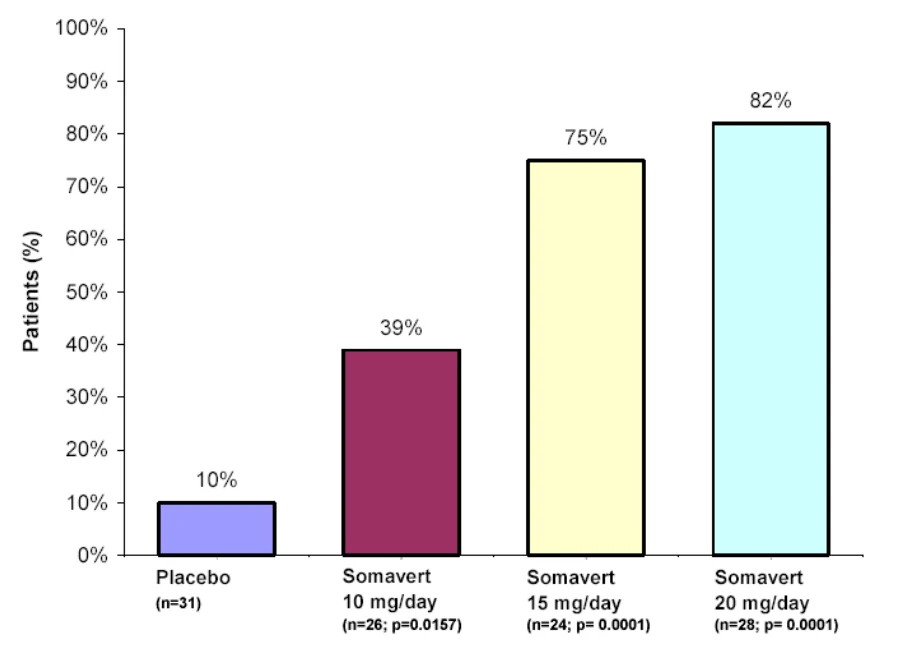
Table 8 shows the effect of treatment with Somavert on ring size and on signs and symptoms of acromegaly. Ring size at week 12 was significantly smaller (improved) in the groups treated with 15 or 20 mg of Somavert, compared with placebo. The total score for signs and symptoms at week 12 was significantly lower (improved) in each of the groups treated with Somavert, compared with the group treated with placebo.
| Table 8. Mean Change from Baseline (95% Confidence Interval) at Week 12 for Ring Size and Signs and Symptoms of Acromegaly | ||||
| Somavert | Placebo n=30 | |||
10 mg/day n=26 | 15 mg/day n=24-25 | 20 mg/day n=26-27 | ||
| Ring size | -0.8 (-1.5, -0.2) | -1.9† (-2.8, -1.1) | -2.5† (-3.8, -1.2) | -0.1 (-1.0, 0.7) |
| Total score for signs and symptoms of acromegaly | -2.5* (-4.2, -0.8) | -4.4* (-6.9, -1.9) | -4.7† (-6.6, -2.9) | 1.3 (-0.9, 3.6) |
| Soft-tissue swelling | -0.7 (-1.4, -0.1) | -1.2* (-2.2, -0.3) | -1.3† (-1.8, -0.8) | 0.3 (-0.5, 1.1) |
| Arthralgia | -0.3 (-1.0, 0.4) | -0.5 (-1.5, 0.5) | -0.4 (-1.2, 0.4) | 0.1 (-0.6, 0.7) |
| Headache | -0.4 (-1.0, 0.2) | -0.3 (-0.9, 0.4) | -0.3 (-1.1, 0.5) | 0.1 (-0.5, 0.7) |
| Perspiration | -0.6 (-1.3, 0.02) | -1.1* (-1.7, -0.6) | -1.7† (-2.3, -1.1) | 0.1 (-0.5, 0.8) |
| Fatigue | -0.5* (-1.0, 0.1) | -1.3† (-2.0, -0.6) | -1.0* (-1.7, -0.4) | 0.7 (0.2, 1.3) |
* p value versus placebo ≤ 0.05 † p value versus placebo ≤ 0.001 | ||||
Serum GH concentrations, as measured by research assays using antibodies that do not cross-react with pegvisomant (see 9 DRUG INTERACTIONS, Drug-Laboratory Test Interactions), rise within two weeks of beginning treatment with Somavert. The largest GH response was seen in patients treated with doses of Somavert greater than 20 mg/day. This effect is presumably the result of diminished inhibition of GH secretion as IGF-I levels fall. As shown in Figure 3, when patients with acromegaly were given an 80 mg loading dose of Somavert followed by a fixed daily dose, this rise in GH was inversely proportional to the fall in IGF-I and generally stabilized by week 2. Serum GH concentrations also remained stable in patients treated with Somavert for up to 18 months. Increases of serum GH concentrations were not associated with pituitary tumour enlargement (see 7 WARNINGS AND PRECAUTIONS, Tumour Growth).
Figure 3. Percent Change in Serum GH and IGF-I Concentrations
Placebo 10 mg/d 15 mg/d 20 mg/d BL Wk 2 Wk 4 Wk 8 Wk 12 -75 -50 -25 0 25 50 75 -200 -150 -100 -50 0 50 100 150 200 GH C hange from B aseline (%) IGF-I C hange from B aseline (%)
Another cohort of 38 patients with acromegaly was treated with Somavert in a long-term, open-label, dose-titration study and received at least 12 consecutive months of daily dosing with Somavert (mean = 85 weeks). The mean (± SD) IGF-I concentration at baseline in this cohort was 917 (± 356) ng/mL after withdrawal from previous medical therapy, falling to 303 (± 163) ng/mL at the end of treatment with Somavert. Thirty-six of the 38 patients (94.7%) achieved a normal (age-adjusted) IGF-I concentration. After the first visit at which a normal IGF-I concentration was observed, IGF-I levels remained within the normal range at 92% of all subsequent visits over a mean duration of one year.
In a separate long-term, open-label, dose titration study, 108 patients with acromegaly received Somavert for a mean duration of 43 weeks. The mean (± SD) IGF-I concentration at baseline in this cohort was 718 (± 324) ng/mL after withdrawal from previous medical therapy, falling to 381 (± 200)
ng/mL at the end of treatment with Somavert. One hundred of the 108patients (92.6%) achieved a normal (age-adjusted) IGF-I concentration.
A subgroup analysis of the data from the 12-week study demonstrated that Somavert was effective in those patients whose IGF-1 level was not adequately controlled on somatostatin analog therapy. In those patients classified as resistant to somatostatin analogs (n=30), the percentage of patients who achieved a normal (age-adjusted) IGF-I concentration after 12 weeks was 61.9%. When allowed to titrate the Somavert dose based on IGF-1 levels during the long-term, open-label, dose titration study, 93.3% of patients in this somatostatin analog resistant group were documented with a normal IGF-I concentration. Similarly, 78.6% of patients classified as responsive to somatostatin analogs (n=19) achieved a normal IGF-1 concentration after 12 weeks on Somavert; this increased to 89.5% in the long-term, open-label, dose-titration study.
14.4 Immunogenicity
In pre-marketing clinical studies, approximately 17% of the patients had low titer, non-neutralizing anti-GH antibodies. These antibodies do not appear to have clinical significance. An assay for anti-pegvisomant antibodies in a patient receiving Somavert is not commercially available.
15 MICROBIOLOGY
No microbiological information is required for this drug product.
16 NON-CLINICAL TOXICOLOGY
General Toxicology:
The toxicity of pegvisomant was evaluated in studies of up to six months, in mice, rats and monkeys.
Acute Toxicity
Administration of pegvisomant to mice as a single dose of up to 10 mg/kg either intravenously (IV) or subcutaneously (SC) or to cynomolgus monkeys as single IV doses of 15 or 100 mg/kg did not result in any treatment-related toxic findings.
Long-term Toxicity
The repeated dose toxicity of pegvisomant was characterized in 2 week studies in mice, a 4 week study in rhesus monkeys and 26 week studies in rats and rhesus monkeys.
IV administration of pegvisomant for 2 weeks to mice caused local irritation at the injection site at doses ≥ 1 mg/kg/day. Body weight gain was reduced in males at 3 mg/kg/day. Additional findings included increases in serum total protein, albumin and phosphorus, and decreases in serum glucose, chloride, and alkaline phosphatase. Liver changes, characterized by areas of increased hepatocellular basophilia and decreased hepatocellular pallor, were observed at doses of 1 and 3 mg/kg/day and were considered to be physiological rather than toxicological in nature.
SC administration of pegvisomant for 2 weeks to mice resulted in elevated serum total protein, albumin, calcium, cholesterol, and albumin/globulin ratios as well as decreased serum glucose, potassium, chloride, and alkaline phosphatase. Livers of mice administered ≥ 1 mg/kg/day had areas of increased hepatocellular basophilia and decreased hepatocellular pallor. These findings were considered to be physiological responses to the treatment rather than toxicological.
Administration of pegvisomant to the rhesus monkey every other day for 4 weeks was associated with slight swelling and minimal to slight hemorrhage at injection sites in a small number of animals. Body weight gain was reduced in males at doses ≥ 1mg/kg/day and in females at all dose levels. Females at 3 mg/kg/day had slightly decreased hemoglobin concentrations, packed cell volumes and red blood cell counts. Serum alkaline phosphatase was decreased in both males and females at doses ≥ 1 mg/kg/day. Microscopic examination of the tissues revealed no evidence of systemic toxicity.
Daily SC administration of pegvisomant for 26 weeks in rats caused decreases in body weight and food consumption in males at 30 mg/kg/day. Serum alkaline phosphatase was decreased in males at all dose levels and in females at 30 mg/kg/day. Additional findings in females were increases in kidney weights at 30 mg/kg/day, and increases in urine protein and leukocytes and increased incidences of nephropathy at doses of 3 mg/kg/day and above. Liver weights were increased in females at doses ≥ 10 mg/kg/day. Microscopically, hepatocellular vacuolation was seen in both sexes at 30 mg/kg/day. Localized effects at the injection sites included thickening of the skin, microscopically observed inflammation and submandibular lymph node macrophage vacuolation at all dose levels. All of these effects, when present, were reversible for animals from the 3 mg/kg/day group.
Weekly SC administration of pegvisomant to the rhesus monkey for 26 weeks resulted in changes associated with the pharmacological activity of the compound such as fatty infiltration of some tissues, mild anemia, lowered white cell counts and reduction in bone and bone marrow. These changes were accompanied by reduced serum phosphorus, alkaline phosphatase and IGF-I concentrations. With the exception of the reduction in serum phosphorus and bone marrow, all of these changes were reversible or trended towards normal during an 8-week recovery period. The no-observed-adverse-effect level (NOAEL) was 1 mg/kg/day.
Carcinogenicity:
Pegvisomant demonstrated an anti-tumour effect, when given SC to mice bearing human meningioma tumours, four lines of human breast tumours or murine colon tumours. In most cases, pegvisomant administration significantly reduced tumour growth or the number of metastases. The mechanism of the anti-tumour activity is suggested to be through the GH/IGF-I axis. Pegvisomant reduces tumour growth through reduction in the tumour mitogen IGF-I. Since its sole mechanism of action is on GH receptors, pegvisomant is not likely to have tumour initiation or tumour promoting ability and hence has no potential to act as a carcinogen.
A two year carcinogenicity study was performed in male and female rats at subcutaneous doses up to 20 mg/kg/day (approximately 12 times the anticipated clinical exposure at 30 mg/day based on body surface area). Malignant fibrous histiocytomas were found at injection sites in male rats only, but not in female rats, and only at the mid and high doses. The incidence of these tumours was dose dependent and correlated with a dose dependent increase in irritation and inflammation at the injection sites. This response is consistent with literature reports of inert, nongenotoxic biomaterials producing this type of neoplasm in rodents after chronic subcutaneous injection.
Genotoxicity: Pegvisomant was not mutagenic in the Ames test or clastogenic in the in vitro chromosomal aberration test in human lymphocytes.
Reproductive and Developmental Toxicology: Early embryonic development and teratology studies were conducted in rabbits with pegvisomant administered SC at doses of 1, 3, and 10 mg/kg/day. No teratogenic potential was revealed, but there was an increase in implantation loss at the dose of 10 mg/kg/day. This finding may have been due to decreased IGF-I concentrations and/or GH activity, below normal, in maternal animals as opposed to the expected clinical situation where IGF-I levels will be normalized. No reproductive toxicity studies were conducted in rats because pegvisomant is not pharmacologically active in rodents.
Special Toxicology: Pegvisomant was administered to rabbits as SC injections of 3 mg/kg on Days 0, 1, 2, 6, 7 and 8 of the study. Histopathological examination revealed minimal infiltration at all injection sites. These changes were considered to be due to the route of administration but not due to dermal irritation.