


Product Monograph - Ssp+
1 INDICATIONS
SSP+ (platelet additive solution E) is an isotonic solution designed to:
- Partially replace plasma in the preparation and storage of buffy-coat derived platelet concentrates or apheresis platelet units. The recommended ratio is as follows: up to 80% SSP+ / 20% plasma;
- Enable platelets to be stored in a mix of SSP+ and plasma at 20°C - 24°C, under gentle agitation, for up to 7 days following collection and according to local regulations.
The solution should never be infused directly to the patient.
There is no direct therapeutic effect to be expected from the formulation.
2 CONTRAINDICATIONS
SSP+ (platelet additive solution E) alone is not for direct intravenous infusion. There are no known contraindications associated with the use of SSP+ solution for the preparation of platelet concentrates.
3 DOSAGE AND ADMINISTRATION
SSP+ (platelet additive solution E) is a storage solution for platelet concentrates and has no pharmacological effect. The solution is not directly administered to the patient but is used to produce high quality platelets concentrates that can be stored for up to 7 days following collection at 20oC - 24oC with agitation. See Special Handling Instructions.
4 OVERDOSAGE
SSP+ (platelet additive solution E) is used as a storage solution for platelet concentrates and has no pharmacological effect. Multiple transfusions of platelet additive solution may lead to overdosage of potassium and magnesium. Monitor changes in electrolyte concentration and acid-base balance when multiple transfusions of platelets in SSP+ are administered. In the event of overdose, discontinue transfusion immediately and institute appropriate corrective treatment.
The signs and symptoms of potassium overdose include paresthesias of the extremities, areflexia, muscular or respiratory paralysis, mental confusion, weakness, hypotension, cardiac arrhythmias, heart block, electrocardiographic abnormalities and cardiac arrest. Treatment of hyperkalemia includes the following;
- 1. Dextrose Injection, USP 10% or 25%, containing 10 units of crystalline insulin per 20 grams of dextrose administered intravenously, 300 to 500 mL/hour.
- 2. Absorption and exchange of potassium using sodium or ammonium cycle cation exchange resin, orally and as retention enema.
- 3. Hemodialysis and peritoneal dialysis. The use of potassium-containing foods or medications must be eliminated. However, in cases of digitalization, too rapid a lowering of plasma potassium concentration can cause digitalis toxicity.
Signs of magnesium overdose include flushing, sweating, hypotension, depressed reflexes, flaccid paralysis, hypothermia, circulatory collapse, cardiac and CNS depression proceeding to respiratory paralysis. Disappearance of the patellar reflex is a useful clinical sign to detect the onset of magnesium overdose. In the event of overdosage artificial ventilation may be required until a calcium salt can be injected intravenously to antagonize the effects of magnesium.
5 DOSAGE FORMS, STRENGTHS, COMPOSITION AND PACKAGING
Description
The SSP+ (platelet additive solution E) is a sterile, isotonic solution in a single dose container. It contains no bacteriostatic or antimicrobial agents. SSP+ is indicated as a platelet additive solution for the 7-day storage of platelet concentrates.
The composition of the solution is listed in the table below.
| INGREDIENT | QUANTITY (g/L) |
| Sodium Citrate Dihydrate | 3.18 |
| Sodium Acetate Trihydrate | 4.42 |
| Sodium Dihydrogen Phosphate Dihydrate | 1.05 |
| Disodium Phosphate Anhydrous | 3.05 |
| Magnesium Chloride Hexahydrate | 0.30 |
| Potassium Chloride | 0.37 |
| Sodium Chloride | 4.05 |
SSP+ solution is supplied in a flexible polyolefin bag designed with one or two connection modes, according to the reference codes, and protected by a plastic overwrap (not the sterile barrier). The polyolefin bag is made from a multilayered film. It exhibits virtually no leachables.
SSP+ solution is available as follows:
| REFERENCE CODE | BAG VOLUME (ML) | APPLICATION | PACK SIZE | |||||
| SSP2025X | 250 | Buffy coats preparation | 30/box | |||||
| SSP2028X | 280 | 20/box | ||||||
| SSP2030X | 300 | |||||||
| SSP2128X | 280 | Apheresis | ||||||
| SSP2130X | 300 | |||||||
| SSP2150X | 500 | |||||||
6 WARNINGS AND PRECAUTIONS
SSP+ (platelet additive solution E) is NOT FOR DIRECT INTRAVENOUS INFUSION
- Multiple transfusions of SSP+-stored platelets may lead to overdosage of potassium and magnesium
- Check the integrity of the container and the overwrap before use.
- Use at a temperature between 18° and 24°C.
- Store at a temperature between 15°C and 30°C.
- Do not use sharp objects.
- Do not use if the overwrap or the container show any visible signs of deterioration.
- Do not use if the solution is cloudy.
- Do not vent for the transfusion of platelets.
- Must be used with approved devices including connections.
- Do not re-use. Discard unused SSP+ solution.
- Do not use if no label.
7 ADVERSE REACTIONS
Adverse Reaction Overview
SSP+ (platelet additive solution E) is not expected to cause adverse events other than those normally associated with platelet transfusion.
Clinical Trial Adverse Reactions
No adverse reactions were reported in subjects infused with a small volume of radiolabeled platelets that had been stored for 7 days in 70% SSP+/30% plasma Platelet Additive Solution.
8 DRUG INTERACTIONS
SSP+ (platelet additive solution E) is used as a storage solution for concentrated platelets and it is not intended for direct intravenous infusion alone. There are no known drug interactions in its use as a platelet storage solution.
9 ACTION AND CLINICAL PHARMACOLOGY
SSP+ (platelet additive solution E) is a plasma replacing fluid that provides the appropriate components for platelet function during storage. SSP+ alone is not intended for direct intravenous infusion and does not, by itself, have any therapeutic effects but rather acts to provide the appropriate environment and nutrients to maintain platelets relevant function and thus their storage. The table shows the function of each key component:
| INGREDIENT | FUNCTION |
| Sodium Citrate Dihydrate | Prevent the activation of the platelets |
| Sodium Acetate Trihydrate | Reduction of lactate production |
| Sodium Dihydrogen Phosphate Dihydrate | Buffer |
| Disodium Phosphate Anhydrous | Buffer |
| Magnesium Chloride Hexahydrate | Reduce aggregation and improve functionality |
| Potassium Chloride | Reduce aggregation and improve functionality |
| Sodium Chloride | Maintains the isotonic property of the solution |
| Water For Injection | Solvent |
The solution provides the appropriate components for platelet function while allowing for a lower volume of plasma in the platelet product during storage.
10 STORAGE, STABILITY AND DISPOSAL
Store SSP+ (platelet additive solution E) at a temperature between 15°C and 30°C.
Platelets in SSP+ solution can be stored between 20°C and 24°C for up to 7 days under gentle agitation following collection.
Discard according to local regulations.
11 SPECIAL HANDLING INSTRUCTIONS
Preparation of the platelets concentrates using SSP+ (platelet additive solution E)
Manifold pooling (use of 4 to 6 Buffy-Coats)
- 1. Make a sterile connection between each buffy-coat tubing and each end-line tubing of the manifold device.
- 2. Connect by sterile connection the SSP+ bag tubing to the remaining manifold set end-tubing.
- 3. Hang all the buffy-coat bags at the same level and the SSP+ bag on a higher level.
- 4. Allow the buffy-coats to drain into the pooling bag.
- 5. Close the clamp above the pooling bag and then allow the SSP+ solution to drain into each buffy-coat bag.
- 6. Agitate in order to recover a maximum of buffy-coat & open the clamp, allow the SSP+ solution to drain into the pooling bag.
- 7. Remove the manifold set and then follow standard procedures to obtain a pooled buffy-coat derived platelet concentrate.
Cascade pooling (4-6 Buffy Coats)
- 1. Connect by sterile connection the SSP+ bag tubing to the bleed line of the first buffy-coat bag in the train.
- 2. Make a sterile connection between the buffy-coat plasma line (tube equipped with a breakaway cannula) of the first buffy-coat bag and the bleed line of the second buffy-coat.
- 3. Then make a sterile connection between the second buffy-coat and the third buffy-coat. Repeat the operation with each buffy-coat until a maximum of 6 buffy-coats attached.
- 4. (Option: connect the tubing of the plasma line of the last buffy-coat bag to a platelet recovery set).
- 5. Hang the chain vertically by suspending the SSP+ bag with the chain of buffy-coats underneath. Allow the buffy-coats to drain into the pooling bag.
- 6. Use the SSP+ solution to drain one bag after each other.
- 7. Remove the set and then follow standard procedures to obtain a pooled buffy-coat derived platelet concentrate.
Apheresis
- 1. Connected to the apheresis set, the SSP+ solution can be used as a substitution-solution for a part of the plasma in platelet concentrates.
- 2. Connect the Additive Solution with the luer connector to the apheresis set.
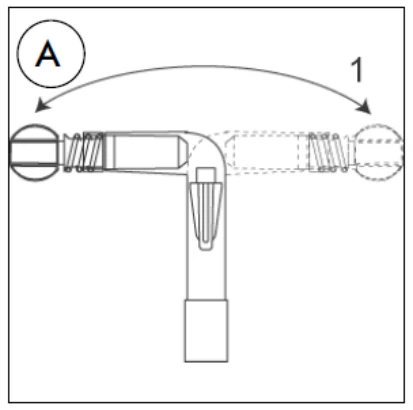
- 3. Break the breakable connector in the Additive Solution line by moving the connector back and forth 90° until an audible “snap” sound is heard in both directions (see drawing (A).
- 4. Bend tubing 180° to force the arrow piece of the frangible upward into the soft tubing closer to the bag opening and away from the base (B).
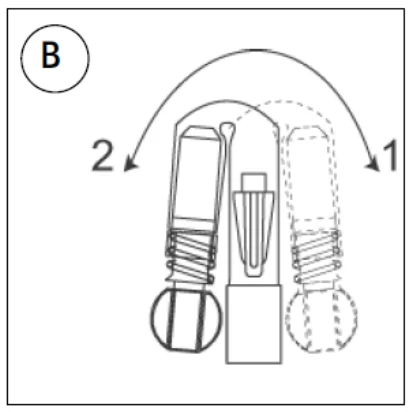
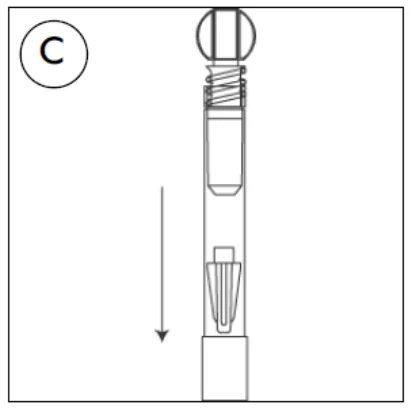
This prevents this piece from reseating. To ensure proper flow, check to see if a gap exists between the arrow and base of the frangible (C). If not repeat step B.
- 5. Hang the Additive Solution bag on the IV hook with the platelet product bag supported (not hanging) below.
- 6. Follow the valid apheresis protocol of your institution. Allow the appropriate amount of storage solution to flow into the platelet product bag and mix gently.
PART II: SCIENTIFIC INFORMATION
PHARMACEUTICAL INFORMATION
Drug Substance
SSP+ (platelet additive solution E) is a polyionic sterile, non-pyrogenic storage solution. The solution is an odorless, colorless liquid with a pH range between 7.0 – 7.5 to allow platelets preservation.
The Drug Substance is the SSP+ solution with the following constituting ingredients:
INGREDIENT 1:
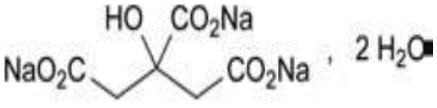
Proper name: Sodium Citrate Dihydrate
Chemical name: Trisodium 3-hydroxy-3-carboxylate-1,5-pentanedicarboxylate
Molecular formula: C6H5O7Na3, 2H2O
Molecular mass: 294.1 g/mol
Structural formula:
Physical properties:
Appearance: White or almost write, crystalline powder or white or almost white, granular crystals, slightly deliquescent in moist air.
Solubility: Freely soluble in water, and insoluble in ethanol.
INGREDIENT 2:
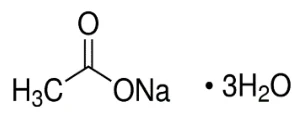
Proper name: Sodium Acetate Trihydrate
Chemical name: Sodium Acetate Trihydrate
Molecular formula: C2H3NaO2, 3H2O
Molecular mass: 136.08 g/mol
Structural formula:
Physical properties:
Appearance: White or almost white, crystalline powder or colourless crystals
Solubility: Soluble in water
INGREDIENT 3:
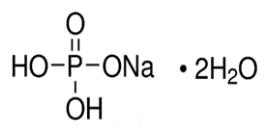
Proper name: Sodium Dihydrogen Phosphate Dihydrate
Chemical name: Sodium Dihydrogen Phosphate Dihydrate
Molecular formula: NaH2PO4, 2H2O
Molecular mass: 156.02 g/mol
Structural formula:
Physical properties:
Appearance: White or almost white, crystalline powder or colourless crystals
Solubility: Soluble in water
INGREDIENT 4:
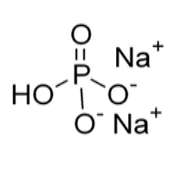
Proper name: Disodium Phosphate Anhydrous
Chemical name: Disodium Hydrogen Phosphate Anhydrous
Molecular formula: Na2HPO4
Molecular mass: 141.96 g/mol
Structural formula:
Physical properties:
Appearance: White or almost white powder hygroscopic
Solubility: Soluble in water
INGREDIENT 5:
Proper name: Potassium Chloride
Chemical name: Potassium Chloride
Molecular formula: KCl
Molecular mass: 74.55 g/mol
Structural formula:
K+ - Cl-
Physical properties:
Appearance: White or almost white, crystalline powder or colourless crystals
Solubility: Soluble in water
INGREDIENT 6:
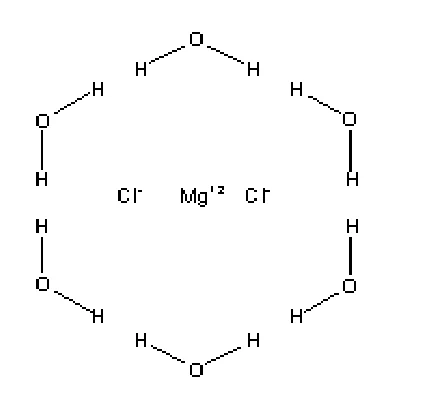
Proper name: Magnesium Chloride Hexahydrate
Chemical name: Magnesium Dichloride Hexahydrate
Molecular formula: MgCl2, 6H2O
Molecular mass: 203.30 g/mol
Structural formula:
Physical properties:
Appearance: Colourless crystals, hygroscopic
Solubility: Soluble in water
INGREDIENT 7:
Proper name: Sodium Chloride
Chemical name: Sodium Chloride
Molecular formula: NaCl
Molecular mass: 58.44 g/mol
Structural formula:
Na+ - Cl-
Physical properties:
Appearance: White or almost white, crystalline powder or colourless crystals or white or almost white pearls
Solubility: Soluble in water
INGREDIENT 8:
Proper name: Water for Injection
Chemical name: Water for Injection
Molecular formula: H2O
Molecular mass: 18.02 g/mol
Structural formula:
H2O
Physical properties:
Appearance: Clear and colourless liquid
Solubility: Not applicable
CLINICAL TRIALS
Information to support the recovery and survival of platelets stored in SSP+ for 7 days comes from literature providing moderate quality of evidence:
- Cardigan & Williamson, Recovery and Survival in normal volunteers of Single Buffy Coat Platelet Concentrates stored in SSP+ platelet additive solution for 7 days; 2008.
- Tardivel et al, A comparative study of the efficiency of plasma and additive solution preserved platelet concentrates; Vox Sanguinis – 2012. 103 (Suppl. 1), 1–271.
MICROBIOLOGY
Not applicable
NON-CLINICAL TOXICOLOGY
Toxicological studies have not been conducted with SSP+ (platelet additive solution E). Ingredients of SSP+ comply with European Pharmacopeia and are standard compositions in platelet additive solutions. The toxicity profile of the ingredients have been well established as electrolytes or non-medicinal ingredients.
REFERENCE
Diedrich B, Sandgren P, Jansson B, Gulliksson H, Svensson L, Shanwell A. In vitro and in vivo effects of potassium and magnesium on storage up to 7 days of apheresis platelet concentrates in platelet additive solution. Vox Sang. 2008; 94:96-102
Gulliksson H. Platelet Storage Media. Vox Sang. 2014;107(3): 205-212.
ICCBBA. ISBT 128 - Standard terminology for medical products of human origin. 2018 [cited 2018 August 24].
Ringwald J, Walz S, Zimmermann R, Zingsem J, Strasser E, Weisbach V, et al. Hyperconcentrated platelets stored in additive solution: aspects on productivity and in vitro quality. Vox Sang. 2005; 89:11-18.
Ringwald J, Zimmerman R, Eckstein R. The new generation of platelet additive solution for storage at 22oC: development and current experience. Transfus Med Rev. 2006;20(2):158-164.