


Patient Medication Information: uses, side effects, how to take - Susvimo
What is Susvimo used for?
SUSVIMO (ranibizumab) is used to treat adults with neovascular (wet) age-related macular degeneration (AMD) who have previously responded to and need frequent treatment (every 8 weeks or more frequently) with a Vascular Endothelial Growth Factor (VEGF) inhibitor medication in the gel-like part of the eye (intravitreal) in order to maintain vision gain. This condition is caused by small, abnormal blood vessels that grow in the back of the eye (retina). The abnormal vessels may leak blood or fluid in the macula (center part of the retina). This can lead to scars that may make your vision worse and lead to blind spots.
How does Susvimo work?
A protein called vascular endothelial growth factor (VEGF) helps to form the leaky blood vessels in the back of the eye (macula). Susvimo is a medicine that contains the ingredient ranibizumab. It attaches to and blocks VEGF protein. This stops or slows the growth and leakage from the abnormal blood vessels in your eye.
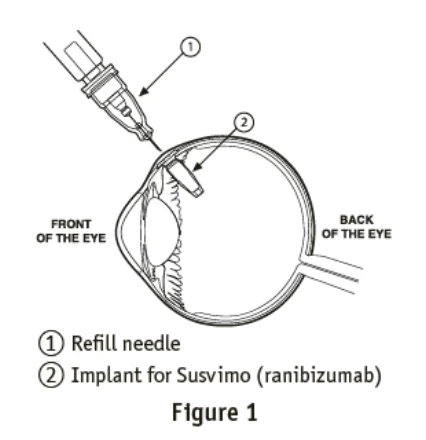
Susvimo is made to be released through an implant that stays in your eye. A doctor will perform surgery to place the implant in your eye. It is about the size of a grain of rice. It will need to be refilled with the medicine Susvimo which can be done through an injection. The picture (Figure 1) below shows how the implant will be refilled with the medicine using a refill needle and where the implant can be found in the eye.
Serious Warnings and Precautions
- Endophthalmitis: The Susvimo implant could cause endophthalmitis (an infection of the eyeball that can cause blindness and permanent damage to your eye). The chance to have endophthalmitis associated with Susvimo is 3-times greater than monthly intravitreal injection of anti- vascular endothelial growth factor agent in the eye. Endophthalmitis requires urgent (same day) medical or surgical treatment. Call your healthcare provider right away and seek immediate care from an ophthalmologist if you have increasing eye pain, vision loss, sensitivity to light, or redness in the white of the eye.
- You can only receive Susvimo if you have been well informed of the risks associated with Susvimo, procedures of insertion, refill-exchange and removal, and ocular implant dislocation, and have been well instructed on how to take care of your eye to prevent serious side effects including endophthalmitis throughout treatment with Susvimo and have signed the surgical consent form provided by your doctor.
What are the ingredients in Susvimo?
Medicinal ingredients: ranibizumab. One mL of solution contains 100 mg of ranibizumab.
Non-medicinal ingredients: Histidine HCl, L Histidine, L Histidine Hydrochloride Monohydrate, Polysorbate 20, Sucrose, Water for Injection
Susvimo comes in the following dosage forms:
Solution for Injection (100 mg/mL)
Susvimo is the medicine that gets injected into the ocular implant. Susvimo is in a vial and is a clear to slightly opalescent, colourless to pale brown liquid.
Two pack types are available:
Initial fill kit (to fill your implant the first time)
One vial of Susvimo and 1 initial fill needle [34G (0.18 mm) x 3 mm, 5 µm]
Refill-exchange kit (to refill your implant)
One vial of Susvimo and 1 refill needle [34G (0.18 mm) x 5 mm, 5 µm]
Do not use Susvimo if:
- You are allergic to ranibizumab or any of the other ingredients in Susvimo or any component of the container (see list of ingredients provided above). If you think you may be allergic, ask your doctor for advice.
- You have, or think you have, an infection in or around your eye.
- You have inflammation in your eye (you may feel pain or have redness in your eye or have swelling around your eye).
To help avoid side effects and ensure proper use, talk to your healthcare professional before you take Susvimo. Talk about any health conditions or problems you may have, including if you:
Develop endophthalmitis (an infection of the eyeball that can cause blindness and permanent damage to your eye) or severe inflammation of your eye. This requires urgent (same day)
- medical or surgical treatment. Call your healthcare provider right away if you have increasing eye pain, vision loss, sensitivity to light, or redness in the white of the eye.
- Develop rhegmatogenous retinal detachment (tear and separation of layers of the retina in the back of the eye that senses light). Rhegmatogenous retinal detachment can cause blindness and requires urgent surgical treatment. Call your healthcare provider or go to the emergency room right away if you see flashing lights, see a curtain or veil covering part of your vision, have a change in your vision, or a loss of vision.
- Develop vitreous hemorrhage (bleeding within the gel-like substance [vitreous] inside of your eye): Call your healthcare provider right away if you have an increase in moving spots or what looks like spider webs in your vision. You may need surgical treatment.
- Develop conjunctival erosion (a missing layer on top of the white part of the eye). It could result in exposure of the implant. Conjunctival erosion may require surgical treatment.
- Develop conjunctival bleb (a small bulge in the layer that covers the white part of the eye where the implant was placed), have a sudden feeling that something is in your eye (foreign body sensation), have eye discharge, or watering of the eye. Conjunctival bleb may require surgical treatment.
- Develop conjunctival retraction (an opening of the layer that covers the white part of the eye). Conjunctival retraction may cause the implant to be exposed and may require surgical treatment. Call your healthcare provider right away if you suddenly feel that something is in your eye, or have eye discharge, or watering of the eye.
- Notice that the implant has moved out of place (device dislocation). This movement may require urgent surgical treatment to correct. Tell your healthcare provider right away if you notice that the implant has moved out of place.
- Notice damage to the implant [that prevents continued treatment (refills) with Susvimo]. If this damage prevents proper filling of the implant, your wet AMD may be inadequately treated and your physician may remove the implant from your eye and/or change your treatment.
- Develop signs of a possible allergic reaction (for example, fast pulse, low blood pressure, sweating, allergic skin reactions such as rash, itching or stinging).
- The use of Susvimo may cause temporary decrease in vision after the Susvimo insertion procedure.
- Susvimo may cause an increase in eye pressure. Your healthcare provider will check your eye pressure.
- Susvimo may cause cataract (clouding of the eye lens).
- The use of Susvimo is potentially related to the risk of blood clots blocking blood vessels (arterial thromboembolic events). This may lead to heart attack or stroke.
Other warnings you should know about:
- There is no experience of using Susvimo in both eyes.
Contraception: Women who could become pregnant must use effective contraception (birth control) during treatment and for at least 12 months after the last refill with Susvimo.
Pregnancy: There is no experience of using Susvimo in pregnant women. However, based on how Susvimo works, it could harm your unborn baby. Susvimo should not be used during pregnancy unless the benefit of the medicine is greater than the risk to your unborn baby.
If you are pregnant, think you may be pregnant, or are planning to have a baby, ask your doctor for advice before taking this medicine.
If you become pregnant while taking this medicine, your doctor may replace Susvimo from the implant with salt water solution (saline).
Breastfeeding: Susvimo is not recommended during breast-feeding because it is not known whether the medicine will pass into human milk. Ask your doctor or pharmacist for advice before Susvimo treatment.
Children and adolescents (below 18 years of age): Susvimo is NOT used in children and adolescents. The use of Susvimo has not been studied in children and adolescents.
Ability to drive and use machines: You may have decreased vision for a short period of time when you:
- first get your implant placed in your eye
- if you have the implant removed
- receive a refill of Susvimo
- because of some of the tests that are done to your eye during your appointment
Do not drive or use machines until you can remove the eye shield (as advised by your doctor) and your vision has gotten better.
Use with Standard Procedures:
If you are prescribed:
- an ultrasound for your eye (A-scan ophthalmic ultrasound)
- slit lamp examination (using a microscope with a bright light during your eye exam)
- indirect ophthalmoscopy (an exam of the inside of the back of the eye using a beam of light and a handheld lens)
- tonometry (a test to measure the pressure inside your eye), a scan that uses light beams to make detailed pictures of the inside of your eye (optical coherence tomography-OCT)
- a test to see how much you can see out of the corner of your eye (visual field or perimetry)
- laser treatments that may be used by your eye doctor
- radiography (x-ray)
- computed tomography (CT) scan
- fluorescein/indocyanine angiography (an eye test that uses a special dye and camera to look at blood flow in certain parts of the eye)
- fundus autofluorescence (a test that creates a picture from colours in the back of your eye that give out light).
Inform your clinician that you have an implanted medical device.
Important Note on Magnetic Resonance Imaging (MRI):
Get your implant card from your healthcare provider after receiving the ocular implant and keep the card in a safe place for future reference. If you need to undergo an MRI, let your doctor know that you have an implant in your eye and show the healthcare provider your Susvimo implant card. This is especially important as you may only have an MRI under specific scan conditions which your healthcare provider can confirm.
Tell your healthcare professional about all the medicines you take, including any drugs, vitamins, minerals, natural supplements or alternative medicines.
- Especially if you are taking medicines that reduce the formation of blood clots (such as warfarin, low or regular doses of aspirin, or nonsteroidal anti-inflammatory drugs (e.g. ibuprofen, naproxen).
How to take Susvimo:
- You can only receive Susvimo if you have been fully informed the risks associated with Susvimo, procedures of insertion, refill-exchange and removal, ocular implant dislocation and damage, and have signed the surgical consent form provided by your doctor.
- You can only receive Susvimo if you have been fully instructed how to take care of your eye throughout treatment with Susvimo, including after the surgery to insert the implant, after refill and after implant removal if needed.
Before receiving Susvimo your doctor will check that you respond to this kind of medicine.
You can only receive Susvimo if you have responded to previous injections of a Vascular Endothelial Growth Factor (VEGF) inhibitor in the gel-like part of the eye (intravitreal) and require intravitreal injections of an anti-VEGF medication every 8 weeks or more frequently in order to maintain vision gain.
- Susvimo will be given to you by a healthcare professional in a healthcare setting.
- An eye surgeon trained to put in implants will fill the implant with Susvimo before placing it in your eye.
- An eye surgeon trained in implant insertion procedures will insert the implant in your eye.
- Afterwards, your eye doctor trained in refill procedures will refill the implant every 6 months.
- Your doctor(s) will perform both of these procedures using a local anesthetic to numb the eye and will be careful to lower the risk of infection by using sterile procedures (procedures that are very clean).
Susvimo must only be given using the implant.
Monitoring and care during your treatment with Susvimo:
Your doctor will monitor your condition and that of the implant throughout your treatment with Susvimo to allow for prompt medical assistance if necessary (see “To help avoid side effects and ensure proper use, talk to your healthcare professional before you take Susvimo. Talk about any health conditions or problems you may have, including if you:” and “Other warnings you should know about”). Follow you doctor’s instructions for how to care for the treated eye. These instructions include but are not limited to the following:
After the surgery to insert the implant:
Positioning of your head
- Keep your head above shoulder level for the rest of the day.
- Sleep with your head raised up on 3 or more pillows if lying down during the day and night after the implant is put in.
How to care for your eye
- Do not remove the eye shield from the eye until you are told to by your doctor. At bedtime, keep wearing an eye shield for at least 7 nights after the implant has been placed.
- Take all eye medications after surgery, as directed by your doctor.
- Do not push on the eye, rub the eye, or touch the area of the eye where the implant is placed (i.e. underneath the eyelid in the upper and outer part of your eye) for 30 days after the implant has been placed.
- Do not take part in any strenuous activities until 1 month after the implant has been placed or after talking with your doctor.
See Important Note on Magnetic Resonance Imaging (MRI) on page 32.
After the refill procedure:
- Do not push on the eye, rub the eye, or touch the area of the eye where the implant is located (i.e. underneath the eyelid in the upper and outer part of your eye) for 7 days after the refill procedure.
- Put antimicrobial (kills different germs such as bacteria or viruses) eye drops into the eye, as directed by your doctor.
After the implant removal procedure (if it is deemed medically necessary):
- Keep your head above shoulder level for the rest of the day.
- Sleep with your head raised up on 3 or more pillows if lying down during the day and night after the implant has been taken out.
- Wear an eye shield for at least 7 nights following the implant removal procedure.
- Do not participate in strenuous activities until 14 days following the implant removal procedure.
- Administer all post-operative anti-inflammatory and antimicrobial drops, as directed by your doctor.
Throughout treatment with Susvimo:
- Upon receiving the ocular implant, do not drive or use machinery until the eye shield can be removed as directed by your doctor and visual function has recovered sufficiently (see “Ability to drive and use machines”).
- Avoid rubbing your eye or touching the area of your eye where the implant is placed as much as possible (this area is shown as 2 in the Figure 1 under “How does Susvimo work?”). If you have to rub or touch your eye, make sure your hands are cleaned before touching the eye.
- Susvimo, implant and/or implant related procedures have been associated with endophthalmitis or severe inflammation of the eye, rhegmatogenous retinal detachment, conjunctival reactions (bleb, erosion, retraction), vitreous hemorrhage, the dislocation of the implant, septum dislodgement, a temporary decrease in vision, an increase in eye pressure or development of a cataract (see “To help avoid side effects and ensure proper use, talk to your healthcare professional before you take Susvimo. Talk about any health conditions or problems you may have, including if you:”
Seek immediate care from an ophthalmologist if there are sudden changes in vision (an increase in moving spots, the appearance of “spider webs”, flashing lights, or a loss in vision), increasing eye pain, progressive vision loss, sensitivity to light, redness in the white of the eye, a sudden sensation that something is in their eye, or eye discharge or watering. Immediately report any signs and symptoms of reactions that may need urgent medical or surgical treatment and/or a delay in your next refill of Susvimo as long as the implant is in place (see
- “Serious side effects and what to do about them” and “To help avoid side effects and ensure proper use, talk to your healthcare professional before you take Susvimo. Talk about any health conditions or problems you may have, including if you:”).
Usual dose:
The recommended dose of Susvimo is 2 mg and it will be continuously delivered by the implant. The implant is refilled every 24 weeks (approximately 6 months) by your doctor.
Depending on how you respond to treatment with Susvimo, your doctor may give you additional injection(s) into your eye (intravitreal injections) of a different form of ranibizumab within the 24-week refill interval.
Your doctor will regularly monitor your condition to check that the treatment is working for you.
While monitoring your condition, your doctor may feel it necessary to stop the refills of Susvimo or safely remove the implant through surgery.
Overdose:
| If you think you, or a person you are caring for, have administered too much Susvimo, contact a healthcare professional, hospital emergency department, or regional poison control centre immediately, even if there are no symptoms. |
Missed Dose:
If you miss a dose (scheduled refill), schedule a new appointment with your doctor to receive the refill as soon as possible. Do not wait until the next planned refill.
What are possible side effects from using Susvimo?
These are not all the possible side effects you may have when taking Susvimo. If you experience any side effects not listed here, tell your healthcare professional.
The list of possible side effects from treatment with Susvimo include side effects related to Susvimo (the medication in the implant), the presence of the implant in the eye, and the procedures to place the implant in the eye, refill the implant, and remove the implant.
Tell your doctor if experience any of the following side effects:
Very common: may affect more than 1 in 10 people
- blood on top of the white of the eye (conjunctival hemorrhage)
- swelling of the coloured part of the eye (iritis)
- eye pain
Common: may affect up to 1 in 10 people
- moving spots in your vision (vitreous floaters)
- feeling like that something might be in the eye(s) (foreign body sensation in eyes)
- bleeding within the gel-like substance at the back of the eye (vitreous hemorrhage)
- low pressure inside the eye (hypotony of eye)
- when the gel-like substance at the back of the eye (vitreous) shrinks and separates from the layer (retina) at the back of the eye that senses light (vitreous detachment)
- pain during the procedure
- inflammation of the eyelid (redness, pain, swelling, and itching of the eyelids, eyelid scales) [blepharitis]
- eye irritation (burning, stinging, itching, tearing, redness)
- swelling of the layer that covers the white part of the eye (conjunctival edema)
- bleeding from the blood vessels in the back of the eye (retinal hemorrhage)
- swelling of the clear part at the front of the eye (corneal edema)
- blurred vision
- scratch to the clear part at the front of the eye (corneal abrasion)
- problem with the clear part (cornea) at the front of the eye (corneal disorder)
- drooping of the upper eyelid (eyelid ptosis)
- less sharpness of vision (visual acuity reduced)
- itchy eyes (eye pruritis)
- more tears than usual/watering eyes (lacrimation increased)
- infection of the layer that covers the white of the eye (conjunctivitis)
- problem in the layer that covers the white part of the eye (conjunctival disorder)
- bruising around the eye following surgery (ecchymosis)
- swelling of the eyelid (eyelid edema)
- attachment of the coloured part of the eye (iris) to other structures in the eye (iris adhesions)
- eye discomfort (ocular discomfort)
- less pressure of the eye (intraocular pressure decreased)
- eyes are more sensitive to light (photophobia)
- inflammation of the gel-like substance at the back of the eye (vitritis)
- leaking fluid from your eye (eye discharge)
- blood in front of the coloured part (iris) of the eye (hyphema)
- inflammation of the iris (coloured part of the eye) and its nearby tissue in the eye (iridocyclitis)
- headache
- nausea
- vomiting
- damage to the implant
Uncommon: may affect up to 1 in 100 people
- separation of the layer of blood vessels (called the choroid) from underneath the white part of the eye (choroidal detachment)
- redness in the white part of the eye (scleral hyperemia)
- separation of the layer (retina) in the back of the eye that senses light (rhegmatogenous retinal detachment)
- thinning of the white part of the eye (scleral thinning)
- discomfort after a refill at or around the area where Susvimo implant was placed (administration site discomfort)
- problems that may happen after the procedure to place the Susvimo implant in your eye (e.g. a stitch can be seen)
- discomfort after the procedure (post procedural discomfort)
- hole or tear in layer (retina) in the back of the eye that senses light (retinal tear)
- cloudiness of the Susvimo implant (device material opacification)
- scar tissue at the place where the Susvimo implant was inserted (implant site fibrosis)
- a reaction (e.g. swelling) at or around the place where Susvimo implant was placed (implant site reaction)
- swelling after the procedure
Serious side effects and what to do about them
| Symptom / effect | Talk to your healthcare professional | Stop taking drug and get immediate medical help | |
|---|---|---|---|
| Only if severe | In all cases | ||
| VERY COMMON | |||
| Redness in the layer that covers the white of the eye (conjunctival hyperemia) | ✓ | ✓ | |
| COMMON | |||
| Infection of the eyeball with inflammation of the inside of the eye or increasing eye pain, vision loss, sensitivity to light, or redness in the white of the eye (endophthalmitis) | ✓ | ✓ | |
See flashing lights, see a curtain or veil covering part of your vision, have a change in your vision, or a loss of vision (rhegmatogenous retinal detachment) | ✓ | ✓ | |
| Experience sudden changes in your vision (moving spots in your vision, the appearance of “spider webs”, flashing lights, a change in your vision, or a loss in vision) (vitreous hemorrhage) | ✓ | ✓ | |
| Sudden feeling that something is in your eye(s) | ✓ | ✓ | |
| Eye discharge or watering | ✓ | ✓ | |
| Gap in the layer that covers the white of the eye near the cut where the implant was placed (this may cause the implant to become uncovered) (conjunctival retraction) | ✓ | ✓ | |
| Leakage of fluid from blister-like bulge in the layer that covers the white part of the eye (conjunctival filtering bleb leak) | ✓ | ✓ | |
| Wearing away of the layer that covers the white part of the eye (may cause exposure of the implant) [Conjunctival erosion] | ✓ | ✓ | |
Cataract (clouded, blurred or dim vision) | ✓ | ||
| Implant moves out of place (device dislocation) | ✓ | ✓ | |
| Implant damage | ✓ | ✓ | |
Serious side effects and what to do about them
| Symptom / effect | Talk to your healthcare professional | Stop taking drug and get immediate medical help |
|---|
| Only if severe | In all cases | ||
|---|---|---|---|
| UNCOMMON | |||
Allergic reactions (fast pulse, low blood pressure, sweating, allergic skin reactions such as rash, itching or stinging) | ✓ | ✓ | |
Signs of stroke (weakness or paralysis of limbs or face, difficulty speaking or understanding, sudden blurring or loss of vision) | ✓ | ✓ | |
If you have a troublesome symptom or side effect that is not listed here or becomes bad enough to interfere with your daily activities, tell your healthcare professional.
Reporting Side Effects
You can report any suspected side effects associated with the use of health products to Health Canada by:
NOTE: Contact your health professional if you need information about how to manage your side effects. The Canada Vigilance Program does not provide medical advice. |
Storage:
Keep this medicine out of the sight and reach of children. Store Susvimo and the Initial fill and Refill-exchange kits in the refrigerator at 2°C to 8°C in the original carton to protect from light. Prior to use, the unopened vial may be kept at 9°C to 30°C for up to 24 hours. Do not freeze. Do not shake.
If you want more information about Susvimo:
- Talk to your healthcare professional
- Find the full product monograph that is prepared for healthcare professionals and includes this Patient Medication Information by visiting the Health Canada website: https://www.canada.ca/en/health-canada/services/drugs-health-products/drug-products/drug-product-database.html; the manufacturer’s website (www.rochecanada.com), or by calling 1-888-762-4388.
Last Revised: SEPT 14, 2022
©Copyright 2022, Hoffmann-La Roche Limited
SUSVIMO™ is a trade-mark of F. Hoffmann-La Roche AG, used under license.

Hoffmann-La Roche Limited
Mississauga, ON L5N 5M8