


Product Monograph - Trazorel
ACTION AND CLINICAL PHARMACOLOGY
Trazodone hydrochloride is a psychoactive compound with sedative and antidepressant properties. Its mechanism of action in humans is not clear.
Pharmacokinetics
Absorption
Trazodone hydrochloride is well absorbed after oral administration with peak plasma levels obtained within one-half to two hours after ingestion. Absorption is somewhat delayed and enhanced by food. Trazodone is 89-95% protein bound in vitro at concentrations attained with therapeutic doses.
Metabolism
In vitro studies in human liver microsomes show that trazodone is metabolized to an active metabolite, m-chlorophenylpiperazine (mCPP) by cytochrome P450 3A4 (CYP3A4). Other metabolic pathways that may be involved in metabolism of trazodone have not been well characterized.
Elimination
Approximately 60-70% of 14C-labelled trazodone hydrochloride was found to be excreted in the urine within two days and 9-29% in feces over 60-100 hours.
In some patients TRAZOREL may accumulate in the plasma.
Drug-Drug Interactions
(See also PRECAUTIONS: Drug Interactions) In vitro drug metabolism studies reveal that trazodone is a substrate of the cytochrome P450 3A4 (CYP3A4) enzyme and trazodone metabolism can be inhibited by the CYP3A4 inhibitors ketoconazole, ritonavir, and indinavir. The effect of short-term administration of ritonavir (200 mg twice daily, 4 doses) on the pharmacokinetics of a single dose of trazodone (50 mg) has been studied in 10 healthy subjects. The Cmax of trazodone increased by 34%, the AUC increased 2.4-fold, the half-life increased by 2.2-fold, and the clearance decreased by 52%. Adverse effects including nausea, hypotension, and syncope were observed when ritonavir and trazodone were co-administered.
Carbamazepine induces CYP3A4. Following co-administration of carbamazepine 400 mg/day with trazodone 100 mg to 300 mg daily, carbamazepine reduced plasma concentrations of trazodone (as well as mCPP) by 76% and 60%, respectively, compared to pre-carbamazepine values.
The pharmacokinetic profile of TRAZOREL (ICN Canada Ltd.*) in comparison to DESYREL® (Bristol Laboratories Canada) is summarized below:
SUMMARY TABLE OF THE COMPARATIVE BIOAVAILABILITY DATA TRAZOREL (100 mg) From measured data Geometric Mean Arithmetic Mean (CV%) | |||
PARAMETER (means) | TRAZOREL ICN Canada* | DESYREL® Bristol Labs Canada | RATIO OF Geometric Means |
AUCT (ng.hr/mL) | 9068.47 9468.41 (32%) | 8987.33 9478.83 (34%) | 100 |
AUCI (ng.hr/mL) | 9417.57 9885.49 (35%) | 9278.08 9863.72 (38%) | 100 |
Cmax (ng/mL) | 1213.47 1236.17 (20%) | 1185.23 1210.61 (21%) | 102 |
| Tmax (h) | 1.86 (44%) | 2.29 (54%) | |
| T1/2 (h) | 5.6 | 6.0 | |
The Tmax and T1/2 parameters are expressed as the arithmetic means.
*Company name changed to Valeant Canada limitée/Limited
INDICATIONS AND CLINICAL USE
TRAZOREL (trazodone hydrochloride) is of value in the symptomatic relief of depressive illness.
CONTRAINDICATIONS
TRAZOREL (trazodone hydrochloride) is contraindicated in patients who are hypersensitive to the drug or any other compound in the formulation.
WARNINGS
Trazodone has been associated with the occurrence of priapism. In approximately 33% of the cases reported, surgical intervention was required and, in a portion of these cases, permanent impairment of erectile function or impotence resulted. Male patients with prolonged or inappropriate erections should immediately discontinue the drug and consult their physician. If the condition persists for more than 24 hours, it would be advisable for the treating physician to consult a urologist or appropriate specialist in order to decide on a management approach.
Caution should be used when administering TRAZOREL to patients with cardiac disease, and such patients should be closely monitored, since antidepressant drugs (including TRAZOREL) have been associated with the occurrence of cardiac arrhythmias. Recent clinical studies in patients with pre-existing cardiac disease indicate that trazodone hydrochloride may be arrhythmogenic in some patients in that population. Arrhythmias identified include isolated premature ventricular contractions (PVC’s), ventricular couplets, and in two patients short episodes (3 to 4 beats) of ventricular tachycardia. There have also been several postmarketing reports of arrhythmias in trazodone-treated patients who have pre-existing cardiac disease and in some patients who did not have pre-existing cardiac disease. TRAZOREL (trazodone hydrochloride) is not recommended for use during the initial recovery phase of myocardial infarction.
PRECAUTIONS
General: The possibility of suicide in depressed patients remains during treatment and until significant remission occurs. Therefore, the number of tablets prescribed at any one time should take into account this possibility, and patients with suicide ideation should never have access to large quantities of trazodone.
Episodes of grand mal seizures have been reported in a small number of patients. The majority of these patients were already receiving anticonvulsant therapy for a previously diagnosed seizure disorder.
Safety of Driving: Since trazodone hydrochloride may impair the mental and/or physical abilities required for performance of potentially hazardous tasks, such as operating an automobile or machinery, the patient should be cautioned not to engage in such activities while impaired.
Drug Interactions: In vitro drug metabolism studies suggest that there is a potential for drug interactions when trazodone is given with CYP3A4 inhibitors. Ritonavir, a potent CYP3A4 inhibitor, increased the Cmax, AUC, and elimination half-life, and decreased clearance of trazodone after administration of ritonavir twice daily for 2 days. Adverse effects including nausea, hypotension, and syncope were observed when ritonavir and trazodone were co-administered. It is likely that ketoconazole, indinavir, and other CYP3A4 inhibitors such as itraconazole or nefazodone may lead to substantial increases in trazodone plasma concentrations with the potential for adverse effects. If trazodone is used with a potent CYP3A4 inhibitor, a lower dose of trazodone should be considered.
Carbamazepine reduced plasma concentrations of trazodone when co-administered. Patients should be closely monitored to see if there is a need for an increased dose of trazodone when taking both drugs.
Trazodone may enhance the response to alcohol and the effects of barbiturates and other CNS depressants and patients should be cautioned accordingly.
Increased serum digoxin and phenytoin levels have been reported to occur in patients receiving trazodone hydrochloride concurrently with either of those two drugs. Little is known about the interaction between trazodone hydrochloride and general anesthetics; therefore, prior to elective surgery, TRAZOREL (trazodone hydrochloride) should be discontinued for as long as clinically feasible.
Because it is not known whether an interaction will occur between trazodone hydrochloride and MAO inhibitors, administration of TRAZOREL (trazodone hydrochloride) should be initiated very cautiously with gradual increase in dosage as required, if an MAO inhibitor is given concomitantly or has been discontinued shortly before medication with TRAZOREL is instituted.
TRAZOREL may cause hypotension including orthostatic hypotension and syncope; caution is required if it is given to patients receiving antihypertensive drugs and an adjustment in the dose of the antihypertensive medication may be required.
Because of the absence of experience, concurrent administration of electro-shock therapy should be avoided.
There have been reports of increased and decreased prothrombin time occurring in warfarinized patients who take trazodone hydrochloride.
Pregnancy and Lactation: Since the safety and use of trazodone hydrochloride in pregnant women has not been established, it should not be used in women of childbearing potential unless, in the opinion of the physician, the expected benefits justify the potential risk to the fetus. Since trazodone hydrochloride and/or its metabolites have been detected in the milk of lactating animals, it should not be administered to nursing mothers unless the potential benefits justify the possible risks to the child.
Children: The safety and effectiveness of trazodone hydrochloride in children below the age of 18 have not been established.
Laboratory Tests: It is recommended that white blood cell and differential counts should be performed in patients who develop sore throat, fever, or other signs of infection or blood dyscrasia, and trazodone should be discontinued if the white blood cell or absolute neutrophil count falls below normal.
Hyperprolactinemia and Breast Tumors: There is sufficient experimental evidence to conclude that chronic administration of those psychotropic drugs, such as trazodone, which increase prolactin secretion, has the potential to induce mammary neoplasms in rodents under appropriate conditions. Tissue culture experiments indicate that approximately 33% of human breast cancers are prolactin dependent in vitro, a factor of potential importance if the prescription of these drugs is contemplated in a patient with a previously detected breast cancer.
Although disturbances such as galactorrhea, amenorrhea, gynecomastia and impotence have been reported, the clinical significance of elevated serum prolactin levels or increased secretion and turnover is unknown for most patients. Neither clinical studies nor epidemiological studies conducted to date, however, have shown an association between chronic administration of these drugs and mammary tumorigenesis; available evidence is considered too limited to be conclusive at this time. (See TOXICOLOGY)
ADVERSE REACTIONS The most common adverse reactions encountered are drowsiness, nausea, vomiting, headache and dry mouth. Adverse reactions reported include the following:
Behavioral: drowsiness, fatigue, lethargy, retardation, light-headedness, dizziness, difficulty in concentration, confusion, impaired memory, disorientation, excitement, agitation, anxiety, tension, nervousness, restlessness, insomnia, nightmares, anger, hostility and, rarely, hypomania, visual distortions, hallucinations, delusions, and paranoia.
Neurologic: tremor, headache, ataxia, akathisia, muscle stiffness, slurred speech, retarded speech, vertigo, tinnitus, tingling of extremities, paresthesia, weakness, grand mal seizures (see PRECAUTIONS), and rarely, impaired speech, muscle twitching, numbness, dystonia, and involuntary movements.
Autonomic: dry mouth, blurred vision, diplopia, miosis, nasal congestion, constipation, sweating, urinary retention, increased urinary frequency, and incontinence.
Cardiovascular: orthostatic hypotension, hypertension, tachycardia, palpitations, shortness of breath, apnea, syncope, arrhythmias, prolonged P-R interval, atrial fibrillation, bradycardia, ventricular ectopic activity (including ventricular tachycardia), myocardial infarction, cardiac arrest, and conduction block.
Gastrointestinal: nausea, vomiting, diarrhea, gastrointestinal discomfort, anorexia, and increased appetite.
Endocrine: priapism (see WARNINGS), decrease and, more rarely, increase in libido, weight gain and loss, and rarely, menstrual irregularities, retrograde ejaculation, and inhibition of ejaculation.
Allergic or toxic: skin rash, itching, edema, and, rarely, hemolytic anemia, methemoglobinemia, liver enzyme alterations, obstructive jaundice, leukocytoblastic vasculitis, purpuric maculopapular eruptions, photosensitivity, and fever.
Miscellaneous: aching joints and muscles, peculiar taste, hypersalivation, chest pain, hematuria, red, tired and itchy eyes.
SYMPTOMS AND TREATMENT OF OVERDOSAGE:
Symptoms: Overdosage of trazodone may cause an increase in incidence or severity of any of the reported adverse reactions, e.g., hypotension and excessive sedation. In one known suicide attempt, the patient presented with symptoms of drowsiness and weakness 3 hours after ingesting 7.5 g (12.5 times the maximum daily dose) of trazodone hydrochloride. Recovery was uneventful. Death by deliberate or accidental overdosage with tazodone alone has not yet been reported.
For management of a suspected drug overdose, contact your regional Poison Control Centre.
Treatment: There is no specific antidote for trazodone hydrochloride. Management of overdosage should, therefore, be symptomatic and supportive. Any patient suspected of having taken an overdosage should be admitted to hospital as soon as possible and the stomach emptied by gastric lavage. Forced diuresis may be useful in facilitating elimination of the drug.
DOSAGE AND ADMINISTRATION Dosage should be initiated at a low level and increased gradually, noting carefully the clinical response and any evidence of intolerance. It should be kept in mind that there may be a lag in the therapeutic response. Increasing the dosage rapidly does not normally shorten this latent period and may increase the incidence of side effects.
Usual Adult Dosage: The initial recommended dose is 150-200 mg daily, in two or three divided doses. TRAZOREL (trazodone hydrochloride) should be taken shortly after a meal or light snack in order to reduce the incidence of adverse reactions. The initial dose may be increased according to tolerance and response by increments of 50 mg, usually up to 300 mg daily in divided doses. In some patients, doses up to 400 mg daily and, rarely, up to 600 mg daily in hospitalized patients, may be required. Occurrence of drowsiness may require the administration of a major portion of the daily dose at bedtime or a reduction of dosage.
Once an adequate response has been achieved, the dosage may be gradually reduced, with adjustment depending on therapeutic response. During prolonged maintenance therapy the dosage should be kept at the lowest effective level.
Use in the Elderly: If used in the elderly, doses not exceeding half the recommended adult dosage should be used, with adjustments made depending on tolerance and response.
Because safety and effectiveness in children have not been established TRAZOREL is not recommended in the pediatric age group.
AVAILABILITY
Each peach, round, concave scored tablet engraved ICN T21 contains: trazodone hydrochloride 50 mg; each white, round, concave scored tablet engraved ICN T22 contains: trazodone hydrochloride 100 mg; each peach, round, concave scored tablet engraved ICN T23 contains: trazodone hydrochloride 150 mg. TRAZOREL 100 & 150 mg is available in bottles of 100's and 500's. TRAZOREL 50 mg is available in bottles of 100's, 250's and 500's.
PHARMACEUTICAL INFORMATION
Proper name: Trazodone hydrochloride
Chemical group: Triazolopyridine
Chemical name: 1,2,4-Triazolo-4,3-a-pyridin-3(2H)-one,2-3-4-(3-chlorophenyl)- 1-piperazinyl-,monohydro-chloride.
Molecular Formula: C19H22ClN5O·HCl
Structural Formula: 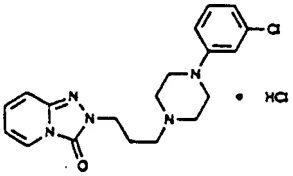
Molecular Weight: 408.33
Description: Trazodone Hydrochloride USP - white to off-white crystalline powder.
Melts between 231 and 234o C when the melting point determination is carried out in an evacuated capillary tube; otherwise melts with decomposition over a broad range below 230°C.
Solubility: sparingly soluble in chloroform and in water.
Other Characteristics: Trazodone is not chemically related to tricyclic, tetracyclic, or other known antidepressants.
Storage requirements: Trazodone should be stored in tight, light-resistant containers, at controlled room temperature (15-30°C).
COMPOSITION
TRAZOREL tablets contain: Trazodone hydrochloride USP, croscarmellose sodium, lactose, magnesium stearate, cellulose, povidone
PHARMACOLOGY The pharmacological profile of trazodone differs significantly from that of other known psychopharmacological agents.
Trazodone impedes the membrane uptake of serotonin. Small doses of the drug impede the depletion of brain serotonin, by fenfluramine, but doses of 50 mg/kg do not affect the concentration of serotonin in the rat brain. In experimental studies, trazodone is a weak inhibitor of noradrenalin re-uptake but is practically inactive against l-dopa, histamine, and acetylcholine. It has no known monoamine oxidase inhibiting activity.
Trazodone exhibits CNS depressant properties, causing decreased motor activity in cats, rats and mice and increasing the hexobarbital-induced sleeping time in mice. It also inhibits conditioned avoidance responding in rats at doses which do not influence the unconditioned response (ED50=19.5 mg/kg p.o.). Trazodone has no anticonvulsant, anti-reserpine or cataleptogenic effects and its muscle relaxant activity is very weak.
In mice, responses to painful stimuli are suppressed by doses at which motor activity is unaffected (<10 mg/kg p.o.), and oxotremorine-, clonidine- and nicotine-induced tremors are significantly inhibited by 12.5 mg/kg i.p. Trazodone protects grouped mice against amphetamine-induced toxicity, but does not inhibit the stereotyped behavior due to amphetamine or apomorphine.
In rats, infusion of trazodone produces first a fall in mean blood pressure, followed by ECG changes only as a consequence of the hypotension produced. In anesthetized dogs, graded doses between 1 and 30 mg/kg i.v. demonstrated no effect on His bundle conduction and no evidence of heart block or rhythm disturbance other than the slowing of normal sinus rhythm, while 0.5 to 5 mg/kg imipramine slowed impulse conduction as well as atrial transmission.
The effect of trazodone on the sleep-wakefulness cycle in rats was comparable to that of similar doses of imipramine. 10 mg/kg p.o. reduced and 160 mg/kg completely suppressed REM sleep.
TOXICOLOGY
Acute Toxicity
| LD50 in mg/kg (95% confidence limits) | ||||
| Route | Species | |||
| Mouse | Rat | Rabbit | Dog | |
| Intravenous | 91 (82-101) | 91 (86-96) | 52 | >40 |
| Intraperitoneal | 210 (189-233) | 178 (162-196) | - | - |
| Oral | 610 (540-689) | 690 (616-733) | 560 | 500 |
Signs of toxicity included dyspnea, salivation, ptosis, agressivity, hypoactivity, prostration, and clonic convulsions.
Subacute and Chronic Toxicity: In several subacute studies in rats, 100 to 450 mg/kg/day per os for one to four months produced a decrease in body weight gain and slight liver enlargement in males as the main toxic effects. The highest dose also caused some deaths. In dogs, 50 and 100 mg/kg/day per os for one month produced tremors, vomiting and clonic convulsions.
One of two dogs receiving 100 mg/kg died after 3 weeks. In a 6-month rat study, administration of approximately 250 mg/kg/day in the diet resulted in significantly greater liver weights than in control rats and in slightly lower weight gain in males. Dogs receiving 5 and 25 mg/kg/day for 6 months showed no toxic effects.
An 18-month study was carried out in rats using doses of 0, 30, 100, and 300 mg/kg/day p.o. A decrease in body weight gain was seen in all treated groups and males at the highest dose level showed significantly reduced food intake. No behavioral or pathologic effects were observed at the lowest dose level, while rats at the 100 mg/kg dose exhibited some lethargy and salivation immediately following dosing. At the highest dose level, there was excessive salivation and the animals became inactive, assuming a prone position for approximately 3 hours after dosing. Occasionally body tremors were also seen. Tolerance developed to all these reactions within 30 weeks.
Beagle dogs were given oral doses of 0, 10 and 40 mg/kg/day for one year; however, after 8 weeks the highest dose was reduced to 30 mg/kg/day following the death of 3/10 animals in the group. No abnormal signs were observed at the 10 mg/kg level. In the 20 mg/kg/day group, one animal was found prostrate and panting on one occasion and another was unexpectedly found dead near the end of the study. 40 mg/kg produced occasional transient ataxia, excessive salivation and convulsions. Following the three deaths and the reduction of dosage to 30 mg/kg, a fourth death occurred 16 weeks later, subsequent to convulsions. A fifth animal became hypersensitive to touch and aggressive during the final 6 months of the study. Haematological and biochemical analyses were normal apart from one case of transient anemia in the 20 mg/kg group and slightly elevated SGPT values in 2/6 high dosed dogs during the final 3 months.
Groups of 6 rhesus monkeys received 0, 20, 40, and 80 mg/kg/day of trazodone by gavage of one year. The only effects noted were a slight dose-related decrease in activity and tremors in 3 high dose monkeys. Both effects decreased during the study.
Reproductive Studies: A number of reproductive studies were performed. Fertility and general reproductive performance of male and female rats were not affected by doses of up to 250 mg/kg/day. At 300 mg/kg, the birth weight of pups was significantly reduced.
In one rat study, 100 and 210 mg/kg/day p.o. was given during days 10-15 and 6-15 of gestation respectively, and another study, 150 to 450 mg/kg/day p.o. during days 9-14 of gestation. At 100 mg/kg only a sedative effect on dams was noted. 150 mg/kg and higher doses produced increased sedation, decreased maternal and fetal weights, and retarded ossification. 300 and 450 mg/kg resulted in a significant increase in resorption and stillborn feti in addition to retarded fetal growth. Also noted were isolated cases of branched rib, separated thoracic arch, umbilical hernia, and exencephalia.
Peri- and postnatal effects of up to 300 mg/kg/day of trazodone were examined in rats. The only effects observed were reduced birth and weaning weights of offspring in the highest dosage group.
Carcinogenicity Studies: A two-year carcinogenicity study was performed in rats at dose levels of 0, 40 and 80 mg/kg/day. Larger numbers of female rats in both treatment groups died sooner than controls and most deaths were related to the presence of pituitary tumors. The incidence of palpable masses (mammary tumors, cysts, etc.) also was increased in both treatment groups at 12, 13, and 14 months. The observations may be related to the effects of trazodone on prolactin secretion. (Acute administration caused an increase in prolactin blood levels; chronic administration did not; however, turnover was not studied. A neuroleptic, used as a positive control, produced similar results). The relative incidences of male rats with pituitary tumors were reversed; however, early deaths due to nephritis and other causes might have influenced these observations.
SELECTED REFERENCES
Preclinical :
- 1.
Baiocchi L et al. Basic metabolites of trazodone in humans. Arzneim-Forsch
1974;24:1699.
- 2.
Catanese B, Lisciani R. Investigations on the absorption and distribution of trazodone or
AF 1161 in rats, dogs and humans. Boll Chim Farm 1970;109:369.
- 3.
Garattini S et al. Effects of trazodone on serotonin in the brain and platelets of the rat.
Biochem Pharmacol 1976;25:13.
- 4. Scorza-Barcellona P. Investigations on the possible teratogenic effects of trazodone in rats and rabbits. Boll Chim Farm 1970;109:323.
- 5.
Silvestrini B et al. Pharmacological properties of AF 1161, a new psychotropic drug. Int J
Neuropharmacol 1968;7:587.
Clinical :
- 1. Fabre LF, et al. Trazodone efficacy in depression: A double-blind comparison with imipramine and placebo in day-hospital type patients. Curr Ther Res 1979;25:827.
- 2.
Goldberg HL et al. Treatment of neurotic depression with a new antidepressant. J of
Clinical Psychopharm 1981;1(6):35S-38S.
- 3. Gerner R et al. Treatment of geriatric depression with trazodone, imipramine and placebo: A double-blind study. J of Clinical Psychiatry 1980;41(6):216-220.
- 4. Kellams JJ et al. Trazodone, a new antidepressant: Efficacy and safety in endogenous depression. J of Clinical Psychiatry 1979;40(9):390-395.
- 5. Gershon S et al. Lack of anticholinergic side effects with a new antidepressant – trazodone. J of Clinical Psychiatry 1980;40(3):100-104.
- 6. Feighner JP. Trazodone, a triazolopyridine derivative, in primary depressive disorder. J of Clinical Psychiatry 1980;41(7):252-255.
- 7.
Trazodone. Proceedings of the 1st International Symposium. Montreal, 1973. In: Ban
TA, Silvestini B, editors. Modern Problems of Pharmacopsychiatry. Karger; 1974 (vol.
9).
- 8.
Goldstein I et al. Pharmacologic detumescence: The alternative to surgical shunting. J of
Urology 1986 Apr;135(4 :PEII):308A.
- 9. Padma-Nathan H et al. Treatment of prolonged or priapistic erections following intercavernosal papaverine therapy. Seminars in Urology 1986;IV.
- 10. Gamble DE, Peterson LG. Trazodone overdose: Four years of experience from voluntary reports. J of Clinical Psychiatry 1986;47(11):544-546.
BIBLIOGRAPHY
- 1. Agnoli A. Historique et pharmacologie de la trazodone. L'Encephale 1986; XII, 239-242
- 2.
American Society of Hospital Pharmacists. American Hospital Formulary Service 1992;
1246-1250.
- 3.
Baldessarini RJ. Drugs and the treatment of psychiatric disorders. In: Goodman and
Gilman's: The Pharmacological Basis of Therapeutics. 8th Edition, Pergamon Press,
1990; 404-414.
- 4.
Brogden RN, Heel RC, Speight TM and Avery GS. Trazodone: A review of its pharmacological properties and therapeutic use in depression and anxiety. Drugs
1981;21:401-429.
- 5.
Fabre LF, and Feighner JP. Long-term therapy for depression with trazodone. J Clin
Psychiatry 1983; 44:17-21.
- 6. Feighner JP. Trazodone in major affective disorders. Psychopathology 1984; 17, 2:15-23.
- 7. Feighner JP, and Boyer WF. Overview of USA controlled trials of trazodone in clinical depression. Psychopharmacology 1988; 95:S50-S53.
- 8.
Gershon S, and Newton R. Lack of anticholinergic side effects with a new antidepressant
- Trazodone. J Clin Psychiatry 1980; 41, 3:100-104.
- 9.
Gershon S, Yeragani VK, and Aleem A. Tolerance et pharmacovigilance de la trazodone.
L'Encephale 1986; XII:249-257.
- 10. Kellams JJ, Klapper MH, and Small JG. Trazodone, A new anti-depressant: efficacy and safety in endogenous depression. J Clin Psychiatry 1979; 40: 390-395.
- 11.
Martindale: The Extra Pharmacopoeia: Trazodone hydrochloride. 29th Edition. The
Pharmaceutical Press, London, 1989; 381-383.
- 12.
Monteleone P, and Gnocchi G. Evidence for a linear relationship between plasma trazodone levels and clinical response in depression in the elderly. Clinical
Neuropharmacology 1990; 13, Suppl. 1:S84-S89.
- 13. Rakel RE. The greater safety of trazodone over tricyclic antidepressant agents: 5-year experience in the United States. Psychopathology 1987; 20, Suppl. 1:57-63.
- 14.
Schatzberg AF. Trazodone: A 5-year review of antidepressant efficacy. Psychopathology
1987; 20, Suppl. 1:48-56.
- 15.
Silvestrini B, and Pacifico V. Trazodone, a new avenue in the treatment of depression.
Psychopathology 1984; 17, Suppl. 2: 3-14.
- 16.
Spivak B, Radvan M, and Meltzer M. Side effects of trazodone in a geriatric population.
J Clin Psychopharmacol 1989; 9, No. 1:62-63.