


Patient Medication Information: uses, side effects, how to take - Vyalev
Serious warnings and precautions box
What VYALEV is used for:
VYALEV is used in adults:
- to treat severe and disabling motor symptoms from advanced Parkinson’s disease, and
- when these symptoms cannot be well-controlled with other Parkinson’s disease medicines.
How VYALEV works:
Sleep warning:
Taking VYALEV can cause you to feel dizzy, drowsy, light-headed, or sleepy. You may also suddenly fall asleep (sleep attacks) without any warning signs. This can happen at any time including when you are engaged in daily activities like driving a car, which can cause accidents. These symptoms may happen more often if you take other medicines or have a sleeping disorder. If you have any of these symptoms, tell your healthcare professional right away. Before you do any tasks that may require your attention, you should wait until you know how you react to VYALEV.
Infusion site reactions and infections:
VYALEV is administered under your skin (i.e., “subcutaneous infusion”) into your abdomen using an infusion pump. This can cause skin reactions and infections at the infusion sites, which can lead to a life-threatening condition known as sepsis. Tell your healthcare professional if you notice any skin changes at the infusion site (e.g., redness, warmth, swelling, pain, or discoloration when you apply pressure to it). You should always administer VYALEV exactly as your healthcare professional has told you. If you are unsure or if you forget how to properly take VYALEV, ask your healthcare professional.
VYALEV belongs to a group of medicines known as antiparkinson agents. It is a combination of two medicinal ingredients foslevodopa and foscarbidopa. In the body, foslevodopa is made into the chemical called dopamine that helps transfer signals between nerve cells. With Parkinson’s disease, patients have low dopamine levels causing movement problems such as tremor, feeling stiff, slow movement, and balance problems. The medicinal ingredients in VYALEV work together as follows:
- Foslevodopa: increases the amount of dopamine in your body to reduce these movement problems.
- Foscarbidopa: improves the effect of foslevodopa and reduces the side effects of foslevodopa.
The ingredients in VYALEV are:
Medicinal ingredient(s): foslevodopa and foscarbidopa
Non-medicinal ingredients: hydrochloric acid, sodium hydroxide, and water for injection
VYALEV comes in the following dosage form:
- Solution: 240 mg of foslevodopa and 12 mg of foscarbidopa per mL
Do not use VYALEV if:
- you are allergic to foslevodopa, levodopa, foscarbidopa, carbidopa, or to any other ingredients in VYALEV.
- you are taking or have recently taken in the last 14 days monoamine oxidase (MAO – type A) inhibitor antidepressants.
- you are taking medicines known as sympathomimetic amines (e.g., epinephrine, norepinephrine, and isoproterenol).
- you have a condition where you must not take any medicines that can increase your blood pressure, increase your heart rate, or constrict your blood flow. This can include if you have a condition known as pheochromocytoma, hyperthyroidism, or Cushing's syndrome.
- you have untreated heart, vascular, liver, kidney, lung (e.g., asthma), blood, or hormonal disease.
- you have narrow-angle glaucoma (eye pain caused by increased pressure in the eyes).
- you have unknown skin problems or a history of a skin cancer (i.e., melanoma).
To help avoid side effects and ensure proper use, talk to your healthcare professional before you take VYALEV. Talk about any health conditions or problems you may have, including if you:
- have or have had heart or blood vessel problems (e.g., heart attacks or abnormal heart rhythms).
- have lung problems (e.g., asthma).
- have severe kidney, liver, or hormone problems.
- have or have had mental health problems (e.g., depression, suicidal thoughts, or hallucinations).
- have an eye problem known as glaucoma.
- have or have had an ulcer in your stomach or intestines.
have or have had a condition known as polyneuropathy (damage to the nerves in your skin, muscles, and organs), or if you are at a higher risk of having polyneuropathy. This can include if you have:
- vitamin B12 or vitamin B6 deficiencies;
- diabetes;
- low thyroid hormone (hypothyroidism).
- have had any seizures in the past or are at a higher risk of having seizures.
- are on a low salt diet.
are pregnant, plan to become pregnant, or are able to become pregnant and are not using a birth control method.
- are breastfeeding or plan to breastfeed.
Other warnings you should know about:
Impulse control disorders: VYALEV can cause impulse control disorders that cause:
- you to develop urges or cravings to behave in ways that are unusual for you; or
- you to be unable to resist the impulse, drive, or temptation to carry out certain activities that could harm yourself or others.
Tell your healthcare professional right away if you, your family, or caregiver notices that you are showing signs of impulse control disorders. This can include:
- addictive gambling;
- addiction-like symptoms leading to cravings for VYALEV and other medicines used to treat Parkinson’s disease;
- excessive buying or spending;
- binge eating or compulsive eating; and
- abnormally high sex drive or an increase in sexual thoughts or feelings.
Your healthcare professional may change your dose if you develop an impulse control disorder or signs of one.
Infusion site reactions and infections:
- Tell your healthcare professional if you notice any skin changes at the infusion site. This can include redness, warmth, swelling, pain, or discolouration when you apply pressure to it.
- You should always follow aseptic (sterile) techniques while using VYALEV.
- You should regularly change the infusion site (at least every third day), using a new infusion set. Make sure the new infusion site is at least 2.5 cm from a site used in the last 12 days. You may need to change the infusion site more often than every third day, if you notice any of the above-mentioned skin changes.
- If you notice signs of a local infection, ensure to treat according to your healthcare professional’s recommendations and monitor for signs of systemic infection (e.g., fever, confusion, fast heartbeat or breathing, cold and pale skin, and loss of consciousness).
Monitoring and testing: Your healthcare professional will monitor your health throughout your treatment. This may include:
- blood tests
- monitoring your liver, kidney, and heart functions
- periodic skin examinations (e.g., skin cancer and infusion site reactions or infections)
- monitoring the pressure of your eyes
You should be aware that abnormal urine dipstick test results can occur when taking VYALEV. These include having:
- a false positive result, if a urine dipstick test is used to assess the amount of ketones in the urine; and
- a false negative result, if glucose oxidase methods are used to assess the amount of glucose in the urine.
Melanoma (a type of skin cancer): Studies of people with Parkinson’s disease show that they may be at an increased risk of developing melanoma, when compared to people without Parkinson’s disease. It is not known if this problem is associated with Parkinson’s disease, or the drugs used to treat Parkinson’s disease. Do not take more VYALEV than prescribed by your healthcare professional. You should take VYALEV exactly as directed by your healthcare professional.
Sodium content: VYALEV is high in sodium. It contains 42.4 mg of sodium per millilitre. You should keep track of your daily sodium intake to ensure that you do not exceed your total daily limit, especially if you are on a low salt diet.
Tell your healthcare professional about all the medicines you take, including any drugs, vitamins, minerals, natural supplements or alternative medicines.
Serious drug interactions:
Serious drug interactions with VYALEV include:
- monoamine oxidase (MAO – type A) inhibitor antidepressants, medicines used to treat depression. You must stop taking MAO inhibitor antidepressants at least 14 days before starting your treatment with VYALEV.
- sympathomimetic amines, medicines that can be used for treating asthma, increasing heart rate and blood pressure (e.g., epinephrine, norepinephrine, isoproterenol, and amphetamine).
The following may also interact with VYALEV:
- antiemetics, medicines used to prevent nausea or vomiting.
- antihypertensives, medicines used to treat high blood pressure.
- benzodiazepines, medicines used to help you sleep or that help reduce anxiety.
- caffeine, used to increase alertness.
- isoniazid, a medicine used to treat tuberculosis.
- medicines used to treat mental health disorders (e.g., antipsychotics, phenothiazines, butyrophenones, risperidone, antidepressants, fluvoxamine, clozapine, duloxetine, melatonin)
- medicines used to treat Parkinson’s disease (e.g., catechol-o-methyl transferase (COMT) inhibitors; MAO inhibitors (type-B) can be taken concomitantly but selegiline and levodopa concomitant use has been associated with low blood pressure).
- papaverine, a medicine used to increase blood flow and treat spasms.
- phenytoin, a medicine used to treat seizures or epilepsy.
- renal uptake transporter substrates, medicines that can be absorbed by the kidney uses certain proteins called transporters.
- theophylline, a medicine used to treat asthma and other lung problems.
How to take VYALEV:
- Always take VYALEV exactly as prescribed by your healthcare professional.
- Your healthcare professional will train you on the proper use of VYALEV and the VYAFUSER pump before you start your treatment and, as necessary, thereafter. Check with your healthcare professional if you have any questions.
- Always following aseptic (sterile) techniques while using VYALEV.
- Wash your hands before handling any of the system components (vial, syringe, infusion set/tube).
- VYALEV is administered under your skin (called “subcutaneous infusion”). It will be administered near your stomach using an infusion pump called VYAFUSER pump. Do NOT administer VYALEV using any other route of administration and do NOT use another infusion pump. Refer to the VYAFUSER pump instructions for use for the details.
- The VYALEV solution comes in a glass vial. The solution from the vial is transferred to a sterile syringe and the syringe is then placed within the VYAFUSER pump. The VYAFUSER pump is connected via a tube for subcutaneous infusion under your skin. The VYAFUSER pump continuously gives you the medicine for 24 hours. You may need to reload the pump with a new syringe within a 24-hour period to make sure you have enough medicine in your blood to control your symptoms.
VYALEV can be taken with or without food.
- You should regularly change the infusion site (at least every third day) using a new infusion set. Make sure the new infusion site is at least 2.5 cm from a site used within the last 12 days. You may need to change the infusion site more often, if you notice any skin reactions or infections. This can include if you notice any redness, warmth, swelling or lumps/bumps, bleeding, pain, or discoloration when you apply pressure to the infusion site. Tell your healthcare professional if you notice any of these symptoms.
- Ensure that the tube (soft cannula) is firmly in place and that there is no solution leaking from the infusion site.
- Do NOT swim, bathe, or shower with the VYAFUSER pump.
- If the adhesive of the infusion tube becomes loose, change the infusion tube and rotate the infusion site.
- Do NOT stop or change your dose of VYALEV unless your doctor tells you to. Suddenly stopping or lowering your VYALEV dose quickly may cause a serious problem called “Neuroleptic Malignant Syndrome”.
Read the Instructions for use before using VYALEV.
Usual dose:
Your healthcare professional will decide the right dose of VYALEV for you. This can depend on your age, if you take other medicines, your medical condition, and how you respond to VYALEV.
Overdose:
If you think you, or a person you are caring for, have taken too much VYALEV, contact a healthcare professional, hospital emergency department, regional poison control centre or Health Canada’s toll-free number, 1-844 POISON-X (1-844-764-7669) immediately, even if there are no signs or symptoms.
Missed dose:
If you miss a dose for:
- A short period of time (e.g., to take a shower): Start your pump with your normal dose as soon as possible.
- More than 1 hour: If the dose is missed for more than 1 hour, a new infusion set (including tubing and cannula) should be used and rotated to a different infusion site.
- More than 3 hours: You may need to self-administer a loading dose to quickly regain control of your symptoms. Talk to your healthcare professional about what to do in those situations.
- More than 24 hours: Tell your healthcare professional. They may need to adjust your dose before you can resume your treatment.
If you have any further questions on the use of this medicine, ask your healthcare professional.
Possible side effects from using VYALEV:
These are not all the possible side effects you may have when taking VYALEV. If you experience any side effects not listed here, tell your healthcare professional.
The side effects of VYALEV may include:
- constipation;
- diarrhea;
- nausea;
- difficulty breathing;
- dry mouth;
- falls;
- feeling dizzy when standing up from a sitting or lying down position;
- stomach pain or swollen stomach;
- swelling of the feet, ankles, legs, hands, and arms;
- vertigo;
- joint pain and swelling;
- decreased appetite;
- cough;
- fever.
Serious side effects and what to do about them:
| Frequency/Side Effect/Symptom | Talk to your healthcare professional | Stop taking this drug and get immediate medical help | |
|---|---|---|---|
| Frequency/Side Effect/Symptom | Talk to your healthcare professional | Stop taking this drug and get immediate medical help | |
| Frequency/Side Effect/Symptom | Talk to your healthcare professional | Stop taking this drug and get immediate medical help | |
| Frequency/Side Effect/Symptom | Talk to your healthcare professional | Stop taking this drug and get immediate medical help | |
| Only if severe | In all cases | ||
| Only if severe | In all cases | ||
| Only if severe | In all cases | ||
| Only if severe | In all cases | ||
| Very common | |||
| Dyskinesia: involuntary movements that you can’t control, muscle spasms, or muscle twitching. | ✓ | ||
| Hallucinations: seeing or hearing things that are not there | ✓ | ||
| Infusion site reactions and infections: redness, warmth, swelling, pain, itchiness, irritation, rash, infection, bruising, skin discoloration when pressure is applied, or signs of sepsis (e.g., fever, confusion, fast heartbeat, fast breathing, cold and pale skin, or loss of consciousness). | ✓ | ||
| On-off phenomenon (medicine wears off before your next dose): changes to movement control, tremor, rigidity, or slow movement re-emerge. | ✓ | ||
| Common | |||
| Cataracts: clouding of the lens in the eye, blurry vision, dim vision and/or eye pain. | ✓ | ||
| Freezing phenomenon: unable to move your feet or feeling that your feet are frozen or stuck to the ground. | ✓ | ||
| Hypertension (high blood pressure): shortness of breath (dyspnea), fatigue, dizziness, fainting, chest pain or pressure, swelling in your ankles and legs, bluish colour to your lips and skin, racing pulse, or heart palpitations. | ✓ | ||
| Hypokalemia (low level of potassium in the blood): muscle weakness, muscle spasms, cramping, constipation, feeling of skipped heart beats or palpitations, fatigue, tingling or numbness. | ✓ | ||
| Hypotension (low blood pressure): dizziness, fainting, light- | ✓ | ||
| headedness, blurred vision, nausea, vomiting, or fatigue. | |||
| Impulse control disorder (urges and behaviours that are unusual): addictive gambling, addiction to other medicines, excessive buying or spending, binge eating or compulsive eating, or abnormally high sex drive or an increase in sexual thoughts or feelings. | ✓ | ||
| Mental or behavioural changes: loss of memory, impaired thinking and decision-making, panic attacks, confusion, false beliefs (delusion), paranoia, anxiety, delirium, depression, difficulty sleeping (insomnia), difficulty falling asleep, sleeping too much, changes in appetite or weight, feelings of worthlessness, guilt, regret, helplessness or hopelessness, withdrawal from social situations and activities, reduced sex drive, or thoughts of death or suicide. | ✓ | ||
| Urinary incontinence (involuntary loss of urine) | ✓ | ||
| Uncommon | |||
| Osteoarthritis (reduction of cartilage in the joints): joint pain, stiffness, reduced range of motion, clicking or popping when a joint is bent, loss of balance, swelling around a joint, or muscle weakness. | ✓ | ||
| Unknown | |||
| Glaucoma: eye pain, increased eye pressure, eye redness, headache, blurred vision, nausea, or vomiting. | ✓ | ||
| Nervous system problems (including neuroleptic malignant syndrome): muscle stiffness or inflexibility, increased body temperature, agitation, confusion, | ✓ | ||
| coma, rapid or irregular heartbeat, sweating, confusion, reduced consciousness, numbness, tingling, decreased sensation, weakness, or pain in the feet, ankles, legs, hands, and arms. | |||
| Melanoma (a type of skin cancer): unusual skin growth, itchiness, tenderness, pain, or a change, swelling, or redness of an existing mole. | ✓ | ||
| Polyneuropathy (damage to the nerves in your skin, muscles, and organ): decreased ability to sense vibrations, sharp shooting pain, numbness, tightness, tingling, burning, or sensory loss. | ✓ | ||
| Suddenly falling asleep (sleep attacks): feeling sleepy, dizzy, drowsy, or light-headed. | ✓ | ||
If you have a troublesome symptom or side effect that is not listed here or becomes bad enough to interfere with your daily activities, tell your healthcare professional.
Reporting side effects
You can report any suspected side effects associated with the use of health products to Health Canada by:
- Visiting the Web page on Adverse Reaction Reporting (canada.ca/drug-device-reporting) for information on how to report online, by mail or by fax; or
- Calling toll-free at 1-866-234-2345.
NOTE: Contact your healthcare professional if you need information about how to manage your side effects. The Canada Vigilance Program does not provide medical advice.
Storage:
- Store the vials in a refrigerator at 2°C to 8°C. Do NOT freeze or use any solution that has been frozen.
- The vials may be kept at room temperature (maximum of 30°C) for up to 28 days. Do NOT return any vials to the refrigerator once they have been stored at room temperature. To help you keep track, you should record the date when the vials are removed from the refrigerator. A space is provided on the carton.
- Do NOT use the solution after the expiry date stated on the vial and carton.
- Do NOT use the solution if it is cloudy, has flakes, has particles.
- Dispose all supplies and unused solution according to local regulations.
Keep out of reach and sight of children.
If you want more information about VYALEV:
- Talk to your healthcare professional
- Find the full product monograph that is prepared for healthcare professionals and includes the Patient Medication Information by visiting the Health Canada Drug Product Database website (https://www.canada.ca/en/health-canada/services/drugs-health-products/drug-products/drug-product-database.html); the manufacturer’s website www.abbvie.ca ; or by calling 1-888-704-8271.
- Information about the support services can be obtained by visiting www.abbviecare.ca or by calling the Abbvie Care Support Program at 1-844-686-3672
Date of Authorization: 2026-04-14
© 2026 AbbVie. All rights reserved.
VYALEV®is a trademark of AbbVie AB.
VYAFUSER™ is a trademark of AbbVie AB.
All trademarks, product names and company names or logos cited that are not AbbVie-owned or licensed trademarks within the content are used for identification purposes only and are the property of their respective owners. No right or license is being granted to AbbVie by implication or otherwise to use any third party owned trademarks.
INSTRUCTIONS FOR USE
Preparing the VYALEV® solution with the VYAFUSER™ Pump
For subcutaneous infusion only.
Please read all of the instructions before using VYALEV.
Before using VYALEV:
Your healthcare professional will train you on how to properly self-administer VYALEV using the delivery system (i.e., VYAFUSER pump, VYALEV vial, vial adapter, syringe, infusion set, carrying accessories, rechargeable battery, and charger). Ask your healthcare professional if you are unsure.
Storage:
- VYALEV can be stored at room temperature (up to 30°C) for up to 28 days. It is good practice to keep just one (1) carton of VYALEV at room temperature at a time. To help you keep track, you should record the date when the vials are removed from the refrigerator. A space is provided on the carton.
- Store the additional cartons in the refrigerator at 2°C to 8°C, until needed.
- Always withdraw the entire contents of the solution from the vial into the syringe. Do NOT save any VYALEV solution for later use.
- Discard VYALEV if it has been stored at room temperature (up to 30°C) for longer than 28 days.
Do NOT freeze the VYALEV solution and do NOT use any solution that has been frozen.
IMPORTANT INFORMATION
VYALEV Solution:
- The VYALEV solution colour may vary and has no impact on product quality. It may be colourless, or may vary in colour anywhere between light yellow and brown, possibly with purple or red tint. It may become darker in color while in the syringe.
- Do NOT use the solution if it is cloudy, has flakes, or has particles.
- If the vial is refrigerated prior to use, remove the VYALEV vial from the refrigerator and allow it to sit at room temperature out of direct sunlight for 30 minutes.
- Do NOT dilute the VYALEV solution or fill the syringe with any substance other than what your healthcare professional has prescribed.
Disposable Components (Vial Adapter and Syringe)
- A new vial adapter must be used with each new VYALEV vial.
- Do NOT use the VYALEV solution if it has been in the syringe for more than 24 hours.
A. Transfer Solution from the VYALEV Vial to the Syringe
- 1. Make sure your workspace is clean. This will help to avoid contamination.
- 2.
Gather the following supplies (see Figure A):
- - Syringe
- - VYALEV Vial
- - Vial Adapter
- - Alcohol Pads
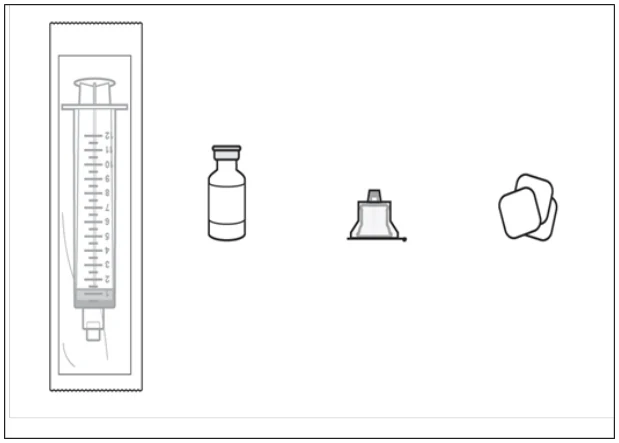
Figure A
- 3.
Inspect components for expiration and for any packaging damage. This should include the VYALEV vial (see Figure B), vial adapter, and syringe.
- • Verify the solution is the VYALEV solution prescribed by your healthcare professional.
- • Do NOT use the VYALEV solution, vial adapter, or syringe if it is expired.
- • Do NOT use any components if their sterile packaging has been damaged prior to use.
Note: The product packaging for the infusion set, vial adapter, and syringe indicates if they are sterile and how they were sterilized.
Syringe
Solution vial
Vial adapter
Alcohol pads
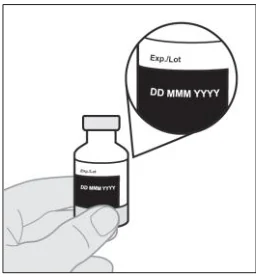
Figure B
- 4.
Inspect the contents of the VYALEV vial (see Figure C).
- •
Verify the following:
- - No cloudiness of the liquid.
- - No particles observed in liquid.
- •
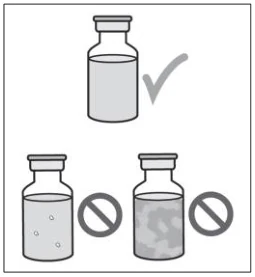
Figure C
- Do NOT use if the VYALEV solution is cloudy or contains flakes or particles.
- If the vial is refrigerated prior to use, remove the vial from the refrigerator and allow it to sit at room temperature out of direct sunlight for 30 minutes. Do NOT warm the VYALEV solution (in vial or syringe) in any other way other than letting it warm at room temperature. For example, do NOT warm in a microwave or in hot water.
- Wash your hands with soap and water and dry them (see Figure D).
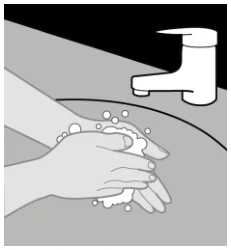
Figure D
- 6.
Prepare VYALEV vial.
- a. Remove the vial cap (see Figure E).
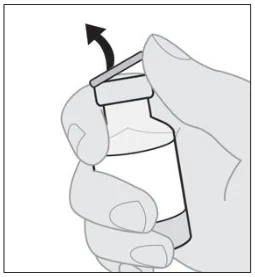
Figure E
- b. Wipe the top of the vial with an alcohol pad and allow to dry (see Figure F). This will help to avoid contamination.
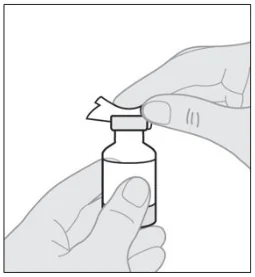
Figure F
- 7.
Attach the vial adapter to the VYALEV vial.
- • Please refer to your Vial Adapter Instructions For Use for detailed steps.
Note: The Instructions for Use of vial adapter will be provided by your healthcare professional. If you are unsure about any instructions or if you have misplaced these instructions, ask your healthcare professional."
Vial Adapter
- 8.
Prepare the syringe.
- a. Obtain a new syringe and remove it from its packaging.
- b. Depress the rubber plunger to fully expel all air (see Figure G).
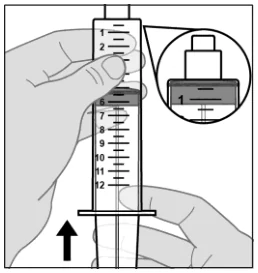
Figure G
- To minimize the risk of infections, do NOT let the tip of any disposable component come into contact with any unclean surfaces. If the tip of the vial adapter or syringe comes into contact with an unclean surface, discard it and get a new one.
- While holding the vial adapter firmly, attach the syringe to the vial adapter by pushing and then screwing it into place (see Figure H).
- Do NOT overtighten.
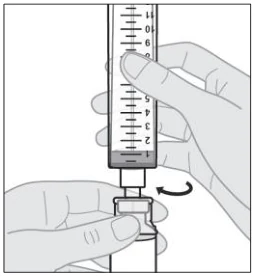
Figure H
- 10.
Hold the syringe vertically with the VYALEV vial above the syringe (see Figure I).
Note: Your vial adapter may look different than in Figure I.
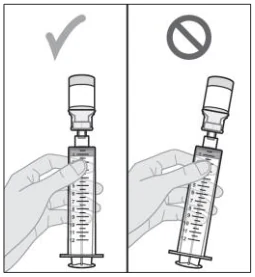
Figure I
- 11.
Withdraw full contents of the vial into the syringe.
- a.
While holding the syringe firmly in one hand, pull down the plunger rod with the other hand to withdraw the full contents of the VYALEV vial into the syringe to around the 12 mL mark, or until you see air at the tip of the syringe (see Figure J).
Notes:
- It is important to hold the syringe pointing straight up.
- Always withdraw the entire contents of the VYALEV vial into the syringe.
- You will see air (head space) at the tip of the syringe.
- a.
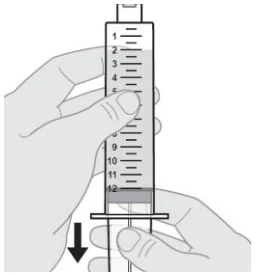
Figure J
- 12.
Inspect for air bubbles.
- • If there are large air bubbles, they must be removed. Presence of air may affect dose delivery accuracy.
- • As seen in Figure K, small bubbles are acceptable and the air at the tip of the syringe (the head space) is expected.
- • As seen in Figure L, larger air bubbles are not acceptable. While the air at the top of the syringe (the head space) is expected, the larger bubbles are not.
- a. IF YOU SEE LARGE AIR BUBBLES, continue with Section B: Manually Remove Air Bubbles.
- b. IF YOU SEE SMALL AIR BUBBLES or DO NOT SEE ANY AIR BUBBLES, skip the next section and proceed to Section C: Purge Air from Syringe.
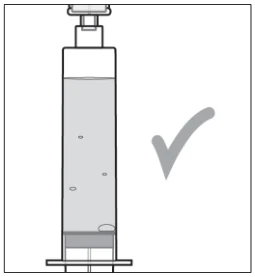
Figure K
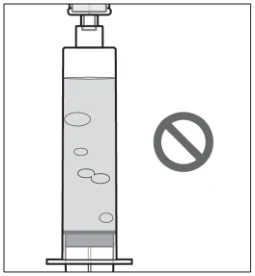
Figure L
B. Manually Remove Air Bubbles
- 13.
Gather the bubbles into a single air bubble.
- a.
Slowly and gently rotate the syringe and tilt it back and forth (see Figure M). Do NOT shake or tap the syringe to remove the air bubbles.
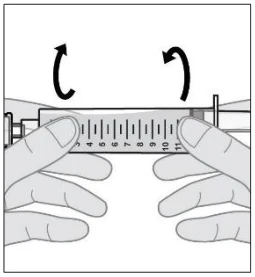
Figure M
- a.
Note: If there are still air bubbles, gather the bubbles by gently rotating the syringe end over end (see Figure N).
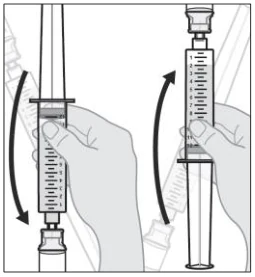
Figure N
- b. When the large air bubbles are gathered into a single air bubble, continue with the next step.
C. Purge Air from Syringe
- 14.
Push air out of the syringe.
- a. With the vial still attached, point the syringe upward.
- b. Slowly push the air out of the syringe and into the vial (see Figure O).
- c. Continue pushing until all of the air is pushed out the syringe and into the vial and there is solution visible in the syringe tip.
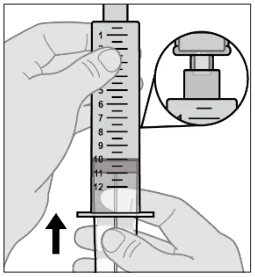
Figure O
Notes:
- Some resistance will be felt as the air is pushed back into the vial.
- If the syringe is tilted slightly and not pointing straight up, you may see a small air bubble in the corner (see Figure P). This is acceptable.
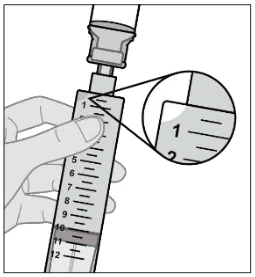
Figure P
- 15. Invert syringe and vial so that the vial is upright on the table (see Figure Q).
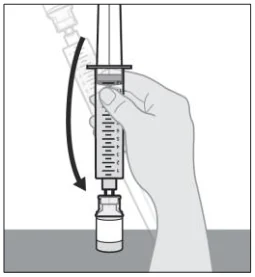
Figure Q
- 16.
Disconnect the syringe from the vial adapter.
- a. Hold the vial adapter firmly with one hand and the barrel of the syringe with the other.
- b. Unscrew the syringe from the vial adapter (see Figure R). When disconnecting the syringe from the vial, do NOT push the plunger or else the solution will leak.
- c. Place the syringe on a clean surface, making sure the syringe tip does not contact an unclean surface. To minimize the risk of infections, do NOT let the tip of any disposable component come into contact with any unclean surfaces. If the tip of the vial adapter or syringe comes into contact with an unclean surface, discard it and get a new one.
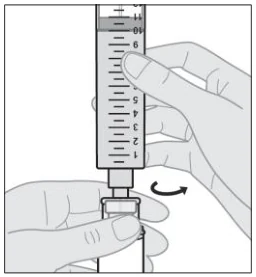
Figure R
- 17. Your syringe is now ready for use. Follow the next step as indicated in your Patient Instructions for Use of VYAFUSER Pump.
The Instructions for Use of the VYAFUSER pump will be provided by your healthcare professional. If you are unsure about any instructions or if you have misplaced these instructions, ask your healthcare professional.
Patient Instructions for Use of VYAFUSER Pump
D. Disposal
- 18. Used vials with the vial adapters still attached should be disposed of according to local regulations or as directed by your healthcare professional.
If you have any questions or concerns:
Call your healthcare professional to talk about any questions you may have. For questions or concerns visit the manufacturer’s website (www.abbvie.ca), patient support program (www.abbviecare.ca) or call 1-888-704-8271.
Date of Authorization:
© 2026 AbbVie. All rights reserved.
VYALEV® is a trademark of AbbVie AB.
VYAFUSER™ is a trademark of AbbVie AB.
All trademarks, product names and company names or logos cited that are not AbbVie-owned or licensed trademarks within the content are used for identification purposes only and are the property of their respective owners. No right or license is being granted to AbbVie by implication or otherwise to use any third party owned trademarks.