


Product Monograph - Zarontin Syrup
RECENT MAJOR LABEL CHANGES
| 7 WARNINGS AND PRECAUTIONS, Hematologic | 07/2022 |
| 7 WARNINGS AND PRECAUTIONS, Skin | 07/2022 |
TABLE OF CONTENTS
Sections or subsections that are not applicable at the time of authorization are not listed.
RECENT MAJOR LABEL CHANGES .......................................................................................... 2
TABLE OF CONTENTS ............................................................................................................ 2
PART I: HEALTH PROFESSIONAL INFORMATION .................................................................... 4
1 INDICATIONS ............................................................................................................. 4
1.1 Pediatrics .................................................................................................................. 4
1.2 Geriatrics .................................................................................................................. 4
2 CONTRAINDICATIONS ................................................................................................ 4
3 SERIOUS WARNINGS AND PRECAUTIONS BOX ........................................................... 4
4 DOSAGE AND ADMINISTRATION ................................................................................ 4
4.1 Dosing Considerations ............................................................................................. 4
4.2 Recommended Dose and Dosage Adjustment ........................................................ 4
4.4 Administration ......................................................................................................... 5
4.5 Missed Dose ............................................................................................................. 5
5 OVERDOSAGE ............................................................................................................ 5
6 DOSAGE FORMS, STRENGTHS, COMPOSITION AND PACKAGING ................................ 5
7 WARNINGS AND PRECAUTIONS ................................................................................. 6
7.1 Special Populations .................................................................................................. 8
7.1.1 Pregnant Women ............................................................................................... 8
7.1.2 Breast-feeding .................................................................................................... 8
7.1.3 Pediatrics ............................................................................................................ 8
7.1.4 Geriatrics ............................................................................................................ 8
8 ADVERSE REACTIONS................................................................................................. 9
8.5 Post-Market Adverse Reactions ............................................................................... 9
9 DRUG INTERACTIONS ................................................................................................ 9
9.2 Drug Interactions Overview ..................................................................................... 9
9.4 Drug-Drug Interactions ............................................................................................ 9
9.5 Drug-Food Interactions .......................................................................................... 10
9.6 Drug-Herb Interactions .......................................................................................... 10
9.7 Drug-Laboratory Test Interactions......................................................................... 10
10 CLINICAL PHARMACOLOGY ...................................................................................... 10
10.3 Pharmacokinetics ............................................................................................. 10
11 STORAGE, STABILITY AND DISPOSAL ........................................................................ 10
12 SPECIAL HANDLING INSTRUCTIONS .......................................................................... 11
PART II: SCIENTIFIC INFORMATION ..................................................................................... 12
13 PHARMACEUTICAL INFORMATION .......................................................................... 12
14 CLINICAL TRIALS ...................................................................................................... 12
15 MICROBIOLOGY ...................................................................................................... 12
16 NON-CLINICAL TOXICOLOGY .................................................................................... 12
PATIENT MEDICATION INFORMATION ................................................................................ 13
PART I: HEALTH PROFESSIONAL INFORMATION
1 INDICATIONS
ZARONTIN / ZARONTIN SYRUP (ethosuximide) is indicated for the control of absence (petit mal) epilepsy.
1.1 Pediatrics
Pediatrics (3-17 years): Safety and effectiveness in pediatric patients below the age of 3 years have not been established (see 4.2 Recommended Dose and Dosage Adjustment).
1.2 Geriatrics
No data are available to Health Canada. Caution should be exercised in dose selection for an elderly patient, recognizing the more frequent hepatic and renal dysfunctions.
2 CONTRAINDICATIONS
- ZARONTIN / ZARONTIN SYRUP is contraindicated in patients who are hypersensitive to ethosuximide or to any ingredient in the formulation, including any non-medicinal ingredient, or component of the container. For a complete listing, see 6 DOSAGE FORMS, STRENGTHS, COMPOSITION AND PACKAGING.
- ZARONTIN / ZARONTIN SYRUP should not be used in patients who are hypersensitive to succinimides or components of these products.
3 SERIOUS WARNINGS AND PRECAUTIONS BOX
Serious Warnings and Precautions
| Blood dyscrasias, including with fatal outcomes, have been reported to be associated with the use of ethosuximide; therefore, periodic blood counts should be performed. Should signs and/or symptoms of infection (e.g., sore throat, fever) develop, blood count determinations should be considered at that point (see 7 WARNINGS AND PRECAUTIONS, Hematologic). |
4 DOSAGE AND ADMINISTRATION
4.1 Dosing Considerations
As with other anticonvulsants, it is important to proceed slowly when increasing or decreasing dosage, as well as when adding or eliminating other medication. Abrupt withdrawal of anticonvulsant medication may precipitate absence (petit mal) status.
Patients taking ethosuximide should be advised of the importance of adhering strictly to the prescribed dosage regimen.
4.2 Recommended Dose and Dosage Adjustment
Initial dose: children aged 3 to 6 years, 250 mg daily; older patients, 500 mg daily in divided doses. The dose thereafter must be individualized according to response and tolerance. Dosage should be increased by small increments: e.g. increase daily dose by 250 mg every 4 to 7 days until control is achieved with minimal side effects. Daily dosage of 1 to 1.5 g in divided doses frequently controls seizures; however, it may be necessary to exceed this amount by slow increases and careful evaluation of patient’s response. Dosage exceeding 1.5 g daily, in divided doses, should be administered only under the strictest supervision of the physician. The optimal dose for most children is 20 mg/kg/day. This dose has given average plasma levels within the accepted therapeutic range of 280 to 710 μmol/L (40 to 100 μg/mL). Subsequent dose schedules can be based on effectiveness and plasma level determinations.
Ethosuximide may be administered in combination with other anticonvulsants when other forms of epilepsy coexist with absence (petit mal). The optimal dosage for most children is 20 mg/kg/day.
4.4 Administration
Ethosuximide can be taken with or without food.
Syrup: Advise the patient to carefully measure the dose using a measuring device/spoon. A household spoon should not be used to avoid dosing errors.
4.5 Missed Dose
In case of missed dose, the next dose should be taken as scheduled. A double dose should not be taken.
5 OVERDOSAGE
Symptoms: Acute overdoses may produce nausea, vomiting, and CNS depression including coma with respiratory depression. A relationship between ethosuximide toxicity and its plasma levels has not been established. The therapeutic range is 280 to 710 μmol/L, although levels as high as 1,050 μmol/L have been reported without signs of toxicity.
Treatment: Treatment should include emesis (unless the patient is or could rapidly become obtunded, comatose, or convulsing) or gastric lavage, activated charcoal, cathartics and general supportive measures. Hemodialysis may be useful to treat ethosuximide overdose. Forced diuresis and exchange transfusions are ineffective.
| For management of a suspected drug overdose, contact your regional poison control centre. |
6 DOSAGE FORMS, STRENGTHS, COMPOSITION AND PACKAGING
Table 1 – Dosage Forms, Strengths, Composition and Packaging
| Route of Administration | Dosage Form / Strength/Composition | Non-medicinal Ingredients |
| Oral | Capsules 250 mg | D&C Yellow No. 10, FD&C Red No. 3, gelatin, glycerin, polyethylene glycol and sorbitol |
| Oral | Syrup 250 mg/5 mL (50 mg/mL) | Alcohol, citric acid anhydrous, FD&C Yellow No. 6, FD&C Red No. 3, flavoring agents, glycerin, purified water, saccharin sodium, sodium benzoate, sodium citrate, sucrose and vanillin. |
ZARONTIN: 250 mg ethosuximide per capsule. Available in bottles of 100.
ZARONTIN SYRUP: Each 5 mL contains 250 mg ethosuximide. Alcohol: 3%. Energy: 62.76 kJ (15 kcal)/5 mL. Sodium: <1 mmol (6.7 mg)/5 mL. Gluten-, lactose-, parabens-, sulfite- and tartrazine-free. Available in bottles of 500 mL.
7 WARNINGS AND PRECAUTIONS
Please see 3 SERIOUS WARNINGS AND PRECAUTIONS BOX.
Driving and Operating Machinery
Ethosuximide may impair the mental and/or physical abilities required for the performance of potentially hazardous tasks, such as driving a motor vehicle or other such activity requiring alertness; therefore the patient should be cautioned accordingly.
Hematologic
Blood dyscrasias, including some with fatal outcomes, have been reported to be associated with the use of ethosuximide; therefore, periodic blood counts should be performed. Should signs and/or symptoms of infection (e.g., sore throat, fever) develop, blood count determinations should be considered at that point. Patients should be instructed to promptly contact their physician if they develop signs and/or symptoms (e.g., sore throat, fever) suggesting an infection.
Drug-Induced Immune Thrombocytopenia
Drug-induced immune thrombocytopenia (DITP) has been reported with ethosuximide. In the reported cases, the onset of symptoms occurred 1 to 3 weeks after initiation of ethosuximide; one patient had recurrence of symptoms within 1 day of a subsequent re-challenge with the drug. In those cases in which the platelet count was specified, the nadir was 2,000 and 3,000/mm3. When DITP is suspected, discontinue ZARONTIN / ZARONTIN SYRUP, monitor serial platelet counts, and treat as appropriate. If possible, assess the presence of drug-dependent antiplatelet antibodies. Avoid future use of ZARONTIN / ZARONTIN SYRUP in patients with history of ethosuximide-induced DITP.
Hepatic/Biliary/Pancreatic
Ethosuximide is capable of producing morphological and functional changes in the animal liver. In humans, abnormal liver function studies have been reported.
Administer ethosuximide with extreme caution to patients with known liver disease. Periodic liver function studies are advised for all patients receiving the drug.
Immune
Case of systemic lupus erythematosus have been reported with the use of ethosuximide. The physician should be alert to this possibility.
Neurologic
Ethosuximide, when used alone in mixed types of epilepsy, may increase the frequency of grand mal seizures in some patients.
Psychiatric
Suicidal Ideation and Behavior
Suicidal ideation and behavior have been reported in patients treated with antiepileptic agents in several indications.
All patients treated with antiepileptic drugs, irrespective of indication, should be monitored for sign of suicidal ideation and behavior and appropriate treatment should be considered.
Patients (and caregivers of patients) should be advised to seek medical advice should signs of suicidal ideation or behavior emerge.
An FDA meta-analysis of randomized placebo controlled trials, in which antiepileptic drugs were used for various indications, has shown a small increased risk of suicidal ideation and behavior in patients treated with these drugs. The mechanism of this risk is not known.
There were 43892 patients treated in the placebo controlled clinical trials that were included in the meta-analysis. Approximately 75% of patients in these clinical trials were treated for indications other than epilepsy and, for the majority of non-epilepsy indications the treatment (antiepileptic drug or placebo) was administered as monotherapy. Patients with epilepsy represented approximately 25% of the total number of patients treated in the placebo controlled clinical trials and, for the majority of epilepsy patients, treatment (antiepileptic drug or placebo) was administered as adjunct to other antiepileptic agents (i.e., patients in both treatment arms were being treated with one or more antiepileptic drug). Therefore, the small increased risk of suicidal ideation and behavior reported from the metanalysis (0.43% for patients on antiepileptic drugs compared to 0.24% for patients on placebo) is based largely on patients that received monotherapy treatment (antiepileptic drug or placebo) for non-epilepsy indications. The study design does not allow an estimation of the risk of suicidal ideation and behavior for patients with epilepsy that are taking antiepileptic drugs, due both to this population being the minority in the study, and the drug-placebo comparison in this population being confounded by the presence of adjunct antiepileptic drug treatment in both arms.
Renal
In humans, abnormal renal function studies have been reported.
Administer ethosuximide with extreme caution to patients with known renal disease. Periodic urinalysis studies are advised for all patients receiving the drug.
Skin
Serious dermatologic reactions, including Stevens-Johnson syndrome (SJS), have been reported with ethosuximide treatment. SJS can be fatal. The onset of symptoms is usually within 28 days, but can occur later. ZARONTIN / ZARONTIN SYRUP should be discontinued at the first sign of a rash, unless the rash is clearly not drug-related. If signs or symptoms suggest SJS, use of this drug should not be resumed and alternative therapy should be considered.
Drug Reaction with Eosinophilia and Systemic Symptoms (DRESS), also known as multi organ hypersensitivity, has occurred with ZARONTIN / ZARONTIN SYRUP. Some of these events have been fatal or life-threatening. DRESS typically, although not exclusively, presents with fever, rash, lymphadenopathy and/or facial swelling, in association with other organ system involvement, such as hepatitis, nephritis, hematologic abnormalities, myocarditis, or myositis, sometimes resembling an acute viral infection. Eosinophilia is often present. This disorder is variable in its expression, and other organ systems not noted here may be involved. It is important to note that early manifestations of hypersensitivity (e.g. fever, lymphadenopathy) may be present even though rash is not evident. If such signs or symptoms are present, the patient should be evaluated immediately. ZARONTIN / ZARONTIN SYRUP should be discontinued if an alternative etiology for the signs or symptoms cannot be established.
7.1 Special Populations
7.1.1 Pregnant Women
Recent reports indicate an association between the use of anticonvulsant drugs and an elevated incidence of birth defects in children born to epileptic women taking such medication during pregnancy. The incidence of congenital malformations in the general population is regarded to be approximately 2%; in children of treated epileptic women this incidence may be increased 2 to 3 fold. The increase is largely due to specific defects, e.g., congenital malformations of the heart, and cleft lip and/or palate. Nevertheless, the great majority of mothers receiving anticonvulsant medications deliver normal infants.
Data are more extensive with respect to phenytoin and phenobarbital, but these drugs are also the most commonly prescribed anticonvulsants. Some reports indicate a possible similar association with the use of other anticonvulsants, including trimethadione and paramethadione. However, the possibility also exists that other factors, e.g., genetic predisposition or the epileptic condition itself may contribute to or may be mainly responsible for the higher incidence of birth defects.
Anticonvulsant drugs should not be discontinued in patients in whom the drug is administered to prevent major seizures, because of the strong possibility of precipitating status epilepticus with attendant hypoxia and risk to both the mother and the unborn child. With regard to drugs given for minor seizures, the risk of discontinuing medication prior to or during pregnancy should be weighed against the risk of congenital defects in the particular case and with the particular family history.
Epileptic women of childbearing age should be encouraged to seek professional counsel and should report the onset of pregnancy promptly to their physician. Where the necessity for continued use of antiepileptic medication is in doubt, appropriate consultation might be indicated.
The preceding considerations should be borne in mind and ethosuximide should be used in women of childbearing potential only when the expected benefits to the patient warrant the possible risk to a fetus.
7.1.2 Breast-feeding
Mothers receiving ethosuximide should not breast-feed their infants. Ethosuximide is excreted in human milk.
7.1.3 Pediatrics
Safety and effectiveness in pediatric patients below the age of 3 years have not been established (see 4 DOSAGE AND ADMINISTRATION).
7.1.4 Geriatrics
No data are available to Health Canada.
8 ADVERSE REACTIONS
8.5 Post-Market Adverse Reactions
Gastrointestinal: Gastrointestinal symptoms occur frequently and include anorexia, vague gastric upset, nausea and vomiting, cramps, epigastric and abdominal pain, weight loss, and diarrhea. There have been reports of gum hypertrophy and swelling of the tongue.
Genitourinary: microscopic hematuria and vaginal bleeding.
Hemopoietic: Leukopenia, agranulocytosis, pancytopenia, aplastic anemia, with or without bone marrow suppression, eosinophilia, and thrombocytopenia.
Integumentary: Dermatologic manifestations which have occurred with the administration of ethosuximide have included urticarial, Stevens-Johnson syndrome (SJS), Drug Reaction with Eosinophilia and Systemic Symptoms (DRESS), systemic lupus erythematosus, and pruritic erythematous rashes.
Miscellaneous: myopia and hirsutism.
Nervous system: Neurologic and sensory reactions reported during therapy with ethosuximide have included drowsiness, headache, dizziness, euphoria, hiccups, irritability, hyperactivity, lethargy, fatigue, and ataxia. Psychiatric or psychological aberrations associated with ethosuximide administration have included disturbances of sleep, night terrors, inability to concentrate, and aggressiveness. These effects may be noted particularly in patients who have previously exhibited psychological abnormalities. There have been rare reports of paranoid psychosis, increased libido, and increased state of depression with overt suicidal intentions.
9 DRUG INTERACTIONS
9.2 Drug Interactions Overview
Since ethosuximide may interact with concurrently administered antiepileptic drugs, periodic serum level determinations of these drugs may be necessary (refer to Table 2).
9.4 Drug-Drug Interactions
The drugs listed in this table are based on either drug interaction case reports or studies, or potential interactions due to the expected magnitude and seriousness of the interaction (i.e., those identified as contraindicated).
Table 2 - Established or Potential Drug-Drug Interactions
| Proper/Common name | Source of Evidence | Effect | Clinical comment |
| Anticonvulsant such as phenytoin, phenobarbital, valproic acid and lamotrigine. | T, C | Ethosuximide may elevate phenytoin serum levels. Valproic acid has been reported to both increased and decrease ethosuximide levels. | Periodic serum level determinations of these drugs may be necessary during treatment. |
Legend: C = Case Study; CT = Clinical Trial; T = Theoretical
9.5 Drug-Food Interactions
Interactions with food have not been established.
9.6 Drug-Herb Interactions
Interactions with herbal products have not been established.
9.7 Drug-Laboratory Test Interactions
Interactions with laboratory tests have not been established.
10 CLINICAL PHARMACOLOGY
10.3 Pharmacokinetics
Absorption
ZARONTIN / ZARONTIN SYRUP (ethosuximide) is completely and rapidly absorbed from the gastrointestinal tract. Peak plasma levels occur 1 to 7 hours after a single oral dose.
Distribution:
Ethosuximide is not significantly bound to plasma proteins; therefore, the drug is present in saliva and CSF in concentrations approximately equal to that of the plasma. Therapeutic concentrations are in the range of 280 to 710 mcmol/L (40 to 100 g/mL).
Metabolism:
Ethosuximide is extensively metabolized to at least 3 plasma metabolites.
Elimination
The elimination half-life for the drug is 40 to 60 hours in adults and 30 hours in children. Only 12 to 20% of the drug is excreted unchanged in the urine.
11 STORAGE, STABILITY AND DISPOSAL
Store ZARONTIN capsules between 15 and 25 °C and protect from heat.
Store ZARONTIN SYRUP between 15 and 25 °C and protect from freezing and light.
Keep out of the reach and sight of children.
12 SPECIAL HANDLING INSTRUCTIONS
No special handling instructions.
PART II: SCIENTIFIC INFORMATION
13 PHARMACEUTICAL INFORMATION
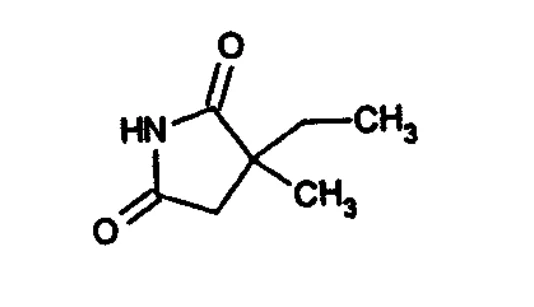
Drug Substance
Proper name: Ethosuximide
Chemical name: 3-ethyl-3-methyl-2, 5-pyrrolidinedione, 3-ethyl-3-methyl-, (±)-.
Molecular formula and molecular mass: C7H11NO2 - 141.17 g/mol
Structural formula:
14 CLINICAL TRIALS
This information is not available for this drug product.
15 MICROBIOLOGY
No microbiological information is required for this drug product.
16 NON-CLINICAL TOXICOLOGY
There have been no adequate, well-controlled studies on the carcinogenicity, mutagenicity, or impairment of fertility of this product.