


Product Monograph - Zometa Lyophilized Powder
SUMMARY PRODUCT INFORMATION
Route of Administration | Dosage Form / Strength | Clinically Relevant Nonmedicinal Ingredients |
| Injectable |
|
For a complete listing see Dosage Forms, Composition and Packaging section. |
†This corresponds to 4.264 mg zoledronic acid monohydrate
INDICATIONS AND CLINICAL USE
Tumor-Induced Hypercalcemia
ZOMETA (zoledronic acid for injection) is indicated for the treatment of Tumor-Induced Hypercalcemia following adequate saline rehydration. Prior to treatment with ZOMETA, renal excretion of excess calcium should be promoted by restoring and maintaining adequate fluid balance and urine output.
Bone Metastases of Solid Tumors and Osteolytic Lesions of Multiple Myeloma
ZOMETA is indicated for the treatment of patients with documented bone metastases from solid tumors (including prostate cancer, breast cancer, lung cancer, renal cell carcinoma and other solid tumors) and patients with osteolytic lesions of multiple myeloma in conjunction with standard care in order to prevent or delay potential complications from the bone lesions (See WARNINGS: Renal Dysfunction).
CONTRAINDICATIONS
ZOMETA (zoledronic acid for injection) is contraindicated in pregnancy, breast-feeding women and patients with clinically significant hypersensitivity to zoledronic acid or other bisphosphonates, or any of the excipients in the formulation of ZOMETA (see DOSAGE FORMS, COMPOSITION AND PACKAGING).
WARNINGS AND PRECAUTIONS
General
Tumor-Induced Hypercalcemia
It is essential in the initial treatment of tumor-induced hypercalcemia that intravenous rehydration be instituted to restore urine output. Patients should be hydrated adequately throughout treatment but overhydration must be avoided.
In patients with cardiac disease, especially in the elderly, additional saline overload may precipitate cardiac failure (left ventricular failure or congestive heart failure). Fever (influenza-like symptoms) may also contribute to this deterioration.
Serum electrolytes, calcium, phosphate and serum creatinine should be carefully monitored following initiation of therapy with ZOMETA (zoledronic acid for injection). Patients with anemia, leukopenia or thrombocytopenia should have regular hematology assessments. Occasional cases of mild, transient hypocalcemia, usually asymptomatic, have been reported. Symptomatic hypocalcemia occurs rarely and can be reversed with calcium gluconate. Patients who have undergone thyroid surgery may be particularly susceptible to develop hypocalcemia due to relative hypoparathyroidism.
In tumor-induced hypercalcemia, either ionized calcium or total serum calcium corrected (adjusted) for albumin should be monitored during treatment with ZOMETA. Serum calcium levels in patients who have hypercalcemia of malignancy may not reflect the severity of hypercalcemia, since hypoalbuminemia is commonly present. Corrected serum calcium values should be calculated using established algorithms, such as: Albumin-corrected serum calcium (cCa, mmol/L) = tCa + 0.02 (mid-range albumin-measured albumin).
Carcinogenesis and Mutagenesis
In carcinogenicity studies, zoledronic acid was administered orally (gavage) to rats and mice for at least 104 weeks without evidence of carcinogenic potential. Chronic parenteral administration was not feasible given the potential of the compound to cause severe local irritation. The pharmacological bone changes (nonproliferative hyperostosis) typically observed following long term bisphosphonate administration to young animals with growing skeletons gave clear evidence of systemic exposure to zoledronic acid in both species at all doses.
Six mutagenicity studies were conducted with zoledronic acid: three Ames Assays (using E. coli and/or S. typhimurium), a gene mutation assay using V79 hamster cells, a cytogenetics test with
Chinese hamster cells and an in vivo micronucleus assay in rats. There was no evidence of mutagenic potential.
Drug Interactions
In clinical studies, no clinically apparent interactions occurred when ZOMETA was administered concomitantly with commonly used anticancer agents, diuretics, antibiotics, and analgesics. ZOMETA shows no appreciable binding in vitro to plasma proteins and to human P450 enzymes, indicating a low likelihood of pharmacokinetic drug-drug interactions. However, no formal clinical interaction studies have been performed.
ZOMETA should be used with extreme caution in conjunction with other antineoplastic agents that are either known to produce renal dysfunction (it is advised that renal function be monitored); or where the dose depends upon renal function (for example platinum-containing agents).
Caution is advised when bisphosphonates are administered with aminoglycosides, since these agents may have an additive effect resulting in a lower serum calcium level for prolonged periods. This has not been reported in ZOMETA clinical trials.
In multiple myeloma patients, the risk of renal dysfunction may be increased when ZOMETA is used in combination with thalidomide.
Effects on ability to drive or use machines
In rare cases, somnolence and/or dizziness may occur, in which case the patient should not drive, operate potentially dangerous machinery or engage in other activities that may be hazardous.
Hepatic Impairment
As only limited clinical data are available for patients with hepatic insufficiency, dosage recommendations cannot be given for this group.
Osteonecrosis of the jaw
Osteonecrosis of the jaw (ONJ) has been reported in patients with cancer receiving treatment regimens including bisphosphonates. Many of these patients were also receiving chemotherapy and corticosteroids. The majority of reported cases have been associated with dental procedures such as tooth extraction. Many had signs of local infection including osteomyelitis.
A dental examination with appropriate preventive dentistry should be considered prior to treatment with bisphosphonates in patients with concomitant risk factors (e.g. cancer, chemotherapy, head and neck radiotherapy, corticosteroids, poor oral hygiene).
While on treatment, these patients should avoid invasive dental procedures if possible. For patients who develop ONJ while on bisphosphonate therapy, dental surgery may exacerbate the
condition. For patients requiring dental procedures, there are no data available to suggest whether discontinuation of bisphosphonate treatment reduces the risk of ONJ. Clinical judgment of the treating physician should guide the management plan of each patient based on individual benefit/risk assessment.
Renal
Monitoring of renal function is recommended in all patients prior to the administration of each dose of ZOMETA.
Renal Dysfunction
DUE TO THE RISK OF CLINICALLY SIGNIFICANT DETERIORATION IN RENAL FUNCTION, WHICH MAY PROGRESS TO RENAL FAILURE, SINGLE DOSES OF ZOMETA SHOULD NOT EXCEED 4 MG AND THE DURATION OF THE INFUSION SHOULD BE NO LESS THAN 15 MINUTES.
Bisphosphonates, including ZOMETA have been associated with reports of renal dysfunction. Factors that may increase the potential for deterioration in renal function include dehydration, pre-existing renal impairment, multiple cycles of ZOMETA or other bisphosphonates or using an infusion time shorter than currently recommended (the 4-mg dose is given as a single-dose intravenous infusion over not less than 15 minutes in not less than 100 mL diluent). Concomitant use of potentially nephrotoxic drugs (i.e. ASA, NSAIDS, diuretics, ACE inhibitors etc.) may also increase the potential for renal impairment. Renal function should be monitored appropriately during therapy with ZOMETA. Increases in serum creatinine may occur in some patients with chronic administration of ZOMETA at recommended doses. Patients with evidence of deterioration in renal function should be appropriately evaluated with consideration given as to whether the potential benefit of continued treatment with ZOMETA outweighs the possible risk.
The use of ZOMETA is not recommended in patients with severe renal impairment. This recommendation is made in view of the potential impact of bisphosphonates including ZOMETA on renal function, the lack of extensive clinical safety data in patients with severe renal impairment at baseline (serum creatinine > 400 µmol/L or > 4.5 mg/dL in patients with tumor-induced hypercalcemia; and serum creatinine > 265 µmol/L or > 3.0 mg/dL in patients with bone metastases of solid tumors and osteolytic lesions of multiple myeloma) and only limited pharmacokinetic data in patients with severe renal impairment at baseline (creatinine clearance < 30 mL/min).
ZOMETA should not be given together with other bisphosphonates to treat hypercalcemia since the combined effects of these agents are unknown.
ZOMETA should not be mixed with calcium-containing intravenous infusions.
ZOMETA should be used with extreme caution in conjunction with other antineoplastic agents that are either known to produce renal dysfunction (it is advised that renal function be monitored); or where the dose depends upon renal function (for example platinum-containing agents).
Renal Impairment
Limited clinical data are available for patients with renal impairment and monitoring of renal function is recommended in these patients. ZOMETA is excreted exclusively via the kidney and the risk of adverse reactions may be greater in patients with impaired renal function. ZOMETA has not been tested in patients with severe renal impairment (serum creatinine > 400 µmol/L or > 4.5 mg/dL in patients with tumor-induced hypercalcemia; and serum creatinine > 265 µmol/L or > 3.0 mg/dL in patients with bone metastases of solid tumors and osteolytic lesions of multiple myeloma). Therefore, its use is not recommended in this patient population. Close monitoring of renal function is necessary in patients who are receiving concomitant drugs with nephrotoxic potential.
Patients should have their serum creatinine levels assessed prior to each dose of ZOMETA. Upon initiation of treatment in patients with bone metastases of solid tumors and osteolytic lesions of multiple myeloma, with mild-to-moderate renal impairment, lower doses of ZOMETA are recommended. In patients who show evidence of renal deterioration during treatment, appropriate evaluation should be carried out and consideration should be given as to whether the potential benefit outweighs the possible risk. If ZOMETA treatment is to be continued in these patients, ZOMETA should only be resumed when serum creatinine returns to within 10% of baseline.(See DOSAGE AND ADMINISTRATION).
Respiratory
Patients with Asthma
While not observed in clinical trials with ZOMETA, administration of other bisphosphonates has been associated with bronchoconstriction in aspirin-sensitive asthmatic patients. ZOMETA should be used with caution in patients with aspirin-sensitive asthma.
Special Populations
Pregnant Women:
ZOMETA should not be administered during pregnancy (see CONTRAINDICATIONS). There is no clinical evidence to support the use of ZOMETA in pregnant women, and animal studies suggest ZOMETA may cause fetal harm when administered to a pregnant woman.
In animal reproduction studies zoledronic acid was administered subcutaneously to rats and rabbits. Teratogenicity manifested by external, visceral and skeletal malformations was observed in the rat at doses ≥ 0.2 mg/kg. There was also evidence of maternal toxicity at ≥
0.2 mg/kg as well as fetal toxicity at 0.4 mg/kg. No teratological or embryo/fetal effects were observed in the rabbit. However, maternal toxicity was marked at ≥ 0.1 mg/kg due to decreased serum calcium. Bisphosphonates readily cross the placental barrier and are taken up into the developing fetal skeleton; thus, the teratogenicity observed in the rat was attributed to the compound=s potency in lowering serum calcium and binding to fetal bone.
Nursing Women:
ZOMETA should not be administered to breast-feeding women (see CONTRAINDICATIONS). There is no clinical experience with ZOMETA in lactating women and it is not known whether ZOMETA passes into breast milk. A study in lactating rats has shown that another bisphosphonate Aredia* (pamidronate) passes into the milk. Mothers treated with ZOMETA should therefore not breast feed their infants.
Pediatrics:
The safety and efficacy of ZOMETA in children have not been established. Until further experience is gained, ZOMETA can only be recommended for use in adult patients.
Geriatrics (> 65 years of age):
Controlled clinical studies of ZOMETA in TIH do not provide a sufficient number of geriatric subjects to determine whether patients 65 years and older respond differently. The median age in the two controlled clinical trials in patients with tumor-induced hypercalcemia was 61 years old (range: 21-87 years old).
Controlled clinical studies of ZOMETA in the treatment of bone metastases of solid tumors and osteolytic lesions of multiple myeloma in patients over age 65 revealed similar efficacy and safety compared to younger patients. The proportion of patients experiencing SREs is lower in the ZOMETA treatment group when compared to placebo and similar to Aredia (pamidronate) 90 mg. Older patients generally had adverse events similar to those of the overall population. However, because of the greater frequency of decreased hepatic, renal, or cardiac function, and of concomitant disease or other drug therapy in elderly patients, ZOMETA should be administered with caution in this patient population.
Monitoring and Laboratory Tests
Serum calcium, electrolytes, phosphate, magnesium and creatinine, and CBC, differential, and hematocrit/hemoglobin must be closely monitored in patients treated with ZOMETA.
PrAREDIA* is a registered trademark
ADVERSE REACTIONS
Adverse Drug Reaction Overview
Adverse reactions to ZOMETA (zoledronic acid for injection) are usually mild and transient and similar to those reported for other bisphosphonates. Intravenous administration has been most commonly associated with fever. Occasionally, patients experience a flu-like syndrome consisting of fever, chills, bone pain and/or arthralgias and myalgias. In most cases, no specific treatment is required and the symptoms subside after 24-48 hours.
Gastrointestinal reactions such as nausea and vomiting have been reported following intravenous infusion of ZOMETA. Local reactions at the infusion site, such as redness or swelling, were observed infrequently.
Rare cases of rash, pruritis, and chest pain have been reported following treatment with ZOMETA.
As with other bisphosphonates, isolated cases of hypomagnesemia have been reported. Isolated cases of uveitis, episcleritis, and conjunctivitis have also been reported.
While not observed in clinical trials with ZOMETA, administration of other bisphosphonates has been associated with bronchoconstriction in acetylsalicylic acid-sensitive asthmatic patients.
Clinical Trial Adverse Drug Reactions
Because clinical trials are conducted under very specific conditions the adverse reaction rates observed in the clinical trials may not reflect the rates observed in practice and should not be compared to the rates in the clinical trials of another drug. Adverse drug reaction information from clinical trials is useful for identifying drug-related adverse events and for approximating rates.
Tumor-Induced Hypercalcemia
Patients with tumor-induced hypercalcemia may have numerous confounding medical conditions that make causality of adverse events difficult to assess due to the prevalence and wide variety of symptoms related to the underlying disease, its progression, and the side effects of cytotoxic chemotherapy.
Frequently, the reduction in renal calcium excretion is accompanied by a fall in serum phosphate levels that does not require treatment. The serum calcium may fall to asymptomatic hypocalcemic levels.
Grade 3 [Common Toxicity Criteria (CTC)] serum creatinine was seen in 2.3% and 3.0% of patients receiving ZOMETA 4mg and Aredia (pamidronate) 90 mg, respectively in the clinical
trials in tumor-induced hypercalcemia. Grade 4 (CTC) serum creatinine was seen in 0% and 1.0% in patients receiving ZOMETA 4 mg and Aredia (pamidronate) 90 mg, respectively.
Table 1 lists the adverse experiences considered to be treatment-related in the tumor-induced hypercalcemia trials.
Table 1: Treatment-Related Adverse Experiences Reported in Tumor-Induced
Hypercalcemia Clinical Trials
ZOMETA 4 mg % (N= 86) | Aredia 90 mg % (N=103) | |
| Fever | 7.0 | 9.7 |
| Hypocalcemia | 5.8 | 1.9 |
| Hypophosphatemia | 3.5 | 1.0 |
| Nausea | 1.2 | 1.0 |
| Pruritus | 1.2 | 0 |
| Skeletal pain | 1.2 | 1.0 |
| Hypomagnesemia | 1.2 | 0 |
| Taste perversion | 1.2 | 0 |
| Thirst | 1.2 | 0 |
| Pancytopenia | 1.2 | 0 |
| Arthralgia | 1.2 | 0 |
| Bradycardia | 1.2 | 0 |
| Confusion | 1.2 | 0 |
| Fatigue | 1.2 | 0 |
| Hallucination | 1.2 | 0 |
| Vomiting | 1.2 | 0 |
| Chest pain | 1.2 | 0 |
Bone Metastases of Solid Tumors and Osteolytic Lesions of Multiple Myeloma
The adverse event data pertaining to bone metastases of solid tumors and osteolytic lesions of multiple myeloma are based upon the core and extension phases of the three pivotal controlled trials in this indication (see DETAILED PHARMACOLOGY, CLINICAL STUDIES). These trials included 2042 safety evaluable patients treated with either ZOMETA 4 mg, Aredia 90 mg or placebo. Of these 2042 patients who entered the core phase of the trials: 969 completed the core phase, 619 entered the safety extension phase, and 347 completed the extension phase. The median duration of exposure to ZOMETA 4 mg (core plus extension phases) was 10.5 months for patients with prostate cancer, 12.8 months for patients with breast cancer and multiple myeloma, and 4.0 months for patients with lung cancer and other solid tumors. The mean duration of exposure to ZOMETA 4 mg (core plus extension phases) was 11.8 months for patients with prostate cancer, 13.9 months for patients with breast cancer and multiple myeloma, and 5.7 months for patients with lung cancer and other solid tumors (see CLINICAL STUDIES).
In general, ZOMETA was well tolerated across all studies for various tumor types in patients with bone metastases and in patients with multiple myeloma. The proportion of patients
experiencing Grade 3 and Grade 4 laboratory abnormalities and adverse events were similar in patients treated with ZOMETA and Aredia (pamidronate).
Grade 3 [Common Toxicity Criteria (CTC)] serum creatinine was seen in 1.3%, 1.5% and 1.7% of patients receiving ZOMETA 4mg, Aredia 90 mg and placebo, respectively. Grade 4 (CTC) serum creatinine was in 0.4%, 0.4% and 0% of patients receiving ZOMETA 4 mg, Aredia 90 mg and placebo, respectively.
The most commonly reported (>15%) adverse experiences occurred with similar frequencies in the ZOMETA, Aredia and placebo treatment groups, and most of these adverse experiences may have been related to the underlying disease state or cancer therapy. Table 2 lists the adverse experiences which occurred in ≥ 15% of patients regardless of study drug relationship by preferred term and treatment group, in the bone metastases trials.
Table 2: Commonly Reported Adverse Experiences in Three Bone Metastases Clinical Trials
| ZOMETA 4 mg | Aredia 90 mg | Placebo | |
| n (%) | n (%) | n (%) | |
| Patients studied | |||
| Total no. of patients studied | 1031 (100) | 556 (100) | 455 (100) |
| Total no. of patients with an AE | 1015 (98.4) | 548 (98.6) | 445 (97.8) |
| Adverse events (preferred term) | |||
| Bone pain | 55.2% | 56.8% | 62.4% |
| Nausea | 46.2% | 47.8% | 37.6% |
| Fatigue | 38.6% | 43.2% | 28.6% |
| Anemia | 33.4% | 31.5% | 28.1% |
| Vomiting | 32.3% | 32.9% | 26.8% |
| Pyrexia | 31.8% | 30.9% | 19.6% |
| Constipation | 31.0% | 29.1% | 38.2% |
| Dyspnea NOS | 27.4% | 27.9% | 23.5% |
| Weakness | 24.4% | 19.4% | 25.1% |
| Diarrhea NOS | 24.2% | 29.1% | 18.2% |
| Myalgia | 23.2% | 25.7% | 16.3% |
| Anorexia | 22.4% | 14.6% | 23.1% |
| Cough | 21.7% | 23.2% | 14.3% |
| Arthralgia | 21.0% | 23.6% | 16.0% |
| Edema lower limb | 20.9% | 22.7% | 18.5% |
| Malignant neoplasm aggravated | 19.9% | 17.4% | 19.6% |
| Headache NOS | 18.5% | 26.8% | 11.0% |
| Dizziness (excl. vertigo) | 17.5% | 16.4% | 12.7% |
| Insomnia NEC | 16.1% | 20.0% | 16.0% |
| Weight decreased | 15.9% | 9.0% | 13.4% |
| Back pain | 15.1% | 19.1% | 8.8% |
| Paresthesia NEC | 14.5% | 15.3% | 7.7% |
Depression NEC
| 14.2% | 17.1% |
10.8% Pain in limb
| 13.9% | 15.1% |
11.4% NOS: Not otherwise specified NEC: Not elsewhere classified
The adverse events occurring during the studies were generally of a type and frequency expected in patients with cancer and bone metastases, many of whom were undergoing antineoplastic therapy. Except for pyrexia, the absolute difference in the proportions of patients in the ZOMETA 4 mg group compared with the placebo group for any of the common adverse events did not exceed 10%. Pyrexia, or fever, may occur as part of an acute phase reaction with bisphosphonate administration.
Among less commonly occurring adverse events (< 15% of patients in any group), hypocalcemia was reported in 4.7%, 2.5%, and 0.7% of patients in the ZOMETA 4 mg, Aredia, and placebo groups, respectively. Hypokalemia was reported in 9.7%, 9.0%, and 4.8% of patients in the ZOMETA 4 mg, Aredia, and placebo groups, respectively.
Renal Dysfunction
In the bone metastases trials renal deterioration was defined as an increase of 44.2 Fmol/L (0.5 mg/dL) for patients with normal baseline creatinine (< 123.76 Fmol/L or < 1.4 mg/dL) or an increase of 88.4 Fmol/L (1.0 mg/dL) for patients with an abnormal baseline creatinine (≥ 123.76 Fmol/L or ≥ 1.4 mg/dL ). The following are data on the incidence of renal deterioration in patients receiving ZOMETA 4 mg over 15 minutes in these trials. (See Table 3).
Table 3. Percentage of Patients with Renal Function Deterioration Who Were Randomized Following the 15-Minute Infusion Amendment
| Patient Population/Baseline Creatinine | ||||
| Multiple Myeloma and Breast Cancer | ZOMETA 4 mg | Aredia 90 mg | ||
| n/N | (%) | n/N | (%) | |
| Normal | 27/246 | (11.0%) | 23/246 | (9.3%) |
| Abnormal | 2/26 | (7.7%) | 2/22 | (9.1%) |
| Total | 29/272 | (10.7%) | 25/268 | (9.3%) |
| Solid Tumors | ZOMETA 4 mg | Placebo | ||
| n/N | (%) | n/N | (%) | |
| Normal | 17/154 | (11%) | 10/143 | (7%) |
| Abnormal | 1/11 | (9.1%) | 1/20 | (5%) |
| Total | 18/165 | (10.9%) | 11/163 | (6.7%) |
| Prostate Cancer | ZOMETA 4 mg | Placebo | ||
| n/N | (%) | n/N | (%) | |
| Normal | 12/82 | (14.6%) | 8/68 | (11.8%) |
| Abnormal | 4/10 | (40%) | 2/10 | (20%) |
| Total | 16/92 | (17.4%) | 10/78 | (12.8%) |
The risk of deterioration in renal function appeared to be related to time on study, whether patients were receiving ZOMETA (4 mg over 15 minutes), placebo, or Aredia.
The frequency distribution of chemotherapy-associated adverse events by chemotherapy, renal involvement and treatment group for patients in the primary safety population is provided in Table 4. This includes patients who were administered at least one chemotherapeutic agent during the study (i.e. patients treated with only hormonal agents are not included). Each chemotherapeutic agent is classified in one of the three categories: renally excreted, nephrotoxic, or no renal involvement (See Tables 4-1 and 4-2). For a chemotherapy that is both renally excreted and nephrotoxic, the agent is classified as nephrotoxic.
Patients receiving renally excreted drugs that were not nephrotoxic had a similar incidence of nausea for the ZOMETA and placebo treatment groups when compared to the nephrotoxic agents. Nausea was higher for the Aredia treatment group for the nephrotoxic agents when compared to the agents that were not nephrotoxic and renally excreted. Vomiting, stomatitis and
anorexia were similar for all of the treatment groups whether or not the agent was renally excreted or nephrotoxic. Alopecia was higher in all groups treated with nephrotoxic drugs when compared to renally excreted drugs.
Table 4. Frequency distribution of chemotoxicities ( >1%) by renal involvement and treatment group for patients who were treated with at least one chemotherapy agent (Safety evaluable patients)
| Renal involvement H | ZOMETA 4 mg | Aredia 90 mg | Placebo |
| Renally excreted | |||
| Number of patients | 221 | 163 | 76 |
| Total with chemotoxicity | 161 (72.9%) | 100 (61.3%) | 54 (71.1%) |
| Nausea | 113 (51.1%) | 68 (41.7%) | 37 (48.7%) |
| Vomiting NOS1 | 75 (33.9%) | 48 (29.4%) | 23 (30.3%) |
| Anorexia | 55 (24.9%) | 23 (14.1%) | 28 (36.8%) |
| Appetite decreased NOS | 39 (17.6%) | 16 (9.8%) | 7 (9.2%) |
| Stomatitis | 25 (11.3%) | 21 (12.9%) | 6 (7.9%) |
| Alopecia | 24 (10.9%) | 18 (11.0%) | 9 (11.8%) |
| Malaise | 6 (2.7%) | 3 (1.8%) | 5 (6.6%) |
| Cachexia | 4 (1.8%) | 1 (0.6%) | 3 (3.9%) |
| Gingivitis | 3 (1.4%) | 3 (1.8%) | 0 (0.0%) |
| Mouth ulceration | 3 (1.4%) | 2 (1.2%) | 0 (0.0%) |
| Gingival disorder NOS | 0 (0.0%) | 0 (0.0%) | 1 (1.3%) |
| Malnutrition NOS | 0 (0.0%) | 2 (1.2%) | 0 (0.0%) |
| Pallor | 0 (0.0%) | 0 (0.0%) | 1 (1.3%) |
| Nephrotoxic | |||
| Number of patients | 471 | 248 | 164 |
| Total with chemotoxicity | 345 (73.2%) | 191 (77.0%) | 116 (70.7%) |
| Nausea | 249 (52.9%) | 136 (54.8%) | 73 (44.5%) |
| Vomiting NOS | 194 (41.2%) | 99 (39.9)% | 58 (35.4%) |
| Anorexia | 117 (24.8%) | 46 (18.5%) | 48 (29.3%) |
| Alopecia | 93 (19.7%) | 54 (21.8%) | 24 (14.6%) |
| Appetite decreased NOS | 63 (13.4%) | 23 (9.3%) | 17 (10.4%) |
| Stomatitis | 59 (12.5%) | 36 (14.5%) | 7 (4.3%) |
| Malaise | 18 (3.8%) | 10 (4.0%) | 8 (4.9%) |
| Mouth ulceration | 13 (2.8%) | 5 (2.0%) | 1 (0.6%) |
| Malnutrition NOS | 6 (1.3%) | 2 (0.8%) | 1 (0.6%) |
| Pallor | 6 (1.3%) | 2 (0.8%) | 2 (1.2%) |
| Gingivitis | 5 (1.1%) | 2 (0.8%) | 0 (0.0%) |
| Cachexia | 3 (0.6%) | 0 (0.0%) | 4 (2.4%) |
| No renal involvement | |||
| Number of patients | 0 | 1 | 0 |
| Total with chemotoxicity | 0 (0%) | 1 (100%) | 0 (0%) |
| Nausea | 0 (0%) | 1 (100%) | 0 (0%) |
1NOS: Not otherwise specified.
H Each chemotherapeutic agent is classified in one of the three categories: renally excreted, nephrotoxic, or no renal involvement (See Tables 4-1 and 4-2)
Table 4-1. Listing of chemotherapy agents by renal involvement H*
Renal toxic Preferred term Preferred term
| Adriamycin + Cyclophosphamide | Methotrexate |
| Adriamycin + Vincristine + MTX | Methotrexate sodium |
| Aldesleukin | Mitomycin |
| BCG Vaccine | Oxaliplatin |
| Carboplatin | Paclitaxel |
| Cisplatin | Raltitrexed |
| Cyclophosphamide | Streptozocin |
| Cyclophosphamide + 5-FU + Methotrexate | Strontium-89 |
| Cyclophosphamide + 5-FU + Prednisolone | Taxol + Carboplatin |
| Cyclophosphamide + Doxorubicin + 5-FU | Tegafur |
| Cyclophosphamide + Epirubicin | Tegafur Uracil |
| Dacarbazine | Teniposide |
| Etanercept | Thalidomide |
| Gallium Nitrate | Thiotepa |
| Gemcitabine | Topotecan Hydrochloride |
| Gemcitabine Hydrochloride | Trastuzumab |
| Hydroxycarbamide | Carboplatin + Etoposide |
| Ifosfamide | CMF + Dexamethasone |
| Interferon | CMF + Tamoxifen |
| Interferon Alfa | FAC + Tamoxifen Citrate |
| Interferon Beta | Topotecan |
| Interferon Gamma | EVCMF |
| Interferon Nos | (Epirubicine+Vincri.+Cycloph.+MTX+5FU) |
| Interleukin-2 | |
| M - VAC |
*David S. Fischer, M.Tish Knobf, Henry J. Durivage. The Cancer Chemotherapy Handbook, 5th edition. 1997.
Table 4-2. Listing of chemotherapy agents by renal involvementH*
Renally excreted Preferred term Preferred term
| 5-FU + Calciumfolinat | Melphalan |
| Adriamycin + 5-FU | Melphalan + Prednisolone |
| Betamethasone | Mitoxantrone |
| Bethamethasone Sodium Phosphate | Mitoxantrone Hydrochloride |
| Bleomycin | Tropisetron Hydrochloride |
| Bleomycin Sulfate | Vinblastine |
| Busulfan | Vinblastine Sulfate |
| Capecitabine | Vincristine |
| Carmustine | Vincristine Sulfate |
| Cytarabine | Vindesine |
| Daunorubicin | Vinorelbine |
| Dexrazoxane Hydrochloride | Vinorelbine Bitartrate |
| Docetaxel | Vinorelbine Ditartrate |
| Doxorubicin | Pirarubicin |
| Doxorubicin Hydrochloride | |
| Epirubicin | |
| Epirubicin Hydrochloride | |
| Etoposide | |
| Exemestane | |
| Floxuridine | |
| Flurouracil | |
| Formestane | |
| Irinotecan | |
| Irinotecan Hydrochloride | |
| Lomustine |
*David S. Fischer, M.Tish Knobf, Henry J. Durivage. The Cancer Chemotherapy Handbook, 5th edition. 1997.
Post-Market Adverse Drug Reactions
A number of cases of osteonecrosis (primarily of the jaws) associated with Zometa have been reported since market introduction. Osteonecrosis of the jaws has other well documented multiple risk factors. It is not possible to determine if these events are related to ZOMETA or other bisphosphonates, to concomitant drugs or other therapies (e.g. chemotherapy, head and neck radiotherapy, corticosteroid), to patient=s underlying disease or to other co-morbid risk factors (e.g. anemia, infection, pre-existing oral disease).
DOSAGE AND ADMINISTRATION
Dosing Considerations
Monitoring of renal function is recommended in all patients prior to the administration of each dose of ZOMETA.
Renal Impairment
ZOMETA is excreted exclusively via the kidney and the risk of adverse reactions may be greater in patients with impaired renal function.
ZOMETA has not been tested in patients with severe renal impairment (serum creatinine > 400 µmol/L or > 4.5 mg/dL in patients with tumor-induced hypercalcemia; and serum creatinine > 265 µmol/L or > 3.0 mg/dL in patients with bone metastases of solid tumors and osteolytic lesions of multiple myeloma). Therefore, its use is not recommended in this patient population.
Hepatic Impairment
As only limited clinical data are available for patients with hepatic insufficiency, dosage recommendations cannot be given for this group.
Recommended Dose and Dosage Adjustment
Tumor-Induced Hypercalcemia
The recommended dose of ZOMETA (zoledronic acid for injection) in hypercalcemia (albumin-corrected serum calcium > 3.0 mmol/L (12 mg/dL)) is 4 mg. The 4-mg dose is given as a single-dose intravenous infusion over no less than 15 minutes following standard rehydration procedures.
Albumin-corrected serum calcium (cCa, mmol/L) = tCa + 0.02 (mid-range albumin-measured albumin).
Prior to treatment with ZOMETA (zoledronic acid for injection) renal excretion of excess calcium should be promoted by restoring and maintaining adequate fluid balance and urine output.
Patients who show complete or partial response initially may be retreated with ZOMETA 4 mg if serum calcium does not return to normal or does not remain normal after initial treatment although retreatment with Zometa 4 mg in TIH patients has not been assessed for efficacy and safety in prospective studies. It is recommended that at least one week must elapse before retreatment to allow for a full response to the initial dose. In addition, retreatment should be given to only those patients who can tolerate the standard rehydration procedures (i.e., 3 to 5 litres of fluids per day and more than 400 meq of sodium chloride per day). In any patient
requiring repeated administration, serum BUN and creatinine must be evaluated and possible deterioration in renal function must be assessed prior to each re-administration (See WARNINGS AND PRECAUTIONS).
Dosage Adjustment: Mild to Moderate Renal Impairment
Dose reduction in patients with tumor-induced hypercalcemia with mild to moderate renal impairment is not recommended.
Bone Metastases of Solid Tumors and Osteolytic Lesions of Multiple Myeloma
The recommended dose of ZOMETA in patients with documented metastatic bone lesions from solid tumors and patients with osteolytic lesions of multiple myeloma for patients with creatinine clearance > 60 mL/min is 4 mg, given as a single dose intravenous infusion over no less than 15 minutes every 3 to 4 weeks. In patients requiring antineoplastic therapy, ZOMETA should be administered either prior to or after this treatment. Patients will be required to take an oral calcium supplement of 500 mg and a multivitamin containing at least 400 IU of Vitamin D daily. If a patient has a prior history of hypercalcemia or develops hypercalcemia during treatment with calcium and Vitamin D supplementation, the patient is advised to discontinue taking calcium and Vitamin D.
ZOMETA has been used with cyclophosphamide, doxorubicin, paclitaxel, anastrozole, melphalan and tamoxifen. It has been given less frequently with docetaxel, dexamethasone, prednisone, carboplatin, letrozole, vinorelbine, cisplatin and gemcitabine.
Dosage Adjustment: Mild to Moderate Renal Impairment
ZOMETA has been used in patients with bone metastases of solid tumors and osteolytic lesions of multiple myeloma with mild to moderate renal impairment in clinical trials; their risk of renal deterioration was increased compared to that of patients with normal renal function. Therefore, if ZOMETA is to be administered to patients with mild to moderate renal impairment (defined as baseline creatinine clearance 30 mL/min to 60 mL/min), doses should be reduced. The following dosing recommendations are based on data from pharmacokinetic studies however, the efficacy and safety of adjusted dosing has not been prospectively assessed in clinical trials.
Upon treatment initiation, the recommended ZOMETA doses for patients with reduced renal function (mild and moderate renal impairment) are listed in the following table. These doses are calculated based on pharmacokinetic data in order to achieve the same AUC as that achieved in patients with creatinine clearance of 75 mL/min (see PART I: ACTION AND CLINICAL PHARMACOLOGY, Special Populations and Conditions, Renal Insufficiency). Creatinine clearance (CrCl) is calculated using the Cockcroft-Gault formula†.
†CrCl (mL/min) = 1.2 [140-age(years)] x [total body weight (kg)] {multiply by 0.85 for females} serum creatinine (µmol/L)
| Baseline Creatinine Clearance (mL/min) | ZOMETA Recommended Dose‡ |
| > 60 | 4.0 mg |
| 50-60 | 3.5 mg |
| 40-49 | 3.3 mg |
| 30-39 | 3.0 mg |
‡ Doses calculated assuming target AUC of 0.66 (mg*hr/L) (CrCl = 75 mL/min)
During treatment, serum creatinine should be measured before each ZOMETA dose and treatment should be withheld for renal deterioration. In the clinical studies, renal deterioration was defined as follows:
For patients with normal baseline creatinine (< 123 µmol/L or < 1.4 mg/dL), an increase of
44 µmol/L or 0.5 mg/dL
- For patients with abnormal baseline creatinine ( > 123 µmol/L or >1.4 mg/dL), an increase of 88 µmol/L or 1.0 mg/dL
In the clinical studies, ZOMETA treatment was resumed only when the creatinine returned to within 10% of the baseline value. ZOMETA should be re-initiated at the same dose as that prior to treatment interruption.
Renal function should be monitored appropriately during therapy with ZOMETA. Patients with evidence of renal function deterioration should be appropriately evaluated and consideration should be given as to whether the potential benefit outweighs the possible risk.
Administration
Reconstitution:
Method of Preparation
ZOMETA Lyophilized Powder
4 mg Dose: ZOMETA lyophilized powder is reconstituted by adding 5 mL of Sterile Water for Injection, USP, to each vial. The resulting concentration allows for withdrawal, using a sterile syringe, of 4 mg of ZOMETA. The drug must be completely dissolved before the solution is withdrawn.
The reconstituted vials are for single use only and unused portions should be discarded.
The content of the reconstituted vials are withdrawn using a sterile syringe and further diluted in 100 mL of sterile 0.9% Sodium Chloride Injection, USP, or 5% Dextrose Injection, USP.
Reduced Doses for Patients with Baseline CrCl ≤ 60 mL/min: Withdraw an appropriate volume of the reconstituted solution (4 mg/ 5 mL) as needed:
- 4.4 mL for 3.5 mg dose
- 4.1 mL for 3.3 mg dose
- 3.8 mL for 3.0 mg dose
The withdrawn reconstituted solution must be further diluted in 100 mL of sterile 0.9% Sodium Chloride Injection, USP, or 5% Dextrose Injection, USP. The dose must be given as a single intravenous injection over no less than 15 minutes.
ZOMETA Concentrate
Vials of ZOMETA concentrate contain overfill allowing for the withdrawal of 5 mL of concentrate (equivalent to 4 mg zoledronic acid for injection). The content of the vials is withdrawn using a sterile syringe. This concentrate should immediately be diluted in 100 mL of sterile 0.9% Sodium Chloride Injection, USP, or 5% Dextrose Injection, USP. Do not store undiluted concentrate in a syringe, to avoid inadvertent injection. Any unused portion of ZOMETA concentrate should be discarded.
Reduced Doses for Patients with Baseline CrCl ≤ 60 mL/min: Withdraw an appropriate volume of the 5 mL - ZOMETA concentrate as needed:
- 4.4 mL for 3.5 mg dose
- 4.1 mL for 3.3 mg dose
- 3.8 mL for 3.0 mg dose
The withdrawn concentrate must be diluted in 100 mL of sterile 0.9% Sodium Chloride Injection, USP, or 5% Dextrose Injection, USP. The dose must be given as a single intravenous injection over no less than 15 minutes.
Incompatibilities
ZOMETA must not be mixed with calcium-containing infusion solutions, such as Lactated Ringer=s solution, and should be administered as a single intravenous solution in a line separate from all other drugs.
Studies with glass bottles, as well as several types of infusion bags and infusion lines made from polyvinylchloride, polyethylene and polypropylene (prefilled with 0.9 % sodium chloride solution or 5 % glucose solution), showed no incompatibility with ZOMETA.
Stability of Reconstituted or Diluted ZOMETA Solutions
If not used immediately after reconstitution or dilution with infusion media, for microbiological integrity, the solution should be refrigerated at 2-8oC. The refrigerated solution should then be
equilibrated to room temperature prior to administration. The total time between reconstitution and/or dilution, storage in the refrigerator and end of administration must not exceed 24 hours. Unused portions of the reconstituted admixtures must be discarded.
Strict adherence to the intravenous route is recommended for the parenteral administration of ZOMETA.
Note: Parenteral drug products should be inspected visually for particulate matter and discoloration prior to administration, whenever solution and container permit.
Store ZOMETA lyophilized powder and ZOMETA concentrate at 15 oC - 30 oC.
OVERDOSAGE
There is no experience of acute overdose with ZOMETA (zoledronic acid for injection). There have been two patients who received maladministration of 32 mg of ZOMETA given over 5 minutes. Neither patient experienced any clinical or laboratory toxicity. Clinically relevant hypocalcemia should be corrected by intravenous administration of calcium gluconate.
In an open label study of ZOMETA 4 mg in breast cancer patients, a female patient received a single 48 mg dose of zoledronic acid in error. Two days after the overdose the patient experienced a single episode of hyperthermia (38°C), which resolved after treatment. All other evaluations were normal, and the patient was discharged seven days after the overdose.
A patient with Non-Hodgkin=s Lymphoma received ZOMETA 4 mg daily on four successive days for a total dose of 16 mg. The patient developed paresthesia and abnormal liver function tests with increased GGT (nearly 100U/L, exact value unknown). The outcome of this case is not known.
ACTION AND CLINICAL PHARMACOLOGY
Mechanism of Action
The principal pharmacologic action of ZOMETA (zoledronic acid for injection) is inhibition of bone resorption. Although the antiresorptive mechanism is not completely understood, several factors are thought to contribute to this action. Zoledronic acid accumulates in bone, where it blocks the resorption of mineralized bone and cartilage. In vitro, zoledronic acid inhibits osteoclastic activity and induces apoptosis in osteoclasts, as well as reducing the formation and recruitment of osteoclasts into bone. In vitro, zoledronic acid has a very large ratio between the desired inhibition of bone resorption and the adverse effects on bone mineralization. Zoledronic acid inhibits the osteoclastic hyperactivity and accelerated bone resorption induced by various stimulatory factors released by tumors. In long-term animal studies, doses of zoledronic acid similar to those recommended for the treatment of hypercalcemia inhibit bone resorption without adversely affecting the formation, mineralization, or mechanical properties of bone.
In addition to inhibiting osteoclastic bone resorption, zoledronic acid exerts direct anti-tumor effects on cultured human myeloma and breast cancer cells, inhibiting their proliferation and inducing apoptosis. Zoledronic acid also inhibits the proliferation of human endothelial cells in vitro and is anti-angiogenic in animal tumor models. In vitro zoledronic acid reduces the invasion of human breast cancer cells into the extracellular matrix.
Preclinical data suggest that low micromolar concentrations of zoledronic acid are cytostatic and pro-apoptotic in vitro to a range of human cancer cell lines (breast, prostate, lung, bladder, myeloma). This anti-tumor efficacy may be enhanced when used in combination with other anti-cancer drugs. Preclinical data suggest that zoledronic acid is also anti-proliferative for human fetal osteoblasts and promotes their differentiation, a property that may be potentially relevant for the treatment of bone metastases in prostate cancer. Zoledronic acid has been shown to inhibit the proliferation of human endothelial cells in vitro and is anti-angiogenic in vivo. Zoledronic acid at picomolar concentrations has been shown to inhibit tumor cell invasion through extracellular matrix in preclinical cancer models.
Pharmacodynamics
Clinical studies in TIH demonstrated that the effect of ZOMETA is characterized by decreases in serum calcium and urinary calcium excretion. Normalization of serum calcium by day 4 was greater for the ZOMETA 4 mg and 8 mg doses (45% and 56%, respectively) compared with Aredia (pamidronate) 90 mg (33%).
Tumor-Induced Hypercalcemia
Osteoclastic hyperactivity resulting in excessive bone resorption is the underlying pathophysiologic derangement in tumor-induced hypercalcemia (TIH, hypercalcemia of malignancy) and metastatic bone disease. Excessive release of calcium into the blood as bone is resorbed results in polyuria and gastrointestinal disturbances, with progressive dehydration and decreasing glomerular filtration rate. This results in increased renal resorption of calcium, setting up a cycle of worsening systemic hypercalcemia. Correction of excessive bone resorption and adequate fluid administration to correct volume deficits are, therefore, essential to the management of hypercalcemia.
Most cases of hypercalcemia associated with malignancy occur in patients who have breast cancer, squamous-cell tumors of the lung or head and neck, renal cell carcinoma, and certain hematologic malignancies, such as multiple myeloma and some types of lymphomas. A few less common malignancies, including vasoactive intestinal-peptide-producing tumors and cholangiocarcinoma, have a high incidence of hypercalcemia as a metabolic complication. Patients who have tumor-induced hypercalcemia can generally be divided into two groups according to the pathophysiologic mechanism involved.
In humoral hypercalcemia, osteoclasts are activated and bone resorption is stimulated by factors such as parathyroid-hormone-related protein, which are elaborated by the tumor and circulate
systemically. Humoral hypercalcemia usually occurs in squamous-cell malignancies of the lung or head and neck or in genitourinary tumors such as renal cell carcinoma or ovarian cancer. Skeletal metastases may be absent or minimal in these patients.
Extensive invasion of bone by tumor cells can also result in hypercalcemia due to local tumor products that stimulate bone resorption by osteoclasts. Tumors commonly associated with locally mediated hypercalcemia include breast cancer and multiple myeloma.
Total serum calcium levels in patients who have tumor-induced hypercalcemia may not reflect the severity of hypercalcemia, since concomitant hypoalbuminemia is commonly present. Ideally, ionized calcium levels should be used to diagnose and follow hypercalcemic conditions; however, these are not commonly or rapidly available in many clinical situations. Therefore, adjustment of the total serum calcium value for differences in albumin levels is often used in place of measurement of ionized calcium; several nomograms are in use for this type of calculation (see DOSAGE AND ADMINISTRATION).
Bone Metastases of Solid Tumors and Osteolytic Lesions of Multiple Myeloma
Osteolytic bone lesions and metastases commonly occur in patients with multiple myeloma, breast cancer, non-small cell lung cancer, renal cell carcinoma and a variety of other solid tumors. Bone lesions associated with bone metastases from prostate carcinoma classically are osteoblastic in contrast to those from other carcinomas, which are usually osteolytic or mixed osteolytic/osteoblastic. Adenocarcinoma of the prostate spreads most commonly to the well vascularized areas of the skeleton such as the vertebral column, ribs, skull, and the proximal ends of the long bones. Prostate carcinoma cells have long been believed to gain access to the vertebral column and ribs via the Batson venous plexus, which is a low pressure, high volume plexus of vertebral veins that join the intercostal veins.
These bone changes in patients with evidence of osteolytic and osteoblastic skeletal destruction may cause severe bone pain that requires either radiation therapy or narcotic analgesics (or both) for symptomatic relief. These changes also cause pathologic fractures of bone in both the axial and appendicular skeleton. Axial skeletal fractures of the vertebral bodies may lead to spinal cord compression or vertebral body collapse with significant neurologic complications. Patients may also experience episode(s) of hypercalcemia.
Pharmacokinetics
Single or multiple (q 28 days) 5-minute or 15-minute infusions of 2, 4, 8 or 16 mg ZOMETA were given to 64 cancer patients with bone metastases. The post infusion decline of zoledronic acid concentrations in plasma was consistent with a triphasic process showing a rapid decrease from peak concentrations at end-of-infusion to <1% of Cmax after 24 hours post infusion with population half-lives of t 2α 0.24 hours and t 2β 1.87 hours for the early disposition phases of the drug, followed by a prolonged period of very low concentrations in plasma between days 2 and 28 post infusion, with a terminal elimination half-life t2γ of 146 hours. The area under the plasma concentration versus time curve (AUC0-24h) of zoledronic acid was linearly related to
dose. The accumulation of zoledronic acid following a 28-day dosing schedule over 3 cycles was low, with mean AUC0-24h ratios cycles 2 and 3 versus 1 of 1.13 " 0.30 and 1.16 " 0.36, respectively.
In vitro and ex vivo studies showed low affinity of zoledronic acid for the cellular components of human blood. Binding to human plasma proteins was approximately 56% and independent of the concentration of zoledronic acid.
Zoledronic acid does not inhibit human P-450 enzymes in vitro. Zoledronic acid does not experience biotransformation. In animal studies <3% of the administered intravenous dose was found in the feces, with the balance either recovered in the urine or taken up by bone, indicating that the drug is eliminated intact via the kidney. Following an intravenous dose of 20 nCi 14C-zoledronic acid in a cancer patient with bone metastases, the radioactivity excreted in the urine consisted solely of intact drug.
In 64 cancer patients with bone metastases on average (" s.d.) 39 " 16% of the administered dose was recovered in the urine within 24 hours, with only trace amounts of drug found in urine post day 2. The cumulative percent of drug excreted in the urine over 0-24 hours was independent of dose. The balance of drug not recovered in urine over 0-24 hours, representing drug presumably bound to bone tissue is slowly released back into the systemic circulation, giving rise to the observed prolonged low plasma concentrations days 2 to 28 post dose. The 0 B 24 h renal clearance of zoledronic acid was on average (" s.d.) 3.7 " 2.0 L/h.
Zoledronic acid clearance was reasonably independent of dose and demographic variables, with effects of body weight, gender, and race on clearance being within the bounds of the inter-patient variability of clearance, which was 36%.
Increasing the infusion time from 5 minutes to 15 minutes caused a 30% decrease in the zoledronic acid concentration at the end of the infusion, but had no effect on the area under the plasma concentration versus time curve.
Special Populations and Conditions
There are no pharmacokinetic data in patients with hypercalcemia.
Pediatrics: There are no pharmacokinetic data in pediatric patients (see WARNINGS AND PRECAUTIONS).
Geriatrics: The pharmacokinetics of ZOMETA were not affected by age in cancer patients with bone metastases aged 38 years to 84 years.
Race: The pharmacokinetics of ZOMETA were not affected by race in cancer patients with bone metastases.
Hepatic Insufficiency: There are no pharmacokinetic data in patients with impaired liver function. ZOMETA is not cleared by the liver, therefore impaired liver function may not affect the pharmacokinetics of ZOMETA.
Renal Insufficiency: Limited pharmacokinetic data are available for ZOMETA in patients with severe renal impairment (creatinine clearance <30 mL/min). The pharmacokinetic studies were conducted in cancer patients (n=64) typical of the target clinical population, showing renal function mainly in the range of normal to moderately impaired [mean (" s.d.) creatinine clearance 84 " 29 mL/min, range 22 - 143 mL/min]. In these 64 patients the renal clearance of zoledronic acid was found to closely correlate with creatinine clearance, representing in the mean (" s.d.) 75 " 33% of the creatinine clearance. Creatinine clearance is calculated by the Cockcroft-Gault formula (see DOSAGE AND ADMINISTRATION):
CrCl (mL/min) = 1.2 [140-age(years)] x [total body weight (kg)] {multiply by 0.85 for females} serum creatinine (µmol/L)
Patients with mild to moderate renal impairment (creatinine clearance 50 - 80 mL/min) showed increases in plasma AUC of 26% to 36%, whereas patients with moderate to severe renal impairment (creatinine clearance 30 - 50 mL/min) showed increases in plasma AUC of 27 - 41%, compared to patients with normal renal function (creatinine clearance > 80 mL/min). However, there were no further increases in the systemic exposure after multiple doses in patients with impaired renal function (see WARNINGS AND PRECAUTIONS).
The population-derived relationship of ZOMETA clearance with creatinine clearance offers an algorithm for dose reduction in renal impairment. ZOMETA systemic clearance (CL) in individual patients can be calculated from the population clearance of ZOMETA and that individual’s creatinine clearance, as CL (L/h) = 6.5x(CLcr/90)0.4. This formula can be used to predict ZOMETA AUC in patients, where CL=Dose/AUC0-4. The average AUC0-24 in patients with normal renal function was 0.42 mg•h/L and the calculated AUC0-4 for a patient with creatinine clearance of 75 mL/min was 0.66 mg•h/L following a 4 mg dose of ZOMETA.
STORAGE AND STABILITY
Store ZOMETA lyophilized powder and ZOMETA concentrate at 15 oC - 30 oC.
After reconstitution or dilution with infusion media, the solution should be refrigerated at 2oC-8oC. The refrigerated solution should then be equilibrated to room temperature prior to administration. The total time between reconstitution, dilution, storage in the refrigerator, and end of administration must not exceed 24 hours. Unused portions of the reconstituted admixtures must be discarded.
DOSAGE FORMS, COMPOSITION AND PACKAGING
Zometa is available in two dosage forms: ZOMETA lyophilized powder and ZOMETA concentrate. Each vial of ZOMETA lyophilized powder or ZOMETA concentrate delivers 4 mg of zoledronic acid corresponding to 4.264 mg zoledronic acid monohydrate.
Available in cartons containing 1 vial.
Composition:
ZOMETA Lyophilized Powder:
Each vial of ZOMETA lyophilized powder contains 4 mg zoledronic acid (anhydrous). This corresponds to 4.264 mg zoledronic acid monohydrate. Inactive Ingredients: 220 mg mannitol per vial, USP, as bulking agent and sodium citrate, USP as buffering agent.
ZOMETA Concentrate:
Each 5 mL vial of ZOMETA concentrate contains 4 mg zoledronic acid sterile liquid concentrate. This corresponds to 4.264 mg of zoledronic acid monohydrate. Inactive Ingredients: 220 mg mannitol per vial, USP, as bulking agent and sodium citrate, USP as buffering agent and water for injection.
PART II: SCIENTIFIC INFORMATION
PHARMACEUTICAL INFORMATION
Drug Substance
Proper name: Zoledronic acid
Chemical name: (1-Hydroxy-2-imidazol-1-yl-phosphonoethyl) phosphonic acid monohydrate
Molecular formula: C5H10N2O7P2
H2O
Molecular mass: 290.11
Structural formula:
N
N
OH
PO3H2
PO3H2
. H2O
Physicochemical properties:
Description:
Solubility:
pH:
White crystalline powder
Highly soluble in 0.1N sodium hydroxide solution, sparingly soluble in water and 0.1N hydrochloric acid, and practically insoluble in organic solvents
The pH of a 0.7% solution of zoledronic acid in water is approximately 2.0
CLINICAL TRIALS
Tumor-Induced Hypercalcemia
Two identical multicenter, randomized, double-blind, double-dummy studies of ZOMETA 4 mg given as a 5-minute infusion or Aredia (pamidronate) 90 mg given as a 2-hour infusion were conducted in patients with tumor-induced hypercalcemia (TIH). Note: Administration of ZOMETA 4 mg given as a 5-minute intravenous infusion has been shown to result in an increased risk of renal toxicity, as measured by increases in serum creatinine, which can progress to renal failure. The incidence of renal toxicity and renal failure has been shown to be reduced when ZOMETA 4 mg is given as a 15-minute intravenous infusion over no less than 15 minutes. (see WARNINGS AND PRECAUTIONS and DOSAGE AND ADMINISTRATION). TIH was defined as corrected serum calcium (CSC) concentration of ≥ 12.0 mg/dL (3.00 mmol/L). The primary efficacy variable was the proportion of patients having a complete response, defined as the lowering of the CSC to ≤ 10.8 mg/dL (2.70 mmol/L) within ten days after drug infusion. Each treatment group was considered efficacious if the lower bound of the 95% confidence interval for the proportion of complete responders was >70%. This was achieved for the ZOMETA 4 mg group in each study, but not for the Aredia 90 mg group. To assess the effects of ZOMETA versus those of Aredia, the two multicenter TIH studies were combined in a pre-planned analysis. The results showed that ZOMETA 4 mg was statistically superior to Aredia 90 mg for the proportion of complete responders at day 7 and day 10. The results also demonstrated a faster normalization of CSC by day 7 for ZOMETA 4 mg.
The following response rates were observed (Table 5):
Table 5: Proportion of Complete Responders by Day in pooled TIH studies
| Day 4 | Day 7 | Day 10 | |
| ZOMETA 4 mg (N=86) | 45.3% (p=0.104) | 82.6% (p=0.005) | 88.4% (p=0.002) |
| Aredia 90 mg (N=99) | 33.3% | 63.6% | 69.7% |
| P-values vs Aredia 90mg based on Cochran-Mantel Haenszel adjusting for baseline CSC | |||
Secondary efficacy variables, time to relapse and duration of complete response, were also assessed. Time to relapse was defined as the duration (in days) from study infusion until the last CSC value ≤ 11.6 mg/dL (2.90 mmol/L). Patients who did not have a complete response were assigned a time to relapse of 0 days. Duration of complete response was defined as the duration (in days) from the occurrence of a complete response until the last CSC # 10.8 mg/dL (2.70 mmol/L). The results showed that ZOMETA 4 mg had a statistically longer time to relapse than Aredia.
Table 6: Results for Secondary Efficacy Variables in pooled TIH studies
| ZOMETA 4 mg | Aredia 90 mg | ||||
| N | Median (days) | P- value | N | Median (days) | |
| Time to relapse | 86 | 30 | 0 | 99 | 17 |
| Duration of complete response | 76 | 32 | NA | 69 | 18 |
| P-values vs Aredia 90 mg based on Cox regression adjusted for baseline CSC NA: Duration of complete response was not analyzed in the subset of complete responders | |||||
Bone Metastases of Solid Tumors and Osteolytic Lesions of Multiple Myeloma
Three randomized, controlled trials in patients with bone metastases of solid tumors and osteolytic lesions of multiple myeloma were conducted with ZOMETA. The planned duration of therapy in the core studies were 15 months in the trial in patients with prostate cancer, 13 months in the trial in patients with breast cancer and multiple myeloma, and 9 months in the trial in patients with lung cancer and other solid tumors. In addition, an extension phase was included in each trial in order to primarily determine the safety of long-term exposure to ZOMETA. Patients who successfully completed the primary core phase of treatment were given the option to extend treatment for a total of 24 months (prostate cancer), 25 months (breast cancer and multiple myeloma), and 21 months (lung and other solid tumors). In the trials with patients with breast cancer and multiple myeloma, and in patients with lung cancer and other solid tumors, only the core phase was reported for efficacy as a high percentage of patients did not choose to participate in the extension phase.
The studies were amended twice because of renal toxicity. The ZOMETA infusion duration was increased from 5 minutes to 15 minutes. After all patients had been accrued, but while dosing and follow-up continued, patients in the 8-mg ZOMETA treatment arm were switched to 4 mg. Patients who were randomized to the ZOMETA 8-mg group are not included in these analyses.
Each study evaluated skeletal-related events (SREs), defined as any of the following: pathologic fracture (vertebral or non-vertebral), radiation therapy to bone (including the use of radioisotopes), surgery to bone or spinal cord compression. A change in antineoplastic therapy due to increased pain was considered as an SRE in the prostate cancer study only. Planned analyses included the proportion of patients with an SRE during the core phase of the study (the primary efficacy endpoint) and main secondary efficacy endpoints including time to the first SRE (i.e. the hazard ratio for the first occurrence of an SRE not taking death into consideration
Proportion of patients with SRE
at Month 15 (Prostate Cancer)
0
20
40
60
80
100
Zometa 4 mg
(n=214)
Placebo (n=208)
(censoring deaths)), and multiple event analysis. Multiple event analysis using the Andersen-Gill approach was performed to evaluate the overall effect of ZOMETA on the occurrence of skeletal complications. This analysis takes into account all clinically meaningful events experienced by the study patients, and considers the total number of events experienced as well as the time from randomization to each event. However, the assumptions required for this analysis are strong and it is difficult to assess whether the data meet the assumptions. For the multiple event analysis, events that occurred in close proximity were counted as one event.
Radiation therapy to bone and pathological fractures were the most common type of skeletal related events.
Bone Metastases due to Prostate Cancer
In a phase III randomized, double-blind trial, ZOMETA was compared to placebo for the prevention of Skeletal Related Events (SREs) in prostate cancer patients with bone metastases. A total of 422 patients (214 ZOMETA 4 mg, 208 placebo) with metastatic bone disease from prostate cancer with a rising serum PSA despite hormonal treatment were randomized to receive either ZOMETA 4 mg administered over 15 minutes or placebo every 3 weeks. The primary efficacy variable was the proportion of patients having an SRE at 15 months. The proportion of patients experiencing at least one SRE (33% for ZOMETA 4 mg vs. 44% for placebo, p = 0.02) demonstrated statistically significant superiority for ZOMETA vs. placebo. See Figure 1.
Figure 1
ZOMETA was superior to placebo for time to first SRE at 15 months (hazard ratio of 0.67, 95% CI: 0.49, 0.91), median of 321 days for placebo vs. median not reached for ZOMETA 4 mg. ZOMETA demonstrated a statistically significant superiority over placebo for time to fracture (p= 0.01).
In addition, of the 146 (81 ZOMETA, 65 placebo) patients who completed the core phase of the trial, 132 (74 ZOMETA, 58 placebo) consented to enter the extension phase and 85 (49 ZOMETA and 36 placebo) completed it. At 24 months, the ZOMETA 4 mg group had a
P=0.02
(-20.3%, -1.8%)
significantly lower proportion of patients experiencing at least one SRE (of all patients initially randomized) when compared with placebo (38% for ZOMETA 4 mg, 49% for placebo,p=0.03). No adjustments to the p-values for the two analysis time points were made. The multiple event analysis indicated that prostate cancer patients receiving ZOMETA 4 mg had a 36% overall reduction in risk (hazard ratio of 0.64, 95% CI: 0.485, 0.84; p=0.002) for skeletal complications compared to placebo over the course of the trial. See Table 7 for the results of the main secondary efficacy analyses.
Table 7: Results of main secondary efficacy variables (Core + Extension Phase)
Prostate Cancer Patients All SRE | ||||
| Core Phase | Core + Extension Phase | |||
ZOMETA 4 mg | Placebo | ZOMETA 4 mg | Placebo | |
| N | 214 | 208 | 214 | 208 |
Time to First SRE
Hazard Ratio (95% CI) vs. placebo 0.67 (0.49, 0.91) 0.68 (0.50, 0.91)
Median Time to SRE** (days) n.r.** 321 488 321
P-ValueH 0.01 0.01
Multiple Event Analysis
Hazard Ratio (95% CI) vs. placebo
0.64 (0.47, 0.87)
0.64 (0.48, 0.84)
P-ValueH 0.004 0.002
**Median Time to first SRE not taking death into consideration (i.e. deaths were censored). **Not reached.
Hp-values vs. placebo based on Cox-regression stratified by presence of distant metastases at initial diagnosis or not.
Bone Metastases from Breast Cancer and Osteolytic Lesions of Multiple Myeloma
The second phase III randomized, double-blind trial was designed to demonstrate comparable efficacy of ZOMETA 4 mg to Aredia 90 mg. A total of 1116 patients (561 ZOMETA 4 mg, 555 Aredia 90 mg) with either Durie-Salmon Stage III multiple myeloma or Stage IV breast cancer with at least one bone lesion were treated with ZOMETA 4 mg via 15-minute intravenous (IV) infusion or Aredia 90 mg via 2-hour IV infusion every 3 to 4 weeks. The primary efficacy endpoint was the proportion of patients experiencing at least one skeletal-related event (SRE) at 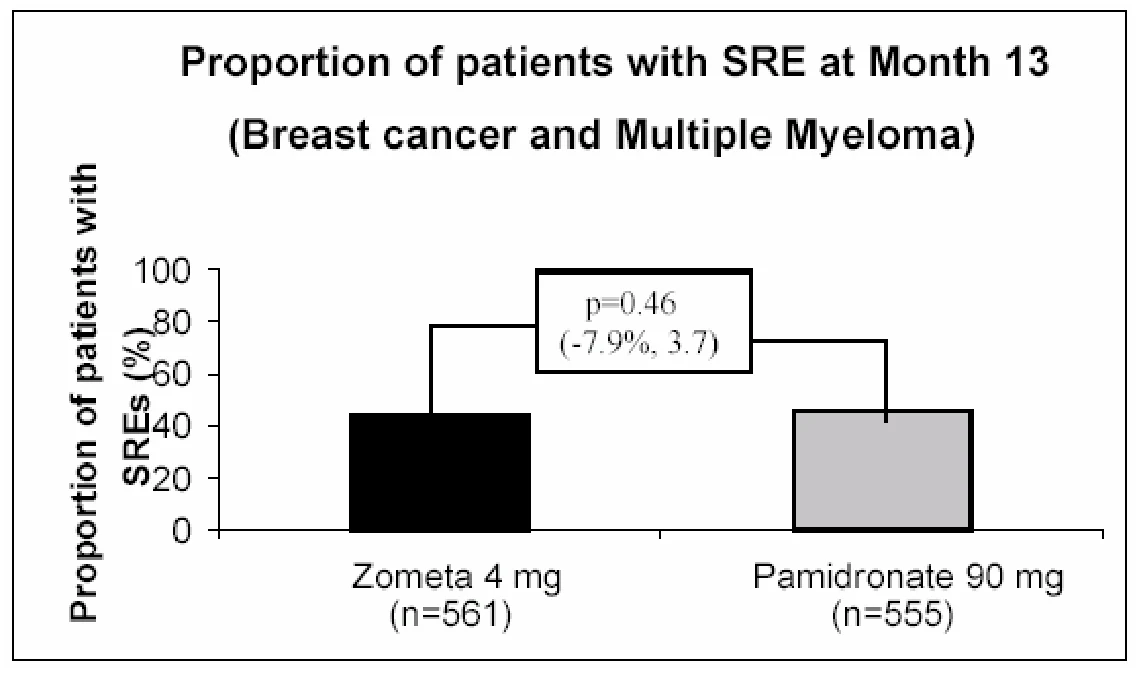
13 months. The proportion of patients with an SRE was 44% and 46% for ZOMETA 4 mg and Aredia 90 mg, respectively (p=0.46). See Figure 2.
Figure 2
ZOMETA was demonstrated to be comparable to Aredia in efficacy for the endpoint of the proportion of patients with an SRE in a non-inferiority analysis. There were no significant differences between ZOMETA and Aredia in time to first SRE.
The multiple event analysis indicated that patients with breast cancer and multiple myeloma receiving ZOMETA 4 mg in this trial had a 11.5% overall reduction in risk (hazard ratio of 0.88, 95% CI: 0.75, 1.05; p =0.15) for skeletal complications, compared to patients receiving Aredia 90 mg over the core phase of the trial. See Table 8 for the results of the main secondary efficacy analyses.
Table 8: Results of main secondary efficacy variables (Core Phase)
| Breast Cancer and Multiple Myeloma Patients | |||
| All SRE | |||
ZOMETA
4 mg
Aredia
90 mg
| N | 561 | 555 |
Time to First SRE Hazard Ratio (95% CI) vs Aredia 90 mg Median Time to SRE*(days) P-ValueH Multiple Event Analysis Hazard Ratio (95% CI) vs Aredia 90 mg P-ValueH | 0.91 (0.77, 1.09) 373 363 0.32 0.88 (0.75, 1.05) 0.15 | |
*Median Time to first SRE not taking death into consideration (i.e. deaths were censored). Hp-value vs. Aredia 90 mg based on Cox-regression stratified by cancer type.
In addition, of the 690 (353 ZOMETA, 337 Aredia) patients who completed the core phase of the trial, 417 (212 ZOMETA, 205 Aredia) consented to enter the extension phase. Another 111 patients continued with open-label Aredia which at the time was the standard of care. A total of 246 (123 ZOMETA, 123 Aredia) patients completed the extension phase. In the extension phase, only the safety data are reported (see ADVERSE REACTIONS).
Bone metastases from solid tumors other than breast cancer or prostate cancer
A third phase III randomized, double-blind, placebo-controlled trial compared ZOMETA to placebo for the prevention of SREs in patients who had solid tumors other than breast cancer or prostate cancer, with osteolytic or mixed bone metastases. Patients had to have at least 1 lytic metastasis for study entry. A total of 257 patients were randomized to ZOMETA 4 mg; 134 patients with non-small cell lung cancer (NSCLC) and 123 with other solid tumors (OST). A total of 250 patients were randomized to placebo (130 patients with NSCLC, 120 with OST). Patients received either an intravenous infusion of ZOMETA 4 mg or placebo every 3 weeks. The primary efficacy variable was the proportion of patients having an SRE at nine months. At nine months, the ZOMETA 4 mg group had a lower proportion of patients experiencing an SRE when compared with placebo (38% for ZOMETA 4 mg, 44% for placebo, p=0.13), see Figure 3. The difference for the primary efficacy variable was not statistically significant. However, when tumor-induced hypercalcemia (TIH) was also included as an SRE, the proportion of patients having an SRE reached statistical significance favoring ZOMETA 4 mg over placebo (38% for ZOMETA 4 mg and 47% for placebo, p=0.04).
Proportion of patients with SRE (-TIH) at
Month 9 (NSCLC and OST)
0
20
40
60
80
100
Zometa 4 mg
(n=257)
Placebo (n=250)
Figure 3
Study patients had a median overall survival of 6 months. ZOMETA extended the median time to an SRE by greater than two months (67 days) [median of 230 days vs. 163 days, p = 0.02. See Table 9] .
The multiple event analysis indicated that patients with lung cancer and other solid tumors (other than breast cancer or prostate cancer) receiving ZOMETA 4 mg had a 27% overall reduction in risk (hazard ratio of 0.73, 95% CI: 0.57, 0.95; p=0.02) for skeletal complications compared to placebo over the core phase of the trial. See Table 9 for the results of the main secondary efficacy analyses.
| P=0.13 | ||
| (-15.2%, 1.9%) | ||
Table 9: Results of main secondary efficacy variables (Core Phase)
| NSCLC and OST Patients | ||||
| All SRE (-TIH) | ||||
ZOMETA 4 mg | Placebo | |||
| N | 257 | 250 | ||
Time to First SRE Hazard Ratio (95% CI) vs placebo | 0.73 (0.55, 0.96) | |||
Median Time to SRE* (days) 230 163
P-ValueH 0.02
Multiple Event Analysis
Hazard ratio (95% CI) vs placebo
P-ValueH
0.73 (0.57, 0.95)
0.02
*Median Time to first SRE not taking death into consideration (i.e. deaths were censored). Hp-value vs. placebo based on Cox-regression stratified by cancer type.
In addition, of the 131 (68 ZOMETA, 63 placebo) patients who completed the core phase of the trial, 69 (34 ZOMETA, 35 placebo) consented to enter the extension phase and 16 (8 ZOMETA, 8 placebo) completed it. In the extension phase, only the safety data are reported (see ADVERSE REACTIONS).
DETAILED PHARMACOLOGY
ZOMETA belongs to a new highly potent class of bisphosphonates which act specifically on bone. It is one of the most potent inhibitors of osteoclastic bone resorption.
The selective action of bisphosphonates on bone is based on their high affinity for mineralized bone, but the precise molecular mechanism leading to the inhibition of osteoclastic activity is still unclear. In a variety of preclinical assays of bone metabolism, zoledronic acid inhibits bone resorption in vitro at concentrations of 0.3-30 nM, and in vivo at doses of 0.3-30 Fg/kg without exerting any untoward effects on either bone formation or mineralization.
In addition to inhibiting osteoclastic bone resorption, ZOMETA exerts direct anti-tumor effects on cultured human myeloma and breast cancer cells, inhibiting proliferation and inducing apoptosis. It also inhibits human endothelial cell proliferation in vitro and is anti-angiogenic in animals. Moreover, the observation that ZOMETA reduces the invasion of human breast cancer
cells through extracellular matrix in vitro indicates that it may possibly have anti-metastatic properties.
In broad safety screening, no adverse effects were detected on the cardiovascular or central nervous systems at pharmacologically relevant doses for the inhibition of bone resorption.
TOXICOLOGY
Acute Toxicity
| Species | Route | Doses (mg/kg) | Findings |
| Rat | i.v. | 0.6, 6, 30, 60, 80 | > 6 mg/kg: mortality and clinical signs 6 mg/kg: renal findings LD50 = approximately 13 mg/kg |
| Rat | i.v. | 1.6, 8, 16, 32 | > 8 mg/kg: mortality, clinical signs, necropsy findings in kidney, liver, GI tract > 1.6 mg/kg: 9 BW, FC, injection site irritation max. non lethal dose: 1.6 mg/kg min. lethal dose: 8 mg/kg |
| Dog | i.v. | 2,10 | 2 mg/kg: no clinical signs 10 mg/kg: mortality |
| Mouse | s.c. | 10,50 | 10 mg/kg: no clinical signs 50 mg/kg: mortality, clinical signs LD50 = 10-50 mg/kg in males and > 10 mg/kg in females |
| Rat | p.o. | 200, 2000 | > 200 mg/kg: 9 FC,BW, clinical signs, necropsy findings in stomach: enlarged, red lesions 2000 mg/kg: 100% mortality |
The acute parenteral toxicity of zoledronic acid was moderate to marked in the mouse, rat and dog. The estimated LD50 in the mouse (s.c.) and rat (i.v.) was 10-50 mg/kg (males)/>10 mg/kg (females) and 13 mg/kg (males), respectively. Compound-related renal tubular lesions were observed in the rat after one dose at 6 mg/kg. A single intravenous injection in the dog produced clinical signs, intestinal hemorrhage and mortality after 6 days in one male at 10 mg/kg. The other male received 2 mg/kg and survived the 14-day postdose observation period without clinical signs.
Subacute and Chronic Toxicity
| Study Type | Species | Route | Doses (mg/kg) | Findings |
| Intravenous | ||||
| 10-Day range-Finding | Rat | i.v. | 0.06, 0.6, 6 | 0.06 mg/kg: well tolerated 0.6 mg/kg: clin. signs; micro in kidneys, liver 6 mg/kg: sacrifice due to severe clin. signs; micro in bone, kidneys, stomach, liver, thymus, spleen, lymph nodes NOAEL: 0.06 mg/kg |
| 2-Week | Rat | i.v. | 0.06, 0.6, 3.2 (every third day for 18 days) | > 0.06 mg/kg: local irritation, non-proliferative hyperostosis > 0.6 mg/kg: gastric lesions 3.2 mg/kg: mortality, clin signs; 9 BW/FC, clin lab alterations, 8 adrenal, kidney, liver wgts, nephropathy, hepatocellular hypertrophy NOAEL: not established |
| 10-Day range-finding | Dog | i.v. | 0.1, 1 | > 0.1 mg/kg: micro in bone rib, injection sites 1 mg/kg: clin. signs; micro findings in stomach, intestine, liver, lung, thymus NOAEL: 0.1 mg/kg |
4-Week + 1 mo. Recovery | Dog | i.v. | 0.02, 0.06, 0.2 | > 0.06 mg/kg: clinical signs 0.2 mg/kg: clin. signs; micro in GI tract NOAEL: 0.02 mg/kg |
3-Month + 1 mo. Recovery | Dog | i.v. | 0.01,0.03, 0.160.2 | >0.01 mg/kg: genital tract atrophy (F); 8 primary spongiosa in bone; splenic histiocytosis; lung inflammation, thymic atrophy > 0.03 mg/kg: moribund sacrifice at 0.1 6 0.2 mg/kg due to inj.site irritation, 9 BW/FC, 8 ALAT/ASAT, 9 bone AP, PO4, creatinine and 9 RBC indices; inj. site ulceration, kidney lesions, genital tract (M) & pancreatic atrophy, inflammation of urinary bladder, esophagus, stomach and liver. NOAEL: not established |
26/52-wk+ 6 mo. Recovery | Dog | i.v. | 0.005,0.03, 0.1 | All doses: inj site irritation; 9 phosphate; non-proliferative hyperostosis >0.03 mg/kg : micro in kidneys, GI tract; 8 BUN, 8 total protein. 0.1 mg/kg: 9 creatinine, 8 ASAT, 9Ca. NOAEL: 0.005 mg/kg |
Bone analyses (26/52-wk + 6 mo. Recovery ) | Dog | i.v. | 0.005,0.03, 0.1 | All biomechanical parameters assessing bone quality showed either no deleterious effect or an increase in quality at pharmacologically efficacious doses. |
| Subcutaneous | ||||
| 10-Day range- finding | Rat | s.c. | 0.2,0.6,2 | 2 mg/kg: clin. signs; microscopic changes in kidneys, liver; spleen, thymus, lymph nodes, lung and adrenals. > 0.6 mg/kg: clin. signs > 0.2 mg/kg: Local irritation at the injection sites |
1-Month + 1 mo recovery | Rat | s.c. | 0.02,0.06,0.2 | 0.2 mg/kg: swelling at injection site; clin. signs; micro findings in liver, lymph nodes > 0.06 mg/kg: clin. signs; micro findings of spleen, injection sites, skeletal muscle; NOAEL: 0.02 mg/kg |
3-Month + 1 mo recovery | Rat | s.c. | 0.01,0.03,0.1 | Tolerated without mortality at doses up to and including 0.1 mg/kg. Non-proliferative hyperostosis. NOAEL 0.01 mg/kg in females. No NOAEL in males due to reduced BW/FC at all doses. |
6/12-Month + 6 mo recovery | Rat | s.c. | 0.001,0.003, 0.01 | $0.001 mg/kg: 9 bone AP, 8 reticulocyte count, splenic hemosiderosis and congestion, 8 splenic hematopoiesis, 8 cellularity of femoral/tibial marrow, non-proliferative hyperostosis. Following bone morphometry, no deleterious effects after administration for 12 months. $0.003 mg/kg: 9 RBC parameters, 8 fibrinogen, renal tubular changes, progressive nephropathy. 0.01 mg/kg: testicular tubular atrophy Bone morphometry on bone (tibia) did not reveal deleterious effects NOAEL: 0.001 mg/kg |
| Oral | ||||
| 13-week | Mouse | p.o. | 0, 0.3, 3, 10, 30620 | 0.3 B 30620 mg/kg: mortality; respiratory signs; 9 FC; non-proliferative hyperostosis 3 - 30620 mg/kg: 9 BW; laryngeal, tracheal & bronchial inflammation |
| 10-Day range-finding | Rat | p.o. | 1,10,100 | 1 and 10 mg/kg: well-tolerated 100 mg/kg: mortality & moribund sacrifice after 1 wk; clin. signs; gastritis, GI tract necrosis, acute renal tubular lesions, liver changes; lymphoid depletion spleen, thymus. |
1-Month + 1 mo recov. | Rat | p.o. | 62060 | 6 mg/kg: well-tolerated >20 mg/kg: clin signs; liver, spleen, lymph nodes 60 mg/kg: mortality; GI tract, kidneys, salivary glands, thymus, adrenal, lung, trachea NOAEL: 6 mg/kg |
6-Month + 1 mo recov. | Rat | p.o. | 0.1,1, 10 | >0.1 mg/kg: bone >1 mg/kg: clin signs 10 mg/kg: mortality NOAEL: 0.1 mg/kg |
| 10-Day | Dog | p.o. | 1630, 10 (for 9d); 30 (for 10d) a | 1630 mg/kg: clin. signs; micro findings in kidneys, esophagus, liver; non-proliferative hyperostosis. 10 mg/kg: no significant findings |
| 1-Month | Dog | p.o. | 3,10, 30 | > 3 mg/kg: clin signs > 10 mg/kg: mortality; liver, lung, thymus 30 mg/kg: gingiva, pancreas, adrenals |
6-Month + 1 mo. Recov | Dog | p.o. | 0.01, 0.1, 1 | Well-tolerated at doses of up to 1 mg/kg. Histological bone changes were considered pharmacologic NOAEL: 1 mg/kg |
| a From day 9 of dosing: 30 mg/kg for an additional 10 days | ||||
Reproductive Toxicity Studies
| Study Type | Species | Route | Doses (mg/kg) | Findings |
| Segment I | Rat | s.c. | 0.01, 0.03, 0.1 | > 0.01: maternal toxicity and severe effects on parturition such that the study was terminated on lactation day 7. |
Segment II range- finding | Rat | s.c. | 0.2, 0.6, 2 | > 0.2 mg/kg: irritation at injection site > 0.6 mg/kg: 9 maternal BW. 9/10 dams with total resorption (embryo/fetal death) of progeny; remaining dam w/ only 2 fetuses (one with cleft palate). |
| Segment II | Rat | s.c. | 0.1, 0.2, 0.4 | > 0.2 mg/kg: 9 maternal BW; 9 fetal wgt; anomalies of viscera and/or skeleton w/ wavy ribs & delay in skeletal maturation. 0.4 mg/kg: 9/24 dams with total resorption of fetuses; some fetuses with edema, cleft palate, short lower jaw, abnormal ossification |
Segment II range- finding (non-pregnant) | Rabbit | s.c. | 0.2,0.6,2 | 0.6 or 0.2 mg/kg suitable doses for main study. |
Segment II range- finding (pregnant) | Rabbit | s.c. | 0.1,0.2,0.4 | 0.2, 0.4 mg/kg: early termination due to severe clinical signs/toxicity. 0.1 mg/kg: 9 fetal wgt; no signs of abnormal fetal development. |
| Segment II | Rabbit | s.c. | 0,01, 0.03, 0.1 | Maternal toxicity at $ 0.01 mg/kg due to 9 blood calcium. No embryo/fetotoxicity or teratogenicity. |
Zoledronic acid was evaluated for potential adverse effects on fertility, labor, delivery and lactation of the parental generation rats as well as development, behavior and fertility of the F1 generation at doses of 0.01, 0.03 and 0.1 mg/kg; however, many females in the treated groups either died or were sacrificed while moribund at parturition due to difficulty in delivery (dystocia) such that the study was terminated on lactation day 7.
Teratology studies were performed in two species, both via subcutaneous administration. Teratogenicity was observed in the rat at doses $ 0.2 mg/kg manifested by external, visceral and skeletal malformations. There were also dose-related increases in the incidence of poor skeletal ossification at $ 0.2 mg/kg and evidence of maternal toxicity at $ 0.2 mg/kg as well as fetal toxicity at 0.4 mg/kg. No teratological or embryo/fetal effects were observed in the rabbit though maternal toxicity was marked at $ 0.1 mg/kg due to decreased serum calcium.
Carcinogenicity
Zoledronic acid was administered orally (gavage) to rats and mice for at least 104 weeks without evidence of carcinogenic potential. Chronic parenteral administration was not feasible given the potential of the compound to cause severe local irritation, often after only one or several doses. As zoledronic acid, and bisphosphonates in general, manifest poor oral bioavailability, fasting procedures were instituted to facilitate absorption. Nevertheless the pharmacological bone changes typically observed following long term bisphosphonate administration (non-proliferative hyperostosis) to young animals with growing skeletons gave clear evidence of systemic exposure to zoledronic acid in both species at all doses. An increased incidence of Harderian gland adenomas/adenocarcinomas was observed in males at 0.1 and 1.0 mg/kg and females at doses $ 0.3 mg/kg. These increases were not considered to be related to zoledronic acid administration or biologically meaningful as the Harderian gland is a unique, highly specialized organ which is not present or known to have any correlate in humans; thus, it has no relevance.
| Species | Route | Doses (mg/kg) | Findings |
| Mouse | p.o. | 0.1,0.3,1.0 | $ 0.1 mg/kg: non-proliferative hyperostosis $ 0.3 mg/kg: 9 BW |
| Rat | p.o. | 0.1,0.5,2.0 | $ 0.1 mg/kg: non-proliferative hyperostosis $ 0.5 mg/kg: 9 BW,FC 2.0 mg/kg: 8 extramedullary hematopoiesis |
Mutagenicity
| Study Type | Findings | |
in vitro: Ames a, Ames b , Amesc Range: a5000 Fg/plate (-S9/+S9), b390 - 25000 Fg/plate, c1250 Fg/plate (-S9/+S9) | Negative | |
| in vitro: Cytogenetics test on Chinese hamster cells Range: 9.7 B 1250 Fg/mL | Negative | |
| in vitro: Gene mutation test using V79 Chinese hamster cells Range: 2 B 15 Fg/mL | Negative | |
| in vivo: Micronucleus in rats Range: 2.6 B 10.4 mg/kg | Negative | |
| a Bacterial test systems (S. typhimurium), with/without metabolic activation. bBatch control | ||
| cBacterial test system (S. typhimurium/ E. coli), with/without metabolic activation. | ||
There was no evidence of mutagenicity for zoledronic acid in a battery of tests covering various endpoints of genotoxicity.
REFERENCES
- 1. Anderson PK, and Gill RD, Cox=s regression model for counting processes: a large sample study. Ann Statist 1982; 10: 1100-20.
- 2. Arden-Cordone M, Siris E, Lyles K, et al., Antiresorptive effect of a single infusion of microgram quantities of zoledronate in Paget=s disease of bone. Calcif Tissue Int 1997; 60: 415-418.
- 3. Body J, Jortholary A, Romieu G, et al., A dose-finding study of zoledronate in hypercalcemic cancer patients. J Bone Miner Res 1999; 9: 1557-1561.
- 4. Buckler H, Fraser W, Hosking D, et al., Single infusion of zoledronate in Paget=s disease of bone: a placebo-controlled, dose-ranging study. Bone 1999; 24 (S5): 81S-85S.
- 5. Garnero P, Gineyts E, Schaffer A, et al., Measurement of urinary excretion of nonisomerized and beta-isomerized forms of type I collagen breakdown products to monitor the effects of the biphosphonate zoledronate in Paget=s disease. Arthritis Rheum 1998; 41: 354-360.
- 6. Green JR, Müller K, Jaeggi KA. Preclinical Pharmacology of CGP 42-446, a new, potent, heterocyclic bisphosphonate compound. J Bone Miner Res 1994; 9: 745-751.
- 7. Green J, Seltenmeyer Y, Jaeggi K, Widler L, Renal tolerability profile of novel, potent bisphosphonates in two short-term rat models, Pharmacol Toxicol 1997; 80: 225-230.
- 8. Risser F, Pfister C, Degen P, An enzyme inhibition assay for the quantitative determination of the new bisphosphonate zoledronate in plasma. J Pharm Biomed Anal 1997; 15: 1877-1880.
- 9. Rosen Lee S, Gordon D, Kaminski M, et al., Zoledronic acid versus pamidronate in the treatment of skeletal metastases in patients with breast cancer or osteolytic lesions of multiple myeloma: A phase III, double-blind, comparative trial. The Cancer Journal. September/October 2001; 7 (5), 377-387.
- 10. Rosen LS, Gordon DH, Dugan W, et al., Zoledronic acid is superior to pamidronate for treatment of bone metastases in breast carcinoma patients with at least one osteolytic lesion. Cancer. 2004;100:36-43.
- 11. Rosen LS, Gordon DH, Kaminski M, et al., Long-term efficacy and safety of zoledronic acid compared with pamidronate disodium in the treatment of skeletal complications in patients with advanced multiple myeloma and breast cancer. Cancer. 2003;98:1735-1744.
- 12. Saad F, Gleason Donald M, Murray R, et. al., A randomized, placebo-controlled trial of zoledronic acid in patients with hormone-refractory metastatic prostate carcinoma. Journal of the National Cancer Institute October 2, 2002; 94 (19), 1458-1468.
- 13. Saad F, Gleason Donald M, et al., Long-term efficacy of zoledronic acid for the prevention of skeletal complications in patients with metastatic hormone-refractory prostate cancer. Journal of the National Cancer Institute June 2, 2004;96 (11):879-882.
- 14.
Therneau M, Hamilton SA. rhDNase as an example of recurrent event analysis. Statist
Med 1997;16:2029-47.