


Product Monograph - Zyprexa
Recent Major Label Changes
| N/A |
|---|
Table of Contents
Certain sections or subsections that are not applicable at the time of the preparation of the most recent authorized product monograph are not listed.
Recent Major Label Changes ................................................................................................................ 2
Table of Contents ................................................................................................................................. 2
Part 1: Health Professional Information ............................................................................................... 4
- 1.
Indications ................................................................................................................................... 4
1.1 Pediatrics .................................................................................................................................................... 4
1.2 Geriatrics .................................................................................................................................................... 4
- 2. Contraindications ........................................................................................................................ 5
- 3. Serious Warnings And Precautions Box ........................................................................................ 5
- 4.
Dosage and Administration .......................................................................................................... 5
4.1 Dosing Considerations ................................................................................................................................ 5
4.2 Recommended Dose and Dosage Adjustment ........................................................................................... 5
4.3 Reconstitution ............................................................................................................................................ 7
4.4 Administration ............................................................................................................................................ 8
4.5 Missed Dose ............................................................................................................................................... 9
- 5. Overdose ..................................................................................................................................... 9
- 6. Dosage Forms, Strengths, Composition, and Packaging .............................................................. 10
- 7.
Warnings and Precautions ......................................................................................................... 11
General ............................................................................................................................................................... 11
Carcinogenesis and Genotoxicity ........................................................................................................................ 12
Cardiovascular .................................................................................................................................................... 12
Dependence, Tolerance and/or Abuse Liability .................................................................................................. 13
Driving and Operating Machinery ...................................................................................................................... 13
Endocrine and Metabolism ................................................................................................................................. 13
Gastrointestinal .................................................................................................................................................. 15
Genitourinary ...................................................................................................................................................... 15
Hematologic ........................................................................................................................................................ 15
Hepatic/Biliary/Pancreatic .................................................................................................................................. 16
Neurologic .......................................................................................................................................................... 17
Psychiatric ........................................................................................................................................................... 18
Renal .................................................................................................................................................................. 18
Reproductive Health ........................................................................................................................................... 18
Skin .................................................................................................................................................................. 19
7.1 Special Populations ................................................................................................................................... 19
7.1.1. Pregnancy ........................................................................................................................................ 19
7.1.2. Breastfeeding .................................................................................................................................. 20
7.1.3. Pediatrics ......................................................................................................................................... 20
7.1.4. Geriatrics ......................................................................................................................................... 21
- 8.
Adverse Reactions ..................................................................................................................... 21
8.1 Adverse Reaction Overview ...................................................................................................................... 21
8.2 Clinical Trial Adverse Reactions ................................................................................................................ 22
8.2.1 Clinical Trial Adverse Reactions – Pediatrics ........................................................................................ 33
8.4 Abnormal Laboratory Findings: Hematologic, Clinical Chemistry, and Other Quantitative Data............. 34
8.5 Post-Market Adverse Reactions ............................................................................................................... 39
- 9.
Drug Interactions ....................................................................................................................... 41
9.2 Drug Interactions Overview ...................................................................................................................... 41
9.3 Drug-Behaviour Interactions .................................................................................................................... 42
9.4 Drug-Drug Interactions ............................................................................................................................. 42
9.5 Drug-Food Interactions ............................................................................................................................. 45
9.6 Drug-Herb Interactions ............................................................................................................................. 45
9.7 Drug-Laboratory Test Interactions ........................................................................................................... 45
- 10.
Clinical Pharmacology ............................................................................................................ 45
10.1 Mechanism of Action ................................................................................................................................ 45
10.2 Pharmacodynamics .................................................................................................................................. 45
10.3 Pharmacokinetics ..................................................................................................................................... 48
- 11. Storage, Stability, and Disposal .............................................................................................. 51
- 12. Special Handling Instructions ................................................................................................. 51
Part 2: Scientific Information ............................................................................................................. 52
- 13. Pharmaceutical Information .................................................................................................. 52
- 14.
Clinical Trials ......................................................................................................................... 52
14.1 Clinical Trials by Indication ....................................................................................................................... 52
Schizophrenia and Related Disorders (oral ZYPREXA) ........................................................................................ 52
Bipolar Disorder (oral ZYPREXA) ........................................................................................................................ 55
Agitation associated with Schizophrenia and Bipolar I Mania (ZYPREXA IntraMuscular) .................................. 65
14.2 Comparative Bioavailability Studies ......................................................................................................... 67
- 15. Microbiology ......................................................................................................................... 68
- 16. Non-Clinical Toxicology .......................................................................................................... 68
Patient Medication Information ......................................................................................................... 72
PrZYPREXA ........................................................................................................................................................... 72
PrZYPREXA ZYDIS .................................................................................................................................................. 72
Patient Medication Information ......................................................................................................... 81
PrZYPREXA IntraMuscular .................................................................................................................................... 81
Part 1: Health Professional Information
1. Indications
ZYPREXA, ZYPREXA ZYDIS (oral olanzapine) is indicated for
- the acute and maintenance treatment of schizophrenia and related psychotic disorders.
In controlled clinical trials, oral ZYPREXA was found to improve both positive and negative symptoms.
Oral ZYPREXA has been shown to be effective in maintaining clinical improvement during 1-year of continuation therapy in patients who had shown an initial treatment response.
ZYPREXA, ZYPREXA ZYDIS (oral olanzapine) is indicated for
- the acute treatment of manic or mixed episodes in bipolar I disorder (monotherapy or cotherapy)
- maintenance treatment in bipolar I disorder (monotherapy).
Olanzapine may be used as monotherapy or cotherapy with agents commonly used in the treatment of acute bipolar disorder (e.g., lithium or divalproex sodium).
The efficacy of ZYPREXA as monotherapy maintenance treatment in bipolar patients with manic or mixed episodes who responded to acute treatment with ZYPREXA was demonstrated in two 1-year “time to relapse” trials (see 14 Clinical Trials).
The physician who elects to use ZYPREXA for extended periods should periodically re-evaluate the long-term usefulness of the drug for the individual patient (see 4 Dosage and Administration section).
ZYPREXA IntraMuscular (intramuscular olanzapine) is indicated for
- the rapid control of agitation in patients with schizophrenia and related psychotic disorders, and bipolar mania.
The efficacy of ZYPREXA IntraMuscular for the control of agitation was established in 2 short-term (24 hours) placebo-controlled trials in agitated inpatients with schizophrenia and one short-term (24 hours) placebo-controlled trial in agitated patients with mania associated with bipolar disorder (see 14 Clinical Trials section).
1.1 Pediatrics
Pediatrics (< 18 years of age): The safety and efficacy of ZYPREXA have not been established in pediatric populations and its use is not recommended (see 7.1.3 Pediatrics and 8 Adverse Reactions/Clinical Trial Adverse Reactions/Clinical Trial Adverse Reactions – Pediatrics/Adverse Events in Adolescent Patients (ages 13-17 years))
1.2 Geriatrics
Geriatrics (≥ 65 years): ZYPREXA, ZYPREXA ZYDIS, AND ZYPREXA IntraMuscular are not indicated for treatment of elderly patients with dementia (see 3 Serious Warnings And Precautions Box and 7.1.4 Geriatrics). Caution should be used when treating geriatric patients with ZYPREXA, ZYPREXA ZYDIS, AND ZYPREXA IntraMuscular (see 10.3 Pharmacokinetics, 7.1.4 Geriatrics, and 4.1 Dosing Considerations).
2. Contraindications
ZYPREXA (olanzapine) is contraindicated in patients who are hypersensitive to this drug or to any ingredient in the formulation, including any non-medicinal ingredient, or component of the container. For a complete listing, see 6 Dosage Forms, Strengths, Composition, and Packaging section.
3. Serious Warnings And Precautions Box
- Increased Mortality in Elderly Patients with Dementia:
Elderly patients with dementia treated with atypical antipsychotic drugs are at an increased risk of death compared to placebo. Analyses of thirteen placebo controlled trials with various atypical antipsychotics (modal duration of 10 weeks) in these patients showed a mean 1.6-fold increase in death rate in the drug-treated patients. Although the causes of death were varied, most of the deaths appeared to be either cardiovascular (e.g., heart failure, sudden death) or infectious (e.g., pneumonia) in nature. (See 7 Warning and Precautions/Special Populations/Use in Geriatric Patients with Dementia). ZYPREXA is not indicated for use in elderly patients with dementia.
4. Dosage and Administration
4.1 Dosing Considerations
- Absorption of oral ZYPREXA is not affected by food
- Dosage adjustments may be necessary in hepatic impairment, renal impairment, and with concomitant CYP1A2 inhibitors (see General Considerations for Dosing in Special Populations and 9.4 Drug-Drug Interactions)
- ZYPREXA ZYDIS orally disintegrating tablet is intended for oral administration only. The orally disintegrating tablet breaks easily and should be handled carefully, with dry hands (see 4.4 Administration)
- ZYPREXA IntraMuscular is intended for intramuscular use only. Parenteral drug products should be inspected visually for particulate matter and discolouration prior to administration, whenever solution and container permit
- Concomitant administration of ZYPREXA IntraMuscular and parenteral benzodiazepine is not recommended (see 7 Warnings and Precautions, Cardiovascular, Hypotension and Syncope).
- Oral ZYPREXA and ZYPREXA IntraMuscular are not recommended for use in the pediatric population (see 7.1.3 Pediatrics).
- Oral ZYPREXA and ZYPREXA IntraMuscular are not indicated for treatment of elderly patients with dementia (see 3 Serious Warnings and Precautions Box)
- Baseline and periodic monitoring of blood glucose, body weight and lipids are recommended (see 7 Warnings and Precautions, Endocrine and Metabolism)
- Baseline and periodic monitoring of complete blood count (CBC) are recommended (see 7 Warnings and Precautions, Hematologic)
4.2 Recommended Dose and Dosage Adjustment
ORAL ZYPREXA
Bioequivalence of the 15 mg and 20 mg tablets to multiple 5 mg tablets has been demonstrated. These tablet formulations are equally well absorbed and can be readily interchanged. Pharmacokinetic studies showed that the ZYPREXA Tablets and ZYPREXA ZYDIS dosage forms are bioequivalent. ZYPREXA ZYDIS orally disintegrating tablets can be used as an alternative to ZYPREXA Tablets. (see 14.2 Comparative Bioavailability Studies).
Schizophrenia and Related Disorders
Adults: ZYPREXA (olanzapine) should be administered on a once-a-day schedule without regard to meals, generally beginning with 5 to 10 mg, with a target dose of 10 mg/day within several days. Further dosage adjustments, if indicated, should generally occur at intervals of not less than 1 week, since steady state for ZYPREXA would not be achieved for approximately 1 week in the typical patient. When dosage adjustments are necessary, dose increments/ decrements of 5 mg per day are recommended. An increase to a dose greater than target dose of 10 mg/day (i.e., to a dose of 15 mg/day or greater) is normally recommended only after clinical assessment.
In clinical trials a dose range of 5-20 mg/day was studied (see 14 Clinical Trials).
Doses above 20 mg/day have been evaluated from a safety perspective (see Table 6 in Adverse Events, Dose-Dependent Adverse Events subsection); however, efficacy at doses above 20 mg/day has not been systematically evaluated.
Maintenance Therapy in Schizophrenia:
It is recommended that responding patients with schizophrenia be continued on ZYPREXA at the lowest dose needed to maintain remission. Patients should be reassessed periodically to determine the need for maintenance treatment. While there is no body of evidence available to answer the question of how long the patient should be treated with ZYPREXA, the effectiveness of maintenance treatment is well established for many other antipsychotic drugs.
Bipolar Disorder
Bipolar Mania
Adults: The recommended starting dose for olanzapine is 15 mg administered once a day in monotherapy and 10 mg daily in combination therapy.
It may be given without regard to meals as its absorption is not affected by food. The dosage range of olanzapine is from 5 mg to 20 mg per day. Daily dosage should be adjusted in response to clinical assessment.
Maintenance Therapy in Bipolar Disorder:
Patients who have been receiving and responding to ZYPREXA for the treatment of acute manic or mixed episodes of bipolar disorder should initially continue maintenance therapy at the same dose (see 14 Clinical Trials). Subsequent daily dosage should be adjusted on the basis of clinical status within a range of 5-20 mg per day.
Patients should be periodically reassessed to determine the need for maintenance treatment and the appropriate dose for such treatment.
ZYPREXA INTRAMUSCULAR
In clinical trials, individual doses of 5 mg, 7.5 mg and 10 mg of intramuscular olanzapine for injection have been shown to be effective in controlling agitation in patients with schizophrenia (see 14 Clinical Trials). Individual doses of more than 10 mg of intramuscular olanzapine have not been studied and are not recommended.
Usual Dose for Agitated Patients with Schizophrenia and Bipolar Mania:
The usual initial dose for olanzapine injection is 10 mg, administered as a single intramuscular injection. A lower dose (5 mg or 7.5 mg) may be given, on the basis of individual clinical status.
Repeat and Maximum Dose:
In clinical trials over a 24 hour period, a minority of patients required a second dose, and only a small percent of patients required a third dose of ZYPREXA IntraMuscular (see 14 Clinical Trials). Thus safety information on the use of repeated doses of ZYPREXA IntraMuscular is limited. Nevertheless, if warranted by the clinical situation, a second dose, 5-10 mg, may be administered 2 hours after the first injection. A third dose, if required, should be given no sooner than four hours after the second dose. The safety of total daily doses greater than 30 mg has not been evaluated in clinical trials.
The recommended maximum daily dose of olanzapine (oral and IM) is 20 mg, with no more than three injections in a 24 hour period.
General Considerations for Dosing in Special Populations
Elderly or Debilitated Patients:
Oral ZYPREXA: In clinical trials, 44 patients with schizophrenia or related disorders who were 65 years of age or over were treated with ZYPREXA (5-20 mg daily) (see 7 Warnings and Precautions, 7.1.4 Geriatrics). Given the limited experience with ZYPREXA in the elderly, and the higher incidence of concomitant illness and concomitant medication in this population, ZYPREXA should be used with caution.
The recommended starting dose is 5 mg in patients who are elderly, debilitated, who have a predisposition to hypotensive reactions, who otherwise exhibit a combination of factors that may result in slower metabolism of ZYPREXA (e.g., nonsmoking female patients), or who may be pharmacodynamically more sensitive to ZYPREXA. When indicated, dose escalation should be performed with caution in these patients.
Zyprexa IntraMuscular: Lower doses (e.g., 2.5 mg) should be considered when clinical factors warrant.
Patients with Hepatic and/or Renal Impairment:
Oral Zyprexa: As clinical experience is lacking in these patients, the lower initial starting dose and slower titration to initial target dose should be considered. Further dose escalation, when indicated, should be conservative (see 7 Warnings and Precautions, Hepatic/Biliary/Pancreatic and 7 Warnings and Precautions, Renal).
4.3 Reconstitution
Directions for preparation of ZYPREXA IntraMuscular with Sterile Water for Injection:
Dissolve the contents of the vial using 2.1 mL of Sterile Water for Injection to provide a solution containing approximately 5 mg/mL of olanzapine. The resulting solution should appear clear and yellow. ZYPREXA IntraMuscular reconstituted with Sterile Water for Injection should be used immediately (within 1 hour) after reconstitution. Discard any unused portion.
| Vial Size | Volume of Diluent to be Added to Vial | Approximate Available Volume | Nominal Concentration per mL |
| 5 mL | 2.1 mL of Sterile Water for Injection | 2 mL | 5 mg/mL |
The following table provides injection volumes for delivering various doses of intramuscular olanzapine for injection reconstituted with Sterile Water for Injection.
| Dose, mg Olanzapine | Volume of Injection, mL |
| 10 | Withdraw total contents of vial |
| 7.5 | 1.5 |
| 5 | 1 |
| 2.5 | 0.5 |
Physical Incompatibility Information:
ZYPREXA IntraMuscular should be reconstituted only with Sterile Water for Injection. ZYPREXA IntraMuscular should not be combined in a syringe with diazepam injection because precipitation occurs when these products are mixed. Lorazepam injection should not be used to reconstitute ZYPREXA IntraMuscular as this combination results in a delayed reconstitution time. ZYPREXA IntraMuscular should not be combined in a syringe with haloperidol injection because the resulting low pH has been shown to degrade olanzapine over time.
Ongoing Therapy:
If ongoing olanzapine therapy is clinically indicated, treatment with intramuscular olanzapine for injection should be discontinued and oral olanzapine may be initiated in a range of 5-20 mg/day as soon as clinically appropriate (see 4 Dosage and Administration, Oral Administration subsection).
Reconstituted ZYPREXA IntraMuscular may be stored at controlled room temperature 20°C-25°C [See USP] for up to 1 hour if necessary. Discard any unused portion of reconstituted ZYPREXA IntraMuscular (see 11 Storage, Stability, and Disposal)
4.4 Administration
ZYPREXA ZYDIS orally disintegrating tablet is intended for oral administration only. It begins disintegrating in the mouth within seconds, allowing its contents to be subsequently swallowed with or without liquid.
The orally disintegrating tablet breaks easily and should be handled carefully, with dry hands. Direct contact with hands should be avoided if possible. One blister cell must be separated from the strip prior to peeling the blister backing. The blister backing should be carefully peeled back and the orally disintegrating tablet pushed out and placed directly in the mouth. The orally disintegrating tablet may also be stirred into 125 mL (4 ounces) of water, milk, coffee, orange juice or apple juice and the contents promptly consumed.
Zyprexa IntraMuscular is intended for intramuscular use only. Do not administer intravenously or subcutaneously. Inject slowly, deep into the muscle mass.
Concomitant administration of intramuscular olanzapine and parenteral benzodiazepine is not recommended (see 7 Warnings and Precautions, Hypotension and Syncope).
Parenteral drug products should be inspected visually for particulate matter and discolouration prior to administration, whenever solution and container permit.
4.5 Missed Dose
If a patient misses an oral dose by a few hours, advise patient to take as soon as he/she remembers. If most of the day has passed, advise patient to wait until the next scheduled dose. Advise patients to not take 2 doses of ZYPREXA at once.
5. Overdose
Signs and Symptoms
Very common symptoms reported in olanzapine overdose (≥ 10% incidence) include tachycardia, agitation/aggressiveness, dysarthria, various extrapyramidal symptoms, and reduced level of consciousness ranging from sedation to coma.
Other medically significant sequelae of olanzapine overdose include delirium, convulsion, possible neuroleptic malignant syndrome, respiratory depression, aspiration, hypertension or hypotension, cardiac arrhythmias (< 2% of overdose cases) and cardiopulmonary arrest. Fatal outcomes have been reported for acute overdoses as low as 450 mg of oral olanzapine but survival has also been reported following acute overdose of approximately 2,000 mg of oral olanzapine.
Management of Overdose
There is no specific antidote for olanzapine. Induction of emesis is not recommended. Standard procedures for management of overdose may be indicated (i.e., gastric lavage, administration of activated charcoal). The concomitant administration of activated charcoal was shown to reduce the oral bioavailability of olanzapine by 50 to 60%.
Symptomatic treatment and monitoring of vital organ function should be instituted according to clinical presentation, including treatment of hypotension and circulatory collapse and support of respiratory function. Do not use epinephrine, dopamine, or other sympathomimetic agents with beta-agonist activity since beta stimulation may worsen hypotension.
For management of a suspected drug overdose, contact your regional Poison Control Centre or Health Canada’s toll-free number, 1-844 POISON-X (1-844-764-7669).
- 6. Dosage Forms, Strengths, Composition, and Packaging
Table 1: Dosage Forms, Strengths, and Composition
| Product | Route of Administration | Dosage Form/ Strength/Composition | Non-Medicinal Ingredients |
| Zyprexa | oral | tablet / 2.5 mg (8 µmol)1, 5 mg (16 µmol)1, 7.5 mg (24 µmol)1 , 10 mg (32 µmol)1, 15 mg (48 µmol)1 , 20 mg (64 µmol)1 | Tablets: carnauba wax, crospovidone, hydroxypropyl cellulose, hydroxypropyl methylcellulose, lactose, magnesium stearate, and microcrystalline cellulose Colour coating and ink contain some or all of the following ingredients: FD&C Blue No.2 Aluminum Lake (15.0 mg tablets only2), polyethylene glycol (2.5 mg, 5.0 mg, 7.5 mg, 10.0 mg, and 20 mg tablets only), polysorbate 80 (2.5 mg, 5.0 mg, 7.5 mg, and 10.0 mg, only), Synthetic Red Iron Oxide (20.0 mg tablets only), titanium dioxide, triacetin (15.0 mg tablets only). |
| Zyprexa ZYDIS | oral | orally disintegrating tablets / 5 mg (16 µmol)1, 10 mg (32 µmol)1, 15 mg (48 µmol)1, 20 mg (64 µmol)1 | aspartame4, gelatin, mannitol, sodium methyl paraben and sodium propyl paraben |
| Zyprexa IntraMuscular | intramuscular injection | parenteral / 10 mg per vial3 | Lactose, tartaric acid (hydrochloric acid and/or sodium hydroxide may have been added during manufacturing to adjust pH) |
1 equivalent activity of olanzapine
2 2.5 mg, 5.0 mg, 7.5 mg, and 10.0 mg tablets are imprinted with edible ink which contains FD&C Blue No.2 Aluminum Lake
3 each vial contains olanzapine, as the tartrate, equivalent to 10 mg olanzapine with inactive ingredients
4 ZYPREXA ZYDIS contains phenylalanine (0.34, 0.45, 0.67, or 0.90 mg per 5, 10, 15, or 20 mg oral lyophilisate, respectively).
AVAILABILITY OF DOSAGE FORMS:
ZYPREXA Tablets:
The 2.5 mg, 5 mg, 7.5 mg, and 10 mg tablets are white, round, film-coated, and imprinted in blue ink with “LILLY” and the tablet identification code. The 15 mg and 20 mg tablets are elliptical, film-coated light blue and pink, respectively, and debossed with “LILLY” and the tablet identification code.
The 2.5 mg, 5 mg, and 10 mg tablets are available in amber HDPE bottles of 7, 60, 100, 250, and 1000 tablets and in blisters. The 7.5 mg tablets are available in amber HDPE bottles of 60, 100, 250, and 1000 tablets and blisters. The 15 mg and 20 mg tablets are available in amber HDPE bottles of 7, 30, 100, and 1000 tablets and in blisters.
| TABLET STRENGTH | ||||||||
| 2.5 mg | 5 mg | 7.5 mg | 10 mg | 15 mg | 20 mg | |||
| Tablet No. | 4112 | 4115 | 4116 | 4117 | 4415 | 4420 | ||
| Imprinted or Debossed | LILLY 4112 | LILLY 4115 | LILLY 4116 | LILLY 4117 | LILLY 4415 | LILLY 4420 | ||
ZYPREXA ZYDIS Orally Disintegrating Tablets:
The 5 mg, 10 mg, 15 mg, and 20 mg tablets are yellow and round. The tablets are supplied in aluminum blister strips in cartons of 7 tablets or 28 tablets per carton.
ZYPREXA IntraMuscular:
ZYPREXA IntraMuscular is available as single use 5 mL vials in packages of 1s (VL7597).
For reconstitution information, please see 4 Dosage and Administration, Reconstitution.
ZYPREXA IntraMuscular is intended for intramuscular use only.
7. Warnings and Precautions
Please see 3 Serious Warnings And Precautions Box
General
Clinical experience with olanzapine in patients with concomitant illness is limited. Caution is thus advised when using ZYPREXA in patients with diseases or conditions that could affect the metabolism or the pharmacodynamic activity of olanzapine (see 4 Dosage and Administration section and 10 Clinical Pharmacology).
Body Temperature Regulation:
Disruption of the body’s ability to reduce core body temperature has been attributed to antipsychotic agents. Appropriate care is advised when prescribing ZYPREXA for patients who will be experiencing conditions which may contribute to an elevation of core temperature, e.g., exercising strenuously, exposure to extreme heat, receiving concomitant medication with anticholinergic activity, or being subject to dehydration.
Falls:
ZYPREXA may cause somnolence, postural (orthostatic) hypotension, motor and sensory instability, which may lead to falls and, consequently, fractures or other injuries. For patients with diseases, conditions, or medications that could exacerbate these effects, complete fall risk assessments when initiating antipsychotic treatment and recurrently for patients on long-term antipsychotic therapy.
Use in Other Concomitant Illnesses
Anticholinergic effects: as ZYPREXA demonstrated anticholinergic activity in vitro, caution is advised when prescribing for patients with symptomatic prostatic enlargement, narrow-angle glaucoma or paralytic ileus and related conditions.
In clinical trials, a single case of pre-existing intracranial hypertension was exacerbated.
ZYPREXA ZYDIS contains aspartame, a source of phenylalanine, and should be taken with caution in patients with phenylketonuria (see 6 Dosage Forms, Strengths, Composition, and Packaging).
Carcinogenesis and Genotoxicity
For animal data, see 16 Non-Clinical Toxicology section.
Cardiovascular
ZYPREXA has not been evaluated in patients with a recent history of myocardial infarction or unstable heart disease. Patients with these conditions were excluded from pre-marketing clinical trials. Due to the more rapid and higher peak plasma concentrations following intramuscular compared to oral administration (see 10 Clinical Pharmacology section), particular caution is advised with the use of ZYPREXA IntraMuscular. ZYPREXA IntraMuscular should not be administered to patients with unstable medical conditions, such as acute or unstable cardiovascular conditions such as myocardial infarction, unstable angina pectoris, severe hypotension and/or bradycardia, or sick sinus syndrome. If the patient’s medical history with regard to unstable medical conditions cannot be determined, the risks and benefits of IM olanzapine should be considered in relation to other alternative treatments.
Hypotension and Syncope:
As with other drugs that have high alpha-1 adrenergic receptor blocking activity, ZYPREXA may induce orthostatic hypotension, tachycardia, dizziness, and sometimes syncope, especially at the initiation of treatment. In a clinical trial database of 2500 patients treated with oral ZYPREXA, syncope was reported in 0.6% (15/2500). The risk of orthostatic hypotension and syncope may be minimized by initiating therapy with 5 mg QD (see 4 Dosage and Administration section). A more gradual titration to the target dose should be considered if hypotension occurs.
Hypotension and/or syncope associated with bradycardia has been observed infrequently with ZYPREXA IntraMuscular.
Patients receiving intramuscular olanzapine should be closely observed for hypotension including postural hypotension, bradyarrhythmia and/or hypoventilation, particularly for the first 2 to 4 hours following injection. Patients should remain recumbent if dizzy or drowsy after injection until examination indicates that they are not experiencing hypotension including postural hypotension, bradyarrhythmia and/or hypoventilation.
Caution is necessary in patients who receive intramuscular olanzapine with other drugs having effects that can induce hypotension, bradycardia, respiratory or central nervous system depression. Concomitant administration of intramuscular olanzapine and parenteral benzodiazepine and/or other drugs with CNS depressant activity has been associated with post-marketing reports of serious adverse events, including fatalities and is therefore not recommended. If the patient is considered to need parenteral benzodiazepine treatment, this should not be given until at least one hour after IM olanzapine administration. If the patient has received parenteral benzodiazepine, IM olanzapine administration should only be considered after careful evaluation of clinical status and the patient should be closely monitored for excessive sedation and cardiorespiratory depression (see 9 Drug Interactions section).
ZYPREXA should be used with particular caution in patients with known cardiovascular disease (history of myocardial infarction or ischemia, heart failure, or conduction abnormalities), cerebrovascular disease, and conditions which would predispose patients to hypotension (dehydration, hypovolemia, and treatment with antihypertensive medications).
QT Interval:
In clinical trials, clinically meaningful QTc prolongations (Fridericia QT correction [QTcF] ≥ 500 milliseconds [msec] at any time post baseline in patients with baseline QTcF < 500 msec) were uncommon (0.1% to 1%) in patients treated with olanzapine, with no significant differences in associated cardiac events compared to placebo. However, as with other antipsychotics, caution should be exercised when olanzapine is prescribed with medicines known to increase QTc interval, especially in the elderly, in patients with congenital long QT syndrome, congestive heart failure, heart hypertrophy, hypokalaemia or hypomagnesaemia (see 8 Adverse Reactions, Post-Market Adverse Drug Reactions).
Cardiac Death:
In a retrospective observational study, patients treated with atypical antipsychotics (including olanzapine) or typical antipsychotics had a similar dose-related increase of presumed sudden cardiac death (SCD) compared to non-users of antipsychotics (almost twice the risk than that for non-users). In postmarketing reports with olanzapine, the event of SCD has been reported very rarely.
Dependence, Tolerance and/or Abuse Liability
Zyprexa has not been systematically studied in humans for its potential for abuse, tolerance, or physical dependence. Evaluations of gross behaviour, suppression of barbital withdrawal, and self-administration (monkeys) and physical dependence production (rats) showed no physical dependence potential. These observations are limited to preclinical data and were not systematically studied in humans. Therefore, it is not possible to predict on the basis of this limited experience the extent to which a CNS-active drug will be misused, diverted, or abused once marketed. Consequently, patients should be evaluated carefully for a history of drug abuse, and such patients should be observed closely for signs of Zyprexa misuse or abuse (e.g., development of tolerance, increases in dose, drug-seeking behavior).
Driving and Operating Machinery
Potential Effect on Cognitive and Motor Performance:
Because ZYPREXA may cause somnolence, patients should be cautioned about operating hazardous machinery, including motor vehicles, until they are reasonably certain that ZYPREXA therapy does not affect them adversely.
Endocrine and Metabolism
Weight Gain:
Olanzapine was associated with weight gain during clinical trials. Clinically significant weight gain was observed across all baseline body mass index (BMI) categories (see 8 Adverse Reactions, Other Adverse Events Observed During Clinical Trials with Oral and Intramuscular Olanzapine Across All Indications, Weight Changes). Using pooled data from patients treated with olanzapine over the dosage range of 5 mg to 20 mg per day mean gain was 5.4 kg. The mean change in weight was comparable for patients with schizophrenia and bipolar mania. A retrospective analysis of 573 patients receiving olanzapine for up to 3 years found that dose was not a significant predictor of greater long-term changes in weight.
In long-term studies (at least 48 weeks), both the magnitude of weight gain and the proportion of olanzapine-treated patients who had clinically significant weight gain were greater than in short-term studies. The percentage of patients who gained ≥ 25% of their baseline body weight with long-term exposure was very common (≥ 10%).
Hyperglycaemia:
As with some other antipsychotics, exacerbation of pre-existing diabetes and hyperglycaemia have been reported rarely, and diabetic ketoacidosis and diabetic coma, including some fatal cases, have been reported very rarely during the use of ZYPREXA, sometimes in patients with no reported history of hyperglycaemia (see 8 Adverse Reactions, Post-Market Adverse Drug Reactions section). In some cases, a prior increase in body weight has been reported which may be a predisposing factor. Patients should have baseline and periodic monitoring of blood glucose and body weight.
In clinical trials (up to 52 weeks) olanzapine was associated with a greater mean change in glucose relative to placebo. Treatment-emergent clinically significant changes in fasting glucose were observed in patients with or without evidence of glucose dysregulation at baseline (see 8 Adverse Reactions, Abnormal Laboratory Findings: Hematologic, Clinical Chemistry, and Other Quantitative Data, Glucose Changes).
Assessment of the relationship between atypical antipsychotic use and glucose abnormalities is complicated by the possibility of an increased background risk of diabetes mellitus in patients with schizophrenia and the increasing incidence of diabetes mellitus in the general population. Given these confounders, the relationship between atypical antipsychotic use and hyperglycemia-related adverse events is not completely understood. However, epidemiological studies suggest an increased risk of treatment-emergent hyperglycemia-related adverse events in patients treated with the atypical antipsychotics. Precise risk estimates for hyperglycemia-related adverse events in patients treated with atypical antipsychotics are not available.
Any patient treated with atypical antipsychotics should be monitored for symptoms of hyperglycemia including polydipsia, polyuria, polyphagia, and weakness. Patients who develop symptoms of hyperglycemia during treatment with atypical antipsychotics should undergo fasting blood glucose testing. In some cases, hyperglycemia has resolved when the atypical antipsychotic was discontinued; however, some patients required continuation of anti-diabetic treatment despite discontinuation of the suspect drug. Patients with risk factors for diabetes mellitus (e.g., obesity, family history of diabetes) who are starting treatment with atypical antipsychotics should undergo fasting blood glucose testing at the beginning of treatment and periodically during treatment. Patients with an established diagnosis of diabetes mellitus who are started on atypical antipsychotics should be monitored regularly for worsening of glucose control.
Hyperprolactinemia:
As with other drugs that block dopamine D2 and/or serotonin 5-HT2 receptors, olanzapine may elevate prolactin levels. Elevations associated with ZYPREXA treatment are generally mild, and may decline during continued administration.
Since tissue culture experiments indicate that approximately one-third of human breast cancers are prolactin-dependent in vitro, ZYPREXA should only be administered to patients with previously detected breast cancer if the benefits outweigh the potential risks. Caution should also be exercised when considering ZYPREXA treatment in patients with pituitary tumours. Possible manifestations associated with elevated prolactin levels are amenorrhea, galactorrhea, and menorrhagia.
As is common with compounds which stimulate prolactin release, the administration of olanzapine resulted in an increase in the incidence of mammary neoplasms in both rats and mice. The physiological differences between rats and humans with regard to prolactin make the clinical significance of these findings unclear. To date, neither clinical nor epidemiological studies have shown an association between chronic administration of these drugs and mammary tumorigenesis.
Long-standing hyperprolactinemia when associated with hypogonadism may lead to decreased bone mineral density in both female and male subjects.
Lipids:
Increases in lipids have been observed in olanzapine-treated patients in placebo-controlled clinical trials. Treatment-emergent clinically significant changes in fasting lipids were observed in patients with or without evidence of dyslipidemia at baseline (see 8 Adverse Reactions, Abnormal Laboratory Findings: Hematologic, Clinical Chemistry, and Other Quantitative Data, Lipids subsection). Appropriate clinical monitoring is recommended, including baseline and follow-up lipid evaluations.
Gastrointestinal
Antiemetic Effect:
Consistent with its dopamine antagonist effects, olanzapine may have an antiemetic effect. Such an effect may mask signs of toxicity due to overdosage of other drugs, or may mask symptoms of disease such as brain tumour or intestinal obstruction.
Genitourinary
Priapism:
Rare cases of priapism have been reported with antipsychotic use, such as ZYPREXA. This adverse reaction, as with other psychotropic drugs, did not appear to be dose-dependent and did not correlate with the duration of treatment. The most likely mechanism of action of priapism is a relative decrease in sympathetic tone.
Urinary Retention:
ZYPREXA possesses anticholinergic properties, which can lead to adverse drug reactions such as urinary retention. There have been several serious post-marketing reports of urinary retention in ZYPREXA-treated patients and in some cases, catheterization was required. ZYPREXA should be prescribed with caution in patients with a current diagnosis or prior history of urinary retention and in patients with other risk factors for urinary retention (e.g. benign prostatic hyperplasia). ZYPREXA should also be prescribed with caution in patients receiving medications with anticholinergic activity that can affect voiding.
Hematologic
Venous Thromboembolism:
Venous thromboembolism (VTE), including fatal pulmonary embolism, has been reported in temporal association with antipsychotic drugs, including ZYPREXA, in case reports and/or observational studies. When prescribing ZYPREXA, all potential risk factors for VTE should be identified and preventative measures undertaken, particularly since patients with schizophrenia often present with risk factors for VTE. Very rare cases of VTE have been reported in ZYPREXA-treated patients during the
post-marketing period.
Hematologic Indices:
In oral olanzapine clinical trials, there were no data to suggest ZYPREXA adversely affected bone marrow function, even in patients with a history of clozapine-associated neutropenia or leukopenia. ZYPREXA was associated with a 5.7% incidence of mainly transient treatment-emergent elevations of eosinophil counts above the normal range. Elevations were not associated with any symptoms, identifiable allergic phenomena, or changes in other hematologic indices. Rare cases of leukopenia have been reported with
ZYPREXA. In case of symptoms of infection, WBC count and differential count should be considered.
Neutropenia, granulocytopenia and agranulocytosis have been reported during antipsychotic use. Therefore, it is recommended that patients have their complete blood count (CBC) tested prior to starting ZYPREXA and then periodically throughout treatment.
Hepatic/Biliary/Pancreatic
Small single-dose clinical pharmacology studies (see 10 Clinical Pharmacology section) did not reveal any major alterations in olanzapine pharmacokinetics in subjects with hepatic impairment. Given the limited clinical experience with ZYPREXA in patients with these conditions, caution should be exercised (see 4 Dosage and Administration section).
Aminotransferase Elevations:
During pre-marketing clinical trials, therapy with oral ZYPREXA was associated with elevation of hepatic aminotransferases, primarily ALT (SGPT). Within a clinical trial database of 2280 ZYPREXA-treated patients, with baseline ALT (SGPT) levels ≤ 60 IU/L, 5.9% (134/2280) had treatment-emergent ALT (SGPT) elevations to > 120 IU/L, 1.9% (44/2280) had elevations to > 200 IU/L, and 0.2% (5/2280) had elevations to > 400 IU/L. No patients had values in excess of 700 IU/L. None of the ZYPREXA-treated patients who had elevated aminotransferase values manifested clinical symptomatology associated with liver impairment. The majority of aminotransferase elevations were seen during the first six weeks of treatment. Most elevations were transient (66%) while patients continued on ZYPREXA therapy, or falling (11%) at the last available measurement. Of the 134 ZYPREXA-treated patients whose enzyme levels increased to > 120 IU/L, 20 discontinued treatment (6 for hepatic, 14 for other reasons) while their ALT (SGPT) values were still rising. In 38 ZYPREXA-treated patients with baseline ALT (SGPT) > 90 IU/L, none experienced an elevation to > 400 IU/L.
Rare post-marketing reports of hepatitis have been received. Very rare cases of cholestatic or mixed liver injury have also been reported in the post-marketing period. Hepatic failure, including fatalities has also been reported very rarely in the post-marketing period. See 8.5 Post-Market Adverse Reactions section.
Precaution should be exercised when using ZYPREXA in patients with pre-existing hepatic disorders, in patients who are being treated with potentially hepatotoxic drugs, or if treatment-emergent signs or symptoms of hepatic impairment appear.
For patients who have known or suspected abnormal hepatic function prior to starting ZYPREXA, standard clinical assessment including measurement of aminotransferase levels is recommended. Periodic clinical reassessment with aminotransferase levels is recommended for such patients, as well as for patients who develop any signs and symptoms suggestive of a new onset liver disorder during ZYPREXA therapy.
Neurologic
Neuroleptic Malignant Syndrome:
Neuroleptic malignant syndrome (NMS) is a potentially fatal symptom complex that has been reported in association with antipsychotic drugs, including ZYPREXA.
Clinical manifestations of NMS are hyperpyrexia, muscle rigidity, altered mental status, and evidence of autonomic instability (irregular pulse or blood pressure, tachycardia, diaphoresis, and cardiac dysrhythmia). Additional signs may include elevated creatine phosphokinase, myoglobinuria (rhabdomyolysis), and acute renal failure.
In arriving at a diagnosis, it is important to identify cases where the clinical presentation includes both serious medical illness (e.g., pneumonia, systemic infection, etc.), and untreated or inadequately treated extrapyramidal signs and symptoms (EPS). Other important considerations in the differential diagnosis include central anticholinergic toxicity, heat stroke, drug fever, and primary central nervous system pathology.
The management of NMS should include 1) immediate discontinuation of all antipsychotic drugs including ZYPREXA and other drugs not essential to therapy; 2) intensive symptomatic treatment and medical monitoring; and 3) treatment of any concomitant serious medical problems for which specific treatments are available. There is no general agreement about specific pharmacological treatment for uncomplicated NMS.
If a patient requires antipsychotic drug treatment after recovery from NMS, the potential re-introduction of therapy should be very carefully considered. The patient should be carefully monitored since recurrences of NMS have been reported.
Tardive Dyskinesia:
Tardive dyskinesia (TD), a syndrome consisting of potentially irreversible involuntary dyskinetic movements, is associated with the use of antipsychotic drugs. Tardive dyskinesia occurs more frequently in elderly patients; however, patients of any age can be affected. It is unknown whether antipsychotic drugs may differ in their potential to cause TD. However, during long-term, double-blind, extension schizophrenia maintenance trials (894 olanzapine-treated patients; median olanzapine treatment, 237 days), ZYPREXA was associated with a statistically significantly lower incidence of treatment-emergent dyskinesia compared to haloperidol. During long-term, double-blind, monotherapy extension bipolar maintenance trials (567 olanzapine-treated patients, for up to 1 year), there were no cases of TD in the ZYPREXA arms, as determined by either reported adverse events or the Abnormal Involuntary Movement Scale (AIMS). TD has been reported very rarely (≤ 0.0025%) in post-market surveillance.
The risk of developing tardive dyskinesia and the chance of it becoming irreversible are believed to increase as the duration of treatment and the cumulative dose of antipsychotic drug increase. However, the syndrome can develop, although less commonly, after relatively brief periods of treatment at low doses. There is no known treatment for established cases of TD. The syndrome may remit, partially or completely, if antipsychotic drug treatment is withdrawn. Antipsychotic drug treatment itself, however, may suppress the signs and symptoms of tardive dyskinesia, thereby masking the underlying process.
Given these considerations, ZYPREXA should be prescribed in a manner that is most likely to minimize the risk of tardive dyskinesia. As with any antipsychotic drug, ZYPREXA should be reserved for patients who appear to be receiving substantial benefit from the drug. In such patients the lowest effective dose and the shortest duration of treatment should be sought. The need for continued treatment should be reassessed periodically.
If signs or symptoms of tardive dyskinesia appear in a patient on ZYPREXA, drug discontinuation should be considered. However, some patients may benefit from continued treatment with ZYPREXA despite the presence of the syndrome.
Seizures:
Conventional neuroleptics are known to lower seizure threshold. In clinical trials, seizures have occurred in a small number (0.9%, 22/2500) of ZYPREXA-treated patients. There were confounding factors that may have contributed to the occurrence of seizures in many of these cases. ZYPREXA should be used cautiously in patients who have a history of seizures or have conditions associated with seizures or have a lowered seizure threshold.
Psychiatric
Suicide:
The possibility of suicide or attempted suicide is inherent in psychosis, and thus close supervision and appropriate clinical management of high-risk patients should accompany drug therapy.
Renal
Small single-dose clinical pharmacology studies (see 10 Clinical Pharmacology section) did not reveal any major alterations in olanzapine pharmacokinetics in subjects with renal impairment. Given the limited clinical experience with ZYPREXA in patients with these conditions, caution should be exercised (see 4 Dosage and Administration section).
Uric Acid:
In the pre-marketing clinical trial database, oral ZYPREXA was associated with mild elevations of uric acid in some patients. However, only one ZYPREXA-treated patient experienced treatment-emergent gout, and the baseline uric acid concentration for this patient was at least as large as all concentrations observed while the patient was receiving ZYPREXA.
Reproductive Health
Fertility
For animal data, see 16 Non-Clinical Toxicology section. Sexual dysfunction or menstrual changes (see 8 Adverse Reactions section) related to hyperprolactinemia might influence fertility and reproduction.
Function
Olanzapine may elevate prolactin levels which might lead to sexual dysfunction (erectile dysfunction, libido decreased, loss of libido, orgasm abnormal) and menstrual changes (amenorrhea, menorrhagia) and galactorrhea.
In patients with schizophrenia, menstrual-related adverse events potentially associated with prolactin elevations were common (< 10% to ≥ 1%), whereas sexual function-related and breast-related adverse events were infrequent (< 1% to ≥ 0.1%). In patients treated for other mental illnesses (Bipolar Depression, Psychotic Depression, Borderline Personality Disorder and Bipolar Mania), sexual function-related adverse events potentially associated with prolactin elevations were common (< 10% to ≥ 1%), whereas breast-related and menstrual-related adverse events were infrequent (< 1% to ≥ 0.1%) (see 8 Adverse Reactions section).
Skin
Drug Reaction with Eosinophilia and Systemic Symptoms (DRESS):
Drug Reaction with Eosinophilia and Systemic Symptoms (DRESS) has been reported with olanzapine exposure. DRESS consists of a combination of three or more of the following: cutaneous reaction (such as rash or exfoliative dermatitis), eosinophilia, fever, lymphadenopathy and one or more systemic complications such as hepatitis, nephritis, pneumonitis, myocarditis, and pericarditis. Severe cutaneous adverse reactions are sometimes fatal. Discontinue olanzapine if DRESS is suspected.
7.1 Special Populations
7.1.1. Pregnancy
There are no adequate and well-controlled studies in pregnant women. Patients should be advised to notify their physician if they become pregnant or intend to become pregnant during treatment with ZYPREXA. Because human experience in pregnant females is limited, this drug should be used in pregnancy only if the potential benefit justifies the potential risk to the fetus.
Non-Teratogenic Effects:
Neonates exposed to antipsychotic drugs (including ZYPREXA) during the third trimester of pregnancy are at risk for extrapyramidal and/or withdrawal symptoms following delivery. There have been reports of agitation, hypertonia, hypotonia, tremor, somnolence, respiratory distress and feeding disorder in these neonates. These complications have varied in severity; while in some cases symptoms have been self-limited, in other cases neonates have required intensive care unit support and prolonged hospitalization.
ZYPREXA should not be used during pregnancy unless the expected benefits to the mother markedly outweigh the potential risks to the fetus.
Labour and Delivery:
Parturition in rats was not affected by olanzapine. The effect of ZYPREXA on labour and delivery in humans is not known.
Reproductive and Developmental toxicology in animal models
Fertility studies in male and female rats and teratology studies in rats and rabbits have been conducted by the oral route. Mating performance was affected by administration of very high olanzapine doses due to sedation in male rats, but the effect was quickly reversed when treatment stopped. Estrous cycles were affected and reproduction parameters were influenced in rats given high doses. No adverse effects were observed on numbers of corpora lutea, implantations, fetal viability, or fetal weight, and there were no effects on litter size or on the survival, growth, or development of the offspring from parents given up to 18 times the maximum daily human dose (5 mg/kg/day in rats). Although the reproductive process in female rats from mating through fertilization was not adversely affected by treatment, this evidence does not exclude a possible interference with maintenance of pregnancy at high doses of olanzapine. The reproduction studies conducted did not reveal evidence of harm to the fetus. Maternal toxicity, developmental toxicity (indicated by fetal growth retardation and slightly delayed ossification at birth), and increased numbers of nonviable offspring occurred at higher doses. However, fetal malformations were not increased. Transient modest decreases in activity levels of the progeny from females given 0.25 mg/kg/day and skeletal changes indicative of growth retardation in fetuses from females given 5 mg/kg/day were observed. Transient decreases in offspring activity have occurred at all doses; however, there were no effects on body weight, growth, mating, fertility, or live births in second-generation animals. Placental transfer of olanzapine occurs in rat fetuses (see 16 Non-Clinical Toxicology).
7.1.2. Breastfeeding
In a study in lactating, healthy women, olanzapine was excreted in breast milk. Mean infant exposure (mg/kg) at steady state was estimated to be 1.8% of the maternal olanzapine dose (mg/kg). Patients should be advised not to breast feed an infant if they are taking ZYPREXA.
Data from animal model
Olanzapine was also detected in the milk of rats at concentrations up to three-fold higher than those in the plasma (see 16 Non-Clinical Toxicology).
7.1.3. Pediatrics
Pediatrics (< 18 years of age): The safety and efficacy of ZYPREXA in children under the age of 18 years have not been established and its use is not recommended.
Weight gain has been observed with atypical antipsychotic use in pediatric and adolescent patient populations. Independent of any changes during treatment with atypical antipsychotics, weight gain can be associated with adverse changes in other metabolic parameters (e.g., glucose and lipid metabolism). Abnormal childhood weight and metabolic status have been associated with adverse cardiovascular outcomes in adulthood. Weight gain and changes in other metabolic parameters associated with atypical antipsychotics can be more frequent or more severe in pediatric and adolescent patients than in the adult patients.
The long-term safety of atypical antipsychotics, including potential cardiometabolic effects and effects on growth, maturation and behavioural development in patients under 18 years of age has not been systematically evaluated.
A greater magnitude of weight gain and lipid alterations has been reported in adolescents compared with adults. Adolescents treated with olanzapine experienced a significantly higher incidence of elevated prolactin levels and significantly higher mean increases in prolactin levels compared with adults. Hepatic aminotransferase elevations are more common in adolescents as compared to adults. Sedation-related events are more common in adolescents as compared to adults.
See also 8 Adverse Reactions, Clinical Trial Adverse Reactions, Clinical Trial Adverse Reactions – Pediatrics, Adverse Events in Adolescent Patients (ages 13-17 years).
7.1.4. Geriatrics
Geriatrics (≥ 65 years of age): The number of patients 65 years of age or over with schizophrenia or related disorders exposed to oral ZYPREXA during clinical trials was limited (N = 44). Caution should thus be exercised with the use of ZYPREXA in the elderly patient, recognizing the more frequent hepatic, renal, central nervous system, and cardiovascular dysfunctions, and more frequent use of concomitant medication in this population (see 4 Dosage and Administration section).
Use in Geriatric Patients with Dementia
Overall Mortality:
Elderly patients with dementia treated with atypical antipsychotic drugs showed increased mortality compared to placebo in a meta-analysis of 13 controlled trials of various atypical antipsychotic drugs. In five placebo-controlled trials with oral ZYPREXA in this population, the incidence of mortality was 3.5% for ZYPREXA-treated patients compared to 1.5% for placebo-treated patients. ZYPREXA is not indicated in elderly patients with dementia (see 3 Serious Warnings And Precautions Box).
Dysphagia:
Esophageal dysmotility and aspiration have been associated with antipsychotic drug use. Aspiration pneumonia is a common cause of morbidity and mortality in patients with advanced Alzheimer’s disease. Olanzapine and other antipsychotic drugs should be used cautiously in patients at risk for aspiration pneumonia.
Cerebrovascular Adverse Events (CVAEs), Including Stroke, in Elderly Patients with Dementia:
Cerebrovascular adverse events (e.g., stroke, transient ischemic attack), including fatalities, were reported in trials of olanzapine in elderly patients with dementia-related psychosis. In placebo-controlled studies, there was a higher incidence of CVAEs in patients treated with ZYPREXA compared to patients treated with placebo (1.3% vs. 0.4%, respectively; see 8 Adverse Reactions section). ZYPREXA is not approved for the treatment of elderly patients with dementia.
There is insufficient evidence to determine whether CVAEs in elderly patients with dementia are associated specifically with ZYPREXA or all antipsychotic agents. Clinical trial data appear to suggest that patients with a dementia diagnosis of vascular or mixed type had a higher likelihood of experiencing CVAEs than other types of dementia.
The risks and benefits of the use of ZYPREXA in elderly patients with dementia should be assessed taking into account the risk predictors for CVAEs in the individual patient. Patients/caregivers should be advised to immediately report signs and symptoms of potential CVAEs, such as sudden weakness or numbness in the face, arms, or legs, and speech or vision problems.
8. Adverse Reactions
8.1 Adverse Reaction Overview
The stated frequencies of adverse events represent the proportion of individuals who experienced at least once, a treatment-emergent adverse event of the type listed. An event was considered treatment-emergent if it occurred for the first time or worsened while receiving therapy following baseline evaluation. It is important to emphasize that although the events were reported during therapy, they were not necessarily caused by the therapy.
ORAL ADMINISTRATION:
The most commonly reported adverse reactions in patients with schizophrenia that were associated with Zyprexa oral therapy (incidence of ≥ 5% and at least twice the rate of placebo) were discontinuation due to ALT (SGPT) elevation, dizziness, constipation, personality disorder, weight gain, akathisia, and postural hypotension (see 7 Warnings and Precautions).
The most commonly reported adverse reactions in patients with bipolar disorder that were associated with Zyprexa oral therapy (incidence of ≥ 5% and at least twice the rate of placebo) were somnolence, dry mouth, dizziness, asthenia, constipation, dyspepsia, increased appetite, weight gain, back pain, speech disorder, increased salivation, amnesia, paresthesia, and tremor (see 7 Warnings and Precautions).
INTRAMUSCULAR ADMINISTRATION:
The only most common adverse event reported at an incidence of ≥ 5% among ZYPREXA-IntraMuscular-treated patients and at least twice that for placebo was somnolence.
8.2 Clinical Trial Adverse Reactions
Clinical trials are conducted under very specific conditions. Therefore, the frequencies of adverse reactions observed in the clinical trials may not reflect frequencies observed in clinical practice and should not be compared to frequencies reported in clinical trials of another drug.
The prescriber should be aware that the figures in the tables and tabulations cannot be used to predict the incidence of side effects in the course of usual medical practice where patient characteristics and other factors differ from those that prevailed in the clinical trials. Similarly, the cited frequencies cannot be compared with figures obtained from other clinical investigations involving different treatments, uses, and investigators. The figures cited, however, do provide the prescribing physician with some basis for estimating the relative contribution of drug and nondrug factors to the side effect incidence in the populations studied.
Adverse Events Associated with Discontinuation:
ORAL ADMINISTRATION
Schizophrenia and Related Disorders:
In short-term, placebo-controlled trials, there was no statistically significant difference in rates of discontinuation of ZYPREXA or placebo attributed to adverse events. Overall, 5% of ZYPREXA-treated patients discontinued treatment for adverse events compared with 6% of placebo-treated patients. Discontinuations due to ALT (SGPT) elevations, however, were considered to be drug related (2% for olanzapine versus 0% for placebo) (see 7 Warnings and Precautions, Hepatic/Biliary/Pancreatic subsection).
Bipolar Disorder:
Bipolar Mania
In short-term, placebo-controlled clinical trials, there was no difference overall in the incidence of discontinuation due to adverse events (2% for olanzapine versus 2% for placebo).
Bipolar Maintenance
In the long-term (1-year), placebo-controlled clinical trial, of the 225 ZYPREXA-treated patients, 16% (n = 35) discontinued due to an adverse event, compared with 9% (n = 12) of 136 placebo-treated patients.
In the long-term (1-year), active-controlled clinical trial, of the 217 ZYPREXA-treated patients, 19% (n = 41) discontinued due to an adverse event, compared with 26% (n = 55) of 214 lithium-treated patients.
All Short-Term Trials - Schizophrenia and Bipolar Mania Trials:
In short-term, active-controlled clinical trials, of the 1796 oral ZYPREXA-treated patients in comparative clinical trials with haloperidol, 98 (5%) discontinued treatment for adverse events compared with 66 of 810 (8%) haloperidol-treated patients.
All Short-Term Trials - Overall Integrated Safety Database:
In a pre-marketing clinical trial database of 2500 ZYPREXA-treated patients, 14.9% (372/2500) discontinued due to an adverse event. About half (183/372) of these discontinuations were associated with the underlying psychopathology. Other adverse events most commonly (incidence of 0.5% - 0.6%) reported as the reason for discontinuation among olanzapine-treated patients were: ALT (SGPT) increased, unintended pregnancy, creatine phosphokinase increased, and convulsion.
INTRAMUSCULAR ADMINISTRATION
In short-term, placebo-controlled trials, there was little difference overall in the incidence of discontinuation due to adverse events (0.4%) for intramuscular olanzapine for injection vs. placebo (0%).
In short-term, active-controlled clinical trials, there was little difference overall in the incidence of discontinuations due to adverse events for patients treated with intramuscular olanzapine (0.6%) vs. intramuscular haloperidol-treated groups (1.8%).
In the overall integrated safety database, of the 722 patients treated with intramuscular olanzapine, a total of 5 (0.7%) discontinued due to adverse events. The adverse events leading to discontinuation were anxiety, maculopapular rash, agitation, hostility and tachycardia.
Most Commonly Observed Adverse Events:
ORAL ADMINISTRATION
Schizophrenia and Related Disorders:
In the schizophrenia placebo-controlled trials, the most commonly observed adverse events associated with the use of olanzapine (incidence of ≥ 5% and at least twice placebo) were: dizziness (11% for olanzapine vs 4% for placebo), constipation (9% vs 3%), ALT (SGPT) increased (8% vs 3%), personality disorder (8% vs 4%), weight gain (6% vs 1%), akathisia (5% vs 1%), and postural hypotension (5% vs 2%).
Bipolar Disorder:
Bipolar Mania
In the bipolar mania monotherapy placebo-controlled trials, the most commonly observed adverse events associated with the use of olanzapine (incidence of ≥ 5% and at least twice placebo) were: somnolence (35% vs 13%), dry mouth (22% vs 7%), dizziness (18% vs 6%), asthenia (15% vs 6%), constipation (11% vs 5%), dyspepsia (11% vs 5%), increased appetite (6% vs 3%), and tremor (6% vs 3%).
In bipolar mania combination placebo-controlled trials, the most commonly observed adverse events associated with the combination of olanzapine and lithium or valproate (incidence of ≥ 5% and at least twice placebo) were: dry mouth (32% for olanzapine combination vs 9% for placebo), weight gain (26% vs 7%), increased appetite (24% vs 8%), dizziness (14% vs 7%), back pain (8% vs 4%), constipation (8% vs 4%), speech disorder (7% vs 1%), increased salivation (6% vs 2%), amnesia (5% vs 2%), and paresthesia (5% vs 2%). In addition to the latter list of adverse events identified during bipolar mania combination clinical trials tremor (≥ 10%) has also been identified.
Bipolar Maintenance
In the one-year ‘time to relapse’ placebo-controlled clinical trial in bipolar disorder, the most commonly observed adverse events associated with olanzapine (incidence of ≥ 5% and at least twice placebo) were: weight increased (8% for olanzapine vs 1.5% for placebo), headache NOS (6.7% vs 2.9%), fatigue (6.2% vs 1.5%), depression (5.8% vs 2.9%).
Other Indication Trials:
Abnormal gait and falls have been observed very commonly (≥ 10%) in clinical trials with elderly patients with dementia-related psychosis. Also, urinary incontinence and pneumonia were commonly reported (≥ 1% and < 10%) in these patients.
In clinical trials in patients with drug-induced (dopamine agonist) psychosis associated with Parkinson’s disease, worsening of Parkinsonian symptomatology and hallucinations were reported very commonly and more frequently than with placebo.
INTRAMUSCULAR ADMINISTRATION
There was one adverse event (somnolence) observed at an incidence of 5-6% or greater among intramuscular olanzapine 10 mg for injection-treated patients and not observed at an equivalent incidence among placebo-treated patients (olanzapine incidence at least twice that for placebo) during the placebo-controlled pre-marketing studies. The incidence of somnolence during the 24 hour IM treatment period in clinical trials in agitated patients with schizophrenia or bipolar mania was 6% for intramuscular olanzapine for injection and 3% for placebo.
Intramuscular olanzapine for injection was commonly associated (< 10% and ≥ 1%) with bradycardia, hypotension, and tachycardia in clinical trials (see 7 Warnings and Precautions, Cardiovascular subsection).
Commonly Observed Adverse Events:
Adverse Events Occurring at an Incidence of 1% or More Among Oral Olanzapine-Treated Patients:
Certain portions of the discussion below relating to objective or numeric safety parameters are derived from studies in patients with schizophrenia and have not been duplicated for bipolar disorder trials. However, this information is also generally applicable to bipolar disorder. Table 2 enumerates the incidence of treatment-emergent adverse events, rounded to the nearest percent, that occurred during acute therapy (up to 6 weeks) of schizophrenia in 1% or more of patients treated with oral ZYPREXA (doses ≥ 2.5 mg/day) where the incidence in patients treated with ZYPREXA was greater than the incidence in placebo-treated patients.
Table 2: Schizophrenia Trials: Treatment-Emergent Adverse Events Incidence in Placebo-Controlled Clinical Trials with Oral Olanzapine - Acute Phase1
| Percentage of Patients Reporting Event | ||||||
| Percentage of Patients Reporting Event | ||||||
| Body System/Adverse Event | ZYPREXA (N = 248) | Placebo (N = 118) | ||||
| Body System/Adverse Event | ZYPREXA (N = 248) | Placebo (N = 118) | ||||
| Body As a Whole | ||||||
| Headache | 17% | 15% | ||||
| Pain | 10% | 9% | ||||
| Fever | 5% | 3% | ||||
| Abdominal pain | 4% | 2% | ||||
| Back pain | 4% | 3% | ||||
| Chest pain | 4% | 2% | ||||
| Neck rigidity | 2% | 1% | ||||
| Intentional injury | 1% | 0% | ||||
| Cardiovascular System | ||||||
| Postural hypotension | 5% | 2% | ||||
| Tachycardia | 4% | 1% | ||||
| Hypotension | 2% | 1% | ||||
| Digestive System | ||||||
| Constipation | 9% | 3% | ||||
| Dry mouth | 7% | 4% | ||||
Gamma glutamyl transpeptidase increased | 2% | 1% | ||||
| Increased appetite | 2% | 1% | ||||
| Hemic and Lymphatic | ||||||
| Leukopenia | 1% | 0% | ||||
| Metabolic and Nutritional Disorders | ||||||
| SGPT increased | 8% | 3% | ||||
| Weight gain2 | 6% | 1% | ||||
| Edema | 2% | 0% | ||||
| Peripheral edema | 2% | 0% | ||||
| SGOT increased | 2% | 0% | ||||
| Creatine phosphokinase increased | 1% | 0% | ||||
| Musculoskeletal System | ||||||
| Arthralgia | 3% | 2% | ||||
| Joint disorder | 2% | 1% | ||||
| Twitching | 2% | 1% | ||||
| Nervous System | ||||||
| Somnolence2 | 26% | 15% | ||||
| Agitation | 23% | 17% | ||||
| Insomnia | 20% | 19% | ||||
| Nervousness | 16% | 14% | ||||
| Hostility | 15% | 14% | ||||
| Dizziness2 | 11% | 4% | ||||
| Anxiety | 9% | 8% | ||||
| Personality disorder | 8% | 4% | ||||
| Akathisia2 | 5% | 1% | ||||
| Hypertonia | 4% | 3% | ||||
| Speech disorder | 4% | 1% | ||||
| Tremor | 4% | 3% | ||||
| Amnesia | 2% | 0% | ||||
| Drug dependence | 2% | 0% | ||||
| Euphoria | 2% | 0% | ||||
| Neurosis | 1% | 0% | ||||
| Respiratory System | ||||||
| Rhinitis | 10% | 6% | ||||
| Cough increased | 5% | 3% | ||||
| Pharyngitis | 5% | 3% | ||||
| Skin and Appendages | ||||||
| Fungal dermatitis | 2% | 0% | ||||
| Vesiculobullous rash | 2% | 1% | ||||
| Special Senses | ||||||
| Amblyopia | 5% | 4% | ||||
| Blepharitis | 2% | 1% | ||||
| Eye disorder | 2% | 1% | ||||
| Corneal lesion | 1% | 0% | ||||
| Urogenital System | ||||||
| Menstrual disorder3 | 2% | 0% | ||||
1 The following events had an incidence equal to or less than placebo: abnormal dreams, accidental injury, anorexia, apathy, asthenia, cogwheel rigidity, confusion, conjunctivitis, depression, diarrhea, dysmenorrhea3, dyspepsia, ecchymosis, emotional lability, hallucinations, hyperkinesia, hypertension, hypokinesia, libido increased, myalgia, nausea, paranoid reaction, paresthesia, pruritus, rash, schizophrenic reaction, sweating, thinking abnormal, tooth caries, vaginitis3, vomiting.
2 Statistically significantly more frequent in patients treated with oral ZYPREXA than in patients treated with placebo.
3 Denominator used was for females only (N = 41 ZYPREXA; N = 23 Placebo).
Adverse Events Occurring at an Incidence of 1% or More Among Intramuscular Olanzapine for Injection-Treated Patients:
Table 3 enumerates the incidence, rounded to the nearest percent, of treatment-emergent adverse events that occurred in 1% or more of patients treated with intramuscular olanzapine for injection and with incidence greater than placebo who participated in the short-term, placebo-controlled trials in agitated patients with schizophrenia or bipolar mania.
Table 3: Treatment-Emergent Adverse Events: Incidence in Short-Term (24 Hour), Placebo-Controlled Clinical Trials with Intramuscular Olanzapine for Injection in Agitated Patients with Schizophrenia or Bipolar Mania1
| Percentage of Patients Reporting Event | |||||
| Body System/Adverse Event | Olanzapine (N = 415) | Placebo (N = 150) | |||
| Body as a Whole | |||||
| Asthenia | 2 | 1 | |||
| Cardiovascular System | |||||
| Hypotension | 2 | 0 | |||
| Postural hypotension | 1 | 0 | |||
| Nervous System | |||||
| Dizziness | 4 | 2 | |||
| Somnolence | 6 | 3 | |||
| Tremor | 1 | 0 | |||
1 Events reported by at least 1% of patients treated with olanzapine for injection, except the following events which had an incidence equal to or less than placebo: agitation, anxiety, dry mouth, headache, hypertension, insomnia, nervousness.
Other Adverse Events from Schizophrenia Trials:
Certain portions of the discussion below relating to objective or numeric safety parameters, namely, vital sign changes and weight gain, are derived from studies in patients with schizophrenia and have not been duplicated for bipolar mania. However, this information is also generally applicable to bipolar mania.
Weight Changes:
During acute therapy (up to 6 weeks) in controlled clinical trials comparing ZYPREXA with placebo in the treatment of schizophrenia, the percentages of patients with weight gain ≥ 7% of baseline body weight at any time were 29% for ZYPREXA and 3% for placebo, which was a statistically significant difference. The average weight gain during acute therapy in patients treated with ZYPREXA was 2.8 kg. Clinically significant weight gain was observed across all baseline body mass index (BMI) categories. In long-term extension schizophrenia trials, there was an average gain of 5.4 kg, and 56% of olanzapine-treated patients with weight gain > 7% of baseline body weight. In long-term extension bipolar maintenance trials, there was a mean weight gain of 3.8 kg, and with 31% of olanzapine-treated patients with weight gain > 7% of baseline body weight (see 7 Warnings and Precautions, Endocrine and Metabolism subsection).
Vital Sign Changes:
In placebo-controlled clinical trials, orthostatic hypotension (greater than 30 mm decrease in systolic blood pressure) occurred with an incidence of 5% in oral olanzapine-treated patients compared to 2% in placebo-treated patients (vital sign measurements collected only after 3-7 days of ZYPREXA treatment). Oral olanzapine was associated with a mean baseline to endpoint increase in heart rate of 2.4 beats per minute compared to no change among placebo-treated patients (see 7 Warnings and Precautions, Cardiovascular subsection).
Intramuscular olanzapine for injection was commonly associated (< 10% and ≥ 1%) with bradycardia, hypotension, and tachycardia in clinical trials (see 7 Warnings and Precautions, Cardiovascular subsection).
ECG Changes:
Between-group comparisons for pooled placebo-controlled trials revealed no statistically significant olanzapine/placebo differences in the proportions of patients experiencing potentially important changes in ECG parameters, including QT, QTc, and PR intervals.
Other Adverse Events Observed During Clinical Trials with Oral and Intramuscular Olanzapine Across All Indications
The following discussion relates primarily to weight gain changes observed during clinical trials across all indications.
Weight Changes:
Weight gain has been very commonly observed in olanzapine-treated patients during clinical trials. In 13 placebo-controlled olanzapine monotherapy studies, 22.2% of olanzapine-treated patients gained ≥ 7% of their baseline body weight versus 3% of placebo-treated patients, with a median exposure to event of 8 weeks; 4.2% of olanzapine-treated patients gained ≥ 15% of their baseline weight versus 0.3% of placebo-treated patients, with a median exposure to event of 12 weeks. Clinically significant weight gain was observed across all baseline body mass index (BMI) categories.
In long-term studies (at least 48 weeks), both the magnitude of weight gain and the proportion of olanzapine-treated patients who had clinically significant weight gain were greater than in short-term studies. The percentage of patients who gained ≥ 25% of their baseline body weight with long-term exposure was very common (≥ 10%).
Prolactin:
In controlled clinical trials (up to 12 weeks), elevations in prolactin were observed in 30% of olanzapine-treated patients as compared to 10.5% of placebo-treated patients. In the majority of these patients, the elevations were mild. In patients with schizophrenia, menstrual-related adverse events potentially associated with prolactin elevations (TEAEs analysis up to 52 weeks of treatment) were common (< 10% to ≥ 1%), whereas sexual function-related and breast-related adverse events were infrequent (< 1% to ≥ 0.1%). In patients treated for other mental illnesses (Bipolar Depression, Psychotic Depression, Borderline Personality Disorder and Bipolar Mania), sexual function-related adverse events (erectile dysfunction, libido decreased, loss of libido, orgasm abnormal) potentially associated with prolactin elevations were common (< 10% to ≥ 1%), whereas breast-related and menstrual-related adverse events were infrequent (< 1% to ≥ 0.1%).
Vital Sign Changes:
Bradycardia was uncommonly observed in clinical trials.
Photosensitivity Reactions:
Photosensitivity reactions were uncommonly observed in clinical trials.
Table 4 summarizes core adverse drug reaction terms and their frequencies identified from an integrated database of 42 completed olanzapine clinical studies in adults, consisting of 7787 patients exposed to olanzapine in placebo- or comparator-controlled clinical studies.
Table 4: Core Adverse Drug Reactions from Clinical Trials of Olanzapine
1 As assessed by measured values within the clinical trial database.
Dose-Dependent Adverse Events:
Dose-relatedness of adverse events was assessed using data from a clinical trial with a fixed dosage range.
Table 5 enumerates the treatment-emergent adverse events in which there was a statistically significantly increasing dose response in this clinical trial.
| Body System/Adverse Reaction Term | Frequency | |||||||
| ≥ 10% | < 10% and ≥ 1% | < 1% and ≥ 0.1% | < 0.1% and ≥ 0.01% | < 0.01% | ||||
| Body as a Whole | ||||||||
| Pyrexia | X | |||||||
| Cardiovascular | ||||||||
| 1Orthostatic Hypotension | X | |||||||
| Digestive System | ||||||||
| Abdominal Distension | X | |||||||
| Musculoskeletal System | ||||||||
| Arthralgia | X | |||||||
| Nervous System | ||||||||
| Amnesia | X | |||||||
| Respiratory, Thoracic and Mediastinal Disorders | ||||||||
| Epistaxis | X | |||||||
| Laboratory Analytes | ||||||||
| Clinical Chemistry | ||||||||
| 1Alkaline phosphatase –Increased | X | |||||||
| 1Gamma Glutamyltransferase (GGT) (U/L) - High | X | |||||||
| 1Uric Acid (µmol/L) – High | X | |||||||
| Hematology | ||||||||
| 1Leukopenia, including Neutropenia | X | |||||||
Table 5: Schizophrenia Trials: Dose-Dependent Adverse Events in a Fixed Dosage Range, Placebo-Controlled Clinical Trial1 of Oral Olanzapine
| Percentage of Patients Reporting Event | |||||||||||||
Body System/ Adverse Event | Placebo (N = 68) | ZYPREXA 5 ± 2.5 mg/day (N = 65) | ZYPREXA 10 ± 2.5 mg/day (N = 64) | ZYPREXA 15 ± 2.5 mg/day (N = 69) | |||||||||
| Digestive System | |||||||||||||
| Constipation | 0% | 6.2% | 9.4% | 14.5% | |||||||||
| Nervous System | |||||||||||||
| Abnormal dreams | 0% | 0% | 1.6% | 4.3% | |||||||||
| Dizziness | 2.9% | 7.7% | 9.4% | 17.4% | |||||||||
| Somnolence | 16.2% | 20.0% | 29.7% | 39.1% | |||||||||
| Respiratory System | |||||||||||||
| Pharyngitis | 1.5% | 3.1% | 1.6% | 10.1% | |||||||||
1 Fungal dermatitis was also reported with a statistically significantly increasing dose response, but is not included as a drug cause was remote.
Table 6 enumerates the treatment-emergent adverse events from one 8-week, randomized, double-blind, fixed-dose trial comparing 10 (N = 199), 20 (N = 200) and 40 (N = 200) mg/day of olanzapine in patients with schizophrenia or schizoaffective disorder. Statistically significant differences among the 3 dose groups were observed for the following safety outcomes: fatigue, dizziness, prolactin elevation, and weight gain (mean change).
Table 6: Schizophrenia Trial: Dose-Dependent Adverse Events in a Fixed Dose, Placebo-Controlled Clinical Trial of Oral Olanzapine1
| Adverse Event | ZYPREXA 10 mg/day (N = 195) | ZYPREXA 20 mg/day (N = 191) | ZYPREXA 40 mg/day (N = 197) |
| Fatigue2,3 (% reporting event) | 1.5% | 2.1% | 6.6% |
| Dizziness3 (% reporting event) | 2.6% | 1.6% | 6.6% |
| Prolactin Elevation2,3,4 (% reporting event) | 31.2% | 42.7% | 61.1% |
| Prolactin Elevation2,3 (mean change from baseline to endpoint) | -10.5 ng/mL | -1.7 ng/mL | 4.9 ng/mL |
| Weight Gain ≥ 7% at any time (% reporting event) | 14.0% | 18.4% | 20.5% |
| Weight Gain2 (mean change from baseline to endpoint) | 1.9 kg | 2.3 kg | 3.0 kg |
1 Study HGLF: 8-week, Phase IV, parallel, randomized, double-blind, fixed-dose study in patients with schizophrenia and schizoaffective disorder evaluating the dose-response efficacy and safety of olanzapine 10, 20, and 40 mg/day. Patients were titrated up to their randomized dose over 2 weeks.
2 significant difference between 10 vs. 40 mg/day
3 significant difference between 20 vs. 40 mg/day
4 > 24.2 ng/mL (female) or > 18.77 ng/mL (male) at any time during the trial
Incidence of Treatment-Emergent Extrapyramidal Symptoms:
Table 7 enumerates the percentage of patients with treatment-emergent extrapyramidal symptoms as assessed by categorical analyses of formal rating scales during acute therapy in a controlled clinical trial comparing oral olanzapine at 3 fixed dosage ranges with placebo in the treatment of schizophrenia.
Table 7: Schizophrenia Trials: Treatment-Emergent Extrapyramidal Symptoms Assessed By Rating Scales Incidence In A Fixed Dosage Range, Placebo-Controlled Clinical Trial -- Acute Phase1
| Percentage of Patients | |||||||||
| Placebo | ZYPREXA 5 ± 2.5 mg/day | ZYPREXA 10 ± 2.5 mg/day | ZYPREXA 15 ± 2.5 mg/day | ||||||
| Parkinsonism2 | 15% | 14% | 12% | 14% | |||||
| Akathisia3 | 23% | 16% | 19% | 27% | |||||
1 No statistically significant differences.
2 Percentage of patients with a Simpson-Angus Scale total score ≥ 3.
3 Percentage of patients with a Barnes Akathisia Scale global score ≥ 2.
8 enumerates the percentage of patients with treatment-emergent extrapyramidal symptoms as assessed by spontaneously reported adverse events during acute therapy in the same controlled clinical trial comparing oral olanzapine at 3 fixed dosage ranges with placebo in the treatment of schizophrenia. Similar results were found during the long-term (up to 1-year) double-blind monotherapy extension bipolar maintenance trial comparing ZYPREXA with placebo; there was a higher statistical incidence of akathisia for combined doses of ZYPREXA versus placebo.
Table 8: Schizophrenia Trials: Treatment-Emergent Extrapyramidal Symptoms Assessed by Adverse Events Incidence in an Oral Fixed Dosage Range, Placebo-Controlled Clinical Trial -- Acute Phase1
| Percentage of Patients Reporting Event | ||||||||||||
| Extrapyramidal Symptoms | Placebo (N = 68) | ZYPREXA 5 ± 2.5 mg/day (N = 65) | ZYPREXA 10 ± 2.5 mg/da y (N = 64) | ZYPREXA 15 ± 2.5 mg/day (N = 69) | ||||||||
| Dystonic events2 | 1% | 3% | 2% | 3% | ||||||||
| Parkinsonism events3 | 10% | 8% | 14% | 20% | ||||||||
| Akathisia events4 | 1% | 5% | 11%1 | 10%1 | ||||||||
| Dyskinetic events5 | 4% | 0% | 2% | 1% | ||||||||
| Residual events6 | 1% | 2% | 5% | 1% | ||||||||
| Any extrapyramidal event | 16% | 15% | 25% | 32%1 | ||||||||
1 Statistically significantly different from placebo.
2 Patients with the following COSTART terms were counted in this category: dystonia, generalized spasm, neck rigidity, oculogyric crisis, opisthotonos, torticollis.
3 Patients with the following COSTART terms were counted in this category: akinesia, cogwheel rigidity, extrapyramidal syndrome, hypertonia, hypokinesia, masked facies, tremor.
4 Patients with the following COSTART terms were counted in this category: akathisia, hyperkinesia.
5 Patients with the following COSTART terms were counted in this category: buccoglossal syndrome, choreoathetosis, dyskinesia, tardive dyskinesia.
6 Patients with the following COSTART terms were counted in this category: movement disorder, myoclonus, twitching.
The following Table 9 enumerates the percentage of patients with treatment-emergent extrapyramidal symptoms as assessed by categorical analyses of formal rating scales during controlled clinical trials comparing fixed doses of intramuscular olanzapine for injection with placebo in agitation. Patients in each dose group could receive up to three injections during the trials (see 14 Clinical Trials section). Patient assessments were conducted during the 24 hours following the initial dose of intramuscular olanzapine for injection. There were no statistically significant differences from placebo.
Table 9: Treatment-Emergent Extrapyramidal Symptoms Assessed By Rating Scales Incidence In A Fixed Dose, Placebo-Controlled Clinical Trial Of Intramuscular Olanzapine For Injection In Agitated Patients With Schizophrenia*
| Percentage of Patients | |||||||||||
| Placebo | Olanzapine IM 2.5 mg | Olanzapine IM 5 mg | Olanzapine IM 7.5 mg | Olanzapine IM 10 mg | |||||||
| Parkinsonism1 | 0 | 0 | 0 | 0 | 3 | ||||||
| Akathisia2 | 0 | 0 | 5 | 0 | 0 | ||||||
* No statistically significant differences.
1 Percentage of patients with a Simpson-Angus Scale total score ≥ 3.
2 Percentage of patients with a Barnes Akathisia Scale global score ≥ 2.
The following 10 enumerates the percentage of patients with treatment-emergent extrapyramidal symptoms as assessed by spontaneously reported adverse events in the same controlled clinical trial comparing fixed doses of intramuscular olanzapine for injection with placebo in agitated patients with schizophrenia. There were no statistically significant differences from placebo.
Table 10: Treatment-Emergent Extrapyramidal Symptoms Assessed by Adverse Events Incidence in a Fixed Dose, Placebo-Controlled Clinical Trial of Intramuscular Olanzapine for Injection in Agitated Patients with Schizophrenia*
| Percentage of Patients Reporting Event | |||||||||||
Placebo (N = 45) | Olanzapine IM 2.5 mg (N = 48) | Olanzapine IM 5 mg (N = 45) | Olanzapine IM 7.5 mg (N = 46) | Olanzapine IM 10 mg (N = 46) | |||||||
| Dystonic events1 | 0 | 0 | 0 | 0 | 0 | ||||||
| Parkinsonism events2 | 0 | 4 | 2 | 0 | 0 | ||||||
| Akathisia events3 | 0 | 2 | 0 | 0 | 0 | ||||||
| Dyskinetic events4 | 0 | 0 | 0 | 0 | 0 | ||||||
| Residual events5 | 0 | 0 | 0 | 0 | 0 | ||||||
| Any extrapyramidal event | 0 | 4 | 2 | 0 | 0 | ||||||
* No statistically significant differences.
1 Patients with the following COSTART terms were counted in this category: dystonia, generalized spasm, neck rigidity, oculogyric crisis, opisthotonos, torticollis.
2 Patients with the following COSTART terms were counted in this category: akinesia, cogwheel rigidity, extrapyramidal syndrome, hypertonia, hypokinesia, masked facies, tremor.
3 Patients with the following COSTART terms were counted in this category: akathisia, hyperkinesia.
4 Patients with the following COSTART terms were counted in this category: buccoglossal syndrome, choreoathetosis, dyskinesia, tardive dyskinesia.
5 Patients with the following COSTART terms were counted in this category: movement disorder, myoclonus, twitching.
Other Investigational Trials
Cerebrovascular Adverse Events (CVAEs) in Elderly Patients with Dementia
Data from 5 placebo-controlled trials in elderly patients with dementia-related psychosis (Alzheimer’s, vascular, and mixed; ZYPREXA n = 1178 and placebo n = 478) suggest that there was a higher incidence of CVAE in patients treated with ZYPREXA compared to patients treated with placebo (1.3% vs. 0.4%, respectively). Although the incidence of CVAE was not significantly different when analyzed with Fisher’s Exact Test (p = 0.177), the difference was found to be significant when simultaneously controlling for age, gender, and type of dementia using Poisson Regression (p = 0.0428). Four patients died in the ZYPREXA group versus 1 patient in the placebo group. In open-label safety trials studied for up to 59 weeks in dementia patients (N = 231), 7 cases of CVAEs, including 2 fatalities, were reported (see 7 Warnings and Precautions section).
Data from these trials suggest that patients with a dementia diagnosis of vascular or mixed type had a 5-fold higher likelihood of experiencing CVAEs than patients with a diagnosis of Alzheimer’s. There is insufficient information to determine whether CVAEs in elderly patients with dementia are associated specifically with ZYPREXA or all antipsychotic agents.
ZYPREXA is not approved for use in elderly patients with dementia.
Overall Mortality
Elderly patients with dementia treated with atypical antipsychotic drugs showed increased mortality compared to placebo in a meta-analysis of 13 controlled trials of various atypical antipsychotic drugs. In five placebo-controlled trials with oral ZYPREXA in this population, the incidence of mortality was 3.5 % for ZYPREXA -treated patients compared to 1.5% for placebo-treated patients. ZYPREXA is not indicated in elderly patients with dementia.
8.2.1 Clinical Trial Adverse Reactions – Pediatrics
Adverse Events in Adolescent Patients (ages 13-17 years)
ZYPREXA is not indicated for pediatric use, including adolescent patients (ages 13-17) (see 7.1.3 Pediatrics).
The types of adverse events observed in adolescent patients treated with olanzapine were similar to those seen in adult patients. Although no clinical trials designed to compare adolescents to adults were conducted, the data from the adolescent trials were compared to those of the adult trials.
Mean increase in weight in adolescents (4.6 kg over 3 weeks median duration of exposure) was greater than in adults (2.6 kg over 7 weeks median duration of exposure).
In long-term studies (at least 24 weeks), both the magnitude of weight gain and the proportion of adolescent olanzapine-treated patients who had clinically significant weight gain were greater than in short-term studies and were greater than in adult patients with comparable exposures. With long-term exposure, approximately half of adolescent patients gained ≥ 15% and almost a third gained ≥ 25% of their baseline body weight. Among adolescent patients, mean weight gain was greatest in patients who were overweight or obese at baseline.
Sedation-related events are more common in adolescents (44%) as compared to adults (29%).
Differences between adolescent and adult results for laboratory findings are discussed in section 8.4 below.
Core Adverse Drug Reactions and Frequencies from Clinical Trials in Adolescent Patients (ages 13-17 years)
Table 11 summarizes core adverse drug reaction terms for olanzapine compared to placebo and their frequencies identified only during clinical trials in adolescent patients (ages 13 to 17 years). Core adverse drug reactions in adolescents related to laboratory findings are shown in section 8.4 below.
Table 11: Core Adverse Drug Reactions and Frequencies from Clinical Trials in Adolescent Patients (ages 13-17 years)
| Body System/Adverse Reaction Term | Olanzapine | Placebo | ||||||||||
| Frequency | N | Frequency | N | |||||||||
| Body as a Whole | ||||||||||||
| Weight gain ≥ 7% of baseline body weight (kg)2 | 40.6% | 197 | 9.8% | 112 | ||||||||
| Weight gain ≥15% of baseline body weight (kg)3 | 7.1% | 197 | 2.7% | 112 | ||||||||
| Digestive System | ||||||||||||
| Dry Mouth | 6.15% | 179 | 0% | 89 | ||||||||
| Increased Appetite | 24% | 179 | 6% | 89 | ||||||||
| Nervous System | ||||||||||||
| Sedation1 | 44.1% | 179 | 9% | 89 | ||||||||
1 Represented cluster of MedDRA terms including: hypersomnia, lethargy, sedation, somnolence.
2 Median duration of exposure to event = 4 weeks
3 Median duration of exposure to event = 19 weeks
8.4 Abnormal Laboratory Findings: Hematologic, Clinical Chemistry, and Other Quantitative Data
Adults
Lipids:
In placebo-controlled clinical trials of up to 12 weeks in duration, olanzapine-treated patients had a greater mean increase in fasting total cholesterol, LDL cholesterol, and triglycerides compared to placebo-treated patients.
Mean increases in fasting lipid values (total cholesterol, LDL cholesterol, and triglycerides) were greater in patients without evidence of lipid dysregulation at baseline. However, for mean changes in fasting triglycerides, the difference between olanzapine and placebo was greater in patients with evidence of lipid dysregulation at baseline. Elevations in fasting triglyceride levels ≥ 11.3 mmol/L were uncommonly observed with olanzapine use (8 week median duration of exposure).
Table 12: Changes in Fasting Lipids Values from Adult Placebo-Controlled Olanzapine Monotherapy Studies with Treatment Duration up to 12 Weeks
| Laboratory Analyte | Olanzapine* | Placebo |
|---|---|---|
| Triglycerides: fasting normal to high (< 1.70 mmol/L to ≥ 2.26 mmol/L) | 9.2% (N = 457) | 4.4% (N = 251) |
| Triglycerides: fasting borderline to high (≥ 1.70 mmol/L and < 2.26 mmol/L to ≥ 2.26 mmol/L) | 39.3% (N = 135) | 20.0% (N = 65) |
| Cholesterol-Total: fasting normal to high (< 5.18 mmol/L to ≥ 6.22 mmol/L) | 2.8% (N = 392) | 2.4% (N = 207) |
| Cholesterol-Total: fasting borderline to high (≥ 5.18 mmol/L and < 6.22 mmol/L to ≥ 6.22 mmol/L) | 23.0% (N = 222) | 12.5% (N = 112) |
| LDL cholesterol: fasting normal to high (< 2.59 mmol/L to ≥ 4.14 mmol/L) | 0% (N = 154) | 1.2% (N = 82) |
| LDL cholesterol: fasting borderline to high (≥ 2.59 mmol/L and < 4.14 mmol/L to ≥ 4.14 mmol/L) | 10.6% (N = 302) | 8.1% (N = 173) |
* Median duration of exposure 8 weeks.
For fasting HDL cholesterol, no statistically significant differences were observed between olanzapine-treated patients and placebo-treated patients (see 7 Warnings and Precautions, Endocrine and Metabolism subsection).
The proportion of patients who had changes in total cholesterol, LDL cholesterol or triglycerides from normal or borderline to high, or changes in HDL cholesterol from normal or borderline to low, was greater in long-term studies (at least 48 weeks) as compared with short-term studies. Treatment-emergent clinically significant changes in fasting lipids were observed in patients with or without evidence of dyslipidemia at baseline.
Glucose:
In clinical trials (up to 52 weeks) olanzapine was associated with a greater mean change in glucose relative to placebo.
The difference in mean changes between olanzapine and placebo was greater in patients with evidence of glucose dysregulation at baseline (including those patients diagnosed with diabetes mellitus or who met criteria suggestive of hyperglycemia), and these patients had a greater increase in HbA1c compared to placebo.
In patients with baseline normal fasting glucose levels (< 5.5 mmol/L), 2.2% (N = 543) of those treated with olanzapine (median exposure duration of 8 weeks) were found to have high glucose levels (≥ 6.99 mmol/L) during olanzapine treatment versus 3.4% (N = 293) of those treated with placebo. In patients with baseline borderline fasting glucose levels (≥ 5.5 mmol/L and < 6.99 mmol/L), 17.4% (N = 178) of those treated with olanzapine (median exposure duration of 5 weeks) were found to have high glucose levels (≥ 6.99 mmol/L) during olanzapine treatment versus 11.5% (N = 96) of those treated with placebo.
The proportion of patients who had a change in glucose level from normal or borderline at baseline to high increased over time. Treatment-emergent clinically significant changes in fasting glucose were observed in patients with or without evidence of glucose dysregulation at baseline.
Glycosuria was commonly reported in olanzapine-treated patients during clinical trials.
Other Laboratory Changes
Olanzapine is associated with asymptomatic increases in SGPT, SGOT, and GGT (see 7 Warnings and Precautions, Hepatic subsection). Olanzapine is also associated with generally mild increases in serum prolactin, which usually decreases with continued drug treatment (for treatment-emergent adverse events related to prolactin elevation, see section 8 Adverse Reactions, Clinical Trial Adverse Reactions, Other Adverse Events Observed During Clinical Trials with Oral and Intramuscular Olanzapine Across All Indications above). In a fixed-dose trial with oral ZYPREXA in schizophrenia, prolactin elevations were also dose-related (see 8 Adverse Reactions, Clinical Trial Adverse Reactions, Dose-Dependent Adverse Events above). Olanzapine is also associated with asymptomatic elevations of eosinophils and uric acid (see 7 Warnings and Precautions, Renal subsection), and with decreases in serum bicarbonate.
Elderly
In 5 double-blind, placebo controlled clinical trials of elderly patients with dementia-related psychosis (n = 1184 total in the olanzapine arms and n = 478 total in placebo arms), olanzapine-treated patients showed significantly greater incidence rates compared to placebo-treated patients of low albumin (10.4% vs 5.5%, respectively), low hemoglobin (4.2% vs 1.8%) and low hematocrit (4.6% vs 2.4%). Of patients who had low albumin values, 3.6% in the olanzapine-treated group vs 1.4% in the placebo-treated also experienced a treatment-emergent respiratory infection. A causal relationship between the two adverse events has not been determined.
Adolescents
Mean increases in fasting glucose were similar in adolescents and adults treated with olanzapine; however, the difference between olanzapine and placebo groups was greater in adolescents compared to adults.
In long-term studies (at least 24 weeks), changes in glucose from normal at baseline to high were uncommon (< 1% and ≥ 0.1%).
Mean increases in fasting total cholesterol, LDL cholesterol, and triglycerides were generally greater in adolescents than in adults treated with olanzapine. However, in short term trials, the differences between olanzapine and placebo were similar for adolescents and adults.
The proportion of treatment-emergent clinically significant changes in normal-to-high or borderline-to-high fasting total cholesterol, LDL cholesterol and triglycerides was greater in adolescents compared to adults, and the differences between olanzapine and placebo in these categories of laboratory values were also generally greater in adolescents. In long-term studies, treatment-emergent clinically significant changes in total cholesterol, LDL cholesterol, and triglycerides were observed in adolescents with or without evidence of dyslipidemia at baseline.
Compared with adults, adolescents treated with olanzapine experienced a significantly higher incidence of elevated prolactin levels (47% in olanzapine-treated adolescents vs 30% in olanzapine-treated adults) and significantly higher mean increases in prolactin levels.
Hepatic aminotransferase elevations (3 times the Upper limit of Normal) are more common in adolescents (12.1%) as compared to adults (5.4%).
Table 13: Adverse Drug Reactions related to Clinical Chemistry and their Frequencies from Clinical Trials in Adolescent Patients (ages 13-17 years)
| Body System/Adverse Reaction Term | Olanzapine | Placebo | |||||||||
| Frequency | N | Frequency | N | ||||||||
| Clinical Chemistry | |||||||||||
| ALT/SGPT > 3 × ULN all randomized patients with ALT baseline <= 3 × ULN1 | 12.1% | 174 | 2.3% | 87 | |||||||
| AST/SGOT – Increased2 | 27.6% | 163 | 3.8% | 79 | |||||||
| Total bilirubin –Decreased3 | 22.1% | 154 | 6.7% | 75 | |||||||
| GGT – Increased4 | 10.1% | 169 | 1.2% | 83 | |||||||
| Prolactin – Increased5 | 47.4% | 116 | 6.8% | 59 | |||||||
| Cholesterol – total, fasting normal to high (< 4.40 mmol/L to ≥ 5.18 mmol/L)6 | 6.9% | 87 | 2.3% | 43 | |||||||
| Cholesterol – total, fasting borderline to high (≥ 4.40 mmol/L and < 5.18 mmol/L to ≥ 5.18 mmol/L)6 | 38.9% | 36 | 7.7% | 13 | |||||||
| LDL cholesterol: fasting normal to high (< 2.85 mmol/L to ≥ 3.37 mmol/L) | 5.1% | 98 | 4.5% | 44 | |||||||
| LDL cholesterol: fasting borderline to high (≥ 2.85 mmol/L and < 3.37 mmol/L to ≥ 3.37 mmol/L) | 48.3% | 29 | 0% | 9 | |||||||
| Triglycerides, fasting normal to high (< 1.02 mmol/L to > 1.47 mmol/L)6 | 26.9% | 67 | 10.7% | 28 | |||||||
| Triglycerides, fasting borderline to high (≥ 1.02 mmol/L and ≤ 1.47 mmol/L to > 1.47 mmol/L)6 | 59.5% | 37 | 35.3% | 17 | |||||||
| Glucose, fasting normal to high (< 5.55 mmol/L to ≥ 6.99 mmol/L)6 | 0% | 124 | 1.9% | 53 | |||||||
| Glucose, fasting borderline to high (≥ 5.55 mmol/L and < 6.99 mmol/L to ≥ 6.99 mmol/L)7 | 14.3% | 14 | 0% | 13 | |||||||
1 Covance reference ranges: Low High
(U/L) Female 13 - ≤ 17.999 6 34
(U/L) Male 13 - ≤ 17.999 6 43
2 Covance reference ranges: Low High
(U/L) Female 13 - ≤ 17.999 10 40
(U/L) Male 13 - ≤ 17.999 10 40
3 Covance reference ranges: Low High
(mmol/L) Female 13 - ≤ 17.999 3 21
(mmol/L) Male 13 - ≤ 17.999 3 21
4 Covance reference ranges Low High
(U/L) Female 13 - ≤ 17.999 0 33
(U/L) Male 13 - ≤ 17.999 0 51
5 Covance reference ranges for prolactin as published by Wiedemann and Jonetz-Mentzel (1993)
Female: 12 to 14 years: 2.52 – 16.90 ng/mL
14 to 19 years: 4.20 – 39.00 ng/mL
Male: 12 to 14 years: 2.84 – 24.00 ng/mL
14 to 19 years: 2.76 – 16.10 ng/mL
6 Median duration of exposure was 3 weeks
7 Median duration of exposure was 5 weeks
Health Canada has not authorized an indication for pediatric use.
ECG Changes:
Between-group comparisons for pooled placebo-controlled trials revealed no statistically significant olanzapine/placebo differences in the proportions of patients experiencing potentially important changes in ECG parameters, including QT, QTc, and PR intervals.
8.5 Post-Market Adverse Reactions
Table 14 summarizes core adverse drug reaction terms and their frequencies identified from global post-marketing surveillance in addition to what was reported in clinical trials (see preceding section 8 Adverse Reactions, Clinical Trial Adverse Drug Reactions). A causal relationship between ZYPREXA and the emergence of these events has not been established.
Table 14: Core Adverse Drug Reactions Seen with Olanzapine Formulations1
| Body System/Adverse Reaction Term | Frequency | |||||||
| ≥10% | <10% and ≥1% | < 1% and ≥0.1% | < 0.1% and ≥ 0.01% | < 0.01% | ||||
| Body as a Whole | ||||||||
| Allergic reaction2 | X | |||||||
| Discontinuation reaction3 | X | |||||||
| Cardiovascular | ||||||||
| Venous Thromboembolism, including Pulmonary Embolism and Deep Vein Thrombosis | X | |||||||
| Digestive System | ||||||||
| Pancreatitis | X | |||||||
| Salivary Hypersecretion8 | X | |||||||
| Hematologic | ||||||||
| Thrombocytopenia4 | X | |||||||
| Hepatobiliary disorders | ||||||||
| Hepatitis | X | |||||||
| Jaundice | X | |||||||
| Hepatic failure | X | |||||||
| Metabolic | ||||||||
| Diabetic Coma | X | |||||||
| Diabetic Ketoacidosis5 | X | |||||||
| Hypercholesterolemia7 | X | |||||||
| Hyperglycaemia | X | |||||||
| Hypertriglyceridemia6,7 | X | |||||||
| Exacerbation of pre-existing diabetes | X | |||||||
| Musculoskeletal System | ||||||||
| Rhabdomyolysis | X | |||||||
| Nervous System | ||||||||
| Restless Legs Syndrome (RLS)8 | X | |||||||
| Seizures | X | |||||||
| Stuttering1, 9 | X | |||||||
| Skin and Appendages | ||||||||
| Alopecia | X | |||||||
| Drug Reaction with Eosinophilia and Systemic Symptoms (DRESS) | X | |||||||
| Rash | X | |||||||
| Urogenital System | ||||||||
| Priapism | X | |||||||
| Urinary Incontinence | X | |||||||
| Urinary Retention | X | |||||||
| Laboratory Analytes | ||||||||
| Clinical Chemistry | ||||||||
| Total bilirubin –Increased | X | |||||||
1 Adverse event identified from spontaneous post-marketing surveillance.
2 e.g., maculopapular rash, anaphylactoid reaction, angioedema, pruritus, or urticaria.
3 i.e., diaphoresis, nausea or vomiting.
4 Including a case of thrombocytopenic purpura.
5 COSTART term is diabetic acidosis.
6 COSTART term is hyperlipemia.
7 Random cholesterol levels of ≥6.22 mmol/L and random triglyceride levels of ≥11.30 mmol/L have been very rarely reported.
8 Adverse event identified from spontaneous post-marketing reporting with frequency determined using the olanzapine clinical trial database.
9 Stuttering was only studied in oral formulations and the review did not include details about the rapid IM formulation.
As with other atypical anti-psychotics, there have been isolated post-market reports with olanzapine of serious cardiovascular-related adverse events, including fatalities (see 7 Warnings and Precautions, Cardiovascular).
Neutropenia, granulocytopenia and agranulocytosis have been reported during antipsychotic use. Therefore, it is recommended that patients have their complete blood count (CBC) tested prior to starting ZYPREXA and then periodically throughout treatment.
Venous Thromboembolism (VTE), including fatal pulmonary embolism, has been reported with antipsychotic drugs, including ZYPREXA. However, since patients who require treatment with antipsychotics often present with acquired risk factors for VTE all possible risk factors of VTE e.g., immobilization, should be identified and preventative measures undertaken.
Patients should be advised of the risk of severe constipation during ZYPREXA treatment, and that they should tell their doctor if constipation occurs or worsens, as they may need laxatives.
Atypical antipsychotic drugs, including ZYPREXA, have been associated with cases of sleep apnea, with or without concomitant weight gain. In patients who have a history of or are at risk for sleep apnea, ZYPREXA should be prescribed with caution.
Risks of somnambulism (sleep walking) and sleep-related eating disorder have been associated with the use of atypical antipsychotics including olanzapine.
Cases of syndrome of inappropriate secretion of antidiuretic hormone (SIADH) and hyponatremia have been identified during the post-marketing period.
9. Drug Interactions
9.2 Drug Interactions Overview
The metabolism of olanzapine may be affected by inhibitors or inducers of the P450 cytochrome isoforms, specifically CYP1A2 activity. Olanzapine clearance was increased by smoking or carbamazepine coadministration. Smoking and carbamazepine therapy are known to induce CYP1A2 activity. Known potent inhibitors of CYP1A2 activity may decrease olanzapine clearance.
Olanzapine is not a potent inhibitor of CYP1A2 activity. In vitro microsomal studies show that olanzapine is a weak inhibitor of CYP1A2 (Ki = 36 μM), CYP2D6 (Ki = 89 μM), and CYP3A4 (Ki = 490 μM). Based upon these Ki values, little inhibition of these cytochrome P-450 enzymes is expected in vivo at concentrations below 5 μM (roughly 1500 ng/mL) because the olanzapine concentration will be less than 10% of its Ki value. In clinical studies, observed steady-state plasma concentrations of olanzapine are rarely > 150 ng/mL (approximately 0.5 μM). Olanzapine is thus not likely to cause clinically important pharmacokinetic drug-drug interactions mediated through the metabolic routes outlined above. (See 9 Drug Interactions section).The pharmacokinetics of theophylline, a drug principally metabolized by CYP1A2, are not altered by olanzapine.
9.3 Drug-Behaviour Interactions
Alcohol: Given the primary CNS effects of ZYPREXA, caution should be used when it is taken in combination with other centrally acting drugs and alcohol since additive pharmacological effects such as increased sedation may occur.
Smoking: Concomitant smoking may induce the metabolism of olanzapine.
9.4 Drug-Drug Interactions
The drugs listed in this Table 15 are based on either drug interaction case reports or studies, or potential interactions due to the expected magnitude and seriousness of the interaction (i.e., those identified as contraindicated).
Table 15: Established or Potential Drug-Drug Interactions
| Proper/Common name | Source of Evidence | Effect | Clinical comment | |||
| Proper/Common name | Source of Evidence | Effect | Clinical comment | |||
| Proper/Common name | Source of Evidence | Effect | Clinical comment | |||
| Proper/Common name | Source of Evidence | Effect | Clinical comment | |||
| Activated Charcoal | CT | The concomitant administration of activated charcoal reduced the oral bioavailability of ZYPREXA by 50% to 60%. | Activated charcoal may be a useful agent to reduce olanzapine absorption in situations of overdose (see 5 Overdose). | |||
| Antacids, e.g. aluminium, magnesium or cimetidine | CT | Single doses of antacid (aluminium, magnesium) or cimetidine did not affect the oral bioavailability of ZYPREXA. | ||||
| Antihypertensive Agents | T | Because of its potential for inducing hypotension, olanzapine may enhance the effects of certain antihypertensive agents. | Caution should be exercised in patients who receive medicinal products that can induce hypotension, bradycardia, or respiratory depression. | |||
| Carbamazepine | CT | Olanzapine Cmax, AUC, and t½ were consistently lower when given after carbamazepine. | Concomitant carbamazepine therapy may induce the metabolism of olanzapine. | |||
| CYP1A2 Inducers | In vitro | Population modeling has suggested that clearance of olanzapine correlates with the activity of CYP1A2. | Agents that induce CYP1A2 such as omeprazole may increase clearance of olanzapine. | |||
| CYP1A2 Inhibitors, e.g. | CT | Fluvoxamine, a specific | A lower starting dose of | |||
| fluvoxamine, ciprofloxacin, ketoconazole | CYP1A2 inhibitor, has been shown to significantly inhibit the metabolism of olanzapine. The mean increase in olanzapine Cmax following fluvoxamine was 54% in female nonsmokers and 77% in male smokers. The mean increase in olanzapine AUC was 52% and 108%, respectively. | olanzapine should be considered in patients who are using fluvoxamine or any other CYP1A2 inhibitors, such as ciprofloxacin or ketoconazole. A decrease in the dose of olanzapine should be considered if treatment with an inhibitor of CYP1A2 is initiated. | ||||
| Diazepam | CT | In clinical trials with single doses of oral ZYPREXA, no inhibition of the metabolism of diazepam (P450 CYP3A4) was evident. | ||||
| Dopamine Agonists, Levodopa | T | As it exhibits in vitro dopamine antagonism, ZYPREXA may antagonize the effects of levodopa and dopamine agonists. | ||||
| Drugs Metabolized via P450-CYP1A2, -CYP2C9, -CYP2C19, -CYP2D6, and -CYP3A | In vitro | In in vitro studies with human microsomes, olanzapine showed little potential to inhibit cytochromes P450-CYP1A2, -CYP2C9, -CYP2C19, -CYP2D6, and -CYP3A. | Olanzapine is thus unlikely to cause clinically important drug-drug interactions mediated through the metabolic routes described. However, the possibility that olanzapine may alter the metabolism of other drugs, or that other drugs may alter the metabolism of olanzapine, should be considered when prescribing ZYPREXA. | |||
| Fluoxetine | CT | Fluoxetine (60 mg single dose or 60 mg daily for 8 days) causes a mean 16% increase in the maximum concentration of olanzapine and a mean 16% decrease in olanzapine clearance. | The magnitude of the impact of this factor is small in comparison to the overall variability between individuals, and therefore dose modification is not routinely recommended | |||
| Imipramine/Desiprami ne | CT | In clinical trials with single doses of oral ZYPREXA, no inhibition of the metabolism of | ||||
| imipramine/desipramine (P450-CYP2D6) was evident. | ||||||
| Lithium or Biperiden | CT | Oral ZYPREXA showed no interaction when co-administered with lithium or biperiden. | ||||
| Lorazepam | CT | In a clinical pharmacokinetic/ pharmacodynamic study, administration of intramuscular lorazepam (2 mg) one hour following intramuscular olanzapine (5 mg) did not significantly affect the pharmacokinetics of olanzapine, unconjugated lorazepam, or total lorazepam. Administration of intramuscular lorazepam two hours after injection of intramuscular olanzapine however, added to the somnolence observed with either drug alone. | Concomitant injection of intramuscular olanzapine and parenteral benzodiazepine is not recommended (see 7 Warnings and Precautions, Cardiovascular, Hypotension and Syncope). | |||
| Theophylline | CT | The pharmacokinetics of theophylline, a drug principally metabolized by CYP1A2, were not altered by olanzapine in a clinical trial with single doses of IV theophylline. | ||||
| Valproate | In vitro | Studies in vitro using human liver microsomes showed that olanzapine has little potential to inhibit the glucuronidation of valproate, which is the major metabolic pathway. Furthermore, valproate was found to have little effect on the metabolism of olanzapine in vitro. Daily concomitant in vivo administration of 10 mg | Therefore, concomitant olanzapine administration does not require dosage adjustment of valproate. | |||
| olanzapine for 2 weeks did not affect steady state plasma concentrations of valproate. | ||||||
| Warfarin | CT | In clinical trials with single doses of oral ZYPREXA, no inhibition of the metabolism of warfarin (P450 CYP2C9) was evident. | ||||
Legend: CT = Clinical Trial; T = Theoretical
9.5 Drug-Food Interactions
Absorption of olanzapine is not affected by food.
9.6 Drug-Herb Interactions
Interactions with herbal products have not been identified.
9.7 Drug-Laboratory Test Interactions
Interactions with laboratory tests have not been identified.
10. Clinical Pharmacology
10.1 Mechanism of Action
ZYPREXA (olanzapine), a thienobenzodiazepine, is an antipsychotic agent that demonstrates a broad pharmacologic profile across a number of receptor systems. The mechanism of action of olanzapine in the listed indications is unclear. However, the efficacy of olanzapine in schizophrenia could be mediated through a combination of dopamine and serotonin type 2 (5HT2) antagonism.
10.2 Pharmacodynamics
Pharmacodynamic Properties:
Olanzapine displays high receptor affinity binding in vitro at dopamine D2, D3, D4 (Ki = 11-31 nM), 5-HT2A/C (Ki = 4 and 11 nM, respectively), 5-HT3, 5-HT6, muscarinic M1-M5 (Ki = 1.9-2.5 nM), adrenergic α1 (Ki = 19 nM), and histamine H1 (Ki = 7 nM) receptor subtypes, while displaying a lower affinity at dopamine D1 and D5 receptor subtypes (Ki = 51-119 nM). In a behavioural paradigm predictive of antipsychotic activity, olanzapine reduced conditioned avoidance response in rats at doses lower than 4 times those required to produce catalepsy. In a single dose (10 mg) PET study in healthy subjects, olanzapine produced higher 5-HT2A than dopamine D2 receptor occupancy. The percent of D2 occupancy was less than the threshold value predictive of extrapyramidal events.
In animals olanzapine has been observed to produce a significant reduction in the firing of A10 dopaminergic cells. The number of spontaneously active A9 neurons either remained constant or was increased. This may explain the low incidence of extrapyramidal side effects with olanzapine usually associated with the typical antipsychotics.
Olanzapine also increases extracellular levels of dopamine in a regionally specific manner in the prefrontal cortex, similar to mood stabilizers, lithium and valproate.
In Vitro Receptor Binding Affinities:
The binding affinities of olanzapine versus clozapine and haloperidol are summarized in Table 16. The binding profile of olanzapine has similarities to that produced by clozapine, although the affinity of olanzapine is somewhat greater for dopamine D1 and D2 receptors and lower at alpha-2 receptors. With respect to 5-HT receptor subtypes, both agents show greatest affinity for 5-HT2A and 5-HT2C receptors. The ratio of activity between 5-HT2A and D2 receptors is slightly less for olanzapine than for clozapine, although olanzapine is still about twice as active at 5-HT2A receptors compared with D2 receptors. Both compounds also have a high affinity for muscarinic receptor subtypes, particularly the m1 site. The affinity constants (Ki, nM) for olanzapine, clozapine, and haloperidol are shown below:
Table 16: Affinity constants for olanzapine, clozapine, and haloperidol
| Compound | Dopamine D1 | Dopamine D2 | α1 | α2 | Histamine H1 |
| Olanzapine | 31 ± 0.7 | 11 ± 2 | 19 ± 1 | 230 ± 40 | 7 ± 0.3 |
| Clozapine | 85 ± 0.7 | 125 ± 20 | 7 ± 4 | 8 ± 3 | 6 ± 2 |
| Haloperidol | 25 ± 7 | 1 ± 0.04 | 46 ± 6 | 360 ± 100 | 3630 ± 85 |
| Compound | 5-HT1A | 5-HT1B | 5-HT1D | 5-HT2A | 5-HT2C | 5-HT3 |
| Olanzapine | >10,000 | 1355 ± 380 | 800 ± 190 | 4 ± 0.4 | 11 ± 1 | 57 |
| Clozapine | 770 ± 220 | 1200 ± 170 | 980 ± 115 | 12 ± 3 | 8 ± 0.8 | 69 |
| Haloperidol | 7930 ± 500 | >10,000 | 6950 ± 950 | 78 ± 22 | 3085 | >1000 |
| Compound | m1 | m2 | m3 | m4 | m5 |
| Olanzapine | 1.9 ± 0.1 | 18 ± 5 | 25 ± 2 | 13 ± 2 | 6 ± 0.8 |
| Clozapine | 1.9 ± 0.4 | 10 ± 1 | 14 ± 1 | 18 ± 5 | 5 ± 1.2 |
| Haloperidol | 1475 ± 300 | 1200 ± 180 | 1600 ± 305 | >10,000 | Not Tested |
Olanzapine has no significant activity at GABAA, benzodiazepine, or β receptors. Olanzapine also interacts with dopamine D4 receptors (Ki 27 nM).
In vivo biochemical studies were conducted to confirm the binding data and investigate the functional consequences of interacting with these neurotransmitter receptor sites.
In Vivo Neuroendocrine Studies:
It has been shown that corticosterone concentrations in rats can be elevated by 5-HT-mediated or dopamine-mediated mechanisms. Olanzapine antagonizes the 5-HT (quipazine-induced) (ED50 0.57 mg/kg) and D2 dopamine receptor-mediated (pergolide-induced) (ED50 3 mg/kg) increases in corticosterone. These results show that olanzapine has greater activity at 5-HT compared with D2 dopamine receptors in vivo. These results complement the behavioural studies showing that olanzapine preferentially antagonizes a 5-HT-induced response.
In Vivo Behavioural Pharmacology:
In behavioural studies, olanzapine exhibits a broad pharmacologic profile, as predicted from the biochemical data.
Olanzapine blocks apomorphine induced climbing behaviour with an ED50 of approximately 5 mg/kg. The climbing response has previously been shown to require both D1 and D2 receptor activation. These results therefore indicate that olanzapine possesses dopamine antagonist activity in vivo.
A second study in mice looked at the ability of olanzapine to block 5 hydroxytryptophan (5 HTP) induced head twitches, a test probably mediated by 5 HT2 receptors. Olanzapine produced dose related reductions in the head twitch response with approximate ED50s of 2 mg/kg. Olanzapine preferentially blocks the head twitch, compared with the climbing response, demonstrating that this agent exhibits greater activity at the 5 HT receptor compared with dopamine receptors in vivo. These results agree with those reported in rats, showing that olanzapine preferentially antagonizes 5 HT mediated rather than dopamine mediated elevations in corticosterone (Moore et al. 1993).
Olanzapine doses of 2.5 to 10 mg/kg produced a significant reduction in oxotremorine induced tremor in mice, with an ED50 of 3 mg/kg. These results demonstrate that olanzapine possesses anticholinergic activity in vivo at doses which also antagonize dopamine mediated effects.
Inhibition of a conditioned avoidance response has been widely used as a test to predict the antipsychotic potential of a compound, while the induction of catalepsy in rats is associated with the occurrence of extrapyramidal symptoms in the clinic. ED50s for the various compounds in blocking a conditioned avoidance response or inducing catalepsy in rats are given in Table 17.
Table 17: Effect of Olanzapine and Haloperidol on Conditioned Avoidance Responding (CAR) and the Induction of Catalepsy (CAT) in Lister Hooded Rats
| Compound | CAR | CAT | Ratio |
| Olanzapine | 5.6 (4.6-6.8) | 23 (18.7-29) | 4.1 |
| Haloperidol | 0.28 (0.24-0.33) | 0.74 (0.6-0.9) | 2.6 |
Note: The results are expressed as ED50 values (mg/kg p.o.) with 95% confidence intervals stated in parentheses. The ratio is the ED50 CAT / ED50 CAR.
Although olanzapine induces catalepsy, this only occurs at doses higher than those required to block the conditioned avoidance response.
A number of reports have shown that the "atypical" agent, clozapine, differs from "typical" antipsychotics in its effects on schedule controlled behaviour. In a rat or pigeon conflict test, olanzapine, clozapine, and chlordiazepoxide produced the characteristic changes in rates of responding associated with anxiolytics, although the effect of olanzapine and clozapine was smaller than that seen with chlordiazepoxide. All three compounds decreased or had no effect on the high rates of responding produced in the reward component, whereas the rates in time out and particularly the conflict period were increased. This type of profile was not seen with the "typical" antipsychotic, haloperidol, which only decreased the rates in all the components. These data further emphasize the "atypical" profile of olanzapine.
In Vivo Electrophysiology:
“Typical” antipsychotic agents, such as haloperidol, reduce the spontaneous firing of both A9 and A10 dopaminergic neurons in the CNS following chronic dosing. The A9 (nigrostriatal system) is thought to mediate extrapyramidal motor disturbances, while the A10 (mesolimbic system) has been associated with the antipsychotic activity of compounds. Olanzapine (10 and 20 mg/kg subcutaneously for 21 days) produced a significant reduction in the firing of A10 dopaminergic cells. The number of spontaneously active A9 neurons either remained constant or was increased. These results are very similar to those reported previously for clozapine and further emphasize the “atypical” pharmacologic profile of olanzapine.
Human Versus Animal Metabolism:
In animal species (mice, rats, and dogs) used for toxicologic evaluation, olanzapine was metabolized through aromatic hydroxylation (forming phenolic metabolites and/or their glucuronide conjugates), allylic (alkyl) oxidation, N dealkylation, and N oxidation reactions.
Although similarities in the metabolic fate of olanzapine in animals (mice, rats, and dogs) and humans include the 2 alkyl hydroxylation, N dealkylation, and N oxidation pathways, two significant differences can be noted. First, direct glucuronidation, producing mainly 10 N glucuronide and to a lesser extent 4’ N glucuronide, was a significant metabolic pathway in humans. These N glucuronides were absent in animal species except for a trace amount of 10 N glucuronide in dog urine. Second, metabolites resulting from aromatic oxidation were not found in any human biological fluids. The monkey also did not appear to form 10 N glucuronide, but was similar to humans in apparently not forming metabolites resulting from the oxidative attack of the benzene ring of olanzapine.
10.3 Pharmacokinetics
In the following Table 18, a summary of clinically relevant pharmacokinetic parameters for Olanzapine can be found.
Table 18: Summary of Olanzapine Pharmacokinetic Parameters in Healthy Subjects
| Statistic | t½ (h) | CL (L/h) | Vd (L) |
| Number of observations | 491 | 491 | 479 |
Mean Median | 33.1 30.5 | 26.1 23.6 | 1,148 1,091 |
5th Percentile 95th Percentile | 20.7 54.1 | 12.0 46.9 | 660 1,792 |
Minimum Maximum | 14.5 79.5 | 7.1 142.0 | 400 2,438 |
CL, Plasma Clearance; t1/2, Elimination Half-Life; Vd, Volume of Distribution.
Estimates of Olanzapine pharmacokinetic parameters were pooled selectively across 15 clinical pharmacology studies (single dose studies only) comprising a total of 193 subjects.
ZYPREXA tablets:
Absorption:
ZYPREXA is well absorbed after oral administration, reaching peak plasma concentrations within 5 to 8 hours. The absorption is not affected by food.
Distribution:
Plasma concentrations of orally administered olanzapine were linear and dose proportional in trials studying doses from 1 to 20 mg. The maximum plasma concentrations (Cmax) of olanzapine after single oral doses of 5, 10 and 15 mg averaged 7, 14, and 21 ng/mL, respectively (20 ng/mL = 0.064 μM). In young healthy volunteers, after once-a-day repeated dosing, steady-state Cmax was approximately twice that achieved after a single dose (e.g., 23 ng/mL versus 12 ng/mL for a 10-mg dose). In the elderly, the steady state plasma concentration was approximately 3-fold higher than that achieved after a single dose (e.g., 16 ng/mL versus 5 ng/mL for a 5-mg dose). In both, young and elderly, steady-state concentrations of olanzapine were obtained after seven days of once daily dosing.
Over time and dosage range, pharmacokinetic parameters within an individual are very consistent. However, plasma concentrations, half-life and clearance of olanzapine may vary between individuals on the basis of smoking status, gender, and age (see 10 Clinical Pharmacology, Pharmacokinetics, Special Populations and Conditions below). Data from pooled, single dose pharmacokinetic studies showed the half-life of olanzapine to range from 21 to 54 hours (5th to 95th percentile), and the apparent plasma clearance to range from 12 to 47 L/hr (5th to 95th percentile).
The plasma protein binding of olanzapine was about 93% over the concentration range of about 7 to about 1000 ng/mL. Olanzapine is bound predominantly to albumin and α1-acid glycoprotein.
Metabolism:
Olanzapine is metabolized in the liver by conjugative and oxidative pathways. The major circulating metabolite is the 10-N-glucuronide, which is pharmacologically inactive and does not pass the blood brain barrier. Cytochrome P450 isoforms CYP1A2 and CYP2D6 contribute to the formation of the N-desmethyl and 2-hydroxymethyl metabolites. Both metabolites exhibited significantly less in vivo pharmacological activity than olanzapine in animal studies. The predominant pharmacologic activity is from the parent olanzapine.
Elimination:
After oral administration to healthy subjects, the mean terminal elimination half-life was 33 hours (21 to 54 hours for 5th to 95th percentile) and the mean olanzapine plasma clearance was 26 L/hr (12 to 47 L/hr for the 5th to 95th percentile). Olanzapine pharmacokinetics varied on the basis of smoking status, gender, and age. Table 19 summarizes these effects:
Table 19: Olanzapine Key Pharmacokinetics
| Patient Characteristics | Half-Life (hours) | Plasma Clearance (L/hr) |
| Nonsmoking | 38.6 | 18.6 |
| Smoking | 30.4 | 27.7 |
| Female | 36.7 | 18.9 |
| Male | 32.3 | 27.3 |
| Elderly (65 and older) | 51.8 | 17.5 |
| Non-elderly | 33.8 | 18.2 |
Although smoking status, gender, and, to a lesser extent, age may affect olanzapine clearance and half-life, the magnitude of the impact of these single factors is small in comparison to the overall variability between individuals.
ZYPREXA ZYDIS
Pharmacokinetic studies demonstrate that ZYPREXA tablets and ZYPREXA ZYDIS dosage forms of olanzapine are bioequivalent. ZYPREXA ZYDIS orally disintegrating tablets can be used as an alternative to ZYPREXA tablets (see Error! Reference source not found. Comparative Bioavailability Studies).
Intramuscular Administration:
ZYPREXA IntraMuscular results in rapid absorption with peak plasma concentrations occurring within 15 to 45 minutes. The peak concentration is on average 4 to 5 fold higher than that of an equivalent oral dose. Area under the curve achieved after an intramuscular dose is equivalent to that achieved after oral administration of the same dose. The half-life observed after intramuscular administration is similar to that observed after oral dosing. The pharmacokinetics are linear over the clinical dosing range. Metabolic profiles after intramuscular administration are quantitatively similar and qualitatively identical to metabolic profiles after oral administration.
Special Populations and Conditions
Geriatrics: In a study involving 24 healthy subjects, the mean elimination half-life of olanzapine was about 1.5 times greater in elderly (> 65 years) than in non-elderly subjects (≤ 65 years). Caution should be used in dosing the elderly, especially if there are other factors that might additively influence drug metabolism and/or pharmacodynamic sensitivity (see 4 Dosage and Administration, Elderly or Debilitated Patients section).
Sex: Clearance of olanzapine is approximately 30% lower in women than in men. There were, however, no apparent differences between men and women in effectiveness or adverse effects. Dosage modifications based on gender should not be needed.
Ethnic Origin: In a study of Caucasians, Japanese, and Chinese subjects, there were no differences in olanzapine pharmacokinetics among the three populations. Cytochrome P450 isoform CYP2D6 status does not affect the metabolism of olanzapine.
Hepatic Insufficiency: No differences in the single-dose pharmacokinetics of oral olanzapine were noted in subjects with clinically significant cirrhosis (who were mostly smokers) when compared to healthy subjects (all non-smokers). Multiple-dose studies in patients with hepatic impairment, however, have not been performed.
Renal Insufficiency: There was no significant difference in mean elimination half-life or olanzapine plasma clearance between subjects with severely impaired renal function compared to individuals with normal renal function. Approximately 57% of radio-labelled olanzapine is excreted in urine, principally as metabolites.
- 11. Storage, Stability, and Disposal
ZYPREXA Tablets:
Store tablets at 15°C-30°C. Protect from light and moisture.
ZYPREXA ZYDIS:
Sensitive to light, keep tablets in the original package in a dry place at 15°C-30°C.
ZYPREXA IntraMuscular:
Store ZYPREXA IntraMuscular (unconstituted) between 15°C-30°C.
Reconstituted ZYPREXA IntraMuscular may be stored at controlled room temperature 20°C-25°C [See USP] for up to 1 hour if necessary.
As with all parenteral drug products, reconstituted solutions should be inspected visually for clarity, particulate matter, precipitation, discolouration and leakage prior to administration, whenever solution and container permit. Solutions showing haziness, particulate matter, precipitate, discolouration or leakage should not be used. Discard any unused portion of reconstituted ZYPREXA IntraMuscular.
12. Special Handling Instructions
ZYPREXA Zydis:
ZYPREXA Zydis should be handled carefully with dry hands.
Part 2: Scientific Information
13. Pharmaceutical Information
Drug Substance
Non-proprietary name of the drug products: Olanzapine
Chemical name: 2-Methyl-4-(4-methyl-1-piperazinyl)-10H-thieno[2,3-b ] [1,5] benzodiazepine
Molecular formula and molecular mass: C17H20N4S
312.44
Structural formula:
Physicochemical properties:
| Description: | Olanzapine is an antipsychotic agent of the thienobenzodiazepine class. It is a yellow crystalline solid, which is soluble in n-Propanol and practically insoluble in water. |
| pKa: | 5.00 and 7.40 in Dimethylformamide/Water (60:40, v/v) |
| Melting Point: | 195 ± 2°C |
14. Clinical Trials
14.1 Clinical Trials by Indication
Schizophrenia and Related Disorders (oral ZYPREXA)
The efficacy of oral ZYPREXA (olanzapine) in the reduction of and maintenance of the reduction of the manifestations of schizophrenia and related psychotic disorders was established in 3 well-controlled clinical trials of psychotic inpatients who, at entry met the DSM-III-R criteria for schizophrenia (most with a course at entry of ‘chronic with acute exacerbation’) and 1 well-controlled clinical trial of psychotic inpatients and outpatients who, at entry, met the DSM-III-R criteria for schizophrenia, schizophreniform disorder, or schizoaffective disorder. Study designs for the studies mentioned above can be found in Table 20.
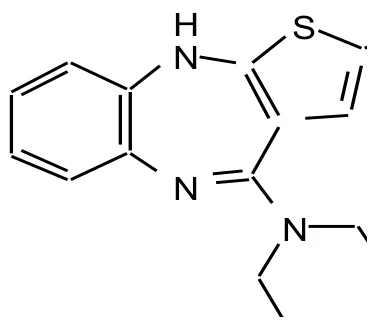
Table 20: Schizophrenia and Related disorder trials characteristics: oral administration
| Parameter | 1 | 2 | 3 | 4 | 5 |
|---|---|---|---|---|---|
| Number of subjects | 335 | 152 | 431 | 1996 | 894 |
| Duration of study | 6 weeks | 6 weeks | 6 weeks | 6 weeks | Extension maintenance trials with median treatment length of 237 days |
| Treatment arms | 3 fixed dosage ranges: 5 ± 2.5 mg/day 10 ± 2.5 mg/day 15 ± 2.5 mg/day | 2 fixed dose ranges: 1 mg/day 10 mg/day | 3 fixed dose ranges: 1 mg/day 5 ± 2.5 mg/day 10 ± 2.5 mg/day 15 ± 2.5 mg/day | 1 dosage range: 5 to 20 mg/day | See Studies 1, 3, and 4 |
| Type of control | Haloperidol 15 ± 5 mg/day BID, Placebo | Placebo | Haloperidol 15 ± 5 mg/day BID | Haloperidol 5 to 20 mg/day | Controlled |
| Further characteristics | - | - | - | 2:1 randomization | Double-blinded; extension maintenance trials of studies 1, 3, and 4 |
Schizophrenia and Related Disorders Trials Results
(1) A 6-week, placebo-controlled trial (N = 335) compared 3 fixed dosage ranges of ZYPREXA (5 ± 2.5, 10 ± 2.5, and 15 ± 2.5 mg/day QD), 1 dosage range of haloperidol (15 ± 5 mg/day on a BID schedule), and placebo. The 2 higher dosage ranges of ZYPREXA were statistically significantly superior to placebo on the Brief Psychiatric Rating Scale (BPRS) total, the Clinical Global Impressions - Severity of Illness (CGI - S) scale, and the BPRS positive psychosis cluster. The highest dosage range of ZYPREXA was statistically significantly superior to placebo and to haloperidol on the Scale for the Assessment of Negative Symptoms (SANS). Efficacy of ZYPREXA generally increased with dose. The 5 ± 2.5 mg/day dosage range of ZYPREXA was numerically, but not statistically, significantly superior to placebo on BPRS total and other assessments of overall psychopathology.
(2) A 6-week, placebo-controlled trial (N = 152) compared 2 fixed doses of ZYPREXA (1 or 10 mg/day QD) and placebo. ZYPREXA, 10 mg/day, was statistically significantly superior to placebo on the BPRS total, the BPRS positive psychosis cluster, the CGI-S scale, the Positive and Negative Syndrome Scale (PANSS) total, the PANSS positive subscale, and the PANSS negative subscale. ZYPREXA, 1 mg/day, appeared to be a no-effect dose with no difference, clinically or statistically, from placebo on any assessment or psychopathology.
(3) A 6-week, dose comparison trial (N = 431) compared 3 fixed dosage ranges of ZYPREXA (5 ± 2.5, 10 ± 2.5 and 15 ± 2.5 mg/day QD), ZYPREXA (1 mg/day QD), and haloperidol (15 ± 5 mg/day on a BID schedule). There were no statistically significant differences between groups on efficacy measures except for the highest dosage range of ZYPREXA, which was statistically significantly superior to ZYPREXA 1 mg, on the BPRS positive psychosis cluster, PANSS positive subscale, and the CGI-S scale.
(4) A 6-week comparator-controlled trial (N = 1996, 2:1 randomization, ZYPREXA: haloperidol) compared 1 dosage range of ZYPREXA (5 to 20 mg/day QD) and 1 dosage range of haloperidol (5 to 20 mg/day QD). The acute mean modal doses (for those patients with at least 3 weeks of treatment) were 13.2 mg/day for ZYPREXA and 11.8 mg/day for haloperidol. ZYPREXA was statistically significantly superior to haloperidol on the BPRS total, the BPRS negative psychosis cluster, the PANSS negative subscale, and the CGI-S scale. ZYPREXA was also statistically significantly superior to haloperidol on the Montgomery-Asberg Depression Rating Scale (MADRS). The validity of this scale in patients with schizophrenia, however, is not established.
(5) The effectiveness of ZYPREXA in long-term therapy, i.e., > 6 weeks, was evaluated in 3 double-blind, controlled, extension maintenance trials (of acute trials 1, 3, and 4 above). Patients who showed adequate clinical improvement following double-blind acute therapy were allowed to continue on in a double-blind, long-term extension maintenance phase on their acute dosage regimen. Long-term maintenance of treatment response (as defined by continued reduction in signs and symptoms sufficient to not require hospitalization for psychosis) was compared over time (894 ZYPREXA-treated patients; median length of treatment was 237 days). The percentage of patients maintaining treatment response over one year was compared. ZYPREXA was statistically significantly superior to placebo in the one placebo-controlled trial and was comparable or statistically significantly superior to the active comparator in 3 of 3 active comparator-controlled trials.
Summary of Schizophrenia and Related Disorders Trials
While the efficacy of ZYPREXA at a dose of 5 mg/day was not statistically superior to placebo (see (1 above)), some individual patients receiving this dose had a good acute response, and were well maintained during a 1-year extension phase.
The above trials (including open-label extension) and an additional trial in geriatric patients with primary degenerative dementia of the Alzheimer’s type constitute the primary database (N = 2500 patients treated with ZYPREXA, corresponding to 1122.2 patient-years; N = 810 patients treated with haloperidol, corresponding to 193.0 patient-years; N = 236 patients treated with placebo, corresponding to 27.1 patient-years).
Bipolar Disorder (oral ZYPREXA)
Bipolar Mania Acute:
The efficacy of oral olanzapine in treating acute bipolar mania was demonstrated in 5 controlled studies, including 2 placebo-controlled studies, 2 active comparator studies and 1 cotherapy study. All patients enrolled in these studies had a diagnosis of bipolar I disorder and displayed an acute manic or mixed episode (with or without psychotic features) according to the DSM-IV criteria based on clinical assessment and confirmed by the structured clinical interview for the diagnostic and statistical manual, SCID-P. Study designs for the studies mentioned above and in section Error! Reference source not found. Error! Reference source not found. can be found in
.
Table 21: Bipolar Mania Acute Trials characteristics: oral administration
| Placebo-controlled trials | Active Comparator trials | Cotherapy trial | |||
|---|---|---|---|---|---|
| Parameter | 1 | 2 | 3 | 4 | 5 |
| Number of subjects | Y-MRS: 70 LOCF: 69 | Y-MRS: 60 LOCF:55 | Olanzapine arm: 125 Divalproex arm: 126 | Olanzapine arm: 234 Haloperidol arm: 219 | Olanzapine + Valproate or Lithium: 229 Valproate or Lithium alone: 115 |
| Duration of study | 3 weeks | 4 weeks | 3 weeks (continuation phase 11 months) | 6 weeks (6 weeks maintenance of response phase in the absence of a placebo arm) | 6 weeks (18 months re-randomized phase) |
| Treatment arms | Dose range: 5 to 20 mg/day | Dose range: 5 to 20 mg/day | Dose-range Olanzapine: 5 to 20 mg/day Dose-range Divalproex: 500 to 2500 mg/day | Dose-range Olanzapine: 5 to 20 mg/day Dose-range Haloperidol: 3 to 15 mg/day | Cotherapy vs. Monotherapy |
| Type of control | Placebo | Placebo | Divalproex | Haloperidol | Monotherapy |
| Further characteristics | - | - | Double-blinded, Randomized | Double-blinded | Double-blinded |
Bipolar Mania Acute Trials Results:
Placebo-Controlled Trials: The 2 placebo-controlled trials evaluated the efficacy of olanzapine versus placebo in treating bipolar manic or bipolar mixed episodes as measured by the Y-MRS total score LOCF mean change from baseline to endpoint over 3 weeks (n = 70 and n = 69, respectively) and 4 weeks (n = 60 and n = 55, respectively). These trials demonstrated superiority in the efficacy of olanzapine compared with placebo. The key findings were as follows:
- Olanzapine, at a dose range of 5-20 mg/day, was statistically superior to placebo in improving manic symptoms in each study (p = 0.019 and p< 0.001, respectively).
- In each study, a statistically significantly greater percentage of olanzapine-treated patients (48.6% and 64.8%, respectively) compared with placebo-treated patients (24.2% and 42.9%, respectively) responded to treatment (≥ 50% reduction in Y-MRS total score) (p = 0.004 and p = 0.023, respectively).
- In each study, the percentage of patients that were in clinical remission (endpoint Y-MRS total score ≤ 12) were significantly greater among olanzapine patients (45.7% and 61.1%, respectively) compared with placebo patients (25.8% and 35.7%, respectively) (p = 0.020 and p = 0.013, respectively).
- Olanzapine efficacy did not differ significantly among the main subtypes of bipolar mania, for example patients with a history of rapid cycling, with or without psychotic features, and bipolar mixed or bipolar manic.
Active Comparator Trials: Two active comparator trials were conducted.
The first active comparator study evaluated the efficacy of olanzapine versus divalproex in treating bipolar manic and bipolar mixed episodes by using the Y-MRS total score LOCF mean change from baseline to endpoint. This study was a 3-week, double-blind study with a double-blind continuation phase of 11 months. The primary objective of the study was to demonstrate non-inferiority in the efficacy of olanzapine compared with divalproex at 3 weeks. Patients were randomized to either olanzapine (5-20 mg/day, n = 125) or divalproex (500-2500 mg/day, n = 126). The key findings were as follows:
- Olanzapine was statistically superior to divalproex in improving manic symptoms as measured by Y-MRS change score at 3 weeks (mean improvements of 13.4 and 10.4 points, respectively, p = 0.028).
- The proportion of patients meeting the criteria for response was not statistically significantly different between olanzapine and divalproex groups (54.4% and 42.3%, respectively) (p = 0.059).
- The proportion of patients that was in clinical remission was significantly greater among olanzapine patients (47.2%) compared with divalproex patients (34.1%) (p = 0.039).
The second active comparator study evaluated the efficacy of olanzapine versus haloperidol in treating bipolar manic or mixed episodes by assessing the proportion of patients in protocol-defined remission from manic and depressive symptoms at 6 weeks. Remission was defined as: 1) achieving improvement in clinical symptomatology in manic and depressive symptoms; 2) having achieved specific reductions in Y-MRS and HAMD-21 total scores; and 3) continuing to take study medication at Week 6. This trial consisted of a 6-week double-blind phase followed by a 6-week double-blind maintenance of response phase in the absence of a placebo arm. Patients were randomly assigned to treatment with olanzapine 5-20 mg/day (n = 234) or haloperidol 3-15 mg/day (n = 219). The key findings were as follows:
- Olanzapine and haloperidol were similarly effective in improving manic symptoms.
- A clinical response to treatment was defined as a ≥ 50% improvement in Y-MRS total score from baseline to endpoint. In both treatment groups, a large proportion of patients responded to treatment. At the end of the acute phase 72.3% and 74.2% of olanzapine and haloperidol patients, respectively met the response criteria, and at the end of the continuation phase almost all patients were classified as responders (96.3% of 160 olanzapine patients and 94.1% of 136 haloperidol patients).
- The proportion of patients in symptomatic remission at the end of the acute phase (6 weeks) was similar for olanzapine and haloperidol patients (52.1% versus 46.1%, respectively (p = 0.152)). Among patients who entered the continuation phase and were not in symptomatic remission at 6-weeks, significantly more olanzapine patients (68.3%) than haloperidol patients (41.0%) were in remission by the end of the continuation period (p = 0.014).
- Manic symptoms continued to improve among olanzapine patients to a statistically significant extent.
- Olanzapine was statistically significantly more efficacious than haloperidol in patients without psychotic features (acute phase remission rates were 56.7% in 104 olanzapine patients and 41.6% in 89 haloperidol patients, respectively) (p = 0.043).
Cotherapy Trial: This trial evaluated the efficacy of olanzapine plus either valproate or lithium (cotherapy, n = 229) versus valproate or lithium alone (monotherapy, n = 115) in treating bipolar manic or mixed episodes as measured by the Y-MRS total score LOCF mean change from baseline to endpoint. This study was a 6-week, double-blind study with a re-randomized double-blind phase of 18 months. The key findings were as follows:
- Olanzapine in combination with either valproate or lithium was significantly more efficacious than monotherapy (valproate or lithium) in improving manic symptoms (mean improvements of 13.1 and 9.1 points, respectively) (p = 0.003).
- The proportion of patients that clinically responded to treatment was statistically significantly greater among patients receiving olanzapine cotherapy (67.7%) than lithium or valproate monotherapy (44.7%, p < 0.001).
- The percentage of patients that were in clinical remission was significantly greater in the olanzapine cotherapy group (78.6%) compared with the lithium or valproate monotherapy group (65.8%, p = 0.012).
- The difference in time to remission was also statistically significantly different (p = 0.002). The median estimated remission time was 14 days for olanzapine cotherapy-treated patients and 22 days for monotherapy-treated patients.
Bipolar Maintenance:
The efficacy of oral olanzapine as monotherapy for maintenance treatment of bipolar disorder in patients who responded to acute treatment with olanzapine for a manic or mixed episode was demonstrated in two 1-year ‘time to event’ controlled trials: one placebo-controlled and one active comparator trial against lithium monotherapy.
All patients enrolled in these studies had a diagnosis of bipolar I disorder and displayed an acute manic or mixed episode (with or without psychotic features) according to the DSM-IV criteria.
For both studies: Patients had to meet study-defined response criteria (YMRS total score of ≤ 12 and a HAMD-21 total score ≤ 8) during open-label treatment with olanzapine (or olanzapine plus lithium in the active comparator study) in order to be randomized into the double-blind maintenance period for observation of study-defined relapse. Dosing was flexible (5 - 20 mg/day for olanzapine; serum levels 0.6 - 1.2 mEq/L for lithium).
The exit criteria was symptomatic relapse of bipolar disorder, either mania or depression. Symptomatic relapse of mania was defined as reaching a YMRS total score ≥ 15, and symptomatic relapse of depression as reaching a HAMD-21 total score ≥ 15; for the placebo-controlled study only, the definitions also included being hospitalized for mania or depression. Thus, the primary efficacy variable was time to, and incidence of, the exit symptomatic relapse of bipolar disorder, based on analysis of Kaplan-Meier time-to-relapse curves. The key characteristics for the bipolar maintenance trials can be found in Table .
Table 22: Bipolar Maintenance Trials characteristics: oral administration
| Parameter | 1 | 2 |
|---|---|---|
| Number of subjects | Olanzapine arm: 225 Placebo arm: 136 | Olanzapine + Placebo arm: 217 Lithium + Placebo arm: 214 |
| Duration of study | 1 year | 1 year |
| Treatment arms | Dose range: 5 to 20 mg/day | Dose range Olanzapine arm: 5 to 20 mg/day Dose range Lithium arm: 0.6–1.2 mEq/L serum level |
| Type of control | Placebo | Lithium Monotherapy |
Placebo-controlled trial:
The study evaluated the efficacy of olanzapine vs placebo in maintenance treatment of manic or mixed bipolar episodes by using survival curve analysis to assess the time to, and incidence of, relapse of bipolar disorder. In this trial, 361 patients who had demonstrated response criteria for an average of 16 days were randomized to either continuation of olanzapine at their same dose (n = 225) or to placebo (n = 136), for observation of relapse for up to one year.
The key findings were as follows:
- Figure 1 shows the 1-year time-to-relapse curves for total discontinuations from the study in each arm over time, whether exiting due to relapse, or withdrawal due to adverse events or other reasons. The percentage of patients remaining in the study (i.e., relapse-free, and have not withdrawn for any reason) can be seen at each of the 3, 6, 9 and 12 month points; at study-end, this is 24% (n = 53) for olanzapine and 10% (n = 13) for placebo. The time-point at which 50% of the patients in a specific arm had withdrawn for any reason was Day 59 for the olanzapine group compared to Day 23 for the placebo group.
- Figure 2 shows the 1-year time-to-relapse curves for specifically the exit criterion of bipolar relapse (i.e., patients who withdrew for other reasons were censored and excluded from the calculated numerators and denominators). Olanzapine was superior to placebo, for both incidence of bipolar relapse (46.7% vs 80.1%, respectively), and median time to relapse (174 days vs 22 days, respectively). Note that a high relapse incidence for the placebo arm is not unexpected given the limited time that patients had been demonstrating response criteria prior to randomization.
Figures 2a and 2b show the efficacy time-to-relapse curves for each of manic and depressive relapse, respectively. Olanzapine showed a statistically significant advantage over placebo in terms of each of mania and depression, although a greater advantage was seen in mania.
Figure 1: Time to Event (Relapse or Discontinuation)
Study HGHL; Double-Blind Treatment Phase
Figure 2: Time to Symptomatic Relapse of Bipolar Disorder, Including Hospitalization
Study HGHL; Double-Blind Treatment Phase
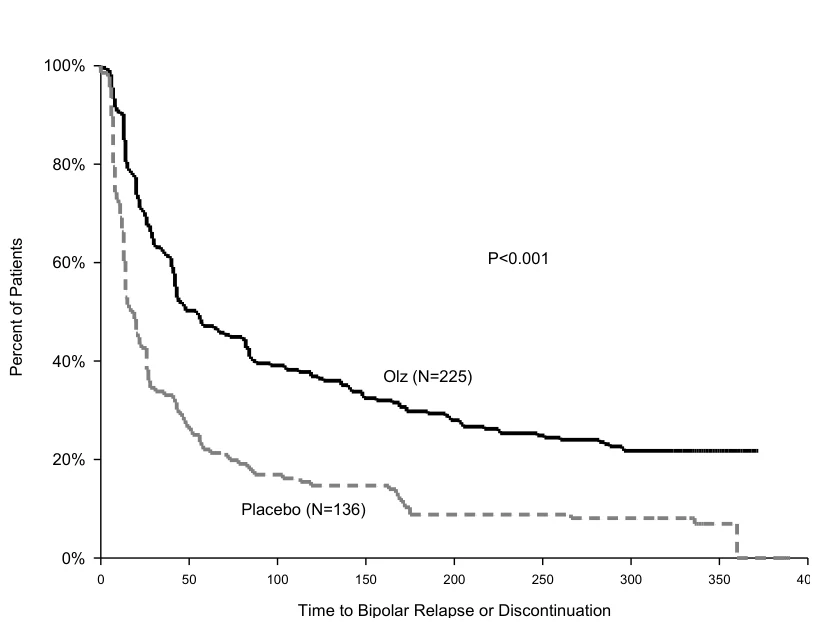
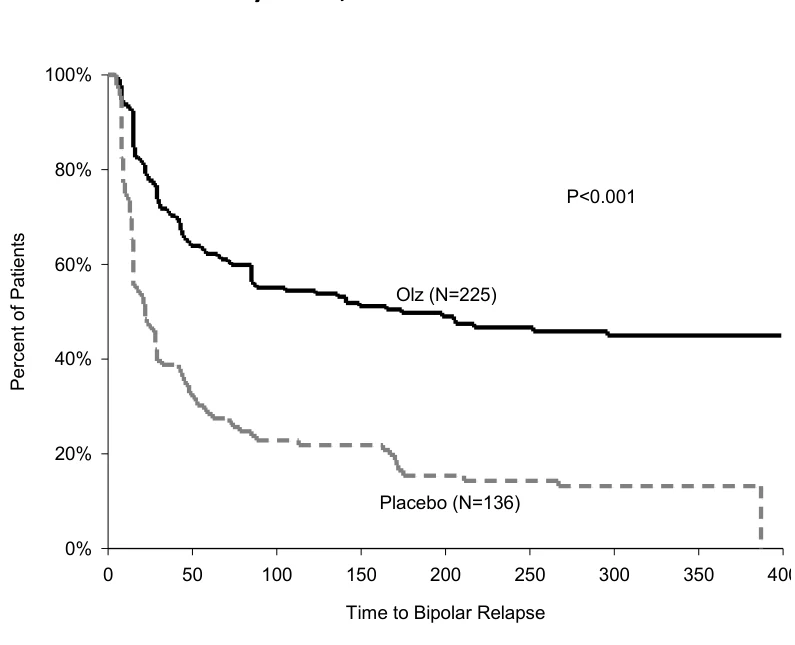
Figure 2a: Time to Symptomatic Relapse of Mania, Including Hospitalization
Study HGHL; Double-Blind Treatment Phase
Figure 2b: Time to Symptomatic Relapse of Depression, Including Hospitalization
Study HGHL; Double-Blind Treatment Phase
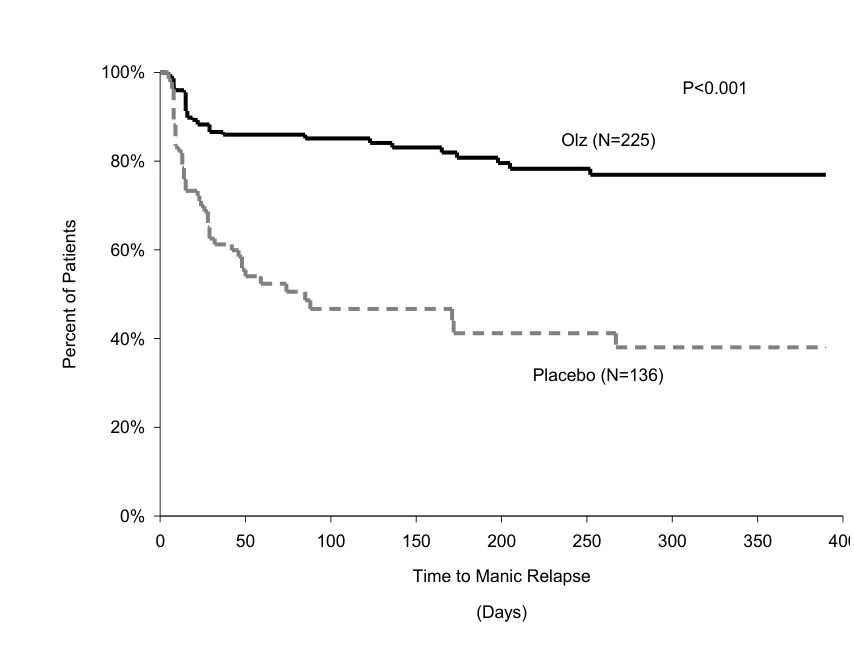
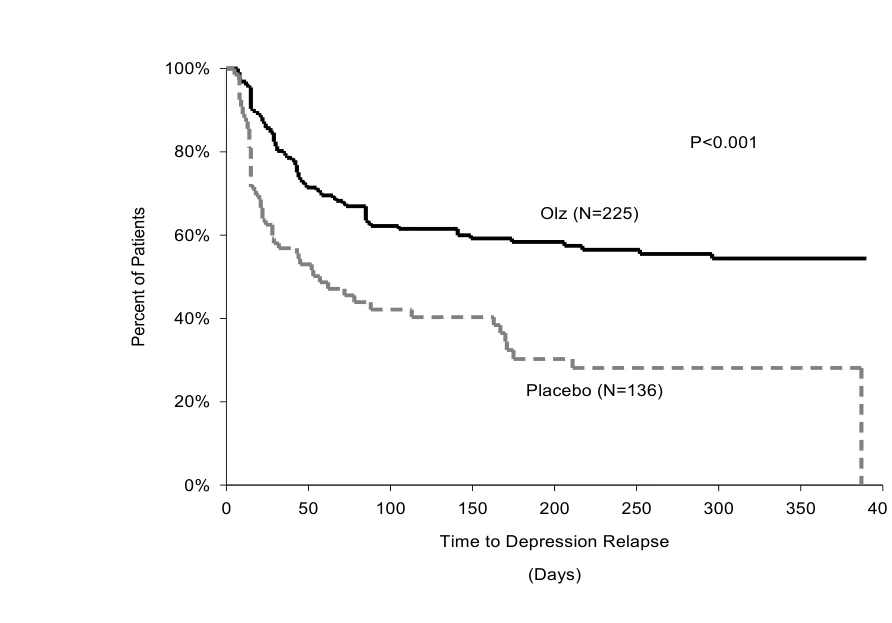
Active comparator trial:
The study evaluated the efficacy of olanzapine vs lithium in maintenance treatment of manic or mixed bipolar episodes in a non-inferiority design to assess the incidence of relapse of bipolar disorder and further, by using survival curve analysis to assess time to relapse. In this trial, 543 patients who had demonstrated response criteria for an average of 20 days were randomized to either olanzapine plus placebo (n = 217) or lithium plus placebo (n = 214) for observation of relapse for up to one year. The first month of the double blind period was a taper period to allow for non-abrupt lithium discontinuation. The non-inferiority margin used in this study was: ± 20% of the efficacy seen for the reference population.
The key findings were as follows:
- Figure 3 shows the 1-year time-to-relapse curves for total discontinuations from the study in each arm over time, whether exiting due to relapse, or withdrawal due to adverse events or other reasons. The percentage of patients remaining in the study (i.e., relapse-free, and have not withdrawn for any reason) can be seen at each of the 3, 6, 9 and 12 month points; at study-end, this is 42% (n = 94) for olanzapine and 28% (n = 61) for lithium. The time-point at which 50% of the patients in a specific arm had withdrawn for any reason was Day 255 for the olanzapine group compared to Day 192 for the lithium group.
- Figure 4 shows the 1-year time-to-relapse curves for specifically the exit criterion of bipolar relapse (i.e., patients who withdrew for other reasons were censored and excluded from the calculations of numerators and denominators). Olanzapine was non-inferior to lithium for both incidence of bipolar relapse (30.0% vs 38.8%, respectively), and time to 25% of patients experiencing relapse (122 days vs 143 days, respectively).
- It can be seen from Figure 4 that for approximately the first five months of the 1-year trial, relapse rate was higher in olanzapine-treated patients; thereafter, the rate of relapse for lithium increases, while that for olanzapine flattens out.
Figures 4a and 4b are the 1-year time-to-relapse curves for each of the exit criterion of manic and depressive relapse respectively. Olanzapine showed a statistically significant advantage over lithium in rate of mania relapse, and was non-inferior for depressive relapse.
Figure 3: Time to Event (Relapse or Discontinuation)
Study HGHT; Double-Blind Treatment Phase
Figure 4: Time to Symptomatic Relapse of Bipolar Disorder
Study HGHT; Double-Blind Treatment Phase
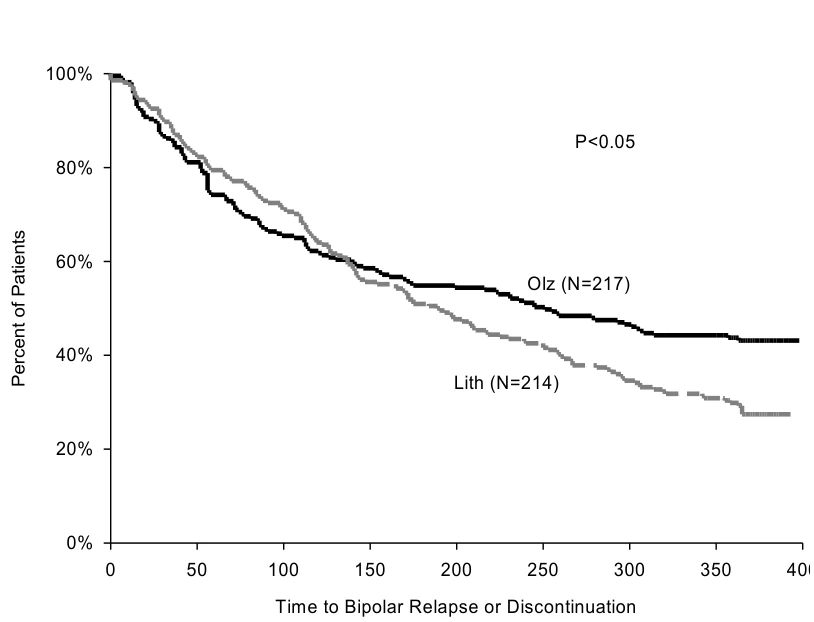
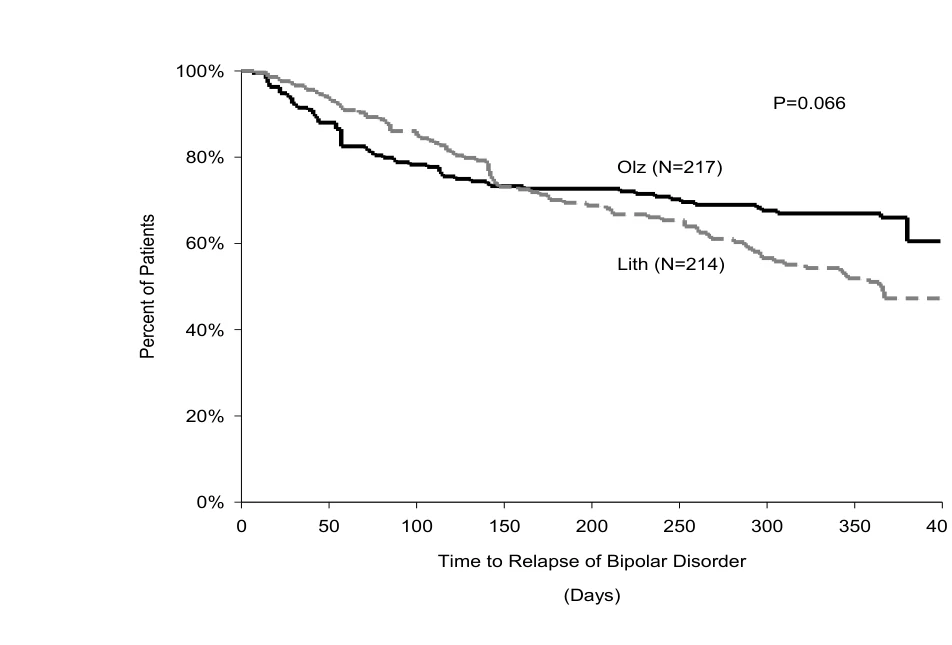
Figure 4a: Time to Symptomatic Relapse of Mania
Study HGHT; Double-Blind Treatment Phase
Figure 4b: Time to Symptomatic Relapse of Depression
Study HGHT; Double-Blind Treatment Phase
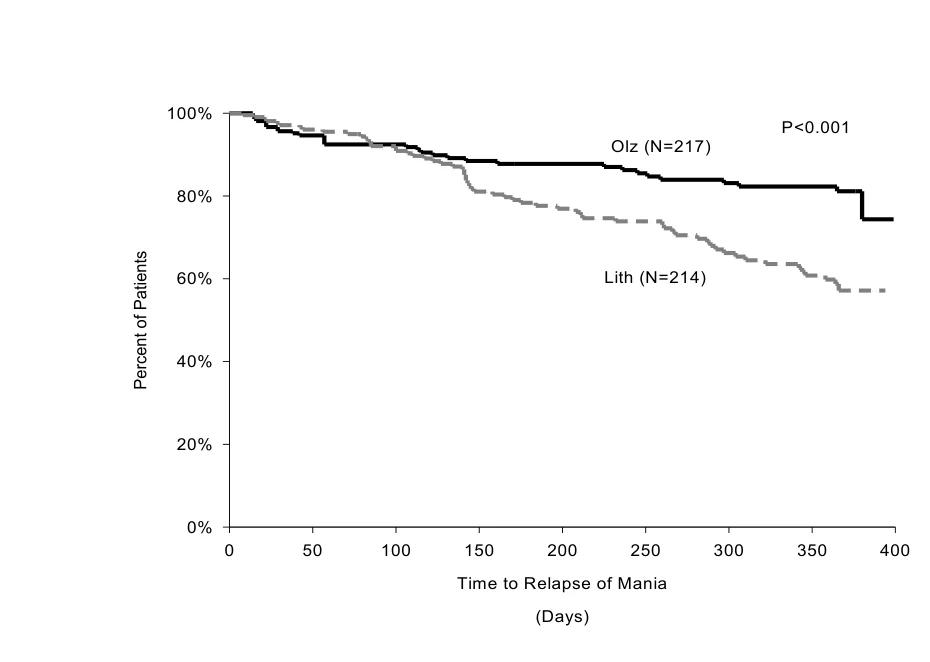
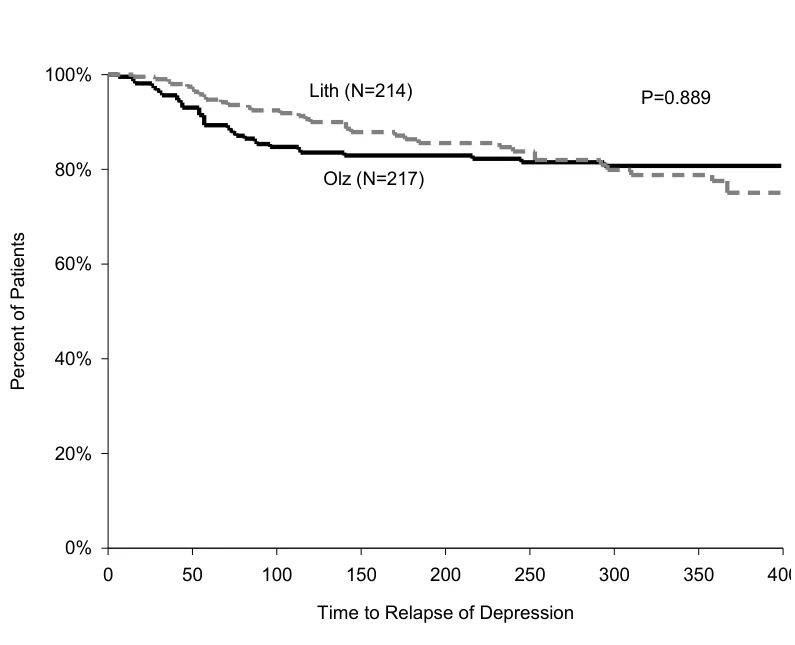
Summary of Bipolar Disorder Trials
Bipolar Mania: Olanzapine was more efficacious than placebo and divalproex and as effective as haloperidol in improving overall manic symptomatology in patients with acute bipolar I disorder, manic or mixed episode, with or without psychotic symptoms, and with or without a history of rapid cycling. Olanzapine is associated with a faster onset of action (based on median time to remission estimated with Kaplan-Meier analysis) compared to divalproex and similar to that of haloperidol. The addition of olanzapine also improve patients not responding to lithium or valproate. Olanzapine was not associated with inducing or worsening symptoms of depression.
Bipolar Maintenance: Two 1-year controlled studies support the use of ZYPREXA monotherapy in maintenance treatment of bipolar patients who responded to acute ZYPREXA treatment for a manic or mixed episode. Based on analysis of one-year Kaplan-Meier survival curves, olanzapine was superior to placebo, and non-inferior to lithium, in both time to, and incidence of, bipolar relapse over one year.
Agitation associated with Schizophrenia and Bipolar I Mania (ZYPREXA IntraMuscular)
The efficacy of intramuscular olanzapine for the rapid control of agitation was established in 3 short-term (up to 24 hours of IM treatment) placebo-controlled trials. Two trials were in agitated inpatients with schizophrenia, schizophreniform disorder and schizoaffective disorder who were able to give informed consent, and included a single active comparator treatment arm of haloperidol injection. One trial was in agitated patients with mania associated with bipolar disorder, and included a single active comparator treatment arm of lorazepam injection. Patients needed to be: (1) judged by the clinical investigators as clinically agitated and clinically appropriate candidates for treatment with intramuscular medication; and (2) exhibiting a level of agitation that met or exceeded a threshold score of > 14 on the five items comprising the Positive and Negative Syndrome Scale (PANSS) Excited Component (i.e., poor impulse control, tension, hostility, uncooperativeness and excitement items) with at least one individual item score > 4 using a 1-7 scoring system (1 = absent, 4 = moderate, 7 = extreme). The PANSS Excited Component has been validated in non-agitated and agitated patients, and is an established factor of the PANSS. The primary efficacy measure used for assessing agitation was the change from baseline in the PANSS Excited Component at 2 hours after the initial injection. Several additional efficacy measures including the Agitation Calmness Evaluation Scale (ACES), Corrigan Agitated Behaviour Scale (CABS) were also utilized. Patients could receive up to three injections during the 24 hour IM treatment periods; however, patients could not receive a second injection until after the primary efficacy measure was assessed (2 hours following initial injection). The study design of the studies mentioned above can be found in Error! Reference source not found..
Table 23: Agitated inpatients: intramuscular administration study
| Parameter | 1 | 2 | 3 |
|---|---|---|---|
| Number of subjects | 270 | 311 | 201 |
| Diagnosis | Schizophrenia and related disorders | Schizophrenia and related disorders | Bipolar I Disorder (manic or mixed) |
| Duration of study | 24 hours | 24 hours | 24 hours |
| Treatment arms | 2.5 mg to 10 mg | Olanzapine arm: 10 mg Haloperidol arm: 7.5 mg | Olanzapine arm: 1 to 3 injections (10 mg, 10 mg and 5 mg) Lorazepam arm: 1 to 3 injections (2 mg, 2 mg and 1 mg) |
| Type of control | Placebo | Haloperidol, Placebo | Lorazepam, Placebo |
| Further characteristics | - | Randomized | Randomized |
Agitation Trials Results
In a placebo-controlled trial in agitated inpatients meeting DSM-IV criteria for schizophrenia, schizophreniform disorder or schizoaffective disorder (n = 270), four fixed intramuscular olanzapine for injection doses of 2.5 mg, 5 mg, 7.5 mg and 10 mg were evaluated. All doses were superior to placebo on the PANSS Excited Component and the CABS at 2 hours post-injection. There was a statistically significant dose response relationship over the range of 2.5 mg to 10 mg. The 5 mg, 7.5 mg and 10 mg doses were statistically significantly superior to both placebo and the 2.5 mg dose on the PANSS Excited Component, the CABS and the ACES. The superior treatment responses on the PANSS Excited Component for the 5 mg, 7.5 mg, and 10 mg doses compared to placebo were observed at 30 minutes post-injection, the first timepoint measured.
The following table shows the number of injections received by patients in each treatment group over the 24 hour treatment period. As can be seen, less than 25% of patients in the olanzapine 10 mg group required more than one injection, compared to 67% in the placebo group.
Table 24: Summary of Injection Frequency
| No of Injections | Olanzapine IM 2.5 mg (N = 48) | Olanzapine IM 5.0 mg (N = 45) | Olanzapine IM 7.5 mg (N = 46) | Olanzapine IM 10.0 mg (N = 46) | Haloperido l IM 7.5 mg (N = 40) | Placebo (N = 45) |
| 1 | 23 (47.9) | 29 (64.4) | 33 (71.7) | 35 (76.1) | 30 (75.0) | 15 (33.3) |
| 2 | 22 (45.8) | 15 (33.3) | 12 (26.1) | 10 (21.7) | 7 (17.5) | 9 (20.0) |
| 3 | 3 (6.3) | 1 (2.2) | 1 (2.2) | 1 (2.2) | 3 (7.5) | 21 (46.7) |
In a second placebo-controlled trial agitated inpatients meeting DSM-IV criteria for schizophrenia, schizophreniform disorder or schizoaffective disorder (n = 311) were randomized (2:2:1 ratio) to one to three injections of a fixed intramuscular olanzapine for injection dose of 10 mg, intramuscular haloperidol (7.5 mg) or placebo. Olanzapine for injection was superior to placebo on the PANSS Excited Component, the CABS, and the ACES at 2 hours post-injection. The superior treatment response of 10 mg olanzapine for injection compared to placebo on the PANSS Excited Component was observed as early as 15 minutes post-injection, the first timepoint measured. In the olanzapine treatment group 21% of patients received two injections, and 3% three injections during the 24 hour treatment period, compared to 44% and 6% respectively in the placebo treatment group.
In a placebo-controlled trial in acutely agitated patients diagnosed with bipolar I disorder and displaying an acute manic or mixed episode (with or without psychotic features) according to the DSM-IV (n = 201), intramuscular (IM) olanzapine and IM lorazepam were compared. Patients were randomized (2:1:1 ratio) to 1 to 3 injections over 24 hours of IM olanzapine (10 mg, 10 mg and 5 mg), IM lorazepam (2 mg, 2 mg and 1 mg) or IM placebo (3rd injection to patients in the placebo arm was 10 mg IM olanzapine) to a maximum cumulative IM olanzapine dose of 25 mg, or IM lorazepam dose of 5 mg. Olanzapine for injection was superior to IM placebo and IM lorazepam in reducing agitation as measured by change in mean PANSS Excited Component score, the CABS, and the ACES during the 2 hours following injection. The superior treatment response of 10 mg olanzapine for injection compared to lorazepam (2 mg) or placebo on the PANSS Excited Component was observed as early as 30 minutes post-injection, the first time-point measured. In the olanzapine treatment group, 18% of patients received two injections, and 8% three injections during the 24 hour treatment period, compared to 28% and 26% respectively in the lorazepam treatment group, and 12% and 41%, respectively, in the placebo treatment group.
14.2 Comparative Bioavailability Studies
Bioequivalence of the 15 mg and 20 mg tablets to multiple 5 mg tablets has been clearly demonstrated in two separate studies. These tablet formulations are equally well absorbed and can be readily interchanged.
Table 25: Summary Tables of the Comparative Bioavailability Data
Geometric Mean Arithmetic Mean (CV%) | ||||||||||
| PARAMETER | 15 mg Zyprexa Tablet | 3 x 5 mg Zyprexa Tablet | Ratio of Geometric Means (%) | |||||||
AUC0-t (ng×hr/mL) | 820.0 833.1 (19.1) | 841.2 862.3 (23.2) | 97.5 | |||||||
AUC0-72 (ng×hr/mL) | 678.7 690.7 (20.2) | 676.6 690.0 (20.7) | 100.3 | |||||||
AUC0-4 (ng×hr/mL) | 875.3 891.5 (20.3) | 899.6 925.7 (24.6) | 97.3 | |||||||
Cmax (ng/mL) | 21.2 21.6 (19.9) | 21.4 21.9 (21.2) | 98.9 | |||||||
Tmaxa (h) | --- 6.1 (73.4) | --- 5.7 (36.6) | --- | |||||||
T2a (h) | --- 33.7 (20.0) | --- 36.6 (19.1) | --- | |||||||
Study included N = 14 subjects (7/14 females; 12/14 nonsmokers)
a The Tmax and T1/2 parameters are expressed as the arithmetic means (CV%).
Geometric Mean Arithmetic Mean (CV%) | ||||||||||
| PARAMETER | 20 mg Zyprexa Tablet | 4 x 5 mg Zyprexa Tablet | Ratio of Geometric Means (%) | |||||||
AUC0–t (ng·hr/mL) | 522.0 557.6 (37.4) | 509.7 538.3 (33.6) | 102.4 | |||||||
AUC0–72 (ng·hr/mL) | 459.4 487.2 (35.5) | 446.6 470.4 (32.8) | 102.8 | |||||||
AUC0–4 (ng·hr/mL) | 538.3 574.4 (37.2) | 525.4 555.3 (33.6) | 102.4 | |||||||
Cmax (ng/mL) | 17.9 18.7 (31.5) | 19.5 20.5 (33.0) | 91.9 | |||||||
Tmaxa (h) | --- 6.1 (42.1) | --- 4.3 (51.3) | --- | |||||||
T½a (h) | --- 26.5 (17.1) | --- 27.1 (19.0) | --- | |||||||
Study included N = 14 subjects (14/14 males; 14/14 smokers)
a The Tmax and T1/2 parameters are expressed as the arithmetic means (CV%).
Pharmacokinetic studies showed that the ZYPREXA Tablets and ZYPREXA ZYDIS dosage forms are bioequivalent. ZYPREXA ZYDIS orally disintegrating tablets can be used as an alternative to ZYPREXA Tablets.
15. Microbiology
No microbiological information is required for this drug product.
16. Non-Clinical Toxicology
An extensive series of acute, subchronic, chronic, reproduction, and genetic toxicity as well as oncogenicity studies have been conducted to support clinical trials with olanzapine. In most of these studies, olanzapine was given by the oral route to rodents, rabbits, and monkeys in an aqueous suspension with 5% to 10% acacia and to dogs as neat material in capsules.
General Toxicology
The findings of toxicology studies support the safety of olanzapine for oral use in humans as an antipsychotic agent.
Acute Toxicity:
The acute toxicity of olanzapine was studied in mice, rats, dogs, and monkeys. The estimated median lethal dose for each species is shown below in Table 26.
Table 26: Acute Toxicity Summary
Estimated Median Lethal Dose (mg/kg/day)
Species
Route
Males
Females
Mouse
Oral
211
208
Rat
Oral
174
177
Dog
Oral
Both sexes > 100 mg/kg
Monkey
Nasogastric
Both sexes > 100 mg/kg
Rat
Intraperitoneal
112
107
Signs of toxicity in rodents included hypoactivity, lethargy, leg weakness, coma, tremors, clonic convulsions, salivation, poor grooming, and depressed body weight gain.
The potential for irritation of an aqueous intramuscular formulation of olanzapine was tested in one in vitro and two in vivo (dog and rabbit) studies. The intent of these studies was to characterize the effects at the site of injection. Overall, these tests indicated that formulations of olanzapine, at 1.7 to 8.4 mg/mL in a tartaric acid/lactose vehicle, have the potential to cause slight irritation of skeletal muscle. While the in vitro model suggested a potential for moderate irritation at the higher concentrations tested, the in vivo models indicated either very little or slight potential for irritation.
Chronic/subchronic toxicity
Subchronic administration studies of up to 3 months in duration have been conducted by the oral route in mice, rats, and dogs. Chronic toxicity studies of up to 1 year were conducted by the oral route in rats and dogs.
The predominant effects in laboratory animals given olanzapine were CNS depression and anticholinergic effects related to the pharmacology of the drug. Tolerance to the CNS depression developed in repeated-dose studies. Depressed body weight gain was a consistent finding in mice given 30 mg/kg/day and in rats given 4 mg/kg/day. Effects on hematology parameters were found in each species studied in repeated-dose studies. Rats given 16 mg/kg/day had decreased lymphocyte and neutrophil counts and atrophy of bone marrow consistent with the marked reduction in body weight gain. Mice given 3 mg/kg/day developed leukopenia, due primarily to lymphocytopenia, but also associated with neutropenia. Lymphoid necrosis of thymus and spleen was seen in mice given ≥ 10 mg/kg/day. Instances of reversible neutropenia, with or without thrombocytopenia, or anemia developed in a low number of individual dogs treated with 8 or 10 mg/kg/day. Bone marrow from some dogs with olanzapine-induced neutropenia responded to olanzapine with lower than expected numbers of maturing granulocytic cells; however, progenitor and proliferating cells were present in adequate numbers. No olanzapine-related hematologic effects were seen in dogs receiving olanzapine at either 2 or 5 mg/kg/day.
Effects observed in rats consistent with increased plasma concentrations of prolactin in rats included decreased weights of ovaries and uterus. Histopathologic tissue alterations in mammary gland morphology and vaginal epithelium and increased prominence of ovarian follicles were also consistent with elevated prolactin concentrations. Prolactin-induced histopathologic tissue alterations found in rats regressed after treatment cessation. No unexpected toxicologically important findings unrelated to pharmacologic activity were found in the 1-year studies in rats given 4 mg/kg/day or in dogs given 5 mg/kg/day.
Genotoxicity
Olanzapine was not mutagenic or clastogenic in a full range of standard tests which included bacterial mutation tests and in vitro and in vivo mammalian tests. Appropriate positive controls were used in each test to verify the sensitivity of the test systems.
Carcinogenicity
The oncogenic potential of olanzapine was evaluated in studies in rats and mice. Carcinogenicity studies were conducted in CD-1 mice and Fischer 344 rats. Olanzapine was administered orally to mice at doses of 3, 10, or 20 mg/kg for 19 months (males) or 21 months (females) in an initial study, and in a subsequent study at doses of 0.5, 2, or 8 mg/kg for 21 months (males and females). Rats received oral doses of 0.25, 1, 2.5, or 4 mg/kg (males) or 0.25, 1, 2.5, 4, or 8 mg/kg (females) for 24 months. Initial dose levels 2.5 and 4 mg/kg/day in females were increased to 4 and 8 mg/kg/day, respectively, on Day 211. These doses are equivalent to 2 to 70 times the maximum daily human dose (mouse studies) or 0.9 to 28 times the maximum daily human dose (rats). A maximum tolerated dose was achieved in both mouse and rat studies. Increased mortality was seen in mice at doses of 10 and 20 mg/kg and decreases in circulating lymphocytes and neutrophils were seen at doses 0.5 mg/kg. In female mice treated with olanzapine, the incidence of mammary tumours was increased at doses ≥ 2 mg/kg. Female rats treated with 4 or 8 mg/kg had an increase in malignant mammary tumours, but the overall incidence of mammary gland neoplasia was unchanged. An increase in total incidence of mammary gland tumours in female mice given 10 or 20 mg/kg/day (the high dose was decreased from 30 mg/kg/day due to excess mortality) was also noted. Antipsychotic drugs, including olanzapine, have been shown to chronically elevate prolactin concentrations in rodents. An increase in mammary neoplasms has been found in rodents after chronic administration of other antipsychotic drugs and is considered to be prolactin mediated. The role of prolactin in human breast cancer has not been defined conclusively, and there are presently no epidemiologic data indicating increased risk for breast cancer for humans using antipsychotic drugs.
Reproductive and Developmental toxicology
Fertility studies in male and female rats and teratology studies in rats and rabbits have been conducted by the oral route. Mating performance was affected by administration of olanzapine due to sedation in male rats given doses greater than 18 times the maximum daily human dose, (5 mg/kg/day in rats) but the effect was quickly reversed when treatment stopped. Estrous cycles were affected and reproduction parameters were influenced in rats given doses greater than 4 times the maximum daily human dose (≥ 1 mg/kg/day in rats). No adverse effects were observed on numbers of corpora lutea, implantations, fetal viability, or fetal weight, and there were no effects on litter size or on the survival, growth, or development of the offspring from parents given up to 18 times the maximum daily human dose (5 mg/kg/day in rats). Although the reproductive process in female rats from mating through fertilization was not adversely affected by treatment, this evidence does not exclude a possible interference with maintenance of pregnancy at high doses of olanzapine. Reproduction studies, performed in rats and rabbits at doses of olanzapine 3.5 and 7 times the maximum daily human dose (20 mg), respectively, have revealed no evidence of harm to the fetus. Maternal toxicity, developmental toxicity (indicated by fetal growth retardation and slightly delayed ossification at birth), and increased numbers of nonviable offspring occurred at higher doses (in rats at 14 and 63 times the maximum daily human dose and in rabbits at 28 and 105 times the maximum daily human dose). However, fetal malformations were not increased. Transient modest decreases in activity levels of the progeny from females given 0.25 mg/kg/day and skeletal changes indicative of growth retardation in fetuses from females given 5 mg/kg/day were observed. Transient decreases in offspring activity have occurred at all doses; however, there were no effects on body weight, growth, mating, fertility, or live births in second-generation animals. Placental transfer of olanzapine occurs in rat fetuses. Olanzapine was also detected in the milk of rats at concentrations up to three-fold higher than those in the plasma.
Hematologic Indices
In animal studies with olanzapine, the principal hematologic findings were reversible peripheral cytopenias in individual dogs given high doses of olanzapine (24 to 30 times the maximum daily human dose), dose-related decreases in lymphocytes and neutrophils in mice, and lymphopenia secondary to compromised nutritional status in rats. A few dogs treated with 24 to 30 times the maximum daily human dose developed reversible neutropenia or reversible hemolytic anemia between 1 and 10 months of treatment. Effects on hematology parameters in each species involved circulating blood cells, and no evidence of bone marrow cytotoxicity was found in any of the species examined.