


Patient Medication Information: uses, side effects, how to take - Acarizax
Serious warnings and precautions box
What ACARIZAX® is used for:
ACARIZAX® is for children and adults aged 5 to 65 who are allergic to house dust mites and have allergic rhinitis (with or without conjunctivitis). Symptoms of allergic rhinitis include sneezing, runny or itchy nose, stuffed up nose (with or without symptoms of conjunctivitis such as itchy, burning, red, or watery eyes).
Before you begin treatment with ACARIZAX®, your allergy to house dust mites will be confirmed by a doctor who will perform skin and/or blood tests.
ACARIZAX® is NOT a medication that gives immediate relief for symptoms of house dust mite allergy.
ACARIZAX® has not been tested in subjects under 5 years old, and the efficacy and safety of ACARIZAX® have not been well established in subjects over 64.
- ACARIZAX® is intended for use only by physicians with adequate training and experienced in the treatment of allergic diseases.
- It is common for patients to experience mild or moderate local allergic reactions with ACARIZAX® (for example, an itchy mouth or a sore throat). Serious life-threatening allergic reactions which require immediate medical attention may occur in patients treated with ACARIZAX®. If you experience stronger allergic reactions with a feeling of swelling in the throat, difficulty swallowing or breathing and voice changes, contact your physician immediately. The treatment has to be stopped immediately until your physician advises otherwise.
- The first tablet of ACARIZAX® must be taken at the doctor’s office. Your doctor will also tell you to stay on site for 30 minutes to check out for possible side effects to the treatment you may have.
How ACARIZAX® works:
ACARIZAX® is a tablet that treats your allergy caused by house dust mites. It contains an allergen extract that helps to make you less sensitive to the house dust mites you are allergic to.
The ingredients in ACARIZAX® are:
Medicinal ingredient(s): standardized allergen extract from the house dust mites D. farinae and D. pteronyssinus.
Non-medicinal ingredients: fish gelatin, mannitol, and sodium hydroxide. ACARIZAX® does not contain lactose.
ACARIZAX® comes in the following dosage form(s):
ACARIZAX® is a prescription tablet that you take once a day by placing it under your tongue.
Each tablet contains 12 SQ-HDM of a Standardized Allergen Extract, House Dust Mites (D. farinae and D. pteronyssinus).
Do not use ACARIZAX® if:
- you are allergic (hypersensitive) to any of the non-medicinal ingredients of ACARIZAX® (see The ingredients in ACARIZAX® are:)
- you have had a serious allergic reaction to house dust mite allergy shots, tablets or drops;
- you have severe or unstable asthma.
- are taking beta-blockers (a medicine prescribed for heart conditions, such as high blood pressure).
- you have any swelling or sores in your mouth or have recently had any mouth injury or mouth surgery (such as a tooth removal) or tooth loss. Your doctor may delay the start of your treatment until you are better.
- you have been diagnosed with a rare condition called eosinophilic esophagitis.
To help avoid side effects and ensure proper use, talk to your healthcare professional before you take ACARIZAX®. Talk about any health conditions or problems you may have, including if you:
- have ever had a serious allergic reaction to allergy shots, tablets or drops
- have worsening asthma symptoms or breathing problems
- have an airway infection, such as common cold, sore throat or pneumonia
are pregnant or plan to become pregnant
- are breastfeeding or plan to breastfeed. It is not known if ACARIZAX® will pass into breast milk
- have diseases affecting the immune system e.g. autoimmune diseases, immune complex diseases or (severe) immune deficiency diseases.
- have malignant diseases (e.g. cancer).
Other warnings you should know about:
There is limited experience with ACARIZAX® in patients younger than 5 or older than 64. Therefore, the use of ACARIZAX® is not recommended in these age groups.
Stop treatment and get emergency medical treatment right away if you have any of the following symptoms after taking ACARIZAX®:
- dizziness, fainting, fast or weak heartbeat, feeling nervous or feeling of “impending doom”
- throat tightness or swelling of the tongue or throat that causes trouble speaking, breathing or swallowing
- wheezing, shortness of breath, cough, chest tightness or trouble breathing
- stomach cramps, vomiting or diarrhea
- skin rash, itching, flushing or hives
Children must be watched by an adult for any signs of allergic reactions, including breathing difficulties, for a minimum of 15 minutes after taking each tablet. The need for an epinephrine device should be decided on a case-by-case basis and discussed with your doctor.
Stop treatment with ACARIZAX® if you have any of the following symptoms that do not go away or that worsen:
- heartburn, difficulty swallowing, pain with swallowing, or chest pain
Tell your healthcare professional about all the medicines you take, including any drugs, vitamins, minerals, natural supplements or alternative medicines. Your doctor will tell you if it is safe to take other medicines while you are using ACARIZAX®. No drug interaction studies have been done in patients taking ACARIZAX®.
How to take ACARIZAX®:
The first dose of ACARIZAX® should only be taken in the doctor’s office. After taking the first dose, you will be watched for 30 minutes by a healthcare professional for symptoms of a serious allergic reaction.
Your doctor may prescribe medicines for you to take in case you have a serious allergic reaction.
After the first dose, you may take ACARIZAX® at home.
Usual dose:
Take ACARIZAX® once daily for as long as your doctor tells you to take it. ACARIZAX® treatment can begin at any time during the year.
How should I take ACARIZAX®?
- 1. Do not use food or water to take the tablet.
- 2. Remove the tablet from the package with dry hands by carefully removing the foil. (If your hands are wet or damp, the tablet will break or dissolve too soon.)
- 3. Place the tablet under the tongue right away. It will rapidly dissolve.
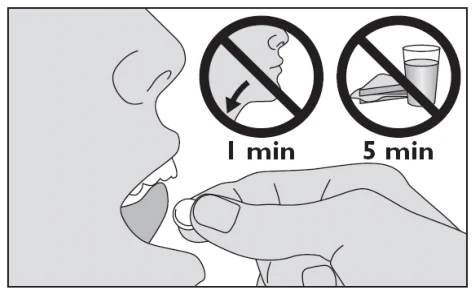
- 4. Do not swallow for about 1 minute.
- 5. Do not drink or eat for 5 minutes after taking the tablet.
- 6. Wash your hands after handling the tablet.
Detailed Instructions
- 1. Tear off the strip marked with triangles at the top of the blister pack.
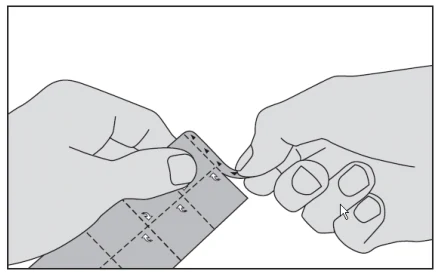
- 2. Tear a square off the blister pack along the perforated lines.
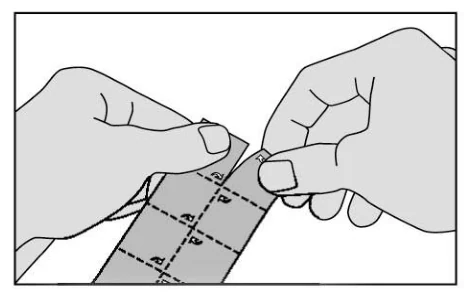
- 3. Remove the tablet carefully from the foil (do not force the tablet through the foil. It may become damaged as it easily breaks. Instead, fold back the marked corner of the foil and then pull it off). Take it immediately.
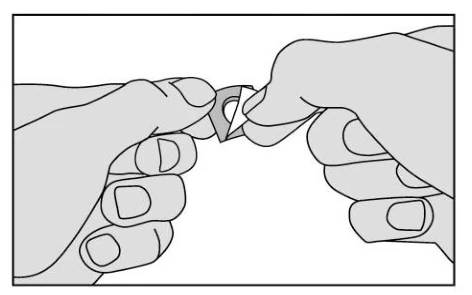
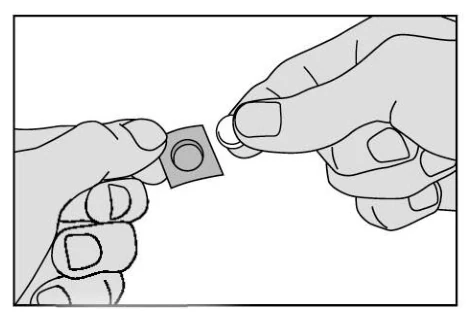
- 4. Place the tablet under the tongue. Allow it to remain there for a few seconds until it dissolves. Do not swallow during the first minute. Do not eat or drink for 5 minutes. Wash hands after handling the tablet. Children must be watched for signs of allergic reactions including breathing difficulties for a minimum of 15 minutes after taking each tablet.
General information about the safe and effective use of ACARIZAX®
This medicine has been prescribed for you. Do not give it to anyone else. It may harm them, even if their symptoms are the same as yours.
Your doctor may also prescribe medications to treat possible allergic reactions from ACARIZAX® treatment.
Overdose:
Taking more than one ACARIZAX® tablet in one day can cause severe allergic reactions.
If you think you, or a person you are caring for, have taken too much ACARIZAX®, contact a healthcare professional, hospital emergency department, regional poison control centre or Health Canada’s toll-free number, 1-844 POISON-X (1-844-764-7669) immediately, even if there are no signs or symptoms.
Missed dose:
Do not take more than one ACARIZAX® tablet daily. If you miss a dose, return to your normal schedule the next day. Do not take a double dose to make up for the forgotten dose.
If temporarily stopping treatment for more than 15 days consult your doctor before restarting treatment with ACARIZAX®.
Possible side effects from using ACARIZAX®:
These are not all the possible side effects you may have when taking ACARIZAX®. If you experience any side effects not listed here, tell your healthcare professional.
Side effects caused by ACARIZAX® usually happen early in treatment, but can happen even if you have been taking ACARIZAX® for months.
The most common side effects of ACARIZAX® include:
- throat irritation
- itching of the ears and/or mouth
- tingling and/or burning of the mouth
- swelling of the mouth including lips and/or tongue
Stronger allergic reactions to ACARIZAX® include:
- swelling of the throat, mouth or tongue
- difficulty swallowing or breathing
- asthma attack/wheezing
- hives/itchy rash
- voice changes (hoarse voice or trouble speaking)
- rapid heart rate
- low blood pressure
- fainting
If you experience these symptoms, contact your doctor immediately and get emergency treatment. Do not take any more doses until your doctor tells you to.
Very common [in more than 10% of patients (1 in 10)]:
Mouth: itching, burning, ulcer; swelling on the roof of the mouth
Tongue: swelling, ulcer
Lips: swelling
Throat: irritation, swelling
Ears: itching
Other: nausea, pain in the stomach
Common [in 1-10% of patients (more than 1 in 100 but less than 1 in 10)]:
Mouth: discomfort, swelling, tingling, pain, numbness, soreness, unpleasant taste; redness on the inside of the mouth
Tongue: itching, swelling
Lips: itching, swelling
Throat: trouble swallowing; redness, dryness, pain; swelling in the back of the throat
Eyes: itching
Other: heart burn, diarrhea, vomiting, indigestion, chest discomfort, tingling, sneezing, itching all over the body, hives all over the body
Uncommon [between 0.1% and 1% of patients (more than 1 in 1000 but less than 1 in 100)]:
Mouth: inflammation, swelling, dryness, decreased sensation, blister, pain and swelling of the gums, salivary gland enlargement, excessive salivating
Tongue: inflammation, blister, redness
Lips: inflammation, blister, ulcer
Throat: inflammation, tightness, discomfort, pain, swelling, dryness, swelling of the tonsils
Ears: discomfort, pain
Eyes: inflammation, irritation, redness, eyelid swelling, tearing
Nose: inflammation, itching, swelling, discomfort, congestion, runny nose, sneezing, nose bleeding
Other: shortness of breath, asthma, cough, difficulty or inability speaking, sensation of foreign body, stomach pain and discomfort, constipation, heartburn, chest pain and discomfort, tiredness, dizziness, headache, itching, rash, flushing, redness of the skin, eczema, tingling or prickling sensation, respiratory tract infection, feeling nervous
Rare [less than 0.1% of patients (less than 1 in 1000)]:
Other: Eosinophilic esophagitis which may present as any of the following symptoms that do not go away or worsen: heartburn, difficulty swallowing, pain with swallowing, or chest pain.
The side effects observed in children were similar to those in adults. The following side effects were reported in addition or more often in children compared to adults:
Mouth: swelling (very common), unpleasant taste (very common)
Eyes: allergic inflammation (redness, irritation, tearing) (common)
Other: Eosinophilic esophagitis which may present as any of the following symptoms that do not go away or worsen: heartburn, difficulty swallowing, pain with swallowing, or chest pain (uncommon), rapid swelling of the face (uncommon)
Serious side effects and what to do about them
| Symptom / effect | Talk to your healthcare professional | Stop taking drug and get immediate medical help | |
|---|---|---|---|
| Only if severe | In all cases | ||
| VERY COMMON | |||
| Swelling in the mouth | √ | ||
| Swelling in the throat | √ | ||
| Swollen tongue | √ | ||
| COMMON | |||
| Trouble swallowing | √ | ||
| Chest discomfort | √ | ||
| Itching all over the body | √ | ||
| Hives all over the body | √ | ||
| UNCOMMON | |||
| Throat tightness | √ | ||
| Severe allergic reactions | Seek emergency help immediately | ||
| Shortness of breath | |||
If you have a troublesome symptom or side effect that is not listed here or becomes bad enough to interfere with your daily activities, tell your healthcare professional.
Reporting side effects
You can report any suspected side effects associated with the use of health products to Health Canada by:
- Visiting the Web page on Adverse Reaction Reporting (canada.ca/drug-device-reporting) for information on how to report online, by mail or by fax; or
- Calling toll-free at 1-866-234-2345.
NOTE: Contact your healthcare professional if you need information about how to manage your side effects. The Canada Vigilance Program does not provide medical advice.
Storage:
- Store at room temperature (do not store above 25°C).
- Store in the original package and protect from moisture.
- Keep out of reach and sight of children.
If you want more information about ACARIZAX®:
- Talk to your healthcare professional
- Find the full product monograph that is prepared for healthcare professionals and includes this Patient Medication Information by visiting the Health Canada website: (https://www.canada.ca/en/health-canada/services/drugs-health-products/drug-products/drug-product-database.html.
Contact regarding reporting of Side Effects to ALK Inc.:
Telephone (toll-free): 1-800-325-7354 (for English) or 1-800-663-0972 (for French)
Fax (toll-free): 1-866-255-2244
Last Revised: 2026-05-05
®Trademark of ALK-Abelló A/S.
© 2025 ALK-Abelló A/S. All rights reserved.