


Product Monograph - Afinitor (Novartis Pharmaceuticals Canada, 5 mg, ..., 3 mg)
RECENT MAJOR LABEL CHANGES
| 7 Warnings and Precautions, Radiation Sensitization and Radiation Recall | 11/2021 |
TABLE OF CONTENTS
Sections or subsections that are not applicable at the time of authorization are not listed.
RECENT MAJOR LABEL CHANGES .................................................................................2
TABLE OF CONTENTS........................................................................................................2
PART I: HEALTH PROFESSIONAL INFORMATION ........................................................5
1 INDICATIONS ............................................................................................................5
1.1 Pediatrics ............................................................................................................6
1.2 Geriatrics.............................................................................................................7
2 CONTRAINDICATIONS ............................................................................................7
3 SERIOUS WARNINGS AND PRECAUTIONS BOX ...............................................8
4 DOSAGE AND ADMINISTRATION ..........................................................................9
4.1 Dosing Considerations .........................................................................................9
4.2 Recommended Dose and Dosage Adjustment.......................................................9
4.3 Reconstitution ................................................................................................... 18
4.4 Administration................................................................................................... 18
4.5 Missed Dose ...................................................................................................... 19
5 OVERDOSAGE ........................................................................................................ 19
6 DOSAGE FORMS, STRENGTHS, COMPOSITION AND PACKAGING ............. 19
7 WARNINGS AND PRECAUTIONS......................................................................... 20
7.1 Special Populations ............................................................................................ 26
7.1.1 Pregnant Women ......................................................................................26
7.1.2 Breast-feeding ...........................................................................................26
7.1.3 Pediatrics ...................................................................................................26
7.1.4 Geriatrics ...................................................................................................27
8 ADVERSE REACTIONS.......................................................................................... 27
8.1 Adverse Reaction Overview................................................................................ 27
8.2 Clinical Trial Adverse Reactions .......................................................................... 30
8.3 Less Common Clinical Trial Adverse Reactions .................................................... 40
8.4 Abnormal Laboratory Findings: Hematologic, Clinical Chemistry and Other Quantitative Data ........................................................................................................ 45
8.5 Post-Market Adverse Reactions.......................................................................... 50
9 DRUG INTERACTIONS........................................................................................... 51
9.2 Drug Interactions Overview................................................................................ 51
9.4 Drug-Drug Interactions ...................................................................................... 51
9.5 Drug-Food Interactions ...................................................................................... 54
9.6 Drug-Herb Interactions ...................................................................................... 54
9.7 Drug-Laboratory Test Interactions ...................................................................... 54
10 CLINICAL PHARMACOLOGY................................................................................ 54
10.1 Mechanism of Action.................................................................................... 54
10.2 Pharmacodynamics ...................................................................................... 55
10.3 Pharmacokinetics ......................................................................................... 55
11 STORAGE, STABILITY AND DISPOSAL ............................................................. 58
12 SPECIAL HANDLING INSTRUCTIONS................................................................. 58
PART II: SCIENTIFIC INFORMATION .............................................................................. 59
13 PHARMACEUTICAL INFORMATION .................................................................... 59
14 CLINICAL TRIALS ................................................................................................... 60
14.1 Clinical Trials by Indication............................................................................ 60
Hormone Receptor-Positive, HER2-Negative Advanced Breast Cancer .......................... 60
Pancreatic Neuroendocrine Tumours (PNET)................................................................ 65
Advanced, Non-Functional Neuroendocrine Tumours of Gastrointestinal or Lung Origin.......................................................................................................................... 69
Metastatic Renal Cell Carcinoma (mRCC) ..................................................................... 74
Renal Angiomyolipoma associated with Tuberous Sclerosis Complex ............................ 77
SEGA associated with Tuberous Sclerosis Complex ....................................................... 81
Seizures associated with Tuberous Sclerosis Complex................................................... 85
14.3 Comparative Bioavailability Studies .............................................................. 86
15 MICROBIOLOGY ..................................................................................................... 88
16 NON-CLINICAL TOXICOLOGY .............................................................................. 88
PATIENT MEDICATION INFORMATION .......................................................................... 91
PATIENT MEDICATION INFORMATION ........................................................................ 106
PART I: HEALTH PROFESSIONAL INFORMATION
1 INDICATIONS
AFINITOR® (everolimus) is indicated for:
- the treatment of postmenopausal women with hormone receptor-positive, HER2- negative advanced breast cancer in combination with exemestane after recurrence or progression following treatment with letrozole or anastrozole.
The effectiveness of AFINITOR in advanced breast cancer is based on a demonstration of progression-free survival (PFS) benefit. Clinical benefit such as prolongation of overall survival (OS) or improvement in quality-of-life (QOL) has not been demonstrated (see 14 CLINICAL TRIALS).
- the treatment of well- or moderately differentiated neuroendocrine tumours of pancreatic origin (PNET) in patients with unresectable, locally advanced or metastatic disease that has progressed within the last 12 months.
The effectiveness of AFINITOR in PNET is based on demonstrated progression-free survival (PFS) benefit in a phase III placebo-controlled study in patients with documented progressive disease within 12 months of randomization. There was no evidence of an overall survival (OS) benefit and quality of life (QOL) was not measured (see 14 CLINICAL TRIALS).
- the treatment of unresectable, locally advanced or metastatic, well-differentiated, non-functional neuroendocrine tumours (NET) of gastrointestinal or lung origin in adults with progressive disease.
The effectiveness of AFINITOR in gastrointestinal or lung NET is based on demonstrated progression-free survival (PFS) benefit in a phase III placebo-controlled study in patients whose disease had progressed within 6 months of randomization. An overall survival (OS) benefit or improvement in quality of life (QOL) has not been demonstrated. Subgroup analyses suggested that patients with better prognosis benefited less from AFINITOR treatment (see 14 CLINICAL TRIALS).
AFINITOR in combination with a somatostatin analogue is not indicated for the treatment of patients with neuroendocrine tumours from gastrointestinal or lung origin.
AFINITOR is not indicated for the treatment of patients with functional carcinoid tumours (see 7 WARNINGS AND PRECAUTIONS and 14 CLINICAL TRIALS).
- the treatment of patients with metastatic renal cell carcinoma (RCC) of clear cell morphology, after failure of initial treatment with either of the vascular endothelial growth factor receptor tyrosine kinase inhibitors (VEGF-receptor TKIs) sunitinib or sorafenib.
The effectiveness of AFINITOR is based on PFS. Prolongation of OS was not demonstrated for AFINITOR in RCC nor were quality-of-life differences shown between patients receiving AFINITOR versus placebo in the pivotal phase III trial (see 14 CLINICAL TRIALS).
- the treatment of adult patients (≥ 18 years of age) with renal angiomyolipoma associated with tuberous sclerosis complex (TSC), who do not require immediate surgery.
The effectiveness of AFINITOR in the treatment of renal angiomyolipoma is based on an analysis of objective responses in patients treated for a median of 8.3 months in the pivotal phase III placebo-controlled trial (see 14 CLINICAL TRIALS).
AFINITOR and AFINITOR® DISPERZ® are indicated for:
- the treatment of patients with subependymal giant cell astrocytoma (SEGA) associated with tuberous sclerosis complex (TSC) that have demonstrated serial growth, who are not candidates for surgical resection and for whom immediate surgical intervention is not required.
The effectiveness of AFINITOR is based on an analysis of change in SEGA volume.
Prescribers should take into consideration that surgical resection can be curative, while treatment with AFINITOR has been shown only to reduce the SEGA volume.
The pharmacokinetic properties of AFINITOR and AFINITOR DISPERZ have been evaluated in clinical comparative bioavailability trials (see 10 CLINICAL PHARMACOLOGY, Pharmacokinetics). AFINITOR DISPERZ has not been studied in clinical safety and efficacy trials.
AFINITOR DISPERZ is indicated for:
- as adjunctive treatment of seizures associated with Tuberous Sclerosis Complex (TSC) in patients 2 years and older, with a definite diagnosis of TSC, who are not satisfactorily controlled with current therapies.
Only patients with a definite diagnosis of TSC participated in the seizures related clinical trial. Therefore, AFINITOR DISPERZ should not be used for the treatment of any type of seizure in any other patient population (see 2 CONTRAINDICATIONS and 14 CLINICAL TRIALS).
AFINITOR DISPERZ is the only formulation that should be used for the treatment of patients with seizures associated with TSC.
1.1 Pediatrics
Pediatrics (<18 years of age): No data are available to Health Canada; therefore, Health Canada has not authorized an indication for AFINITOR for pediatric use in patients with Hormone Receptor-Positive, HER2-Negative Advanced Breast Cancer, Advanced NET, Metastatic RCC and renal angiomyolipoma associated with TSC (see 7.1.3 Pediatrics).
Pediatrics (>1 to <18 years of age): Based on the data submitted and reviewed by Health Canada, the safety and efficacy of AFINITOR and AFINITOR DISPERZ in pediatric patients with SEGA > 1 year of age has been established. Therefore, Health Canada has authorized an indication for pediatric patients with SEGA > 1 year of age. There are limited efficacy and safety data in patients 1 to 3 years of age with AFINITOR in patients with SEGA (see 7.1.3 Pediatrics).
1.2 Geriatrics
Geriatrics (≥ 65 years of age):
In the advanced breast cancer study, no overall differences in effectiveness were observed between elderly and younger patients. Differences in the incidence of deaths due to any cause within 28 days of the last AFINITOR dose and in the incidence of adverse reactions leading to permanent treatment discontinuation were observed between elderly and younger patients (see 7.1.4 Geriatrics and 14 CLINICAL TRIALS).
In two other randomized trials (metastatic RCC and advanced PNET), no overall differences in safety or effectiveness were observed between elderly and younger patients (see 14 CLINICAL TRIALS).
In the randomized advanced GI/Lung NET study, no overall differences in effectiveness were observed between elderly and younger patients. Adverse events reported with 1.5-fold the incidence in older patients receiving everolimus relative to those aged <65 years included cardiac failure, lower respiratory tract infections (pneumonia, lung infection, bronchitis), cough and decreased appetite.
2 CONTRAINDICATIONS
- AFINITOR (everolimus) and AFINITOR DISPERZ are contraindicated in patients who are hypersensitive to the drug, to other rapamycin derivatives or to any ingredient in the formulation, including any non-medicinal ingredient, or component of the container. For a complete listing, see 6 DOSAGE FORMS, STRENGTHS COMPOSITION AND PACKAGING (see also 7 WARNINGS AND PRECAUTIONS).
- AFINITOR (everolimus) and AFINITOR DISPERZ are contraindicated for the treatment of seizures (of any type) in populations other than those with a definite diagnosis of TSC (see 14 CLINICAL TRIALS).
3 SERIOUS WARNINGS AND PRECAUTIONS BOX
Serious Warnings and Precautions
Hormone receptor-positive, HER2-negative advanced breast cancer, advanced NET and metastatic kidney cancer:
SEGA associated with TSC:
Renal Angiomyolipoma associated with TSC:
The following are clinically significant adverse events: |
4 DOSAGE AND ADMINISTRATION
4.1 Dosing Considerations
AFINITOR and AFINITOR DISPERZ should be prescribed by a qualified healthcare professional who is experienced in the use of antineoplastic therapy and/or in the treatment of patients with TSC.
AFINITOR (everolimus) is available in two dosage forms, tablets (AFINITOR) and tablets for oral suspension (AFINITOR DISPERZ). AFINITOR and AFINITOR DISPERZ are not interchangeable and should not be combined to achieve the desired dose. Consistently use the same dosage form, as appropriate for the indication being treated (see 4.4 Administration).
AFINITOR Tablets
AFINITOR (tablets) may be used in all approved oncology indications and for the renal angiomyolipoma associated with tuberous sclerosis complex (TSC) and subependymal giant cell astrocytoma (SEGA) associated with TSC indications. For patients with SEGA associated with TSC, AFINITOR must be used in conjunction with therapeutic drug monitoring (see Therapeutic drug monitoring for patients treated for SEGA and/or seizures associated with TSC below).
AFINITOR (tablets) have not been studied and should not be used in patients with seizures associated with TSC.
AFINITOR DISPERZ (Tablets for Oral Suspension)
AFINITOR DISPERZ (tablets for oral suspension) should only be used for the treatment of patients with SEGA and/or seizures associated with TSC. For patients with SEGA and/or seizures associated with TSC, AFINITOR DISPERZ must be used in conjunction with therapeutic drug monitoring (see Therapeutic drug monitoring for patients treated for SEGA and/or seizures associated with TSC below).
AFINITOR and AFINITOR DISPERZ should be administered orally once daily at the same time every day (preferably in the morning), either consistently with food or consistently without food (see 10 CLINICAL PHARMACOLOGY).
Management of Adverse Reactions
Management of severe or intolerable suspected adverse drug reactions may require temporary dose interruption (with or without dose reduction) or discontinuation of AFINITOR or AFINITOR DISPERZ therapy. If dose reduction is required, the suggested dose is approximately 50% lower than the dose previously administered (see Table 2 and 7 WARNINGS AND PRECAUTIONS). For dose reductions below the lowest available tablet strength, alternate day dosing should be considered.
4.2 Recommended Dose and Dosage Adjustment
Hormone Receptor-Positive, HER2-Negative Advanced Breast Cancer, Advanced NET, Metastatic RCC and Renal Angiomyolipoma associated with TSC
The recommended dose of AFINITOR for the treatment of hormone receptor-positive, HER2-negative advanced breast cancer, advanced NET, metastatic RCC and renal angiomyolipoma associated with TSC is 10 mg, to be taken once daily.
Hormone Receptor-Positive, HER2-Negative Advanced Breast Cancer: Treatment with AFINITOR and exemestane should continue as long as clinical benefit is observed or until unacceptable toxicity occurs.
Advanced NET and Metastatic RCC: Treatment with AFINITOR should continue as long as clinical benefit is observed or until unacceptable toxicity occurs.
Renal Angiomyolipoma associated with Tuberous Sclerosis Complex: Optimal duration of treatment with AFINITOR is not known.
Geriatrics (≥ 65 years):
No dosage adjustment is required for elderly patients (see 10 CLINICAL PHARMACOLOGY, Special Populations and Conditions, Geriatrics).
Pediatrics (˂ 18 years):
Health Canada has not authorized an indication for AFINITOR or AFINITOR DISPERZ for pediatric use in patients with Hormone Receptor-Positive, HER2-Negative Advanced Breast Cancer, Advanced NET, Metastatic RCC and renal angiomyolipoma associated with TSC.
SEGA and/or seizures associated with Tuberous Sclerosis Complex
Individualise dosing based on body surface area (BSA, in m2), calculated using the Dubois formula1.
Titration may be required to attain target everolimus trough concentrations, followed by optimal therapeutic effect within this range. Doses that are tolerated and effective vary between patients. Concomitant antiepileptic therapy may affect the metabolism of everolimus and may contribute to this variance (see 9 DRUG INTERACTIONS and Therapeutic drug monitoring for patients treated for SEGA and/or seizures associated with TSC).
Starting dose and target trough concentrations in SEGA associated with TSC
The recommended starting daily dose for AFINITOR or AFINITOR DISPERZ for the treatment of patients with SEGA associated with TSC is 4.5 mg/m2, rounded to the nearest strength of AFINITOR or AFINITOR DISPERZ. Different strengths of AFINITOR can be combined to attain the desired dose. Likewise, different strengths of AFINITOR DISPERZ can be combined to attain the desired dose. The two dosage forms should not be combined to achieve the desired dose.
Dosing should be titrated with the objective of attaining everolimus trough concentrations of 5 to 15 ng/mL, subject to tolerability.
Starting dose and target trough concentrations in seizures associated with TSC
The recommended starting daily dose for AFINITOR DISPERZ for the treatment of seizures associated with TSC is shown in Table 1. The starting dose should be rounded to the nearest available strength of AFINITOR DISPERZ. Different strengths of AFINITOR DISPERZ can be combined to attain the desired dose. Dosing should be titrated to attain trough concentrations of 5 to 15 ng/mL.
Table 1 AFINITOR DISPERZ starting dose in TSC with refractory seizures
| Age | Starting dose without co-administration of CYP3A4/PgP inducer | Starting dose with co-administration of CYP3A4/PgP inducer |
|---|---|---|
| <6 years | 6 mg/m2 | 9 mg/m2 |
| ≥6 years | 5 mg/m2 | 8 mg/m2 |
AFINITOR DISPERZ is the only formulation that should be used for the treatment of patients with seizures associated with TSC.
Dose titration for SEGA (AFINITOR and AFINITOR DISPERZ) and/or seizures (AFINITOR DISPERZ) associated with TSC.
Individualized dosing should be titrated by increasing the dose by increments of 1 to 4 mg of everolimus to attain the target trough concentration for optimal clinical response. Efficacy, safety, concomitant medication, and the current trough concentration should be considered when planning for dose titration. Individualized dose titration can be based on simple proportion:
New everolimus dose = current everolimus dose x (target concentration/current concentration)
The trough concentration should then be assessed 1 to 2 weeks after this change in dose.
Therapeutic drug monitoring for SEGA and/or seizures associated with TSC
Therapeutic drug monitoring of everolimus whole blood concentrations is required for patients treated for SEGA and/or seizures associated with TSC. A validated bioanalytical assay that is specific for everolimus, for example LC/MS, should be used. When possible, the same assay and laboratory should be used for therapeutic drug monitoring throughout treatment.
Everolimus whole blood trough concentrations should be assessed approximately 1 to 2 weeks after the initial dose, after any change in dose or dosage form (between AFINITOR and AFINITOR DISPERZ), after an initiation or change in co-administration of inducers or inhibitors of CYP3A4 /PgP (see 7 WARNINGS AND PRECAUTIONS and 9 DRUG INTERACTIONS) or after any change in hepatic (Child-Pugh) status (see Recommended Dose and Dosage Adjustment, Patients with hepatic impairment below and 10 CLINICAL PHARMACOLOGY).
Long-term dose monitoring
For patients with SEGA and/or seizures associated with TSC, once a stable dose is attained, monitor trough concentrations every 3 to 6 months in patients with changing body surface area or every 6 to 12 months in patients with stable body surface area for the duration of treatment.
SEGA volume monitoring for patients treated with AFINITOR or AFINITOR DISPERZ
SEGA volume should be evaluated approximately 3 months after commencing AFINITOR or
AFINITOR DISPERZ therapy and periodically thereafter. In the phase II and phase III clinical studies, SEGA volume monitoring was performed at baseline, Month 3, Month 6 and every 6 months thereafter. The optimal schedule of monitoring and the optimal duration of AFINITOR therapy are unknown, but SEGA progressions were reported in 13 of the 111 patients approximately 8 to 56 months after initiation of AFINITOR therapy by independent central review in the phase III study. Six patients progressed while on AFINITOR remained on treatment as they were considered to be experiencing clinical benefit. No patient required surgical intervention for SEGA during the course of the study. Subsequent dose adjustments should take into consideration changes in SEGA volume, corresponding trough concentration and tolerability. Responses have been observed at trough concentrations as low as 2 ng/mL; as such, once acceptable efficacy has been achieved, additional dose increase is not necessary.
Pediatrics (˂ 18 years):
Dosing recommendation for pediatric patients with SEGA and for pediatric patients ≥6 years of age with seizures associated with TSC are consistent with those for the corresponding adult population. The recommended AFINITOR DISPERZ starting dose for patients <6 year of age and patients ≥6 years of age is provided in Table 1.
Dosage Modifications for Adverse Reactions
Table 2 summarizes recommendations for dose interruption, reduction, or discontinuation of AFINITOR or AFINITOR DISPERZ in the management of adverse reactions. General management recommendations are also provided as applicable. Clinical judgment of the treating physician should guide the management plan of each patient based on individual benefit/risk assessment.
Table 2 AFINITOR or AFINITOR DISPERZ dose adjustment and management recommendations for adverse drug reactions
| Adverse Drug Reaction | Severitya | AFINITOR or AFINITOR DISPERZ Dose Adjustmentb and Management Recommendations |
|---|---|---|
| Non-infectious pneumonitis | Grade 1 Asymptomatic, clinical or diagnostic observations only; intervention not indicated | No dose adjustment required. Initiate appropriate monitoring. |
Grade 2 Symptomatic, medical intervention indicated; limiting instrumental ADLc | Consider interruption of therapy, rule out infection and consider treatment with corticosteroids until symptoms improve to ≤ Grade 1. Re-initiate treatment at a lower dose. Discontinue treatment if failure to recover within 4 weeks. | |
Grade 3 Severe symptoms; limiting self-care ADLc; O2 indicated | Interrupt treatment until symptoms resolve to ≤ grade 1. Rule out infection and consider treatment with corticosteroids. Consider re-initiating treatment at a lower dose. If toxicity recurs at Grade 3, consider discontinuation. |
| Adverse Drug Reaction | Severitya | AFINITOR or AFINITOR DISPERZ Dose Adjustmentb and Management Recommendations |
|---|---|---|
Grade 4 Life-threatening respiratory compromise; urgent intervention indicated (e.g., tracheotomy or intubation) | Discontinue treatment, rule out infection, and consider treatment with corticosteroids. | |
| Stomatitis | Grade 1 Asymptomatic or mild symptoms, intervention not indicated | No dose adjustment required. Manage with non-alcoholic or salt water (0.9%) mouth wash several times a day. |
Grade 2 Moderate pain; not interfering with oral intake; modified diet indicated | Temporary dose interruption until recovery to grade ≤1. Re-initiate treatment at the same dose. If stomatitis recurs at Grade 2, interrupt dose until recovery to Grade ≤1. Re-initiate treatment at a lower dose. Manage with topical analgesic mouth treatments (e.g. benzocaine, butyl aminobenzoate, tetracaine hydrochloride, menthol or phenol) with or without topical corticosteroids (i.e. triamcinolone oral paste).d | |
Grade 3 Severe pain; interfering with oral intake | Temporary dose interruption until recovery to Grade ≤1. Re-initiate treatment at a lower dose. Manage with topical analgesic mouth treatments (i.e. benzocaine, butyl aminobenzoate, tetracaine hydrochloride, menthol or phenol) with or without topical corticosteroids (i.e. triamcinolone oral paste).d | |
Grade 4 Life-threatening consequences; urgent intervention indicated | Discontinue treatment and treat with appropriate medical therapy. | |
| Other non-haematologic toxicities (excluding metabolic events) | Grade 1 | If toxicity is tolerable, no dose adjustment required. Initiate appropriate medical therapy and monitor. |
| Grade 2 | If toxicity is tolerable, no dose adjustment required. Initiate appropriate medical therapy and monitor. If toxicity becomes intolerable, temporary dose interruption until recovery to Grade ≤1. Re-initiate treatment at the same dose. If toxicity recurs at Grade 2, interrupt treatment until recovery to Grade ≤1. Re-initiate treatment at a lower dose. | |
| Grade 3 | Temporary dose interruption until recovery to grade ≤1. Initiate appropriate medical therapy and monitor. Consider re-initiating treatment at a lower dose. If toxicity recurs at Grade 3, consider discontinuation. | |
| Grade 4 | Discontinue treatment and treat with appropriate |
| Adverse Drug Reaction | Severitya | AFINITOR or AFINITOR DISPERZ Dose Adjustmentb and Management Recommendations |
|---|---|---|
| medical therapy. | ||
Metabolic events (e.g. hyperglycaemia, dyslipidaemia) | Grade 1 | No dose adjustment required. Initiate appropriate medical therapy and monitor. |
| Grade 2 | No dose adjustment required. Manage with appropriate medical therapy and monitor. | |
| Grade 3 | Temporary dose interruption. Re-initiate treatment at a lower dose. Manage with appropriate medical therapy and monitor. | |
| Grade 4 | Discontinue treatment and treat with appropriate medical therapy. | |
Thrombocytopenia (Platelet count decreased) | Grade 1 (<LLNe - 75.0 x 10⁹/L) | No dose adjustment required. |
Grade 2 (<75.0 - 50.0 x 10⁹/L) | Temporary dose interruption until recovery to Grade ≤1. Re-initiate treatment at the same dose. | |
Grade 3 (<50.0 - 25.0 x 10⁹/L) | Temporary dose interruption until recovery to Grade ≤1. Re-initiate treatment at a lower dose. | |
Grade 4 ( <25.0 x 10⁹/L) | Temporary dose interruption until recovery to Grade ≤1. Re-initiate treatment at a lower dose. | |
Neutropenia (Neutrophil count decreased) | Grade 1 (<LLNe – 1.5 x 10⁹/L) | No dose adjustment required. |
Grade 2 (<1.5 – 1.0 x 10⁹/L) | No dose adjustment required. | |
Grade 3 (<1.0 - 0.5 x 10⁹/L) | Temporary dose interruption until recovery to Grade ≤2. Re-initiate treatment at the same dose. | |
Grade 4 (<0.5 x 10⁹/L) | Temporary dose interruption until recovery to Grade ≤2. Re-initiate treatment at a lower dose. | |
| Febrile neutropenia | Grade 3 ANCf <1.0 x 10⁹/L with a single temperature of >38.3ºC (101ºF) or a sustained temperature of ≥38ºC (100.4ºF) for more than one hour. | Temporary dose interruption until recovery of ANC to ≥ 1.25 x 10⁹/L and no fever. Re-initiate treatment at a lower dose. |
Grade 4 Life-threatening consequences; urgent intervention indicated | Discontinue treatment. |
a Severity grade description: 1 = mild symptoms; 2 = moderate symptoms; 3 = severe symptoms; 4 = life-threatening symptoms.
Grading based on National Cancer Institute (NCI) Common Terminology Criteria for Adverse Events (CTCAE) v4.03.
b If dose reduction is required, the suggested dose is approximately 50% lower than the dose previously administered.
c Activities of daily living (ADL)
d Avoid using agents containing alcohol, hydrogen peroxide, iodine, and thyme derivatives in management of stomatitis as they may worsen mouth ulcers. Antifungal agents should not be used, unless an oral fungal infection has been diagnosed, in which case oral topical antifungal agents are preferred.
e Lower limit of normal (LLN)
f Absolute Neutrophil Count (ANC)
Dosage Modifications for Use with CYP3A4 and/or PgP Inhibitors
Moderate inhibitors of CYP3A4 and/or PgP: Use caution when administering AFINITOR in combination with moderate inhibitors of CYP3A4 (e.g., amprenavir, fosamprenavir, aprepitant, erythromycin, fluconazole, verapamil, diltiazem) or PgP. If patients require co-administration of a moderate inhibitor of CYP3A4 or PgP, reduce the AFINITOR or AFINITOR DISPERZ daily dose by approximately 50%. Further dose reduction may be required to manage adverse reactions. For dose reductions below the lowest available strength, alternate day dosing should be considered (see 7 WARNINGS AND PRECAUTIONS and 9 DRUG INTERACTIONS).
Hormone receptor-positive, HER-2 negative advanced breast cancer, advanced NET, metastatic renal cell carcinoma and renal angiomyolipoma associated with TSC:
If the moderate inhibitor of CYP3A4/PgP is discontinued, consider a washout period of at least 3 days, or four drug elimination half-lives, before the AFINITOR dose is increased. The AFINITOR dose should be returned to the dose used prior to initiation of the moderate inhibitor of CYP3A4 or PgP (see 7 WARNINGS AND PRECAUTIONS and 9 DRUG INTERACTIONS).
SEGA and/or seizures associated with TSC:
Everolimus trough concentrations should be assessed approximately 1 to 2 weeks after the addition of a moderate inhibitor of CYP3A4/PgP. If the moderate inhibitor is discontinued, the AFINITOR or AFINITOR DISPERZ dose should be returned to the dose used prior to initiation of the inhibitor and the everolimus trough concentration should be re-assessed approximately 2 weeks later (see 7 WARNINGS AND PRECAUTIONS and 9 DRUG INTERACTIONS).
Strong inhibitors of CYP3A4/PgP: Avoid the use of concomitant strong inhibitors of CYP3A4 (e.g., ketoconazole, itraconazole, clarithromycin, atazanavir, nefazodone, saquinavir, telithromycin, ritonavir, indinavir, nelfinavir, voriconazole) or PgP, due to the risk of reduced effectiveness of the drug (see 7 WARNINGS AND PRECAUTIONS and 9 DRUG INTERACTIONS).
Grapefruit, grapefruit juice, star fruit, Seville oranges and other foods that are known to inhibit cytochrome P450 and PgP activity should be avoided during treatment (see 7 WARNINGS AND PRECAUTIONS and 9 DRUG INTERACTIONS).
Dosage Modifications for Use with CYP3A4 and/or PgP Inducers
Strong inducers of CYP3A4: Avoid the use of concomitant strong inducers of CYP3A4 (e.g., anticonvulsants [such as carbamazepine, oxcarbazepine, phenobarbital and phenytoin]; St. John’s Wort [Hypericum perforatum]; rifampin, rifabutin, rifapentine). If AFINITOR must be co-administered with a strong CYP3A4/PgP inducer, the patient should be carefully monitored for clinical response. Consider a dose increase of AFINITOR when co-administered with strong CYP3A4/PgP inducers if alternative treatment is not possible.
Renal angiomyolipoma associated with TSC:
If patients with renal angiomyolipoma associated with TSC require co-administration of an anticonvulsant that is a strong inducer of CYP3A4, consider increasing the AFINITOR recommended dose up to 20 mg daily, using increments of 5 mg or less. This dose of AFINITOR is predicted, based on pharmacokinetic data, to adjust the AUC to the range observed without inducers. However, there are limited clinical data with this dose adjustment in patients with renal angiomyolipoma receiving an anticonvulsant which is a strong inducer of CYP3A4. If the anticonvulsant that is a strong inducer of CYP3A4 is discontinued, the AFINITOR dose should be returned to the dose used prior to initiation of the anticonvulsant.
SEGA associated with TSC:
Patients who have SEGA associated with TSC who are receiving concomitant strong inducers of CYP3A4 at the start of everolimus treatment may require an increased AFINITOR or AFINITOR DISPERZ dose to attain trough concentrations of 5 to 15 ng/mL. The daily dose may be increased by 2.5 mg every 2 weeks for AFINITOR and by 2 mg every 2 weeks for AFINITOR DISPERZ (see Therapeutic drug monitoring for patients treated for SEGA and/or seizures associated with TSC below, 7 WARNINGS AND PRECAUTIONS and 9 DRUG INTERACTIONS).
For patients who have SEGA associated with TSC who are not receiving concomitant strong inducers at the start of everolimus treatment, the addition of a strong inducer may require an increased AFINITOR or AFINITOR DISPERZ dose. Double the daily dose of AFINITOR or AFINITOR DISPERZ and assess tolerability. Determine the everolimus trough level two weeks after doubling the dose. Further adjust the dose if necessary by increments of 1 to 4 mg as necessary to maintain the target trough concentration (see Therapeutic drug monitoring for patients treated for SEGA and/or seizures associated with TSC below).
Seizures associated with TSC:
For patients with seizures associated with TSC receiving concomitant strong CYP3A4 inducers (e.g., enzyme inducing antiepileptic drugs carbamazepine, phenobarbital, and phenytoin) at the start of treatment with everolimus, increase the starting dose of AFINITOR DISPERZ to attain trough concentrations of 5 to 15 ng/mL (see recommendations outlined in Table 1). Further adjust the dose by increments of 1 to 4 mg as necessary to maintain the target trough concentration (see Therapeutic drug monitoring for patients treated for SEGA and/or seizures associated with TSC below, 7 WARNINGS AND PRECAUTIONS and 9 DRUG INTERACTIONS).
If patients with seizures associated with TSC are not receiving concomitant strong inducers at the start of AFINITOR DISPERZ treatment, the addition of a strong inducer may require an increased AFINITOR DISPERZ dose. Double the daily dose of AFINITOR DISPERZ and assess tolerability. Assess the everolimus trough level two weeks after doubling the dose. Further adjust the dose if necessary by increments of 1 to 4 mg as necessary to maintain the target trough concentration (see Therapeutic drug monitoring for patients treated for SEGA and/or seizures associated with TSC below).
SEGA and/or seizures associated with TSC:
The addition of another concomitant strong CYP3A4 inducer may not require additional dose adjustment. Determine the everolimus trough level two weeks after initiating the additional inducer. Adjust the dose in 1 to 4 mg increments as necessary to maintain the target trough concentration (see Therapeutic drug monitoring for patients treated for SEGA and/or seizures associated with TSC below).
Discontinuation of one of multiple strong CYP3A4 inducers may not require additional dose adjustment. Determine the everolimus trough level two weeks after discontinuation of one of multiple strong CYP3A4 inducers (see Therapeutic drug monitoring for patients treated for SEGA and/or seizures associated with TSC below). If all strong inducers are discontinued, impose a washout period of at least 5 days (reasonable time for significant enzyme de-induction) before the AFINITOR or AFINITOR DISPERZ dose is returned to the dose used prior to initiation of the strong CYP3A4 inducer. Determine the everolimus trough concentration approximately 2 weeks later (see 9 DRUG INTERACTIONS).
Dose Modification for Patients with Renal Impairment
No studies with AFINITOR in patients with impaired renal function have been carried out. However, given that renal metabolism and clearance of AFINITOR is minimal (< 5% of total), no dosage adjustment is recommended (see 10 CLINICAL PHARMACOLOGY, Special Populations and Conditions, Renal Insufficiency)
Dose Modification for Patients with Hepatic Impairment
Table 3 Patients with Hormone receptor-positive, HER-2 negative advanced breast cancer, advanced NET, metastatic renal cell carcinoma and renal angiomyolipoma associated with TSC.
| Patients with hepatic impairment | Recommended dose |
| Mild hepatic impairment (Child-Pugh A) | 7.5 mg daily; the dose may be decreased to 5 mg if not well tolerated |
| Moderate hepatic impairment (Child-Pugh B) | 5 mg daily; the dose may be decreased to 2.5 mg if not well tolerated |
| Severe hepatic impairment (Child-Pugh C) | if the potential benefit outweighs the risk, a dose of 2.5 mg daily may be used but must not be exceeded. |
Table 4 Patients with SEGA associated with TSC, ≥18 years of age
| Patients with hepatic impairment | Recommended dose |
| Mild hepatic impairment (Child-Pugh A) | 75% of the dose calculated based on BSA (rounded to the nearest strength) |
| Moderate hepatic impairment (Child-Pugh B) | 50% of the dose calculated based on BSA (rounded to the nearest strength) |
| Severe hepatic impairment (Child-Pugh C) | not recommended |
Table 5 Patients with seizures associated with TSC, ≥18 years of age
| Patients with hepatic impairment | Recommended dose |
| Mild hepatic impairment (Child-Pugh A) | 75% of the dose calculated based on BSA (rounded to the nearest strength) |
| Moderate hepatic impairment (Child-Pugh B) | 25% of the dose calculated based on BSA (rounded to the nearest strength) |
| Severe hepatic impairment (Child-Pugh C) | not recommended |
Dose adjustments should be made if a patient’s hepatic (Child-Pugh) status changes during treatment.
Patients <18 years of age:
AFINITOR and AFINITOR DISPERZ are not recommended for patients <18 years of age with
SEGA or seizures associated with TSC and concomitant hepatic impairment.
4.3 Reconstitution
Not Applicable.
4.4 Administration
AFINITOR
AFINITOR tablets should be swallowed whole with a glass of water. The tablets should not be chewed or crushed.
AFINITOR DISPERZ
AFINITOR DISPERZ tablets for oral suspension should be administered as a suspension only and should not be swallowed whole, chewed, or crushed. The suspension can be prepared in an oral syringe or in a small drinking glass. Care should be taken to ensure the entire dose is administered.
Administer the suspension immediately after preparation. Discard the suspension if not administered within 60 minutes of preparation. Prepare the suspension in water only.
A complete and illustrated set of instructions for the tablet for oral suspension is provided in PATIENT MEDICATION INFORMATION.
Using an oral syringe:
- Place the prescribed dose of AFINITOR DISPERZ into a 10 mL syringe. Do not exceed a total of 10 mg per syringe. If higher doses are required, prepare an additional syringe. Do not break or crush tablets.
- Draw approximately 5 mL of water and 4 mL of air into the syringe.
- Place the filled syringe into a container (tip up) for 3 minutes, until the AFINITOR DISPERZ tablets are in suspension.
- Gently invert the syringe 5 times immediately prior to administration.
- After administration of the prepared suspension, draw approximately 5 mL of water and 4 mL of air into the same syringe, and swirl the contents to suspend remaining particles. Administer the entire contents of the syringe.
Using a small drinking glass:
- Place the prescribed dose of AFINITOR DISPERZ into a small drinking glass (maximum size 100 mL) containing approximately 25 mL of water. Do not exceed a total of 10 mg of AFINITOR DISPERZ per glass. If higher doses are required, prepare an additional glass. Do not break or crush tablets.
- Allow 3 minutes for suspension to occur.
- Stir the contents gently with a spoon, immediately prior to drinking.
- After administration of the prepared suspension, add 25 mL of water and stir with the same spoon to re-suspend remaining particles. Administer the entire contents of the glass.
Switching dosage forms
The two dosage forms (AFINITOR and AFINITOR DISPERZ) are not interchangeable. Do not combine the two dosage forms to achieve the desired dose. Use one dosage form or the other.
When switching dosage forms, the dose should be adjusted to the closest milligram strength of the new dosage form and the everolimus trough concentration should be assessed approximately 2 weeks later (see Therapeutic drug monitoring for patients treated for SEGA and/or seizures associated with TSC above).
4.5 Missed Dose
AFINITOR and AFINITOR DISPERZ can still be taken up to 6 hours after the time it is normally taken. After more than 6 hours, the dose should be skipped for that day. The next day, AFINITOR or AFINITOR DISPERZ should be taken at its usual time. Double doses should not be taken to make up for the one that was missed.
5 OVERDOSAGE
Reported experience with overdose in humans is very limited. Single doses of up to 70 mg have been given with acceptable acute tolerability.
There is no specific treatment for AFINITOR or AFINITOR DISPERZ overdose and general supportive care, including frequent monitoring of vital signs and close observation of the patient, is indicated.
| For management of a suspected drug overdose, contact your regional poison control centre. |
6 DOSAGE FORMS, STRENGTHS, COMPOSITION AND PACKAGING
Table 6 Dosage Forms, Strengths, Composition and Packaging
| Route of Administration | Dosage Form / Strength/Composition | Non-medicinal Ingredients |
| AFINITOR | ||
| Oral | Tablet 2.5 mg, 5 mg and 10 mg | Butylated hydroxytoluene (E321), crospovidone, hypromellose, lactose anhydrous, lactose monohydrate, magnesium stearate. |
| AFINITOR DISPERZ | ||
| Oral | Tablet for oral suspension 2 mg, 3 mg and 5 mg | Butylated hydroxytoluene (E321), cellulose microcrystalline, crospovidone, hypromellose, lactose monohydrate, |
Tablets
AFINITOR (everolimus) tablets are elongated, white to slightly yellow in colour with a bevelled edge and no score. AFINITOR tablets are available in three strengths: 2.5 mg, 5 mg and 10 mg.
2.5 mg:
The tablets are engraved with “LCL” on one side and “NVR” on the other.
5 mg:
The tablets are engraved with “5” on one side and “NVR” on the other.
10 mg:
The tablets are engraved with “UHE” on one side and “NVR” on the other.
AFINITOR 2.5 mg, 5 mg and 10 mg tablets are supplied in blister packs (10 blisters/card, 3 cards/carton).
Tablets for oral suspension
AFINITOR DISPERZ tablets for oral suspension are round, flat, white to slightly yellowish in colour with a bevelled edge and no score. AFINITOR DISPERZ tablets for oral suspension are available in three strengths: 2 mg, 3 mg and 5 mg.
2 mg:
The tablets are engraved with “D2” on one side and “NVR” on the other.
3 mg:
The tablets are engraved with “D3” on one side and “NVR” on the other.
5 mg:
The tablets are engraved with “D5” on one side and “NVR” on the other.
AFINITOR DISPERZ 2 mg, 3 mg and 5 mg tablets for oral suspension are supplied in blister packs (10 blisters/card, 3 cards/carton).
7 WARNINGS AND PRECAUTIONS
Please see 3 SERIOUS WARNINGS AND PRECAUTIONS BOX.
General
Drug-Drug Interactions
Co-administration with strong inhibitors of CYP3A4 and/or PgP should be avoided (see 4 DOSAGE AND ADMINISTRATION and 9 DRUG INTERACTIONS).
Use caution when administered in combination with moderate inhibitors of CYP3A4 and/or PgP. If AFINITOR or AFINITOR DISPERZ must be co-administered with a moderate inhibitor of CYP3A4 and/or PgP, the patient should be carefully monitored for undesirable effects and the dose reduced (see 4 DOSAGE AND ADMINISTRATION and 9 DRUG INTERACTIONS).
| magnesium stearate, mannitol, silica colloidal anhydrous. |
Co-administration with strong inducers of CYP3A4 and/or PgP should be avoided due to the risk of reduced effectiveness of the drug. If AFINITOR or AFINITOR DISPERZ must be co-administered with a strong inducer of CYP3A4 and/or PgP, the patient should be carefully monitored for clinical response. Consider a dose increase of AFINITOR or AFINITOR DISPERZ when co-administered with anticonvulsants that are strong inducers of CYP3A4 if alternative treatment is not possible. However, there are limited clinical data with this dose adjustment in patients with renal angiomyolipoma receiving an anticonvulsant that is a strong inducer of CYP3A4 (see 4 DOSAGE AND ADMINISTRATION and 9 DRUG INTERACTIONS).
Exercise caution when AFINITOR or AFINITOR DISPERZ is taken in combination with orally administered CYP3A4 substrates with a narrow therapeutic index due to the potential for drug interactions that may increase blood levels of CYP3A4 substrates. Interaction between AFINITOR or AFINITOR DISPERZ and non-orally administered CYP3A4 substrates has not been studied (see 9 DRUG INTERACTIONS).
Patients taking concomitant ACE inhibitor therapy may be at increased risk for angioedema (e.g. swelling of the airways or tongue, with or without respiratory impairment). A review of pooled clinical trial data in the oncology setting revealed that angioedema occurred in 3.2% and 2.9% of everolimus patients treated with concomitant ACE inhibitors during double-blind and open-label treatment, respectively. In contrast, angioedema occurred in 0.5% and 0.7% of everolimus patients NOT treated with ACE inhibitors, in double-blind and open-label treatment, respectively.
Endocrine and Metabolism
Hyperlipidaemia: Hypercholesterolaemia and hypertriglyceridaemia have been reported in patients taking AFINITOR (see 8 ADVERSE REACTIONS). Monitoring of fasting lipid profile is recommended prior to the start of AFINITOR or AFINITOR DISPERZ therapy and periodically thereafter. Consider dose reduction, dose interruption or discontinuation, as well as management with appropriate medical therapy (see 4 DOSAGE AND ADMINISTRATION, Dosing Considerations, Table 2).
Hyperglycaemia: Hyperglycaemia has been reported in patients taking AFINITOR. Monitoring of fasting serum glucose is recommended prior to the start of AFINITOR or AFINITOR DISPERZ therapy and periodically thereafter (see Monitoring and Laboratory Tests below). More frequent monitoring is recommended when AFINITOR or AFINITOR DISPERZ is co-administered with other drugs that may induce hyperglycaemia. Optimal glycaemic control should be achieved before starting a patient on AFINITOR or AFINITOR DISPERZ. New onset type 2 diabetes has occurred with AFINITOR treatment (see 8 ADVERSE REACTIONS).
Functional carcinoid tumour
In a randomized, double-blind, multi-centre trial in 429 patients with functional carcinoid tumours, AFINITOR plus depot octreotide was compared to placebo plus depot octreotide. The study did not meet the primary efficacy endpoint (PFS) and the OS interim analysis numerically favoured the placebo plus depot octreotide arm. Therefore, the use of AFINITOR in patients with functional carcinoid tumours is not recommended outside an investigational study.
Gastrointestinal
Stomatitis, including mouth ulceration, is a common adverse event in patients treated with AFINITOR. Across the clinical trial experience, 44% to 86% of the patients receiving AFINITOR experienced stomatitis (see 8 ADVERSE REACTIONS). Stomatitis mostly occurs within the first 8 weeks of treatment.
For mouth ulcers and stomatitis, topical treatments are recommended, but alcohol-, hydrogen peroxide-, iodine- or thyme-containing mouthwashes should be avoided as they may exacerbate the condition. Antifungal agents should not be used unless oral fungal infection has been diagnosed (see 4 DOSAGE AND ADMINISTRATION, Table 2 and 9 DRUG INTERACTIONS).
A single arm study suggested that an alcohol-free corticosteroid oral solution, administered as a mouthwash during the initial 8 weeks of treatment with AFINITOR plus exemestane, may decrease the incidence and severity of stomatitis in postmenopausal breast cancer patients.
Hematologic
Decreased hamoglobin, lymphocytes, neutrophils and platelets have been reported in patients taking AFINITOR (see 8 ADVERSE REACTIONS). Monitoring of complete blood count is recommended prior to the start of AFINITOR or AFINITOR DISPERZ therapy and periodically thereafter.
Hemorrhage
Clinical trials in patients with advanced cancers treated with AFINITOR have reported all grades of hemorrhage. In the RCC trial, gastrointestinal (GI) hemorrhage, retinal hemorrhage, vaginal hemorrhage, pulmonary alveolar hemorrhage, melaena and hematuria were reported as adverse events. In the hormone receptor-positive, HER2-negative advanced breast cancer trial, a single case of tumour hemorrhage was reported as a fatal adverse drug reaction. Post-marketing surveillance reported GI, tumour, pulmonary and cerebral hemorrhage as adverse events. Some cases were fatal (GI hemorrhage and cerebral hemorrhage). In the renal angiomyolipoma with TSC trial, low grade epistaxis, vaginal haemorrhage and menorrhagia were reported (see 8 ADVERSE REACTIONS).
Caution is advised in patients taking AFINITOR or AFINITOR DISPERZ during concomitant use with active substances known to affect platelet function or that can increase the risk of hemorrhage and in patients with a history of bleeding disorders. Be vigilant for signs and symptoms of bleeding throughout the treatment period, especially if risk factors for hemorrhage are combined.
Immune
Hypersensitivity reactions: Hypersensitivity reactions manifested by symptoms including, but not limited to, anaphylaxis, dyspnoea, flushing, chest pain or angioedema (e.g. swelling of the airways or tongue, with or without respiratory impairment) have been observed with everolimus (see 2 CONTRAINDICATIONS). Patients taking concomitant ACE inhibitor therapy may be at increased risk for angioedema (e.g. swelling of the airways or tongue, with or without respiratory impairment).
Infections: Everolimus has immunosuppressive properties and may predispose patients to bacterial, fungal, viral or protozoal infections, including infections with opportunistic pathogens (see 8 ADVERSE REACTIONS). Localised and systemic infections, including pneumonia, other bacterial infections and invasive fungal infections, such as aspergillosis, candidiasis, or pneumocystis jirovecii pneumonia (PJP) and viral infections including reactivation of hepatitis B virus have been described in patients taking AFINITOR. Some of these infections have been severe (e.g. leading to sepsis [including septic shock], respiratory or hepatic failure) and occasionally have had a fatal outcome in adult and pediatric patients (see 7 WARNINGS AND PRECAUTIONS, Special Populations, Pediatrics).
Physicians and patients should be aware of the increased risk of infection with AFINITOR or AFINITOR DISPERZ. Pre-existing infections should be treated and fully resolved prior to starting treatment with AFINITOR or AFINITOR DISPERZ. Be vigilant for signs and symptoms of infection; if a diagnosis of infection is made, institute appropriate treatment promptly and consider interruption or discontinuation of AFINITOR or AFINITOR DISPERZ.
If a diagnosis of invasive systemic fungal infection is made, discontinue AFINITOR or AFINITOR DISPERZ and treat with appropriate antifungal therapy (see 4 DOSAGE AND ADMINISTRATION).
Cases of pneumocystis jirovecii pneumonia (PJP), some with fatal outcome, have been reported in patients who received everolimus. PJP may be associated with concomitant use of corticosteroids or other immunosuppressive agents. Prophylaxis for PJP should be considered when concomitant use of corticosteroids or other immunosuppressive agents are required.
Vaccinations: The use of live vaccines and close contact with those who have received live vaccines should be avoided during treatment with AFINITOR or AFINITOR DISPERZ (see 9 DRUG INTERACTIONS). For pediatric patients with SEGA and/or seizures associated with TSC who do not require immediate treatment, complete the recommended childhood series of live vaccinations prior to the start of therapy according to local treatment guidelines (e.g. updated Canadian Immunization Guide).
Monitoring and Laboratory Tests
Evaluation of CBC and serum chemistries (including blood glucose, lipids, liver function tests, creatinine, BUN, electrolytes, magnesium, calcium and phosphate) and urinary protein should be performed at the beginning of treatment with AFINITOR or AFINITOR DISPERZ and periodically thereafter.
Body weight, longitudinal growth and pubertal development should be monitored at regular intervals (every 12 months) and neurological development should be monitored according to TSC guidelines in pediatric patients (see Special Populations, Pediatrics).
Musculoskeletal
Rhabdomyolysis: There have been unconfirmed reports of rhabdomyolysis presenting as myalgia, muscle pain and weakness with significantly elevated creatine kinase in patients treated with AFINITOR. During AFINITOR or AFINITOR DISPERZ therapy, patients should be monitored for the possible development of rhabdomyolysis especially if they are prescribed a concomitant statin. Patients on treatment with AFINITOR or AFINITOR DISPERZ should be advised to report promptly symptoms including muscle pain, weakness, or dark urine. If rhabdomyolysis is diagnosed, institute treatment promptly and consider interruption or discontinuation of AFINITOR or AFINITOR DISPERZ (see 9 DRUG INTERACTIONS, Drug-Drug Interactions).
In a clinical trial of 118 patients with renal angiomyolipoma associated with TSC, one patient (<1%) receiving AFINITOR reported an adverse event of rhabdomyolysis.
Peri-Operative Considerations
Impaired wound healing is a class effect of rapamycin derivatives, including everolimus. Caution should therefore be exercised with the use of AFINITOR or AFINITOR DISPERZ in the peri-surgical period.
Radiation Sensitization and Radiation Recall
Severe cases of radiation sensitization and radiation recall involving cutaneous and visceral organs (including radiation esophagitis and radiation pneumonitis ) have been reported in patients treated with radiation prior to during,or following AFINITOR or AFINITOR DISPERZ treatment. Caution should therefore be exercised for patients using AFINITOR or AFINITOR DISPERZ in close temporal relationship with radiation therapy (see 8.5 Post-Market Adverse Reactions).
Renal
Elevations of serum creatinine, usually mild, and proteinuria have been reported in patients taking AFINITOR (see 8 ADVERSE REACTIONS). Monitoring of renal function, including measurement of blood urea nitrogen (BUN), urinary protein, or serum creatinine, is recommended prior to the start of AFINITOR or AFINITOR DISPERZ therapy and periodically thereafter. Renal function of patients should be monitored particularly where patients have additional risk factors that may further impair renal function (see also Monitoring and Laboratory Tests).
Cases of renal failure (including acute renal failure), some with a fatal outcome, have been observed in patients treated with AFINITOR (see 8 ADVERSE REACTIONS).
Reproductive Health: Female and Male Potential
Women of childbearing potential, including pre-pubertal women, should be advised to use a highly effective method of contraception while receiving AFINITOR or AFINITOR DISPERZ, and for up to 8 weeks after ending treatment.
If amenorrhoea develops in a woman of childbearing potential who is receiving AFINITOR or AFINITOR DISPERZ, use of a highly effective method of contraception should continue.
In the renal angiomyolipoma associated with TSC clinical trial, secondary amenorrhoea has been reported in 15% of females receiving everolimus and in 4% of females receiving placebo. In the SEGA associated with TSC trial, amenorrhea occurred in 17% of females receiving everolimus and in none of the females receiving placebo. The mechanism is unknown. Early referral of patients with menstrual irregularities to endocrine specialists is recommended (see 8 ADVERSE REACTIONS).
- Fertility
Both female and male fertility may be compromised by treatment with AFINITOR or AFINITOR
DISPERZ. Secondary amenorrhoea and associated luteinizing hormone (LH)/follicle stimulating hormone (FSH) imbalance have been observed in female patients receiving AFINITOR. Blood levels of FSH and LH increased, blood levels of testosterone decreased, and azoospermia have been observed in male patients receiving AFINITOR. A reduction in male fertility has also been demonstrated in animal studies (see 16 NON-CLINICAL TOXICOLOGY).
Respiratory
Non-infectious pneumonitis: Non-infectious pneumonitis is a class effect of rapamycin derivatives, including AFINITOR and AFINITOR DISPERZ. Cases of non-infectious pneumonitis (including interstitial lung disease) were reported in up to 19% of patients treated with AFINITOR (see 8 ADVERSE REACTIONS). Some of these have been severe and on rare occasions, a fatal outcome was observed.
A diagnosis of non-infectious pneumonitis should be considered in patients presenting with non-specific respiratory signs and symptoms such as hypoxia, pleural effusion, cough or dyspnoea, and in whom infectious, neoplastic and other non-medicinal causes have been excluded by means of appropriate investigations. Opportunistic infections such as pneumocystis jirovecii pneumonia (PJP) should be ruled out in the differential diagnosis of non-infectious pneumonitis (see Immune, Infections). Patients should be advised to report promptly any new or worsening respiratory symptoms.
Patients who develop radiological changes suggestive of non-infectious pneumonitis and have few or no symptoms may continue AFINITOR or AFINITOR DISPERZ therapy without dose alteration.
If symptoms are moderate (Grade 2), consideration should be given to interruption of therapy until symptoms improve. The use of corticosteroids may be indicated. AFINITOR or AFINITOR DISPERZ may be reintroduced at a daily dose approximately 50% lower than the dose previously administered (see 4 DOSAGE AND ADMINISTRATION, Table 2).
For cases of Grade 3 non-infectious pneumonitis, interrupt AFINITOR or AFINITOR DISPERZ until, resolution to less than or equal to Grade 1. AFINITOR or AFINITOR DISPERZ may be reintroduced at a daily dose approximately 50% lower than the dose previously administered, depending on the individual clinical circumstances. If toxicity recurs at Grade 3, consider discontinuation of AFINITOR or AFINITOR DISPERZ. For cases of Grade 4 non-infectious pneumonitis, AFINITOR or AFINITOR DISPERZ therapy should be discontinued. Corticosteroids may be indicated until clinical symptoms resolve. For patients who require use of corticosteroids for treatment of non-infectious pneumonitis, prophylaxis for pneumocystis jirovecii pneumonia (PJP) should be considered. The development of pneumonitis has also been reported at a reduced dose (see 4 DOSAGE AND ADMINISTRATION, Table 2).
Sporadic lymphangioleiomyomatosis (LAM)
The safety and effectiveness of AFINITOR in the treatment of patients with renal angiomyolipoma associated with sporadic LAM has not been established.
Vascular
Deep vein thrombosis (DVT) and pulmonary embolism (PE) events have been reported with
AFINITOR use in clinical trials (see 8 ADVERSE REACTIONS).
7.1 Special Populations
7.1.1 Pregnant Women
Foetal harm may occur when administered to pregnant women. Apprise women of potential harm to the foetus. Animal studies have shown post-implantation loss in rats and rabbits as well as foetal toxicity at below clinical exposures (see 16 NON-CLINICAL TOXICOLOGY).
7.1.2 Breast-feeding
It is unknowns if everolimus is excreted in breast milk. Precaution should be exercised because many drugs can be excreted in human milk. In animal studies everolimus and/or its metabolites readily passed into the milk of lactating rats. Women taking AFINITOR or AFINITOR DISPERZ should therefore not breastfeed during treatment and for 2 weeks after the last dose.
7.1.3 Pediatrics
Pediatrics (< 18 years of age): No data are available to Health Canada; therefore, Health Canada has not authorized an indication for AFINITOR for pediatric cancer patients use with Hormone Receptor-Positive, HER2-Negative Advanced Breast Cancer, Advanced NET, Metastatic RCC and renal angiomyolipoma associated with TSC.
AFINITOR and AFINITOR DISPERZ have not been studied in pediatric patients with SEGA < 1 year of age and are not recommended for use in this age group. There are limited efficacy and safety data in patients 1 to 3 years of age with AFINITOR in patients with SEGA.
AFINITOR DISPERZ has not been studied in pediatric patients <2 years of age with seizures associated with TSC and is not recommended for use in this age group.
The optimal duration of AFINITOR or AFINITOR DISPERZ therapy for patients with SEGA is not known; however, SEGA re-growth has been reported to occur once therapy is discontinued (see 4 DOSAGE AND ADMINISTRATION, SEGA volume monitoring for patients treated with AFINITOR and AFINITOR DISPERZ and 14 CLINICAL TRIALS, SEGA associated with Tuberous Sclerosis Complex).
Non-clinical data suggest that there is a risk of delayed developmental landmarks and delayed reproductive development in patients taking everolimus. In juvenile rat toxicity studies, dose-related delayed attainment of developmental landmarks including delayed eye-opening, delayed reproductive development in males and females, and increased latency time during the learning and memory phases were observed at doses as low as 0.15 mg/kg/day (see 16 NON-CLINICAL TOXICOLOGY). Although a conclusive determination cannot be made due to the lack of a comparator arm in the open label follow-up periods of two phase III studies and a phase II study, AFINITOR did not appear to adversely impact growth and pubertal development in the 409 pediatric patients treated with AFINITOR in clinical trials with an estimated exposure of 944.20 patient treatment years (PTY).
The effect of AFINITOR on neurological development is unknown, AFINITOR has not been associated with adverse effects on neurological development in children. Body weight, longitudinal growth and pubertal development should be monitored at regular intervals (every 12 months) and neurological development should be monitored according to TSC guidelines in pediatric patients. Therapy should be individualized for the patient and clinical situation.
AFINITOR and AFINITOR DISPERZ are not recommended for use in pediatric patients with renal angiomyolipoma associated with TSC.
The pooled safety data from clinical trials in the TSC setting included 3 randomized double blind placebo controlled trials and one prospective open label single arm trial to evaluate the safety and efficacy of everolimus for treatment of TSC and its related indication. The overall type, frequency and severity of adverse events across the age groups were similar, with the exception of infections, which occurred at a higher frequency and severity in patients <6 years of age. A total of 46 out of 137 patients (34%) <6 years had Grade 3/4 infections, compared to 49 out of 272 patients (18%) 6 to <18 years and 24 out of 203 patients (12%) ≥18 years. In the clinical trial conducted in patients with seizures associated with TSC, two fatal cases due to infection were reported in 409 patients <18 years receiving everolimus.
No data are available in a pediatric population with hepatic impairment. Everolimus clearance, normalised to body-surface area, may be higher in younger patients than in adults and therefore the available adult data in hepatic impairment cannot be used to predict pediatric dosing (see 10 CLINICAL PHARMACOLOGY, Special Populations and Conditions, Pediatrics). AFINITOR and AFINITOR DISPERZ are not recommended for use in patients < 18 years of age with SEGA and concomitant hepatic impairment (Child-Pugh A, B or C). AFINITOR DISPERZ is not recommended for use in patients < 18 years of age with seizures associated with TSC and concomitant hepatic impairment (Child-Pugh A, B or C). (see 4 DOSAGE AND ADMINISTRATION and 10 CLINICAL PHARMACOLOGY, Special Populations and Conditions, Hepatic Insufficiency).
7.1.4 Geriatrics
Geriatrics (≥ 65 years of age): In the randomized hormone receptor-positive, HER2-negative advanced breast cancer study, the incidence of deaths due to any cause within 28 days of the last AFINITOR dose was 3.7% overall; 6.3% in patients ≥ 65 years of age compared to 2.1% in patients < 65 years of age. Adverse reactions leading to permanent treatment discontinuation occurred in 33% of patients ≥ 65 years of age compared to 17% in patients < 65 years of age. Careful monitoring and appropriate dose adjustments for adverse reactions are recommended (see 4 DOSAGE AND ADMINISTRATION).
Other reported clinical experience has not identified differences in response between the elderly and younger patients (see 10 CLINICAL PHARMACOLOGY, Special Populations and Conditions, Geriatrics).
8 ADVERSE REACTIONS
8.1 Adverse Reaction Overview
Adverse Events in Hormone Receptor-Positive, HER2-Negative Advanced Breast Cancer
In a randomized, placebo-controlled phase III study (BOLERO-2) in patients with Hormone Receptor-Positive, HER2-Negative Advanced Breast Cancer, the most common treatment-emergent adverse events irrespective of causality (incidence ≥ 30%) were stomatitis, infections, rash, fatigue, diarrhea and decreased appetite. Grade 3-4 events were observed more frequently among patients receiving AFINITOR plus exemestane than patients receiving placebo plus exemestane [grade 3 (40.9% vs. 22.3%, respectively) and grade 4 (8.7% vs. 5.0%, respectively)]. The most common grade 3-4 adverse events (incidence ≥ 3%) were stomatitis, infections, fatigue, dyspnea and pneumonitis. Specific grade 3 or grade 4 infections were: pneumonia (1.2%), sepsis (0.3%), gastroenteritis (0.6%), and primary atypical pneumonia (0.4%). Fatal adverse reactions occurred in 7/482 (1.5%) of patients who received AFINITOR plus exemestane, with one death each due to pneumonia, sepsis, staphylococcal sepsis, tumour hemorrhage, ischemic stroke, completed suicide and renal failure. One death (0.4%) due to pneumonia occurred among 238 patients on the placebo plus exemestane arm.
The rates of treatment-emergent adverse events resulting in permanent discontinuation were 24% and 5% for the AFINITOR plus exemestane and placebo plus exemestane treatment groups, respectively. The most commonly reported AEs leading to discontinuation in the AFINITOR plus exemestane arm were: pneumonitis (4.4% of patients), stomatitis (2.5%), dyspnea (1.9%), fatigue (1.9%), decreased appetite (1.7%), anemia (1.7%) and rash (1.5%). The incidence of dose adjustments was 64% among patients receiving AFINITOR in the AFINITOR plus exemestane arm and 21% among patients receiving placebo in the placebo plus exemestane arm. Adverse events necessitating dose adjustments (interruptions or reductions) were more frequent among patients in the AFINITOR plus exemestane arm than in the placebo plus exemestane arm (60% versus 12%, respectively). The most commonly reported AEs that necessitated dose interruption or reduction for the AFINITOR plus exemestane arm were stomatitis (23.7% of patients), pneumonitis (7.3%) and thrombocytopenia (5.2%).
Adverse Events in Advanced Pancreatic Neuroendocrine Tumours
In a randomised, controlled trial of AFINITOR (n=204) versus placebo (n=203) in patients with advanced pancreatic neuroendocrine tumours (PNET), the most common adverse reactions (incidence ≥ 30%) were stomatitis, rash, diarrhea, fatigue, oedema, abdominal pain, nausea, fever and headache. The most common grade 3/4 adverse reactions (incidence ≥ 5%) were stomatitis and diarrhea.
On-treatment deaths due to infections (1%), renal failure (0.5%), cardiac arrest (0.5%), death (0.5%), hepatic failure (0.5%) and acute respiratory distress (0.5%) were observed in the AFINITOR arm, but none in placebo arm. There was 1 on-treatment death due to pulmonary embolism (0.5%) in the placebo arm. The rates of treatment-emergent adverse events (irrespective of causality) resulting in permanent discontinuation were 20.1% and 5.9% for the AFINITOR and placebo treatment groups, respectively.
The most common adverse reactions (irrespective of causality) leading to treatment discontinuation were pneumonitis, infections and pyrexia. Infections, stomatitis, pneumonitis, thrombocytopenia and pyrexia were the most common reasons for treatment delay or dose reduction. The most common medical interventions required during AFINITOR treatment were for infections, stomatitis, rash, diarrhea and peripheral oedema.
Adverse Events in Advanced Non-Functional Neuroendocrine Tumours of Gastrointestinal or Lung Origin
In a randomized, controlled phase III study (RADIANT-4) in patients with advanced non-functional NET of GI or lung origin, serious adverse events (SAEs) were reported more frequently in AFINITOR-treated group (42.1%) than in the placebo group (19.4%). While the incidence of specific individual SAEs was low for both treatment groups, the most commonly reported SAEs in AFINITOR group, irrespective of causal relationship to the study drug, were abdominal pain (5.4%), pyrexia (4.5%), diarrhea (4.0%), anemia (3.0%), pneumonia (3.0%), small intestinal obstruction (3.0%), asthenia (2.5%), fatigue (2.5%), vomiting (2.5%), and pneumonitis (2.0%).
Deaths during double-blind treatment where an adverse event was the primary cause occurred in three patients on AFINITOR (1.5%) and two patients on placebo (2.0%). Causes of death due to an adverse event on the AFINITOR arm included one case of each of the following: cardiac failure, respiratory failure and septic shock. Causes of death on the placebo arm due to an adverse event included one case of lung infection and one case of dyspnea. The rates of treatment-emergent adverse events resulting in permanent discontinuation were 29% and 7% for the AFINITOR and placebo treatment groups, respectively. Dose delay or reduction was necessary in 70% of AFINITOR patients and 19% of placebo patients.
The most frequent adverse events (AEs) (≥5%), irrespective of causality, requiring dose adjustment or interruption were anemia, stomatitis, diarrhea, fatigue, oedema peripheral, pyrexia, pneumonitis. The most frequent AEs (irrespective of causality) leading to treatment discontinuation were stomatitis (3.0%), GGT increased (1.5%) and diarrhea (1.5%). Other AEs occurred in ≤ 1% of patients each.
The most common (≥ 10%) adverse events (irrespective of causality) requiring medical intervention during AFINITOR treatment were anemia, stomatitis, diarrhea, abdominal pain, nausea, pyrexia, oedema peripheral, urinary tract infection, pneumonitis, cough, rash and hypertension.
Adverse Events in Metastatic RCC
In a randomised phase III study for the treatment of metastatic renal cell carcinoma, the most common treatment-emergent adverse events irrespective of causality (incidence ≥ 30%) were stomatitis, anemia, infections, asthenia, fatigue, cough and diarrhea. The most common grade 3-4 adverse events (incidence ≥ 3%) were anemia, infections, dyspnea, hyperglycaemia, stomatitis, fatigue, dehydration, pneumonitis, abdominal pain, asthenia and hypercholesterolaemia.
The rates of treatment-emergent adverse events resulting in permanent discontinuation were 14% and 3% for the AFINITOR and placebo treatment groups, respectively. Most treatment-emergent adverse events were grade 1 or 2 in severity.
Adverse Events in Renal Angiomyolipoma associated with Tuberous Sclerosis Complex
In a randomized double-blind, parallel-group, placebo-controlled, multi-centre phase III study for the treatment of patients who have renal angiomyolipoma associated with TSC (n=113) or with sporadic lymphangioleiomyomatosis (LAM) (n=5), the most common treatment-emergent adverse reaction irrespective of causality (incidence ≥ 30%) was stomatitis. The most common grade 3-4 adverse events (incidence ≥ 2%) were stomatitis, amenorrhoea and convulsion. A single death was reported in the AFINITOR arm as a result of status epilepticus in a patient with a prior history of intractable seizures.
The rates of treatment-emergent adverse events resulting in permanent discontinuation were 4% and 10% for the AFINITOR and placebo treatment groups, respectively. Adverse reactions leading to permanent discontinuation in the AFINITOR arm were hypersensitivity/angioedema/bronchospasm, convulsion and decreased blood phosphorus.
Dose adjustments (interruptions or reductions) due to adverse reactions were more frequent among patients in the AFINITOR arm than in the placebo arm (52% versus 21%, respectively). The most commonly occurring adverse reaction leading to AFINITOR dose adjustment or need for medical intervention was stomatitis.
Adverse Events in SEGA associated with Tuberous Sclerosis Complex
In a randomized (2:1), double-blind, placebo-controlled, phase III trial in patients with subependymal giant cell astrocytoma (SEGA) associated with tuberous sclerosis complex (TSC) (N=117), the most common treatment-emergent adverse event irrespective of causality reported for AFINITOR (incidence ≥ 30%) was stomatitis. The most common grade 3-4 adverse reactions (incidence ≥ 2%) were stomatitis, pyrexia, pneumonia, viral gastroenteritis, aggression, agitation, neutropenia and amenorrhoea.
There were no adverse events resulting in permanent discontinuation. Dose adjustments (interruptions or reductions) due to adverse events occurred in 55% of AFINITOR-treated patients. The most common adverse event leading to AFINITOR dose adjustment was stomatitis.
Adverse Events in Patients with Seizures Associated with TSC
In a randomized, double-blind, multicenter, three-arm, parallel-group, phase-III study of AFINITOR DISPERZ versus placebo as adjunctive therapy conducted in patients with seizures associated with TSC, the most common adverse reactions reported for AFINITOR DISPERZ with an incidence ≥ 20% (in either the LT or HT arms) were stomatitis (55% AFINITOR DISPERZ LT, 64% AFINITOR DISPERZ HT) and diarrhea (17%, 22%). The most common Grade 3-4 adverse reactions (incidence ≥ 2%) were stomatitis (3%, 4%), neutropenia (2%, 2%), pneumonia (1%, 2%), and irregular menstruation (0%, 2%). The most common serious adverse events (incidence ≥ 1%) were pneumonia (0.9%, 3%), status epilepticus (2%, 2%), headache (0%, 2%), seizure (2%, 0.8%), mouth ulceration (2%, 0%), pharyngitis (2%, 0%), and urinary tract infection (2%, 0%).
Adverse reactions leading to study drug discontinuation occurred in 5% and 3% of patients in the AFINITOR DISPERZ LT and HT arms, respectively, and in 2% of patients in the placebo arm. The most common adverse reaction (incidence ≥ 1%) leading to AFINITOR DISPERZ discontinuation was stomatitis (2% AFINITOR DISPERZ LT, 2% AFINITOR DISPERZ HT, 0% placebo). Dose adjustments (interruptions or reductions) due to adverse reactions occurred in 24% and 35% of patients in the AFINITOR DISPERZ LT and HT arms, respectively (Placebo: 8%). The most common adverse reactions (incidence ≥ 3%) leading to dose adjustments in the AFINITOR DISPERZ LT or HT arms were stomatitis (11%, 16%) including mouth ulceration (7%, 4%), pneumonia (0.9%, 4%), and pyrexia (3%, 2%).
8.2 Clinical Trial Adverse Reactions
Clinical trials are conducted under very specific conditions. The adverse reaction rates observed in the clinical trials; therefore, may not reflect the rates observed in practice and should not be compared to the rates in the clinical trials of another drug. Adverse reaction information from clinical trials may be useful in identifying and approximating rates of adverse drug reactions in real-world use.
Hormone Receptor-Positive, HER2-Negative Advanced Breast Cancer
The data described below reflect exposure to AFINITOR (10 mg/day) in combination with exemestane (25 mg/day) (n=482) and placebo in combination with exemestane (25 mg/day) (n=238) in a randomized, placebo-controlled phase III study (BOLERO-2) for the treatment of postmenopausal women with oestrogen receptor-positive, HER 2-neu/non-amplified locally advanced breast cancer2 or metastatic breast cancer. The median age of patients was 61 years (range 28 - 93) and 75% were Caucasian. Safety results are based on a median follow-up of approximately 13 months. As of the data cut-off date of the updated analysis, the median duration of treatment with AFINITOR was 23.9 weeks (range: 1 to 100) with a median dose intensity of 8.7 mg/day; the median duration of placebo therapy was 13.4 weeks (range: 1 to 79).
Table 7 compares the incidence of treatment-emergent adverse events reported with an incidence of ≥ 10% for patients receiving AFINITOR 10 mg daily versus placebo.
Treatment-emergent adverse events in Table 7 are listed according to MedDRA system organ class. Within each system organ class, the adverse events are ranked by frequency, with the most frequent events first.
Table 7 Adverse events, irrespective of causality, reported in at least 10% of patients and at a higher rate in the AFINITOR arm than in the placebo arm (Hormone Receptor-Positive, HER2- Negative Advanced Breast Cancer)
| AFINITOR + exemestane N=482 | Placebo + exemestane N=238 | ||||||||||||||
|---|---|---|---|---|---|---|---|---|---|---|---|---|---|---|---|
| All grades | Grade 3 | Grade 4 | All grades | Grade 3 | Grade 4 | ||||||||||
| % | % | % | % | % | % | ||||||||||
| Any Adverse Event | 100 | 41 | 9 | 90 | 22 | 5 | |||||||||
| Gastrointestinal Disorders | |||||||||||||||
| Stomatitisa | 67 | 8 | 0 | 11 | 0.8 | 0 | |||||||||
| Diarrhea | 33 | 2 | 0.2 | 18 | 0.8 | 0 | |||||||||
| Nausea | 29 | 0.2 | 0.2 | 28 | 1 | 0 | |||||||||
| Vomiting | 17 | 0.8 | 0.2 | 12 | 0.8 | 0 | |||||||||
| Constipation | 14 | 0.4 | 0 | 13 | 0.4 | 0 | |||||||||
| Dry mouth | 11 | 0 | 0 | 7 | 0 | 0 | |||||||||
| General Disorders and Administration Site Conditions | |||||||||||||||
| Fatigue | 36 | 4 | 0.4 | 27 | 1 | 0 | |||||||||
| Oedema peripheral | 19 | 1 | 0 | 6 | 0.4 | 0 | |||||||||
| Pyrexia | 15 | 0.2 | 0 | 7 | 0.4 | 0 | |||||||||
| Asthenia | 13 | 2 | 0.2 | 4 | 0 | 0 | |||||||||
| Infections and Infestations | |||||||||||||||
| Infectionsb | 50 | 4 | 1 | 25 | 2 | 0 | |||||||||
| Investigations | |||||||||||||||
| Weight decreased | 25 | 1 | 0 | 6 | 0 | 0 | |||||||||
| Metabolism and Nutrition Disorders | |||||||||||||||
| Decreased appetite | 30 | 1 | 0 | 12 | 0.4 | 0 | |||||||||
| Hyperglycaemia | 14 | 5 | 0.4 | 2 | 0.4 | 0 | |||||||||
| Musculoskeletal and Connective Tissue Disorders | |||||||||||||||
| Arthralgia | 20 | 0.8 | 0 | 17 | 0 | 0 | |||||||||
| Back pain | 14 | 0.2 | 0 | 10 | 0.8 | 0 | |||||||||
2 N=2 patients (0.4%) in the AFINITOR plus exemestane arm only
| AFINITOR + exemestane N=482 | Placebo + exemestane N=238 |
|---|
| All grades | Grade 3 | Grade 4 | All grades | Grade 3 | Grade 4 |
|---|
| % | % | % | % | % | % | ||
|---|---|---|---|---|---|---|---|
| Pain in extremity | 9 | 0.4 | 0 | 11 | 2 | 0 | |
| Nervous System Disorders | |||||||
| Dysgeusia | 22 | 0.2 | 0 | 6 | 0 | 0 | |
| Headache | 21 | 0.4 | 0 | 14 | 0 | 0 | |
| Psychiatric disorders | |||||||
| Insomnia | 13 | 0.2 | 0 | 8 | 0 | 0 | |
| Respiratory, Thoracic and Mediastinal Disorders | |||||||
| Cough | 24 | 0.6 | 0 | 12 | 0 | 0 | |
| Dyspnea | 21 | 4 | 0.2 | 11 | 0.8 | 0.4 | |
| Epistaxis | 17 | 0 | 0 | 1 | 0 | 0 | |
| Pneumonitisc | 19 | 4 | 0.2 | 0.4 | 0 | 0 | |
| Skin and Subcutaneous Tissue Disorders | |||||||
| Rash | 39 | 1 | 0 | 6 | 0 | 0 | |
| Pruritus | 13 | 0.2 | 0 | 5 | 0 | 0 | |
| Alopecia | 10 | 0 | 0 | 5 | 0 | 0 | |
| Vascular Disorders | |||||||
| Hot flush | 6 | 0 | 0 | 14 | 0 | 0 | |
CTCAE Version 3.0 a Includes stomatitis, mouth ulceration, aphthous stomatitis, glossodynia, gingival pain, glossitis and lip ulceration b Includes all preferred terms within the ‘infections and infestations’ system organ class, the most common being nasopharyngitis (10%), urinary tract infection (10%), upper respiratory tract infection (5%), pneumonia (4%), bronchitis (4%), cystitis (3%), sinusitis (3%), and also including candidiasis (<1%), sepsis (<1%) and hepatitis C (<1%). c Includes pneumonitis, interstitial lung disease, lung infiltration and pulmonary fibrosis | |||||||
Advanced Pancreatic Neuroendocrine Tumours
In a randomised, controlled trial of AFINITOR (n=204) versus placebo (n=203) in patients with advanced pancreatic neuroendocrine tumours (PNET) the median age of patients was 58 years (range 23-87 years), 79% were Caucasian and 55% were male. The median duration of blinded study treatment was 37 weeks (range 1-130) for patients receiving AFINITOR and 16 weeks (range 0-146) for those receiving placebo. Patients on the placebo arm could cross over to open-label AFINITOR upon disease progression.
Table 8 compares the incidence of treatment-emergent adverse reactions reported with an incidence of ≥ 10% for patients receiving AFINITOR 10 mg daily versus placebo. Within each MedDRA system organ class, the adverse reactions are presented in order of decreasing frequency.
Table 8 Adverse reactions reported in at least 10% of patients and at a higher rate in the AFINITOR arm than in the placebo arm (PNET)
AFINITOR N=204 | Placebo N=203 | |||||||||||
|---|---|---|---|---|---|---|---|---|---|---|---|---|
| All grades | Grade 3 | Grade 4 | All grades | Grade 3 | Grade 4 | |||||||
| % | % | % | % | % | % | |||||||
| Any adverse reaction | 100 | 49 | 13 | 98 | 32 | 8 | ||||||
AFINITOR N=204 | Placebo N=203 |
|---|
| All grades | Grade 3 | Grade 4 | All grades | Grade 3 | Grade 4 |
|---|
| % | % | % | % | % | % | ||||||
|---|---|---|---|---|---|---|---|---|---|---|---|
| Gastrointestinal disorders | |||||||||||
| Stomatitisa | 70 | 7 | 0 | 20 | 0 | 0 | |||||
| Diarrheab | 50 | 5 | 0.5 | 25 | 3 | 0 | |||||
| Abdominal pain | 36 | 4 | 0 | 32 | 6 | 1 | |||||
| Nausea | 32 | 2 | 0 | 33 | 2 | 0 | |||||
| Vomiting | 29 | 1 | 0 | 21 | 2 | 0 | |||||
| Constipation | 14 | 0 | 0 | 13 | 0.5 | 0 | |||||
| Dry mouth | 11 | 0 | 0 | 4 | 0 | 0 | |||||
| General disorders and administration site conditions | |||||||||||
| Fatigue/malaise | 45 | 3 | 0.5 | 27 | 2 | 0.5 | |||||
| Oedema (general and peripheral) | 39 | 1 | 0.5 | 12 | 1 | 0 | |||||
| Fever | 31 | 0.5 | 0.5 | 13 | 0.5 | 0 | |||||
| Asthenia | 19 | 3 | 0 | 20 | 3 | 0 | |||||
| Infections and infestations | |||||||||||
| Nasopharyngitis/rhinitis/URI | 25 | 0 | 0 | 13 | 0 | 0 | |||||
| Urinary tract infection | 16 | 0 | 0 | 6 | 0.5 | 0 | |||||
| Investigations | |||||||||||
| Weight decreased | 28 | 0.5 | 0 | 11 | 0 | 0 | |||||
| Metabolism and nutrition disorders | |||||||||||
| Decreased appetite | 30 | 1 | 0 | 18 | 1 | 0 | |||||
| Diabetes mellitus | 10 | 2 | 0 | 0.5 | 0 | 0 | |||||
| Musculoskeletal and connective tissue disorders | |||||||||||
| Arthralgia | 15 | 1 | 0.5 | 7 | 0.5 | 0 | |||||
| Back pain | 15 | 1 | 0 | 11 | 1 | 0 | |||||
| Pain in extremity | 14 | 0.5 | 0 | 6 | 1 | 0 | |||||
| Muscle spasms | 10 | 0 | 0 | 4 | 0 | 0 | |||||
| Nervous system disorders | |||||||||||
| Headache/migraine | 30 | 0.5 | 0 | 15 | 1 | 0 | |||||
| Dysgeusia | 19 | 0 | 0 | 5 | 0 | 0 | |||||
| Dizziness | 12 | 0.5 | 0 | 7 | 0 | 0 | |||||
| Psychiatric disorders | |||||||||||
| Insomnia | 14 | 0 | 0 | 8 | 0 | 0 | |||||
| Respiratory, thoracic and mediastinal disorders | |||||||||||
| Cough/productive cough | 25 | 0.5 | 0 | 13 | 0 | 0 | |||||
| Epistaxis | 22 | 0 | 0 | 1 | 0 | 0 | |||||
| Dyspnea/dyspnea exertional | 20 | 2 | 0.5 | 7 | 0.5 | 0 | |||||
| Pneumonitisc | 17 | 3 | 0.5 | 0 | 0 | 0 | |||||
| Oropharyngeal pain | 11 | 0 | 0 | 6 | 0 | 0 | |||||
| Skin and subcutaneous disorders | |||||||||||
| Rash | 59 | 0.5 | 0 | 19 | 0 | 0 | |||||
| Nail disorders | 22 | 0.5 | 0 | 2 | 0 | 0 | |||||
| Pruritus/pruritus generalized | 21 | 0 | 0 | 13 | 0 | 0 | |||||
| Dry skin/xeroderma | 13 | 0 | 0 | 6 | 0 | 0 | |||||
| Vascular disorders | |||||||||||
| Hypertension | 13 | 1 | 0 | 6 | 1 | 0 | |||||
| Median duration of treatment (wks) | 37 | 16 | |||||||||
AFINITOR N=204 | Placebo N=203 |
|---|
| All grades | Grade 3 | Grade 4 | All grades | Grade 3 | Grade 4 |
|---|
| % | % | % | % | % | % | |
|---|---|---|---|---|---|---|
CTCAE Version 3.0 a Includes stomatitis, aphthous stomatitis, gingival pain/swelling/ulceration, glossitis, glossodynia, lip ulceration, mouth ulceration, tongue ulceration and mucosal inflammation. b Includes diarrhea, enteritis, enterocolitis, colitis, defecation urgency and steatorrhoea. c Includes pneumonitis, interstitial lung disease, pulmonary fibrosis and restrictive pulmonary disease. | ||||||
Advanced Non-Functional Neuroendocrine Tumours of Gastrointestinal or Lung Origin
The data described below reflect exposure to AFINITOR (n=205) and placebo (n=97) in a randomized, controlled phase III study (RADIANT-4) in patients with advanced non-functional NET of GI or lung origin. The median duration of blinded study treatment was 40 weeks for patients receiving AFINITOR and 20 weeks for those receiving placebo.
Table 9 compares the incidence of treatment-emergent adverse events reported with an incidence of ≥ 10% for patients receiving AFINITOR 10 mg daily plus best supportive care versus placebo plus best supportive care. Within each MedDRA system organ class, the adverse reactions are presented in order of decreasing frequency.
Table 9 Adverse events reported in at least 10% of patients with advanced non-functional neuroendocrine tumours (NET) of gastrointestinal or lung origin and at a higher rate in the AFINITOR arm than in the placebo arm
AFINITOR N=202 | Placebo N=98 | ||||||||||||
| All grades | Grade 3 | Grade 4 | All grades | Grade 3 | Grade 4 | ||||||||
| % | % | % | % | % | % | ||||||||
| Any adverse reaction | 99 | 57 | 12 | 89 | 21 | 7 | |||||||
| Blood and lymphatic system disorders | |||||||||||||
| Anemia | 22 | 5 | 1 | 12 | 3 | 0 | |||||||
| Gastrointestinal disorders | |||||||||||||
| Stomatitisa | 63 | 9 | 0 | 22 | 0 | 0 | |||||||
| Diarrhea | 41 | 8 | 1 | 31 | 2 | 0 | |||||||
| Nausea | 26 | 3 | 1 | 17 | 1 | 0 | |||||||
| Vomiting | 15 | 4 | 0 | 12 | 2 | 0 | |||||||
| General disorders and administration site conditions | |||||||||||||
| Edema peripheral | 39 | 3 | 0 | 6 | 1 | 0 | |||||||
| Fatigue | 37 | 4 | 1 | 36 | 1 | 0 | |||||||
| Asthenia | 23 | 2 | 1 | 8 | 0 | 0 | |||||||
| Pyrexia | 23 | 1 | 1 | 8 | 0 | 0 | |||||||
| Infections and infestations | |||||||||||||
| Infectionsb | 58 | 8 | 3 | 29 | 1 | 1 | |||||||
| Investigations | |||||||||||||
| Weight decreased | 22 | 2 | 0 | 11 | 1 | 0 | |||||||
| Metabolism and nutrition disorders | |||||||||||||
| Decreased appetite | 22 | 1 | 0 | 17 | 1 | 0 |
| Hyperglycemia | 12 | 5 | 0 | 3 | 0 | 0 |
| Musculoskeletal and connective tissue disorders | ||||||
| Arthralgia | 12 | 1 | 0 | 8 | 0 | 0 |
| Nervous system disorders | ||||||
| Dysgeusia | 18 | 1 | 0 | 4 | 0 | 0 |
| Psychiatric disorders | ||||||
| Insomnia | 10 | 0 | 0 | 7 | 1 | 0 |
| Respiratory, thoracic and mediastinal disorders | ||||||
| Cough | 27 | 0 | 0 | 20 | 0 | 0 |
| Dyspnea | 20 | 3 | 0 | 11 | 1 | 1 |
| Pneumonitisc | 16 | 2 | 0 | 2 | 0 | 0 |
| Epistaxis | 13 | 1 | 0 | 3 | 0 | 0 |
| Skin and subcutaneous disorders | ||||||
| Rash | 30 | 1 | 0 | 9 | 0 | 0 |
| Pruritus | 17 | 1 | 0 | 9 | 0 | 0 |
| Vascular disorders | ||||||
| Hypertension | 12 | 4 | 0 | 8 | 3 | 0 |
Grading according to CTCAE Version 4.03 a Includes stomatitis, mouth ulceration, aphthous stomatitis, gingival pain, glossitis, tongue ulceration and mucosal inflammation. b Urinary tract infection, nasopharyngitis, upper respiratory tract infection, lower respiratory tract infection (pneumonia, bronchitis), abscess, pyelonephritis, septic shock and viral myocarditis. c Includes pneumonitis and interstitial lung disease. | ||||||
Metastatic RCC
The data described below reflect exposure to AFINITOR (n=274) and placebo (n=137) in a randomised phase III study for the treatment of metastatic renal cell carcinoma. In total, 165 patients were exposed to AFINITOR 10 mg/day for ≥ 4 months. The median age of patients was 61 years (range 27 to 85 years), 90% were Caucasian and 78% were males. The median duration of blinded study treatment was 141 days (range 19 to 451) for patients receiving AFINITOR and 60 days (range 21 to 295) for those receiving placebo.
Table 10 compares the incidence of treatment-emergent adverse events reported with an incidence of ≥ 10% for patients receiving AFINITOR 10 mg/day versus placebo.
Treatment-emergent adverse events in Table 10 are listed according to MedDRA system organ class. Within each system organ class, the adverse events are ranked by frequency, with the most frequent events first.
Table 10 Adverse events, irrespective of causality, reported in at least 10% of patients and at a higher rate in the AFINITOR arm than in the placebo arm (mRCC)
| AFINITOR 10 mg/day N=274 | Placebo N=137 | |||||||||||||
|---|---|---|---|---|---|---|---|---|---|---|---|---|---|---|
| All grades | Grade 3 | Grade 4 | All grades | Grade 3 | Grade 4 | |||||||||
| % | % | % | % | % | % | |||||||||
| Any Adverse Event | 97 | 52 | 13 | 93 | 23 | 5 | ||||||||
| Gastrointestinal Disorders | ||||||||||||||
| Stomatitisa | 44 | 4 | <1 | 8 | 0 | 0 | ||||||||
| Diarrhea | 30 | 1 | 0 | 7 | 0 | 0 | ||||||||
| Nausea | 26 | 1 | 0 | 19 | 0 | 0 | ||||||||
| Vomiting | 20 | 2 | 0 | 12 | 0 | 0 | ||||||||
| Blood and Lymphatic System Disorders | ||||||||||||||
| Anemia | 38 | 9 | <1 | 15 | 4 | <1 | ||||||||
| Infections and Infestations b | 37 | 7 | 3 | 18 | 1 | 0 | ||||||||
| General Disorders and Administration Site Conditions | ||||||||||||||
| Asthenia | 33 | 3 | <1 | 23 | 4 | 0 | ||||||||
| Fatigue | 31 | 5 | 0 | 27 | 3 | <1 | ||||||||
| Oedema peripheral | 25 | <1 | 0 | 8 | <1 | 0 | ||||||||
| Pyrexia | 20 | <1 | 0 | 9 | 0 | 0 | ||||||||
| Mucosal inflammation | 19 | 1 | 0 | 1 | 0 | 0 | ||||||||
| Respiratory, Thoracic and Mediastinal Disorders | ||||||||||||||
| Cough | 30 | <1 | 0 | 16 | 0 | 0 | ||||||||
| Dyspnea | 24 | 6 | 1 | 15 | 3 | 0 | ||||||||
| Epistaxis | 18 | 0 | 0 | 0 | 0 | 0 | ||||||||
| Pneumonitisc | 14 | 4 | 0 | 0 | 0 | 0 | ||||||||
| Skin and Subcutaneous Tissue Disorders | ||||||||||||||
| Rash | 29 | 1 | 0 | 7 | 0 | 0 | ||||||||
| Pruritus | 14 | <1 | 0 | 7 | 0 | 0 | ||||||||
| Dry skin | 13 | <1 | 0 | 5 | 0 | 0 | ||||||||
| Metabolism and Nutrition Disorders | ||||||||||||||
| Anorexia | 25 | 1 | 0 | 14 | <1 | 0 | ||||||||
| Hypercholesterolaemia | 20 | 3 | 0 | 2 | 0 | 0 | ||||||||
| Hypertriglyceridaemia | 15 | 1 | 0 | 2 | 0 | 0 | ||||||||
| Hyperglycaemia | 12 | 6 | 0 | 2 | 1 | 0 | ||||||||
| Nervous System Disorders | ||||||||||||||
| Headache | 19 | <1 | <1 | 9 | <1 | 0 | ||||||||
| Dysgeusia | 10 | 0 | 0 | 2 | 0 | 0 | ||||||||
| Musculoskeletal and Connective Tissue Disorders | ||||||||||||||
| Pain in extremity | 10 | 1 | 0 | 7 | 0 | 0 | ||||||||
| Median Duration of Treatment (d) | 141 | 60 | ||||||||||||
CTCAE Version 3.0 a Stomatitis (including aphthous stomatitis), and mouth and tongue ulceration. b Includes all preferred terms within the ‘infections and infestations’ system organ class, the most common being nasopharyngitis (6%), pneumonia (6%), urinary tract infection (5%), bronchitis (4%), and sinusitis (3%), and also including aspergillosis (<1%), candidiasis (<1%) and sepsis (<1%). c Includes pneumonitis, interstitial lung disease, lung infiltration, pulmonary alveolar hemorrhage, pulmonary toxicity and alveolitis. | ||||||||||||||
Renal Angiomyolipoma associated with Tuberous Sclerosis Complex
The data described below reflect exposure to AFINITOR (10 mg/day) (n=79) vs. placebo (n=39) in a randomized double-blind, parallel-group, placebo-controlled, multi-centre phase III study for the treatment of patients who have renal angiomyolipoma associated with TSC (n=113) or with sporadic lymphangioleiomyomatosis (LAM) (n=5). The median age of patients was 31 years (range: 18 to 61 years), 89% were Caucasian, and 34% were male. The median duration of blinded study treatment was 48 weeks (range: 2 to 115 weeks) for patients receiving AFINITOR and 45 weeks (range: 9 to 115 weeks) for those receiving placebo.
Table 11 compares the incidence of treatment-emergent adverse events reported with an incidence of ≥ 10% for patients receiving AFINITOR 10 mg daily or placebo and occurring more frequently with AFINITOR than with placebo.
Treatment-emergent adverse events in Table 11 are listed according to MedDRA system organ class. Within each system organ class, the adverse events are ranked by frequency, with the most frequent events first.
Table 11 Adverse events, irrespective of causality, reported in at least 10% of patients and at a higher rate in the AFINITOR arm than in the placebo arm (Renal Angiomyolipoma associated with TSC)
| AFINITOR 10 mg/day N=79 | Placebo N=39 | ||||||||||||
|---|---|---|---|---|---|---|---|---|---|---|---|---|---|
| All grades | Grade 3 | Grade 4 | All grades | Grade 3 | Grade 4 | ||||||||
| % | % | % | % | % | % | ||||||||
| Any Adverse Event | 100 | 25 | 5 | 97 | 8 | 5 | |||||||
| Blood and Lymphatic System Disorders | |||||||||||||
| Anemia | 11 | 0 | 0 | 3 | 0 | 0 | |||||||
| Leukopenia | 10 | 0 | 0 | 8 | 0 | 0 | |||||||
| Gastrointestinal Disorders | |||||||||||||
| Stomatitisa | 78 | 6 | 0 | 23 | 0 | 0 | |||||||
| Nausea | 16 | 0 | 0 | 13 | 0 | 0 | |||||||
| Vomiting | 15 | 0 | 0 | 5 | 0 | 0 | |||||||
| Diarrhea | 14 | 0 | 0 | 5 | 0 | 0 | |||||||
| Abdominal pain | 11 | 0 | 0 | 8 | 3 | 0 | |||||||
| General Disorders and Administration Site Conditions | |||||||||||||
| Oedema peripheral | 13 | 1 | 0 | 8 | 0 | 0 | |||||||
| Infections and Infestations | |||||||||||||
| Upper respiratory tract infection | 11 | 0 | 0 | 5 | 0 | 0 | |||||||
| Investigations | |||||||||||||
| Blood lactate dehydrogenase increased | 11 | 0 | 0 | 3 | 0 | 0 | |||||||
| Metabolism and Nutrition Disorders | |||||||||||||
| Hypercholesterolaemia | 23 | 1 | 0 | 3 | 0 | 0 | |||||||
| Hypophosphataemia | 11 | 0 | 0 | 3 | 0 | 0 | |||||||
| Musculoskeletal and Connective Tissue Disorders | |||||||||||||
| Arthralgia | 13 | 0 | 0 | 5 | 0 | 0 | |||||||
| Nervous System Disorders | |||||||||||||
| Headache | 22 | 0 | 0 | 21 | 3 | 0 | |||||||
| Respiratory, Thoracic and Mediastinal Disorders | |||||||||||||
| AFINITOR 10 mg/day N=79 | Placebo N=39 |
|---|
| All grades | Grade 3 | Grade 4 | All grades | Grade 3 | Grade 4 |
|---|
| % | % | % | % | % | % | |
|---|---|---|---|---|---|---|
| Cough | 20 | 0 | 0 | 13 | 0 | 0 |
| Skin and Subcutaneous Tissue Disorders | ||||||
| Acne | 22 | 0 | 0 | 5 | 0 | 0 |
| Rashb | 11 | 0 | 0 | 0 | 0 | 0 |
| Eczema | 10 | 0 | 0 | 8 | 0 | 0 |
Grading according to CTCAE Version 3.0 a Includes stomatitis, aphthous stomatitis, mouth ulceration, gingival pain, glossitis and glossodynia. b Includes rash, erythema, rash erythematous, palmar erythema, rash macular | ||||||
Amenorrhea (secondary) occurred in 15% of AFINITOR-treated females (8 of 52) and 4% (1 of 26) of females in the placebo group. Other adverse reactions involving the female reproductive system were menorrhagia (10%), menstrual irregularities (10%), vaginal hemorrhage (8%), menstruation delayed (2%) and oligomenorrhoea (2%).
Further long term follow-up with a median duration of exposure of 47 months resulted in the following additional notable adverse events:
nasopharyngitis (44.6%), urinary tract infection (31%), proteinuria (18%), bronchitis (14.3%), pyrexia (13%), oropharyngeal pain (13%), pruritus (12%), gastroenteritis (12%), blood lactate dehydrogenase increased (11%), dizziness (11%) and myalgia (11%), dental conditions (tooth abscess [7.1%], tooth infection [6.3%], and periodontitis [5.4%]), and metrorrhagia (5.4%).
Blood follicle stimulating hormone (FSH) increased and blood luteinizing hormone (LH)
increased was reported in 2 male patients (5.1%; 2/39 male patients). One of these 2 patients also reported blood testosterone decreased (2.6%; 1/39 male patients).
SEGA associated with Tuberous Sclerosis Complex
The data described below reflect exposure to AFINITOR (n=78) or placebo (n=39) in a randomized (2:1), double-blind, placebo-controlled, phase III trial in patients with subependymal giant cell astrocytoma (SEGA) associated with tuberous sclerosis complex (TSC) (N=117). The median age of patients was 9.5 years (range: 0.8 to 26.6 years), 93% were Caucasian and 57% were male. The median duration of blinded study treatment was 52 weeks (range: 24 to 89 weeks) for patients receiving AFINITOR and 47 weeks (range: 14 to 88 weeks) for those receiving placebo.
Table 12 compares the incidence of treatment-emergent adverse events irrespective of causality reported with an incidence of ≥ 10% for patients receiving AFINITOR and occurring more frequently with AFINITOR than with placebo.
Treatment-emergent adverse events in Table 12 are listed according to MedDRA system organ class. Within each system organ class, the adverse events are ranked by frequency, with the most frequent events first.
Table 12 Adverse events, irrespective of causality, reported in at least 10% of patients and at a higher rate in the AFINITOR arm than in the placebo arm (SEGA associated with TSC– Phase III Trial)
AFINITOR N=78 | Placebo N=39 | ||||||||||||
| All grades % | Grade 3 % | Grade 4 % | All grades % | Grade 3 % | Grade 4 % | ||||||||
| Any adverse reaction | 97 | 36 | 3 | 92 | 23 | 3 | |||||||
| Gastrointestinal disorders | |||||||||||||
| Stomatitisa | 62 | 9 | 0 | 26 | 3 | 0 | |||||||
| Vomiting | 22 | 1 | 0 | 13 | 0 | 0 | |||||||
| Diarrhea | 17 | 0 | 0 | 5 | 0 | 0 | |||||||
| Constipation | 10 | 0 | 0 | 3 | 0 | 0 | |||||||
| Infections and infestations | |||||||||||||
| Respiratory tract infectionb | 31 | 1 | 1 | 23 | 0 | 0 | |||||||
| Gastroenteritisc | 10 | 4 | 1 | 3 | 0 | 0 | |||||||
| Pharyngitis streptococcal | 10 | 0 | 0 | 3 | 0 | 0 | |||||||
| Ear infectionf | 18 | 3 | 0 | 15 | 3 | 0 | |||||||
| General disorders and administration site conditions | |||||||||||||
| Pyrexia | 23 | 6 | 0 | 18 | 3 | 0 | |||||||
| Fatigue | 14 | 0 | 0 | 3 | 0 | 0 | |||||||
| Psychiatric and behavioural disorder | |||||||||||||
| Anxiety, aggression or other behavioural disturbanced | 21 | 5 | 0 | 3 | 0 | 0 | |||||||
| Skin and subcutaneous tissue disorders | |||||||||||||
| Rashe | 21 | 0 | 0 | 8 | 0 | 0 | |||||||
| Acne | 10 | 0 | 0 | 5 | 0 | 0 | |||||||
Grading according to CTCAE Version 3.0 a Includes mouth ulceration, stomatitis and lip ulceration b Includes respiratory tract infection, upper respiratory tract infection and respiratory tract infection viral c Includes gastroenteritis, gastroenteritis viral and gastrointestinal infection d Includes agitation, anxiety, panic attack, aggression, abnormal behaviour and obsessive compulsive disorder e Includes rash, rash generalized, rash macular, rash maculo-papular, rash papular, dermatitis allergic and urticaria f Includes otitis media, ear infection, ear infection bacterial, otitis media acute | |||||||||||||
Amenorrhoea (secondary) occurred in 17% (3 out of 18) of AFINITOR-treated females aged 10 to 55 years (age of oldest patient in this target range was 27 years) and in none of the females in the placebo group. For this same group of AFINITOR-treated females, the following menstrual abnormalities were reported: dysmenorrhoea (6%), menorrhagia (6%), metrorrhagia (6%) and unspecified menstrual irregularity (6%).
Further long-term follow-up with a medium duration of exposure of 47 months resulted in the following additional notable adverse events and key laboratory abnormalities: nasopharyngitis (35%), cough (26%), pneumonia (25%), sinusitis (20%), bronchitis (18%), otitis media (18%), headache (15%), decreased appetite (14%), hyperglycemia (13%), hypertension (11%), urinary tract infection (9%), decreased fibrinogen (8%), oropharyngeal pain (6%), cellulitis (6%), abdominal pain (5%), weight decrease (5%), irritability (5%) and elevated creatinine (5%) and azoospermia (1%).
Seizures Associated with TSC
The data described below are based on a randomized, double-blind, multicenter, three-arm, parallel-group, phase-III study of AFINITOR DISPERZ versus placebo as adjunctive therapy conducted in patients with seizures associated with TSC. A total of 247 patients received AFINITOR DISPERZ (Low dose/low trough [LT] range: 3 to 7 ng/mL, n=117; High dose/high trough [HT] range: 9 to 15 ng/mL, n = 130) or placebo (n=119), added to each patient’s concomitant AED therapy.
Table 13 compares the incidence of treatment-emergent adverse events irrespective of causality reported in at least 10% of patients and at a higher rate in the AFINITOR DISPERZ arm than in the placebo arm during the Core treatment phase (Seizures associated with TSC).
Table 13 Adverse events, irrespective of causality, by MedDRA Preferred Term reported in at least 10% of patients and at a higher rate in the AFINITOR DISPERZ arm than in the placebo arm during the Core treatment phase (Seizures associated with TSC)
| AFINITOR DISPERZ | Placebo | |||||||||||||||||||||
| LT target of 3-7 ng/mL | HT target of 9-15 ng/mL | |||||||||||||||||||||
| N=117 | N=130 | N=119 | ||||||||||||||||||||
| All grades | Grade 3 | Grade 4 | All grades | Grade 3 | Grade 4 | All grades | Grade 3 | Grade 4 | ||||||||||||||
| % | % | % | % | % | % | % | % | % | ||||||||||||||
| Any adverse reactions | ||||||||||||||||||||||
| Gastrointestinal disorders | ||||||||||||||||||||||
| Stomatitisa | 55 | 3 | 0 | 64 | 4 | 0 | 9 | 0 | 0 | |||||||||||||
| Diarrhea | 17 | 0 | 0 | 22 | 0 | 0 | 5 | 0 | 0 | |||||||||||||
| Vomiting | 12 | 0 | 0 | 10 | 2 | 0 | 9 | 0 | 0 | |||||||||||||
| Infections and infestations | ||||||||||||||||||||||
| Nasopharyngitis | 14 | 0 | 0 | 16 | 0 | 0 | 16 | 0 | 0 | |||||||||||||
| Upper respiratory tract infection | 13 | 0 | 0 | 15 | 0 | 0 | 13 | 1 | 0 | |||||||||||||
| General disorders and administration site conditions | ||||||||||||||||||||||
| Pyrexia | 20 | 0 | 0 | 14 | 1 | 0 | 5 | 0 | 0 | |||||||||||||
| Respiratory, thoracic and mediastinal disorders | ||||||||||||||||||||||
| Cough | 11 | 0 | 0 | 10 | 0 | 0 | 3 | 0 | 0 | |||||||||||||
| Skin and subcutaneous tissue disorders | ||||||||||||||||||||||
| Rashb | 6 | 0 | 0 | 10 | 0 | 0 | 3 | 0 | 0 | |||||||||||||
aIncludes reports of stomatitis, mouth ulceration, aphthous ulcer, lip ulceration, tongue ulceration, mucosal inflammation, gingival pain bIncludes reports of rash, rash erythematous, rash generalized, erythema, rash maculo-papular, rash macular | ||||||||||||||||||||||
8.3 Less Common Clinical Trial Adverse Reactions
Hormone Receptor-Positive, HER2-Negative Advanced Breast Cancer
Other treatment-emergent adverse reactions occurring more frequently with AFINITOR than with placebo, but with an incidence of < 10% and considered clinically relevant include:
Cardiac disorders: Tachycardia (3%)
Ear and labyrinth disorders: Deafness (0.8%)
Gastrointestinal disorders: Abdominal pain (5%), dysphagia (2%), gingivitis (2%)
Metabolism and nutrition disorders: Diabetes mellitus (1%), dehydration (3%)
Nervous system disorders: Ageusia (1%)
Renal and urinary disorders: Renal failure (1%), renal failure acute (0.8%), renal impairment (1%)
Respiratory, thoracic and mediastinal disorders: Pleural effusion (4%), pulmonary embolism (2%), hemoptysis (1%)
Skin and subcutaneous tissue disorders: Nail disorder (8%), erythema (4%), acne (3%), hand-foot syndrome (reported as palmar-plantar erythrodysaesthesia syndrome) (0.6%), angioedema (0.2%)
Vascular disorders: Hypertension (8%), lymphoedema (6%), muscle hemorrhage (0.8%), rectal hemorrhage (0.8%), hemorrhoidal hemorrhage (0.6%), intra-abdominal haematoma (0.6%), deep vein thrombosis (1%)
Advanced Pancreatic Neuroendocrine Tumours
Other treatment-emergent adverse reactions occurring more frequently with AFINITOR than with placebo, but with an incidence of < 10% and considered clinically relevant include:
Cardiac disorders: Angina pectoris (2%), cardiac failure (1%)
Gastrointestinal disorders: Dysphagia (3%), oral pain (3%), small intestinal obstruction (0.5%)
General disorders and administration site conditions: chills (6%), Chest pain (3%), generalised oedema (2%)
Hematologic disorders: Pure red cell aplasia (0.5%)
Metabolism and nutrition disorders: Dehydration (6%)
Psychiatric disorders: Depression (6%)
Renal and urinary disorders: Proteinuria (4%), renal failure (2%)
Reproductive system and breast disorders: Menstruation irregular (3%)
Respiratory, thoracic and mediastinal disorders: Pleural effusion (7%), pulmonary embolism (2%), pulmonary oedema (1%)
Skin and subcutaneous tissue disorders: Acne (6%), erythema (5%), hand-foot syndrome (reported as palmar-plantar erythrodysaesthesia syndrome) (3%), angioedema (0.5%)
Advanced Non-Functional Neuroendocrine Tumours of Gastrointestinal or Lung Origin
Other clinically relevant treatment-emergent adverse events with an incidence of < 10% in AFINITOR group but occurring more frequently than with placebo, include:
Blood and lymphatic system disorders: Thrombocytopenia (4%), neutropenia (3%)
Cardiac disorders: Cardiac failure (3%), cardiac failure congestive (1%), cardiac failure chronic (1%), left ventricular dysfunction (1%)
Eye disorders: Eyelid oedema (4%)
Gastrointestinal disorders: Small intestinal obstruction (3%), intestinal obstruction (2%), dysphagia (3%)
General disorders and administration site conditions: Impaired healing (1%)
Investigations: Alanine aminotransferase increased (5%), blood cholesterol increased (5%), gamma-glutamyltransferase increased (5%), aspartate aminotransferase increased (4%), blood creatinine increased (4%)
Metabolism and nutrition disorders: Hypokalaemia (10%), hypercholesterolaemia (6%), hypertriglyceridaemia (5%), hypophosphataemia (5%), diabetes mellitus (4%), type 2 diabetes mellitus (1%), hypocalcaemia (4%)
Musculoskeletal and connective tissue disorders: Pain in extremity (9%), myalgia (6%)
Nervous system disorders: Lethargy (4%), Paraesthesia (2%)
Renal and urinary disorders: Proteinuria (8%), renal failure (1%)
Respiratory, thoracic and mediastinal disorders: Pleural effusion (5%)
Skin and subcutaneous tissue disorders: Dermatitis acneiform (9%), dry skin (9%), nail disorder (6%), erythema (6%), acne (5%), palmar-plantar erythrodysaesthesia syndrome (4%)
Vascular disorders: Deep vein thrombosis (1%), phlebitis (1%)
Metastatic RCC
Other treatment-emergent adverse events occurring more frequently with AFINITOR than with placebo, but with an incidence of < 10% and considered clinically relevant include:
Blood and lymphatic system disorders: Lymphopenia (8%), thrombocytopenia (7%), leukopenia (3%)
Cardiac disorders: Tachycardia (3%), congestive cardiac failure (1%)
Eye disorders: Eyelid oedema (4%), conjunctivitis (2%), retinal hemorrhage (<1%)
Gastrointestinal disorders: Abdominal pain (9%), dry mouth (8%), hemorrhoids (5%), dyspepsia (4%), dysphagia (4%), anal hemorrhage (<1%) hematochezia (<1%), melaena (<1%) and rectal hemorrhage (<1%)
General disorders and administration site conditions: Weight decreased (9%), chest pain (5%), chills (4%), impaired wound healing (<1%)
Investigations: Blood creatinine increased (9%)
Metabolism and nutrition disorders: Dehydration (5%), hypophosphataemia (5%), alanine aminotransferase increased (3%), aspartate aminotransferase increased (3%), hypocalcaemia (3%), exacerbation of pre-existing diabetes mellitus (2%), new-onset diabetes mellitus (<1%)
Musculoskeletal and connective tissue disorders: Jaw pain (3%)
Nervous system disorders: Dizziness (7%), paraesthesia (5%), ageusia (1%)
Psychiatric disorders: Insomnia (9%)
Renal and urinary disorders: Renal failure (3%), acute renal failure (1%), increased daytime urination (2%), hematuria (2%)
Reproductive system and breast disorders: Vaginal hemorrhage (<1%)
Respiratory, thoracic and mediastinal disorders: Pleural effusion (7%), pharyngolaryngeal pain (4%), rhinorrhoea (3%), pulmonary alveolar hemorrhage (<1%)
Skin and subcutaneous tissue disorders: Hand-foot syndrome (reported as palmar-plantar erythrodysaesthesia syndrome) (5%), nail disorder (5%), erythema (4%), onychoclasis (4%), skin lesion (4%), acneiform dermatitis (3%), acne (<1%), angioedema (0.7%)
Vascular disorders: Hypertension (4%), hemorrhage (3%)§, deep vein thrombosis (<1%)
§Excluding epistaxis
Renal Angiomyolipoma associated with Tuberous Sclerosis Complex
Other treatment-emergent adverse reactions occurring more frequently with AFINITOR than with placebo, but with an incidence of ˂ 10% and considered clinically relevant include:
Blood and lymphatic system disorders: Thrombocytopenia (8%)
Gastrointestinal disorders: Flatulence (6%), oral pain (1%)
Immune system disorders: Hypersensitivity (3%)
Infections and infestations: Otitis media (6%), sinusitis (6%), rash pustular (5%), oral herpes
(4%), pneumonia (4%), gingivitis (1%)
Investigations: Carbon monoxide diffusing capacity decreased (9%), blood alkaline phosphatase increased (9%), gamma-glutamyltransferase increased (6%), blood phosphorus decreased (5%)
Metabolism and nutrition disorders: Hyperlipidaemia (8%), decreased appetite (6%), iron deficiency (6%)
Nervous system disorders: Migraine (5%), dysgeusia (4%), ageusia (1%)
Psychiatric disorders: Depression (5%), insomnia (4%), aggression (1%)
Respiratory, thoracic and mediastinal disorders: Epistaxis (9%), pneumonitis (1%)
Reproductive system and breast disorders: Blood luteinising hormone increased (4%), blood follicle stimulating hormone increased (3%), ovarian cyst (3%)
Skin and subcutaneous tissue disorders: Dry skin (9%), dermatitis acneiform (8%), angioedema
(1%)
Vascular disorders: Hypertensive crisis (1%)
SEGA associated with Tuberous Sclerosis Complex
Other treatment-emergent adverse events occurring with AFINITOR with an incidence of < 10% and considered clinically relevant include:
Blood and Lymphatic Disorders: Neutropenia (6 %), anemia (5 %)
Gastrointestinal disorders: Nausea (8%), oral pain (5%)
General disorders and administrative site conditions: Irritability (5%)
Immune system disorders: Hypersensitivity (3%)
Infections and infestations: Urinary tract infection (4%), gingivitis (4%), herpes zoster (1%)
Investigations: Blood luteinising hormone increased (1%)
Metabolism and Nutrition Disorders: Decreased appetite (9%), hypercholesterolaemia (6%)
Musculoskeletal and connective tissue disorder: Pain in extremity (8%)
Psychiatric disorders: Aggression (8%), insomnia (6%)
Respiratory, thoracic and mediastinal disorders: Pneumonia (6%), epistaxis (5%), pneumonitis (1%)
Seizures Associated with TSC
Other adverse events occurring with AFINITOR DISPERZ treated patients with an incidence of < 10% and considered clinically relevant include (%AFINITOR DISPERZ LT, %AFINITOR DISPERZ HT):
Gastrointestinal disorders: constipation (0%, 4%), nausea (1%, 3%), flatulence (0%, 2%), gastritis (1%, 1%), abdominal pain (3%, 0%), abdominal pain upper (2%, 5%)
General disorders and administration site conditions: fatigue (3%, 5%)
Infections and infestations: pharyngitis (5%, 6%), pneumonia (2%, 4%), sinusitis (0.9%, 4%), urinary tract infection (3%, 2%), pharyngitis streptococcal (0%, 2%), gastroenteritis viral (0%, 1%), gingivitis (3%, 1%), otitis media (2%, 1%), cellulitis (1%, 1%)
Investigations: blood lactate dehydrogenase increased (0%, 1%), blood luteinizing hormone increased (1%, 0%)
Metabolism and nutritious disorders: decreased appetite (9%, 7%)
Nervous system disorders: headache (3%, 9%)
Psychiatric disorders: irritability (2%, 2%), aggression (2%, 1%), insomnia (3%, 1%)
Renal and urinary disorders: proteinuria (0%, 2%)
Reproductive and breast disorders: amenorrhea (7%, 3%; in female patients aged 10 to 55 years), irregular menstruation (7%, 9%; in female patients aged 10 to 55 years), menorrhagia (3%, 3%; in female patients aged 10 to 55 years)
Respiratory, thoracic and mediastinal disorders: epistaxis (3%, 5%), pneumonitis (0%, 1%)
Skin and subcutaneous tissue disorders: acne (3%, 6%), dry skin (3%, 2%)
Vascular disorders: hypertension (2%, 2%)
Updated safety information from 361 patients treated with AFINITOR DISPERZ in the Core and/or Extension treatment phases for a median duration of 20.8 (0.5 to 37.9) months identified the following additional notable adverse reactions: angioedema (0.3%) and sepsis (0.8%).
8.4 Abnormal Laboratory Findings: Hematologic, Clinical Chemistry and Other Quantitative Data
Clinical Trial Findings
Hormone Receptor-Positive, HER2-Negative Advanced Breast Cancer
Clinically relevant laboratory abnormalities are presented in Table 14.
Table 14 Clinically relevant laboratory abnormalities reported in > 10% of patients and at a higher rate in the AFINITOR arm than in the placebo arm (Hormone Receptor-Positive, HER2- Negative Advanced Breast Cancer
| Laboratory parameter | AFINITOR + exemestane N=482 | Placebo + exemestane N=238 | |||||||||||
|---|---|---|---|---|---|---|---|---|---|---|---|---|---|
| All grades | Grade 3 | Grade 4 | All grades | Grade 3 | Grade 4 | ||||||||
| % | % | % | % | % | % | ||||||||
| Hematologya | |||||||||||||
| Laboratory parameter | AFINITOR + exemestane N=482 | Placebo + exemestane N=238 |
|---|
| All grades | Grade 3 | Grade 4 | All grades | Grade 3 | Grade 4 |
|---|
| % | % | % | % | % | % | |||
|---|---|---|---|---|---|---|---|---|
| Hemoglobin decreased | 68 | 6 | 0.6 | 40 | 0.8 | 0.4 | ||
| WBC decreased | 58 | 1 | 0 | 28 | 0 | 0.8 | ||
| Platelets decreased | 54 | 3 | 0.2 | 5 | 0 | 0.4 | ||
| Lymphocytes decreased | 54 | 11 | 0.6 | 37 | 5 | 0.8 | ||
| Neutrophils decreased | 31 | 2 | 0 | 11 | 0.8 | 0.8 | ||
| Clinical chemistry | ||||||||
| Glucose increased | 69 | 9 | 0.4 | 44 | 0.8 | 0.4 | ||
| Cholesterol increased | 70 | 0.6 | 0.2 | 38 | 0.8 | 0.8 | ||
| Aspartate transaminase (AST) increased | 69 | 4 | 0.2 | 45 | 3 | 0.4 | ||
| Gamma-glutamyltransferase increased | 59 | 10 | 3 | 54 | 13 | 3 | ||
| Alanine transaminase (ALT) increased | 51 | 4 | 0.2 | 29 | 5 | 0 | ||
| Triglycerides increased | 50 | 0.8 | 0 | 26 | 0 | 0 | ||
| Albumin decreased | 33 | 0.8 | 0 | 16 | 0.8 | 0 | ||
| Potassium decreased | 29 | 4 | 0.2 | 7 | 1 | 0 | ||
| Creatinine increased | 24 | 2 | 0.2 | 13 | 0 | 0 | ||
CTCAE Version 3.0
a Reflects corresponding adverse drug reaction reports of anemia, leukopenia, lymphopenia, neutropenia and thrombocytopenia (collectively as pancytopenia), w hich occurred at low er frequency
Advanced Pancreatic Neuroendocrine Tumours
Clinically relevant laboratory abnormalities are presented in Table 15.
Table 15 Clinically relevant laboratory abnormalities reported in ≥ 10% of patients and at a higher rate in the AFINITOR arm than in the placebo arm (PNET)
| Laboratory parameter | AFINITOR N=204 | Placebo N=203 | |||||||||
|---|---|---|---|---|---|---|---|---|---|---|---|
| All grades | Grade 3-4 | All grades | Grade 3-4 | ||||||||
| % | % | % | % | ||||||||
| Hematology | |||||||||||
| Hemoglobin decreased | 86 | 15 | 63 | 1 | |||||||
| Lymphocytes decreased | 45 | 16 | 22 | 4 | |||||||
| Platelets decreased | 45 | 3 | 11 | 0 | |||||||
| WBC decreased | 43 | 2 | 13 | 0 | |||||||
| Neutrophils decreased | 30 | 4 | 17 | 2 | |||||||
| Clinical chemistry | |||||||||||
| Alkaline phosphatase increased | 74 | 8 | 66 | 8 | |||||||
| Glucose (fasting) increased | 75 | 17 | 53 | 6 | |||||||
| Cholesterol increased | 66 | 0.5 | 22 | 0 | |||||||
| Bicarbonate decreased | 56 | 0 | 40 | 0 | |||||||
| Aspartate transaminase (AST) increased | 56 | 4 | 41 | 4 | |||||||
| Alanine transaminase (ALT) increased | 48 | 2 | 35 | 2 | |||||||
| Phosphate decreased | 40 | 10 | 14 | 3 | |||||||
| Triglycerides increased | 39 | 0 | 10 | 0 | |||||||
| Calcium decreased | 37 | 0.5 | 12 | 0 | |||||||
| Potassium decreased | 23 | 4 | 5 | 0 | |||||||
| Creatinine increased | 19 | 2 | 14 | 0 | |||||||
| Sodium decreased | 16 | 1 | 16 | 1 | |||||||
| Albumin decreased | 13 | 1 | 8 | 0 | |||||||
| Bilirubin increased | 10 | 1 | 14 | 2 | |||||||
| Potassium increased | 7 | 0 | 10 | 0.5 | |||||||
| CTCAE Version 3.0 | |||||||||||
Advanced Non-Functional Neuroendocrine Tumours of Gastrointestinal or Lung Origin
Clinically relevant laboratory abnormalities are presented in Table 16.
Table 16 Clinically relevant laboratory abnormalities reported in ≥ 10% of patients with advanced non-functional neuroendocrine tumours (NET) of gastrointestinal or lung origin and at a higher rate in the AFINITOR arm than in the placebo arm
| AFINITOR N=202 | Placebo N=98 | ||||||||||||
| All grades % | Grade 3 % | Grade 4 % | All grades % | Grade 3 % | Grade 4 % | ||||||||
| Hematology | |||||||||||||
| Hemoglobin decreased | 81 | 5 | 0 | 41 | 2 | 0 | |||||||
| Lymphocytes decreased | 66 | 15 | 2 | 32 | 2 | 0 | |||||||
| White blood cell count decreased | 49 | 2 | 0 | 17 | 0 | 0 | |||||||
| Platelets decreased | 33 | 2 | 1 | 11 | 0 | 0 | |||||||
| Neutrophils decreased | 32 | 2 | 0 | 15 | 3 | 0 | |||||||
| Clinical chemistry | |||||||||||||
| Creatinine increased | 82 | 2 | 1 | 82 | 1 | 1 |
| Cholesterol increased | 71 | 0 | 0 | 37 | 0 | 0 |
| Aspartate transaminase (AST) increased | 57 | 1 | 1 | 34 | 2 | 0 |
| Glucose (fasting) increased | 55 | 6 | 0 | 36 | 1 | 0 |
| Alanine transaminase (ALT) increased | 46 | 5 | 1 | 39 | 1 | 0 |
| Phosphate decreased | 43 | 4 | 0 | 15 | 2 | 0 |
| Triglycerides increased | 30 | 3 | 1 | 8 | 1 | 0 |
| Potassium decreased | 27 | 4 | 2 | 12 | 3 | 0 |
| Albumin decreased | 18 | 0 | 0 | 8 | 0 | 0 |
| Grading according to CTCAE Version 4.03 | ||||||
Metastatic RCC
Clinically relevant laboratory abnormalities are presented in Table 17.
Table 17 Clinically relevant laboratory abnormalities reported at a higher rate in the AFINITOR arm than in the placebo arm (mRCC)
| Laboratory parameter | AFINITOR 10 mg/day N=274 | Placebo N=137 | |||||||||||
|---|---|---|---|---|---|---|---|---|---|---|---|---|---|
| All grades | Grade 3 | Grade 4 | All grades | Grade 3 | Grade 4 | ||||||||
| % | % | % | % | % | % | ||||||||
| Haematologya | |||||||||||||
| Hemoglobin decreased | 92 | 12 | 1 | 79 | 5 | <1 | |||||||
| Lymphocytes decreased | 51 | 16 | 2 | 28 | 5 | 0 | |||||||
| Platelets decreased | 23 | 1 | 0 | 2 | 0 | <1 | |||||||
| Neutrophils decreased | 14 | 0 | <1 | 4 | 0 | 0 | |||||||
| Clinical chemistry | |||||||||||||
| Cholesterol increased | 77 | 4 | 0 | 35 | 0 | 0 | |||||||
| Triglycerides increased | 73 | <1 | 0 | 34 | 0 | 0 | |||||||
| Glucose increased | 57 | 15 | <1 | 25 | 1 | 0 | |||||||
| Creatinine increased | 50 | 1 | 0 | 34 | 0 | 0 | |||||||
| Phosphate decreased | 37 | 6 | 0 | 8 | 0 | 0 | |||||||
| Aspartate transaminase (AST) increased | 25 | <1 | <1 | 7 | 0 | 0 | |||||||
| Alanine transaminase (ALT) increased | 21 | 1 | 0 | 4 | 0 | 0 | |||||||
| Bilirubin increased | 3 | <1 | <1 | 2 | 0 | 0 | |||||||
CTCAE Version 3.0 a Includes reports of anemia, leukopenia, lymphopenia, neutropenia, pancytopenia, thrombocytopenia | |||||||||||||
Renal Angiomyolipoma associated with Tuberous Sclerosis Complex
Clinically relevant laboratory abnormalities are presented in Table 18 below.
Table 18 Clinically relevant laboratory abnormalities reported in at a higher rate in the AFINITOR arm than in the placebo arm (Renal Angiomyolipoma associated with TSC)
| Laboratory parameter | AFINITOR 10 mg/day N=79 | Placebo N=39 | |||||||||||
|---|---|---|---|---|---|---|---|---|---|---|---|---|---|
| All grades % | Grade 3 % | Grade 4 % | All grades % | Grade 3 % | Grade 4 % | ||||||||
| Hematology | |||||||||||||
| Hemoglobin decreased | 61 | 0 | 0 | 49 | 0 | 0 | |||||||
| White blood cells (WBC) decreased | 37 | 0 | 0 | 21 | 0 | 0 | |||||||
| Lymphocytes decreased | 20 | 1 | 0 | 8 | 0 | 0 | |||||||
| Platelets decreased | 19 | 0 | 0 | 3 | 0 | 0 | |||||||
| Clinical chemistry | |||||||||||||
| Cholesterol increased | 85 | 1 | 0 | 46 | 0 | 0 | |||||||
| Triglycerides increased | 52 | 0 | 0 | 10 | 0 | 0 | |||||||
| Phosphate decreased | 49 | 5 | 0 | 15 | 0 | 0 | |||||||
| Alkaline phosphatase increased | 32 | 1 | 0 | 10 | 0 | 0 | |||||||
| Aspartate transaminase (AST) increased | 23 | 1 | 0 | 8 | 0 | 0 | |||||||
| Alanine transaminase (ALT) increased | 20 | 1 | 0 | 15 | 0 | 0 | |||||||
| Glucose (fasting) increased | 14 | 0 | 0 | 8 | 0 | 0 | |||||||
| Grading according to CTCAE Version 3.0 | |||||||||||||
Further long term follow-up with a median duration of exposure of 47 months resulted in the following additional key laboratory abnormalities: partial thromboplastin time increased (63%), prothrombin time increased (40%), fibrinogen decreased (38%).
SEGA associated with Tuberous Sclerosis Complex
Key laboratory abnormalities reported more frequently with AFINITOR than placebo are presented in Table 19.
Table 19 Laboratory abnormalities reported in at a higher rate in the AFINITOR arm than in the placebo arm (SEGA associated with TSC - Phase III Trial)
AFINITOR N=78 | Placebo N=39 | ||||||||||||
|---|---|---|---|---|---|---|---|---|---|---|---|---|---|
| All grades % | Grade 3 % | Grade 4 % | All grades % | Grade 3 % | Grade 4 % | ||||||||
| Hematology | |||||||||||||
| Elevated partial thromboplastin time | 72 | 3 | 0 | 44 | 5 | 0 | |||||||
| Neutrophils decreased | 46 | 9 | 0 | 41 | 3 | 0 | |||||||
| Hemoglobin decreased | 41 | 0 | 0 | 21 | 0 | 0 | |||||||
| Clinical chemistry | |||||||||||||
| Hypercholesterolemia | 81 | 0 | 0 | 39 | 0 | 0 | |||||||
| Elevated aspartate transaminase (AST) | 33 | 0 | 0 | 0 | 0 | 0 | |||||||
| Hypertriglyceridemia | 27 | 0 | 0 | 15 | 0 | 0 | |||||||
AFINITOR N=78 | Placebo N=39 |
|---|
| All grades % | Grade 3 % | Grade 4 % | All grades % | Grade 3 % | Grade 4 % | |
|---|---|---|---|---|---|---|
| Elevated alanine transaminase (ALT) | 18 | 0 | 0 | 3 | 0 | 0 |
| Hypophosphatemia | 9 | 1 | 0 | 3 | 0 | 0 |
Grading according to CTCAE Version 3.0
Seizures Associated with TSC
Clinically relevant laboratory abnormalities reported more frequently with AFINITOR DISPERZ than placebo are presented in Table 20.
Table 20 Clinically relevant laboratory abnormalities reported in at a higher rate in the AFINITOR DISPERZ arm than in the placebo arm during the Core treatment phase (Seizures associated with TSC)
| AFINITOR DISPERZ | Placebo | |||||||||||||||||||||||
| LT target of 3-7 ng/mL | HT target of 9-15 ng/mL | |||||||||||||||||||||||
| N=117 | N=130 | N=119 | ||||||||||||||||||||||
| All grades | Grade 3 | Grade 4 | All grades | Grade 3 | Grade 4 | All grades | Grade 3 | Grade 4 | ||||||||||||||||
| % | % | % | % | % | % | % | % | % | ||||||||||||||||
| Hematology | ||||||||||||||||||||||||
| Neutropenia | 25 | 4 | 0 | 37 | 5 | 0.8 | 23 | 7 | 0 | |||||||||||||||
| Anemia | 27 | 1 | 0 | 30 | 0 | 0 | 21 | 1 | 0 | |||||||||||||||
| Leukopenia | 14 | 0 | 0 | 25 | 0 | 0 | 18 | 0 | 0 | |||||||||||||||
| Thrombocytopenia | 12 | 0 | 0 | 15 | 0 | 0 | 6 | 0 | 0 | |||||||||||||||
| Clinical Chemistry | ||||||||||||||||||||||||
| Hypercholesterolemia | 85 | 0 | 0 | 85 | 0.8 | 0 | 58 | 0 | 0 | |||||||||||||||
| Hypertriglyceridemia | 43 | 2 | 0 | 38 | 0.8 | 0.8 | 22 | 0 | 0 | |||||||||||||||
| Elevated alanine transaminase (ALT) | 17 | 0 | 0 | 22 | 0 | 0 | 6 | 0 | 0 | |||||||||||||||
| Elevated aspartate transaminase (AST) | 13 | 0 | 0 | 18 | 0 | 0 | 4 | 0 | 0 | |||||||||||||||
| Hyperglycemia | 19 | 0 | 0 | 18 | 0 | 0 | 17 | 0 | 0 | |||||||||||||||
| Elevated alkaline phosphatase | 24 | 0 | 0 | 16 | 0 | 0 | 29 | 0 | 0 | |||||||||||||||
| Hypophosphatemia | 9 | 1 | 0 | 16 | 0.8 | 0.8 | 3 | 0 | 0 | |||||||||||||||
| Grading according to CTCAE version 4.03 | ||||||||||||||||||||||||
8.5 Post-Market Adverse Reactions
Other adverse drug reactions are presented below; some of them are reported spontaneously. Because spontaneous events are reported voluntarily from a population of uncertain size, it is not always possible to reliably estimate their frequency or clearly establish a causal relationship to AFINITOR exposure.
Table 21 Adverse Drug Reactions Reported in the Post Marketing Setting
| Blood and lymphatic system disorders | febrile neutropenia |
| Immune system disorders | hepatitis B reactivation, including fatal outcome (reactivation of infections is an expected event during periods of immunosuppression), angioedema with and without concomitant use of ACE inhibitors |
| Infections and infestations | pneumocystis jirovecii pneumonia (PJP) |
| Injury, poisoning and procedural complications | Radiation sensitization and radiation recall |
| Musculoskeletal and connective tissue disorders | rhabdomyolysis |
| Renal and urinary disorders | renal failure events, including fatal outcome (monitoring of renal function is recommended), proteinuria |
| Reproductive system and breast disorders | secondary amenorrhoea |
| Respiratory, thoracic and mediastinal disorders | pulmonary embolism |
| Vascular disorders | lymphoedema |
9 DRUG INTERACTIONS
9.2 Drug Interactions Overview
Everolimus is a substrate of CYP3A4, and also a substrate and moderate inhibitor of the multidrug efflux pump PgP. Therefore, absorption and subsequent elimination of everolimus may be influenced by products that affect CYP3A4 and/or PgP.
In vitro, everolimus is a competitive inhibitor of CYP3A4 and a mixed inhibitor of CYP2D6.
9.4 Drug-Drug Interactions
The drugs listed in this table are based on either drug interaction case reports or studies, or potential interactions due to the expected magnitude and seriousness of the interaction (i.e., those identified as contraindicated).
Table 22 Established or Potential Drug-Drug Interactions
| Proper/Common name/ Drug class | Source of Evidence | Effect | Clinical comment |
| Strong CYP3A4 inhibitor /Pgp (including but not limited to ketoconazole, itraconazole, voriconazole, atazanavir, indinavir, nelfinavir, ritonavir, saquinavir, nefazodone, clarithromycin and telithromycin) | CT | Increase in exposure to everolimus. Cmax and AUC increased by 3.9- and 15.0-fold, respectively in healthy subjects when everolimus was co-administered with ketoconazole. | Concurrent treatment should be avoided |
| Moderate inhibitors of CYP3A4 (including, but not limited to erythromycin, verapamil, cyclosporine, fluconazole, diltiazem, amprenavir, fosamprenavir or aprepitant) and moderate PgP inhibitors | CT | Increase in exposure to everolimus in healthy subjects when everolimus was co-administered with:
| Requires caution. Reduce the AFINITOR or AFINITOR DISPERZ dose if co-administered with moderate inhibitors of CYP3A4 and/or PgP (see 4 DOSAGE AND ADMINISTRATION and 7 WARNINGS AND PRECAUTIONS). |
| Inducers of CYP3A4 and/or PgP (including, but not limited to rifampin, rifabutin, carbamazepine, phenobarbital, phenytoin efavirenz, nevirapine). | CT | Pre-treatment of healthy subjects with multiple doses of rifampin 600 mg daily for 8 days followed by a single dose of everolimus, increased everolimus oral-dose clearance nearly 3-fold and decreased Cmax by 58% and AUC by 63%. | Concurrent treatment with strong inducers of CYP3A4 and/or PgP should be avoided. If AFINITOR or AFINITOR DISPERZ must be co-administered with a strong inducer of CYP3A4 and/or PgP, it may be necessary to adjust the AFINITOR or AFINITOR DISPERZ dose (see 4 DOSAGE AND ADMINISTRATION and 7 WARNINGS AND PRECAUTIONS). |
| HMG-CoA reductase inhibitors atorvastatin (a CYP3A4 substrate), simvastatin (a CYP3A4 substrate) and pravastatin (a non-CYP3A4 substrate) | CT | No clinically significant pharmacokinetic interactions. | Caution should be exercised if a statin is prescribed for hyperlipidaemia, since the risk of developing rhabdomyolysis may be increased with statin use (see 7 WARNINGS AND PRECAUTIONS, Musculoskeletal). |
CYP3A4 Substrates (midazolam) | CT | Co-administration of an oral dose of midazolam with everolimus resulted in a 25% increase in midazolam Cmax and a 30% increase in midazolam AUC(0-inf ), whereas the metabolic AUC(0-inf ) ratio (1-hydroxy-midazolam/midazolam) and the terminal t1/2 of midazolam were not affected. | Interaction between everolimus and non-orally administered CYP3A4 substrates has not been studied (see 7 WARNINGS AND PRECAUTIONS). |
| Depot octreotide | Co-administration of everolimus and depot octreotide increased octreotide Cmin with a geometric mean ratio (everolimus/placebo) of 1.47 (90% CI: 1.32 to 1.64). | ||
| Exemestane | Co-administration of AFINITOR and exemestane (a drug which is metabolized in part by CYP3A4) increased exemestane Cmin and C2h by 45% and 71%, respectively. However, the corresponding oestradiol levels at steady state (4 weeks) were not different between the two treatment arms. | No increase in adverse events related to exemestane was observed in patients with hormone receptor-positive, HER2-negative advanced breast cancer receiving the combination. |
Legend: C = Case Study; CT = Clinical Trial; T = Theoretical
Effect of Everolimus on Antiepileptic drugs (AEDs):
Everolimus increased pre-dose concentrations of the antiepileptic drugs (AEDs) carbamazepine, clobazam, and the clobazam metabolite N-desmethylclobazam by about 10%. The increase in the pre-dose concentrations of these AEDs may not be clinically significant but dose adjustments for AEDs with a narrow therapeutic index e.g. carbamazepine may be considered. Everolimus had no impact on pre-dose concentrations of AEDs that are substrates of CYP3A4 (clonazepam, diazepam, felbamate and zonisamide) or other AEDs, including valproic acid, topiramate, oxcarbazepine, phenobarbital, phenytoin and primidone.
Effects of Combination Use of Angiotensin Converting Enzyme (ACE) Inhibitors:
Patients taking concomitant ACE inhibitor therapy may be at increased risk for angioedema (e.g. swelling of the airways or tongue, with or without respiratory impairment). The nature of the pharmacodynamic interaction has not been established (see 7 WARNINGS AND PRECAUTIONS, General, Drug-Drug Interactions).
Vaccinations:
Immunosuppressants may affect the response to vaccination and vaccination during treatment with AFINITOR or AFINITOR DISPERZ may therefore be less effective. The use of live vaccines should be avoided during treatment with AFINITOR or AFINITOR DISPERZ (see 7 WARNINGS AND PRECAUTIONS). Examples of live vaccines are: intranasal influenza, measles, mumps, rubella, oral polio, BCG, yellow fever, varicella, and TY21, a typhoid vaccine.
For pediatric patients with SEGA and/or seizures associated with TSC who do not require immediate treatment, complete the recommended childhood series of live vaccinations prior to the start of therapy. An accelerated vaccination schedule may be appropriate.
9.5 Drug-Food Interactions
Grapefruit, grapefruit juice, star fruit, Seville oranges, and other foods that are known to inhibit cytochrome P450 and PgP activity may increase everolimus exposures and should be avoided during treatment.
9.6 Drug-Herb Interactions
St. John’s wort (Hypericum perforatum) is an inducer of CYP3A4 that may increase the metabolism of everolimus and decrease everolimus blood levels and should be avoided.
9.7 Drug-Laboratory Test Interactions
Interactions between AFINITOR or AFINITOR DISPERZ and laboratory tests have not been studied.
10 CLINICAL PHARMACOLOGY
10.1 Mechanism of Action
Everolimus is an inhibitor targeting mTOR (mammalian target of rapamycin), or more specifically, mTORC1 (mammalian 'target of rapamycin' complex 1). mTOR is a key serine-threonine kinase playing a central role in the regulation of cell growth, proliferation and survival. The regulation of mTORC1 signalling is complex, being modulated by mitogens, growth factors, energy and nutrient availability. mTORC1 is an essential regulator of global protein synthesis downstream of the PI3K/AKT pathway, which is dysregulated in the majority of human cancers. Consistent with the central regulatory role of mTORC1, its inhibition by everolimus has been shown to reduce cell proliferation, glycolysis and angiogenesis in solid tumours in vivo, both through direct anti-tumour cell activity and inhibition of the tumour stromal compartment.
Activation of the mTOR pathway is a key adaptive change driving endocrine resistance in breast cancer. Various signal transduction pathways are activated to escape the effect of endocrine therapy. One pathway is the PI3K/Akt/mTOR pathway, which is constitutively activated in aromatase inhibitor (AI)-resistant and long-term oestrogen-deprived breast cancer cells. In in vitro models of breast cancer cells, resistance to AIs due to Akt activation can be reversed by co-administration with everolimus.
In tuberous sclerosis complex, a genetic disorder, inactivating mutations in either the TSC1 or the TSC2 gene lead to hamartoma formation throughout the body as well as seizures. In animal models of TSC, everolimus appears to exert inhibitory effects on phosphorylation of substrates of mTOR (see 16 NON-CLINICAL TOXICOLOGY).
10.2 Pharmacodynamics
Pharmacodynamics/Exposure response relationships
Exposure-response relationships: There was a moderate correlation between the decrease in the phosphorylation of 4E-BP1 (p4E-BP1) in tumour tissue and the average everolimus Cmin at steady state in blood after daily administration of 5 or 10 mg everolimus. Further data suggest that the inhibition of phosphorylation of the S6 kinase is very sensitive to the mTOR inhibition by everolimus. Inhibition of phosphorylation of elF-4G was complete at all Cmin values after the 10 mg daily dose.
Cardiac Electrophysiology: Everolimus was studied in a randomised, placebo- and active-controlled, crossover ECG assessment study performed in 64 healthy subjects who received 20 mg and 50 mg single doses of everolimus. The maximum placebo-adjusted mean difference from placebo in the QTcF interval [QTcF=QT/RR0.33] was 4.15 (90% CI 2.33; 5.97) ms in the 20 mg treatment arm and 4.26 (90% CI 2.45, 6.07) ms in the 50 mg treatment arm, both at the 12 hour time point. The effects of repeat dosing were not tested.
10.3 Pharmacokinetics
Table 23 Summary Statistics of Main Pharmacokinetic Parameters of Everolimus in the Pivotal Phase III Trial
| Cmax (ng/mL) | tmax (h) | Cmin (ng/mL) | AUC0- τ (ng.h/mL) | CL/F (L/h) | CL/F (L/h/m2) | |
|---|---|---|---|---|---|---|
| Day 1 (n = 13) | 68.1 ± 29.8 | 1 (1-2) | 7.9 ± 3.4 | 455.0 ± 168.5 | _ | _ |
| CV | (43.7%) | (43.3%) | (37.0%) | |||
| Day 15 (n =12) | 76.7 ± 39.3 | 1 (1-5) | 19.8 ± 12.3 | 729.1 ± 262.7 | 15.4 ± 5.3 | 7.5 ± 2.3 |
| CV | (51.2%) | (61.8%) | (36.0%) | (34.3%) | (30.1%) |
Absorption: After administration of AFINITOR to patients with advanced solid tumours, peak everolimus concentrations are reached 1 to 2 hours after administration of an oral dose of 5 to 70 mg everolimus under fasting conditions or with a light fat-free snack. Cmax is dose-proportional with daily dosing between 5 and 10 mg. With single doses of 20 mg and higher, the increase in Cmax is less than dose-proportional; however, AUC shows dose-proportionality over the 5 to 70 mg dose range. Steady-state was achieved within 2 weeks with the daily dosing regimen. There was a significant correlation between AUC0-τ and pre-dose trough concentration at steady-state on the daily regimen.
Food effect: In healthy subjects, high fat meals reduced systemic exposure to AFINITOR 10 mg (as measured by AUC) by 22% and the peak blood concentration Cmax by 54%. Light fat meals reduced AUC by 32% and Cmax by 42%. Food, however, had no apparent effect on the elimination phase concentration-time profile.
Relative bioavailability of tablets for oral suspension: In comparative bioavailability studies, the Cmax of everolimus associated with the tablet for oral suspension when administered as a suspension in water was lower than that of the intact everolimus tablets (Cmax of the tablets for oral suspension was 64% to 80% of the intact everolimus tablets). In addition, the AUC0-∞ of the everolimus tablets for oral suspension was 86% to 91% that of intact everolimus tablets. Similarly, AUC0-72h was 86 to 90 % that of the intact everolimus tablets. However, the predicted trough (Cmin) concentrations of everolimus at steady-state after daily administration were similar for both formulations (see Table 37 and Table 38, 14 CLINICAL TRIALS, Comparative Bioavailability Studies).
Distribution: The blood-to-plasma ratio of everolimus, which is concentration-dependent over the range of 5 to 5,000 ng/mL, is 17% to 73%. The amount of everolimus confined to the plasma is approximately 20% at blood concentrations observed in cancer patients given AFINITOR 10 mg/day. Plasma protein binding is approximately 74%, both in healthy subjects and in patients with moderate hepatic impairment.
Following intravenous administration in a rat model, everolimus was shown to cross the blood-brain barrier in a non-linear dose-dependent manner, suggesting saturation of an efflux pump at the blood-brain barrier. Brain penetration of everolimus has also been demonstrated in rats receiving oral doses of everolimus.
Metabolism: Everolimus is a substrate of CYP3A4 and PgP. Following oral administration, it is the main circulating component in human blood. Six main metabolites of everolimus have been detected in human blood, including three monohydroxylated metabolites, two hydrolytic ring-opened products, and a phosphatidylcholine conjugate of everolimus. These metabolites were also identified in animal species used in toxicity studies, and showed approximately 100-times less activity than everolimus itself. Hence, the parent substance is considered to contribute the majority of the overall pharmacological activity of everolimus.
Elimination: No specific elimination studies have been undertaken in cancer patients; however, data are available from the transplantation setting. Following the administration of a single dose of radio-labelled everolimus in conjunction with cyclosporine, 80% of the radioactivity was recovered from the faeces, while 5% was excreted in the urine over 10 days. The parent substance was not detected in urine or faeces.
Special Populations and Conditions
Pediatrics: In patients who have SEGA associated with TSC receiving AFINITOR, the geometric mean Cmin values normalized to mg/m2 dose in patients aged < 10 years and 10 - 18 years were lower by 54% and 40% respectively, than those observed in adults (> 18 years of age), suggesting that everolimus clearance normalized to body surface area was higher in pediatric patients as compared to adults. Dosing in this population should be guided by Therapeutic Drug Monitoring (see 4.2 Recommended Dose and Dosage Adjustment, SEGA and/or seizures associated with Tuberous Sclerosis Complex, Therapeutic drug monitoring for SEGA and/or seizures associated with TSC)).
In patients with seizures associated with TSC receiving AFINITOR DISPERZ, a trend was observed toward lower Cmin normalized to dose (as mg/m2) in younger patients. Median Cmin normalized to mg/m2 dose was lower for the younger age groups (<6 years), indicating that everolimus clearance (normalized to body surface area) was higher in younger patients (see 4 DOSAGE AND ADMINISTRATION, Table 1).
- Geriatrics: In a population pharmacokinetic evaluation in cancer patients, no significant influence of age (27 to 85 years) on oral clearance (CL/F: range 4.8 to 54.5 litres/hour) of everolimus was detected.
- Sex: Analyses of efficacy and safety data in male and female subgroups suggest that no dose adjustments are necessary based on patient gender.
- Ethnic Origin: Oral clearance (CL/F) is similar in Japanese and Caucasian cancer patients with similar liver functions. Based on analysis of population pharmacokinetics, oral clearance (CL/F) is on average 20% higher in black transplant patients.
- Hepatic Insufficiency: The influence of hepatic impairment on the pharmacokinetics of AFINITOR was assessed in two independent single oral dose studies in adult volunteers. One study evaluated the pharmacokinetics of everolimus in 8 volunteers with moderate hepatic impairment (Child-Pugh B) and 8 volunteers with normal hepatic function. Compared to normal volunteers, there was a 2.2-fold increase in exposure (AUC0-inf ) for subjects with moderate hepatic impairment. A second study evaluated the pharmacokinetics of AFINITOR in 7 volunteers with mild hepatic impairment (Child-Pugh A), 8 volunteers with moderate hepatic impairment (Child-Pugh B), 6 volunteers with severe hepatic impairment (Child-Pugh C) and 13 volunteers with normal hepatic function. Compared to normal volunteers, there was a 1.6-fold, 3.3-fold and 3.6-fold increase in exposure (AUC0-inf ) for volunteers with mild, moderate and severe hepatic impairment, respectively. Simulations of multiple dose pharmacokinetics support the dosing recommendations in hepatic impaired patients based on their Child-Pugh status. Dose adjustment is recommended for patients with hepatic impairment. Dosing recommendations are based on the combined results of the two studies (4 DOSAGE AND ADMINISTRATION).
- Renal Insufficiency: In a population pharmacokinetic analysis of 170 patients with advanced cancer, no significant influence of creatinine clearance (25 to 178 mL/min) was detected on CL/F of everolimus. Post-transplant renal impairment (creatinine clearance range 11 to 107 mL/min) did not affect the pharmacokinetics of everolimus in transplant patients.
11 STORAGE, STABILITY AND DISPOSAL
Store at room temperature (15 – 30 °C). Store in the original package to protect from light and moisture.
Keep in a safe place out of the reach of children and pets.
12 SPECIAL HANDLING INSTRUCTIONS
The extent of absorption of everolimus through topical exposure is not known. Therefore, caregivers are advised to avoid contact with suspensions of AFINITOR DISPERZ. Wash hands thoroughly before and after preparation of the suspension.
PART II: SCIENTIFIC INFORMATION
13 PHARMACEUTICAL INFORMATION
Drug Substance
Proper name: Everolimus
Chemical name:
(1R,9S,12S,15R,16E,18R,19R,21R,23S,24E,26E,28E,30S,32S,35R)-1,18-Dihydroxy-12-{(1R)-2-[(1S, 3R, 4R)-4-(2-hydroxyethoxy)-3-methoxycyclohexyl]-1-methylethyl}-19,30-dimethoxy-15,17,21,23, 29,35-hexamethyl-11,36-dioxa-4-azatricyclo [30.3.1.04,9]-hexatriaconta-16,24,26,28-tetraene-2,3,10,14,20-pentaone
Molecular formula: C53H83NO14
Molecular mass: 958.2
Structural formula:
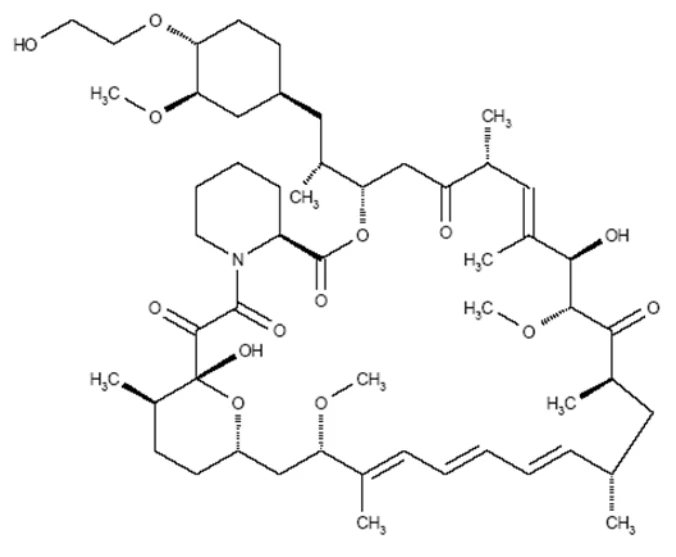
Physicochemical properties:
| Physical description: | White to faintly white powder |
| Solubility: | The drug substance is practically insoluble in water, but it is soluble in organic solvents. |
| pH: | Because the solubility in water is very low (<0.01 %) the pH of an aqueous solution was not determined. The pH value of 0.1 % suspension of several batches in 1 % aqueous solution of KNO3 were measured and the values lie in the range 4-6. |
| pKa: | No pKa value can be determined (neutral compound). |
| Partition Coefficient: | Because of the low solubility of everolimus stabilized with BHT in water and in aqueous buffers, the partition coefficient could not be determined. |
| Melting Point: | Not applicable since the drug substance is amorphous. |
14 CLINICAL TRIALS
14.1 Clinical Trials by Indication
Hormone Receptor-Positive, HER2-Negative Advanced Breast Cancer
Study Y2301 (BOLERO-2)
Table 24 Summary of patient demographics for clinical trial in Hormone Receptor-Positive, HER2-Negative Advanced Breast Cancer
| Study | Study Design | Dosage, route of administration and duration | Study subjects (n) | Median age (range) | Sex |
| Y2301 (BOLERO-2) | A randomized, double-blind, multicentre, international phase III study of AFINITOR plus exemestane versus placebo plus exemestane was conducted in postmenopausal women with oestrogen receptor-positive, HER 2-neu/non-amplified advanced breast cancer with recurrence or progression following prior therapy with | Afinitor 10 mg tablet, oral. The median duration of blinded treatment was 24 weeks for patients receiving Afinitor plus exemestane and 13.4 weeks for those receiving placebo plus exemestane. | n = 724 AFINITOR plus exemestane (n = 485) and placebo plus exemestane (n = 239). Race (n [%]): Caucasian - 547 (75.6%) Asian – 143 (19.8%) Black – 16 (2.2%) Other – 18 (2.5%) | Median Age: 61 years (range 28 years to 93 years) Age category (years) (n [%]): < 65 years: 449 (62%) ≥ 65 years to <75 years: 181 (25%) ≥ 75 years: 94 (13%) | Females (100%) |
Refractory disease to NSAIs was defined as:
- Recurrence while on or within 12 months of the end of adjuvant treatment with letrozole or anastrozole
or
- Progression while on or within 1 month of the end of letrozole or anastrozole treatment for locally advanced or metastatic breast cancer
Except for the prior use of exemestane and mTOR inhibitors, there were no restrictions as to the last anticancer treatment prior to randomization. Patients were permitted to have received 0-1 prior lines of chemotherapy in the advanced disease setting. Documented recurrence or progression on last therapy prior to randomization was required, but letrozole or anastrozole did not have to be the last line of therapy.
Patients were randomized in a 2:1 ratio to receive either AFINITOR (10 mg daily) or matching placebo in addition to open-label exemestane (25 mg daily). Randomization was stratified by documented sensitivity to prior hormonal therapy (yes vs. no) and by the presence of visceral metastasis (yes vs. no). Sensitivity to prior hormonal therapy was defined as either (1) documented clinical benefit (complete response [CR], partial response [PR], stable disease ≥ 24 weeks) to at least one prior hormonal therapy in the advanced setting or (2) at least 24 months of adjuvant hormonal therapy prior to recurrence.
The primary endpoint for the trial was progression-free survival (PFS) evaluated by Response Evaluation Criteria in Solid Tumours (RECIST 1.0), based on the investigator’s (local radiology) assessment. Supportive PFS analyses were based on a blinded, independent central radiology review.
Overall survival (OS) was the key secondary endpoint. Other secondary endpoints included Overall Response Rate (ORR), Clinical Benefit Rate (CBR), Safety, change in Quality of Life (QOL) [EORTC QLQ-C30] and time to ECOG PS deterioration.
The two treatment groups were generally balanced with respect to baseline demographics, tumour burden, disease characteristics and history of prior anti-neoplastic therapies (see Table 24 and Table 25). Overall, 84% of patients were considered to be sensitive to prior endocrine therapy. Patients in the placebo plus exemestane arm did not cross-over to AFINITOR at the time of progression.
Table 25 Disease Characteristics (Hormone Receptor-Positive, HER2-Negative Advanced Breast Cancer)
letrozole or anastrozole. was required, but letrozole or anastrozole did not have to be the last line of therapy. |
| Disease characteristic | AFINITOR plus exemestane N=485 n (%) | Placebo plus exemestane N=239 n (%) | All patients N=724 n (%) | ||||||||
|---|---|---|---|---|---|---|---|---|---|---|---|
| Current disease status | |||||||||||
| Metastatic | 483 (99.6) | 239 (100.0) | 722 (99.7) | ||||||||
| Locally advanced | 2 (0.4) | 0 | 2 (0.3) | ||||||||
| Metastatic site of cancer | |||||||||||
| Bone | 370 (76.3) | 184 (77.0) | 554 (76.5) | ||||||||
| Visceral (excluding CNS) | 283 (58.4) | 143 (59.8) | 426 (58.8) | ||||||||
| CNS | 6 (1.2) | 0 | 6 (0.8) | ||||||||
| Other | 245 (50.5) | 137 (57.3) | 382 (52.8) | ||||||||
| ECOG performance status | |||||||||||
| 0 | 293 (60.4) | 142 (59.4) | 435 (60.1) | ||||||||
| 1 | 174 (35.9) | 84 (35.1) | 258 (35.6) | ||||||||
| 2 | 9 (1.9) | 7 (2.9) | 16 (2.2) | ||||||||
| Missing | 9 (1.9) | 6 (2.5) | 15 (2.1) | ||||||||
| Prior anti-neoplastic therapy | |||||||||||
| Any non-steroidal aromatase inhibitor (NSAI) | 485 (100) | 239 (100) | 724 (100) | ||||||||
| Prior hormonal therapy other than NSAI | 281 (57.9) | 146 (61.1) | 427 (59.0) | ||||||||
| Chemotherapy | 337 (69.5) | 156 (65.3) | 493 (68.1) | ||||||||
| Neoadjuvant /adjuvant setting | 211 (43.5) | 95 (39.7) | 306 (42.3) | ||||||||
| Advanced setting (one line) | 125 (25.8) | 58 (24.3) | 183 (25.3) | ||||||||
| Other therapy | 38 (7.8) | 13 (5.4) | 51 (7.0) | ||||||||
At baseline, 218 patients (45.2%) to be randomized to AFINITOR plus exemestane and 130 patients (54.6%) to be randomized to placebo plus exemestane were taking a bisphosphonate. At update, 251 patients (52.1%) in the AFINITOR plus exemestane arm and 140 patients (58.8%) in the placebo plus exemestane arm were taking a bisphosphonate.
The trial met its primary PFS endpoint at a pre-planned interim efficacy analysis (median study follow-up of 7.6 months and documentation of 68% of targeted PFS events). A statistically significant clinical benefit of AFINITOR plus exemestane over placebo plus exemestane was demonstrated by a 2.4-fold prolongation in median PFS (median: 6.93 months versus 2.83 months), resulting in a 57% risk reduction of progression or death (PFS HR 0.43; 95% CI: 0.35, 0.54); one-sided log-rank test p-value <0.0001 per local investigator assessment.
Subsequently, the trial remained blinded to investigators and patients to permit OS data to mature. Updated efficacy results (excluding OS) with an additional 5 months of follow-up (overall median follow-up of 12.5 months and documentation of 87% of targeted PFS events) demonstrated a significant clinical benefit of AFINITOR plus exemestane over placebo plus exemestane by a 2.3-fold prolongation in median PFS (median: 7.36 months versus 3.19 months), resulting in a 56 % risk reduction of progression or death (PFS HR 0.44; 95% CI: 0.36, 0.53); one-sided log-rank test p-value <0.0001 per local investigator assessment (see Table 26 and Figure 1).
The analysis of PFS based on independent central radiological assessment was supportive (see
Table 26).
No clinically or statistically significant differences were observed between the two treatment arms in terms of time to deterioration of ECOG PS (≥ 1 point) and median times to deterioration (≥ 5%) of QLQ-C30 domain scores.
OS data were not mature at the time of a second interim analysis (additional 8 months of follow-up) based on 182 observed deaths (representing 23% and 29% of patient-deaths reported in the AFINITOR plus exemestane arm and placebo plus exemestane arm, respectively). No statistically significant treatment-related difference in OS was noted [HR=0.77 (95% CI: 0.57, 1.04)]. The final OS analysis is planned at 398 deaths.
Table 26 Efficacy Results at a Median Follow-up of 12.5 Months (Hormone Receptor-Positive, HER2-Negative Advanced Breast Cancer)
| Analysis | AFINITOR + exemestane N=485 | Placebo + exemestane N=239 | Hazard Ratio (95%CI) | p-value |
|---|---|---|---|---|
| Median progression-free survival (months, 95% CI) | ||||
| Investigator radiological review | 7.36 (6.93 to 8.48) | 3.19 (2.76 to 4.14) | 0.44 (0.36 to 0.53) | <0.0001 |
| Independent radiological review | 11.01 (9.56 to NA) | 4.11 (2.83 to 5.55) | 0.36 (0.28 to 0.45) | <0.0001 |
| Best overall response (%, 95% CI) | ||||
| Objective response rate [Complete response (CR) or Partial response (PR)] | 12% (7.0 to 12.4) | 1.3% (0.3 to 3.6) | - | <0.0001 a |
Clinical benefit rate (CR or PR or stable disease ≥ 24 weeks | 50.5% (46.0 to 55.1) | 25.5% (20.1 to 31.5) | - | <0.0001a |
a p-value is obtained from the exact Cochran-Mantel-Haenzel test using a stratified version of the Cochran-Armitage permutation test
Figure 1 Kaplan-Meier Progression-free Survival Curves at a Median Follow-up of 12.5 Months
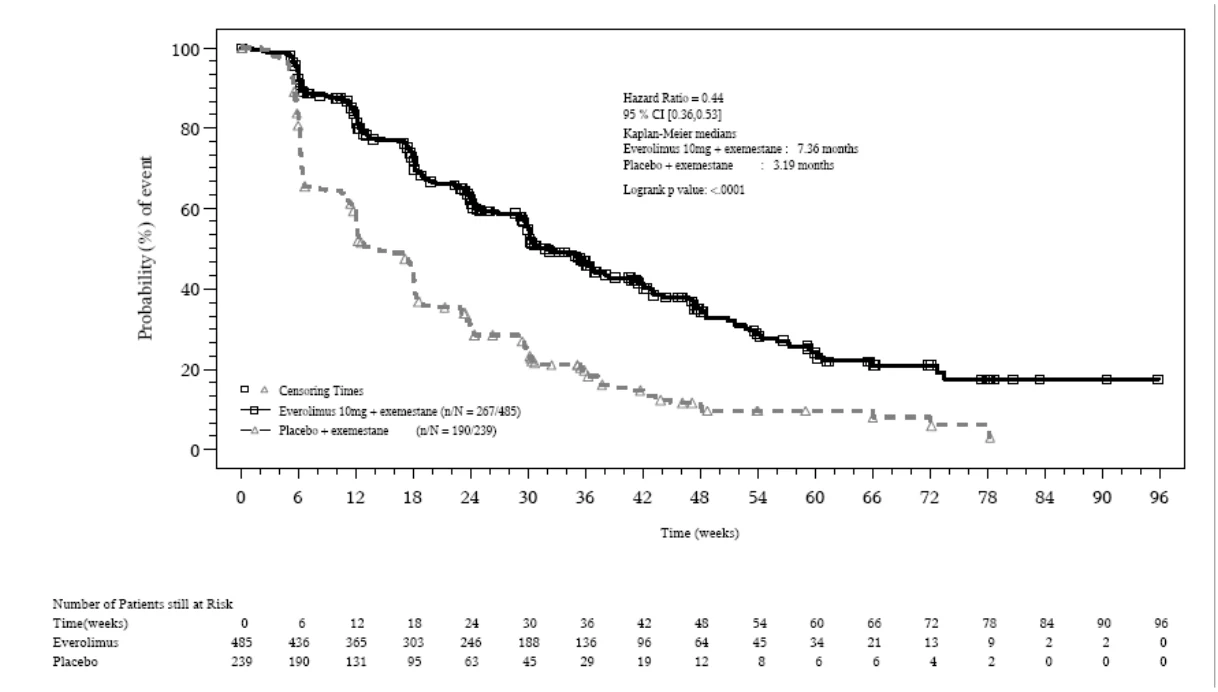
Planned exploratory subgroup analyses of PFS demonstrated a positive treatment effect for AFINITOR plus exemestane across all subgroups analysed (see Figure 2).
Figure 2 Forest plot of PFS as per investigator by subgroup
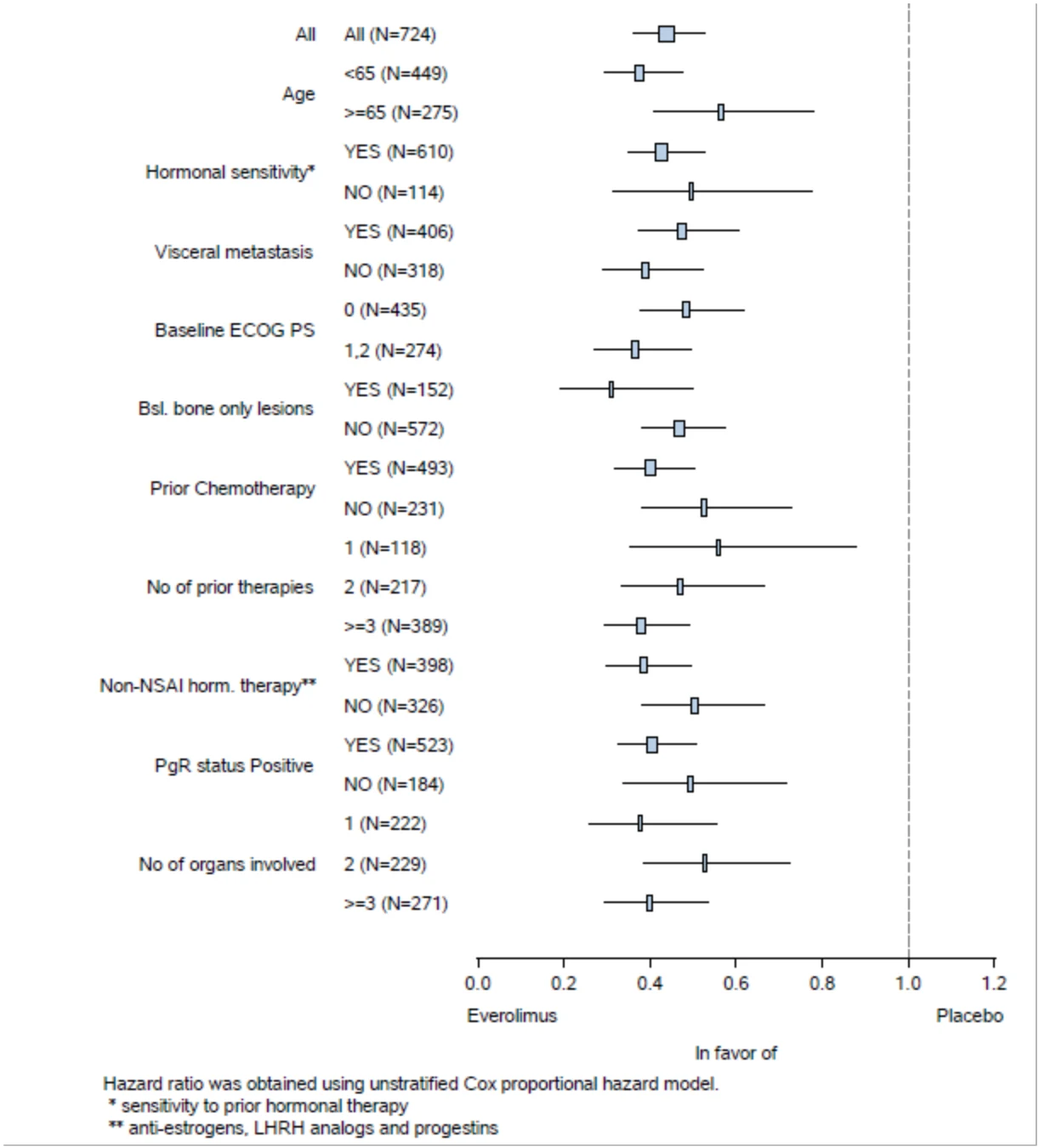
Pancreatic Neuroendocrine Tumours (PNET)
Study C2324 (RADIANT-3)
Table 27 Summary of patient demographics for clinical trial in Pancreatic Neuroendocrine Tumours (PNET)
Patients were stratified by prior cytotoxic chemotherapy (yes/no) and by WHO performance status (0 vs. 1 and 2). Treatment with somatostatin analogues was allowed as part of BSC.
The primary endpoint for the trial was PFS evaluated by RECIST (Response Evaluation Criteria in Solid Tumours, version 1.0) as per investigator radiology review. After documented radiological progression, patients could be unblinded by the investigator; those randomized to placebo were then able to receive open-label AFINITOR. Crossover from placebo to open-label AFINITOR occurred in 73% (148/203) of patients.
Secondary endpoints include safety, objective response rate (ORR) (complete response [CR] or partial response [PR]) and overall survival.
Patients were randomized 1:1 to receive either AFINITOR 10mg/day (n=207) or placebo (n=203). Demographics were well balanced (median age 58 years, 55% male, 79% Caucasian).
| Study | Study Design | Dosage, route of administration and duration | Study subjects (n) | Mean age (range) | Sex (%) |
| C2324 (RADIANT-3) | A randomized, double-blind, multi-centre phase III study of AFINITOR plus best supportive care (BSC) versus placebo plus BSC was conducted in patients with locally advanced or metastatic pancreatic neuroendocrine tumours (PNET) and disease progression within the prior 12 months. | Afinitor 10mg/day tablet, oral. Patients were treated with study medication until objective tumor progression was documented per RECIST criteria (as per the local investigator), unacceptable toxicity, or until treatment discontinuation because of any other reason. | n=410 AFINITOR 10mg/day (n=207) or placebo (n=203). Race (n [%]) Caucasian – 322 (78.5%) Asian – 74 (18.0%) Black – 11 (2.7%) Other - 3 (0.7%) | Mean age:56.5 years Range 20 to 87 years Age (n [%]) < 65 years 299 (72.9%) ≥ 65 years 111 (27.1%) | Male 55.4% Female 44.6% |
Table 28 Disease Characteristics (PNET)
| Disease characteristic | AFINITOR N=207 n (%) | Placebo N=203 n (%) | Total N-410 N (%) | ||||
|---|---|---|---|---|---|---|---|
| Histologic grade | |||||||
| Well differentiated | 170 (82.1) | 171 (84.2) | 341 (83.2) | ||||
| Moderately differentiated | 35 (16.9) | 30 (14.8) | 65 (15.9) | ||||
| Unknown | 2 (1.0) | 2 (1.0) | 4 (1.0) | ||||
| WHO performance status | |||||||
| 0 | 139 (67.1) | 133 (65.5) | 272 (66.3) | ||||
| 1 | 62 (30.0) | 64 (31.5) | 126 (30.7) | ||||
| 2 | 6 (2.9) | 6 (2.9) | 12 (2.9) | ||||
| Prior long-acting somatostatin analogue therapy | 101 (48.8) | 102 (50.2) | 203 (49.5) | ||||
The trial demonstrated a statistically significant improvement in PFS (median 11.0 months versus 4.6 months), resulting in a 65% risk reduction in investigator-determined PFS (HR 0.35; 95% CI: 0.27, 0.45; p<0.0001) (see Table 29 and Figure 3). PFS improvement was observed across all patient subgroups, irrespective of prior somatostatin analogue use. The PFS results by investigator radiological review, central radiological review and adjudicated radiological review are shown below in Table 29.
Table 29 Progression Free Survival Results (PNET)
| Analysis | N 410 | AFINITOR N=207 | Placebo N=203 | Hazard Ratio (95%CI) | p-valueb |
|---|---|---|---|---|---|
| Median progression-free survival (months) (95% CI) | |||||
| Investigator radiological review | 11.0 (8.4 to 13.9) | 4.60 (3.1 to 5.4) | 0.35 (0.27 to 0.45) | <0.0001 | |
| Central radiological review | 13.7 (11.2 to 18.8) | 5.7 (5.4 to 8.3) | 0.38 (0.28 to 0.51) | <0.001 | |
| Independent radiological reviewa | 11.40 [10.84, 14.75] | 5.39 [4.34, 5.55] | 0.34 [0.26, 0.44] | <0.0001 | |
a Includes adjudication for discrepant assessments between investigator radiological review and central radiological review b one-sided p-value from a stratified log-rank test | |||||
Figure 3 Kaplan-Meier Investigator-Determined Progression-free Survival Curves
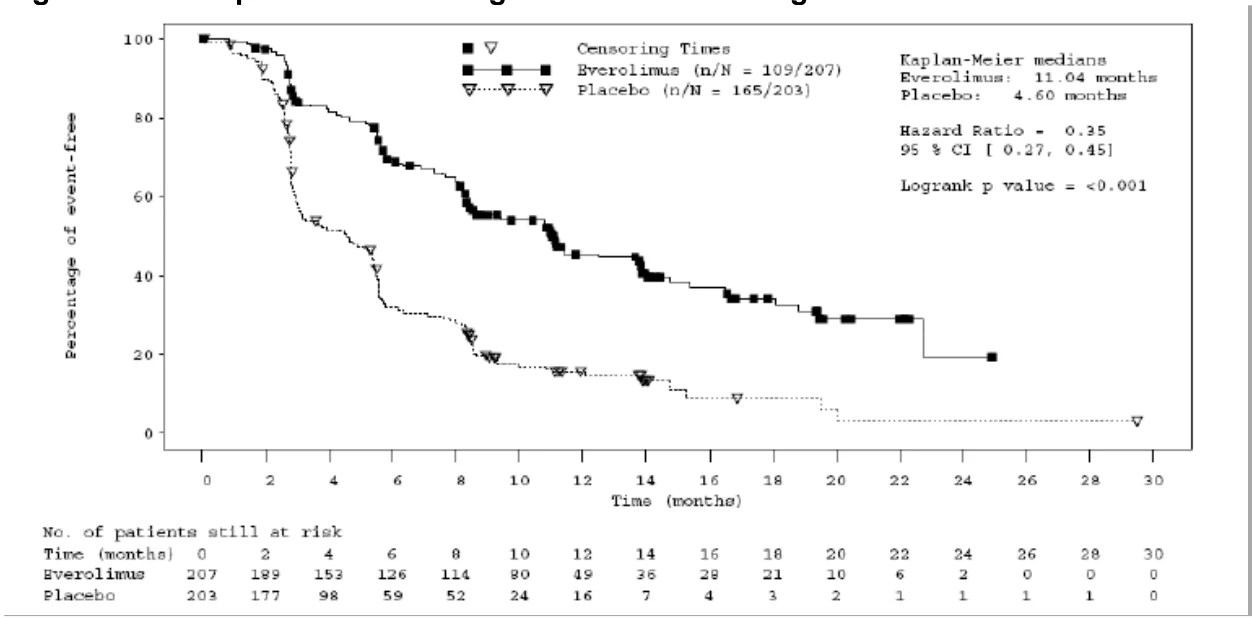
The objective response rate per investigator assessment was 4.8% for the AFINITOR arm vs. 2% for the placebo arm. Tumour reduction is also evident from the corresponding waterfall plot (Figure 4). Results indicate that 64.4% of patients in the everolimus arm experienced tumour shrinkage versus 20.6% for placebo.
Figure 4 Tumour shrinkage: best percentage change from baseline in sum of longest diameters as per investigator assessment
Everolimus n (%) | Placebo n (%) | |||
| Decrease in best percentage change from baseline | 123 (64.4%) | 39 (20.6%) | ||
| Zero change in best percentage change from baseline | 11 (5.8%) | 10 (5.3%) | ||
| Increase in best percentage change from baseline | 43 (22.5%) | 112 (59.3%) | ||
| % Change in target lesion available but contradicted by overall lesion response = PD* | 14 (7.3%) | 28 (14.8%) | ||
| * Patients for w hom the best % change in target lesions w as either unavailable or w as contradicted by overall lesion response of “unknow n” w ere excluded from this analysis. Percentages w ere derived using the remaining number of evaluable patients (n) as the denominator. | ||||
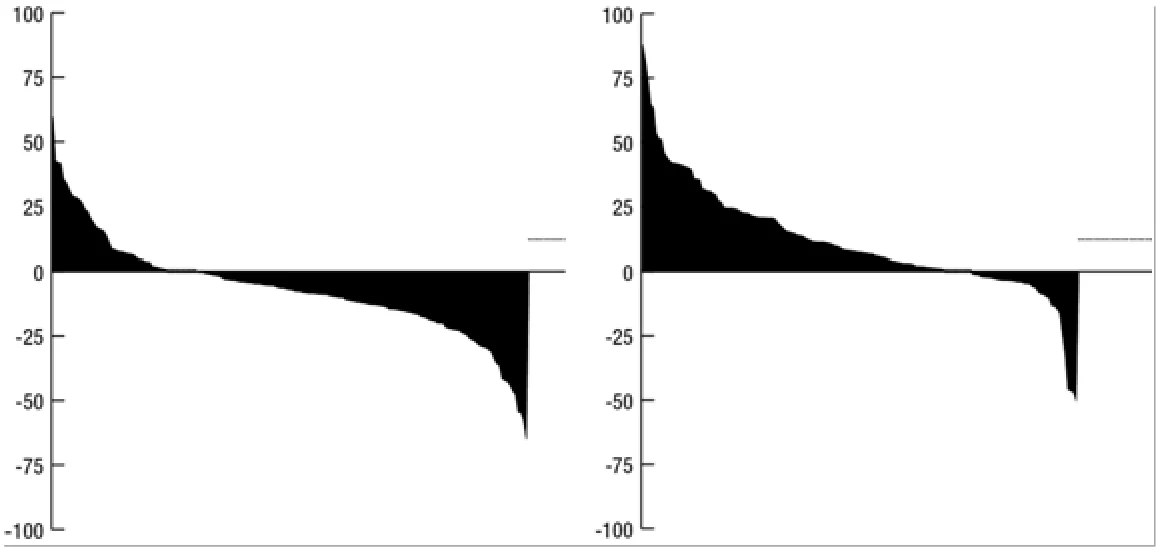
The overall survival results are not yet mature and no statistically significant treatment-related difference in OS was noted [HR=0.99 (95% CI: 0.68 to 1.43)]. Crossover of > 72% of patients from placebo to open label AFINITOR following disease progression likely confounded the detection of any treatment related difference in OS.
Advanced, Non-Functional Neuroendocrine Tumours of Gastrointestinal or Lung Origin
Study T2302 (RADIANT-4)
Table 30 Summary of patient demographics for clinical trial in Neuroendocrine tumours (PNET)
| Study | Study Design | Dosage, route of administration and duration | Study subjects (n) | Median age (range) | Sex (n [%]) |
| T2302 (RADIANT – 4) | A randomized, double-blind, multi-center study of AFINITOR plus best supportive care (BSC) versus placebo plus best supportive care was conducted in patients with unresectable, locally advanced or metastatic neuroendocriSEGAne tumours (NET) of gastrointestinal or lung origin without a history of and no active symptoms related to carcinoid syndrome. | Afinitor 10 mg/day, tablet, oral. The median duration of blinded treatment was 40.4 weeks for patients receiving AFINITOR and 19.6 weeks for those receiving placebo. | n = 302 AFINITOR (10 mg daily) (n = 205), placebo (n = 97). | Median age 63 years Range 22 to 86 years Age (n [%]) <65 years: 159 (52.6%) ≥ 65 years: 143 (47.4%) | Male: 142 (47%) Female:160 (53.0%) |
Patients enrolled in Study T2302 had well-differentiated (low or intermediate grade) histology and evidence of disease progression within 6 months prior to randomization. Randomization was stratified by prior somatostatin analog (SSA) use, tumour origin and WHO performance status. Best supportive care excluded the use of anti-tumour therapies such as SSAs.
The primary endpoint for the study was progression-free survival (PFS) evaluated by Response Evaluation Criteria in Solid Tumours (modified RECIST version 1.0) based on independent radiological assessment. Supportive PFS analysis was based on local investigator review.
Secondary endpoints included overall survival (OS), Overall Response Rate (ORR), Safety, change in Quality of Life (QoL) via FACT-G and time to WHO PS deterioration.
A total of 302 patients were randomised in a 2:1 ratio to receive either AFINITOR (10 mg daily) (n = 205) or placebo (n = 97). The two treatment groups were generally balanced with respect to the baseline demographics, disease characteristics and history of prior somatostatin analog (SSA) use. Patients in the placebo arm did not cross-over to everolimus at the time of progression.
Table 31 Disease Characteristics (GI or lung NET)
| Disease Characteristics | AFINITOR N=205 n (%) | Placebo N=97 n (%) | Total N=302 n (%) | ||||
|---|---|---|---|---|---|---|---|
| WHO performance status – n (%) | |||||||
| 0 | 149 (72.7) | 73 (75.3) | 222 (73.5) | ||||
| 1 | 55 (26.8) | 24 (24.7) | 79 (26.2) | ||||
| 2 | 1 (0.5) | 0 | 1 (0.3) | ||||
| Primary tumour site | |||||||
| Lung | 63 (30.7) | 27 (27.8) | 90 (29.8) | ||||
| Ileum | 47 (22.9) | 24 (24.7) | 71 (23.5) | ||||
| Rectum | 25 (12.2) | 15 (15.5) | 40 (13.2) | ||||
| CUP | 23 (11.2) | 13 (13.4) | 36 (11.9) | ||||
| Jejunum | 16 (7.8) | 6 (6.2) | 22 (7.3) | ||||
| Stomach | 7 (3.4) | 4 (4.1) | 11 (3.6) | ||||
| Duodenum | 8 (3.9) | 2 (2.1) | 10 (3.3) | ||||
| Colon | 5 (2.4) | 3 (3.1) | 8 (2.6) | ||||
| Other | 6 (2.9) | 2 (2.1) | 8 (2.6) | ||||
| Caecum | 4 (2.0) | 1 (1.0) | 5 (1.7) | ||||
| Appendix | 1 (0.5) | 0 | 1 (0.3) | ||||
| Tumour Grade | |||||||
| Grade 1 | 129 (62.9) | 65 (67.0) | 194 (64.2) | ||||
| Grade 2 | 75 (36.6) | 32 (33.0) | 107 (35.4) | ||||
| Time from initial diagnosis to randomization | |||||||
| ≤6 months | 26 (12.7) | 12 (12.4) | 38 (12.6) | ||||
| >6 months - ≤12 months | 37 (18.0) | 13 (13.4) | 50 (16.6) | ||||
| >12 months - ≤18 months | 14 (6.8) | 12 (12.4) | 26 (8.6) | ||||
| >18 months - ≤24 months | 12 (5.9) | 9 (9.3) | 21 (7.0) | ||||
| >24 months - ≤36 months | 29 (14.1) | 13 (13.4) | 42 (13.9) | ||||
| >36 months | 87 (42.4) | 38 (39.2) | 125 (41.4) | ||||
| Previous treatments | |||||||
| Any prior antineoplastic therapy1 | 159 (77.6) | 82 (84.5) | 241 (79.8) | ||||
| Disease Characteristics | AFINITOR N=205 n (%) | Placebo N=97 n (%) | Total N=302 n (%) | |||||
|---|---|---|---|---|---|---|---|---|
| Any prior radiotherapy | 44 (21.5) | 19 (19.6) | 63 (20.9) | |||||
| Any prior surgery | 121 (59.0) | 70 (72.2) | 191 (63.2) | |||||
| Any loco-regional therapy | 23 (11.2) | 10 (10.3) | 33 (10.9) | |||||
| Any prior medications | 63 (30.7) | 29 (29.9) | 92 (30.5) | |||||
| Any prior chemotherapy | 54 (26.3) | 23 (23.7) | 77 (25.5) | |||||
| Any prior hormonal therapy | 1 (0.5) | 1 (1.0) | 2 (0.7) | |||||
| Any prior immunotherapy | 7 (3.4) | 5 (5.2) | 12 (4.0) | |||||
| Any prior targeted therapy | 2 (1.0) | 0 | 2 (0.7) | |||||
| Any prior other therapy | 2 (1.0) | 4 (4.1) | 6 (2.0) | |||||
| Prior SSA treatment | ||||||||
| Yes | 109 (53.2) | 54 (55.7) | 163 (54.0) | |||||
| Disease stage | ||||||||
| I | 0 | 1 (1.0) | 1 (0.3) | |||||
| II | 2 (1.0) | 3 (3.1) | 5 (1.7) | |||||
| III | 7 (3.4) | 3 (3.1) | 10 (3.3) | |||||
| IV | 196 (95.6) | 90 (92.8) | 286 (94.7) | |||||
| Disease sites | ||||||||
| Liver | 163 (79.5) | 76 (78.4) | 239 (79.1) | |||||
| Lymph node/Lymphatic system | 85 (41.5) | 45 (46.4) | 130 (43.0) | |||||
| Lung | 45 (22.0) | 20 (20.6) | 65 (21.5) | |||||
| Bone | 42 (20.5) | 15 (15.5) | 57 (18.9) | |||||
| Peritoneum | 25 (12.2) | 8 (8.2) | 33 (10.9) | |||||
| Liver tumour burden | ||||||||
| 0% | 34 (16.6) | 14 (14.4) | 48 (15.9) | |||||
| >0-10% | 119 (58.0) | 61 (62.9) | 180 (59.6) | |||||
| >10-25% | 29 (14.1) | 8 (8.2) | 37 (12.3) | |||||
| >25-50% | 9 (4.4) | 4 (4.1) | 13 (4.3) | |||||
| >50% | 12 (5.9) | 10 (10.3) | 22 (7.3) | |||||
| Unknown | 2 (1.0) | 0 | 2 (0.7) | |||||
¹Any prior antineoplastic therapy includes patients who have had prior medication (other than somatostatin analog), radiotherapy or surgery.
The efficacy results were obtained from the final analysis of PFS after 178 PFS events were observed per independent radiological review.
The study demonstrated a statistically significant clinical benefit of everolimus over placebo by a 52% risk reduction of progression or death (HR 0.48; 95% CI: 0.35, 0.67; one-sided stratified log-rank test p-value <0.001) per independent assessment (see Table 32 and Figure 5). The analysis of PFS based on local investigator assessment was supportive.
Table 32 RADIANT-4 – Progression Free Survival results
| Analysis | N 302 | AFINITOR N=205 | Placebo N=97 | Hazard Ratioa (95%CI) | p-valueb | |||
|---|---|---|---|---|---|---|---|---|
| Median progression-free survival (months) (95% CI) | ||||||||
| Independent radiological review | 11.0 (9.2 to 13.3) | 3.9 (3.6 to 7.4) | 0.48 (0.35 to 0.67) | <0.001 | ||||
| Investigator radiological review | 14.0 (11.2 to 17.7) | 5.5 (3.7 to 7.4) | 0.39 (0.28 to 0.54) | <0.001 | ||||
aHazard ratio from a stratified Cox model bOne-sided p-value from a stratified log-rank test | ||||||||
Figure 5 RADIANT-4 – Kaplan-Meier progression-free survival curves (independent radiological review)
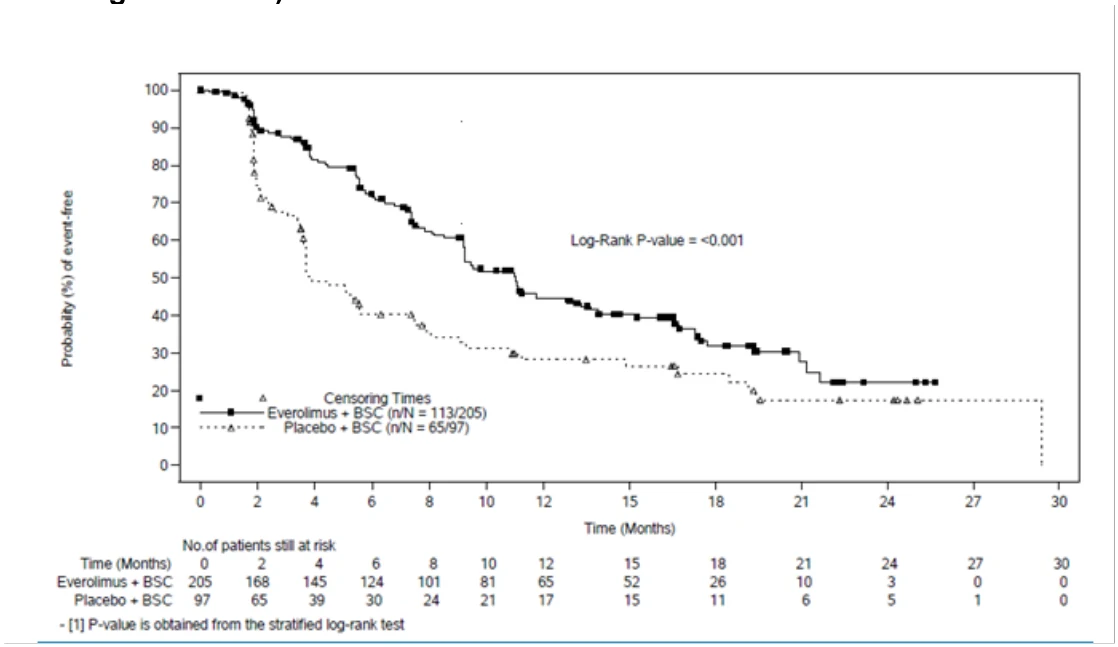
The overall PFS benefit favored AFINITOR across demographic and prognostic stratification subgroups (See Figure 6). Stratum A (appendix, cecum, jejunum, ileum, duodenum, and carcinoma of unknown primary (CUP)) corresponds to better prognosis and that stratum B (lung, stomach, rectum, and colon (with the exception of cecum) has worse prognosis. In an exploratory subgroup analysis of PFS for sites of tumour origin, a positive treatment effect has been observed in all subgroups with the exception of the subgroup of patients with ileum as primary site of tumour origin (Ileum: HR=1.22 [95% CI: 0.56 to 2.65]). (See Figure 7).
Figure 6 Forest plot of hazard ratio for PFS by subgroup based on stratification factors (independent radiological review)
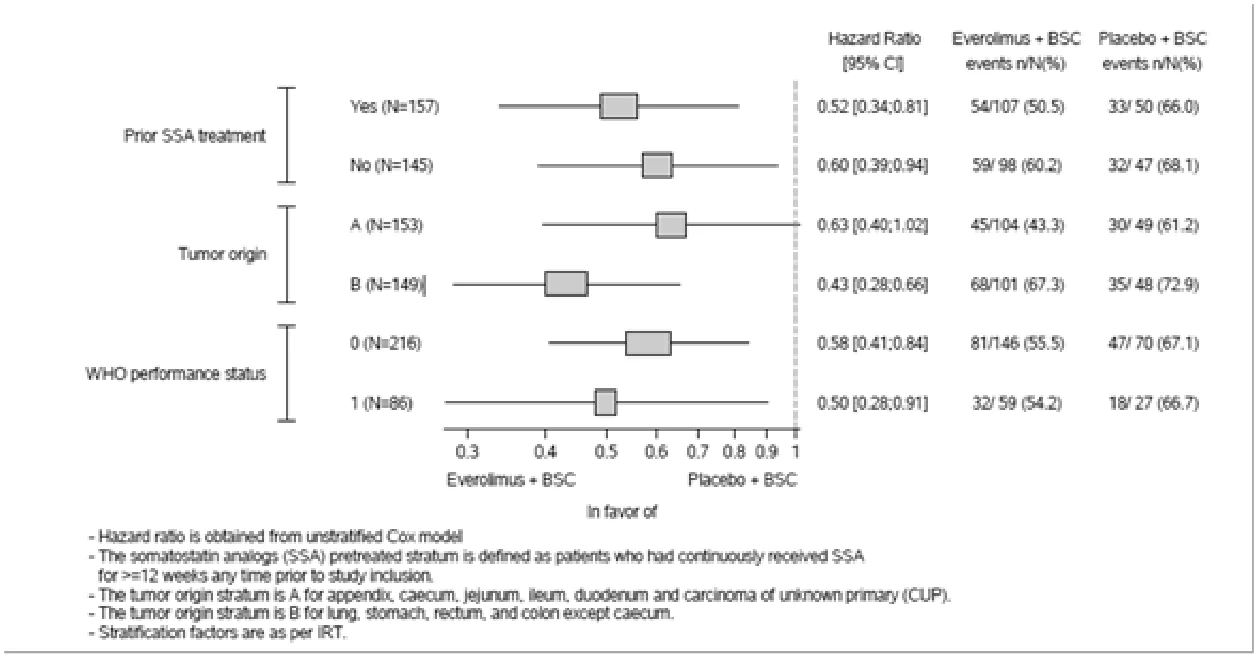
Figure 7 Forest plot of stratified hazard ratio for PFS treatment effect for patient subgroups (independent radiological review)
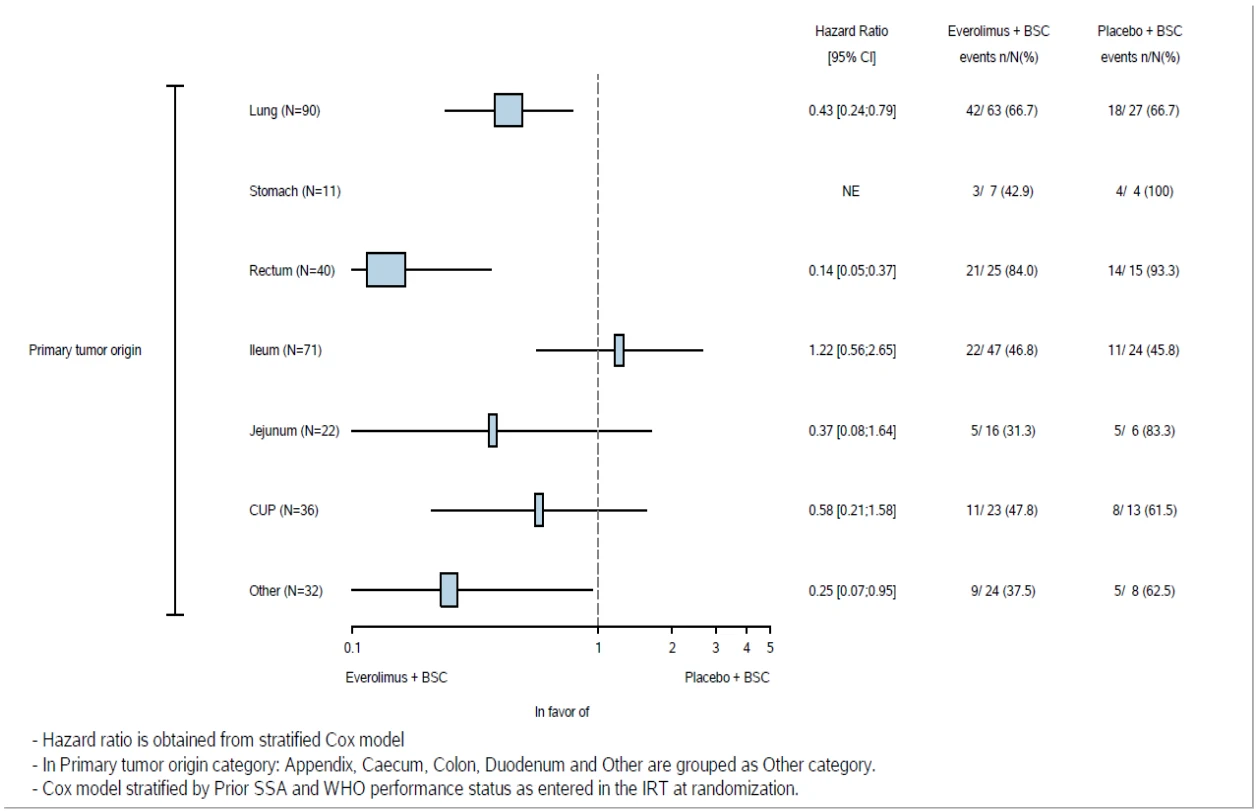
The overall response rate as per independent assessment was 2% in the everolimus arm vs. 1% in the placebo arm. The overall survival (OS) analysis is not yet mature.
Clinically or statistically significant differences were not observed between the two treatment arms in terms of time to deterioration of WHO PS (≥1 point) and time to deterioration of FACT-G total score (≥7 points).
Metastatic Renal Cell Carcinoma (mRCC)
Study C2240 (RECORD-1)
Table 33 Summary of patient demographics for clinical trial in Metastatic Renal Cell Carcinoma (mRCC)
| Study | Study Design | Dosage, route of administration and duration | Study subjects (n) | Mean age (range) | Sex (n (%)) |
| C2240 (RECORD – 1) | A phase III, international, multi-centre, randomised, double-blind study comparing AFINITOR 10 mg/day (2 x 5 mg tablets) and placebo, both in conjunction with best supportive care, was conducted in patients with mRCC whose disease had progressed despite prior treatment with the VEGF (vascular endothelial growth factor)-receptor tyrosine kinase inhibitors (TKIs) sunitinib, | Afinitor 10 mg/day, tablet, oral. The blinded treatment continued until the occurrence of tumour progression or unacceptable toxicity. | n=416 Afinitor n=277 Placebo n=139 Race (n [%]) Afinitor: Caucasian: 246 (88.8%) Asian: 16 (5.8%) Black: 2 (0.7%) Native American: 1 (0.4%) Other/ Missing: 9/4 (2.9%/1.4%) Race (n [%]) Placebo: Caucasian: 121 (87.1%) | Median age: 61 years Range: 27 to 85 years Age (n [%]) <65 years: Afinitor:165 (59.6%) Placebo: 98 (70.5%) ≥ 65 years: Afinitor: 112 (40.4%) Placebo: 41 (29.5%) | Male 106 (76.3 %) Female 33 (23.7%) |
Prior therapy with bevacizumab, interleukin-2 or interferon-alpha was also permitted. Patients were stratified according to Memorial Sloan-Kettering Cancer Center (MSKCC) prognostic score (favourable- vs. intermediate- vs. poor-risk groups) and prior anticancer therapy (1 vs. 2 prior VEGF-receptor TKIs).
Progression-free survival, documented using RECIST (Response Evaluation Criteria in Solid Tumours) and assessed via a blinded, independent central review, was the primary endpoint. Secondary endpoints included safety, objective tumour response rate, overall survival, disease-related symptoms and quality of life. After documented radiological progression, patients could be unblinded by the investigator: those randomised to placebo were then able to receive open-label AFINITOR 10 mg/day. The Independent Data Monitoring Committee recommended termination of this trial at the time of the second interim analysis as the primary endpoint had been met.
Table 34 Disease Characteristics (mRCC)
| Disease characteristic | AFINITOR N=277 | Placebo N=139 |
|---|---|---|
| MSKCC prognostic score [n (%)] | ||
| Favourable risk | 81 (29.2) | 39 (28.1) |
| Intermediate risk | 156 (56.3) | 79 (56.8) |
| Poor risk | 40 (14.4) | 21 (15.1) |
| Prior VEGF-receptor TKI therapy [n (%)] | ||
| One prior VEGF-receptor TKI | 205 (74.0) | 103 (74.1) |
| Two prior VEGF-receptor TKIs | 72 (26.0) | 36 (25.9) |
| Prior immunotherapy (n [%]) | 179 (64.6) | 93 (66.9) |
Results from a planned interim analysis showed that AFINITOR was superior to placebo for the primary endpoint of progression-free survival (PFS), with a statistically significant 67% reduction in the risk of progression or death. At 6 months, PFS rates were 36% for AFINITOR therapy compared with 9% for placebo (see Table 35 and Figure 8).
Table 35 Progression Free Survival results (mRCC)
| Population | N | AFINITOR N=277 | Placebo N=139 | Hazard Ratio (95%CI) | p-value a |
|---|---|---|---|---|---|
| Median progression-free survival (months) (95% CI) | |||||
| Primary analysis | |||||
| sorafenib, or both sunitinib and sorafenib. | Asian: 11 (7.9%) Black: 3 (2.2%) Native American: 0 (0%) Other/ Missing: 3/1 (2.2%/0.7%) |
| Population | N | AFINITOR N=277 | Placebo N=139 | Hazard Ratio (95%CI) | p-value a | |||
|---|---|---|---|---|---|---|---|---|
| All (blinded independent central review) | 416 | 4.9 (4.0 to 5.5) | 1.9 (1.8 to 1.9) | 0.33 (0.25 to 0.43) | <0.001a | |||
| Supportive/sensitivity analyses | ||||||||
| All (local review by investigator) | 416 | 5.5 (4.6 to 5.8) | 1.9 (1.8 to 2.2) | 0.32 (0.25 to 0.41) | <0.001a | |||
| MSKCC prognostic score | ||||||||
| Favourable risk | 120 | 5.8 (4.0 to 7.4) | 1.9 (1.9 to 2.8) | 0.31 (0.19 to 0.50) | <0.001b | |||
| Intermediate risk | 235 | 4.5 (3.8 to 5.5) | 1.8 (1.8 to 1.9) | 0.32 (0.22 to 0.44) | <0.001b | |||
| Poor risk | 61 | 3.6 (1.9 to 4.6) | 1.8 (1.8 to 3.6) | 0.44 (0.22 to 0.85) | 0.013 b | |||
a Log-rank test stratified by prognostic score b Unstratified, tw o-sided log-rank test | ||||||||
Figure 8 Kaplan-Meier progression-free survival curves
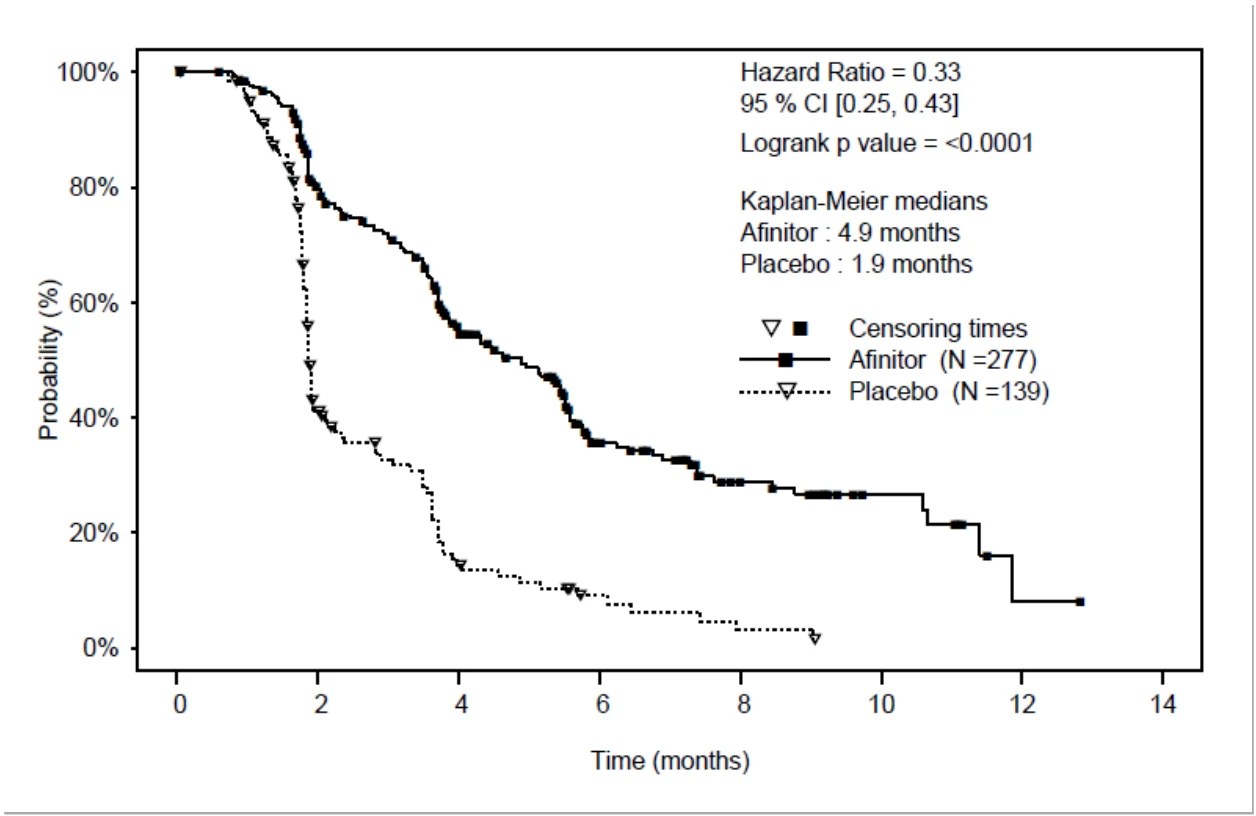
A low objective response rate (ORR) was observed with no significant differences apparent between the two treatment arms. ORR, based on RECIST, was documented in 1.8% (95% CI: 0.6-4.2%) of patients receiving everolimus therapy (vs. 0% for placebo); all 5 of these patients had partial responses. The progression-free survival advantage therefore primarily reflects the population with disease stabilisation (corresponding to 67% of the AFINITOR treatment group) (see Figure 9).
Figure 9 Waterfall plot: best percentage change from baseline of target lesions by central radiology
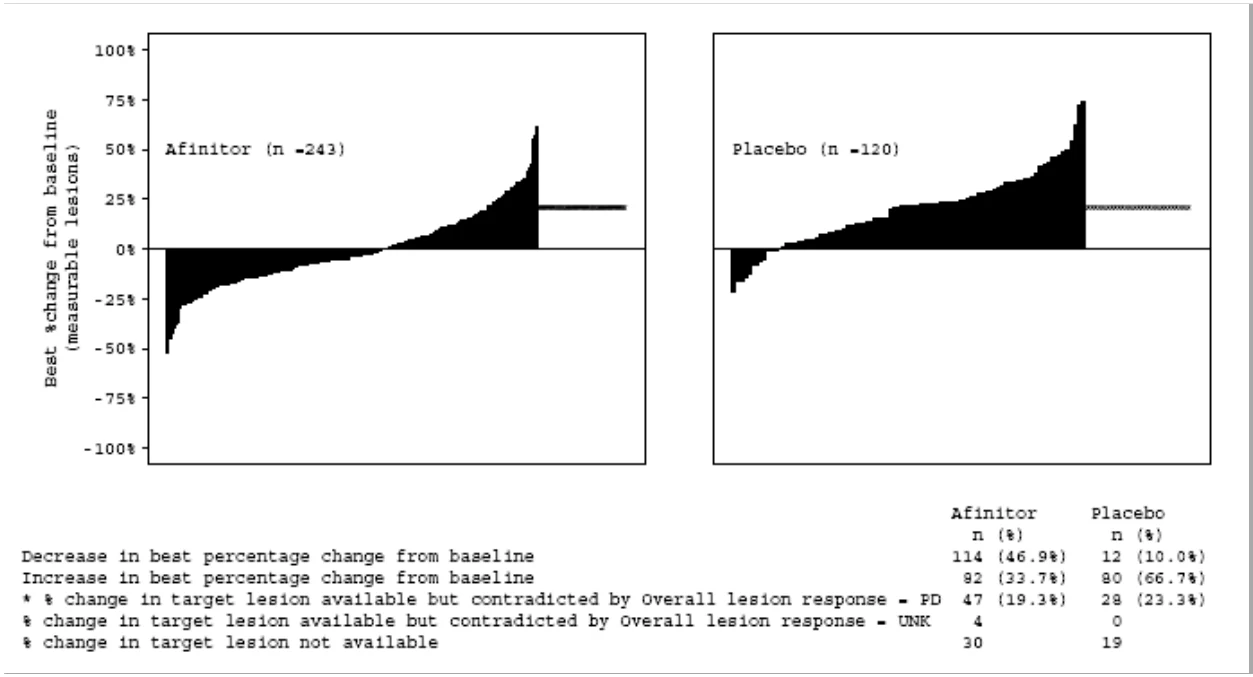
No statistically significant treatment-related difference in overall survival was noted, although there was a trend in favour of AFINITOR (HR 0.82; 95% CI: 0.57 to 1.17; p=0.137). Crossover to open-label AFINITOR following disease progression for patients allocated to placebo may have confounded the detection of any treatment-related difference in overall survival.
No difference in health-related quality of life was observed in patients receiving AFINITOR compared to placebo patients
Renal Angiomyolipoma associated with Tuberous Sclerosis Complex
M2302 (EXIST-2)
Table 36 Summary of patient demographics for clinical trial in Renal Angiomyolipoma associated with Tuberous Sclerosis Complex (TSC)
| Study | Study Design | Dosage, route of administration and duration | Study subjects (n) | Mean age (range) | Sex (M/F) |
| M2302 (EXIST -2) | A randomized, double-blind, multi-centre phase III study of AFINITOR versus | Afinitor 10 mg/day, tablet oral, until | n =118 AFINITOR 10 mg daily | Mean age Afinitor: | Male (n [%]) Afinitor: |
The primary efficacy endpoint for the trial was angiomyolipoma response rate based on independent central radiology review. Response was defined as: ≥ 50% reduction in the sum of angiomyolipoma volume relative to baseline, plus absence of new angiomyolipoma ≥ 1.0 cm in longest diameter, plus no increases in renal volume > 20% from nadir, plus absence of grade ≥ 2 angiomyolipoma-related bleeding. The analysis was stratified by use of enzyme-inducing antiepileptic drugs (EIAEDs) at randomisation (yes/no).
Key secondary endpoints included time to angiomyolipoma progression and skin lesion response rate.
The primary analyses of efficacy endpoints were limited to the blinded treatment period which ended 6 months after the last patient was randomized. The median duration of follow-up was 8.3 months (range 0.7 to 24.8 months).
Patients initially treated with placebo were allowed to cross over to everolimus at the time of angiomyolipoma progression or after the primary analysis. At the time of the final analysis (4 years following the last patient randomization), the median duration of exposure to everolimus was 46.9 months (range 0.5 to 63.9 months).
Demographic and baseline disease characteristics and history of prior anti-angiomyolipoma therapies were generally well balanced.
Table 37 Disease Characteristics (Full Analysis Set) (Renal Angiomyolipoma associated with TSC)
| placebo was conducted in patients who have renal angiomyolipoma associated with TSC (n=113) or with sporadic lymphangioleiomyomatosis (LAM) (n=5). Presence of at least one angiomyolipoma ≥ 3 cm in longest diameter using CT/MRI (based on local radiology assessment), no immediate indication for surgery, and age ≥ 18 years were required for entry. | disease progression or unacceptable toxicity or discontinuation for any other reason. | (n=79) or matching placebo (n=39) Race (n [%]) Afinitor: Caucasian: 71 (89.9%) Asian: 7 (8.9%) Other: 1 (1.3%) Placebo: Caucasian: 34 (87.2%) Asian: 4 (10.3.%) Other: 1 (2.6%) | 32.5 years Placebo: 31 years. Range: 18 to 61 years. | 27 (34.2%), Placebo: 13 (33.3%) Female (n [%]) Afinitor: 52 (65.8%), Placebo: 26 (66.7%) |
| Disease characteristic | AFINITOR N=79 | Placebo N=39 |
|---|---|---|
| Diagnosis of TSC2 | ||
| n (%) | ||
| At least two major features | 77 (97.5) | 36 (92.3) |
| Only one major feature and at least two minor features | 0 | 0 |
| EIAED use/EIAED non-use (n, %) | ||
| EIAED use | 13 (16.5) | 7 (17.9) |
| EIAED non-use | 66 (83.5) | 32 (82.1) |
| Longest diameter of largest angiomyolipoma2 | ||
| ≥ 8cm | 22 (27.8) | 12 (30.8) |
| ≥ 4cm and <8cm | 45 (57.0) | 19 (48.7) |
| ≥ 3cm and <4cm | 6 (7.6) | 4 (10.3) |
| < 3cm | 5 (6.3) | 2 (5.1) |
| Number of target angiomyolipoma lesions ≥ 1cm in longest diameter (n, %) | ||
| 1-5 | 32 (40.5) | 15 (38.5) |
| 6-10 | 46 (58.2) | 23 (59.0) |
| Number of patients with angiomyolipoma lesions present in (n, %) | ||
| One kidney only | 13 (16.7) | 11 (28.9) |
| Both kidneys | 65 (83.3) | 27 (71.1) |
| Sum of volumes of target angiomyolipoma lesions (cm3) 2 | ||
| Median | 85.4 | 119.8 |
| Range | 8.6 – 1611.5 | 3.0 – 4520.0 |
| Prior anti-angiomyolipoma therapy (surgery/invasive procedure) | ||
| Renal embolization | 19 (24.1) | 9 (23.1) |
| Nephrectomy | 14 (17.7) | 8 (20.5) |
| Number of patients with ≥ 1 skin lesion at baseline | 77 (97.5) | 37 (94.9) |
1 Other was applied to patients of mixed race
2 Baseline kidney CT/MRI assessments were per central radiology review
Results showed that AFINITOR was statistically superior to placebo for the primary efficacy endpoint of angiomyolipoma response rate (p<0.0001). Best overall response rate was 41.8% (95% CI: 30.8, 53.4) for the AFINITOR arm compared with 0% (95% CI: 0.0, 9.0) for the placebo arm (Figure 8). Consistent treatment effects were observed across all subgroups evaluated (i.e., EIAED use vs. EIAED non-use, sex, age and race) at the primary efficacy analysis (Figure 10).
Figure 10 Forest plot of angiomyolipoma response by subgroup (Full Analysis Set) at primary analysis
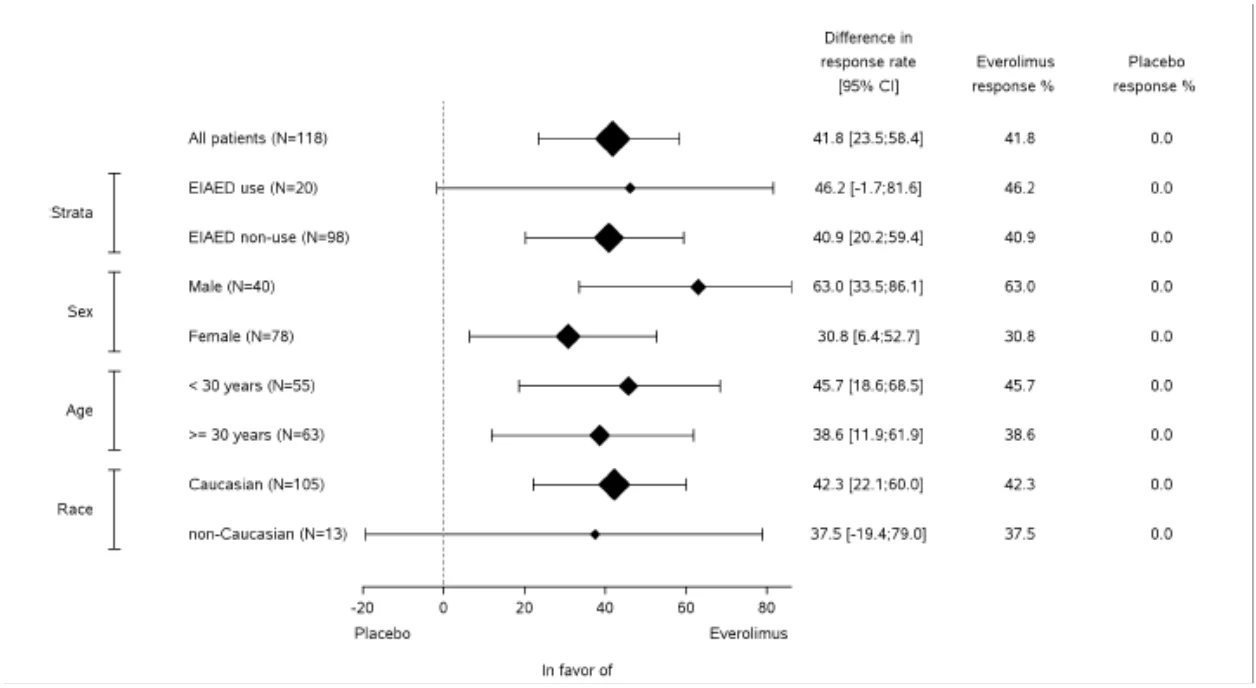
Table 38 Angiomyolipoma Response
| Primary Analysis | Final analysis | ||||||||||
| AFINITOR | Placebo | p-value | AFINITOR | ||||||||
| N=79 | N=39 | N=112 | |||||||||
| Angiomyolipoma response ratea - % | 41.8 | 0 | <0.0001 | 58.0 | |||||||
| 95% CI | (30.8, 53.4) | (0.0, 9.0) | (48.3, 67.3) | ||||||||
| a Per independent central radiology review | |||||||||||
Figure 11 Waterfall plot: Angiomyolipoma shrinkage: best percentage change from baseline (Full Analysis Set)1,2 at primary analysis
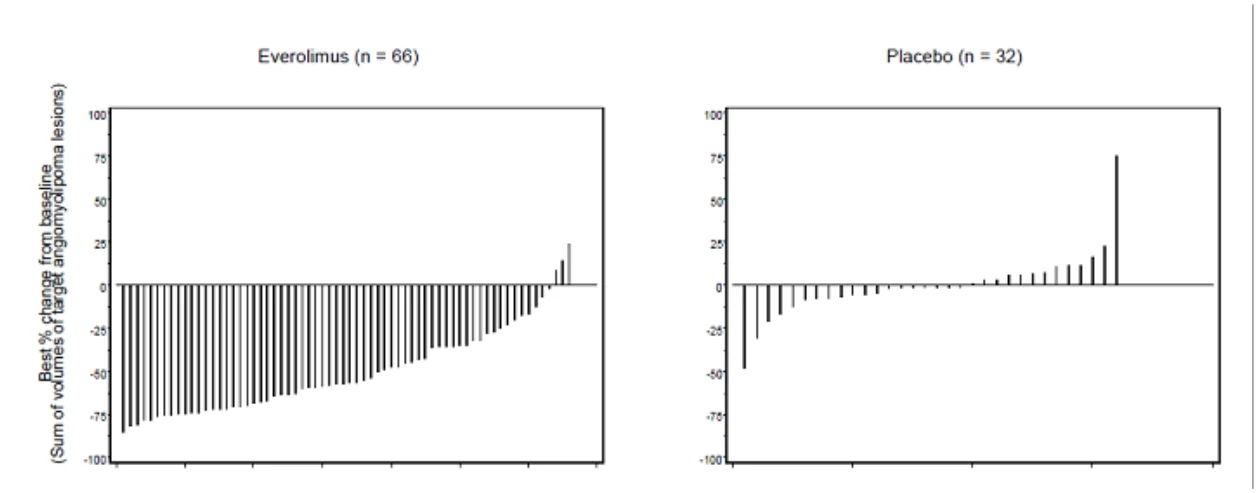
1 Per independent central radiology review
2 Patients for whom the best % change in sum of volumes of target angiomyolipoma lesions was not available and patients with overall angiomyolipoma response = Not evaluable were excluded from the graph
At the primary analysis, progressions were observed in 3.8% (3/79) of patients in the AFINITOR arm compared with 20.5% (8/39) of patients in the placebo arm. AFINITOR was associated with a statistically significant prolongation in time to angiomyolipoma progression (HR 0.08; 95% CI: 0.02, 0.37; p<0.0001). Median time to angiomyolipoma progression was 11.4 months in the placebo arm and was not reached in the AFINITOR arm.
At the final analysis, the angiomyolipoma best overall response rate had increased to 58.0% (95% CI: 48.3, 67.3). Median time to angiomyolipoma progression was not reached. Angiomyolipoma progressions were observed in 14.3% of the patients (16/112). The estimated angiomyolipoma progression-free rates at 24 months and 48 months were 91.6% (95% CI: 84.0%, 95.7%) and 83.1% (95% CI: 73.4%, 89.5%) respectively. No cases of angiomyolipoma-related nephrectomy and only one case of renal embolization were reported among patients treated with everolimus during the study.
At the primary analysis, AFINITOR also demonstrated improvements in skin lesion response (p=0.0002), with partial response rates of 26.0% (20/77) for the AFINITOR arm and 0% (0/37) for the placebo arm. At the final analysis, the overall skin lesion response rate had increased to 68.2% (73/107) (95% CI: 58.5%, 76.9%).
SEGA associated with Tuberous Sclerosis Complex
Study M2301 (EXIST-1)
Table 39 Summary of patient demographics for clinical trial in SEGA associated with Tuberous Sclerosis Complex (TSC)
| Study | Study Design | Dosage, route of administration and duration | Study subjects (n) | Mean age (range) | Sex (n [%]) |
Eligible patients had the presence of at least one SEGA lesion ≥ 1.0 cm in longest diameter using MRI (based on local radiology assessment) and one or more of the following: serial radiological evidence of SEGA growth, a new SEGA lesion ≥ 1 cm in longest diameter, or new or worsening hydrocephalus.
The primary efficacy endpoint was SEGA response rate based on independent central radiology review. Analysis of SEGA response rate was limited to the blinded treatment period which ended 6 months after the last patient was randomised. The analysis was stratified by use of enzyme-inducing antiepileptic drugs (EIAEDs) at randomisation (yes/no).
Key secondary endpoints included time to SEGA progression and skin lesion response rate. Renal angiomyolipoma response was an exploratory endpoint.
The two treatment arms were generally well balanced with respect to demographic and baseline
| M2301 (EXIST -1) | A randomized, double-blind, multicentre, phase III study of AFINITOR versus placebo was conducted in 117 patients with SEGA associated with TSC. Patients were randomised in a 2:1 ratio to receive either AFINITOR or placebo. | Patients randomized to the treatment arm received AFINITOR at a starting dose of 4.5 mg/m2 daily orally, with subsequent dose adjustments as needed, to achieve and maintain everolimus trough concentrations of 5 to 15 ng/mL, as tolerated. The median duration of blinded study treatment was 52.2 weeks (range 24 to 89 weeks) for patients receiving AFINITOR and 46.6 weeks (range 14 to 88 weeks) for those receiving placebo. | n = 117 Afinitor (n=78), Placebo (n=39) Race (n [%]) Caucasian: 109 (93.2%) Black: 4 (3.4%) Other: 3 (2.6%) | Mean Age Afinitor: 10.1 years Placebo: 10.3 years Range 0.8 to 26.6 years | Male (67 (57.3%) Female 50 (42.7%) |
disease characteristics and history of prior anti-SEGA therapies.
Table 40 Demographic and Disease Characteristics
| Disease characteristic | AFINITOR N=78 n (%) | Placebo N=39 n (%) | Total N=117 n (%) | ||||
|---|---|---|---|---|---|---|---|
| Number of target SEGA lesions | |||||||
| Bilateral SEGA | 63 (80.8) | 30 (76.9) | 93 (79.5) | ||||
| ≥ 2 | 36 (46.2) | 14 (35.9) | 50 (42.7) | ||||
| Brain MRI assessment | |||||||
| Inferior growth | 19 (24.4) | 11 (28.2) | 30 (25.6) | ||||
| Evidence of deep parenchymal invasion | 8 (10.3) | 3 (7.7) | 11 (9.4) | ||||
| Radiographic evidence of hydrocephalus | 8 (10.3) | 0 (0.0) | 8 (6.8) | ||||
| Skin and subcutaneous tissue disorders | |||||||
| At least one skin lesion | 72 (92.3) | 38 (97.4) | 110 (94.0) | ||||
| Prior SEGA-related surgery | 6 (7.7) | 2 (5.1) | 8 (6.8) | ||||
a ‘Other’ w as applied to patients w ho w ere of mixed race
Results showed that AFINITOR was superior to placebo for the primary endpoint of best overall SEGA response (p<0.0001) (Table 35). At the time of primary analysis, all SEGA responses were on-going and the median duration of response was 5.3 months (range 2.1 to 8.4 months).
Patients initially treated with placebo were allowed to cross over to AFINITOR at the time of SEGA progression and upon recognition that treatment with AFINITOR was superior to treatment with placebo. All patients receiving at least one dose of AFINITOR were followed until drug discontinuation or study completion. At the time of final analysis, the median duration of exposure to AFINITOR among all such patients was 204.9 weeks (range 8.1 to 253.7). The best overall SEGA response rate had increased to 57.7% (95% CI: 47.9, 67.0) at the final analysis (Table 35).
Table 41 SEGA response (Study EXIST-1)
| Primary analysis3 | Final analysis4 | |||
AFINITOR N=78 | Placebo N=39 | p-value | AFINITOR | |
| SEGA response rate1,2 (%) | 34.6 | 0 | <0.0001 | 57.7 |
| 95% CI | 24.2, 46.2 | 0.0, 9.0 | 47.9, 67.0 | |
1 Per independent central radiology review
2 SEGA responses w ere confirmed w ith a repeat scan. Response w as defined as: ≥ 50% reduction in the sum of SEGA volume relative to baseline, plus no unequivocal worsening of non-target SEGA lesions, plus absence of new SEGA ≥ 1 cm in longest diameter, plus no new or worsening hydrocephalus.
3 Primary analysis for double blind period
4 Final analysis includes patients who crossed over from the placebo group; median duration of exposure to everolimus of 204.9 w eeks
Consistent treatment effects were observed across all subgroups evaluated (i.e., EIAED use vs. EIAED non-use, sex and age) at the primary analysis (Figure 12).
Figure 12 Forest plot of SEGA response by subgroup at primary analysis
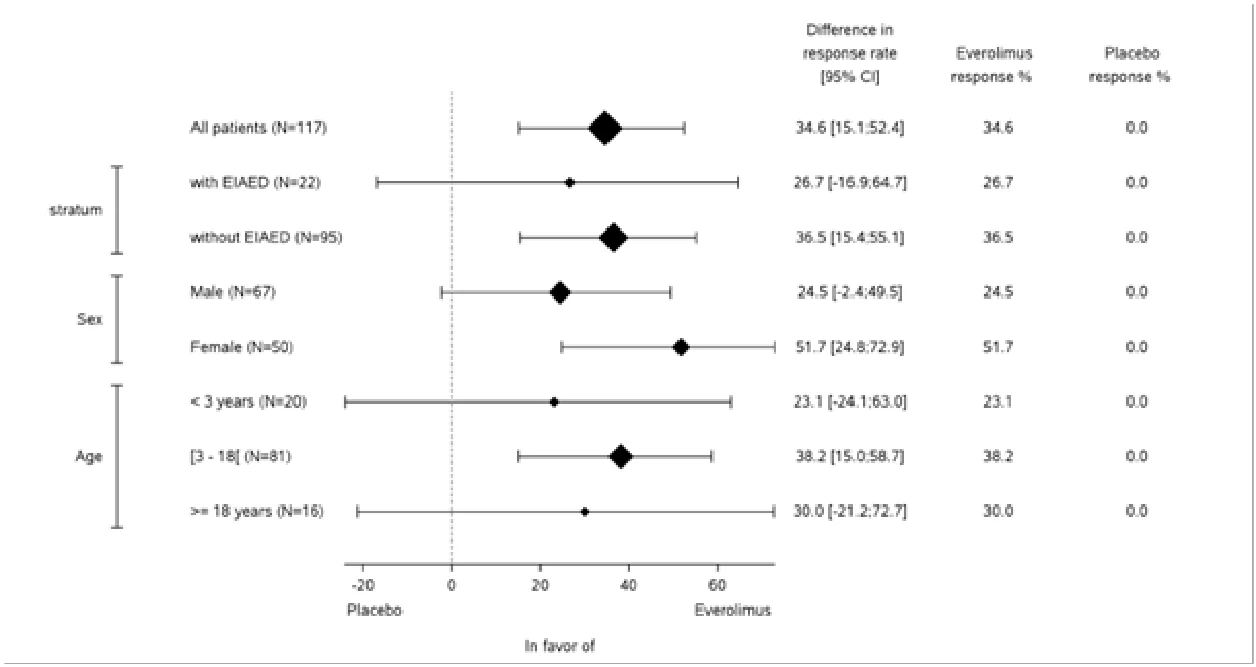
During the double blind period, reduction of SEGA volume was evident within the initial 12 weeks of treatment with AFINITOR: 29.7% (22/74) of patients had ≥50% reductions in volume and 73.0% (54/74) of patients had ≥ 30% reductions in volume. At Week 24, 41.9% (31/74) of patients had ≥ 50% reductions and 78.4% (58/74) of patients had ≥ 30% reductions in SEGA volume.
In the AFINITOR treated population (N=111) of the study, including patients who crossed over from the placebo group, tumour response, starting as early as after 12 weeks on AFINITOR, was sustained at later time points. The proportion of patients achieving at least 50% or at least 30% reductions in SEGA volume were 62.1% (41/66) and 77.3% (51/66) respectively, at Week 192 after start of AFINITOR treatment.
Progressions were only observed in the placebo arm (15.4%) during the blinded phase of the study. Thirteen of the 111 patients (11.7%) treated with AFINITOR had documented disease progression by the end of the follow-up period.
AFINITOR demonstrated improvements in skin lesion response with response rates of 41.7% for the AFINITOR arm and 10.5% for the placebo arm. At the final analysis, the skin lesion response rate increased to 58.1% (95% CI: 48.1, 67.7).
At the time of the primary analysis, renal angiomyolipoma responses were only observed in the AFINITOR arm (n/N:16/30; 53.3%; 95% CI: 34.3, 71.7). At the time of final analysis, among the 41 TSC-SEGA in patients with an angiomyolipoma lesion(s) present at start of treatment with AFINITOR. 30 patients (73.2 %; 95% CI: 57.1, 85.8) achieved, as their best overall response, at least a 50% reduction in sum of angiomyolipoma volumes.
No patient required surgical intervention for SEGA during the entire course of the study.
Seizures associated with Tuberous Sclerosis Complex
Study M2304 (EXIST-3)
Table 42 Summary of patient demographics for clinical trial in Seizures associated with Tuberous Sclerosis Complex
Patients had partial-onset seizures with or without secondary generalization and were not satisfactorily controlled with combinations of anti-epileptic drugs (AEDs). During the 8-week Baseline phase, patients were required to have ≥16 seizures per 28 days. The Core treatment phase of the study was 18 weeks in duration (including a 6 week Titration period and a 12 week
| Study | Study Design | Dosage, route of administration and duration | Study subjects (n) | Mean age (range) | Sex (M/F) |
| M2304 (EXIST – 3) | The safety and efficacy of AFINITOR DISPERZ as adjunctive therapy in the treatment of seizures associated with tuberous sclerosis complex (TSC) were studied in a randomized, double-blind, placebo-controlled, multicenter, phase III trial. All patients had a definite diagnosis of TSC. Approximately half the patients were male. | The Core treatment phase of the study was 18 weeks in duration (including a 6 week Titration period and a 12 week Maintenance period). The study consisted of three arms and compared two doses of everolimus (low trough [LT]: 3-7 ng/mL and high trough [HT]: 9-15 ng/mL) with placebo. Across all arms, approximately 95% of the patients completed the Core treatment phase of the study. | n = 366 Afinitor (n= 247) Placebo (n= 119) Data on race were limited (approximately 35% of the patients were non-Caucasian). | Mean age: 13 years Range: 2 to 56 years | There were no significant differences in seizure control as a function of gender. Approximately half the patients were male. |
Maintenance period). The study consisted of three arms and compared two doses of everolimus (low trough [LT]: 3-7 ng/mL and high trough [HT]: 9-15 ng/mL) with placebo. Across all arms, approximately 95% of the patients completed the Core treatment phase of the study.
A statistically significant treatment effect was observed for both doses of AFINITOR DISPERZ relative to placebo (p=0.003 [LT] and p<0.001 [HT]) for the median percent reduction from Baseline in seizure frequency during the Maintenance period of the Core Treatment Phase. This was supported by the analysis of responder rate during the Maintenance period of the Core treatment phase (Table 43). Efficacy results from the entire Core Treatment Phase (Titration + Maintenance periods) support the results from the Maintenance period of the Core Treatment Phase.
Table 43 Median Percent Reduction in Seizure Frequency and Proportion of Patients with at least a 50% Reduction in Seizure Frequency from Baseline (Full Analysis Set)
| Efficacy Resultsa | AEDs + Placebo | AEDs + AFINITOR DISPERZ | ||||||||
| N=119 | LT Target 3-7 ng/mL N=117 | HT Target 9-15 ng/mL N=130 | ||||||||
| Median percent reduction from Baseline during the Maintenance period of the Core treatment phase | 14.9 | 29.3 | 39.6 | |||||||
| p-value versus placebo | 0.003 | <0.001 | ||||||||
| Responder Rate from Baseline during the Maintenance period of the Core treatment phase | 15.1 | 28.2 | 40.0 | |||||||
| p-value versus placeboc | 0.008 | <0.001 | ||||||||
a The primary efficacy endpoint was the median percent reduction from Baseline during the Maintenance period of the Core treatment phase. Responder rate was defined as percentage of patients who achieved at least a 50% reduction from Baseline in seizure frequency during the Maintenance period of the Core treatment phase.
At the end of the Core treatment phase, roughly 4% of the patients in AFINITOR DISPERZ arms became seizure-free vs about 1% in placebo.
14.3 Comparative Bioavailability Studies
Table 44 presents the results of a randomized, open label, cross-over study in 53 healthy volunteers comparing the bioavailability of the AFINITOR DISPERZ 5 mg tablet for oral suspension to the AFINITOR 5 mg tablet.
Table 44 Single dose bioavailability study 1
Everolimus (1 x 5 mg AFINITOR tablet and 1 x 5 mg AFINITOR DISPERZ tablet for oral suspension) From measured data Geometric Mean Arithmetic Mean (CV %) |
|---|
| Parameter | AFINITOR DISPERZ 5 mg Tablet for oral suspension (Test) | AFINITOR 5 mg Tablet (Reference) | Ratio of Geometric Means | 90% Confidence Interval |
|---|---|---|---|---|
AUC0-72h (ng.h/mL) | 190.11 196.62 (26.00) | 211.56 220.44 (32.29) | 0.90 | 0.85, 0.95 |
AUC0-∞ (ng.h/mL) | 230.95 238.17 (24.90) | 252.47 262.63 (31.38) 1 | 0.91 | 0.86, 0.96 |
CMAX (ng/mL) | 25.73 26.59 (25.55) | 31.98 33.09 (29.22) | 0.80 | 0.75, 0.86 |
TMAX§ (h) | 1.5 (0.5, 4.0) | 1.00 (0.5, 3.0) | ||
T½‡ (h) | 34.92 (19.23) 2 | 33.30 (15.14) |
1 N=52 for AUC0-∞ for the 5 mg tablet
2 N=52 for T½ for the 5 mg tablet for oral suspension
§ Expressed as median (range)
‡ Expressed as the arithmetic mean (CV%)
Table 45 presents the results of a randomized, open label, cross-over study in 51 healthy volunteers comparing the bioavailability of the AFINITOR DISPERZ 5 mg tablet for oral suspension to the 5 x 1 mg everolimus tablets.
Table 45 Single dose bioavailability study 2
Everolimus (5 x 1 mg everolimus tablets and 1 x 5 mg AFINITOR DISPERZ tablet for oral suspension) From measured data Geometric Mean Arithmetic Mean (CV %) |
|---|
| Parameter | AFINITOR DISPERZ 5 mg Tablet for oral suspension (Test) | 5 x 1 mg everolimus tablets (Reference) | Ratio of Geometric Means | 90% Confidence Interval |
|---|---|---|---|---|
AUC0-72h (ng.h/mL) | 186.49 194.78 (31.28) | 214.11 224.32 (32.72) | 0.86 | 0.80, 0.93 |
AUC0-∞ (ng.h/mL) | 219.69 230.62 (33.55) | 254.62 266.76 (32.79) | 0.86 | 0.80, 0.93 |
CMAX (ng/mL) | 25.45 26.68 (30.62) | 39.68 41.10 (27.95) | 0.64 | 0.60, 0.68 |
TMAX§ (h) | 1.50 (0.5, 4.0) | 0.50 (0.5, 2.0) |
| Parameter | AFINITOR DISPERZ 5 mg Tablet for oral suspension (Test) | 5 x 1 mg everolimus tablets (Reference) | Ratio of Geometric Means | 90% Confidence Interval |
|---|---|---|---|---|
T½‡ (h) | 32.81 (20.08) | 34.03 (31.60) |
§ Expressed as median (range).
‡ Expressed as the arithmetic mean (CV%).
15 MICROBIOLOGY
No microbiological information is required for this drug product.
16 NON-CLINICAL TOXICOLOGY
General Toxicology:
Single Dose Toxicity Studies
Single dose toxicity studies were conducted in rats and mice. Everolimus showed a low acute toxic potential after oral administration in mice and rats. No lethality or severe toxicity was observed after single oral doses of 2000 mg/kg (limit test) in either mice or rats. The low oral acute toxicity indicates that there is a minimal risk of intoxication following accidental or deliberate overdosing.
Repeated Dose Toxicity Studies
Repeated dose toxicity studies were performed in mice over 13 weeks, in rats up to 26 weeks, in minipigs up to 4 weeks and in monkeys up to 52 weeks. The monkey was selected as a non-rodent species because gastrointestinal intolerability of everolimus was seen in the oral rising-dose study in the dog, precluding this species from treatment for longer periods. Similar findings have been reported with rapamycin in this species.
In summary, the major target organs were male and female reproductive systems (testicular tubular degeneration, reduced sperm content in epididymides and uterine atrophy) in several species; lungs (increased alveolar macrophages) in rats and mice; and eyes (lenticular anterior suture line opacities) in rats only. Minor kidney changes were seen in the rat (exacerbation of age-related lipofuscin in tubular epithelium, increases in hydronephrosis) and mouse (exacerbation of background lesions). There was no indication of kidney toxicity in monkeys or minipigs.
Everolimus appeared to spontaneously exacerbate background diseases (chronic myocarditis in rats, coxsackie virus infection of plasma and heart in monkeys, coccidian infestation of the gastrointestinal tract in minipigs, skin lesions in mice and monkeys). These findings were generally observed at systemic exposure levels within the range of therapeutic exposure or above, with the exception of the findings in rats, which occurred below therapeutic exposure due to a high tissue distribution.
Carcinogenicity:
Administration of everolimus for up to 2 years did not indicate any oncogenic potential in mice and rats up to the highest doses, corresponding respectively to 3.9 and 0.2 times the estimated clinical exposure from a 10 mg daily dose.
Genotoxicity:
Genotoxicity studies covering relevant genotoxicity endpoints showed no evidence of clastogenic or mutagenic activity.
Reproductive and Developmental Toxicology:
In a male fertility study in rats, testicular morphology was affected at 0.5 mg/kg and above, and sperm motility, sperm head count, and plasma testosterone levels were diminished at 5 mg/kg, which is within the range of therapeutic exposure (52 ng.hr/mL and 414 ng.hr/mL respectively compared to 560 ng.hr/mL human exposure at 10 mg/day) and which caused a reduction in male fertility. There was evidence of reversibility. Female fertility was not affected, but everolimus crossed the placenta and was toxic to the conceptus.
In rats, everolimus caused embryo/foetotoxicity at systemic exposure below the therapeutic level. This was manifested as mortality and reduced foetal weight. The incidence of skeletal variations and malformations (e.g. sternal cleft) was increased at 0.3 and 0.9 mg/kg. In rabbits, embryotoxicity was evident in an increase in late resorptions. The effects of everolimus on the pre- and post-natal development or rats were limited to slightly affected body weight and survival in the F1-generation at ≥0.1 mg/kg, and did not indicate a specific toxic potential.
Juvenile Toxicity:
In a rat oral juvenile development study, the administration of everolimus at 0.15, 0.5 and 1.5 mg/kg on post partum days 7 to 70 with 13- and 26-week recovery periods resulted in systemic toxicity at all doses (exposure below the therapeutic exposure, based on AUC), including decreased absolute body weight gain, food consumption, delayed attainment of some developmental landmarks, with full or partial recovery after cessation of dosing. With the possible exception of the rat-specific lens finding (where young animals appeared to be more susceptible), it appears that there is no significant difference in the sensitivity of juvenile animals to the adverse effects of everolimus as compared to adult animals.
In juvenile monkeys (approximately 1 year old), the oral treatment with everolimus at dosages up to 0.5 mg/kg (exposure equivalent to the therapeutic exposure, based on AUC) for 4 weeks did not cause relevant toxicity.