


Patient Medication Information: uses, side effects, how to take - Apo-Salbutamol HFA
ABOUT THIS MEDICATION
What the medication is used for:
APO-SALBUTAMOL HFA is used in Adults and Children 4 years or older to:
- relieve bronchospasm
- prevent bronchospasm
- prevent bronchospasm caused by exercise
Bronchospasm is a sudden worsening of shortness of breath and wheezing.
The safety and effectiveness of APO-SALBUTAMOL HFA in children under the age of 4 are not known.
What it does:
APO-SALBUTAMOL HFA is one of a group of medicines called bronchodilators. APO-SALBUTAMOL HFA relaxes the muscles in the walls of the small air passages in the lungs. This helps to open up the airways and so helps to relieve chest tightness, wheezing and cough so that you can breathe more easily.
When it should not be used:
Do not use APO-SALBUTAMOL HFA if you are allergic to it or any of the components of its formulation or for the treatment of preterm labour or miscarriage.
What the medicinal ingredient is:
Salbutamol sulfate.
What the nonmedicinal ingredient is:
1, 1, 1, 2-tetrafluoroethane (HFA-134a).
What dosage forms it comes in:
APO-SALBUTAMOL HFA is a pressurized metered dose inhaler containing 100 mcg of salbutamol per inhalation.
APO-SALBUTAMOL HFA will deliver at least 200 puffs. However, after 200 puffs, the amount of drug delivered per spray may not be consistent. The canister should be discarded when 200 puffs have been used.
WARNINGS AND PRECAUTIONS
Before you use APO-SALBUTAMOL HFA, talk to your doctor or pharmacist if:
- You have ever had to stop taking other medications for this illness because you were allergic to them or they caused problems.
- You are having treatment for a thyroid condition.
- You are having treatment for high blood pressure or a heart problem.
- You have diabetes.
- You have a past history of seizures.
You have low levels of potassium in your blood (hypokalemia), especially if you are taking:
- Drugs known as xanthine derivatives (such as theophylline)
- Steroids to treat asthma
- Water pills (diuretics)
You are pregnant or intend to become pregnant. Taking APO-SALBUTAMOL HFA during pregnancy may cause harm to your baby. Your doctor will consider the benefit to you and the risk to your baby of taking APO-SALBUTAMOL HFA while you're pregnant.
- You are breastfeeding. It is not known if APO-SALBUTAMOL HFA passes into breast milk.
If the relief of wheezing or chest tightness is not as good as usual, or the effect lasts for less than three hours, tell your doctor as soon as possible. If you notice a sudden worsening of your shortness of breath and wheeze shortly after taking your medicine, tell your doctor as soon as possible. It may be that your chest condition is worsening and you may need to add another type of medicine to your treatment.
You should always carry your APO-SALBUTAMOL HFA with you to use immediately in case you experience an asthma attack.
Effects on Children:
Children may experience:
- Changes in sleep patterns
- Changes in behaviour such as restlessness, excitability (hyperactivity)
- Seeing or hearing things that are not there
INTERACTIONS WITH THIS MEDICATION
As with most medicines, interactions with other drugs are possible. Tell your doctor, nurse, or pharmacist about all the medicines you take, including drugs prescribed by other doctors, vitamins, minerals, natural supplements, or alternative medicines.
The following may interact with APO-SALBUTAMOL HFA:
- Anti-depressants
- Allergy medication
- Blood pressure-lowering drugs, including propranolol
- Diuretics (“water pills”)
- Bronchodilators used to open the airway (such as other asthma medication)
- Epinephrine
- Digoxin, a heart medication
PROPER USE OF THIS MEDICATION
APO-SALBUTAMOL HFA should only be inhaled. Do not swallow.
If You Are Also Using an Inhaled Corticosteroid:
- Always use APO-SALBUTAMOL HFA first
- Wait a few minutes
- Then use your inhaled corticosteroid.
Your doctor may prescribe APO-SALBUTAMOL HFA regularly every day, or only for when you are wheezy or short of breath, or before you exercise. Use APO-SALBUTAMOL HFA only as directed by your doctor.
The action of APO-SALBUTAMOL HFA may last up to 6 hours and should last for at least 4 hours.
You should call your doctor immediately if:
- the effects of one dose last less than 3 hours;
- you notice a sudden worsening of your shortness of breath
- your symptoms gets worse;
- your usual dose does not provide relief of wheezing or chest tightness;
- you need to use APO-SALBUTAMOL HFA more often than before
These may be signs that your asthma or chest condition is getting worse. Your doctor may want to reassess your treatment plan.
Do not increase the dose or the number of times you use your medicine without asking your doctor, as this may make you feel worse.
If you have to go into hospital for an operation, take your inhaler with you and tell the doctor what medicine(s) you are taking.
If your doctor decides to stop your treatment, do not keep any left over medicine unless your doctor tells you to.
Usual dose:
Adults and Adolescents 12 years or older
To relieve bronchospasm: 1 to 2 puffs as needed.
If you have a more severe attack, you can repeat the dose every 4 to 6 hours, and immediately consult your doctor or the nearest hospital.
- To prevent bronchospasm: 1 to 2 puffs repeated every 4 to 6 hours to a maximum four times a day.
- To prevent bronchospasm caused by exercise: 2 puffs 15 minutes before exercise.
Maximum dose – 8 puffs in a 24 hour period
Children 4-11 years
- To relieve bronchospasm: 1 puff as needed
The dose may be increased to 2 puffs if required. Follow your doctor’s instructions. If you have a more severe attack you can repeat the dose every 4 to 6 hours, and immediately consult your doctor or the nearest hospital.
- To prevent bronchospasm: 1 puff repeated every 4 to 6 hours to a maximum four times a day as prescribed by your doctor.
To prevent bronchospasm caused by exercise:
1 puff 15 minutes before exercise. The dose may be increased to 2 puffs if required. Follow your doctor’s instructions.
Maximum dose – 4 puffs in a 24 hour period
How to Prime APO-SALBUTAMOL HFA:
Before using APO-SALBUTAMOL HFA for the first time, or if your inhaler has not been used for more than 5 days, shake the inhaler well and release four puffs into the air to ensure that it works properly.
How to Use APO-SALBUTAMOL HFA:
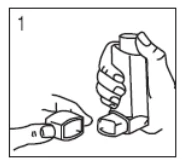
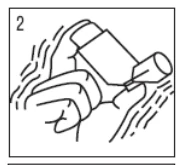
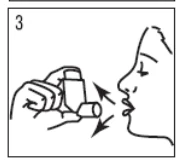
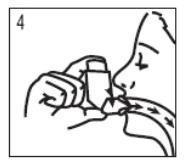
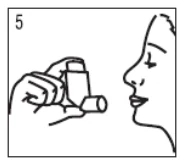
It is extremely important that you use your APO-SALBUTAMOL HFA properly. This will ensure it is delivered correctly so that you receive maximum benefit. Carefully follow the instructions shown.
|  |
|  |
|  |
|  |
|  |
| |
| |
Important: Do not rush steps 3, 4, and 5. It is important that you start to breathe in as slowly as possible just before operating your inhaler. Practice in front of a mirror for the first few times. If you see "mist" coming from the top of your inhaler or the sides of your mouth, you should start again from step 2.
Children - APO-SALBUTAMOL HFA should be used under the supervision of an adult who understands the proper use of the inhaler, and only as prescribed by the doctor. The adult must encourage the child (as described above) to exhale, and then trigger the spray immediately as inhalation begins. Use of a spacer with the inhaler is recommended for children under 5 years of age. Talk to your doctor if your child has difficulties using the inhaler.
How to clean APO-SALBUTAMOL HFA :
Your inhaler should be cleaned at least once per week.
- 1. Pull the metal canister out of the plastic casing of the inhaler and remove the mouthpiece cover.
- 2. Rinse the plastic casing of the inhaler thoroughly under warm running water and then wash the plastic casing again through the mouthpiece. Do not put the metal canister into water.
- 3. Dry the plastic casing of the inhaler THOROUGHLY inside and out.
- 4. Replace the canister and mouthpiece cover.
- 5. After cleansing, release one puff into the air to make sure that the inhaler works.
Overdose:
| In case of drug overdose, contact a health care practitioner, hospital emergency department or regional Poison Control Centre immediately, even if there are no symptoms. Take this leaflet or your medication with you so that the hospital or poison control centre will know what you have taken. |
If you accidentally take a larger dose than prescribed, you are more likely to get side effects like a faster heart beat, headaches and feeling shaky or restless. These effects usually wear off within a few hours, but you should tell your doctor as soon as possible.
Missed Dose:
If you forget to inhale a dose, do not worry, just inhale the next dose when it is due or if you become wheezy.
SIDE EFFECTS AND WHAT TO DO ABOUT THEM
Side effects may include:
Effects on heart
- Hypertension
Effects on nervous system
- Headache
- Feeling a little shaky
- Feeling anxious or irritable
- Feeling tired or weak
- Trouble sleeping (insomnia)
- Hyperactivity in children
- Dizziness, vertigo
- Drowsiness
Effects on muscles and joints
- Muscle cramps
- Muscle pain
Other Effects
- Cough
- Respiratory infections and/or inflammation
- Diarrhea
- Nausea and vomiting
- Chest pain or discomfort
- Flushing
- Difficulty urinating
- Unusual taste in your mouth
- Dry or irritated throat
| SERIOUS SIDE EFFECTS, HOW OFTEN THEY HAPPEN AND WHAT TO DO ABOUT THEM | ||||
| Symptom/effect | Talk with your doctor or pharmacist | Stop taking drug and call your doctor or pharmaci st | ||
| Only if severe | In all cases | |||
| Common | Faster heart beat than usual | ✓ | ||
| Uncommon | Irregular heart beat (palpitations) | ✓ | ||
| Rare | Low Blood Potassium (hypokalemia ): muscle weakness and muscle spasms | ✓ | ||
| Hallucination s in Children: see or hear things that are not there | ✓ | |||
| Very Rare | Bronchospas m: Sudden worsening of shortness of breath and wheezing shortly after using APO-SALBUTAM OL HFA | ✓ | ||
| Allergic Reactions: sudden wheeziness and chest pain or tightness; or swelling of eyelids, face, lips, tongue or throat. | ✓ | |||
| Irregular Heart Beat (atrial fibrillation, supraventricul ar tachycardia, extrasystoles) | ✓ |
This is not a complete list of side effects. If you have any unexpected effects after receiving APO-SALBUTAMOL HFA, contact your doctor or pharmacist.
HOW TO STORE IT
Keep out of sight and reach of children.
After use, replace the mouthpiece cover firmly and snap it into position. Do not use excessive force.
Store at a temperature between 15°C and 25°C. Do not keep any left over medicine unless your doctor tells you to.
Warning: The canister contents are under pressure. The canister may explode if heated. Do not place in hot water or near radiators, stoves or other sources of heat. Even when empty, do not puncture or incinerate canister.
Reporting Side Effects
You can report any suspected side effects associated with the use of health products to Health Canada by: Visiting the Web page on Adverse Reaction Reporting (https://www.canada.ca/en/health-canada/services/drugs-health-products/medeffect-canada/adverse-reaction-reporting.html) for information on how to report online, by mail or by fax; or calling toll-free at 1-866-234-2345
NOTE: Contact your health professional if you need information about how to manage your side effects. The Canada Vigilance Program does not provide medical advice.
MORE INFORMATION
You may need to read this leaflet again. PLEASE DO NOT THROW IT AWAY until you have finished your medicine.
If you want more information about APO-SALBUTAMOL HFA:
- Talk to your healthcare professional
- Find the full product monograph that is prepared for healthcare professionals and includes this Consumer Information by visiting the Health Canada website (https://health-products.canada.ca/dpd-bdpp/index-eng.jsp). Find the Consumer Information on the manufacturer’s website (http://www.apotex.ca/products), or by calling 1-800-667- 4708.