


Product Monograph - Arepanrix H5N1
RECENT MAJOR LABEL CHANGES
| 4 DOSAGE AND ADMINISTRATION, 4.2 Recommended Dose and Dosage Adjustment | 12/2024 |
|---|
TABLE OF CONTENTS
Sections or subsections that are not applicable at the time of authorization are not listed.
RECENT MAJOR LABEL CHANGES .......................................................................................... 2
TABLE OF CONTENTS ............................................................................................................ 2
PART I: HEALTH PROFESSIONAL INFORMATION .................................................................... 4
1 INDICATIONS ............................................................................................................. 4
1.1 Pediatrics .................................................................................................................. 4
2 CONTRAINDICATIONS ................................................................................................ 4
4 DOSAGE AND ADMINISTRATION ................................................................................ 4
4.2 Recommended Dose and Dosage Adjustment ........................................................ 4
4.4 Administration ......................................................................................................... 5
5 OVERDOSAGE ............................................................................................................ 7
6 DOSAGE FORMS, STRENGTHS, COMPOSITION AND PACKAGING ................................ 7
7 WARNINGS AND PRECAUTIONS ................................................................................. 8
7.1 Special Populations .................................................................................................. 9
7.1.1 Pregnant Women ............................................................................................... 9
7.1.2 Breast-feeding .................................................................................................... 9
7.1.3 Pediatrics ............................................................................................................ 9
8 ADVERSE REACTIONS................................................................................................. 9
8.1 Adverse Reaction Overview ..................................................................................... 9
8.2 Clinical Trial Adverse Reactions ............................................................................. 10
8.2.1 Clinical Trial Adverse Reactions – Pediatrics.................................................... 12
8.5 Post-Market Adverse Reactions ............................................................................. 14
9 DRUG INTERACTIONS .............................................................................................. 15
9.4 Drug-Drug Interactions .......................................................................................... 15
9.7 Drug-Laboratory Test Interactions......................................................................... 15
10 CLINICAL PHARMACOLOGY ...................................................................................... 15
10.1 Mechanism of Action ....................................................................................... 15
10.2 Pharmacodynamics .......................................................................................... 16
11 STORAGE, STABILITY AND DISPOSAL ........................................................................ 16
12 SPECIAL HANDLING INSTRUCTIONS .......................................................................... 16
PART II: SCIENTIFIC INFORMATION ..................................................................................... 17
13 PHARMACEUTICAL INFORMATION .......................................................................... 17
14 CLINICAL TRIALS ...................................................................................................... 17
14.1 Trial Design and Study Demographics ............................................................. 17
14.2 Study Results .................................................................................................... 20
15 MICROBIOLOGY ...................................................................................................... 22
16 NON-CLINICAL TOXICOLOGY .................................................................................... 22
PATIENT MEDICATION INFORMATION ............................................................................... 23
PART I: HEALTH PROFESSIONAL INFORMATION
1 INDICATIONS
AREPANRIXTM H5N1 (AS03-Adjuvanted H5N1 Pandemic Influenza Vaccine) is indicated for active immunization of adults and children from 6 months of age against influenza caused by the H5N1 subtype virus contained in the vaccine. This indication is based on immunological data as the vaccine has not been evaluated in efficacy trials against influenza disease. See 14 CLINICAL TRIALS.
AREPANRIX™ H5N1 should be used according to official guidance.
1.1 Pediatrics
Pediatrics (6 months – 17 years): Based on the data submitted and reviewed by Health Canada, the safety and immunogenicity of AREPANRIXTM H5N1 in pediatric patients has been established. Therefore, Health Canada has authorized an indication for pediatric use. See 14.2 Study Results.
2 CONTRAINDICATIONS
AREPANRIXTM H5N1 is contraindicated in patients with a history of an anaphylactic reaction (i.e., life-threatening) to any of the constituents or trace residues of this vaccine, including egg protein. See 6 DOSAGE FORMS, STRENGTHS, COMPOSITION AND PACKAGING.
4 DOSAGE AND ADMINISTRATION
4.2 Recommended Dose and Dosage Adjustment
Adults (≥ 18 years of age):
Adults 18 years of age and above should receive two doses (each 0.5 mL) of AREPANRIX™ H5N1 containing the A/American wigeon/South Carolina (H5N1) strain, the first administered at an elected date, the second at least three weeks after the first dose for maximum efficacy.
Pediatrics (6 months to 17 years of age):
Children and adolescents aged 6 months to 17 years should receive two doses (each 0.25 mL) of AREPANRIX™ H5N1 containing the A/American wigeon/South Carolina (H5N1) strain, the first administered at an elected date, the second at least three weeks after the first dose.
Pediatrics (less than 6 months of age):
Use of the vaccine is not recommended in this age group.
4.4 Administration
For intramuscular use only. Do not inject intravascularly.
The preferred site for injection is the anterolateral aspect of the thigh in infants or the deltoid muscle of the upper arm in children and adults. The vaccine should not be injected in the gluteal area or areas where there may be a major nerve trunk and/or blood vessel.
Instructions for use:
AREPANRIX™ H5N1 should not be mixed with other vaccines/medicinal products (see 9.4 Drug-Drug Interactions, Use with Other Vaccines).
AREPANRIX™ H5N1 consists of two containers: one multidose vial containing the antigen (suspension) and a second multidose vial containing the adjuvant system (emulsion). The antigen suspension is a translucent to whitish opalescent suspension that may sediment slightly. The emulsion is a whitish to yellowish homogeneous milky liquid.
Prior to administration, the two components should be mixed.
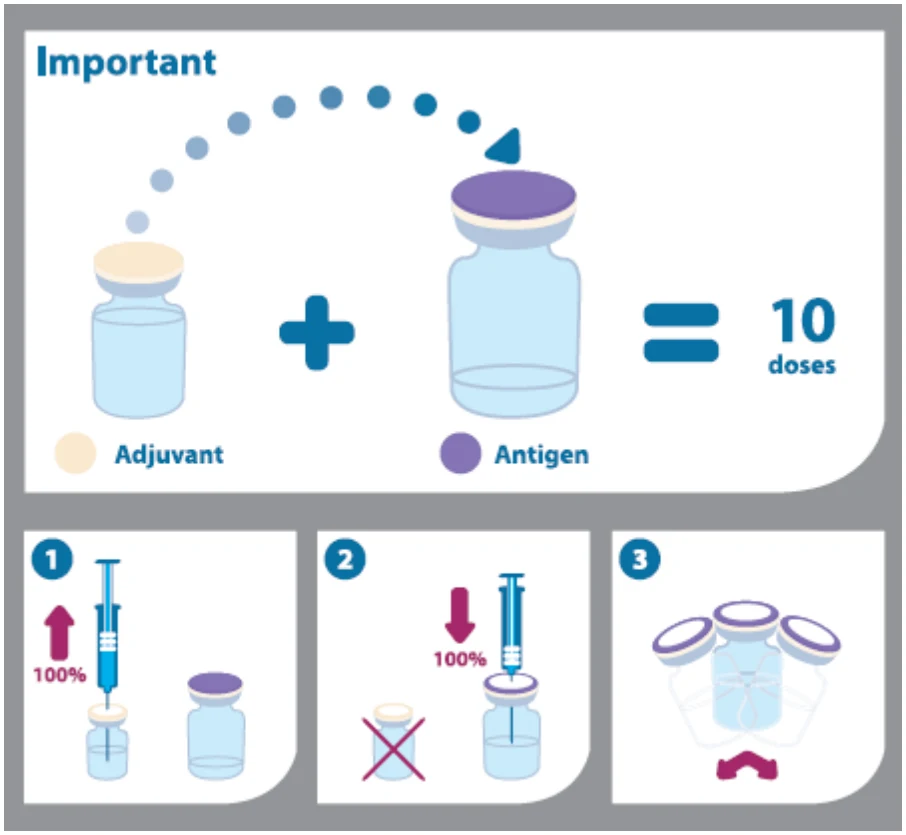
Instructions for mixing and administration of the vaccine:
- 1. Before mixing the two components, the emulsion (adjuvant) and suspension (antigen) should be allowed to reach room temperature (allow a minimum of 15 minutes). Whitish sediments may be observed in the suspension vial; these sediments are part of the normal physical appearance of the suspension. The emulsion presents as a whitish to yellowish homogeneous milky liquid appearance.
- 2. Each vial should be mixed by inversion and inspected visually for any foreign particulate matter (other than the white sediments described above) and/or abnormal physical appearance. In the event of either being observed (including rubber particles from the stopper), do not mix the vaccine and do not administer.
- 3. The vaccine is mixed by withdrawing the entire contents of the vial containing the adjuvant by means of a 5 mL syringe and by adding it to the vial containing the antigen. It is recommended to equip the syringe with a 23-G needle. However, in the case this needle size would not be available, a 21-G needle might be used. The vial containing the adjuvant should be maintained in upside down position to facilitate the withdrawal of the full content.
- 4. After the addition of the adjuvant to the antigen, the vaccine should be mixed thoroughly by inversion. The mixed vaccine is a whitish to yellowish homogeneous milky liquid emulsion. In the event of other variation being observed, do not administer.
- 5. The volume of AREPANRIX™ H5N1 vial after mixing is at least 5 mL. The vaccine should be administered in accordance with the recommended posology. See 4 DOSAGE AND ADMINISTRATION.
- 6. The vial should be thoroughly mixed by inversion prior to each administration and inspected visually for any foreign particulate matter and/or abnormal physical appearance. In the event of either being observed (including rubber particles from the stopper), do not administer.
- 7. Each vaccine dose of 0.5 mL (adults >18) or 0.25 mL (children 6 months – 17 years) is withdrawn into a 1 mL syringe for injection and administered intramuscularly. It is recommended to equip the syringe with a needle gauge not larger than 23-G.
- 8. After mixing, use the vaccine within 24 hours. The mixed vaccine can either be stored in a refrigerator (2°C - 8°C) or at room temperature (up to 30°C). If the mixed vaccine is stored in a refrigerator, it should be allowed to reach room temperature (allow a minimum of 15 minutes) before each withdrawal.
Any unused product or waste material should be disposed of in accordance with local requirements.
5 OVERDOSAGE
Insufficient data are available.
For management of a suspected drug overdose, contact your regional poison control centre.
6 DOSAGE FORMS, STRENGTHS, COMPOSITION AND PACKAGING
To help ensure the traceability of vaccines for patient immunization record-keeping as well as safety monitoring, health professionals should record the time and date of administration, quantity of administered dose (if applicable), anatomical site and route of administration, brand name and generic name of the vaccine, the product lot number and expiry date.
Table 1: Dosage Forms, Strengths and Composition
Description
AREPANRIX™ H5N1 influenza vaccine is a two-component vaccine consisting of an H5N1 immunizing antigen (as a suspension), and an AS03 adjuvant system (as an oil-in-water emulsion).
The H5N1 antigen is a sterile, translucent to whitish opalescent suspension that may sediment slightly in a 10 mL vial. The antigen is prepared from virus grown in the allantoic cavity of embryonated hen’s eggs. The virus is inactivated with ultraviolet light treatment followed by formaldehyde treatment, purified by centrifugation and disrupted with sodium deoxycholate.
The AS03 adjuvant system is a sterile, homogenized, whitish to yellowish homogeneous milky emulsion composed of DL-α-tocopherol, squalene and polysorbate 80 in a 3 mL vial.
| Route of Administration | Dosage Form / Strength / Composition | Non-medicinal Ingredients |
| Intramuscular injection | Suspension and emulsion for emulsion for injection. Each 0.5 mL vaccine dose contains 3.75 micrograms of A/American wigeon/ South Carolina/22-000345-001/2021 (H5N1) and is adjuvanted with AS03 composed of squalene, DL-α-tocopherol and polysorbate 80 | Disodium hydrogen phosphate, Potassium chloride, Potassium dihydrogen phosphate, Sodium chloride, Thimerosal and Water for injection Trace amounts of egg proteins including ovalbumin (≤ 0.083 μg per dose), formaldehyde, sodium deoxycholate and sucrose. |
Immediately prior to use, the full contents of the AS03 vial is withdrawn and added to the antigen vial (mix ratio 1:1). The mixed final product for administration is an emulsion, containing enough product for 10 doses.
Dosage Forms
AREPANRIX™ H5N1 is a two-component vaccine containing a suspension and an emulsion that are mixed to prepare an emulsion for injection.
Composition
After combining and mixing the 2 components, each 0.5 mL vaccine dose contains 3.75 micrograms1 of A/American wigeon/South Carolina/22-000345-001/2021 (H5N1)2 and is adjuvanted with AS03.
1haemagglutinin,
2propagated in eggs
The GlaxoSmithKline proprietary AS03 adjuvant system is composed of squalene (10.69 milligrams per 0.5 mL dose), DL-α-tocopherol (11.86 milligrams per 0.5 mL dose) and polysorbate 80 (4.86 milligrams per 0.5 mL dose)
Preservative content is 5 micrograms thimerosal USP per 0.5 mL dose or 2.5 micrograms organic mercury (Hg) per 0.5 mL dose.
Packaging
2.5 mL of the antigen suspension is contained in a 10 mL vial (type I glass) for 10 doses with a stopper (butyl rubber without latex). Pack size of 10.
2.5 mL of the adjuvant emulsion is contained in a 3 mL vial (type I glass) for 10 doses with a stopper (butyl rubber without latex). Pack size of 10.
7 WARNINGS AND PRECAUTIONS
General
Caution is needed when administering this vaccine to persons with a known hypersensitivity (other than anaphylactic reaction) to the active substance, to any of the excipients and to residues.
As with all injectable vaccines, appropriate medical treatment and supervision should always be readily available in case of an anaphylactic event following the administration of the vaccine.
Immunization shall be postponed in patients with severe febrile illness or acute infection, unless the benefits outweigh the potential risks of administering the vaccine to those patients.
AREPANRIX™ H5N1 should under no circumstances be administered intravascularly or intradermally.
Syncope (fainting) can occur following, or even before, any vaccination as a psychogenic response to the needle injection. It is important that procedures are in place to avoid injury from faints.
There are no data on co-administration of AREPANRIX™ H5N1 with other vaccines. Therefore, co-administration is not recommended. However, if administration of AREPANRIX™ H5N1 with another vaccine is deemed necessary following benefit/risk assessment, immunization should be carried out on separate limbs. In such case, it should be noted that the adverse reactions may be intensified.
Immune
Antibody response in patients with endogenous or iatrogenic immunosuppression may be insufficient.
A protective immune response may not be elicited in all vaccinees.
Neurologic
If Guillain-Barré syndrome has occurred within 6 weeks of receipt of prior influenza vaccine, the decision to give AREPANRIX™ H5N1 should be based on the careful consideration of the potential benefits and risks.
Immunization should be delayed in a patient with an active neurologic disorder, but should be considered when the disease process has been stabilized.
7.1 Special Populations
7.1.1 Pregnant Women
No data have been generated in pregnant women with AREPANRIX™ H5N1 and with the AS03 adjuvant system contained in the vaccine. Data from vaccinations with seasonal trivalent influenza vaccines in pregnant women do not indicate that adverse fetal and maternal outcomes were attributable to the vaccine.
Healthcare providers need to assess the benefits and potential risks of administering the vaccine to pregnant women.
7.1.2 Breast-feeding
No data have been generated in breast-feeding women.
7.1.3 Pediatrics
The use of AREPANRIX™ H5N1 in infants under 6 months of age is not recommended.
8 ADVERSE REACTIONS
8.1 Adverse Reaction Overview
Symptoms reported after vaccination with AREPANRIX™ H5N1 were predominantly local and general reactogenicity and mostly mild to moderate. Symptoms resolved mostly within a few days. The most frequently reported reactogenic symptoms from the Phase III Q-PAN-H5N1-002 clinical study were: pain (83.2%), redness (8.5%) and swelling (10.4%) at the injection site, muscle aches (45.2%), headache (34.9%), fatigue (34.0%), joint pain (25.3%), fever (4.6%), shivering (16.7%), sweating (10.7%), feeling sick (nausea) (2.8%) and diarrhea (2.6%). In children 6 months to <6 years of age, the following additional side effects have been frequently observed: irritability (43.5%), drowsiness (34.4%) and loss of appetite (26.9%).
8.2 Clinical Trial Adverse Reactions
Clinical trials are conducted under very specific conditions. The adverse reaction rates observed in the clinical trials; therefore, may not reflect the rates observed in practice and should not be compared to the rates in the clinical trials of another drug. Adverse reaction information from clinical trials may be useful in identifying and approximating rates of adverse drug reactions in real-world use.
In a randomized, placebo-controlled, observer-blind, multi-centre study, conducted in the US and Canada, subjects 18 years of age and older were vaccinated with Influenza Virus Vaccine containing A/Indonesia/5/2005 (AREPANRIX™ H5N1; N = 3,422) or placebo (N = 1,139) as a 2-dose vaccination series (Total Vaccinated Cohort) with 3.75 µg HA/AS03. The reactogenicity of vaccination was solicited by collecting adverse events using standardized forms for 7 consecutive days following vaccination with AREPANRIX™ H5N1 or placebo (i.e., Day 0 to Day 6). The reported frequencies of solicited local and general adverse reactions after each dose are presented below:
Table 2: Percentage of Subjects Reporting Solicited Local or General Adverse Reactions Within 7 Days Following Each Vaccination (Total Vaccinated Cohorta) – Study Q-PAN-H5N1-002
| Adverse Reaction | AREPANRIX™ H5N1 | Placebo | ||
|---|---|---|---|---|
| Post dose 1 | Post dose 2 | Post dose 1 | Post dose 2 | |
| Local | N= 3372 subjects (%) | N=3275 subjects (%) | N= 1118 subjects (%) | N= 1091 subjects (%) |
| Pain | 76.2 | 69.8 | 13.9 | 10.2 |
| Swelling | 7.1 | 6.4 | 0.4 | 0.3 |
| Redness | 5.3 | 5.0 | 0.4 | 0.4 |
| General | N= 3367 subjects (%) | N= 3272 subjects (%) | N= 1118 subjects (%) | N= 1092 subjects (%) |
| Muscle Aches | 32.8 | 30.0 | 12.2 | 8.2 |
| Headache | 22.2 | 19.6 | 17.1 | 11.2 |
| Fatigue | 21.4 | 21.4 | 15.1 | 9.1 |
| Joint Pain | 14.8 | 15.7 | 7.0 | 4.9 |
| Shivering | 7.4 | 10.7 | 5.5 | 3.7 |
| Sweating | 5.4 | 6.0 | 3.8 | 2.8 |
| Fever ≥38.0ºC | 1.2 | 2.7 | 1.2 | 0.9 |
a Total Vaccinated Cohort = all subjects who received at least one dose of vaccine and for whom any safety data were available.
Pain at the injection site was the most commonly reported solicited local symptom in both AREPANRIX™ H5N1 and placebo groups and was reported at a 6-fold higher frequency (i.e. following 73% of doses) in the AREPANRIX™ H5N1 group. Despite the high incidence of injection site pain, the incidence of severe pain was low, with reports occurring after 2.7% of AREPANRIX™ H5N1 doses and 0.4% of placebo doses. Overall, severe solicited or unsolicited adverse events of any type occurred in the 7 days after 6.4 % of AREPANRIX™ H5N1 doses and 3.6% of placebo doses. The most common severe solicited adverse event was local injection site pain; severe general solicited adverse events occurred after <2% of doses.
The incidence of unsolicited adverse reactions has been evaluated from clinical studies in approximately 3,800 subjects aged 18 years and older who received a 0.5 mL dose of AREPANRIX™ H5N1 containing A/Indonesia/5/2005 (H5N1) strain.
Unsolicited adverse reactions reported are listed per dose according to the following frequencies:
Very common (≥1/10)
Common (≥1/100 to <1/10)
Uncommon (≥1/1,000 to <1/100)
Rare (≥1/10,000 to <1/1,000)
Very rare (<1/10,000)
The following adverse reactions have been reported in adults:
Table 3: Adverse Reactions Reported in Adults
| System Organ Class |
|---|
Adverse Reactions
| Frequency | |||
|---|---|---|---|
| Blood and lymphatic system disorders | Lymphadenopathy | Uncommon | |
| Psychiatric disorders | Insomnia | Uncommon | |
| Nervous System Disorders | Dizziness, paresthesia | Uncommon | |
| Ear and labyrinth disorders | Vertigo | Uncommon | |
| Respiratory, thoracic and mediastinal disorders | Dyspnoea | Uncommon | |
| Gastrointestinal disorders | Nausea, diarrhoea | Common | |
| Abdominal pain, vomiting, dyspepsia, stomach discomfort | Uncommon | ||
| Skin and subcutaneous tissue disorders | Pruritus, rash | Uncommon | |
| Musculoskeletal and connective tissue disorders | Back pain, musculoskeletal stiffness, neck pain, muscle spasms, pain in extremity | Uncommon | |
| General disorders and administration site conditions | Injection site reactions (such as bruising, induration, pruritus, warmth), asthenia, chest pain, malaise | Uncommon | |
During the entire Q-PAN-002 study, one subject who received AREPANRIX™ H5N1 developed facial palsy which was an adverse event considered not causally associated to the vaccine.
8.2.1 Clinical Trial Adverse Reactions – Pediatrics
In a randomized, placebo-controlled, observer-blind, multi-centre study, conducted in the United States, Canada and Thailand, 838 subjects aged 6 months through 17 years received Influenza Virus Vaccine containing A/Indonesia/5/2005 (AREPANRIX™ H5N1; N = 607) or placebo (N = 231) as a 2-dose vaccination series of 0.25 mL (half the adult dose).
The reactogenicity of vaccination was solicited by collecting adverse events using standardized forms for 7 consecutive days following vaccination with AREPANRIX™ H5N1 or placebo (i.e., Day 0 to Day 6). The reported frequencies of solicited local and general adverse reactions after each dose are presented below:
Table 4: Incidence of Solicited Local or General Adverse Reactions within 7 Days Following Each Vaccinationb in Children Aged 6 Months through 17 Years
| Adverse Reaction | AREPANRIX™ H5N1 | Placebo | ||
|---|---|---|---|---|
| Post Dose 1 | Post Dose 2 | Post Dose 1 | Post Dose 2 | |
| Aged 6 Months through 17 Years | ||||
| Local | n = 602 subjects (%) | n = 592 subjects (%) | n = 229 subjects (%) | n = 223 subjects (%) |
| Injection site pain | 58.1 | 51.0 | 23.6 | 19.3 |
| Injection site swelling | 5.0 | 3.9 | 0.0 | 0.4 |
| Injection site erythema | 4.2 | 1.4 | 0.0 | 0.0 |
| Aged 6 Months through 5 Years | ||||
| General | n = 293 subjects (%) | n = 287 subjects (%) | n = 122 subjects (%) | n = 118 subjects (%) |
| Irritability/ Fussiness | 30.0 | 28.9 | 26.2 | 19.5 |
| Drowsiness | 22.5 | 20.6 | 15.6 | 16.1 |
| Loss of appetite | 18.4 | 15.7 | 17.2 | 14.4 |
| Fever ≥38.0ºC | 10.6 | 11.5 | 10.7 | 7.6 |
| Aged 6 Years through 17 Years | ||||
| General | n = 306 subjects (%) | n = 305 subjects (%) | n = 107 subjects (%) | n = 104 subjects (%) |
| Myalgia | 30.7 | 23.9 | 10.3 | 10.6 |
| Headache | 24.5 | 18.4 | 10.3 | 11.5 |
| Fatigue | 21.6 | 17.0 | 8.4 | 13.5 |
| Joint pain | 11.8 | 8.5 | 2.8 | 6.7 |
| Gastrointestinala | 8.8 | 6.9 | 12.1 | 6.7 |
| Shivering | 3.9 | 5.2 | 2.8 | 4.8 |
| Sweating | 6.5 | 2.0 | 1.9 | 1.9 |
| Fever ≥38.0ºC | 3.6 | 3.3 | 0.9 | 1.9 |
a Nausea, vomiting, diarrhea, and/or abdominal pain.
b Total vaccinated cohort – Year 1
n = number of subjects with documented doses
8.5 Post-Market Adverse Reactions
No post-marketing surveillance data are available following administration of AREPANRIX™ H5N1. The safety experience with other pandemic influenza vaccines, as well as seasonal vaccines is provided below.
Other pandemic influenza vaccines
The safety experience with other pandemic influenza vaccines, AREPANRIX™ H1N1 influenza vaccine (A/California/7/2009 H1N1, manufactured in Quebec, Canada) and Pandemrix™ (H1N1) influenza vaccine (A/California/7/2009 H1N1, manufactured in Dresden, Germany), may be relevant to AREPANRIX™ H5N1 because these vaccines are AS03-adjuvanted. These vaccines were widely used during the 2009 Influenza A (H1N1) pandemic.
During post approval use of these influenza vaccines containing AS03 adjuvant, the following adverse events were identified. Because these events are reported voluntarily from a population of uncertain size, it is not always possible to reliably estimate their incidence or to establish a causal relationship to the vaccine. Adverse events described here are included because: a) they represent reactions which are known to occur following immunizations generally or influenza immunizations specifically; b) they are potentially serious; or c) the frequency of reporting.
Immune system disorders
Anaphylaxis, allergic reactions
Nervous system disorders
Febrile convulsions, Guillain Barré syndrome, somnolence, paresthesia
Skin and subcutaneous tissue disorders
Angioedema, generalized skin reactions, urticaria
General Disorders and Administration Site Conditions
Injection site reactions (such as inflammation, mass, necrosis, ulcer)
Epidemiological studies in several countries have reported an association between another pandemic influenza vaccine (PandemrixTM H1N1 manufactured in Dresden, Germany) and narcolepsy with or without cataplexy. These studies have described an absolute risk increase of narcolepsy of approximately 1.4 to 8 additional cases per 100,000 vaccinated children/adolescents and approximately 1 additional case per 100,000 vaccinated adults compared to background rates of 0.12 to 0.79 per 100,000 children/adolescents per year and 0.67 to 1.10 per 100,000 adults per year. However, there are several limitations with the retrospective observational studies that need to be considered when interpreting the results. Further research is needed to investigate the observed association between PandemrixTM and narcolepsy.
Seasonal vaccines
The following post-market adverse drug reactions have been reported with seasonal trivalent vaccines without AS03 adjuvant:
Blood and lymphatic system disorders
Transient thrombocytopenia.
Immune system disorders
Allergic reactions, including anaphylactic and anaphylactoid reactions, in rare cases leading to shock.
Nervous system disorders
Neuralgia, convulsions.
Neurological disorders, such as encephalomyelitis, neuritis and Guillain Barré syndrome.
Vascular disorders
Vasculitis with transient renal involvement.
Skin and subcutaneous tissue disorders
Angioedema, generalized skin reactions including urticarial.
9 DRUG INTERACTIONS
9.4 Drug-Drug Interactions
Use with Other Vaccines
There are no data on co-administration of AREPANRIX™ H5N1 with other vaccines. Therefore, co-administration is not recommended. However, if administration of AREPANRIX™ H5N1 with another vaccine is deemed necessary following benefit/risk assessment, immunization should be carried out on separate limbs. In such case, it should be noted that the adverse reactions may be intensified.
The immunological response may be diminished if the patient is undergoing immunosuppressant treatment.
9.7 Drug-Laboratory Test Interactions
False positive ELISA serologic tests for HIV-1, Hepatitis C, and especially HTLV-1 may occur following influenza vaccination. These transient false-positive results may be due to cross-reactive IgM elicited by the vaccine. For this reason, a definitive diagnosis of HIV-1, Hepatitis C, or HTLV-1 infection requires a positive result from a virus-specific confirmatory test (e.g. Western Blot or immunoblot).
10 CLINICAL PHARMACOLOGY
10.1 Mechanism of Action
The mechanism of action of type A (H5N1) influenza virus vaccines are based on their ability to induce antibodies against viral haemagglutinin (HA), a key viral protein for cell entry, thereby blocking viral attachment to human respiratory epithelial cells. Specific levels of haemagglutination-inhibition (HI) antibody titer post-vaccination with inactivated influenza virus vaccines, including H5N1 influenza virus vaccines, have not been correlated directly with protection from influenza illness but the antibody titers have been used as a measure of vaccine activity. In some human challenge studies with other influenza viruses, HI antibody titers of ≥1:40 have been associated with protection from influenza illness in up to 50% of subjects.
10.2 Pharmacodynamics
Information from non-clinical studies
The ability to induce protection against a homologous vaccine strain was assessed non-clinically with A/Indonesia/05/05 (H5N1) using a ferret challenge model.
Challenge with a homologous H5N1 strain (A/Indonesia/5/2005) In the homologous protection experiment, naïve ferrets (six ferrets/group) were immunized intramuscularly with vaccine candidate containing three different doses of H5N1 antigen derived from A/Indonesia/5/2005 (H5N1) (7.5, 3.8 and 1.9 µg of HA antigen) adjuvanted with the standard full dose (AS03A) or half dose (AS03B) of AS03. Control groups included ferrets immunized with adjuvant alone and non-adjuvanted vaccine (7.5 micrograms HA). Ferrets were vaccinated on days 0 and 21 and then challenged by the intratracheal route on day 49 with homologous wild-type A/Indonesia/5/2005 virus. Only 50% of ferrets immunized with the non-adjuvanted influenza vaccine were protected from death, and showed slightly lower lung viral loads and degree of viral shedding in the upper respiratory track as those exhibited by ferrets immunized with adjuvant alone. Conversely the combination of a range of doses of H5N1 antigen with AS03 adjuvant was able to protect against mortality (100% protection) and to reduce lung virus loads and viral shedding after intratracheal challenge with a homologous H5N1 virus.
11 STORAGE, STABILITY AND DISPOSAL
Store in a refrigerator (2°C – 8°C).
Do not freeze.
Store in the original package in order to protect from light.
The shelf-life is 3 years, based on the antigen component.
After mixing, the vaccine should be used within 24 hours. See 4.4 Administration.
Any unused product or waste material should be disposed of in accordance with local requirements.
12 SPECIAL HANDLING INSTRUCTIONS
There are no special handling instructions
PART II: SCIENTIFIC INFORMATION
13 PHARMACEUTICAL INFORMATION
Drug Substance
Proper name: AS03-Adjuvanted H5N1 Pandemic Influenza Vaccine
Physicochemical properties: Emulsion for injection
The H5N1 influenza virus HA antigen is prepared from virus propagated in the allantoic cavity of embryonated hen’s eggs. The virus is inactivated with ultraviolet light treatment followed by formaldehyde treatment, purified by centrifugation, and disrupted with sodium deoxycholate. The antigen is suspended in a phosphate buffer solution. The virus antigen drug substance contains 15μg HA/mL A/American wigeon/South Carolina/22-000345-001/2021 (H5N1) antigen, thimerosal (a mercury derivative) 20μg/mL as preservative and phosphate buffered saline composed of sodium chloride, potassium chloride, disodium hydrogen phosphate, potassium dihydrogen phosphate and water for injection. The drug substance contains trace residual amounts of egg proteins, formaldehyde, sodium deoxycholate and sucrose.
The AS03 adjuvant system is prepared separately and is a whitish to yellowish homogenous milky liquid emulsion. The oil phase contains two biodegradable oils, squalene and DL-α-tocopherol. The aqueous phase contains phosphate buffered saline and polysorbate 80.
Product Characteristics:
14 CLINICAL TRIALS
14.1 Trial Design and Study Demographics
Five studies conducted with AREPANRIX™ H5N1 vaccine (Q-Pan-H5N1-001, Q-Pan-H5N1-002, Q-Pan-H5N1-005, Q-Pan-H5N1-009 and Q-Pan-H5N1-0021) are presented. An overview of the studies is given in the table below.
Table 5: Summary of Patient Demographics for Clinical Trials in Specific Indication
| Study # | Study Design | Dosage, Route of Administration and Duration | Study Subjects (n) | Mean Age (Range) | Sex |
| Study # | Study Design | Dosage, Route of Administration and Duration | Study Subjects (n) | Mean Age (Range) | Sex |
| Q-Pan-H5N1-001 | Ph I/II, Observer blind, randomized, active-controlled. D- & Q-Equivalence | A/Indo Q-Pan H5N1 - 3.75 µg HA (No adjuvant)
A/Indo D-Pan H5N1 - 3.75 µg HA + AS03A
Contingency arms: A/Indo Q-Pan H5N1 - 1.9 µg HA + AS03A
2 doses (Days 0, 21) – IM injection | Q: 481 D: 299 | 38.6 yrs (18-64) (core group) 39.5% (18-64) Cont. arms | F: 57.8% M: 42.2% (core group) F: 56.0% M: 44.0% Cont. arms |
| Q-Pan-H5N1-002 | Ph III, Observer blind, randomized, placebo controlled. Clinical consistency | A/Indo Q-Pan H5N1 - 3.75 μg HA (3 lots) + AS03A (3 lots) Placebo (control) 2 doses (Days 0, 21) – IM injection | Q: 3422 Pl: 1139 | 38.6 yrs (18-64) 71.9 yrs (65-91) | F: 57.0% M: 43.0% F: 54.9 M: 45.1 |
| Q-Pan-H5N1-009 | Ph II, Open, randomized. Dosing interval study | A/Indo Q-Pan H5N1 - 3.75 μg HA + AS03A 2 doses (Days 0.21; Days 0, 14; Days 0, 7 or Days 0, 0) – IM injection | 312 | 40.3 yrs (18-65) | F: 53.2% M: 46.8% |
| Q-Pan-H5N1-005 | Ph II, Observer-blind, randomized Heterologous prime-boost | Priming (one dose): A/Indo Q-Pan H5N1
Booster (one dose): A/Turkey Q-Pan H5N1
Placebo (one dose) 2 doses of active vaccine and 1 dose of placebo (Day 0, Months 6 and 18) – IM injection | 841 | 50.0 yrs (18-87) | F: 60.0% M: 40.0% |
| Q PAN H5N1-021 | Phase II/III, randomized, controlled, observer-blind | Q-Pan H5N1 vaccine (1.9 μg HA, A/Indonesia strain+ AS03B ) Placebo (phosphate buffered saline) 2-doses (Day 0, 21) – IM injection | 607 231 | 85.7 mths (6-215) 82.8 mths (6-215) | F: 47.0% M: 53.0% F: 50.2% M: 49.8% |
D- and Q-, represent Dresden, Germany and Quebec, Canada for the production sources of antigen, respectively. Pl. represents placebo subjects. HA: haemagglutinin. A/Vietnam, strain H5N1 A/Vietnam/1194/2004. A/Indo, strain H5N1 A/Indonesia/05/2005. F and M represent female and male subjects, respectively. Cont. arms represent contingency arms within the clinical study. AS03A and AS03B represent 250 µL and 125 µL of AS03, respectively. IM represents intramuscular.
The demographic characteristics of subjects enrolled in Q-Pan adult studies are as follows: All subjects in adult Q-Pan studies were above 18 years of age. The majority of subjects (at least 85.0%) in studies Q-Pan-H5N1-001, -002, -005, and -009 were white Caucasians. The demographic profile for the different treatment groups and the age strata were comparable with respect to gender and racial distribution.
For study Q-Pan-H5N1-021, in the overall population, the mean age was 7 years (range: 6 months through 17 years); 52% were male; and the racial distribution was 45% white, 15% black, 35% Asian, and 5% other racial/ethnic groups.
14.2 Study Results
Both homologous humoral immune responses (against the H5N1 strain contained in the vaccine) and cross-reactive humoral responses (against H5N1 strains not contained in the vaccine) following two doses of vaccine given 21 days apart are described. Persistence of immune response at 6 months after vaccination is also presented. In addition, limited data obtained using an alternative schedule (2 doses given 14 days apart), the immune response following boosting with a heterologous strain, are also described.
Humoral immune responses to the vaccine strain were measured through haemagglutination inhibition and by virus neutralization assays. The described humoral immune responses to a variant strain was measured through haemagglutination inhibition.
The haemagglutination inhibition responses are presented as the seroprotection rate (defined as the proportion of subjects with an antibody titre ≥ 1:40), the seroconversion rate (defined as the proportion of subjects who were either seronegative prior to vaccination and have a protective post-vaccination titre of ≥ 1:40 or who were seropositive prior to vaccination and have at least a 4-fold increase in titre post-vaccination) and the geometric mean fold rise (defined as the ratio of the post-vaccination geometric mean titre divided by the pre-vaccination geometric mean titre). The CHMP (CHMP̸ BWP̸ 214̸ 96) criteria applicable to these parameters are defined as follows:
- Seroprotection rate: >70% for subjects aged 18-60 years and >60% for subjects above 60 years
- Seroconversion rate: >40% for subjects aged 18-60 years and >30% for subjects above 60 years
- Geometric mean fold rise: >2.5 for subjects aged 18-60 years and >2.0 for subjects above 60 years.
Although CHMP criteria (based on point estimates) are not specifically defined for pediatrics, the same criteria as for adults 18-60 years have been used. Note that the CBER criteria (CBER, 2007) for acceptable immunogenicity for adults aged 18-60 years (which uses similar target values but based on meeting the lower 95% CI rather than point estimate), have been explicitly deemed relevant for children.
The virus neutralization responses are presented as the vaccine response rate (VRR), defined as the percentage of subjects having at least a 4-fold increase in serum neutralizing antibody titer (between the pre- and post-priming or pre- and post-booster vaccination time points).
Adults 18-60 and >60 years of age
Immune response against the vaccine strain The immunogenicity of AREPANRIX™ H5N1 containing the A/Indonesia/5/2005 (H5N1) strain was evaluated in a clinical study (Q-Pan-H5N1-002) in which subjects 18-60 years of age (N=1,488) and >60 years of age (N=479) received two doses of vaccine 21 days apart. The haemagglutination-inhibition antibody response twenty-one days after the second dose and the persistence at 6 months following the first vaccination is presented in the following table:
Table 6: Haemagglutination-Inhibition Response Against the Vaccine Strain A/Indonesia/5/2005
| Parameter | Against A/Indonesia/5/2005 | |||
|---|---|---|---|---|
| 21 days after 2nd dose | 6 months after 1st dose | |||
| 18-60 years | >60 years | 18-60 years | >60 years | |
| Number of Subjects | 1488 | 479 | 353 | 104 |
Seroprotection Rate % (95% CI) | 91.0 (89.4, 92,4) | 76.8 (72.8, 80.5) | 62.2 (56.8, 67.1) | 63.5 (53.4, 72.7) |
Seroconversion Rate % (95% CI) | 91.0 (89.4, 92.4) | 76.4 (72.3, 80.1) | 62.2 (56.8, 67.1) | 62.5 (52.5, 71.8) |
| Geometric Mean Fold Rise Value (95% CI) | 51.4 (47.8, 55.3) | 17.2 (14.9, 19.9) | 7.4 (6.3, 8.7) | 7.8 (5.9, 10.4) |
According to Protocol Cohort
CI = Confidence interval
Twenty-one days after the second dose, the vaccine response rates (virus neutralization response) were 94.4% for subjects aged 18-60 years and 80.4% for subjects above 60 years.
In another clinical study (Q-Pan-H5N1-009), subjects 18-64 years of age received two doses of AREPANRIX™ H5N1 according to different schedules. Twenty-one days after the second dose, the seroprotection rate was 92.8% for subjects receiving two doses 14-days apart and 95.2% for subjects receiving two doses 21-days apart,
Cross-reactive immune response against a heterologous strain The cross-reactive immune response against a heterologous strain A/Vietnam/1194/2004 (H5N1) was evaluated in a clinical study (Q-Pan-H5N1-001), in which subjects 18-64 years of age (N=144) received two doses of vaccine 21 days apart. Twenty-one days after the second dose, the seroprotection rate, seroconversion rate and geometric mean fold rise against A/Vietnam/1194/2004 (H5N1) were 63.9%, 61.8% and 7.6, respectively.
Immune response after heterologous boosting In study Q-Pan-H5N1-005, subjects 18 years of age and above received a booster dose of vaccine containing A/turkey/Turkey/1/2005 18 months after a single dose of AREPANRIX™ H5N1 or 6 months after a placebo dose. Ten days following the booster dose, the seroprotection rate, seroconversion rate and geometric mean fold rise against A/turkey/Turkey/1/2005 were 95.2%, 85.5% and 32.0, respectively in the group who received a priming dose of AREPANRIX™ H5N1 and were 64.6%, 44.4% and 4.0, respectively in the unprimed group.
Children (6 months to 17 years of age)
The immunogenicity of AREPANRIX™ H5N1 containing the A/Indonesia/5/2005 (H5N1) strain was evaluated in a clinical study (Q-Pan-H5N1-021) in which children 6 months to <18 years of age (N=607) received two doses (each 0.25 mL) of vaccine 21 days apart. The persistence of the immune response was also evaluated in approximately 50% of subjects at 6 months (182 days) and approximately 50% of subjects at 1 year (385 days) following the first dose of AREPANRIX™ H5N1.
The haemagglutination-inhibition response against the vaccine strain A/Indonesia/05/2005 twenty-one days after the second dose (Day 42) and the persistence at 6 months following the first vaccination is presented in the following table:
Table 7: Haemagglutination-Inhibition Response Against the Vaccine Strain A/Indonesia/05/2005
| Parameter | Against A/Indonesia/5/2005 | |||||
|---|---|---|---|---|---|---|
| 21 days after 2nd dose | 6 months after 1st dose | |||||
| 6 months - <36 months | 3 years - <9 years | 9 years - <18 years | 6 months - <36 months | 3 years - < 9 years | 9 years - <18 years | |
| Number of Subjects | 175 | 185 | 203 | 84 | 89 | 87 |
Seroprotection Rate % 1 (D42: 98.3% CI) (D182: 95% CI) | 100.0 (97.3, 100.0) | 99.5 (96.4, 100.0) | 99.0 (95.8, 99.9) | 95.2 (88.3, 98.7) | 84.3 (75.0, 91.1) | 72.4 (61.8, 81.5) |
Seroconversion Rate % (95% CI) | 100.0 (97.9, 100.0) | 99.5 (97.0, 100.0) | 99.0 (96.5, 99.9) | 95.2 (88.3, 98.7) | 84.3 (75.0, 91.1) | 70.1 (59.4;79.5) |
Geometric Mean Titer Value (95% CI) | 777.1 (705.6, 855.9) | 543.8 (484.9, 609.8) | 416.2 (371.5, 466.2) | 90.6 (78.1, 105.0) | 57.4 (50.8;64.9) | 50.2 (43.3;58.2) |
According to Protocol Cohort.
1The seroprotection rate at Day 42 (21 days after 2nd dose) was the primary endpoint, and 98.3% CIs are presented in order to account for multiple testing across the different age groups. All other analyses are descriptive and are not adjusted for multiple testing, and 95% CI are presented.
In addition to the results presented in Table 5, the persistence of the immune response continued to decline at Day 385 but remained above baseline with seroprotection rates of 85.7% for 6 months - <36 months, 55.3% for 3 years - <9 years and 28.4% for 9 years - <18 years.
Neutralizing antibody responses against homologous strain A/Indonesia/05/2005 and against the drift-variant virus A/Vietnam/1194/2004 strain, were also evaluated in approximately 40 subjects twenty-one days after the second dose in study Q-Pan H5N1-021. The homologous vaccine response rate was greater than 97.5% in all subjects. For the drift-variant virus, A/Vietnam/1194/2004 strain, the vaccine response rates were 40.0%, 72.2% and 88.2% in children aged 9-<18 years 3-<9 years and 6-<36 months, respectively.
15 MICROBIOLOGY
No microbiological information is required for this drug product.
16 NON-CLINICAL TOXICOLOGY
General Toxicology: Non-clinical data reveal no special hazard for humans based on conventional studies of safety pharmacology, acute and repeated dose toxicity, local tolerance, fertility, embryo-foetal and postnatal toxicity (up to the end of the lactation period).