


Patient Medication Information: uses, side effects, how to take - Beclomethasone Nasal Spray
What is BECLOMETHASONE NASAL SPRAY used for?
BECLOMETHASONE NASAL SPRAY is used to treat:
- perennial (year-round) allergic rhinitis (e.g., allergies to dust mites, animals, and mold).
- seasonal allergic rhinitis, also known as “hay fever” (e.g., outdoor allergies to grass, trees, and ragweed pollen).
- nasal polyps and to prevent new nasal polyps after surgery (nasal polypectomy).
How does BECLOMETHASONE NASAL SPRAY work?
BECLOMETHASONE NASAL SPRAY is a corticosteroid. It works within your nose and nasal passages to reduce inflammation. This may help relieve symptoms of your allergic rhinitis (inflammation of lining of the nose), such as:
- a stuffy nose,
- a runny nose,
- itching, or
- sneezing.
What are the ingredients in BECLOMETHASONE NASAL SPRAY?
Medicinal ingredient: beclomethasone dipropionate
Non-medicinal ingredients: avicel (microcrystalline cellulose and carboxymethylcellulose sodium), benzalkonium chloride, dextrose, phenylethyl alcohol, polysorbate 80 and purified water.
BECLOMETHASONE NASAL SPRAY comes in the following dosage forms:
Suspension: 50 mcg / spray (actuation)
Each BECLOMETHASONE NASAL SPRAY device contains 200 sprays (actuations).
Do not use BECLOMETHASONE NASAL SPRAY if:
- you have or had tuberculosis of the respiratory tract.
you have an untreated infection such a:
- fungal infection,
- bacterial infection, or
- viral infection.
you are allergic to beclomethasone dipropionate or any of the other ingredients in
BECLOMETHASONE NASAL SPRAY (see list of Non-medicinal ingredients above).
your child is less than 6 years of age.
To help avoid side effects and ensure proper use, talk to your healthcare professional before you take BECLOMETHASONE NASAL SPRAY. Talk about any health conditions or problems you may have, including if you:
- have been on long-term corticosteroid therapy;
- had an allergic reaction to other corticosteroids;
- are taking or have previously taken other steroids either as an injection or by mouth;
- have asthma and are taking or have previously taken other steroids either as an injection or by mouth. Serious side effects can occur when you are switch from an oral or an injectable steroid to an inhaled one.
are pregnant or plan to become pregnant;
are breastfeeding or plan to breastfeed. It is not known if BECLOMETHASONE NASAL
SPRAY can be transferred through breast milk. Your doctor will decide whether you can use this medication if you are breast feeding or planning on breast feeding;
- have not had or been vaccinated for chickenpox or measles;
- have pre-existing or new infections;
- have thyroid problems;
- have liver problems;
- are taking acetylsalicylic acid.
Other warnings you should know about:
Growth in children: All cortisone-type medicines, especially when used for a long time, may possibly interfere with the usual growth pattern in growing children and adolescents. Your child’s growth must be monitored by your doctor while they are taking this medication.
Infections: You may be at risk of developing new infections or not know you have an infection while taking corticosteroids. This is important if you are taking any cortisone-type medicine as they can affect your immune system and make it difficult for you/your child to fight an infection. Tell your doctor right away if you notice any signs of an infection. Your doctor should also monitor you for the development of infections, including for a yeast infection (called Candida albicans) of the nose and pharynx.
Measles and chickenpox: You should avoid being exposed to people who have measles or chickenpox while taking BECLOMETHASONE NASAL SPRAY. If you are exposed, tell your doctor right away.
Slower healing of wounds: Nasal corticosteroids may delay the healing of wounds. If you are recovering from a recent surgery, trauma, or ulcers in your nose, you should not use BECLOMETHASONE NASAL SPRAY until the wound has healed.
Glaucoma and/or cataracts: BECLOMETHASONE NASAL SPRAY may cause glaucoma (increased pressure in the eye) and/or cataracts (clouding of the eye). Tell your doctor if you have a history of glaucoma, cataracts, or notice a change in your vision. Your doctor should also monitor you for these changes while you are taking this medication.
Laboratory tests: Your doctor may order certain tests or exams while you are taking BECLOMETHASONE NASAL SPRAY.
Tell your healthcare professional about all the medicines you take, including any drugs, vitamins, minerals, natural supplements or alternative medicines.
The following may interact with BECLOMETHASONE NASAL SPRAY:
- other medicines that suppress the immune system (e.g., corticosteroids and prednisone),
- ketoconazole and itraconazole (used to treat fungal infection),
- ritonavir (used to treat HIV infections or AIDS), and
- acetylsalicylic acid (used for pain and fever relief).
How to use BECLOMETHASONE NASAL SPRAY:
- Only use BECLOMETHASONE NASAL SPRAY in your nose (intranasal route).
- BECLOMETHASONE NASAL SPRAY is NOT recommended for use in children under 6 years of age.
- Use BECLOMETHASONE NASAL SPRAY exactly as your healthcare professional tells you to use it. You may not notice relief from your symptoms right away as it may take a few days for this medicine to work. Use it regularly.
- Do NOT use more of the medicine or take it more often than what your healthcare professional has instructed.
- Do NOT stop taking BECLOMETHASONE NASAL SPRAY even if you feel better unless told to do so by your doctor. Your doctor may need to lower your dose slowly before stopping the medication completely.
Before using BECLOMETHASONE NASAL SPRAY, please carefully read and follow the
Directions for Use section below.
Usual dose:
Adults and children over 6 years of age:
Use two sprays (actuations) into each nostril twice daily. Your first spray should directed at the upper part of the nasal cavity and the second spray directed at the lower part of the nasal cavity (see #4 below).
Tell your doctor if you notice any of the following:
- signs of an infection,
- unusual bleeding in your nose,
- you don’t see any signs of improvement after a few days, and/or
- your condition worsens.
Before using BECLOMETHASONE NASAL SPRAY, please carefully read and follow these instructions:
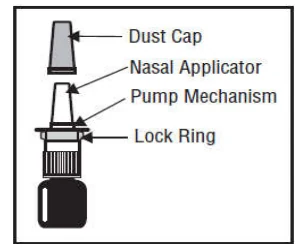
Directions for Use:
Note: For Use in the Nose Only
- 1. Remove the dust cap and lock-ring from the nasal applicator. Shake the bottle.
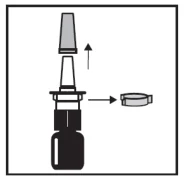
- 2. The very first time the spray is used and when the spray is used for the first time each day, prime the pump. To prime the pump, press downwards on the white collar using your index and middle fingers while supporting the base of the bottle with your thumb (aim away from your face). Press down until a fine spray appears (at least 4 times). The spray is now ready for use.
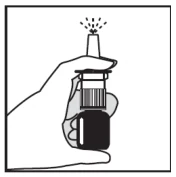
- 3. Gently blow your nose. Close one nostril. Tilt your head forward slightly and, keeping the
bottle upright, carefully insert the nasal applicator into your other nostril. 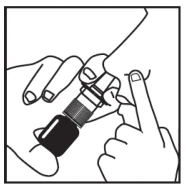
- 4. For each spray your physician has instructed you to take, gently breathe inwards through the nostril while pressing firmly downwards once on the white collar using your index and middle fingers while supporting the base of the bottle with your thumb. Breathe out through your mouth.
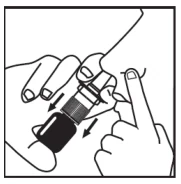
NOTE: When BECLOMETHASONE NASAL SPRAY is administered as two sprays into each nostril, the first spray should be directed at the upper, and the second at the lower part of the nasal cavity to insure coverage of the entire nasal passage.
Upper Nasal cavity Lower Nasal cavity 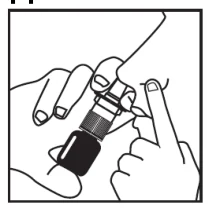
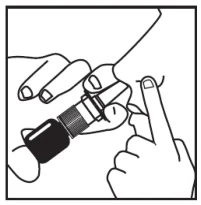
- 5. Repeat steps 3 and 4 for the other nostril.
- 6. Replace the lock-ring and the dust cap.
Cleaning:
To clean the nasal applicator, remove the dust cap and the lock-ring, press gently upwards on the white collar and the nasal applicator will come free. Wash the applicator and dust cap under cold water. Dry the applicator and reassemble the applicator, the dust cap and lock-ring. Please refer to the first diagram identifying all the parts to help with putting the nasal applicator back together.
If the nasal applicator becomes blocked, remove the dust cap, unscrew the complete pump mechanism and soak it in warm water for a few minutes. Rinse with cold water, dry and refit to bottle.
Overdose:
Missed Dose:
If you miss a dose, just take your next dose when it is due. Do NOT double dose of BECLOMETHASONE NASAL SPRAY to make up for the missed dose.
What are possible side effects from using BECLOMETHASONE NASAL SPRAY?
These are not all the possible side effects you may feel when taking BECLOMETHASONE NASAL SPRAY. If you experience any side effects not listed here, contact your healthcare professional.
Side effects may include:
- Irritation and burning in the nose;
- Sneezing;
- Dryness or crusting in the nose;
- Nose bleeds;
- Sore throat;
- Cough;
- Stomach pain; and/or
- Rash.
Serious side effects and what to do about them
| Symptom / effect | Talk to your healthcare professional | Stop taking drug and get immediate medical help | ||
| Only if severe | In all cases | |||
| Ulcers in the nose. | √ | |||
| Localized infections of the nose and pharynx with Candida albicans (yeast infection). | √ | |||
| Cataracts: clouding of the lens in the eye, blurry vision, dim vision and/or eye pain. | √ | |||
| Allergic Reaction (immediate or delayed): swelling of face, mouth, tongues or throat; severe itching; red patches on skin; rash; hives; stomach and/or abdominal pain. | √ | |||
| Hypercorticism (also called Cushing syndrome, when the body makes too much cortisol): weight gain, increase in fatty tissue deposits, pink or purple stretch marks on your skin, thinning (fragile skin that bruises easily), slow healing, acne, high blood pressure, and/or bone loss. | √ | |||
Decreased Adrenal Function: tiredness, weakness, nausea, vomiting, and/or low blood pressure. | √ | |||
If you think you have taken too much BECLOMETHASONE NASAL SPRAY, contact your healthcare professional, hospital emergency department or regional poison control center immediately, even if there are no symptoms.
| Nasal Septum Perforation (a hole in the nasal septum that divides the two nostrils): crusting around the perforation, repeated nosebleeds, and/or whistling sound when you breathe from your nose. | √ | |||
| Headache, dizziness, nausea, or feeling tired. | √ | |||
| Urticarial reaction: skin with red spots which burn, itch, and/or sting. | √ | |||
| Glaucoma: Increased pressure in the eye, eye and head pain, swelling or redness in or around the eye, and changes in vision, hazy or blurred vision, and/or sudden sight loss. | √ | |||
| Bronchospasm (when there is a sudden narrowing of the airway): difficulty breathing, cough, wheezing, shortness of breath, and/or tightness of chest. | √ | |||
| Angioedema (swelling of tissue under the skin): difficulty breathing; swollen face, hands and feet, genitals tongue, throat; swelling of the digestive tract causing diarrhea, nausea and/or vomiting. | √ |
If you have a troublesome symptom or side effect that is not listed here or becomes bad enough to interfere with your daily activities, talk to your healthcare professional.
Reporting Side Effects
You can report any suspected side effects associated with the use of health products to Health Canada by:
- Visiting the Web page on Adverse Reaction Reporting (https://www.canada.ca/en/health-canada/services/drugs-health-products/medeffect-canada/adverse-reaction-reporting.html) for information on how to report online, by mail or by fax; or
- Calling toll-free at 1-866-234-2345.
NOTE: Contact your health professional if you need information about how to manage your side effects. The Canada Vigilance Program does not provide medical advice.
Storage:
Store at room temperature (15°C to 30°C). Protect from light. Do not refrigerate. Throw away the device after 3 months of use. Keep out of reach and sight of children.
If you want more information about BECLOMETHASONE NASAL SPRAY:
- Talk to your healthcare professional
- Find the full Product Monograph that is prepared for healthcare professionals and includes this Patient Medication Information by visiting the Health Canada website (https://health-products.canada.ca/dpd-bdpp/index-eng.jsp). Find the Patient Medication Information on the manufacturer’s website http://www.apotex.ca/products, or by contacting DISpedia, Apotex's Drug Information Service at: 1-800-667-4708
Date prepared: September 18, 2020