


Patient Medication Information: uses, side effects, how to take - Apo-Ciclesonide
ABOUT THIS MEDICATION
What the medication is used for:
APO-CICLESONIDE is a corticosteroid for use in adults and adolescents 12 years of age or older, to relieve the symptoms that may occur with hay fever [seasonal allergic rhinitis (SAR)] or other year-round allergies [perennial allergic rhinitis (PAR)], including stuffiness/congestion in the nose, runny nose, itching and sneezing.
What it does:
APO-CICLESONIDE is a medication that is used in the nose. When taken according to the directions, APO-CICLESONIDE can help relieve nasal congestion (blocked nose), runny nose, itching and sneezing. It reduces inflammation in the lining of the nose and nasal passages.
The therapeutic effects of corticosteroids like APO-CICLESONIDE are not immediate. It may take a few days for this medicine to work. It is very important that you use it regularly. Do not stop treatment even if you feel better unless told to do so by your doctor.
When it should not be used:
Do not use this medication if:
- you are allergic to any of the ingredients in APO-CICLESONIDE;
- you have an untreated infection of the nose (i.e. yellow or green discharge from the nose);
- your nose was recently operated on or injured. You may be told to wait until healing has occurred before using APO-CICLESONIDE.
What the medicinal ingredient is:
Ciclesonide
What the non-medicinal ingredients are:
APO-CICLESONIDE contains edetate disodium dihydrate, hydrochloric acid, hypromellose, microcrystalline cellulose and carboxymethylcellulose sodium, potassium sorbate and purified water.
What dosage forms it comes in:
APO-CICLESONIDE comes in an amber bottle with a manual metered pump. Each spray activation delivers 50 micrograms of APO-CICLESONIDE in a metered dose. Each bottle is contained in an aluminum foil pouch containing an oxygen absorber.
WARNINGS AND PRECAUTIONS
BEFORE you use APO-CICLESONIDE talk to your doctor or pharmacist:
- About all health problems you have now or have had in the past;
- About all the medicines you take, including those you can buy without a prescription;
- If you ever had to stop taking other medicines for hay fever or other allergies because you were allergic to them or experienced other problems;
- If you have a history of tuberculosis (TB) infections;
- If you have sores in the nose;
- If you have an infection (fungal, bacterial, or viral)
- If you have herpes simplex (virus) infection of the eye;
- If you are taking other steroid medicine by mouth or by inhalation (breathing in);
- If you are taking drugs that suppress the immune system;
If you are pregnant, plan to become pregnant or are breastfeeding. Do not use this medication during pregnancy or breastfeeding without first discussing it with your doctor.
INTERACTIONS WITH THIS MEDICATION
Talk to your doctor or pharmacist if you are taking ketoconazole, itraconazole, ritonavir, or nelfinavir. These drugs may interact with APO-CICLESONIDE.
PROPER USE OF THIS MEDICATION
Your doctor will decide what an appropriate dosage of APO-CICLESONIDE is for you.
Your doctor or pharmacist has explained when and how to take APO-CICLESONIDE. Follow your doctor or pharmacist’s directions carefully – they may be different from the information provided in this leaflet.
APO-CICLESONIDE should be taken once daily as directed.
Usual dose:
Adults and Adolescents (12 Years and Older): The recommended dosage is 2 sprays in each nostril once daily (total daily dose,
200 micrograms).
The maximum total daily dosage should not exceed 2 sprays in each nostril
(200 micrograms/day).
APO-CICLESONIDE is not presently approved for use in patients younger than 12 years of age.
How to Use APO-CICLESONIDE Properly:
Preparing For Use:
- 1. Remove APO-CICLESONIDE from its tamper proof foil pouch and write the date of opening on the bottle label. It’s important to throw away the nasal spray bottle 6 months after this date.
- 2.
Shake the bottle gently and prime the pump by pressing downward on the shoulders of the applicator eight times. Read the complete instructions carefully and use only as directed. If unused within 4 or more consecutive days, reprime by spraying one time or until a fine mist appears. There is enough medication in this bottle to allow for the required priming and repriming, in addition to the 120 doses.
Do not twist the pump or nasal applicator.
Using the Spray:
- 1. Blow your nose to clear your nostrils if needed.
- 2. Shake the bottle gently and remove the cap.
- 3.
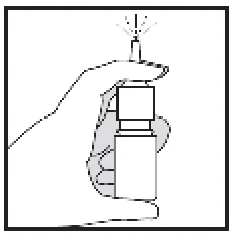
Hold the bottle firmly with your index and middle finger on either side of the spray tip while supporting the base of the bottle with your thumb (Figure 1).
Figure 1
- 4.
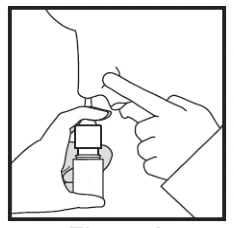
Insert spray tip into one nostril, and close the other nostril with your finger (Figure 2).
Figure 2
- 5.
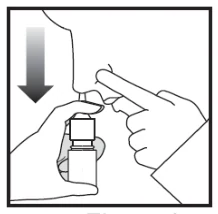
Tilt your head forward slightly and keeping the bottle upright, press the pump quickly and firmly and inhale through your nose as you spray (Figure 3).
Avoid spraying in eyes or directly onto the nasal septum.
Figure 3
- 6. If a second spray is required in this nostril, repeat steps 3-5. Repeat steps 3-6 for the other nostril.
- 4.
Applicator Cleaning Instructions:
After daily use of your nasal spray, wipe the applicator tip with a clean tissue and replace the cap.
On a weekly basis or if the nasal applicator is clogged at any time, use the following cleaning instructions. (Do not try to unblock the tiny spray hole on the nasal applicator with a pin or other sharp object. Do not twist or try to remove the white plastic pump attached to the medicine bottle.):
- 1. Remove the cap and then gently pull upwards to free the nasal applicator.
- 2. Wash the cap and applicator with warm water.
- 3. Dry and replace the nasal applicator.
- 4. Prime the unit with one spray or until a fine mist appears.
- 5. Replace the cap.
How To Know When Your Nasal Spray Bottle Is Empty:
The amount of nasal spray left can be seen through a window on the bottle. You should discard the bottle after using 120 sprays or 6 months after opening the foil pouch, whichever comes first.
Overdose:
If you think you have taken too much APO-CICLESONIDE, contact your healthcare professional, hospital emergency department or regional poison control centre immediately, even if there are no symptoms.
If you accidentally take more than the maximum recommended daily dose, contact your doctor or health care professional immediately.
Missed Dose:
It is very important that APO-CICLESONIDE is used regularly. If a dose is missed, the next dose should be taken when it is due. Do not double dose.
SIDE EFFECTS AND WHAT TO DO ABOUT THEM
Like any medication, APO-CICLESONIDE may cause side effects in some people. Side effects that may occur with the use of corticosteroid nasal sprays, including APO-CICLESONIDE, are:
- headache
- nose bleeds
- nasal ulcers
- pain, burning, irritation, or dryness inside of the nose
- nausea
- dry mouth
- decreased taste sensitivity
sore throat
If any of these affects you severely, tell your doctor, nurse, or pharmacist.
Serious side effects and what to do about them
| Symptom / effect | Talk to your healthcare professional | Stop taking drug and get immediate medical help | |||||
| Only if severe | In all cases | ||||||
| Rare | Allergic Reactions: Rash, hives, swelling of the face, lips, tongue or throat, difficulty swallowing or breathing. | * | |||||
| Fungal infection in the nose. | * | ||||||
This is not a complete list of side effects. For any unexpected effects while taking APO-CICLESONIDE, contact your doctor or pharmacist.
HOW TO STORE IT
Store at room temperature 15°C - 30°C. Do not freeze. Shake gently. Protect from light. Discard product 6 months after opening of aluminum foil pouch.
Keep out of the reach and sight of children.
Reporting Side Effects
You can report any suspected side effects associated with the use of health products to Health Canada by:
NOTE: Contact your health professional if you need information about how to manage your side effects. The Canada Vigilance Program does not provide medical advice. |
MORE INFORMATION
NOTE: This CONSUMER INFORMATION leaflet provides you with the most current information at the time of printing.
If you want more information about APO-CICLESONIDE:
- Talk to your healthcare professional
Find the full product monograph that is prepared for healthcare professionals and includes this Patient Medication Information by visiting the Health Canada website (http://hc-sc.gc.ca/index-eng.php); the manufacturer’s website http://apotex.ca/products, or by calling DISpedia, Apotex's Drug Information Service at:
1-800-667-4708