


Patient Medication Information: uses, side effects, how to take - Nasal Allergy and Congestion Relief
ABOUT THIS MEDICATION
What the medication is used for:
NASAL ALLERGY AND CONGESTION RELIEF is a corticosteroid, which reduces inflammation. It is used in adults and children 12 years of age and older, for temporary relief of symptoms of the following conditions:
Seasonal allergic rhinitis: also called “outdoor allergies” is caused by allergies to grass, trees and ragweed pollen.
Perennial allergic rhinitis: year round/indoor allergies caused by dust mites, animals and molds.
The allergy symptoms include
- stuffiness/nasal congestion
- runny nose
- nose itching
- sneezing.
Full effect depends on daily and continued use as long as allergy triggers remain.
What it does:
When sprayed into the nose it helps reduce inflammation in nasal passages and relieves the allergy symptoms.
In some patients, NASAL ALLERGY AND CONGESTION RELIEF may relieve symptoms within 12 hours; others may have to wait at least 48 hours, even if used daily.
When it should not be used:
NASAL ALLERGY AND CONGESTION RELIEF should not be used:
- if you are allergic to NASAL ALLERGY AND CONGESTION RELIEF or to any of its ingredients.
- if you have an infection in the nose (i.e. yellow or green discharge from the nose) that is not being treated.
- if your nose was recently operated on or injured. In this case you may be told to wait until healing has occurred before using NASAL ALLERGY AND CONGESTION RELIEF.
- if you have frequent and severe nosebleeds.
- if you have been diagnosed with tuberculosis and it is not being treated.*
- if you have untreated fungal, bacterial, or systemic viral infections.*
- if you have a herpes simplex (virus) infection of the eye and it is not being treated.*
*See WARNINGS AND PRECAUTIONS for additional information.
What the medicinal ingredient is:
NASAL ALLERGY AND CONGESTION RELIEF contains mometasone furoate.
What the nonmedicinal ingredients are:
Benzalkonium chloride, citric acid, glycerin, microcrystalline cellulose and carboxymethylcellulose sodium, polysorbate 80, purified water and sodium citrate dihydrate.
What dosage forms it comes in:
NASAL ALLERGY AND CONGESTION RELIEF comes in a nasal spray device which delivers 140 sprays. Each spray delivers an unscented mist, containing the equivalent of 50 mcg of mometasone furoate.
WARNINGS AND PRECAUTIONS
Do not spray NASAL ALLERGY AND CONGESTION RELIEF into your eyes or mouth. It is for use in the nose only.
Before you use NASAL ALLERGY AND CONGESTION RELIEF talk to your doctor or pharmacist if you are pregnant or nursing a baby. Breast-feeding is not recommended during treatment with this drug.
If you have any of the following conditions consult your doctor or pharmacist before using NASAL ALLERGY AND CONGESTION RELIEF. If you develop one of these conditions while using this drug, stop treatment and see your doctor:
- sores in the nose
- tuberculosis (active or previous)
- infection (fungal, bacterial or viral)
- herpes simplex (virus) infection of the eye
- change in vision
- severe or frequent nose bleed
(See ABOUT THIS MEDICATION - When it should not be used, for additional information).
Although not observed with mometasone furoate aqueous nasal spray, development of glaucoma (elevated pressure inside the eye ball) or cataracts (clouding of the lens of the eye) have been reported with other intranasal and inhaled corticosteroids.
Although not observed with mometasone furoate aqueous nasal spray, slower rate of growth has been reported in some children receiving other intranasal corticosteroids. You and your doctor should monitor your child’s growth.
Contact your doctor if you think you have developed an infection in the nose after starting NASAL ALLERGY AND CONGESTION RELIEF (i.e. normally clear discharge from the nose has turned yellow or green) or if you have, or come into contact with someone who has chickenpox, measles or tuberculosis.
Be sure to use this medicine exactly as instructed. Do not use more NASAL ALLERGY AND CONGESTION RELIEF than recommended in an attempt to increase its effectiveness, (See PROPER USE OF THIS MEDICATION for additional information). Do not share this medicine with anyone else; it may harm them even if their symptoms are the same as yours. Do not use this product for treating other disease such as cold.
INTERACTIONS WITH THIS MEDICATION
To avoid the possibility of drug interactions, be sure to advise your physician or pharmacist of any other medications that you are taking, particularly corticosteroid medicine, either by mouth or by injection. The dose of some medications may need adjustment while you are using NASAL ALLERGY AND CONGESTION RELIEF.
Drugs that may interact with NASAL ALLERGY AND CONGESTION RELIEF are listed below. Your doctor may wish to monitor you carefully if you are taking these medicines:
- Ketoconazole
- Itraconazole
- Clarithromycin
- Ritonavir
- Cobicistat-containing products
PROPER USE OF THIS MEDICATION
FOR INTRANASAL USE ONLY. DO NOT SPRAY INTO EYES or MOUTH
Follow the INSTRUCTIONS FOR USE described below to properly use this spray bottle. If you have any questions, call 1-800-667-4708.
Usual dose and Directions for use:
Adults and children 12 years of age and older
Once daily, spray two times into each nostril while sniffing gently.
When your symptoms are under control, you may reduce to one (1) spray into each nostril once daily to maintain control of your symptoms.
You may stop and re-start use as needed based on your symptoms.
When using this product:
- Do not use more than 4 sprays in 24 hours;
- Do not share this bottle with anyone else as this may spread germs;
- Do not use continuously for more than six months without consulting your doctor.
Stop use and ask a doctor or pharmacist if
- Your allergy symptoms do not improve after one week
- Changes to the eyesight
- Severe or frequent nosebleeds
- You have or developed symptom of an infection
Overdose:
| If you think you, or a person you are caring for, have taken too much NASAL ALLERGY AND CONGESTION RELIEF, contact a healthcare professional, hospital emergency department, or regional poison control centre immediately, even if there are no symptoms. |
|---|
Missed dose:
If you miss taking your dose on time, do not worry; take a dose if you remember within an hour or so.
However, if you do not remember until later, skip the missed dose and go back to your regular dosing schedule. Do not double the dose.
INSTRUCTIONS FOR USE
How to prime the pump
- 1. Shake the bottle well.
- 2. Remove the plastic cap (Figure 1).
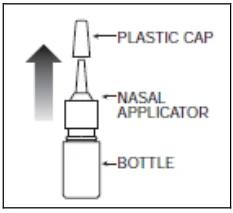
Figure 1
- 3. Prime the pump into the air the first time it is used, or when not used for a week or more.
Do not pierce the nasal applicator.
- To prime the pump, press downward on the shoulders of the nasal applicator using your index finger and middle finger while holding the base of the bottle with your thumb (Figure 2). Point the spray away from you while doing this.
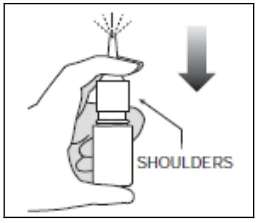
Figure 2
- Press down and release the pump 10 times or until a fine spray appears, taking care not to spray into eyes or face.
- The pump is now ready to use.
How to use and clean
- 1. Shake the bottle well before each use.
- 2.
• Gently blow your nose to clear the nostrils.
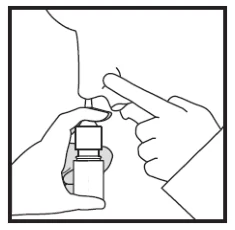
- With your finger, hold 1 nostril shut.
Tilt your head forward slightly, keep the bottle upright, and carefully insert the nasal applicator into the other nostril (Figure 3).
Figure 3
Do not spray directly onto the nasal septum (the wall between the 2 nostrils).
- 3.
• Hold the spray bottle upright and press firmly downward on the shoulders of the nasal applicator.
- Breathe gently inward through the nostril.
- Then breathe out through the mouth.
- ➢ Adults and children 12 years and over: 2 sprays in each nostril.
- 4. Repeat in the other nostril.
- 5. Wipe the outside of the nasal applicator with a clean tissue and replace the plastic cap after each use.
- 3.
What to do if blocked
Clean the inside of the applicator if it gets blocked.
Do not try to unblock the nasal applicator by inserting a pin or other sharp object, as this will damage the applicator.
- 1. Remove the plastic cap.
- 2.
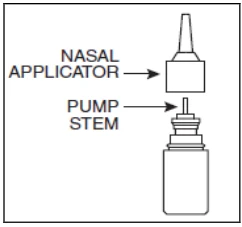
Pull gently upward on the nasal applicator to remove (Figure 4).
Figure 4
- 3. Rinse both ends of the nasal applicator under cold water. Let air dry (Figure 5).
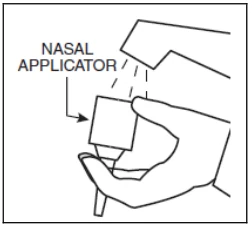
Figure 5
- 4. Once dry, put nasal applicator back on pump stem.
- 5.
Reprime the pump.
(See How to prime the pump instructions).
Please keep this package insert for future use.
If you have any questions, call 1-800-667-4708.
SIDE EFFECTS AND WHAT TO DO ABOUT THEM
Side effects that may occur with the use of corticosteroid nasal sprays, including NASAL ALLERGY AND CONGESTION RELIEF, are headache, nose-bleed or blood-tinged mucus, burning or irritation inside the nose, sneezing or sore throat.
Disturbances of taste and smell have been reported very rarely. If these side effects do not go away or worsen, stop use and contact your doctor or pharmacist.
The following less common side effects have been seen in Clinical Trials: swollen lymph nodes, vision changes, eye tearing, dry eyes, eye inflammation or infection, ear ache, ringing in the ears, stomach pain, constipation, diarrhea, nausea, tongue and tooth disorders, dry mouth, aggravated allergy symptoms, swelling of the body including the face, fever, flu-like symptoms, thirst, cold sore, infections, muscle and/or joint pain, tremor, dizziness, migraine, depression, nightmares causing sleep disturbances, fatigue, loss of voice, bronchitis, shortness of breath, wheezing, acne, skin rashes and high blood pressure.
In addition to some of the above side effects, the following post-market side effects have been seen: nasal septum perforation.
SERIOUS SIDE EFFECTS AND WHAT TO DO ABOUT THEM
| Symptom / effect | Talk to your healthcare professional | Stop taking drug and get immediate medical help | ||
| Only if severe | In all cases | |||
| Rare | Immediate hyper-sensitivity: an allergic reaction which may cause sudden onset of wheezing or difficulty in breathing shortly after taking this medication | √ | ||
| Un-common | Chest pain, irregular or fast heartbeat | √ | ||
| Unknown | Blurred vision, increased pressure in your eyes, eye pain, distorted vision | √ | ||
IF YOU EXPERIENCE ANY UNDESIRABLE OR TROUBLESOME EFFECTS, INCLUDING ANY THAT ARE NOT LISTED, ADVISE YOUR PHYSICIAN OR PHARMACIST.
HOW TO STORE IT
KEEP OUT OF THE REACH OF CHILDREN.
- Store between 2°C and 25°C (36°F and 77°F).
- Protect from light.
- Do not freeze.
- Do not use this product after the expiration date on the package.
When NASAL ALLERGY AND CONGESTION RELIEF is removed from its cardboard container, prolonged exposure of the product to direct light should be avoided. Brief exposure to light, as with normal use, is acceptable.
Reporting Side Effects
You can report any suspected side effects associated with the use of health products to Health Canada by:
|
|---|
NOTE: Contact your health professional if you need information about how to manage your side effects. The Canada Vigilance Program does not provide medical advice. |
|---|
MORE INFORMATION
Drug testing for sports events: This product is a corticosteroid for nasal administration. Although it is not measurable in the blood, corticosteroids may be detected in the urine during drug testing. Thus, prior written permission for its use may be required by sports agencies.
You may want to read this leaflet again. Do not throw it away until you have finished your medication.
If you want more information about NASAL ALLERGY AND CONGESTION RELIEF:
|
|---|