


Product Monograph - Bipazen
CLINICAL PHARMACOLOGY
Desmopressin acetate is a synthetic structural analogue of the natural human hormone, arginine vasopressin.
Desmopressin acetate administration causes a transient increase in all components of the Factor VIII complex (Factor VIII coagulant activity, Factor VIII related antigen, and ristocetin cofactor) and in plasminogen activator. Either directly or indirectly, desmopressin acetate causes these factors to be released very rapidly from their endothelial cell storage sites. In addition, desmopressin acetate may have a direct effect on the vessel wall, with increased platelet spreading and adhesion at injury sites.
A second dose given before endothelial cell stores are replenished will not have as great an effect as the initial dose. Responses as great as the initial one usually are seen if 48 hours or more have elapsed between doses.
Desmopressin acetate alters the permeability of the renal tubule to increase resorption of water. The increase in the permeability of both the distal tubules and collecting ducts appears to be mediated by a stimulation of the adenylcyclase activity in the renal tubules.
The pharmacokinetic and pharmacodynamic profiles after subcutaneous or intravenous administration to healthy volunteers are equivalent. The plasma half-life ranges from 3.2 to 3.6 hours.
INDICATIONS AND CLINICAL USE
Bipazen (desmopressin acetate injection) is indicated for prophylaxis of mild hemophilia A and mild von Willebrand’s disease Type I, and for the treatment of central diabetes insipidus.
Hemophilia A
Bipazen is indicated for patients with hemophilia A with Factor VIII levels greater than 5%.
Bipazen will often maintain hemostasis in patients with hemophilia A during surgical procedures and postoperatively, when administered 45 minutes prior to the scheduled procedure.
Bipazen will also stop bleeding in hemophilia A patients with episodes of spontaneous or trauma-induced injuries such as hemarthroses, intramuscular hematomas or mucosal bleeding.
In certain clinical situations, it may be justified to try Bipazen in patients with Factor VIII levels between 2-5%, however, these patients should be carefully monitored.
Von Willebrand’s Disease (Type I)
Bipazen is indicated for patients with mild to moderate classic von Willebrand’s Disease (Type I) with Factor VIII levels greater than 5%.
Bipazen will often maintain hemostasis in surgical procedures and postoperatively when administered 45 minutes prior to the scheduled procedure.
Bipazen will usually stop bleeding in mild to moderate von Willebrand’s patients with episodes of spontaneous or trauma-induced injuries such as hemarthroses, intramuscular hematomas or mucosal bleeding.
Those von Willebrand’s disease patients who are least likely to respond are those with severe homozygous von Willebrand’s disease with Factor VIII antigen and von Willebrand’s Factor (ristocetin cofactor) activities less than 1%. Other patients may respond in a variable fashion depending on the type of molecular defect they have. Bleeding time and Factor VIII coagulant activity, Factor VIII antigen and von Willebrand’s Factor activities should be checked during administration of Bipazen to ensure that adequate levels are being achieved.
Bipazen is not indicated for the treatment of severe classic Type I von Willebrand’s disease and Type II B and when there is evidence of an abnormal molecular form of Factor VIII antigen (See CONTRAINDICATIONS.)
Diabetes Insipidus
Bipazen (desmopressin acetate injection) is indicated for the management of vasopressin sensitive central diabetes insipidus and for the control of temporary polyuria and polydipsia following head trauma, hypophysectomy or surgery in the pituitary region.
CONTRAINDICATIONS
Hypersensitivity to desmopressin or to any of the excipients.
Because of the risk of platelet aggregation and thrombocytopenia, Bipazen should not be used in patients with type IIB or platelet-type (pseudo) von Willebrand’s disease.
Habitual or psychogenic polydipsia
Cardiac insufficiency and other conditions requiring treatment with diuretics Known hyponatraemia
Syndrome of inappropriate ADH secretion (SIADH)
WARNINGS
Patients who do not have need of antidiuretic hormone for its antidiuretic effect, in particular those who are young or elderly, should be cautioned to ingest only enough fluid to satisfy thirst, in order to decrease potential occurrence of water intoxication and hyponatremia. Patients receiving intravenous therapy must have fluid input and output monitored closely and maintain fluid and electrolyte balance to prevent hyponatremia and water intoxication. Treatment without concomitant reduction of fluid intake may lead to fluid retention and/or hyponatremia with or without accompanying warning signs and symptoms.
Bipazen must be used with caution in patients prone to vascular headaches and patients with coronary insufficiency and hypertensive cardiovascular diseases, because of possible changes in blood pressure and tachycardia.
Bipazen has no therapeutic effect in Glanzmann’s thrombaesthenia.
Tachyphylaxis may develop with repeated use.
Lack of therapeutic effect has been noted in patients who have been febrile or otherwise “stressed” for several days. Whenever possible, therapeutic efficacy (i.e., Factor VIII response in hemophilia and bleeding time correction in other disorders) should be established in individual patients prior to use and followed throughout the course of treatment. The coincident use of anti-fibrinolytic agents to counteract desmopressin-induced plasminogen activator release has been recommended, however, benefit has not been clearly established.
The benefits of desmopressin versus other hemostatic therapies should be carefully assessed in situations where prolonged haemostasis is required including active postoperative bleeding and variceal bleeding in patients with cirrhosis.
Bipazen is not effective in controlling polyuria caused by renal disease, nephrogenic diabetes insipidus, psychogenic diabetes insipidus, hypokalemia or hypercalcemia.
PRECAUTIONS
General
The drug should be used with caution in patients with coronary artery insufficiency and/or hypertensive cardiovascular disease, because of possible tachycardia, and changes in blood pressure.
Bipazen should not be used in patients with hemophilia B because it has no effect on Factor IX levels.
Bipazen should not be administered to dehydrated patients until water balance has been adequately restored.
Severe bladder dysfunction and outlet obstruction should be ruled out before starting treatment for central diabetes insipidus.
Precautions must be taken in patients at risk for increased intracranial pressure.
Treatment with Bipazen injection should be interrupted or carefully adjusted during acute intercurrent illnesses characterised by fluid and/or electrolyte imbalance (such as systemic infections, fever, gastroenteritis) as well as in excessive bleeding, and the fluid and electrolyte balance should be carefully monitored.
Due to post-marketing reports with desmopressin acetate injections of deep vein thrombosis, cerebrovascular accident and disorder (stroke), cerebral thrombosis, myocardial infarction, angina pectoris and chest pain, precautions should be taken before using Bipazen injection in elderly patients and in patients with risk factors and history of thrombosis, thrombophilia and known cardiovascular disease.
Desmopressin acetate injection has an antidiuretic effect. Patients receiving this drug should be cautioned to reduce their ingestion of fluids for at least six (6) hours after receiving the drug. Patients receiving intravenous fluids must be placed on fluid input/output monitoring.
Bipazen should be used with caution in patients with cystic fibrosis because these patients are prone to hyponatremia. Children and geriatric patients should be closely observed for possible water retention due to over-ingestion of fluids.
Renal impairment
Bipazen should be used with caution in patients with moderate and severe renal insufficiency (creatinine clearance below 50 ml/min).
Use in Children
Use in infants and children will require careful fluid intake restriction to prevent possible hyponatremia and water intoxication.
Bipazen should not be used in infants younger than three months in the treatment of hemophilia A or von Willebrand’s disease.
Other special populations
Children, elderly and patients with serum sodium levels in the lower range of normal may have an increased risk of hyponatraemia.
Use in Pregnancy
Reproduction studies performed in rats and rabbits have revealed no evidence of harm to the fetus due to desmopressin acetate injection. The use of desmopressin acetate injection in pregnant women with no harm to the fetus has been reported, however, no controlled studies have been carried out. Unlike preparations containing the natural hormones, desmopressin acetate injection in antidiuretic doses has no uterotonic action, but the physician should weigh possible therapeutic advantages against potential risks in each case.
Nursing Mothers
There have been not controlled studies in nursing mothers. A single study on a post-partum woman demonstrated a marked change in plasma desmopressin acetate level following an intranasal dose of 10 mcg, but little drug was detectable in breast milk. Results from analysis of milk from nursing mothers receiving high doses of desmopressin (300 mcg intranasal), indicate that the amounts of desmopressin that may be transferred to the child are considerably less than the amounts required to influence diuresis.
Drug Interaction
Clofibrate, chlorpropamide and carbamazepine may potentiate the antidiuretic activity of desmopressin while demeclocycline, lithium and norepinephrine may decrease its activity.
Although the pressor activity of desmopressin acetate injection is very low compared with the antidiuretic activity, use of doses of Bipazen as large as 0.3 mcg / kg with other pressor agents, should be done only with careful patient monitoring.
Special attention should be given when desmopressin is co-administered with other drugs affecting water and/or sodium homeostasis, e.g. opioids, selective serotonin reuptake inhibitors (SSRIs), tricyclic antidepressants (TCAs), nonsteroidal anti-inflammatory drugs (NSAIDs), chlorpromazine, carbamazepine and some antidiabetics of the sulfonylurea group since concurrent use can lead to an increased risk of fluid retention/hyponatraemia. In patients with chronic therapy with drug(s) affecting water and/or sodium homeostasis, Bipazen should be administered after confirmation of normal baseline sodium.
Laboratory Tests
Hemophilia A
Laboratory tests for assessing patient status include levels of Factor VIII coagulant, Factor VIII antigen and Factor VIII ristocetin cofactor (von Willebrand factor) as well as activated partial thromboplastin time. Factor VIII coagulant activity should be determined before giving Bipazen for hemostasis. If Factor VIII coagulant activity is present at less than 5% of normal, Bipazen should not be relied upon alone.
von Willebrand’s Disease
Laboratory tests for assessing patient status include levels of Factor VIII coagulant, Factor VIII antigen and Factor VIII ristocetin cofactor (von Willebrand factor). The skin bleeding time may be helpful in following these patients and should always be assessed pre-operatively.
Diagnosis of Central Diabetes Insipidus
Central diabetes insipidus may be demonstrated by the inability to produce urine of osmolality above 175 mOsm / kg with dehydration severe enough to cause a loss of greater than 2% of body weight.
Patients are selected for therapy by establishing a diagnosis by means of a water deprivation test, the hypertonic saline infusion test, and/or response to 5 units arginine vasopressin given subcutaneously after dehydration.
Continued response to Bipazen can be monitored by urine volume and osmolality. In case of severe dehydration, plasma osmolality determination may be required.
ADVERSE REACTIONS
The most frequently reported adverse reaction with desmopressin acetate injection during post-marketing is hyponatraemia. Hyponatraemia may cause headache, nausea, vomiting, water intoxication, weight increase, malaise, abdominal pain, muscle cramps, dizziness, confusion, decreased consciousness, generalized or local oedema (peripheral, face) and in severe cases brain oedema, hyponatraemic encephalopathy, convulsions, and coma. Hyponatraemia is reversible. Treatment should be individualised and rapid overcorrection should be avoided to reduce the risk of further complications.
Post-marketing hypersensitivity reactions including local allergic reactions such as dyspnoea, erythema, generalized or local oedemas (peripheral, face), pruritus, rash, rash macular, rash maculopapular, rash erythematous, skin plaque and urticaria, have been reported in association with desmopressin acetate injection. More serious hypersensitivity reactions including anaphylactic shock and reaction, and anaphylactoid shock and reaction have also been reported in association with desmopressin acetate injection. Allergic reactions usually occur rapidly after drug administration and may occur during first time usage or after repeated exposure of desmopressin acetate injection.
Desmopressin acetate injection has produced transient headache, nausea, mild abdominal cramps and vulvar pain. Facial flushing, tachycardia, mild hypotension and oliguria have also been reported.
Rare post marketing cases of deep vein thrombosis, cerebrovascular accident/disorder (stroke), cerebral thrombosis, pulmonary embolism, myocardial infarction, angina pectoris and chest pain have been reported in patients treated with desmopressin. Due to confounding factors and/or missing information, a causal relationship with desmopressin acetate injection has not been established/confirmed.
Side effects following intravenous administration to 297 patients included transient facial flushing (approximately 18%), fatigue (3%), headache (2%), and oliguria (1%). Other effects reported at a frequency of less than 1% included nausea, dizziness, syncope and abdominal cramping.
Side effects following subcutaneous administration to 190 subjects included transient facial flushing (7%). Other effects reported at a frequency of less than 1% included hypotension, transient headache, abdominal tension, nausea, tachycardia and discomfort at the injection site.
See WARNINGS for the possibility of water intoxication and hyponatremia.
Very occasionally, intravenous injection of desmopressin acetate injection has produced local erythema, swelling or burning pain along the course of the vein.
Other post-marketing adverse events that have been reported following the use of desmopressin acetate injection are:
Respiratory, thoracic and mediastinal disorders – Dyspnoea
Gastrointestinal disorders – nausea, vomiting
Nervous system disorders - headache, dizziness
General disorders and administration site conditions - injection/infusion site reactions including swelling, pain, extravasation, erythema, bruising and nodules, chills
REPORTING SIDE EFFECTS
You can report any suspected side effects associated with the use of health products to Health Canada by:
- Visiting the Web page on Adverse Reaction Reporting (canada.ca/drug-device-reporting) for information on how to report online, by mail or by fax; or
- Calling toll-free at 1-866-234-2345
NOTE: Contact your health professional if you need information about how to manage your side effects. The Canada Vigilance Program does not provide medical advice.
SYMPTOMS AND TREATMENT OF OVERDOSAGE
If you think you, or a person you are caring for, have taken too much Bipazen, contact a healthcare professional, hospital emergency department, regional poison control centre or Health Canada’s toll-free number, 1-844 POISON-X (1-844-764-7669) immediately, even if there are no signs or symptoms.
Overdose of desmopressin acetate injection leads to a prolonged duration of action with an increased risk of water retention and hyponatraemia.
Excessive doses may cause headaches, abdominal cramps, nausea and facial flushing. In such cases the dosage should be reduced, frequency of administration decreased, or the drug withdrawn according to the severity of the condition.
There is no known antidote for desmopressin acetate injection. Water intoxication responds rapidly to diuretic therapy (e.g., furosemide) and appropriate replacement fluid support, without interference with hemostatic effects. The treatment of hyponatraemia should be individualised and can include discontinuation of desmopressin acetate injection treatment, fluid restriction and symptomatic treatment.
DOSAGE AND ADMINISTRATION
Haemophilia A and von Willebrand’s Disease Type I and Other Hemostatic Disorders
Intravenous Infusion
Children: 0.3 mcg / kg
Adults: 0.3 mcg / kg
(maximum dose 20 mcg)
If Bipazen is used pre-operatively, it should be administered 30 minutes prior to the scheduled procedure. The peak effect is obtained one (1) hour after administration. Response is immediate for bleeding time reduction.
Note: The necessity for repeat administration of Bipazen or use of any blood products for hemostasis should be determined by laboratory response as well as the clinical condition of the patient. The tendency toward tachyphylaxis (lessening of response) with repeated administration, given more frequently than every 48 hours should be considered in treating each patient.
Dilution for Infusion
Dilute in sterile physiological saline and infuse slowly over 20 to 30 minutes. In adults and children weighing more than 10 kg, 50 mL of diluent is used; in children weighing 10 kg or less, 10 mL of diluent is used. Side effects may be decreased by slow infusion. Blood pressure and pulse rate should be monitored during infusion.
Diabetes Insipidus
Bipazen dosage must be determined for each patient and adjusted according to the pattern or response. Response should be estimated by two parameters: adequate duration of sleep and adequate, not excessive, water turnover.
Intravenous, Intramuscular or Subcutaneous Administration
Children: 0.1 mL (0.4 mcg) once daily.
Adults: 0.25 to 1 mL (1 - 4 mcg) once daily.
Method of Initiation of Bipazen treatment:
To institute therapy with Bipazen, patients should be withdrawn from previous medication and allowed to establish a base-line polyuria and polydipsia. The stable polyuria is used as a baseline to determine the magnitude and duration of the response to medication. In less severe cases, prior water loading may be desirable to establish a vigorous flow of urine. When the urine osmolality reaches a plateau at the low level (in most cases, less than 100 mOsm per kilogram), the first dose of desmopressin acetate is administered intranasally or parenterally. A urine sample is obtained after two hours and hourly thereafter, following Bipazen administration. Samples are measured for volume and osmolality. When the patient has reached the previous baseline urine osmolality and urine flow, the drug effect has ceased and the next dose of Bipazen is administered. The cycle is then repeated until the patient has reached a stable condition.
One (1) mL (4 mcg) of Bipazen (desmopressin acetate injection) solution has an antidiuretic activity of about 16 IU; 1 mcg of Bipazen is equivalent to 4 IU.
For patients who have been controlled on intranasal desmopressin acetate and who must be switched to the injection form, either because of poor intranasal absorption, or because of the need for surgery, the comparable antidiuretic dose of the injection is explained below.
Intranasal administration requires a higher dosage than intravenous administration since only 10% of intranasally administered drug will be absorbed. The intranasal dosage that is required is therefore 10 times larger than the intravenous dose, thus an approximate parenteral dosage of one-tenth that of the intranasal, is required and should be adjusted for each patient individually to obtain an adequate diurnal rhythm of water turnover.
Bipazen is only available as a 4 mcg / mL solution to be administered parenterally.
PHARMACEUTICAL INFORMATION
DRUG SUBSTANCE
Proper Name: Desmopressin Acetate
Chemical Name: 1-Desamino-8-arginine-vasopressin acetate trihydrate
1-(3-mercaptopropionic acid)-8-D-arginine-vasopressin monoacetate (salt) trihydrate
Molecular Formula: Acetate: C48H74N14O17S2
Free Base: C46H64N14O12S2
Molecular Weight: Acetate: 1183.2 g/mol
Free Base: 1069.2 g/mol
Structure:
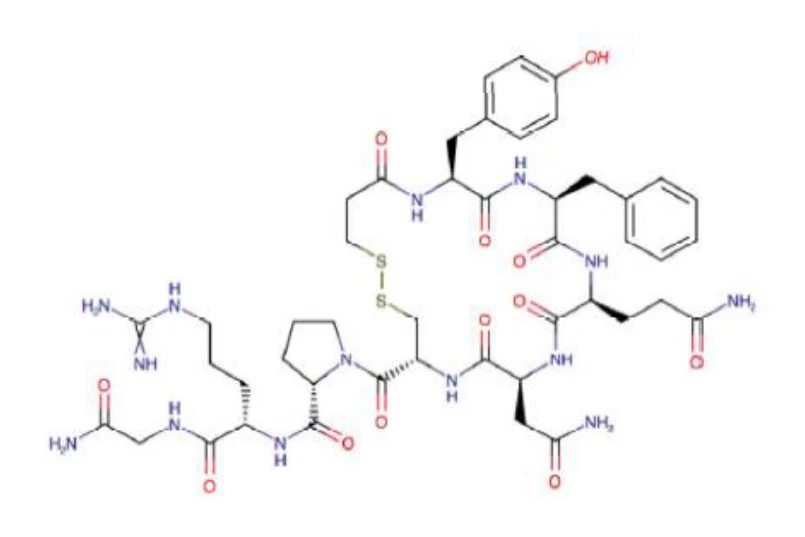
Description
Desmopressin acetate is a white lyophilized fluffy powder. It is soluble in water, ethanol, methanol and acetic acid, and only slightly soluble in chloroform and ethylacetate. An aqueous solution of 1 mg/mL at 24°C has a pH of 4.8.
DOSAGE FORM
Composition
Each ampoule contains 4 mcg of desmopressin acetate (equivalent to 3.6 mcg free base) in
1.0 mL of an isotonic sterile and pyrogen-free water solution.
Availability
Bipazen (desmopressin acetate injection) is available in a carton of 10x1 mL ampoules. Ampoules are clear glass with two yellow identification rings.
Storage
Keep in the refrigerator at 2-8° C, but do not freeze. Protect from light. Keep out of reach and sight of children.
Instructions for Opening Ampoules
- 1. Hold ampoule with narrow end pointing upwards. Shake or tap ampoule to empty the tip.
- 2. While holding above the score line, snap off tip by forcing it downwards.
Special Handling Instructions
Prior to use the solution in ampoule should be inspected for clarity, particulate matter, discolouration and leakage, discard without using if any of the above are observed.
REFERENCES
- 1. DDAVP® Injection (desmopressin acetate injection, 4 mcg/mL), Control No. 212376, Product Monograph, Ferring Inc. Apr. 05, 2018.
If you want more information about Bipazen:
- Talk to your healthcare professional
- Find the full Product Monograph that is prepared for healthcare professional by visiting the Health Canada website (https://health-products.canada.ca/dpd-bdpp/index-eng.jsp); or by calling 1-877-302-2561.
KVR Pharmaceuticals Inc. 21 Parr Boulevard Unit 12 Caledon, Ontario L7E 4G3
Last Revised: MAY 19, 2026