


Product Monograph - Blexten (Aralez Pharmaceuticals Canada, 6 mg)
Recent Major Label Changes
None at time of the most recent authorization
Table of Contents
Certain sections or subsections that are not applicable at the time of the preparation of the most recent authorized product monograph are not listed.
Recent Major Label Changes .................................................................................................. 2
Table of Contents .................................................................................................................. 2
Part 1: Health Professional Information ................................................................................. 4
1 Indications ................................................................................................................. 4
1.1 Pediatrics ................................................................................................................. 4
1.2 Geriatrics ................................................................................................................. 4
2 Contraindications ....................................................................................................... 4
4 Dosage and Administration ........................................................................................ 4
4.1 Dosing Considerations ............................................................................................ 4
4.2 Recommended Dose and Dosage Adjustment ....................................................... 4
4.4 Administration ........................................................................................................ 4
4.5 Missed Dose ............................................................................................................ 5
5 Overdose ................................................................................................................... 5
6 Dosage Forms, Strengths, Composition, and Packaging ............................................... 5
7 Warnings and Precautions .......................................................................................... 6
General ................................................................................................................................ 6
Driving and Operating Machinery ....................................................................................... 6
Ophthalmologic ................................................................................................................... 6
Reproductive Health ........................................................................................................... 6
7.1 Special Populations ................................................................................................. 6
7.1.1 Pregnancy .................................................................................................... 6
7.1.2 Breastfeeding .............................................................................................. 7
7.1.3 Pediatrics ..................................................................................................... 7
7.1.4 Geriatrics ..................................................................................................... 7
8 Adverse Reactions ...................................................................................................... 7
8.1 Adverse Reaction Overview .................................................................................... 7
8.2 Clinical Trial Adverse Reactions .............................................................................. 7
8.3 Less Common Clinical Trial Adverse Reactions ....................................................... 7
8.5 Post-Market Adverse Reactions .............................................................................. 8
9 Drug Interactions ....................................................................................................... 8
9.2 Drug Interactions Overview .................................................................................... 8
9.3 Drug-Behavioural Interactions ................................................................................ 8
9.4 Drug-Drug Interactions ........................................................................................... 8
9.5 Drug-Food Interactions ........................................................................................... 9
9.6 Drug-Herb Interactions ........................................................................................... 9
9.7 Drug-Laboratory Test Interactions.......................................................................... 9
10 Clinical Pharmacology ................................................................................................ 9
10.1 Mechanism of Action .............................................................................................. 9
10.2 Pharmacodynamics ................................................................................................. 9
10.3 Pharmacokinetics .................................................................................................... 9
11 Storage, Stability, and Disposal ................................................................................. 11
Part 2: Scientific Information ............................................................................................... 12
12 Pharmaceutical Information ..................................................................................... 12
13 Clinical Trials ............................................................................................................ 13
14.1 Clinical Trials by Indication ................................................................................... 13
14 Microbiology ............................................................................................................ 14
15 Non-Clinical Toxicology ............................................................................................ 14
17 Supporting Product Monographs .............................................................................. 15
Patient Medication Information .......................................................................................... 16
Part 1: Health Professional Information
1 Indications
BLEXTEN (bilastine) ophthalmic solution, 6 mg/mL, is indicated for:
- the treatment of ocular signs and symptoms of seasonal and perennial allergic conjunctivitis in adults.
1.1 Pediatrics
Pediatrics (<18 years of age): No data are available to Health Canada; therefore, Health Canada has not authorized an indication for pediatric use.
1.2 Geriatrics
Geriatrics (> 65 years of age): No dosage adjustments are necessary in patients over 65 years of age (see 10 Clinical Pharmacology, 4 Dosage and Administration).
2 Contraindications
BLEXTEN is contraindicated in patients who are hypersensitive to this drug or to any ingredient in the formulation, including any non-medicinal ingredient, or component of the container. For a complete listing of ingredients and components see 6 Dosage Forms, Strengths, Composition and Packaging.
4 Dosage and Administration
4.1 Dosing Considerations
No special dosing considerations are necessary for BLEXTEN.
4.2 Recommended Dose and Dosage Adjustment
The recommended daily dosage in adults is one drop in the affected eye(s) once daily.
Once symptomatic improvement has been established, therapy should be continued for as long as needed to sustain continued improvement. Therapy should not be used for more than 8 weeks without seeking medical advice.
No dosage adjustment is required in hepatic or renal impairment.
4.4 Administration
For ophthalmic use.
To prevent contamination of the dropper tip and solution, care must be taken not to touch the eyelids, surrounding areas or other surfaces with the dropper tip of the bottle. The tip of the nozzle should be wiped with a clean tissue after use to remove any residual liquid.
Patients should be instructed to remove contact lenses before administration of the BLEXTEN eye drops and to wait at least 15 minutes before putting their contact lenses back in.
If using other eye drops, patients should wait at least 5 minutes between putting in BLEXTEN Ophthalmic solution and the other drops. Eye ointments should be applied last.
4.5 Missed Dose
If a dose is missed, the next scheduled dose should be taken. An extra dose should not be taken.
5 Overdose
No specific reactions after ocular overdose are known and with ocular use, overdose reactions are not anticipated as excessive fluid will flow out of the eye quickly.
In phase I clinical trials with oral formulations tested at doses up to 11 times (single dose) and up to 10 times (multiple dose) the human recommended oral dose, dizziness, headache and nausea were the most frequently reported adverse events, with no serious adverse events reported.
For the most recent information in the management of a suspected drug overdose, contact your regional poison control centre or Health Canada’s toll-free number, 1-844 POISON-X (1-844-764-7669).
6 Dosage Forms, Strengths, Composition, and Packaging
Table 1 – Dosage Forms, Strengths and Composition
Description
BLEXTEN ophthalmic solution is a clear, colorless solution. Each drop contains 0.2 mg bilastine.
Packaging
BLEXTEN 6 mg/mL ophthalmic solution is packaged in a multi-dose LDPE bottle (5 mL preservative free solution) and white HDPE nozzle with tamper evident screw-cap. Pack size contains 1 x 5 mL bottle.
| Route of Administration | Dosage Form/Strength/ Composition | Non-Medicinal Ingredients |
| ophthalmic | ophthalmic solution, 6 mg/mL. | glycerol, hydroxypropyl β-cyclodextrin, methyl cellulose, sodium hyaluronate, sodium hydroxide 1 N (for pH-adjustment), water for injection |
7 Warnings and Precautions
General
For ophthalmic use only. Not for injection or oral use.
Driving and Operating Machinery
After dropping BLEXTEN ophthalmic solution into the conjunctival sac of the eye, the visual acuity can deteriorate for a few minutes due to the formation of streaks.
Temporary blurred vision or other visual disturbances may affect the ability to drive or use machines. If blurred vision occurs after instillation, the patient should be advised to wait until the vision clears before driving or using machinery.
Ophthalmologic
Bilastine is an antiallergic/antihistaminic active substance and, although administered topically, it is absorbed systematically. If signs of serious reactions or hypersensitivity occur, treatment should be discontinued.
Administration site reactions
If adverse events at the administration site, such as eye irritation, pain, redness or change in vision occur or if the patient’s condition is worsened, discontinuation of the treatment should be considered.
Reproductive Health
- Fertility
No impairments of fertility have been observed in rats (see 16 Non-Clinical Toxicology). Regarding human fertility, no effects are anticipated since systemic exposure to bilastine after ocular administration is negligible (see 10 Clinical Pharmacology).
7.1 Special Populations
7.1.1 Pregnancy
There are no or limited data from the oral or ocular use of bilastine in pregnant women.
Reproductive toxicity in animals was only observed at oral exposures more than 1000-fold higher than human levels after ocular dosing (see 16 Non-Clinical Toxicology).
No effects during pregnancy are therefore anticipated since systemic exposure to bilastine after ocular administration is negligible. BLEXTEN ophthalmic solution can be used during pregnancy.
7.1.2 Breastfeeding
The excretion of bilastine in milk has not been studied in humans.
Considering the low systemic absorption of bilastine after ocular administration (see 10 Clinical Pharmacology), no effects on the breastfed newborn/infant are anticipated after ocular administration in humans. BLEXTEN ophthalmic solution can be used during breast-feeding.
7.1.3 Pediatrics
Pediatrics (<18 years of age): No data are available to Health Canada; therefore, Health Canada has not authorized an indication for pediatric use.
7.1.4 Geriatrics
No dosage adjustments are recommended in subjects over 65 years of age (see 10 Clinical Pharmacology and 4 Dosage and Administration).
8 Adverse Reactions
8.1 Adverse Reaction Overview
In Phase II and Phase III clinical studies involving bilastine 6 mg/mL eye drops, solution, 682 patients participated, with 340 receiving bilastine 6 mg/mL eye drops of which 218 were treated for up to 8 weeks. Overall, the incidence of treatment emergent adverse event (TEAE) was balanced between the groups. Approximately 9.7% of subjects receiving bilastine 6 mg/mL eye drops and 13.6% of subjects in the vehicle group reported at least 1 TEAE. Most of the TEAEs reported in the phase II and III studies were mild and there were no severe or serious adverse events.
8.2 Clinical Trial Adverse Reactions
Clinical trials are conducted under very specific conditions. Therefore, the frequencies of adverse reactions observed in the clinical trials may not reflect frequencies observed in clinical practice and should not be compared to frequencies reported in clinical trials of another drug.
No treatment-related adverse drug reactions occurred at an incidence ≥ 1%.
8.3 Less Common Clinical Trial Adverse Reactions
Overall, most of the related TEAEs (ADRs) were ocular and most of the events were reported in the long-term study. Only one event (mild headache) in the phase II study and none in the phase III efficacy study was considered to be related to study medication.
Table 2 Related Treatment-Emergent Adverse Reactions Reported in ≥ 0.1% of Patients Treated with Bilastine 6 mg/mL eye drops in the Phase II and Phase III Ocular Studies
| Body System / AE | BLEXTEN 6 mg/mL N=340 | Vehicle N=192 |
| Eye disorders | ||
| Dry eye | 2 | 2 |
| Eye discharge | 2 | 0 |
| Eye irritation | 1 | 1 |
| Lacrimation increased | 1 | 0 |
| Ocular discomfort | 1 | 0 |
| Nervous system disorders | ||
| Dysgeusia | 1 | 0 |
| Headache | 1 | 0 |
In the long-term study (8 weeks treatment), all TEAEs were classified as mild or moderate. The number of ocular adverse events considered as related to treatment was low, with 7 adverse events in 6 patients (2.8%) for the bilastine group, and 5 adverse events in 5 patients (4.3%) in the vehicle group.
8.5 Post-Market Adverse Reactions
During post-marketing experience with oral bilastine formulations, hypersensitivity reactions have been observed with frequency not known.
9 DRUG INTERACTIONS
9.2 Drug Interactions Overview
No interaction studies have been performed. Considering the low systemic exposure to bilastine after ocular administration, no clinically relevant interaction with other medicinal products is expected.
9.3 Drug-Behavioural Interactions
The interaction of BLEXTEN with individual behavioural risks (e.g. cigarette smoking, cannabis use, and/or alcohol consumption) has not been studied.
9.4 Drug-Drug Interactions
- Topical Ocular Products
In case of concomitant therapy with other topical ocular medicinal products, an interval of 5 minutes should be allowed between successive applications. Eye ointments should be administered last.
- Contact lenses
Physical compatibility with contact lenses has been demonstrated in vitro. Patients can continue using contact lenses during treatment with this medicinal product.
9.5 Drug-Food Interactions
Interactions with food have not been established.
9.6 Drug-Herb Interactions
Interactions with herbal products have not been established.
9.7 Drug-Laboratory Test Interactions
Interactions with laboratory tests have not been established.
10 Clinical Pharmacology
10.1 Mechanism of Action
Bilastine is a non-sedating, second-generation histamine antagonist with selective peripheral H1 receptor affinity and no apparent affinity for muscarinic receptors. Bilastine antagonises histamine, stabilizes mast cells and prevents histamine induced inflammatory cytokine production by human conjunctival epithelial cells, and thus prevents itching, vasodilation and vascular leak leading to ocular redness, chemosis and blepharitis.
10.2 Pharmacodynamics
Bilastine 6 mg/mL ophthalmic solution is designed to be locally applied and locally acting at the conjunctiva. Pharmacodynamic studies were previously performed for the oral formulations, and no new clinical pharmacodynamic studies were performed for the ophthalmic solution.
Cardiac Electrophysiology: At the oral therapeutic dose of 20 mg/day and a supratherapeutic dose of 100 mg/day administered to healthy volunteers, bilastine was associated with a concentration-related prolongation of the QTcF interval. However, QTcF interval prolongation is not expected with Blexten ophthalmic solution due to the low systemic exposure of bilastine following ocular administration (See 10.3 Pharmacokinetics).
10.3 Pharmacokinetics
Bilastine pharmacokinetic properties have been extensively studied with the oral formulation. The pharmacokinetic properties of bilastine 6 mg/ml ophthalmic solution, were evaluated in a phase I study of twelve healthy subjects who received one drop into each eye per day (0.42 mg/day) for 5 days.
Table 3 – Summary of bilastine 6 mg/mL ophthalmic solution pharmacokinetic parameters in healthy volunteers following once-daily administration for 5 days.
| Cmax,ss (ng/mL) | Tmax (h) | t½ (h) | AUC(0-τ)ss (h*ng/mL) | CLSS (L/h) | Vc/F (L) | Vp/F (L) | |
|---|---|---|---|---|---|---|---|
Steady state Mean | 2.7 | 2.52 h | 7.88 h | 19.5 | 21.5 | 59.2 | 30.2 |
Absorption
Bilastine is rapidly absorbed into the blood stream after ocular application. At steady state, bilastine reached maximum blood levels of 2.7 ng/ml within 2.52 hours after administration, i.e., about 1.5% of Cmax at steady state following oral administration of bilastine 20 mg tablets.
Distribution
Bilastine is 84-90% bound to plasma proteins in humans, over the concentration range of 0.2 µg/ml to 1 µg/ml, which includes the plasma levels observed at therapeutic doses following oral administration of bilastine tablets. The apparent central distribution volume (Vc/F) was 59.2 L and the apparent peripheral distribution volume (Vp/F) was 30.2 L.
Metabolism
Little or no metabolism was observed in vitro and in vivo for bilastine after oral administration. Bilastine did not induce or inhibit activity on CYP 450 isoenzymes in in vitro studies. No hepatic enzyme inhibition or induction by bilastine was detected.
Elimination
In a mass balance study performed in healthy adult volunteers, after administration of a single oral dose of 20 mg ¹⁴C-bilastine, almost 95% of the administered dose was recovered in urine (28.3%) and feces (66.5%) as unchanged bilastine. The mean elimination half-life following oral administration was 14.5 h, while after ocular administration was 7.88 h.
Linearity
Bilastine presents linear pharmacokinetics in the dose range studied (5 to 220 mg oral administration), with a low interindividual variability.
Special Populations and Conditions
Pediatrics: Effectiveness in pediatric patients has not been established.
Geriatrics: Only limited pharmacokinetic data are available in subjects older than 65 years. No statistically significant differences have been observed with regard to PK of bilastine in subjects aged over 65 years compared to adult population aged between 18 and 35 years.
Hepatic Impairment: There are no pharmacokinetic data in subjects with hepatic impairment. Bilastine is not significantly metabolized in humans. Results of a renal impairment study indicate renal elimination to be a major contributor in the elimination of bilastine; therefore, biliary excretion is expected to be only marginally involved. Changes in liver function are not expected to have a clinically relevant influence on bilastine pharmacokinetics.
Renal Impairment: The pharmacokinetics of bilastine (oral administration, 20 mg tablets) in renally-impaired subjects demonstrated that the same dose and dosing interval of oral bilastine can be administered to subjects independently of the severity of renal impairment in a safe and efficacious manner. Therefore, due to lower systemic exposure compared to oral bilastine 20 mg tablets, no dose adjustment is recommended for bilastine ophthalmic solution for patients with renal impairment.
11 Storage, Stability, and Disposal
Recommended storage conditions: Store between 15°C – 30°C. Do not use BLEXTEN ophthalmic solution if the bottle has been opened for longer than 2 months.
Keep out of reach and sight of children.
Part 2: Scientific Information
13 Pharmaceutical Information
Drug Substance
Non-proprietary name of the drug substance: bilastine
Chemical name: 2-[4-(2-(4-(1-(2-ethoxyethyl)-1H-benzimidazol-2-yl)piperidin-1-yl)ethyl)phenyl]-2-methylpropionic acid
or
p-[2-[4-[1-(2-ethoxyethyl)-2-benzimidazolyl]piperidino]ethyl]-α-methylhydratropic acid
Molecular formula and molecular mass: C28H37N3O3 and 463.61 g/mol
Structural formula:
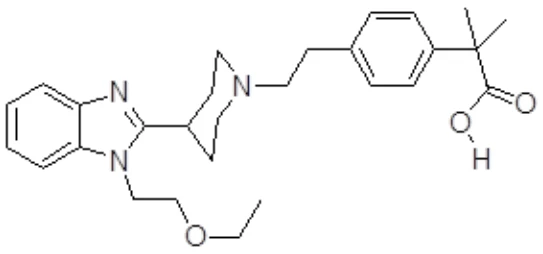
Physicochemical properties:
Physical Form: White, crystalline powder
Solubility:
Practically insoluble
acetonitrile
Very slightly soluble
water, buffer pH=6, buffer pH=4.5, buffer pH=8, acetone and isopropyl alcohol, glycerin
Slightly soluble
NaOH 0.01N, ethanol, methanol and dimethylsulfoxide (DMSO), 1,2-propylene glycol
Sparingly soluble
dimethylformamide (DMF), 0.1N hydrochloric acid (HCl) and buffer pH=3.5
Freely soluble
chloroform, HCl 1N and NaOH 1N pKa Value: 4.15 ± 0.06, when determined by ultraviolet spectrophotometry and 4.18 by HPLC.
Hygroscopicity: Bilastine is not hygroscopic tested under ambient temperature (25.1 ± 0.1 °C) and relative humidity (85 % RH) conditions.
14 Clinical Trials
14.1 Clinical Trials by Indication
Allergic conjunctivitis
Table 3 - Summary of patient demographics for BOFT-0218 in Allergic Conjunctivitis
| Study # | Study design | Dosage, route of administration and duration | Study subjects (n) | Mean age (Range) | Sex |
| BOFT-0218/AC -CAC | Double-blind, randomized, parallel, vehicle and active drug controlled, pivotal study | bilastine ophthalmic solution 6 mg/mL, ketotifen ophthalmic solution 0.025% Vehicle One drop in each eye on Day 1 and Day 8 (0.21 mg/eye/treatment day) Ocular use 2 treatments within 8 days | 91 90 47 | 45.9 (18-72) 41.7 (18-65) 45.1 (18-87) | M/F 33/58 M/F 37/53 M/F 22/25 |
Pivotal Efficacy Study
The efficacy and safety of bilastine 6 mg/ml ophthalmic solution was demonstrated in a Phase lll multi-center, double-blind, randomized, parallel-group, vehicle- and active-controlled study in 228 subjects using the Conjunctival Allergen Challenge (CAC) Model. The primary endpoint was defined as ocular itching evaluated by the subject at 3, 5 and 7 minutes after CAC performed 16 hours post-treatment on Day 1 and 15 minutes post-treatment on Day 8. This study employed a hierarchical analysis where significance was determined by stepwise comparison of bilastine versus vehicle. To demonstrate efficacy for ocular itching, bilastine ophthalmic solution needed to show clinical superiority over vehicle by at least 0.5 units of a 5-point scale for all three (3) post-CAC time points: 3(±1), 5(±1), and 7(±1) minutes post-CAC and at least 1 unit for the majority (2:3) of these post-CAC time points on both Day 1 and Day 8.
For the primary endpoint, bilastine 6 mg/mL met the criteria established by the hierarchical paradigm: all ocular itch measures, at both 15 minutes and 16 hours post-treatment were statistically significantly lower for bilastine than for the vehicle. Further, bilastine 6 mg/mL reduced itching by > 1 unit as compared to vehicle at 15 minutes post-treatment at all 3 time points, and by > 0.75 units in 2 out of 3 time points at 16 hours post-treatment (see Table 4).
Table 4: ANCOVA LS Mean Ocular Itch Responses to Bilastine 6 mg/mL Ophthalmic Solution in BOFT-0218
| Challenge time | 16 hours post-treatment | 15 minutes post-treatment | ||||
|---|---|---|---|---|---|---|
| Ocular Itch Assessment | 3 minutes | 5 minutes | 7 minutes | 3 minutes | 5 minutes | 7 minutes |
| Vehicle | 2.262 | 2.532 | 2.570 | 1.856 | 2.030 | 1.953 |
| Bilastine 6 mg/mL | 1.595 | 1.736 | 1.732 | 0.664 | 0.822 | 0.818 |
| Difference1 | -0.667 | -0.796 | -0.839 | -1.192 | -1.208 | -1.134 |
| P-value | <0.0001 | <0.0001 | <0.0001 | <0.0001 | <0.0001 | <0.0001 |
1Bilastine – Vehicle Note: Bolded differences indicate clinical efficacy.
For the secondary endpoint of conjunctival redness, bilastine ophthalmic solution demonstrated improvement over vehicle (P <0.05) at 15 minutes post-treatment but not at 16 hours post-treatment.
Long-Term Safety Study
A multi-centre, randomised, double blind, vehicle-controlled, parallel-group, phase III, long-term study was conducted to assess the safety, tolerability and efficacy of bilastine 6 mg/mL ophthalmic solution when used up to 8 weeks. BLEXTEN ophthalmic solution was found to be well tolerated and effective when used for up to 8 weeks in 218 adult patients.
15 Microbiology
No microbiological information is required for this drug product.
16 Non-Clinical Toxicology
General Toxicology: Non-clinical data with bilastine reveal no special hazard for humans based on conventional studies of safety pharmacology, repeated dose toxicity, genotoxicity and carcinogenic potential.
Reproductive and Developmental Toxicology: In reproduction toxicity studies, no effect on male and female fertility or pre- and postnatal development was detected at oral bilastine dose up to 1000 mg/kg bodyweight in rats. In embryo-foetal development studies with oral bilastine administration, slightly increased pre- and post-implantation losses in rats as well as delayed ossification and growth retardation in rabbits were only observed at more than 1000-fold in excess of the human exposure at the recommended ocular dose.
Special Toxicology: In a lactation study, bilastine was identified in the milk of nursing rats administered a single oral dose (20 mg/kg). Concentrations of bilastine in milk were about half of those in maternal plasma. Considering the low systemic absorption of bilastine after ocular administration (see 10 Clinical Pharmacology), lower levels of bilastine in human breast milk may therefore be expected.
17 Supporting Product Monographs
BLEXTEN (bilastine), orodispersible tablets (10 mg), tablets (20 mg), oral solution (2.5 mg/mL) Control #241318, Product Monograph, Aralez Pharmaceuticals Canada Inc.