


Product Monograph - Opticrom
1 INDICATIONS
OPTICROM® (sodium cromoglycate) Ophthalmic Solution 2% is indicated to help relieve and prevent symptoms associated with allergic conjunctivitis or hay fever conjunctivitis.
1.1 Pediatrics
Pediatrics (0 – 5 years of age): Based on the data submitted and reviewed by Health Canada, the safety and efficacy of OPTICROM® in pediatric patients below the age of 5 years has not been established.
1.2 Geriatrics
Geriatrics (> 65 years of age): No data are available to Health Canada; therefore, Health Canada has not authorized an indication for geriatric use.
2 CONTRAINDICATIONS
OPTICROM® is contraindicated in patients who are hypersensitive to this drug or to any ingredient in the formulation, including any non-medicinal ingredient, or component of the container. For a complete listing, see Dosage Forms, Strengths, Composition and Packaging.
3 DOSAGE AND ADMINISTRATION
3.1 Dosing Considerations
The effect of OPTICROM® therapy is dependent upon its administration at regular intervals as directed in the labelling.
Symptomatic response to treatment (decreased itching, tearing, redness and discharge) is usually evident within 2-3 days. Once symptomatic improvement has been established, therapy should be continued for as long as needed to sustain improvement.
3.2 Recommended Dose and Dosage Adjustment
Adults and children over 5 years: Two drops in each eye 4 times daily at regular intervals. One drop contains approximately 0.8 mg sodium cromoglycate.
3.3 Missed Dose
No data available for this section.
4 OVERDOSAGE
There have been no reported cases in humans of overdosage of the drug. Symptomatic treatment is suggested should accidental ingestion occur.
| For management of a suspected drug overdose, contact your regional poison control centre. |
5 DOSAGE FORMS, STRENGTHS, COMPOSITION AND PACKAGING
Table – Dosage Forms, Strengths, Composition and Packaging.
OPTICROM® is a clear, colourless to pale yellow sterile solution supplied in 10mL plastic dropper bottles.
6 WARNINGS AND PRECAUTIONS
General
The recommended frequency of administration should not be exceeded.
OPTICROM® should only be used for allergic conditions of the eye. In some instances irritation or redness may be due to serious eye conditions such as infection, foreign body in the eye, or other mechanical or chemical corneal trauma requiring the attention of a doctor. If you experience eye pain, changes in vision, pain on exposure to light, acute redness of the eye, excessive discharge, abnormal pupils, if condition worsens or if relief is not obtained within 72 hours consult your doctor immediately.
Any remaining contents should be discarded four weeks after opening. Do not touch dropper tip to any surface since this may contaminate the solution.
Ophthalmologic
During treatment with OPTICROM® (sodium cromoglycate) Ophthalmic Solution 2%, soft contact lenses should not be worn.
6.1 Special Populations
6.1.1 Pregnant Women
There has been to date, no adequate and well controlled studies in pregnant women.
| Route of Administration | Dosage Form / Strength/Composition | Non-medicinal Ingredients |
| topical ophthalmic | solution 2% w/v | benzalkonium chloride, edetate disodium and purified water |
6.1.2 Breast-feeding
It is not known whether this drug is excreted in human milk. Because many drugs are excreted in human milk, caution should be exercised when OPTICROM® is administered to a nursing woman.
6.1.3 Pediatrics
Pediatrics (0 – 5 years of age): Based on the data submitted and reviewed by Health Canada, the safety and efficacy of OPTICROM® in pediatric patients below the age of 5 years has not been established.
6.1.4 Geriatrics
No data available.
7 ADVERSE REACTIONS
7.1 Clinical Trial Adverse Reactions
Because clinical trials are conducted under very specific conditions, the adverse reaction rates observed in the clinical trials may not reflect the rates observed in practice and should not be compared to the rates in the clinical trials of another drug. Adverse reaction information from clinical trials is useful for identifying drug-related adverse events and for approximating rates.
The most frequently reported adverse reaction attributed to the use of OPTICROM® on the basis of reoccurrence following administration is transient ocular stinging or burning upon instillation.
The following adverse reactions have been reported as infrequent events; conjunctival injection, watery eyes, itchy eyes, dryness around the eye, puffy eyes, eye irritation and sties. It is unclear whether they are attributable to the drug.
7.2 Post-Market Adverse Reactions
The reported post-marketing adverse reactions are as follows: blurred vision, and hypersensitivity reaction including generalized erythema, signs and symptoms related to angioedema and eye allergy.
8 DRUG INTERACTIONS
8.1 Drug-Drug Interactions
Sodium cromoglycate has been used in association with other ophthalmic solutions in the rabbit including mydriatrics, antibiotics, steroids, vasocontrictors and astringents. No drug-drug interactions have been observed in the rabbit eyes.
9 ACTION AND CLINICAL PHARMACOLOGY
9.1 Mechanism of Action
In the immediate allergic reaction (Type I), the union of antigen with reaginic antibody leads to the formation and release of mediators of the local anaphylactic reaction. The principal effect of sodium cromoglycate is its specific ability to stabilize the membrane of the mast cell and thus prevent the release of mediators of anaphylaxis. The action appears to be specific for reaginic (immediate type) antigen/antibody reactions. No direct effect has been demonstrated on other types of immune reactions (Type II, III, and IV).
9.2 Pharmacodynamics
Sodium cromoglycate has no vasoconstriction, anti-histaminic or anti-inflammatory activity. Within 2-3 days of commencing treatment one can expect improvement in the signs and symptoms of seasonal allergic conjunctivitis (itching, tearing, congestion, etc.) in most patients. Continued therapy will usually keep the patient free from ophthalmic allergy symptoms during the challenge period.
9.3 Pharmacokinetics
Absorption: Sodium cromoglycate is poorly absorbed. When multiple doses of sodium cromoglycate ophthalmic solution are instilled into the rabbit eyes less than 0.01% of the administered dose of sodium cromoglycate is absorbed into the systemic circulation (presumably by way of the eye, nasal passages, buccal cavity and gastrointestinal tract). Trace amounts (less than 0.01%) of the sodium cromoglycate dose penetrated into the aqueous humor and clearance from this chamber is virtually complete within 24 hours after treatment is stopped.
In normal volunteers, analysis of drug excretion indicates approximately 0.03% of sodium cromoglycate is absorbed following administration to the eye.
Distribution: A study on corneal epithelium wound healing in albino rabbits failed to demonstrate any significant difference in the rate of corneal re-epithelialisation between sodium cromoglycate ophthalmic solution, sterile saline solution, no treatment and an ophthalmic corticosteroid.
Metabolism: Sodium cromoglycate is taken up by the liver and the kidneys.
Elimination: Sodium cromoglycate is excreted unchanged via the bile and urine.
10 STORAGE, STABILITY AND DISPOSAL
Store at 15º to 30°C.
Protect from direct sunlight.
Discard opened bottle after 4 weeks.
11 SPECIAL HANDLING INSTRUCTIONS
Not applicable.
PART II: SCIENTIFIC INFORMATION
12 PHARMACEUTICAL INFORMATION
Drug Substance
Proper name: sodium cromoglycate (Ph. Eur.)
cromolyn sodium (USP)
Chemical name: Disodium 4, 4'-dioxo-5,5'-(2-hydroxytri-methylenedioxy) di (chromene-2-carboxylate)
Molecular formula and molecular mass: C23H14Na2O11 and 512.3
Structural formula:
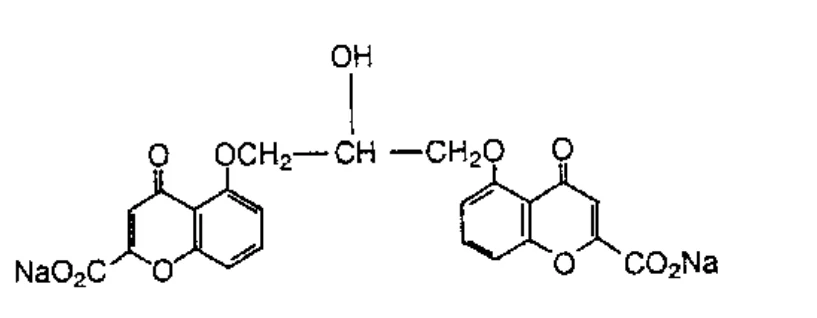
Physicochemical properties: sodium cromoglycate is a white hygroscopic powder, soluble in 20 parts of water and the resulting solution is neutral.
13 NON-CLINICAL TOXICOLOGY
Acute Toxicity
The LD50 was approximately 4000 mg/kg administered peritoneally in mice, rats, guinea pigs, hamsters and rabbits, and intravenously in monkeys.
Subacute and Chronic Toxicity:
Studies of Sodium Cromoglycate Ophthalmic Solution:
A 4% solution of sodium cromoglycate was instilled into the rabbit eyes up to 4 times daily for 28 days. No signs of irritation to the cornea, iris or conjunctiva were seen. No drug related macroscopic or microscopic changes were observed.
New Zealand albino rabbits and squirrel monkeys received 2% sodium cromoglycate two to ten times daily for 3 months and 6 months respectively. No fundoscopic changes were seen. Detailed histopathological examination of the eyes and related structures revealed no local irritation or toxic effects of treatment. Rats received sodium cromoglycate subcutaneously for 90 days at daily doses of 30, 78 and 198 mg/kg. Renal tubular damage was noted in some rats at the two higher dose levels. Other toxic effects that were seen at the higher dose were that the growth rates were depressed and a significant increase in weight of the hearts and adrenals. No toxic effects were detected in the group dosed at 30 mg/kg.
Rhesus Monkeys were given intravenous injection of sodium cromoglycate for 180 days at daily doses of 2, 10 and 50 mg/kg. No toxic effects were observed.
Carcinogenesis, Mutagenesis and Reproduction
Long term studies in mice (12 months intraperitoneal treatment followed by six months observation), hamsters (12 months intraperitoneal treatment) followed by 12 months observation and rats (18 months subcutaneous treatment) showed no neoplastic effect of sodium cromoglycate.
No evidence of chromosomal damage or cytotoxity was obtained in various mutagenesis studies.
No evidence of impaired fertility was shown in laboratory reproduction studies.
Conclusion from the Toxicology Studies
Sodium cromoglycate has a remarkably low order of toxicity as demonstrated in many systems. The safety margin thus established, gives confidence that extended use in humans does not constitute a significant toxicological hazard.